Introduction
The increase in worldwide population results in fast-growing demand for food, feed and fuel, creating significant economic and environmental issues. For solving these issues, it is essential to diversify the sources of energy (Cameron and Keppler, Reference Cameron and Keppler2010), and, in that respect, biomass takes a prominent position. The tropical agroforestry resources strongly desired for biofuel production are sugarcane, grain and sweet sorghum, maize and cassava for producing bioethanol of first generation, and oil palm, cashew, soybean, coconut, sunflower and Jatropha for biodiesel (Duku et al., Reference Duku, Gu and Hagan2011).
In the context of threat to food safety, sorghum varieties able to produce grains, stem sugar and fodder together are of particular interest for reducing competition between food and non-food production. This species also presents the advantage of having a large genetic diversity and spectrum of adaptation to various cropping environments (Mace et al., Reference Mace, Tai, Gilding, Li, Prentis, Bian, Campbell, Hu, Innes, Han, Cruickshank, Dai, Frère, Zhang, Hunt, Wang, Shatte, Wang, Su, Li, Lin, Godwin, Jordan and Wang2013). Most of the sorghum cultivars used in West Africa are photoperiod-sensitive. This trait allows the synchronization of flowering by the end of the rainy season, enabling farmers to obtain acceptable yield despite late sowing (Vaksmann et al., Reference Vaksmann, Traoré and Niangado1996). It has also the advantage, with an early sowing, of increasing the duration of the vegetative phase and the biomass accumulation and thus potentially the accumulation of non-structural carbohydrates in stems before flowering for sweet cultivars (Gutjahr et al., Reference Gutjahr, Vaksmann, Dingkuhn, Thera, Trouche, Braconnier and Luquet2013). Genotypes, combining photoperiod sensitivity to favour tall plant development, juiciness to ease sugar storage and extraction, large panicles and stay-green (i.e. leaf greenness maintenance after flowering) to ensure dual-yield maintenance under terminal drought, should be indeed interesting for multi-purpose sorghum (sugar, stem and leaf biomass, and grain) in drought-prone environments (Gutjahr et al., Reference Gutjahr, Vaksmann, Dingkuhn, Thera, Trouche, Braconnier and Luquet2013). But the way in which grain and stem sugar production can be combined and optimized in a single genotype still needs to be elucidated (Gutjahr et al., Reference Gutjahr, Vaksmann, Dingkuhn, Thera, Trouche, Braconnier and Luquet2013).
In West Africa, sweet sorghum genotypes are found within the local landraces and are mostly belonging to bicolor, caudatum-bicolor and durra races (Bezançon et al., Reference Bezançon, Pham, Deu, Vigouroux, Sagnard, Mariac, Kapran, Mamadou, Gérard, Ndjeunga and Chantereau2009; Nebie et al., Reference Nebie, Nanema, Kando, Traore, Labeyrie, Sawadogo, Sawadogo and Zong2013). Several studies found that most of the guinea landraces of West Africa including the margaritiferum group are neither sweet nor juicy (Bezançon et al., Reference Bezançon, Pham, Deu, Vigouroux, Sagnard, Mariac, Kapran, Mamadou, Gérard, Ndjeunga and Chantereau2009).
In West Africa and particularly in Senegal, although local landraces are genetically diversified, they achieve lower grain yield than improved varieties when grown under favourable conditions (Traoré et al., Reference Traoré, Reyniers, Vaksmann, Kone, Sidibe, Yorote, Yattara and Kouressy2000). Nevertheless, farmers still prefer the local landraces because of their adaptability to various local situations and thus their ability for stable yield over years. Regarding the improvement of sugar yield or combined grain/sugar yield, many investigations on genetics, physiology and agronomy remain yet to be conducted.
The goal of the present study is to characterize a collection of African sorghum landraces, mostly from Senegal, for traits of potential interest for biomass, sucrose and grain productions, i.e. for multi-purpose (food, feed and fuel) in Sudano-Sahelian, drought-prone cropping environments. Finally, this paper aims at recommending traits, trait combination and local sorghum genotypes to be considered in dedicated breeding programmes for tropical semi-arid environments.
Materials and methods
Plant material
A total of 84 African accessions mostly Senegalese landraces and four control cultivars (104GRD, IS23566, F221 and CSM-63), already tested in previous studies for their capability to accumulate stem sugar, were studied. Cultivars 104GRD and IS23566 are known to be very sweet, F221 very sweet and juicy, and CSM-63 less sweet and not juicy. All accessions except the controls were provided by the Genetic Resources Lab of CIRAD (Montpellier, France). Their local name, botanical race, country and locality of origin are mentioned in Table S1 (available online). In the text, accessions are called by the letter ‘A’ followed by their number of appearance in Table S1. For the clarity of Fig. 1, only their number is used.
Experimental site and design
The trial was conducted in Senegal at the station of Centre National de Recherche Agronomique de Bambey (16°28′W longitude, 14°42′N latitude, altitude of 17 m) during the rainy season between July and December 2012. The climate of this area is Sudano-Sahelian, characterized by a short rainy season ranging from mid-June to mid-October with mono-modal rainfall distribution that peaks in August. In 2012, the total rainfall was 601.3 mm.
The soil was sandy (88.1%) with low clay (7%), low loam (2.33%), low organic matter (0.61%) and low nitrogen (0.35%) with a slightly alkaline pH (7.38).
The 88 accessions were sown in two planting dates, July 24 (S1) and August 21 (S2). The experimental design was an alpha lattice with three replicates, 11 blocks per replicate and eight entries per block. Each elemental plot included one 2.4 m-long row, with 0.8 m spacing between rows and 0.40 m spacing between the hills on each row. The plots were thinned to three plants per hill around 15 days after emergence. The fertilization of the crop was 150 kg/ha of NPK (15-10-10) after sowing. Urea was applied at a rate of 100 kg/ha twice, 50 kg/ha after thinning and 50 kg/ha during vegetative growth. A manual weeding was performed every 2 weeks from the sowing date.
Morphology and phenology
For each plot, the dates of flag leaf ligulation, anthesis and physiological maturity were noted (i.e. when 50% confluence was reached).
At anthesis, three plants were randomly chosen per plot, for counting green leaf number (GL) and internode number (IN). At grain maturity, plant height (PH), stem median diameter (DIAM), peduncle length (LPE) and panicle length (LPA) were measured. The average of internode length (INL) was calculated as follows:
 $$INL = \frac {PH - LPE - LPA}{IN}. $$
The coefficient of photoperiod sensitivity (KP) was computed for each accession following the equation formulated by Traoré et al. (Reference Traoré, Reyniers, Vaksmann, Kone, Sidibe, Yorote, Yattara and Kouressy2000) as follows:
 $$KP = \frac {DSFL_{1} - DSFL_{2}}{S_{2} - S_{1}}, $$
where DSFL1 and DSFL2 are the duration from sowing to flag leaf stage for the sowings of July and August, respectively, and S1 and S2 are the first and second sowing dates, respectively.
Biomass quantification
At grain maturity, three plants were randomly selected per plot for panicle, stem and leaf fresh weight measurements. Dry weights were estimated after biomass was sun dried followed by a period of 48h in an oven at 70°C.
Stem sugar quantification
Brix was measured at anthesis and maturity for both dates. A few drops of juice were taken by crushing a piece of a median internode of three plants randomly sampled, using the handle extractor (ATAGO CO., LTD, Tokyo, Japan); Brix was then measured using a digital refractometer (Hanna© instruments, USA). The three stems of the same plants were then pressed using a homemade three-roll press inspired by the horizontal three-roller crusher (Jagadish No. 6, Gujarat, India) used by Datta Mazumdar et al. (Reference Datta Mazumdar, Poshadri, Srinivasa Rao, Ravinder Reddy and Reddy2012). After filtering, juice weight was measured. At maturity, due to technical constraints, stem juice weight (JW) was taken only for July sowing. Sugar content (SCT in g) and sugar concentration (SCC in mg/g DW) were calculated using Brix, and stem moisture (HMAT, difference between fresh and dry stem weights) using the equations in Gutjahr et al. (Reference Gutjahr, Vaksmann, Dingkuhn, Thera, Trouche, Braconnier and Luquet2013).
 $$SCT = \frac {Brix\times 8.827\times \left (SFW - SDW\right )}{1000}, $$
where 8.827 is the slope of the regression line between Brix and sugar concentration in g/l,
 $$\begin{eqnarray} SCC = \frac {SCT}{SDW}\times 1000. \end{eqnarray}$$
Index of aptitude to multi-purpose
The index of aptitude to multi-purpose (IAM) was computed for both sowing dates: July (IAMJ) and August (IAMA). For IAMJ, panicle dry weight (PDW), sugar content (SCT), juice weight (JW) and leaf dry weight (LDW) were taking into account. IAMA was similarly computed but without JW as this trait was not measured for August sowing. IAM was computed using the equation in Trouche et al. (Reference Trouche, Aguirre Acuña, Castro Briones, Gutiérrez Palacios and Lançon2011) as follows:
 $$IAM_{ i } = \sum _{ j } a _{ j }\times \left [\frac { x _{ ij } - m _{ j }}{ s _{ j }}\right ], $$
where i is the number of accessions, x ij the phenotypic value of accession i for trait j, m j the grand mean from all accessions for trait j, s j the standard deviation of all accessions for trait j, and a j the relative weightings of trait j in the index.
According to the importance of the grain for the farmers and the current interest for stem sugar, more consideration was given to PDW, SCT and JW. Accordingly, the values of a j chosen are given as follows:
IAMJ: aPDW= 3, aSCT= 2, aJW= 2 and aLDW= 1;
IAMA: aPDW= 3, aSCT= 2 and aLDW= 1.
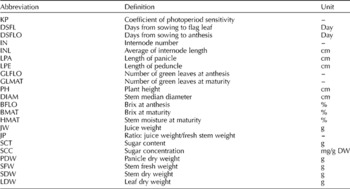
All the traits used in the study are defined in Table 1.
Abbreviations, definitions and units of the studied traits

Data analysis
The analyses of variance (ANOVA) and the Tukey HSD test for mean comparison were performed using R software version 3.0.2 (http://www.R-project.org/; R Core Team, Reference R Core Team2013).
All the following analyses were performed only on July sowing data for which all variables could be assessed. Broad-sense heritability (H2bs) based on the ANOVA results was calculated using the equation formulated by Allard (Reference Allard1960), which is given as follows:
 $$H^{2}bs = \frac {\partial ^{2}g}{\partial ^{2}g + \partial ^{2}e}\ with\ \partial ^{2}g = \frac {MSg - MSe}{ R }\ and\ \partial ^{2} e = MSe, $$
where
 $$\partial ^{2}g $$
is the genotypic variance,
 $$\partial ^{2}e $$
the environmental variance, R the number of replications, and MSg and MSe the genotypic and residual mean squares, respectively.
The correlation matrix was computed on all phenology, morphology and yield variables. Hierarchical ascendant clustering (HAC) was carried out using Ward's method based on Euclidean distances. A factorial discriminant analysis (FDA) was performed to refine the clustering in order to sort out a group of accessions most suitable for multi-purpose. The HAC and FDA analyses were performed using the XLSTAT software (Addinsoft, 2012, Paris).
Results
Overall variability among accessions and sowing dates
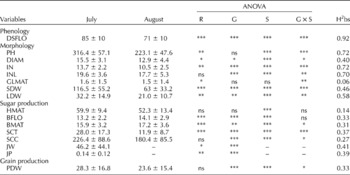
Highly significant effects of sowing date (S) could be observed for all the traits measured for the two sowing dates, except for GLMAT (Table 2). Regarding phenology and morphology traits, the genotype effect (G) was detected for all variables except PH and GLMAT. Strong genotype × sowing date interaction (G × S) was noted on DSFLO, PH, IN and SDW. All the stem sugar-related traits were affected by the G effect but the G × S effect was significant for BMAT, SCC and above all for SCT. Grain yield (PDW) was significantly affected by the G and G × S effects.
Effect of replicate (R), genotype (G), sowing date (S) and interaction (G×S), and broad-sense heritability (H2bs) for all traits measured in the studied population at anthesis and maturity

* P< 0.05; ** P< 0.001; *** P< 0.0001; ns: not significant (P>0.05).
Broad-sense heritability (H2bs) was computed to estimate the respective influence of environment and genotype on each trait (Table 2). High H2bs (>0.70) was recorded for DSFLO, PH, IN and INL but moderate for DIAM. For biomass traits, it was moderate for SDW and LDW and low for GLMAT. It was moderate for sugar-related traits such as BFLO, BMAT, SCT, JW and JP but weak for SCC and HMAT. It was moderate for PDW.
Variability in photoperiod sensitivity
The coefficient of photoperiod sensitivity (KP) ranges from 0 for absolute photoperiod-insensitive accessions to 1 for strictly photoperiod-sensitive ones. The accessions with a KP below 0.4, between 0.4 and 0.6, and between 0.6 and 1 were, respectively, considered with weak, moderate and high photoperiod (PP) sensitivity. Based on this classification, we have established that our studied population consisted of 22.6% of weakly PP-sensitive (19 accessions), 34.5% of moderately PP-sensitive (29 accessions) and 42.9% of highly PP-sensitive genotypes (36 accessions).
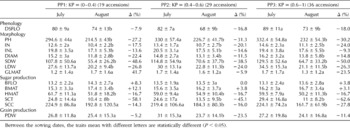
Table 3 presents the effects of sowing date on the studied traits depending on their PP sensitivity. It can be noted that regardless of plant PP sensitivity and except for BFLO and GLMAT, sowing date affected all traits in the same way. DSFLO and morphological traits such as IN, PH, DIAM and INL were significantly affected by sowing date for all groups. BMAT was systematically increased and HMAT decreased for August sowing. However, this trend was always significant for HMAT while only with weakly PP-sensitive accessions for BMAT. SCT and SCC were systematically reduced for late sowing albeit not significantly for SCC in the weakly PP-sensitive group. PDW was generally maintained across sowing dates except for the moderately PP-sensitive group, reduced for August sowing.
Effects of the two sowing dates on growth, sugar and biomass yield components according to the photoperiod sensitivity of the studied population

PP1: KP, low PP sensitive; PP2: KP, moderate PP sensitive; PP3: KP, high PP sensitive; Δ, percentage of decrease or increase in August sowing compared with July sowing.
Between the sowing dates, the traits mean with different letters are statistically different (P< 0.05).
Correlation between studied variables
For July sowing (Table S2, available online), DSFLO was strongly and positively correlated with IN but negatively with INL. Both DSFLO and IN were positively correlated with DIAM, SDW, LDW and SCT. However, only IN and INL, and not DSFLO, were positively and significantly correlated with PH. INL was also negatively correlated with DIAM and sugar production-related traits (HMAT, SCT, SCC and JP). Similarly, PH was negatively correlated with HMAT and SCC. SCC was strongly correlated with Brix and HMAT, as its computation depends on both variables. Interestingly, panicle dry weight (PDW) was negatively correlated with DSFLO but positively correlated with PH. GLMAT was significantly correlated only with SDW.
For August sowing, correlations observed for July, between DSFLO and IN and most of traits related to plant size, biomass (DW) and sugar productions, were lost (results not shown), suggesting a strong impact of the response to the photoperiod and vegetative phase duration on elemental trait relation with observed productions.
Structure of phenotypic variation
Hierarchical ascendant cluster (HAC) analysis based on July data sorted out the 88 cultivars in three clusters according to the 18 variables listed in Table S3 (available online).
Cluster I contains 37 accessions with a large prevalence of the guinea race (84%), from Groundnut Basin, Senegal River valley, Eastern Senegal and Upper Casamance in Senegal, and from Mali and Burkina Faso. This cluster includes accessions with moderate PP sensitivity characterized by high plants with long but thin internodes. This cluster was also characterized by low SDW, LDW and SCC but high PDW. It includes the control cultivar CSM-63.
Cluster II encompasses 15 accessions of 73% guinea, 13% caudatum and 13% intermediate types. These accessions mostly originate from South Senegal (mainly from Upper Casamance and Eastern Senegal) and Mali. This cluster comprises highly PP-sensitive and late-flowering accessions. It gathers the highest plants with the longest internodes. It shows high SCT, with moderate SCC and JW but the highest mean values for PDW, SDW and LDW. Cluster III contains 36 accessions, of which 47% are durra, 17% caudatum, 16% guinea, 3% bicolor and 19% intermediate types. These accessions are mostly originating from Senegal (Senegal River valley, Groundnut Basin, Lower Casamance and Eastern Senegal). Compared with the other clusters, it gathers cultivars with the shortest plants but with large stem diameter. It was also represented by moderate SDW and LDW and low PDW. It showed, however, the highest SCT and SCC due to the highest BMAT and HMAT. Our sweet control varieties 104GRD (caudatum, Kenya), F221 (bicolor, Mali) and IS23566 (guinea-caudatum, Ethiopia) belong to this cluster III.
The accessions of Guinea margaritiferum and caudatum races are distributed in all the three clusters whereas the other guinea accessions are mostly present in clusters I and II. Apart from one accession, all durra accessions were found in cluster III. Among the durra groups, no divergence was observed between those cultivated in rain-fed conditions and those in flood recession system conditions.
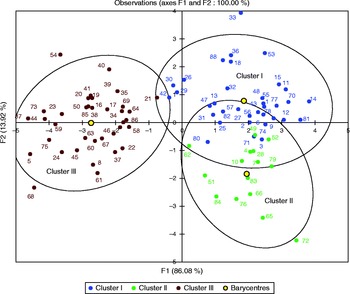
Factorial discriminant analysis (FDA) was performed to further identify the most discriminating traits of the three clusters through the λ-Wilk test. From the 18 variables tested by HAC, ten were revealed as the most discriminant ones, in decreasing order: SDW, IN, SCC, PH, INL, LDW, DIAM, SCT, JW and HMAT (Table S4, available online). The axis F1, explaining 86% of overall variability, was correlated with SCC, PH, JW, INL, HMAT and JW. The axis F2 explained only 14% of overall variability. This axis was mostly correlated with IN, SDW, DIAM, LDW and SCT. Fig. 1 shows the three clusters identified according to F1 and F2, which largely confirmed the clustering made by HAC (except for six accessions).
Factorial discriminant analysis of the studied population based on July sowing.

Identification of accessions of interest for multi-purpose
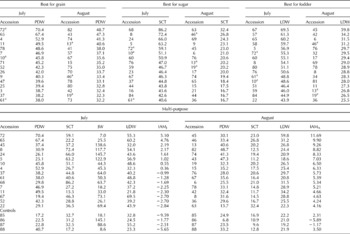
The index of aptitude to multi-purpose (IAM) was computed to refine the identification of accessions showing the best trade-off among grain, sugar and fodder production. Based on individual (single) yield components and IAM, the best 20% accessions regarding multi-purpose aptitude at each sowing dates are presented in Table 4. Very few accessions were among the 20% best for both sowing dates for a given productive trait: A78 for grain, A44 and A76 for stem sugar, A8 and A76 for fodder, A8, A45 and A67 for multi-purpose. For July planting, some accessions showed good dual-purpose ability, by combining high grain and sugar yields (A10 and A37), high grain and fodder yields (A65) or high sugar and fodder (A5 and A8), and high multi-purpose ability (A10, A61 and A72). For August sowing, the accessions showing dual-purpose ability were A15 and A74 for grain and sugar, A42 and A78 for grain and fodder and mainly A45 and A46 for sugar and fodder, and A13, A19 and A46 for multi-purpose. Most of these best accessions outperformed the control cultivars of this study. According to FDA, clusters I and II contributed 20 and 50%, respectively, to the set of best accessions for grain production. Clusters II and III both contributed 33% to the set of best accessions for sugar production. Finally, the set of best accessions for fodder and multi-purpose both constituted 50% of contribution by cluster II and 22% of contribution by cluster III.
Top 20% accessions within the studied panel of 84 landraces, for single production traits (grain: PDW (g), sugar: SCT (g) and JW (in g), and fodder: LDW (g)) and for multi-purpose value (synthesized in IAM, Index of Aptitude to Multi-purpose), for July and August sowings. Acronyms are defined in Table 1. Best accessions are compared with the four control cultivars of this study (A85–A88).

a Accessions were simultaneously among the 20% best for all the single production traits and for multi-purpose index (for a given planting date).
Discussion
The present study aimed at exploring the phenotypic variability available among the sorghum Senegalese landraces for traits of potential interest for fodder, sugar and grain production in drought-prone cropping environments and their response depending on the sowing date. Photoperiod sensitivity, grain and fodder yield and traits related to stem morphology sweetness and juiciness were thus measured on plants sown at two sowing dates in order to identify those landraces presenting trait combination of interest for single, dual or multi-purpose. The originality of this study resides in the fact that (1) it focused on West African accessions not yet studied for traits related to stem sugar production, particularly the flooded recession sorghums; and (2) it sorted out from this diversity, traits of interest to be further studied genetically and physiologically for implementing breeding programmes on multi-purpose sweet sorghum targeting West African cropping conditions.
Advantage of early sowing to optimize multi-purpose performance of sweet photoperiod-sensitive sorghums
The effect of significant sowing date was noted on morphological traits, resulting in an increase in plant height and stem diameter for July sowing, whatever the level of PP sensitivity of the cultivar. As a result, late sowing negatively affected the production of stem and leaf biomass. Stem sugar production (SCT) was reduced due to both stem dry weight and moisture reduction, constituting together the sugar reservoir. Grain yield was also reduced by late sowing but to a minor extent (17 vs. 57% reduction for SCT). Similar results were obtained by Almodares and Darany (Reference Almodares and Darany2006), Voigt et al. (Reference Voigt, Botha and Gerber2008), Abd El-Razek and Besheit (Reference Abd El-Razek and Besheit2009), Erickson et al. (Reference Erickson, Helsel, Woodard, Vendramini, Wang, Sollenberger and Gilbert2011) and Reddi et al. (Reference Reddi, Janawade and Palled2013) emphasizing the beneficial effect of early sowing on sweet sorghum performance in terms of biomass, sugar and/or grain production in warm and dry conditions of Asia, America and Africa. This was also reported by Gutjahr et al. (Reference Gutjahr, Vaksmann, Dingkuhn, Thera, Trouche, Braconnier and Luquet2013) in the conditions of Mali, who, however, did not observe any significant effect of sowing date on grain yield, probably distorted by bird damages in their experiment. In our study, G × S interactions were significant for all the traits studied. In particular, our study revealed that the accessions with the highest PP sensitivity showed the highest reduction of PH, SCC, SCT and PDW with late sowing. Although Teetor et al. (Reference Teetor, Duclos, Wittenberg, Young, Chawhuaymak, Riley and Ray2011) did not assess various PP-sensitive categories, they also revealed genotypic dependence of sowing date effect on sugar production-related traits and thus on predicted ethanol yield.
From our results and those of other authors, it can be concluded that whatever the cultivation areas, the genotype and photoperiod response, early sowing is needed to enhance multi-purpose ability. Three accessions (A8, A45 and A67) were found among the best identified in the present study for multi-purpose aptitude for both sowing dates (July and August). However, among them, A45 was not among the best for any single production traits for July sowing, suggesting a strong trade-off among desired traits. A multi-purpose cultivar capable of maintaining high sugar and grain yields with late sowing could be of interest in the areas where photoperiod-sensitive sorghum is cultivated in second place during the rainy season after the harvest of a short-cycle cash crop as it is the case of groundnut in some areas in Senegal and in other parts of West Africa.
Plant height is a complex trait when breeding for sugar production
In this study, the accessions with the highest sugar accumulation were tall but not the tallest. Indeed, they did not have the longest DSFLO and did not bring the longest internodes but only the most numerous internodes (highest IN). This is in line with the fact that both PH and INL were negatively correlated with SCT in the present study. This is however not entirely in line with that reported by Kawahigashi et al. (Reference Kawahigashi, Kasuga, Okuizumi, Hiradate and Yonemaru2013), and Zou et al. (Reference Zou, Yan, Zhai, Zhang, Zou and Tao2011) reported that plant height was positively correlated with total sugar content. Several studies highlighted stem size (height and diameter) as systematically beneficial for high sugar production and suggested to take advantage of photoperiod sensitivity to obtain, with early sowing, taller plants with higher biomass and higher sugar accumulation (Olson et al., Reference Olson, Ritter, Rooney, Kemanian, McCarl, Zhang, Hall, Packer and Mullet2012; Gutjahr et al., Reference Gutjahr, Vaksmann, Dingkuhn, Thera, Trouche, Braconnier and Luquet2013). The present study could not entirely confirm this relationship probably because of the genetic diversity addressed: studied accessions were generally tall and dedicated to grain production. There is no doubt that plant height is in general one of the key traits to breed for to improve sugar production as shown by many authors. This trait is highly heritable as confirmed in Table 2. Accordingly, the studied collection should be a good source of parents for breeding programme dedicated to plant height improvement. Nevertheless, attention should be further paid to the correlations found among stem juiciness (JP), SCT and internode dimensions (negative with INL and positive with DIAM; Table S3 (available online)). It should be interesting to explore the relationships among internode dimensions, tissue anatomy and juiciness. This is even more justified that taller genotypes are more prone to lodge (Salas Fernandez et al., Reference Salas Fernandez, Becraft, Yin and Lubberstedt2009), as also confirmed among the studied accessions here, and would benefit from a more wind-resistant stem anatomy.
Mining Senegalese sorghum diversity for breeding for multi-purpose sorghums
The large phenotypic diversity observed in the present study allowed ranking the 88 cultivars into three clusters that were low to highly photoperiod sensitive. They were mainly contrasted in terms of phenological and agromorphological traits. Considering their performance, cluster I was mostly suitable for grain production, cluster II for multi-purpose and cluster III for stem sugar production. This latter was made of accessions mostly belonging to durra and caudatum races and their intermediate types. In Niger, Bezançon et al. (Reference Bezançon, Pham, Deu, Vigouroux, Sagnard, Mariac, Kapran, Mamadou, Gérard, Ndjeunga and Chantereau2009) revealed the presence of several sweet landraces within bicolor race, which Harlan and de Wet (Reference Harlan and de Wet1972) previously reported within another collection. Nebie et al. (Reference Nebie, Nanema, Kando, Traore, Labeyrie, Sawadogo, Sawadogo and Zong2013) studying 117 sweet sorghum landraces from Burkina Faso, mostly bicolor, caudatum and durra, found over 75% juicy with an average of more than 16% for Brix, confirming that sweet genotypes should be found mainly within these groups. However, the present study suggests that attention should be paid to guinea race that could provide some sweet genotypes as well.
Sugar, grain and biomass production were all correlated with some component morphological or phenological traits (e.g. internode number and length, diameter and DSFLO), the heritability of which was moderate to high (Table S2, available online). These traits should thus be good candidates for sorghum genetic improvement. These results corroborate the findings of Murray et al. (Reference Murray, Sharma, Rooney, Klein, Mullet, Mitchell and Kresovich2008), Shiringani et al. (Reference Shiringani, Frisch and Friedt2010) and Zou et al. (Reference Zou, Yan, Zhai, Zhang, Zou and Tao2011) who, similarly, found higher heritability for traits underlying biomass and sugar productions. Breeding for high biomass and sugar productions might be performed by improving the combination of such traits as partially reported by Codesido et al. (Reference Codesido, Vacas, Macarulla, Gracia and Igartua2013) pointing out in particular plant height, internode number and sugar concentration as traits of interest. This also supports the findings of Gutjahr et al. (Reference Gutjahr, Vaksmann, Dingkuhn, Thera, Trouche, Braconnier and Luquet2013) who reported similar correlations on a smaller panel of West African accessions.
Conclusion
This study focused on a collection of 84 sorghum accessions from Africa mainly Senegal. A set of accessions and trait combination of interest for multi-purpose (food, feed and fuel) were pointed out for local cropping situations particularly when practising early sowing with photoperiod-sensitive genotypes. Plant height was found to contribute to stem biomass but not to stem sugar production. This could be explained by the negative correlation between stem juiciness and plant height in this study and, apart from this, the negative correlation between stem juiciness and sweetness internode length. Further studies are needed to know how to combine plant height and internode morphology and anatomy favouring sweetness and juiciness. Plant height was in addition associated with high panicle dry weight, which is advantageous for multi-purpose. Among studied accessions, the most interesting for multi-purpose were durra, caudatum and their intermediate types. However, attention must be paid to guinea race among which some accessions showed to some extent stem sugar production ability. Very low variability was observed regarding stay-green expression. Further studies should be performed to unravel the role stay-green can play for enhancing and stabilizing multi-purpose sorghum production, in particular for terminal drought-prone environments as met in West Africa.
Supplementary material
To view supplementary material for this article, please visit http://dx.doi.org/10.1017/S1479262115000155
Acknowledgements
The authors are thankful to Mr. Bounama Sall, technician of ISRA Bambey, for his assistance in field management. They also thank the Cirad unit of genetic resources (LSRG), which provided the seed for the studied collection.