1. Introduction
All around the world in recent years, discussions regarding navigation by maritime autonomous surface ships (MASS) have increased, and demonstrations and local tests are being repeatedly conducted. From the early to mid 2010s, several consortiums, such as Norwegian Forum for Autonomous Ships (NFAS, 2017), Maritime Unmanned Navigation through Intelligence in Networks (MUNIN, 2016a), Novel Inland water transport and Maritime transport concepts project (NOVIMAR, 2018), Advanced Autonomous Waterborne Applications Initiative (AAWA, 2016) and MAS Regulatory Working Group (MASRWG, 2017), were established. Each such organisation has made proposals regarding the issues, standards, rules of conduct, etc. for MASS navigation.
Furthermore, in the mid 2010s, demonstrations and local tests of MASS were started around the world and continue to this day. In August 2017, Wärtsilä Corporation succeeded in a remote control operation test in the North Sea (Wärtsilä, 2017) and in 2018 an automatic docking test was successfully conducted (Wärtsilä, 2018). In 2018, Rolls-Royce and Finferries demonstrated a fully autonomous ferry trip from Parainen to Nauvo, Finland (Rolls-Royce, 2018). In February 2020, Bastø Fosen, Kongsberg Maritime and the Norwegian Maritime Authority demonstrated a world-first fully autonomous ship carrying passengers and vehicles (Kongsberg, 2020). Further, in December 2020, MTI Co., Ltd., Japan Marine Science Inc. and Kobe University connected the autopilot of the training ship Fukaemaru with an artificial intelligence (AI) manoeuvring support system and conducted a demonstration test where the Fukaemaru performed evasive manoeuvres while keeping the specified safe distance away from other ships and obstacles in the congested waters of Osaka Bay (Kobe University, 2020). In addition, 22 companies including Nippon Yusen K.K. plan to perform a demonstration test towards the world-first goal of unmanned navigation by a coastal container ship in congested waters over a long distance from April 2021 until March 2025 (NYK, 2020).
As described above, standards concerning MASS navigation are being proposed and demonstrations and local tests towards the goal of making MASS a reality are being conducted globally (Jorgensen, 2016; MUNIN, 2016b; DMA, 2017; NFAS, 2020). In 2017, at the 98th MSC (Maritime Safety Committee) session of the International Maritime Organization (IMO), deliberations regarding MASS commenced (IMO, 2017). The next year, at the 99th MSC session, MASS were defined into the following four degrees of autonomous operation (IMO, 2018a). At the 103th MSC session in 2021, Regulatory Scoping Exercises for MASS were carried out.
• Degree 1: Ship with automated processes and decision support: Seafarers are on board to operate and control shipboard systems and functions. Some operations may be automated.
• Degree 2: Remotely controlled ship with seafarers on board: The ship is controlled and operated from another location, but seafarers are on board.
• Degree 3: Remotely controlled ship without seafarers on board: The ship is controlled and operated from another location. There are no seafarers on board.
• Degree 4: Fully autonomous ship: The operating system of the ship is able to make decisions and determine actions by itself.
Several proposals have been made regarding MASS of differing degrees of autonomy, but this paper will focus mainly on discussing the regulatory implications for Degree 3 and Degree 4 operation.
2. Review of literature
There are several issues that need to be considered for the practical implementation of MASS to be successful, and one of those is the implementation of ship avoidance algorithms that adhere to the Regulations for Preventing Collisions at Sea (COLREGs). Much research has been carried out on this topic, and Wang et al. (Reference Wang, Yu, Liang and Li2018) demonstrated some of the obstacles that need to be considered in their proposals for basing algorithms on current COLREGs. Furthermore, Naeem et al. (Reference Naeem, Henrique and Hu2016) published work on how to utilise ‘artificial potential fields’ frameworks that meet the requirements outlined in COLREGs in a series of ship avoidance simulations. Zhao et al. (Reference Zhao, Li and Shi2016) discussed how to conform to COLREGs using the evidential reasoning theory and optimal reciprocal collision avoidance (ORCA) algorithm in ship avoidance situations. According to Beser and Yildirim (Reference Beser and Yildirim2018), ‘we present COLREGS based obstacle avoidance and path planning using Fast Marching Square algorithm for multiple USV's and effectiveness of visual guidance aided bearing only navigation in case of distance measuring sensor failure’. Huang et al. (Reference Huang, Chen, Chen, Negenborn and Gelder2020) investigated this topic from a ‘three processes’ perspective (i.e., motion prediction, conflict detection and conflict resolution), analysed existing methods and identified new trends in ship collision avoidance studies.
Additionally, several instances of collision avoidance with MASS have been researched (Campbell and Naeem, Reference Campbell and Naeem2012; Lu et al., Reference Lu, Niu, Savvaris and Tsourdos2016; Mei and Arshad, Reference Mei and Arshad2017; Lyu and Yin, Reference Lyu and Yin2018; Singh et al., Reference Singh, Sharma, Sutton, Hatton and Khan2018; Crespo et al., Reference Crespo, Gómez and Arias2019; Borkowski et al., Reference Borkowski, Pietrzykowski and Magaj2021). The research on collision avoidance with MASS posits that a standardised safety zone needs to be established for the algorithms to be effective.
Other examples of previous research indicate the need for further amendments/revisions to COLREGs with regard to the operation of MASS. According to Zhou et al. (Reference Zhou, Huang, Wang, Wu and Liu2020), in order to solve the problem of misinterpretation of COLREGs, amendment of the ‘look-out’ rule (COLREGs Rule 5) is needed to permit watch keeping solely via ‘computer vision’ alone. Other research on this topic carried out by Porathe (Reference Porathe2019) indicates that AI may actually become more proficient than humans, so the software installed on MASS should focus on behaving in a more humanlike manner. In addition, Pritchett (Reference Pritchett2015) states that a look-out is ‘both eyes and ears of the ship’, and the current inability of these fully autonomous models to comply with navigational rules raises practical and legal concerns.
According to other research carried out by Swain (Reference Swain2018), ‘none of the COLREGS Rules categorically require the physical presence of a human crew onboard for a UMS to comply with the Rules as written’, however, ‘a broad reading of certain rules, like Rule 5, or a workaround that involves the use of a remote human operator, like Rule 2, and the rules on radio communications is necessary for even the most advanced UMS to fully comply with the COLREGS as written’. Chircop (Reference Chircop2018) brings up further issues by positing that ‘MASS will not be expected to enjoy special privileges. They do not qualify as vessels “not under command”.’. With regard to the interpretation of Rule 5, Ringbom (Reference Ringbom2019) states that the ‘matter depends on whether the wording and spirit of Rule 5 is broad enough to authorise a replacement of the human lookout by various types of cameras, radar, audio technology and other technical solutions, assuming that the technologies used are at least as effective and safe as diligent humans performing the lookout functions’.
It is essential to consider the viewpoints of seafarers, who actually apply and utilise COLREGs every day, every hour and every minute they are operating a ship. With the appearance of MASS, it is expected that the instances of human error will decrease. This will depend largely on how AI and human navigated vessels can coexist on the oceans. This paper posits that in order for seafarers to cope efficiently with the changing ship handling seascape and to coexist safely with MASS, a reinterpretation and revision of COLREGs is needed. After briefly describing the history and principles of COLREGs, this paper will consider each provision of COLREGs based on results of the questionnaire given to 130 seafarers.
3. History and principles of COLREGs
3.1 History of COLREGs
The history of rules for avoiding ship collisions goes back to the Code of Hammurabi. In this code, which is said to be the oldest set of ship collision regulations in the world, it mentions that there was a tradition that ‘ships that are easily manoeuvrable should evade ships that are not easily manoeuvrable’ (Kishimoto, Reference Kishimoto2017). Also, in Lex Rhodia (Rhodian Sea Law), it was established that travelling ships should fully compensate for any damage inflicted to anchored or reefed-sail ships. It is said that this regulation demonstrates the principle that ‘traveling ships should evade anchored ships’ (Tsushima, Reference Tsushima1927). After the maritime laws of medieval times and before the UK established the ‘rule of the road at sea’ by an Act of Parliament, it is said that the rule that ‘approaching ships should evade each other’ was used as the practice of seamen (Gault et al., Reference Gault, Hazelwood and Tettenborn2016; Kishimoto, Reference Kishimoto2017). Many years before the rule of the road at sea was regulated by Act of Parliament, the practice of seamen had established rules to enable approaching ships to keep clear of each other. Then, after the Trinity House Rule in 1840 and the The Steam Navigation Act in 1846, the Regulations for Preventing Collisions at Sea were created in 1863 (Kemp, Reference Kemp1976; Cockcroft and Lameijer, Reference Cockcroft and Lameijer2012; Kishimoto, Reference Kishimoto2017). These regulations were the start of international regulations for preventing collisions at sea. After further regulations, such as the Washington Congress Regulations in 1889 and the Regulations for Preventing Collisions at Sea in 1948, COLREGs were introduced (Kemp, Reference Kemp1976).
3.2 Principles in COLREGs
COLREGs, which came to be formed as described above, have the following common principles in terms of their objectives and in each provision (Miyoshi et al., Reference Miyoshi, Fujimoto and Rooks2021).
Principle 1: Do not create the potential for collision.
Principle 2: The ship that can evade easiest should evade.
Principle 3: In dangerous situations, both ships should evade.
Principle 4: In critical situations, all efforts should be made to evade, regardless of regulations.
For example, Rule 5 and Rule 7 (d), which concern the possibility of a collision, assume that ships will not create the potential for collision (Principle 1). Regarding the principle that the ship that can evade easiest should evade (Principle 2), navigation rules for each type of ship (Rule 18, Rule 3, Rule 9, Rule 10) clarify this point precisely. The rule for overtaking ships (Rule 13) also seems to be an indication of this. The principle that in dangerous situations both ships should evade (Principle 3) is clarified in Rule 17 (a) (ii), (b). The principle that in critical situations all efforts should be made to evade, regardless of regulations (Principle 4), is the same as Rule 2 (b). Also, Rule 17 (c) and Rule 19 (d) (i), which allow for turning to port in exceptional circumstances, are indications of this principle.
The questionnaire used in this study asked about the above-mentioned four principles. The answers are explained in the following section.
4. Deliberating COLREGs considering the seafarers’ questionnaire answers
4.1 Objectives and outline of implementing questionnaire
The questionnaire about MASS was completed between November 2020 and February 2021 by a total of 130 people, consisting of 47 Japanese and 35 non-Japanese seafarer employees of A shipping company, 17 Japanese and five non-Japanese seafarer employees of B shipping company, six employees of C Agency of Maritime Education and Training for Seafarers and 20 pilots from D Pilots’ Association.
The purpose of the questionnaire was, with the emergence of MASS, to clarify the feelings, interpretations and practice of on-site professional seafarers regarding COLREGs and MASS. Through the analysis of their responses, it is evident that there are limitations to the interpretation of COLREGs in their current form and revisions are required. A significant amount of previous research has focused on the various technical aspects of MASS (algorithms, AIS (Automatic Identification System), radar and avoidance manoeuvre technology) and how they can meet the requirements of COLREGs, but there is very little research on how seafarers will have to cope with the changing paradigm and reinterpret rules and regulations when dealing with MASS on the sea. There were 130 respondents and all of them gave valid answers. Of the respondents, 98 are currently ship captains or chief officers, 40 of whom are non-Japanese. Table 1 shows the distribution of the respondents’ ages. Table 2 shows the length of sea experience of the respondents. Over 60% have eight years or more experience, which shows the abundance of experience of the respondents. Table 3 shows the licence type of the pilots who took part in the questionnaire and Table 4 shows the licence type of the 110 seafarer respondents other than pilots. The knowledge and experience of the 20 pilots is guaranteed by the licences they hold and, combined with the fact that 75% of the 110 seafarers have a grade 1 licence, the specialty of the respondents’ knowledge and experience is assured.
Ages of respondents

Sea experience of respondents

Licence type of respondents: 20 (pilots)

Note: Workable vessels range: *1: unlimited; *2: up to 60,000 gross tons, but dangerous goods loading vessels up to 20,000 gross tons; *3: up to 30,000 gross tons, but not dangerous goods loading vessels.
Licence type of respondents: 110 (other than pilots)

Note: 1: ocean going master mariner; 2: ocean going chief class; 3: ocean going second and third class; 4: coastal going navigator.
The following section focuses on an analysis of the results of the questionnaire on the interpretations and implementation of COLREGs with regard to coexistence with MASS, with a particular focus on which regulations should or should not be revised according to seafarers.
4.2 Rule 5 Look-out
4.2.1 Definition of look-out
Rule 5 establishes rules for look-out. It contains the following passage: ‘Every vessel shall at all times maintain a proper look-out by sight and hearing as well as by all available means appropriate in the prevailing circumstances and conditions so as to make a full appraisal of the situation and of the risk of collision.’ Provisions regarding look-out were established in Act No. 29 of Regulations for Preventing Collisions at Sea in 1960 (Final Act of the International Conference on Safety of Life at Sea, 1960 Annex B) and, after revisions in 1972, they became independently defined in Rule 5. The point of this was that ‘it is expressed positively in a suvstantive rule’ and that ‘the new arrangement emphasises more strongly the importance of a good look-out’ (Gault et al., Reference Gault, Hazelwood and Tettenborn2016).
4.2.2 Look-out on MASS
When interpreting Rule 5, how should we consider look-out on MASS? The grammatical subject of Rule 5 is ‘every vessel’ and not the actions of a person. However, when a vessel collects information such as weather conditions, oceanographic phenomena, the movement of other vessels in the area and conditions such as topography without using a person's senses, it is thought that look-out work cannot be called watching or hearing. Further, the work of a look-out includes being able to filter information unconsciously and also to make decisions. Actual manned look-outs also need to properly use devices such as radar and ARPA (Gault et al., Reference Gault, Hazelwood and Tettenborn2016). When Rule 5 was made independent from Rule 29, AI captains and AI officers did not exist and the rule did not consider the potential for AI look-out. Regarding this point, the following opinion has been voiced: ‘It is becoming possible for computers to replace human eyes to identify, track and measure a target’, and therefore ‘As such, autonomous ships will have more advanced and safer “available means” for proper look-out than conventional ships’ (Zhou et al., Reference Zhou, Huang, Wang, Wu and Liu2020). Also, the following has been noted: ‘It is arguable that a broader automation of the lookout functions could be accommodated within the existing wording of the COLREGs, provided that the technical performance of the equipment allows the person in charge of the ship to have an overview of the circumstances which is the same or better than through a human lookout.’ (Ringbom, Reference Ringbom2019). On the other hand, opinions such as the following exist: ‘Thus, advocates of a “functional” approach to Rule 5 in the context of MASS operations must yield to the reality that sensors have yet to eclipse the human eye or ear in providing a “full appraisal” of the situation and risk of collision.’ (Coito, Reference Coito2021). In this way, regarding the ‘ability’ of the look-out on a MASS, there is a large discrepancy in assumptions between authors on the subject. Or, perhaps, there is a large discrepancy in the assumed sea area.
What then do seafarers think about look-out work for MASS? The questionnaire asked the following question regarding look-out: ‘Regarding the definition of “look-out,” should the method of look-out for MASS be similar to human senses (using sight, hearing and all available means) or should the risk of collision be evaluated only by numerical data? (This is the characteristic method for MASS.)’ Of the respondents, 102 (78⋅5%) gave the following answer: ‘It should be evaluated by both human senses and numerical data’ (see Table 5).
Question regarding definition of ‘Look-out’

This result is extremely interesting. It reveals the common expectation that the look-out for MASS should use not only human senses but also numerical data. This allows us to catch a glimpse of the wishes of seafarers on conventional vessels that, where a certain leeway exists when manoeuvring a MASS, some kind of indicator should be set for that leeway. For example, in the open ocean, where coming across another ship is rare (e.g., when the radar range is set to 20 miles and only a few ships can be seen), if a conventional vessel is recognised within six miles of a ship, evading manoeuvres according to identification criteria, such as evading to prevent the potential for collision, would be required. If numerical criteria such as this existed, when, due to some kind of problem or trouble, a MASS approached within six miles of a conventional vessel after having been recognised as a MASS, the conventional vessel would immediately be able to perform evading manoeuvres.
In addition, when performing look-out work, the operators of conventional vessels are interested in whether the approaching ship is a MASS or a conventional vessel. See Table 6 below for details.
Question: ‘Due to the emergence of MASS, how should the interpretation and usage change for COLREG Rule 5 (Look-out)?’

Note: Respondents answered by selecting all applicable items. Total number of respondents: 130.
From the viewpoint of conventional vessels, the primary problem is to identify whether the other ship with which a collision could occur is a MASS or not. It is clear that seafarers exhibit an unease about trusting MASS in manoeuvring situations. Also, if the movement of the MASS brings it within a certain distance, close observation becomes necessary. On the other hand, from the viewpoint of the MASS, it must be aware of the movement of a conventional vessel if it has entered an area within a certain distance of the MASS, and also be able to forecast its movement. New standards (or procedures) regarding look-out should encompass these points. Regarding how far the ‘certain distance’ should be, the six miles mentioned above could be considered as a standard distance from where another ship should be distinguishable. This is because, in Rule 22, six miles is used as a recognition distance benchmark for mast lights of ships over 50 m long. In the free-answer section of the questionnaire, several answers of ‘6 miles’ were received as a case of ample time (Rule 8). The focus of the questionnaire did not entail inquiring into when dealing with the distance between two vessels. The basis of using this together with other data is described below.
4.3 Positioning and distinguishing MASS
4.3.1 Classifying MASS (Rule 3)
How should we position MASS within Rule 3 and Rule 18? In current COLREGs, power-driven vessels are the lowest prioritised category, and according to Rule 3 (b)–(g) and Rule 18 they have a duty to evade vessels such as vessels not under command, vessels restricted in their ability to manoeuvre, sailing vessels and vessels engaged in fishing.
When given a literal interpretation, MASS fall under the category of ‘vessel propelled by machinery’, just as other motor vessels do. According to the questionnaire, the seafarers’ answers regarding how MASS should be positioned within current rules revealed that 81⋅5% of respondents believe that autonomously navigated vessels should be considered to be power-driven vessels (Table 7). Similarly, 75⋅4% of seafarers answered that remotely controlled vessels should also be classified as power-driven vessels (Table 8).
The classification type of a ‘MASS’

The classification type of a ‘remotely controlled ship’

Allen claims that, ‘Although the NAVSAC reportedly expressed some doubt as to the classification of UMVs as “vessels” under the present definition in COLREGs Rule 3 (a), they proposed that the US Coast Guard sponsor an amendment to the definition of a vessel “Restricted in her Ability to Manoeuvre” (RAM) in Rule 3 (g) to add “a self-propelled vessel while unmanned and operating autonomously”.’ (Allen, Reference Allen2012). Indeed, when viewed from this perspective, MASS could possibly be categorised in this way. However, considering Principle 2, it would be difficult to classify an autonomously navigated vessel as restricted in its ability to manoeuvre, rather than a power-driven vessel, unless there were exceptional conditions, such as sluggish evasion manoeuvring, low top speed, or being unable to change bearing easily (Miyoshi et al., Reference Miyoshi, Fujimoto and Rooks2021). Furthermore, although MASS could be designated a new classification, as it was regarding the Wing-in-Ground (WIG) Rule 3 (m), if there is no real distinction between MASS and other motor vessel avoidance capabilities, it may not be necessary to grant MASS a special categorisation in this way. Results from the surveys listed above indicate that currently, seafarers regard MASS as normal motor vessels with regard to COLREGs.
4.3.2 Distinguishing MASS
This can also be seen in the answers to the following question where, put simply, seafarers of conventional vessels want to be able to distinguish MASS easily. (The authors infer that the idea that MASS are a different entity to conventional vessels exist behind these answers.)
Answers to the question ‘What methods should be taken to help identify MASS at sea?’ showed that 96% (125) of respondents expect that the transmission of a signal such as from AIS will become obligatory. Also, 68% (89) of respondents requested the installation of shapes or lights (Table 9). Porathe (Reference Porathe2019) points out the following: ‘In my opinion it is therefore important that ships navigation in autonomous mode show some kind of identification signal.’ See Table 10.
Question: ‘What methods should be taken to help identify MASS at sea?’

Question: ‘What are the MASS characteristics that you want to know?’

Note: Respondents answered by selecting all applicable items. Total number of respondents: 130.
As shown in Table 6, whether or not the other ship is a MASS is an important point for the seafarers of conventional vessels. These seafarers also want to know about the following characteristics: 77⋅7% of respondents: ‘navigation characteristics in heavy traffic (more than 3 vessels)’, 71⋅5% of respondents: ‘design guidelines for MASS programs’, and 66⋅9% of respondents: ‘the timing for turning to starboard, port and reducing speed’ (Table 11). From these questionnaire results, we can see strong indicators emerge that MASS are manoeuvred in a separate way from conventional vessels. When MASS become a more common sight, distinguishing whether or not the other ship is a MASS might become indispensable information for deciding your own ship's speed and course, and might become a required skill of conventional vessel seafarers, as a point of good seamanship.
Question: ‘Is it necessary to establish a numerical standard for the “in ample time …” part of COLREG Rule 8?’

4.4 Qualitative provisions
Certain provisions within COLREGs are written in qualitative rather than quantitative terms. For example, Rule 8 (a) states that actions to avoid collision must be ‘made in ample time’, and Rule 8 (b) states that alterations of course and/or speed must ‘be large enough to be readily apparent’. Rule 16 stipulates that ‘take early and substantial action to keep well clear’. Exactly how many seconds or minutes is ‘so far as possible’ is not made clear (it must surely depend on the situation), and exactly how many degrees are needed to turn in order to ‘take early and substantial action to keep well clear’ is not immediately obvious (it would depend on factors such as weather conditions, oceanographic phenomena, your vessel's bearing/speed/manoeuvring ability, and the other vessel's bearing/speed/manoeuvring ability).
Regarding these points, Porathe (Reference Porathe2019) comments that ‘for a programmer programming the collision avoidance module of an autonomous navigation software the difficulty is not only in judging which action, but also when to execute it “early” and “substantially”.’
The answers to the question, ‘Is it necessary to establish a numerical standard for the “in ample time …” part of COLREG Rule 8?’ are split, as shown in Table 11.
Further, when the respondents who believed that a numerical standard was necessary were asked to ‘please write numerical suggestions regarding distance and bearing for avoiding collision suitable for the “in ample time …” part of COLREG Rule 8’, the answers for the distance were diverse, including ‘6 miles’, ‘8 miles’ and ‘12 miles’. Of course, no respondents answered ‘2 miles or less’. Also, some respondents said that they ‘cannot answer because it depends on the congestion or convergence of ships in the sea area’. In actuality, it is difficult to establish the specifics of ample time because it largely depends on circumstances.
4.5 Conditions of restricted visibility
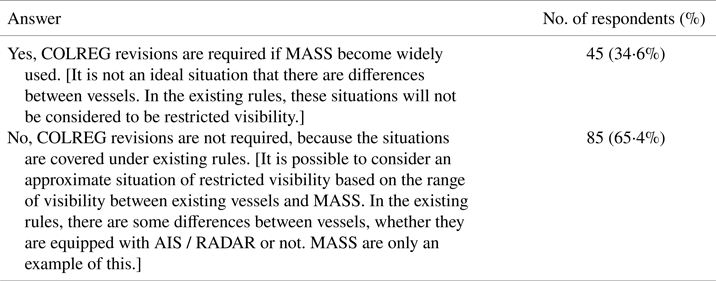
Navigation rules regarding the conduct of vessels in restricted visibility are established in Rule 19. Conditions of restricted visibility are also defined in Rule 3 (l), as follows: ‘The term “restricted visibility” means any condition in which visibility is restricted by fog, mist, falling snow, heavy rainstorms, sandstorms and any other similar causes’ (Rule 3 (l)). Further, ‘Vessels shall be deemed to be in sight of one another only when one can be observed visually from the other’ (Rule 3 (k)). If both vessels must resort to using radar to recognise the other vessel due to restricted visibility, or if one of the vessels can recognise the other vessel via radar but cannot see it with the naked eye, the vessels are in a situation of restricted visibility. Zhou et al. (Reference Zhou, Huang, Wang, Wu and Liu2020) point out, ‘An autonomous ship (superior vision) and a non-autonomous ship (visual observation) encounter in restricted visibility, the latter can be “seen” from the autonomous ship, but cannot “see” the autonomous ship. Hence, “vessels in sight of one another” cannot occur unless both are autonomous ships.’ When using not only eyesight but also radars, AIS, etc., it is indeed possible to pick up and recognise other ships. The questionnaire asked the following question: ‘If MASS come to be widely used, what kind of revisions are required to the rules about restricted visibility in COLREGs?’ Answers to this question showed that respondents who think that revisions are not necessary outweigh those who think that revisions are necessary (Table 12).
Question: ‘If MASS come to be widely used, what kind of revisions are required to the rules about restricted visibility in COLREGs?’

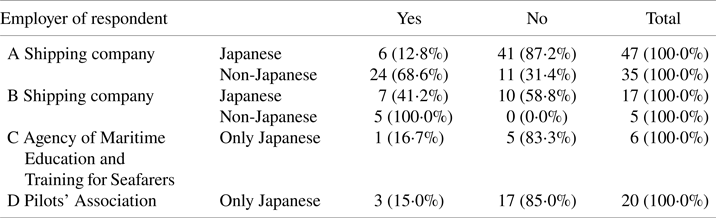
Although there is a variation in the responses of those who answered ‘Yes’ according to shipping company and nationality, there were not many answers that indicated that revisions are necessary. See Table 13 below for detailed results.
Comparison of answers between Japanese and non-Japanese seafarers

With the emergence of MASS, how will the interpretation of conditions of restricted visibility change? Current regulations place emphasis on ‘eyesight’ and, as long as the legal system centres around obtaining information such as the course and speed of other ships through the eyes of a human, even if obtaining information through methods other than eyesight is possible, it would be difficult to interpret this as not being in a situation of restricted visibility that the regulations stipulate. (Rule 5 is also based on visual recognition and defines look-out work as using all available means appropriate, with eyesight in mind.) If only one of the ships cannot see the other ship, this means that each ship's situation recognition is different. Therefore, there is an asymmetry in terms of each ship's information and situation. In that case, the situation on which the regulations are based collapses. (Rule 11 to Rule 18 of the regulations are applied only when both ships are within each other's field of vision.) Accordingly, even if one ship can see the other ship via radar or AIS in a situation where recognition with the naked eye is impossible, if the other ship cannot visually recognise it, then the other ship cannot be said to be in the same visual range.
In a case where a MASS can recognise a conventional vessel via radar, even if crossing vessel navigation is applied to the conventional vessel and MASS, the conventional vessel is not obligated to avoid or to act as the stand-on vessel. (From the conventional vessel's perspective, as long as its visibility is restricted, maintaining speed as the stand-on vessel would be difficult. On the other hand, it would also be difficult, due to restricted visibility, to perform proper evading manoeuvres without slowing to the appropriate speed.) In a case like this, under current regulations, Rule 19 would be applied as if in a situation of restricted visibility. Even now, between ships where one has a radar and the other does not, in a situation where fog, heavy rainstorms or sandstorms restrict visibility, even if the ship with a radar is able to pick up and recognise the other ship, Rule 19 is applied.
MASS technology incorporates autonomy in all aspects of awareness, analysis, judgement and command, but it still needs further development to be able to handle situations with other vessels that have limited visibility. Consequently, the implementation of large changes to visibility detection does not seem to be appearing with MASS, and thus it could be said that there is no big difference between MASS and the current conventional ships operating today.
In the end, it can be interpreted that as both MASS and visibility fall under the same restrictions, they must obey Rule 19. It would be undesirable to implement policy changes to make exceptions implementing policy changes to make exceptions to Rule 19 for MASS only. From the perspective of a MASS, if it can accurately recognise a conventional vessel's movement, assuming that it was possible to avoid applying Rule 19, the MASS would be obligated to avoid all conventional vessels. (This type of idea aligns with Principle 2 and does not disrupt the theoretical system of COLREGs. The provision of Rule 18 (f) regarding WIG craft is another example of this.) If this were true, it may not always be a disadvantageous thing for conventional vessels. (Of course, if this caused a conventional vessel to be the stand-on vessel, it would be required to avoid a third ship in the area, which could lead to complications in interpretation of regulations.)
4.6 COLREGS's four principles and Rule 2
4.6.1 Seafarers’ perceptions of the four principles
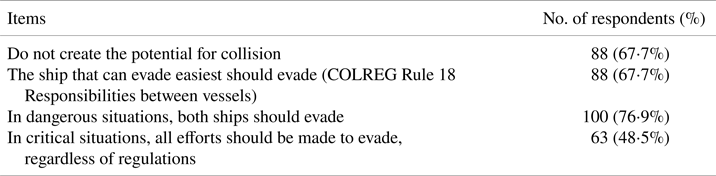
The point about COLREGs being founded on four principles is discussed in section 3.2. Answers to the question about these four principles are summarised in Table 14.
Question: ‘Which principle(s) is/are included in COLREGs?’

Note: Respondents answered by selecting all applicable items. Total number of respondents: 130.
The authors were surprised by the 48⋅5% for Principle 4. This is because Principle 4 is basically Rule 2 (b) rewritten in an abstract and generalised form and is therefore part of the text of COLREGs. Examination is required into the reason behind this answer about Principle 4.
In response to the question, ‘With the emergence of MASS, should these principles be revised, or should they be (all or partly) maintained, if all principles in question 1 exist?’, 110 (92⋅3%) of the respondents answered ‘Yes’. From this it is clear that seafarers do not want all (or, at least part of) the principles of current COLREGs to be changed.
4.6.2 Principle 4 and MASS
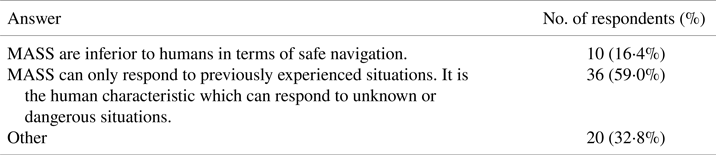
The questionnaire asked the following: ‘Should MASS vessels be allowed to implement Principle 4 from question 1? (see below for details).’ The ratio of affirmative and negative answers was approximately equal in a tight result (Table 15). The reasons for allowing implementation are shown in Table 16. ‘Other’ answers included, ‘Even with MASS, actions to avoid the worse outcome should be allowed’ and ‘Some situations are unavoidable even when rules are followed’. The reasons for not allowing implementation are shown in Table 17. ‘Other’ answers included, ‘evading manoeuvres that ignore rules are unpredictable and so autonomous ships should be made to evade according to rules’, as well as several other answers reasoning that evading manoeuvres of MASS are unpredictable. An answer of ‘MASS are inferior to humans’ was also available, and it was selected by 10 (16%) of the 61 respondents.
Question: ‘Should MASS vessels be allowed to implement principle 4 from question 1?’

Note: Principle 4 denotes that, ‘In critical situations, all efforts should be made to evade, regardless of regulations.’
The reasons for answering ‘should be allowed’

Note: Respondents answered by selecting all applicable items. Total number of respondents: 69.
The reasons for answering ‘should not be allowed’

Note: Respondents answered by selecting all applicable items. Total number of respondents: 61.
As long as opinions are conflicting, it is unclear which is better for seafarers from the above results. However, the most common reason for allowing Principle 4 is that distinguishing between conventional vessels and MASS is not necessary. This is a kind of personification of MASS where they are thought to have a similar manoeuvring ability to humans. On the other hand, the main reasons for not allowing Principle 4 are that MASS cannot handle unknown phenomena and that the actions of MASS cannot be predicted. The background to these answers probably lies in the idea that even MASS are just ‘machines’ and in critical situations they do not have the ability to behave in the same way as humans.
The answers of respondents depend on the extent to which they believe MASS have a ‘level’ of ability such as evasion manoeuvring or responding in critical situations, and how that ability is estimated. In this sense, if the seafarers’ common understanding of MASS, the requirements of systems installed on MASS and the form in which they are actualised becomes clear, opinions about allowing Principle 4 will naturally change.
4.6.3 Seamanship and MASS
A position paper by CMI (2018) describes the relationship between MASS and Rule 2 as follows: ‘Autonomous and unsupervised ships, however, would fall foul of Rule 2 in its current form.’ Further, Zhou et al. (Reference Zhou, Huang, Wang, Wu and Liu2020) state, ‘In summary, this rule requires human intervention for decision making. Theoretically, the remote-controlled mode can still meet the safety requirements, but further revisions may be necessary to resolve the barriers to actual application for fully autonomous mode.’ Swain (Reference Swain2018) states that, ‘At first look, Rule 2 on Responsibility in Part A on General Rules and Rule 5 on Look-outs in Part B on Steering and Sailing present the most difficulty for UMSs because these rules appear to require the involvement of humans, at least implicitly’ and goes on to say, ‘This rule therefore implies a degree of human or human-like decision-making to have the ability to make judgments of an “ordinary seaman” and to determine when a departure from the Rules is necessary.’ Umeda et al. (Reference Umeda, Shimizu, Minami and Miyoshi2018) state that, ‘As long as the word “caution” infers human awareness, under current rules, an interpretation where a computer rather than a human is the subject of paying attention cannot be allowed.’ In light of the discussion above, how should we think about Rule 2 (a) and Rule 8 (a) with regard to seamanship and COLREGs? Is it necessary for MASS to comply with Rule 2 (a) and Rule 8 (a)? AI cannot be considered human, so the interpretation of the above rules enters into a grey area. Now, should a kind of seamanship that is contrary to the ordinary practice of seamen be required for MASS? The answers to this question are shown in Table 18. Respondents who said seamanship is necessary rose to 73⋅8%.
Question: ‘Is seamanship required for MASS vessels?’

As previously shown, COLREGs do not contain much quantitative language, but rather rely on more vague qualitative phrasing. This is why there is an essential need for definitive explanations of what concepts like ‘good seamanship’ and ‘the ordinary practice of seamen’. It is difficult to imagine how to quantify these things in a computer program, but MASS will require the ability to keep safe distances from other ships while at anchorage, for example. Consequently, there is an obligation for MASS to obey Rule 2 (a).
5. Discussion
From the survey outlined in this study, we can begin to see a picture of how seafarers regard the current situation with MASS from the data they prudently provided in their responses to the questionnaire. The results of this research indicate that the opinions of seafarers diverge on various points. The majority of the respondents indicated a need to revise the ‘restricted visibility’ condition because MASS are currently regarded the same as the existing vessels in both good and bad ways under restricted visibility conditions. This may be due to the expectations of seafarers. When asymmetry occurs in the limited visibility conditions, it becomes difficult to apply the provisions of limited visibility. In this case, various navigation regulations are applied, or judgement is based on seamanship depending on the situation. These conditions greatly reduce predictability and in turn may increase risk of collision.
In principle, the application of the four principles of COLREGs should be required for MASS if they are to be ships that fall under the jurisdiction of COLREGs. Conversely, Principle 4 is applicable and, if necessary, it is required to prevent collisions even if the regulation is violated. It is assumed that, even on MASS, a certain number of crew members are on board, and the application of this principle seems to be justified from the viewpoint of protecting their lives. However, as is clear from the results of the questionnaire (Table 15), some anxiety remains among seafarers. In reality, when navigation between three ships becomes a problem, when ships are safely manoeuvring around each other, or when the route is set by local navigational rules as in near the exit of a passage, or other complicated situations, it may not be possible to derive unique interpretations of the regulations as currently written. When the danger of imminent collision arises, there is a possibility that the rules are not clear enough, and the navigation judgement to be applied cannot be effectively determined. In these types of situations, it is possible that the judgement required at that time demands the best decision and subsequent action to avoid a collision. This would be the result of the fourth application of the principle.
Furthermore, should MASS be required to incorporate a human element, that is, should MASS also have seamanship? Or is seamanship unnecessary for MASS? This is a difficult question without a simple answer, but generally the former seems to be desirable. The reason is that the provisions of COLREGs vary and often depend on the situation. In addition, the measures to avoid anchored vessels to be taken by sailing vessels are not stated anywhere in COLREGs and are based on good seamanship; in fact, without good seamanship, safe avoidance manoeuvres are impossible. From the point of view of seafarers, it is highly possible that information gathering and judgement will not be hindered and safe operation will be possible if MASS do not significantly diverge from conventional ship manoeuvring. On the other hand, realistic operations that differ from the provisions may be taken (after wireless communication, it is not rare for ships to agree to pass starboard to starboard despite provisions). For this reason, seamanship and humanity are indispensable when interpreting rules and regulations at sea.
Additionally, when ships are in a head-on situation, and the other ship continues to move straight and not show signs of turning to starboard, should a vessel expect it to turn within a certain approach distance, or should its crew disregard what they see and continue ahead? Judgement as to whether to manoeuvre the ship assuming that it does not seem to turn due to other circumstances would be a judgement based on good seamanship. Another apt example is during night sailing, if MASS AI navigational software judged that a ship was oncoming based on the positional relationship of its mast lights, but in reality, it was a crossing ship, could MASS correct this misunderstanding? This is an example of what can often confuse human seafarers, and it is unclear how such complicated situations will be dealt with by MASS. Especially for Aegis ships, the distance between the two mast lights is shortened, so sometimes crossing situations are misunderstood as oncoming (Fujimoto et al., Reference Fujimoto, Kondo, Fuchi, Konishi, Matsumoto and Nishimura2017).
It is unclear whether humans or MASS will be more adept at recognising and correcting for these types of mistakes, but if such machine learning is not introduced to MASS ahead of their deployment on the oceans, it is conceivable that they may run into these types of situations unprepared for the complex and speedy decisions that are required to avoid collisions. In addition, there are no provisions in COLREGs for navigation between three ships; in these situations, the ships will be operated in accordance with the ordinary practice of seamen. The examples outlined above strongly indicate that it is necessary for MASS to incorporate seamanship into their navigational practices.
6. Conclusion
In order to continue achieving the end-goal of COLREGs, which is to avoid collisions, the actions of MASS must be predictable to seafarers on conventional vessels. For Look-out (Rule 5), a numerical standard for MASS would be beneficial. When given a literal interpretation, MASS are counted as power-driven vessels, and the idea that all COLREG rules would be applied to them is strong, and therefore seafarers believe that MASS should not be given higher or lower priority. We can say that the opinions that MASS should be classified as power-driven vessels and the four principles of COLREGs should be applied to MASS demonstrate this point.
As is clear in the four principles of COLREGs, vessel manoeuvring is achieved with the trust of the other vessel (that it will also be manoeuvred according to the regulations or good seamanship). In the foreseeable future, conventional vessels and MASS will need to communicate well, trust each other and perform give-way/stand-on vessel manoeuvres.
Acknowledgements
The authors wish to thank the participants from NYK (Nippon Yusen Kaisha) Line, K Line (Kawasaki Kisen Kaisha, Ltd.), Japan Agency of Maritime Education and Training for Seafarers and Osaka Wan Pilots’ Association for responding to their MASS survey.