Introduction
Terminal-repeat retrotransposon in miniature (TRIM) elements are small ( < 900 bp) in size, abundant and ubiquitously present in plant genomes, in addition to being found in the genome of an ant, Pogonomyrmex barbatus (Witte et al., Reference Witte, Le, Bureau and Kumar2001; Zhou and Cahan, Reference Zhou and Cahan2012). TRIM elements share structural features with long terminal-repeat (LTR) retrotransposons, including the terminal repeat (TR), primer-binding site (PBS) and poly-purine tract (PPT); thus, TRIM elements are considered to be derivatives of LTR retrotransposons (Wicker et al., Reference Wicker, Sabot, Hua-Van, Bennetzen, Capy, Chalhoub, Flavell, Leroy, Morgante, Panaud, Paux, SanMiguel and Schulman2007; Zou et al., Reference Zou, Gong, Yang and Meng2009). TRIM elements sometimes associate with genic regions and can change gene structure and function by affecting the promoter, shuffling the coding region and/or altering gene expression. In addition, TRIM elements are an important source of molecular markers that have been effectively utilized for genome mapping, diversity and evolutionary studies (Witte et al., Reference Witte, Le, Bureau and Kumar2001; Yang et al., Reference Yang, Kwon, Choi, Kim, Jin, Lim, Park, Kim, Lim, Kim, Lee, Lim, Paterson and Park2007).
The Brassicaceae family is economically important, with >330 genera and around 3700 species. It has diverse phenotypic resources and includes important species for studies of the evolution of polyploidy (Johnston et al., Reference Johnston, Pepper, Hall, Chen, Hodnett, Drabek, Lopez and Price2005; Mun et al., Reference Mun, Kwon, Yang, Seol, Jin, Kim, Lim, Kim, Baek, Choi, Yu, Kim, Kim, Lim, Lee, Hahn, Lim, Bancroft and Park2009; Wang et al., Reference Wang, Wang, Wang, Sun, Wu, Liu, Bai, Mun, Bancroft, Cheng, Huang, Li, Hua, Freeling, Pires, Paterson, Chalhoub, Wang, Hayward, Sharpe, Park, Weisshaar, Liu, Li, Tong, Song, Duran, Peng, Geng, Koh, Lin, Edwards, Mu, Shen, Soumpourou, Li, Fraser, Conant, Lassalle, King, Bonnema, Tang, Belcram, Zhou, Hirakawa, Abe, Guo, Jin, Parkin, Batley, Kim, Just, Li, Xu, Deng, Kim, Yu, Meng, Min, Poulain, Hatakeyama, Wu, Wang, Fang, Trick, Links, Zhao, Jin, Ramchiary, Drou, Berkman, Cai, Huang, Li, Tabata, Cheng, Zhang, Sato, Sun, Kwon, Choi, Lee, Fan, Zhao, Tan, Xu, Wang, Qiu, Yin, Li, Du, Liao, Lim, Narusaka, Wang, Li, Xiong and Zhang2011). In addition, the widely used diploid model plant, Arabidopsis thaliana, is a member of the Brassicaceae family. The Brassica rapa and B. oleracea genomes have now been sequenced and are publicly available, revealing that around 40% of both genomes is derived from transposable elements (Cheng et al., Reference Cheng, Liu, Wu, Fang, Sun, Liu, Li, Hua and Wang2011; Wang et al., Reference Wang, Wang, Wang, Sun, Wu, Liu, Bai, Mun, Bancroft, Cheng, Huang, Li, Hua, Freeling, Pires, Paterson, Chalhoub, Wang, Hayward, Sharpe, Park, Weisshaar, Liu, Li, Tong, Song, Duran, Peng, Geng, Koh, Lin, Edwards, Mu, Shen, Soumpourou, Li, Fraser, Conant, Lassalle, King, Bonnema, Tang, Belcram, Zhou, Hirakawa, Abe, Guo, Jin, Parkin, Batley, Kim, Just, Li, Xu, Deng, Kim, Yu, Meng, Min, Poulain, Hatakeyama, Wu, Wang, Fang, Trick, Links, Zhao, Jin, Ramchiary, Drou, Berkman, Cai, Huang, Li, Tabata, Cheng, Zhang, Sato, Sun, Kwon, Choi, Lee, Fan, Zhao, Tan, Xu, Wang, Qiu, Yin, Li, Du, Liao, Lim, Narusaka, Wang, Li, Xiong and Zhang2011; Yu et al., Reference Yu, Zhao, Wang, Tong, Huang, Tehrim, Liu, Hua and Liu2013). Two studies have suggested that TRIM elements may play active roles in the evolution of duplicated genes in the B. rapa genome (Kwon et al., Reference Kwon, Kim, Lim, Long, Meng, Lim, Kim, Kim, Jin, Kim, Ahn, Wessler, Yang and Park2007; Yang et al., Reference Yang, Kwon, Choi, Kim, Jin, Lim, Park, Kim, Lim, Kim, Lee, Lim, Paterson and Park2007).
Members of a particular TRIM family, Cassandra, have been identified in many plant genomes including Brassica species. Cassandra elements have a unique TR structure in which some carry a highly conserved 5S rRNA gene. Moreover, Cassandra TRs are very similar in structure in monocot and dicot plants (Kalendar et al., Reference Kalendar, Tanskanen, Chang, Antonius, Sela, Peleg and Schulman2008). In this study, we comparatively analysed the Cassandra family members in the A. thaliana, B. oleracea and B. rapa genomes and revealed their continuous and recent amplification in each Brassica species.
Materials and methods
Sequence analysis of Cassandra elements from Brassicaceae species
The sequences of Cassandra family members from B. oleracea (AY860308), B. rapa (AY860309) and A. thaliana (AY923743) were used as queries for the analysis of Cassandra elements in the three genomes (Kalendar et al., Reference Kalendar, Tanskanen, Chang, Antonius, Sela, Peleg and Schulman2008). All the Cassandra elements were retrieved from the three genomes using BLASTn analysis with an E value < × 10− 10 from a local database (http://im-crop.snu.ac.kr/). The genome sequences and gene annotation information of B. oleracea (version 1.0), B. rapa (version 1.2) and A. thaliana (version TAIR10) were obtained from Bolbase (Yu et al., Reference Yu, Zhao, Wang, Tong, Huang, Tehrim, Liu, Hua and Liu2013), BRAD (Cheng et al., Reference Cheng, Liu, Wu, Fang, Sun, Liu, Li, Hua and Wang2011) and TAIR (Lamesch et al., Reference Lamesch, Berardini, Li, Swarbreck, Wilks, Sasidharan, Muller, Dreher, Alexander, Garcia-Hernandez, Karthikeyan, Lee, Nelson, Ploetz, Singh, Wensel and Huala2012), respectively. The distributions of Cassandra elements in the B. oleracea, B. rapa and A. thaliana genomes were determined using an in silico mapping tool (Sampath et al., Reference Sampath, Lee, Lee, Izzah, Choi, Jin, Park and Yang2013). The insertion positions of Cassandra elements in various genomic locations such as introns, exons, untranslated regions and intergenic spaces in B. oleracea, B. rapa and A. thaliana were characterized using a custom Perl script. The nearly intact Cassandra family members (defined as having >80% sequence similarity and >80% sequence coverage) from the B. oleracea, B. rapa and A. thaliana genomes were used for phylogenetic analysis, and the phylogenetic tree was constructed using MEGA5 (Tamura et al., Reference Tamura, Peterson, Peterson, Stecher, Nei and Kumar2011).
Results and discussion
We retrieved all the Cassandra elements in the A. thaliana, B. oleracea and B. rapa genomes (Kalendar et al., Reference Kalendar, Tanskanen, Chang, Antonius, Sela, Peleg and Schulman2008). The retrieved elements included the conserved signature domains, namely the TR (~350 bp), PBS, PPT and internal sequence. The sizes of the Cassandra family members ranged from 801 to 826 bp, and the elements had a low AT content (45–49%) compared with the whole genomes (>63.8%; Wang et al., Reference Wang, Wang, Wang, Sun, Wu, Liu, Bai, Mun, Bancroft, Cheng, Huang, Li, Hua, Freeling, Pires, Paterson, Chalhoub, Wang, Hayward, Sharpe, Park, Weisshaar, Liu, Li, Tong, Song, Duran, Peng, Geng, Koh, Lin, Edwards, Mu, Shen, Soumpourou, Li, Fraser, Conant, Lassalle, King, Bonnema, Tang, Belcram, Zhou, Hirakawa, Abe, Guo, Jin, Parkin, Batley, Kim, Just, Li, Xu, Deng, Kim, Yu, Meng, Min, Poulain, Hatakeyama, Wu, Wang, Fang, Trick, Links, Zhao, Jin, Ramchiary, Drou, Berkman, Cai, Huang, Li, Tabata, Cheng, Zhang, Sato, Sun, Kwon, Choi, Lee, Fan, Zhao, Tan, Xu, Wang, Qiu, Yin, Li, Du, Liao, Lim, Narusaka, Wang, Li, Xiong and Zhang2011). Hereafter, we will refer to the Cassandra TRIM families from A. thaliana, B. oleracea and B. rapa as At-Cassandra, Bo-Cassandra and Br-Cassandra, respectively (Table 1). Most of the Bo-Cassandra and Br-Cassandra members shared high sequence similarity. By contrast, At-Cassandra members exhibited dissimilarities and indel structures compared with Bo-Cassandra and Br-Cassandra members, suggesting that the Cassandra family has recently been amplified in the Brassica genus (Fig. S1, available online).
Characteristics of Cassandra elements in Arabidopsis thaliana, Brassica oleracea and B. rapa

TRIM, Terminal-repeat retrotransposon in miniature; TR, Terminal repeat; TSD, Target Site Duplication; CDS, Coding DNA Sequence.
a At-Cassandra, Bo-Cassandra and Br-Cassandra members were extracted from 120, 256 and 385 Mb of pseudo-chromosome sequences from A. thaliana, B. oleracea and B. rapa, respectively. The detailed physical position information and characterization of members are summarized in Tables S1, S2 and S3 (available online) for A. thaliana, B. oleracea and B. rapa, respectively.
b Genomic distributions of Cassandra elements from A. thaliana, B. oleracea and B. rapa were characterized using information from TAIR (The Arabidopsis Information Resource; Lamesch et al., Reference Lamesch, Berardini, Li, Swarbreck, Wilks, Sasidharan, Muller, Dreher, Alexander, Garcia-Hernandez, Karthikeyan, Lee, Nelson, Ploetz, Singh, Wensel and Huala2012), Bolbase (Yu et al., Reference Yu, Zhao, Wang, Tong, Huang, Tehrim, Liu, Hua and Liu2013) and BRAD (Cheng et al., Reference Cheng, Liu, Wu, Fang, Sun, Liu, Li, Hua and Wang2011), respectively.
A. thaliana, B. oleracea and B. rapa pseudo-chromosome sequences contained 173, 602 and 451 members, respectively. Among the 602 Bo-Cassandra members, 130, 108 and 364 had relatively intact elements, solo TR and fragmented structures, respectively. Of the 451 Br-Cassandra members, 60 were intact. Only 9 of the 173 At-Cassandra members were identified as intact, suggesting that Cassandra elements proliferated in the Brassica genus after divergence from the Arabidopsis genus (Table 1; Tables S1, S2 and S3, available online). We also analysed the Cassandra family members in Oryza sativa, Medicago truncatula and Zea mays and identified 32, 10 and 1087 intact elements, respectively (Tables S4, S5 and S6, available online).
Cassandra family members, including intact elements, solo TR and fragments of Cassandra elements, exhibited random distribution patterns on the A. thaliana, B. oleracea and B. rapa pseudo-chromosome sequences (Fig. S2, available online). In addition, a survey of only intact elements also revealed a random distribution pattern. The characterization of insertion positions revealed that the Cassandra family members preferentially resided in intergenic spaces (88–94%), although a number of these were located in the introns of genes in B. oleracea and B. rapa (Table 1; Tables S1, S2 and S3, available online).
Our phylogenetic analysis revealed that At-Cassandra members are diverse compared with Bo-Cassandra and Br-Cassandra members. The high sequence conservation of Bo-Cassandra and Br-Cassandra elements suggests that Bo-Cassandra and Br-Cassandra members have recently been amplified in the Brassica genus (Fig. S3, available online).
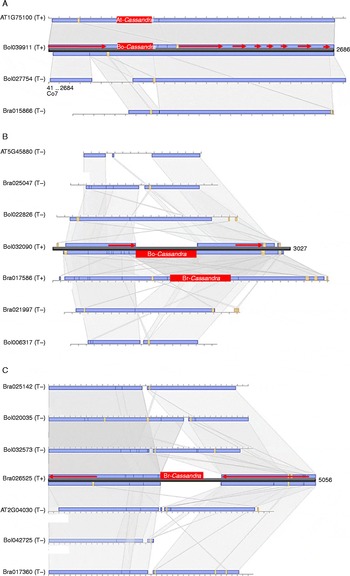
Comparative analysis of homologous sequences harbouring Cassandra members can reveal their transposition period (Kwon et al., Reference Kwon, Kim, Lim, Long, Meng, Lim, Kim, Kim, Jin, Kim, Ahn, Wessler, Yang and Park2007; Yang et al., Reference Yang, Kwon, Choi, Kim, Jin, Lim, Park, Kim, Lim, Kim, Lee, Lim, Paterson and Park2007; Sampath et al., Reference Sampath, Lee, Lee, Izzah, Choi, Jin, Park and Yang2013). One of the Cassandra members was found in the syntenic regions of the three genomes, suggesting that it might have evolved before the A. thaliana–Brassica split 20 million years ago (MYA; Fig. 1(A); Mun et al., Reference Mun, Kwon, Yang, Seol, Jin, Kim, Lim, Kim, Baek, Choi, Yu, Kim, Kim, Lim, Lee, Hahn, Lim, Bancroft and Park2009; Town et al., Reference Town, Cheung, Maiti, Crabtree, Haas, Wortman, Hine, Althoff, Arbogast, Tallon, Vigouroux, Trick and Bancroft2006; Yang et al., Reference Yang, Lai, Tai and Li1999). Other members were unique in the Brassica genus, coexisting in one of the triplicated paralogous regions of B. oleracea and B. rapa. These elements probably inserted themselves into the region between 4 and 17 MYA, after genome triplication of the tribe Brassicaceae but before speciation of B. oleracea and B. rapa (Fig. 1(B); Mun et al., Reference Mun, Kwon, Yang, Seol, Jin, Kim, Lim, Kim, Baek, Choi, Yu, Kim, Kim, Lim, Lee, Hahn, Lim, Bancroft and Park2009; Town et al., Reference Town, Cheung, Maiti, Crabtree, Haas, Wortman, Hine, Althoff, Arbogast, Tallon, Vigouroux, Trick and Bancroft2006; Yang et al., Reference Yang, Lai, Tai and Li1999). Another Br-Cassandra member was unique to B. rapa, suggesting that it was activated after the divergence of B. rapa and B. oleracea 4 MYA (Fig. 1(C); Mun et al., Reference Mun, Kwon, Yang, Seol, Jin, Kim, Lim, Kim, Baek, Choi, Yu, Kim, Kim, Lim, Lee, Hahn, Lim, Bancroft and Park2009; Town et al., Reference Town, Cheung, Maiti, Crabtree, Haas, Wortman, Hine, Althoff, Arbogast, Tallon, Vigouroux, Trick and Bancroft2006; Yang et al., Reference Yang, Lai, Tai and Li1999). As exemplified by these three distribution patterns, Cassandra elements have remained active in these species for more than 20 million years.
Micro-synteny comparison of genomic regions containing Cassandra elements with their non-inserted paralogues (NIPs) and non-inserted orthologues (NIOs) in Arabidopsis thaliana, Brassica oleracea and B. rapa. (A) Shared insertion in A. thaliana and B. oleracea. Micro-synteny comparison of genomic regions of At-Cassandra (AT1G75100) and Bo-Cassandra (Bol039911) with its NIP (Bol027754) and a NIO from B. rapa (Bra015866). (B) Shared insertion in B. oleracea and B. rapa. Micro-synteny comparison of genomic regions of Bo-Cassandra (Bol032090) and Br-Cassandra (Bra017586) with its NIPs (Bol006317 and Bol022826) and NIOs from B. rapa (Bra025047 and Bra017586) and A. thaliana (AT3G45880). (C) Unique Cassandra element insertion in B. rapa. Micro-synteny comparison of the genomic region of Br-Cassandra (Bra026525) with its NIPs (Bra025142 and Bra017360) and NIOs from B. oleracea (Bol020035, Bol032573 and Bol042725) and A. thaliana (AT2G04030). Exons and gene direction are indicated with red arrows. Cassandra element insertions are shown as red bars. T+ and T − indicate genes with Cassandra insertion and non-insertion, respectively.

The present study reveals the continuous activation of Cassandra TRIM family elements throughout evolution in Brassicaceae species, even though the Cassandra family was derived from the ancestor of monocot and dicot plants. Further identification of autonomous partner elements will be important for exploring the functional and evolutionary roles of Cassandra elements in plants.
Supplementary Material
To view supplementary material for this article, please visit http://dx.doi.org/10.1017/S1479262114000446
Acknowledgements
This work was supported by Golden Seed Project (Center for Horticultural Seed Development, No. 309008-05-1-cg000), Ministry of Oceans and Fisheries (MOF), Republic of Korea.