In studying economic development, social scientists tend to assume that most urban dwellers who need jobs but cannot find steady work must have come from somewhere else. That is, they must be migrants from the countryside. This assumption has deep roots in development thinking: early developmental economists attributed urban labor force growth primarily to migration from rural areas (Harris and Todaro Reference Harris and Todaro1970; International Labour Organization 1960; Lewis Reference Lewis1954; United Nations 1951). This same assumption later structured accounts of the rapid rise in urban informality in low- and medium-income countries (hereafter, referred to collectively as LICs). Rising rates of informality were typically attributed to a wave of migration from rural to urban areas, taking place despite a persistent lack of urban employment opportunities (Araghi Reference Araghi1995; Bradshaw Reference Bradshaw1987; Portes and Schauffler Reference Portes and Schauffler1993; Safa Reference Safa1986). Arguing along these lines, Mike Davis claimed that in the 1980s and 1990s, “agricultural deregulation and financial discipline enforced by the IMF [International Monetary Fund] and World Bank continued to generate an exodus of surplus rural labor to urban slums even as cities ceased to be job machines” (Reference Davis2006: 15). By the twenty-first century, there were about 1 billion informal workers, accounting for approximately one-half of all nonagricultural workers (de Laiglesia and Jütting Reference de Laiglesia and Jütting2009: 18). Among this billion, the representative informal worker was taken to be a recent rural-to-urban migrant (Roy Reference Roy, Roy and AlSayyad2004).
Yet even before the onset of the 1982 debt crisis, UN demographers were beginning to call previous assumptions about the sources of urban growth into question. As early as the 1950s, the largest part of urban population growth in LICs was already due to people being born in urban areas, rather than migrating to them (United Nations 1980). The urban born also came to account for larger and larger shares of the urban labor force. These insights have had little impact outside of a specialized demographic literature (Martine et al. Reference Martine, McGranahan, Montgomery and Fernández-Castilla2008; Montgomery et al. Reference Montgomery, Stren, Cohen and Reed2004). Yet the consequences of this reversal for our understanding of the sources of both urban labor-force growth and rising informality are profound. As I show in the following text, urbanization rates declined in the 1980s and 1990s in nearly all LICs. China is a key exception, but even with China included, projected levels of global urbanization in 2000 turned out to overestimate actual levels (United Nations 2001). The implication is that, in the face of agrarian crises, many of the world’s rural dwellers were forced to remain in the countryside, or to circulate back and forth to cities temporarily because they could not find permanent places in depressed urban economies (Breman Reference Breman1996; Bryceson Reference Bryceson, Bryceson, Kay and Mooij2000).
Despite slowing rates of urbanization after 1980, urban labor forces continued to expand rapidly across the low-income world. Urban workers appeared to come from nowhere. The explanation is that a large share of urban labor-force expansion in this period was due to urban-born children aging into labor markets. They were forced to find employment in slack economies, so many of them ended up working informally. We can assume that a large share of entrants into informal work in this period consisted of the children of informal workers, simply because the latter made up a sizable share of the labor force. The result was an intergenerational reproduction of informality taking place on an expanding scale. The specific links between demographic expansion and urban informalization have not been sufficiently explored.
This article investigates those links as part of wider story about the global process of proletarianization, which like informalization must be rethought in relation to demographic growth. I define proletarianization as a rise in the share of the population that depends on selling its labor—or the simple products of its labor—to survive.Footnote 1 Insofar as it has been examined at all, global proletarianization has been analyzed as an implicit feature of urbanization. But if the majority of both LIC urban growth and labor-force expansion since 1950 has been due to demographic growth taking place directly in urban areas, then global proletarianization must be rethought. Since 1950, the world’s urban-dwelling population has more than quintupled in size, from 750 million to 4.2 billion people, yet over the same period, the world’s rural population did not shrink. There are 3.4 billion rural dwellers alive today—more than there were people in the entire world in 1950. This article argues that in the second half of the twentieth century, rapid demographic growth generated a unique form of social-structural change that was largely responsible for generalizing the proletarian condition across the world. The demographic expansion of the labor force continued to unfold at a rapid pace even after the 1982 debt crisis reduced the availability of urban jobs, contributing to major increases in levels of urban informality.
Although this article focuses on the rapidly rising supply of labor in the urban areas of LICs, it is important to point out that a persistently low demand for labor has also been a long-standing problem in LICs. By the time the 1982 debt crisis hit, LIC economies had already been plagued by decades rising urban unemployment and underemployment. In the 1960s, UN observers identified two main causes of this low demand for urban labor. First, high levels of economic inequality made for skewed consumption profiles, gearing economies toward production of capital-intensive goods demanded primarily by the elite, rather than labor-intensive goods demanded by the wider population (International Labour Organization 1964). Second, ongoing technological advances, embodied in machinery imported from the industrialized countries, made economic development in LICs more capital intensive and less labor intensive overall (ibid.). These two trends resulted in a relatively low employment intensity of GDP growth (Seers Reference Seers1970). Problems around employment expansion were then compounded following the 1982 debt crisis, when GDP growth rates collapsed across much of the low-income world. Nevertheless, as this article shows, the ensuing decline in the demand for labor in urban areas failed to discourage the further growth of the urban workforce because generations of urban-born youth—many of them the sons and daughters of urban informal-sector workers—continued to come of age and had to work to live.
This article has four sections. The first section looks at postwar accounts of proletarianization, which focused on mechanisms pulling and pushing people from the countryside to cities. The second section outlines the alternative mechanism of proletarianization that I call demographic dispossession. The third section then focuses in on the role demographic dispossession played in informalizing the LIC workforce following the 1982 debt crisis, comparing outcomes in most LICs to the exceptional case of China. The final section looks at shifts in the pattern of population growth since 1950, which have made demographic increase in LICs both more rapid and more urban in character than had been the case historically in high-income countries (HICs).
Sources of Proletarianization
In 1950, 70 percent of the world’s population lived in the countryside and 62 percent of its workforce labored in agriculture (Bairoch and Limbor Reference Bairoch and Limbor1968: 326). Today, these shares have fallen to 46 percent and 28 percent, respectively.Footnote 2 Globally, there are more people living in urban areas than in rural ones and almost three times as many nonfarmworkers as farmworkers. In the mid-twentieth century, most people grew or made much of what they consumed. Today, the vast majority depend on markets to purchase most of what they need to live—even though many individuals earn their incomes only as precarious “wage hunters and gatherers” (Breman Reference Breman1994). What factors made for the proletarianization of the world’s population after 1950? And why did this process continue to unfold despite a persistent lack of formal employment opportunities?
Answers to these questions typically begin with a model proposed by W. Arthur Lewis in his article “Economic Development with Unlimited Supplies of Labor” (Reference Lewis1954). Lewis described how, in the course of economic development, people are pulled from the countryside to cities in search of a better life. For Lewis, proletarianization follows naturally from commercialization: it is a consequence of people taking advantage of the gains of trade. The higher the economic growth rate, the more urban job opportunities open up, and the more people leave the land. Lewis’s model was widely adopted across the new field of development economics: it helped convince policy makers that the key to achieving economic development was sustaining high rates of economic growth (Arndt Reference Arndt1989). However, this perspective soon came up for criticism.
In the 1950s and 1960s, many more people entered urban labor markets than there were jobs available. The International Labour Organization (ILO) called attention to this phenomenon in the 1960s (International Labour Organization 1961, 1964). The ILO then launched a World Employment Program to study employment issues in greater detail (International Labour Organization 1969). The ILO came to describe individuals occupying vulnerable positions in LIC economies as informally employed (International Labour Organization 2002). This category subsumes those who are employed without a contract, for example day laborers, and those who are self-employed or work as unpaid family labor in micro-enterprises selling directly on the market. Some workers choose informal business ownership over wage work; however informal employment is mostly generated “not so much in response to investment opportunities” but rather “out of necessity to create one’s own employment” in slack labor markets (Sethuraman Reference Sethuraman and Sethuraman1981: 16). Urban informality has grown significantly since it was first described in the early 1970s; it expanded dramatically in the 1980s and 1990s (Breman and van der Linden Reference Breman and van der Linden2014; Charmes Reference Charmes2012).
With a Lewis Model, it was difficult to explain why people continued to search for jobs in urban labor markets despite a persistent lack of formal job opportunities. John Harris and Michael Todaro (Reference Harris and Todaro1970) proposed that government interventions into the labor markets of LICs had artificially raised urban wages relative to rural incomes, drawing people into cities on the mere chance of getting an urban job. Michael Lipton (Reference Lipton1977) similarly argued that an “urban bias” in LIC governments had led to the overexpansion of city populations. The IMF and the World Bank used these theories to justify the implementation of structural adjustment programs, which encouraged LIC governments to deregulate labor markets to reduce wage differentials between formal and informal jobs, yet even as labor protections eroded and wage differentials fell, levels of urban informality continued to rise (UN-HABITAT 2003).
Alternative, heterodox accounts of proletarianization took a different approach, looking to factors pushing people into urban labor markets against their will. These accounts were typically Marxist or Marxist inspired. The dependentistas criticized Lewis for assuming that the countryside was a site of undeveloped rural economies. Andre Gunder Frank (Reference Frank1966) argued instead that rural economies had been actively underdeveloped by the process of commercialization, as mediated by colonialism. Colonial powers had narrowed formerly diverse forms of rural existence, making the poor more vulnerable to the natural catastrophes and social upheavals that then dispossessed them of their livelihoods and forced them to flee to cities.
The concept of dispossession remains key to heterodox accounts of the proletarianization process today (Akram-Lodhi and Kay Reference Akram-Lodhi and Kay2010). Formerly, that process was defined in terms of a shift from subsistence agriculture to waged labor. However, such a definition proved inadequate for an era that saw a massive expansion of urban informal work. After all, most informal workers do not earn wages (International Labour Organization 2002). Finding no one to employ them, they sell goods and services directly on the market. Informal workers can be included among the proletariat only if the latter’s defining feature is taken to be not wage labor but rather the lack of access to land or other forms of property that forces people to seek waged work. The same situation leads people to engage in own-account informal activities when work for wages is unavailable.
Heterodox accounts typically focus on two mechanisms of dispossession pushing rural-dwellers into urban labor markets: (1) dispossession by rural differentiation and (2) dispossession by direct expropriation (Akram-Lodhi and Kay Reference Akram-Lodhi and Kay2010: 183). Like the Lewis account, both alternatives begin from the process of commercialization and associated gains of trade. In the dispossession-by-differentiation account, smallholding peasants abandon subsistence agriculture to grow marketable crops. Now subject to market laws, these producers achieve varied rates of return. A few are able to accumulate; however, most lose their land and migrate to urban areas. In the dispossession-by-expropriation account, landowners expel peasants from the land by force or by dubious legal means to orient toward production for the market. Few peasants find employment on converted farms. Most are pushed into overcrowded urban markets.
These heterodox accounts of proletarianization have, in turn, formed the basis of a critical literature on informalization, which takes as given that one or another form of rural dispossession has been the main source of a growing urban informal workforce (Davis Reference Davis2006; Roy and AlSayyad Reference Roy and AlSayyad2004). In this context, analysts have examined the role of neoliberal policies in accelerating the pace of rural dispossession: by gutting rural development programs, breaking up communal lands, and selling large tracts of land to investors. The heterodox accounts have the right starting point: they ask, what are the forces pushing people into urban labor markets, causing labor supply to rise in excess of demand? However, like the mainstream accounts, the heterodox ones focus on mechanisms transferring the population from rural to urban areas. In reality, proletarianization since 1950 has been much more a matter of population growth than population transfer (United Nations 2001: 35). The failure to account for urban demographic growth in economic accounts of urban labor-force expansion has been “seriously misleading” (Preston Reference Preston1979: 196).
Demographic Dispossession
Urban population increase derives from two sources: net migration and net urban demographic growth (for accounting purposes, in-situ urbanization—that is, the reclassification of rural areas as urban ones—is considered to be a form of rural-to-urban migration). Thus:
 $$urban\, increase = (in-migration - outmigration)+(urban\, births - urban\, deaths).$$
Using standard demographic statistics, it is possible to calculate the share of urban population increase that derives from each of these two sources. Demographers define the urbanization rate, that is, the rate of growth of the urban percentage, as follows:
 $$urbanization\, rate = urban\, population\, growth\, rate - total\, population\, growth\, rate.$$
Dividing both sides of this equation by the urban growth rate gives us:
 $$(urbanization\, rate/urban\, growth\, rate) = {\it 1} - (total\, growth\, rate/urban\, growth\, rate).$$
If we assume that rates of demographic growth are approximately the same in rural and urban areas (mortality and fertility rates may vary, but the resulting rate of growth must be roughly the same), then the first term in this equation is equivalent to the migration share of urban growth, while the final term is equivalent to the urban demographic share of urban growth. In 1980, UN surveys confirmed that this assumption held for many LICs, although it does not necessarily hold in all times and places (see Montgomery et al. Reference Montgomery, Stren, Cohen and Reed2004: 115–16).Footnote 3 Between 1950 and 2000, the LIC urbanization rate was 1.6 percent, the total population growth rate was 2.1 percent, and the urban growth rate was 3.7 percent, so net migration was responsible for approximately 43 percent of urban growth in LICs, while net urban demographic growth was responsible for 57 percent.
The dominant role of urban demographic growth in explaining urban population increase in LICs was recognized belatedly. It was not until the late 1970s that UN researchers concluded that LIC urban population growth rates were high not due to “unusually rapid changes in urban proportions” but rather due to “rapid changes in the total population size to which those proportions are applied” (United Nations 1980: 17). Changes in total population sizes were enormous: LIC populations doubled in size in 31 years, from 1.7 billion in 1950 to 3.4 billion in 1981. Those populations then nearly doubled in size again, growing to 6.1 billion in 2015. Such changes then ramified through the labor force as young people came of age and had to find work.
Population growth explains why, despite massive increases in nonagricultural employment across LICs, agricultural employment levels were almost always larger in 2010 than they had been in 1960, making it seem as if urban workforces had appeared out of nowhere.Footnote 4 In Indonesia, the nonagricultural labor force expanded by 700 percent between 1960 and 2010, even though the agricultural labor force grew by 80 percent. Meanwhile, in Egypt, the nonagricultural labor force expanded by 462 percent over the same period, even as the agricultural labor force grew by 42 percent. These are two examples of a nearly universal phenomenon in LICs, which finds its explanation in the immense demographic growth of these populations.
This section develops an account of demographic expansion as an autonomous mechanism of proletarianization in LICs. Alongside the proletarianizing mechanisms of dispossession by differentiation and dispossession by expropriation (see preceding text), rapid population growth effected a third and more crucial form of dispossession that I call demographic dispossession.Footnote 5 Due to rapid population growth, more and more young people found that when they came of age, they lacked access to the resources that would have allowed them to survive without recourse to the labor market. Although this article focuses on urban areas, it is crucial to point out that demographic dispossession unfolded simultaneously in both rural and urban areas of LICs.
Dispossession of Peasants
Demographic dispossession took place first of all in the countryside. Rapid population growth was disruptive to peasant forms of life, upending intergenerational practices of resource management by pulverizing existing landholdings and accelerating the pace at which new lands were brought under cultivation. As rural populations grew, peasants divided up their land among successively larger generations of children. Many families found that their inheritance was too small for them to live by farming. They were partly or wholly proletarianized.Footnote 6 It is possible to get a sense of the pressures leading to demographic dispossession in the countryside by comparing shifts in the average amount of cultivated land per agricultural producer by country. However, the situation for poor rural dwellers was generally much worse than these statistics suggest because landholdings tended to be highly unequally distributed (World Bank 2008: 87).
In most LICs, land per person fell significantly in the decades after 1950. To take just three examples: in Mexico, Egypt, and India, these ratios fell by around 25 percent in 20 years, 1960–80, putting pressure on rural dwellers trying to survive through self-sufficient farming. In India, such ratios continued to fall after 1980, reaching 50 percent of their 1960 level in the 2000s. By contrast, in Mexico and Egypt, land-per-person ratios improved in the 1980s, as agricultural populations peaked in absolute terms and began to decline due to outmigration (in both countries, agricultural workforces were still larger in 2010 than they had been in 1960, due to an intervening period of growth). The pulverization of holdings added to pressures—various in both nature and degree—which continued to push people to migrate to towns (Bernstein Reference Bernstein2010). However, many such migrants were unable to find permanent work in cities: they were forced to circulate among rural areas or back and forth to urban ones, or to remain behind in the countryside, as rural informal workers (Breman Reference Breman1996).
A countervailing factor to this form of dispossession was given in the degree to which smallholders were able to take new lands under cultivation. Opportunities to do so varied. In sub-Saharan Africa, land under crop increased by 55 percent between 1960 and 2010; in Southeast Asia, it increased by 62 percent over the same period. Much of the land colonized by smallholders was ecologically fragile, yet farming that land allowed more people to persist as agricultural producers: among regions, sub-Saharan Africa and Southeast Asia have the highest shares of their labor forces in farming today. Elsewhere, little additional land was taken under crop. In India, the total cultivated area increased by just 16 percent between 1960 and 2010. Limits to the extension of cultivated land meant that many families saw their plots pulverized in the course of a few generations of rapid population growth, resulting in widespread demographic dispossession.Footnote 7
Dispossession of the Children of Urban Workers
Demographic dispossession also unfolded in a second way, among already dispossessed populations living in cities. In capitalist societies, only the sons and daughters of well-to-do families can avoid working because they inherit property from which they can derive an income. The children of most urban dwellers inherit nothing from their parents. Finding a job is therefore a normal part of the proletarian life course: young people are forced to sell their labor or its simple products as soon as their parents are no longer able to contribute to their upkeep. When parents no longer provide for their children, they revisit their own dispossession on their sons and daughters, who then lose nonmarket access to goods and services and have to work. In periods of population growth, this process issues in an expansion of the urban labor supply, dramatically increasing the size of the dispossessed population and hence of the proletariat.
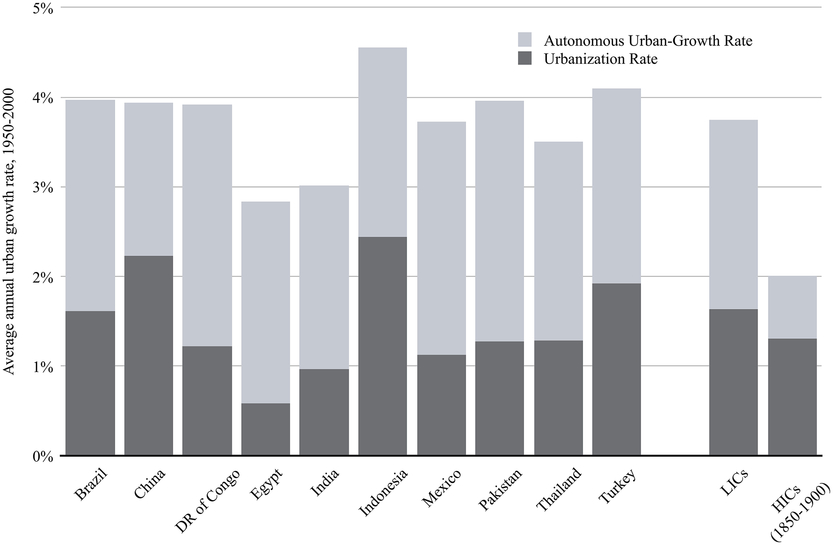
This second form of demographic dispossession was the single largest contributor to proletarianization after 1950, yet it is frequently misconstrued: in analyzing the growth of cities, people have tended to mistake urban population growth due to urban births in excess of urban deaths for that due to rural-to-urban migration (Montgomery et al. Reference Montgomery, Stren, Cohen and Reed2004: 87). It is true that LIC urban populations expanded at an unprecedented pace after 1950: they grew at an average annual rate of 3.7 percent per year between 1950 and 2000 as compared to just 2 percent per year in Europe between 1850 and 1900 (Bairoch and Goertz Reference Bairoch and Goertz1986; see Figure 1). That’s how Lagos, which housed 325,000 people in 1950, could grow to a city of more than 10 million in just 60 years. Analysts such as Harris and Todaro (Reference Harris and Todaro1970) assumed that this rapid growth was due to rapid rates of rural-to-urban migration; they then sought to explain why such migration was so fast.
Urbanization and autonomous urban growth, 1950–2000.
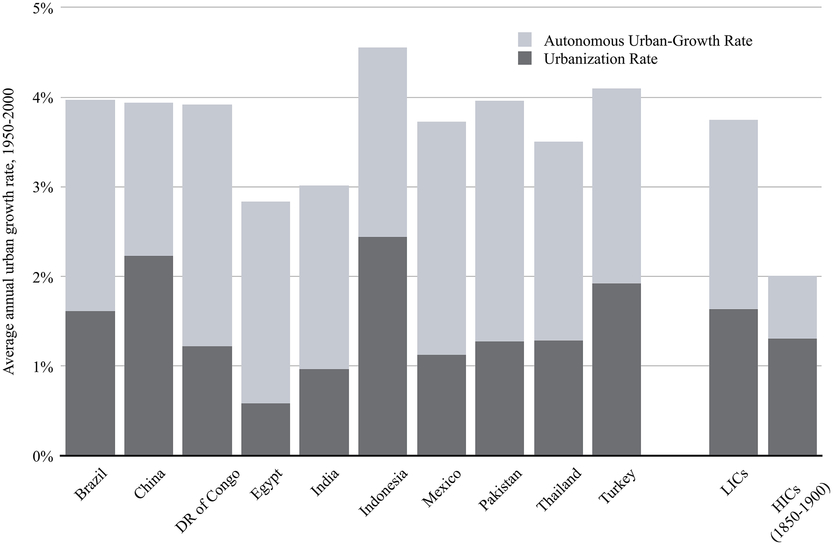
In reality, less than half of urban growth in LICs since 1950 has been due to migration from the countryside. As described previously, rates of in-migration are approximately indicated by the urbanization rate, which measured 1.6 percent per year in the LICs between 1950 and 2000—only somewhat higher than the urbanization rate between 1850 and 1900 in Europe, at 1.3 percent per year. The remainder of urban population growth was due to what demographers call urban natural increase; I call it autonomous urban growth because this growth was not natural but rather changed over time. We can define the autonomous urban growth rate as follows:
 $$autonomous\, urban\, growth\, rate = urban\, growth\, rate - urbanization\, rate.$$
The autonomous urban growth rate measured 2.1 percent per year in the LICs in the second half of the twentieth century, that is, three times as high as the 0.7 percent growth rate achieved in Europe between 1850 and 1900. This autonomous growth largely accounts for the unprecedented character of LIC urban growth: urban populations grew quickly simply because many more people were born in cities than died in them. Increases in the urban labor supply then took place independently of population transfer, as young people came of age and began to look for work.
Recognizing the role of autonomous urban growth in explaining the post-1950 expansion of the global proletariat is key to understanding the overall history of proletarianization. Unlike many of their rural counterparts, urban workers depend on market exchange to meet most of their needs. Such market dependence is all the more extreme for people born in cities: generally speaking, they cannot not migrate “back” to the countryside to take up a rural livelihood that they never knew. The urban born are thus caged within urban labor markets to a much greater extent: they must sell their labor regardless of changes in labor market conditions. In competing to sell their labor, the poorest among the urban born often find themselves at a disadvantage with respect to the rural-to-urban migrants who continue show up in urban labor markets despite the dearth of urban jobs. Those migrants are “usually better educated and have more economic resources” than both the poorest rural and urban dwellers (Tacoli et al. Reference Tacoli, McGranahan, Satterthwaite, Martine, McGranahan, Montgomery and Fernández-Castilla2008: 48).
Dispossession and Informality
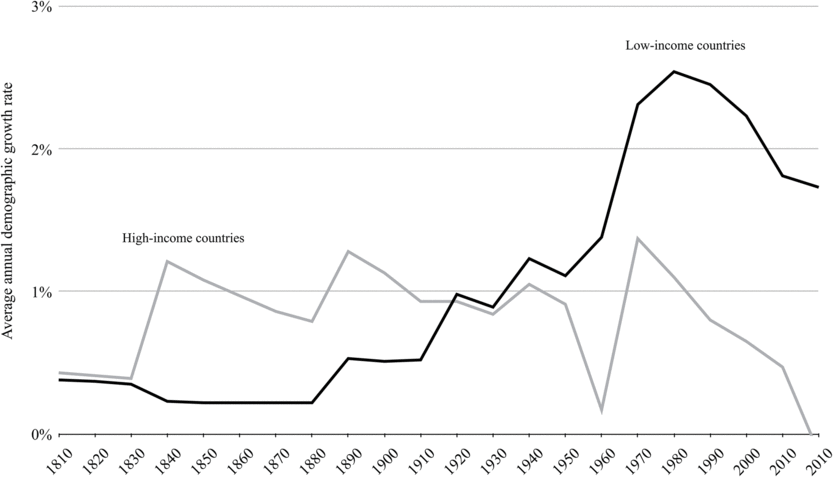
I now turn to the specific role demographic factors played in the informalization of the LIC workforce. The key here is that, unlike migration rates—which tend to vary directly with economic growth rates—rapid population growth rates generate demographic dispossession largely independently of the prevailing speed of economic growth. This feature of demographic dispossession helps explain the accelerating pace of proletarianization over the course of the twentieth century: population growth rates sped up in many LICs in the 1920s and then in all LICs after 1950, leading to an acceleration in the pace of labor-force expansion (Figure 2). Crucially, the labor force continued to expand quickly down to the end of the twentieth century, even after demographic growth rates began to decelerate in the mid-1960s.
Population growth rates, 1800–2010.

Between 1965 and 1985, LIC population growth rates peaked and then slowed, as parents started to have fewer children: in the early 1960s, more than six children were born on average to each LIC family; by the early 1980s, average fertility levels had fallen to a little more than four children. Today, the average LIC family has less than 2.7 children. However, slowing population growth rates did not initially slow the rate of growth of the labor force, for two reasons. First, even as population growth rates fell, more and more people continued to age into the workforce (Bloom et al. Reference Bloom, Canning and Sevilla2003). The result was that an ever-growing share of the population consisted of workers. For example, in China, the total population grew by 110 percent between 1960 and 2010, while the labor force grew by 190 percent. Meanwhile, in Brazil, the total population grew by 170 percent, while the labor force grew by 290 percent.
This trend might have been counteracted by another, namely the tendency of women to drop out of the workforce, at least initially, as the workforce shifts into nonfarmwork. In patriarchal societies, women are tasked with minding young children, and this task is more difficult to perform at work once home and workplace are separated (Mammen and Paxon Reference Mammen and Paxon2000). However, from the 1960s forward, women in LICs began to have fewer children at what were, historically speaking, low levels of GDP per capita. More women remained in the labor force during their childbearing years despite shifting out of agricultural employment (Bloom et al. Reference Bloom, Canning, Fink and Finlay2009).Footnote 8
The consequence was that, although it unfolded at a decelerating pace, demographic growth continued to give rise to major increases in the labor supply. In the waning decades of the twentieth century, these unfolding trends interacted with a global economic slowdown, issuing in a dramatic informalization of urban work.
A Lasting Economic Downturn
A major economic downturn set in across most LICs in the 1980s and 1990s, beginning with the Third World debt crisis of 1982–85. When that crisis hit, LIC economies had already been suffering from employment problems associated with a low employment-intensity of GDP growth, for several decades (International Labour Organization 1969; Seers Reference Seers1970). Those problems were compounded when GDP growth rates fell sharply following the onset of the debt crisis. Many LIC governments subsequently turned to the IMF and World Bank for assistance, adopting structural adjustment programs in an effort to restore previously prevailing rates of growth on a new, supposedly more stable foundation by opening their economies to global trade (UN Conference on Trade and Development 1989; UN-HABITAT 2003). However, in this era, the world economy entered a more turbulent period of lower growth rates punctuated by periodic financial crises (Brenner Reference Brenner2006).
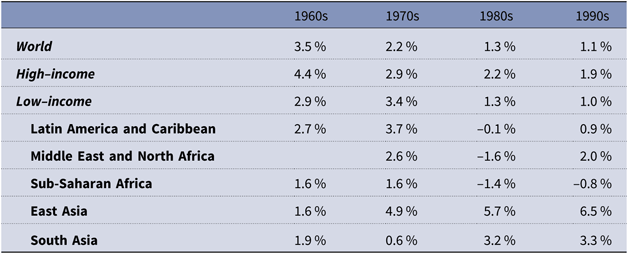
GDP-per-capita growth rates slowed significantly at this time (Table 1). Opportunities to gain from global trade became scarcer, even as the trade share of global GDP rose rapidly. Only a few countries with strong competitive advantages—mostly located in East and Southeast Asia—were able to benefit from those opportunities in a significant way. Outside of East and Southeast Asia, many LICs experienced a “lost decade” in the 1980s (Ocampo Reference Ocampo2004). Growth rates recovered to some extent in the 1990s but remained low or negative. Meanwhile, in South Asia, per capita growth rates rose from the beginning of the 1980s but did so unevenly: on the subcontinent, many states in India continued to see little growth (Kohli Reference Kohli2006, Reference Kohli2012).

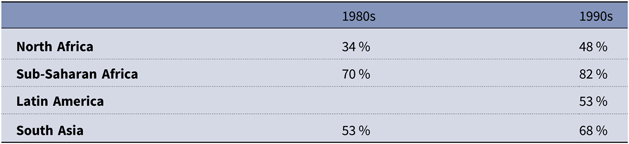
Due to low rates of GDP per capita growth, the 1980s and 1990s were decades of rising informality, as entrants into nonagricultural labor markets encountered a dearth of new employment opportunities (see Table 2). In these years, nonagricultural employment came to account for a much greater share of total LIC employment, so absolute levels of informality rose by more than these statistics suggest. The jobs crisis in the urban areas of many LICs was extreme. Factories closed due to both general economic depression and heightened competition from imports. At the same time, governments laid off large numbers of public employees, as part of programs of austerity. The result was an informalization of formal-sector workers.
Informality rates in the nonagricultural sector, selected regions, 1980–2000

Source: Charmes Reference Charmes2012.
Economic downturns in this period were sharp in rural areas as well. World market prices for most crops declined sharply, putting massive pressure on small producers (Food and Agriculture Organization of the United Nations 2000: 133–34). Making matters worse, government price supports for farmers were often removed in this period as part of IMF-led structural adjustment programs (ibid.: 147). The result, in many countries, was a lasting agrarian crisis, which accelerated an already ongoing agricultural exodus associated with the global displacement of traditional farming by industrial agriculture. Based on evidence from rural areas, some scholars attributed the explosive growth in the informal urban proletariat in the 1980s and 1990s to a wave of in-migration from the countryside associated with dispossession by way of rural differentiation or direct expropriation (Araghi Reference Araghi1995; Davis Reference Davis2006).
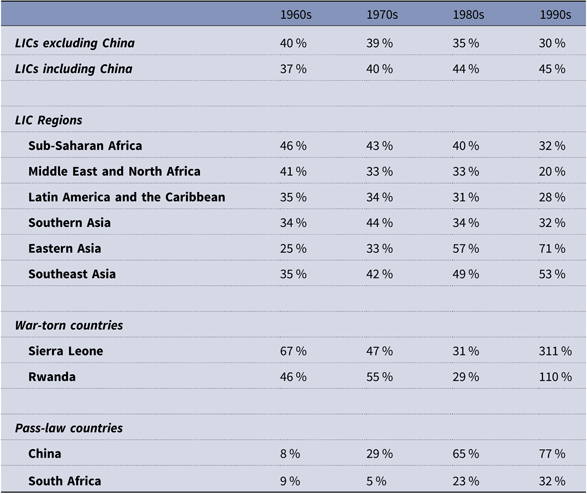
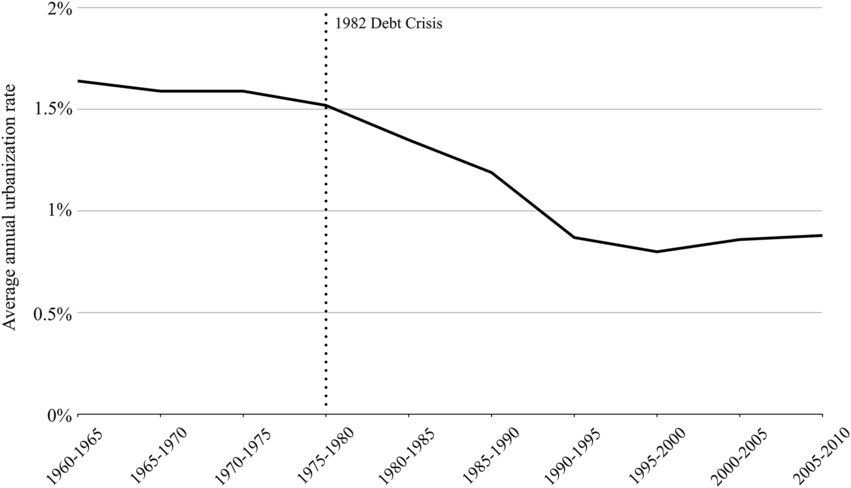
However, if that were true, we would expect the migration share of urban population growth to have risen at this time. Instead, in almost all LICs, the migration share fell (Table 3). Migration shares in most countries had already been falling since the 1950s as a normal consequence of urbanization: as the urban share rises, the relative contribution of migration to urban growth will fall (Montgomery et al. Reference Montgomery, Stren, Cohen and Reed2004: 112–15). However, in many countries, migration shares fell exceptionally quickly in the 1980s and 1990s. By the late twentieth century, migration shares had fallen so significantly across so many countries that UN urbanization projections were thrown off: “the attainment of 50 percent of the population living in urban areas” was delayed “from 2000 to 2007 or 2008” (United Nations 2001: 1). Urbanization rates in LICs after 1980 were lower than expected, even though the urbanization rate in China accelerated after 1979.

The explanation of this phenomenon is that—due to a lasting economic crisis in LIC urban areas—many dispossessed rural dwellers who otherwise would have permanently migrated to cities were unable to do so (see Figure 3). They could not gain footholds in depressed urban economies where job openings were scarce. At the same time, many people found it difficult to generate own-account work for themselves in the urban informal sector because emergent opportunities there largely depend on economic growth occurring in the rest of the economy (Breman Reference Breman1996). Because they could not find steady work, large numbers of people were forced to remain in the countryside, even though job opportunities in agriculture were also declining.
Urbanization rates in LICs, excluding China, 1960–2010.

That contradicts the way rural-to-urban migratory flows are commonly understood. We often assume that people move to cities first and then try to find work, but historically, the reverse has more typically been the case: people secure urban employment—often by means of kinship ties—before they move (Montgomery et al. Reference Montgomery, Stren, Cohen and Reed2004: 327). If no urban employment can be found, people engage in circular migration, coming and going on a temporary basis while looking for more permanent arrangements (Tacoli et al. Reference Tacoli, McGranahan, Satterthwaite, Martine, McGranahan, Montgomery and Fernández-Castilla2008). Circular migration has remained common in many countries precisely because of a lack of urban job opportunities. For the same reason, many rural dwellers have been forced to languish in rural areas—and even to circulate between depressed rural areas or to and from dynamically expanding ones—despite a simultaneous dearth of jobs in agriculture. Rural nonfarm economic sectors are correspondingly expanding (Haggblade et al. Reference Haggblade, Peter and Reardon2007). They house a dispersed informal proletariat, which is the rural counterpart of the concentrated informal proletariat in cities (the ILO recognized the existence of a rural form of informality only in the 1990s, even though Jan Breman and others described its existence soon after the ILO theorized urban informality; see Breman Reference Breman1976; Bromley Reference Bromley1978).
Nevertheless, in spite of reduced rates of rural-to-urban migration, the 1980s and 1990s still saw high rates of urban population growth due to demographic factors. In fact, this was a period of unprecedented urban growth: 1 billion people were added to LIC urban areas between 1980 and 2000. Excluding China (which I consider in the following section), 65 percent of LIC urban growth in the 1980s was due to urban births, rising to 70 percent in the 1990s. At the same time, huge numbers of people who had been born in urban areas joined the labor force. To take two examples, typical of LICs, Mexico and Egypt each saw their nonagricultural workforces double in size in just 20 years between 1980 and 2000. India saw its nonagricultural labor force grow by even more, 134 percent, over the same period, representing an increment of some 96 million additional nonfarmworkers. Many of these new labor-market entrants ended up in the urban informal sector, which grew massively in this period. They had little choice because they had to find work to live.
Exceptions That Prove the Rule
It should be noted that in a few countries, migration shares of urban growth rose after 1980 instead of falling (see Table 3). Looking at these exceptional cases helps us understand the general rule. Countries experiencing rising migration shares fall into three categories. First, there are countries that experienced violent conflicts, such as Sierra Leone and Rwanda. Second, there are countries that repealed “pass laws,” which had formerly made migration to cities illegal. Examples include South Africa and China.Footnote 9 Finally, there were countries that experienced rapid economic growth. While other LICs saw sharp reductions in economic growth rates after 1980s, East and Southeast Asian countries saw economic growth rates accelerate, making it possible for large numbers of poor rural dwellers to find toeholds in urban economies.
Among these exceptional cases, China stands out. The Chinese population is so large and moved against the current to such a large extent that including China in calculations of LIC migration shares of urban growth shifts their direction of change. China was an exceptional case for a variety of reasons but mainly because, after 1979, China began to experience extremely high rates of GDP growth, which remained elevated for decades.Footnote 10 High rates of economic growth in China led to rapid urban job creation, spurring a massive wave of rural-to-urban migration.
Due to high rates of economic growth, China also saw relatively low rates of economic informality: in 2010, informal employment was estimated to be 25 percent of urban employment, which is low compared to LIC averages (Park and Xiaobo Reference Park and Xiaobo2013). These trends and figures set China apart from most other LICs; outside of China, an economic downturn in the 1980s and 1990s caused urbanization rates to decline, rather than rise. Nevertheless, in those other LICs, urban populations continued to grow rapidly, as urban births became the main engine driving urban expansion. The urban born came of age and entered labor markets that, in the context of stagnant economies, were overcrowded. They had little choice but to join the ranks of informal workers.
Demographic Transitions
In the second half of the twentieth century, demographic growth made for an ever-larger proletariat and did so regardless of whether LIC economies were growing quickly. The autonomy of demographic processes from economic ones turned out to be especially crucial in the final decades of the twentieth century, when rapid urban labor-force growth continued in spite of economic stagnation, issuing in an increasing informalization of the urban workforce. The question that now imposes itself is how to explain the specific pattern of demographic growth that was behind demographic dispossession in the LICs. This section argues that patterns of demographic growth shifted significantly over the course of the twentieth century, causing major changes to take place in the form of global proletarianization.
Explaining Population Growth
The immensity of global demographic growth in the twentieth century has given rise to a number of theories that seek to explain its origins. In spite of their unpopularity among demographers, Malthusian or more broadly “populationist” accounts—which argue that poor people are having too many children relative to available resources—are still commonplace (Angus and Butler Reference Angus and Butler2011). Malthusianism does offer a powerful explanation of premodern population growth. Over the long history of agrarian civilizations, populations tended to grow during times of peace and empire building until they hit the limit of what their existing resource bases could support, given a relatively fixed technological level and a rigid social structure (Turchin Reference Turchin2009). At that point, prices for food crops rose relative to those of land and manufactures, leading to instability and war, with the consequence that population levels stabilized or declined. That in turn caused the terms of trade for food crops to move in the opposite direction (Brenner Reference Brenner and Wickham2007).
However, such patterns cannot account for twentieth-century trends. In the twentieth century, there was no resource cliff. Between 1900 and 2000, the size of the global population increased by 270 percent, yet real prices of food crops decreased by 60 percent (Pfaffenzeller et al. Reference Pfaffenzeller, Newbold and Rayner2007). In 2000, there were still 750 million malnourished people in the world, but their plight had little to do with global resource constraints (Food and Agriculture Organization of the United Nations 2000: 190). On the contrary, that plight was largely the result of agricultural overproduction in an era of industrialized farming.Footnote 11 The global population has not, therefore, overshot its resource base. Yet, in spite of this fact, population growth rates have slowed significantly since the mid-1960s, falling from almost 2.1 percent per year in the late 1960s to less than 1.2 percent per year in the early 2010s.Footnote 12
The combined effects of (1) falling food prices in spite of rapid population growth and (2) falling fertility levels in spite of rising life expectancies broke the pattern of Malthusian cycles that formerly governed agrarian civilizations. In the mid-twentieth century, an alternative account emerged that sought to explain these trends as part of a wider story of modern social-structural change (Szreter Reference Szreter1993). Malthusians had feared that rapid population growth in the nineteenth and twentieth centuries was a consequence of the fact that people, particularly poor people, were having more children than before. Proponents of the demographic transition theory showed that, in reality, parents were mostly having the same number of children as before; populations were growing rapidly primarily because fewer children were dying. In the HICs, people eventually responded to higher survival rates by having fewer children. In the 1940s, demographic transition theorists predicted, correctly, that the same process would unfold in LICs (Davis Reference Davis1945). These theorists pointed out, however, that the fertility adjustments that bring the era of rapid population growth to an end occur only after a delay of some decades. Due to this decades-long delay between falling mortality rates and falling fertility rates, rapid population growth rates persist for a long time (once they begin to fall, fertility levels also have to chase a moving target because mortality rates continue to fall as well). That is precisely what happened in the low-income world.
Yet the version of demographic transition theory popularized in the mid-twentieth century by Frank Notestein (Reference Notestein and Schultz1945) and Kingsley Davis (Reference Davis1945)—which remains the one most familiar to historians—is less useful in explaining population trends in the low-income world. That account relied on a tight connection between economic modernization, on the one hand, and falling mortality and fertility, on the other. Notestein and Davis theorized that, in a first phase, economic modernization would reduce mortality rates without altering parents’ demand for large families: parents would continue to demand large families because having children served as a form of social security for the elderly; children could also be employed as farmhands after a few years of age. Supposedly, the demand for large families would continue unabated until a second phase, when further modernization transformed the reigning social values, elevating the individual over the collective and leading to a demand for small families rather than large ones.
In fact, as became clear in the 1960s and 1970s, both phases of the demographic transition were unfolding in countries where no economic modernization was taking place. For example, John Cleland (Reference Cleland2001: 74) points out that in Bangladesh, GDP per capita stagnated at $280 between 1970 and 1990, yet over that same period, average life expectancies rose from 46 to 56 years, and fertility levels fell from 6.9 to 5.0 children per family. Economic growth was a precondition of neither falling mortality levels nor a declining demand for children. That fertility levels could decline under so many different conditions was particularly surprising to demographers (Bongaarts and Bulatao Reference Bongaarts and Bulatao2001: 56). No socioeconomic shift appeared to be necessary to start the process. Fertility declined in countries where school enrollments were rising as well as where they were falling (ibid.: 59). The most accurate predictor of fertility decline is literacy; however, in some societies with high literacy levels, fertility fell slowly (ibid.). One might suppose that the reason why no single socioeconomic factor explains fertility decline is that some states promoted family planning, yet studies of the effects of such state intervention have proven inconclusive, and fertility declined even where governments were indifferent or hostile to family planning (Livi-Bacci Reference Livi-Bacci2006: 161). On the basis of these observations, Szreter (Reference Szreter2011) has suggested that there can be no general theory of demographic transition, only specific histories in each country. Yet there are few historical phenomena more global in their scale and scope.
Here, I rely on an alternative perspective, originally put forward by Wilson and Airey (Reference Wilson and Airey1999), which claims that the only prior event needed to set the fertility transition in motion in any country is the mortality transition (see also Cleland Reference Cleland2001; Dyson Reference Dyson2001, Reference Dyson2010). Wilson and Airey’s revision to demographic transition theory is based on historical research that revealed that in the HICs before the onset of fertility transitions, fertility levels varied widely (Wilson and Airey Reference Wilson and Airey1999: 121). Maximum human fertility levels were also far higher than demographers had expected. Thus, even before the demographic transition began, populations must have had at their disposal both means of adjusting fertility and also reasons for doing so. The fact that populations grew extremely slowly in the past led Wilson and Airey to conjecture that before the transition, societies must have controlled fertility levels so that they approximately balanced mortality levels (ibid.: 120). In reality, birth rates were slightly higher than death rates, generating slow population growth and population cycles. Nevertheless, it appears to be the case that in pretransitional societies, people generally limited fertility so populations did not grow quickly. Those societies may have valued large families, as earlier theorists supposed, but having a large family was a matter of fate rather than effort: it meant that more of one’s children survived infancy and early childhood (Cleland Reference Cleland2001). For every family blessed with many surviving children, there was likely to be at least one family cursed with no surviving children.
Declining infant and child mortality levels in the modern era then acted as a shock to pretransitional demographic regimes, generating socially destabilizing rates of population growth (ibid. 2001: 82). Each successive generation was much larger than the last, upending long-standing practices of intergenerational resource management. Neither modernization nor any other factor had to be present for people to react to the destabilizing consequences of population growth by reducing fertility levels (Dyson Reference Dyson2001: 71). Declining mortality and the rapid population growth it entailed were destabilizing in themselves. The delay between the two legs of the demographic transition is then explained simply as a delayed reaction: before they adopt modern methods of contraception, people have to be convinced that falling child mortality rates represent a secular rather than cyclical change. That takes time: typically, women who already have more than two surviving children are the first in their communities to use contraceptives (Cleland Reference Cleland2001: 78). As feminist scholars have argued, reducing fertility also requires shifts in change-resistant patriarchal social relations (Janssens Reference Janssens2007; Mackinnon Reference Mackinnon1995).
This alternative account is key to understanding the histories of both the demographic transition and demographic dispossession in the low-income world, encouraging us to focus our attention on the global history of the mortality transition. In the two centuries after 1800, the modern mortality transition underwent its own, twofold transformation. First, its pace accelerated as it uncoupled from rising incomes associated with economic development. Second, it became more urban in character. Both of these shifts preceded the onset of the demographic transition in the LICs and largely explain the difference between recent patterns of population growth in low-income countries and the historical experiences of high-income countries.
Mortality Declines Accelerate
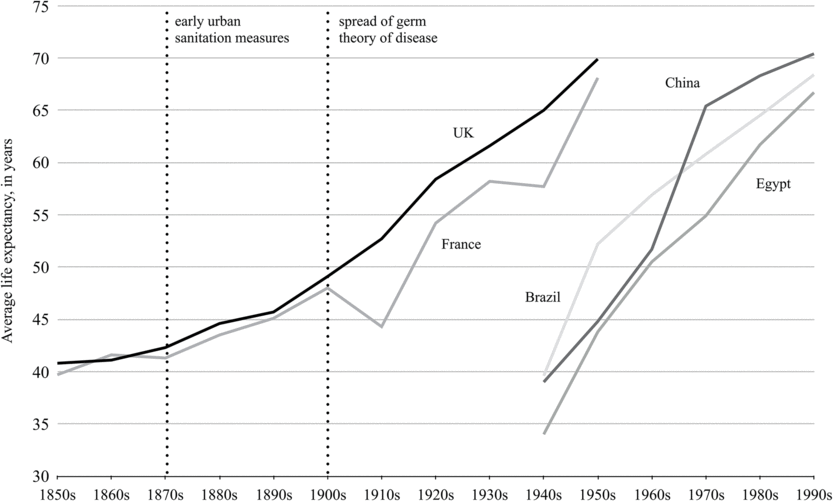
It is possible to measure the long-term acceleration of the global mortality transition by the pace at which gains in life expectancy were achieved in different periods. Gains in life expectancy in Western Europe between 1830 and 1900 measured just 0.14 years per year. By contrast, for the world as a whole, gains in life expectancy between 1900 and 1950 were on the order of 0.25 years per year, rising further to 0.31 years per year between 1950 and 2010. Due to this accelerating pace, the leap in life expectancy from 40 years to 65 years took place more quickly in the LICs in the twentieth century than it had in the HICs in the nineteenth and early twentieth centuries (see Figure 4). In Germany, average life expectancies took 130 years (1820–1950) to rise from 41 to 67 years; China made roughly the same leap, from 39 to 65 years, in less than one third of the time (1940–80). The disruption to modes of life brought on by rising life expectancies was therefore much more sudden in LICs than it had been in HICs.Footnote 13 As survival rates rose, population growth rates spiked to between 2 and 3 percent per year, in turn causing a massive wave of demographic dispossession to unfold across the low-income world. In most countries, the fertility transition began within 25 years of 1950 and unfolded rapidly. Between 1967 and 1997, LIC fertility levels fell by 50 percent, from six children born per woman to three children. But once again, fertility levels were chasing a moving target: mortality levels fell so quickly that, in spite of rapidly declining fertility, population growth rates remained elevated.
Average life expectancy, 1850–2000.

To understand why the pace of the mortality transition accelerated over time, we have to recognize that this transition was, in essence, an “epidemiological transition” (Omran Reference Omran1971; Riley Reference Riley2001). In the past, people died more frequently of communicable diseases such as typhoid fever and gastroenteritis; today, people die more frequently of degenerative diseases such as heart disease and cancer (that has dramatic effects on rates of child mortality because children are particularly susceptible to death by communicable disease). In the early modern period, this epidemiological shift started to unfold first in northwestern Europe and then in the rest of Europe as a result of the capitalist transformation of agricultural production and distribution (Fogel Reference Fogel2004). Mortality rates improved largely due to a greater stability of calorie intake and then due to improving sources of nourishment. On this basis, some analysts argued that economic development would always be the major source of falling mortality levels (McKeown Reference McKeown1976).
In reality, by the late nineteenth century, a dramatic shift had taken place in the major mechanisms of the mortality transition. Improvements in the production of lenses—taking place as part of the Second Industrial Revolution—made it possible to develop powerful microscopes, which allowed scientists to see bacteria and infer the existence of viruses (Caldwell Reference Caldwell2006: 166). These scientists formulated a germ theory of disease, which revolutionized the understanding of the disease transmission from the 1880s onward and issued in major innovations in public health and medicine. New knowledge was eventually embodied in goods such as vaccines and antibiotics, which were cheap to distribute, especially when and where international institutions were willing to assist state governments (Caldwell Reference Caldwell1986; Soares Reference Soares2007). Many other innovations arising from germ theory were nearly costless to implement, such as hand-washing, isolating the sick, and boiling drinking water (Riley Reference Riley2001:188). Once these means of reducing mortality were discovered, they only had to be communicated to others to be effective.
It is highly likely that these latter, relatively costless innovations were responsible for the dramatic decline in mortality levels that took place in many LICs in between the 1920s and 1960s because these declines frequently occurred in countries that saw little increase in GDP per capita levels (Riley Reference Riley2005). For example, Jamaica experienced particularly rapid declines in mortality between 1920 and 1950 in spite of zero increase in per capita incomes, largely as a result of effective government information campaigns (ibid.: 100–1). The upshot is that, in LICs, declining mortality levels were increasingly uncoupled from economic growth, allowing dramatic declines in mortality to take place even where economic growth rates stagnated or collapsed.Footnote 14
Advances in public health and medicine resulting from the elaboration of the germ theory had their most dramatic effects on urban mortality levels. Until the late nineteenth century, urban areas were demographic sinks: more people died in cities than were born in them because disease transmission rates were especially high where populations were dense (Dyson 2010: 24). That slowed the pace of population growth in HICs in the nineteenth century because the demographic transition was accompanied by urbanization (Riley Reference Riley2008: 22). Innovations based on the germ theory of disease subsequently removed the brakes on urban autonomous growth. However, by the time the germ theory was elaborated, HIC fertility levels were already beginning to fall. As a result, life expectancy rose rapidly but did not cause population growth rates to spike.
LIC demographic transitions were different in this regard: cities acted as autonomous sources of population growth from the start of those transitions. That explains the fundamental difference between the character of the demographic transition in the HICs and the LICs: in the latter, population growth rates were simultaneously much higher and more urban. That also helps explain why demographic factors were overlooked in the history of global proletarianization: in LICs, autonomous urban growth contributed to unprecedented urban and overall population growth rates, which had no historical correlate in the high-income world.
In sum, the global mortality transition began with and was tied to rising incomes associated with the transition to capitalism. Over time, however, due to the capitalist transformation of production and associated developments in science, the mortality transition unmoored itself; it became relatively autonomous from economic development. On that basis, the demographic transition began to unfold across populations that may have been imbricated in market exchange but were not dependent on that exchange for their survival. That explains the global extent of proletarianization in the world economy today—why it has taken place even where substantial economic development is absent.Footnote 15 Urban labor forces have expanded largely due to population growth. People come of age and need to find work, regardless of labor-market conditions because working is the only way they can gain access to a meagre share of humanity’s abundant wealth.
Conclusion
Population growth has formed a key backdrop to the expansion of capitalist economies for more than two centuries. Between 1820 and 1920, the global population increased from 1 billion to 2 billion people. Over the subsequent 98 years, it then expanded to more than 7 billion people, of which more than 4 billion are urban dwellers. Looking at this sevenfold increase, taking place over two centuries, it is easy to see that demographic dispossession was the major cause of the expansion of urban workforces in the modern era—even if its effects were dampened in the first three-quarters of the nineteenth century by high rates of urban mortality.
A major consequence of demographic dispossession has been that, year after year, enterprises have found at their disposal a growing supply of young recruits needing to find work to live. What will happen to capitalist economies in the future as the pace of demographic expansion continues to slow down and then begins to go into reverse? Such a reversal is already unfolding in a number of HICs, but over the coming decades, it will take place in many LICs, too (Reher Reference Reher2007). The entire world will likely experience its population peak within the next half century, as more and more countries see average fertility levels fall below the replacement rate. In fact, as long as already unfolding demographic tendencies continue, the population is likely to be smaller in the year 2100 than it was in the year 2000.Footnote 16 That might finally reverse the advantage that capital has in sourcing labor from oversupplied markets.
Still, that turning point is decades away. Before then, the world’s population will likely increase by another 1.5 to 2 billion people, with nearly all that growth taking place in the urban areas of LICs. In reflecting on the whole, modern period of growth, it is important to remember that the increase in the global population has not been the result of unrestrained sexualities or of change-resistant cultures. Instead, modern population growth has largely been an unintended consequence of a health transition, which has itself been part of a wider transition in global human development. World life expectancies have risen from 30 years in 1900 to almost 70 years today, largely but not exclusively due to declines in child mortality levels. Over the same period, literacy rates among those ages 15 and older climbed from 21 percent in 1900 to more than 80 percent; average years of education rose from 1.7 years per person to 7.7 years; and urbanization shares rose from 13 percent to 54 percent. In all these cases, disparities between HICs and LICs remain large, but that does not change the fact that today’s population is not only larger; it is also healthier, more educated, more urban and more interconnected than ever before.
Over the past two centuries, the capacities of human beings have increased by leaps and bounds. So have their expectations for their lives, as made apparent in, among other things, billions of individuals’ efforts to acquire educations in search of a better life. The problem people face in large parts of the world is a persistently low demand for their labor, which has pushed a billion people into the nonfarm informal labor force and has left additional hundreds of millions to languish in rural poverty who might otherwise have moved to cities.