Introduction
Carboniferous and Permian coral faunas of Iran were studied extensively in the last century (Douglas, Reference Douglas1936). However, most studies focused on the Permian materials and mainly on the Alborz areas, northern Iran (e.g., Douglas, Reference Douglas1936, Reference Douglas1950; Hudson, Reference Hudson1958; Flügel, Reference Flügel1964, Reference Flügel1968, Reference Flügel1972, Reference Flügel1990, Reference Flügel1994, Reference Flügel1995; Graf, Reference Graf1964; Ezaki, Reference Ezaki1989, Reference Ezaki1991), with a few exceptions, such as the Mississippian corals described from northern Iran (Flügel, Reference Flügel1963) and eastern Iran (Flügel, Reference Flügel1991) and the Early Pennsylvanian corals documented from east-central Iran (Badpa et al., Reference Badpa, Poty, Ashouri and Khaksar2016). Nevertheless, no Late Pennsylvanian and early Permian corals have been reported from Iran due to a lack of favorable environmental conditions at this time interval in most areas. Recently, a Gzhelian to Asselian carbonate sequence was discovered and confirmed by abundant fusulinids in the Tabas area, eastern central Iran (Leven and Taheri, Reference Leven and Taheri2003; Leven and Gorgij, Reference Leven and Gorgij2006, Reference Leven and Gorgij2011a, Reference Leven and Gorgij2011b), which provides the possibility of finding corals in this interval.
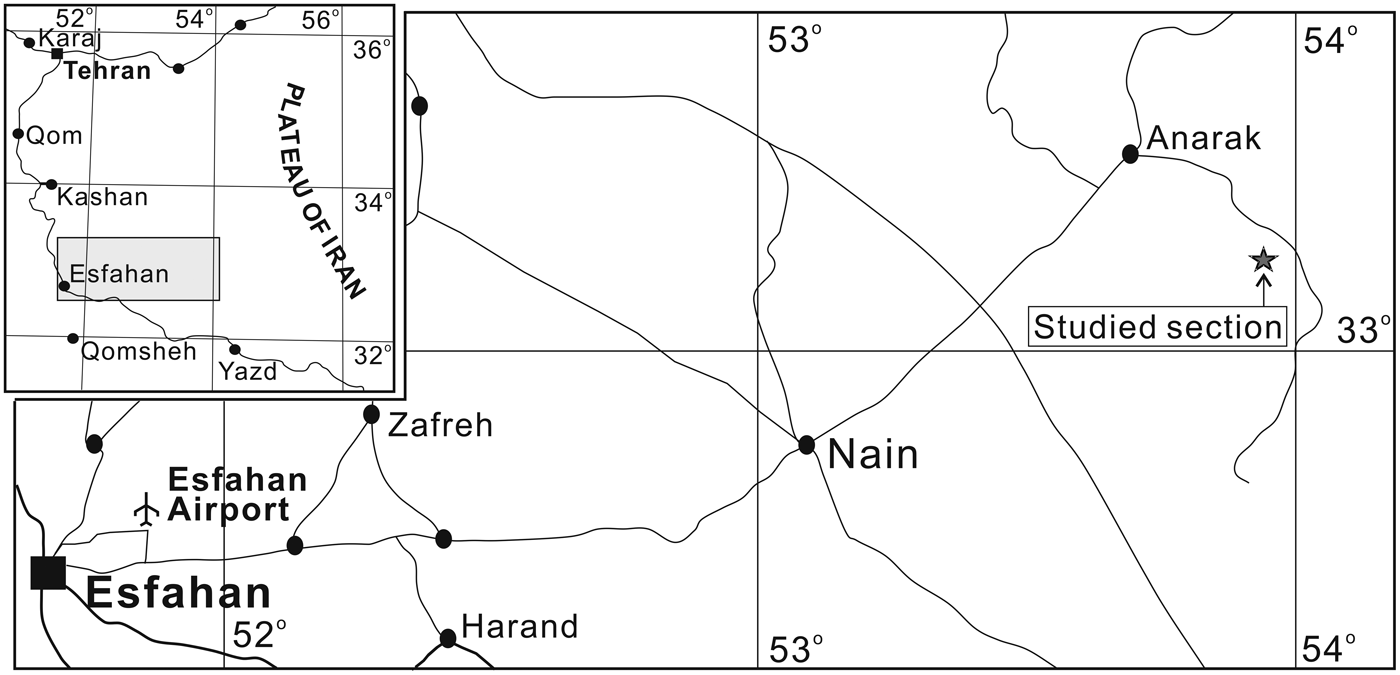
Abundant and diverse rugose coral specimens were collected from the Anarak section located about 30 km southeast of Anarak town, central Iran, which can be easily reached from Esfahan (Fig. 1). In this paper, the main aims are: (1) to describe and decipher the composition of this Iranian coral fauna; and (2) to determine its stratigraphical and paleobiogeographical implications.
Geographical map with the location of studied section in Iran.

Stratigraphy and paleobiogeography
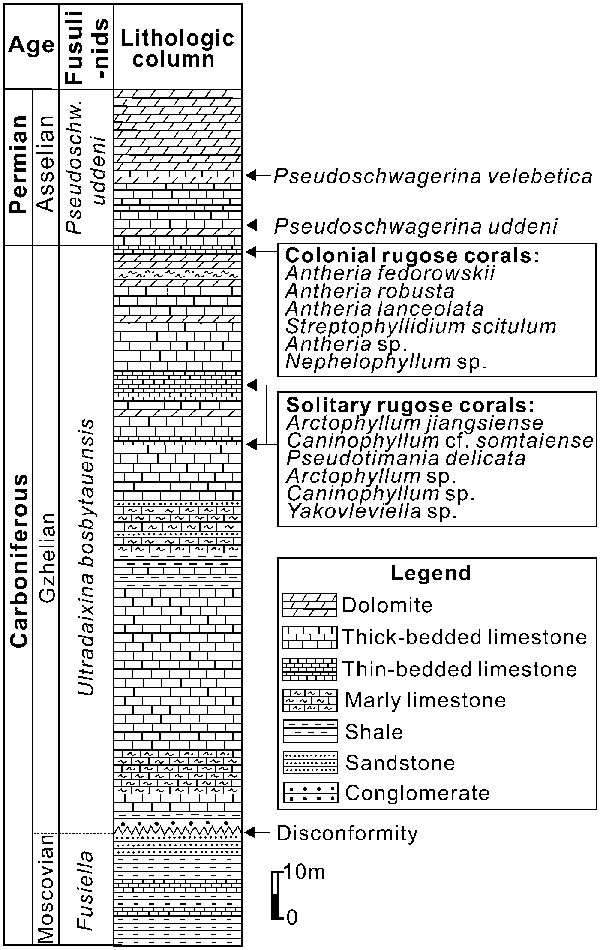
A continuous carbonate sequence ranging from the late Gzhelian to Asselian occurs in the Anarak area, eastern Esfahan district, central Iran (Figs. 1, 2). More than 200 m of this sequence was measured, and it comprises limestones, marly limestones, and dolomites, with a few sandstones and shale intercalations in the middle part (Fig. 2). This sequence has a less than 1-m-thick conglomerate bed at the base, indicating a disconformable contact with its underlying clastic strata (Fig. 2). The fusulinid biostratigraphy shows that this disconformity represents a depositional hiatus lasting from the late Moscovian through the Kasimovian to the early Gzhelian (Leven and Gorgij, Reference Leven and Gorgij2006). The Carboniferous and Permian (C/P) boundary is placed at 130 m above the conglomerate bed based on the first occurrence of the fusulinid Pseudoschwagerina (Fig. 2). Abundant aulophyllid (Yakovleviella sp.), bothrophyllid (Caninophyllum cf. somtaiense, Pseudotimania delicata, and Caninophyllum sp.), and cyathopsid (Arctophyllum jiangsiense and Arctophyllum sp.) solitary rugose corals occur at two horizons, about 40 and 30 m respectively, below the C/P boundary, and kepingophyllid (Antheria fedorowskii n. sp., Antheria lanceolata, Antheria robusta n. sp., Streptophyllidium scitulum, Antheria sp., and Nephelophyllum sp.) colonial rugose corals are present just 2 m below this boundary (Fig. 2). These coral faunas are associated with diverse fusulinids, including Rauserites and Ultradaixina bosbytauensis (Leven and Gorgij, Reference Leven and Gorgij2006), indicating a latest Gzhelian age (Fig. 2).
Lithologic column of the studied section and stratigraphic distribution of corals with key fusulinids.

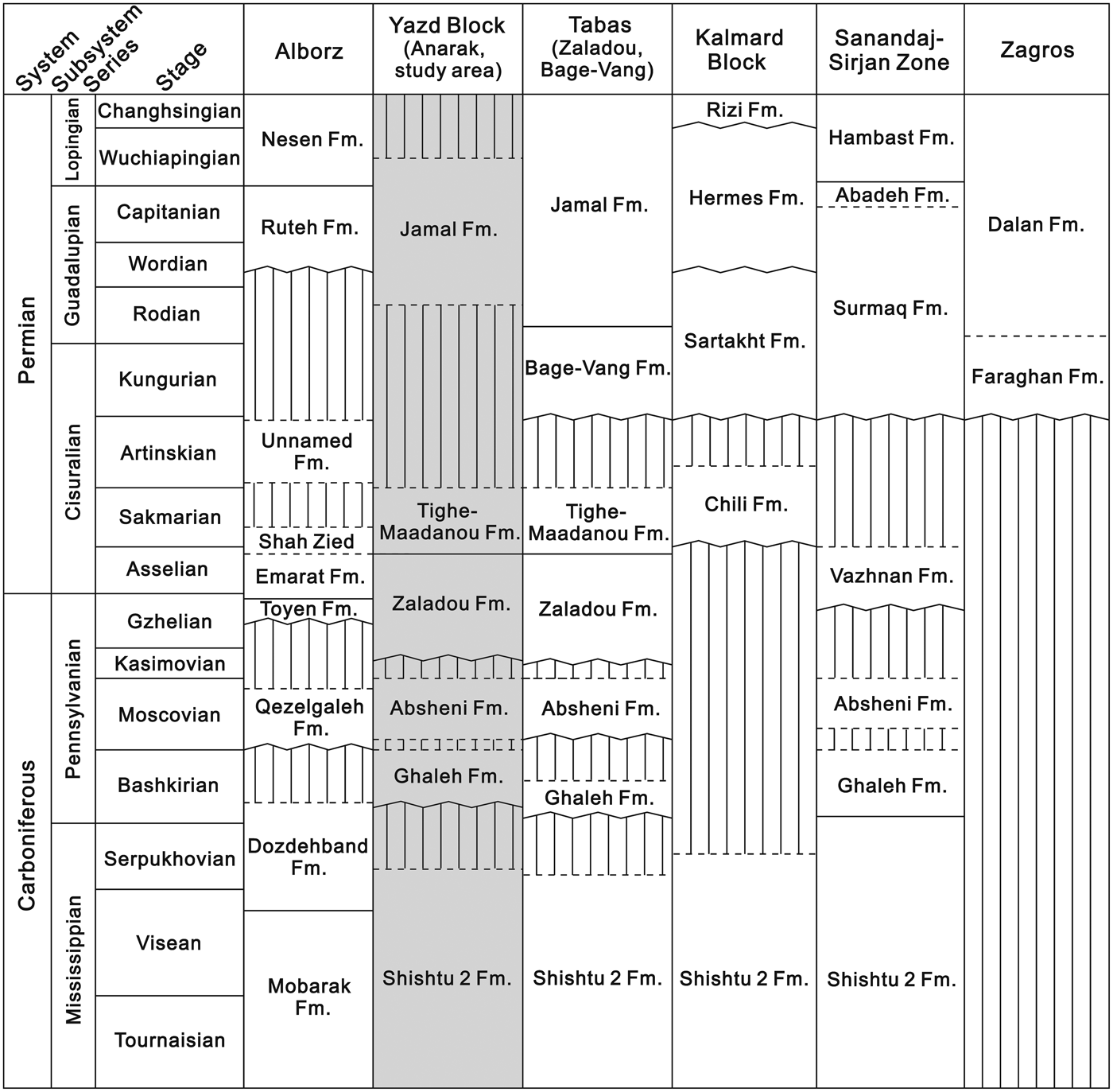
Comparable Carboniferous and Permian transitional strata are present in the Tabas area, eastern central Iran (Vachard, Reference Vachard, Wagner, Winkler and Granados1996; Alsharhan and Nairn, Reference Alsharhan, Nairn, Scholle, Peryt and Ulmer-Scholle1995; Leven and Taheri, Reference Leven and Taheri2003; Leven and Mohaddam, Reference Leven and Mohaddam2004). In central and western east Iran, the Carboniferous to Permian succession generally consists of the Shishtu, Ghaleh, Absheni, Zaladou, Tighe-Maadanou, and Jamal formations in ascending order (Partoazar, Reference Partoazar1995; Leven and Taheri, Reference Leven and Taheri2003; Leven and Gorgij, Reference Leven and Gorgij2011b) (Fig. 3). The Shishtu Formation includes Devonian and Mississippian strata, while the Ghaleh and Absheni formations contain the Pennsylvanian (Bashkirian and Moscovian stages) (Leven et al., Reference Leven, Davydov and Gorgij2006; Leven and Gorgij, Reference Leven and Gorgij2011b) (Fig. 3). The lateral lithologic changes of the Carboniferous–Permian transitional strata (the Zaladou Formation) are very large, even within this small area around Tabas, central Iran. In the Zaladou section, 100 km north of Tabas, the upper part of the Zaladou Formation is composed mainly of clastics with about a 30 m thickness of limestone at the top part, which is overlain by dolomites belonging to the lower part of the Tighe-Maadanou Formation (Leven and Taheri, Reference Leven and Taheri2003; Leven and Gorgij, Reference Leven and Gorgij2011b) (Fig. 3). In the Bage-Vang section, 50 km north of Tabas, the upper part of the Zaladou Formation is composed completely of clastics overlain by marl, marly limestone, and limestone that contain Bolorian fusulinids and belong to the lower part of the Tighe-Maadanou Formation (Leven and Vaziri, Reference Leven and Vaziri2004; Leven and Gorgij, Reference Leven and Gorgij2011b). In the studied section, however, 200 km southwest of Tabas, the Carboniferous–Permian transitional beds, comprising limestones, marly limestones, and dolomites, were named the Zaladou Formation by one of the authors (Gorgij) in an unpublished report. Such distinctive facies changes within short distances imply that an unstable shelf depositional environment existed in central Iran during the Carboniferous–Permian transitional time. These various sequences may represent different shallow-water environments on relatively independent and separated blocks or islands distributed in the southern margin of the Paleotethys (Domeier and Torsvik, Reference Domeier and Torsvik2014). The remaining Permian strata are placed in the Jamal Formation (Leven and Gorgij, Reference Leven and Gorgij2011b) (Fig. 3).
Correlation of the Carboniferous–Permian strata in different regions of Iran (revised from Leven and Gorgij, Reference Leven and Gorgij2011b). Gray shading indicates the studied area.

Late Pennsylvanian corals are unknown from the Gondwanan and Cimmerian (Peri-Gondwanan) continents because of a depositional hiatus or lack of limestones (Wang et al., Reference Wang, Ueno, Mizuno and Sugiyama2001; Wang and Sugiyama, Reference Wang and Sugiyama2002). This absence of coral faunas was followed by the early Permian coral faunas characterized by non-dissepimented solitary types. In contrast, abundant large dissepimented solitary and compound corals occurred in the Paleotethyan regions during the Late Pennsylvanian and early Permian times. Therefore, the presence or absence of Late Pennsylvanian large solitary and compound corals is useful to differentiate between the faunas of Tethyan and Gondwanan (also Peri-Gondwanan) paleobiogeographical affinity. During the Late Pennsylvanian, the coral families Aulophyllidae, Bothrophyllidae, Cyathopsidae, and Kepingophyllidae are absent from the Gondwanan and Peri-Gondwanan regions, but widely present in the Paleotethyan realm, especially the Kepingophyllidae, only known from China and Indochina as a typical Cathaysian representative (Fedorowski, Reference Fedorowski1997). Thus, the occurrence of Dibunophyllinae, Bothrophyllidae, Cyathopsidae, and Kepingophyllidae in central Iran indicates that this region may have a close biogeographical relationship with China and Indochina of the Cathaysian province rather than the Gondwanan and Cimmerian continents of the Cimmerian province (Wang and Sugiyama, Reference Wang and Sugiyama2002; Wang et al., Reference Wang, Yao, Lin, Lucas and Shen2018). The studied area may have been located at an intermediate latitude between the Cimmerian continents and South China and Indochina blocks. As mentioned earlier, a number of blocks or islands that were distributed in the southern margin of the western Paleotethys might have provided a good migration route for connecting with the Chinese and Indochina blocks (Fedorowski, Reference Fedorowski1997; Wang et al., Reference Wang, Yao, Lin, Lucas and Shen2018).
Materials and methods
Thirty-two samples (9 massive colonial rugose corals and 23 solitary rugose corals) were collected by one of the authors (Gorgij) in the Anarak section, northeast of Nain, Esfahan Province, central Iran (Fig. 1). A total of 70 transverse and longitudinal thin sections were produced using standard techniques and were photographed and identified with a Nikon E800 microscope. Based on these thin sections and specimens, 12 rugose coral species belonging to seven genera are described and discussed. The morphologic terminology used here follows that of Hill (Reference Hill and Teichert1981), Poty (Reference Poty1981), and Wu and Kong (Reference Wu and Kong1983).
Repository and institutional abbreviation
All the studied specimens are registered with the prefix NIGP and housed in the Nanjing Institute of Geology and Paleontology (NIGP), Chinese Academy of Sciences, Nanjing, China. GSTJ: Geological Survey Team, Jiangxi.
Systematic paleontology
Class Anthozoa Ehrenberg Reference Ehrenberg1834
Subclass Rugosa Milne-Edwards and Haime, Reference Milne-Edwards and Haime1850
Order Stauriida Verrill, Reference Verrill1865
Suborder Caniniina Wang, Reference Wang1950
Family Cyathopsidae Dybowski, Reference Dybowski1873
Genus Arctophyllum Fedorowski, Reference Fedorowski1975
Type species
Campophyllum intermedium Toula, Reference Toula1875. Novaya Zemlya, Russia (Toula, Reference Toula1875, p. 50, 51, pl. 5, figs. 13, 14).
Diagnosis
Solitary rugose corals. Alar septa are well developed and counter-septum is shortened in neanic stage. Major and minor septa are continuous in ephebic stage. Cardinal septum is shortened with open cardinal fossula, while counter-septum is less so. Dissepimentarium is narrow without lonsdaleoid vesicles (Fedorowski, Reference Fedorowski1975).
Occurrence
Pennsylvanian, Novaya Zemlya and Moscow Basin, Russia (Chwieduk, Reference Chwieduk2014); lower Gzhelian, Donets Basin, Ukraine (Ogar, Reference Ogar2010); Gzhelian–lower Permian, Spitsbergen, Norway (Chwieduk, Reference Chwieduk2014).
Arctophyllum jiangsiense Zhu and Zhao, Reference Zhu and Zhao1992
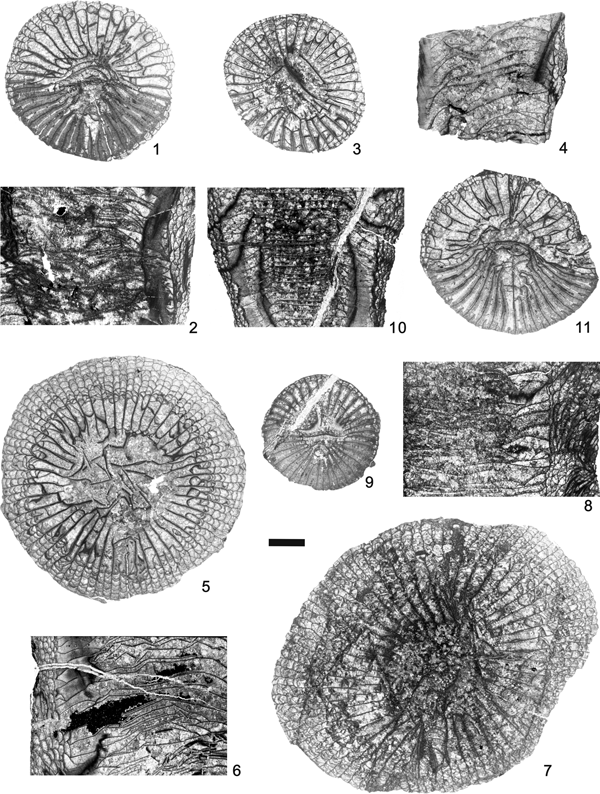
Figure 4.1, 4.2
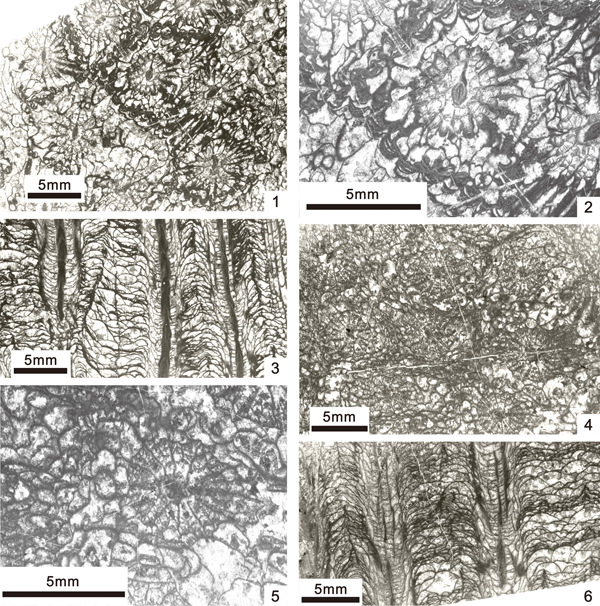
Solitary rugose corals from the Zaladou Formation in the Anarak section in Esfahan, central Iran: (1, 2) Arctophyllum jiangsiense, transverse and longitudinal sections, NIGP168840; (3, 4) Arctophyllum sp., transverse section, NIGP168847, and longitudinal section, NIGP168845; (5, 6) Caninophyllum cf. somtaiense, transverse and longitudinal sections, NIGP168854; (7, 8) Caninophyllum sp., transverse section, NIGP168857, and longitudinal section, NIGP168856; (9, 10) Pseudotimania delicata, transverse and longitudinal sections, NIGP168861; (11) Yakovleviella sp., transverse section, NIGP168862. Scale bar = 5 mm.

Holotype
GSTJ JG-1/JG-2 from the Chuanshan Formation (Upper Pennsylvanian), Jiangxi Province, China (Zhu and Zhao, Reference Zhu and Zhao1992, pl. 1, fig. 1a, b).
Diagnosis
Solitary rugose coral. The specimen 20 mm in diameter contains 34 septa in both orders. Major septa are four-fifths of the corallite radius. They are strongly thickened with lateral connection in cardinal quadrants and thinner in the counter-quadrants within the tabularium. Minor septa are within dissepimentarium. Cardinal septum is shortened within obvious cardinal fossula. Dissepimentarium is narrow with herringbone dissepiments. Four or five tabulae develop within height of 5 mm (Zhu and Zhao, Reference Zhu and Zhao1992).
Occurrence
This species occurs in the Zaladou Formation at the Anarak section in Esfahan, central Iran, belonging to the Gzhelian stage of the Upper Pennsylvanian.
Description
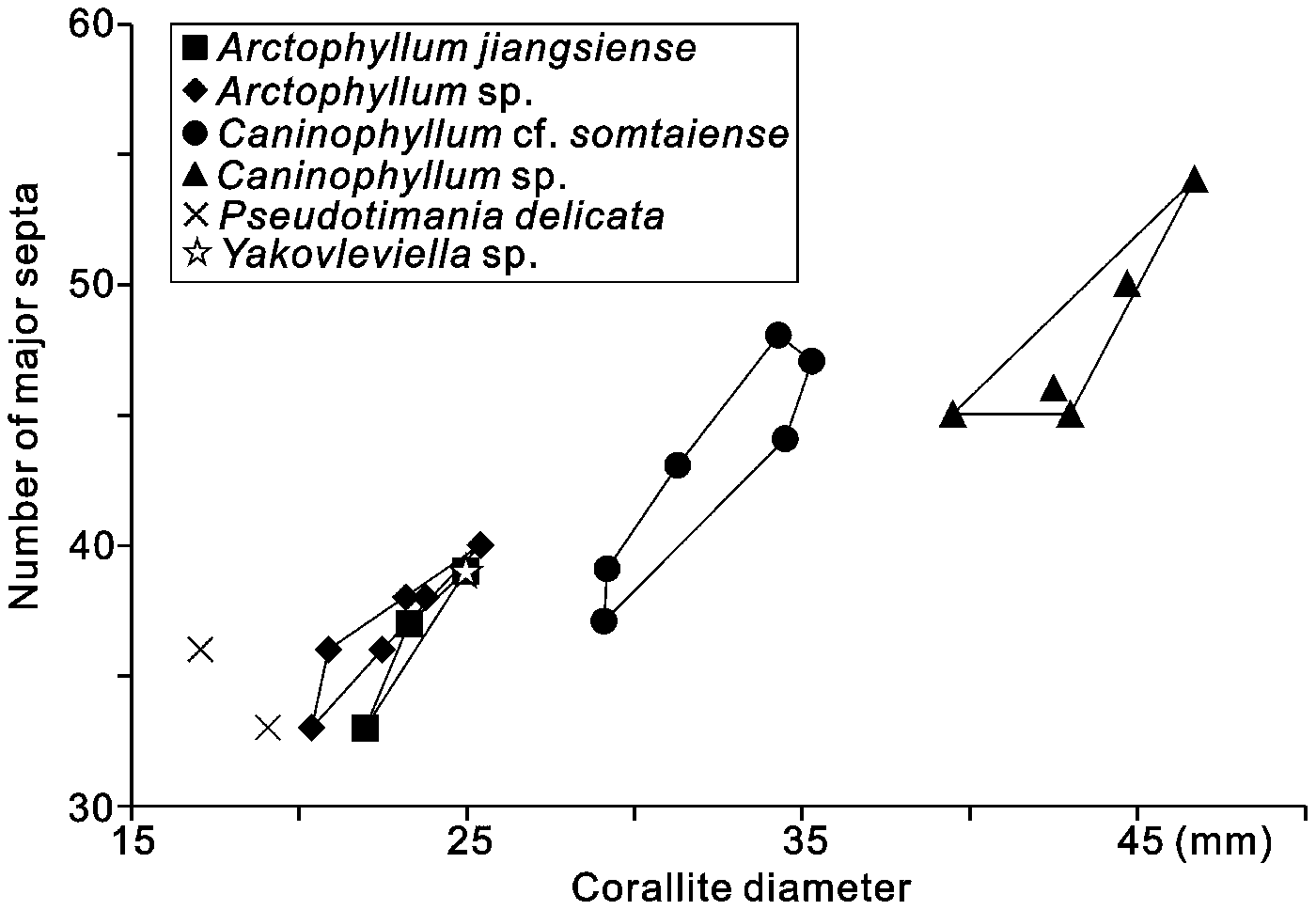
In transverse section, corallites are round in form. The diameter and tabularium width of the corallites range from 22 to 25 mm and from 20.5 to 21.5 mm, with a mean value of 23.4 mm and 21 mm, respectively (Fig. 5). The number of septa of both orders varies from 33 to 39 (Fig. 5). Major septa reach approximately three-fifths to two-thirds of the corallite radius, leaving free space at the corallite axis about 8–10 mm in diameter. Major septa are thin in the dissepimentarium and strongly thickened in the tabularium with lateral connection in cardinal quadrants, becoming thinner toward the counter-septum. Cardinal septum is shortened and located in a distinct open cardinal fossula, which is bordered by major septa sequentially shortened toward the cardinal septum. The length of the counter-septum is slightly shortened or not obviously different from other major septa. Minor septa are variable in length, within dissepimentarium or reaching to inner wall in some cases. Dissepimentarium is narrow, about one-tenth to one-sixth of the radius. It comprises 3–5 rows of interseptal dissepiments, which are generally concentric with less herringbone forms. The innermost row of dissepiments is commonly thickened. In longitudinal section, tabulae are incomplete, with flat or concave tabulae in the axial part, which are attached to underlying tabulae and decline to the dissepimentarium in the peripheral part. Dissepiments are large and elongated in vesicle form. There are 4 or 5 tabulae and 4 or 5 dissepiments within 5 mm height.
Scatter diagram showing the number of major septa plotted against corallite diameters of the studied solitary rugose corals.

Materials
NIGP168840–168842. Three relatively well-preserved specimens with slightly eroded outer walls. Three transverse and longitudinal thin sections, one from each specimen, were studied. The tabulae are fragmented in some cases, indicating some compression of corallite. The ambiguity of corallite microstructures may be caused by diagenesis.
Remarks
These specimens show the features of strongly thickened major septa in the tabularium with lateral connection in cardinal quadrants, narrow dissepimentarium, shortened cardinal septum and relatively long major septa, which fit well into the variability of the species Arctophyllum jiangsiense, occurring in the Chuanshan Formation in Jiangxi Province, South China. They also have a similar septal number and corallite diameter (Zhu and Zhao, Reference Zhu and Zhao1992). Although Zhu and Zhao (Reference Zhu and Zhao1992) mentioned that abundant A. jiangsiense was widely distributed in the Chuanshan Formation, only a few specimens have been described. In addition, the species studied in the present work are insufficient. Therefore, further description and comparison of A. jiangsiense between South China and Iran are not possible, especially for the immature stage.
Arctophyllum sp.
Figure 4.3, 4.4
Occurrence
This species is present in the Zaladou Formation in the Anarak section in Esfahan, central Iran, belonging to the Gzhelian stage of the Upper Pennsylvanian.
Description
In transverse section, corallites are round in shape. The diameter and tabularium width of the corallites are variable from 20 to 25 mm and from 16 to 21 mm, with a mean value of 22.9 mm and 19.1 mm, respectively (Fig. 5). The number of septa of both orders ranges from 33 to 40 (Fig. 5). Major septa reach approximately one-half to three-fifths of the corallite radius, leaving free space at the axial part of about 9–11 mm in diameter. Major septa are thin in the dissepimentarium and thickened in the tabularium of cardinal quadrants but are not connected. They gradually become thinner toward the counter-septum in the tabularium. Cardinal septum is shortened and located in a distinct open cardinal fossula, bordered by major septa sequentially shortened toward the cardinal septum. The counter-septum length is slightly shortened or not different from other major septa. Minor septa are variable in length, commonly short within the dissepimentarium or reaching to the inner wall in some cases. Dissepimentarium is narrow, about one-seventh to one-fifth of the radius. It comprises 2–5 rows of interseptal dissepiments, which are generally in concentric and herringbone forms. The innermost row is commonly thickened. In longitudinal section, tabulae are incomplete, with mainly flat and slightly concave tabulae in the axial part, which are attached to underlying tabulae and incline to dissepimentarium in the peripheral part. Dissepiments are large and elongated in vesicle form. There are 3 or 4 tabulae and 4–6 dissepiments within 5 mm height.
Materials
NIGP168843–168848. Six relatively well-preserved specimens with seven transverse thin sections and one longitudinal thin section. Their outer walls are slightly eroded. The tabulae are fragmented in some cases, indicating some compression of corallite. The ambiguity of corallite microstructures may be caused by diagenesis.
Remarks
This species resembles Arctophyllum cf. jiangsiense, described in this paper, by having similar corallite diameter and septal number. However, it distinctly differs from A. cf. jiangsiense in nonconnection of major septa in the tabularium of cardinal quadrants and also in having shorter major septa and larger dissepimentarium width. Seven specimens of this species were studied, but none represent the immature stage. Hence, the precise identification of this species requires further studies of both immature and mature specimens.
Family Bothrophyllidae Fomichev, Reference Fomichev1953
Genus Caninophyllum Lewis, Reference Lewis1929
Type species
Cyathophyllum archiaci Milne-Edwards and Haime, Reference Milne-Edwards and Haime1852. British Isles (Milne-Edwards and Haime, Reference Milne-Edwards and Haime1852, p. 183, pl. 34, fig. 7).
Diagnosis
Large solitary rugose coral. Major septa are numerous, long, slightly thick in the tabularium, particularly in cardinal quadrants, thinning toward axis. Cardinal septum is shortened, leaving an open cardinal fossula with depressed tabulae. Dissepimentarium is variable in width, made of simple, V-shaped or herringbone dissepiments. Tabulae are more or less complete, horizontal in central part but turned down in the periphery (after Poty, Reference Poty1981).
Occurrence
Carboniferous, Europe and Asia (Yu et al., Reference Yu, Lin, Shi, Huang and Yu1981).
Caninophyllum cf. somtaiense Fontaine, Suteethorn, and
Vachard, Reference Fontaine, Suteethorn and Vachard1995
Figure 4.5, 4.6
Occurrence
This species occurs in the Zaladou Formation in the Anarak section in Esfahan, central Iran, belonging to the Gzhelian stage of the Upper Pennsylvanian.
Description
In transverse section, corallites are round in form. The diameter and tabularium width of the corallite range from 29 to 35 mm and from 20 to 25 mm, with a mean value of 32.3 mm and 23.6 mm, respectively (Fig. 5). The number of septa of both orders varies from 37 to 48 (Fig. 5). Major septa reach approximately one-half to three-fifths of corallite radius, leaving free space at the corallite axis of about 12–15 mm in diameter. Major septa are thin in the dissepimentarium and slightly thickened in the tabularium. Cardinal septum is shortened and located in the open cardinal fossula, which is bordered by two pairs of neighboring septa. The length of the counter-septum is not different from lengths of other major septa. The last pair of metasepta of the cardinal quadrants are also shortened. Minor septa are long, reaching to the inner wall or penetrating into the tabularium in some cases. Dissepimentarium is about one-fifth to three-tenths of the corallite radius. It comprises 6–8 rows of interseptal dissepiments, which are generally irregular and concentric, with fewer being herringbone. The innermost row is slightly thickened. In longitudinal section, tabulae are incomplete, with mostly arched and rare concave tabulae in the axial part; these are attached to underlying tabulae and decline to the dissepimentarium in the peripheral part. Dissepiments are large and elongated. There are 5 or 6 tabulae and 4 or 5 dissepiments per 5 mm height.
Materials
NIGP168849–168854. Six well-preserved specimens with six transverse sections and four longitudinal thin sections. Their outer walls are slightly eroded. The tabulae are fragmented in some cases, indicating some compression of corallite.
Remarks
The studied specimens from the Anarak section resemble the species Caninophyllum somtaiense in northeast Thailand (Fontaine et al., Reference Fontaine, Suteethorn and Vachard1995). They share similar features, including septum number/coral diameter indices, thickened major septa in the tabularium, shortened cardinal septum, equal length of minor septa to dissepimentarium, and incompletely arched tabulae. However, they differ from the Thailand specimens by having a wider septal range, more rows of dissepiments, and a larger interval between tabulae in longitudinal section. Therefore, the studied specimens are identified as Caninophyllum cf. somtaiense.
Caninophyllum sp.
Figure 4.7, 4.8
Occurrence
This species is from in the Zaladou Formation in the Anarak section in Esfahan, central Iran, belonging to the Gzhelian stage of the Upper Pennsylvanian.
Description
In transverse section, corallites are round or elliptical in shape. The diameter and tabularium width of the corallites vary from 40 to 47 mm and from 26 to 35 mm, with a mean value of 43.3 mm and 30.4 mm, respectively (Fig. 5). The number of septa of both orders ranges from 45 to 54 (Fig. 5). Major septa reach approximately two-thirds to three-fourths of the corallite radius, leaving free space at the corallite axis of about 9–16 mm in diameter. The major septa are thin in the dissepimentarium and slightly thickened in the tabularium. Cardinal septum is shortened, located in the open cardinal fossula, and bordered by two pairs of neighboring septa. The length of counter-septum is similar to the lengths of other major septa. Minor septa reach to the inner wall. Dissepimentarium is about one-fourth to one-third of the radius. It comprises 8–11 rows of interseptal dissepiments that are generally irregular and concentric, with fewer being herringbone. The innermost row is slightly thickened. In longitudinal section, tabulae are incomplete, flat in the axial part and slightly declined or flat to the dissepimentarium in the peripheral part. Dissepiments are large and elongated. There are 5 or 6 tabulae and 3–5 dissepiments within 5 mm height.
Materials
NIGP168855–168859. Five relatively well-preserved specimens with five transverse sections and two longitudinal thin sections. Their outer walls are slightly eroded. The tabulae are fragmented in some cases, indicating some compression of corallite. The ambiguity of corallite microstructures may be caused by diagenesis.
Remarks
Compared with Caninophyllum cf. somtaiense, described in this study, this species has a greater septal number, more rows of dissepiments, larger corallite diameter, and longer major septa. It has a similar range in corallite diameter as the species Caninophyllum belcheri (Harker, Reference Harker1960) documented from the Gzhelian stage in Spitsbergen (Chwieduk, Reference Chwieduk2014). In addition, they also share similar characteristics of major septa length and dissepimentarium width (Chwieduk, Reference Chwieduk2014). However, the Spitsbergen specimens have obviously greater septal numbers (from 55 to 57) and greater degree of difference in septal thickness between cardinal and counter-quadrants (Chwieduk, Reference Chwieduk2014).
Genus Pseudotimania Dobrolyubova and Kabakovitsch, Reference Dobrolyubova and Kabakovitsch1948
Type species
Timania mosquensis Dobrolyubova, Reference Dobrolyubova1937. Moscow Basin, Russia (Dobrolyubova, Reference Dobrolyubova1937, p. 22–24, pl. 2, figs. 1–7).
Antheria lanceolata from the Zaladou Formation in the Anarak section in Esfahan, central Iran: NIGP168863, (1, 2) transverse sections; (3) longitudinal section. Antheria sp. from the Zaladou Formation at the Anarak section in Esfahan, central Iran: NIGP168869, (4, 5) transverse sections; (6) longitudinal section.

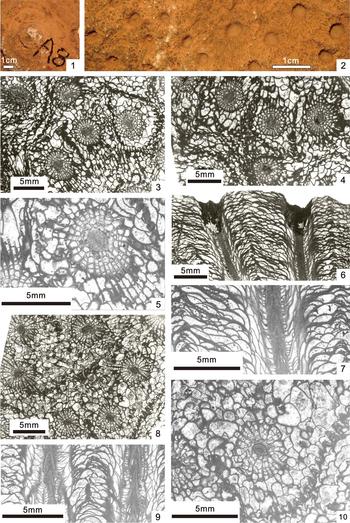
Antheria fedorowskii n. sp. from the Zaladou Formation in the Anarak section in Esfahan, central Iran: holotype, NIGP168864, (1, 2) exterior of specimen showing bottom of coral colony (1) and top (2), (3–5) transverse sections, (6, 7) longitudinal sections; paratype, NIGP168865, (8, 10) transverse sections, (9) longitudinal section.

Diagnosis
Solitary rugose corals. Major septa are variable in length and strongly thickened, especially in the cardinal quadrants with lateral connection. Protosepta are joined in early growth stages, in later growth stages, cardinal protoseptum is shortened with distinct cardinal fossula, but counter-septum is obviously longer than the other major septa. Dissepimentarium is narrow. Tabulae are commonly incomplete, with flat tabulae at the corallite axis and downward ones at the periphery (Yu et al., Reference Yu, Lin, Shi, Huang and Yu1981).
Occurrence
Pennsylvanian, Russia (Yu et al., Reference Yu, Lin, Shi, Huang and Yu1981) and South China (Wu and Zhao, Reference Wu and Zhao1989); Gzhelian (Pennsylvanian)–Sakmarian (early Permian), Spitsbergen, Norway (Chwieduk, Reference Chwieduk2014).
Pseudotimania delicata Wu and Zhao, Reference Wu and Zhao1974
Figure 4.9, 4.10
Holotype
NIGP21885/21886, from the Maping Formation (Upper Pennsylvanian–lower Permian), Guizhou Province, China (Wu and Zhao, Reference Wu and Zhao1974, p. 272, pl. 138, figs. 14, 15).
Diagnosis
Solitary rugose coral. In transverse section, during late neanic stage, major septa are strongly thickened with common lateral connection and nearly reach corallite axis. Cardinal septum is shorter. Cardinal fossula is not obvious. Minor septa are very short within dissepimentarium. At the transition from neanic to mature stage, cardinal septum is shorter than other major septa. Number of septa is 22 or 23 at corallite diameter of 9–11 mm. Dissepimentarium is very narrow. In mature stage, major septa are still thickened and withdraw from corallite center. Cardinal septum is short, and minor septa remain the same length. Two or three rows of dissepiments are present. Number of septa is 36 at corallite diameter of 17 mm. In longitudinal section, during mature stage, tabulae are complete and flat in the axial part, and inclined tabulae are attached to their underlying tabulae in the peripheral part. Dissepiments are irregular in vesicle form. Number of tabulae is 5 within 5 mm height (Wu and Zhao, Reference Wu and Zhao1989).
Occurrence
This species is present in the Zaladou Formation at the Anarak section in Esfahan, central Iran, belonging to the Gzhelian stage of the Upper Pennsylvanian.
Description
In transverse section, corallite is round in shape. The diameter and tabularium width of the corallite range from 17 to 19 mm and from 15 to 17 mm, with mean values of 18.3 mm and 16.2 mm, respectively. The number of septa of both orders vary from 33 to 39 (Fig. 5). Major septa reach approximately two-thirds to three-fourths of the corallite radius, arranged radially in counter-quadrants and pinnately in cardinal ones. Cardinal septum is strongly shortened with its neighboring septa slightly shortened to form a distinct closed cardinal fossula bordered by their neighboring long major septa. Major septa in the tabularium of the cardinal quadrants are thicker than those in the counter-quadrants, and they are laterally connected. Counter-septum is obviously longer than the other septa in counter-quadrants, and reaches near the axis. Minor septa are short within the dissepimentarium, which is about one-tenth of the corallite radius. It comprises 2 or 3 rows of interseptal dissepiments, which are generally regular and concentric. The innermost row is commonly thickened. In longitudinal section, tabulae are incomplete in mesa-shaped form. They are flat in the axial part, and attached to underlying tabulae and/or decline to dissepimentarium in the peripheral part. Dissepiments are large and elongated in vesicle form. There are 4–7 tabulae and 5–7 dissepiments per 5 mm height.
Materials
NIGP168860/168861. Two relatively well-preserved specimens with two transverse and longitudinal thin sections, respectively. Their outer walls are slightly eroded. The ambiguity of corallite microstructures may be caused by diagenesis.
Remarks
Most characteristics of the described specimens fit well with the species Pseudotimania delicata, which is documented in the Pennsylvanian strata from Guizhou Province, South China (Wu and Zhao, Reference Wu and Zhao1989). They contain similar characteristics of septal number versus corallite diameter index, strongly thickened major septa in the tabularium of cardinal quadrants, and narrow dissepimentarium width. In addition, this species also resembles the species Pseudotimania longiseptata Chwieduk, Reference Chwieduk2014, which is present in Spitsbergen from the Gzhelian stage to the Sakmarian stage (Chwieduk, Reference Chwieduk2014). However, the Iranian specimens differ from the Spitsbergen specimens by having a lower septa number and corallite diameter and more complete tabulae.
Suborder Aulophyllina Hill, Reference Hill and Teichert1981
Family Aulophyllidae Dybowski, Reference Dybowski1873
Subfamily Aulophyllinae Dybowski, Reference Dybowski1873
Genus Yakovleviella Fomichev, Reference Fomichev1953
Type species
Yakovleviella tschernyschewi Fomichev, Reference Fomichev1953. Donets Basin, Russia (Fomichev, Reference Fomichev1953, p. 320–323, pl. 21, figs. 1–7).
Diagnosis
Solitary rugose corals. Protosepta are joined in early growth stages with axial structure built of lamellar pseudocolumella on the basis of cardinal septum and axial tabellae. In mature growth stage, cardinal septum is shortened and the axial structure disappears. Major septa are variable in length, and minor septa are restricted to the dissepimentarium zone. Tabulae are not complete, with flat tabellae at the corallite axis and vesicular ones at periphery (Chwieduk, Reference Chwieduk2014).
Yakovleviella sp.
Figure 4.11
Occurrence
This species occurs in the Zaladou Formation in the Anarak section in Esfahan, central Iran, belonging to the Gzhelian stage of the Upper Pennsylvanian.
Description
The characteristics of this species are known only from transverse section, due to the lack of longitudinal section. Corallite is round in form. The diameter and tabularium width of the corallite are 25 mm and 22.4 mm, respectively. The number of septa of both orders is 39 (Fig. 5). Major septa reach approximately one-half of the radius, arranged radially in counter-quadrants and pinnately in cardinal ones. Major septa in cardinal quadrants are relatively longer than those in the counter-quadrants, and they are strongly thickened with lateral connection in the tabularium. Cardinal septum is long, reaches into the axial part, and connects with some major septa, forming a thin pseudocolumella. Counter-septum is the same length as remaining major septa of counter-quadrants. Minor septa slightly penetrate into the tabularium. Dissepimentarium is one-tenth of the corallite radius, comprising 2 rows of interseptal dissepiments, which are generally regular and concentric. The innermost row is commonly thickened. Cardinal fossula is narrow due to the shortened major septa around the cardinal septum.
Materials
NIGP168862. One relatively well-preserved specimen with only one transverse thin section. Its outer wall is eroded. The ambiguity of corallite microstructures may be caused by diagenesis.
Remarks
This specimen is assigned to the genus Yakovleviella based on its long cardinal septum, together with thickened major septa in the tabularium of cardinal quadrants and narrow dissepimentarium. According to the plot of number of major septa versus corallite diameter, the described species has septal number, corallite diameter, and dissepimentarium width comparable to those of the Spitsbergen species Y. tschernyschewi Fomichev, Reference Fomichev1953, with 39 septa at 23 mm diameter and dissepimentarium occupying one-tenth of the corallite radius. However, the studied species differ from Y. tschernyschewi, as its minor septa extend out of the dissepimentarium zone. The studied species also resembles the Spitsbergen species Y. spitsbergensis Chwieduk, Reference Chwieduk2014, as it has 40 septa at 24 mm diameter. However, Y. spitsbergensis differs from the studied species by having minor septa restricted within the dissepimentarium zone and larger dissepimentarium width. The studied specimen is difficult to identify to species level, requiring more specimens and further ontogenetic studies.
Suborder Lonsdaleiina Spasskiy and Kachanov, Reference Spasskiy and Kachanov1974
Family Kepingophyllidae Wu and Zhou, Reference Wu and Zhou1982
Genus Antheria Wu and Zhao, Reference Wu and Zhao1974
Type species
Antheria polygonalis Wu and Zhao, Reference Wu and Zhao1974. Maping Formation (Upper Pennsylvanian to lower Permian), Guizhou Province, China (Wu and Zhao, Reference Wu and Zhao1974, p. 273, pl. 138, figs. 2, 3, pl. 139, figs. 3, 4).
Other species
Up to now, in addition to the type species A. polygonalis, 13 species of the genus Antheria have been described from Moscovian (Pennsylvanian) to Sakmarian (early Permian) strata in South China: A. angusta Guo, Reference Guo1983, A. convexa Wu and Zhao, Reference Wu and Zhao1989, A. firmus Zhang, Reference Zhang2002, A. irregularis Zheng, Reference Zheng1986, A. lanceolata Wu and Zhao, Reference Wu and Zhao1989, A. magna Wu and Kong, Reference Wu and Kong1983, A. naotica Zhao and Zhou, Reference Zhao and Zhou1995, A. obscura Guo, Reference Guo1983, A. pendulus Fan, Reference Fan1978, A. polytheca Jia et al., Reference Jia, Xu, Kuang, Zhang, Zuo and Wu1977, A. rara Zhao and Zhou, Reference Zhao and Zhou1995, A. sp. Wu and Zhao, Reference Wu and Zhao1989, and A. tenuis Guo, Reference Guo1983.
Diagnosis
Cerioid to partly aphroid rugose corals with squamotheca or stratotheca. Septa of two orders. Axial column is oval or lath-like and sometimes connected to counter-septum. Lonsdaleoid dissepiments develop in periphery, and dissepiments appear between septa. The tabularium is composed of clinotabulae and transverse tabulae (revised from Wu and Zhao, Reference Wu and Zhao1974).
Occurrence
Moscovian (Pennsylvanian) to Sakmarian (early Permian), South China.
Remarks
Nephelophyllum is closely similar to Antheria, but differs in having a complex axial column that is composed of a columella, septal lamellae, and a few axial tabellae (Wu and Zhao, Reference Wu and Zhao1974). Hunanophyllum Jia et al., Reference Jia, Xu, Kuang, Zhang, Zuo and Wu1977, which has Hunanophyllum lithostrotionelloidea Jia et al., Reference Jia, Xu, Kuang, Zhang, Zuo and Wu1977 as the type species, is similar to Antheria, but differs in having a more developed cystozone and an obvious boundary between cystose and septal zones (Yu et al., Reference Yu, Lin, Shi, Huang and Yu1981).
Antheria lanceolata Wu and Zhao, Reference Wu and Zhao1989
Figure 6.1–6.3
Holotype
NIGP92643/92644, from the Maping Formation (Upper Pennsylvanian to lower Permian), Yunnan Province, China (Wu and Zhao, Reference Wu and Zhao1989, pl. 60, fig. 1a–c).
Occurrence
This species occurs in the Zaladou Formation in the Anarak section in Esfahan, central Iran, belonging to the Gzhelian stage of the Upper Pennsylvanian.
Description
Cerioid to partly aphroid rugose corals. In transverse section, the distance between the centers of adjacent corallites ranges from 6 to 9 mm. Stratotheca is well developed, composed of lateral fusion of layers of separated curved lamellae. Lonsdaleoid dissepiments are large and variable in size in globose or subglobose forms. Septa are thickened and radially arranged in two orders, numbering 11 or 12 in mature corallites. Major septa are long, dilated in outer part and tapering to center. Minor septa are almost equal in length to dissepimentarium width. Concentric and a few herringbone dissepiments appear between septa. Axial column is slightly thickened in lath-like to oval form, which is usually connected with the counter-septum. In longitudinal section, intercorallite wall is discontinuous. Cystozone is composed of steeply inclined lonsdaleoid dissepiments between the intercorallite wall and septal zone. Dissepimentarium contains dissepiments steeply inclined toward the tabularium, which comprises relatively short clinotabulae and transverse tabulae. In some cases, it is difficult to differentiate clinotabulae from inclined dissepiments. Transverse tabulae are flat and tightly spaced, with about 15–18 within a vertical distance of 5 mm. Axial column is dense in cone-in-cone structures, formed by vertically arranged subulate growth lines.
Materials
NIGP168863. One specimen with two transverse and two longitudinal thin sections.
Remarks
This specimen falls into Antheria lanceolata Wu and Zhao, Reference Wu and Zhao1989 by the characteristics of a discontinuous intercorallite wall, similar corallite diameter, septal number and transverse tabulae number, and slightly thickened lath-like to oval axial column connected with the counter-septum.
Antheria fedorowskii new species
Figure 7.1–7.10
Holotype
NIGP168864 with one hand-specimen photo, two transverse and two longitudinal thin sections (Fig. 7.1–7.7), from the Zaladou Formation (Gzhelian stage), Esfahan, central Iran.
Paratype
NIGP168865 with two transverse and two longitudinal thin sections (Fig. 7.8–7.10), from the Zaladou Formation (Gzhelian stage), Esfahan, central Iran.
Diagnosis
Antheria with rounded axial column 1.5–1.8 mm wide, which is usually connected with counter-septum. Number of major septa is 13 or 14. Calice is 5 mm deep.
Occurrence
This species occurs in the Zaladou Formation in the Anarak section in Esfahan, central Iran, belonging to the Gzhelian stage of the Upper Pennsylvanian.
Description
Four to five concentric wrinkles and many radial lines are clearly discernible on the basal part of hand specimens. External wall is well expressed by high ridge on upper surface, bordering polygonal corallites. Calice can be differentiated into inner and outer parts. Outer area is nearly planar, with septal ridges clearly discernible, whereas the central part is abruptly depressed, forming a calicular pit with a diameter of about 5 mm and a depth of 4–5 mm. Oval axial column is discernible at the base of the central calice.
In transverse section, corallum is cerioid to aphroid, with distance of 8–12 mm between the centers of adjacent corallites. Stratotheca is well developed, composed of lateral fusion of layers of separated curved lamellae. Lonsdaleoid dissepiments are large although variable in size, globose or subglobose. Septa are radially arranged in two orders, numbering 13 or 14 in mature corallites. Major septa reach to the axial column and are dilated in outer part and tapering to center. Minor septa are almost equal in length to dissepimentarium width, but slightly thinner than major septa. Concentric and a few herringbone dissepiments appear between septa. Axial column is oval, rounded with a width of 1.5–1.8 mm, usually connected with the counter-septum. In longitudinal section, intercorallite wall is discontinuous but easily discernible by vertical arrangement of squamae. Cystozone is composed of flat, elongated, and almost horizontally arranged lonsdaleoid dissepiments between the intercorallite wall and septal zone. Dissepimentarium contains dissepiments steeply inclined toward the tabularium, which is composed of steeply arranged clinotabulae and narrow transverse tabulae. In some cases, it is difficult to differentiate clinotabulae from inclined dissepiments. Transverse tabulae are flat and tightly spaced, with about 19–22 within a vertical distance of 5 mm. Axial column is dense in cone-in-cone structures, formed by vertically arranged subulate growth lines. Sinuous median dark lines are discernible in the axial column.
Etymology
In honor of Professor Jerzy Fedorowski for his contributions on late Paleozoic corals.
Remarks
The new species is similar to Antheria pendulus Fan, Reference Fan1978 from Sichuan, South China, but the latter has more major septa (16 or 17), smaller dissepiments, and an axial column of smaller diameter. The new species is also similar to Antheria magna Wu and Kong, Reference Wu and Kong1983, but the latter has more major septa (15–19) and a thicker intercorallite wall.
Antheria robusta new species
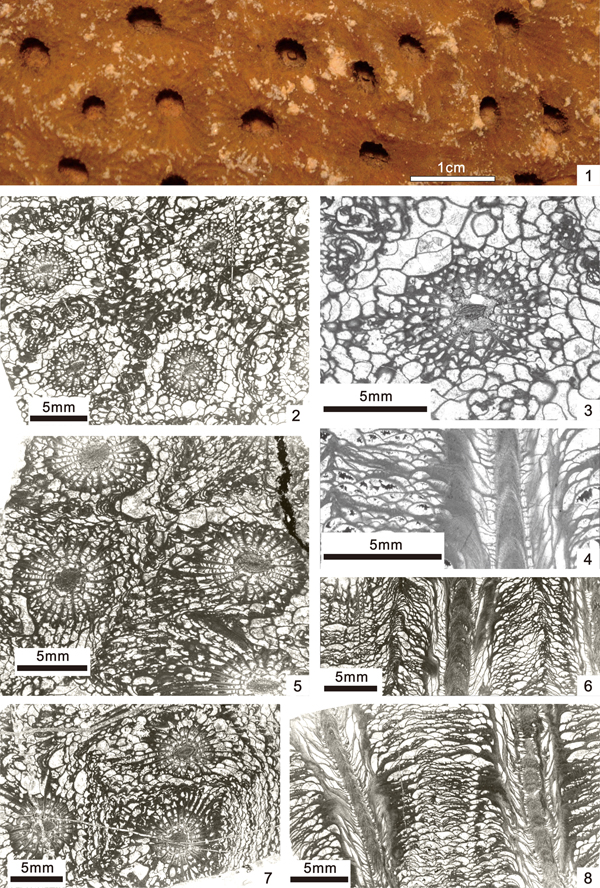
Figure 8.1–8.8
Antheria robusta n. sp. from the Zaladou Formation in the Anarak section in Esfahan, central Iran: NIGP168866, (1) exterior of specimen showing top of coral colony, (2, 3) transverse sections, (4) longitudinal section; holotype, NIGP168867, (5, 6) transverse section and longitudinal section; paratype, NIGP168868, (7, 8) transverse section and longitudinal section.

Holotype
NIGP168867 with three transverse and three longitudinal thin sections (Fig. 8.5–8.6), from the Zaladou Formation (Gzhelian stage), Esfahan, central Iran.
Paratype
NIGP168868 with one transverse thin section and one longitudinal thin section (Fig. 8.7–8.8), from the Zaladou Formation (Gzhelian stage), Esfahan, central Iran.
Diagnosis
Antheria with a robust and rounded axial column with a maximum width of 2.1 mm. Number of major septa is 14 or 15.
Occurrence
This species occurs in the Zaladou Formation in the Anarak section in Esfahan, central Iran, belonging to the Gzhelian stage of the Upper Pennsylvanian.
Description
Polygonal corallites are bordered by external wall well expressed by high ridge on upper surface. Distinct inner and outer parts of calice can be distinguished. The outer area is nearly planar and septal ridges are clearly seen. The central part is abruptly depressed and forms a calicular pit with a diameter of about 6 mm and a depth of 2–3 mm. Axial column is almond-like as a protuberance that is very clear on the calice floor.
In transverse section, corallum is partly aphroid with distance of 8–14 mm between the centers of adjacent corallites. Stratotheca is well developed and composed of separated curved lamellae. Lonsdaleoid dissepiments are variable in size in globose, subglobose, and other shapes. Septa are radially arranged and in two orders. Major septa almost reach the axial column, numbering 14 or 15 in mature corallite. They are dilated in the outer part, tapering to the center. Minor septa are slightly shorter and thinner than major septa. Dissepiments are concentric and sometimes herringbone between septa. Axial column is strong in oval or rounded form with a maximum width of 2.1 mm, usually connected with the counter-septum. It splits into septal lamella and axial tabellae in some cases, with a median columella. In longitudinal section, intercorallite wall is discontinuous and formed by vertical arrangement of squamae. Cystozone consists of slightly inclined lonsdaleoid dissepiments, which are small in globose form. Dissepimentarium comprises steeply inclined dissepiments, which sometimes extend to the tabularium becoming clinotabulae. The tabularium is composed of clinotabulae and transverse tabulae. It is difficult to differentiate clinotabulae from some inclined dissepiments. Transverse tabulae are flat, tightly spaced, with about 20–25 in a vertical distance of 5 mm. Axial column is mainly dense in cone-in-cone structures, formed by vertically arranged subulate growth lines. Sinuous median dark lines are discernible in the axial column.
Etymology
Latin adjective robustus meaning “robust,” which is a reference to the robust axial column.
Other materials
NIGP168866 (Fig. 8.1–8.4), one specimen with three transverse and two longitudinal thin sections, respectively.
Remarks
The new species resembles Antheria fedorowskii n. sp., but differs in having a wider and more complex axial column.
Antheria sp.
Figure 6.4–6.6
Occurrence
This species is present in the Zaladou Formation in the Anarak section in Esfahan, central Iran, belonging to the Gzhelian stage of the Upper Pennsylvanian.
Description
Cerioid to partly aphroid rugose corals. In transverse section, corallum is mainly cerioid and partly aphroid, with a distance of 6–9 mm between the centers of adjacent corallites. Stratotheca is well developed. Lonsdaleoid dissepiments are variable in size in subglobose form. Septa are radially arranged in two orders, numbering 11 or 12 in mature corallite. Major septa almost reach to the axial column, tapering from outer to center. Minor septa are about one-half the length of major septa. Dissepiments are concentric and herringbone between septa. Axial column is weak, lath-like, and usually connected with counter-septum. In longitudinal section, intercorallite wall is discontinuous. Cystozone is wide, containing flattened cystoses. Dissepimentarium is narrow with steeply inclined dissepiments toward the tabularium. Dissepiments sometimes extend to tabulae, which are difficult to differentiate from clinotabulae. Transverse tabulae are flat and loosely spaced, with about 12–14 in a vertical distance of 5 mm. Axial column is mainly dense in cone-in-cone structures, formed by vertically arranged subulate growth lines.
Materials
NIGP168869. One specimen with two transverse and two longitudinal thin sections.
Remarks
The occurrence of the characteristics of cerioid to partly aphroid corallum, with squamotheca or stratotheca, lath-like axial column connected to counter-septum, cystoses developed in periphery, dissepiments appearing between septa, and clinotabulae and transverse tabulae in the tabularium, suggest that this specimen belongs to the genus Antheria. This species resembles A. angusta Guo, Reference Guo1983 by similar corallite diameter and septal number and discontinuous intercorallite wall, but differs from the latter by its weak axial column and widely spaced tabulae. The studied specimen also resembles A. irregularis Zheng, Reference Zheng1986 by similar corallite diameter, lath-like axial column and tabulae density, but the latter has more septa. Because of the incompleteness of the material, this species is placed in open nomenclature.
Genus Streptophyllidium Wang in Xiao et al., Reference Wang, Xiao, Wang, Zhang and Dong1986
Type species
Streptophyllum scitulum Wu and Kong, Reference Wu and Kong1983. Upper Carboniferous to lower Permian strata, Tianlin County, Guangxi Province, China (Wu and Kong, Reference Wu and Kong1983, p. 371, pl. 2, figs. 1, 2).
Other species
Up to now, five species have been described, and all of them are from Guizhou Province, South China. In addition to the type species, the other species include Streptophyllidium houchangense Wang, Reference Wang, Xiao, Wang, Zhang and Dong1986, S. gracilens Wang, Reference Wang, Xiao, Wang, Zhang and Dong1986, S. undulatum Wang, Reference Wang, Xiao, Wang, Zhang and Dong1986, and S. heterothecum Zhao, Reference Zhao1988.
Diagnosis
Compound and massive rugose corals. Corallites are meandroid or linear in shape, with cysts on the external wall. Septa are arranged in two orders. Stratotheca is well developed. Axial column is simple and solid. Several stereozones are present in the cystose area. Tabulae are incomplete, gently sloping toward the center (after Wu and Kong, Reference Wu and Kong1983).
Occurrence
Kasimovian–Gzhelian (Pennsylvanian) to Sakmarian (lower Permian), South China.
Remarks
As Wu and Kong (Reference Wu and Kong1983) described, this genus is closely similar to Antheria but differs from the latter in having meandroid or linear instead of cerioid to partly aphroid coralla. Because the name Streptophyllum has been used for Silurian corals by Chi (Reference Chi1931), Wang (Reference Wang, Xiao, Wang, Zhang and Dong1986) used Streptophyllidium as a replacement.
Streptophyllidium scitulum Wu and Kong, Reference Wu and Kong1983
Figure 9.1–9.3
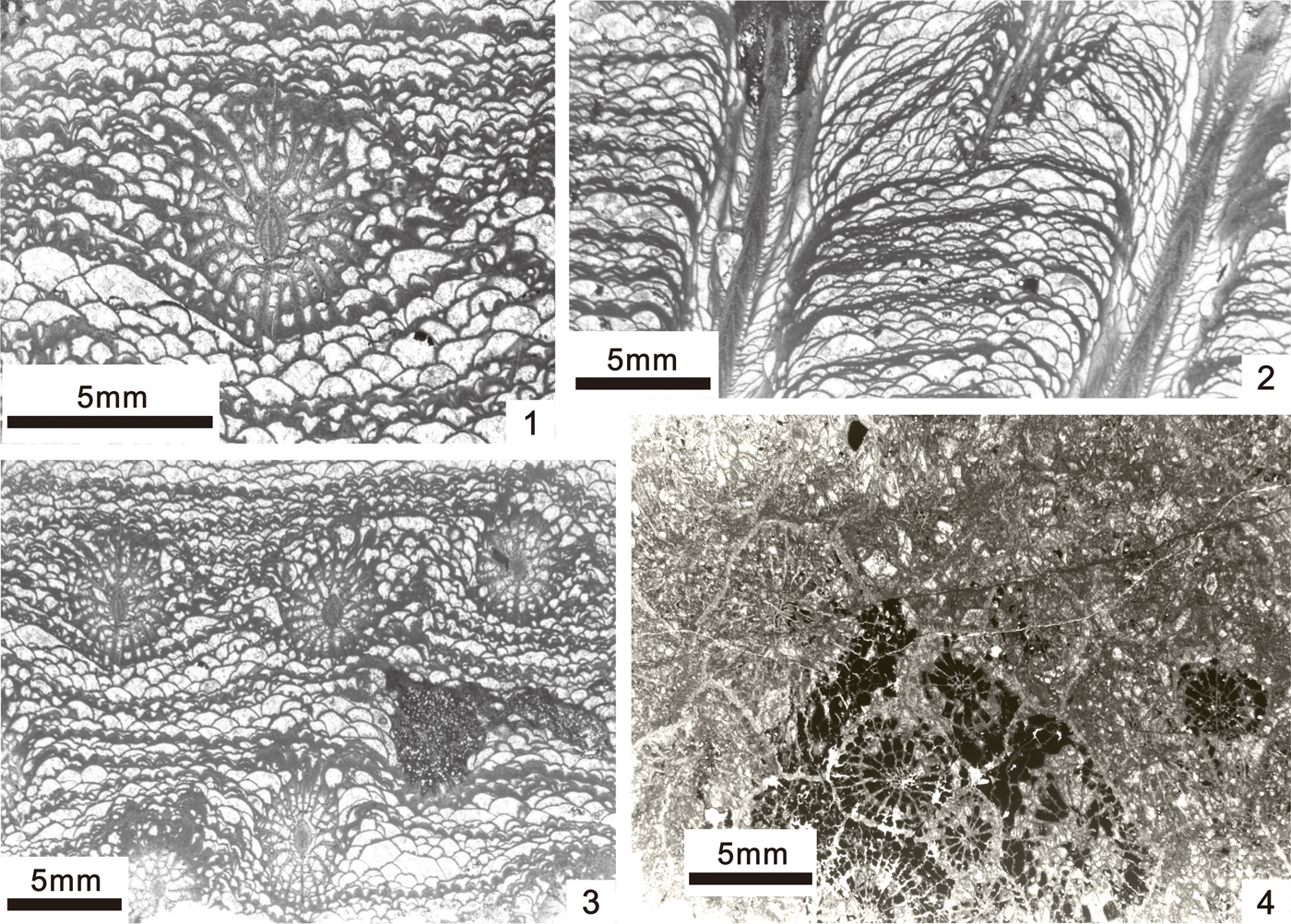
Streptophyllidium scitulum from the Zaladou Formation in the Anarak section in Esfahan, central Iran: NIGP168870, (1, 3) transverse sections; (2) longitudinal section. Nephelophyllum sp. from the Zaladou Formation in the Anarak section in Esfahan, central Iran: NIGP168871, (4) transverse section.
Holotype
NIGP72398/72399, from the uppermost Carboniferous to lowermost Permian strata, Tianlin County, Guangxi Province, China (Wu and Kong, Reference Wu and Kong1983, p. 371, pl. 2, figs. 1, 2).
Diagnosis
Streptophyllidium with the septa number ranging from 11 to 13. The distance between the centers of neighboring corallites varies from 5 to 12 mm. Transverse tabulae are flat and tightly spaced with about 12–17 in a vertical distance of 5 mm (Wu and Kong, Reference Wu and Kong1983).
Occurrence
This species is from the Zaladou Formation in the Anarak section in Esfahan, central Iran, belonging to the Gzhelian stage of the Upper Pennsylvanian.
Description
Meandroid rugose corals. In transverse section, stratotheca is well developed, formed by separated curved lamellae and some short transverse or oblique brambles. Distance between the centers of neighboring corallites ranges from 6 to 11 mm. Septa are in two orders, 12–14 in number. Major septa commonly reach the axial column. Minor septa are one-half to three-fourths the length of the major septa. Outer ends of septa are laterally dilated to form the inner wall, and they are disrupted by the cysts in subglobose and other shapes. Dissepiments are concentric and sometimes herringbone concentric between septa. Axial column is simple, solid, and oval shaped. Several stereozones are present in the cystose area. In longitudinal section, theca is obviously discernible in cystozone in mesa-shaped form. In the cystozone, the cystoses are horizontally placed in the axial part and slightly inclined in the periaxial part and are variable in size in globose or subglobose form. In the dissepimentarium, the dissepiments are steeply inclined toward the tabularium, and in some cases extend to the tabularium, becoming clinotabulae. The tabularium is composed of clinotabulae and transverse tabulae. It is difficult to differentiate clinotabulae from some inclined dissepiments. Transverse tabulae are flat and tightly spaced with about 17–20 in a vertical distance of 5 mm. Axial column is in cone-in-cone structures, formed by vertically arranged subulate growth lines.
Materials
NIGP168870. One specimen with two transverse and two longitudinal thin sections.
Remarks
The studied specimen from the Anarak section fits well into the variability of the species Streptophyllidium scitulum described by Wu and Kong (Reference Wu and Kong1983), which occurs in Guangxi Province, South China. However, the Iranian specimen differs from the Chinese species in having a slightly higher number of septa, a larger inner wall diameter, and more tightly spaced tabulae (Wu and Kong, Reference Wu and Kong1983).
Genus Nephelophyllum Wu and Zhao, Reference Wu and Zhao1974
Type species
Nephelophyllum simplex Wu and Zhao, Reference Wu and Zhao1974. Maping Formation (Upper Pennsylvanian to lower Permian), Guizhou Province, China (Wu and Zhao, Reference Wu and Zhao1974, p. 374, pl. 139, figs. 1, 2).
Diagnosis
Cerioid or partly aphroid rugose corals. Septa are arranged in two orders. Axial column is narrow, containing simple median plate with few short radial lamellae and axial tabellae. The tabularium includes subhorizontal or sagging pericolumnar tabulae and clinotabulae in the peripheral part (Hill, Reference Hill and Teichert1981).
Occurrence
Upper Pennsylvanian to lower Permian, China.
Remarks
Nephelophyllum Wu and Zhao, Reference Wu and Zhao1974 is closely similar to Antheria, but differs in having a complex axial column. Nephelophyllum has a high diversity in South China. More than 30 species have been named from the Upper Pennsylvanian and lower Permian strata in China, mainly South China. A detailed revision may be necessary for those taxa, because many of them were established based on single and random sections and lack a complete specimen. However, it is not the purpose of this paper to undertake such a revision.
Nephelophyllum sp.
Figure 9.4
Occurrence
This species is present in the Zaladou Formation in the Anarak section in Esfahan, central Iran, belonging to the Gzhelian stage of the Upper Pennsylvanian.
Description
In transverse section, corallum is cerioid. Cystoses are large, appearing in margins or corners of corallites. Septa consist of two orders. Major septa reach to the center, with 14–16 in mature corallite. Minor septa are about one-half the length of major septa. Dissepiments are concentric between septa. Axial column is composed of a distinctive median columella, with 5–8 radially arranged septal lamellae and few axial tabellae.
Materials
NIGP168871. One specimen with one transverse thin section. No longitudinal sections are available because of poor preservation.
Remarks
The occurrence of the characteristics of a cerioid corallum, cystoses, and simple axial column indicates this specimen belongs to the genus Nephelophyllum. However, this species is placed in open nomenclature, due to the incompleteness of the material.
Acknowledgments
We would like to give our thanks to R.R. West who critically read the article and made many helpful comments and improvements. We also thank J. Fedorowski and I. Somerville for their valuable comments on and great improvements to our article, and we also thank the chief editor J. Jin and the associate editor R.J. Elias for their handling of the article and helpful comments. This work was financially supported by the Strategic Priority Research Program (B) of the Chinese Academy of Sciences (CAS) (grant nos. XDB26000000, XDB18000000), the National Natural Science Foundation of China (grant no: 41630101), the Natural Science Foundation of Jiangsu Province (grant no. BK20181107), and the Ministry of Science and Technology Foundation Project (grant no. 2013FY111000).