Middlewood Sessions began tentatively in the summer of 2004 when two people (including me) identified common musical interests at a point that synchronised opportunity and motivation to act upon an impulse to make some music together. Over the next eight years, in addition to the two initial core members, 28 people (musicians, visual artists and technicians) contributed to the project, plus a sound engineer whose deep involvement in the production of the final album – The Middlewood Sessions (2012) – led him to be considered as a third core member. The music of Middlewood Sessions infuses the timbral qualities of jazz and orchestral music with the driving rhythms of dance music. The first single, ‘Fall Back’ (Middlewood Sessions 2007), was released in June 2007 on London-based Brownswood Recordings, followed by a double A-side release on Wah Wah 45s in the following year (Middlewood Sessions 2008). Two remixes were commissioned to support those releases, all of which were played by DJs of international standing and received some positive critical acclaim.Footnote 1 Six live UK performances took place between July 2007 and August 2008 in venues garnering respect for their association with jazz, popular music or club culture (including the Jazz Café and Cargo in London, and the HiFi Club in Leeds). The album, which marked the culmination of the life of the project, was named ‘Jazz Album of the Month’ in April 2012 on Radio NL6 in the Netherlands and achieved number 14, by public vote, in the ‘Albums of 2012’ poll on Rté Pulse in Ireland.
The research project from which this paper is derived was grafted onto the ongoing music project in 2006 just as ‘Fall Back’ was beginning to receive national and international radio play.Footnote 2 Data were collected via four interviews (spread between May 2007 and November 2011), participant diaries (reflective and those for everyday organisation), textual artefacts such as press materials and reviews, radio interview transcripts and ethnographic reports of live performances. Analyses of interviews and reflective diaries were carried out according to principles of thematic identification and grouping in line with interpretative phenomenological analysis (Smith et al. Reference Smith, Flowers and Larkin2009). Emergent themes were organised using an adaptation of Spradley's (Reference Spradley1980) nine-point model for carrying out descriptive participant observations. As a participant observer, taking on the dual role of producer and researcher, my personal diaries were instrumental in capturing the chronological ordering of events that provides the spine to the understanding of the project's lifespan as presented here. And this access to personal materials, potentially out of reach to other researchers, is significant: the participant-observation approach is valuable because of the level of insight it affords of a ‘reality from the viewpoint of someone “inside” the case study’ (Yin Reference Yin2009, p. 112), but it is also limited because of the mono-perspectival, inherently personal view it offers. Despite the fact that the music project had been underway for two years before the research began (and, therefore, my status changed from participant to participant-observer) and my role as a music producer with Middlewood Sessions had already been established to a certain extent, the effect of my presence and ability to manipulate proceedings as a researcher cannot be disentangled from my role as music-making participant. While data captured via interviews and corroborating documents go some way towards objectifying the case study in rendering it as data (coupled with the passage of a significant amount of time plus the analytical processes to which textual materials are subjected), remnants of my memories and biases are bound to remain as I seek to formulate a report such as I present here. As such, while I draw on interpretative phenomenological methods I also draw on memory as part of a formalised reflection on the creative activities in which I played a part.
The longitudinal case study of Middlewood Sessions is delineated by the amount of time it took to make an album. The longitudinal view allows us to trace the fortunes of a music project over time; the case study approach is valuable because it allows us ‘to understand a real-life phenomenon in depth’ (Yin Reference Yin2009, p. 18). However, a research project such as this has to chase a moving target. What began as a piece of research designed to understand something about the neatly circumscribed context of a small-scale collaboration between two people striving to make original music in a domestic project studio (as Middlewood Sessions was originally) soon had to adapt to account for the new locations participants sought to visit (including professional studios and performance venues) and the increasingly complex social picture that emerged as musicians, visual artists and sound engineers were invited to contribute as those at the heart of the project pursued their growing ambitions. This is entirely in line with a phenomenological perspective: the longitudinal case study research project had to change to accommodate the changing scope of the ageing, developing object of study.
At the heart of this research is the desire to understand how people collaborate as part of a studio project, how people use technologies to make music and how all of this unfolds over time. While the designation ‘studio project’ sounds straightforward (and the initial opportunity for the research project suggested a certain level of circumscription, at that point in time), it is a context that potentially involves numerous locations, different modes of working and complex relationships between many people. Indeed, it is this mixture of locations, interactions and varying forms of collaboration – and how all of this shifts as it is played out across time – that I seek to explore because it is an example of contemporary music production practice. To do this, I propose three ways of thinking about time: nests, arcs and cycles. I hope to set out a theoretical apparatus for considering the temporal dimensions of musical creativity as it takes place in the guise of a studio project, while relaying something of the specific, detailed and idiographic nature of the Middlewood Sessions case study. Prior to that, I begin with two critical incidents followed by an exploration of the existing literature on time and creativity.
Two critical incidents
How can we understand the life story of Middlewood Sessions? How can we delineate its lifespan, what defines its shape and how can we describe it? The events, moments, slices of time, actions, interactions, ideas, decisions, doubts and epiphanies that caused the studio project to coalesce into a form made manifest in audio recordings and live performances are innumerable. But some events, for participants, stand out as more critical than others. Two such critical events occurred at roughly the mid-point of the life of Middlewood Sessions: one a recording session in a professional studio and the other a live performance. For those at the core of the project, these events came to symbolise a critical juncture.
On 22 June 2008, Middlewood Sessions hired Yellow Arch Studios in Sheffield, in the north of England, for the day. The history of the place was present: it drew Middlewood Sessions out of its spare-room habitat; it exuded its influence on the sense of occasion; and the architectural fabric of the place, having housed the work of well-known and respected figures, seemed to erase any chronological gaps in the historical record of the studio's use.Footnote 3 Going to this place offered an exciting prospect.
So we paid a couple of hundred quid, went into this studio, did a morning of drum recording and then an afternoon of string multitracking. The drums sounded awesome on their system because they've got thousands of pounds worth of monitor speakers. We were really excited – got back home and played it over my £180 monitors. And I just thought: what's the point? Spending all this time and effort going to a studio then to not be able to do anything with it. So, at that point, I had an agenda: new computer, new monitors. I've invested a couple of thousand pounds to make it worthwhile and that has been an amazingly positive step. I think it's changed our sound and it's made us craft things a bit more. (Interview 2)
The disparity between the quality and stature of the professional studio versus that of the domestic project studio was unmasked. While going to Yellow Arch offered the possibility of taking the next step towards achieving something of worth (after all, others had passed through and managed it), the disparity between the two places – symbolised by the relative qualities of their constituent technologies – was keenly felt. Excitement turned to disappointment for the participants, marking a critical turning point.
A month later, on 26 July 2008, Middlewood Sessions performed at the Jazz Café in Camden Town, London. Their fifth live performance of six, this gig represented another step along the path of playing venues of increasing size and stature. The booking at the Jazz Café symbolised a level of recognition that carried its cost in the demand for a high-quality performance in line with all those artists who had been on that stage before. The moment when the studio project had matured to such an extent that its wares should be played out to an expectant, knowing audience was captured by a recording taken from the live mixing desk.
We had the CD sent to us a few days ago. It was recorded with a view to sending off a live demo to get a gig at the Southport Weekender [festival]. But the CD sounded very bad (these types of recording, straight off the desk, usually do). The CD was an object of disgust for us, rather than the object of pride it should have been. (Diary, August 2008)
The opportunity of the event was reified in the CD object. But the disappointment of hearing the ‘reality’ of the performance, as mediated by the mixing desk recording, despite attempts to explain away the poor quality, acted as another stark indicator of the gulf between aspiration and achievement, between the amateur project studio and the alluring, professional music industry.
These two critical events offer snapshots into the attitudes and aspirations of the project as it stood in mid-2008 but, in hindsight, they also represent a turning point. They represent the culmination of a long and complex chain of causes and effects, driven by the desire to make music of increasingly high quality, and the financial and emotional commitment participants were making to the project. These events did not simply occur: they were inextricably woven into the fabric of the music project and they had meaning for those involved. In the aftermath of these disappointments, there was a fallow period of seven months during which no activity took place, which was eventually broken by the first of a series of recording sessions to complete the full-scale album. How can we understand the significance of these critical events as part of the much longer creative endeavour? Or, more generally, in what ways can we understand individual events in the overall lifespan of a studio project?
Time and creativity
The notion of time runs through much creativity research and generally falls into two categories: cyclical (time's cycle) and linear (time's arrow). Building on earlier work by Runco (Reference Runco1999), Mainemelis addresses the nature of time and creativity: ‘Time surrounds, shapes, even determines creativity, in a variety of intriguing, sometimes mysterious, and largely unexplored ways’ (Mainemelis Reference Mainemelis2002, p. 227). Time's cycle denotes repetition, recurrence, replication, predictability and periodicity. Time's arrow is ‘inspired by Heraclitus’ ever-flowing river, in which one cannot step twice because other waters flow by' (Mainemelis Reference Mainemelis2002, p. 228); it denotes the irreversible, ever-changing, unstable and unexpected events in the linear passage from birth to death. In creativity research these two types of time are endowed with a theoretical tension because of the way they are conceptualised. On the one hand, stage models seek to capture the arrowed, linear trajectory of a creative process by characterising ordered and necessary phases of activity. On the other hand, componential models seek to account for the dynamic interrelation of recurrent factors that come into play, variously ordered, throughout a creative process. Kozbelt (Reference Kozbelt2009, Reference Kozbelt, Kantrowitz, Brew and Fava2011) addresses this theoretical tension in his research relating to realism in Western visual art between 1300 and 1900.
Both oversimplified stage models and wildly interactive componential models are inadequate for characterizing the rich dynamics of the creative process. This impasse is compounded by the domain generality of most current models of creativity, which do not incorporate the particulars of any domain. … (Kozbelt Reference Kozbelt2009, p. 35)
Kozbelt seeks to understand the complexity of the creative process (which he takes to be axiomatic and domain-specific) by drawing an analogy with embryonic development. An embryo grows according to the genetic code of its raw DNA; a work of art grows from basic, pre-inventive structures according to a culturally perpetuated heuristic handed down from generation to generation (Kozbelt Reference Kozbelt2009, p. 36). ‘Ontogenetic heterochrony’ (Kozbelt Reference Kozbelt2009, p. 35; 2011, p. 56) accounts for the ordered yet mutable pattern of creative work; works of art, just like developing embryos, follow established patterns to remain viable. A heterochrony refers to an alteration in the timing of a particular part of the creative process (through truncation, condensation, expansion, addition, reordering) that might lead to a different (possibly novel) outcome. The order in which the creative endeavour is spun out over a period of time, during which ideas are grown and elaborated, is fundamental to understanding a particular kind of creative behaviour. Whether for single works of art, inventions or ideas, ‘[c]reative individuals, in a quest for mastery and novelty, engage in an across-time, persistent series of transformations that begin with a knowledge base and result in the emergence of a valued product’ (Brower Reference Brower2003, p. 63). How time is traversed is as important as understanding the status of the end product.
Any proposal of a dichotomy between stage and componential models is misleading because, when enlivened and mutable, stage models are componential models (and vice versa) just as arrowed and cyclical time are simultaneous in daily experience (Mainemelis Reference Mainemelis2002, p. 228). The interrelation between stage and componential models is captured in Lubart's (Reference Lubart2001) survey of models of creativity developed in the latter half of the 20th century. Taking Wallas's (Reference Wallas1926) oft-cited four-stage model as the basis – preparation, incubation, illumination, verification – Lubart traces the development of more refined models that characterise creative work as ‘a dynamic blend of processes that co-occur, in a recursive way throughout the work’ (Lubart Reference Lubart2001, p. 298). Even though Wallas's stage model has received much criticism (Eindhoven and Vinacke Reference Eindhoven and Vinacke1952, particularly pp. 161–2; Weisberg Reference Weisberg1986), its component parts resurface in much later work.
… Amabile (Reference Amabile1996) incorporated a version of the basic stage model into her componential model of creativity. The creative process is described as consisting of several phases: (a) problem or task identification, (b) preparation (gathering and reactivating relevant information and resources), (c) response generation (seeking and producing potential responses), and (d) response validation and communication (testing the possible response against criteria). (Lubart Reference Lubart2001, p. 297)
In Amabile's model, motivation is a crucial factor in sustaining creative activity over a period of time sufficient in duration to yield valuable results. The 10-year rule (Ericsson et al. Reference Ericsson, Krampe and Tesch-Römer1993, p. 366) describes the length of time required to acquire the knowledge and skills necessary to achieve something that is deemed valuable in a related field or domain; ‘and this is just the time needed to prepare oneself. … The actual creative work follows this 10-year (or longer) period of practice and study’ (Kaufman and Baer Reference Kaufman, Baer, Sternberg, Grigorenko and Singer2004, p. 5). It takes time for people to acquire the skills and knowledge required to operate within a domain – e.g. popular music composition (McIntyre Reference McIntyre2006) and production (McIntyre Reference McIntyre2008) – and to produce something new (see also McIntyre Reference McIntyre2011, Reference McIntyre, Frith and Zagorski-Thomas2012). When the field accepts and values the new artefact, the ideas encoded within it (and the objects as iconic representations themselves) are sustained to the point where the accumulated effect is domain change: ‘creativity occurs when a person makes a change in a domain, a change that will be transmitted through time’ (Csikszentmihalyi Reference Csikszentmihalyi and Sternberg1999, p. 315). As Gruber (Reference Gruber1988, p. 32) has it, ‘the task of understanding creative work requires us to conceive of the creative person as an evolving system in an evolving milieu’. Such a complex and highly variable dual evolution of person and milieu requires a suitably flexible framework. Componential (or confluence) models help to situate the complexity of creative activity; stage models help to describe it.
The process of this creative work, this skilled bringing about of something novel and useful (Mayer Reference Mayer and Sternberg1999, pp. 449–51) in some social context (Plucker and Beghetto Reference Plucker, Beghetto, Sternberg, Grigorenko and Singer2004, p. 156), could be explained as a list of ordered events. But this privileged retrospective view neatly disguises the more complex, messy story of unfolding, unpredictable events and bypasses any explanation of their patterning, which is contingent, incremental and emergent. To tackle the question of how to understand the lifespan of a creative endeavour, and to acknowledge the tension between the smooth appearance of chronological time and the shattered, scattered reality of creative practices, I propose three ways of thinking about the temporal dimensions of creative work which, when taken together, constitute a fracto-chronological perspective: nest (nidus), arrow (arcus) and cycle (cyclus). The prefix of this term (‘fracto-’) is derived from a meteorological usage to describe fragmentary cloud phenomena that are broken away from main formations. The metaphor is useful: while a cloud may appear unified in form, on closer inspection it is a shifting, fragile mass of tiny particles. How creative work unfolds over time may equally appear stable and neat from a distanced perspective (e.g. listening to a track or reviewing a composer's lifework), but on closer inspection a story of messiness, uncertainty and flux is revealed. Tracing an etymological root, we might think of the fractus of creativity to describe creative processes as interrupted, non-linear, broken, fragmented. While the experience of listening to music gives an impression of chronological time passing (perhaps) smoothly, the process by which that music was made is unlikely to be just so. An album, for example, proves creative processes took place, but it also obliterates the story of its generative origins through the illusion of the temporality it constructs.
Nest (nidus)
Thinking of time as nested concerns the layering of different spans of time, from the macro-historical to the micro-musical. Nested spans of time accumulate into stratified arcs that assemble the ‘antecedent conditions’ (Woodman and Schoenfeldt Reference Woodman and Schoenfeldt1990, pp. 284–5) of the situation in which the creativity takes place. These conditions may include biographical-sociocultural factors (an individual's history, learning, experience and background) and cultural-historical dimensions that determine context (technological development, physical environment, cultural climate). The nested view of time accounts for the combination and culmination of people's work – how contributions fit together, how effort is expended and distributed – which becomes particularly visible in the context of a collaborative endeavour such as a studio project. Creativity is distributed among members of ‘the same group [that] comes together multiple times, with the intention of generating a creative product across repeated encounters’ (Sawyer and DeZutter Reference Sawyer and DeZutter2009, p. 83).
The proposition of nested time, or nidus, also designates a ‘place in which something is nurtured or developed’ (Thompson Reference Thompson1996, p. 919). This place of safety, like a nest, is where something emerges, develops and grows. The mobility of computer technologies means that a project studio could coalesce in any number of places, or could be constituted physically and virtually. The necessity of place for the project studio becomes undermined, or at least challenged, and we need only make a small adjustment to the concept of nidus, becoming: a time in which something is nurtured or developed. The idea of a span of time as a locus of safety, carved out of precious time upon which many demands are made, brings together the twin characteristics of nidus: spans of time are stratified among many other spans of time of variable duration; time devoted to creative activity is precious and nurturing.
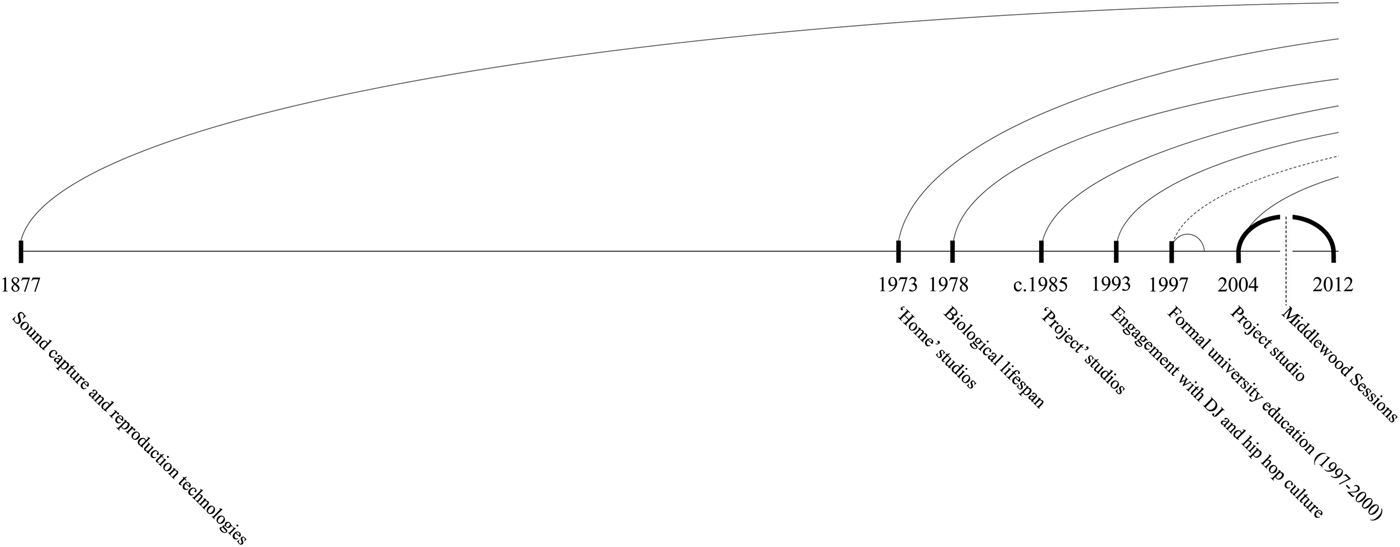
The studio project nestles under stratified layers of other arcs whose weight bears down upon the endeavour, shaping and constraining it (see Figure 1). The Middlewood Sessions studio project is subsumed under the broader arc of the project studio, which gathers together the physical, technological apparatus necessary for the creative endeavour. Extending out, the sounds, attitudes, working practices and aspirations of Middlewood Sessions are shaped by the formal university education of one core member between 1997 and 2000 (the effects of which continue long after the graduation ceremony) and the engagement with DJ and hip hop culture of another (whose immediacy and in-the-moment mode infuses the ethos of the project).Footnote 4 These educational experiences, situated institutionally and socioculturally, are part of the chain of experiences constituting a whole biological lifespan (e.g. starting in 1978), whose innumerable events, junctions and influential forces prior to the project studio are brought to bear: not fatalistically, but in shaping, constraining and bearing down. In a technologically mediated context like the project studio, all of the sociocultural and personal-biographical arcs are necessarily bonded to technological arcs. The broadest of these is the era in which sound is mediated by capture and reproduction technologies beginning in 1877 and proceeding through acoustical, electrical and digital eras (see Horning Reference Horning2002, Reference Horning2004; Katz Reference Katz2004).Footnote 5 In 1973, Melody Maker ran an article offering basic advice about setting up a home studio, (over-)stating the emerging trend: ‘about half the garages and basements in England must be echoing to the siren song of rock music by now; everybody's building their own recording studios’ (Blake Reference Blake1973, p. 34). In the same year, sales of electronic synthesisers were tracked as a separate category, indicating their viability in the emerging consumer music technology industry (Théberge Reference Théberge1997, pp. 52–3). At this point, prohibitive costs meant only ‘star performers’ could assemble such home studios ‘to experiment and create while relatively unfettered by the constraints of time and money’ (Théberge Reference Théberge1997, p. 231) imposed by professional studios. After a series of reciprocal innovations between the computer and music technology industries throughout the 1970s, a new type of studio environment emerged, the ‘so-called “project studios” – often little more than large home installations’ (Théberge Reference Théberge2004, p. 773), whose quality began to compete with established commercial studios. Since the early 1990s, computer technologies have continued to get smaller, lighter, cheaper and more powerful, leading to a proliferation of music-making practices across expanding socio-demographic planes (Greene Reference Greene2001; Crowdy Reference Crowdy2007) and in ‘geographic locations previously unusable for sonic creativity’ (Slater and Martin Reference Slater and Martin2012, p. 72). This proliferation has diversified the personae of music production.
Nested, stratified time.

These strata exert their combined and specific force upon the album, which represents the creative work of Middlewood Sessions, through their presence and agency throughout the creative process. This agency is easier to detect with strata that are ‘closer’ to the immediate activity: the technological assemblage of the project studio, located in the attic room, and the subjectivities of the key protagonists that are present, manifest and coercive. But these agencies have a form, a shape, inherited from and partly determined by their preceding histories that acts upon, and within, the immediate slice of time. The computer technologies or microphones being used are not magically occurrent objects (just as the pattern of computer technologies getting smaller, lighter yet more powerful throughout the 1990s is not automatic), but are the results of extensive research and development by individuals and companies. Similarly, the tastes and preferences of those making the decisions about which groove to accept and which to reject are not formed in isolation from accumulated experience and memory. These objects and subjectivities are dependent on many agencies (the technical work of others to design the capsule for the Beyerdynamic M201 microphone used underneath the snare; the memorable performance by the Cinematic Orchestra at a music festival in 2002) that have been exerted at a removed time but are still detectable in the immediate, moment-to-moment activity of the creative endeavour. Latour discusses the lecture hall as an example of the continuous connection between the lecture happening now and the ‘dreams and drawings of someone else, at some other time, in some other place’ (Latour Reference Latour2005, p. 195, original emphases). He continues: ‘This local site has been made to be a place by some other locus through the now silent mediation of drawings, specifications, wood, concrete, steel, varnish and paint; through the work of many workers and artisans who have now deserted the scene because they let objects carry their action in absentia’ (Latour Reference Latour2005, p. 195, original emphases). Just as the face-to-face interaction of lecturer and students is ‘the terminus point of a great number of agencies swarming towards them’ (Latour Reference Latour2005, p. 196), so too the moment-to-moment process of making music as part of Middlewood Sessions collects together the strata of agencies that, however seemingly removed, continue, necessarily, to exert their force.Footnote 6
The album conceals layers of its stratified history, a ‘multi-layered past’ (Donin Reference Donin and Collins2012, p. 15), in its layers of sound. The assembling of technologies to record a string section is a moment of synchronised agencies and subjectivities. But, once dismantled, all that remains is the sonic trace of this finely balanced, specific assemblage. This recording session is but one of many such events whose resultant traces are superimposed upon one another and spliced together to construct a different temporality from that of its making. To recall my proposition of the fractus of creativity, the smooth appearance of temporality, through the auditory experience of the eventual album, is of a different order from the shattered and scattered pattern of activity that brought about the constituent sounds. The ‘reality of the illusions’ (Moorefield Reference Moorefield2005, p. 109) on the album obliterates the story of the times, locations and specific technological and subjective agencies that were, at one point, the actuality of the music.
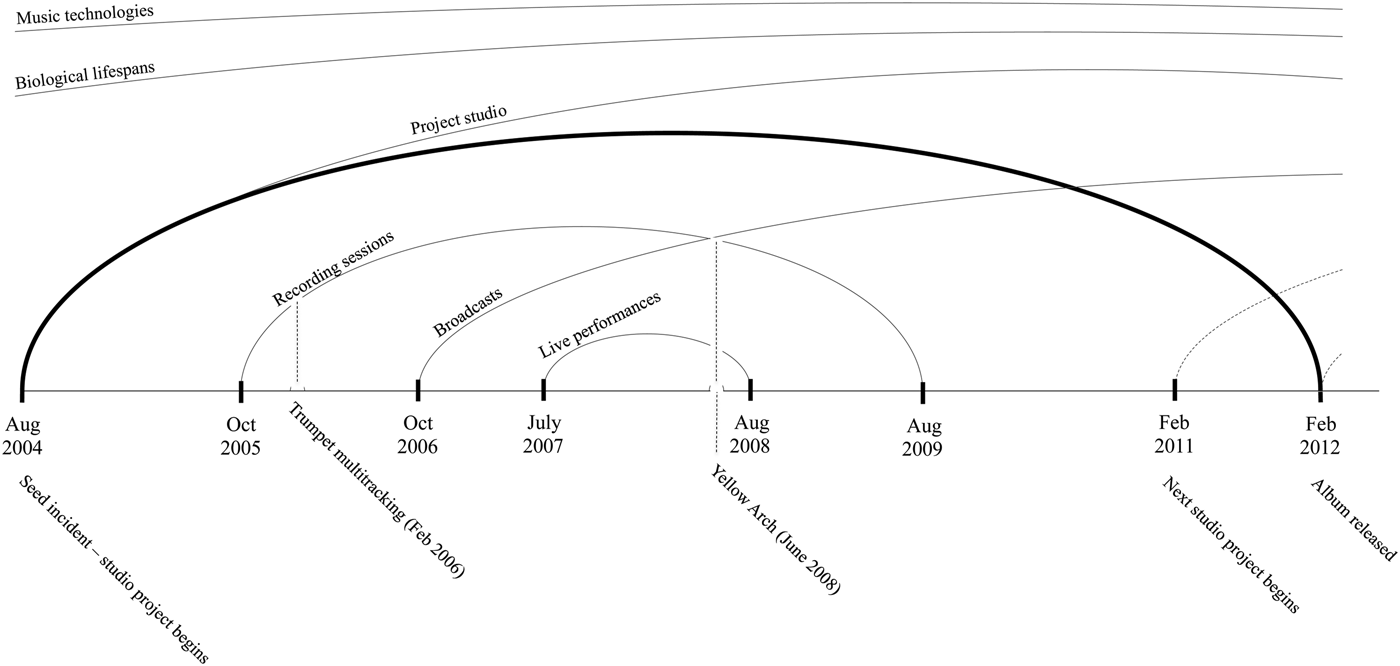
By altering the scale of view to take in the lifespan of Middlewood Sessions, other nests become visible (see Figure 2). The ‘seed incident’ (Doyle Reference Doyle1998, p. 30) in August 2004 begins the studio project; the release of the album in February 2012 terminates it. We may think of nested spans of time as either closed or open. The Middlewood Sessions studio project is a closed-span of time because the release of the album represents the closing down of all work on the project, the intentional end-point where participants cease their efforts. But while musical work ceases, the trace of this work, the summative encoding of effort as audio data, transcends the closed-span of the studio project. Consider broadcast: the relaying of a trace to a distant listening audience pries the musical work away from its nidus. And once this music is available to replay and rehear, an arc of dissemination remains open, puncturing the closed-span of the studio project. Given this, all closed-spans are capable of remaining open in some way, particularly if traces are reified and retrievable, as enabled by the fundamental capacity of computer technologies to store and recall data. Conversely, all arcs may be regarded as closed-spans: the open-span designation simply indicates a scale of view that does not make an end-point visible. For example, if technologies or data formats become obsolete then any music encoded in such a way will fade from the possibility of experience, closing its span. Finally, the closed-span of the studio project is not the same as the project studio. Starting in February 2011, the technological assemblage put in place to service the emergent Middlewood Sessions was put to use for a new studio project.Footnote 7 The two projects overlap and entwine together under the shared arc of the project studio.
Nests of time for Middlewood Sessions.
The first recording session in the drummer's basement studio in Nottingham in October 2005 began a series of similar events, ending with the final recording session in August 2009. Although functionally similar – to record performances of extracts of Middlewood Sessions' emerging music – there were several approaches to recording adopted throughout the project. One such recording session was the trumpet multi-tracking session in a living room in Manchester in February 2006, contrasted with the professional studio Yellow Arch recording session in June 2008 and the on-location approach adopted in 2009 in which spaces for general uses (e.g. parties, functions, meetings) were taken over and temporarily purposed as a recording studio. This mixture of approaches characterises the emergent, contingent nature of studio project practice with different approaches to recording being adopted according to ambition and opportunity. Regardless of type of location, each recording session represented a couple of hours carved out of busy domestic and work lives, and each was finite and self-contained. Live performances constitute another closed-span demarcated clearly by distinct, ineffaceable events – final and unique in equal measure. The arc of live performance, spanning 13 months between July 2007 and August 2008, nestles within the broader project, shaped by the weight of all those arcs above it: the technologies needed for the performance of contemporary popular music, the musical skills of the people involved, the sounds and attitudes of the project, the material as shaped by recording sessions, and the reputation triggered by broadcast.
Arrow (arcus)
Those curves representing nested spans of time are traversed by arrowed time, passing moment to moment, irreversibly, from start to finish, birth to death. Arcus, derived from an earlier root meaning ‘bow and/or arrow’ (Harper Reference Harper2001–2013), is used here to conflate an overarching phrase of time (a conceptual category) and its implicit linear trajectory (an experiential, chronological reality). Arcus, describing anything curved or bowed, superstitiously avoids ‘the thing belonging to the bow’ (Harper Reference Harper2001–2013) – the sharp arrow whose trajectory, once triggered, is unstoppable, ideally dangerous, but not infinite. An arc, then, determines two points in time, a beginning and an end, that are traversed by ordered, chronological, arrowed time.
There are two defining characteristics of arrowed time: it is bounded by events and it has stages. Events mark the passage of time in their power to summarise, symbolise, represent, crystallise and portend. The critical events at Yellow Arch and the Jazz Café, along with others such as the inception of the project, the first radio broadcast and the release of the finished album, mark the boundaries of stages in the creative process. These stages I call gestation, validation and maturation. This is undeniably another stage theory whose constituent parts resemble others – Wallas's (Reference Wallas1926) preparation, incubation, verification; Mace and Ward's (Reference Mace and Ward2002) four-part model featuring conception, development, making and finishing – but I propose these stages as part of a fractal stage model. Fractals are complex and elaborate forms whose parts, statistically, are ‘identical at all scales’ (Mandelbrot Reference Mandelbrot1977, p. 1); that is, they are ‘invariant under certain transformations of scale’ (Mandelbrot Reference Mandelbrot1977, p. 18). So, the stages I propose are replicated at every level of the creative process, from the overall eight-year lifespan trajectory to the recording of a 16-bar drum pattern (spanning 56 seconds at 135 beats per minute) as part of a two-hour recording session in a basement in Nottingham. The gestation-validation-maturation trinity ‘cascades’ (Mandelbrot Reference Mandelbrot1977, p. 34) through all levels of the creative endeavour, with each transformation of scale revealing more detail.
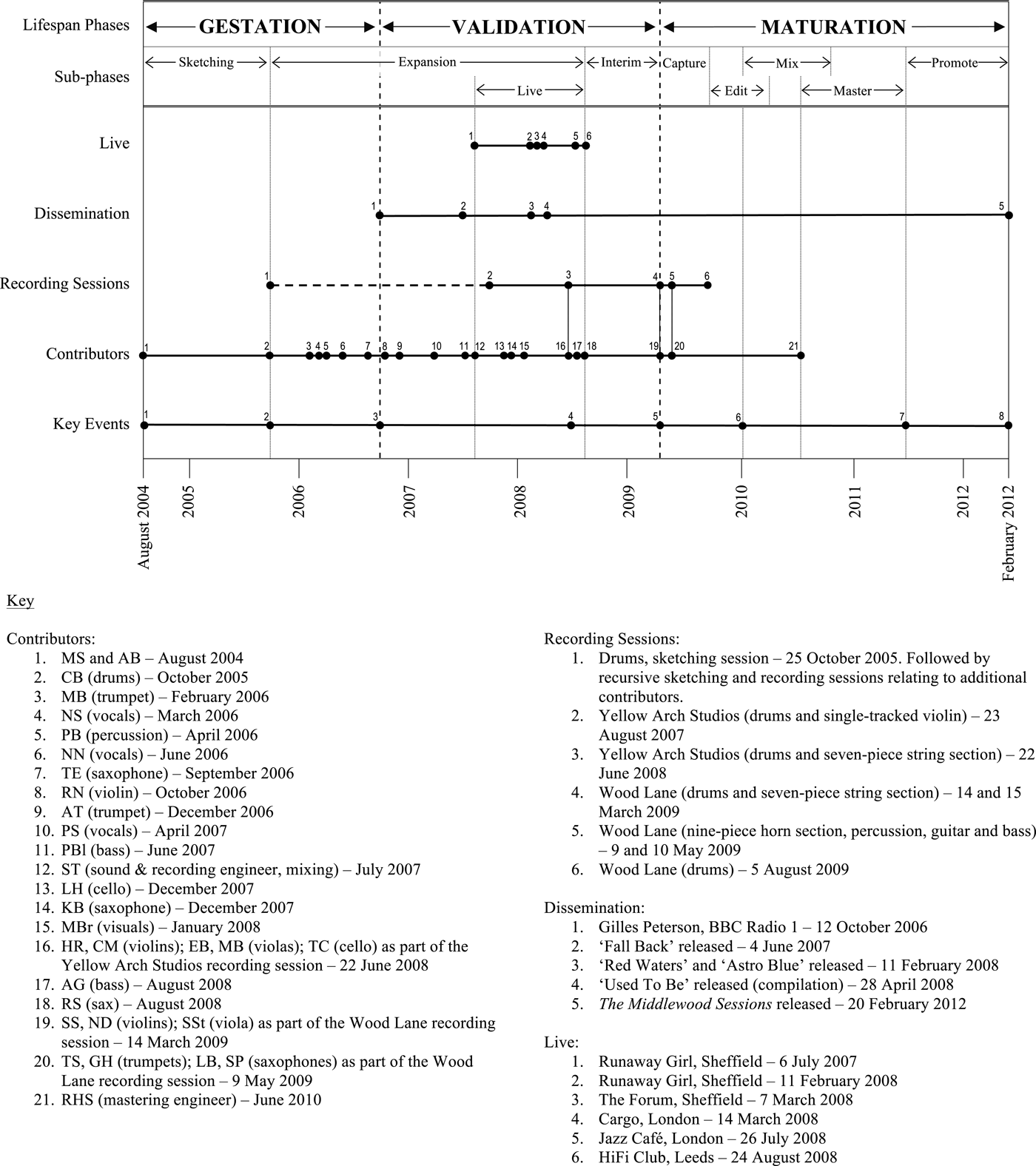
Understood at lifespan level, the three stages are bounded and populated by eight key events (see Figure 3).Footnote 8 The first is the seed incident in August 2004, the meeting between two friends, that triggered the whole endeavour; the eighth, completing the arc or nidus of the studio project, is the moment when the finished album was made publicly available in February 2012, indicating that the project had matured to fruition. The fourth conflates the two critical incidents described earlier in this paper (Yellow Arch and the Jazz Café), which turned out to be central to the music project both chronologically (occurring at roughly the mid-point of the lifespan) and symbolically (the achievements up to that point and the hopes for the future clustered densely, representing shortcomings that demanded resolution of one sort or another). The second marks the first recording session, representing the first major shift in the profile of the project: personnel, technological configuration, technical parameters, geographical location, musical and social dimensions all change. The third occurred on 12 October 2006 when Gilles Peterson played ‘Fall Back’ on UK national station BBC Radio 1. That broadcast concretised all of the endeavours up to that point, approving the trajectory of the collaboration. It made available the musical artefact to the audience, the audience to the artists and the artists to a wider music culture; it marks the first contact with the professional field. The fifth restarts the project, after its partial collapse following the disappointments (for participants) of Yellow Arch and the Jazz Café, with two large-scale weekend-long on-location recording sessions (in March and May 2009; see Figure 3, ‘Recording Sessions’, nodes 4 and 5) featuring drums, percussion, seven-piece string section, nine-piece horn section, guitar and bass. The new approach to recording, featuring full single-tracked takes in an acoustically desirable location, was more professional and proficient in nature, compared with the experimental and exploratory single-instrument multi-track recording sessions happening in the spare room (with duvets and pillows acting as makeshift acoustic treatment). The sixth marks the start of the mixing process and the seventh the point when the finished master fell onto the doormat on 6 June 2011.
Lifespan phases and key events.
Gestation
The gestation stage encapsulates the early developmental processes where the parameters of the collaboration are mapped out in broad terms (shared musical interests, influences, aspirations) and in some detail (musical dimensions invoking grooves, instrumental combinations, melodic types and harmonic preferences, plus the practicalities of instrumental and technological abilities). The gestation stage has the sparsest population of contributors and accumulated artefacts (they are yet to emerge) and is characterised by diffuse goals and experimental and temporary small-scale explorations. Two simultaneous strands of gestational development are entwined: musical ‘idiolect’ (Moore Reference Moore2012, p. 120) and ethos. Small-scale musical sketches assembled, disassembled, chopped, recombined, restructured, reorganised and replayed in Cubase,Footnote 9 encoded a set of emerging values while simultaneously rehearsing them. Once musical material and ethos became sufficiently stable, played out during regular Saturday morning sessions, the sketching sub-phase shifted into an expansion sub-phase symbolised by the first recording session in October 2005.
And here the fractal view is useful. Both musical material and ethos had been validated by the internal quality control mechanisms enacted by the two initial members to the point where the project's material was deemed mature enough to involve others. The gestation, validation and maturation stages had already played out in the sketching sub-phase, giving rise to the first few tracks to be presented to the drummer in his basement that day in October 2005. And the stages play out with an even finer grain too. During the two-hour recording session, each new response by the drummer was a sketch, a gestative performance, that was validated or rejected in a process that brought the idea to maturation at some point in the accumulating mass of takes. A recording session for a single instrumental element of a single track involves many recursions of the gestation-validation-maturation stages. Packing up equipment, lugging it back up the narrow staircase and loading it into the car to be driven back up the motorway suggests finality; the ideas that had been proposed through improvisation had been brought to maturity, captured and committed to hard disk. But this process of rendering music as code leaves it ‘open to re-formation, to repeated re-creation’ (Born Reference Born2005, p. 26). So while the recording session had gestated, its emergent ideas validated and brought to maturity, it was, in the broader scheme of the project, a gestation stage whose fruits received much critical attention, revision and evaluation in the following months. Gestation, validation and maturation continued to cycle around at different transformations of scale until the music had developed to the point where it could be packaged off and dropped irreversibly into the postbox as a four-track demo to 24 labels and DJs in September 2006.
Validation
Gilles Peterson's selecting ‘Fall Back’ for inclusion in his BBC Radio 1 ‘Worldwide’ show in October 2006 marks the start of the dissemination of the project and the lifespan-level validation phase (see Figure 3, ‘Dissemination’, node 1). Validation is an operation of approval derived from situated knowledge and aesthetic judgement. It comes in many forms but falls into two broad types: internal/local (for which criteria relate to the attitudes, aspirations and preferences of those directly involved in making the music) or external/non-local (for which criteria variably depend on the status of the person or institution bestowing the validation). Peterson provided external validation as a representative of his field, which encompasses particular kinds of popular music. His selection of the track was motivated by his in-depth, situated knowledge derived from his years as a DJ and broadcaster. Over the life of the studio project, 29 contributors accrued in addition to the two original core members and each contributor expanded the localised mechanisms of validation by bringing particular knowledge, aesthetic positions and technical skills. While this informal feedback loop was vital for the project in accumulating momentum and sustaining activity, external validation proved more powerful. The act of selecting and broadcasting ‘Fall Back’ symbolised the values represented by the DJ, the radio show, the radio station and, ultimately, the wider audience. These values are acquired and preserved by those in the studio project as anchor points; or, in the form of broadcasts, as objects of pride whose ineffaceability constituted a valuable reserve of positivity.
The validation stage is the most exciting, the densest in terms of activity and the most risky. Validation is a powerful force, providing fuel when in the positive but threatening collapse when it is withheld. At the local level (which can also include an individual's personal emotional response), validation has a confirmatory function where the accumulation of positive experiences transforms into confidence. From external, non-local quarters, examples of validation included: receiving the vinyl test pressing from the record label, the conferment of the mastering engineer's good opinion about the quality of the recorded strings, the brief email from a DJ saying how well a track worked on a dance floor in Dublin, the offer of a gig slot from promoters in Sheffield, and a telephone call from a record label about the release date of a double A-side. Finally, playing live to an audience affords an immediate form of feedback that can be positive and risky in equal measure. This risk, as it turned out, was reflected in the glazed eyes of non-dancing spectators at the Jazz Café gig – a sure sign of what was to follow on the live recording that proved such a disappointment for those in the project who were pinning their hopes on the opportunities this object could offer.
Maturation
The stability of the maturation stage caused two opposing effects. First, the quality of production improved via the adoption of more linear working practices that resemble those already long established in the music industry: capture, edit, mix, master, promote. Gone are the tentative, recursive cycles of experimentation. The musical material, already constructed and structured through the moment-to-moment contingencies of the previous stages (each one playing out cascades of gestation-validation-maturation), simply has to be executed, captured and re-presented. This was done through single-tracked recording sessions with full instrumental sections (see Figure 3, ‘Recording Sessions’, nodes 4, 5 and 6). The virtual, illusory ensemble, constructed in the project studio, became a physical, social reality. Second, the stability of musical materials and working processes brought advantages in terms of quality, but also brought a decline in the sense of the project as collaborative, experimental, collective and emergent. With the adoption of linear working practices, a hierarchical structure emerged that began to resemble older conceptions of creative authorship. What the maturation stage represents, in this case study, is simultaneous success (in terms of the quality of material being made) and collapse (in the sense that notions of distributed creativity were undermined by the scripted, ritualised and predictable nature of the endeavour in this final lifespan stage). The motivation in this final stage was a push towards proving that the domain had been acquired – including mastery of musical materials (structure, groove, harmony, melody, arrangements, timbres) and production processes (technologies, technical skills, logistics, social interaction skills; see Slater, in press) – and that the studio project was capable of producing artefacts viable for the field.
Participants reported that one of the main reasons for embarking on these large-scale recording sessions was to smooth out the significant differences in the sound of the recorded material that had accrued as a result of the recursive, exploratory, non-uniform approach to capturing sound in the earlier stages of the project. The idea was to record sections of the ensemble in the same acoustic to unify the sonic signature of the resulting virtual band. In doing so, the studio project sought to efface its origins, to conceal its history, by disguising the domestic beginnings that were initially prized as the site of exploration and spontaneous creativity. Finally, the arrow of time, beginning from the seed incident, reaches its end-point in the death of the collaborative, distributed creativity that was symbolic of the creative freedom afforded by the project studio – and in the contentment of achieving a long-desired goal.
Cycle (cyclus)
Repetition in creative activity establishes a cycle of events that constitute the working practice, or heuristic, of a particular atelier. The driving force for this cycle, this circling around of processes, is the aspiration to develop musical material of a particular type (in alignment with a chosen subfield) and of a particular quality (in comparison to exemplars existing as part of that subfield). In discussing the compositional process, Donin identifies two main periods in compositional activity that alternate to create a recursive cycle: ‘a preparation period (during which musical ideas are developed alongside the technical constraints that define the projected final work) and a writing period (during which a musical manuscript is written and computer files are produced)’ (Donin Reference Donin and Collins2012, p. 12). Spanning these two periods in a crosswise relationship, activities concerning the construction of elements and their subsequent exploitation are present to varying degrees. The central process that animates the cycle between these two periods is ‘(re)listening’ (Donin Reference Donin and Collins2012, p. 13), a process of review that results in the validation or recalibration of plans. The continual checking of progress during the writing of a piece invokes two scales of time: one broad and conceptual, the other minute and experiential. ‘Synoptic planning’ describes the global concepts whose tenets determine the characteristics of the sonic material and the overall formal scheme; ‘heuristic ideation’ describes how the properties of a piece ‘emerge throughout the writing process, as a result of recurrent or accumulated local compositional procedures … that operate continuously throughout every stage of writing’ (Donin Reference Donin and Collins2012, p. 19).
This continuous alternation between states, driven by evaluation, recalls the Geneplore model (Finke et al. Reference Finke, Ward and Smith1992; Finke Reference Finke1996; Ward et al. Reference Ward, Smith, Finke and Sternberg1999) in which creative behaviour switches between the generation of pre-inventive structures (incomplete, perhaps fragmentary, but potentially viable) and their extensive exploration (which may propose further generative options). Similarly, in relation to collaborative songwriting and production teams working in Anglo-American commercial mainstream popular music, Bennett (Reference Bennett and Collins2012) describes a stimulus evaluation model with four evaluative operations (approval, veto, negotiation, adaptation) bounded by an initial stimulus to begin the songwriting process and confirmatory consensus marking its termination. These six ‘non-linear and interacting’ (Bennett Reference Bennett and Collins2012, p. 155) processes recur over all levels of a song's development, from micro to macro, until consensus is reached. The eventual form of the thing being created – a track or album – is constrained throughout the process of creation by ‘the parts they must have, the functions they must serve, or the particular categories to which they must belong’ (Finke Reference Finke1996, p. 386). The parts, functions and categories of the music and ethos of Middlewood Sessions were discovered as part of a cyclical, iterative and exploratory process.
Another way to think about cyclical time is that all creative activity takes place within broader cycles of life (Csikszentmihalyi Reference Csikszentmihalyi1997, p. 8). The time available to devote to any creative work is finite; the competitive demands of family life and the rhythms of working life curb and contain activity. With several contributors working in education as peripatetic instrumental tutors, primary and secondary school teachers, and lecturers in higher education, activity on the studio project peaked when demands of working life lapsed; half-term breaks, Christmas, Easter and summer vacations became the sites of creative work. Middlewood Sessions never became a full-time, salary-paying job for any of the participants; the aspiration towards professionalism was in terms of quality of production rather than derivation of income. The studio project took place ‘between the cracks of jobs and earning money’ (Diary, August 2007) in vacation periods and on Saturday mornings. It became symbolic of non-work, of a luxurious, indulgent way to spend time that was a counterpoint to the frustrations of work life. In this sense, the project studio is a charged location – a place, and time, of safety where ideas are nurtured. However, while the project was brought to life in between terms and semesters, the wider music industry operates on a different time cycle. The escape from one form of reality (the demands of working life) brought the project into collision with another (the professional music industry) whose ongoing, concurrent cycles were not always compatible with those of the studio project.
One of the most potent symbols of the conflict was that often the gigs were on a Friday. The Cargo gig [in London on 14 March 2008] was on a Friday and this meant that [he] had to have time off work. As a primary school teacher, he just couldn't do it. It was a really difficult decision for him to make. (Interview 3)
In this, the tracings of the three types of cycle are summarised: social, ontological and processual. The social describes the confluence of musicians required to put on a live performance, for example, whose availability is synchronous with many other cycles of life. The ontological traces the transformation of the recorded artefact into something performed that fills an architectural space – or, in other words, the transformation between different forms of music's tokened existence.Footnote 10 And the processual, to which my attention now turns, describes all of the processes and sub-processes that had accumulated up to that point to form the working process that resulted in the music that was performed at the Cargo gig.
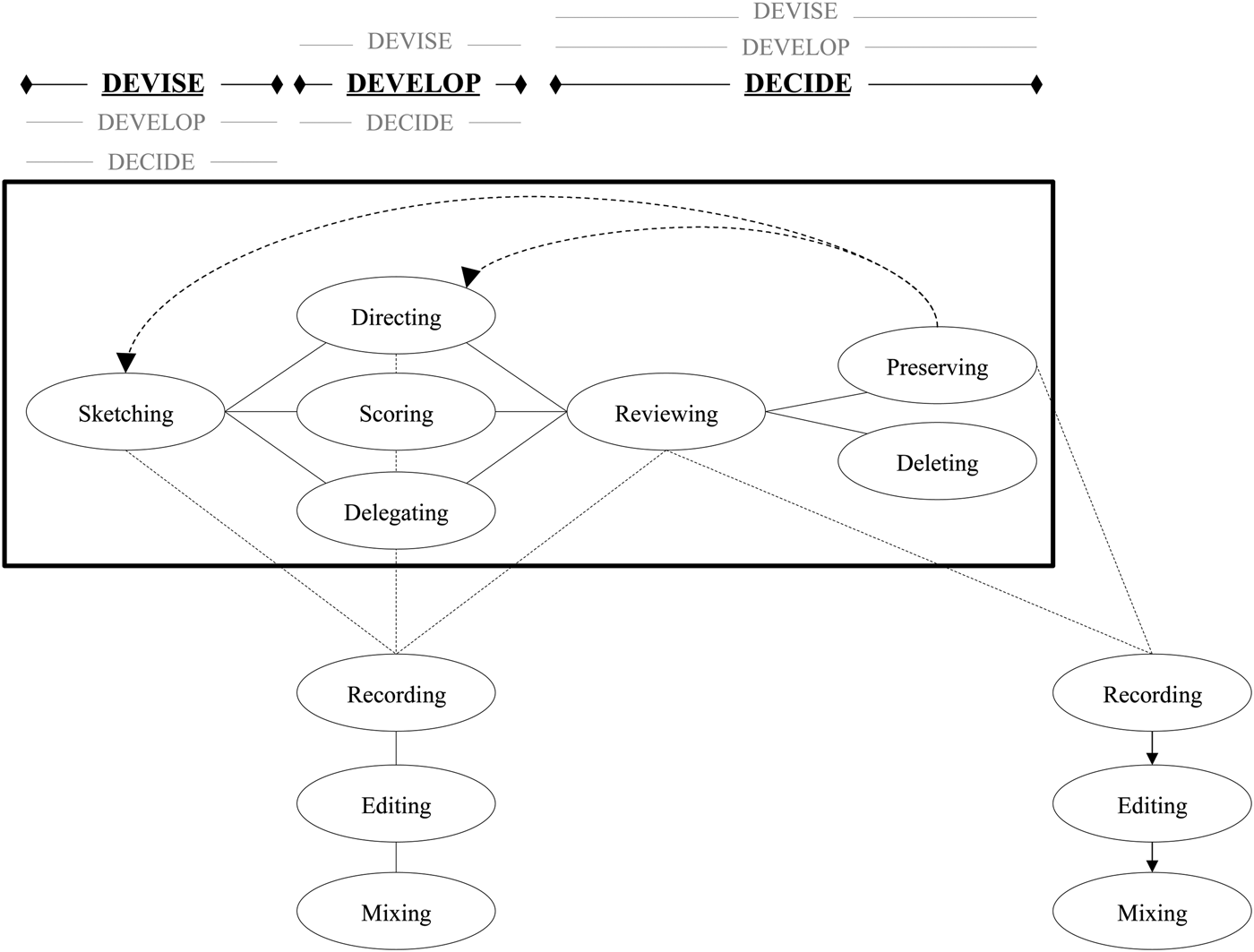
The working process model (see Figure 4) is derived from participants' descriptions of how they went about making the music.Footnote 11 The labels for each sub-process are derived from terms emerging in the interview and diary data. There are three types of sub-process: devise, develop, decide. The boundaries between each type are diffuse (just as stages are fractal); material is devised, developed and decided upon with varying weights in each stage, indicated by their replication in the vertical axes of each sub-process stage. Each of the sub-processes will be exemplified, but first, the status of the recording-editing-mixing group needs to be addressed because it constitutes a fundamental function of musical creativity as mediated by technology.
Working process model.
In the latter stages of the life of the project, when material has been devised, developed and decided upon, recording-editing-mixing constitute a linear process whose function is to capture, re-present and thus preserve material. Operation at this stage is at album level. With the musical material now encoded in neat scores and structured, ordered computer files, the focus shifted to the context and means of recording (how to deploy appropriate microphone arrays to capture or control the lively acoustic emanating from the stone walls and wooden floors of the converted grain loft),Footnote 12 the ingenuity of creating seamless edits and the subtleties of fine-grained decisions concerning levels, spatialisation and dynamics processing in the mix. In the earlier stages, the recording-editing-mixing group is still implicated in the capture and presentation of material, although the deployment of individual processes is less linear and operates at (sub-)track level. Recording captures ideas as opposed to performances; editing and mixing happen along the way as a means of preparing and temporarily presenting the accumulating material to prompt further responses by musicians. In short, recording, editing and mixing are provisional in the earlier gestation and validation lifespan stages but presentational in the latter maturation stage.
Devise: sketching
The raw material for sketches was captured in various ways: audio from snippets captured on mobile phones, pitches named on scraps of paper with barely any order, rhythmic grooves tapped out on tables, and fingers tracing remembered shapes on the fretboard. These sketches, rarely exceeding two bars in duration, were brought from elsewhere: the studio nurtured the nascent idea, but rarely ignited it; the devise stage begins earlier and in another place. From the early seed – a rhythmic amalgam barely spelling out a groove or a germinal melodic idea – the next priority was to build a structural foundation through the multiplication of the initial cell, often taking only one session to achieve. The mapping of structural design provides a perspective where the overall dynamic shape of the material can be better understood and, from there, detail added. Development is occurring as material is being devised.
This is the start of the usual working method where we identify where, roughly, we want strings to appear (considering the overall dynamic) and then [he] sings at me some rough ideas – usually pitches anchored at certain points. (Diary, June 2007)
The dialogue between an ideational heuristic and synoptic planning (Donin Reference Donin and Collins2012) is played out with large-scale structural designs emerging from the latent potential of snippets of musical material. It is interesting to note that working methods are becoming ‘usual’ by this point in 2007, some three years into the project. This sense of establishment of process is an indicator of the stabilising effect of cycles of validation that contributes to the evolution of a particular mode of collaborative working in which roles and tasks are assigned. By this point there is a sense of confidence that the distribution of roles between the two core members will produce viable musical results. The invocation of ‘usual working methods’ indicates that the lifespan-level gestation period has ended and that domain acquisition (Csikszentmihalyi Reference Csikszentmihalyi and Sternberg1999; McIntyre Reference McIntyre2011) is well underway; ethos, the boundaries of musical materials and working processes have been sketched and are now available for use. The working process continues: once the skeletal material has been replicated to form a bare-bones structure, improvisational responses constitute the main strategy for ideation.
The spontaneous moment plays an enormous part in the very early stages of writing – improvisation around rhythmic and harmonic structures acts as a generative tool and it's the material that strikes us as effective in the moment that gets retained. (Diary, January 2008)
Technology functions like a sonic mirror, reflecting back, almost immediately, the emergent form, which preserves a connection with the real-time, temporally conjunct experience of music. The real-time trialling of ideas plays a part in all stages of composition; for example, saxophone arrangements can be recorded to test ‘pacing and harmony in advance of [a] studio day’ (Diary, August 2007) which helps to build confidence, relieve pressure imposed by the expense of professional studio time, promote a sense of creative exploration and extend the sketching process. In a similar way to the crosswise relationship between construction and exploitation that Donin (Reference Donin and Collins2012, p. 12) describes, there is a crosswise relationship between fragmented and linear timespans during sessions of music making. Indeed, this switching between temporal modes is a defining feature of music technologies. By striking the spacebar, the session file begins to play: the fragmented and recursive processes of discovery and decision making during the constructional sketching phases of generating music are replaced by the smooth, linear temporality of musical time tested to reveal how well the material is being exploited. The spacebar toggles between a temporal mode in which fragments of sound that have been ‘pried from their context’ (Hennion Reference Hennion1989, p. 409) can be considered, manipulated and exploited in the construction of a song, and another that gives ‘a unity to this pile of inert pieces’ (Hennion Reference Hennion1989, p. 411). The spacebar negotiates the crosswise tension between the fractus of creativity as process and the experiential linearity of music as product.
Develop: directing, scoring, delegating
Sketching strategies are extended in three ways: directing, scoring and delegating. Directing refers to a co-present mode of development that occurs in collaboration with musicians. Those directing take on the role of observer (or auditor) by guiding, limiting and supporting the improvising musicians as they respond. These responses are constrained by the parameters of the pre-existing materials (shaped, at least, by the weight of the project studio and biographic arcs), which are intended to act as stimulants in the transition from pre-inventive form to established musical expression, catalysed by the improviser playing a part in a process of real-time composition (Rose and MacDonald Reference Rose, MacDonald and Collins2012). Directing implies a mode of in-the-moment musicianship based on orality, and aurality, during which material may be instantaneously devised, developed and decided upon in a series of incremental turns, each of which advances the ‘unfolding story’ (Sawyer and DeZutter Reference Sawyer and DeZutter2009, p. 83) of the development of the material.
Scoring involves the conversion of improvised offerings into standard Western notation. Other notations are used temporarily (graphical depictions, pitch names, chord sequences including extended harmonies), but staff-based notations become particularly important when working with larger ensembles requiring coordination. The score is an organisational device that prescribes action, which allows, if not demands, mediatory intervention in order to be made and to be interpreted. Initial notations are skeletal representations that seek to describe the sonorous improvised moment which, once transcribed, can be developed by adding, extending, expanding, quantifying, solidifying and generally making material suit not only specific instruments but particular musicians' idiosyncrasies.Footnote 13 This order of working, from the improvised to the notated and then back again, describes the ‘ontogenetic’ (Kozbelt Reference Kozbelt2009, p. 35; 2011, p. 56) patterning of Middlewood Sessions' creative process. In cycling between two ontological tokens (aural–written or improvised–notated), the sense of the material changes from being open, existing in the moment, to being fixed, less flexible. This change is partly desired because it represents a decisive settling of ideas, but is partly resisted because of the desire to retain flexibility. Fixing notations, or the closing down of improvisational ideation, requires certainty and decisiveness about the future outcome; but the absence of certainty can be disguised as the desire for flexibility.
I tend to break up 16-bar phrases into 2x8 and arrange the blocks with slight variations. This enables me to maximize the recording sessions and generate enough material to cover all eventualities. This is a sensible use of time – it just requires a little more forethought. This approach also implies that the song is still in a flexible and dynamic state: these arrangements are really trying to be ‘future-proof’ to allow us to change and adapt as the recording takes place. (Diary, January 2008)
Notations here are directed towards the preservation of material for some future enactment – usually a recording session. The cycling between the two ontological tokens brings with it tensions: between fixity and freedom, immediacy and laborious meticulousness, individual and collective contributions. The ‘forethought’ required in preparing scores for recording sessions distances the moment of improvised enactment through the reifying effects of deciding what (and how) to notate. This distancing effect happens because the score is an object (as opposed to a percept) and because the act of producing scores implicates a very different timescale from that of improvisation whose time-frame maps directly onto that of the experience of the material in question – music. The creation of a score is a time-consuming, solitary activity. While many people can simultaneously perform into an array of microphones, or gather around a computer monitor (Williams Reference Williams2012), only one person at a time can put pencil to manuscript. The score, as the bastion of the lone author, is perpetuated by the specialist skill of notation and by the amount of time implicated in this writing-out of another temporal form. Despite this, the score is subsumed into a process of collaborative creativity; it becomes a subtype in the service of an emergent creation based on a collage of contributions from different people.
Delegating describes a developmental process whereby material is given to other contributors in the project to work on without the original core members being present. When directing, core members enter into a form of tacit delegation by leaving the specific and minute details of the musical gesture or expression to the improvising musicians. Delegation proper involves the temporary (temporal) severance of the core members from their material, facilitated, in this case, by ‘computer technology, multi-track recording software and high-speed Internet connectivity’ (Théberge Reference Théberge2004, p. 760) that allow music, as data, to be transferred to another place for development at another time. This form of development resembles Bennett's ‘demarcation’ model for collaborative songwriting in which ‘parties need not be present in order to co-write’ (Bennett Reference Bennett2011, p. 4), as one party provides some element of the song in a more or less complete form onto which the next party adds their contribution. While this process enriches the possibilities for the project, it brings with it a fear of lost control.
S had re-recorded all of N's vocal parts (not just re-recorded, but had scrapped the original verses and lyrics and written new parts) and had recorded his backing vocal parts and a completely new verse for himself. In short, all of the vocal elements were new to us. This was initially very exciting! They do sound awesome and lift the track to a completely different level (S has that Midas ability). However, on reflection, we felt cornered, as we'd completely lost creative control of the track. (Diary, October 2007, original emphasis)
Decide: reviewing, deleting, preserving
The accumulation of musical responses, as exemplified by the delegated vocal recordings of S and N, creates a complex cascade of authors. The fear of lost control equates to a fear of lost authorship. During the processes of reviewing, this fear is allayed because authority is asserted through decision making; overriding authoritative control smooths the complex structure of collaborative origination. This authority is most decisively administered in the approach to deciding whether to preserve material or not: anything deemed to have even the barest traces of deficiency is deleted, even if what is being effaced represents a substantial amount of work.
We'd recorded strings for it at Yellow Arch and I'd probably spent about four or five days editing the material for this [one] section alone. There is quite a lot of investment represented in the material when seen in this way but, despite that, it did not work at the Jazz Café. And we can't make it work now so it has been deleted … It's a liberating feeling. Deleting problematic material helps to clear the stage for developing the material that does work. (Diary, August 2008)
Deleting is a confident and liberating action, one of a binary of possible outcomes of the process of reviewing; what I term ‘preserving’ and ‘deleting’, Bennett labels ‘approval’ and ‘veto’, the latter of which can lead to ‘negotiation or adaptation’ (Bennett Reference Bennett and Collins2012, p. 155) in a manner similar to the feedback loop in the working process model presented here (Figure 4) that returns material to the ‘devise’ or ‘develop’ stage. The decision-making process, whether to erase or preserve, has three bases. First, the social structure provides objectivity. Each person provides a ‘fresh pair of ears’ (Diary, January 2008) to review the efforts of others. The demarcation of separated spans of time caused by the domestic setting and the demands of family and work life magnifies the possibility of objectivity, or opportunities for reflective rumination (Cohen and Ferrari Reference Cohen and Ferrari2010). Secondly, and in contrast to those ruminative gaps, technologies provide an ‘ability to constantly review’ (Interview 3), repeat and manipulate sound (Katz Reference Katz2004, pp. 24–31, pp. 41–6) in such detail and with such ease that the emergent collaborative endeavour can be compared, contrasted, judged and evaluated as part of the continual, incremental cycle of development. Thirdly, the purposefulness of decision making that participants report suggests criteria built around a clearly defined extra-referential system of tracks and artists and an intra-referential system based on a body of original material sufficiently substantial and coherent to function as a basis for ongoing comparison. The intra-referential system marks a significant moment in the life of the project. It locates the tipping point where the collective identity of the studio project, as encoded in tangible outcomes that appeal to the senses (recordings, broadcasts, live performances), has coalesced enough to propagate its own discourse. The studio project has come of age.
Closing thoughts
The intention here has been to explore a single case study of a studio project as played out in the increasingly prevalent context of the domestic project studio – a form of musical creativity whose embedding in other cycles of life is perhaps made all the more acute through its proximity to them. Understanding the constraints of available time offers a way of understanding how creative behaviour comes to be patterned in that there are forces outside the immediate creative endeavour that act to shape it. But the practicalities of carrying out creative work exert just one type of force. Aspirations, motivations, aesthetic dispositions, friendship networks, commercial structures, technologies, attitudes, successes and disappointments all contribute to the complex story of how something new, and hopefully useful, gets made. The linearity of a narrative, like that of Middlewood Sessions, is easy in retrospect but unknowable, unpredictable, messy, fractured, interrupted and fragmented as it plays out for those experiencing it. To account for this, I have proposed the term fractus of creativity to capture some of the different ways that creative work plays out: nested time, arcs and cycles. I have also proposed a fractal stage model that accounts for the nature of creativity as a process of nurturing, of bringing something to fruition that spins out over time in a general order that is replicated at different levels of transformation from the lifespan level to the minutiae of musical material. In this sense, though complete in its biographic dimensions (the studio project is now over for its participants, no work continues) and though mature in terms of the artefacts and traces left behind, what I have reported here could just be a gestation phase in a much longer cycle of creative endeavour. Albeit a gestational phase that, in all its complexity, took just under eight years to complete.