

1. INTRODUCTION
Thinking of rural law courts,Footnote 1 one cannot escape the question of their competence: did they maintain social order and enable exchange, or did they allow for rent seeking by powerful nobles and their associates? Historians have often been pessimistic about the efficiency of rural law courts. For example S. R. Epstein claimed that for economic growth to occur, jurisdictions in the countryside had to be replaced by urban territorial jurisdictions. According to Epstein this was the most effective way to limit the high transaction costs that pre-modern societies faced, as urban elites ‘had the strongest incentives and the best economic, administrative and political skills to coordinate reciprocally beneficial trading relations with the countryside’.Footnote 2 Such a thing was hard to achieve, however, and, according to Epstein: ‘jurisdictional fragmentation, which gave rise to multiple coordination failures, rather than autocratic rule was arguably the main source of the institutional inefficiency of “absolutism” before the nineteenth century’.Footnote 3
It is relatively easy to propose several reasons why rural law courts may have been inefficient. To begin with, the courts could not profit from economies of scale, and hence could not support the elaborate land registries, or professional writers that larger urban economies could provide. Furthermore, since judges were often recruited from amongst the ranks of the peasantry, rural law courts were not conducted by men of the highest calibre. With the exception of nobles, who might have sent their sons to university, few people in the countryside were able to invest in an education that would allow a career in public office. In contrast, urban elites often prepared their sons for a career in business and public office, causing the pool of qualified officials to increase.Footnote 4 Rural areas may even have suffered from a ‘brain drain’, in that more successful inhabitants would ultimately acquire citizenship in towns and hence became ineligible to participate in rural law courts. By and large, therefore, over the course of the late middle ages, urban law courts are likely to have become more professionalised, while those in the countryside lagged behind.Footnote 5
Had the factors above caused rural law courts to become corrupt, many transactions would have fallen through because of the risk they involved. Poor villagers would have feared that a wealthier neighbour might be able to exercise disproportionate influence upon the administration of justice if a dispute arose, while those not from a particular village (hereafter ‘non-residents’) dealing with an inhabitant, or inhabitants, of that village may have had similar concerns.Footnote 6 Such fears contributed to ‘inter-jurisdictional transaction costs’, meaning the actual and perceived costs incurred when two participants in an exchange belonged to different jurisdictions and concluded their transaction by making use of the ‘home court’ of one of them. For example, if a man from one of the towns (hereafter ‘a townsman’) lent money to a man from a rural village (hereafter a ‘villager’), and the transaction was secured by means of ratification and registration by the law court in the village of the latter, any future conflict would be resolved by this court, and therefore the townsman might have perceived this to be to his disadvantage. Could he, as an outsider, trust the village judges not to give their fellow villager preferential treatment? If he had such worries, a creditor could either walk away from the transaction, or try to obtain information about the administration of justice in the village, and the reliability of its judiciary, which would raise his information costs. In such a case, he might have demanded a premium to cover the default risk and his information costs. If the transaction costs of exchange between members of different jurisdictions proved particularly high, this may have affected the extent and direction of transactions between those jurisdictions. Townsmen would have preferred the ‘home advantage’ offered by urban law courts, and in this respect the emergence of urban territorial jurisdictions, and the gradual dissolution of rural law courts may indeed have helped to streamline trade, as Epstein suggested.Footnote 7
However, it is not evident that urban jurisdictions took over in the countryside in the county of Holland, even though this is often considered to have been a textbook example of an economically flourishing pre-industrial region. During the golden age of the Dutch Republic, in the seventeenth century, the province of Holland was heavily urbanised but it still had numerous urban and rural law courts, despite attempts by several towns to gain control over the rural areas surrounding them.Footnote 8 These towns tried to do away with what they perceived as harmful proto-industries in the countryside, but only a few managed to accomplish this. Even fewer managed to incorporate their rural hinterland within the territory of their urban jurisdictions, and when they did, the areas concerned were usually very small.Footnote 9 It would seem that in many respects, villages became more important over time. Research conducted by Clé Lesger into the regional function of the town of Hoorn, in the north of Holland, shows that its ‘function as a regional service centre declined as a result of rising service levels in the [region's] villages’ in the sixteenth and seventeenth centuries.Footnote 10 This shift was visible in the greater number of commodities being sold in the villages, something Lesger links to the growth and increasing purchasing power of the population.Footnote 11 However, he also points out that the expansion of public services provided by the villages played a role, either as a cause underlying the expansion of village markets, or as an effect of increasing demand for services by those participating in an exchange of goods or services.Footnote 12 In the latter respect law courts may have had an important role to play along with other institutions such as weighing houses and notaries’ offices.Footnote 13
The resilience of rural law courts in Holland raises two straightforward questions: did sustained economic growth in Holland occur because rural law courts performed well or despite the fact that the towns failed to establish territorial jurisdiction?Footnote 14 These questions gain importance when we realise that many scholars have indicated that economic growth in Holland depended in no small part on villagers in the countryside who took up proto-industrial activities and commercial agriculture, and sold their wares in the expanding urban markets both in Holland and further afield.Footnote 15 Townsmen and villagers exchanged commodities, engaged in labour contracts, invested in land and in financial instruments, and, in doing so, they had to negotiate the boundaries of many urban and rural jurisdictions, yet apparently encountered few obstacles. Does this mean that rural law courts in Holland differed from those elsewhere in Europe, where they allegedly had to be replaced by urban territorial jurisdictions before economic growth became possible?Footnote 16
An analysis of the organisation and functioning of village law courts in Holland is a first step towards answering such questions. To this end this article first discusses the emergence of rural law courts in Holland, focusing particularly on the strong position that village law courts acquired. Then, drawing on a case study of the law court of Mijnsheerenland, a village in the south of the county of Holland, we will discuss the main functions of village law courts, particularly the ratification and registration of transactions and conflict resolution. To arrive at a better understanding of the function of village law courts in regional economies the subsequent sections explore possible ways of studying inter-jurisdictional transaction costs. Did such costs prevent those from outside Mijnsheerenland from participating in the relatively complex transactions where land in the village was used as collateral? Or did townsmen and those from elsewhere lack trust in the village law court of Mijnsheerenland, and demand a premium in compensation? Our analysis shows that there is, in fact, little reason to believe that trust was an issue in sixteenth-century Mijnsheerenland. We argue that this was the result of one of the peculiarities of the juridical system in Holland; despite being fragmented the system also managed to be uniform because it was dominated by public courts that were under the central control of the counts of Holland.
2. RURAL LAW COURTS IN HOLLAND
Policing and administration of justice were some of the most important tasks of pre-industrial village communities. Jos Raadschelders even claimed that these were also the first tasks for which local governments took responsibility, starting in the early middle ages.Footnote 17 In Holland, and elsewhere, there had been others willing to maintain law and order. Nobles in particular saw it as their duty to do so. As a result, for many village communities in Europe the administration of justice did not come without a compromise having to be reached with nobles used to exercising their domanial and feudal rights, resulting in the coexistence of different types of law court at a local level. In this respect villages in Holland stood apart because nobles wielding domanial and feudal rights had all but disappeared by the late middle ages, and manor courts were absent.Footnote 18 This exceptional situation was made possible through the large-scale reclamation of the vast inland marshes of Holland, which had been carried out under supervision of the counts of Holland and the bishops of Utrecht in the east of the province. In the course of this reclamation process, from the tenth to thirteenth centuries, the counts and bishops established a political structure consisting of local jurisdictions administered by government agents (sheriffs) and villagers. Except for a few small areas that had been inhabited before the reclamations, nobles and clergymen did not preside over jurisdictions of their own.Footnote 19
The limited judicial role of nobles and clergymen declined further over time and as a result, by the late middle ages, villages in Holland operated as ‘public bodies’, and villagers participated as judges in the law courts. The law courts were an important aspect of the village as a public body forming ‘a local jurisdiction of (legally) free inhabitants, with several tasks derived from public authority, such as self-government, maintaining law and order, judiciary, and the maintenance of common goods’.Footnote 20 This system of law courts in Holland was relatively comprehensive, particularly when compared with the situation elsewhere in Europe where several types of law courts coexisted and often overlapped, which may have contributed to the ‘coordination failures’ mentioned by Epstein. In Holland there were also many jurisdictions, but almost all of these were public law courts of the same type, so jurisdictions did not overlap. Furthermore, the public law courts were all part of a larger legal structure, overseen by the counts of Holland, consisting of regional courts of appeal and a supreme court in The Hague, and later in Malines.Footnote 21 This structure has been linked to the emergence of a ‘territorial state’, most prominently by the historian Hendrik van der Linden.Footnote 22 Perhaps this is overstating matters, but it remains true that by the end of the middle ages the public law courts in towns and villages faced hardly any competition from noble or ecclesiastical law courts.
This does not mean that nobles were completely absent from legal processes. Many villages had to deal with the presence of nobles, who had either held on to some ancient rights, or had managed to acquire some form of lordship (as ambachtsheren).Footnote 23 In practice, this meant that the nobles had a right to appoint a sheriff, and to certain revenues, such as the fines levied by the sheriff.Footnote 24 Nobles thus had a clear interest in villages, not least because they derived their noble title from their lordship over these villages. They were often of help to ‘their’ villages, for instance by using their political weight in disputes between villages and towns over rural proto-industries.Footnote 25 However, direct control of the nobles over the administration of justice was severely limited; villages functioned as independent public bodies, and so did their law courts. By 1500 – and probably much earlier – the vast majority of Holland consisted of urban and rural jurisdictions that were governed by their inhabitants under the ultimate supervision of the counts of Holland. In only a few villages was the latter not the case; here the counts exercised no jurisdiction and nobles thus possessed ‘quasi-immunities’.Footnote 26 The existence of a few towns that had succeeded in establishing small territorial jurisdictions has already been mentioned, and in the sixteenth century some large towns also managed to acquire lordship over a few villages. By the mid-seventeenth century, however, only 8 per cent of the villages in Holland had become subject to urban jurisdiction, although among the remaining 92 per cent there were villages in the north of Holland, in the Westfriesland area, which differed only very slightly from towns in terms of the privileges that they held.Footnote 27 To pacify this unruly area, the counts of Holland in 1415 had granted all villages a ‘town charter’, allowing them the right to organise administration and justice in the same way as towns did.Footnote 28
What was the function of the public law courts? The answer to this question can be found in the charters, first recorded in the thirteenth century, laying out the customary law of rural regions that settled the relations between the counts of Holland and the villages. One of the most important of these charters, the so-called Kennemer landrecht, provides insight into the legal system found in the large region of Kennemerland (to the west and northwest of Amsterdam). The charter demonstrates the development of rural law courts, from a system where an itinerant judge (azega) assisted the villagers in settling disputes, to a system involving a college of more specialised judges (called aldermen (schepenen) or heemraden, or simply ‘neighbours’, chosen from the ranks of the villagers).Footnote 29 The latter system emerged gradually over the course of the late middle ages, causing the azega to disappear over time.Footnote 30 This suggests that by the late middle ages law courts were confident that they could take care of the administration of justice themselves.
Sheriffs were appointed by the counts of Holland, or by local lords. Either way, sheriffs were government agents, who swore an oath of office and could be fined or even removed if they were deemed to be corrupt.Footnote 31 They organised the village law courts, summoning plaintiffs and defendants, making sure that hearings were undertaken in an orderly fashion, and executing the sentences decreed by the judges. The village law courts were competent to settle ‘simple’ criminal and civil disputes. However, they could not impose corporal punishment or heavy fines.Footnote 32 More serious cases were sentenced by a high court, where a bailiff (baljuw) presided. Bailiffs also heard all appeals against judgments meted out by village law courts, as well as pursuing lawsuits involving nobles.Footnote 33
Under civil law in Holland, village law courts were competent to settle all disputes over land within their jurisdiction.Footnote 34 Anyone disputing property rights, lease contracts or mortgages had to file a complaint with the local sheriff, who would then gather inhabitants for a session of the law court. The plaintiff could not then file a complaint with any other court. This system helped prevent endless litigation before several law courts, and put a stop to any bickering between law courts about their competence to hear a certain case.Footnote 35 The counts of Holland protected this practice: in 1351 count William V, who reigned from 1351 to 1389, forbade nobles and clerics from settling such disputes.Footnote 36 Conflict resolution was a matter for local government agents (sheriffs) and judges chosen from the ranks of the villagers. High courts would only pronounce on disputes after one of the litigants had lodged an appeal against a sentence by a village law court.Footnote 37
Village law courts provided those participating in exchange transactions with a number of economic institutions: ratification, registration and conflict resolution. By ratifying transactions concerning land, the judges confirmed that the exchange was carried out according to local custom. If they suspected any form of deceit they would not ratify the transaction. As public law courts were competent to settle all disputes over land within their jurisdiction, they were also the court of choice for the ratification of transactions involving land. Public law courts gave greater preference to contracts that they had ratified themselves than to those issued by any other authorities, both public and private, and therefore participants in transactions involving land had a strong preference for their transactions to be ratified by the local court. A contract sealed by a noble or clergyman would not suffice because it provided little legal security. The best legal security was only to be acquired through one law court, namely the court with immediate jurisdiction over the land involved. Ratification of transactions by local public law courts had been the practice during the late middle ages, but the courts did not ratify all transactions. Until 1529 participants in exchange were free to decide whether they would have a transaction ratified by the village law court, by another law court or by a noble, cleric or priest who had his own seal.Footnote 38 They could also opt against ratification altogether, but non-ratification of a transaction with the proper public law court meant risking the expropriation of the land involved if a third party brought a claim, such as a claim of title to the land. As a result, those buying land would generally have demanded that the transaction was ratified by the village law court, and the same would have applied to creditors accepting land as a collateral. It is presumed that transactions involving less valuable assets were not usually ratified.
Law courts helped prevent information asymmetries with respect to property rights by carefully examining the proposed transaction, and looking for any irregularities or obstacles, such as claims to the property by third parties. Originally, when involved in this task they had to rely on local collective memory but from the late fifteenth century they could consult registers of prior transactions involving land. Before the sixteenth century the ratification of transactions concerning land did not necessarily go hand in hand with their registration. Village law courts witnessed transactions, in some cases recording a contract in writing to which members of the court attached their seal, but they did not keep minutes or draw up copies for future reference. This practice became much more common in later centuries. Although a few registers from the mid-fifteenth century can be found, it seems that the majority of villages only began to make records of the transactions that they ratified after 1542 once Emperor Charles V and King Philip II had issued several decrees making registration mandatory.Footnote 39
Finally, legal security for the participants in a transaction depended to a considerable degree on the role played by the law courts in conflict resolution. Information on the latter is provided by so-called dingtalen, which were protocols stipulating how the sheriff, and the group of inhabitants that acted as judges, had to proceed.Footnote 40 Creditors of ratified debts had the right to a relatively fast and inexpensive type of debt recovery called panden. The sheriff would seize the collateral. The debtor could either pay within 24 hours of the seizure, or take up to two weeks to object to it.Footnote 41 In cases where the debtor did not object, or the objection was dismissed, the judges would estimate the value of the collateral seized and allow the creditor to take as much as necessary to recover his loss.Footnote 42 Of course, such procedures involved expenses: the whole procedure of panden cost about 10 stivers. This sum was added to the debt and thus had to be paid for by the debtor.Footnote 43 Altogether, village law courts thus provided some crucial services. They were responsible for civil jurisdiction involving land, and had a firm grip on ratification and registration of transactions involving land. We may therefore assume that the quality of the local court had a decisive effect on exchange transactions on both a local and regional scale.
3. A CASE STUDY: THE LAW COURT OF MIJNSHEERENLAND
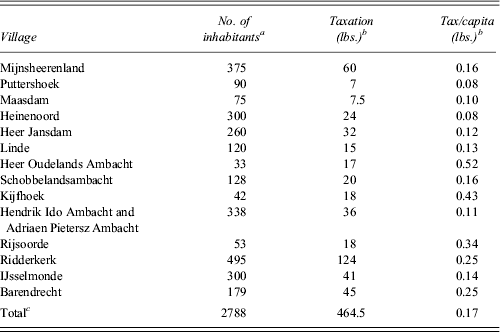
Having explained how rural law courts in Holland developed during the late middle ages, it is time to turn to our case study of the village of Mijnsheerenland, or Mijnsheerenland van Moerkerken, as it was also called. Several sources shed light on the village's public law court, the most important being registers of contracts ratified by the court. Mijnsheerenland was located in the south of Holland, in the region of Hoekse Waard. In the sixteenth century it was a relatively new settlement, having been reclaimed by the Flemish knight Lodewijk Praet van Moerkercken after the ‘St. Elisabeth’ flood of 1421 had inundated the region and destroyed the then existing villages.Footnote 44 A large government inquiry for the purpose of the reorganisation of tax assessments, which took place in 1514, gives some of the best information about Mijnsheerenland in this period. At the time of the inquiry the sheriff and aldermen (who are referred to as heemraden in the sources) of Mijnsheerenland claimed that the village contained 63 houses and, according to the sexton, the parish had around 250 inhabitants who were more than 13 or 14 years old and who would therefore receive the Holy Communion during mass. The entire population, including young children, would probably have numbered about 375 individuals.Footnote 45 Mijnsheerenland was estimated to extend over 1,000 morgen, or approximately 2,104 acres, of which only 15.5 morgen, or 38 acres, were owned by residents of the village. The rest was owned by people who lived in nearby towns, such as Dordrecht, and further away, in towns such as Utrecht. It is doubtful that these figures are very accurate, as the villagers may have understated their landownership in order to be given a relatively low tax assessment.Footnote 46 In addition, the 1514 inquiry tells us that most of the inhabitants of Mijnsheerenland earned their living in agriculture or fishing, by catching birds, and digging dikes.Footnote 47 To gain an impression of how Mijnsheerenland compared to other villages on the several islands in the south of Holland, we gathered data on inhabitants and taxation from other villages included in the 1514 inquiry. The data in Table 1 show that Mijnsheerenland was a rather large village. On the islands considered, only Ridderkerk had more inhabitants. The figures also make it clear that the village was not especially wealthy, the tax per capita being 0.16 pounds (hereafter lbs.), close to the average of 0.17 lbs.Footnote 48
Population and taxation in the south of Holland, 1514

a As our sources record only the number of people who received Holy Communion we have corrected our figures to allow for people who did not do so, i.e. infants and children younger than 13 or 14 years. We follow the approach used by Van der Woude who calculated that approximately 33 per cent of the population would have been younger than 13–14 years (A. M. Van der Woude, Het Noorderkwartier. Een regionaal historisch onderzoek in de demografische en economische geschiedenis van westelijk Nederland van de late middeleeuwen tot het begin van de negentiende eeuw (Wageningen, 1972), 77–85).
b Taxation expressed in pounds (lbs.), a unit of account used by the government of Holland to distribute taxation among towns and villages.
c The 15 villages listed all lay in the areas of Hoeksche Waard and Zwijndrechtse Waard; the list comprises all those villages for which we have data on population and taxation.
Sources: R. Fruin ed., Informacie up den staet faculteyt ende gelegentheyt van de steden ende dorpen van Hollant ende Vrieslant om daernae te reguleren de nyeuwe schiltaele gedaen in den jaere MDXIV (Leiden, 1866), 185–9; R. Fruin ed., Enqueste ende informacie upt stuck van der reductie ende reformatie van den schildtalen (Leiden, 1876), 267–9; J. C. Naber, Een terugblik. Statistische bewerking van de resultaten van de Informatie van 1514 (Haarlem, 1970).
When, after the St. Elisabeth flood, Lodewijk Praet and his descendants became lords of the new settlement they gained the right to appoint a sheriff, who was responsible for organising court days. Often, the sheriff also acted as village secretary. The local court was completed by four judges, called heemraden, drawn from the ranks of the villagers.Footnote 49 Praet was granted the right to appoint a sheriff in 1422, with the condition that he would elect a man from the rural elite.Footnote 50 This does not mean that Praet and his sheriff could act in an unrestrained manner, as the sheriff was bound by customary law (landrecht) and monitored by the bailiff of Zuidholland, who invested the sheriff with his authority (the so-called banbrief).Footnote 51 Further constraints on the right to appoint a sheriff are evident in the record of a dispute from 1611. Johan van Raesvelt, then lord of Mijnsheerenland, had appointed two foreigners from outside Holland as sheriff and secretary. These appointments were much to the dismay of the villagers, who complained to the magistrate in Dordrecht, referring to a privilege issued by Emperor Charles V in 1555, stating that foreigners were not to become civil servants. The magistrates of Dordrecht, the capital of the Zuidholland region, asked the lord to kindly appoint someone else, of course prompting the latter to explain why he believed that his candidates should be appointed.Footnote 52 The outcome of this dispute is unclear, but it does hint that there were constraints on a lord's right to appoint a sheriff.
We use three sources in our discussion of the village law court of Mijnsheerenland: a register of all ratifications of transfers involving land (called schepenregister); a register of ratifications not involving land (called willekeuren); and a register of civil hearings (called dingboek). The first is a register of contracts covering the years 1532 to 1567, which records mainly transfers of real estate and the creation of mortgages.Footnote 53 Its earliest entries thus predate the decree of 1542, which forced local courts to keep written records of transactions involving land. In general, records in this source are uniform. They start with a formula stipulating that the sheriff and heemraden had ratified the transaction: ‘I, Aert van Gheel, sheriff in Moerkerken and we, heemraden in the same village, Jacop Janszoon, Aert van Driel Ariaenszoon, Willem Janszoon and Jan Jacobszoon acknowledge we have been witness to …’.Footnote 54 What usually follows is a description of the transaction, including references to the legal framework that the local court had to offer. Transactions involving land required the transfer of property rights, or the grant of a claim on the land, which could only be confirmed by the local court. Thus the sheriff and heemraden ‘acknowledge we have witnessed the transfer of 5 morgen of land and confirm that the seller was the owner [i.e. had the right to sell the land]’.Footnote 55
This confirmation of property rights was not taken lightly. Before it could take place, the proposed sale had been announced in public, on several Sundays during mass. If no one came forward with a claim to the land, the sale could be finalised. The question of property rights was also crucial when land was mortgaged. Creditors had to be sure that the debtor could dispose of the collateral, and did not try to deceive them in any way. In Mijnsheerenland the sheriff and heemraden therefore monitored whether a mortgage was of sufficient size to secure the loan in question: ‘this land suffices [to secure an annuity of] 9 Rhenish guilders annually’.Footnote 56 Furthermore, the sheriff and heemraden also looked for hidden dues attached to the land: ‘we, sheriff and heemraden, acknowledge this land to be unburdened with any annuities’.Footnote 57 The latter was done by referring to the extensive knowledge of the heemraden of past transactions and local affairs, by public announcements of proposed transactions, and presumably also by checking registers of the law court.Footnote 58 Furthermore, when the court discovered deceit, it would impose a heavy fine.Footnote 59 Thus, the law court of Mijnsheerenland improved legal security in three ways: by confirming that the transaction complied with the rules through ratification; by ensuring that evidence of a transaction would be available in writing via registration; and by keeping track of transactions through the use of registers and the knowledge of members of the court.
Thus far, we have been discussing transactions involving land. To what degree did law courts facilitate other types of transaction? In a second register, of willekeuren (the word willecore meant ratification), aldermen of Mijnsheerenland recorded transactions not involving the transfer or mortgaging of land.Footnote 60 In general, willekeuren included postponed payments, such as purchases on credit, which were ratified by the local court to add legal security. Debtors could put up collateral, such as livestock,Footnote 61 or had to agree to be liable with all their possessions, present and future. Compared with the use of land as collateral, this type of personal liability offered less legal security. Whereas property rights to land were closely monitored, it was difficult to tell how often a debtor had already used a cow as collateral. Furthermore, while land was immovable, a debtor could flee, taking his cow with him. Law courts thus offered creditors seeking optimal legal security a relatively elaborate procedure that was based on the use of land as collateral. Those willing to take a greater risk could go through a simpler procedure, with other forms of collateral.
As a result, creditors of large sums demanded land as collateral, and creditors of smaller sums made do with other kinds of security. This difference is quite evident when we compare the value of average debts recorded in the schepenregister (165.8 guilders) with those recorded in the willekeuren (40.1 guilders). To be sure, these were considerable sums, equivalent to the wages that a skilled labourer might expect to receive for 550 and 133 days’ work, respectively.Footnote 62 These examples suggest that the inhabitants of Mijnsheerenland did not bother to have petty debts recorded in the official registers. For these they relied on more informal security mechanisms, such as making sure that there were witnesses to the transactions, by putting their own reputation at stake, or simply by threatening to exclude defaulters from future transactions.Footnote 63
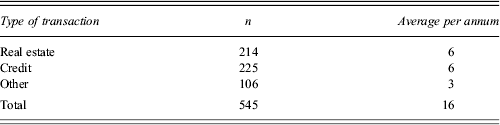
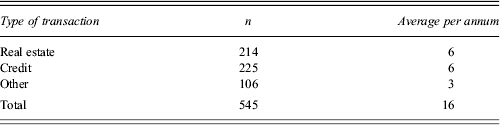
A quantitative analysis of the above-mentioned sources shows that the schepenregister running from 1532 to 1567 contained 545 transactions that the law court of Mijnsheerenland had ratified (see Table 2). In 214 cases these involved the transfer of real estate, either through sale or, in several instances, the ‘swapping’ of ownership in an attempt to reallocate landed property. Another important category of transaction recorded in the schepenregister was the extension of credit which without exception involved the selling of a redeemable annuity (or losrente) with land as collateral. Of the contracts in the register, 225 were of this type. The remaining 106 contracts show that the heemraden also ratified many other legal procedures, such as the recording and administering of wills, but, again, all of these involved land. On average, the court ratified 16 transactions each year, in the ratio of 6 transfers of real estate to 6 credit contracts and 3 other types of contracts. An average of 12 transfers involving real estate per annum was typical of a village economy such as that in Mijnsheerenland. Law courts in towns such as Edam or Haarlem witnessed many more of these type of transactions.Footnote 64 However, we must remember that Mijnsheerenland contained only 60 households, or thereabouts, and therefore it is obvious that villages too could have quite dynamic economies.Footnote 65
Total number and average number per annum of transactions ratified by the court of Mijnsheerenland, 1532–1567, by type of transaction
Sources: L. Helms van Eis ed., ‘Register ende protocol van eijgen- ende rentebrieve van Moerkercken, ingaende anno XV c XXXII ende eindigende metten jare 1552’, Ons voorgeslacht. Maandblad van de vereniging ter bevordering van het stamboomonderzoek voor Rotterdam en omstreken 37 (1982), 97–123; L. Helms van Eis ed., ‘Register en protocol van eijgen- ende rentebrieve van Moerkerken, ingaende anno XVc XXXII ende eindigende metten jare 1552’, Ons voorgeslacht. Maandblad van de vereniging ter bevordering van het stamboomonderzoek voor Rotterdam en omstreken 40 (1985), 143–55.
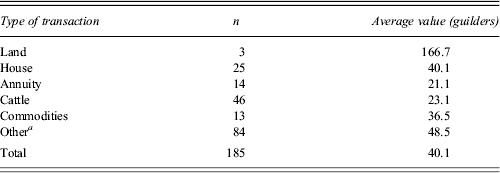
In the 23 years between 1545 and 1567 the register of willekeuren contained almost 10 transactions per annum on average: 9 short-term debts and 1 other transaction per year. The short-term debts recorded in the willekeuren are detailed in Table 3, but it would seem that the majority of the transactions involving short-term debts were never recorded as it is unlikely that transactions involving livestock, grain and other commodities occurred less often than those involving land. Apparently the average value of willekeuren transactions (40.1 guilders) was close to the threshold where participants in an exchange felt that informal securities were sufficient.
Total number and average value of transactions recorded in the willekeuren of Mijnsheerenland, 1545–1567, by type of transaction
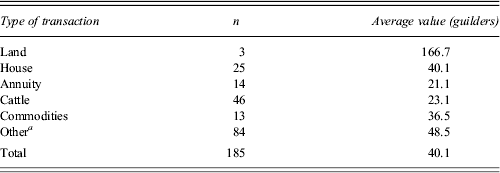
a The category ‘other’ consists of unspecified debts and specified debts not included within any of the other categories.
Source: L. Helms van Eis ed., ‘Het register van Moerkercken. resp. Mijnsheerenland (1559–1563) ORA Mijnsheerenland inv. nr. 4’ (available at http://hogenda.nl/Docs/DocumentView.aspx?KeyValue={156dbbc4-c0c9-4fec-a477-0a2cd9671dd1}).
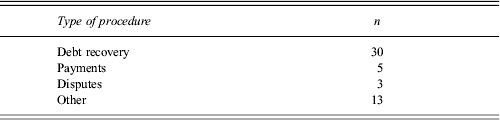
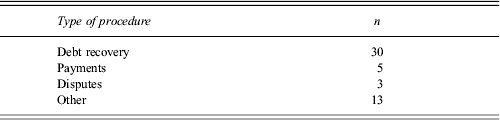
Finally, to gain a further impression of how the law court of Mijnsheerenland functioned, we considered the court proceedings from the months of February to July 1560 recorded in the register of the dingboek. We focused on these months because they provide the earliest available data on civil jurisdiction. The sheriff and heemraden sometimes assembled in church on court days.Footnote 66 As the register has entries from all days of the week, plaintiffs apparently did not have to wait for a formal court day to initiate a legal procedure, although procedures seem to have been less expensive if they did so.Footnote 67 It thus appears to have been relatively easy to start a legal procedure, even for people from outside Mijnsheerenland, who only visited the village occasionally. Out of the 51 entries in the dingboek register, 30 concerned the recovery of debts (see Table 4).Footnote 68 Among these there is reference to schatting, the procedure during which the sheriff and heemraden would estimate which goods of a debtor would suffice to compensate the creditor. For example, the sheriff estimated the value of the cows belonging to Adriaen Ijemansz to be 16 guilders each. If Ijemansz did not pay his debt within 24 hours, the sheriff would proceed to confiscate the cows.Footnote 69 Given the number of debt recovery cases shown in Table 4, it can be inferred that the law court of Mijnsheerenland dealt with approximately 60 debt recovery cases per annum. Many of these cases would have involved petty debts that would not have been ratified by the village law court. For example, one case dealt with a ‘tab’ worth less than three guilders run up in a public house. In a number of cases landlords sued their tenants for arrears on their leases. In order to ensure they received payment, the landlords demanded that the sheriff seize the crops that the tenants were growing.Footnote 70
Number of procedures, by category, recorded in the dingboek register between February and July 1560
Source: L. Helms van Eis ed., ‘Het register van Moerkercken. resp. Mijnsheerenland (1559–1563) ORA Mijnsheerenland inv. nr. 4’ (available at http://hogenda.nl/Docs/DocumentView.aspx?KeyValue={156dbbc4-c0c9-4fec-a477-0a2cd9671dd1}).
4. LOCALS AND NON-RESIDENTS BEFORE THE LAW COURT OF MIJNSHEERENLAND
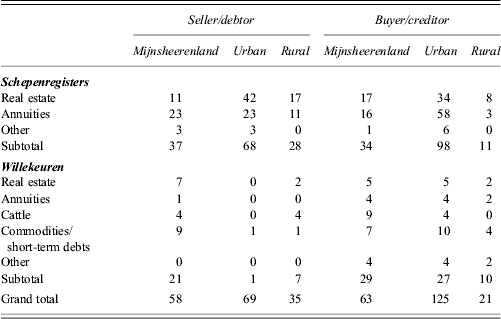
In the remainder of this article we take a closer look at the function of the law court of Mijnsheerenland in the local and regional economy. We pay attention to the position of non-residents in particular, asking whether they were prominent participants in some of the macro-economic developments of the day, such as the increased urban investment in the rural economy, or whether they suffered from inter-jurisdictional transaction costs, and therefore did not play a major role. Because our sources do not provide data on residence in a systematic way, a straightforward answer to these questions is not possible. The place of residence is clearly stated for 248 individuals appearing in the register and willekeuren. Since many of these individuals appear repeatedly in our sources, we are aware of the place of residence of 371 participants in exchange transactions (Table 5). However, these people were involved in only a minority of all transactions. In all, there were 545 transactions in the register and 247 in the willekeuren, giving a combined total of 792 transactions, which would have involved at least 1,584 contracting parties.
Number of participants in transactions by place of residence (where recorded) in schepenregisters (1532–1567) and willekeuren (1545–1567) of Mijnsheerenlanda
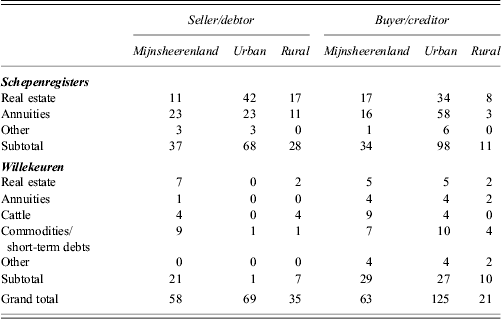
a Individuals who gave their place of residence as ‘Oudelandse Westdijk’, ‘Stoutgen’ or ‘Blaaksedijk’ are classified as being resident in Mijnsheerenland. Of the total of 1584 participants in exchange arrangements, 1213, or 76.6 per cent, are excluded from this table because their place of residence was not recorded. The 371 participants included in this table thus comprise 23.4 per cent of all participants mentioned in either the schepenregisters or the willekeuren. Of the participants recorded in the schepenregisters, 25.3 per cent are included in the table, and 19.2 per cent of those recorded in the willekeuren.
Sources: L. Helms van Eis ed., ‘Register ende protocol van eijgen- ende rentebrieve van Moerkercken, ingaende anno XV c XXXII ende eindigende metten jare 1552’, Ons voorgeslacht. Maandblad van de vereniging ter bevordering van het stamboomonderzoek voor Rotterdam en omstreken 37 (1982), 97–123; L. Helms van Eis ed., ‘Register en protocol van eijgen- ende rentebrieve van Moerkerken, ingaende anno XVc XXXII ende eindigende metten jare 1552’, Ons voorgeslacht. Maandblad van de vereniging ter bevordering van het stamboomonderzoek voor Rotterdam en omstreken 40 (1985), 143–55; L. Helms van Eis ed., ‘Het register van Moerkercken. resp. Mijnsheerenland (1559–1563) ORA Mijnsheerenland inv. nr. 4’ (available at http://hogenda.nl/Docs/DocumentView.aspx?KeyValue={156dbbc4-c0c9-4fec-a477-0a2cd9671dd1}).
In theory, the number of known places of residence could be expanded by linking the names of individuals who have their residence stated in a record to records where the same individuals appear without data on their place of residence. For example, if it is assumed that someone appearing as Vas Wittenzoon at one point in the sources was the same person as an individual referred to as Vas Wittenzoon van Mijnsheerenland at another point, then it may be assumed that the first person was also a resident of Mijnsheerenland. We have refrained from doing so because the use of patronymics and the absence of proper surnames makes such an exercise too speculative, particularly as participants in an exchange transaction may have moved from one place of residence to another. One final point to be noted is that, in the event that more than one person was mentioned as selling or buying, we considered the first-mentioned individual to be the initiator of the transaction, and have only taken this individual into account.
In the village of Mijnsheerenland transactions involving townsmen, or men from urban areas, occurred frequently. The evidence presented in Table 5, which indicates the residence of 276 people appearing in the schepenregisters, demonstrates this quite effectively. The majority came from towns: 150 from nearby Dordrecht, 9 from Delft, 1 from Leiden, and 4 from The Hague. Two came from Louvain, further away in the duchy of Brabant. They bought and sold land and, in a few instances, houses as well as annuities. A smaller number could be identified as rural inhabitants: 71 from Mijnsheerenland itself, and 39 from other villages in the vicinity. In the willekeuren inhabitants of Mijnsheerenland feature more prominently, with 50 of those mentioned being from the village. A further 17 came from other villages, and 28 could be identified as townsmen.
Townsmen appeared quite frequently before the court of Mijnsheerenland. However, the figures in Table 5 demonstrate that they appeared predominantly in the schepenregisters and much less in willekeuren. The transactions recorded in the latter register often involved cattle sales and consumer credit, typically elements of the rural economy in which townsmen did not frequently participate. When townsmen do appear in the willekeuren, the sums recorded were almost three times higher on average than when they did not. Transactions in which townsmen were involved had an average value of 131 guilders, whereas when only rural inhabitants were involved the equivalent figure was just 46 guilders. Although the data taken from schepenregisters and willekeuren do not provide information on all participants in the transactions recorded, they do suggest that a considerable proportion, possibly even the majority, of the people appearing before the law court of Mijnsheerenland came from outside the jurisdiction of the village law court.
If village law courts were unreliable, as Epstein has suggested, few non-residents would have participated in inter-jurisdictional transactions, such as buying land in the countryside or creating long-term debt with rural land as collateral. They would only have done so if they were to receive an additional premium to cover their ‘inter-jurisdictional transaction costs’, which are taken here to be the extra expenses that outsiders incurred compared with locals making the same type of transaction.Footnote 71 Before a transaction occurred outsiders may have incurred extra expense because they had to obtain information about the local customs and village law court. After the transaction had occurred they may have been put to extra expense because they had trouble enforcing timely payments as a result of not residing locally, and possibly also because the village law courts favoured the resident villagers over people from elsewhere. As with any other transaction costs, such expenses affected the perceived profitability of the exchange, and therefore the likelihood of an inter-jurisdictional transaction taking place.
Transaction costs were particularly high where long-term loans were involved. Redeemable annuities (losrenten) were loans with real estate as collateral in which the creditor bought an annuity, transferring a principal sum to the debtor, the seller of the annuity. The seller agreed to pay an annual sum until the principal was redeemed, something which usually took several decades to achieve. Even though contemporaries did not perceive returns from redeemable annuities as interest, they can best be comprehended as ‘interest-bearing’ long-term loans. They involved relatively large principals and returns worth several months of wages to a skilled worker, so annuity buyers risked losing substantial amounts if the seller defaulted.Footnote 72 Furthermore, returns were paid annually over several decades, which made this type of transaction rather complex. To make matters even more complicated, the annuity was heritable, so it also continued to exist after the original buyer and seller had passed away and, if the land acting as collateral was sold, the obligation to pay the annuity fell to the new owner, even although he had played no part in the original deal. Over the years, the identities of those paying the annuities changed frequently and, as a result, buyers relied much more heavily on the village law court for security when deciding to participate in a transaction, than on their own assessment of the reliability of the seller.
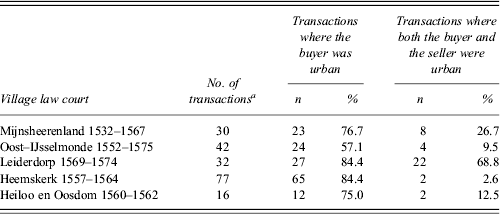
Buyers of redeemable annuities in Mijnsheerenland depended on the law court to ratify and register their transactions, and to handle any future disputes and debt-recovery procedures, thus providing them with security. The evidence in Table 5 indicates that outsiders – both from the towns and from other rural communities – bought annuities with land in Mijnsheerenland as collateral. In total, 62 townsmen and 5 rural inhabitants were willing to invest in annuities while relying on the law court in Mijnsheerenland for security. Townsmen in particular had plenty of opportunities to invest elsewhere. They could, for instance, have invested in various types of public debt or in redeemable annuities offered by citizens of their home district. Many did this, but a considerable number also opted for investments secured by village law courts, not only in Mijnsheerenland, but in dozens of other villages as well (see Table 6).
Number of townsmen as sellers and buyers of annuities on collateral of rural land, by village law court
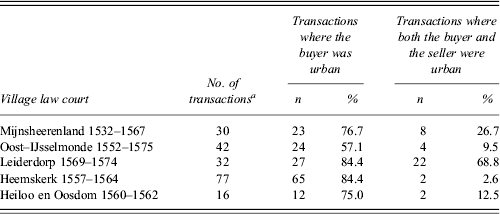
a All transactions, including those where the sellers were urban residents and the buyers came from a rural village, and those where both sellers and buyers came from a rural village. For Oost-IJsselmonde we know the place of residence of participants in 42 out of 44 transactions (95.5%); for Leiderdorp this figure is 32 out of 37 (86.5%); for Heemskerk it is 77 out of 80 (96.3%); for Heiloo en Oosdom it is 16 out of 20 (80.0%).
Sources: Mijnsheerenland: L. Helms van Eis ed., ‘Register ende protocol van eijgen- ende rentebrieve van Moerkercken, ingaende anno XV c XXXII ende eindigende metten jare 1552’, Ons voorgeslacht. Maandblad van de vereniging ter bevordering van het stamboomonderzoek voor Rotterdam en omstreken 37 (1982), 97–123; L. Helms van Eis ed., ‘Register en protocol van eijgen- ende rentebrieve van Moerkerken, ingaende anno XVc XXXII ende eindigende metten jare 1552’, Ons voorgeslacht. Maandblad van de vereniging ter bevordering van het stamboomonderzoek voor Rotterdam en omstreken 40 (1985), 143–55; L. Helms van Eis ed., ‘Het register van Moerkercken. resp. Mijnsheerenland (1559–1563) ORA Mijnsheerenland inv. nr. 4’ (available at http://hogenda.nl/Docs/DocumentView.aspx?KeyValue={156dbbc4-c0c9-4fec-a477-0a2cd9671dd1}). Oost-IJsselmonde: Gemeentearchief Rotterdam. Archieven van de voormalige gemeente IJsselmonde. inv. nr. 183 (see also the transcription by Michel Ball: http://www.mickyarco.com/IJsselmonde183.htm). Leiderdorp: Regionaal Archief Leiden. Archief Leiderdorp. Oud-rechterlijk archief. inv. nr. 2. Heemskerk: Noordhollands Archief. Ambachts- en gemeentebestuur van Heemskerk (gemeente Heemskerk) inv. nr. 243. Heiloo en Oosdom: Gemeentearchief Alkmaar. Oud-rechterlijk en weeskamerarchief Heiloo. inv. nr. 70. f. 10-41v.
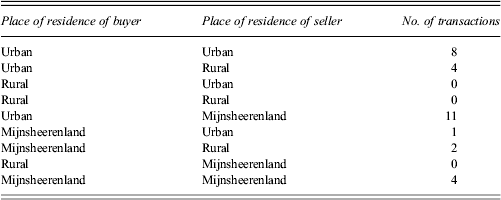
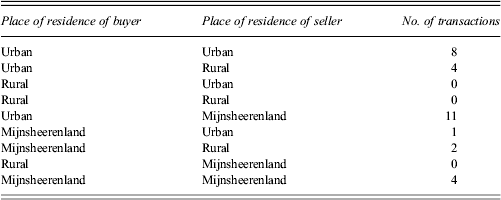
In a considerable number of the transactions involving redeemable annuities recorded in Mijnsheerenland neither the buyer nor the seller came from the village. Table 7 presents figures showing transactions of redeemable annuities for which we know the residence of both parties. Although there are only 30 observations, 12, or 40 per cent, consisted of transactions where neither party came from Mijnsheerenland. Of the 30 transactions, 8 (26.7 per cent) were between townsmen, with the seller using real estate in Mijnsheerenland as his collateral, and in another 4 cases inhabitants of rural villages other than Mijnsheerenland did the same thing to secure an annuity. Outsiders did not shy away from using and accepting real estate in Mijnsheerenland as collateral. More importantly, by doing so they also accepted that the village law court would be their main means of debt recovery, should that prove necessary. Table 6 shows that this phenomenon was not restricted to Mijnsheerenland. Elsewhere in Holland rural land, and the village law courts, served to secure transactions made between urban dwellers. The most striking data come from Leiderdorp, a village close to the town of Leiden, where in 68.8 per cent of the cases land in Leiderdorp was used as collateral for annuities contracted between citizens of Leiden.
Number of sales of redeemable annuities by place of residence of buyer and seller
Sources: L. Helms van Eis ed., ‘Register ende protocol van eijgen- ende rentebrieve van Moerkercken, ingaende anno XV c XXXII ende eindigende metten jare 1552’, Ons voorgeslacht. Maandblad van de vereniging ter bevordering van het stamboomonderzoek voor Rotterdam en omstreken 37 (1982), 97–123; L. Helms van Eis ed., ‘Register en protocol van eijgen- ende rentebrieve van Moerkerken, ingaende anno XVc XXXII ende eindigende metten jare 1552’, Ons voorgeslacht. Maandblad van de vereniging ter bevordering van het stamboomonderzoek voor Rotterdam en omstreken 40 (1985), 143–55; L. Helms van Eis ed., ‘Het register van Moerkercken. resp. Mijnsheerenland (1559–1563) ORA Mijnsheerenland inv. nr. 4’ (available at http://hogenda.nl/Docs/DocumentView.aspx?KeyValue={156dbbc4-c0c9-4fec-a477-0a2cd9671dd1}).
5. WAS THERE A ‘HOME COURT’ ADVANTAGE?
In the sixteenth century and earlier, non-residents frequently accepted village law courts as the main institution for securing valuable investments.Footnote 73 This could mean that they expected the village law court to ratify and register the transaction properly, to help settle any disputes about redeemable annuities, and to recover debts in a satisfactory manner. However, there is also the possibility that non-residents made use of the services of village law courts in spite of their perceived unreliability, only agreeing to transactions because they were compensated by a premium in the form of a higher return.
Returns from redeemable annuities reflect creditors’ trust in the law court that they had to rely upon when recovering debt. However, the returns also reflect other factors, such as the moral hazard involved, or the degree of trust that buyers had in the willingness of the sellers to live up to their side of the deal. Furthermore, the returns are also likely to reflect the opportunity costs incurred: perhaps the buyer could do better with his savings, or the seller could attract credit under more favourable conditions. In this respect it is important to realise that returns from redeemable annuities were negotiated in capital markets in which some parties were simply better positioned than others, due to their information network, occupationFootnote 74 or reputation.Footnote 75 Another element that could affect the returns is time preference, i.e. whether an individual was focused on his current well-being and thus more inclined to spend, or on his future well-being and thus more willing to save. Finally, as a creditor would wish to receive an interest rate that, at the very least, covered any rise in prices he had to anticipate inflation rates or face a loss in terms of purchasing power when the interest was paid and the principal was returned.
All this means that the interest rates we observe in the schepenregisters and willekeuren of Mijnsheerenland were the result of a multitude of factors. Isolating the default risk premium, to gain a better understanding of the perceived reliability of village law courts, is therefore a difficult exercise. What follows can therefore provide only a general impression of the presence of default risk premiums in transactions involving non-residents. We begin with a consideration of opportunity costs, time preference, and anticipated inflation to gauge how these factors may have affected interest rates in Mijnsheerenland in the sixteenth century. Opportunity costs varied from one person to another. For example, a merchant from the town of Dordrecht may have had more opportunities to buy and sell annuities than an artisan from Mijnsheerenland, and hence the latter may have had a relatively limited range of choices. Likewise, an artisan from Mijnsheerenland is more likely to have been in a better position with respect to access to markets than a peasant. Since we are largely unaware of the socio-economic background of the creditors and debtors that appeared before the court of Mijnsheerenland, it is difficult to take opportunity costs into account. However, we may safely assume that inhabitants of towns had a greater range of choices, and therefore could negotiate more favourable rates of return in Mijnsheerenland. Townsmen looking to buy annuities could invest their savings in life and redeemable annuities sold by the government of the province of Holland,Footnote 76 or in life and redeemable annuities sold by large towns in Holland and elsewhere in the Low Countries, or in both.Footnote 77 Furthermore both they, and townsmen looking to sell could participate in the relatively lively urban market for private annuities where many hundreds of annuities were contracted every year.Footnote 78 Although villagers could also invest in these types of public and private debt, we assume they had fewer opportunities to do so, because of their infrequent presence in town, and their lack of an urban information network. Although village capital markets could be quite prolific, and included possibilities to invest in public and private annuities, the number of transactions was relatively low.Footnote 79 This leads us to expect that urban buyers of annuities would, in general, have had more options and could, therefore, more easily refuse to buy redeemable annuities yielding relatively low returns. Urban sellers of annuities could likewise take advantage of the relatively large numbers of buyers and sellers in the ‘thicker’ markets of towns to look for a favourable deal, or, in other words, one that involved a low return. When we move on to time preference, there is a strand of literature that suggests that peasants were risk averse and very much concerned with spending immediately. However, this idea of the risk-averse peasant has been discredited in more recent literature, and therefore we assume that most townsmen and villagers thought the same way about the question whether to spend or invest.Footnote 80 Finally, with respect to anticipated inflation, prices in Mijnsheerenland and its immediate surroundings probably increased at a similar rate.Footnote 81 Thus there is no reason to believe that locals would have demanded a different level of compensation from that sought by most non-residents, and thus this is not a factor that distorts our data. In fact, it is even uncertain whether people took anticipated inflation into account when making decisions. They may have had reason to do so, as prices rose during the sixteenth century, and we know that people in Holland noticed this and complained about it, but we can find no evidence of contemporaries adjusting interest rates to allow for anticipated inflation.Footnote 82 Furthermore, pre-industrial inflation rates were low, hardly ever exceeding 1 per cent per annum, so that even if contemporaries anticipated inflation, this can hardly have affected interest rates.Footnote 83
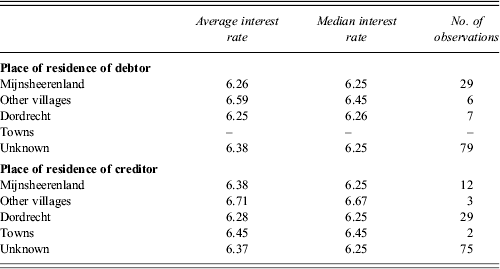
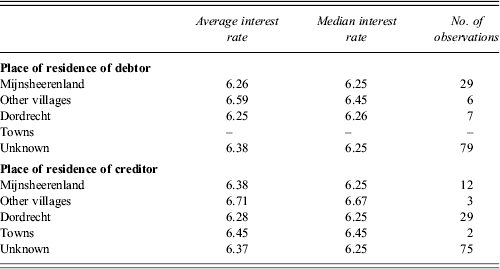
Did urban buyers of annuities secured on land in Mijnsheerenland require a premium because they had little trust in village law courts? To begin answering this question we can formulate the following expectations. If urban buyers of redeemable annuities required a premium because the transactions had to be conducted through the law court in Mijnsheerenland, this would be visible in their returns. These would be higher than those of urban sellers of annuities using collateral in Mijnsheerenland or, possibly, of other villages as well. Opportunity costs of urban investors, the other main factor affecting the returns that buyers could negotiate, would also have had an upward effect on ‘interest rates’. Data on interest rates in Mijnsheerenland, however, do not show townsmen receiving higher premiums. In fact, differences in interest rates negotiated by locals and non-residents were generally very low (Table 8). Furthermore, contrary to what we expected, the most important group of buyers of annuities in Mijnsheerenland, those living in Dordrecht, actually negotiated relatively low returns, of 6.28 per cent per annum on average. Apparently, people from the nearby town of Dordrecht did not require a higher premium to compensate them for exposure to the Mijnsheerenland law court, nor did their superior access to markets allow them to negotiate better deals. When we look at buyers coming from other towns and villages, we find that they negotiated slightly higher interest rates, 6.45 and 6.71 per cent, respectively. We thus cannot rule out the possibility that some of them did demand a small premium to cover the inter-jurisdictional risk, or profited from low opportunity costs, but we have to keep in mind that the number of observations is rather limited and the averages could therefore be subject to considerable error.
Interest rates per annum in Mijnsheerenland, by places of residence of debtors and creditors, 1532–1567
Sources: L. Helms van Eis ed., ‘Register ende protocol van eijgen- ende rentebrieve van Moerkercken, ingaende anno XV c XXXII ende eindigende metten jare 1552’, Ons voorgeslacht. Maandblad van de vereniging ter bevordering van het stamboomonderzoek voor Rotterdam en omstreken 37 (1982), 97–123; L. Helms van Eis ed., ‘Register en protocol van eijgen- ende rentebrieve van Moerkerken, ingaende anno XVc XXXII ende eindigende metten jare 1552’, Ons voorgeslacht. Maandblad van de vereniging ter bevordering van het stamboomonderzoek voor Rotterdam en omstreken 40 (1985), 143–55; L. Helms van Eis ed., ‘Het register van Moerkercken. resp. Mijnsheerenland (1559–1563) ORA Mijnsheerenland inv. nr. 4’ (available at http://hogenda.nl/Docs/DocumentView.aspx?KeyValue={156dbbc4-c0c9-4fec-a477-0a2cd9671dd1}).
If we consider the matter from the opposite direction, we would expect local buyers of redeemable annuities to be in a rather advantageous position when dealing with sellers who lived elsewhere but were using real estate in Mijnsheerenland as collateral. The locals ran little risk, because they lived in the jurisdiction that was to provide them with legal security. As the buyers in such transactions would not require a default risk premium, and the sellers had low opportunity costs, we would expect interest rates to be relatively low. Again, however, Table 8 provides little evidence in support of this. The majority of sellers coming from villages other than Mijnsheerenland paid slightly higher interest rates, which is contrary to what is to be expected, and sellers from Dordrecht paid interest rates that were very close to the general average. When we ignore the averages, and take a closer look at certain transactions, some sellers from outside Mijnsheerenland actually paid some of the highest interest rates to be found in our sources. Meindert Meusz from Dordrecht paid 8.7 per cent interest, while the church fabric of Maasdam, a village some 5 kilometres to the east of Mijnsheerenland, paid 7.1 per cent. Why these sellers would pay high interest rates is difficult to explain. Their buyers, all from Mijnsheerenland, should have been content with collateral held in their home village.
6. CONCLUDING REMARKS
The above exercise is intended as a first step towards a more thorough analysis of inter-jurisdictional transaction costs. A definite rejection of the idea that participants in exchange preferred their ‘home court’ over ‘foreign’ courts requires more thorough, statistical analysis. Such an analysis should include more data on the social status and economic dealings of participants, in order to obtain a clearer impression of the role of opportunity costs. It should also compare multiple types of courts, i.e. urban, village and other, set in several socio-economic contexts.
For now, we must make do with some observations which suggest that in Holland inter-jurisdictional transaction costs appear to have played a minor role. Non-residents frequently appeared before village courts, accepting land in the countryside as collateral for complex transactions, such as redeemable annuities. To a large measure non-residents had to depend on the village law court for their financial security, but this does not seem to have scared them away. On the contrary – in many cases both buyers and sellers of annuities were non-residents using land in the village as collateral. If we assume that most of the sellers were also in possession of land in their place of residence,Footnote 84 it seems that participants in exchange transactions saw public law courts to be more or less interchangeable. Of course, travelling to a nearby village to use its court involved time and expense, but, apart from this, one does not get the impression that there were great objections to using land in the countryside as collateral. The perception of the courts as interchangeable is not unexpected, given the very strong position of public law courts in the towns and villages of Holland, the larger structure of regional and supreme courts in which they were embedded, and the relative uniformity of rules and procedures.Footnote 85 This created a decentralised but, at the same time, relatively uniform legal framework that resembled Epstein's ideal type of the large urban jurisdiction in its uniformity, but differed from it in its fragmentation.
ACKNOWLEDGEMENTS
This research was conducted as part of the Netherlands Organisation for Scientific Research (NWO) VICI-project ‘Economic growth and stagnation in the pre-industrial era: Iraq, Italy and the Low Countries, 600–1700’. The author thanks colleagues on this project, as well as Arjan Nobel, for comments on a first draft of this paper.