When young children are referred for mental health treatment because of their disruptive behavior, they may receive one of many different diagnoses, depending on family and risk history, biological and neurological factors, the severity and variety of their behavioral symptoms, and the quality of their relationships with their primary caregivers. Diagnosing young children's mental health problems is often more art than science. The field of developmental psychopathology is still in the process of trying to understand how “pathways” of psychopathology vary (Cicchetti & Toth, Reference Cicchetti and Toth2009) as different contexts differentially expose children to risk and support resilience. Interparental violence (IPV) and physical abuse (PA) of the child are generally acknowledged as indicators of violent, pathogenic family contexts, exposing children to greater risk. We know that more severe violence combined with child victimization is associated with high rates of behavior problems in children (e.g., Fantuzzo et al., Reference Fantuzzo, DePaola, Lambert, Martino, Anderson and Sutton1991) and more severe psychiatric disorders in adolescents (Pelcovitz, Kaplan, DeRosa, Mandel, & Salzinger, Reference Pelcovitz, Kaplan, DeRosa, Mandel and Salzinger2000). However, the mechanisms by which IPV and PA create vulnerabilities for young children and how they interact to increase psychopathology are less well understood. Research suggests that the quality of the parent–child relationship is a key risk/protective factor for young children, helping to buffer effects of trauma on children exposed to IPV (e.g., Lieberman, Van Horn, & Ozer, Reference Lieberman, van Horn and Ozer2005) and that relationship-based interventions are effective in reducing the behavior problems of children exposed to IPV (Timmer, Ware, Zebell, & Urquiza, Reference Timmer, Ware, Urquiza and Zebell2010). But we do not know whether or in what ways the parent–child relationship is affected by the experience of both IPV and PA; whether IPV and PA together serve as mutually potentiating factors, creating a more dysfunctional parent–child relationship profile.
Main and Hesse (Reference Main, Hesse, Greenberg, Cicchetti and Cummings1990) proposed that when mothers are frightened or frightening to their children—showing threatening, withdrawing, or dissociative behavior—the children find themselves in a situation where the source of their safety becomes a source of fear. Because children cannot avoid the source of their fear, they suffer “fright without solution” (Hesse & Main, Reference Hesse and Main2006, p. 310) and their attachment to their mothers becomes disorganized, alternating between a desire to approach and a desire to avoid their mothers. This attachment style is thought to be fundamentally disorganizing, compromising children's cognitive and socioemotional well-being (Main & Hesse, Reference Main, Hesse, Greenberg, Cicchetti and Cummings1990) and increasing chances of psychopathology (Carlson, Reference Carlson1998).
Research investigating the function of parents' frightening or frightened behavior in the development of attachment to caregivers has found that a significantly greater proportion of maltreated (abused and/or neglected) than nonmaltreated infants were judged to have insecure and disorganized attachments (e.g., Carlson, Cicchetti, Barnett, & Braunwald, Reference Carlson, Cicchetti, Barnett and Braunwald1989), suggesting that any high-risk, aversive caregiving environment is highly likely to contain frightening or frightened parental behavior and hence produce attachment insecurity or disorganization. In addition to the risk posed by mothers' physical abusiveness, children who witnessed IPV might also be likely to perceive their parents as a source of fear, displaying insecure or disorganized attachment behavior. If outcomes related to the parent–child relationship function according to a “cumulative risk” of fear model, mutually potentiating the likelihood of negative outcomes, then when PA and IPV co-occur, we would assume that the likelihood of attachment disorganization and poor outcomes would increase. In other words, the more frightening experiences children endure, the more we would expect to observe insecure or disorganized attachment behavior.
The purpose of this paper is to investigate the combined effects of IPV and PA on the parent–child relationship. We expect that a family ecology of violence will predict greater disruption in the emotional quality of the relationship between physical abusive mothers' and their young, clinic-referred children.
Background Literature
PA and the parent–child relationship
There is a large, robust literature establishing the connection between experiencing PA and a range of negative outcomes for children (for a review, see Cicchetti & Toth, Reference Cicchetti, Toth and Hansen2000). It is now well established that abusive parents engage in more negative and fewer positive interactions with their children than nonabusive parents (Bousha & Twentyman, Reference Bousha and Twentyman1984). Wolfe (Reference Wolfe1987) noted that “it appears to be the relative absence of positive interactions that sets members of abusive families apart from matched, nonabusive controls rather than the dramatic display of open conflict and aggression” (p. 77). Children also contribute to this pattern of high negative/low positive parent–child dyadic interaction pattern with high rates of physical aggression, noncompliance, and antisocial behaviors (for reviews, see Cicchetti & Toth, Reference Cicchetti, Toth and Hansen2000; Kolko, Reference Kolko1992). Research reports that physically abused children exhibit an array of problem social behaviors, including poor emotional regulation, distractibility, negative affect, and a resistance to directions (e.g., Shields & Cicchetti, Reference Shields and Cicchetti1998). A recent meta-analysis of 55 studies, representing 4,792 children, found a strong relationship between maltreatment, socioeconomic risk, and the proportion of children with secure versus insecure attachment (Cyr, Euser, Bakermans-Kranenburg, & van IJzendoorn, Reference Cyr, Euser, Bakermans-Kranenburg and VanIJzendoorn2010). Maltreated children were found to be less secure and more disorganized in their attachment style than other high-risk children, supporting theory that proposes a connection between frightening or frightened parental behavior and attachment disorganization (e.g., Hesse & Main, Reference Hesse and Main2006; Lyons-Ruth, Bronfman, & Parsons, Reference Lyons-Ruth, Bronfman and Parsons1999; Main & Hesse, Reference Main, Hesse, Greenberg, Cicchetti and Cummings1990). In sum, research findings connect maltreatment with deficits in parenting behavior, poor relatedness of the child to the parent, and a host of problem child behaviors.
From a developmental psychopathological point of view, these negative outcomes form links in a developmental trajectory, combining with environmental and social contexts and, to a large extent, determine individuals' psychological and social functioning as adults. The quality of children's attachment and the parent–child relationship has been scrutinized as possible linking mechanisms between maltreatment negative child outcomes. Lieberman (Reference Lieberman2004) argued for regular consideration of children's attachment to their caregivers in any clinical assessment of the psychological effects of trauma. In a recent study, Alink, Cicchetti, Kim, and Rogoch (Reference Alink, Cicchetti, Kim and Rogosch2009) expanding upon prior research, found that the child's perception of their relatedness to their mother moderated the links between maltreatment history and emotional regulation. These findings suggest that the parent–child relationship buffers the effects of maltreatment on core social–emotional attributes and affirms the value of studying the effects of violence on the quality of children's relationships with their parents.
IPV and the parent–child relationship
Studies of effects of IPV on parent–child dynamics paralleled studies of maltreatment on the parent–child relationship. Like the findings in the literature describing the effects of PA on children, there is convincing evidence from two meta-analyses of more than 100 studies that children exposed to domestic violence have more negative emotional and behavioral outcomes than children not exposed to violence (Kitzmann, Gaylord, Holt, & Kenny, Reference Kitzmann, Gaylord, Holt and Kenny2003; Wolfe, Crooks, Lee, McIntyre-Smith, & Jaffee, Reference Wolfe, Crooks, Lee, McIntyre-Smith and Jaffe2003). Such negative child outcomes were hypothesized to be a result of disruptions in the marital system spilling over into other family systems by creating a context that supports negative cognitive appraisals of others' behavior and intentions in multiple family systems. A 1995 meta-analysis established the existence of a “spillover effect” from violent marital relationships to disruptions in the parent–child relationship, such that increasingly negative marital relationships were associated with more negative parent–child relationships (Erel & Berman, Reference Erel and Burman1995).
Different qualities of the parent–child relationship have received empirical support as moderating or mediating the relationship between IPV and children's mental health outcomes: children's appraisals of the violence between their caregivers (Grych & Fincham, Reference Grych and Fincham1993); the supportive quality of a positive parent–child relationship (Lieberman et al., Reference Lieberman, van Horn and Ozer2005; Lyons-Ruth & Jacobvitz, Reference Lyons-Ruth, Jacobvitz, Cassidy and Shaver2008; Margolin, Gordis, & Oliver, Reference Margolin, Gordis and Oliver2004); children's emotional security (Davies & Cummings, Reference Davies and Cummings1994); and the combination of these children's appraisals, supportive parenting, and children's attachment to their parents (DeBoard-Lucas, Fosco, Rayner & Grych, Reference DeBoard-Lucas, Fosco, Raynor and Grych2010).
Grych and Fincham (Reference Grych and Fincham1990) conceptualized the effect of family violence on children's development in a cognitive–contextual framework, asserting that characteristics of the conflict and the family environment, and children's appraisal of that conflict determined the degree to which children felt threatened and responsible for the violence between their caregivers. These feelings, they believed were key to understanding the development of psychopathology. A meta-analysis of 71 studies investigating children's responses to IPV found some substantiation for their hypotheses (Rhoades, Reference Rhoades2008). Recent research found that the quality of parenting and the child's attachment moderated the relationship between children's appraisals of IPV and their adjustment (DeBoard-Lucas et al., Reference DeBoard-Lucas, Fosco, Raynor and Grych2010). Lyons-Ruth and Jacobvitz (Reference Lyons-Ruth, Jacobvitz, Cassidy and Shaver2008) and Lieberman (Reference Lieberman2004) go further, stating that the trauma and frightening parent behavior disrupts the child's attachment system, which is fundamentally destabilizing and heightens the likelihood of future psychopathology.
Davies and Cummings (Reference Davies and Cummings1994) theorized that emotional security is an organizing goal across contexts and that exposure to marital conflict threatened children's emotional security and hence disrupted their emotional regulatory systems. In an effort to show that children's emotional security was more critical to understanding the effects of marital conflict on children than the physical threat of violence, Davies, Harold, Goeke-Morey, and Cummings (Reference Davies, Harold, Goeke-Morey and Cummings2002) constructed an elegant set of studies that demonstrated the strong connection between children's ratings of their emotional security and parent ratings of their behavior problems, irrespective of the amount of conflict in the marital relationship. Taking their work further, they used sensitization theory to explain long-term negative consequences of marital conflict on children, hypothesizing that exposure to marital conflict threatened their emotional security, sensitizing them to possible future threats and increasing their emotional reactivity to conflict.
Although the nuances of the theories driving the approaches of these researchers vary, they largely agree that qualities of family life, and specifically the parent–child relationship, will influence the meaning children ascribe to the marital violence, which will in turn influence their emotional and behavioral responses. Possibly because the thought that the act of physically abusing a child can be thought of as an indicator of family violence, we have not considered that there might be variations in the children's assessment of this threat. However, the strong evidence that meanings children ascribe to threatening circumstances vary according to contextual differences, that these meanings help construct internal representations of self and family, and drive emotional and behavioral responses are likely to apply to multiple violent and traumatic life situations.
Co-occurring IPV and PA and the parent–child relationship
Research has consistently linked the occurrence of IPV with an increased likelihood of child PA (e.g., Appel & Holden, Reference Appel and Holden1998; Jouriles, McDonald, Slep, Heyman, & Garrido, Reference Jouriles, McDonald, Slep, Heyman and Garrido2008). A recent study, using data from the National Survey of Children's Exposure to Violence found that a third of children who had witnessed IPV had been maltreated in the past year, compared to 8.6% of nonwitnesses (Hamby, Finkelhor, Turner, & Ormrod, Reference Hamby, Finkelhor, Turner and Ormrod2010). Studies investigating the co-ocurrence of IPV and PA have addressed its effects on children's social and psychological development (e.g., Hughes, Parkinson, & Vargo, Reference Hughes, Parkinson and Vargo1989; Litrownik, Newton, Hunter, English, & Everson, Reference Litrownik, Newton, Hunter, English and Everson2003) and on the severity of psychological symptoms (Fantuzzo et al., Reference Fantuzzo, DePaola, Lambert, Martino, Anderson and Sutton1991; Shen, Reference Shen2009). In general, studies have found that children who are “abused witnesses” show greater amounts of externalizing behavior and total psychological problems than others (for meta-analyses, see Kitzmann et al., Reference Kitzmann, Gaylord, Holt and Kenny2003; Wolfe et al., Reference Wolfe, Crooks, Lee, McIntyre-Smith and Jaffe2003). The differential effect of these co-occurring traumatic experiences on the parent–child relationship has not been investigated.
To sum up, experiences of IPV and PA by the mother have similar effects on parenting behavior and children's mental health. Their effects on the parent–child relationship may be key to understanding their effects on children's mental health. When co-occurring, we would expect them to add severity to children's traumatic experience and cause greater problems in the parent–child relationship, using Rutter's (Reference Rutter1981) cumulative risk perspective. Using a clinical sample of children with disruptive behaviors, we will investigate the combined effects of IPV and PA on the mother–child relationship by determining the effects of mothers' physical abusiveness on the quality of their relationship, and note how it further varies by their exposure to IPV. We expect that a family ecology of violence will predict greater disruption in the emotional quality of the relationship between physically abusive mothers and their young children.
Assessing the Parent–Child Relationship in the Context of Violence
Although there is a wide range of perspectives on the centrality of the parent–child relationship in developmental psychopathology, those designing and evaluating interventions for young maltreated children are increasingly viewing it as central to obtaining and maintaining treatment effects in young children exposed to violence (e.g., Lieberman et al., Reference Lieberman, van Horn and Ozer2005; Timmer et al., Reference Timmer, Ware, Urquiza and Zebell2010). Despite agreement about the usefulness of relationship-based interventions and importance of assessing the quality of the parent–child relationship to get an indication of children's risk, there is no standard way to measure it. Researchers have generally found that combining free play with challenging or stressful tasks allows the researcher to measure a wider variety of behaviors. It is possible to a obtain baseline measure of dyadic interaction quality under very little stress and compare it to situations that are slightly more stressful. The decay of parental warmth and sensitivity under stress, children's flexibility and willingness to go along with new tasks, as well as their response to the change in their parents' behavior provide information about the quality of the relationship. We use a series of three analogs of common parent–child interactions that vary in the amount of control parents are asked to wield over their children, knowing that parental attempts to obtain their children's compliance are more likely to end in coercive power struggles and tantrums (e.g., Patterson, Reference Patterson, Reid, Patterson and Snyder2002). Using this strategy of systematically altering the context of the interaction allows us to view more complex patterns of interaction. As a rule, we expect that dyads' EA will decay as the stress of the play situation increases. We hypothesize that the more violence children have been exposed to, the more dysfunctional their interactions will appear, relative to other dyads and relative to less stressful play situations.
Method
Sample description
A sample of 232 mother–child dyads was used to investigate how IPV exposure affects emotional availability (EA) of physically abusive mothers and their children: 169 had no report of PA and 63 had a suspected or documented history of PA by their mothers. The children were referred to Parent–Child Interaction Therapy (PCIT) for treatment of disruptive behavior problems between January 1995 and August 2010, meeting Sacramento County-defined criteria for medical necessity (i.e., met DSM criteria for a mental health diagnosis). Dyads were eligible for this study if the mothers consented to participate in research, children were between 2 and 7 years of age, had been living with their biological mothers for at least a month, and had no history of sexual abuse. In addition, children who had been physically abused by someone other than their mothers were excluded from the study, as were children from homes where other family members were violent, but not their parents. Children in the study had either been physically abused by their mothers or had no prior history of PA; they had either experienced IPV or had no report of family violence. If more than one child in a family was eligible for the study, the child referred first for treatment was selected. If both began treatment at the same time, one was chosen at random, all other things being equal (e.g., both had audible videotapes of the observational assessment). Approximately 73% dyads were referred to treatment by their child welfare social worker; and 30% were court-mandated to treatment. The treatment setting was a university hospital-based outpatient clinic primarily serving children in low-income families with a history of maltreatment, receiving child welfare services in Sacramento County, California. The study and consent form were approved by the university institute review board.
Description of dyads in the study
The children ranged in age from 2 to 7.9 years and nearly 70% were under 5 years of age (mean age = 4.44 years, SD = 1.4). Nearly two-thirds of the children were male (65.5%). Approximately half of mothers (53%) and children (47%) were White/non-Hispanic, 17% of the mothers and 23% of children were African American, and 22% of mothers and 24% of children were Latino. The dyads in the sample had multiple risks: 82% of the children either had been physically abused, neglected, exposed to IPV, or their mothers' drug use. Mothers had an average of 11.7 years of schooling (SD = 1.8); 77% had a high school education or less. Approximately 66% of mothers were single: 22% were previously married and 44% reported never being married. Half of the mothers (53%) had a history of drug or alcohol abuse.
Procedures
Parents were mailed or were given a battery of standardized measures and a short demographic questionnaire before they came to the clinic for their first PCIT treatment session. Because PCIT is an assessment-based protocol, parents were asked to complete a battery of standardized assessments before beginning treatment and to participate in a videotaped 15-min semistructured observational assessment of the quality of caregiver and child interactions. The parent and child played together at a table in a room equipped with a two-way mirror, and a video camera mounted inside a giant crayon in the corner of the room. The parent wore a “bug in the ear” device, so that they could hear the therapist give them instructions from the other side of a two-way mirror.
Observational assessment
In order to maximize observed differences among groups of dyads, we used an assessment procedure that varied the amount of stress the dyad experienced. Many ineffective parents can appear effective in conditions of low stress, but dysfunction is likely to appear as stress increases (Wahler & Dumas, Reference Wahler and Dumas1989). Stress was induced by increasing the amount of control the parent was asked to use in each of three 5-min, semistructured play situations. Before the first 5 min began, the parent was asked to let the child choose an activity (three different types of toys were placed on the table before the session began), and to follow the child's lead in play. This analog of typical parent–child play was referred to as the “child-directed interaction” (CDI) and required no parent control over the child's play. After 5 min, the therapist instructed the parent to tell the child that it was now their turn to choose the activity, to change the activity, and get the child to play along according to their rules. The ensuing 5-min analog of a situation requiring parents to take more control in play was called “parent-directed interaction” (PDI). Making the transition from CDI to PDI required the parent to exercise some authority and control. However, once the child agreed to transition to the parent's play, the fun quality of play could resume if the parent was not overly concerned about making rules for the child to follow. At the end of the 5 min the therapist instructed the parent to tell the child that “special playtime” was over, and that it was time to clean up the toys. They were told to get the child to clean up by him or herself, without the parent's help. This analog of a typical situation requiring the parent to get the child to perform an undesirable task is called “clean-up” (CU), and required the parent to exercise the most control. Because cleaning up could only occur if play stopped, children often protested cleaning up, which provided an opportunity to observe parents' behavior management strategies.
Measures
Parenting Stress Inventory—Short Form (PSI-SF)
The PSI-SF (Abidin, Reference Abidin1995) was designed to identify parent–child dyads that are experiencing stress and at risk for developing dysfunctional parenting and child behavior problems. The PSI-SF contains 36 items rated on a 5-point scale (1 = strongly disagree to 5 = strongly agree), grouped into three scales: parent distress (PD), parent–child dysfunctional relationship (P-C Dys), and difficult child (DC). The PD Scale measures parents' feelings of distress (e.g., parent competence, depression, social isolation). The P-C Dys Scale reflects the degree to which the parent perceives the child as happy, healthy, enjoys being with the parent, and perceives their relationship as rewarding. The DC Scale measures the parents' perceptions of the child's moods, adaptability, and demandingness. Test–retest coefficients for the three PSI-SF scales were estimated for a sample of N = 530 across a 6-month period: PD, r = .85; P-C Dys, r = .68; DC, r = .78.
IPV and maltreatment history
Information about the family's history of IPV, children's history of maltreatment, and parents' use of drugs and alcohol was obtained from therapists' reports, social workers' reports, and research staff's review of any available court records. The amount of information available on the severity or duration of violence was quite limited. Case files and court reports contained descriptions like, “. . . children were exposed to domestic violence between their parents . . . ” In other cases reports would describe injuries sustained by a mother in a domestic dispute. The inconsistency of reporting forced us to look at global distinctions between families' exposure to violence.
When there was an indication that the child might have been abused, even by an unsubstantiated allegation, we coded “suspected abuse.” For example, if a mother reported to the therapist that her boyfriend hit the child when he got angry with him, we recorded this as suspected abuse, even though the incident might not have been reported to Child Protective Services. Children were classified as having a documented history of PA, a suspicion of PA, and no indication of PA. For purposes of this study, children with suspected and documented histories of PA were both classified as having a history of PA. Only physically abused children whose abuse was perpetrated by their mothers were included in this study.
Two trained research assistants reviewed each child's case file to obtain information about their history of risk. Information for the child was not recorded unless both reviewers agreed on the description. To get an estimate of reliability of dyads' assignment to PA and IPV groups, we rereviewed 31 case files and obtained kappa statistics as a measure of reliability. The kappa values for PA and IPV were 0.84 and 0.93, respectively, suggesting good reliability.
Sociodemographic information
Caregivers completed a brief questionnaire pretreatment containing questions about ethnic identity, marital status, educational attainment, and who lived in the household.
EA Scales
We elected to use the EA Scales (3rd ed.; Biringen, Robinson, & Emde, Reference Biringen, Robinson and Emde1998) to measure the quality of mothers' and young children's relationships. The EA Scales' strong links to parents' and children's attachment styles (Biringen, Reference Biringen2000; Easterbrooks, Biesecker, & Lyons-Ruth, Reference Easterbrooks, Biesecker and Lyons-Ruth2000) and ability to be used in any assessment setting made them an ideal choice for this study. The EA Scales consist of four global parent scales and two child scales that measure specific dimensions of the caregiver–child relationship. Parent scales measure their sensitivity to the child, their nonhostility, nonintrusiveness, and ability to structure the interaction. Child scales measure their responsiveness to the parent and the degree to which they involve the parent in their activities.
Because this is a sample consisting of a high percentage of maltreated children, it is important to highlight the fact that the synchronous quality of the interaction also influences judgments of optimal parent or child EA. For example, if a parent appears warm and sensitive to the child, but the child does not reciprocate, or respond to the parent's overtures, then the parent would not be judged as having optimal EA. Similarly, if a child is cheerful and chatty, but the parent is withdrawn or even somewhat hostile, a child would be judged to be “overresponsive” or “overinvolving” and would not be judged has having optimal EA. In other words, parent and child must both show optimal behavior and affect to be judged as having optimal behavior. As recommended (Biringen, Reference Biringen2000), when children's behavior was nonoptimal, we indicated whether it was overresponsive/overinvolving, externalizing, or showed diminished autonomy on the part of the child. Overresponsiveness/overinvolvement was coded when children showed noticeably more positive affect and behavior than parents, and/or their behavior was positive and seemed designed to keep a parent engaged in play. Diminished autonomy was coded when a parent's intrusive behavior made it difficult for the child to do anything but respond to the parent or fulfill the parent's agenda. Externalizing behavior was coded when a child was angry, defiant, or oppositional. We counted the number of analogs in which a child's nonoptimal behavior was coded as a result of these types of behavior. Priority was given to overresponsive behavior or diminished autonomy (first) and externalizing behavior (second) if more than one type of behavior was evident. We used intraclass correlation coefficients to estimate the reliability of these measures: overresponsive/overinvolving, r = .80, externalizing, r = .90, and diminished autonomy, r = .80.
We use the EA measures in two different ways: as raw scores and as z scores, standardized within the sample and combined across scales and/or across analogs. When EA scale scores served as dependent variables in the first several analyses, we used raw scores by each analog. When we compared parent and child EA or used summary scores as covariates, we used z scores combined across analogs, separately for parents and children.
Coding procedures
EA coders were doctoral level researchers, undergraduate, and graduate students in Psychology or Human Development. Each coder was given didactic training in EA coding and procedures. Coders achieved mastery when 85% of their codes matched each of five criterion tapes coded by the first, second, and third authors. A random selection of 16 assessments was separately coded by the last author (a former student of Dr. Biringen's) to check this project's reliability with other trained EA coders. Intercoder reliability was calculated using the intraclass correlation coefficients, and the following values were found, indicating adequate reliability: parental sensitivity, r = .90; nonhostility, r = .94; nonintrusiveness, r = .82; structuring, r = .71; child responsiveness, r = .77; and involvement, r = .84. It was standard practice for two coders to code each tape and to agree on 85% of codes. All nonmatching codes were resolved by discussion between the coders. When needed, a third coder would evaluate and code the mother–child interaction. No tape was considered “coded” until at least two sets of codes matched on 85% of codes. For reliability purposes, approximately 25% (N = 62) of the videotapes were randomly selected for recoding after all the tapes had been coded. This procedure also checked for observer drift. Interobserver agreement was computed using intraclass correlations. Coefficients ranged from a low of .87 (intrusiveness) to a high of .92 (parent sensitivity), suggesting good reliability.
Analysis plan
In order to determine whether IPV exposure affects the relationship between mothers' physical abusiveness and EA, we performed 3 × 2 × 2 repeated-measures multivariate analyses of covariance separately estimating effects of abuse and IPV on parents and children's EA; analog (observational assessment task) was the repeated measure and IPV history and mothers physical abusiveness were between-subjects factors. We used the repeated-measures structure to determine the effects of increasing parental control on mothers' and children's EA. In order to estimate the effect of abuse and IPV on children's EA apart from the effects of their mothers' behavior, we performed the analysis of children's EA, covarying mothers' EA. This strategy allows us to detect the effects of violence on children's EA net of the situational effects of the interaction.
Results
Descriptive differences and covariate construction
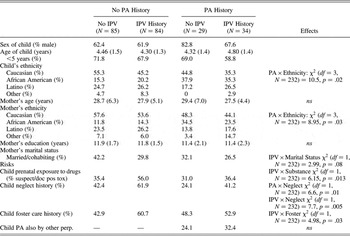
Table 1 describes the differences in demographic characteristics and risk factors between physically abusive and nonabusive mother–child dyads in our sample (N = 232) with and without exposure to IPV. In order to test the significance of main effects and interaction of PA history and IPV exposure, we performed 2 (PA History) × 2 (IPV Exposure) analyses of variance on continuous variables and hierarchical loglinear analyses on categorical variables. Hierarchical loglinear analyses test the need to include different effects in order to account for variation in marginal distributions. The chi-squares and p values are noted for significant effects, reflecting the significance of that particular term (e.g., PA History × IPV × Sex of Child) in explaining the distribution of children across all cells.
Descriptive differences between children physically abused versus not physically abused at the hands of their mothers by exposure to IPV

Note: IPV, interparental violence; PA, physical abuse.
Results showed that no significant interaction terms between PA history and IPV exposure were needed to explain differences in demographic and risk factors. Groups had similar gender and age composition: approximately 70% of the children in each group were under 5 years of age. However, we found significant differences in the ethnic compositions of children and mothers with and without a history of PA. Adjusted residuals showed that children with a PA history and their mothers were more likely to be African American than those with no history of PA. Results also showed that children physically abused by their mothers were significantly less likely to have a history of neglect. Of interest, children exposed to IPV were significantly more likely to have a history of neglect and to have been prenatally exposed to drugs. In addition, children exposed to IPV were more likely to have been placed in foster care. Taken together, these findings suggest that the histories of physically abused children who have experienced IPV are different from those with no IPV history in this sample.
To ensure that differences we might find in subsequent analyses were due to the effects of PA and IPV history and not other characteristics we controlled for significant group differences in demographic and risk history. We created a dummy variable indicating children's African American ethnicity and used this as a covariate in subsequent analyses. Because children's African American ethnicity served as an effective indicator for mothers' ethnicity (Spearman r = .84), only the child's African American ethnicity was included as a covariate in subsequent analyses. Neglect history, prenatal exposure to substances, and foster care history are highly correlated and difficult to use in a linear analysis together. Research has shown the advantage of combining highly correlated covariates that are indicators of risk (e.g., Sameroff, Reference Sameroff2000). For this reason, we created a cumulative risk variable using these three characteristics for use as a covariate in subsequent analyses. The alpha coefficient of reliability of the resulting scale of risk indicators was α = 0.70.
IPV, PA, and mothers' EA in different play contexts
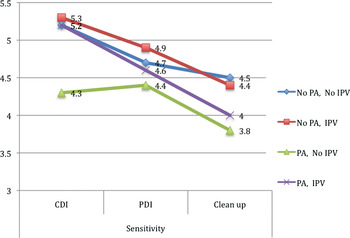
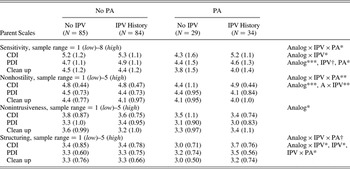
To test the hypothesis that the quality of abusive mothers' relationships with their children is moderated by the added experience of IPV, we performed separate repeated measures multivariate analysis of covariance of parents' and children's EA Scales with analog type as a within-subjects measure (CDI, PDI, CU) with IPV history and mothers' physical abusiveness as between-subjects measures, covarying children's ethnicity, and the cumulative risk indicator. Table 2 presents the means and standard deviations of the parents' EA Scales for each analog, IPV history, and PA history, along with significant univariate effects. We found evidence supporting the hypothesis that IPV moderates the effects of PA on the parent–child relationship. We found that the decrease in mothers' EA across analog varied significantly by the interaction between PA history and IPV exposure: Analog (A) × PA × IPV, overall F (8, 219) = 2.19, p = .03, η2 = 0.07, power = 0.85, such that mothers with PA history and no IPV exposure showed little change from the CDI analog (low power demands) to CU (high power demands); scores were low across the three analogs. In contrast, abusive mothers with a history of IPV showed significantly greater shift in EA from CDI to CU, showing scores more similar to nonabusive mothers with no IPV history in CDI, but low scores more similar to PA mothers with no IPV in CU. This pattern of results was observed in mothers' sensitivity (see Figure 1), nonhostility, and structuring scores: A × PA × IPV, sensitivity F (1, 226) = 6.26, p = .013, η2 = 0.03, power = 0.70; nonhostility F (1, 226) = 6.89, p = .009, η2 = 0.03, power = 0.74; structuring, F (1, 226) = 3.61, p = .06, η2 = 0.02, power = 0.47. Results also showed a significant analog by IPV exposure interaction, and a main effect for mothers' physical abusiveness: A × IPV, overall F (8, 219) = 2.96, p = .004, η2 = 0.10, power = 0.95; PA, overall F (4, 223) = 2.55, p = .04, η2 = 0.04, power = 0.72. An examination of the univariate effects revealed that IPV-exposed mothers have more variability across analogs than those not exposed to IPV, showing greater EA in CDI and falling to the same low levels of EA as other mothers in CU. Physically abusive mothers were less sensitive than nonabusive mothers across all analogs, F (1, 226) = 6.56, p = .01, η2 = 0.03, power = 0.72. Last, we observed that all mothers showed the greatest EA during the CDI. As the demand for mothers' power use increased, their EA decreased: A, overall F (8, 219) = 7.71, p < .001, η2 = 0.22, power = 1.0.
Maternal Sensitivity Scale raw scores for child-directed intervention (CDI), parent-directed intervention (PDI), and clean up by interparental violence (IPV) and physical abuse (PA) status. [A color version of this figure can be viewed online at http://journals.cambridge.org/dpp]

Mean (standard deviation) parent Emotional Availability Scale scores by IPV exposure and mother's physical abusiveness

Note: IPV, interparental violence; PA, physical abuse; CDI, child-directed interaction; PDI, parent-directed interaction. Child's ethnicity (African American) and cumulative risk were controlled in all analyses.
†p < .10. *p < .05. **p < .01. ***p < .001.
IPV, PA, and Children's EA in different play contexts
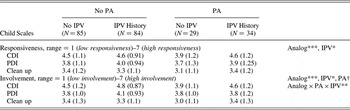
Table 3 presents the means and standard deviations of the child EA Scales by analog, IPV history, and PA history, along with significant univariate effects. Results also supported the hypothesis that IPV moderates the effects of PA on the parent–child relationship. As with mothers, we observed the change in EA across contexts to further differ by IPV history and PA: A × IPV × PA, overall F (4, 225) = 2.42, p = .049, η2 = 0.04, power = 0.69. An examination of the univariate statistics for children's involvement of their parents in play mirrored findings with mothers: A × IPV × PA, F (1, 226) = 7.47, p = .007, η2 = 0.03, power = 0.78. In contrast with other children, physically abused children with no exposure to IPV were less optimally involving of their parents in play in CDI, remained at the same level of diminished involvement during PDI play, and were even less optimally involving in clean up, all other things being equal. Physically abused children who had also been exposed to IPV responded to the task similarly to children who had not been physically abused, showing a linear decline in involvement from CDI to CU. Results also showed differences in children's EA by analog, overall F (4, 223) = 13.55, p < .001, η2 = 0.20, power = 1.0. Like their mothers, children looked best in the CDI situation and worst during CU.
Mean (standard deviation) child Emotional Availability Scale raw scores by IPV exposure and history of physical abuse by mother

Note: IPV, interparental violence; PA, physical abuse; CDI, child-directed interaction; PDI, parent-directed interaction. Child's ethnicity (African American) and cumulative risk were covaried in all analyses.
†p < .10. *p < .05. **p < .01. ***p < .001.
To see whether variations by analog, IPV history and PA observed in previous analyses were reactions to mothers' EA, we reran the previous analysis covarying a summary measure of mothers' EA. Results of these analyses showed that mothers' EA accounted for a large portion of the variation in their children's EA: mothers' EA, F (1, 227) = 109.42, p < .001, η2 = .49, power = 1.0, and yet the effect of the interaction between IPV history, PA, and analog was little diminished by its inclusion: A × IPV × PA, F (1, 222) = 2.29, p = .06, η2 = 0.04, power = 0.66, with little change in the univariate statistics for child involvement: A × IPV × PA, F (1, 227) = 7.16, p = .008, η2 = 0.03, power = 0.76. These findings suggest that the variations across analogs in children's emotionally availability to their mothers may be a result of experiencing PA and IPV rather than a response to their mothers' response to the assessment process.
Comparing parents' and children's EA
Results of previous analyses showed that mothers and children with and without a history of PA and/or exposure to IPV reacted similarly to the task requirements of the three analogs. We do not know how they compare with one another—whether abusive parents are more or less emotionally available to their children than the children are to them. We assume that the power of the context of play and the behavior of the other (i.e., mother or child) will keep parents and children's levels of EA close to one another. However, it is possible that mothers and children with more exposure to violence may differ more from one another than those with less exposure.
To examine this question, we created z scores of summary EA scores separately for mothers and children in each analog. We performed a 2 × 3 × 2 × 2 repeated-measures multivariate analysis of covariance, with subject (S; parent vs. child) and analog as repeated (within-subjects) measures and IPV and PA history as between-subjects measures. Results of this analysis showed that when dyads had been exposed to IPV, children showed somewhat more optimal EA than their mothers; when children were not exposed to IPV, they tended to show less optimal EA than their mothers. We found a significant S × IPV History effect: S × IPV, overall F (1, 226) = 5.34, p = .022, η2 = 0.02, power = 0.63, but no further variation by PA history or by analog. An examination of the means (available upon request) showed less difference between IPV-exposed and nonexposed mothers' EA (no IPV: mean = 0.006, SD = 1.03; IPV: mean = −0.02, SD = 0.99) compared with their children (no IPV: mean = −0.12, SD = 1.1; IPV: mean = 0.11, SD = 0.93). The degree of synchrony of parent–child EA scores (i.e., the absolute value of the difference between parent and child scores) was similar in the two groups of mother–child dyads.
IPV, PA, and types of children's nonoptimal EA
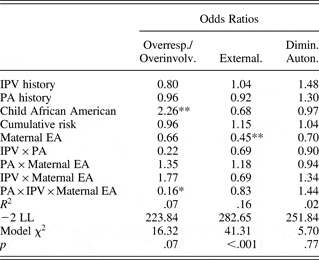
Although previous analyses allowed us to examine differences in levels of EA, differences in changes in EA across play contexts, and differences in relative levels of mothers' EA compared to their children, there is still the possibility that the reasons underlying children's nonoptimal EA varies systematically by exposure to violence. Children can receive nonoptimal responsiveness and involvement scores (scores less than 5) by expressing negative affect and oppositional and defiant behavior—hallmarks of externalizing behavior problems. However, they can also receive nonoptimal scores for showing overresponsive, overinvolving behavior or diminished autonomy. Although children displaying this type of behavior might be perceived as “being good” by a casual observer, it is not considered as optimally emotionally available. Children's overresponsive behavior is considered to be characteristic of role-reversed, caregiving behavior; and diminished autonomy characterizes overcontrol on the part of the parent. Either of these nonoptimal behaviors would be concerning in a high risk sample as it reflects disruptions in the construction of the parent and child roles (Bureau, Easterbrooks, & Lyons-Ruth, Reference Bureau, Easterbrooks and Lyons-Ruth2009) possibly in addition to emotional dysregulation. In this sample, 96% of children show some nonoptimal behavior in at least one analog and 46% show no optimal behavior in any analog. Approximately 53% of children had nonoptimal scores because of externalizing behavior in at least one analog; 21% had overresponsive/overinvolving behavior in at least one analog; and 24% showed diminished autonomy in at least one analog. In order to determine whether the type of child nonoptimal behavior varied by PA history and exposure to IPV, we conducted binomial logistic regressions, predicting the presence versus absence of externalizing behavior, overresponsive/overinvolving, and diminished autonomy, using as predictors IPV and PA history, a standardized summary score of mothers' EA, interaction terms, and covarying African American ethnicity and the indicator of risk.
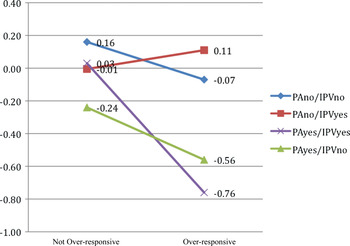
The results of these binomial logistic regressions (see Table 4) showed that (a) as maternal EA decreased, the likelihood of children displaying externalizing behavior increased; (b) diminished autonomy was not significantly predicted by any of the independent variables; and (c) among physically abused children with exposure to IPV, lower maternal EA increases the likelihood that they will show overresponsive behavior. Figure 2 illustrates the mean standardized maternal EA scores by children's PA history, IPV exposure, and the presence of overresponsive/overinvolving behavior.
Standardized global maternal emotional availability scores by physical abuse (PA) history, interparental violence (IPV) history, and presence of overresponsive/overinvolving behavior. [A color version of this figure can be viewed online at http://journals.cambridge.org/dpp]

Results of binomial logistic regressions of types of child nonoptimal EA on IPV history, mothers' physical abusiveness, and covariates

Note: EA, emotional availability; IPV, interparental violence; PA, physical abuse; −2 LL, −2 log likelihood.
*p < .05. **p < .01.
IPV, PA, and differences in parental stress
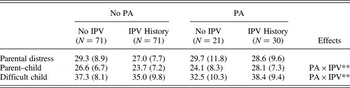
As described earlier, research has supported the idea that risk has a cumulative effect, increasing the severity of negative outcomes (e.g., Kitzmann et al., Reference Kitzmann, Gaylord, Holt and Kenny2003; Wolfe et al., Reference Wolfe, Crooks, Lee, McIntyre-Smith and Jaffe2003). Negative outcomes were generally defined behaviorally or cognitively and measured by standardized assessment tools. Although we were not sure how worse outcomes would manifest themselves in the quality of the parent–child relationship, we expected that the cumulative (i.e., additive) negative effect of PA and IPV history on parents' self-reports of stress in the parent role would be straightforward. To test this, we performed a multivariate analysis of covariance of differences in parental stress resulting from distress in the parent role, stress from dysfunction in the parent–child relationship, and stress from raising a difficult child to see whether our clinical sample would show effects similar to previous studies. Results of this analysis (see Table 5) suggested that IPV tended to moderate the effect of PA on parenting stress: IPV × PA, overall F (3, 187) = 3.76, p = .012, η2 = 0.06, power = 0.81. When examining the univariate effects, we found that the significant effects were limited to the measure of dysfunction in the parent–child relationship and the difficulty of the child to parent: P-C Dysf, F (1, 187) = 8.1, p = .005, η2 = 0.04, power = 9.79; Diff. Ch, F (1, 187) = 7.04, p = .009, η2 = 0.04, power = 0.75. Means for abusive and nonabusive mothers with and without exposure to IPV showed that mothers with dual-violence history reported higher levels of stress related to interaction with the child than those with only IPV history or a history of abusiveness.
Mean (standard deviation) PSI Scale scores by IPV exposure and history of physical abuse by mother

Note: PSI, Parenting Stress Index; IPV, interparental violence; PA, physical abuse. Child's ethnicity (African American) and cumulative risk were covaried.
**p < .01.
Discussion
The purpose of this paper was to use a sample of low-income, high-risk, young children clinic referred for treatment of disruptive behavior problems (similar outcomes) to describe the pathways to psychopathology of children exposed to IPV and PA, and to investigate their effects on the parent–child relationship, a key ingredient of risk and resilience in young children. We expected that a family ecology of violence would predict greater disruption in the emotional quality of the relationship between physical abusive mothers and their young, clinic-referred children. Unexpectedly, we observed that when children only experienced PA, EA scores were lowest across three analogs of parent–child interactions—child- and parent-led play, and CU. These mothers showed less optimal structuring than other mothers and tended to be more hostile, particularly in the CDI analog. Their children displayed a similar pattern of less optimal involvement of their parents in play, also showing noticeable deficits in child-directed play. When children were exposed to IPV and PA, EA scores were similar to those with no history of PA in the play situation requiring little parent control (i.e., CDI). However, these dyads showed the increasing decay in EA as the demand for power increased, such that EA scores for the CU analog were similar to those of other physically abusive mothers. This group's distinct parent–child interaction patterns made us wonder whether we had captured in this group a kind of subculture of dyads Baumrind (Reference Baumrind1994) described in her discussion of the social context of child maltreatment: dyads for whom poverty and culture converge, increasing the likelihood of behavior which is defined by “the system” as child maltreatment. These are dyads for whom marital violence has spilled over into their strategies for managing conflict with their children, but who are not without the ability to express warmth and care. It is important to remember that these mothers did not report any more parental distress than other mothers, although they did report more difficulty parenting the child and more dysfunction in the parent–child relationship. It is possible that the violence in these households was driven by norms and values of their subculture rather than psychological distress (e.g., depression). Of interest, results of a recent study of the effects of early parenting style on outcomes in adolescence show that children whose parents used this power-coercive style of discipline showed the most maladjustment (Baumrind, Larzelere, & Owens, Reference Baumrind, Larzelere and Owens2010), suggesting that there is destructive power in this style of discipline, irrespective of its origins. Subsequent analyses suggested that the magnitude EA scores might not have been the only signal of dysfunction in parent–child relationships.
In the analysis comparing parents' and children's EA scores, the children in groups exposed to IPV were likely to have higher EA than their mothers across the three analogs. Considering the age of the children and their mental health status, we expected parents to display higher EA in the observational assessment than their children. The fact that these children showed higher EA than their parents could suggest that the children were compensating for their parents' skill deficiencies, helping to keep their parents emotionally regulated and connected to their children. The results of the analysis examining predictors of different types of child nonoptimal behavior, although not powerful, showed that among physically abused children with IPV exposure, low maternal EA increased the likelihood of children's overresponsive, overinvolving behavior. On the one hand, it is possible to view this behavior as a sign that these children are actively coping, compensating for their parents' low EA and perhaps minimizing threat. On the other hand, these results support the thought that added exposure to IPV predicts a shift in strategies children use in interactions with their parents. Instead of showing more negative, aggressive, or disconnected behavior, they showed overresponsive, overinvolving behavior when confronted with their low maternal EA. Although unexpected, these findings justify our concerns about these children's social–emotional health. These behaviors are role reversed and parentified (e.g., Jurkovic, Reference Jurkovic1997), typical of caregiving controllingness. They are thought to be a manifestation of disorganized attachment in middle childhood (Bureau et al., Reference Bureau, Easterbrooks and Lyons-Ruth2009) and linked with poor outcomes in clinical research literature (e.g., Jurkovic, Reference Jurkovic1997; Moss, Cyr, Dubois-Comtois, Reference Moss, Cyr and Dubois-Comtois2004). This overresponsive, overinvolving behavior may represent the way in which greater risk manifests itself in the parent–child relationship.
Clinical implications
Putting everything together, we argue that the results support the thought that when physically abused children are also exposed to IPV, we should expect that children may respond differently to their parents, particularly those in which parents use more coercive control, than if there is no indication of exposure to IPV. Although abusive dyads with no exposure to IPV had less optimal EA than those with exposure to IPV across all interaction analogs, dyads with dual violence also showed concerning anomalies in their sharper decrease in EA as parents' need to control their children increased, and in their overresponsive, overinvolving behavior. These effects are noteworthy for mental health providers treating children with a history of abuse and IPV, particularly if they are using relationship-based interventions. First, they suggest that abusive parent–child dyadic interactions might not arouse concern if they were observed only in free play situations. Furthermore, the children's overbright behavior could mask dyadic problems, deceiving a therapist who was not trained to recognize the nonoptimal nature of this behavior. We believe that these findings suggest the need to consider the balance of affect, or synchrony of parent–child relationships. It is easy to regard negative affect, tantrums, and oppositional behavior as the most significant and destructive symptoms of young maltreated children's mental health, particularly because it is so common. It is easy to overlook the clinical significance of children's overly bright and engaging behavior in contrast to a mothers' bland or withdrawn behavior, possibly because it is refreshingly different. However, these findings suggest that this lack of synchrony between parent and child may be clinically significant. The greater likelihood for dual-violence exposed children to show this behavior suggests a possible connection between more complex or chronic trauma and anomalies in the parent–child relationship. Clinicians might take a second look at the dyads that display this behavior, possibly asking more about possible traumatic experiences and evaluating the severity of traumatic symptoms.
Limitations and caveats
We acknowledge that there may be other possible explanations for these results. For instance, we were dependent upon court reports, social worker reports, and client self-reports to categorize dyads as abusive and having a history of IPV. We could not control for the possibility that many PA allegations may have gone unreported, particularly when a mother was receiving child welfare services because of marital violence. In addition, we know that families with active IPV were monitored more closely than those with no IPV, and child maltreatment allegations are substantiated at higher rates in these families than other groups (Kohl, Edelson, English, & Barth, Reference Kohl, Edleson, English and Barth2005). The accuracy of Child Protective Services reporting may partly account for differences in EA.
The nature of the sample, the assessment, and the measures may limit our ability to generalize these findings to broader populations. A clinic-referred sample of children is used because it provides a more varied portrait of disrupted mother-child interactions, but it does not necessarily represent the population of child victims of IPV in the community or from shelters. It is a sample defined primarily by the presence of children's externalizing symptoms and mothers' parenting problems, which precipitated the referral to PCIT, not their history of IPV. Possibly as a result, IPV is not well described in children's clinical case files, making it likely that we are underreporting the influence of IPV on parent–child relationships. At the same time the sample represents a large group of children often seen in mental health treatment, so findings may be useful for clinical practice. Next, a fairly broad age of children was included in the sample (2 to 7 years), although the majority were under 5 years of age. Although all children were observed to have problems in their relationships with their mothers, making them eligible for PCIT services, parent and child interaction strategies change considerably over this time period. We depend on future research to explore the developmental differences in the behaviors we observe. Last, the sample was ethnically diverse and the physically abusive dyads were more likely to be African American than nonabusive dyads. Furthermore, children using the overresponsive style were more likely to be African American. It is possible that the results of these analyses reflect a phenomenon more typical of African American families than other physically abusive mother–child dyads exposed to IPV.
The context and structure of our observational assessment may have influenced our findings. This was part of a clinical assessment, which had certain demand characteristics: mothers often wanted to show us that they were good parents. Furthermore, the assessment period was shorter than recommended for the EA Scales (Biringen, Reference Biringen2000) and we imposed parent control on the interaction, deliberately drawing out the parents' discipline style and increasing chances of seeing difficult behavior in the child. Both the length of the assessments and the structure should be taken into account when comparing EA scores across samples.
Last, this is an objective system for evaluating qualitative aspects of the parent–child relationship. Reliability in coding is essential for building a coherent understanding of the function of EA in development. Although we took care to establish the reliability of our EA coding within our group of coders, across time, and across laboratories, we may have a way of coding EA in overresponsive, overinvolving children that differs from the way other labs might code. Only children with EA in the nonoptimal range were coded as overresponsive and overinvolving; and if the children were overresponsive or overinvolving, the mother also received EA scores in the nonoptimal range. Less skilled coders or coders less familiar with the relationship dynamics of high-risk parents and children might perceive the behavior as positive, therefore optimal. We rely on future work using both the EA Scales and other coding systems to confirm our findings.
Conclusions
The results of this study suggest that the experience of IPV affects the quality of the physically abusive mother–child relationship. Counter to our expectations, physically abusive mother–child interactions with no exposure to IPV showed the lowest EA across all play situations. However, equally as concerning, dyads with dual-violence exposure showed the greatest shifts in EA from child-led play to CU as well as overbright behavior characteristic of a less optimal attachment style, possibly indicating more severe disruptions in the parent–child relationship. As previous studies found (e.g., Kitzmann et al., Reference Kitzmann, Gaylord, Holt and Kenny2003), we found that abusive mothers with IPV exposure reported higher levels of dysfunction in the parent–child relationship and difficulty with child behaviors than abusive mothers with no IPV. We depend upon future research to inform us as to whether these differential effects on the parent–child relationship have any long-term implications for children's mental health outcomes.