In recent years the United States has witnessed an explosion in the number and variety of interest groups seeking to influence foreign policy debates (Lindsay Reference Lindsay1994, 28; Tierney Reference Tierney, Ripley and Lindsay1993; Uslaner Reference Uslaner and Wilson2004). A “resurgent” and increasingly decentralized Congress has provided these groups unprecedented access to policymaking debates (McCormick Reference McCormick and Scott1998, 173; Ripley and Lindsay Reference Ripley and Lindsay1993). These newly formed or newly engaged groups represent economic interests, ethnic and religious communities, and civic-minded citizens. Yet even as the expert-dominated realm of international affairs has opened up to a cacophony of lay interests, one well-organized and traditionally active group—American women—has surrendered its prominent seat at the table and almost completely disengaged from the major foreign policy debates of the day.
Women's organizations' disengagement heralds a politically significant historical development and presents an intellectual puzzle heretofore unexplored by scholars of interest groups, foreign policy, and gender politics. Scholars of foreign policy and interest groups have told a story of ever-expanding participation by citizens' groups, while scholars of women's organizations have focused likewise on women's increasing political engagement. This study examines women's mobilization in reverse. As other scholars have noted, women's organizations in the 1920s formed “a national lobby for the public interest” (Jeffreys-Jones Reference Jeffreys-Jones1995, 47), and international affairs became a major target for their collective action (Cott Reference Cott1987). They remained engaged at least through the 1950s, when their participation began to drop until by the 1990s, women's groups were scarcely a presence at all in major congressional foreign policy debates. Why did women's organizations sound the retreat? Did they disengage because of changes in American women's issue priorities? Changes in the nature of U.S. foreign policy issues? Changes in interest group strategies as they adapted to a reconfigured pressure-group system or larger political context? Does this disengagement matter, for women or for democracy writ large?
This study uses an original data set of women's organizations' appearances before congressional hearings over the past century to document the rise and fall of these groups' collective voice on important matters of war, peace, diplomacy, and international human rights.Footnote 1 Besides documenting women's groups' exodus from this policy realm in the final decades of the late twentieth century, the study uses these data, together with secondary sources, to account for this exodus. In doing so, the study sits at the intersection of three literatures: one involving theories of women's citizenship and collective action (Kraditor Reference Kraditor1971; Lister Reference Lister2003; Skocpol Reference Skocpol1992); one involving theories concerning how issues come to be “defined” and “owned” by different constituencies (Baumgartner and Jones Reference Baumgartner and Jones1993; Gusfield Reference Gusfield1981); and one involving the evolution of the American interest group system (Berry Reference Berry1997; Skocpol Reference Skocpol2003; Walker Reference Walker1991). One contribution of this study, then, is to demonstrate how ideational and organizational theories of collective action on pressing public policy issues are not only linked but also mutually reinforcing. To set up the puzzle and findings, I briefly review these three expansive literatures, drawing theoretical connections along the way.
Throughout American history, women's collective action has been rooted in two dominant rationales: the difference rationale and the equality rationale. They have been used independently and in tandem. The difference rationale holds that, whether by nature, nurture, or strategic adaptation, women's political motivations, understandings, preferences, and/or priorities differ from men's. The equality rationale holds that women possess the same natural rights as men to political and economic opportunity, and that more unites the sexes than separates them. Equality theorists generally believe that differences in female biology or socialization, to the extent they exist, should be taken into account only insofar as they facilitate public policies that promote gender equality.
Difference rationales have been used to advance equality issues (such as female suffrage), as well as broader public issues that affect men and women alike (if not always equally), such as health care, consumer protection, and war and peace. For simplicity's sake, I refer to gender-equality issues as “particularistic” public policies, because they have an intentionally differential focus on women, and to all other issues as “nonparticularistic.”Footnote 2 Difference arguments used to advance particularistic public policies were common during the suffrage movement – Aileen Kraditor (Reference Kraditor1971) calls them “expediency” arguments—but were uncommon during the second-wave women's rights movement of the 1960s–1980s (Offen Reference Offen1988).
Difference arguments have been used more commonly to advance nonparticularistic policies. Such arguments typically turned on one of two narratives. The first was that women, as mothers and stewards of community organizations, had an ethic of care that was not as highly developed in men (the maternal rationale). The second was that women, historically removed from the rough-and-tumble of party politics, had a particularly pure, public-spirited approach to policymaking, one rooted in careful study, democratic deliberation, and consensus (the civic rationale). Both the maternal and civic rationales lent women a certain moral purity that they used to buttress their political authority. Maternal narratives were central to women's collective action around peace (Sharer Reference Sharer2004); social welfare and labor policy (Skocpol Reference Skocpol1992; J. D. Wilson Reference Wilson2007); the Red Scare (Gerson Reference Gerson and Joanne1994); race relations (Feldstein Reference Feldstein and Joanne1994); and antinuclear issues (Garrison Reference Garrison and Joanne1994; Swerdlow Reference Swerdlow1993). Civic rationales, championed by groups such as the League of Women Voters, were used to justify engagement on an equally broad array of issues (Bucy Reference Bucy2002, 2; Goss Reference Goss2009; K. Stone Reference Stone1946, 5; Young Reference Young1989, 168, 178).
By the second half of the twentieth century, however, difference arguments had lost force as women increasingly moved into the previously male-dominated economic and political spheres and as second-wave feminists argued that “different” was inherently unequal and that caretaking perpetuated women's subordination (Brush Reference Brush1996; Dietz Reference Dietz1985; DiQuinzio Reference DiQuinzio, Meagher and DiQuinzio2005; Offen Reference Offen1988; also see, for example, Mansbridge [Reference Mansbridge1986] on issues related to the Equal Rights Amendment and Kaminer [Reference Kaminer1984] on organized feminism's stance against social caretaking through volunteer work). As Skocpol (Reference Skocpol1992, 538) noted in the early 1990s, “in the United States today no such unproblematic connections of womanhood and motherhood, or of private and public mothering, are remotely possible.”
In contrast to difference arguments, equality arguments have sought to minimize differences between men and women and have been focused, traditionally, on advancing particularistic public policies—those intentionally designed to advance women's legal rights, economic status, or physical well-being. This review of difference and equality arguments is necessarily brief and oversimplified; as Wendy Sarvasy (Reference Sarvasy1992) and Eileen McDonagh (Reference McDonagh2009) have noted, women's leaders have often used the two conceptions of female identity simultaneously or combined them into a hybrid form. Nevertheless, difference and equality arguments have distinct emphases, and a review of their uses over the decades contains a relevant insight: that, historically, women's organizations found difference arguments to be more versatile, in terms of public policy advocacy, than equality arguments. I make no claims about the effectiveness of these different arguments in any given policy debate, nor about their relative moral worth. I merely make the point that, historically, difference arguments have been particularly adaptable to shifting political climates and the concomitant changes in issue agendas.
The discussion of difference and equality rationales leads, logically, to the larger question of issue ownership—or how organizations (in this case, women's organizations) use narrative to establish their right to be taken seriously on public questions. In a pluralist democracy, groups tend to specialize in one or more issues over which they have, or develop, expertise and moral authority. Yet the configuration of interests mobilized around a particular policy also changes over time—that is, ownership of issues, as of property, can be transferred (Baumgartner and Jones Reference Baumgartner and Jones1993; Gusfield Reference Gusfield1981). It is interesting to note that while scholars have developed a solid set of theories to explain the emergence of new claims to issue ownership, there has been very little work on the reasons why once-dominant groups fade from the scene.
That said, scholars of interest groups have examined how the interest group universe itself has evolved over time, producing a set of findings that might shed light on the question of which groups own which issues when. One theory holds that these configurations change because new institutional forms are created and enter the mix—a process akin to generational replacement in studies of human populations. In the American context, the new form was the “citizen group,” which proliferated in the 1970s. In this account, citizen groups and other newcomers to the Washington scene helped to break open the closed pressure system that had dominated issue politics for decades (i.e., iron triangles) and to replace it with a more open and fluid set of “issue networks” (Baumgartner and Jones Reference Baumgartner and Jones1993; Berry Reference Berry1977, Reference Berry1997, Reference Berry1999; Heclo Reference Heclo and Anthony1978; Walker Reference Walker1991). The trend has been noted in individual policy domains, including foreign policy (Lindsay Reference Lindsay1994). Citizen group proliferation, in turn, has been driven by the availability of patronage resources (Berry Reference Berry1999; Walker Reference Walker1991); increasing affluence and the rise of postmaterialist values (Berry Reference Berry1999); the proliferation of government programs for claimants to protect (Berry Reference Berry1997; Walker Reference Walker1991); and changes in institutional structures and rules that encouraged group participation (Berry Reference Berry1999; Skocpol Reference Skocpol2003).
Another theory of change identifies the competitive strategies of new and existing groups as the causal mechanism. In this account, to remain viable, interest groups must distinguish themselves as experts in particular policy niches in order to corner the market on political intelligence (Browne Reference Browne1990; Hansen Reference Hansen1991) and on congressional and donor attention (Browne Reference Browne1990). Citizen groups, in particular, tend to forge their identities on the basis of issue specialization (Heaney Reference Heaney2004). Niche theorists argue, in turn, that once an organization has invested in a particular issue, tying group identity to subject-matter expertise, the organization is likely to guard its turf and fend off other groups purporting to speak authoritatively on the matters at hand. Thus, one observable implication of niche theory is that once they have established themselves, interest group guardians will be unlikely to surrender their niche, even as other groups attempt to enter (Browne Reference Browne1990, Reference Browne1988). Another implication is that broad policy domains will be dominated by increasing numbers of single-issue organizations representing narrow, uncontested elites (Browne Reference Browne1990). Although these studies imply that the interest group universe is more specialized and balkanized now than in the past, they are largely silent on why that might be or what accounts for change over time in the universe of groups active in any given policy realm.
A third theory of change—one relevant to the citizen group sector in particular—identifies social and demographic changes as the key drivers (Hansen Reference Hansen1991; Skocpol Reference Skocpol2003). Theda Skocpol (Reference Skocpol2003) argues that the declining legitimacy of race and sex segregation, coupled with the expansion in higher education and the growing share of Americans in professional careers, undermined traditional membership-based associations of laypeople and fueled the growth in professional advocacy groups based in Washington.
While these sets of theories are distinct, particularly in the causal mechanisms that they privilege, they share a premise: that the configuration of interest groups active in a given policy domain is driven largely by the quest for, and availability of, organizational resources, namely, financial and human capital (Gray and Lowery Reference Gray and Lowery1996). Yet, by and large, these resource-oriented theories of interest group evolution do not fully explore the connections between organizational capacities and the substance of what interest entrepreneurs actually do, which is to define problems (Rochefort and Cobb Reference Rochefort and Cobb1994), promulgate new issue understandings (Goss Reference Goss2006; Lowery and Brasher Reference Lowery and Brasher2004; Rochon Reference Rochon1998), and convey policy information in the form of empirical data and symbolic narratives (Hall and Deardorff Reference Hall and Deardorff2006; D. Stone Reference Stone1989; Truman Reference Truman1971; Wright Reference Wright1996). In short, pressure groups not only mobilize resources and advance interests, but they also develop and promulgate ideas about whose voice counts on which issues and why.
Why might ideas be relevant to the question of how interest configurations shift over time? One possibility is that as issues are redefined, some groups gain authority (or issue ownership), while others lose it. The transfer of issue ownership has been observed in, among other policy realms, abortion (Luker Reference Luker1984), gun control (Goss Reference Goss2006), and alcohol control (Gusfield Reference Gusfield1981; Moore Reference Moore and Reich1988). Frank Baumgartner and Bryan Jones (Reference Baumgartner and Jones1993) go so far as to argue that policy issues do not typically move up the political agenda until they are redefined and adopted by new political actors. While persuasive, studies linking evolving ideas and shifts in interest group attention are often unclear on the underlying forces that drive these shifts in issue ownership.
From this cursory review, several conclusions can be drawn. First, in recent decades, leading feminist organizations have embraced equality rationales, while having at best ambivalent feelings about utilizing what had been for them an arguably more versatile set of rationales centered on gender differences. Second, the U.S. interest group universe has expanded to include a wider array of citizen organizations, even if the particular implications for democratic pluralism are in dispute (Browne Reference Browne1990; Skocpol Reference Skocpol2003). Third, the reason why some groups are active on some issues at some times but not others is far from settled, and the possible connections among seemingly distinct theories are underexplored. And finally, while the entrance of new groups into policy domains has been fairly well documented, we know much less about which groups have exited, to what extent, and why.
This study helps to fill that gap with a particularly dramatic and perplexing case: Women's organizations' exodus from congressional debates over international relations. The exodus began in the 1960s, accelerated in the 1970s, and continued throughout the 1980s and 1990s. The rise and fall of women's groups' foreign policy engagement sheds light on the processes of issue ownership and “disownership” in contemporary America. The rest of the article unfolds as follows. First, I set the stage by offering several reasons why this disengagement is particularly puzzling. Then, I introduce the data and methods used to document trends in women's groups' involvement in foreign policy debates on Capitol Hill. Following that, I quantify the decline in terms of number of hearing appearances, scope of issues addressed, and representativeness of the organizations testifying. Next, I investigate eight possible explanations to account for women's groups' exit from the foreign policy stage, finding that explanations centered on women's groups—as opposed to foreign policy, Congress, or American women themselves—are the most compelling. Finally, I conclude by integrating theories of female collective action, issue ownership, and interest group evolution and by suggesting that scholars take seriously not just new voices but also those left behind.
THE PUZZLE
The decline in women's foreign policy activism is puzzling for a number of reasons. For one, the literature on interest group “niches” implies that once a niche is established it is not easily surrendered (Browne Reference Browne1988, Reference Browne1990). Even before World War I, women's organizations had staked out peace and international diplomacy as one of their core policy niches; in 1925, major women's groups formed the National Committee on the Cause and Cure of War, which claimed to represent 20% of American women (Cott Reference Cott1987, 95). Although most American women supported America's entry into World War II and played an important role in sustaining the war effort as charity volunteers and factory workers, women's organizations across the political spectrum also resisted U.S. engagement. Right-wing mothers' groups—such as the America First network, the Mothers of Sons Forum, and Mothers Organize for America—promoted isolationism, as did the leftist Women's International League for Peace and Freedom. By the 1960s, with the Cold War and the advent of the Vietnam conflict, mothers founded Women Strike for Peace (Jeffreys-Jones Reference Jeffreys-Jones1995, 134; Swerdlow Reference Swerdlow1993) and Another Mother for Peace (Jeffreys-Jones Reference Jeffreys-Jones1995; 142). While women's groups were active in the 1960s, their disengagement from foreign policy had begun.
The retreat from national foreign policy debates is puzzling not only because women had established the foreign policy niche in the first place but also because two core bases for their claim to political authority—that they were mothers of soldiers and that foreign affairs affected women's domestic work—had not changed by the 1980s and 1990s. Women were still mothers of soldiers, as well as wives, girlfriends, sisters, and grandmothers, and survey evidence suggested that women did indeed continue to view foreign policy questions differently from men. For example, in a 2003 poll, white women were 10 percentage points less likely than white men to agree that the Iraq invasion was a good idea; the gender gap among African Americans was 24 percentage points.Footnote 3 In 2004, while 62% of men wanted the United States to stay in Iraq, only 45% of women agreed.Footnote 4 Likewise, linking foreign policy to domestic affairs—the world of social caretaking in which women have traditionally played the dominant role—did not become more difficult over time. If anything, globalization has tightened the nexus between international peace, health, and prosperity, on the one hand, and domestic interests, on the other. Increasingly, policies are “intermestic,” pulling many types of domestically focused citizens' and faith-based groups into foreign affairs advocacy (Uslaner Reference Uslaner and Wilson2004). By and large, women's groups have not been part of this trend.
Women's withdrawal from foreign policy is also puzzling because it occurred at a time when women's civic skills and resources were growing and the opportunities to be heard were increasing. From the 1970s through the 1990s, women were becoming increasingly well educated and financially independent. Thanks to the women's liberation movement, together with a raft of equal opportunity laws and rulings, women acquired enhanced economic, legal, and political status. To maintain these gains and push for more, women's organizations flourished (Gelb and Palley Reference Gelb and Palley1996; Goss and Skocpol Reference Goss, Skocpol, O'Neill and Gidengil2006; Schlozman Reference Schlozman, Gurin and Tilly1990). All of these civic skills and resources would have been expected to empower women to play a more central and influential role in policy debates across the board. Indeed, as I show in other work (Goss Reference Goss2006), women's groups were far more prevalent on Capitol Hill in the latter part of the twentieth century than in the middle or early part. Twice as many women's groups testified before Congress on all policy matters in the 1980s compared to the 1950s. And while the number of groups testifying declined in the 1990s, there were still 30% more of them present at that time than at midcentury.
Within foreign policy, the opportunities to be heard on Capitol Hill were likewise multiplying. After Vietnam, America witnessed a “resurgence of Congressional activism” (Lindsay Reference Lindsay1994, 24) in foreign policy, and citizens' groups were mobilized around matters of international affairs. The number of hearings on international affairs and foreign aid issues nearly quadrupled between the 1950s and the 1990s. The number of defense-related hearings increased more than 40% between 1960 and 1990, before dropping again to 1960s levels.Footnote 5 In sum, as Congress devoted increasing time to foreign policy, and as lawmakers grew more solicitous of interest group perspectives, the traditionally best-organized champions of foreign policy—women's groups—paradoxically disengaged.
DATA AND METHODS
To chart the history of women's groups' foreign policy engagement, this study tracks their appearances at hearings held by congressional committees and subcommittees from 1916, the first time a women's group testified at an international affairs hearing, through 2000. The hearing appearances were culled from the Congressional Information Service's CIS Index, scores of phonebook-size volumes that list every person and organization that has ever testified at a (published) congressional hearing. For each organization, the listing includes a brief description of the hearing and the year or Congress in which it took place. The data culled from the printed volumes were then extensively cross-checked against the online hearings database offered by Lexis-Nexis Congressional. The online version supplements the print version by including not only published hearings but also unpublished hearings through 1972 (House) and 1984 (Senate).Footnote 6 Because of the incompleteness of unpublished hearings over time, where warranted this study examines published hearings only.
From 1916 through 2000, women's groups made 1,333 appearances on foreign policy issues (international affairs/foreign aid and defense combined).Footnote 7 Foreign policy appearances constitute just under 13% of all women's group appearances on all issues, second only to appearances related to government reform (n = 2,005) and roughly equal to appearances relating to civil and women's rights issues (n = 1291) and to law, crime, family, social welfare, and education issues combined (n = 1,439). In sum, women's groups historically have been nearly as engaged in foreign policy debates on the Hill as they have been in domestic social policy debates; and women's groups actually have testified more on foreign policy than on women's rights.
For purposes of this study, “foreign policy” means any hearing about “international affairs or foreign aid” or about “defense,” as defined by the Policy Agendas Project.Footnote 8 Each hearing in my data set has been given the same topic code that the Policy Agendas Project coders assigned in their data set of all congressional hearings (which covers 1946–2004).Footnote 9 Although women's groups appeared on a wide array of international affairs and defense-related issues, five concerns dominated: issues relating to manpower, military personnel, and dependents (278 appearances); international organizations, such as the United Nations and the United Nations Children's Fund (UNICEF) (193); U.S. foreign aid (183); Veterans Administration issues, including veterans' benefits (179); and military treaties and aid (108). In addition to being assigned a Policy Agendas Project topic code based on the CIS descriptor, each appearance was coded as to whether or not the women's group was speaking on behalf of women's particularistic concerns (e.g., survivor benefits for widows of soldiers, equal opportunity in the foreign service).
Descriptive analysis of the data provides a window into the issues on which women's groups voiced their concerns before Congress, but the hearings data are not a perfect representation of women's groups' foreign policy activities. The data do not capture “outside strategies,” such as protest marches or petition campaigns, or cases where women's organizations lobbied the executive branch or sought relief through the courts. The data also cannot capture women's groups' activities around those issues not already on the congressional agenda. Nevertheless, the data set is an important barometer of women's groups' international engagements. For one, it provides a systematic record of the salient foreign policy issues on which women's groups chose to focus. Second, because congressional testimony is by invitation, the database illuminates the issues on which members of Congress viewed women's voice as authoritative, as well as the groups deemed politically valuable to invite. In sum, the data tell us a lot about the role of organized women in foreign affairs debates at the elite level.
The study examines trends in the “international affairs” and “defense” categories separately and together. They are considered separately because, as we shall see, women's groups' patterns of engagement have varied over time across the two clusters of issues. They are considered together because in some cases (such as midcentury military aid), the lines between foreign policy and defense are blurred.
FINDINGS
The Rise and Fall of Foreign Policy Engagement
The most striking finding in the data is that women's organizations have beaten a pronounced retreat from foreign policy debates on Capitol Hill, particularly since midcentury. Women's groups were once a critical player in a coalition of organizations, including most notably religious and civic groups that advocated for peace, international organizations, and diplomacy. Although time and resource constraints prevent me from systematically analyzing women's groups as a share of all organizations advocating for foreign policy, a sampling of hearings across a range of issues and time periods suggests that women's groups were prominent advocates. In key hearings on the World Court in 1924–25, for example, women's groups constituted 28% of all organizational witnesses and 22% of all witnesses.Footnote 10 In a series of important hearings on the United Nations Charter in 1954, women's groups constituted 32% of all organizational witnesses and 16% of all witnesses.Footnote 11 Finally, an analysis of House foreign aid hearings at 10-year intervals from 1947 to 1997 finds that women's groups went from constituting 9%–18% of all organizations testifying in the 1940s, 1950s, and 1960s to being completely absent by the 1980s and 1990s.Footnote 12 In sum, women's groups were a visible presence at major foreign policy hearings from suffrage through the start of the second-wave women's movement.
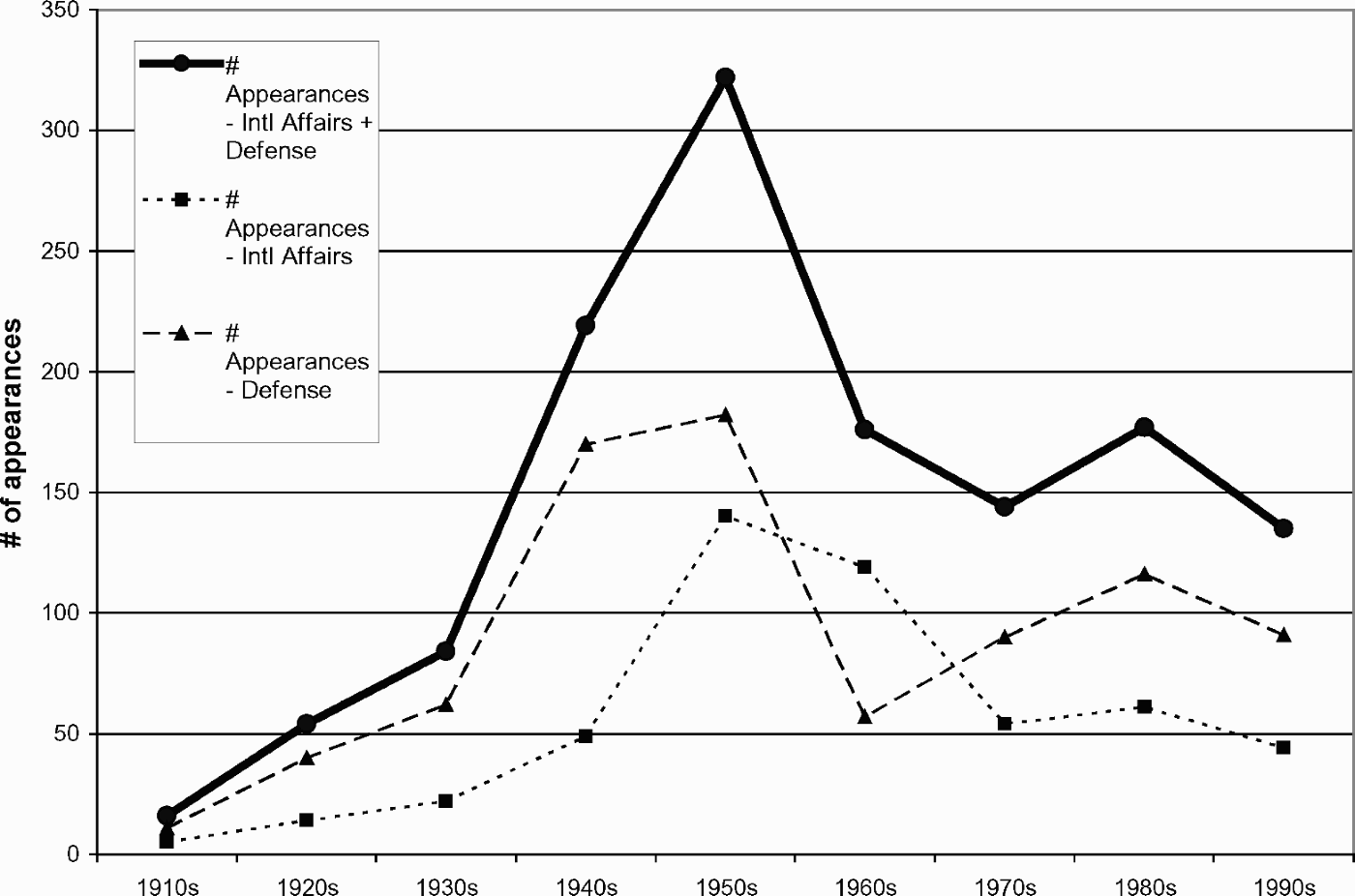
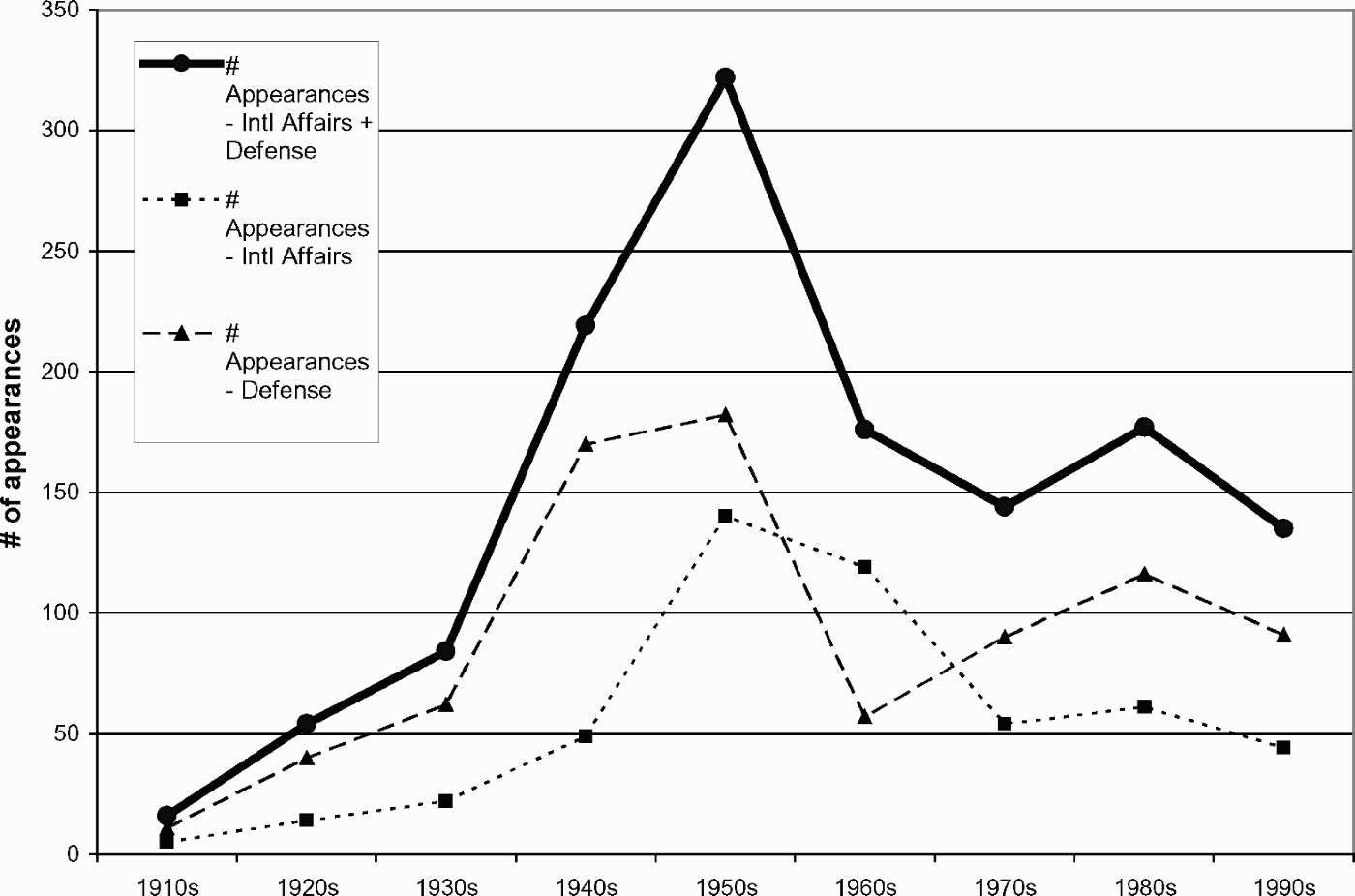
Turning to the data set of all international relations and defense-related appearances by women's groups, we see that their presence has declined from a high of 322 appearances in the 1950s to just 135 in the 1990s, a drop of 58%. (See Figure 1.) Within defense policy, women's groups' appearances peaked in the 1950s, with 182 appearances, before dropping to just 91 appearances by the 1990s. Within international affairs, the peak came in the 1950s, at 140 appearances, then plunged to just 44 in the 1990s.Footnote 13 The drop in international affairs testimony is actually more dramatic than it appears. Because foreign aid in the 1950s was largely military assistance, the Policy Agendas Project assigned those hearings to the defense category, rather than to international affairs and foreign aid. If these hearings had been coded as “foreign aid,” women's groups' appearances in that category would have plunged from 219 in the 1950s to 44 in the 1990s, a drop of 80%.
Women's group appearances on foreign policy. Data include published and unpublished hearings through 1972/House and 1984/Senate; published only thereafter.
The drop in international affairs appearances is surprising for many reasons as noted, but, in particular, because the number of congressional hearings in this realm increased dramatically between 1970 and 2000. At least in theory, there were more opportunities for women's groups to testify. International affairs hearings rose steadily, from roughly 400 in the 1950s to roughly 1,000 in the 1970s to roughly 1,500 in the 1990s, while women's appearances declined from 140 to just 44 in that time period.
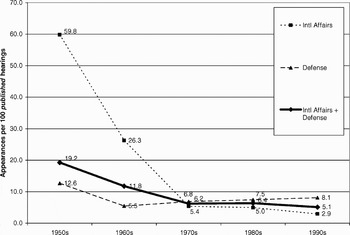
Figure 2 shows the number of women's group appearances as a share of all published hearings on international affairs, defense, and the two combined.Footnote 14 As the graph illustrates, the likelihood of women's groups' appearing at defense-related hearings declined in the 1950s, then rose slightly for the next four decades. (The initial drop reflected the fact that foreign aid, then largely military, falls in the defense category during the 1950s.) But women's groups' presence at international affairs and foreign aid hearings plummeted from roughly 60 appearances per 100 hearings in the 1950s to fewer than 3 appearances per 100 hearings in the 1990s, a drop of 95%. The drop would have been even more striking (97%) if the foreign aid hearings of the 1950s had been assigned to the “international affairs and foreign aid” category, instead of “defense.” Thus, even as women's groups were marching to Capitol Hill in increasing numbers, they did not turn their attention, as Congress did, to international affairs.
Hearing-adjusted appearances, by decade (published hearings only).

The graphs tell only half the story. Besides the quantitative drop in women's groups' appearances, there was an equally intriguing qualitative shift in the nature of their foreign policy engagement. For most of the twentieth century, women's groups were important advocates for the major international issues of the day, and they appeared en masse to state their positions before Congress. In the 1920s and 1930s, women's groups were preoccupied with urging U.S. participation in the Permanent Court of International Justice (also known as the World Court), which they saw as an alternative to war in resolving international disputes. Over the course of two decades, 26 women's associations appeared before Congress 34 times to voice their support for the Court.Footnote 15 As a coalition of 11 national women's groups, representing millions of members, told a Senate Foreign Relations subcommittee in 1924, “There is no question so vital to the women of this country as the achievement and maintenance of world peace.”Footnote 16
During the 1940s, women's groups played a prominent role in hearings on two of the most important items on Congress's agenda: the reconstruction of Europe after World War II and the creation of the United Nations. Seven major women's groups—including the General Federation of Women's Clubs, the League of Women Voters, the Women's Action Committee for Lasting Peace, the Women's International League for Peace and Freedom, and the Daughters of the American Revolution—testified a total of 19 times in support of foreign aid to postwar European nations. Many of the same groups also supported ratification of the United Nations charter, which Congress debated and approved in 1945. Throughout the 1940s, 13 women's associations made a total of 19 appearances related to the UN, and several other groups testified in support of U.S. participation in another new international entity, the World Health Organization. These groups may have drawn inspiration from Eleanor Roosevelt, whom President Harry Truman appointed to the first U.S. delegation to the UN. She was instrumental in securing passage of the UN Declaration on Human Rights in 1948 and chaired the Human Rights Commission from 1946 to 1952 (Cook Reference Cook and Crapol1992, 113).
The 1950s represented the most active decade for women's groups on Capitol Hill, at least in the realm of foreign policy; they appeared 322 times in that decade. The vast majority of those appearances concerned foreign aid, including military aid; continued participation in the United Nations; universal military service and training; and the positioning of U.S. forces in Europe. Again, the largest women's voluntary associations were there with stunning regularity. The League of Women Voters or its chapters testified 47 times during that decade on foreign policy matters, both international affairs and defense; the Women's International League for Peace and Freedom testified 44 times; the National Congress of Parents and Teachers, 24 times; the American Association of University Women and the General Federation of Women's Clubs (or its affiliates), 20 times apiece; the Daughters of the American Revolution, 17 times; and the National Woman's Christian Temperance Union, 14 times. International affairs constituted a priority concern even for the multipurpose organizations in that list (i.e., those that were not established to specialize in international concerns). For example, roughly one-third of all congressional appearances by the League of Women Voters and by the American Association of University Women in the 1950s concerned international or defense policy.
During the 1960s and 1970s, women's groups continued to focus on foreign aid and international organizations, in particular UNICEF, created in 1946. As in the 1950s, the major women's federations appeared frequently. The National Congress of Parents and Teachers, for example, testified on international or defense policy matters 48 times during the 1960s and 1970s; the Women's International League for Peace and Freedom, 39 times; and the League of Women Voters, 30 times. As in decades past, women's groups also came together in a coalition to amplify their voice. The Citizens Committee for UNICEF spoke on behalf of between 9 and 12 women's organizations, as well as a handful of child-welfare groups, in urging Congress to increase its appropriation to the international aid agency.
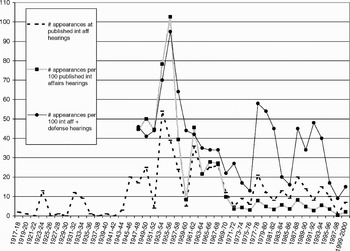
From the 1970s through the 1990s, the scope and nature of women's foreign policy interests changed dramatically. As Figure 1 showed, most of the decline was in international affairs policy (as opposed to defense). In international affairs, the number of women's groups' appearances plunged to roughly 45–55 per decade, down from roughly 120–140 per decade at midcentury. Figure 3, covering published hearings only, provides a more fine-grained look at the rise and fall of women's groups' engagement in foreign policy debates, by Congress. It is interesting to note that women's groups appeared more often in absolute terms on foreign policy questions in 1923–24, just after enactment of national suffrage, than they did in any of the last three Congresses of the twentieth century.
Women's groups and international affairs, 1946–2000 (published hearings only).

In the last third of the 20th century, women's groups' appearances became scattered across a larger range of issues, with less collective focus. In earlier centuries, if women's groups sought to testify at an international affairs hearing, they did not usually do so alone. At midcentury, for example, among international affairs hearings at which at least one women's group appeared, the average number of groups testifying was 2.5 (1940s) and 3.4 (1950s). Some issues, such as ratification and revision of the UN charter, drew as many as 35 women's groups per series of hearings in those decades. By the 1970s, 1980s, and 1990s, however, if a women's group appeared at an international affairs hearing, it was more likely than not to be there without the company of any other women's group. Among international affairs hearings at which a women's group appeared during those three decades, the median number of groups was 1, and the average ranged from 1.3–1.4. Put another way, in the 1950s–1960s, roughly 41%–44% of international affairs hearings in which women's groups appeared featured only one such organization; by the 1980s and 1990s, that figure had risen to 80%. By the late twentieth century, women's groups had more or less stopped coming together in a show of force around questions of American foreign affairs. Instead, individual groups tended to testify on particularistic issues revolving around women's rights and professional status—everything from discrimination against women in the foreign service, to female athletes' participation in the Olympic games, to the international trafficking of women.
Another change involved the types of women's groups that were engaged in foreign policy debates. The big, multipurpose membership associations that had served as women's voice on Capitol Hill at midcentury had abdicated that role by the 1990s. The once-stalwart advocates that were no-shows in the 1990s included the national League of Women Voters,Footnote 17 the National Congress of Parents and Teachers (which had become the PTA), the American Association of University Women, the National Council of Jewish Women, the Citizens' Committee for UNICEF, Daughters of the American Revolution, and the Women's International League for Peace and Freedom. The General Federation of Women's Clubs appeared just once. In their stead, a handful of new, specialized organizations served as women's voice, notably the Women's Commission for Refugee Women and Children and the Coalition for Women in International Development.
Why Did Women's Groups Retreat from Foreign Policy?
To review, women's organizations' retreat from congressional debates on foreign policy during the late twentieth century is paradoxical for several reasons: Women had more political clout; women's groups were appearing on the Hill with greater frequency; and Congress was holding more hearings on foreign policy. After decades of leadership on the most pressing international policy issues, from foreign aid to multilateral organizations, why did women's groups' presence before Congress shrivel as women's legal, political, and economic status grew?
The rest of this article draws on scholarly literature and informed observation to examine eight possible explanations for women's organizations' exodus from national foreign policy debates. The hearings data do not permit a definitive solution to the puzzle; many forces were converging at once to drive the observed trends. However, the hearings data, supplemented by histories of the women's movement and other social transformations occurring in the second half of the twentieth century, build the case that shifts in women's organizational agendas, as opposed to broader trends in female attitudes or foreign policymaking, most likely account for the observed decline in women's collective presence on Capitol Hill. The next three sections consider the eight explanations, finding little support for the first five (centering on foreign policy and women's attitudes) and considerable support for the final three (concerning the evolution in women's organizations' structure and priorities).
Changes in the Politics of Foreign Policy?
Is women's organizational disengagement from foreign policy issues simply an unintentional casualty of larger transformations in the politics of international affairs? Four possible explanations are considered here.
Women's organizations' declining presence is an artifact of a decline in congressional hearings on international affairs or other macropolitical forces
This theory, while plausible, does not hold water. Congress increased its international-affairs hearings nearly fourfold from the 1950s through the 1990s. Far from losing interest, Congress became more actively engaged in foreign policy and in the process provided more opportunities, not fewer, for interest groups, including citizens' organizations, to have their say. What is more, the rise through the 1950s, then the decline through the 1990s, does not correspond to any obvious pattern in geopolitics (such as U.S. engagement in a “hot” war) or partisan politics (such as Democratic control of Congress).
Women's organizations lost clout because foreign policy debates shifted toward interventions on which women were not seen as authoritative
The evidence does not support this explanation. U.S. foreign policy did not shift away from policy interventions traditionally favored by women's organizations (such as international diplomacy) and toward those on which men are presumed expert (such as military strategy).Footnote 18 Indeed, the observed downward trend in women's testimony falls within the “international relations” (i.e., diplomacy) category, and, surprisingly, not within the defense category (see Figure 2).
Women's organizations lost clout because, within international relations, Congress was becoming increasingly engaged with issues on which women's groups had little interest or expertise
Again, there is no support for this explanation, as evidenced by a comparison of the attention paid by women's organizations and Congressional committees to specific topics within the broad category of “international affairs and foreign aid.” Of the 20 subtopicsFootnote 19 in that category, women's groups clearly specialized in three: foreign aid, human rights, and international organizations, which together accounted for more than 80% of women's groups' international affairs appearances between 1950 and 1999. However, far from moving away from these areas of intensive female interest, Congress held many more hearings in the 1970s, 1980s, and 1990s than in the 1960s and 1950s. Although the number of hearings fluctuates—for example, foreign aid hearings grew throughout the 1980s, then abated in the 1990s—in no case did Congress shift away from the issues that had traditionally interested women's groups. Rather, it appears that Congress maintained its traditional concern for foreign aid and international organizations, while branching out into new areas, such as international resources, terrorism, human rights, and region-specific matters.
Women's groups, on the other hand, tended not to show a commensurate broadening in their issue interests. Thus, for example, Congress held 90 hearings on international resources in the 1990s, but women's groups logged only two appearances that decade. What is more, in the three core areas of female interest—foreign aid, human rights, and international organizations—women's groups' appearances dropped dramatically as a share of total hearings on those topics. In the 1950s and 1960s combined, on average two women's groups testified at every published hearing on international organizations or human rights, and at least one women's group appeared at every other hearing on foreign aid. Those numbers dropped precipitously such that by the 1980s and 1990s, a women's group typically appeared only once for 10 published hearings in those three policy domains.Footnote 20 Thus, women's groups did not appreciably broaden their foreign affairs interests, and within their traditional areas of concern, they became less active. Women's group participation went from concentrated and consistent to isolated and sporadic.
Women's groups lost clout because “expert advocates” gained prominence in foreign policy debates at the expense of associations of laypeople
The rise of professionally staffed interest groups, university research centers, and consultants has been documented by Theda Skocpol (Reference Skocpol2003) and Robert Putnam (Reference Putnam2000), among others. Did these groups crowd out women's organizations? To answer that question, I examined the universe of witnesses at the principal House foreign aid hearings in 1947, when women's groups made their first concerted appearance, and in the same hearings at decade intervals thereafter (i.e. 1957, 1967, 1977, 1987, and 1997). Witnesses were coded as to whether they were from a citizens' group (e.g., women's, ethnic, religious, environmental, etc.); a think tank or university; a business or labor organization; or a governmental body (e.g., Congress, an executive branch agency, etc.). The only clear pattern over time is that citizens' group appearances have increased markedly, from 19% to 22% of all appearances in the 1947–77 period to 31%–47% in the 1987–97 period. Within the “citizens” category, religious organizations held their own, while environmental and ethnic groups greatly increased their presence on Capitol Hill. These quantitative findings reinforce the qualitative conclusions of foreign policy scholars that citizens' groups have grown in prominence (Lindsay Reference Lindsay1994; Tierney Reference Tierney, Ripley and Lindsay1993; Uslaner Reference Uslaner and Wilson2004). Thus, the data also suggest that women's groups, a subset of citizens' groups, were not crowded out by professional experts or government elites.
The Changing Interests of American Women?
Citizens' political concerns are shaped by their economic interests and social roles. American women's social and economic roles have changed dramatically since the women's movement of the 1960s and 1970s. Thus, it is reasonable to speculate that as gender roles changed, women's policy interests may have shifted away from global issues affecting all humanity and toward bread-and-butter issues affecting female workers, per the following proposition.
Women's organizations have retreated from foreign policy debates because American women have lost interest in those issues
Again, there is little, if any, evidence for this explanation. Quantifying a shift in women's interest is complicated, but one simple proxy is the degree of attention that women pay to international news stories. Periodically throughout the 1980s and 1990s, the Times Mirror Center for The People & The Press asked representative samples of Americans how closely they were following various news stories.Footnote 21 In general, the “News Interest Index” shows a gender gap, with men being slightly more likely than women to follow military, terrorism, and international policy stories “very closely” (Pew 1997).Footnote 22 Women also were less likely to answer questions about international affairs correctly (Pew 2000).
Although these findings suggest that individual women's relatively lower interest in foreign affairs may help explain their groups' Capitol Hill retreat, there are several reasons to be cautious about such a conclusion. First, as Tom Smith (Reference Smith1984) reports, nearly 60 polls from the 1930s through the 1970s found that women in every case were more likely than men to report “no opinion” on foreign affairs questions, suggesting that the gender gap in attentiveness is nothing new. In many cases, the size of the gender gap in nonopinions during those decades exceeded the interest gap found in later decades. Second, the News Interest Index shows that the gender-based “attention gap” extends to domestic policy. And yet, as women's groups began disengaging from foreign policy debates, they were becoming increasingly engaged with domestic policy issues, as documented in the next section. Third, even though women are less attuned to foreign policy news than are men, a significant fraction of women do pay attention: 38%, on average, in the 1986–97 study. This finding translates into tens of millions of women who claim to care about international affairs and are presumably available for recruitment by women's organizations. In sum, while women are slightly less attuned to foreign affairs than are men, there is no compelling reason to believe that this lack of concern in relative terms explains women's groups' retreat from international relations debates in Washington.
The Changing Agendas of Women's Organizations?
If American women remained concerned about international diplomacy, human rights, and other foreign policy questions, perhaps it is their interest group representatives whose agendas shifted. Here, I consider three explanations relating to women's organizations, focusing on shifts in their arenas of policy focus, membership structure, and conceptions of what a “women's issue” is. These processes of change are not mutually exclusive—indeed, they are interrelated—and I find evidence for all three explanations, as follows.
Women's groups collectively shifted from international work and toward domestic policy
The shift from international to domestic priorities is clearly evident in the data from the mid-1960s through the mid-1980s. During those years, as women's engagement with foreign policy was generally declining, their engagement with domestic policy issues increased. Women's domestic policy presence increased both in absolute terms (number of hearing appearances on domestic policy matters) and in relative terms (appearances per 100 domestic policy hearings). The increase was sharpest during the 1970s, when the women's movement was in its heyday and when Democratic and Republican administrations and the Democratic Congress were attentive to domestic economic and social policy. However, the 1990s saw a sharp decline in women's appearances on domestic policy, both in absolute numbers (–43%) and as a share of all hearings (–35%). Thus, the proposition that women's groups left the foreign policy stage to attend to domestic matters may explain part of the trend in the 1960s–1980s but not in the 1990s.
Women's groups' presence declined because the groups that had been engaged with foreign policy lost vibrancy and were not replaced with equally robust organizations
There is considerable evidence for this explanation. The six women's groups that dominated foreign policy debates in the 1950s and 1960s—the League of Women Voters, the Daughters of the American Revolution, the General Federation of Women's Clubs, the National Council of Jewish Women, the Women's International League for Peace and Freedom, and the American Association of University Women—all experienced declining membership in the second half of the twentieth century (see, for example, Putnam Reference Putnam2000; Skocpol Reference Skocpol2003).Footnote 23 To give one important example, the League of Women Voters—a major foreign policy voice that also has testified on Capitol Hill more than any other women's organization—experienced a 50% drop in membership between 1970 and 2000, even as the female population grew by 39%.Footnote 24 Not surprisingly, as they lost members these “big six” traditional women's associations lost presence among women's groups testifying on Capitol Hill. Together, these groups were responsible for 66% of all women's group appearances at published international affairs hearings in the 1950s, but by the 1980s, they accounted for just 15% of such appearances. By the 1990s, they constituted less than a half of 1%.
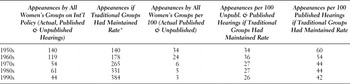
To appreciate the effect of the traditional, general-purpose, mass membership groups' decline, it helps to consider a counterfactual case. What if these organizations had remained as active in congressional international affairs debates in the 1960s–1990s as they were in the 1950s? We can calculate that effect using the same six women's groups that testified the most on international affairs during that decade. If those six groups had continued testifying at the same rate, the number of women's group appearances on international affairs would have risen, not fallen, over the second half of the twentieth century, and the decline in women's presence as a share of all hearings would have been cut dramatically, as Table 1 shows. As the table indicates, the exodus of six traditional membership associations from the foreign policy scene is responsible for roughly 70% of the hearing-adjusted decline in women's organized presence at all congressional hearings on international affairs in any given decade after the 1960s.Footnote 25 With their encompassing missions and commitment to the public good broadly defined, these organizations could generate expertise and credibility on a wide swath of issues. These groups were able to draw on a versatile repertoire of women's collective action frames, namely, maternalism and civic spiritedness rooted in women's “difference,” to legitimize women's voice on issues that were not particular to women's social, economic, or political advancement.
What if traditional groups had stayed active in international affairs?

*Adjusted figures assume that six traditional women's groups (Daughters of the American Revolution, League of Women Voters, American Association of University Women, General Federation of Women's Clubs, National Council of Jewish Women, and Women's International League for Peace and Freedom) testified at the same rate in the 1960s–1990s as in the 1950s. This adjusted tally is added to the actual number of other women's groups (i.e., besides the traditional six) testifying each decade.
Women's groups' presence declined because they shifted their time and resources, within international affairs, toward a narrower set of issues – either because traditionally active groups narrowed their agendas or because newer, more focused groups came to dominate
This explanation builds on the prior one and is an important piece of the puzzle. As the traditional groups were bowing out, a new crop of women's organizations arose to serve as women's voice in international affairs. However, the newer women's groups that came to testify in the 1980s and 1990s differed in important ways from those they had supplanted. For one, these newer groups lacked the strong chapter organization and large membership base that had fueled the traditional voluntaries. In most cases, too, the newer groups had expertise over a more focused set of issues, and as a result would be expected to be invited to testify less frequently.
The feminist orientation of the groups that testified in the 1980s and 1990s is evident in their names: The Women's Action Organization, the Coalition for Women in International Development, International Women's Rights Action Watch, Women's Rights Project of Human Rights Watch, the United Nations Commission on the Status of Women, the Equity Policy Center, the Association for Women in Development, the Women's Commission for Refugee Women, and Women's World Banking. In general, these groups exhorted Congress to direct more development aid toward women, to reduce discrimination against women in foreign policy positions, and to include more women in the process of economic development planning and implementation. The groups saw their role as lobbying for equity in a male-dominated foreign aid establishment that had neglected women's perspectives and interests.
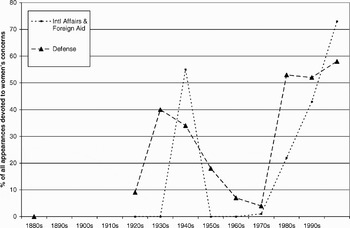
One way to capture the shift in women's groups' interests is to examine the fraction of foreign policy appearances devoted to advocating for women's rights, status, or well-being. As Figure 4 shows, that fraction increased markedly in the 1970s and continued in the 1990s.
Lobbying for women's interests (published and unpublished hearings).

In defense policy, before World War II women's group lobbying for women's interests constituted a significant percentage of all hearing appearances. During this time, women's groups sought government benefits and grave visitation rights for the spouses of fallen soldiers. From the 1940s through the 1960s, however, women's groups switched their focus away from the explicitly gendered issues, making nonparticularistic arguments on policies such as military aid and the draft. Beginning in the 1960s, and escalating throughout the 1990s, women's groups again turned toward women's particularistic interests, including survivor benefits and female roles in the military. In international affairs and foreign aid, the turn toward particularism is even more striking. During the 1950s, not one women's group appeared on behalf of women's interests within the international affairs realm, and in the 1960s, only 1% did. Then the figure started to climb, to 22% of all women's group appearances in the 1970s and 73% in the 1990s. The 1930s notwithstanding, when women's groups rallied against a World Court provision that would have discriminated against women, the postwar trend represented a sea change in women's foreign policy interests.
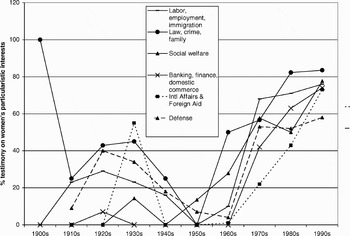
Consistent with both niche and “issue ownership” theories of interest group evolution, women's organizations over the past three decades have moved from a robust engagement in a wide spectrum of public affairs to a focus on issues that directly affect women's rights, status, health, and economic well-being. Figure 5 shows that a similar shift occurred in women's group appearances in four important policy areas, in addition to international affairs and defense. In effect, the definition of what is a “women's issue” has changed rather dramatically. This specialization has narrowed the range of legislation on which women's groups seek to testify and on which their input is sought by Congress. Women's groups now tend to be present at hearings on female-specific legislation or on legislation where women's particularistic concerns constitute a substantial component.
Women's groups testifying on women's issues (published and unpublished hearings).

If the decline in women's foreign policy appearances was driven largely by a shift in the composition of women's groups active in the international realm, what accounts for that underlying development? The data, reinforced by previous work on the women's movement, suggest several mutually reinforcing reasons. First, consistent with resource-based models of niche creation, feminist groups emerged in the 1960s and 1970s to threaten older groups' ability to recruit younger women (Costain Reference Costain1992). Traditional groups also lost members due to society-wide trends, notably the professionalization of expertise (Skocpol Reference Skocpol2003), the waning legitimacy of demographic segregation (Skocpol Reference Skocpol2003), the decline in Americans' taste for civic engagement (Putnam Reference Putnam2000), and women's movement into the workplace (Putnam Reference Putnam2000). As membership declined, traditional women's groups could maintain fewer strong chapters and had to cut their legislative staffs in Washington, which in turn made it more difficult to maintain a vigorous presence on Capitol Hill. These multipurpose voluntary associations had represented women's voice in midcentury foreign policy debates; their decline thus affected the number and range of issues on which laywomen, as women, were heard.
At the same time, the proliferation of interest groups focused on narrow issues within foreign policy crowded out women's organizations, forcing them to seek their own policy niche focused on feminist concerns. Women's groups' emphasis on feminist policies was encouraged by the availability of patronage resources from philanthropic foundations interested in seeding women's movement organizations and projects and advancing women's particularistic concerns (Goss Reference Goss2007). Women's groups' turn toward feminist claims was also influenced by the ideology of the women's movement, which called attention to persistent inequalities in public policy and public life and put remedial measures on the public and elite agendas.
Yet in claiming a feminist niche within the foreign policy issue space, women's groups may have inadvertently undermined their authority to speak on a broader range of international issues. Feminist dimensions to foreign policy are necessarily limited, perhaps more so than in domestic policy. This disparity may explain why women's groups' presence at foreign policy hearings declined during the feminist era, while their presence at domestic policy hearings increased. To be sure, women's groups did find a way to identify and testify about the gendered aspects of foreign policy—such as international development projects aimed at females and equity in the foreign service—but these were never the dominant questions in international affairs, or certainly on the congressional agenda. As women's groups redefined their issue space, their authority over foreign policy and their appearances at international-affairs hearings declined.Footnote 26 In this universe of professionally staffed interest groups, rank-and-file American women—those with knowledge and passion about international affairs but without professional credentials—had few meaningful ways to influence foreign policy.
Issue Ownership and Women's Voice
These findings document the changing nature of women's engagement in foreign affairs, but they also illuminate a seismic shift in women's citizenship as portrayed by their interest organizations. In the years after women won the constitutional right to vote, they were determined to prove themselves to be good citizens, worthy of inclusion in the polity. Women's voluntary organizations marched to Capitol Hill to state their positions on the major foreign policy issues of the day: whether the United States should participate in the World Court or ratify the United Nations Charter, or how much the United States should allocate to rebuild Europe after World War II or to halt hunger among children in developing nations. The organizations spearheading these causes—the League of Women Voters, the American Association of University Women, the General Federation of Women's Clubs, the Women's International League for Peace and Freedom, the National Congress of Parents and Teachers, and others—routinely reported the programs of intensive study through which they had formulated their positions (Goss Reference Goss2009). Leaders portrayed their organizations as representative democracies and touted the tens, or even hundreds, of thousands of knowledgeable, responsible women for whom they spoke (Goss Reference Goss2009).
These traditional organizations, formed in the latter decades of the nineteenth century and the early decades of the twentieth, drew on two types of gender-difference arguments, one rooted in women's roles as compassionate caregivers and the other in women's roles as “super citizens.” In both cases, women's groups portrayed themselves, implicitly or explicitly, as above politics and beyond self-interest. Grounded in the moral purity of gender distinction, these maternal and civic-minded women possessed a self-confident insistence on being heard in the male cloister that was Congress and on the manly issues of war and diplomacy. They saw themselves as stewards of a public good that women uniquely understood.
By the 1980s and 1990s, policy engagement by women's groups suggested a very different notion of women's citizenship. Rather than deploying their knowledge and sensibilities toward nonparticularistic public goods, women's groups were more likely to make particularistic claims for women's rights, protections, and distributional benefits. Women's groups of the period from the 1970s through the 1990s saw themselves as advocates for disempowered and discriminated-against females both in the United States and around the world. The focus on the feminist dimensions of policy implementation coincided with the devaluation of maternal and civic rationales for women's collective action, as well as a decline in the organizations that had championed such arguments (Goss and Skocpol Reference Goss, Skocpol, O'Neill and Gidengil2006; Goss and Heaney Reference Goss and Heaney2008). Unlike their predecessors, feminist groups sought to transform international relations by arguing, in essence, that greater inclusion of women as stewards and beneficiaries of U.S. foreign policy would serve women as a matter of right and, in the process, would further the larger public good.
The logic was sound. However, women's groups' turn away from difference arguments narrowed the range of rationales that they could call upon to legitimize their voice in important foreign policy debates. As congressional interest in foreign affairs grew, women's groups testified less and less frequently. When women's groups did appear before congressional hearings, they did so in a scattershot way and on issues where an obvious feminist claim could be made. The reliance on feminist rationales, coupled with the decline in traditional multipurpose women's associations, may have made it more difficult for women's groups to speak authoritatively on the full range of foreign policy issues that interest American women.
To those interested in women's voice in international policy debates, the developments of the past several decades may be cause for concern. For one, with respect to many areas of foreign policy, the direction and intensity of women's policy preferences differ from men's. Surveys going back to the 1930s have found that women are consistently less in favor of militarism and war than are men (Shapiro and Mahajan Reference Shapiro and Mahajan1986; Smith Reference Smith1984). The founding in 2002 of the antiwar group Code Pink, with its suffusion of female imagery, offers suggestive evidence that there is a unique “women's perspective” on the Iraq invasion that was not being voiced by nongendered organizations (Goss and Heaney Reference Goss and Heaney2008).
Second, women's groups are important drivers of female civic engagement. Gender identity, together with the narratives and rituals associated with it, provides solidaristic and purposive incentives that offset the free-rider problem (Olson Reference Olson1965; Wilson Reference Wilson1995). Once activated to join, female members of women's organizations are significantly more likely than women in mixed-gender groups to serve on the organization's board; to exercise voice in the organization (such as by feeling control over policy, being asked their opinion, and expressing an opinion at a meeting); to hone various civic skills (writing a letter, attending a decision-making meeting, planning a meeting, making a speech); and to be recruited into political action, such as voting (Burns, Schlozman, and Verba Reference Burns, Lehman Schlozman and Verba2001, 230). In sum, women's groups amplify women's voice and influence.
Third, women's organizations fill a political role for women that individual female leaders cannot. Women are still vastly underrepresented in positions of political leadership, whether in Congress (where women constituted 17% of House and 15% of Senate members in the 111th Congress) or in executive directorships and other top staff positions at public interest groups (Shaiko Reference Shaiko1996) and professional, industry, business, trade, and educational associations (Shaiko Reference Shaiko1997). With men occupying 80% or more of elite policy positions, it is hard to argue that women today exercise their collective voice through female leaders of nongendered entities. Even when women do lead, they must be attuned to other interests in and around their positions—voting constituencies, party bosses, the president, congressional committees, boards of directors, donors, and so forth. Simply put, female leaders cannot serve as single-minded champions of women's particularistic concerns. In fact, studies have found that when their numbers are sparse, women legislators may hesitate to champion women's interests (Thomas Reference Thomas1994; Welch Reference Welch1985) and that female officials' willingness to champion women's causes depends critically on women's groups lobbying them to do so (Keiser Reference Keiser1997) or on having dense ties to such organizations (Carroll Reference Carroll, O'Neill and Gidengil2006). In a particularly comprehensive study, S. Laurel Weldon (Reference Weldon2002) found that having a strong, autonomous women's movement (particularly in combination with a strong women's bureau) was a significant predictor of the scope of state efforts to reduce violence against women, whereas the number of female elected officials was not.
Besides raising important questions about women's voice, the evolution of women's involvement in national foreign policy debates sheds new light on dominant theories of interest-group evolution. For one, the case casts doubt on the assumption that policy niches, once established, tend to remain stable. In this case, women's groups “disowned” broad foreign policy issues as they came to specialize in questions of women's rights and status. Important questions remain about the factors driving that specialization. The data suggest that it was driven primarily by the declining organizational resources of traditional multipurpose women's groups, competitive pressures on newcomers to stake out a policy niche, and the availability of resources to support feminist organizations. However, another plausible explanation exists: that leaders of modern women's organizations, influenced by the feminist movement, chose to redefine what a “women's issue” was, in the process narrowing the range of policy questions on which women's groups were presumed authoritative. In this case, the resource-based theory (emphasizing competition over money, members, and policy space) and the political theory (emphasizing ideational transformation) predict the same outcome, policy specialization. The two developments were also clearly mutually reinforcing. The question of whether policy specialization by women's groups was a strategic choice or an organizational imperative remains unresolved.
To the information-seeking congressperson, the segmentation of political interests into policy niches may be useful insofar as specialists can deliver richer policy analysis than generalists can. However, to those concerned with pluralism and participation, specialization has clear costs. Here, finding a niche—namely, protection of women's rights and status—had the effect of transferring issue ownership from large associations of laywomen to new elite actors who did not necessarily represent the breadth of women's interests and perspectives. Ironically, equality feminism may have limited women's voice, while “old-fashioned” difference feminism, with its versatile rationales for political authority, expanded women's voice. One conclusion is clear from the data. By the 1990s, a once-sizable constituency, American laywomen, were scarcely being heard in national conversations about war, peace, and international affairs.