INTRODUCTION
The cuttlefish, Sepia officinalis (Linnaeus, 1758), has been found in the Mediterranean, North and Baltic Seas and as far as South Africa (Önsoy & Salman, Reference Önsoy and Salman2005). It can be found from coastline to about 200 m depth, predominantly on sandy and mud bottoms (Guerra & Castro, Reference Guerra and Castro1988; Guerra, Reference Guerra2006). This species presents a high tolerance for environmental changes, namely for salinity and temperature (Guerra & Castro, Reference Guerra and Castro1988; Serrano, Reference Serrano1992; Guerra, Reference Guerra2006) and is an important fishery resource in several areas of the globe (Roper et al., Reference Roper, Sweeney and Nauen1984).
The main stages of its life are punctuated by important seasonal migrations between shallow and coastal waters in summer (mainly for reproductive proposes) and wintering areas located in deeper waters (Gauvrit et al., Reference Gauvrit, Le Goff and Daguzan1997).
Cuttlefish has been the object of several studies in their natural environment. Distribution and abundance patterns were followed in the English Channel (Dunn, Reference Dunn1999; Wang et al., 2003), ria de Vigo (Guerra & Castro, Reference Guerra and Castro1988), ria de Aveiro (Jorge & Sobral, Reference Jorge and Sobral2004) and the Mediterranean (Mangold-Wirz, Reference Mangold-Wirz1963). Growth studies were performed in the English Channel (Dunn, Reference Dunn1999; Challier et al., Reference Challier, Dunn and Robin2005), Bay of Biscay (Le Goff & Daguzan, Reference Le Goff and Daguzan1991; Pinczon du Sel & Daguzan, Reference Pinczon du Sel and Daguzan1997; Blanc et al., Reference Blanc, Pinczon du Sel and Daguzan1998), ria de Vigo (Guerra & Castro, Reference Guerra and Castro1988) and the Mediterranean (Mangold-Wirz, Reference Mangold-Wirz1963). Reproduction has been studied in the English Channel (Dunn, Reference Dunn1999), Bay of Biscay (Le Goff & Daguzan, Reference Le Goff and Daguzan1991; Gauvrit et al., Reference Gauvrit, Le Goff and Daguzan1997), ria de Vigo (Guerra & Castro, Reference Guerra and Castro1988), ria de Aveiro (Jorge & Sobral, Reference Jorge and Sobral2004) and the Mediterranean (Mangold-Wirz, Reference Mangold-Wirz1963; Önsoy & Salman, Reference Önsoy and Salman2005).
Different strategies have been reported for several reproductive areas. In the English Channel (Dunn, Reference Dunn1999) and French coast (Goff & Daguzan, 1991; Gauvrit et al., Reference Gauvrit, Le Goff and Daguzan1997; Pinczon du Sel & Daguzan, Reference Pinczon du Sel and Daguzan1997; Blanc & Daguzan, Reference Blanc and Daguzan1999) the spawning period lasts from late March to July, while on the Iberian coast and in the Mediterranean Sea mature individuals have been reported all year around (Mangold-Wirz, Reference Mangold-Wirz1963; Guerra & Castro, Reference Guerra and Castro1988; Jorge & Sobral, Reference Jorge and Sobral2004; Önsoy & Salman, Reference Önsoy and Salman2005). Concerning the capacity of reproduction, two groups of breeders (in the first and second year of life) were referred for the Bay of Biscay (Gauvrit et al., Reference Gauvrit, Le Goff and Daguzan1997) and south Brittany (Le Goff & Daguzan, Reference Le Goff and Daguzan1991) while for the English Channel only breeders more than one year old were found (Dunn, Reference Dunn1999).
In Portugal, the cuttlefish has a considerable commercial significance, being the most important traditional fishing activity in the Sado estuary (Serrano, Reference Serrano1992). Despite its economic importance, very few studies have been conducted on this species, especially in what concerns its habitat use patterns and reproduction.
The main goal of the present study is to analyse the spatial and temporal distribution patterns of cuttlefish in the Sado estuary and to study the reproductive cycle of S. officinalis in this area.
MATERIALS AND METHODS
Sampling procedures
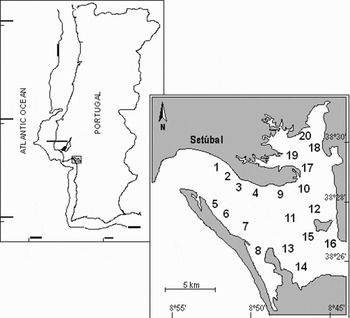
Cuttlefish were sampled monthly, from May 2001 to April 2002, in 20 sampling areas throughout the Sado estuary (Figure 1), using a 4 m beam trawl and 10 mm size mesh. Trawls were towed for 15 minutes, during daylight, at low level waters on spring tides. The distance covered by each trawl was calculated using a GPS. After capture, the individuals were kept frozen and later analysed in the laboratory, where the following measurements were taken: mantle length (ML, to the nearest 1 mm), total weight (TW, to the nearest 0.01g) and gonad weight (GW, to the nearest 0.01 g). Sex and maturity stage were recorded for each individual, following the criteria suggested by Mangold-Wirz (Reference Mangold-Wirz1963): I, immature; II, developing; III, maturing; and IV, ripe.
Location of sampling areas in the Sado estuary.

Distribution patterns
Density and biomass were estimated for each site and season as number of individuals for 1000 m2 and grams by 1000 m2 respectively. To perceive differences in distribution patterns, Kruskal–Wallis tests were performed in data for sample site and for season.
Individuals were arbitrarily divided into 5 groups according to their ML (lower than 40 mm; from 40 mm to 79 mm; from 80 mm to 119 mm; from 120 to 159 and larger than 160 mm) to investigate the length–frequency variation throughout the year. A total of 452 cuttlefish were analysed: 107 females, ranging from 24 mm to 205 mm ML; 89 males, with ML from 28 mm to 156 mm; and 256 indeterminate, from 8 mm to 58 mm ML.
Weight–length relationship
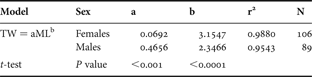
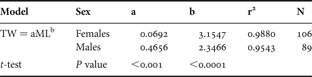
To determine the relationship between ML and TW for males and females the parameters of the equation TW = aML b were estimated. Differences between the parameters estimated for males and females were tested using a t-test. The sex-ratio was calculated for each season and deviations from the 1:1 ratio were assessed using a Chi-square test.
Reproduction strategies
The gonadosomatic index (GSI), calculated as the percentage of the ovary/testes weight in relation to the TW, was estimated for season and maturity stage, and differences were evaluated using the Kruskal–Wallis and Mann–Whitney U-tests.
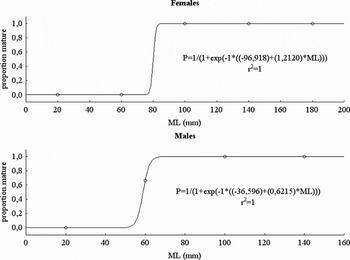
Size at first maturity was considered the length at which 50% of the individuals were mature. The percentage of sexually mature individuals for each sex (maturity stages III and IV) caught from February to May (months with higher percentage of mature individuals) were used to adjust the following logistic model:

Individuals were grouped in 5 length-groups defined above, to minimize the impact of the low number of individuals representing some lengths.
All statistical tests were performed using Statistica 6.0 software considering a significance level of 0.05.
RESULTS
Distribution patterns
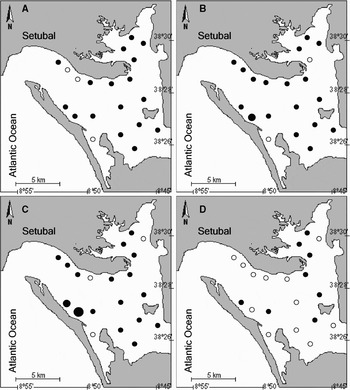
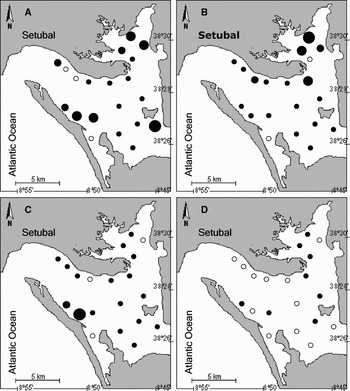
The spatial and temporal patterns of cuttlefish density and biomass are presented in Figures 2 and 3, respectively. Density (H = 51.7, P < 0.05) and biomass (H = 38.9, P < 0.05) values varied significantly according to season. The highest densities were registered in summer and autumn (mean values of 2.0 and 1.8 individuals*1000 m−2, respectively), predominantly in the lower and southern part of the estuary. The highest biomass values were recorded in spring with a mean of 59.6 g*1000 m−2.
Sepia officinalis densities mean values throughout the Sado estuary per season: (A) spring; (B) summer; (C) autumn; and (D) winter. ○- 0 individuals 1000 m−2; •−0 to 5 individuals 1000 m−2; •−5 to 10 individuals 1000 m−2; •−10 to 15 individuals 1000 m−2.

Sepia officinalis biomasses mean values throughout the Sado estuary per season: (A) spring; (B) summer; (C) autumn; and (D) winter. ○−0 g 1000 m−2; •−0 to 50 g 1000 m−2; •−50 to 100 g 1000 m−2; •−100 to 200 g 1000 m−2; •−200 g 1000 m−2.

Spatial differences in cuttlefish densities were also significant (H = 31.2, P < 0.05), being the highest values registered in the lower and southern part of the estuary. Biomass values showed no significant differences between sampling areas (H = 29.3, P > 0.05).
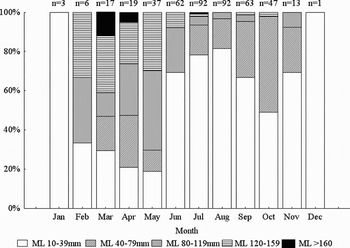
The analysis of the percentage of individuals per size-class through the year (Figure 4) showed that: large cuttlefish enter the estuary in late winter, early spring; during summer and autumn the individuals smaller then 40 mm dominate; in winter, the abundance of S. officinalis in the estuary is strongly reduced.
Percentage of individuals per size-class (I, 10 to 39 mm ML; II, 40 to 79 mm ML; III, 80 to 120 mm ML; IV, 120 to 159; V, ≥160 mm ML) throughout the year (N = 452).

Weight–length relationship
The weight–length relationship was significantly different according to sex (Table 1), being the regression coefficient higher in females. Smaller individuals have similar TW, but for individuals larger than 106 mm ML, females became heavier than males. A 1:1 sex-ratio was obtained for all seasons (χ2 = 0.195, P > 0.05).
Length–weight relationship of Sepia officinalis according to sex.
Reproduction strategies
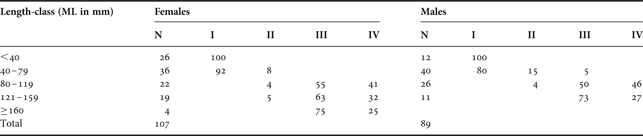
The frequency of individuals within maturity stage according to ML group is shown in Table 2. Immature females ranged between 28 mm and 73 mm ML and developing specimens ranged between 47 mm and 71 mm. Maturing females were caught with ML from 85 mm to 205 mm, and females in ripe condition varied from 94 mm to 165 mm ML.
Percentage of individuals of Sepia officinalis in each maturity stage according to mantle length group.
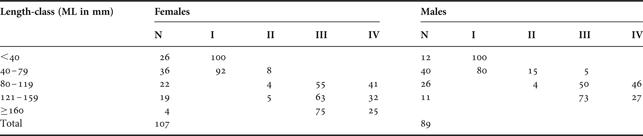
Regarding the males, immature individuals were found from 28 mm to 62 mm ML, while specimens in the developing stage presented a ML between 48 mm and 84 mm. Maturing males ranged between 63 mm and 156 mm ML and individuals in ripe conditions ranged from 85 mm to 140 mm ML.
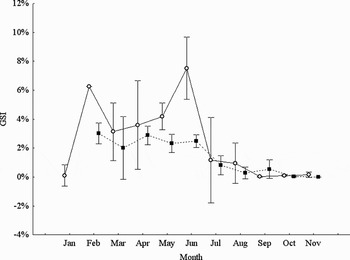
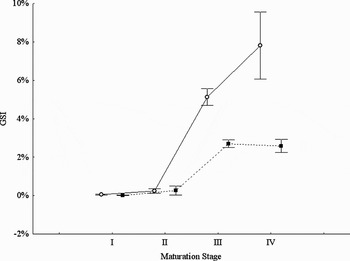
Significant differences in the GSI values were obtained between seasons for both males (H = 14.0, P < 0.05) and females (H = 14.8, P < 0.05). Females showed high GSI values from February to June, noticing a slight increase from April to June (Figure 5). Although small indeterminate individuals prevailed in June samples, the females caught in this month had the higher GSI found in the study period. A similar pattern was noticed for males, with high GSI values from February to June, although these values were considerably lower than those registered for females (Figure 5). GSI increased significantly according to maturity stage in females (H = 84.2, P < 0.05), the male individuals III and IV showed no significant differences (U = 136, P > 0.05) (Figure 6).
Gonadosomatic index (GSI) values for both males (black squares; N = 89) and females (empty circles; N = 106) of Sepia officinalis throughout the year.

Gonadosomatic indices (GSI) by maturation stage for both males (black squares; N = 89) and females (empty circles; N = 106) of Sepia officinalis.

Length at first maturity was estimated as 80 mm ML for females and 59 mm ML for males (Figure 7). The low number of females caught between 65 and 95 mm ML influenced the slope of the model.
Maturity ogives for female and male Sepia officinalis according to mantle length (ML).

DISCUSSION
Cuttlefish abundance in the Sado estuary starts to increase in March, when water temperature also begins to increase and reproduction is triggered. In the summer, adults almost disappear. This may be due to: (i) a mass mortality after spawning, although there was no evidence of dead individuals during the sampling period; (ii) an increase in fishing effort, due to their high commercial value; or (iii) the return of the adults to the sea after the spawning period. During this season, juveniles move to the lower part of the estuary, where physical conditions are more stable and the food availability is higher, due to a large variety of smaller crustaceans that are quite abundant in this area (Neves et al., Reference Neves, Cabral and Gordo2007). In late autumn, when temperature begins to decrease, cuttlefish move offshore and disappear almost completely from the estuary. Densities are thus much higher in summer and autumn, while biomass is higher in spring. A similar abundance pattern was also reported for other geographical areas, namely for the English Channel, where densities were higher from October until February (Wang et al., Reference Wang, Pierce, Boyle, Denis, Robin and Bellido2003; Challier et al., Reference Challier, Dunn and Robin2005) and mature individuals appear from late March to end of July (Dunn, Reference Dunn1999), and on the French coast (Morbihan Bay), where almost 70% of the individuals were caught in August and September (Blanc et al., Reference Blanc, Pinczon du Sel and Daguzan1998).
A large percentage of mature cuttlefish was sampled in the uppermost area of the estuary. This area presented higher turbidity, lower depths and high algal or plant cover, providing suitable substrata for cuttlefish attaching their eggs, as well as a high prey availability, since several brachyurans and small fish are found in this area (Neves et al., Reference Neves, Cabral and Gordo2007; Neves unpublished data). Guerra & Castro (Reference Guerra and Castro1988) also mentioned that cuttlefish spawning occurs mainly in the inner area of the ria de Vigo, which was characterized by important fluctuations of salinity and temperature and a muddy bottom heavily covered by algae and sponges.
The spawning season determined in the present study was shorter than that reported for other areas in the Iberian Peninsula, where Jorge & Sobral (Reference Jorge and Sobral2004), in the ria de Aveiro (west coast of Portugal), and Guerra & Castro (Reference Guerra and Castro1988), in the ria de Vigo, found mature specimens throughout the year.
Males attain sexual maturity before females (Gauvrit et al., Reference Gauvrit, Le Goff and Daguzan1997) being usually smaller than females (Pinczon-du-Sel & Daguzan, 1997). In the North Atlantic, cuttlefish can mature before one year old, although many individuals mature during their second year of life (Gauvrit et al., Reference Gauvrit, Le Goff and Daguzan1997). In the Iberian Peninsula coast, the majority of cuttlefish reproduce when reaching one year old (Guerra & Castro, Reference Guerra and Castro1988). The smallest mature male had 63 mm ML, while the smallest mature female had 85 mm ML. Guerra & Castro (Reference Guerra and Castro1988), in the ria de Vigo, found similar values for the smallest mature individuals (60 mm and 80 mm ML, for males and females, respectively). Other authors, in different regions, have found larger values for the smallest mature individuals: Le Goff & Daguzan (Reference Le Goff and Daguzan1991), in south Brittany, pointed out 80 mm ML for males and 120 mm ML for females; Mangold-Wirz (Reference Mangold-Wirz1963), in the Mediterranean, 80 mm ML for males and 110 mm ML for females; and Önsoy & Salman (Reference Önsoy and Salman2005), in the Aegean Sea, 70 mm ML and 90 mm ML for males and females respectively.
The relationship between ML and TW showed that, in the Sado estuary, females are heavier than males for individuals larger than 106 mm ML. Dunn (Reference Dunn1999) found the same relationship in the English Channel for lengths greater than 108 mm ML, and a higher regression coefficient was obtained for females in the ria de Aveiro (Jorge & Sobral, Reference Jorge and Sobral2004) and ria de Vigo (Guerra & Castro, Reference Guerra and Castro1988). This is probably due to the high contribution in weight of the ovary and nidamental glands of larger females.
Several authors report the occurrence of two breeder generations during the spawning period, which are recognized by their ML (Mangold-Wirz, Reference Mangold-Wirz1963; Le Goff & Daguzan, Reference Le Goff and Daguzan1991; Gauvrit et al., Reference Gauvrit, Le Goff and Daguzan1997; Dunn, Reference Dunn1999; Önsoy & Salman, Reference Önsoy and Salman2005). According to Le Goff & Daguzan (Reference Le Goff and Daguzan1991) breeders in their first year of life presented an average ML of 134 mm and 148 mm, respectively for males and females, while breeders in their second year had ~220 mm ML, for both sexes. According to these results, all mature individuals in the Sado estuary were in their first year of life.
In the Sado estuary, only one breeder generation was found, with an average of 110 mm ML for males and 122 mm ML for females. Alcobia (Reference Alcobia1995), in an unpublished Portuguese report for the Sado estuary, reported a mean ML of 100 mm for individuals during the spawning season, while Serrano (Reference Serrano1992), who also sampled the adjacent coastal areas of the Sado estuary, found larger individuals with a maximum of 400 mm ML. These results suggest that only the younger individuals enter the estuary for spawning, while larger individuals spawn in the adjacent coastal areas.
The stable conditions found in the Sado estuary during spring and summer months, and the high diversity of habitats and high prey availability represent good conditions for reproduction, especially for smaller individuals. In late autumn and winter, the water temperature decreases to nearly 10°C (Neves et al., Reference Neves, Cabral and Gordo2007), a value that has been considered to be limiting for the species (Guerra, Reference Guerra2006). Therefore, in this period, cuttlefish disappear from the estuary and move to coastal waters. Serrano (Reference Serrano1992) found mature individuals all year round in the coastal zone adjacent to the Sado estuary, probably due to the stable conditions in winter months. It is probable that two breeders’ generations would be found in these waters.
The growth of juveniles is extremely dependent on environmental conditions (Dunn, Reference Dunn1999; Domingues et al., Reference Domingues, Sykes and Andrade2002; Koueta & Boucaud-Camou, Reference Koueta and Boucaud-Camou2003). Individuals that are born on the estuary during the summer are likely to grow faster, reaching maturity at a lower ML and a lower age (compared to those born in the coastal zone) becoming mature for reproduction in their first year. Individuals born in other seasons will have poorer conditions for a rapid growth and will probably reach maturity at older ages.
A more detailed study including both the Sado estuary and adjacent coastal waters would be needed to further understand the reproductive strategies of S. officinalis on the Portuguese coast and the differences observed in relation to northern areas and the Mediterranean.
ACKNOWLEDGEMENT
The authors are grateful to Fundação para a Ciência e Tecnologia (POCTI/MAR/15259/99) for funding.