1 The puzzle
In English and many other languages, a subset of the wh-words that introduce interrogative clauses can also introduce embedded non-interrogative wh-clauses known as free relative clauses (FRs). Although they are clauses, FRs have the same distribution and receive the same interpretation as DPs or PPs (see Caponigro Reference Caponigro2003, Reference Caponigro and Young2004). For instance, while the embedded wh-clauses in (1a) and (1b) look identical, the one in (1a) occurs as the complement of an interrogative predicate and is interpreted as an embedded interrogative, whereas the one in (1b) occurs as the complement of a predicate selecting for a DP and is interpreted as the definite DP in (1c).
-
(1)
-
(a) Ana wondered what Samir cooked.
-
(b) Ana tasted what Samir cooked.
-
(c) Ana tasted the stuff Samir cooked.
-
In English, there is a puzzling asymmetry between the acceptability of sentences containing FRs introduced by what and those introduced by who. While what FRs seem to be highly productive and can appear in a wide range of syntactic positions (2a–c), the acceptability of analogous sentences containing who FRs in (3a–c) is degraded, often to the point of ungrammaticality.
-
(2)
-
(a) Ana tasted what Samir cooked. (Direct Object)
-
(b) Clarissa looked at what was laid out on the bar. (PP Complement)
-
(c) What Glenn said didn't make much sense. (Subject)
-
-
(3)
-
(a) *? Ana consoled who Samir fired. (Direct Object)
-
(b) *? Clarissa talked to who was sitting at the bar. (PP Complement)
-
(c) * Who Glenn married didn't make much money. (Subject)
-
Intuitively, sentences with who FRs in subject position, as in (3c), appear to be less acceptable than those in direct object, as in (3a), or PP complement position, as in (3b).
The degraded acceptability of who FRs illustrated here is mysterious in light of the lack of a corresponding asymmetry between whoever and whatever FRs. In (4a–c), whoever FRs do not appear to have the same restrictions as their plain who FR counterparts:
-
(4)
-
(a) Ana consoled whoever Samir fired.
-
(b) Clarissa talked to whoever was sitting at the bar.
-
(c) Whoever Glenn married didn't make much money.
-
Moreover, this asymmetry in English is odd given that cross-linguistically who FRs are attested in many languages, including Italian (5a), Spanish (5b) and German (5c).Footnote 1
-
(5)


While the syntax and semantics of FRs have been discussed extensively (Bresnan & Grimshaw Reference Bresnan and Grimshaw1978; Jacobson Reference Jacobson, Bach, Jelinek, Kratzer and Partee1995; Dayal Reference Dayal and Lawson1997; von Fintel Reference von Fintel, Jackson and Matthews2000, van Riemsdijk Reference van Riemsdijk2006, among others), in these works the focus of investigation is on what FRs and -ever FRs. It has been observed in passing that English who FRs are not productive (Jespersen Reference Jespersen1927, cited in Bresnan & Grimshaw Reference Bresnan and Grimshaw1978), but to our knowledge there has been no investigation into the degraded status of this construction. The purpose of this squib, then, is twofold. First, we describe the results of an experimental study, confirming our intuitions regarding the reduced acceptability of who FRs, and establishing more precisely the empirical ground (section 2). Second, we discuss the possibility of finding an independently motivated solution to the puzzling asymmetry within current theories of syntax, semantic and processing, and highlight why such an attempt faces problems (section 3). Our discussion in section 4 aims to shed some light on a broader theoretical question relating to the robust cross-linguistic process by which elements of the set of wh-words in a language are able to extend their function from interrogatives into other constructions, such as free relatives. We conclude by suggesting diachronic factors may have played a role in the current distributional asymmetry of who FRs and a detailed historical analysis of the development of FRs in English may be needed.
2 Further empirical support
In order to establish a description of the empirical landscape with respect to who FRs in English, we conducted a study to ascertain speakers’ judgments of sentences containing tokens of who and what FRs in a variety of configurations within the matrix clause. Using Amazon's Mechanical Turk, we collected acceptability judgments from native speakers on a scale from 1 (completely unacceptable) to 7 (fully acceptable). The experiment manipulated three conditions: (i) the type of FR (who, what); (ii) the syntactic position of the FR clause in the matrix (subject, object, PP complement); and (iii) whether or not the syntactic position of the gap within the FR matches the syntactic position that the FR takes in the matrix clause. For this last factor, the two conditions were parallel (i.e. Subject gap / Subject FR and Object gap / Object or PP Complement FR), and non-parallel (i.e. Subject gap / Object or PP Complement FR and Object gap / Subject FR). There were three experimental items per condition, and for each item judgments from 25 speakers were collected. All stimulus sentences included past tense, episodic verbal predicates in order to try to induce a specific interpretation of the FR, so avoiding the potential confounding factor of free choice readings (i.e. who FRs interpreted as whoever FRs), and thereby reducing the number of variables to be controlled in the study. The experimental stimuli for the different conditions were matched as closely as possible, with predicates adjusted accordingly to allow for animacy, selectional requirements and semantic plausibility. A complete list of the stimuli is given in the appendix.
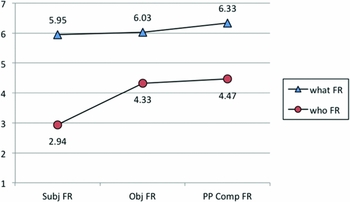
Our results confirmed that sentences containing who FRs are universally rated significantly lower than structurally similar examples with what FRs. Further, the results showed that this reduced acceptability is sensitive to the grammatical position of the FR within the matrix clause. The overall average acceptability of sentences with who FRs in object position (e.g. The young woman kissed who she met at the party) is 4.33 (out of 7), significantly lower than the average rating of 6.03 for sentences with what FRs in this position (t = 8.41, df = 270.5, p < 0.001). Similarly, who FRs acting as PP complements (e.g. The young woman danced with who she met at the party) are rated significantly lower than what FR equivalents: 4.47 (who) vs. 6.33 (what) (t = 10.24, df = 240.8, p < 0.001). Further, as we suspected, who FRs in subject position (e.g. Who the young woman met at the party kissed her on the way home) are deemed to be particularly unacceptable by native speakers, with an average acceptability of only 2.94, significantly lower than the average acceptability for who FRs in object or PP complement position (t = 8.06, df = 322.5, p < 0.001). There is no corresponding reduction in acceptability for what FRs in subject position, with an average acceptability of 5.95.Footnote 2
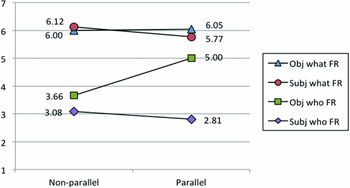
With respect to the effect of syntactic parallelism between the matrix and FR clauses, we found that for who FRs in object position the acceptability is improved if the gap within the FR clause is also in object position (e.g. The young woman kissed [who she met __] at the party), compared to cases of object who FRs without such parallelism, that is, where the gap is in subject position in the FR (e.g. The young woman kissed [who __ met her] at the party). This difference in acceptability is significant: 5.00 (parallel) vs. 3.66 (non-parallel) (t = 4.37, df = 145.8, p < 0.001). However, when who FRs are in subject position in the matrix clause, the position of the gap does not make a difference. We compared parallel cases with the gap also in subject position (e.g. [Who _ met the young woman at the party] kissed her on the way home) and non-parallel cases, for which the gap is in object position (e.g. [Who the young woman met _ at the party] kissed her on the way home). The difference in average acceptability is not statistically significant: 2.81 (parallel) vs. 3.08 (non-parallel) (t = 0.97, df = 143.4, p = 0.33). We interpret this result to mean that subject position who FRs are crashingly bad, that is, they are deprecated below a minimal level of acceptability. The ameliorating effect of the structural parallelism that tends to improve the acceptability of object who FRs does not have a corresponding impact on the acceptability of subject who FRs. With respect to what FRs, we found that the effect of parallelism makes no significant difference in acceptability either for object what FRs: 6.05 (parallel) vs. 6.00 (non-parallel) (t = 0.23, df = 144.8, p = 0.82), or subject what FRs: 5.77 (parallel) vs. 6.12 (non-parallel) (t = 1.45, df = 140.2, p = 0.15).
To recap, our findings confirm the two puzzling facts set out in the introduction. First, who FRs are always judged significantly less acceptable than what FRs, and second, the degree of unacceptability of who FRs can vary.Footnote 3 In particular, acceptability improves if (i) the who FR occurs as the direct object or PP complement rather than in subject position of the matrix clause (see figure 1);Footnote 4 and (ii) the gap in the relative clause is also in object position (see figure 2).
Position of FR in matrix clause

Effect of syntactic parallelism

3 Why the puzzle is puzzling
In this section we discuss why we think the puzzle cannot be solved by (what we know of) current theories of syntax, semantics and processing. We do not aim to show that it is logically impossible for any theory of syntax, semantics or processing to account for our puzzle. Instead, we simply illustrate the difficulty in envisioning a principled account of the puzzle within syntax, semantics or processing that does not rely on stipulations or ad hoc assumptions.
3.1 Syntactic accounts
Who and what FRs do not seem to exhibit any syntactic difference that would correlate with the puzzling asymmetry we have discussed. The few cases of who FRs that do approach acceptability (e.g. The young woman kissed who she met at the party) are distributionally similar to what FRs, in that they always appear in argument position in a sentence, including the complement of a preposition, but never as an adjunct. From a clause-internal perspective, who and what FRs are structurally identical. They exhibit the same word order, with the wh-word in clause-initial position, licensing a DP gap in an argument position. Neither who nor what can be followed by the complementizer that, i.e. both wh-clauses look like FRs rather than headed relatives (e.g. The young woman kissed who (*that) she met at the party, The young woman bought what (*that) she found at the store). Both wh-words who and what constitute a wh-phrase by themselves without a complement or any other material (e.g. The young woman kissed who (*person) she met at the party, The young woman bought what (*umbrella) she found at the store). This is unlike the behavior of wh-words like which or whose, which must be followed at least by a nominal if used out of the blue. These wh-words can never introduce FRs. On the other hand, all the other wh-words introducing FRs in English besides who and what cannot form complex wh-phrases either (e.g. I went where (*place) you went, I left when (*time) you left, I did it how (*quickly) you did it). Consequently, on these grounds, it would be hard to find – absent stipulations – a principled syntactic explanation for the reduced acceptability of who FRs compared to their what counterparts.
It is true that who can be used as a relative pronoun in headed relative clauses (e.g. I saw the guy who likes you), while what cannot (e.g. *I saw the table what you bought), and it is tempting to leverage this asymmetry in order to try to explain the cause of the degradation of FRs introduced by who. However, such an attempt would almost certainly fail, given the observation that the wh-word where can act as a relative pronoun as well (e.g. We just had dinner at the restaurant where you ate last night) and the FRs introduced by this wh-word are perfectly acceptable (e.g. I went where you went).
In summary, then, although at first blush a syntactic explanation for the puzzle may seem plausible, we cannot find an obvious path that does not fairly quickly run up against some intransigent roadblocks.
3.2 Semantic accounts
Similarly, we have not been able to find an independently motivated explanation for our puzzle based upon the compositional semantics of FRs. What FRs and who FRs undergo the same semantic derivation, following Caponigro (Reference Caponigro2003, Reference Caponigro and Young2004). The denotation of a standard FR is the maximal entity of the set of entities satisfying some property indicated by the predicate in the relative clause, and the contribution of the wh-word in the FR is that of a set restrictor: the wh-word applies to the set of entities denoted by the IP within the relative clause, and returns a subset of these entities determined by the nature of the wh-word (i.e. what returns the subset of inanimate entities; who returns the subset of human entities). The only difference, then, between the denotations of who and what FRs is the human/inanimate distinction of the entities in the set. It would be stipulative to simply assert that the semantic composition above is blocked just in case the entities in the given set happen to be human, rather than inanimate entities. As such, we do not see how there can be a compositional semantic explanation for the degradation of who FRs in English.
More fundamentally, though, the prospects of a purely semantic explanation for the asymmetry are dim given the productive use of who FRs cross-linguistically. If an explanation for the unacceptability of who FRs in English relies on contrasts between the semantics of who and what (and assuming that these generalizations are based on universal semantic principles and are not language-specific) then we would predict that who FRs would not be found in any language. However, we have already shown in (5a–c) that many languages with FRs freely allow for the equivalents of who FRs.
3.3 Processing accounts
Next we consider how feasible a processing account would be for explaining the asymmetry. Uncontroversially, FRs may be harder to process in general than simple noun phrases, given their complex syntactic structure, the filler–gap dependency, the introduction of additional discourse referents and, in some cases, non-canonical word order. This additional processing load might be thought of a contributing factor in the reduced acceptability of who FRs. Further, with respect to the even more greatly reduced acceptability of subject who FRs, one might wish to appeal to the fact that complex sentence subjects are generally costly to working memory and represent a processing bottleneck (Kluender Reference Kluender2004). However, one can quickly notice that these two factors do not have the same deleterious effect on the acceptability of fully headed relative clauses (even in subject position), nor do they explain why what FRs are not equally degraded. To find an orthogonal processing explanation for the who/what contrast, one would need to pursue an explanation based on the animacy of the referents of the referring expressions in the sentence. One possibility might be that relative clauses containing two human discourse referents are more difficult to process, owing to the marked nature of having a direct object that refers to a human rather than a more typical inanimate referent in the thematic role of patient. In such cases, potentially there is a temporary ambiguity at the level of discourse (meaning that either referent could be the agent acting upon the other), requiring an appeal to the syntax to disambiguate, and thus additional processing demands on the parser. However, it is not at all clear that this would be sufficient to account for the general large contrast in acceptability we see between who and what FRs, and again we quickly run into the intractable issue of the cross-linguistic data, which would be incorrectly predicted by this theory.
Another possible processing explanation for the reduced acceptability of subject versus object who FRs might be the former's temporary surface similarity to interrogative clauses. A subject who FR (e.g. Who met the young woman at the party. . .) can very naturally be parsed as an interrogative until the matrix predicate is encountered, at which time a reinterpretation is forced. The significant propensity for such garden-pathing, given the relative frequency of interrogatives in the language, may serve to strongly disfavor subject who FRs. For object who FRs, on the other hand, since a matrix predicate selecting for an individual-denoting object would automatically trigger the expectation for its wh-clause complement to be an FR and would exclude its analysis as an interrogative clause. But again, this line of argumentation is quickly derailed when one considers that subject what FRs – as well as subject who FRs in Spanish and Italian – are not deprecated for this same reason. Consequently, a processing account along these lines does not look promising.
A processing explanation, however, might be able to account for the contrast we see between the parallel and non-parallel conditions for who FRs. Recall the contrast in acceptability between (i) The young woman kissed who she met at the party, and (ii) The young woman kissed who met her at the party. For the parallel cases, the gap inside the FR and the relative clause itself are both in object position with respect to the verb in their clause. Moreover, the discourse referent is consistently a thematic patient in the two clauses. This contrasts with the non-parallel cases, in which a single discourse referent is both a thematic agent and a thematic patient within the scope of the same sentence. Possibly, the difficulty of simultaneously assigning incompatible syntactic and thematic roles to a single constituent accounts for the increased processing difficulty for the non-parallel cases. There is some evidence for this to be found in the processing literature. For example, Sheldon (Reference Sheldon1974) proposed the Parallel Function Hypothesis to account for why subject gap relative clauses modifying subject NPs and object gap relative clauses modifying direct objects NPs were acquired sooner and are easier to process than the non-parallel cases. The additional burden of processing of headed relatives clauses that are not in parallel configuration with the matrix clause would naturally carry over to the FR cases. This line of argument may go towards accounting for the relatively higher acceptability of object who FRs with an object gap, compared to object who FRs with a subject gap. The parallelism would not be expected to have a comparable effect on object what FRs with object versus subject gaps, since both of these are already deemed to be fully acceptable. However, a further explanation would still be needed for why such parallelism does not ameliorate the acceptability of subject who FRs with a subject gap. Maybe this is because they are already below a minimum threshold level of acceptability below which no rescue is available.
To sum up, in this section we provided several arguments supporting the view that our puzzle cannot receive a straightforward principled account within current syntactic, semantic or processing approaches.
4 Broader considerations and conclusion
In this squib, we have presented evidence of a puzzling asymmetry between the acceptability of what FRs and the degraded status and restricted distribution of who FRs in English. We have also argued that it is not trivial to imagine a plain, independently motivated, syntactic, semantic or processing explanation for the asymmetry.
Taking a broader perspective, we believe that the puzzle of who FRs in English provides insight into the more general cross-linguistic process by which languages have extended the function of the wh-words in the lexicon from interrogatives to other functions such as free relatives, relative pronouns in headed relative clauses, exclamatives, indefinites, polarity items and so on. This is a fairly robust phenomenon across languages, and so there must be something inherent in the meaning of wh-words that allows for it. However, not every language uses its wh-words for all of these functions, and even for the functions where it does, the subset of wh-words employed can vary. In other words, different wh-words behave differently with respect to the same construction in a language, and also behave differently across languages. Indeed, in the case of FRs there is clear evidence that not all languages with this construction automatically allow them with every wh-word. An asymmetry between who and what FRs is attested in Italian and Spanish as well, except that in those languages the exact reverse is true: while who FRs are fully productive, what FRs are not allowed, and speakers must instead make use of a headed relative clause construction with a light head, as in (6a) and (6b) respectively. The picture is further enriched by German, which does allow for both who FRs, as in (5c) above, and what FRs, as in (6c) below.
-
(6)

The extension of the use of wh-words from interrogatives into a newer construction like a free relative thus appears to result from at least two different mechanisms: some general grammatically driven strategy imposing syntactic and semantic constraints, and some form of lexical licensing that allows specific wh-words to participate in the more general mechanism. For instance, whenever a wh-word is used in an FR, it always occurs in clause-initial position and licenses a gap. Semantically, it behaves like a non-quantificational expression, contributing to build the meaning of a definite description (Caponigro Reference Caponigro2003, Reference Caponigro and Young2004). These are all general features that occur stably in FRs within a language and across languages. Still, within this general strategy, the extension of the use of a specific wh-word has to be licensed by an individual language on a case-by-case basis, as our puzzling asymmetry for English and the cross-linguistic data we just discussed shows.
Lexical licensing may depend on many factors, including diachronic ones. For instance, a very preliminary non-systematic look at the occurrence of who FRs vs. what FRs in the history of English seems to show that while the what FRs we are familiar with today are attested early on, who FRs appear much more rarely, replaced, instead, with constructions that look like light headed relatives (introduced by he who or he that) or correlatives (with a resumptive pronoun in the matrix clause). The availability of competing forms may have served to inhibit the new construction from taking hold in the language. With this in mind, it is possible that a satisfactory explanation for the puzzling phenomenon of the limited distribution of who FRs in contemporary English may only be available after taking account of the state of the language at the time when this construction first began to emerge. We leave such a detailed diachronic investigation to future research.
In conclusion, we believe that the asymmetry between who FRs and what FRs in English we have discussed in this article is a non-trivial puzzle whose solution may require bringing together syntax, semantics, processing, historical development and cross-linguistic investigation.
Appendix: Experimental design and stimuli
The experiment manipulated three conditions: (i) the type of the FR (who, what); (ii) the syntactic position of the FR clause in the matrix (subject, object, PP complement); and (iii) whether the syntactic position of the gap within the FR matches the syntactic position that the FR takes in the matrix clause. For this last factor, the two conditions were parallel (i.e. Subject–Subject and Object–Object/PP Complement), and non-parallel (i.e. Subject–Object/PP Complement and Object–Subject). The experiment included three test items for each condition, resulting in a total of 36 experimental items. The stimuli were informally matched for length and plausibility. However, formal norming studies to determine these effects, or the effects of the frequencies of the lexical items used in the stimuli, were not carried out. A list of the stimuli in each condition is shown below.
Object who FR, parallel
-
1. The young woman kissed who she met at the party
-
2. The skilled sniper hit who he was targeting
-
3. The music teacher married who he dated at college
Object what FR, parallel
-
4. The librarian ate what he cooked that morning
-
5. The fitness buff bought what he had seen on TV
-
6. The booklover read what she had purchased that morning
Object who FR, non-parallel
-
7. The young woman kissed who met her at the party
-
8. The angry teenager hit who insulted him
-
9. The music teacher married who dated him at college
Object what FR, non-parallel
-
10. The hungry mailman ate what looked good to him
-
11. The antique collector bought what appealed to her
-
12. The college professor read what interested her
PP comp who FR, parallel
-
13. The young woman danced with who she met at the party
-
14. The tourist took a picture of who he saw in the plaza
-
15. The sales manager flirted with who he recently hired
PP comp what FR, parallel
-
16. The artist looked at what he had just painted
-
17. The journalist took a picture of what he saw in the subway
-
18. The executive dealt with what he previously ignored
PP comp who FR, non-parallel
-
19. The young woman danced with who met her at the party
-
20. The concert pianist took a picture of who had sent her flowers
-
21. The new employee flirted with who had recently hired him
PP comp what FR, non-parallel
-
22. The security guard looked at what had surprised him
-
23. The social worker took a picture of what was concerning her
-
24. The waiter was pleased with what happened to him
Subject who FR, non-parallel
-
25. Who the young woman met at the party kissed her on the way home
-
26. Who the angry teenager insulted at the party hit him back
-
27. Who the music teacher dated in college married her yesterday
Subject what FR, non-parallel
-
28. What the timid girl scout heard scared her
-
29. What the locker room attendant saw embarrassed him
-
30. What the shareholder heard at the meeting annoyed him
Subject who FR, parallel
-
31. Who met the young woman at the party kissed her on the way home
-
32. Who insulted the angry teenager at the party hit him afterwards
-
33. Who dated the music teacher in college married him yesterday
Subject what FR, parallel
-
34. What excited the horror film fan also scared him a little
-
35. What embarrassed the freshman student also titillated her a little
-
36. What annoyed the impatient worker also depressed her
Related stimuli were created containing whoever and whatever FRs in place of the plain FR counterparts in the sentences above, as were stimulus sentences containing full relative clauses headed by the nominals person, man, girl, thing, etc, as appropriate. An equal number of unrelated filler sentences were included in the study (around one-third of which were uncontroversially grammatical simple clauses, one-third were ungrammatical due to word order violations and one-third were created to be of marginal acceptability, with referents not meeting the selectional restrictions in the subcategorizations of the predicates). The experimental and filler items were divided and counterbalanced into four lists.