I. INTRODUCTION
Carbon nanotubes (CNTs) have been regarded as promising functional materials for nearly 20 years due to their excellent thermal, electrical, and mechanical properties.Reference Jorio, Dresselhaus and Dresselhaus1 Recently, large-scale industrial production of multiwalled CNTs became available at relatively low cost, significantly accelerating interest in potential applications of these CNTs. Thus far, most practical applications of these bulk-manufactured CNTs have been for mechanical strengthening and antistatic coating.2 Although there have been many investigations of CNTs as electrode materials for electrochemical energy storage such as lithium-ion batteries (LIBs) and supercapacitors in the past decades,Reference Landi, Ganter, Cress, DiLeo and Raffaelle3–Reference Shaijumon and Ramaprabhu10 those CNTs were all synthesized at the laboratory scale of multiple grams, permitting high levels of quality control of crystal structure, diameter, purity, and dispersibility and facilitating optimization of performance. Because these synthesis conditions differ markedly from those industrially to produce CNTs in quantities of tens of tons, it is necessary to reinvestigate industrially produced CNTs to determine their potential usefulness as electrode materials for electrochemical energy storage.
Alloying anode materials such as metallic tin (Sn) are very attractive for next-generation LIB in comparison with present commercial graphite anodes because of their high theoretical capacities (e.g., 991 mAh/g for Sn versus 372 mAh/g for graphite).Reference Zhang and Morse11 However, the large volume change of Sn during its reversible alloying/dealloying with Li causes Sn to pulverize and finally lose mechanical and electrical contact with the bulk electrode.Reference Winter and Besenhard12–Reference Li, Martin and Scrosati14 As a result, the cyclability of Sn anodes alone is very poor. Numerous strategies have been proposed to address the problem, including the fabrication of composites in which Sn is incorporated within a resilient matrix to buffer its large volume change,Reference Hassoun, Derrien, Panero and Scrosati15–Reference Kim, Blomgren and Kumta19 the reduction of particle size of Sn to the nanometer scale,Reference Yang, Wachtler, Winter and Besenhard20, Reference Zhang, Hu, Guo, Zheng, Zhong, Song and Wan21 and the utilization of Sn-based intermetallic compoundsReference Wachtler, Besenhard and Winter22–Reference Hassoun, Panero, Simon, Taberna and Scrosati24 or oxides.Reference Lou, Wang, Yuan, Lee and Archer25–Reference Han, Jang, Kim, Oh and Hyeon28 One example of successful application of these strategies is the updated “Nexelion” LIB (3.5 Ah, 18,650 size) released recently by Sony (Tokyo, Japan),29 wherein Sn–Co amorphous alloys are homogeneously mixed with a conductive carbon matrix.
In previous work,Reference Zhang and Morse11 we adapted a bioinspired, kinetically controlled synthesis method to grow Sn nanoparticles in situ within a compliant and conductive matrix of graphite, and the resulted composite (Sn@graphite) as an anode for LIB demonstrated excellent electrochemical performance with stable cyclability. Here, we describe the application of this method to large-scale, industrially produced CNTs to synthesize a Sn@CNTs composite, in which Sn nanoparticles are highly dispersed in the CNTs matrix. Following carbon coating to improve electrochemical cyclic performance, the Sn@CNTs composite displays much higher capacity, initial Coulombic efficiency, and rate capability than the pristine CNTs, when evaluated as anode materials for LIB.
II. EXPERIMENTAL
A. Sample preparation
Industrially produced multiwalled CNTs (0.2 g Baytubes C 150 HP; Bayer MaterialScience, Leverkusen, Germany) were first added to an aqueous solution of tin chloride (SnCl2; 150 mL, 0.013 M), and the solution was then sonicated for 30 min using a high-power ultrasonicator (Qsonica S-4000, Newton, CT) to produce a homogeneous suspension. This suspension was transferred to an open container in a sealed chamber, with an aqueous solution of ammonia (2 wt%) placed in another separate, open container. At room temperature, the ammonia vapor gradually diffused into the precursor suspension while the latter was stirred magnetically, driving the hydrolysis of SnCl2. After 1 h, the suspension was removed from the sealed chamber and filtered. The collected product was washed with deionized water and further dried at 110 °C in air. The dried product was subsequently subjected to an in-situ carbothermal reduction ( )Reference Zhang and Morse11 in a tube furnace at 700 °C under N2/H2 (5% by volume) for 30 min, wherein the CNTs acted as the in-situ reducing agent. The final composite is denoted as Sn@CNTs.
To obtain a surface-modified Sn@CNTs composite, the dried product described above (before carbothermal reduction) was first mixed with a polyvinyl alcohol (PVA; 0.25 g, fully hydrolyzed) powder (Sigma-Aldrich, St. Louis, MO) in water (10 mL). After stirring for 3 h, the mixture was evaporated and then subjected to carbothermal reduction. To thermally decompose PVA to a surface carbon coating, carbothermal reduction this time was performed at 900 °C under N2/H2 (5% by volume) for 60 min. In this way, the reactions of carbothermal reduction and thermal decomposition were performed in one step in the tube furnace.
B. Characterization and electrochemical measurements
Samples were characterized by scanning electron microscopy (SEM; FEI XL30 Sirion, Hillsboro, OR), transmission electron microscopy (TEM) (200 kV; FEI Tecnai G2, Hillsboro, OR), x-ray diffraction (XRD) (Philips X’Pert MPD with Cu Kα radiation, Eindhoven, Netherlands), and Brunauer–Emmett–Teller (BET) specific surface area measurements (TriStar 3000; Micromeritics, Norcross, GA). The content of Sn in the composite was determined by thermogravimetric analysis (Mettler Toledo 851e instrument, Columbus, OH) as described by Wang et al.Reference Wang, He, Ren, Jiang and Wan30
The electrochemical performance of samples as anode materials for LIB was measured in half-cells, which were assembled in an Ar-filled glove box (Mbraun Unilab, with H2O and O2 levels at <1 ppm) with a working electrode, a lithium foil counter electrode, and a porous polypropylene separator. The working electrode was prepared by coating a slurry of active material (85 wt%), carbon black (5 wt%), and poly(vinylidene fluoride) binder (10 wt%) dissolved in N-methyl pyrolidine onto a copper (Cu) foil, and then drying in vacuum at 120 °C for 12 h. This electrode was then cut into sheets with an area of 0.64 cm2 and compressed under a pressure of 11 MPa. The electrolyte was 1 M LiPF6 in a mixture of ethylene carbonate and dimethyl carbonate (1:1 by weight). The cells were galvanostatically charged/discharged (using a BT2000 battery tester from Arbin Instruments, College Station, TX) at 40 mA/g between 0.005 and 2.0 V versus Li+/Li.
III. RESULTS AND DISCUSSION
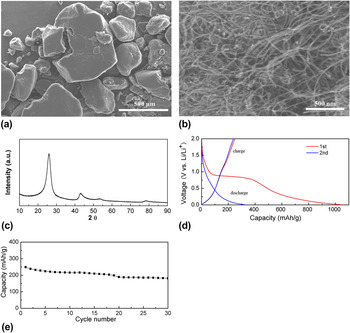
A typical SEM image of the pristine multiwalled CNTs is shown in Fig. 1(a), revealing the highly agglomerated feature (several hundred micrometers in size) that is common in the large-scale industrial production.2 From the zoom-in image in Fig. 1(b), it can be seen that the average diameter of the tangled CNTs is ∼20 nm. Broad diffraction peaks in the XRD pattern [Fig. 1(c)] indicate that the CNTs have nongraphitic structure, similar to that of small-scale, laboratory samples described previously.Reference Wang, Wang, Chang and Zhang8, Reference Shaijumon and Ramaprabhu10Figure 1(d) displays voltage profiles of the CNTs for the first two cycles, and it can be clearly seen that there is a very large irreversible capacity at the first cycle of charge/discharge, revealing a low initial Coulombic efficiency of 23%. This can be attributed to the formation of an extensive solid electrolyte interphase (SEI) on the surface of the CNTs (BET area, 136.3 m2/g), as confirmed by the long voltage plateau at ∼0.85 V which is the “fingerprint” of a SEI layer. Electrochemical cyclic performance of the CNTs is shown in Fig. 1(e), wherein the reversible capacity degrades gradually from 248 mAh/g at the first cycle to 182 mAh/g at the 30th cycle. Based on these electrochemical performance measurements, it can be concluded that modification of the CNTs would be required for efficient performance as electrode material for LIB; the large irreversible capacity loss must be reduced; and the reversible capacity must be improved.
(a, b) Scanning electron microscopy (SEM) images, (c) x-ray diffraction (XRD) pattern, (d) voltage profiles (for the first two cycles), and (e) electrochemical cyclic performance of the pristine carbon nanotubes (CNTs).

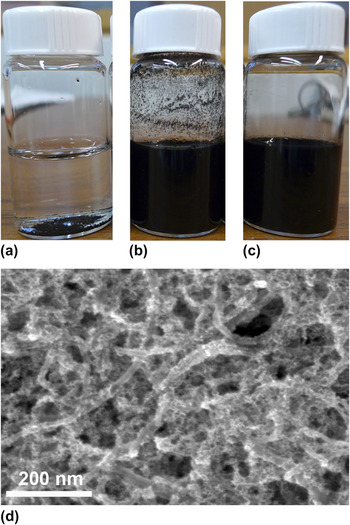
To modify the CNTs by loading alloying anode materials such as Sn particles that enable larger reversible capacity, two methods conventionally can be used: (i) mechanical mixing with Sn, e.g., by ball millingReference Wang, Ahn, Lindsay, Sun, Bradhurst, Dou and Liu31 and (ii) chemical synthesis of Sn, e.g., by first loading a Sn precursor and then chemically converting this to Sn.Reference Lee, Zhang and Liu32–Reference Veeraraghavan, Durairajan, Haran, Popov and Guidotti34 As we discussed in a previous work,Reference Zhang and Morse11 mechanical mixing extensively degrades the crystal structure of the matrix and the loaded particles. For this reason, we chose in-situ chemical synthesis, using the kinetically controlled, vapor diffusion method previously shown to be effective in the synthesis of a wide range of nanostructured oxides, phosphates, and composites.Reference Zhang and Morse11, Reference Schwenzer, Roth, Gomm, Murr and Morse35–Reference Kisailus, Schwenzer, Gomm, Weaver and Morse37 For this purpose, we first dispersed the agglomerated and tangled CNTs in solution. Figure 2(a) shows that the industrially produced CNTs initially exhibit poor dispersion in water, accumulating primarily at the bottom of the vial. After high-power ultrasonication, dispersion is improved, but many large agglomerated particles remain on the wall of the vial, as seen in Fig. 2(b). In contrast, we found that aqueous solution of SnCl2, a tin precursor used for our vapor diffusion synthesis, produced good dispersion after ultrasonication [see Fig. 2(c)]. We found that this effect is due to the partial hydrolysis of SnCl2 during the high-power ultrasonication; this produces hydrolyzed nanoparticles [<10 nm; see Fig. 2(d)] that cover the surfaces of the CNTs and thus prevent their reagglomeration in the solution.
(a)–(c) Photographs showing dispersion of the industrially produced CNTs: (a) in water before ultrasonication; (b) in water after ultrasonication; (c) in the aqueous solution of tin chloride after ultrasonication; (d) SEM image of the dispersed material shown in (c).

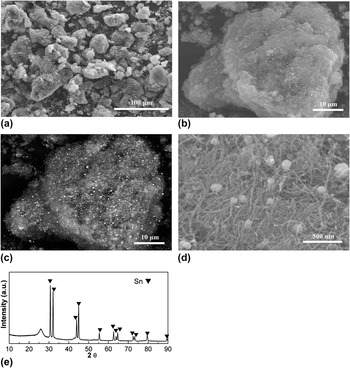
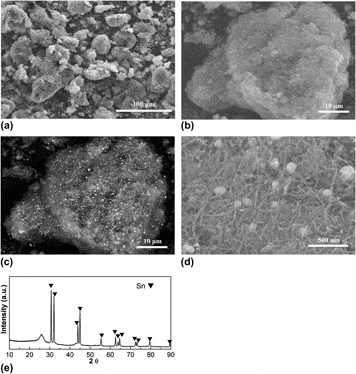
Using the dispersion solution shown in Fig. 2(c) as a precursor, we performed the vapor diffusion reaction in a sealed chamber to further drive the hydrolysis of SnCl2 and increase the loading of hydrolysis product. After filtering and drying, the mixture of the hydrolysis product and the CNTs was subjected to carbothermal reduction, in which the CNTs act as in-situ reductant and the hydrolysis product is converted to metallic Sn particles. Figures 3(a)–3(d) show SEM images of the final Sn@CNTs composite (∼49 wt% Sn). In comparison with the pristine CNTs, this composite has a smaller particle size (∼50 μm on average). This is because of the ultrasonic dispersion that broke up the initial, large agglomerates. From the backscattered electron image of Fig. 3(c), it can be seen that Sn particles of ∼200 nm (bright spots) are homogeneously dispersed throughout the matrix of the CNTs. However, the zoom-in image [see Fig. 3(d)] shows that the Sn particles are not compactly surrounded and enclosed by the CNTs; the poor electrochemical cyclic performance (cf. below) of the composite at this stage of preparation can be attributed to this imperfect interfacial contact. Figure 3(e) exhibits the XRD pattern of the Sn@CNTs composite, revealing that the Sn particles are highly crystalline after carbothermal reduction. Characterization of this composite by SEM and XRD confirms that the vapor diffusion synthesis combined with in-situ carbothermal reduction is effective in growing well-dispersed, crystalline Sn particles in the matrix of the industrial CNTs.

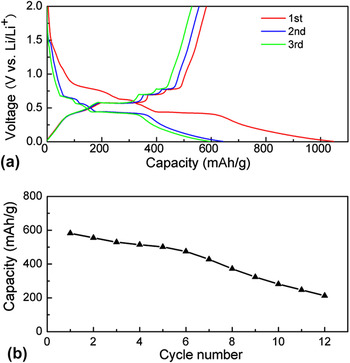
Figure 4(a) displays voltage profiles of the Sn@CNTs composite for the first three cycles of charge/discharge. It can be seen that these profiles are significantly different from those of the pristine CNTs [see Fig. 1(d)], with multiple, additional voltage plateaus that correspond to the electrochemical alloying/dealloying of Li–Sn ( ).Reference Zhang and Morse11 The reversible capacity of the composite at the first cycle is improved to 582 mAh/g in comparison with 248 mAh/g of the pristine CNTs but this capacity quickly fades to 213 mAh/g after 12 cycles, as seen in Fig. 4(b). The reason for this can be ascribed to the relatively poor interfacial contact and enclosure of the Sn particles by the CNTs [see Fig. 3(d)], which thus cannot adequately restrain the large volume change of Sn particles during cycling. We concluded, therefore, that further modification of the Sn@CNTs composite is necessary to overcome this poor cyclability.
Electrochemical performance of the Sn@CNTs composite: (a) voltage profiles for the first three cycles of charge/discharge; (b) cyclability at 40 mA/g.

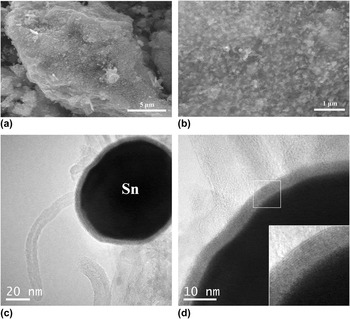
Surface coating of electrode materials (both cathode and anode) by a layer of disordered carbon is a well-known and extensively adopted approach in the electrochemical community to improve the electrical conductivity of internal core materials, to protect the core materials from directly contacting with electrolytes, and/or to accommodate their large volume changes.Reference Zhang, Li, Liu and Cheng38–Reference Zhang, Liu, Li, Bai, Liu, Tan and Cheng40 Therefore, we prepared the surface-modified Sn@CNTs composite (∼38 wt% Sn) as described in “Experimental” section, and Figs. 5(a) and 5(b) exhibit their SEM images. From the zoom-in image [Fig. 5(b)], we can see that the interface between the Sn particles and the CNTs in the surface-modified composite differs significantly from that for the composite lacking the surface coating of carbon [cf. Fig. 3(d)]. Voids between the two components without carbon coating are apparently filled with PVA-derived carbon (∼22 wt%) in the surface-modified composite. More importantly, TEM characterization [see Figs. 5(c) and 5(d)] indicates that the Sn particles are uniformly coated by a layer of the PVA-derived carbon (3–4 nm in thickness), and the lattice fringes of graphenes in the PVA-derived carbon can be observed in the magnified inset of Fig. 5(d). We believe that this coating layer helps accommodate the large volume change of Sn particles upon lithiation and delithiation, contributing to the improved electrochemical performance observed (cf. below).
(a, b) SEM images and (c, d) transmission electron microscopy images of the surface-modified Sn@CNTs composite; the inset in (d) is the magnified image of the rectangular area.

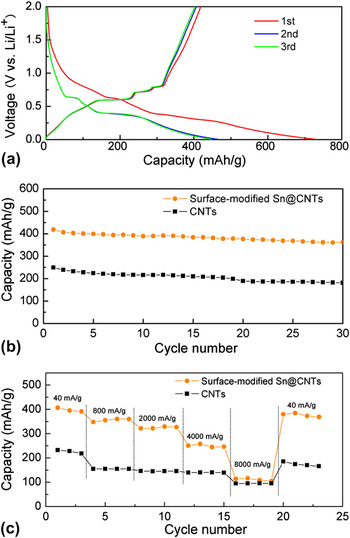
Voltage profiles of the surface-modified Sn@CNTs for the first three cycles of charge/discharge are shown in Fig. 6(a), wherein the multiple voltage plateaus corresponding to the electrochemical alloying/dealloying of Li–Sn are still distinguishable. Furthermore, it can be seen that the irreversible capacity loss at the first cycle is reduced, suggesting an increased Coulombic efficiency of 57% for the modified composite in contrast with 23% for the pristine CNTs. Figure 6(b) displays the electrochemical cyclic performance of this modified composite. Although its reversible capacity (418 mAh/g) at the first cycle is lower than that (582 mAh/g) of the unmodified Sn@CNTs composite above, its cyclability is significantly improved. The surface-modified composite retains a capacity of 362 mAh/g at the 30th cycle, which is much higher than those of the pristine CNTs (182 mAh/g at the 30th cycle) and the unmodified Sn@CNTs composite (213 mAh/g at the 12th cycle) and also is better than current state-of-the-art graphite anodes (350 mAh/g). In addition, the rate capability of the surface-modified Sn@CNTs is also better than that of the pristine CNTs, as shown in Fig. 6(c). At the current density of 2000 mA/g, the surface-modified Sn@CNTs still has a reversible capacity of 320 mAh/g, more than two times higher than 145 mAh/g of the pristine CNTs and also higher than the 250 mAh/g of conventional graphite anodes. The enhanced capacity of the surface-modified Sn@CNTs at large current densities can be ascribed to the contribution of Sn particles. Although we have greatly improved electrochemical performance of the pristine CNTs by both loading Sn and performing surface modification, it needs to be pointed out that practical application of the surface-modified Sn@CNTs as anodes for LIB requires optimization to further increase its initial Coulombic efficiency and long-term cyclic stability. The commercially used, state-of-the-art graphite anodes typically exhibit an initial Coulombic efficiency of >85% and a capacity retention of >90% after 50 cycles.

IV. CONCLUSIONS
In summary, using the vapor diffusion synthesis followed by in-situ carbothermal reduction, we homogeneously grew Sn particles (∼200 nm) at high loading in a matrix of industrially produced, agglomerated CNTs to obtain a Sn@CNTs composite, and we prepared a corresponding surface-modified Sn@CNTs composite with a thin layer of carbon coating (3–4 nm). Electrochemical performance measurements indicate that the surface-modified Sn@CNTs composite has much higher reversible capacity (418 versus 248 mAh/g at the first cycle), initial Coulombic efficiency (57 versus 23%), and rate capacity (320 versus 145 mAh/g at the current density of 2000 mA/g) than the pristine CNTs. Although the results have not been fully optimized, they demonstrate the potential usefulness of our modification method for the fabrication of high-performance CNTs-based composite anode materials for LIB.
ACKNOWLEDGMENTS
This work was supported by grants from the U.S. Department of Energy, Office of Science (Grant No. DE-SC0001009, to University of California, Santa Barbara (UCSB’s) Center for Energy Efficient Materials, an Energy Frontiers Research Center, for the support of H-L. Zhang, and Grant No. DE-FG02-02ER46006 for support of D.E. Morse) and the U.S. Army Research Office (through contract no. W911NF-09-D-0001 to the Institute for Collaborative Biotechnologies). We gratefully acknowledge the use of facilities of UCSB’s Materials Research Laboratory (supported by the Materials Research Science and Engineering Center Program of the National Science Foundation under Award No. DMR05-20415) and the California NanoSystems Institute. We thank David Loren and Joseph Ventura of Bayer MaterialScience for the gift of the Baytubes CNTs to our laboratory at UCSB.