Introduction
Securing the airway is a crucial stage of trauma care. The American College of Surgeons’ (Chicago, Illinois USA) Advanced Trauma Life Support (ATLS) considers assessment and establishment of airway as the first priority of the treatment of a trauma patient.1 The most commonly performed procedures to secure and/or re-establish an airway are endotracheal intubation (ETI), supraglottic airway establishment (such as laryngeal mask), and cricothyroidotomy (CRIC). Whilst ETI is considered to be the first option for definitive airway as advised by the Advanced Cardiac Life Support (ACLS) and the Prehospital Trauma Life Support (PHTLS) guidelines,1,2 emergency CRIC has long been judged as the salvage procedure to establish a patent airway in life-threatening cases in which the patient cannot be intubated or ventilated. This could be the result of complicated patient anatomy, excessive blood or secretions in the mouth or nose, massive facial trauma, or airway obstruction resulting from angioedema, trauma, burns, or a foreign body obstructing the airway.1 It also holds an important role in the Tactical Combat Casualty Care (TCCC) guidelines.Reference Otten, Montgomery and Butler3 Although not being the first choice for airway management in most scenarios, CRIC has several advantages over ETI. It is easier to learnReference You-Ten, Bould, Friedman, Riem, Sydor and Boet4 and requires less training to master.Reference Wong, Prabhu, Coloma, Imasogie and Chung5 However, the success rates of CRIC performance in the prehospital setting differ between different studies and can fluctuate from 68%Reference Mabry6 to very high success rates reaching 89%-100%.Reference McGill, Clinton and Ruiz7–Reference Bair, Panacek, Wisner, Bales and Sakles9 In comparison, prehospital ETI misplacement rates range from 4% to 26%.Reference Adams, Cuniowski, Muck and De Lorenzo10 Yet, this procedure is not flawless. Its most common complications include incorrect execution of the procedure, resulting in the injury of cartilaginous structures with failure to obtain an airway,Reference Langvad, Hyldmo, Nakstad, Vist and Sandberg11 and bleeding. Furthermore, austere environments influence success rates with battlefield treatment,Reference Mabry6 and CRIC performance by air-medical transport services tend to have a lower success rate.Reference Bair, Panacek, Wisner, Bales and Sakles9
While several studies before have reported the success rates of this procedure,Reference Bair, Panacek, Wisner, Bales and Sakles9,Reference Adams, Cuniowski, Muck and De Lorenzo10,Reference Schauer, Bellamy, Mabry and Bebarta12 both in the civilian and the military surrounding, none have assessed CRIC performance, success rate, and the influence of associated factors at the point-of-injury. The Israel Defense Forces (IDF)-Trauma Registry (IDF-TR) records data on every casualty treated by the IDF’s point-of-injury care givers.
This study aimed to review the IDF experience with CRIC over the past two decades.
Methods
Study Design
This retrospective, registry-based study was approved by the Israel Defense Forces Medical Corps (IDF-MC; Ramat Gan, Israel) institutional review board (No. 2014-1948). The manuscript was written and edited according to the STROBE statement.Reference von Elm, Altman and Egger13
Airway Management in the IDF
According to IDF-MC clinical practice guidelines (CPGs), only Advanced Life Support (ALS) providers (physicians and paramedics) can establish a definitive airway by either ETI or CRIC.Reference Tsur, Nadler and Tsur14 The indications for a definitive airway include on-going airway obstruction, suspected impending airway obstruction, and/or apnea, which does not respond to manual ventilation.
The default definitive airway is oral ETI. Primary CRIC is performed when intubation is deemed by the provider unlikely to succeed in cases of severe facial injury and emergency CRIC when two intubation attempts have failed. Overall, ALS providers have three decision points: (1) Should they attempt to establish a definitive airway at all? If yes, (2) Should they attempt it by ETI or by primary CRIC? If ETI fails, (3) Should they attempt another ETI, CRIC, or conservative means (eg, bag valve mask, oxygen mask, or jaw thrust). It is worth mentioning that the IDF’s prehospital protocols do not include supraglottic airway placement. This modality is only in use by anesthesiologists serving in the Airborne Combat Rescue and Evacuation Unit.Reference Shavit, Aviram, Hoffmann, Biton and Glassberg15
For the entire studied time period, the IDF had been using a single commercial kit: PORTEX Cuffed Blue Line Ultra Suctionaid (Smiths Medical, Inc.; Minneapolis, Minnesota USA) with a tube size of 6.0mm and tube length of 64.5mm. The kit includes the PORTEX tube, sterile alcohol pads, disposable #10 scalpel, 10cc syringe, securement rope, and sterile forceps. This kit does not include bougie or tracheal hook, but care providers carry a bougie to use at their discretion. The IDF’s ALS providers are trained according to the preferred technique taught by the ATLS16 using the scalpel technique. The IDF’s physicians and paramedics receive basic training using manikins at the IDF Military Medical School and are required to go to timely refresher training several times a year.
Study Population
The study included all casualties (both military and non-military) recorded in the IDF-TR from the years 1998 through 2018 in whom CRIC was attempted. No exclusion criteria were set. The number of cases in the registry during the study period determined the sample size.
The IDF Trauma Registry
The IDF-TR is a prehospital military trauma registry containing data on all trauma casualties (civilian or military) cared for by military medical teams since 1997 as part of the Trauma and Combat Medicine Branch (TCMB) in the IDF-MC.Reference Tsur, Nadler and Lipsky17 During the treatment, the teams fill out a casualty card, which was previously described.Reference Elon and Baruch18 Within 72 hours of completing treatment, the teams complete a debrief and enter casualty and treatment data into a digital web-based trauma registry. In case the casualty is or has been serving in the military, the registry automatically completes additional demographic data regarding the casualty. A dedicated staff of the TCMB in the IDF’s Surgeon General’s Headquarters validates the accuracy and completeness of data. Inconsistencies or ambiguities are resolved directly with the treating medical team.
Variables
Data extracted from the IDF-TR included: the incident characteristics – military or civilian; casualties’ demographics – age, gender, and citizenship; casualty urgency; mechanisms of injury (MOI); injured body regions; provider’s profession; the number of ETI attempts; success in ETI; the presence of a CRIC attempt; success in CRIC; other life-saving interventions (LSIs) performed; and casualty death. Success in procedure performance was determined and documented by the care provider. A successful attempt was subjectively reported if establishment of the airway was achieved, and if not stated explicitly, was considered as a failure.
The MOI was grouped into two main categories: (1) blunt injuries; and 2) penetrating injuries, including gun-shot wounds and shrapnel injuries. Injuries could be inflicted by combined mechanisms. The providers reported the primary mechanism.
Injured body regions were grouped into the head, neck, torso, pelvis, upper extremities, and lower extremities. Casualties could sustain injuries in multiple body regions. The LSIs were defined according to IDF-MC CPGs to include ETI,Reference Katzenell, Lipsky and Abramovich19 CRIC, needle thoracostomy, chest tube thoracostomy, application of tourniquets and hemostatic dressing,Reference Shina, Lipsky and Nadler20 use of crystalloids, tranexamic acid,Reference Nadler, Gendler, Benov, Strugo, Abramovich and Glassberg21,Reference Lipsky, Abramovich and Nadler22 reconstituted freeze-dried plasma,Reference Nadler, Mozer-Glassberg, Gaines, Glassberg and Chen23 and blood products.
Data Analysis
Data analysis was performed using R version 3.6.0 (R Core Team; Vienna, Austria). Categorical variables were compared using the Fisher’s-exact test; statistical significance was defined by P value ≤.05.
Trial Registration
This registry-based study was approved by the IDF-MC institutional review board (No. 2014-1948).
Results
General Findings
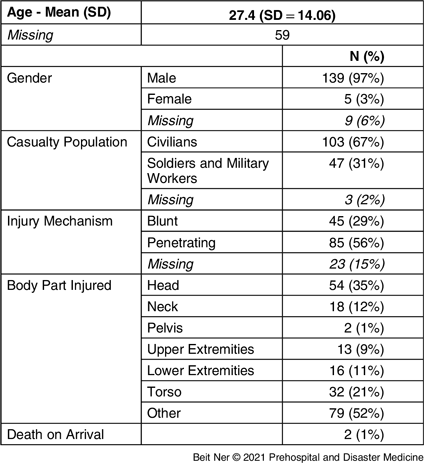
From the years 1998 through 2018, the IDF-TR recorded data regarding 17,702 casualties. Overall, management included the performance of CRIC to 153 of the cases (0.9%). Table 1 summarizes the patients’ demographics and characteristics. Most of the patients were males (96.5%) with a mean age of 27.4 (SD = 14.05) years.
Demographics of Casualties and Pattern of Injury, N = 153

MOI and Body Part Involvement
The most common MOI was penetrating trauma, accounting for 85 (56%) casualties, followed by blunt trauma in 45 (29%) cases (Table 1).
Patients who suffered head injuries accounted for 35% of the CRIC cases, followed by neck and torso injuries, which accounted for 12% and 21% of the cases, respectively. Two CRICs (1%) were performed in patients with no vital signs on the scene (documented as dead-on-arrival) as a salvage procedure (Table 1).
CRIC Performance Analysis
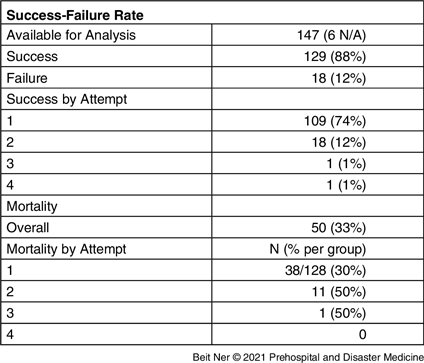
Overall Success Rate—The overall success rate of CRIC was reported at 88%, with 86% of success in patients who underwent only one or two attempts (Table 2). Only three patients underwent more than two attempts.
Cricothyroidotomy Performance Analysis, N = 153

Success Rate Across Providers—A total of 81 CRICs were performed by physicians, while paramedics performed 49 of the procedures, accounting for 51% and 33% of the data. Documentation of care provider was missing in 17 of the cases (12%). Success rates were similar at near 88%.
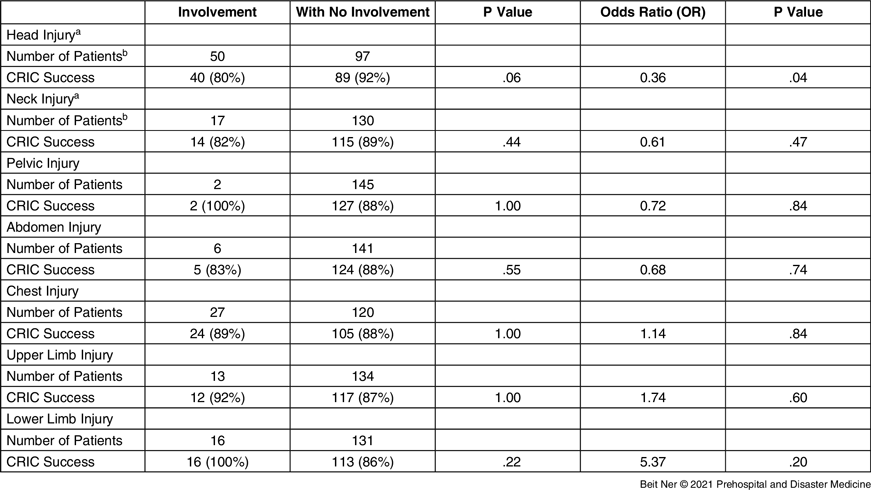
Success Rate According to Injured Body Regions—The CRIC success rates for casualties with and without head trauma were 80% (40/50) and 92% (89/97); P = .06. Odds Ratios for CRIC success in patients suffering of head trauma was 0.36; P = .04. For casualties with neck involvement were 82% (14/17) compared to 89% (115/130) for patients without neck involvement (P = .41). Odds Ratio was 0.61; P = .47. Out of all the cases, only five cases suffered from combined head and neck injuries, and of these, three had successful CRIC, one failed, and for the fifth casualty, data were missing. Chest, abdomen, and extremities involvement did not affect the success rate of CRIC (Table 3).
Effect of Different Body Regions Involvement on Success Rate, N = 153b

Abbreviation: CRIC, cricothyroidotomy.
a Combined head and neck injuries were not analyzed separately. In five casualties, a combined injury was documented.
b Data on body part involvement were unavailable for six casualties.
Mortality—The overall mortality was 33% (50/153) in this cohort, as shown in Table 2. Mortality rates were 48% (12/25) for two or more CRIC attempts (P = .07; Table 2).
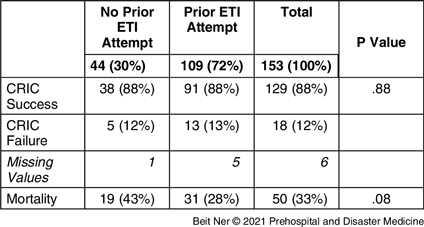
Effect of Prior ETI Attempt on the Success of CRIC Performance and Mortality—An ETI attempt was reported for 109 of the cases (71%) before CRIC. Successful CRIC was documented in 91 (88%) casualties that underwent prior ETI attempts (Table 4). In casualties in which CRIC was chosen as the first option for definitive airway, CRIC was reported to be successful in 38 (88%; P = .88). Mortality rates were 28% and 43% for casualties with and without ETI attempt before CRIC, respectively (P = .08). Odds Ratio for mortality after failed ETI was found to be 0.52 (P = .08).
Effect of Prior ETI Attempt on Success of CRIC Performance and Mortality

Abbreviations: CRIC, cricothyroidotomy; ETI, endotracheal intubation.
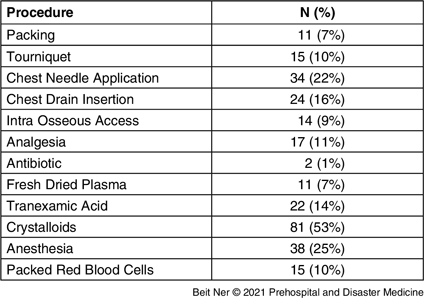
Adjuncts Interventions to Airway Establishment—Table 5 summarizes the LSIs performed on patients receiving CRIC. Chest interventions including needle application and chest drain insertion were reported in 34 (22%) and 24 patients (16%), respectively; the use of fluids, blood-derived products, and other LSI are further detailed in Table 5.
Adjuncts Interventions to Airway Establishment, N = 153a

a Each casualty could be treated and undergo more than one adjuncts intervention.
Discussion
This study aimed to describe the IDF experience of CRIC performance at the point-of-injury. The current study found an overall high success rate of 88%. The success rate was comparable between physicians and paramedics (Table 2). This is one of the largest case series assessing CRIC performance in the prehospital setting.Reference Lockey, Crewdson, Weaver and Davies24
In 109 of the cases (71%), a prior ETI attempt was reported. Prior ETI attempts did not affect the success rate of CRIC (Table 4). Mortality was lower among casualties in which prior ETI attempt was made (28% versus 43%). One explanation for the latter may be a worse presentation, necessitating CRIC for an emergency airway establishment without first attempting ETI. These findings also showed that the contribution of more than two attempts did not add to the overall success of this procedure, which in turn might imply that no more than two attempts should be made. This in turn led to the deduction that no more than two attempts should be made at CRIC, and in the case of two failed attempts, manual ventilation using bag valve mask should be a suitable alternative, enabling adequate oxygenation. This high success rate was also consistent at 88%, whether or not prior attempts of ETI were performed (P = .88). The success rate seemed to decrease slightly only when head trauma was involved (80% versus 92% in non-head injuries; P = .06), and even then, was higher than respective ETI success rates. However, this finding did not reach statistical significance.
As mentioned earlier, CRIC is an infrequently performed procedure and, in many cases, considered as a salvage procedure after failed ETI (with some exceptional scenarios, such as severe facial trauma). In a previously published study by the IDF, out of 5,553 casualties recorded in the IDF-TR, 487 (9%) underwent an initial ETI attempt for a compromised airway.Reference Katzenell, Lipsky and Abramovich19 Of the 406 casualties for whom full data were available and were included in their analysis, 46 had underwent CRIC attempt after failed ETI attempt. Even though they did not address CRICs that were performed as primary option, they reported that CRIC procedures then were performed in one percent of all cases, which is similar to reports of other armies.Reference Schauer, Bellamy, Mabry and Bebarta12
For the given period, physicians performed more CRICs compared to paramedics with similar success rates. Paramedics were introduced in IDF field units at the beginning of 2000. Furthermore, success rates weren’t influenced by the scenario comparing military to non-military events.
As mentioned earlier, head and neck involvement showed a trend for reduced success rate (Table 3). However, data of the severity of these injuries were not extracted, nor the reported Glasgow Comma Scale or Injury Severity Score. This in turn limits the validity and reliability of these findings. Despite being one of the largest case series assessing CRIC performance, the current study identified only five cases of patients who suffered from combined head and neck injuries. This finding can have several explanations. First, full assessment of the IDF-TR for head and neck casualties may reveal higher numbers of ETI rate with high success rate as ETI is the primary method to secure the airway in trauma patients. On the other hand, most head and neck injuries are not severe and do not necessitate airway management. This in turn should prompt further assessment of the focus that is given to the indication during training. Furthermore, of the 18 failed CRIC patients, seven were reported to undergo a successful ETI attempt after the failed CRIC attempt. Unfortunately, data for the other 11 cases were not complete and should be further assessed. While it was not possible to collect data on the subsequent management following the failed CRIC, a possible option is that patients were manually ventilated by bag valve mask, suggesting an incorrect clinical judgement in CRIC performance.
Generally, CRIC is an easy to learn procedure,Reference You-Ten, Bould, Friedman, Riem, Sydor and Boet4 it requires less training than ETI, with success rates as high as 89% to 100% when performed in hospitals.Reference McGill, Clinton and Ruiz7–Reference Bair, Panacek, Wisner, Bales and Sakles9 Even in the hands of inexperienced operators, CRIC was found to be safe and was accomplished within an adequate time.Reference Helm, Hossfeld, Jost, Lampl and Böckers25 However, the prehospital environment seems to be more challenging. That seems to be more accurate in the deployed military settings where CRIC tends to have a lower success rate. Mabry, et alReference Mabry6 reported success rates of 68%; however, more than 60% of the procedures were performed by medics at the point-of-injury, who showed higher failure rates of 33% compared to 15% when these procedures were performed by physicians and physician assistants. In the IDF, the frontline advanced care providers are trained to perform ETI and CRIC. These mainly consist of primary physicians and paramedics with one year of training, both of which can be considered as inexperienced providers when it comes to surgical intervention such as CRIC. Nevertheless, these data suggest high success rates, similar to those reported by Mabry on the procedures that were performed by advanced care providers. The United States’ army reports suggest that CRIC rates in the deployed military setting are double those in civilian trauma.Reference Mabry6,Reference Schauer, Bellamy, Mabry and Bebarta12 However, Barnard, et alReference Barnard, Ervin, Mabry and Bebarta26 showed that of the 24 patients on which CRIC was performed, only six (25%) of the procedures were performed by combat medics on the battlefield while 18 (75%) were done by flight teams. This might imply that care givers in the field still try to avoid performing this life-saving procedure, despite the theoretical advantages and high success rates.
Comparing it to prior reports of 84% in a civilian in-hospital surrounding, the current similar high success rate of 88%, despite battlefield conditions, may be explained in part by the casualties’ characteristics compared to that of the civilian population. Technical issues, such as identification of the cricothyroid membrane, are easier in thin patients, and even though body mass index (BMI) is not recorded at the point-of-injury, it is likely that the majority of the population of 96% young males did not suffer from obesity nor major chronic comorbidities compared to reported obesity (BMI>30) in 40% of the cases in the civilian series.Reference Cook, Woodall and Frerk27
Commonly, CRIC is poorly tolerated by awake patients and necessitates the use of local anesthesia. As mentioned in Table 5, 38 of the patients received systemic sedation or anesthesia. Unfortunately, sufficient information is lacking to identify how many of the other casualties were unconscious as a result of their injury, and how many of them underwent the procedure while conscious. Since a local anesthesia agent is supplied as a part of the kit, the use of local anesthesia prior to the procedure is often not reported. This in turn limits the ability to report its use.
Limitations
This study has several other limitations. First, it is a retrospective, descriptive, registry-based study, and as such, is dependent on the ALS providers’ reports. Second, not all reports were fully completed; some data were missing, which may have lead to selection bias, potentially affecting the results and analysis. Third, over the course of 20 years, the report format has changed. Furthermore, since its establishment in 1997, the IDF-TR underwent several changes which lead to major improvement in the quantity and then in the quality of point-of-injury documentation. The most substantial change was introduced in 2013. Up until 2013, the digital documentation of the data was made by data abstractors of the research section of the TCMB who obtained data retrospectively from the available sources, including casualty cards that were filled by care givers. Since 2013, the care giver at the point-of-injury is obligated to add the data directly to the web-based interface during the first 72 hours after the incidence. This in turn may lead to some inconsistencies in reports and definitions of the concomitant injuries. Lastly, Injury Severity Score and long-term outcomes including complications were not available.
Despite these limitations, this study showed high success rates, which are consistent throughout different levels of training, prior ETI attempt, and body part involvement for most injuries.
Conclusion
Despite the natural drawbacks of a retrospective descriptive study like this, these findings showed that CRIC is of merit in airway management as it has shown to have consistently high success rates throughout different levels of training, injuries, and previous ETI attempts with an overall success rate of 88%. Care providers should be encouraged to retain and develop this skill as part of their tool box.
Conflicts of interest/funding
The authors declare that they have no competing interests. This research received no specific grant from any funding agency in the public, commercial, or not-for-profit sectors.