

INTRODUCTION
There is a growing literature interpreting and analyzing the central hypothesis of Friedrich A. Hayek’s The Road to Serfdom (TRTS). While Hayek dedicated TRTS ([1944] Reference Hayek2007, p. 36) “To Socialists of All Parties,” there has been a relatively limited scholarly focus on interpreting and analyzing the hypotheses put forth by the socialist scholars with whom he was intellectually engaging. Peter Boettke (Reference Boettke1995, Reference Boettke, D’Amico and Martin2020), Bruce Caldwell (Reference Caldwell1997, Reference Caldwell, Hayek and Caldwell2007), Ben Jackson (Reference Jackson2010, Reference Jackson2012a), and Lawrence White (Reference White2012, ch. 6), however, offer some notable exceptions. A better understanding of the arguments of the socialist thinkers of Hayek’s time could provide crucial context for properly interpreting his arguments in TRTS (Lavoie Reference Lavoie1991). While previous works have advanced our understanding of TRTS by contextualizing it within the historical and intellectual context of its time (Boettke Reference Boettke1995, Reference Boettke, D’Amico and Martin2020; Boettke and Candela Reference Boettke and Candela2017; Caldwell Reference Caldwell1997, Reference Caldwell2004, Reference Caldwell, Hayek and Caldwell2007, Reference Caldwell2010; Epstein Reference Epstein1999; Farrant and McPhail Reference Farrant and McPhail2009, Reference Farrant and McPhail2010a, Reference Farrant and McPhail2010b, Reference Farrant and McPhail2011a, Reference Farrant and McPhail2011b, Reference Farrant and McPhail2012; Jackson Reference Jackson2010, Reference Jackson2012a; Jones Reference Jones2002; White Reference White2012, ch. 6), this paper broadens the scope of these works by identifying the central hypotheses posited by prominent socialist thinkers, especially economists, with whom Hayek sought to engage in TRTS.
According to Hayek ([1944] Reference Hayek2007, p. 39), TRTS originated “in many discussions” he had with “friends and colleagues whose sympathies had been inclined toward the left.”Footnote 1 While TRTS was not specifically written to engage their ideas on a technical level (Caldwell Reference Caldwell, Hayek and Caldwell2007, pp. 18–31), Stuart Chase, Henry Dickinson, Hugh Dalton, Evan Durbin, Oskar Lange, Harold Laski, Abba Lerner, Barbara Wootton, and the authors of the essays in Findlay MacKenzie’s Planned Society (Reference MacKenzie1937) undoubtedly were among the most distinguished socialist scholars of their era, frequently engaging in both technical and popular discourse, precisely during the period when Hayek wrote TRTS.
Hayek was intimately familiar with the work of these notable socialist scholars. For instance, in TRTS ([1944] Reference Hayek2007, p. 124), he referred to Stuart Chase as “one of the most prominent economic planners.” In his 1940 article published in Economica, titled “Socialist Calculation: The Competitive ‘Solution,’” Hayek engaged directly with Henry Dickinson’s (Reference Dickinson1939) influential work, Economics of Socialism. Moreover, not only were Dalton, Durbin, Laski, and Wootton colleagues of Hayek’s at the London School of Economics (Caldwell Reference Caldwell, Hayek and Caldwell2007, p. 8; Jackson Reference Jackson2012b, p. 57; Wootton Reference Wootton1945, p. v),Footnote 2 but Hayek also extensively addressed Oskar Lange’s work within the context of his own technical publications surrounding the socialist calculation debate (Hayek Reference Hayek1940, Reference Hayek1945; Caldwell Reference Caldwell2004, pp. 217–220). Furthermore, Abba Lerner was a student of Hayek’s at the London School of Economics (Lerner Reference Lerner1944, p. viii), and Findlay MacKenzie (Reference MacKenzie1937) authored an edited volume of essays on socialism, which Hayek (Reference Hayek1938) reviewed in Economica. In TRTS, Hayek described MacKenzie’s edited volume as “the most comprehensive collective studies on planning” (Hayek [1944] Reference Hayek2007, p. 163).
We contextualize Hayek’s arguments in TRTS by considering two central hypotheses advanced by these socialist intellectuals. The first hypothesis posited that capitalism was inevitably moving towards industrial concentration. The second hypothesis was that government ownership of key sectors of the economy, at the very minimum, was necessary to safeguard democracy against the dangers associated with industrial concentration. While the central hypothesis of Hayek’s TRTS has received considerable scrutiny (Durbin Reference Durbin1945; Alves and Meadowcroft Reference Alves and Meadowcroft2014; McInnes Reference McInnes1998; Merriam Reference Merriam1946; Samuelson Reference Samuelson2008; Shapiro Reference Shapiro2001; Stigler Reference Stigler1988; Wootton Reference Wootton1945), the writing of socialist scholars contemporaneous with Hayek have received relatively limited scholarly examination. A noteworthy observation is that many of these socialist thinkers championed the idea of state ownership or control of key industries as a first-step measure aimed at mitigating resistance on the path toward full state ownership or control of the means of production.
While many prominent liberal intellectuals expressed concern about the relationship between socialism and totalitarianism (Cassel Reference Cassel and MacKenzie1937; Chamberlin Reference Chamberlin1937; Jewkes Reference Jewkes1948; Knight Reference Knight1938; Lippmann Reference Lippman1938), we find that this concern was also widely shared by the socialist thinkers Hayek was engaging in TRTS. The socialist scholars were concerned about conflict emerging from irreconcilable interests, and thus, the totalitarian threat stemming from the use of concentrated power necessary to impose a central plan. Several socialists, such as Lange and Lerner (Reference Lange and Lerner1944), Wootton (Reference Wootton1945), and Herman Finer (Reference Finer1945), advocated for modified forms of socialism, such as market socialism, where the state limited its ownership of the means of production to key industries or centrally planned the economy through directives issued to private owners of capital, explicitly in order to preserve private ownership of the means of production as an institution necessary to protect democratic freedom.
The context of TRTS can be re-examined through the lens of these hypotheses advanced by socialist thinkers who were contemporaries of Hayek. In TRTS, Hayek rejected the first hypothesis put forth by socialist scholars that capitalism had an inevitable trajectory toward industrial concentration. The second hypothesis of the socialist scholars, that government ownership or control of key industries was necessary to protect democracy, was openly advanced by many of these socialist thinkers as a requisite first step that would, favorably in their eyes, lead down a “slippery slope” towards complete ownership of the means of production. In TRTS, Hayek rejected the hypothesis that capitalism would inevitably undermine democracy due to industrial concentration. In his central hypothesis, Hayek built upon the concerns he shared with some socialist thinkers regarding the threat that central planning represented to democracy. We argue that Hayek’s primary purpose in TRTS was to posit a formal hypothesis of the specific mechanisms through which democracy would be undermined under socialism.Footnote 3
The remainder of this paper proceeds as follows. In section II we highlight the two central hypotheses advanced by socialist thinkers that Hayek endeavored to engage within TRTS. Section III expounds upon the apprehensions expressed by socialist thinkers, focusing on their concerns about the likelihood of social conflict and the potential misuse of central planning, which could jeopardize democratic freedoms. Section IV re-evaluates Hayek’s arguments in TRTS in light of the socialist thinkers’ hypotheses. Section V offers our concluding remarks.
II. THE SOCIALIST HYPOTHESES
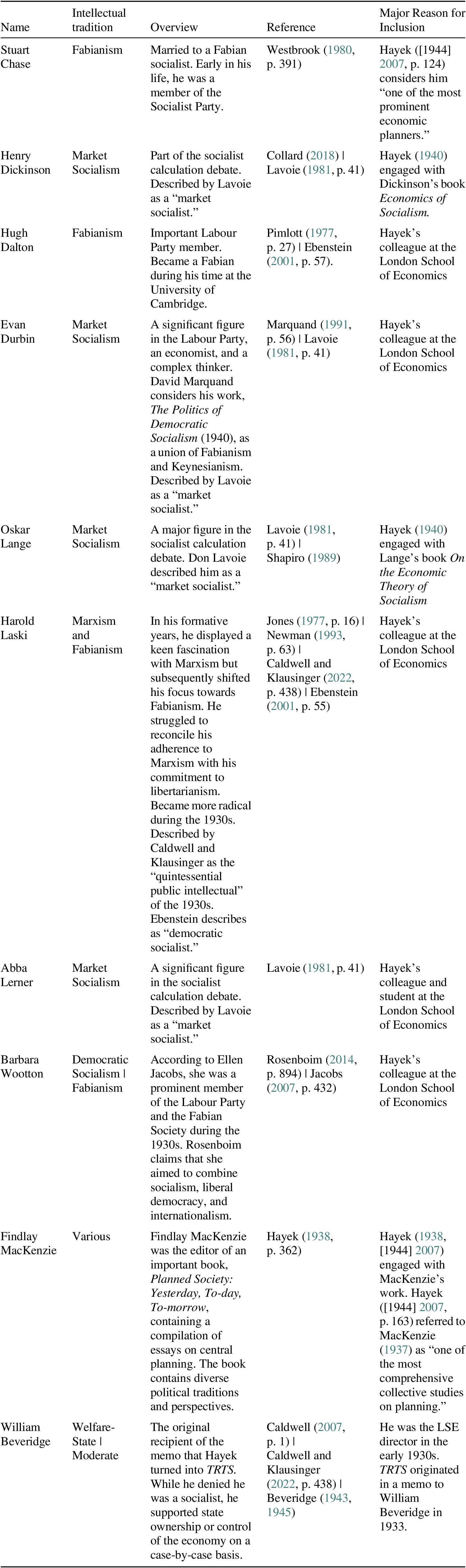
In this section, we identify two hypotheses advanced by leading socialists, including Stuart Chase, Henry Dickinson, Hugh Dalton, Evan Durbin, Oskar Lange, Harold Laski, Abba Lerner, Barbara Wootton, and the authors of the essays in Findlay MacKenzie’s Planned Society (Reference MacKenzie1937), that were made in their critiques of capitalism and defenses of market socialism. First, they hypothesized that industrial concentration was inevitable under capitalism. Second, they hypothesized that government ownership of key industries was a minimum necessary restraint to protect democratic institutions from capitalism. In this paper, we focus on those socialist intellectuals who Hayek primarily engaged in TRTS and his other works, and thus were likely part of the “socialists of all parties” to whom he dedicated the book. This includes a special emphasis on the socialists who were Hayek’s colleagues at the London School of Economics (Ebenstein Reference Ebenstein2001, ch. 6).Footnote 4 Table 1 lists each of the primary socialist intellectuals we analyze and briefly summarizes our justification for their inclusion.
Critics of CapitalismFootnote 6

It is important to point out that we are using the term “socialism” in the context of Hayek’s thought, and it requires some clarification. First, there are numerous variations of socialist views with their own individual intellectual heritage. The only similar feature connecting all these thinkers is the belief in central planning through state control or partial or full ownership of the means of production (Benzecry, Jensen, and Smith Reference Benzecry, Jensen and Smith2024; Giffiths Reference Griffiths1924; Rappaport Reference Rappoport1924, p. 40; Ritschel Reference Ritschel1997, ch. 1). Second, the people whom Hayek believed to be socialists were not necessarily on the left of the political spectrum but shared an overall optimistic attitude towards government control or ownership of the means of production (Ritschel Reference Ritschel1997, ch. 1). An example is his disagreement with the University of Chicago Press regarding the title of TRTS. The University of Chicago Press wanted the title to be “Socialism: The Road to Serfdom,” but both Fritz Machlup (who was handling many of the negotiations) and Hayek resisted, on the grounds that central planning could be undertaken by either the left or right: after all, that was why the dedication was to socialist of all parties” (Caldwell and Klausinger Reference Caldwell and Klausinger2022, p. 525). Third, it is common for intellectuals to change their thinking during their lives, and by no means do we claim that such characterization is a static representation of their overall intellectual tradition. However, in the historical context of when Hayek wrote TRTS, these intellectuals were associated with the views highlighted in Table 1 and held an optimistic view toward government control or ownership of the economy.
William Beveridge may be the best representative of the fluidity of ideas. He engaged with Hayek in the early 1930s in a discussion about National Socialism and whether it was “the last gasp of capitalism” or just a variation of socialism (Caldwell and Klausinger Reference Caldwell and Klausinger2022, p. 438). Although Beveridge supported socialism early on (Harris Reference Harris1977, p. 89), he gradually retreated from the position because, while he supported a certain degree of state ownership of the economy, he fell short of supporting complete state ownership of the economy (Beveridge Reference Beveridge1945).Footnote 5 On a case-by-case basis, he advocated for “public monopoly ownership in certain fields” and “private enterprise subject to public control in other fields” (Beveridge Reference Beveridge1943). In the Daily Herald Michael Foot (Reference Foot1944) describes Beveridge as having adopted “part of the Socialist diagnosis of the ills of our society without having the wisdom to adopt the full Socialist remedy.” Hayek considered Beveridge, as the recipient of Hayek’s initial memo that became TRTS, to be part of the “socialists of all parties.”
The Inevitability of Industrial Concentration under Capitalism
The primary concern among socialist thinkers regarding capitalism, namely its perceived inevitability to lead to industrial concentration (Lange and Lerner Reference Lange and Lerner1944), can be traced back to Karl Marx (Durbin Reference Durbin1940, p. 83; Sau Reference Sau1979).Footnote 7 The argument was based on the belief that industrial concentration would give rise to economic power, which would then translate into political power, thereby posing a threat to democratic institutions. For instance, Dickinson (Reference Dickinson1939, pp. 230–231) writes, “So long as the private ownership of land and capital and the private organization of business enterprise for profit continue, the purpose of ‘planning’ is bound to be not the satisfactions of human needs but the preservation of the existing vested interest of rent, interest, and profit receivers.” In a similar vein, Dalton (Reference Dalton1935, pp. 31–32) contends, “Political democracy, moreover, in a regime of capitalism and great social inequality, is only half-alive. Political forms are twisted by economic forces. Citizens, legally equal, wield unequal power. Political democracy will only be fully alive when married to economic democracy.”
Lange (Reference Lange1937) held that attempts at using regulation to prevent industrial concentration would fail. Anticipating public choice arguments regarding lobbying and regulatory capture (Stigler Reference Stigler1971; Tullock Reference Tullock1967; Peltzman Reference Peltzman1976, Reference Peltzman2022; Yandle Reference Yandle2022), he argued that regulation would fail due to the immense lobbying power of concentrated industries. Lange (Reference Lange1937, pp. 131–132n4), for instance, states, “The best lobbyist becomes the most successful business leader.” Lange and Lerner (Reference Lange and Lerner1944, p. 60) argue:
Each group strives to protect itself from the encroachment of others by restricting entry into the market, or to increase its share and influence through monopolization and exclusion of other groups. Capitalists want to protect their investments, producers their markets, small traders and professionals their business, workers and salary earners their jobs. Business opportunities are protected through combination and collusion, through restriction upon entry, and other means.
Ultimately, according to Lange and Lerner (Reference Lange and Lerner1944, p. 60), “In the universal scramble for special protection and special privileges the free market goes down,” creating industrial concentration that will undermine the “economic foundations of democracy.”Footnote 8
A similar concern was echoed by other socialist thinkers, including Clement Attlee (Reference Attlee1937, ch. 6), Dickinson (Reference Dickinson1939, p. 4), Durbin (Reference Durbin1940, pp. 100, 135–137; 1945, p. 366), Sidney Hook (Reference Hook and MacKenzie1937a, pp. 665, 668), Laski (Reference Laski1933, p. 27), and Kemper Simpson (Reference Simpson1941, p. 10).Footnote 9 For instance, somewhat akin to Lange and Lerner (Reference Lange and Lerner1944), Durbin (Reference Durbin1940, pp. 135–136) posits that the system of free enterprise is progressively giving way to a new system of “State-organized, private-property, monopoly capitalism”:
Freedom of enterprise is rapidly ceasing to exist. Whatever party is in power, the area of the economy brought, whether for good or for ill, within the supervision and control of the State is steadily and relentlessly increased. Freedom of enterprise is not only withering spontaneously away, but it is also being deliberately, consciously and carefully destroyed amid popular acclamation. In its place is appearing an ever-thickening jungle of uncoordinated government control, whose main purpose is restriction, and whose chief fruit is the substitution of monopoly for competition.Footnote 10
Durbin (Reference Durbin1940, pp. 88–89) argued that this transition was inevitable. In his view, the shift from freedom of enterprise to monopoly capitalism was an inherent and unstoppable development. Durbin (Reference Durbin1940, p. 88) identifies several factors that make the transition to monopoly capitalism inevitable, including “the rise in the standard of living, the extent of insecurity of economic life, and the degree of inequality in the distribution of wealth,” and “the invention of money and credit and … joint stock enterprise.” His perspective suggests that rigid social dynamics made redirection unlikely.
Wootton (Reference Wootton1945, p. 12; also see p. 129) notes that concern about the concentration of special interests was the primary reason that most socialists held that government must own the means of production. In fact, even the Liberal Party in Britian saw monopolization as “inevitable” in its defense of its middle way planning (Ritschel Reference Ritschel1997, pp. 42–43). Wootton (Reference Wootton1945), however, in contrast to the prevailing viewpoint among most socialist thinkers, asserts that the challenge of special-interest group lobbying could be effectively addressed within a centrally planned system that included directives for private owners of the means of production.
The Inevitability of Industrial Concentration under Capitalism
A considerable number of socialist thinkers believed that industrial concentration was inevitable, and that governmental regulatory efforts were bound to fail. Thus, policymakers faced a stark choice: either relinquish endeavors to regulate industry, thereby accepting the concentration within capitalism and the consequent erosion of democracy, or opt to nationalize key economic sectors prone to such concentration. As Dickinson (Reference Dickinson1939, p. 233) writes, “political freedom as understood by the nineteenth century liberals—is impossible under capitalism.” Consequently, many of the socialist scholars Hayek was addressing in TRTS saw government ownership of those key industries susceptible to concentration as a legitimate way to preserve democracy (Attlee Reference Attlee1937, ch. 6; Chase Reference Chase1935, chs. 13–14; Durbin Reference Durbin1935, p. 382; Durbin Reference Durbin1940, pp. 135, 147; Lange and Lerner Reference Lange and Lerner1944, pp. 55–56; Lange and Taylor Reference Lange, Taylor and Lippencott1938, p. 120; Laski Reference Laski1933; MacKenzie Reference MacKenzie1937, p. vii).Footnote 11
Laski (Reference Laski1923, p. 203) unequivocally articulated this challenging policy dilemma confronting politicians, asserting that “the problem of capitalist democracy can … only be solved either by the supersession of capitalism or by the suppression of democracy.” For Laski (Reference Laski1923, p. 126), “Clearly, there is therefore implicit in the private ownership of the means of production a basic antagonism between the interests of capital and labour.” Similar to Laski (Reference Laski1923), Hook (Reference Hook and MacKenzie1937a, pp. 668–669) rejected the possibility of directive-based central planning, arguing that, where power is concentrated in trusts and cartels, “there can be no planning of the national economy in its totality under capitalism, because of the absence of homogeneous social interest.”
Many of these socialist scholars saw state ownership or control of key industries as the necessary first step in a gradual transition to full state ownership or control of the means of production.Footnote 12 As Gustav Cassel (Reference Cassel1928, p. 179) observed, “Socialists of the Western world want to proceed with certain moderation and carry out their program piecemeal.”Footnote 13 Socialism’s gradual implementation was seen as a political necessity to reduce resistance to the program (Durbin Reference Durbin1985, p. 60). Durbin (Reference Durbin1935), an advocate for democratic socialism, argues that achieving socialism through “peaceful means” (p. 382) must involve taking steps that include “the socialisation of a number of basic industries” (p. 383) and the financial sector, in order to “not provoke the opponents of Socialism to appeal to force or frighten them into an uncontrollable financial panic” (p. 382). A slow transition, as detailed in Hugh Dalton’s (Reference Dalton1935) Practical Socialism for Britain, while “repugnant to the Right, could not press them to the point of armed revolt” (Durbin Reference Durbin1935, p. 385).Footnote 14
Furthermore, Dalton (Reference Dalton1935, p. 93) proposed, “Socialists hold that public ownership and control should replace private ownership and control over a steadily increasing part of the economic field.” Like Durbin (Reference Durbin1935), Dalton (Reference Dalton1935) defends a gradual progression toward socialism. Dalton (Reference Dalton1935) proceeds to offer a plan for expanding planning in stages: “As the number of these socialised enterprises grows, there must be a plan for their relations to one another, including, in particular, some machinery for determining the prices at which they sell their products to one another and to other purchasers. This machinery can, I think, best be supplied through the Supreme Economic Authority” (p. 310). Similarly, Wootton (Reference Wootton1945, pp. 128–129), in her defense of advocating for socialist planning with private ownership of the means of production, recognized, “The smoothest path towards social ownership of industry is along the road of the demonstrated failure of private enterprise.… The roughest possible road, calculated to arouse the bitterest opposition and to minimize disinterested support, is a comprehensive program of socialization for its own sake.” Angelo Solomon Rappoport’s (Reference Rappoport1924, p. 116) Dictionary of Socialism’s definition of state socialism corroborates this view, noting “the Socialist doctrine which demands State intervention with a view to changing the capitalist into a collective regime. This is to be effected by gradually nationalizing the means of production, especially the big enterprises, such as railways, mines, banks, tramways, factories, etc.” The dictionary stressed that true socialists considered partial state ownership of the means of production to be “half-measures” (p. 117). Dan Giffiths’s (Reference Griffiths1924, p. x) What is Socialism?, while acknowledging a wide range of definitions, argues that there is fundamental agreement on the need for “the social ownership and control of the resources of life” (italics in original).
The major political parties, including the Tory, Liberal, and Labour, all adopted forms of planning as part of their central platforms, though they varied by degree and type (Ritschel Reference Ritschel1997, ch. 1). The Labour Party most explicitly advocated for socialism (Durbin Reference Durbin1985, pp. 12–13). For instance, the Labour Party (Reference Party1934, p. 8) issued a program of action, For Socialism and Peace, a project that had been three years in the works (Dalton Reference Dalton1935, p. viii), which set out “[t]o convert industry, with due regard to the varying needs and circumstances of different sections, from a haphazard struggle for private gain to a planned national economy owned and carried on for the service of the community.” For the Labour Party (Reference Party1934, p. 8), “There is no half-way house between a society based on private ownership of the means of production, with the profit of the few as the measure of success, and a society where public ownership of those means enables the resources of the nation to be deliberately planned for attaining the maximum of general well-being.” Laski (Reference Laski1933, p. 38) noted, “National ownership and control of the banks, the land, power, transport, the mines, investment, and industries like cotton and iron and steel under government control, these were put in the forefront of its [the Labour Party] programme.” By 1944, Beveridge observed that socialism was “the central formula of the Labour Party” (Foot Reference Foot1944, p. 2).Footnote 15 The Liberal Party, of which Beveridge was a part, set a middle path as its primary platform during the 1930s (Ritschel Reference Ritschel1997, ch. 1; Sloman [1986] Reference Sloman2015, ch. 4).
Chase (Reference Chase1935, p. 91) saw “[p]ublic business…on the march around the world” and provided many international examples of the expansion of government ownership of the means of production. Chase (Reference Chase1935, p. 70) thought, however, that once the state took ownership of some industries, it would become difficult to draw a line between the private and public sectors. He believed that the public sector would naturally expand and that it was already, at that time, too late to stop the growth of government ownership of the means of production (p. 32). Under this progress, attempts to prevent the growth of government programs would have to be justified, and, according to Chase (Reference Chase1935, p. 69), “traditional property rights, especially of intangibles, may not be good enough” justification, citing the Supreme Court’s series of gold clauses that gave “traditional property rights a body blow.” Chase (Reference Chase1935, p. 91–92) goes on to state that the only choice left was who should run public business, given that capitalism was inevitably collapsing around the world:
Dictators leaning to the left; dictators leaning to the right; dictators leaning down the middle of the road; parliamentary States slowly forcing back the claims of private property; cooperative States widening their scope of economic action; confused States hoping for a revival of private business, but in its absence experimenting with collectivism in many forms.
Similarly, Durbin (Reference Durbin1940, p. 96; also see p. 98) argued, “The area of the economy directly controlled by the Government, the section of expenditure consumption and production that is already socialized, has grown enormously, is still growing, and is likely to grow still further.” Durbin (Reference Durbin1940, pp. 98–99) takes care to note that while the Second World War may have accelerated this trend, the war itself was not the driving force towards socialism.Footnote 16
Lange (Reference Lange1937, p. 132), made an even stronger argument, stating that government ownership of key industries would “lead straight to socialism.” He (Reference Lange1937, p. 133) elaborates:
When this state of things will have become unbearable, when its incompatibility with economic progress will have become obvious, and when it will be recognised that it is impossible to return to free competition, or to have successful public control of enterprise and of investment without taking them out of private hands, then socialism will remain as the only solution available. Of course, this solution will be opposed by those classes who have a vested interest in the status quo. The socialist solution can, therefore, be carried out only after the political power of those classes has been broken.
Harold Macmillan (Reference MacMillan1938, p. 178), while disagreeing with the inevitability of the socialism argument in his defense of “the middle way,” acknowledged that socialists may easily conclude that capitalism is in inevitable collapse and that the only answer is comprehensive state ownership and control of the means of production.Footnote 17
By drawing insights from the writings of socialist thinkers who were contemporaries of Hayek, we arrive at the conclusion that these scholars put forth arguments for an inevitable and step-by-step shift away from the principles of free enterprise towards socialism. Their collective body of work not only advocated for this transition but also provided comprehensive theoretical frameworks to explain this development.
III. THE SOCIALIST CONCERN ABOUT DEMOCRACY UNDER SOCIALISM
The socialist scholars Hayek was engaging in TRTS shared two primary concerns regarding the threat to democracy posed by socialism.Footnote 18 The first was the threat of social conflict that could emerge from imposing a central plan on groups with irreconcilable interests. The second major concern was the looming threat of totalitarianism, which emerged from the necessity of exploiting governmental power to enforce a centralized plan within the context of pre-existing societal conflicts of interest.
Social Conflict under Socialism
Many of the socialists Hayek was engaging in TRTS also recognized the inevitable conflict of interests that would emerge even under democratic socialism. Some of these socialists even accepted the likelihood of violent clashes in a transition to socialism (Durbin Reference Durbin1940, pp. 148, 159–161, 191; Laski Reference Laski1923; Strachey Reference Strachey1936). The concept of social conflict resulting from a shift in the socio-economic system is deeply rooted in socialist thought. In the earliest days of socialism, as articulated by Marx and Friedrich Engels, the ideas surrounding class struggle were a clear recognition of conflicting interests. Marx’s words underscore this point: “in times when the class struggle nears the decisive hour, the progress of dissolution going on within the ruling class, in fact within the whole range of old society, assumes such a violent, glaring character, that a small section of the ruling class cuts itself adrift, and joins the revolutionary class, the class that holds the future in its hands” (Marx and Engels [1848] Reference Marx, Engels and Tucker1978, p. 481). This statement illuminates the idea that during class struggle, internal divisions within the ruling class can become pronounced due to the violent nature of the class conflict, leading a portion of the bourgeois establishment to align itself with the proletarians.
For instance, Laski (Reference Laski1933, p. 247) weighed the risks of losing “improvements in material well-being” with “the hazards of a largely unknown experiment” but ultimately decided that the possibility of “disaster” was no justification to “surrender to privilege.” The position, Laski (Reference Laski1933, p. 248) suggests, that “alterations in a property system can be made save as its owners consent to it; this, clearly, is a principle that no government can accept.”
Once a socialist state was adopted, socialists continued to see the potential for conflict and violence. Beveridge (Reference Beveridge1936, p. 18) observed that reallocating scarce resources to their highest valued use under central planning would face resistance from special-interest groups. According to Beveridge (Reference Beveridge1936, p. 18), “The central authority will have to be strong enough to sacrifice sectional to general interests.” The socialist scholars of the first half of the twentieth century were not naive about the pressure and threat imposed by special-interest groups. Those groups were always a threat to the greater socialist plan.
MacKenzie (Reference MacKenzie1937, p. xx) noted, “Until the ends and designs of economic control are agreed upon, no planning is possible. Planning involves the redirection of social and economic forces from the paths which they would follow if unopposed.” For MacKenzie (Reference MacKenzie1937, p. xx), then, the core problem of socialist planning was not technical but ethical, since they had “available and powerful” means to pursue ends that were “muddled and evanescent.” Hook (Reference Hook and MacKenzie1937a, p. 669) also expressed concern over conflict generated by the necessity of having a shared social vision when a “common social objective is practically impossible.”Footnote 19 Similarly, Durbin (Reference Durbin1940, p. 264) noted that the mutual frustration of groups with conflicting ends must be worked out tolerantly with compromise. Durbin (Reference Durbin1940, pp. 271–272), for instance, writes:
When individuals or groups disagree—including nations and classes and Parties within the state—the most important question is not what they disagree about, but the method or methods by which their disputes are to be resolved. If force is to be the arbiter between them, international war, civil war, cruelty and persecution are the inevitable consequences. Civilization cannot be built upon these crises of destruction. (italics in original)
MacKenzie (Reference MacKenzie1937, p. xiv) also writes that “special consideration must be given to the existence of friction resulting from the interplay of inertia, ignorance, and anti-social preferences” and that ways must be found “for the modification or removal of this friction.” He (Reference MacKenzie1937, pp. xiv–xv) questions whether “the group interests dominating the present system of free enterprise will be sufficiently enlightened to consider the effects of their pressure upon the welfare of the community, and to permit adjustments necessary to the public interest.”Footnote 20
Given the imminent social conflict, socialist scholars endeavored to formulate a strategy aimed at safeguarding peace within a socialist regime. For instance, Durbin’s (Reference Durbin1940, p. 272) plan for peaceful socialism was through the cultivation of a culture of social duty for contending groups to agree not to use force and rather compromise to settle disputes.Footnote 21 Other scholars argued for the use of propaganda and education to resolve these inevitable conflicts (Lasswell Reference Lasswell and MacKenzie1937, p. 639). For instance, Lewis Mumford (Reference Mumford and MacKenzie1937, p. x) supported “widespread educational re-orientation” to support economic planning. Mumford (Reference Mumford1935, p. 278) elaborates:
What combination of forces and sentiments will be powerful enough to engender this worldwide economic organization? If one hopes for such an organization without counting upon the drive of collective loyalties and ideals, one might just as well admit frankly that one looks forward to suicide. The correct method is not to deny the existence or value of sentiments; but to create fresh sentiments attached to more appropriate kinds of political and economic agents. In this work art and literature and philosophy and science have as critical a part to play as the more pragmatic economic programs.
Due to this concern about the necessity for creating a shared social vision in the economic plan, Eduard Lindeman (Reference Lindeman and MacKenzie1937) argued for extending central planning concerns to education, art, recreation, and religion. MacKenzie (Reference MacKenzie1937, p. 613), recognizing this, stated, “It may well be that economic planning is only a prelude to cultural planning.” Nonetheless, socialist scholars did not provide a comprehensive plan for preventing the infiltration of special-interest groups into the educational system, a domain frequently subject to competing interests (Benzecry and Smith Reference Benzecry and Smith2023, pp. 52–53).
The Totalitarian Threat to Democracy
Due to the inevitable conflicts of interest in central planning, some of these socialist thinkers openly embraced direct state power and control. As long as socialism was adopted by democratic means, or at the very least a “willingness of the legislative assembly,” Laski (Reference Laski1933, p. 250) held, the state must “defend its programme with all the resources of the state behind it,” and “the duty of the party is to experiment as a government to the limit it deems reasonable of the mandate with which it is entrusted.” Laski (Reference Laski1933, p. 251) does note that the “holders of political power” in a socialist state should “do their utmost to conciliate the minority which dissents from their measures. They ought not deliberately to provoke them to revolt.”
Noting the conflict of interests that inevitably emerge under central planning, Harold Lasswell (Reference Lasswell and MacKenzie1937) argues for the necessity of a central planning authority with broad power to compel, stating, “Planning in modern large-scale societies is likely to be inaugurated, not by democracies but by dictator-ships” (pp. 639–640).Footnote 22 Laski (Reference Laski1933, pp. 164–165; also see pp. 240–241) notes this relationship between dictatorship and economic control, claiming, “To ask from the capitalist a peaceful abdication is like asking a pagan Emperor to admit the intellectual compulsion of Christianity.” He hopes for “a peaceful acceptance of socialism” because it “avoids the horrors of violent civil war” and “[i]t permits us also to avoid the costs involved in scrapping a democratic parliamentary system, with the highly efficient administrative machine it has created, and replacing them by a dictatorship which, at least for a period, is bound to mean grave hardship and suffering for the whole community.”
Beveridge (Reference Beveridge1936, p. 22) held that while socialism could solve some of the perceived problems of capitalism, it would not be easy to reconcile it with democracy, claiming, “It might appear impossible to set up a government capable of socialism, at least without risking essential liberties” (p. 30). He (Reference Beveridge1936, p. 27) also notes, “Success of socialistic planning in Russia would still leave open the question of the price in essential liberties at which it had been bought.” When discussing socialism, Beveridge (Reference Beveridge1936, p. 29) assumed that socialism would work as if implemented by omniscient and benevolent actors, but he acknowledged that he did not “consider what kind of political authority would be required to work it successfully, whether the establishment of such an authority could be counted on, what effect its establishment might have on the life of the citizens.” While this was acceptable for a lecture, Beveridge (Reference Beveridge1936, p. 29) said, “In real life, however, the technically best machine is of little value if the owner cannot work it; a fool-or-knave-proof machine of lesser technical merit may be better worth having.” More explicitly, Beveridge (Reference Beveridge1945, p. 5) argued that complete state ownership of the economy “involves an unnecessary interference with liberties.”
Dickinson (Reference Dickinson1939, p. 235) writes, “During the period of transition from a capitalist to a socialist society both forms of liberty [economic and political] may be abridged.” Dickinson (Reference Dickinson1939, pp. 235–236) goes on: “Lenin and Stalin have shown scant respect for the preferences of the individual consumer, yet, if they shall have been the means of establishing a classless society, their ultimate influence will be for economic liberty. After a socialist order has been safely established, the raison d’être of restrictions on liberty will have ceased.” Consequently, for democracy to endure, it would require adaptation to the evolving principles of social harmony and governance.
The socialist thinkers who did not accept totalitarianism openly wrestled with this democratic threat under socialism.Footnote 23 As Harry Laidler (1944 [Reference Laidler1968], p. 643), observed, “The question of whether the type of social planning which democratic socialists aim to achieve is consistent with freedom has in recent years likewise occupied the thought of many progressive thinkers.” Durbin (Reference Durbin1945, p. 360), in his review of TRTS, noted that the comprehensive imposition of central planning on production, consumption, and labor markets “could only be fettered upon us by dictatorship and terror.” Thus, in arguing for the abolition of private ownership of the means of production (Durbin Reference Durbin1940, p. 135), he (Reference Durbin1940, pp. 148, 163–205) found it necessary to address the use of violence in his defense of socialism since he held that violent and undemocratic means could not be used, even temporarily, to achieve socialism.Footnote 24
Durbin (Reference Durbin1940, p. 213) recognized that there was a threat of dictatorship under socialism, which “always represents the complete and unconditional triumph of one participant in a struggle” with “nothing to check the expression of the aggression by the victorious group.” He (Reference Durbin1940, p. 218) was deeply concerned about the fate of the Soviet Union and Nazi Germany, where “victims tramp down to death. There is no end to the suffering, the river of blood flows on.” And “[p]lenty of people, and most Communists, believe in the ‘dictatorship of the proletariat’ as originally defined, and as practised in Russia during the last twenty years. They believe in the concentration camp and the firing squad” (Durbin Reference Durbin1940, p. 208).
Durbin (Reference Durbin1940, p. 218) emphatically stressed that totalitarianism was not the outcome of socialism he envisioned, explicitly arguing, “This is not the road!” (italics in original) for the socialism he advocated. Durbin (Reference Durbin1940, p. 213) believed that the survival of democracy under socialism was contingent upon the cultural recognition of “the necessity for toleration” and the need to set “a limit to the expression of aggression in action.”Footnote 25 He argued that the anti-democratic tendencies occurring under communism and fascism had distinct cultural origins from socialism (Durbin Reference Durbin1940, pp. 249–258). Germany, for instance, lacked the necessary spirit of “tolerance and self-restraint” (Durbin Reference Durbin1945, p. 369).
Ultimately, however, Durbin (Reference Durbin1940, p. 191) acknowledges that whether democracy can survive under socialism “is a purely empirical issue. It can only be supported or refuted by historical evidence.”Footnote 26 He argues that three anecdotal cases, the UK Reform Act of 1832, the subsequent expansion of the voting franchise in the UK, and the Ulster Crisis of 1912 to 1914 (Durbin Reference Durbin1940, pp. 191–205), demonstrate that “the use of force is not primarily or exclusively involved in disputes over economic ends or class privilege” (Durbin Reference Durbin1940, p. 204). Thus, according to Durbin (Reference Durbin1940, p. 205), “Historical evidence, then, shakes to the foundation the doctrine that there must necessarily be bloodshed in the process of destroying economic privilege or in the transition from capitalism to socialism.”
Unlike Durbin (Reference Durbin1940), however, Lange and Lerner (Reference Lange and Lerner1944) did not hold that government should abolish all markets or even all private property.Footnote 27 In the context of the socialist calculation debate, for example, they argued that labor and consumer markets should remain under private sector control since the ability to freely consume and work was necessary to maintain democracy. Looking at the troubling experiences of Russia and Germany, they held that democracy was a vital foundation of socialism (Lerner Reference Lerner1944, p. vii). Lange and Lerner (Reference Lange and Lerner1944, p. 58) argue that effective democratic rights are impossible without the freedom of consumption and occupation because administrative assignment “would give to the administrators control over the most personal and intimate aspects of human life.”Footnote 28 They held that complete government ownership of the economy would lead to totalitarianism (Lange and Lerner Reference Lange and Lerner1944, p. vii; Lerner Reference Lerner1944). For instance, Lange and Lerner (Reference Lange and Lerner1944, p. 55), made the argument that “private ownership of the means of production (private enterprise) provides economically independent citizens and thus form a bulwark of political democracy.”Footnote 29 Allowing all resources to be distributed via central planning would be incompatible with the division of labor and democratic socialism, resulting in concentrated economic power and the possibility of “favoritism or discrimination” (Lange and Lerner Reference Lange and Lerner1944, p. 58). Markets, by allowing “impersonal and automatic ‘rules of the game’ rather than … a superordinate personal authority” (Lange and Lerner Reference Lange and Lerner1944, p. 58), would enhance individual freedom. As Lerner (Reference Lerner1944, p. 1), argued, “The fundamental aim of socialism is not the abolition of private property but the extension of democracy.”Footnote 30
Hook (Reference Hook and MacKenzie1937a, p. 674–675) also expressed concern about the concentration of political power under central planning, calling it “a really serious problem … for which no superficial or simple solutions may be offered.” Similarly, James Meade (Reference Meade1948), a self-styled liberal-socialist, summarized the planning debates up to that point and argued that central planning, entailing state ownership of the means of production, “contains a threat to personal freedom” (p. 6). Meade (Reference Meade1948, p. 6) writes that “the direction of labour, is the hallmark of the Servile States; and it is a sobering observation that there appears to be at present a widespread preference for this alternative.”
While strongly advocating for the growth of public enterprises, Chase (Reference Chase1935, p. 158) also articulates apprehensions regarding the potential threat of totalitarianism arising from excessive government control over the economy, arguing, “We must rigorously oppose the domination and meddling of the State over an area which belongs to the individual and his free choices,” and even offers a list of industries that falls within this domain. But, if the state were to guarantee education, water, and playgrounds, then Chase (Reference Chase1935, p. 277) wondered whether it should also provide “food, clothing, and other essentials as well. … If water, why not milk; if roads, why not an automobile to run upon them?” For the areas he felt should be controlled by government, Chase (Reference Chase1934, p. 313) argued that it must be by an “industrial general staff with dictatorial powers covering the smooth technical operation of all the major sources of raw material and supply. Political democracy can remain if it confines itself to all but economic matters.”
Hook (Reference Hook and MacKenzie1937b, p. 840) wrote, “Sooner or later this second type of socialism will degenerate into the servile state of Fascism,” and, “There is no economic law which guarantees that socialism will be achieved or the form—democratic or dictatorial—it will take when it is achieved” (italics in original). MacKenzie (Reference MacKenzie1937, p. 775) frankly admitted, “The danger, however, is that economic dictatorship may lead to political dictatorship.” Dickinson (Reference Dickinson1939, p. 227), sharing a similar concern, wrote, “In the hands of an irresponsible controller (or group of controllers) it could be made the greatest tyranny that the world has ever seen” (italics in original), but brushed off the threat by saying that we simply had to make freedom the end of planning to ensure that it was achieved. Dickinson (Reference Dickinson1939, p. 234) writes, “Abolish exploitation and substitute a society of freely co-operating agents, then the root cause of tyranny is taken away.”
It is evident, therefore, that the connection between totalitarianism and socialism was a valid and somewhat paramount concern for certain socialist thinkers. To others, democratic institutions were undeniably under threat, but they still considered the alternative to be preferable, in their eyes. It is within this context that we now delve into Hayek’s work, offering a fresh conceptualization of the academic and political environment that preceded TRTS.
IV. CONTEXTUALIZING THE ROAD TO SERFDOM
Hayek found it necessary in TRTS to address the prevailing socialist hypothesis that capitalism was inevitably leading to industrial concentration. As Lionel Robbins (Reference Robbins1939, p. 45) noted, the inevitability of industrial concentration hypothesis was “[w]elcomed by the socialist as support for the view that there can be no organization conducive to the general interest while private property persists.” Early in TRTS, Hayek ([1944] Reference Hayek2007, p. 91) summarizes and argues against the hypothesis, relying on the academic work of Robbins (Reference Robbins1939, ch. 3) and Clair Wilcox ([1940] Reference Wilcox2017) on market concentration.
In accordance with Hayek’s claim ([1944] Reference Hayek2007, p. 92), the prevailing rationale for the emergence of industrial concentration was predominantly attributed to technological progress.Footnote 31 Hayek ([1944] Reference Hayek2007, p. 92) rejects this argument, stating, “The conclusions that the advantage of large-scale production must lead inevitably to the abolition of competition cannot be accepted.” Hayek ([1944] Reference Hayek2007, p. 92), in line with Robbins (Reference Robbins1939, p. 51), argued that it was primarily government policies that restricted competition and drove the concentration of monopoly.Footnote 32 While Hayek ([1944] Reference Hayek2007) does not explain who is driving anti-competitive policies, the reference to Robbins (Reference Robbins1939, ch. 3) suggests that he concurred with Robbins’s assessment that it was special-interest groups. Hayek appears to also concur with Robbins’s (Reference Robbins1939, p. 79) conclusion that “the victory of the pressure groups is not inevitable.”Footnote 33
By critiquing the hypothesis that capitalism would inevitably lead to concentration, Hayek also undermined the subsequent hypothesis held by socialists that state ownership or control of the means of production, at least for key industries, was necessary to preserve democracy from the concentrated power of industry. The fact that many of the socialists Hayek was engaging explicitly saw state ownership or control of key industries as a necessary step towards full state ownership or control of the means of production provided Hayek with additional support for his hypothesis when it came to the unrelenting support of socialism. Hayek ([1944] Reference Hayek2007, p. 59) acknowledged the prevalent notion that democracies were moving in the direction of socialism but firmly rejected the inevitability of such a development: “Scarcely anybody doubts that we must continue to move towards socialism…. It is because nearly everybody wants it that we are moving in this direction. There are no objective facts which make it inevitable.” While there is a literature with conflicting interpretations of whether Hayek was making a “slippery slope” argument in TRTS (Boettke and Candela Reference Boettke and Candela2017; Caldwell Reference Caldwell1997, Reference Caldwell2004, Reference Caldwell, Hayek and Caldwell2007, Reference Caldwell2010; Epstein Reference Epstein1999; Farrant and McPhail Reference Farrant and McPhail2009, Reference Farrant and McPhail2010a, Reference Farrant and McPhail2010b, Reference Farrant and McPhail2011a, Reference Farrant and McPhail2011b, Reference Farrant and McPhail2012; Jackson Reference Jackson2010, Reference Jackson2012a), socialist scholars were making a similar argument to Hayek’s. Many prominent socialist thinkers were advocating for state ownership or control of key industries with the specific belief that it would ultimately result in complete state ownership or control of the means of production.
When it came to the totalitarian threat that socialism posed to democracy, Hayek (Reference Hayek1938, p. 362) was well aware that the socialists he was engaging shared this concern, noting in his review of MacKenzie (Reference MacKenzie1937):
Considerable space is devoted to a survey of the cultural effects of planning, and it is interesting to observe how much all the authors are concerned about the compatibility of planning with freedom and democracy. Whether this finds expression in outright scepticism on this point, or whether it leads the authors to reassert again and again that the two things are compatible without any attempts to show how this is to be achieved, it is at any rate clear that this begins to be recognised as the central problem.
This critique on the incompatibility of democracy and socialism that Hayek noted was directed at the section of MacKenzie (Reference MacKenzie1937) that was explicitly on comprehensive economic planning, not the earlier section that dealt with limited interventions (Hayek Reference Hayek1938, p. 362). In addition, in TRTS, Hayek wrote:
Of late, it is true, some academic socialists, under the spur of criticism and animated by the same fear of extinction of freedom in a centrally planned society, have devised a new kind of “competitive socialism” which they hope will avoid the difficulties and dangers of central planning and combine the abolition of private property with the full retention of individual freedom. ([1944] Reference Hayek2007, p. 88n4)
But Hayek was not the first scholar to recognize the potential threat that socialism posed to democracy. Gustav Cassel (Reference Cassel and MacKenzie1937, p. 796–797; see also Carlson Reference Carlson2011), one of the most prominent economists of the era, made a similar argument, writing, “The arbitrariness, the mistakes and the inevitable contradictions of such policy will, as daily experience shows, only strengthen the demand for a more rational coordination of the different measures and, therefore, for unified leadership. For this reason Planned Economy will always tend to develop into dictatorship.”Footnote 34 Cassel (Reference Cassel and MacKenzie1937, p. 797) goes on, “Strong resistance can be expected only from countries where individual freedom has been looked upon through centuries as one of the most precious attainments of civilization and, at the same time, as a fundamental condition for its further development. But even in such countries the modern fancy for planned economy has driven people much further on the way to dictatorship than is generally recognized.” Many other academics inclined to defend a liberal society were also concerned about the threat that socialism posed to democratic freedom (Chamberlin Reference Chamberlin1937; Lippmann Reference Lippman1938).Footnote 35
For instance, John M. Keynes ([1936] Reference Keynes1997, pp. 378–380), in The General Theory, though he recognized that government control of the means of production could help a country achieve full employment, opposed such a scenario due to its threat to personal liberties.
[I]ndividualism, if it can be purged of its defects and its abuses [through adjusting the propensity to consume and the inducement to invest] is the best safeguard of personal liberty in the sense that, compared with any other system, it greatly widens the field for the exercise of personal choice. It is also the best safeguard for the variety of life, which emerges precisely from this extended field of personal choice, and the loss of which is the greatest of all losses of the homogeneous or totalitarian state. (p. 380)
Keynes ([1936] Reference Keynes1997, p. 381) concludes, “The authoritarian state systems of to-day seem to solve the problem of unemployment at the expense of efficiency and of freedom.” Keynes ([1936] Reference Keynes1997, p. 381) rather sought to “cure the disease [of unemployment] whilst preserving efficiency and freedom.”
Frank Knight was another scholar to note the association between collectivism and totalitarianism. In Frank Knight’s (Reference Knight1938, pp. 865–868) review of Lippmann’s (Reference Lippman1938) The Good Society, he agrees completely with Lippmann’s central hypothesis that “collectivism means dictatorship is correct beyond reasonable doubt,” stating that it was both inevitable and necessary. Hayek’s TRTS built on similar themes but focused his discussion on the experience of Britain rather than the United States (e.g., Jackson Reference Jackson2012b).
Importantly, additional context for TRTS is provided by the fact that MacKenzie’s (Reference MacKenzie1937) volume of essays, with many authors explicitly wrestling with how to maintain democratic freedoms under socialism, included essays by Joseph Stalin and Benito Mussolini. Stalin’s (Reference Stalin and MacKenzie1937) essay was included, according to MacKenzie (Reference MacKenzie1937, p. 843), “[i]n order that a brief official picture of the progress of planning might be made available” because “[i]n Russia, economic planning is a pulsing reality.” Wootton (Reference Wootton1935), similarly, highlighted the success of central planning in the Soviet Union. Dalton (Reference Dalton1935, p. 250) gave the Soviet Union as an example of planning, stating, “The surrounding conditions of British planning, and many of its methods, will differ widely from the Russian, but we shall have many objects, though not all, in common.” Dalton (Reference Dalton1935, p. 332) argued that the case for socialism was strengthened “by concentrating real power in the hands of a small number of men, who have come to exercise a dangerously dictatorial influence over our economic and financial life” because they “simplified the technical task of socialisation” and because the strength of property rights had been sapped.
MacKenzie (Reference MacKenzie1937, p. xiii) embraced socialism because he saw a “conflict … between vested property rights and human rights” (p. xii), and yet one of the prime examples he offered of successful socialism, the Soviet Union, within a few short years became a primary concern of socialists such as Durbin (Reference Durbin1940), Lerner (Reference Lerner1944, p. vii) and Eugene Lyons (Reference Lyons1937).Footnote 36 One can imagine Hayek’s frustration that the very example held up by Wootton, one of his well-intended colleagues with a deep appreciation and commitment to democracy, had resulted in the suppression of democracy.
Even after Hayek published TRTS, Wootton (Reference Wootton1945, pp. 28, 68, 76, 119) continued to offer specific successes of Soviet planning, while admitting, “The [overall] success of the Soviet Union is more difficult to estimate, since the results of social equality are there obscured by the insecurity of civil freedoms” (p. 179). In his book intended to refute TRTS, Finer (Reference Finer1945), while disavowing the Soviet Union and unqualified economic planning (pp. 21–22), notes that “the origin and motivation of the [Soviet] system lie in the quest of freedom and equality” (p. 105). He writes, “Whether the complete planning they undertake, and the speed with which they have pushed it forward, would require everywhere the techniques they use, whether the fear they inspire and the peculiar rewards and punishments they invoke would have to be used everywhere, we have no means whatever of telling” (p. 105). Some of the intellectual socialists of the time, despite the observed experience of Germany and the Soviet Union, were still willing to risk violence and totalitarianism in the pursuit of socialism.
Hayek sent Beveridge his initial memo in 1933. In a 1935 lecture, Beveridge (Reference Beveridge1936, pp. 29–30) seemed to have conceded Hayek’s point, stating that while examining socialism, he did not look at the “persons or authorities who would be required,” simply assuming they would work as intended. He admitted that he failed to consider the effect of socialism on citizens and that it might be impossible to adopt it without “risking essential liberties” (Beveridge Reference Beveridge1936, p. 30).Footnote 37
Given this intellectual context, we argue that the central hypothesis of TRTS should be interpreted as a detailed account of the mechanisms that drove the observed association between socialism and totalitarianism. As Hayek ([1939] Reference Hayek2012, p. 6) wrote in the essay that served as the basis for TRTS: “It will be useful to inquire whether this must necessarily be so or whether, as even Professor Cassel half suggests, the coincidence is accidental.” This association was well-recognized by the socialists of the era. Attempting to discover methods to prevent or mitigate the abuse of power under socialism was a driving concern of socialists. It led many socialists of the era to specifically moderate their arguments for socialism as defined as state ownership or control of the means of production and instead advocate for maintaining private ownership and control of the means of production to some extent explicitly as a safeguard for democratic freedom. Many socialists, however, advocated for a gradual transition to socialism, starting with the moderate and more pragmatic proposal of state ownership or control of key sectors prone to monopolization, specifically to avoid resistance and bloodshed before advancing to complete state ownership or control of the means of production.
V. CONCLUSION
This paper contributes to the ongoing discourse by providing a contextual and interpretive analysis of Hayek’s The Road to Serfdom within the framework of socialist thinkers who were Hayek’s intellectual opponents. The socialist thinkers discussed in this paper encompass figures such as Stuart Chase, Henry Dickinson, Hugh Dalton, Evan Durbin, Oskar Lange, Harold Laski, Abba Lerner, Barbara Wootton, and the authors featured in Findlay MacKenzie’s Reference MacKenzie1937 work, Planned Society.
Two primary hypotheses are identified among these socialist thinkers. First, they posited that capitalism was inevitably progressing towards industrial concentration. Second, they argued that government ownership of key sectors in the economy was imperative to safeguard democracy from the influence of special-interest groups.
Furthermore, this paper observes that many of these socialist thinkers advocated for state ownership or control of key industries as an initial step towards full state control over the means of production. Their arguments for a gradual approach were driven by the desire to mitigate political opposition and, consequently, the potential for violence. Notably, these socialist thinkers, whom Hayek opposed in the context of TRTS, shared a common concern that concentrated economic power had the potential to undermine democratic freedoms by fueling social conflicts, and could even lead to totalitarianism.
In light of this intellectual context, this paper contends that understanding the writings of Hayek’s intellectual opponents is pivotal for interpreting the central hypothesis in TRTS. Hayek fundamentally rejected the socialist notion that capitalism was inevitably leading to industrial concentration. He then systematically described the mechanisms in central planning capable of undermining democracy. In this sense, Hayek built upon the arguments of many socialist thinkers regarding the association between central planning and totalitarianism.
COMPETING INTERESTS
The author declares no competing interests exist.