I. INTRODUCTION
Carbon nanotubes (CNTs) both single and multi-walled represent one of the best examples of novel nanostructures Reference Dai1 with many unique physical and chemical properties that have been increasingly explored for biological and biomedical applications Reference Ajayan and Zhou2 due mainly to their extremely small size, uniform pore distribution and large specific surface area Reference Ahmadzadeh Tofighy and Mohammadi3 with ability to hold the potential for long range of applications, Reference Rezaei and Damiri4 reduction of over-potential and resistance to surface fouling during electrochemical analysis. Reference Afkhami, Khoshsafar, Bagheri and Madrakian5 These remarkable properties of CNTs can be improved further by the addition of metal nanoparticles (NPs). Reference Chen and Lu6 The combination of the two classes of materials (CNTs and metal-NPs) may lead to a successful integration of the properties of the two components in the new nanohybrid which present better features for catalysis and nanotechnology. Reference Georgakilas, Gournis, Tzitzios, Pasquato, Guldi and Prato7 Decoration of CNTs with metal-NPs has been exploited to enhance the sensitivity of the material toward detection of analyte. Reference Clement, Hafaiedh, Parra, Thamri, Guillot, Abdelghani and Llobet8 CNTs-metal-NPs have been shown to act as transduction unit of the adsorption event in a resistive sensor. Reference Clément, Korom, Struzzi, Parra, Bittencourt, Ballester and Llobet9 One of the most commonly used metal-NPs that captured the interest of researchers in this aspects are gold nanoparticles (AuNPs) which have extensively been studied due to largely their excellent properties such as; quantized charging/discharging, electrocatalytic, good stability, and biocompatibility. Reference Daniel and Astruc10,Reference Hajian, Yusof, Faragi and Shams11 Attachment of AuNPs to CNTs is particularly promising for novel, highly efficient photoelectrochemical cells, fuel cell, and sensor devices. Reference Li, Wang, Shan, Song, Han and Niu12 Generally, AuNPs are decorated on the surface of CNTs by either direct or indirect deposition process. In the direct deposition process, AuNPs are directly coated on the surface of CNTs by reduction of HAuCl4, while in the indirect deposition process a covalent linkage is formed between AuNPs and CNTs during fabrication process of nanohybrid. Reference Shi, Yang and Yuet13 Efforts have been made to produce AuNPs/CNTs nanohybrid via different techniques. Reference Downard, Tan and Yu14–Reference Zhang, Wang, Zhang, Yang, Yang and Ding16 Nanohybrid of AuNPs/MWCNTs was reported to facilitate electron exchange reactions with free-diffusing redox species. Reference Li, Xu, Zhou, Xia, Chen, Bron, Schuhmann and Muhler17 However, synthesis of this nanohybrid has been limited in some cases by the aggregation of AuNPs which blocked the electro-active surface area of the CNTs thereby reducing the catalytic effect of the resulting material. While evenly distributed Au nanoparticles on the CNTs surface are considered better for improving the electrocatalytic activity of electrode. Reference Kongkanand, Vinodgopal, Kuwabata and Kamat18
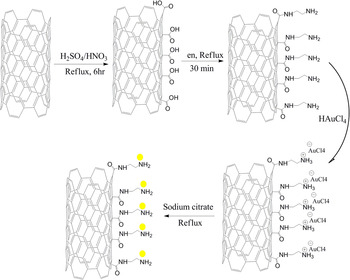
Herein, we have reported a procedure for decorating the surface of functionalized Multi-walled carbon nanotubes (MWCNTs) with AuNPs. Ethylenediamine (en) serves as an inter-linker between the MWCNTs and AuNPs.
Reference Murugesan, Myers and Subramanian19
Construction of the decorated carbon nanotubes (AuNPs/en-MWCNTs) was based on the chemical reaction of en with carboxylic groups under reflux followed by electrostatic bonding of
 ${\rm{AuCl}}_4^ -$
with amine groups. The conversion of
 ${\rm{AuCl}}_4^ -$
to AuNPs was a chemical process involving sodium citrate as a reducing agent. The constructed nanohybrid can be easily suspended in dimethylformamide (DMF) and drop casted on the surface of electrochemical sensors.
II. EXPERIMENTAL
A. Reagents and solutions
MWCNTs with diameter of 7–12 nm, length of 0.5–10 µm (CAT NO 4060741), ethylenediamine (CAT NO E26266-50 ML), and sodium citrate (CAT NO S1804-1 KG) were obtained from Sigma–Aldrich (St. Louis, Missouri). Tetrachloroaurate (III) (99.5%) (CAT NO 101582) was supplied from EMSURE (Darmstadt, Germany). The stock solution of tetrachloroauric acid (III) (HAuCl4) was prepared by dissolving an amount equivalent to 0.1% in deionized water. Ethylenediamine-ethanol solution (en-ethanol) was prepared by diluting an amount of ethylenediamine that is equivalent to 0.1 M in ethanol. All other chemicals were of analytical grade and used without further purification.
B. Apparatus
The structure, composition, and morphology of the Au-decorated carbon nanotubes were studied using Fourier transform infrared spectroscopy (FTIR; Perkin Elmer, Tokyo, Japan), field emission scanning electron microscopy coupled with energy dispersive X-ray (FESEM; JEOL JSM 7600F, JEOL Ltd., Washington, DC), X-ray diffraction (XRD; Philips, PANalytical, Santa Barbara, California) and transmission electron microscopy (TEM) (Hitachi H-7100); pH meter (Fisher Science Education, Waltham, Massachusetts) was used to adjust pH of solutions before each measurement. The samples for FTIR were scanned between 500 and 4000 cm−1 wave number at a resolution of 4 cm−1. FESEM images were obtained by placing small amount of the samples onto a piece of double sided tape stuck to a metal stub. The sample for XRD was placed on a flat amorphous silica sample holder. XRD patterns from 10 to 80° at 2θ were recorded at room temperature using Cu ka radiation. DropSens 8400 electrochemical system (Metrohm Co., Herisau, Switzerland) was used for all voltammetric measurements. A three-electrode configuration was used including a bare SPE modified with AuNPs/en-MWCNTs as working electrode.
Electrochemical characterization of the electrode for conductivity and electro-active surface area were performed in a solution of 1 mM potassium ferrocyanide/0.1 M KCl prepared in double distilled water.
C. Functionalization of MWCNTs
The pristine MWCNTs were functionalized with a mixture of concentrated sulfuric and nitric acid (3:1) under reflux at 50 °C for 6 h. The resulting mixture was diluted with distilled water and filtered repeatedly until the pH of the filtrate was neutral. The sample was then dried at 50 °C overnight and termed as carboxylated MWCNTs.
D. Synthesis of AuNPs/en-MWCNTs
The decoration of AuNPs on the surface of MWCNTs (Scheme 1) was performed by addition of 10 mg of the functionalized MWCNTs to 25 mL en-ethanol solution (0.1 M) and subjected to reflux for 30 min. Different amounts of HAuCl4 (0.1%) were added into the reaction system and further refluxed till boiling followed by addition of 2 mL sodium citrate (1% w/v) drop wise into the boiling solution. The mixture was left refluxing for 30 min; heating was stopped while stirring continued for additional 20 min till cooling and the resulting solution was washed several times by centrifugation at 4000 rpm for 5 min and oven dried at 50 °C overnight.
Schematic illustration of the synthetic process of the AuNPs/en-MWCNTs nanohybrid.

III. RESULTS AND DISCUSSIONS
A. Characterization of AuNPs/en-MWCNTs
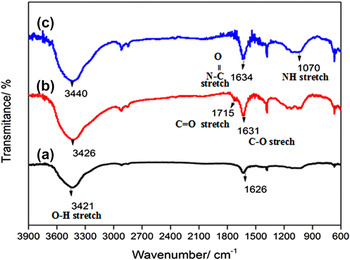
Figure 1 shows the FTIR spectra of the functionalized and unfunctionalized MWCNTs. The spectra of the acid treated MWCNTs [Fig. 1(b)] displayed an absorption peak at 1715 cm−1 which was not present in the pristine MWCNTs [Fig. 1(a)]. This peak at 1715 cm−1 represents C=O stretching Reference Freitas, Mattos, Silva and Dutra20,Reference Liang, Li and Tian21 while the peak at 3421 cm−1 can be ascribed to O–H stretching vibration, the peak at 1631 cm−1 can be assigned to C–O stretching of carboxylic group. It is observed that after treating the functionalized MWCNTs with ethylenediamine, the spectra [Fig. 1(c)] shows the disappearance of 1715 cm−1 and appearance of a new band at lower wave number (1634 cm−1) due to amide carbonyl stretching. Reference Shah and Murthy22 It can also be observed that a peak that corresponds to the NH2 stretching frequency appeared at 1070 cm−1 which causes broadening of the peak at 3440 cm−1. These observations validate the attachment of amine group on the surface of MWCNTs.
FTIR spectra of (a) Pristine MWCNTs, (b) acid functionalized MWCNTs, and (c) amine treated functionalized MWCNTs.

B. Solubility studies
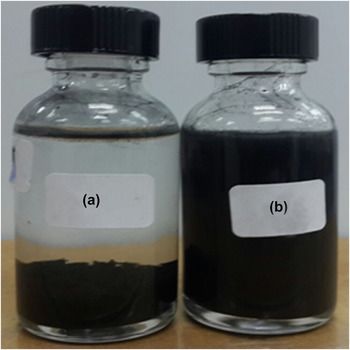
After functionalization of MWCNTs, a semiqualitative experiment was conducted to probe its effect on the dispersibility of MWCNTs in water. As pristine MWCNTs has poor dispersibility in water due to the strong van der Waals interaction that exist between nanotubes leading to formation of bundles and clusters in solution. Reference Huang and Terentjev23 Therefore, in the solubility test, 1 mg Pristine MWCNTs was mixed with 15 mL distilled water and subjected to ultrasonic agitation for 15 min, the same procedure was applied to the functionalized MWCNTs. Aggregates of pristine MWCNTs were observed which entangled together due to its higher surface energy, while the functionalized MWCNTs yield a very good dispersion which could be attributed to the decrease in the surface energy of the nanotubes brought about by increasing of functional groups. After leaving the suspensions for 24 h, the solution of the functionalized MWCNTs remains suspended as shown [Fig. 2(b)], while that of pristine MWCNTs settled at the bottom of the container [Fig. 2(a)] thus, this suggests that functionalization increased the dispersibility of MWCNTs.
Photographs of the samples dispersed in water (a) Pristine MWCNTs (b) functionalized MWCNTs.

C. Influence of HAuCl4 concentration on the size and distribution of AuNPs
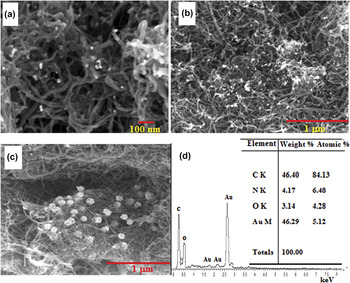
The metal ion concentration is a factor in determining the size and distribution of nanoparticles decorated on MWCNTs. By adjusting the amount of HAuCl4 in the reaction system, the size of gold nanoparticles on the carbon nanotube could be controlled, as uniformly dispersed Au particles on the surface of CNTs are said to considerably improve the electrocatalytic activity of electrode. Reference Zhang, Hummelgard and Olin24 To study the influence of the amount of HAuCl4 on the density and distribution of AuNPs on the surface of MWCNTs, three different nanohybrids based on AuNPs/en-MWCNTs were synthesized by keeping constant the amount of carbon nanotubes and sodium citrate at 10 mg and 2 mL (1% w/v) respectively; then, different volumes of (0.1%) HAuCl4 were injected into the reaction process as 0.5, 1.0, and 2.0 mL. The result of FESEM images (Fig. 3) showed the surface morphology of the synthesized composites. The density of the AuNPs deposited on the surface of 10 mg MWCNTs were evidently different. By addition of 0.5 mL HAuCl4 [Fig. 3(a)] only a few gold nanoparticles could be observed on the surface of carbon nanotubes. This can be ascribed to the insufficiency of the amount of HAuCl4 used, and consequently, to the inability to form a complete shell at the carbon nanotubes surface. When the amount of HAuCl4 was increased to 1.0 mL [Fig. 3(b)] the density and distribution of gold nanoparticles at the surface of carbon nanotubes were increased and evenly distributed. By further increasing in the amount of HAuCl4 to 2.0 mL [Fig. 3(c)] the gold nanoparticles tend to aggregate on the surface of carbon nanotubes with poor distribution. So, it can be said that the best results in terms of density and distribution of gold nanoparticles could be achieved by using 1.0 mL of HAuCl4 (0.1%) on 10 mg multi-walled carbon nanotubes in the presence of 2 mL of sodium citrate (1%) as reducing agent.
FESEM and EDX Images of the decorated carbon nanotubes using different amounts of (0.1%) HAuCl4 (a) 0.5 mL (b) 1.0 mL (c) 2.0 mL, and (d) EDX spectrum: Inset the corresponding weight percentage of the elements.

The elemental composition of the decorated carbon nanotubes was evaluated using energy dispersive x-ray (EDX). The results [Fig. 3(d)] shows a sharp peak of carbon which is attributed to MWCNTs which served as the substrate for the growth of AuNPs, a sharp peak of Au is also observed with some smaller ones indicating the presence of AuNPs in the nanohybrid, presence of nitrogen atom in the spectra suggest the presence of amine group that serves as a linker between MWCNTs and AuNPs in construction of the nanohybrid. The oxygen peak is believed to be from carboxylic and hydroxyl groups that resulted after acid treatment of the MWCNTs. The results are further supported by the EDX data [inset Fig. 3(d)] the weight percents of C, N, O, and Au in the AuNPs/en-MWCNTs nanohybrid are found to be 46.4%, 4.17%, 3.14%, and 46.29%, respectively. All the above results suggest that AuNPs were well decorated on the surface of MWCNTs.
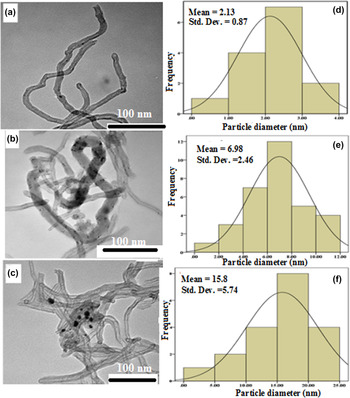
The TEM images of the decorated carbon nanotubes synthesized using different amount of HAuCl4 solution is presented in (Fig. 4). It was observed that as the amount of HAuCl4 increases from 0.5 mL [Fig. 4(a)] to 1.0 mL [Fig. 4(b)], the density and distribution of AuNPs on the surface of MWCNTs also increases, but when the amount reaches 2.0 mL [Fig. 4(c)] AuNPs clumps formed on the surface of the MWCNTs. High density and best distribution of AuNPs on the surface of MWCNTs is achieved using 1.0 mL of the metal salt solution. Therefore, these results further suggest that the optimum result with respect to distribution of AuNPs on the surface of 10 mg MWCNTs is obtained with 1.0 mL of (0.1%) HAuCl4.
TEM images of the nanohybrid at different volume of HAuCl4 (0.1%): (a) 0.5 mL, (b) 1.0 mL and (c) 2.0 mL, and corresponding curve distributions of AuNPs (30 nanoparticles) at (d) 0.5 mL, (e) 1.0 mL and (f) 2.0 mL of HAuCl4 (0.1%).

As the density and distribution of AuNPs varies on the surface of the MWCNTs due to variation in the amount of HAuCl4 so also the size of the AuNPs. Based on the images obtained by TEM analysis, the average sizes of the AuNPs decorated on the MWCNTs are determined by statistical analysis. It was observed that with 0.5 mL [Fig. 4(d)], the size of AuNPs obtained is 2.13 ± 0.87 nm while 6.98 ± 2.46 nm is obtained with 1.0 mL [Fig. 4(e)] and 15.80 ± 5.74 nm is obtained with 2.0 mL [Fig. 4(f)].
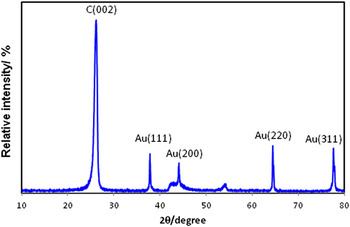
The elemental composition of the decorated carbon nanotubes was further studied by x-ray diffraction (XRD) analysis. The result (Fig. 5) revealed a diffractive peak at 26.70° which correspond to (002) of carbon while the peaks at 37.8°, 44.20°, 66.4°, and 77.6° can be assigned to (111), (200), (220), and (311) crystalline plane diffractions of Au respectively. Reference Islam, Bach, Nga and Lim25 This is an evidence on the decoration of AuNPs on the surface of MWCNTs.
XRD profile of the AuNPs/en-MWCNTs.

It is possible to estimate the size of nanoparticles from XRD data using Scherrer equation [Eq. (1)]. Reference Lngford and Wilson26 Where, D p is crystallite size, λ is x-ray wave length (1.452 nm), β is peak width at half height, and θ is Bragg angle. As it has shown in Fig. 5, Au has four distinct peaks at 37.84, 44.06, 64.46, and 77.62° with average particle size of 34.03 nm.
 $${D_{\rm{p}}} = {{0.94\lambda } \over {\beta \,\cos \,\theta }}\quad .$$
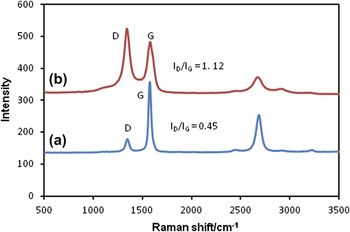
Surface characterization of MWCNTs was further supported by Raman analysis. The results (Fig. 6) show two main bands G and D at 1565 and 1330 cm−1 which indicates the formation of graphitized CNTs and the existence of the disordered carbon such as defective graphitic structure of CNTs respectively. Reference Ghodselahi, Aghababaie, Mobasheri and Salimi27 The relative intensity ratio of these bands (I D/I G) Reference Ferrari and Basko28,Reference Dresselhaus, Jorio, Hofmann, Dresselhaus and Saito29 were estimated to be 0.5 and 1.2 cm−1 for MWCNTs before and after decoration with AuNPs [Figs. 7(a) and 7(b) respectively]. The higher I D/I G value [Fig. 7(a)] indicates a greater disruption of the sp2-bonded carbon atoms to sp3-hybridized carbon atoms suggesting that species have been immobilized on the surface of MWCNTs. Reference Zardini, Amiri, Shanbedi, Maghrebi and Baniadam30 This further suggests that the decoration of AuNPs on the surface of MWCNTs takes place.
Raman spectrum of MWCNTs (a) before and (b) after AuNPs decoration.

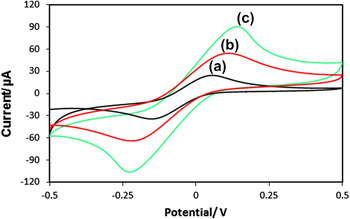
Cyclic voltammetric response of (a) bare SPE (b) MWCNTs/SPE and (c) AuNPs/en-MWCNTs/SPE in K3Fe(CN)6 (1 mM) and KCl (0.1 M).

D. Fabrication of AuNPs/en-MWCNTs based electrode
The AuNPs/en-MWCNTs suspension was prepared by dispersion of 1 mg of AuNPs/en-MWCNTs in 1 mL of DMF using ultrasonic agitation to obtain a relatively stable suspension. An aliquot of the homogeneous suspension was drop casted on the working part of a screen printed electrode (SPE) and dried in air to evaporate DMF. MWCNTs/SPE was also prepared following the same procedure.
E. Electrochemical characterization of the modified SPE
Cyclic voltammetry (CV) of modified and unmodified SPEs in 1 mM K3Fe(CN)6 and 0.1 M KCl, showed a pair of redox peaks in the potential range of −0.5 to +0.5 V. The results (Fig. 7) show lower peak currents on bare SPE which is attributed to the sluggish electron transfer property of the electrode while the peak current increases after modification with MWCNTs. This can be ascribed to the good electron transfer property of MWCNTs and higher surface area. The peak current increases further as AuNPs/en-MWCNTs was used to modify the electrode. Actually, the electrochemical reaction of K3Fe(CN)6 on the surface of modified electrodes becomes more irreversible while oxidation/reduction peak currents are being enhanced. This behavior shows that electroactive surface area and conductivity improve upon modification process while due to decline of standard rate constant (k°), more overvoltage is required and as a result irreversibility increased. Reference Wang31
F. The effect of drop casted volume
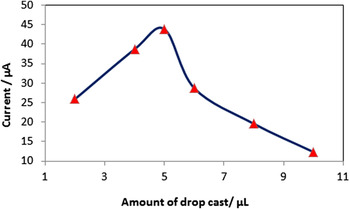
The effect of drop casting volume of AuNPs/en-MWCNTs (1 mg/mL) on the surface of SPE was investigated in the range of 2–10 µL. CV was performed in a solution of 1.0 mM ferrocyanide and 0.1 M KCl in the potential window of −0.5 to 0.5 V at scan rate of 50 mV/s. The results (Fig. 8) show that upon increase in the volume of AuNPs/en-MWCNTs suspension from 2.0 to 5.0 µL, the peak current increases steadily until it reaches 5 µL. But as the volume exceeded 5 µL, the peak current dramatically decreases due to the increasing in thickness of the AuNPs/en-MWCNTs film blocking the electrical conductivity surface of the electrode and diminishing its sensitivity. As a result, 5 µL was chosen as the optimum amount of AuNPs/en-MWCNTs suspension which was used for fabrication of the AuNPs/en-MWCNTs/SPE.
Effect of the amount of drop casted volume of AuNPs/en-MWCNTs on the voltammetric response of the modified electrode.

A comparative study was carried out to investigate the effect of the modifier on the surface area of SPE. The CVs of the different kinds of modified electrodes were performed in K3Fe(CN)6 using 0.1 M KCl as the supporting electrolyte at different scan rates (10–100 mV−1). The electro-active surface areas were estimated according to Randles–Sevcik equation [Eq. (2)]. Reference Bard and Faulkner32
 $${I_{{\rm{pa}}}} = \left( {2.69 \times {{10}^5}} \right){n^{{3 \mathord{\left/ {\vphantom {3 2}} \right. \kern-\nulldelimiterspace} 2}}}A{D^{{1 \mathord{\left/ {\vphantom {1 2}} \right. \kern-\nulldelimiterspace} 2}}}{\nu ^{{1 \mathord{\left/ {\vphantom {1 2}} \right. \kern-\nulldelimiterspace} 2}}}{\rm{Co}}\quad {\rm{.}}$$
Where I pa is the anodic peak current, n is number of electrons transferred, A, electrode surface area, D, diffusion coefficient (7.6 × 10⁻⁶), ν, scan rate, n, number of transferred electrons (n = 1) and Co is concentration of K3Fe(CN)6. Based on Eq. (2), the values of “A” (surface area) were found to be 0.026, 0.034, and 0.046 cm2 for bare SPE, MWCNTs/SPE, and AuNPs/en-MWCNTs/SPE, respectively. This suggests that the Au-decorated carbon nanotubes have brought about an increase in electro-active surface area of the SPE substrate.
G. Electrochemical impedance spectroscopy (EIS) of the electrodes
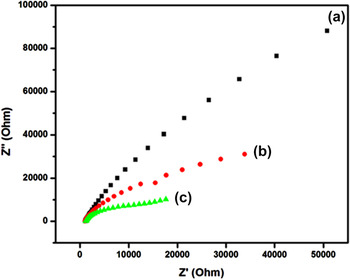
EIS analysis was carried out to further investigate the effect of the modifiers on the electrochemical performance of the electrodes, because it is an effective technique of assessing the features of surface modified electrodes. The charge transfer resistance (R ct) is an important parameter and it can be measured by the semicircle diameter of the Nyquist plots. Reference Jia and Wang33,Reference Liu, Yin, Long, Zhang and Yao34
The results of the EIS analysis (Fig. 9) show that bare SPE exhibits higher R ct (5243 Ω) indicating lower conductivity due to its lower surface area and sluggish electron transfer properties while the MWCNTs/SPE shows lower R ct (1208 Ω) compared to the bare SPE indicating an increase in conductivity which can be attributed to the increase in electron transfer and surface area of the electrode by MWCNTs. A further decrease in R ct (605 Ω) was observed on AuNPs/en-MWCNTs/SPE indicating greater conductivity which is ascribed to the combination of the properties of MWCNTs and AuNPs.
EIS Nyquist plots of bare SPE (a), MWCNTs/SPE (b) and AuNPs/en-MWCNTs/SPE (c) in 1 mM Fe(CN)6 3−/4− solution containing 0.1 KCl, with frequency of 100 kHz to 0.1 Hz and amplitude of 0.01 V.

This shows that the Au-decorated nanotubes causes an increase in surface area and conductivity of a SPE and can be used as modifier to enhance sensitivity in electrochemical sensors.
IV. CONCLUSION
In this study, a procedure was described for decorating carbon nanotubes with gold nanoparticles by electroless deposition process. The gold nanoparticles were indirectly deposited on the surface of multi-walled carbon nanotubes by a linkage of amine group. The density and distribution of the gold nanoparticles on the surface of multi-walled carbon nanotubes were controlled by the concentration of HAuCl4. Higher density of gold nanoparticles coverage were obtained when the amount of multi-walled carbon nanotubes and sodium citrate (1% w/v) were maintained at 10 mg and 2 mL respectively and 1.0 mL of (0.1% w/v) HAuCl4 was used to construct the nanohybrid. The electro-active surface area and conductivity of screen printed electrodes was increased after modification with the constructed nanohybrid which suggests the suitability of AuNPs-decorated carbon nanotubes in fabrication of electrochemical sensors for trace determination of hazardous and pharmaceutical compounds, in vivo cancer detection or for application in surface-enhanced Raman spectroscopy for tracking single molecules.
Conflict of interest
No conflict of interest.
ACKNOWLEDGMENT
The authors gratefully acknowledged the financial support from Universiti Putra Malaysia under grant No. 9142700.