In settings with a low tuberculosis (TB) burden, considerable financial and operational costs are expended in ‘ruling out’ TB in hospitalized patients. Following several outbreaks in the 1990s, Reference Dooley, Villarino and Lawrence1–Reference Daley, Small and Schecter3 prevention of nosocomial TB transmission has been a priority in the United States; guidelines have been developed by the Centers for Disease Control and Prevention (CDC) and adapted at state and institutional levels. 4
Among other measures, CDC guidelines recommend that patients evaluated for pulmonary TB be placed in airborne isolation until active infection is ruled out. 4 Conventional TB evaluation is performed by collecting 3 consecutive sputum samples, at 8–24-hour intervals, for smear microscopy. After all 3 samples have tested negative for the presence of acid-fast bacilli (AFB), infectious pulmonary TB is ‘ruled out’ for the patient, and airborne isolation is lifted. 5
Despite continued use for TB evaluation, serial smear microscopy remains challenged by suboptimal sensitivity (∼60%–70% when compared to mycobacterial culture), Reference Lewinsohn, Leonard and LoBue6 particularly among patients with human immunodeficiency virus (HIV) coinfection who are more likely to produce paucibacillary specimens. Reference Perkins and Cunningham7 Specificity for smear microscopy is ∼90%. Reference Lewinsohn, Leonard and LoBue6 Smear microscopy has been increasingly replaced by nucleic acid amplification tests (NAATs), which have higher sensitivity and specificity as well as shorter time to results. Reference Campos, Quartin and Mendes8–Reference Moore, Guzman and Mikhail10 GeneXpert MTB/RIF (Cepheid MTB/RIF, Sunnyvale, California), a fully automated NAAT system for detection of Mycobacterium tuberculosis (MTB) complex and genotypic rifampin resistance in 2 hours, has 72% sensitivity in smear-negative TB and 92% sensitivity in smear-positive TB, Reference Boehme, Nabeta and Hillemann11 as well as 99%–100% specificity in large diagnostic studies. Reference Chaisson, Romer and Cantu12–Reference Luetkemeyer, Firnhaber and Kendall15
A consensus statement by the National Tuberculosis Controllers Association (NTCA) and Association of Public Health Laboratories (APHL) advocates that 2 negative Xpert tests, in conjunction with clinical judgment, be used to guide discontinuation of airborne isolation. 16 Consistent with its superior sensitivity to AFB smear, evaluation of a single sputum sample using Xpert has 85%–89% sensitivity in culture-positive TB, Reference Chaisson, Romer and Cantu12,Reference Cowan, Chandler and Kracen14,Reference Luetkemeyer, Firnhaber and Kendall15 with evaluation of a second sample increasing sensitivity to 90%–95%. Reference Cowan, Chandler and Kracen14,Reference Luetkemeyer, Firnhaber and Kendall15 Single-Xpert strategies offer the benefit of reduced testing time and cost; however, given the decreased sensitivity compared to 2-Xpert strategies, particularly among patients with smear-negative TB, 2 negative Xpert tests are typically recommended for discontinuation of airborne isolation. 16
Despite emerging data suggesting that implementation of Xpert testing strategies result in reduced time in airborne isolation among inpatients evaluated for infectious pulmonary TB, Reference Chaisson, Romer and Cantu12 serial smear microscopy remains conventional practice in US hospitals. In this study, we sought to evaluate the diagnostic performance and cost-effectiveness of Xpert-based TB evaluation, such as the algorithm proposed by the NTCA and APHL, compared to conventional TB evaluation, at a large academic medical center in New York.
Methods
Study design and patient population
We performed a retrospective cohort study of hospitalized patients evaluated for pulmonary TB from August 2010 to December 2017. Eligible patients were adults (age ≥18 years) admitted to NewYork-Presbyterian–Columbia University Irving Medical Center and NewYork-Presbyterian–Allen Hospital. Among these patients, we identified those who underwent TB evaluation by selecting those who had electronic medical record orders for both airborne isolation and an AFB sputum smear within 24 hours of their isolation order. We excluded patients who were already on TB treatment at the time of their admission, those who never had AFB smears sent or results, and those age <18 years.
To evaluate the impact of TB evaluation on hospital length of stay, we selected a control group of adult patients hospitalized for non-TB pneumonia (hereafter simplified as “pneumonia”) at our study-site hospitals during the same period. We included patients who had an International Classification of Diseases, Ninth Revision, Clinical Modification (ICD-9-CM) or International Classification of Diseases, Tenth Revision, Clinical Modification (ICD-10-CM) diagnosis for pneumonia listed as their discharge diagnosis. We excluded all patients who were already selected for the TB evaluation cohort and those age <18 years.
Data collection and statistical analysis
From electronic medical records, we abstracted demographic data including age, sex, race, and socioeconomic status for all patients in both the TB evaluation and pneumonia cohorts. We defined patients to have low socioeconomic status if they had Medicaid listed as one of their forms of insurance or if their insurance was listed solely as “self-pay,” indicating uninsured. Using ICD-9-CM and ICD-10-CM codes, we abstracted diagnoses of human immunodeficiency virus (HIV) infection, diabetes mellitus, chronic kidney disease, and chronic obstructive pulmonary disease (COPD) for patients in both groups. We classified any patient with a positive HIV antibody–antigen test and/or positive HIV PCR assay to have HIV infection and considered patients with a recent hemoglobin A1c value >7% to have diabetes mellitus. We also identified whether patients had been admitted to the intensive care unit (ICU) at any time during their hospitalization.
According to our institution’s policy, patients evaluated for TB had at least 3 sputum specimens sent for AFB smear and culture, each ideally obtained 8–24 hours apart. Samples were also sent for Xpert testing, which became available at our medical center in 2014. We identified all AFB smear, Xpert, and mycobacterial culture testing results. We defined patients to be AFB positive if any AFB were identified on smear microscopy in at least 1 sputum sample. We considered patients to be Xpert positive if at least 1 of their sputum samples had a positive Xpert assay result. We defined patients to have active pulmonary TB if mycobacterial culture was positive for MTB, regardless of AFB or Xpert result. Using mycobacterial culture for TB as the gold standard, we calculated the sensitivity, specificity, positive predictive value (PPV), and negative predictive value (NPV) for AFB smear and Xpert using standard methods. We also abstracted the final speciation of mycobacterial cultures and the relevant patient diagnoses at discharge as documented by their treating clinicians.
To compare length-of-stay outcomes between the TB evaluation and pneumonia control groups, we performed propensity score matching using an SPSS plug-in from R software (R core, R Foundation for Statistical Computing, Vienna, Austria). Propensity scores (scale, 0–1) were calculated with logistic regression modeling using TB evaluation status as the dependent variable. The covariates in the logistic regression model included demographic data (age, sex, and socioeconomic status), medical comorbidities (HIV, diabetes mellitus, chronic kidney disease, COPD), and whether or not patients required ICU admission during hospitalization. We matched patients 1:2 with replacement by nearest neighbor. We initially set the caliper (the maximum accepted difference in propensity score between matched subjects) to 0.2, and we considered matching successful if the resulting absolute standardized mean difference (ie, mean difference between groups divided by standard deviation of control) was <0.1 for all variables. We calculated the median length of stay in days and interquartile range (IQR) for the 2 matched groups. We then calculated the difference in median length of stay between the groups. Data were analyzed using SPSS version 25.0 software (IBM, Armonk, New York).
Cost-effectiveness analysis
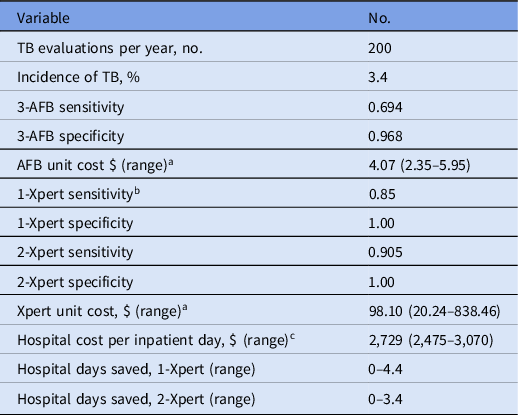
We built a probabilistic decision-analytic model in a decision tree with 3 arms comparing 3 AFB smears (3-AFB), a single Xpert test (1-Xpert), and 2 Xpert tests (2-Xpert). We measured the cost savings per patient and incremental effectiveness of 1-Xpert and 2-Xpert relative to 3-AFB. The incremental effectiveness was defined in 3 ways: additional probability of detecting true cases (both true positive and true negative), additional probability of detecting true positive cases, and additional probability of detecting true negative cases with 1-Xpert and 2-Xpert compared with 3-AFB. Sensitivity and specificity for 3-AFB, 1-Xpert, and 2-Xpert were derived from our study and from prior data, Reference Cowan, Chandler and Kracen14 as were the unit costs of these tests. Reference Choi, Miele, Dowdy and Shah17 The direct cost to hospital per inpatient day was derived from 2017 Kaiser Family Foundation data for New York State hospitals. 18 Potential hospital days saved with 1-Xpert and 2-Xpert were set to range from a minimum of zero days (ie, no hospital days saved) to a maximum based on the difference in median length of stay between our TB evaluation and pneumonia cohorts. The maximum days saved for 2-Xpert was that of 1-Xpert minus 1 day for hypothetical time to collect and run a second Xpert sample. For our probabilistic analysis, we performed a Monte Carlo simulation with 10,000 random iterations. Sensitivity and specificity values were assigned β distributions. For the number of hospital days saved under 1-Xpert and 2-Xpert, we assigned triangular distributions. We also performed a sensitivity analysis of the costs in our model.
Ethics approval
The study was approved by the Columbia University Medical Center Human Research Protection Office (protocol no. AAAR9456).
Results
TB evaluation cohort and test characteristics
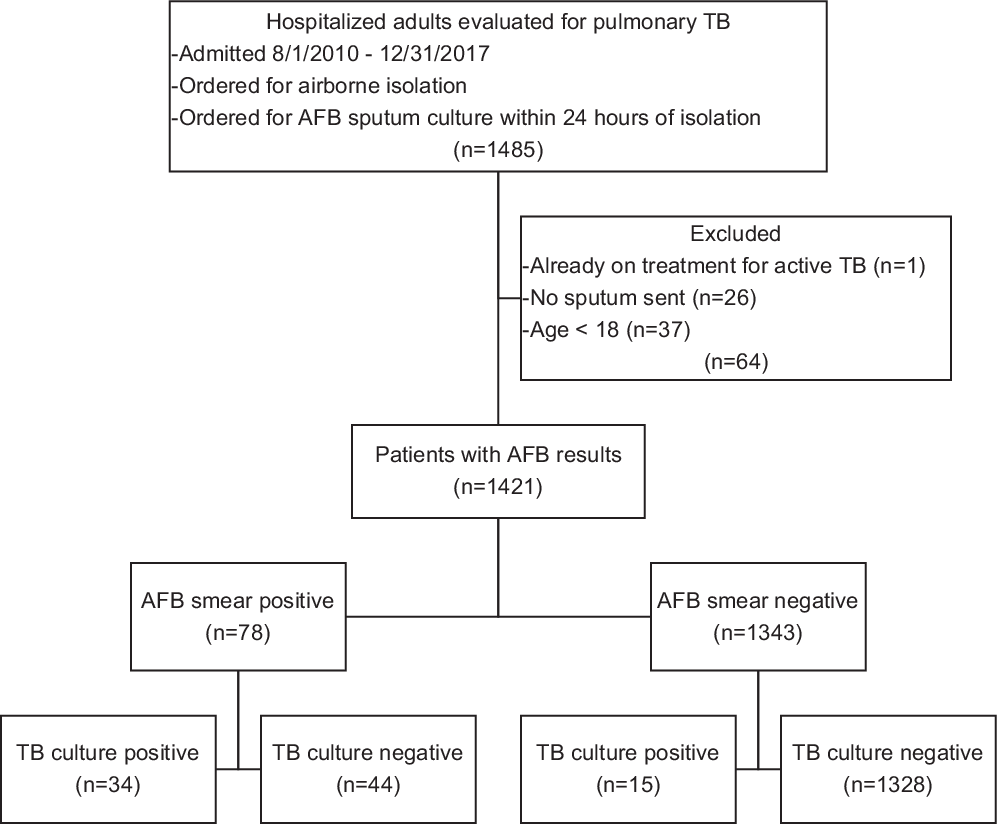
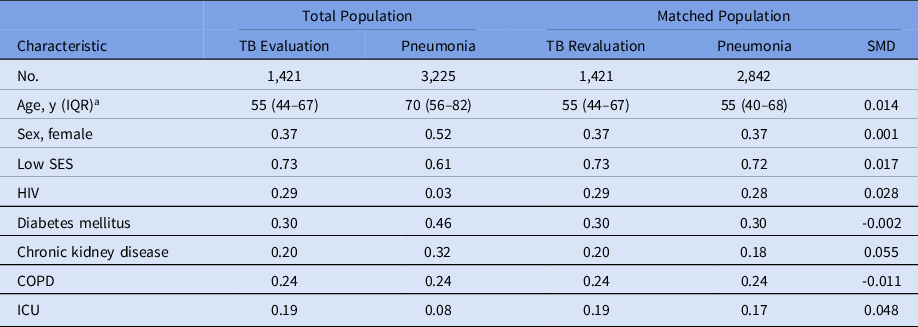
We identified 1,485 hospitalized patients who underwent evaluation for pulmonary TB during the study period. After excluding 64 patients, our TB evaluation cohort comprised 1,421 patients (Fig. 1). The median age was 55 years (interquartile range, 44–67), 521 (36.7%) were female, 1,036 (72.9%) were of low socioeconomic status, 416 (29.3%) were HIV infected, 423 (29.8%) had diabetes mellitus, 288 (20.3%) had chronic kidney disease, 335 (23.6%) had COPD, and 271 (19.1%) had been admitted to the ICU (Table 1).
Selection of patients undergoing evaluation for infectious pulmonary tuberculosis and identification of positive cases. Note. TB, tuberculosis; AFB, acid-fast bacilli.

Baseline Characteristics of TB Evaluation and Pneumonia Controls, Followed by Propensity Score Matching

Note. TB, tuberculosis; SMD, standardized mean difference; IQR, interquartile range; HIV, human immunodeficiency virus; COPD, chronic obstructive pulmonary disease; ICU, intensive care unit.
a Continuous variables listed as median (interquartile range).
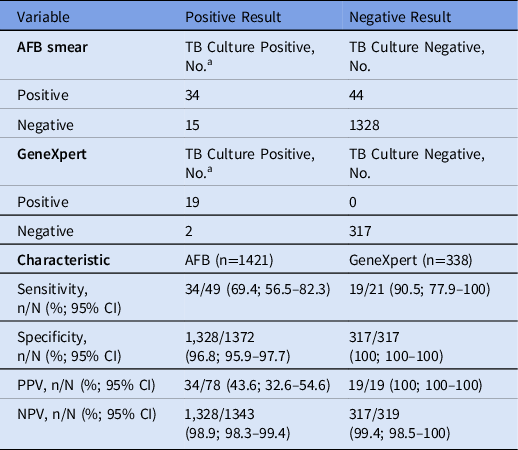
AFB smear was positive in 78 (5.5%) of 1,421 patients, of which 34 (43.6%) of 78 grew MTB on culture (Fig. 1). The remaining 1,343 (94.5%) of 1,421 patients were AFB smear negative, of which 15 (1.1%) of 1,343 had a positive culture. Overall, culture was positive in 49 (3.4%) of 1,421 of patients undergoing TB evaluation. Final speciation results from mycobacterial cultures are available in Supplement 1 (online). Relevant pulmonary diagnoses at discharge are available in Supplement 2 (online).
AFB smear had a sensitivity of 34 (69.4%) of 49 and specificity of 1,328 (96.8%) of 1,372 (Table 2). The PPV for AFB smear was 34 (43.6%) of 78, and the NPV was 1,328 (98.9%) of 1,343. Xpert had a sensitivity of 19 (90.5%) of 21 and specificity of 317 (100%) of 317. The PPV of Xpert was 19 (100%) of 19, and the NPV was 317 (99.4%) of 319.
Diagnostic Performance of AFB Smear and GeneXpert MTB/RIF

Note. AFB, acid-fast bacilli; TB, tuberculosis; CI, confidence interval; PPV, positive predictive value; NPV, negative predictive value.
a Mycobacterial sputum culture positive for MTB used as gold standard.
Pneumonia control group
After excluding patients already in the TB evaluation cohort and those aged <18 years, the pneumonia control cohort consisted of 3,225 patients. The median age was 70 years (interquartile range, 56–82); 1,690 (52.4%) were female; 1,959 (60.7%) were of low socioeconomic status; 107 (3.3%) were HIV positive; 1,471 (45.6%) had diabetes mellitus; 1,027 (31.8%) had chronic kidney disease; 780 (24.2%) had COPD; and 256 (7.9%) had been admitted to the ICU during hospitalization (Table 1).
Propensity score matching and hospital length of stay
Prior to matching, the baseline characteristics between the TB evaluation and pneumonia groups differed significantly in nearly all variables (Table 1). Propensity score matching resulted in 1,421 TB evaluation patients matched with 2,842 pneumonia controls. In total, 1,442 patients comprised the 2,842 control matches, and the matching with replacement strategy allowed for these patients to be matched more than once. The baseline characteristics between the matched groups were well-balanced; the absolute standardized mean differences for all covariates were less than 0.1.
Hospital length-of-stay data were available for 1,394 of the 1,421 TB evaluation patients. The median lengths of stay for the matched TB evaluation and pneumonia cohorts were 8 days (IQR, 4.8–16.0) and 3.6 days (IQR, 2.0–6.8), respectively. The difference in median length-of-stay was 4.4 days.
Cost-effectiveness analysis
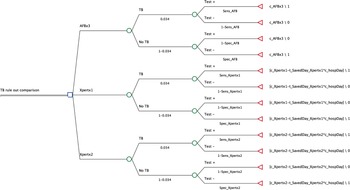
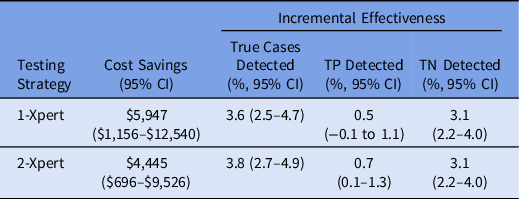
The decision-analytic model and accompanying parameters for our cost-effectiveness analysis are presented in Figure 2 and Table 3, respectively. Compared to 3-AFB, 1-Xpert was associated with an average $5,947 (95% CI, $1,156–$12,540) savings in direct medical costs per patient (Table 4). 1-Xpert was associated with 3.6% (95% CI, 2.5–4.7) additional probability of true case detection, 0.5% (95% CI, −0.1 to 1.1) additional probability of true positive detection, and 3.1% (95% CI, 2.2–4.0) additional probability of true negative detection per patient. Compared to 3-AFB, 2-Xpert was associated with an average $4,445 (95% CI, $696–$9,526) savings in direct medical costs per patient. 2-Xpert was associated with 3.8% (95% CI, 2.7–4.9) additional probability of true case detection, 0.7% (95% CI, 0.1–1.3) additional probability of true positive detection, and 3.1 (95% CI, 2.2–4.0) additional probability of true negative detection per patient. The results of the Monte Carlo simulation and sensitivity analysis are available in Supplement 3 and Supplement 4 (online), respectively.
Schematic of decision tree with 3 comparison arms. ‘AFBx3’ entails 3 serial sputum smears for acid-fast bacilli. ‘Xpertx1’ entails GeneXpert testing of a single sputum sample, and ‘Xpertx2’ entails GeneXpert testing of 2 sputum samples. These arms subsequently branch by probability of tuberculosis or not tuberculosis, then by probability of positive or negative test. The hospital days saved are incorporated at the terminal branches of the ‘Xpertx1’ and ‘Xpertx2’ arms. The parameters for this decision-analytic model can be found in Table 3. Note. TB, tuberculosis; AFB, acid-fast bacilli.

Cost-Effectiveness Parameters

Note. TB, tuberculosis; AFB, acid-fast bacilli.
a Choi et al, Int J Tuberc Lung Dis 2013.Reference Choi, Miele, Dowdy and Shah17
b Cowan et al, Clin Infect Dis 2017.Reference Cowan, Chandler and Kracen14
c Kaiser Family Foundation, 2017.18 Hospital adjusted expenses per inpatient day.
Cost Savings and Incremental Effectiveness of Xpert Strategies with 3-AFB as Reference (Per Patient)

Note. AFB, acid-fast bacilli; CI, confidence interval; TP, true positive; TN, true negative.
Discussion
Among a large cohort of hospitalized patients evaluated for TB in a low-burden setting, we have shown that Xpert is a more accurate and cost-effective platform to evaluate patients for infectious pulmonary TB than conventional AFB-based strategies. Our data, consistent with prior operational and cost-effectiveness analyses and NTCA and APHL guidelines, Reference Chaisson, Romer and Cantu12,Reference Lippincott, Miller, Popowitch, Hanrahan and Van Rie13,Reference Luetkemeyer, Firnhaber and Kendall15,16,Reference Millman, Dowdy and Miller19,Reference Chaisson, Duong and Cattamanchi20 suggest that Xpert-driven strategies should be utilized to evaluate inpatients and guide airborne isolation practices in US hospital systems where Xpert is available.
Compared to smear microscopy, the superior accuracy of Xpert in TB diagnostic evaluation has been well established. Reference Chaisson, Romer and Cantu12–Reference Luetkemeyer, Firnhaber and Kendall15,Reference Lee, Kee and Shin21 In our study, the sensitivity of Xpert was 90.5% (19 of 21) among culture-positive TB patients, and cases undetected by Xpert were smear negative. In contrast, the sensitivity of smear microscopy was 69.4%. The PPV of Xpert was also far greater than that of AFB smear (100% vs 43.6%, respectively), an observation likely attributable to the relatively increased prevalence of nontuberculous mycobacteria (NTM) in our low TB-burden setting (Supplement 1 online). The NPVs of AFB smear and Xpert were high, another reflection of low TB incidence in our setting.
Indicative of its clinical superiority and cost savings, Xpert-based strategies dominated conventional TB evaluation using probabilistic cost-effectiveness analysis. 1-Xpert and 2-Xpert strategies were associated with increased incremental effectiveness compared to conventional TB evaluation; each was associated with additional probability of detecting true positive and true negative cases. 1-Xpert and 2-Xpert were also associated with significant cost savings (average $5,947 and $4,445 per patient undergoing TB evaluation, respectively). In our medical center, where we evaluate ∼200 patients for TB annually, the projected annual savings would total $1.2 million with 1-Xpert and $889,000 with 2-Xpert. A prior cost–benefit analysis evaluating implementation of molecular TB diagnostics in the United States also estimated substantial cost savings with Xpert-based testing ($533,520 annually), driven primarily by reduction in airborne isolation times. Reference Millman, Dowdy and Miller19
The cost savings in our model are driven primarily by reductions in hospital length of stay projected by our propensity score matching analysis. In this analysis, in which patients were matched on multiple confounders that may impact length of stay, patients undergoing TB evaluation spent 4.4 days longer in the hospital. This disparate length-of-stay outcome is striking, particularly considering that most TB evaluation patients were ultimately diagnosed with pneumonia (Supplement 2 online). Much of this excess length of stay is likely attributable to the time-consuming process of serial AFB smear evaluations, which often results in substantial delays before airborne isolation can be discontinued. Reference Thomas, Bello and Seto22 As implementation of Xpert-based testing strategies has been shown to reduce isolation time by almost 2 days compared to serial smear microscopy, Reference Chaisson, Romer and Cantu12–Reference Cowan, Chandler and Kracen14,Reference Millman, Dowdy and Miller19 Xpert-driven protocols to guide airborne isolation would likely result in reductions in total length of stay, as was seen in a 2018 study among inpatients evaluated for TB in San Francisco. Reference Chaisson, Duong and Cattamanchi20
Our study has several methodologic strengths. First, our total cohort of 4,646 patients was drawn from admissions recorded over a 7-year period at 2 hospitals comprising a large academic medical center. Second, our use of propensity score matching to compare length of stay between TB evaluation patients and those hospitalized for pneumonia has not been done previously. By controlling for several potential confounding variables simultaneously, propensity score matching allowed us to compare length of stay between 2 largely exchangeable groups of patients. Third, although precise estimations of airborne isolation times that could be reduced with Xpert-driven evaluations are unknown, our probabilistic cost-effectiveness analysis accounts for this uncertainty by incorporating a distribution of days saved with Xpert.
Our study also has several limitations. As a retrospective cohort study that used propensity score matching as a form of pseudo-randomization, we may have incompletely matched controls to cases because of unmeasured confounding, which may have led to an under- or overestimation of differences of length of stay in the 2 groups. Second, although we analyzed the performance of Xpert using a large data set, Xpert was not ordered for all TB evaluation patients at our hospital, which could bias its performance. Third, we did not directly measure total airborne isolation time, so we cannot directly conclude how much isolation contributed to increased hospital length of stay in the TB evaluation group. Fourth, our cost-effectiveness analysis is based in part on hypothetical data, which may not reflect clinical practice. If perceived ease and rapidity of Xpert were to lead clinicians to overuse the test, this may decrease the positive predictive value of the test thereby decreasing cost-effectiveness.
Xpert has superior diagnostic accuracy compared to AFB smear for evaluation of infectious pulmonary TB in hospitalized patients. TB evaluation patients spend significantly longer time in the hospital compared to matched patients with lower respiratory tract infections; however, the vast majority of these patients do not have TB disease. Based on our modeling study, and in line with existing data and recommendations, Xpert-based testing is likely cost-effective compared to AFB smear and should be used to guide inpatient TB evaluation and airborne isolation in US hospital settings.
Acknowledgments
Financial support
No financial support was provided relevant to this article.
Conflicts of interest
All authors report no conflicts of interest relevant to this article.