Appearing during the Late Pleistocene epoch (Farmer Reference Farmer1994:680), the dart-thrower became an important component of the human tool kit. More powerful than a hand-launched spear, the dart-thrower greatly magnified the force with which a projectile could be propelled (Howard Reference Howard1974:102), and came to be used in regions as diverse as Europe, Oceania, and the Americas (Dickson Reference Dickson1985:7–9; Raymond Reference Raymond1986:153). In Mesoamerica, dart-thrower utilization can be inferentially traced to the Paleoindian period and continued well into the twentieth century (Beyer Reference Beyer1969 [1927]; Saville Reference Saville1925:52; Starr Reference Starr1899:Plate XXI; Stirling Reference Stirling1960; von Winning Reference von Winning1958:96).
In certain contexts the dart-thrower was more than a utilitarian tool for hunting and warfare. Great amounts of time and effort were invested into producing elaborately crafted dart-throwers. Such items served as symbolic, indexical, and iconic signs, which, when brandished, imbued their bearers with an aura of prestige, elevated status, and power.
Despite its significance in Mesoamerica, the dart-thrower has received little scholarly attention in the region and is primarily mentioned as a side-note in most publications, with some early exceptions including Zelia Nuttall (Reference Nuttall1891), Eduard Seler (Reference Seler, Bowditch, Eric, Thompson and Richardson1990 [1904]), Marshall H. Saville (Reference Saville1925), and Eduardo Noguera (Reference Noguera1945). To address this, the following paper demonstrates that the device was used as a pan-Mesoamerican symbol of power. This utilization was not consistent across temporal and spatial boundaries and will be traced using archaeological and historical data from a variety of Mesoamerican cultural groups.
THE DART-THROWER
A dart-thrower is a slender, usually wooden, implement which must include a small spur or notch at its distal end to facilitate contact with a flexible dart. The rear of the dart must consist of a small socket or tapered end depending on the setup of the dart-thrower. Darts are normally fletched. A typical dart-thrower is approximately 60 cm in length (Johnson Reference Johnson1971:191) with a diameter of roughly 2.5–5 cm. Aside from the above parameters, dart-throwers can be highly variable. They can be plain or elaborately decorated. The shaft can be round or flat and the handle can include some form of finger grips that are part of the structure of the shaft, or separate loops which are affixed to the implement with cordage. Conversely, some examples include no loops at all and were simply held in the hand.
A dart-thrower is used by grasping its proximal end and mounting a dart onto the spur at the distal end of the implement. The projectile is then launched using a motion that is similar to an overhand baseball throw. The properties of the dart-thrower and dart, coupled with the exertion of human force, can result in the launching of the projectile at speeds greater than 160 km/h (Perkins Reference Perkins2008a). It seems clear that the advent of such a tool must have dramatically increased humans' hunting efficiency and ability to protect themselves from predators.
Based on the physics involved with its use, it is clear that the dart-thrower has several distinct advantages over a hand-thrust or -thrown spear. In many parts of the world during the Late Pleistocene, humans co-existed with a host of dangerous animals such as mammoths and saber tooth cats. Whether for sustenance or self-preservation, the dart-thrower allowed its user to maintain a greater distance from the target and hence minimize the chance of a potentially lethal close encounter. It also provided benefits in terms of hunting smaller, more skittish animals, enabling the stealthy ambush of such prey. Furthermore, the added force that the dart-thrower imparted on its projectile increased the likelihood of a successful kill by virtue of its far greater penetrating power. Later, as I demonstrate below, the dart-thrower was also used as a weapon of war.
Terminology
In both scholarly and popular English language literature, the dart-thrower is not known by a single term. It is often referred to by its Nahuatl name, atlatl, but also has been called a “spear-thrower” and a “throwing-stick.” This implement is also known by a variety of regional names in different languages. This paper will refer to this tool as a “dart-thrower” for a number of reasons. First, the common term atlatl might mislead the reader into the belief that the Aztec or other Nahuatl speakers invented, named, and/or proliferated the use of this implement. As shown in this paper, this is not so. Using the same rationale, other localized names should be similarly avoided unless purposely referring to the tool of a specific culture. Second, the term “dart-thrower” is preferable to “spear-thrower.” Spears are inferred to be rigid (Perkins Reference Perkins2008b) and designed for thrusting or hand-propulsion. Stiff projectiles are ineffective when used with a dart-thrower—a dart is slender and flexible (Perkins Reference Perkins2008b; Whittaker Reference Whittaker2005:15). Since the terms “spear” and “dart” should not be conflated, the item which propels such a projectile should be referred to as a “dart-thrower.” The term “throwing-stick” is also inappropriate as some dart-throwers were made, at least in part, of materials such as bone or ivory. In addition, the term “throwing-stick” might also cause confusion between a dart-thrower and a stick that is actually used as a projectile for hunting small game. Overall, “dart-thrower” appears to be the most descriptive, accurate, and least ambiguous term.
Early Use
Currently, the earliest potential evidence for the use of the dart-thrower dates to approximately 38,000 years b.c. in Upper Paleolithic Europe (Farmer Reference Farmer1994:681), but the implement was surely present by 16,000 years b.c. (Dickson Reference Dickson1985:7). Since its earliest use the dart-thrower appears to have acquired symbolic meanings beyond a simple utilitarian function. Beautifully crafted dart-thrower spurs carved from antler and mammoth ivory depicting elephants, birds, horses, and fawns have been attributed to this time period (Lister and Bahn Reference Lister and Bahn2007:119).
Dart-throwers might have appeared in the Americas during the late Pleistocene (Farmer Reference Farmer1994:681). Although unequivocal evidence is lacking (Ahler and Geib Reference Ahler and Geib2000:804; Collins Reference Collins, Walker and Driskell2007:72–76; Whittaker Reference Whittaker2005:9), projectiles likely used as dart points have been excavated in situ with mammoth remains at a number of sites throughout North America, including Iztapan in central Mexico (Aveleyra A. de Anda Reference Aveleyra A. de Anda1956; Aveleyra A. de Anda and Maldonado-Koerdell Reference Aveleyra A. de Anda and Maldonado-Koerdell1953; Frison Reference Frison1989:766; Haury et al. Reference Haury, Antevs and Lance1953). Hemmings (Reference Hemmings2004:168–170) also describes several potential Paleoindian dart-thrower fragments from Florida. Further, Hutchings (Reference Hutchings1997) argues that common fractures found on Paleoindian stone points were caused by high-velocity impact that could only be achieved through the use of a dart-thrower. Provided that these assertions are correct, then the utilization of dart-throwers in North America can be traced back to at least the end of the Pleistocene, and as the bow and arrow likely did not appear in the region until at least the end of the Classic period (a.d. 250–900) (Grana-Behrens and Grube Reference Grana-Behrens, Grube and Grube2007:437; LeBlanc Reference LeBlanc, Brown and Stanton2003:282), it seems that the dart-thrower was continuously utilized as the projectile weapon of choice for most of the pre-Columbian history of North American peoples.
Identification of Dart-Throwers
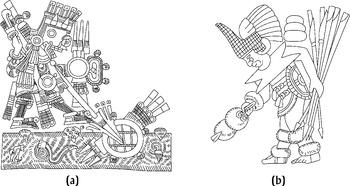
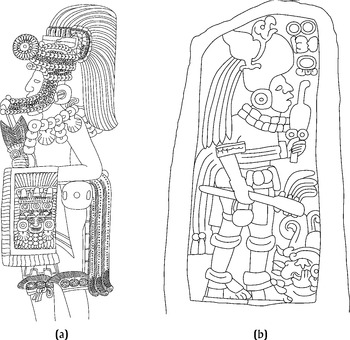
Dart-throwers used in a symbolic manner are often identified in the context of elite costume on murals, codices, stelae, and ceramics, and through their mention in pre-Columbian and colonial texts. Surviving examples of early dart-throwers have also been discovered. Iconographically, a dart-thrower can most readily be identified by its one or two finger-loops/holes (Figures 1, 7, 9, 11, 13, and 14), fingers inserted into such loops (Figures 1, 7, 13, and 14), the instrument's engagement with a dart (Figures 1a, 7a, 12, 13a, and 14a), and to a lesser extent, the item's hooked distal end (Figures 1a, 9, and 14c). Classic and Postclassic depictions often show a bilobal element, of a seemingly soft material, attached to the shaft of the dart-thrower (Figure 1b). Coggins and Ladd (Reference Coggins, Ladd and Coggins1992:252) suggest that the material is fur, but I argue that it is equally possible that it might be cotton or down. They also postulate that because Mesoamericans did not appear to attach weights to their dart-throwers as other Native American groups might have done, the soft bilobal element could have served to aid in weight distribution (Coggins and Ladd Reference Coggins, Ladd and Coggins1992:252). However, it is unlikely that fur, cotton, or down would have been very effective as weights, and instead might have been used to minimize the “whoosh” noise that the thrower made while in action, thereby decreasing the likelihood of startling prey or an enemy while hunting or in warfare. Nonetheless, this is merely a hypothesis and should be tested. It is also probable that the bilobal element fulfilled a presently unknown symbolic function.
(a) Figure grasping dart-thrower by inserting fingers into one large loop (top left of image). Detail from Codex Yoalli Ehecatl (a.k.a. Codex Borgia) page 54. Redrawn by Elbis Domínguez Covarrubias (after Diaz et al. Reference Diaz, Rodgers and Byland1993:Plate 54). (b) Warrior wielding a dart-thrower with bilobal element. Detail of warrior procession from Upper Registers, Interior Wall, Lower Temple of the Jaguar, Chichen Itza. Redrawn by Elbis Domínguez Covarrubias (after Schele and Freidel Reference Schele and Freidel1990:Figure 9:21).

DART-THROWERS OF THE FORMATIVE PERIOD
Although the dart-thrower was likely in utilitarian use across all of Mesoamerica, there is no evidence to demonstrate that it was coevally deployed symbolically by all cultures. Its symbolic dimension often occurred within the context of Teotihuacan-style imagery (Coggins Reference Coggins1988:128; Coggins and Ladd Reference Coggins, Ladd and Coggins1992:253), and its widespread distribution is usually attributed to the conquest by, or the influence/emulation of the ideals of, Teotihuacan (Coggins and Ladd Reference Coggins, Ladd and Coggins1992:253). In spite of this, there is evidence which suggests that the people of Teotihuacan were not the architects of this ideology.
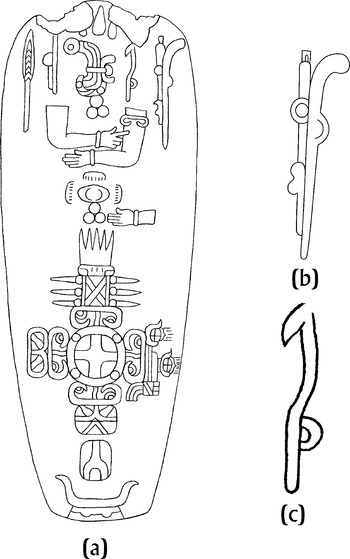
It is possible that the symbolic use of the dart-thrower was a component of the ceremonial material culture of the Olmec horizon, but the evidence is equivocal. The earliest such depiction of a dart-thrower might appear on the unprovenienced Humboldt Celt (Figure 2a), which has been attributed to the Middle Formative period (Justeson Reference Justeson1986:442). As the curved distal end of the motif incised on the top right corner near the sharpened edge of the celt bears a resemblance to a dart-thrower, it was identified as such by Nuttall (Reference Nuttall1891:Plate II39) and Beyer (Reference Beyer1969 [1927]:Figure 4). Beyer's (Reference Beyer1969 [1927]:Figure 4) line drawing (Figure 2b) depicts the item's right central bulge, as well as the circular element to its left, as finger loops. Because the celt is now lost, the only available photograph of the object is not of the artifact itself, but a cast, and does not support the presence of these loops, nor does Humboldt's (1810:Plate XXVIII) lithograph of the item. Further, although the design might not have been intended as realistic, it is worth mentioning that the “loops” are positioned too far towards the hooked distal end to be of any use on a dart-thrower. Another element incised on the celt has received less attention but is a far more likely candidate.
(a) Humboldt Celt. Drawing by Javier Urcid (after lithograph in Humboldt Reference Humboldt1810:Plate XXVIII); (b) Detail drawing of upper right motif. Redrawn by Javier Urcid (after Beyer Reference Beyer1969 [1927]:Figure 4). (c) Detail of motif second from the top right. Drawing by Javier Urcid (after lithograph in Humboldt Reference Humboldt1810:Plate XXVIII).

Directly to the left of the aforementioned motif is another hooked item which appears to have a correctly positioned loop (Figure 2c) as corroborated by the photograph of the celt's cast (Coe Reference Coe and Willey1965:Figure 18). Despite the motif's striking resemblance to a dart-thrower, its unquestionable assignment as such is not possible, as it is devoid of any discernible iconographic context.
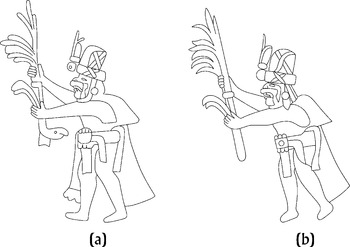
From Formative period Chalcatzingo, Cook de Leonard (Reference Cook de Leonard1967:Figure 1) has identified an object carried by an individual depicted on Monument 2 as a dart-thrower (Figure 3a). From right to left, the scene shows a seated left-facing individual with a presumed erect penis followed by three individuals, two with masks facing right and one facing left. The last figure carries what Cook de Leonard interpreted as a dart-thrower. Her reconstructed line drawing of the monument depicts the implement with a serpentine head, an interpretation that does not appear in any other scholars' renderings of the carvings (Figure 3b) (see also Gay Reference Gay1972; Grove Reference Grove1984). Based on these scholars' work it appears that Cook de Leonard's interpretation might be incorrect.
Left-most figure from Chalcatzingo Monument 2: (a) redrawn by Elbis Domínguez Covarrubias (after Cook de Leonard Reference Cook de Leonard1967:Figure 1); and (b) redrawn by Elbis Domínguez Covarrubias (after Piña Chan Reference Piña Chan1955:69).

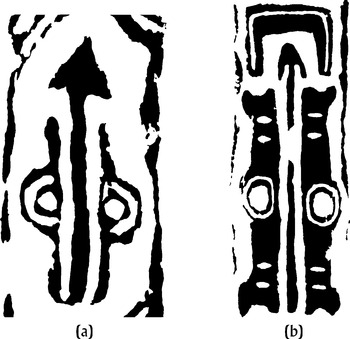
Other dart-thrower motifs of similar antiquity have been reported from two ceramic stamps found at Tlatilco, Mexico (Figures 4a and 4b) (Field Reference Field1967:31, Figures 25 and 29; Hall Reference Hall1997:112–115, Figure 14.3). Field (Reference Field1967:Figure 29) and Hall (Reference Hall1997:Figure 14.3a) claim that two of these stamps display a dart and dart-thrower complete with finger loops. If they are correct, then the stamps portray the superior surface of the dart-thrower as viewed from above. Neither the dart nor dart-thrower is rendered in full, but instead the motif might serve as an iconic synecdoche for the implements. Overall, despite some iconic resemblance, without further contextual relations the images found on these stamps cannot be unquestionably interpreted as dart-throwers.
Impressions from ceramic stamps of possible dart-thrower motifs. Tlatilco, Mexico. (a) Redrawn by Elbis Domínguez Covarrubias (after Field Reference Field1967:Figure 29). (b) Redrawn by Elbis Domínguez Covarrubias (after Field Reference Field1967:Figure 25).

The Bliss Collection at Dumbarton Oaks features two exquisitely-crafted greenstone dart-throwers (see Lothrop et al. Reference Lothrop, Foshag and Mahler1957:Plate IX). Because of the quality of craftsmanship exhibited, they have been attributed to Olmec master artisans (Lothrop et al. Reference Lothrop, Foshag and Mahler1957:235; Taube Reference Taube2004:136). Yet, the provenience and context of these objects is now lost.
In 1957 the Bliss Collection dart-throwers were said to be found together in Veracruz (Lothrop et al. Reference Lothrop, Foshag and Mahler1957:235). Published again in 1963 (Dumbarton Oaks Reference Oaks1963:8, 31), this time the larger of the two (B-33.OJ) was said to have originated in Puebla while the other (B-32.OJ) was attributed simply to Mexico. Finally, in 2004 Taube (Reference Taube2004:136–139) was careful to state that the objects were reportedly found together, without detailing a specific place of origin. Due to their unknown provenience, they cannot be definitively assigned to any time period or culture, and consequently, cannot be considered as evidence for the earliest ceremonial dart-thrower usage. Despite these problems, the fact that such a large quantity of precious greenstone was used in their construction cannot be overlooked. The artisan's selection of raw material certainly bespeaks the original significance of these dart-throwers.
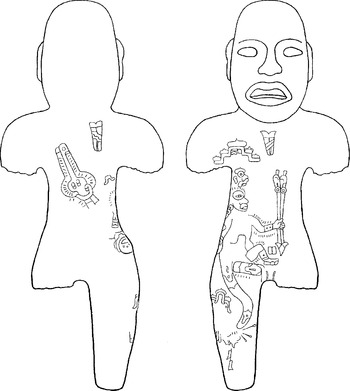
An early greenstone figurine attributed to Oaxaca in the collection at Harvard's Peabody Museum of Archaeology and Ethnology (catalog number 22-18-20/C9551) might depict the earliest reasonably-dated representation of a clearly identifiable dart-thrower. The figurine is incised frontally with an image of a personage dressed as a monkey who carries a pair of darts in one hand, while its other hand wraps to the figurine's posterior (Figure 5). In this hand a dart-thrower is grasped through two finger holes. A motif in the form of a decapitated head (Javier Urcid, personal communication 2010) is also present (located on the most inferior portion of the anterior side of the figurine's right leg), likely associating this scene with human sacrifice.
Greenstone figurine from Oaxaca with incised dart-thrower wielding personage, ca. 400 b.c. Drawing by Javier Urcid.

Like the Humboldt Celt and Bliss dart-throwers, the figurine's exact provenience is unknown, but at least in this case, it can be narrowed to Oaxaca. The Harvard Peabody catalog ledger (Peabody Museum of Archaeology and Ethnology, Harvard University, 1922, Collections Ledger for Artifact Number 22-18-20/C9551) states that the figurine dates to 500–400 b.c., but that its incised design is later. The later addition of inscriptions to early objects, possibly kept as heirlooms, is not unheard of in Mesoamerica (see Schele and Miller Reference Schele and Miller1986:119–121, Plate 32). However, both the Oaxacan figurine's structural appearance and its incision are consistent with securely dated objects from the end of the Middle Formative to the beginning of the Late Formative periods (approximately 400 b.c.). Oaxacan Glyphs C (the most superiorly located glyph on both the figurine's anterior and posterior sides) and J (incised in the middle of the anterior side of the figurine's right leg) closely match those inscribed on the Middle-Late Formative Yucuita stela from western Oaxaca (Guzmán Reference Guzmán1934; Urcid Reference Urcid and García2002:Figure 13). In addition, the forms of Glyph C on the figurine nicely correspond to a diadem featured on an Olmec-style mask from Veracruz (see Joralemon Reference Joralemon1971:Figure 180; Urcid Reference Urcid and García2002:Figure 2), and other Preclassic objects (see Urcid Reference Urcid and García2002:Figures 13 and 14). This figurine represents the earliest case where the internal context of the scene (the relation of the grasped dart-thrower in one hand to the bundle of darts in the other) clearly demonstrates that the object in question is indeed a dart-thrower. Given the scene's association with ritual sacrifice, this figurine also displays the earliest known definitive representation of a dart-thrower in connection with a form of symbolic power.
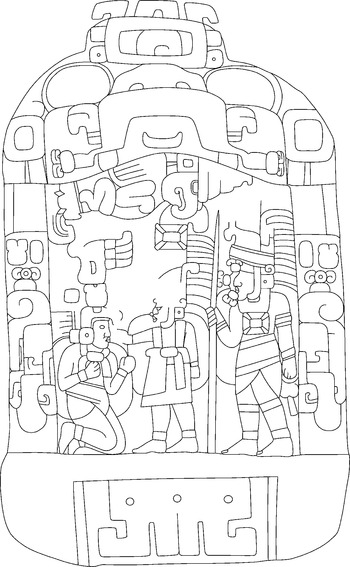
A dart-thrower might also appear on the epi-Olmec period Stela D at the site of Tres Zapotes (Coe Reference Coe and Willey1965:764, 773; Stirling Reference Stirling1943:Figure 4; Taube Reference Taube2004:138), which depicts three figures standing within a zoomorphic mouth which likely represents a cave (Figure 6). The individual to the far right holds an object in its left hand which consists of dangling elements and a possible finger loop. Given its association with a dart-like item held in the figure's other hand it may be argued that the object is a dart-thrower. It should be noted, however, that the “dart” lacks any iconographic rendition of fletching nor is the iconicity of the “dart-thrower” unequivocal in this example.
Tres Zapotes Stela D. Redrawn by Elbis Domínguez Covarrubias (after Taube Reference Taube2004:Figure 64).

By the close of the Formative period dart-throwers were included in lavish burials. In an early first-century a.d. shaft tomb excavated at Huitzilapa, Jalisco, at least three individuals were interred with dart-throwers (López Mestas Camberos and Ramos de la Varga Reference López Mestas Camberos, de la Vega and Townsend1998:60; Pickering and Cabrero Reference Pickering, Cabrero and Townsend1998:74). Unfortunately, the extant components of the dart-throwers are neither illustrated nor described in detail in the cited publications.
The excavators describe the principal occupant (N1) of the tomb as an approximately 45-year-old male richly adorned with shell bracelets, nose rings, earrings, conch shells, jade ornaments, and dart-thrower spurs (López Mestas Camberos and Ramos de la Varga 1998:60). Two other males (N2 and S1) had dart-thrower hooks in their right hands (López Mestas Camberos and Ramos de la Varga 1998:60). One of the male skeletons also had two jade rings at his right hand which might have served to grasp the dart-thrower (Pickering and Cabrero Reference Pickering, Cabrero and Townsend1998:74). It should also be noted that two females (N3 and S2) and a young male (S3) did not possess dart-thrower components (López Mestas Camberos and Ramos de la Varga 1998:60), perhaps suggesting the use of the dart-thrower to index gender and age categories at the site.
A NEW ORDER: DART-THROWERS AS A SYMBOL OF POWER IN CLASSIC PERIOD MESOAMERICA
Because so few unquestionable depictions of Formative dart-throwers exist, the early distribution of its symbolic use is difficult to trace. Furthermore, when, where, and by whom the implement was first utilized as a metaphor of power in Mesoamerica remains uncertain, but it seems to have been by at least 400 b.c. in Oaxaca. Despite this, by assessing the visual communication and material culture of later peoples it might be possible to understand why the dart-thrower became an important vehicle in visually asserting the notion of power.
In contrast to the seeming rarity of dart-throwers in the Formative period, representations are abundant throughout the Classic and Postclassic periods in many parts of Mesoamerica. Although the Oaxacan figurine discussed above demonstrates that the inhabitants of Teotihuacan were not the earliest Mesoamericans to assign symbolic significance to the dart-thrower, it is this culture which first appears to have widely recorded, and perhaps propagated, its allegoric use.
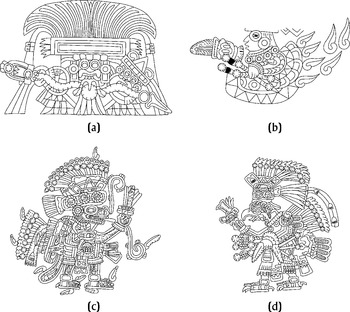
There are numerous examples at Teotihuacan of spiritual entities and/or impersonators wielding dart-throwers. The rain deity shown on the mural in Corridor 21 at the Tetitla compound holds a dart-thrower and an undulating dart that represents a thunderbolt (Figure 7a) (Headrick Reference Headrick2007:127; Miller Reference Miller1973:126; Taube Reference Taube, Carrasco, Jones and Sessions2000:274). This metaphor appears to have remained constant for over a thousand years, as evidenced by Spanish chronicler Diego Durán's identification of the rain deity Tlaloc holding a similar item which was said to be a stroke of lightning (Durán Reference Durán, Horcasitas and Heyden1971:155, Reference Durán and Heyden1994:294; Nuttall Reference Nuttall1891:26–27).
(a) Frontal view of rain god or impersonator with dart-thrower and undulating thunderbolt dart. Mural at Tetitla Corridor 21, Teotihuacan. Redrawn by Elbis Domínguez Covarrubias (after Headrick Reference Headrick2007:Figure 7.2); (b) Warrior with dart-thrower and dart bundle. Mural 3, upper wall, Tepantitla, Patio 9, Teotihuacan. Redrawn by Elbis Domínguez Covarrubias (after Miller Reference Miller1973:Figure 195); (c) Canine warrior with dart bundle and elevated dart-thrower. Portico 1, White Patio, Atetelco, Teotihuacan. Redrawn by Elbis Domínguez Covarrubias (after Headrick Reference Headrick2007:Figure 4.2); (d) Bird warrior carrying darts and holding up dart-thrower. Upper tablero rear wall, Portico 3, White Patio, Atetelco, Teotihuacan. Redrawn by Elbis Domínguez Covarrubias (after Headrick Reference Headrick2007:Figure 4.10).

It is widely recognized that warfare was a significant component of Teotihuacano ideology (Headrick Reference Headrick2007:72; Sugiyama Reference Sugiyama, Hendon and Joyce2004, Reference Sugiyama2005). Its warriors dressed themselves in accoutrements associated with the rain deity, including a pair of rings that circle the eyes, and the deity's primary weapon, the dart-thrower (Headrick Reference Headrick2007:73). At Teotihuacan, the “ways in which warriors hold their atlatls aloft and prominently display their darts conveys the importance of these weapons to their identity” (Figures 7b–7d) (Headrick Reference Headrick2007:73). Perhaps the wearing of accoutrements of deities was a tactic used by warriors and the elite as a form of legitimization, or even establishment, of their elevated social status through ritual linkage with deities. Houston and Stuart (Reference Houston and Stuart1996:289) assert that “the power and mystery of divinity provides the ultimate sanction of worldly authority” and might be dependent on the possession of items and icons of a divine nature. From this perspective, the elite of Teotihuacan did not simply emulate deities, but were attempting to channel divine power by acting as a physical manifestation of them (Houston and Stuart Reference Houston and Stuart1996:299). This would serve to reaffirm their status and power to a wide audience including fellow elites, visitors, and the greater populace.
Through a complex and not yet fully understood set of processes, it appears that a number of prominent motifs from Teotihuacan, such as the dart-thrower, began to spread throughout Mesoamerica during the Early Classic period. Within a pyramid at the minor site of Piedras in Morelos, Mexico, Cook de Leonard (Reference Cook de Leonard, Ekhom and Bernal1971:226, Figure 17) discovered two well-preserved dart-throwers associated with Teotihuacan-style ceramics. In addition, important urban centers, including a host of major Maya sites, also adopted this new set of foreign ideology (Schele and Freidel Reference Schele and Freidel1990).
Prior to the appearance of Teotihuacan-style motifs in the Maya region, it does not appear that the Maya assigned any special symbolic significance to the dart-thrower. This is not to suggest that the Maya did not make utilitarian use of the implement—they must have been aware of it—but rather it simply did not “figure into their politics” (Schele and Freidel Reference Schele and Freidel1990:448, Note 52).
Almost any depiction of a powerful Classic Maya individual reveals that elites in southeastern Mesoamerica were obsessed with advertising their status through self-adornment. A host of sumptuary goods were employed to boast their rank and demonstrate their ability to access rare and exotic materials. Among these were shells, quetzal and macaw feathers, water lilies and other flowers, jaguar pelts, jade beads, pendants, plaques and earflares, as well as finely made spears (Coggins Reference Coggins, Schmidt, de la Garza and Nalda1998). Because Maya rulers did not seem to miss any opportunity to display their power through the use of material culture, the fact that the dart-thrower was not wielded in such a context suggests that it likely had little political and/or ritual value at the time.
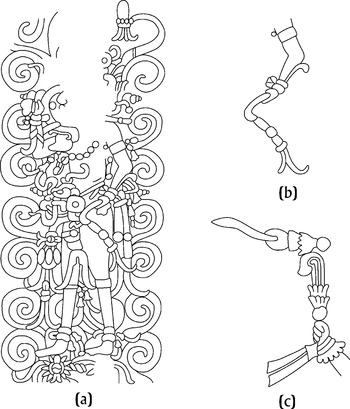
Taube (Reference Taube2004:137–138, Figure 65a–65b) counters this argument by describing stucco ornamentation at the Protoclassic Structure H–Sub 10 at Uaxactun which shows two individuals holding “probable spear-throwers” (Figure 8a). However, the item which is held by the personage in Taube's Figure 65a (Figure 8b) appears to be hooked at both ends, a curious feature not seen in other Mesoamerican dart-thrower imagery. There are also no other elements, such as projectiles, to help contextualize the potential presence of the dart-throwers. On the other hand, in support of Taube's suggestion, the feature protruding from the left-facing hook (as seen by the viewer) resembles a motif present on another possible dart-thrower depicted approximately 13 centuries later in the Codex Vaticanus A (a.k.a. Codex Vaticanus 3738 or Codex Ríos), page 37 (Figure 8c). Ultimately though, assignment of the Structure H–Sub 10 items as dart-throwers is not definitive. Until more concrete evidence is available from this time period in the Maya region, a strong case cannot be made for the presence of the dart-thrower in Maya semasiography before the appearance of Teotihuacan-style imagery.
(a) Detail of Protoclassic stucco ornamentation. Uaxactun, Mexico, Structure H-Sub 10. Redrawn by Elbis Domínguez Covarrubias (after Taube Reference Taube2004:Figure 65); (b) Detail of object held in the left hand of the individual in Figure 16a. Redrawn by Elbis Domínguez Covarrubias (after Taube Reference Taube2004:Figure 65); (c) Detail of dart-thrower. Codex Vaticanus A (a.k.a. Codex Vaticanus 3738 or Codex Ríos). Redrawn by Elbis Domínguez Covarrubias (after Nuttall Reference Nuttall1891:Plate III Figure 4).

Beginning in the fourth and fifth century a.d., Teotihuacan-style motifs begin to appear at a number of Maya sites including Tikal, Uaxactun, Kaminaljuyu, Río Azul, and Copan (Martin Reference Martin and Grube2007a:107; Santley and Alexander Reference Santley, Alexander, Mastache, Parsons, Santley and Puche1996:180–181; Stuart Reference Stuart, Carrasco, Jones and Sessions2000). The catalyst for this influx is unclear, but several scenarios have been proposed. Although an in-depth discussion is outside the purpose of this paper, two hypotheses should be highlighted: first, that Teotihuacan conquered, or at least meddled in the affairs of, a number of Maya sites, or second, that Maya elites appropriated elements of the foreign metropolis as a matter of prestige (Stuart Reference Stuart, Carrasco, Jones and Sessions2000:465).
David Stuart (Reference Stuart, Carrasco, Jones and Sessions2000) cites hieroglyphic evidence as supporting the idea of a Teotihuacano invasion of parts of the Maya region. Stuart (Reference Stuart, Carrasco, Jones and Sessions2000:476–478) interprets inscriptions at Tikal and Uaxactun as stating that a certain personage associated with the west, known as Siyah K'ak' “arrives” at Tikal on 8.17.1.4.12 11 Eb 15 Mac, in the year a.d. 378. Interestingly, the ruler of Tikal, Chak Tok Ich'aak I, also “enters the water” (a Maya metaphor referring to death) this same day (Stuart Reference Stuart, Carrasco, Jones and Sessions2000:478, 507, Note 7). Stuart views Siyah K'ak's arrival as an act of conquest. Siyah K'ak' did not take the throne himself, but instead oversaw the installation of Nun Yax Ayin as ruler. In addition, Stuart (Reference Stuart, Carrasco, Jones and Sessions2000:481–482) identifies the father of Nun Yax Ayin as a lord known as “Spear-Thrower Owl” (who, using the terminology presented in this paper, should be renamed “Dart-Thrower Owl”).
Prior to this time, because the dart-thrower did not appear in any form of Maya graphic communication, Stuart (Reference Stuart, Carrasco, Jones and Sessions2000:482) suggests that this name and associated glyph would not refer to an ethnic Maya individual, and due to the dart-thrower's prominence in the Teotihuacan region, Stuart (Reference Stuart, Carrasco, Jones and Sessions2000:482) believes the name is of highland Mexican origin. Furthermore, the same name appears as the lechuza y armas motif repeatedly depicted on ceramic vessels and medallions worn by warrior figurines at Teotihuacan (Stuart Reference Stuart, Carrasco, Jones and Sessions2000:482–486, Figure 15.18). As such, Stuart surmises that it is possible that “Spear-Thrower Owl” might have been the ruler at this city. Others disagree (Braswell Reference Braswell and Braswell2003:24). Some believe that the “Spear-Thrower Owl” motif was analogous to a Teotihuacano royal coat of arms which might have been adopted by dignitaries from the city (Freidel et al. Reference Freidel, MacLeod, Suhler, Brown and Stanton2003:213). As a note of caution, Stuart (Reference Stuart, Carrasco, Jones and Sessions2000:480) warns that the term “west” associated with Siyah K'ak' is very general and that many rulers have directional glyphs in their names. Nevertheless, Stuart (Reference Stuart, Carrasco, Jones and Sessions2000:479–480) also points out that Siyah K'ak' did indeed come from the west—his presence is recorded at the site of Waka' (located about 70 km west of Tikal) on a monument dated eight days prior to his recorded arrival at Tikal.
Was Siyah K'ak' from Teotihuacan or was he from another locale that had adopted Teotihuacan-style traits? Did he arrive as a conqueror, emissary, merchant, or with some other agenda? These questions are still open for debate, but what is clear is that after his arrival, a new set of motifs, including the dart-thrower, appear in Maya graphic communication and material culture. Perhaps this new set of signs was forced upon the Maya, but it is also likely that the Maya adopted Teotihuacan-style motifs as a means of associating themselves with the mystique and prestige of this powerful foreign metropolis. The fact that this imagery still appeared in the Maya region after the collapse of Teotihuacan in the mid-sixth century (Houston and Stuart Reference Houston and Stuart1996:299; López Luján et al. Reference López Luján, Filloy, Fash, Fash and Hernández2004; Stuart Reference Stuart, Carrasco, Jones and Sessions2000:466, 490) bespeaks its significance and lasting role in the Maya graphic communications system.
Mary Helms' 1993 discussion of the cross-cultural significance of foreign and exotic materials and ideas might explain the appropriation by the Maya, and other Mesoamerican cultures, of Teotihuacan-style motifs such as the dart-thrower. She states that
acts of long-distance acquisition [of items or ideas] associate the cultured, socialized home society not with other units within a known human world but with a different spatial/temporal order of things; with outside places that are regarded as distant from the home society and that are significant because they are accorded a cosmological connotation of one sort or another. (Helms Reference Helms1993:96; note added)
and that
long distance acquisition involves bringing crafted or natural things from some place outside society across some degree of geographic-cum-cosmological distance to a home locale, crossing a cultural threshold from a more or less unknown or exotic or mystical realm outside to the ordered social heartland inside where instructive qualities and symbolism accrue to the goods procured. (Helms Reference Helms1993:105)
Foreign materials, ideas, and even people can be construed as coming from a different spatial or temporal realm of existence (Helms Reference Helms1993:32). Although some “traditional cultures” share a similar view of the vertical axis with Western cultures (i.e., the existence of an upper- and underworld), many “traditional cultures” hold the horizontal axis of the cosmos, as represented by distant regions, in much the same mystique (Helms Reference Helms1993:44, 97). Furthermore, outside of Western culture, there is often not such a clear-cut line between the temporal domains of past, present, and future, which may be traversed along with the horizontal and vertical axes of the cosmos.
By utilizing foreign motifs and being outfitted in clothing and paraphernalia construed as coming from outside the known cultural world, it appears that the Maya were connecting with the spiritual and mythic realms of both time and space (Helms Reference Helms1993:44, 118), while demonstrating an understanding of pan-Mesoamerican religious ideology and their ability to participate in long-distance exchange networks (Fash Reference Fash1994:185). This echoes Houston and Stuart's (1996:289) position that the association of an elite individual with spiritual entities, coupled with the possession of items and icons of a divine nature, served to legitimize one's position of power and authority. Regardless of the processes by which certain Teotihuacan-style motifs became part of the cultural matrix of the Maya, such ideas and goods served to associate elites with a new order of power. Furthermore, although diverse cultures would have retained many individual characteristics, certain symbols and items might have existed within a shared system whereby ideas and goods were exchanged and exploited across cultural boundaries to create a recognizable, distinctively elite character. Those participating in such a network could quickly distinguish themselves as superior in their respective social, political, and religious hierarchies (Joyce and Winter Reference Joyce and Winter1996:42).
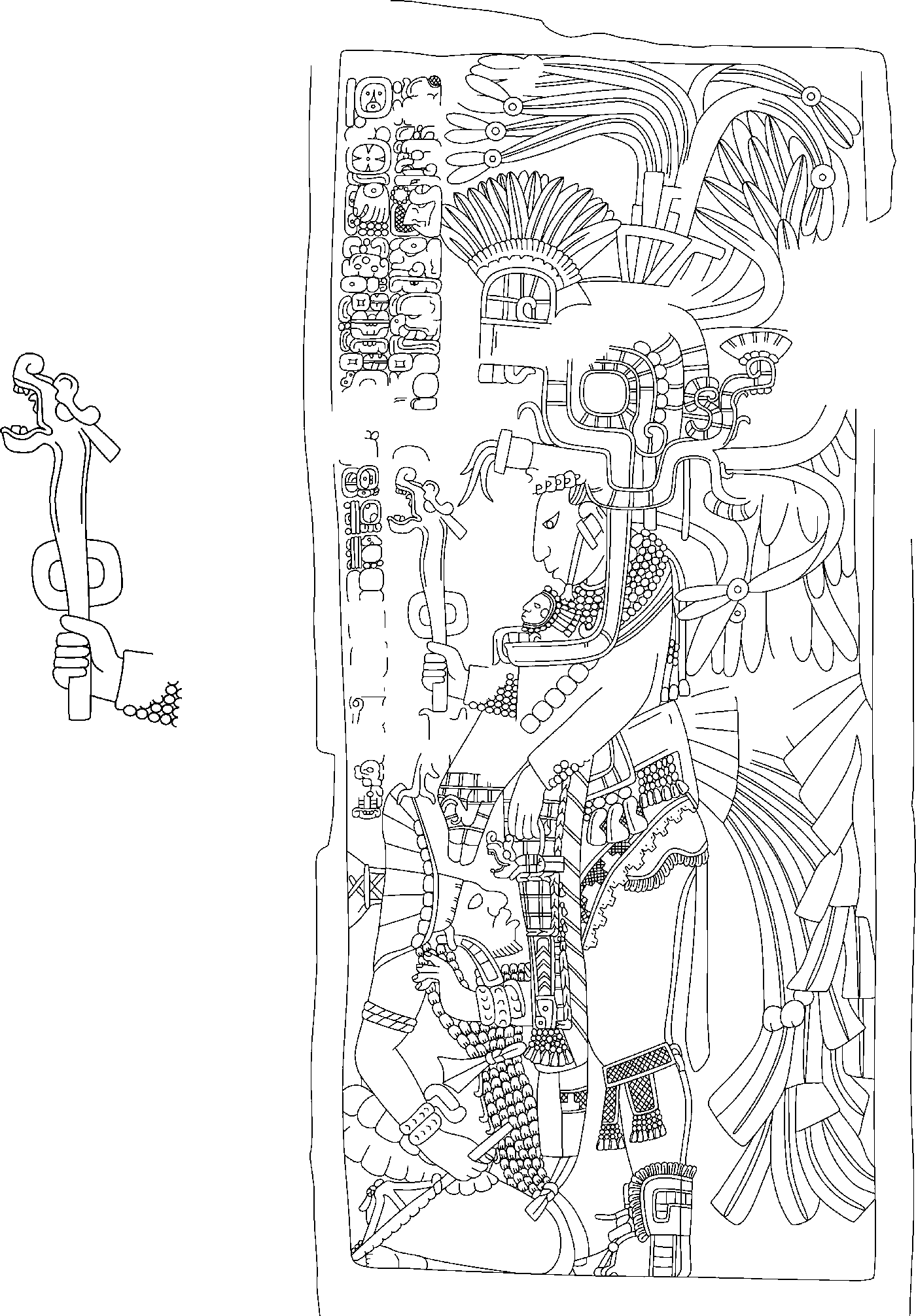
Although only shown semasiographically in association with one individual at Tikal (Stuart Reference Stuart, Carrasco, Jones and Sessions2000:484), the dart-thrower figures prominently in this new complex of symbology across the Maya region. On Stela 31, two images of Nun Yax Ayin flank a portrait of his son, Siyah Chan K'awiil II, who acceded to the throne following the reign of his father (Martin and Grube Reference Martin and Grube2008:35). Although the central character, Siyah Chan K'awiil II, is shown in attire more common to the Maya area, his father's dress is in central Mexican style (Figure 9a) (Martin and Grube Reference Martin and Grube2008:32). According to glyphic evidence, Siyah Chan K'awiil II's mother is said to be local to the Tikal area, so it appears that the new lord represented perhaps a purposeful fusion of foreign and local lineages (Martin and Grube Reference Martin and Grube2008:32). On Stela 31, his local-style dress would serve to establish himself and gain approval within the local culture, whereas his association with his father's central Mexican attire would further legitimize his accession to the throne by displaying his connections with mystic and powerful foreigners—a common goal of many Classic Maya rulers (Fash and Fash Reference Fash, Fash, Carrasco, Jones and Sessions2000:451).
(a) Nun Yax Ayin holding dart-thrower at chest level. Detail from Tikal Stela 31. Redrawn by Elbis Domínguez Covarrubias (after Martin and Grube Reference Martin and Grube2008:35); (b) Ruler holding dart-thrower in his left hand while grasping a club studded with obsidian blades in his right hand. Uaxactun Stela 5. Redrawn by Elbis Domínguez Covarrubias (after Schele and Freidel Reference Schele and Freidel1990:Figure 4:15).

A stela at Uaxactun also demonstrates the appearance of Teotihuacan-style imagery and dart-thrower use in the Maya area. On Stela 5, an individual is shown in Teotihuacan-style garb wielding a dart-thrower and an obsidian blade studded club (Figure 9b). Schele and Freidel (Reference Schele and Freidel1990:146) postulate that the figure is none other than Siyah K'ak', but Martin and Grube (Reference Martin and Grube2008:30) later demonstrate that inscriptions on the stela name the figure as a ruler installed by Siyah K'ak', much in the same manner as was Nun Yax Ayin at Tikal. In fact, Siyah K'ak' might have performed similar actions at the sites of Bejucal, Río Azul, and speculatively at Palenque and Copan (Martin and Grube Reference Martin and Grube2008:30, 156, 196).
The Teotihuacan-style warrior outfit, such as that shown on Stela 5 at Uaxactun, has been dubbed the “Tlaloc-Venus” costume by Schele and Freidel (Reference Schele and Freidel1990:147). Such attire consisted of a “balloon shaped headdress,” owls, a shield, and a dart-thrower and became the standard uniform of the “king as conqueror and warrior” (Schele and Freidel Reference Schele and Freidel1990:146, 443–444, Note 45). Schele and Freidel affirm that the costume “came to have an overwhelming association with war and sacrifice” across Mesoamerica.
Heads of state presenting themselves as warriors is a common strategy used to assert power, political prowess, and prestige. This practice can still be seen in the modern era, particularly among dictators. Prior to his recent overthrow, Saddam Hussein was often depicted in state-sponsored propaganda while wielding a gun. He also dressed in military garb for public appearances as did Adolf Hitler, Benito Mussolini, and a host of other authoritarian rulers. Such analogous use of attire by the Maya not only invoked the spiritual realm through its foreignness, but prominently displayed weapons were also a means of intimidation. By making their prowess as warriors abundantly clear, rulers placed themselves in an elevated position of power.
Although other instances of individuals represented in Teotihuacan-style attire occur within the Maya region, in many cases only select elements were used, or “reproduced,” in Maya culture. Marshall Sahlins (Reference Sahlins1981:31–32) describes reproduction as occurring when certain elements are introduced into a culture whereby the “content of the system changes, but not its norms.” One example of this is shown on a Classic Maya codex-style vessel depicting a deer hunt (see Kerr Reference Kerr2007:K5857). With the exception of the depiction of dart-throwers and darts, which replaced earlier hand-held spears, the physical structure, semasiography, and hieroglyphic inscription of this vessel make no allusion to central Mexican form (Martin Reference Martin and Grube2007b:180). The “norms” of the vessel style had not changed, but the content, in this case the inclusion of dart-throwers, had been altered.
THE TERMINAL CLASSIC/EPICLASSIC AND POSTCLASSIC PERIODS
Although there are many depictions of the dart-thrower throughout Classic period Mesoamerica, they appear with even higher frequency at the end of this period and on through the Postclassic. Throughout Mesoamerica there seems to be an increased focus on militarism at this time, as illustrated in state-sponsored graphic communication (Hendon Reference Hendon, Hendon and Joyce2004:297). Because dart-throwers had already become an important component of warfare throughout the region with the spread of Teotihuacano ideals, they are featured prominently in Epiclassic and Early Postclassic battle scenes. With the decline of Teotihuacan, the great city's influence within the Maya realm waned after the Early Classic (but related motifs and ideals had since been firmly ingrained into Maya ideology and semasiography). However, at the end of the Classic period and into the Terminal Classic and Early Postclassic, central Mexican influence was again felt (Coggins and Ladd Reference Coggins, Ladd and Coggins1992:253; Hendon Reference Hendon, Hendon and Joyce2004:302).
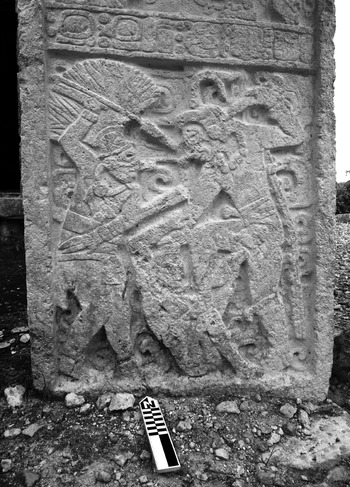
The western Maya site of Seibal appears to have been a locus of such influence. Stelae at the site depict rulers in conjunction with newly appearing foreign elements such as wind deity buccal masks (López Austin and López Luján Reference López Austin, Luján, Carrasco, Jones and Sessions2000:53).Footnote 1 In the Puuc region, at the site of Kabah, war scenes featuring the dart-thrower are also present. Carved on door jambs on Structure 2c-6, warriors wearing rain god goggles, some of whom hold dart-throwers, are shown in scenes of conquest and captive taking (Figure 11).
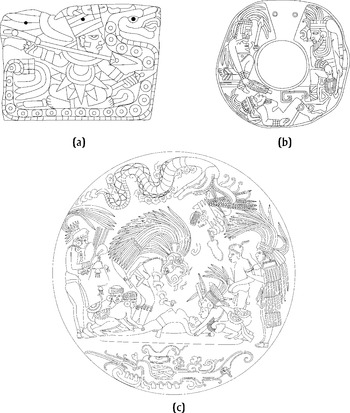
Research at Chichen Itza, noted for its fusion of local and Mexican motifs, has brought to light a great number of depictions of dart-throwers on a variety of media. Few sites can be shown to have displayed the dart-thrower in as many ways. Architectural features such as murals, panels, lintels, and columns depict vivid scenes of dart-thrower wielding warriors. Semasiography on items dredged from the site's Main Cenote, including gold and jade discs and jade beads and plaques, also show warriors with dart-throwers—some of whom are engaged in battle and captive taking (Figure 12) (see also Lothrop Reference Lothrop1952; Proskouriakoff Reference Proskouriakoff1974; Tozzer Reference Tozzer1957). In one particularly vivid scene on Gold Disk H, an ancestor or deity brandishing a dart-thrower emerges from the mouth of a plumed serpent as it floats above a ritual practitioner engaged in an act of human sacrifice (Figure 12c).
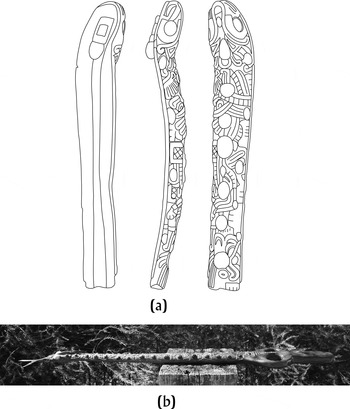
Significantly, portions of a number of the nine dart-throwers recovered from the Main Cenote by Edward H. Thompson (Coggins Reference Coggins, Chase and Shane1984:46, 103, 104, 108; Coggins and Ladd Reference Coggins, Ladd and Coggins1992:244–253) depict ornate serpents, including an example which must have been inlaid with precious stones (Figure 10a). A representation of a similar serpent dart-thrower, complete with finger-loops (Martin Reference Martin and Grube2007a:Figure 162; Taube Reference Taube, Carrasco, Jones and Sessions2000:Figure 10.17b), is shown in the context of the unequal power relation between captor and captive on Bonampak's Stela 3 (Figure 13). It is worth noting that the dart-thrower is not grasped through the finger loops, but instead is held up like a baton. The dart-thrower's prominent location in such a scene, and the presence of other examples as offerings at the Main Cenote of Chichen Itza, certainly emphasize their use as symbols of power, prestige, and ritual significance.
(a) Partial serpent dart-thrower. Main Cenote, Chichen Itza. Redrawn by Elbis Domínguez Covarrubias (after Coggins and Ladd Reference Coggins, Ladd and Coggins1992:Figure 8.18); (b) Interpretive replica of Figure 9a. Produced by Bob Berg. Photo by Donald A. Slater.

Carved door jamb depicting two warriors and a captive. The warrior to the left holds a dart bundle and an elevated dart-thrower. Kabah Structure 2c-6. Photo by Donald A. Slater.

(a) Jade plaque with warrior holding dart-thrower and extra dart. Main Cenote, Chichen Itza. Drawn by Elbis Domínguez Covarrubias (after Proskouriakoff Reference Proskouriakoff1974:Color Plate II); (b) Jade pendent with warriors and captive. The warriors carry darts and dart-throwers. Main Cenote, Chichen Itza. Redrawn by Elbis Domínguez Covarrubias (after Proskouriakoff Reference Proskouriakoff1974:Plate 48); (c) Gold Disk H depicting an individual wielding a dart-thrower while emerging from a plumed serpent floating above a sacrificial scene. Main Cenote, Chichen Itza. Redrawn by Elbis Domínguez Covarrubias (after Lothrop Reference Lothrop1952:Figure 1).

Ruler Yajaw Chan Muwaan stands over a captive. The ruler brandishes a serpent dart-thrower and wears a Teotihuacano style headdress. Bonampak Stela 3. Redrawn by Elbis Domínguez Covarrubias (after Martin Reference Martin and Grube2007a:Figure 162).

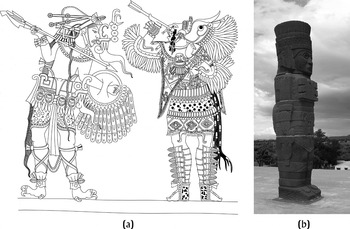
Outside the Maya region, on a mural at Cacaxtla, Mexico, warriors are shown clad in raptor and jaguar costumes participating in fierce battles. The paramount figure in the murals of Building B-sub, named Three Deer, is shown in one scene ready to launch a dart while confronting an enemy who attempts to remove a dart embedded in his cheek (Figure 14a). Three Deer's recognition as the key personage in the murals is supported by Hirth's (1989:73) assertion that the highest ranking individual in a scene is usually associated with imagery connected with the rain god. As the delivery mechanism for thunderbolts, the dart-thrower is clearly connected with this deity. Three Deer also wears rain deity masks in front of his face and at his waist, and a Trapeze-Ray sign at the back of his headdress. To index their military rank, individuals wore symbolically loaded attire when taking to the battlefield (Hirth Reference Hirth, Diehl and Berlo1989:77). Therefore, since the primary figure in the mural is shown wielding a dart-thrower, it is likely that this implement was construed as an important symbol of power at Cacaxtla. At the slightly later Toltec site of Tula, dart-throwers take center stage as a symbol of power, as they appear as the primary weapon wielded by the Atlantean warriors (Figure 14b) at the summit of Pyramid B, perhaps the most significant building at the site.
(a) Detail from mural depicting a battle scene. Building B, Cacaxtla. Drawing by Elbis Domínguez Covarrubias; (b) Column representing a warrior holding a dart-thrower at his side. Pyramid B, Tula. Photo by Donald A. Slater.

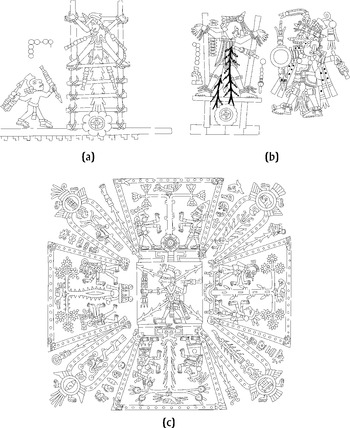
In Mesoamerican warfare, the acquisition and subsequent sacrifice of captives was a crucial responsibility of the elite (Schele and Miller Reference Schele and Miller1986:220). In sacrificial rituals the elite would serve as intermediaries between the spirit realm and the world of the living, whereas the sacrificial captives and their blood served as the vehicle of communication (Schele and Miller Reference Schele and Miller1986:14, 186). As a weapon of war, the dart-thrower figured prominently in the acquisition of captives, and was also used, on occasion, as the mode of sacrifice as shown in Late Postclassic codices such as Iya Nacuaa (a.k.a. Becker I) (Figure 15a) and Tonindeye (a.k.a. Nuttall) (Figure 15b). Furthermore, warriors are also connected with the establishment of tribute relations from conquered polities (Hirth Reference Hirth, Diehl and Berlo1989:75). The dart-thrower's association with such significant ritual and the accrual of wealth further imbued the implement with symbolic value.
(a) Depiction of an individual darting a captive bound to a scaffold. Detail from Codex Iya Nacuaa (a.k.a. Becker I), page 10. Reconstruction drawing by Elbis Domínguez Covarrubias (after Foundation for the Advancement of Mesoamerican Studies 2008); (b) Similar scene of captive darting. Codex Tonindeye (a.k.a. Nuttall Codex) pages 83–84. Redrawn by Elbis Domínguez Covarrubias (after Anders, Jansen and Perez Jiminez 1992); (c) Dart-thrower wielding deity Xiuhtecuhtli at the center of the cosmos. First page of Codex Tezcatlipoca (a.k.a. Codex Fejérváry-Mayer). Redrawn by Elbis Domínguez Covarrubias (after Burland 1971:1).

The dart-thrower retained its significance during the Late Postclassic period as it continued to appear in graphic communication across Mesoamerica, including both Mexican and Maya codices. In such contexts, a strong association with the divine clearly continues during this period, as deities brandish the dart-thrower more frequently than any other weapon (Hassig Reference Hassig1988:75). Sahagún (Reference Sahagún, Anderson and Dibble1970:43) records that the Aztecs believed that their deity Opochtli invented the implement as part of a tool kit that includes the boating pole, trident, nets, and ropes. The dart-thrower's use by the Aztecs to dart fish and water fowl might also explain its Nahuatl name, atlatl, or “water-thrower” (Nuttall Reference Nuttall1891:12–13).
The dart-thrower is often shown in association with Aztec deities including, but not exclusive to, Xiuhtecuhtli, Huitzilopochtli, Tezcatlipoca, Mixcoatl, (Nuttall Reference Nuttall1891:24–25; Quiñones Keber Reference Quiñones Keber1995:145–146), Quetzalcoatl, Tlaloc (Nuttall Reference Nuttall1891:24–27; Teufel Reference Teufel, Moctezuma and Olguín2002:478), and Tlahuizcalpantecuhtli (Seler Reference Seler1904:54). Its importance as a symbol of power is clear on the first page of the Codex Tezcatlipoca (a.k.a. Fejérváry-Mayer), through its prominent position at the center of the cosmos as wielded by Xiuhtecuhtli (Figure 15c) (Seler Reference Seler1901:1). The dart-thrower's significance is further demonstrated by Sahagún (Reference Sahagún, Anderson and Dibble1970:67), who recorded the following poetic couplet for the deity Huitzilopochtli's initiation of battle: “he cast at men the turquoise serpent, the fire drill – war.” The turquoise serpent, or Xiuhcoatl, is the dart-thrower, whereas the fire drill is the dart. Durán's (1971:73; Nuttall Reference Nuttall1891:23) description of Huitzilopochtli's “idol in the great temple of Mexico” holding “in the right hand what resembled a bishop's crosier, made in the shape of a serpent, all blue, with undulations—in the left a shield and four arrows or spears” certainly refers to a dart-thrower.
In an attempt to associate themselves with divine power, individuals wielding dart-throwers are shown as impersonators of deities. An excellent example is featured in the Tonindeye Codex (a.k.a. Nuttall Codex) on pages 83 and 84 where Mixtec culture hero Eight Deer is dressed as Mictlantecutli as he ritually darts a captive bound to a scaffold (Figure 15b). Apparently, it was also important to associate with such divine figures in death. A large ceramic urn excavated from Offering 14 in front of Huitzilopochtli's section of the Templo Mayor Stage IV(b) shows a representation of Tezcatlipoca holding a dart-thrower (Matos Moctezuma Reference Matos Moctezuma, Moctezuma and Olguín2002:469, Number 279). Inside were found the cremated remains of individuals, interpreted as warriors, along with obsidian beads in the shape of duck heads, an obsidian point, two tubular beads, and a perforator. A similar urn excavated nearby in the vicinity of the Coyolxauhqui monolith (Matos Moctezuma Reference Matos Moctezuma, Moctezuma and Olguín2002:469) depicts Mixcoatl, patron of warfare and hunting, wielding a dart-thrower.
The dart-thrower might have also materialized divine power through its connection with celestial phenomena and cosmology. It has been previously mentioned that in Mesoamerica the dart-thrower is believed to be the delivery method for thunderbolts. In addition, meteors are often said to be “celestial darts” and/or arrows (Taube Reference Taube, Carrasco, Jones and Sessions2000:296). Obsidian dart points and other objects found on the ground are still thought by some Mesoamerican people to be the remnants of these otherworldly projectiles (Taube Reference Taube, Carrasco, Jones and Sessions2000:296). Variations of these views are today held by numerous cultures including the Aztec, Mixtec, Huastec, Nahuas of Veracruz, Huichol of Nayarit, and Maya groups such as the Tzotzil and Quiche (Taube Reference Taube, Carrasco, Jones and Sessions2000:296–299). Certainly, as the object from which lightning and shooting stars emanate, the dart-thrower was construed as a symbol of celestial power by the indigenous people of Mesoamerica. In addition, Urcid (Reference Urcid and Evans2010) has recently identified a scene carved into a Late Postclassic dart-thrower which depicts a voladores ceremony, an activity he has demonstrated is linked with dart/scaffold sacrifice and is clearly a ceremonial enactment which represents the quinquepartite layout of the cosmos.
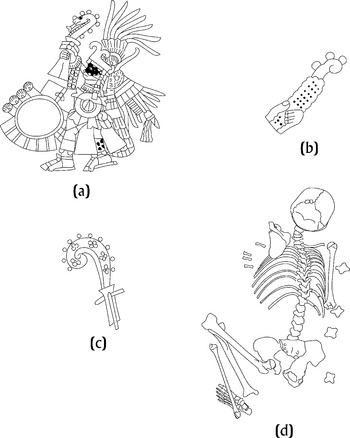
The Xiuhcoatl, used by so many Aztec deities, is often shown with circular and/or cruciform appendages interpreted as stars (Figure 16a and 16c) (Johnson Reference Johnson1971:192–193; Taube Reference Taube, Carrasco, Jones and Sessions2000:297), based on Sahagún's (1975:12) record of a “curved staff of the wind god, hooked at the top, overspread with white green stone stars.” This motif can be traced back to Classic period dart-throwers (Figure 16b) (Taube Reference Taube, Carrasco, Jones and Sessions2000:297). Such cruciform objects have also been discovered in burial context at Cuicuilco and a number of northern Mexican sites (Figure 16d) (Hughes Reference Hughes1956; Johnson Reference Johnson1971) and have been identified by Johnson (Reference Johnson1971:190–191) as potential decorative elements of dart-throwers. She draws her conclusion from a number of factors, including: (1) the objects' linear distribution alongside the deceased individual; (2) the appropriate length of the decayed dart-thrower based on the spacing of the “stars;” and, (3) although the analyzed sample size is small, for each skeleton where a sexual determination was feasible, the individual was male. As the Huitzilapa shaft-tombs (López Mestas Camberos and Ramos de la Varga 1998:60; Pickering and Cabrero Reference Pickering, Cabrero and Townsend1998:74) and a survey of dart-throwers in Mesoamerican representational systems demonstrate, the implement has a clear association with the socially assigned masculine activities of hunting and warfare.
(a) Huitzilpochtli displaying a star-studded serpent dart-thrower. Codex Ciuacoatl (a.k.a. Codex Borbonicus), page 34. Redrawn by Elbis Domínguez Covarrubias (after Taube Reference Taube, Carrasco, Jones and Sessions2000:Figure 10.17a); (b) Dart-thrower with star motifs from ball court marker. Mundo Perdido, Tikal. Redrawn by Elbis Domínguez Covarrubias (after Taube Reference Taube, Carrasco, Jones and Sessions2000:Figure 10.17d); (c) Dart-thrower with cruciform stars depicted by Sahagún. Redrawn by Elbis Domínguez Covarrubias (after Nuttall Reference Nuttall1891:24, Plate III); (d) Burial with four linearly arranged cruciform stars. Burial 4, Cuicuilco, Mexico. Drawn by Elbis Domínguez Covarrubias (after Hughes Reference Hughes1956:Figure 1).

Spaniards arriving in Mesoamerica quickly became aware of the dart-thrower and its status as a symbol of power, as well as its effectiveness as a weapon of war. Eight dart-throwers (not all of which were identified as such by the Spaniards) (Nuttall Reference Nuttall1891:22) were selected among the items Moteuczoma presented to Cortés as gifts, including one from his “array of Quetzalcoatl” that was commissioned especially for this purpose and was made “entirely of turquoise with a sort of serpent's head” (Sahagún Reference Sahagún, Anderson and Dibble1975:11–12). If Sahagún (Reference Sahagún, Anderson and Dibble1975:5) is correct in his account that Moteuczoma believed that Cortés was Quetzalcoatl, certainly Moteuczoma would have presented him with only the finest and most prestigious gifts, such as ornate dart-throwers.
After the pleasantries of initial contact had waned, and the Aztec discovered the foreigners' true intentions, the Spanish soon learned of the effectiveness of the dart-thrower as a weapon. According to Spanish chronicler Bernal Díaz de Castillo (Reference Díaz del Castillo and Maudslay1908:285), Tlaxcalan caciques informed the Spaniards of the arms of the Aztec, including “two-pronged javelins which they hurl with throwing sticks and will go through any sort of armour.” Moreover, the barbed projectile points that the Aztec employed were particularly feared because they could not be pulled out, but instead needed to be “cut out or pushed out the other side” (Durán Reference Durán and Heyden1994:120). Despite the Spaniards' use of firearms, crossbows, cannons, and trebuchets during the Conquest (Sahagún Reference Sahagún, Anderson and Dibble1975), had infectious disease not hindered the Aztec's ability to defend themselves, the use of the dart-thrower, coupled with other factors such as a much larger army, might well have been enough to defeat the invaders.
CONCLUSION
This paper argues that the dart-thrower played an important role as a symbol of power throughout the deep history of Mesoamerica. First used as a hunting tool, the implement took on a variety of new meanings during the ensuing millennia. It served as a powerful representation of foreign “otherness,” the main weapon of military conquest, and metaphorically as the celestial source of thunderbolts and meteors. Used by rulers and warriors to impersonate deities and foreign and ancestral lords, the dart-thrower was viewed as a powerful conduit to other temporal and spatial realms of the horizontal and vertical axes of the cosmos. With other key symbols of power, the dart-thrower demonstrated connectedness with pan-Mesoamerican religious and political ideology and ultimately served as an important vehicle of authoritarian legitimization.
Epilogue: A Commentary on the Functionality of “Ceremonial” Dart-Throwers
One of the main goals of this paper is to demonstrate that the dart-thrower was not merely a utilitarian tool. It should be noted, however, that it was also unlikely that many dart-throwers were purely ceremonial. In fact, it may be argued that all dart-throwers, even the most ornate, could serve as functional weapons and might have been used as such (Urcid Reference Urcid2006, Reference Urcid and Evans2010). In spite of this, more often the opposite has been argued regarding a number of Mesoamerican examples.
When examining inventories of gifts provided to Cortés by Moteuczoma as recorded by Sahagún, Nuttall (Reference Nuttall1891:23) states that the various dart-throwers “of eccentric shape, costly materials and elaborate decoration were certainly intended to be more ornamental than useful.” By using the phrase “more ornamental than useful,” she is leaving open the possibility of functional use, but there is still no reason to assume that a highly decorated dart-thrower must be predominantly ceremonial. Commenting on the same collection of dart-throwers, Hassig postulates that they were only “used” on ritual occasions, but does not explain how they would have been used. Citing Mixtec dart-throwers published by Saville (Reference Saville1925), Covarrubias (Reference Covarrubias1957:307) claims that they are “all too fine and delicate for practical use.” Nevertheless, it has been demonstrated above that warriors took great pride in their appearance on the battlefield. A visually stunning weapon, perhaps carved in the shape of a serpent and bejeweled in jade, turquoise and shell, might have been quite appropriate on the battlefield. Would not even the most ornate dart-thrower contain the necessary components to render it a functional weapon?
There is no better way to investigate this matter than to employ experimental archaeology. To demonstrate my position, I obtained finely crafted replicas of two highly ornamented Mesoamerican dart-throwers. The first is a reproduction (Figure 10b) of a thrower that was dredged from the Main Cenote at Chichen Itza. Because only the distal end of the artifact remained intact, I commissioned Bob Berg of the Thunderbird Atlatl Company to reproduce the grip at the proximal end in a manner consistent with one of several types known to be used in ancient Mesoamerica. I suggested that jade inlay might have been used on the original, so Berg added this detail as well as additional feather adornments based on his interpretation. More importantly, Berg designed the dart-thrower to replicate the off-centered alignment of the original item's hook. This feature, according to Coggins and Ladd (Reference Coggins, Ladd and Coggins1992:248), impeded the dart-thrower's (and other similar examples') functional use, thus rendering it a purely ritual object. Yet in testing neither the off-center alignment of the hook, nor the dart-thrower's ornamentation, got in the way of its performance. It functioned no differently than other dart-throwers which I have used.
Another intriguing example of a dart-thrower was published by Bushnell in 1905 which he thought was “not intended for actual use.” This intricately carved and gilded example is quite unique, as it is “double-barreled” (Bushnell Reference Bushnell1905:220, Plate XXII). With two grooves and two distal pins, this thrower would have the ability to launch two darts at once. But would it work? Several years ago, dart-thrower enthusiast and craftsman Gary Nolf produced a replica of this piece (Figure 17a). I recently borrowed the dart-thrower to perform a few simple tests to determine its functionality. The following results were observed:
• Because of the added weight of two darts, the whole assemblage has a different feel than other, more conventional, setups.
• Because of the extra weight, more power must be exerted to launch the darts.
• It was slightly awkward to load and steady two darts simultaneously.
• After only a few attempts, however, all of the above factors were promptly negated.
• With only several minutes of use, I quickly obtained consistent results and soon achieved a simultaneous score of 10 out of 10 with one dart and 8 out of 10 with the other on an International Standard Accuracy Competition dart-thrower target from a range of approximately 15 m (49 ft) (Figure 17b). The darts were separated on the target by a mere 20.3 cm (8 in).
• Upon launch, the darts' physical motions are almost identical to one another. They flex and fly in relative synchronicity (Figures 17c and 17d) and can be accurately directed by the thrower towards the same desired target.
Based on this experiment, it would seem that although this dart-thrower might at times have served as a non-functional display piece in processions or ceremonies, it was also a very dangerous and doubly effective weapon that could be used for dart sacrifice, battle, and/or hunting.
(a) Double barrelled dart-thrower. Replica by Gary Nolf. Photo by Donald A. Slater; (b) Target showing close grouping of darts launched simulataneously from double-barreled dart-thrower. Photo by Donald A. Slater; (c) Darts just before launch with a double-barreled thrower. Photo by Malinda Stafford Blustain; (d) Dart flying synchonically toward the target after launch with double-barreled thrower. Photo by Malinda Stafford Blustain.

A similar experiment should be conducted regarding the greenstone specimens held by Dumbarton Oaks. These are also often dismissed as non-functional ceremonial pieces (Lothrop et al. Reference Lothrop, Foshag and Mahler1957:235; Taube Reference Taube2004:137, 139). It is unlikely that the larger example (B-33.OJ) could have been used to launch a dart. Its fragile multi-component construction might not have been able to withstand the force of throwing a dart and its tiny finger loops (approximately 8 mm in diameter) might be too small to accommodate even a child's grip. The second and smaller of the two greenstone dart-throwers (B-32.OJ) is said to be non-functional because it is too short at 33 cm and a horizontally-drilled hole might imply that it was meant to be hung as an ornament (Lothrop et al. Reference Lothrop, Foshag and Mahler1957:235; Taube Reference Taube2004:137).
It is a fair assessment that B-32.OJ was used as a hanging ornament, but it is also reasonable to suggest that such a function does not preclude its actual use as a dart-thrower. Although the dart-thrower is indeed shorter than average, it is still large enough to function properly and its squat and robust construction suggests that it could survive the stress of propelling a dart. In fact, functional dart-throwers of similar length are currently sold by the Thunderbird Atlatl Company for use by children. I have experimented with these items and they work perfectly well even for adults.
The best way to support/refute the above arguments would be for an artisan to produce replicas of these items for experimental purposes. Unfortunately, to locate a piece of greenstone large enough to manufacture a dart-thrower might be logistically and cost prohibitive. To punctuate this point, the larger greenstone dart-thrower represents the longest known jade artifact yet found in Mesoamerica (Lothrop et al. Reference Lothrop, Foshag and Mahler1957:235). However, these problems might be avoided by producing replicas from a stone that is of similar grain composition, density, weight, and Mohs Scale hardness.
Last, as discussed above, dart-throwers with bilobal, apparently soft, appendages should also be constructed and tested. Do they perform a physical function such as weight distribution or noise reduction or do these features instead serve some unknown symbolic meaning?
The above experiment demonstrates that future assessments of highly ornate dart-throwers should not be so quick to dismiss such implements as non-functional without first gathering experiential data. Indeed, the results of initial experiments, coupled with the desire of elite Mesoamerican warriors to adorn themselves with the finest possible regalia, suggest that elaborate dart-throwers certainly could have simultaneously served as ceremonial and functional weapons.
RESUMEN
A través del largo pasado de Mesoamérica, el lanza-dardos (nahuatl atlatl) fungió un papel utilitario y simbólico muy importante. Aunque fue una herramienta altamente eficaz en usos prácticos como la cacería y la guerra, existe amplia evidencia que revela su asociación con temas de autoridad, poder y prestigio.
La evidencia indirecta sobre el uso temprano del lanza-dardos en Mesoamérica (en forma de puntas de proyectil) se remonta a finales del Pleistoceno en lugares donde se ha documentado la cacería de mamuts, como Iztapan, en la cuenca de México. No obstante, no es sino hasta el período formativo medio cuando aparece evidencia inequívoca del uso del lanza-dardos como un marcador de estatus social.
Comúnmente equiparado con la imaginería Teotihuacana, ahora se sabe que el lanza-dardos comienza a representarse en la comunicación grafica varios cientos de años antes del apogeo de esta gran urbe. Sin embargo, las elites de Teotihuacan bien podrían haber sido el catalizador para la transmisión extensiva del uso simbólico del lanza-dardos a través de Mesoamérica. En el área Maya, por ejemplo, no hay evidencia clara de que el instrumento fungiera como marcador de estatus sino hasta el período clásico temprano y como parte de una constelación de motivos en estilo Teotihuacano. Al igual que la imaginería relacionada, como es el caso de las mascaras del dios de la Lluvia, el lanza-dardos persistió en el sistema representacional Maya mucho después del colapso político de Teotihuacan. Todavía duránte la conquista española, el lanza-dardos continuó siendo un arma importante y un símbolo de estatus a pesar del advenimiento del arco y la flecha. La imaginería del lanza-dardos abunda en los sistemas gráficos del Postclásico Tardío, incluyendo los códices Mayas y del altiplano central. Más aún, lanza-dardos muy elaborados se incluyeron entre las piezas que Moteuczoma le entregó a Cortés como regalos suntuarios.
Mediante un análisis de la evidencia arqueológica y etnográfica, este trabajo demuestra el papel del lanza-dardos en la producción, despliegue y legitimación de estatus social privilegiado en Mesoamérica a través del tiempo y del espacio. Como epílogo se describen unos breves experimentos que se hicieron utilizando replicas de dos lanza-dardos altamente decorados para demostrar que estos implementos fueron completamente funcionales, por lo que no deben considerarse exclusivamente como objetos ceremoniales, como frecuentemente se ha argumentado. Al contrario, además de su uso ritual, los lanza-dardos decorados debieron ser armas de guerra muy efectivas que simultáneamente exaltaban en batalla el estatus del usuario.
ACKNOWLEDGMENTS
I would like to express my sincere gratitude to a number of individuals and organizations for their support. My advisor, and fellow dart-thrower scholar/enthusiast, Javier Urcid, was instrumental in encouraging and guiding me in the production of this paper. Support, in numerous forms, from Malinda Stafford Blustain and Charles Golden has also been invaluable. Thanks to Elbis Domínguez Covarrubias for lending her artistic talent in drafting most of the figures in this paper, to Travis Stanton and Aline Magnoni for also providing helpful comments on earlier drafts, and to Jane Libby for her editorial expertise. Thanks to article reviewers David Webster, Nicholas Waber, and an anonymous individual for their insightful and valuable suggestions. Thanks again to Javier Urcid for translating my abstract into Spanish. Despite all of the support I received from the above individuals, I bear all responsibility for any errors contained in this paper.
I am grateful for Bob Berg's and Gary Nolf's superb craftsmanship in producing reproductions of two dart-throwers used for experiments reported in this paper. I would also like to thank Marshall Cloyd, Bonnie Sousa, Lindsay Randall, Marla Taylor, Gene Winter, the Robert S. Peabody Museum of Archaeology volunteers, Mark Cutler, and the faculty, staff, and graduate students of the Anthropology Department at Brandeis University and Phillips Academy for their continued support of my ventures. Thanks are also extended to the University of Calgary's Chacmool Archaeology Association for allowing me to present an abbreviated version of this paper in 2008, and Ellen Schattschneider for encouraging me to do so. To Gary and Linda Nolf, Bob and Cheryll Berg, Ken and Bonnie Beatrice, John and Betty Morris—thanks for sharing your enthusiasm for dart-throwing with me over the years. Lastly, for me nothing would be possible without the cornerstones of my life—God, my wife Elizabeth Slater, our daughter Quinn, parents Donald and Valerie Slater, sister Danielle Palen, and the rest of my extended support network.