Introduction
Due to the Caledonian orogeny, the lowest part of the Lower Devonian in the South China Block (including Guangxi and eastern Yunnan) is predominately represented by non-marine siliciclastic rocks. An epicontinental sea started to dominate the southern margin of the South China Block during the Pragian age, and mixed lime-mud units were the dominant deposits on the shallow shelf (Hou, Reference Hou2000). Widespread and massive deposition of Devonian carbonates in the South China Block did not occur until the time of the lower Emsian excavatus Zone (Lu and Chen, Reference Lu and Chen2016). In the past forty years, the Emsian conodonts from Guangxi and southeastern Yunnan had been extensively studied. Since the first Early Devonian (mainly Emsian) conodont research in the South China Block by Wang and Wang (Reference Wang and Wang1978), numerous records of Early Devonian conodonts have been reported in the South China Block. Wang and Ziegler (Reference Wang and Ziegler1983), Wang (Reference Wang1989), and Bai et al. (Reference Bai, Bai, Ma, Wang and Sun1994) successively recognized a relatively complete Pragian and Emsian conodont zonation including the sulcatus, dehiscens, perbonus, inversus, serotinus, and patulus zones, in ascending order. However, the scheme of the standard conodont zonation of the uppermost Pragian and lower Emsian has been changed significantly (Yolkin et al., Reference Yolkin, Weddige, Izokh and Erina1994, table 1). Moreover, owing to the taxonomic revision of Polygnathus dehiscens Philip and Jackson, Reference Philip and Jackson1967, P. kitabicus Yolkin et al., Reference Yolkin, Weddige, Izokh and Erina1994 has been viewed as the direct descendant of P. pireneae Boersma, Reference Boersma1973 and chosen to define the base of the Emsian by its lowest occurrence (Yolkin et al., Reference Yolkin, Kim, Weddige, Talent and House1997).
When reviewing the base of the Emsian in the South China Block that was previously defined by the first appearance of P. dehiscens, Lu and Chen (Reference Lu and Chen2016) pointed out that most specimens previously reported as P. dehiscens in Guangxi and southeastern Yunnan actually belong to P. excavatus excavatus Carls and Gandl, Reference Carls and Gandl1969 or P. excavatus ssp. 114 Carls and Valenzuela-Ríos, Reference Carls, Valenzuela-Ríos, García-López and Bastida2002. They further suggested that the kitabicus Zone in the South China Block probably was located in strata mainly compromising marine siliciclastic rocks. Recently, Lu et al. (Reference Lu, Qie and Chen2016, Reference Lu, Qie, Yu and Chen2017) restudied the famous Liujing section in Guangxi and successfully recognized the uppermost part of the pireneae Zone from the lowermost part of the Shizhou Member of the Yukiang (Yujiang) Formation, and the nothoperbonus Zone from the Daliancun and Liujing members of the Yukiang Formation. Later, the middle and upper subzones of the excavatus Zone were also reported from the uppermost part of the Shizhou Member at the nominate section of this member (Lu et al., Reference Lu, Valenzuela-Ríos, Liao and Kuang2018). As a result, the pireneae, excavatus (part), and nothoperbonus zones have already been recognized from the Yukiang Formation in the Liujing area, whereas the precise level of the Pragian/Emsian boundary or of the base of the kitabicus Zone is still unknown.
In order to establish a biostratigraphically well-documented sequence within the Pragian and Emsian strata of the Liujing area, the lowermost part of the Shizhou Member at the Dacun-1 section was sampled for conodonts. These data contribute to a better regional or global stratigraphic correlation with contemporaneous strata in the South China Block or other continents around the world.
Geological setting
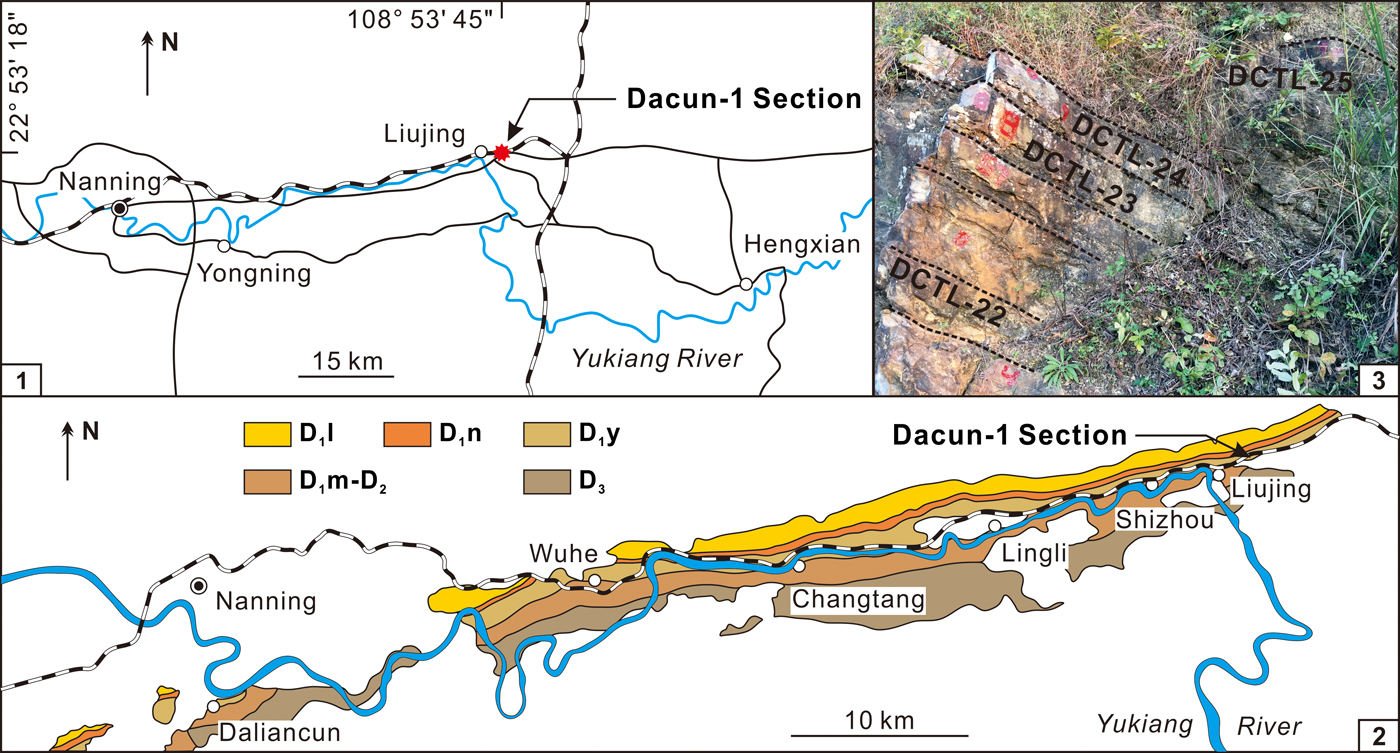
The Yukiang Formation is widely distributed in the area between Nanning and Liujing along the Yukiang (Yujiang) River, Guangxi, South China (Fig. 1.1, 1.2). Wang et al. (Reference Wang, Yu and Fang1964) first subdivided this formation in this area into four lithological units, in ascending order: the Xiayiling, Shizhou, Daliancun, and Liujing members. According to the original description given by Wang et al. (Reference Wang, Yu and Fang1964), the Shizhou Member is represented by alternating mudstone and thin- to medium-bedded limestone in the Liujing area, and has a total of thirty-nine limestone beds cropping out near the Shizhou village, which is located ~3.6 km west of the Liujing section and after which Wang et al. (Reference Wang, Yu and Fang1964) first named the Shizhou Member. However, the Yukiang Formation in the area between Nanning and Liujing today is commonly covered by farmland, devastated by railway construction, or eroded by the Yukiang River. Consequently, the lower part of the Shizhou Member is often poorly exposed.
(1) Location of the study area, with star showing the site of Dacun-1 section in the Liujing area, Guangxi, South China (modified from Lu et al., Reference Lu, Valenzuela-Ríos, Liao and Kuang2018). (2) Geological map showing the exposed Devonian strata in the area between Nanning and Liujing along the Yukiang River. D1l: Lianhuashan Formation; D1n: Nahkaoling (Nagaoling) Formation; D1y: Yukiang (Yujiang) Formation; D1m-D2: Lower Devonian Moding Formation and the Middle Devonian; D3: Upper Devonian. (3) Outcrop view of the lowermost part of the Shizhou Member of the Yukiang Formation exposed at the Dacun-1 section.

Situated at a small hill close to the railway, the Dacun-1 section is located ~300 m northwest of Dacun Village and 1.8 km east of the Liujing section. The lowermost part of the Shizhou Member at this section is composed of thin- to medium-bedded limestone alternating with mudstone and has twenty-nine limestone beds, thus differing greatly from the largely covered lower part of the Shizhou Member at Liujing section, where only seven limestone beds can be sampled. The investigated strata at the Dacun-1 section are 6.84 m thick (Fig. 2). It is hard to detect the lithological boundary between the underlying Xiayiling Member, which is represented by sandstone, mudstone, and siltstone, and the Shizhou Member at the Dacun-1 section because this lithological boundary was probably destroyed by railway construction. The uppermost part of the investigated interval is mainly composed of thick-bedded limestone (Fig. 1.3), which, however, is severely weathered. The strata overlying the studied interval mainly consist of mudstone and siltstone, with no exposed limestone beds.
Stratigraphic column of the uppermost Pragian to lowermost Emsian succession at the Dacun-1 section with conodont ranges.

Materials and methods
Twenty-five limestone samples, weighing 2.85–15.78 kg, were collected in 2015 and 2016 from the lowermost part of the Shizhou Member of the Yukiang Formation at the Dacun-1 section (Table 1). They were crushed mechanically into small pieces (~2–5 cm diameter) and dissolved in dilute acetic acid (5–10%). The insoluble residues were then washed, air-dried, and finally concentrated by heavy-liquid separation using sodium polytungstate. Specimens coated with gold were photographed using a Scanning Electron Microscope (SEM) in the Nanjing Institute of Geology and Palaeontology, Chinese Academy of Sciences (NIGPAS).
Occurrence of conodont species from the lowermost Shizhou Member of the Yukiang Formation at the Dacun-1 section.

In order to show the cross-sections of platforms in different parts of the basal cavity, we scanned specimens NIGP 169979, 169970, and 169985 at the micro-CT lab of NIGPAS, using a 3D X-ray microscope (3D-XRM), Zeiss Xradia 520 versa. Unlike conventional micro-CT, which relies on maximum geometric magnification and flat panel detector to achieve high resolution, 3D-XRM uses CCD-based objectives to get higher spatial resolution. Depending on the size of the fossil specimen, a CCD-based 4X objective was used, providing isotropic voxel sizes of 1.0699 μm for specimen NIGP 169979, 1.4784 μm for specimen NIGP 169970, and 1.5014 μm for specimen NIGP 169985. During the scan, the running voltage for the X-ray source was set to be 60 kV for specimens NIGP 169979 and 169970, and 50 kV for specimen NIGP 169985, and a thin filter (LE2) was used to avoid beam hardening artifacts. To get a high signal-to-noise ratio, 3001 projections over 360° were collected and the exposure time for each projection was set as 3s. Volume data processing was performed using software Vgstudio Max (version 3.0, Volume Graphics, Heidelberg, Germany).
Repository and institutional abbreviation
All specimens described and illustrated herein are deposited in the collections of the Nanjing Institute of Geology and Palaeontology (NIGP), Chinese Academy of Sciences.
Systematic paleontology
Only Pa elements of Polygnathus are described.
Order Ozarkodinida Dzik, Reference Dzik1976
Family Polygnathidae Bassler, Reference Bassler1925
Genus Polygnathus Hinde, Reference Hinde1879
Type species
Polygnathus dubius Hinde, Reference Hinde1879
Polygnathus kitabicus Yolkin et al., Reference Yolkin, Weddige, Izokh and Erina1994
Figures 3.1–3.4, 5.7–5.12
- non Reference Savage1977
Polygnathus dehiscens Philip and Jackson; Savage, p. 59, pl. 1, figs. 29–36.
- ?Reference Schönlaub1985
Polygnathus dehiscens Philip and Jackson; Schönlaub, pl. 3, figs. 8, 9.
- non Reference Mawson, Talent, Brock and Engelbretsen1992
Polygnathus pireneae Boersma; Mawson et al., figs. 7A–F.
- Reference Yolkin, Weddige, Izokh and Erina1994
Polygnathus kitabicus Yolkin et al., p. 150, pl. 1, figs. 1–4 [with synonymy list].
- Reference Yolkin, Izokh, Weddige, Erina, Valenzuela-Ríos and Apekina2011
Polygnathus kitabicus Yolkin et al.; Izokh et al., p. 51, pl. 1, figs. 7–10 [with synonymy list].
- non Reference Baranov, Slavík and Blodgett2014
Polygnathus kitabicus Yolkin et al.; Baranov et al., p. 666, figs. 14A–G.
- Reference Baranov, Slavík and Blodgett2014
Polygnathus kitabicus Yolkin et al.; Martínez-Pérez and Valenzuela-Ríos, p. 146, figs. 9e–g.
- Reference Wang, Ma, Slavík, Wei, Zhang and Lü2018
Eocostapolygnathus kitabicus (Yolkin et al.); Wang et al., figs. 6A, B.
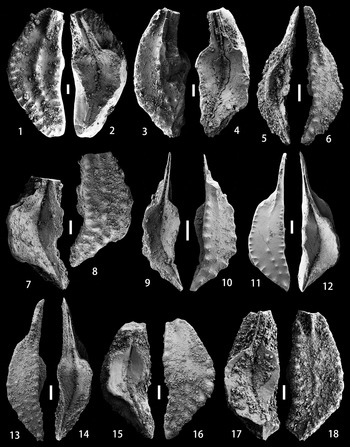
(1–4) Polygnathus kitabicus Yolkin et al., Reference Yolkin, Weddige, Izokh and Erina1994; (1, 2) upper and lower views, NIGP 169970, sample DCTL-25; (3, 4) upper and lower views, NIGP 169971, sample DCTL-25. (5–18) Polygnathus pireneae Boersma, Reference Boersma1973; (5, 6) lower and upper views, NIGP 169972, sample DCTL-1; (7, 8) kitabiformis morph, lower and upper views, NIGP 169973, sample DCTL-1; (9, 10) kitabiformis morph, lower and upper views, NIGP 169974, sample DCTL-7; (11, 12) upper and lower views, NIGP 169975, sample DCTL-8; (13, 14) upper and lower views, NIGP 169976, sample DCTL-9; (15, 16) lower and upper views, NIGP 169977, sample DCTL-10; (17, 18) lower and upper views, NIGP 169978, sample DCTL-12. All scale bars represent 100 μm.

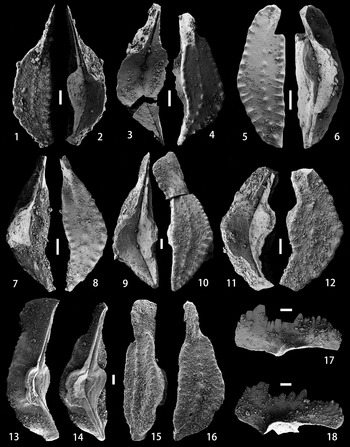
(1–4) Polygnathus pireneae Boersma, Reference Boersma1973; (1, 2) upper and lower views, NIGP 169979, sample DCTL-22; (3, 4) kitabiformis morph, lower and upper views, NIGP 169980, sample DCTL-25. (5–12) Polygnathus sokolovi Yolkin et al., Reference Yolkin, Weddige, Izokh and Erina1994; (5, 6) upper and lower views, NIGP 169981, sample DCTL-1; (7, 8) lower and upper views, NIGP 169982, sample DCTL-1; (9, 10) lower and upper views, NIGP 169983, sample DCTL-8; (11, 12) lower and upper views, NIGP 169984, sample DCTL-10. (13–16) Polygnathus sp., lower-lateral, lower, upper-lateral, and upper views, NIGP 169985, sample DCTL-8. (17, 18) Pandorinellina exigua philipi (Klapper, Reference Klapper1969); (17) lateral view, NIGP 169986, sample DCTL-8; (18) lateral view, NIGP 169987, sample DCTL-10. All scale bars represent 100 μm.

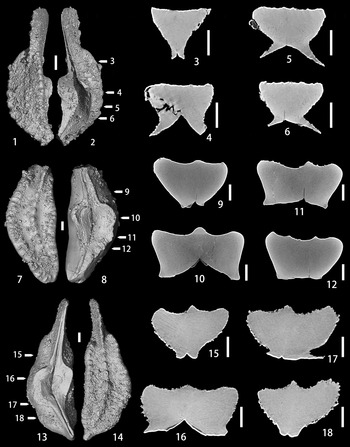
(1–6) Scanned specimen of Polygnathus pireneae Boersma, Reference Boersma1973 using micro-CT; (1, 2) upper and lower views, NIGP 169979, sample DCTL-22; (3–6) cross-sections of platform at different part of basal cavity in P. pireneae. (7–12) Scanned specimen of Polygnathus kitabicus Yolkin et al., Reference Yolkin, Weddige, Izokh and Erina1994 using micro-CT; (7, 8) upper and lower views, NIGP 169970, sample DCTL-25; (9–12) cross-sections of platform at different part of basal cavity in P. kitabicus. (13–18) Scanned specimen of Polygnathus sp. using micro-CT; (13, 14) lower and upper views, NIGP 169985, sample DCTL-8; (15–18) cross-sections of platform at different part of basal cavity in P. sp. All scale bars represent 100 μm.

Holotype
CSGM 976/C1 from the Lower Zinzilban Beds of the Khodzha-Kurgan Formation, Zinzilban Gorge, Uzbekistan (Yolkin et al., Reference Yolkin, Weddige, Izokh and Erina1994, pl. 1, figs. 1, 2).
Description
Free blade is broken and lost in all specimens. Platform narrows anteriorly and is widest at the point where the posterior part starts to deflect inwards to form a rounded curvature of the outer platform margin. The upper platform surface is slightly flat and has weakly developed and shallow adcarinal troughs, which extend to the posterior part of the platform (Figs. 3.1, 3.3, 5.9–5.12). Carina, consisting of laterally compressed and fused denticles in the anterior part of the platform and rounded and discrete nodes in the middle and posterior parts, is situated longitudinally along the center line of the platform and reaches the posterior termination. However, the outer trough in the posterior half of the platform is somewhat wider than the inner one (Fig. 5.11, 5.12). Nodes and short transverse ribs developed on the inner and outer platform margins are separated from the carina by adcarinal troughs. On the lower side, the large and clearly asymmetrical basal cavity has its broad flanks reaching platform margins. It is deeply excavated and V-shaped in cross-section with steep flanks in the anterior part (Fig. 5.10), but progressively shallows in the posterior part with almost flat flanks at the posterior end (Fig. 5.11, 5.12).
Materials
Three specimens.
Remarks
According to Yolkin et al. (Reference Yolkin, Weddige, Izokh and Erina1994) and Izokh et al. (Reference Izokh, Yolkin, Weddige, Erina and Valenzuela-Ríos2011), characteristic features of Polygnathus kitabicus include a narrow platform with weak to shallow adcarinal grooves anteriorly, a rounded outer platform margin, and a large and deep basal cavity whose flanks reach the platform margins. These features make it highly distinguishable from its precursor, P. pireneae, and another almost contemporaneously occurring species, P. sokolovi Yolkin et al., Reference Yolkin, Weddige, Izokh and Erina1994. Moreover, the equally developed adcarinal troughs and centrally situated carina in P. kitabicus also differ greatly from the corresponding features in P. excavatus excavatus. Specimens from the Dacun-1 section show a close similarity to the representative specimens of P. kitabicus from the Zinzilban Gorge (Yolkin et al., Reference Yolkin, Weddige, Izokh and Erina1994, pl. 1, figs. 1–4; Izokh et al., Reference Izokh, Yolkin, Weddige, Erina and Valenzuela-Ríos2011, pl. 1, figs. 7–10) in outline of the outer platform margin, development of adcarinal troughs, and shape of the basal cavity, but mainly differ from the latter by the comparatively wider platform. Moreover, attention is specifically paid to the various and changing depth of the basal cavity in different parts of our specimen. The median cross section in our specimen (Fig. 5.10) is almost identical to that of P. kitabicus illustrated by Yolkin et al. (Reference Yolkin, Weddige, Izokh and Erina1994, text-fig. 2); however, the morphologies of the basal cavity in the posterior part have been never illustrated. Comparison of the basal cavity between P. pireneae and P. kitabicus from the Dacun-1 section indicates that the former usually still has a relatively deep and V-shaped basal cavity, even in the posterior part, whereas the latter has an extremely shallow or even flat posterior basal cavity (compare Fig. 5.5, 5.6 with Fig. 5.11, 5.12).
Polygnathus pireneae Boersma, Reference Boersma1973
Figures 3.5–3.18, 4.1–4.4, 5.1–5.6
- Reference McGregor and Uyeno1972
Polygnathus lenzi Klapper; McGregor and Uyeno, pl. 5, figs. 10–12.
- Reference Boersma1973
Polygnathus pireneae Boersma, p. 287, pl. 2, figs. 1–12.
- Reference Lane and Ormiston1979
Polygnathus pireneae Boersma; Lane and Ormiston, p. 62, pl. 3, figs. 15–17; pl. 5, figs. 2, 3, 9, 10, 27–34, 37.
- Reference Murphy and Matti1982
Polygnathus pireneae Boersma; Murphy and Matti, p. 41, pl. 1, figs. 33–38.
- Reference Wang and Ziegler1983
Polygnathus pireneae Boersma; Wang and Ziegler, pl. 6, fig. 8.
- Reference Mastandrea1985
Polygnathus pireneae Boersma; Mastandrea, pl. 1, fig. 5 (non fig. 6).
- Reference Schönlaub1985
Polygnathus pireneae Boersma; Schönlaub, pl. 3, fig. 7.
- Reference Olivieri and Serpagli1990
Polygnathus pireneae Boersma; Olivieri and Serpagli, p. 72, pl. 3, figs. 2–6.
- Reference Valenzuela-Ríos1994
Polygnathus pireneae Boersma; Valenzuela-Ríos, p. 73, pl. 9, figs. 27, 28, 30.
- non Reference Mawson1998
Polygnathus pireneae Boersma; Mawson, pl. 4, figs. 6, 7.
- Reference Slavík2001
Polygnathus pireneae Boersma; Slavík, p. 264, pl. 1, fig. 17.
- Reference Lu, Qie and Chen2016
Polygnathus pireneae Boersma; Lu et al., p. 289, figs. 5E–N, 6O–R, 7A–J [with synonymy list].
- Reference Lu and Chen2016
Polygnathus pireneae Boersma; Lu and Chen, figs. 4.6, 4.7.
- Reference Lu, Qie, Yu and Chen2017
Polygnathus pireneae Boersma; Lu et al., figs. 3p–s, 4a–f, k–r, 5a–d.
- Reference Wang, Ma, Slavík, Wei, Zhang and Lü2018
Polygnathus pireneae Boersma; Wang et al., figs. 6R, S.
Holotype
Specimen 06-035 from the lowermost part of the Basibé Formation at Castells, Spanish Central Pyrenees (Boersma, Reference Boersma1973, pl. 1, figs. 1–3).
Description
Free blade consisting of five to six high and laterally compressed denticles is approximately one-fourth to one-third of the total length of the unit. Platform, which is broad in adult specimens (Fig. 3.8, 3.11, 3.16, 3.18) but relatively narrow in juvenile or immature specimens (Fig. 3.6, 3.10, 4.4), slightly deflects inwards posteriorly to form a rounded outer platform margin. The upper platform surface is remarkably flat (Fig. 5.3–5.6); adcarinal troughs are commonly undeveloped even at the anterior end of the platform. Consisting of fused denticles in the anterior part of the platform and rounded and discrete nodes in the middle and posterior parts, the carina is situated longitudinally along the center line of the platform and extends to the posterior termination. However, in some specimens (Fig. 3.6, 3.10, 3.11, 3.13, 3.16), the carina in the anterior third part of the platform is specifically indistinct or weakly developed. Joining the free blade at the same position anteriorly, the inner and outer margins are ornamented by nodes or short transverse ridges, with which the carina at the posterior end of the platform may connect to form few semi-crossed transverse ridges (Fig. 3.8, 3.10). On the lower side, the basal cavity is large, clearly asymmetrical, and deeply excavated, with steep and broad flanks just reaching platform margins (Figs. 3.5, 3.12, 3.14, 3.15, 3.17, 4.2) or even visibly protruding beyond platform margins (Figs. 3.7, 3.9, 4.3).
Materials
69 specimens.
Remarks
According to Izokh et al. (Reference Izokh, Yolkin, Weddige, Erina and Valenzuela-Ríos2011, p. 51), Polygnathus pireneae can be subdivided into the sokoloviformis and kitabiformis morphs mainly on the basis of the different outline of the outer platform margin. The sokoloviformis morph has an angular outer platform margin at the point of the inward deflection of the posterior platform, whereas the kitabiformis morph is characterized by the rounded outer platform margin. Several specimens illustrated herein belong to the kitabiformis morph (Figs. 3.7–3.10, 4.3, 4.4), which possesses an extraordinarily large and wide basal cavity whose flanks protrude beyond the platform margins. In contrast, the remaining specimens possess a comparatively narrower basal cavity with steep flanks just reaching platform margins (Figs. 5.5, 5.6, 3.11–3.18, 4.1, 4.2). Similar specimens were also reported at the Liujing section (Lu et al., Reference Lu, Qie and Chen2016, figs. 5E–N).
Specimens from the Dacun-1 section differ from the representative specimens of Polygnathus pireneae in the following aspects. Compared with the adult specimens figured by Izokh et al. (Reference Izokh, Yolkin, Weddige, Erina and Valenzuela-Ríos2011, pl. 1, figs. 1–6), the platform in our adult specimens is much broader (Fig. 3.8, 3.16, 3.18). Secondly, representative specimens of P. pireneae commonly bear a well-developed carina running from the anterior end to the posterior end of the platform, whereas in some of our specimens the carina in the anterior third part of the platform is indistinct or weakly developed (Fig. 3.6, 3.10, 3.11, 3.13, 3.16). Additionally, in contrast to the specimens from the Spanish Central Pyrenees that have a more anteriorly shifted outer anterior platform margin in respect to the inner one (Boersma, Reference Boersma1973, pl. 2, figs. 1–3, 7–9; Martínez-Pérez and Valenzuela-Ríos, Reference Martínez-Pérez and Valenzuela-Ríos2014, figs. 9a–d.), our juvenile and adult specimens have inner and outer anterior platform margins joining the free blade at the same position.
Specimens initially figured as Polygnathus lenzi Klapper, Reference Klapper1969 by McGregor and Uyeno (Reference McGregor and Uyeno1972, pl. 5, figs. 10–12) and those as P. pireneae by Lane and Ormiston (Reference Lane and Ormiston1979, pl. 5, figs. 27, 37) were later re-identified by Yolkin et al. (Reference Yolkin, Weddige, Izokh and Erina1994, p. 149) as P. kitabicus without taking their stratigraphic information into further consideration. Specimens depicted as P. lenzi by McGregor and Uyeno (Reference McGregor and Uyeno1972, pl. 5, figs. 10–12) were collected from a level 185 feet above the base of the Stuart Bay Formation together with Spathoganthodus sulcatus (Philip, Reference Philip1965), strongly indicating that this level belongs to the Pragian and that specimen of P. lenzi could not be identified as P. kitabicus because P. kitabicus first occurs at the base of the Emsian. The specimen figured as P. pireneae by Lane and Ormiston (Reference Lane and Ormiston1979, pl. 5, figs. 27, 37) was obtained from sample 3-29 at the Linear Ridge outcrop together with Eognathodus sulcatus kindlei Lane and Ormiston, Reference Lane and Ormiston1979, a taxon whose stratigraphic distribution is restricted to the Pragian. In view of above-mentioned facts, taxonomic assignments of these specimens proposed by Klapper and Johnson (Reference Klapper and Johnson1980, p. 454) are followed herein.
Polygnathus sokolovi Yolkin et al., Reference Yolkin, Weddige, Izokh and Erina1994
Figure 4.5–4.12
- Reference Yolkin, Weddige, Izokh and Erina1994
Polygnathus sokolovi Yolkin et al., p. 152, pl. 1, figs. 5–8 [with synonymy list].
- Reference Martínez-Pérez and Valenzuela-Ríos2014
Polygnathus sokolovi Yolkin et al.; Martínez-Pérez and Valenzuela-Ríos, p. 152, fig. 9h.
- Reference Lu, Qie and Chen2016
Polygnathus sokolovi Yolkin et al.; Lu et al., p. 291, figs. 7K–Q.
- Reference Lu and Chen2016
Polygnathus sokolovi Yolkin et al.; Lu and Chen, fig. 4.2.
- Reference Lu, Qie, Yu and Chen2017
Polygnathus sokolovi Yolkin et al.; Lu et al., figs. 4g–j.
- Reference Wang, Ma, Slavík, Wei, Zhang and Lü2018
Polygnathus sokolovi Yolkin et al.; Wang et al., figs. 6E, F.
Holotype
CSGM 976/C5 from the Lower Zinzilban Beds of the Khodzha-Kurgan Formation, Zinzilban Gorge, Uzbekistan (Yolkin et al., Reference Yolkin, Weddige, Izokh and Erina1994, pl. 1, figs. 7, 8).
Description
Free blade consisting of five high and laterally compressed denticles is approximately one-fourth of the total length of the unit (Fig. 4.9, 4.10). The flat and relatively broad platform deflects inwards posteriorly to form a distinct angularity of the outer platform margin just behind midlength (Fig. 4.5, 4.8, 4.10, 4.12). In contrast, the inner margin is more or less straight, but one specimen has its inner platform laterally expanded to form a rounded and convex inner margin in the middle part of the platform (Fig. 4.12). Adcarinal troughs are not developed even at the anterior end of the platform. Carina, which consists of fused denticles in the anterior part of the platform and discrete nodes in the middle and posterior parts, is situated longitudinally along the center line of the platform and extends to the posterior termination. However, some specimens possess an indistinct or weakly developed carina in the anterior third part of the platform (Fig. 4.5, 4.8). Joining the free blade at the same position anteriorly, inner and outer margins are ornamented by nodes in the anterior half of the platform and short transverse ridges in the posterior half of the platform. On the lower side, the basal cavity is large, clearly asymmetrical, and deeply excavated, whose steep and broad flanks just reach platform margins (Fig. 4.6, 4.7, 4.9, 4.11).
Materials
Five specimens.
Remarks
Polygnathus sokolovi is characterized by a flat and narrow platform, a distinct angularity of the outer platform margins, and sometimes a few nodes scattered between carina and platform margins (Yolkin et al., Reference Yolkin, Weddige, Izokh and Erina1994, p. 152). Based on the marginal ornamentation on the upper platform surface, Yolkin et al. (Reference Yolkin, Weddige, Izokh and Erina1994) subdivided this species into the Early and Late forms. The former has discrete marginal nodes, whereas the latter is characterized by short transverse marginal ridges. Specimens from the Dacun-1 section have a comparatively broader platform that do not bear any discrete nodes between carina and margins, and a weakly developed carina in the anterior third of the platform in some specimens, both of which differ greatly from the representative specimens of this species from Uzbekistan (Yolkin et al., Reference Yolkin, Weddige, Izokh and Erina1994, pl. 1, figs. 6s–8; Izokh et al., Reference Izokh, Yolkin, Weddige, Erina and Valenzuela-Ríos2011, pl. 2, figs. 1–6). However, our specimens (Fig. 4.5, 4.10. 4.12) show a close similarity in the platform ornamentation to one specimen from Uzbekistan that was suggested by Yolkin et al. (Reference Yolkin, Weddige, Izokh and Erina1994, pl. 1, fig. 5) to be a Late form of P. sokolovi. They all have numerous short transverse marginal ridges and are totally barren of the characteristic nodes intercalated between the outer marginal rim and carina. Accordingly, these specimens from the Dacun-1 section are suggested to be Late forms of P. sokolovi. A similar specimen was also figured by Wang et al. (Reference Wang, Ma, Slavík, Wei, Zhang and Lü2018, fig. 6E) from the Alengchu Formation in western Yunnan. The broad platform also makes our specimens resemble closely P. hindei Mashkova and Apekina, Reference Mashkova and Apekina1980, which, however, is highly differentiable by its numerous nodes intercalated between marginal rims and carina.
Polygnathus sp.
Figures 4.13–4.16, 5.13–5.18
Description
Free blade consisting of five high and laterally compressed denticles is about one-fourth of the total length of the unit. Platform narrows anteriorly and is widest at the point where the posterior half starts to deflect inwards to form a rounded curvature of the outer platform margin. The upper platform surface is slightly flat and has weakly developed and shallow adcarinal troughs, which extend to the posterior part of the platform (Figs. 4.15, 4.16, 5.14–5.18). Carina, which consists of rounded and discrete nodes, is situated longitudinally along the center line of the platform and extends to the posterior end. Nodes and short transverse ribs developed on the inner and outer platform margins are separated from the carina by adcarinal troughs. Compared with the inner anterior margin, the outer one meets the free blade a bit more anteriorly. On the lower side, basal cavity is large, asymmetrical, and relatively shallow, with flanks reaching platform margins (Figs. 4.13, 4.14, 5.13). It is slightly V-shaped in cross-section with a flat rim in the anterior part (Fig. 5.16); the posterior part of basal cavity is remarkably flat and shallow (Fig. 5.17, 5.18).
Materials
One specimen.
Remarks
Polygnathus sp. closely resembles P. kitabicus in having a rounded outer platform margin, weakly developed and shallow adcarinal troughs, and flanks of the basal cavity just reaching rather than protruding beyond the platform margins. However, P. kitabicus is characterized by a greatly excavated and V-shaped basal cavity with steep flanks, whereas the basal cavity in P. sp. is quite shallow with an almost flat rim (compare Fig. 5.10 with Fig. 5.16). The different outline of the basal cavity probably represents one of the intraspecific variations of P. kitabicus; however, a further study with more specimens is needed.
Conodont biostratigraphy
Only 15 of 25 samples yielded conodont elements, and most samples from the severely weathered upper part of the investigated interval were completely barren. Five species or subspecies were identified from 116 specimens of the Pa element (Table 1). Most of these specimens are assigned to the genus Polygnathus, and only a few specimens to Pandorinellina. Based on the stratigraphic ranges of conodont species, the uppermost Pragian through lowermost Emsian succession at the Dacun-1 section is subdivided into two conodont phylogenetic-zones (Fig. 2).
The pireneae Zone.—This Zone is defined by the lowest occurrence of Polygnathus pireneae at the base and by the lowest occurrence of P. kitabicus at the top (Yolkin et al., Reference Yolkin, Weddige, Izokh and Erina1994). At the Dacun-1 section, the pireneae Zone is recognized in the lowermost part of the Shizhou Member of the Yukiang Formation where samples DCTL-1 to DCTL-24 were collected. The co-occurrence of P. sokolovi and P. pireneae is only demonstrated in samples DCTL-1, DCTL-8, and DCTL-10; in contrast, in the Spanish Central Pyrenees (Martínez-Pérez and Valenzuela-Ríos, Reference Martínez-Pérez and Valenzuela-Ríos2014) and Kitab State Geological Reserve Area (Yolkin et al., Reference Yolkin, Weddige, Izokh and Erina1994; Izokh et al., Reference Izokh, Yolkin, Weddige, Erina and Valenzuela-Ríos2011), P. sokolovi has a much higher extension into the overlying kitabicus Zone. Attention is specifically paid to one specimen provisionally termed P. sp. from sample DCTL-8. Although its outline of basal cavity differs greatly from that in P. kitabicus, the upper platform surface bears shallow adcarinal troughs, which can be only observed in P. kitabicus.
The kitabicus Zone.—According to Yolkin et al. (Reference Yolkin, Weddige, Izokh and Erina1994), the lower limit of this zone is defined by the lowest occurrence of Polygnathus kitabicus and its upper limit by the lowest occurrence of P. excavatus excavatus. The lowermost part of the kitabicus Zone is recognized from the highest limestone bed at the Dacun-1 section, a level ~0.92 m above the bed where sample DCTL-24 was collected. Accordingly, the Pragian/Emsian boundary at this section is located at the level of sample DCTL-25. This is the first time that the Pragian/Emsian boundary has been successfully demonstrated in the South China Block.
Discussion
When studying the conodont biostratigraphy of the Yukiang Formation at the Liujing section, Lu et al. (Reference Lu, Qie and Chen2016) made a detailed report about the conodont fauna from the basal part of the Shizhou Member, which is marked by the co-occurrence of Polygnathus pireneae and P. sokolovi. As a result, the basal part of the Shizhou Member in the Liujing section was assigned to the pireneae Zone (Lu et al., Reference Lu, Qie, Yu and Chen2017). At both the Liujing and Dacun-1 sections, P. sokolovi has a much shorter stratigraphic distribution than P. pireneae and is restricted to the pireneae Zone. The kitabiformis and sokoloviformis morphs of P. pireneae co-occur in sample AGP-LJ-78 from the basal part of the Shizhou Member at the Liujing section, whereas only the kitabiformis morph of P. pireneae was recovered from the Dacun-1 section. The kitabiformis morph of P. pireneae extends upwards into the base of the Emsian (sample DCTL-25) together with another unofficially defined morph of P. pireneae, which is characterized by a slightly narrower basal cavity whose flanks just reach rather than visibly protrude outside platform margins. Moreover, it is noteworthy that the kitabiformis morph of P. pireneae is usually restricted to the pireneae Zone and lower part of the kitabicus Zone (Lane and Ormiston, Reference Lane and Ormiston1979; Murphy and Matti, Reference Murphy and Matti1982; Savage et al., Reference Savage, Blodgett and Jaeger1985; Schönlaub, Reference Schönlaub1985; Yolkin et al., Reference Yolkin, Apekina, Erina, Izokh, Kim, Talent, Walliser, Weddige, Werner and Ziegler1989, Reference Yolkin, Izokh, Weddige, Erina, Valenzuela-Ríos and Apekina2011; Olivieri and Serpagli, Reference Olivieri and Serpagli1990; Bardashev and Ziegler, Reference Bardashev and Ziegler1992; Valenzuela-Ríos, Reference Valenzuela-Ríos1994, Reference Valenzuela-Ríos, García-lópez and Bastida2002; Slavík, Reference Slavík2001; Erina in Kim et al., Reference Kim, Salimova, Kim and Meshchankina2007; Izokh et al., Reference Izokh, Yolkin, Weddige, Erina and Valenzuela-Ríos2011), but can range upwards into the middle excavatus Subzone in the Spanish Central Pyrenees (Martínez-Pérez and Valenzuela-Ríos, Reference Martínez-Pérez and Valenzuela-Ríos2014, figs. 4, 9c, 9d), whereas the sokoloviformis morph of P. pireneae was only recorded in the uppermost part the pireneae Zone and lower part of the kitabicus Zone in the Kitab State Geological Reserve Area (Izokh et al., Reference Izokh, Yolkin, Weddige, Erina and Valenzuela-Ríos2011; Yolkin et al., Reference Yolkin, Izokh, Weddige, Erina, Valenzuela-Ríos and Apekina2011; N.G. Izokh, personal communication, 2019). Nevertheless, the morphological variation of P. pireneae and stratigraphic distribution of different morphs of P. pireneae in the Liujing area still need to be further studied in detail.
Recently, Wang et al. (Reference Wang, Ma, Slavík, Wei, Zhang and Lü2018) described the Lower Devonian conodont biostratigraphy of the Alengchu section in western Yunnan Province, an area probably belonging to the Indochina (or Annamia) Terrane (Zhou et al., Reference Zhou, Luo, Zhou and Yuan2001). They provisionally placed the lower boundary of the Emsian at the base of the Alengchu Formation due to the fact that no index taxa were collected from samples 19-6 to 20-3. Therefore, the precise lower boundary of the Emsian at the Alengchu section probably needs further investigation. The kitabicus Zone at the Alengchu section contains the lowest occurrences of Polygnathus kitabicus, P. pireneae, P. sokolovi, and P. pannonicus Mashkova and Apekina, Reference Mashkova and Apekina1980 from the lower part of bed 20 to the upper part of bed 23 in the Alenchu Formation. In the Zinzilban Gorge, the lower part of the kitabicus Zone also retains the early diversification of the genus Polygnathus including the origination of P. hindlei, P. pannonicus, and P. tamara Apekina, Reference Apekina1989 (Yolkin et al., Reference Yolkin, Weddige, Izokh and Erina1994, Reference Yolkin, Izokh, Weddige, Erina, Valenzuela-Ríos and Apekina2011). Unfortunately, because of the middle and upper parts of the Shizhou Member of the Yukiang Formation in the Liujing area mainly consist of mudstone and siltstone, the scarcity of appropriate limestone samples for conodont analysis precludes a definitive demonstration of the early diversification of Polygnathus at the Dacun-1 section for the time being. Moreover, the upper boundary of the kitabicus Zone as well as the lower boundary of the middle excavatus Subzone defined by the lowest occurrence of P. excavatus ssp. 114 in the Liujing area is also unknown.
Acknowledgments
N.G. Izokh, C. Martínez-Pérez, S.X. Zhang, and E. Currano are acknowledged for their critical reviews and important comments. We thank Q. Fu from the NIGPAS for his great assistance in the field, Q.Z. Zheng for her assistance in processing limestone samples in the laboratory, and S.P. Wu for her assistance in scanning specimens at micro-CT lab of the NIGPAS. Sincere thanks also go to C.Y. Wang and Z.J. Yin of the NIGPAS for their meaningful discussions. This research is funded by the Strategic Priority Research Program (B) of the Chinese Academy of Sciences (XDB26000000) and the National Natural Science Foundation of China (41702009 and 41530103). J.C. Liao is supported by the MINECO (Juan de la Cierva Postdoctoral Program, Ref. FJCI-2015-26813). J.F. Lu was financially supported by the Chinese Academy of Sciences during his stay in Valencia, and is now supported by the CSC-DAAD Postdoc Scholarship in Frankfurt am Main.