The dramatic surge in the formation of preferential trade agreements (PTAs)Footnote 1 in recent years has been noted widely, both in the press and in academic scholarship, and has produced a substantial literature on the causes and effects of these agreements. Much of the scholarship on PTAs has focused on their implications for the multilateral trading system, and, more specifically, on the question of whether they constitute ‘building blocks or stumbling blocks’ to the forward momentum of trade liberalization.Footnote 2 Far less attention has been paid to the actual provisions of these agreements. Existing work has treated PTAs as homogenous in their content and by implication in their effects on trade, ignoring the fact that the provisions of these agreements vary widely.
In this paper, we seek to redress this gap in the literature and to address one of the motivating issues for this project on ‘Judicial Politics in International Trade Relations’: does the variation in judicialization we observe in trade agreements actually have an impact on post-agreement trade flows between agreement partners? (De Bièvre and Poletti, this volume). Given that the majority of agreements in the global network of PTAs contains some form of dispute settlement, and that these dispute settlement mechanisms invariably also generate binding resolutions (Allee and Elsig, Reference Allee, Elsig, Dür and Elsig2014), this paper investigates whether such judicialization produces strong positive effects on trade flows. That is, we focus on the economic consequences of judicialization, as observed through changes in trade flows following the signing and ratification of a trade agreement.
We examine the economic effects of enforcement mechanisms in PTAs by contrasting them with two other key dimensions of PTA design: the level of trade policy discretion provided in the PTA's provisions and its flexibility mechanisms. We premise our analytical framework on the argument that strong positive effects on trade flows are the result of an agreement that is also strong on credible commitment, as international institutions such as trade agreements resolve the time-inconsistency problem of trade policy by tying the hands of its signatories. This credible commitment, we argue, is reflected in a combination of three institutional components: (i) trade policy Discretion, or the degree to which an agreement removes trade policy from the hands of the government; and (ii) Enforcement, or the costs of defecting from the agreement, i.e., the level of judicialization, namely the strength of its enforcement mechanisms. At the same time, countries will not necessarily benefit from tying their hands as tightly as possible, and therefore: (iii) Flexibility mechanisms should not only make designing trade agreements easier and lower contracting costs, it should also have a more beneficial effect on trade. By allowing politicians room to respond to exogenous shocks, having more flexible mechanisms may ensure that the PTA continues to develop and does not become a zombie (Gray, Reference Gray2015).
To capture these dimensions in PTA provisions, we apply an original coding scheme to 57 Asian PTAs that have been signed or were in force by 2006. We employ confirmatory factor analysis and find empirical support for the hypothesized relationship between the constructs we develop – Discretion, Enforcement, and Flexibility – and the specific PTA provisions that we identify as their respective component measures. For the main empirical analysis, we employ a standard gravity model of international trade with year and dyadic fixed effects to evaluate the impact of trade agreements on trade flows, with the former measured both as a dichotomous variable and with our measures based on PTA provisions. We find that the dichotomous measure of PTAs does not have a significant effect on trade, but that our more specific measures do. Removing trade policy discretion from a government, and in some cases flexibility mechanisms, have a stronger positive effect on trade flows than do enforcement mechanisms.
Credible commitment and the politics and economics of PTAs
The scholarship on PTAs has addressed a wide range of questions, beginning with the trade-creation effects of PTAs and ultimately their implications as ‘building blocks or stumbling blocks’ or as ‘friends’ or ‘foes’ for the multilateral system (Viner, Reference Viner1950; Bhagwati, Reference Bhagwati1991, Reference Bhagwati, de Melo and Panagariya1993, Reference Bhagwati1994; Baldwin, Reference Baldwin, Baldwin, Haaparnata and Kiander1995; Levy, Reference Levy1997; Bagwell and Staiger, Reference Bagwell, Staiger, Piggott and Woodland1999; Panagariya, Reference Panagariya2000; Pomfret, Reference Pomfret2001[1997]; Aghion et al., Reference Aghion, Antras and Helpman2004; Limão, Reference Limão2006a, Reference Limão2006b; Baier and Bergstrand, Reference Baier and Bergstrand2007). Studies have examined closely the conditions under which PTAs are likely to be trade-diverting, resulting in welfare losses for those outside the agreement and thus a ‘foe’ to the pursuit of multilateral trade liberalization (Grossman and Helpman, Reference Grossman and Helpman1995; Krishna, Reference Krishna1998). Going beyond the theoretical literature, empirical studies of PTAs have found a correlation between PTAs and unilateral trade liberalization (Foroutan, Reference Foroutan1998; Panagariya, Reference Panagariya1999; Bohara et al., Reference Bohara, Gawande and Sanguinetti2004). Interestingly, the relationship between PTAs and trade flows is somewhat mixed. Early studies found that PTAs did not increase trade between members. These studies did not account for the endogeneity of PTAs that may explain their findings (Baier and Bergstrand, Reference Baier and Bergstrand2007). More recent studies, which include dyadic fixed effects to control for endogenous PTA formation, find that PTAs have a strong trade-creating effect among members (Rose, Reference Rose2004; Baier and Bergstrand, Reference Baier and Bergstrand2007; Goldstein et al., Reference Goldstein, Rivers and Tomz2007).Footnote 3
Constraints on trade policy discretion
A standard view of international agreements such as PTAs is that a government uses them to tie its hands with respect to trade policy (Simmons, Reference Simmons2000; Rosendorff and Milner, Reference Rosendorff and Milner2001; Rosendorff, Reference Rosendorff2005; Mitchell and Hensel, Reference Mitchell and Hensel2007; Büthe and Milner, Reference Büthe and Milner2008). Building on the time-inconsistency problem (Kydland and Prescott, Reference Kydland and Prescott1977), or the insight that if a government has discretion over policy, it has an incentive to renege on its ex ante policy promise and enact a different policy ex post, in signing a PTA a government gives up control over trade policy and commits itself to trade liberalization. Agreeing to a PTA sends a signal – if a government violates the agreement, it suffers reputational costs (Simmons, Reference Simmons2000, 819).Footnote 4 A government can relinquish some control over trade policy by joining a multilateral organization such as the GATT/WTO or by signing a free trade agreement which delegates authority to adjudicate to the institution and also limits the ability to increase tariffs, allowing it to resist pressure from protectionist groups (Maggi and Rodriguez-Clare, Reference Maggi and Rodriguez-Clare1998, Reference Maggi and Rodriguez-Clare2007; Bagwell and Staiger, Reference Bagwell, Staiger, Piggott and Woodland1999; Staiger and Tabellini, Reference Staiger and Tabellini1999). A government can point to the trade agreement as the reason why greater protection cannot be granted. These insights have been applied to link PTAs with issue areas other than trade as well. Büthe and Milner (Reference Büthe and Milner2008) argue that PTAs increase FDI in developing countries because their visibility makes reneging on them more costly. Investors are, therefore, more confident that governments will maintain liberal economic policies. Nevertheless, this literature treats all trade agreements as the same, as if they ‘leave no discretion to governments’ (Maggi and Rodriguez-Clare, Reference Maggi and Rodriguez-Clare2007: 1375).
Enforcement mechanisms
However, simply signing an international agreement or delegating policy is not sufficient for a government to tie its hands; there have to be mechanisms in place to deter and to punish cheating on the agreement. Without some way to tell if a government is cheating on the agreement, the public will not believe that the government is not interfering in policy. The presence of these enforcement mechanisms, that is the mechanisms of judicialization in trade agreements, lends credibility to a commitment. North and Weingast define a credible commitment as how constrained a government is ‘to obey a set of rules that do not permit leeway for violating commitments’ (Reference North and Weingast1989: 804). The literature on PTAs largely treats trade agreements as perfectly enforceable, even while recognizing that differences in enforceability exist across agreements in the real world (Maggi and Rodriguez-Clare, Reference Maggi and Rodriguez-Clare1998; Maggi and Rodriguez-Clare, Reference Maggi and Rodriguez-Clare2007).Footnote 5
Studies on enforcement mechanisms in PTAs have focused on their design rather than their effects. James McCall Smith (Reference Smith2000) attributes the adoption of more strict or legalistic dispute settlement mechanisms to a combination of low asymmetries in economic power and an agreement's depth of integration.Footnote 6 Pevehouse and Buhr (Reference Pevehouse and Buhr2005) argue that democracies are more willing to concede autonomy in their international affairs and are motivated by the possible economic benefits of the trade agreement, both of which led them to agree to a high level of legalism in trade agreements.Footnote 7
Flexibility
Yet another body of literature examines the trade-off between flexibility and credibility in the design of enforcement mechanisms (Smith, Reference Smith2000; Rosendorff and Milner, Reference Rosendorff and Milner2001; Rosendorff, Reference Rosendorff2005). Designing institutions that allow governments some leeway to suspend their obligations in the agreement helps governments cope with domestic uncertainty, even if the agreement is less credible. If there are exogenous shocks that increase the pressure to deviate from the terms of the agreements, governments would prefer agreements that allow them some room to temporarily violate the agreement without abrogating the agreement. Rosendorff and Milner (Reference Rosendorff and Milner2001) suggest, for example, that including measures such as escape clauses can help governments cope with domestic uncertainty by allowing them to respond to protectionist interests when necessary. These escape clauses must still impose a cost on a government – if there were no punishment for defecting, it would be difficult to maintain the agreement. Similarly, institutional mechanisms such as the WTO's Dispute Settlement Understanding (DSU) allow temporary ‘defections’ from obligations that render a more stable institution (Rosendorff, Reference Rosendorff2005). These arguments suggest that agreements will ensure greater compliance if governments are permitted to invoke escape clauses in order to alleviate pressures from domestic constituents, so long as there is still some cost in using these mechanisms. There has been no attempt, however, to examine whether differences in enforcement mechanisms have consequences for trade flows among agreement partners.
This paper engages with the recent scholarship on trade agreements that has started to focus on variability in PTA design and its effects. Büthe and Milner (Reference Büthe and Milner2011) examined the link between PTAs with investment provisions and post-agreement FDI flows. Gray and Slapin (Reference Gray and Slapin2012) survey experts to evaluate the degree of PTA effectiveness. Mansfield and Milner (Reference Mansfield and Milner2012) examine the inclusion of formal dispute settlement mechanisms. Rickard and Kono (Reference Rickard and Kono2014) look specifically at procurement provisions within PTAs to see if they do affect procurement. Haftel (Reference Haftel2013) codes many different areas of PTAs and separates out the designed aspects from what is actually implemented. Finally, Dür et al. (Reference Dür, Baccini and Elsig2013) come up with a very detailed scheme to code many different aspects of PTAs.
Hypotheses
We test three hypotheses corresponding to the conceptual dimensions of PTAs: Enforcement, Discretion, and Flexibility. The first dimension is what we call trade policy Discretion, or how much an agreement restricts the behavior of a government. An agreement should have a stronger effect on trade the more it restricts a government's range of actions. A PTA that alters trade restrictions for only a limited group of products or that covers products in which the participant countries do not trade extensively will not be as effective at increasing trade as one that eliminates restrictions on all or most products traded between participants. Footnote 8 In the former cases, the agreement would be a largely symbolic gesture and leave the government plenty of room to respond to protectionist pressures.Footnote 9 Our corresponding hypothesis is:
Hypothesis 1:
Agreements that leave governments less trade policy discretion should increase trade more than those that leave the government more policy discretion.
Our second hypothesis concerns the theme of this volume: the level of judicialization as captured by the mechanisms created to monitor and punish defections from the agreement. If the public cannot determine whether a government is abiding by the terms of the agreement, the government's commitment will be less credible and we would not expect a large increase in trade. We would expect that agreements with stronger dispute settlement and agreements that impose more objective costs will have a stronger effect on trade.
Hypothesis 2:
Agreements with stronger enforcement mechanisms should have a stronger positive effect on trade than those with weaker enforcement mechanisms.
At the same time, a government may want some room to be able to temporarily defect from the agreement without ending the agreement. By designing flexibility into the agreement, a government can respond to exogenous shocks and violate the agreement as long as it agrees to pay some costs of defection (Rosendorff, Reference Rosendorff2005). While this flexibility may decrease overall credibility, it should contribute to greater compliance with and stability of the agreement. Here, we argue that these positive benefits also have a larger and positive effect on trade between agreement partners. Importers and exporters will be more likely to believe that a government will stick with an agreement if it has some room for maneuver. If the agreement is not flexible enough, traders may believe that in difficult economic circumstances a government may back out of the agreement. Alternatively, traders may believe that a government will simply ignore the agreement. In either case, trade will not increase by as much as it would with flexible provisions. Thus, our third hypothesis is about flexibility mechanisms:
Hypothesis 3:
Agreements that allow more flexibility in invoking trade remedies should have a stronger positive effect on trade than those with more stringent trade remedies.
In the empirical analysis, we also consider the contingent effects of discretion and both enforcement and flexibility mechanisms. That is, we would expect that the joint presence of discretion and strong enforcement mechanisms to have a positive effect on trade flows. In the empirical analysis, we account for this contingent effect by interacting two dichotomous variables: one for PTAs above the mean for discretion and one for PTAs above the mean for enforcement.
Coding PTAs
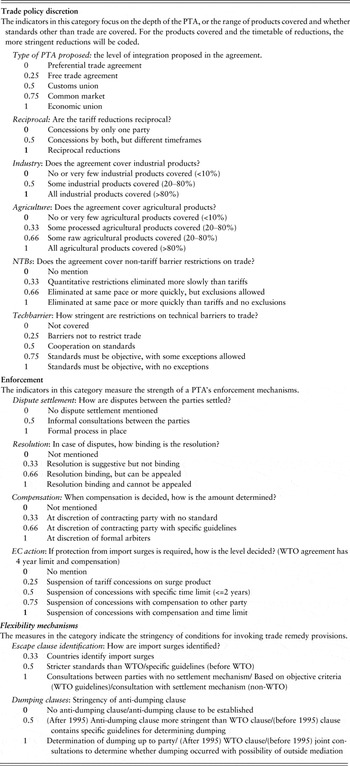
Similar to the central bank independence literature, which quantifies the level of central bank independence by examining the texts of central bank laws (Grilli et al., Reference Grilli, Masciandaro and Tabellini1991; Cukierman et al., Reference Cukierman, Webb and Neyapti1994), we examine the legal provisions of the PTA to distinguish how much they tie a government's hands (discretion), their enforcement mechanisms, and their flexibility mechanisms. Table 1 details our coding scheme, which identifies three categories of measures corresponding to our theoretical constructs: Discretion, Enforcement, and Flexibility. Each component measure of the categories is coded on a scale bounded between 0 and 1, rather than dichotomously, and higher scores should be associated with a larger increase in trade. Because we are interested in an agreement's effect on trade, our components focus on the coverage of trade in goods. We recognize that PTAs now often include many more issue areas and that our coding does not completely cover the contents of the agreement. Nevertheless, the fact that agreements often are about more than trade in goods makes it imperative to understand whether the provisions related to trade in goods do affect trade. If some PTAs are mainly about issues other than trade in goods and some are about trade in goods, treating the two equivalently blurs an important distinction between them. Immediately below, we discuss how each component is coded and how each should increase trade.
PTA coding scheme
The characteristics of PTAs have been grouped into three categories: Discretion, Enforcement, and Flexibility. The analysis employs the average score across these categories for the index of index of PTA commitment and separate scores by category to examine the individual effects of these institutional mechanisms on trade flows.

Trade policy discretion
To estimate the trade policy discretion an agreement leaves to a government, we construct an indicator with six components that measure how much an agreement removes a government's control over trade policy. In effect, we conceptualize discretion as the surrendering of trade policy discretion, rather than the retaining of such discretion, in the core areas as covered in this category. The first component is the type of PTA or the depth of the agreement. The closer the economic ties a PTA creates, the greater the effect on trade, all else equal. Thus, we expect that PTAs that provide for the formation of economic unions will contribute more toward expanded trade flows than other types of PTAs. However, even an agreement that calls itself a free trade agreement may not remove tariffs on all barriers. The remaining components in the discretion category, therefore, include the type of products covered by the agreement, such as the overall coverage of industrial and agricultural products, and whether other trade restrictions such as technical barriers to trade and non-tariff barriers are covered. A trade agreement that allows a government to maintain other types of trade restrictions such as non-tariff barriers or technical barriers to trade leaves a government more trade policy discretion and should have less of an effect on trade than one that removes these types of restrictions. Governments can simply change the trade restrictions from tariffs to non-tariff barriers. Also, an agreement that covers both agricultural and industrial products will restrict the actions of a government more than one that excludes either of these sectors. By including tariff reductions on politically sensitive areas such as agriculture in the agreement, a government can more easily resist future protectionist pressures from this sector.Footnote 10
Enforcement
As discussed above, trade policy involves a time inconsistency problem that must be overcome. An agreement that lowers trade restrictions will do nothing to tie the hands of the government without provisions to deter defections from the agreement. Our second category – enforcement – includes four components that focus on how defections from the agreement are settled.
First, more formal dispute settlement procedures should have a stronger effect on trade than agreements with no dispute settlement mechanisms or with informal mechanisms. The final three components in the Enforcement category measure the costs a government pays for violating the agreement. In order to be effective, enforcement mechanisms should impose some cost to invoke them. If there is no cost to using the mechanisms, there is nothing to prevent a government from using them whenever it wants and we would expect the agreement to have no effect on trade. A government pays a higher cost the more binding is a dispute settlement resolution. If the government can ignore a resolution, then there is little cost imposed on the government for agreement violations. Similarly, leaving the determination of compensation to formal arbiters should impose a higher cost and represent a stronger commitment than leaving the determination of compensation to the injured party. Finally, if the agreement imposes compensation and a time limit for invoking escape clauses, there will be more costs in invoking escape clauses which should make their usage less likely.
Finally, the Flexibility category measures how easily a government can invoke anti-dumping and escape clauses. Our coding gives the highest scores to provisions that allow governments some leeway in using them and middle scores to provisions that strictly define their use. When member countries can consult with one another on the use of escape clauses or to identify dumping, it may be easier to justify the breaches as necessary, given existing economic conditions. We recognize that there are several options for flexibility in an agreement, defined as a temporary defection from legal obligations (Rosendorff and Milner, Reference Rosendorff and Milner2001). The literature suggests that such states may seek such flexibility through the dispute settlement mechanism (Rosendorff, Reference Rosendorff2005) or through the use of binding overhang in the application of tariffs as an alternative to the use of trade remedies (Busch and Pelc, Reference Busch and Pelc2014). These studies have investigated the role of flexibility provisions employed by WTO members. We employ a measure of flexibility in the same spirit as in Milner and Rosendorff and applied to reciprocal trade agreement, also adding levels to indicate the degree of flexibility in how agreement partners may invoke trade remedy provisions.
The three overall category measures – Discretion, Enforcement, and Flexibility – are created by summing the scores for each of the individual components in the category and scaling the value by the number of components, resulting in scores that vary from 0 to 1. Not all agreements have information about every component in the index. All but the escape clause action component penalize an agreement for not having information; for example, agreements that lack detail about dispute settlement clauses receive a score of 0 for this measure. Escape clause actions that lack information are coded as missing and are not included in the numerator or denominator of the category or index totals. The three category and two commitment index totals, therefore, are rescaled to include only those components that are non-missing.
Data and analysis
We conduct our empirical analysis on PTAs in Asia, where such agreements have seen an unprecedented and rapid rise since the mid-1990s and especially in the aftermath of the Asian financial crisis (Ravenhill, Reference Ravenhill2008a, Reference Ravenhill2003).Footnote 11 According to Ravenhill, East Asia in particular has emerged as the ‘most active site in the world’ for trade agreements in the twenty-first century (Reference Ravenhill, MacIntyre, Pempel and Ravenhill2008b: 157). Until then, the region had seen few trade agreements, and the prevailing mode of trade cooperation involved the Asia-Pacific Economic Cooperation (APEC) forum formed in 1989 and the more regionally delimited Association of Southeast Nations (ASEAN), which in 1992 announced its intention to form the ASEAN Free Trade Area (AFTA).Footnote 12
The shift toward bilateral and regional trade agreements represents a marked departure from the APEC forum's emphasis on multilateralism and especially on open regionalism, which involved concerted unilateral trade liberalization and the practice of MFN for members and non-members alike.Footnote 13 The region has also seen a surge in the expansion of existing regional agreements, which involves negotiations between individual countries and regional groupings, including ASEAN's negotiations with Japan, China, and India.Footnote 14 Plurilateral agreements are also in development, forming overlapping arrangements such as the Trans-Pacific Strategic Economic Partnership including New Zealand, Singapore, Brunei Darussalam, and Chile, and a separate New Zealand–Singapore bilateral agreement.
While the existing scholarship has identified key patterns in PTA formation in the region (Ravenhill, Reference Ravenhill, Aggarwal and Urata2006; Dent, Reference Dent2006), few studies have examined the actual impact of Asia's PTAs on trade flows. The Asian region also provides a varied set of cases on which to test whether PTA provisions affect trade, representing a wide range in levels of development, more so than any other region. Countries vary from the very poor (Burma, Bhutan) to the very well-off (Japan, Korea), and countries across the entire range have signed PTAs. Because of the mix of countries in the region, many of the PTAs have been signed under the GATT/WTO's Enabling Clause which has less rigid standards for PTAs than does Article XXIV. There is more variation in PTA provisions across the region as a result. The analysis includes 57 PTAs with at least one Asian country as signatory, out of a total of 64 PTAS in force or signed in 2009 as reported by the Asian Development Bank.Footnote 15 They include all agreements for which texts were available. Appendix 1, available online, lists the PTAs alphabetically, including the year in which the PTA was signed and when it went into force (if applicable).Footnote 16
Descriptive statistics
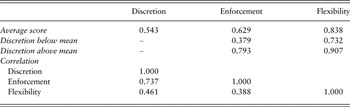
In Table 2, we present descriptive statistics of our measures of PTA provisions, based on the scores for individual PTAs. Both the discretion and the enforcement mechanism measures range from low values to high values and both are skewed towards high values. The mean discretion score is 0.54 while the mean enforcement score is 0.63. The mean flexibility score is even larger at 0.84. There is also a correlation between discretion and enforcement. When agreements remove more trade policy discretion, the average score for the other categories is higher. The average enforcement score for agreements with discretion scores above the mean for all agreements is 0.79 while the average enforcement score when discretion is below the mean is only 0.38. For Flexibility, the average is 0.91 when discretion is above the mean and 0.74 when discretion is below the mean. Discretion is more highly correlated with enforcement (0.74) than it is with flexibility (0.46). The correlation between enforcement and flexibility is only 0.39.
Descriptive statistics by category

Below, we provide some examples of how different PTAs are coded. In 1977, ASEAN members signed a preferential trade agreement. Reflecting its status as a preferential agreement, it scored very low on discretion, at only 0.17. In 1992, ASEAN signed a free trade agreement and the discretion score increased to 0.49. The enforcement score was low in both cases, at 0.27 for the preferential agreement and 0.31 for the FTA. Similarly, the South Asian Association for Regional Cooperation signed a preferential agreement in 1993 with a very low score for discretion (0.08) and a low score for enforcement (0.40). Both scores increased when the South Asian Free Trade Agreement was signed in 2004, with discretion increasing to 0.43 and enforcement to 0.73.
We can also compare PTAs of a single country: Singapore, for example, has nine PTAs in force in our data. While the scores for enforcement and discretion are above the mean, there is still some variation across PTAs. Moreover, the scores for enforcement and discretion do not move together. The New Zealand–Singapore PTA has the highest discretion score among Singapore's PTAs at 0.82 but its enforcement score is 0.78 which is the third lowest among Singapore's PTAs. Singapore has 3 PTAs with an enforcement score of 0.92 (EFTA–Singapore, Japan–Singapore, and Korea–Singapore), but the discretion scores are 0.79, 0.65, and 0.69, respectively.
We employ a measurement model, which links a theoretical construct or latent variable (also called a factor) with observed indicators. We utilize confirmatory factor analysis as we have developed a priori which of the observed indicators, that is, the specific PTA provisions, are associated with which of the three constructs as described above.Footnote 17 We test the hypothesized links between the specific PTA provisions we have identified and the latent constructs Discretion, Flexibility, and Enforcement we developed in the ‘Coding PTAs’ section of this paper. In testing these hypothesized links, we are essentially testing this restricted model vis-à-vis the null hypothesis of an unrestricted model in which no specific relationship is hypothesized between the latent constructs and observed measures.
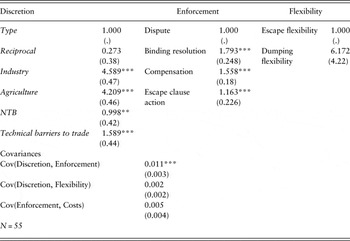
Thus we analyze a measurement with three latent variables—Discretion, Enforcement, and Flexibility, to examine the extent to which the data support empirically these theoretical constructs central to the paper.Footnote 18 The results are presented in Table 3. For Discretion, which includes six components, all components have loadings that are statistically significant. In particular, the degree to which the agreement covers industrial goods, agriculture, and technical barriers to trade (TBTs) is the most important determinant of variation in the construct.Footnote 19 Whether the agreement is reciprocal and includes commitments on non-tariff barriers is less important in determining the level of discretion relinquished by the agreement signatory. For Enforcement, which includes four components, relative to the provision of a formal dispute settlement mechanism, degree to which dispute resolution is binding, compensation relies on third party determination, and escape clause actions conform or go beyond WTO-mandated levels, all show positive and statistically significant loadings. The last construct, Flexibility, appears only to be weakly related to the components specified by our conceptual framework. The covariance statistics at the bottom of Table 3 also show that these constructs are largely independent from one another, as the covariance is low (less than 0.01) for any given pair of latent constructs.
Confirmatory factor analysis: discretion, enforcement, and flexibility

Notes: ** p < 0.05, *** p < 0.01.
Estimates generated using sem command in Stata 12. Constants and error variances not reported. Values of 1 are normalization constraints.
Quantitative analysis
We analyze directed-dyad data to examine whether differences in PTAs have an effect on bilateral trade between partners. All models contain both dyadic fixed effects and year fixed effects. The year fixed effects help control for any systemic shock in a given year that has a similar effect on all countries. The dyadic fixed effects also control for the endogeneity of trade agreements and trade (Baier and Bergstrand, Reference Baier and Bergstrand2004), in particular the non-random factors that drive certain pairs of countries to gravitate toward greater (or lesser) degrees of judicialization.Footnote 20 Dyadic fixed effects transform the data to focus on changes from the dyad's mean value of each variable, so the coefficient on the PTA variables measures the change in trade when the agreement is in effect compared to when it is not in effect.
Our sample contains dyads with at least one Asian country, and covers the years 1970 to 2006, inclusive. Asian countries did not start signing PTAs until the mid-1970s, and even then they were relatively rare until the 1990s.Footnote 21 Appendix 2, available online, lists the Asian countries in the sample. We begin our analyses with a baseline model using a dummy variable for PTAs, which indicates whether the mere existence of a PTA increases trade. In subsequent analyses, we include in turn the three dimensions of PTA provisions and their respective individual components. Discretion, Enforcement, and Flexibility are our independent variables of interest.
The dependent variable is the logged value of goods (in 2000 US dollars) imported into country 1 from country 2. The main source for the data is the IMF's Direction of Trade statistics. Missing data were filled in, when possible, with import data from Gleditsch (Reference Gleditsch2002).Footnote 22 Data from both sources were converted into constant dollars using the United States GDP deflator from the World Bank's World Development Indicators.
To control for economic conditions (economic size and level of economic development), we include standard gravity model variables: the logged products of both a dyad's GDP as well as its GDP per capita. Data on GDP and GDP per capita (both in 2000 US dollars) were obtained from the World Bank's World Development Indicators. Our measure of currency unions is from the Rose (Reference Rose2004), with some updates based on Cohen (Cohen, Reference Cohen2006). The both GATT/WTO and one GATT/WTO variables indicate whether both countries in the dyad or one of the two countries in the dyad are GATT or WTO members. The variables were constructed using the lists of GATT and WTO membership dates available from the WTO website.Footnote 23 With year and dyadic fixed effects, many of the variables common in gravity models drop out of the model. These include land area, contiguity, number of islands in the dyad, the number of landlocked countries in the dyad, colonies, and distance.
Findings
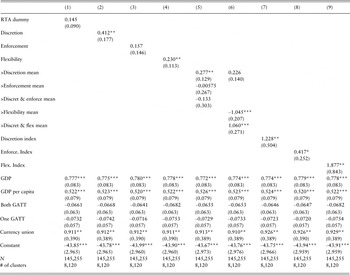
The first column of Table 4 reports baseline estimation results, including a dichotomous variable that takes on the value of 1 if there is a PTA in force within the dyad.Footnote 24 The estimate for the dichotomous PTA variable is positive; however, it just misses statistical significance at the 0.10 level. The result suggests that if all PTAs are treated equivalently, PTAs do not significantly increase trade in Asian countries. The control variables, in the baseline and across all other models, generally behave as expected. GDP and GDP per capita are both positive and significant. Dyadic membership in a currency union also increases trade. Contrary to expectations, both GATT variables are negative but neither is significant
Regression results: 1970–2006

Notes: Significance levels: *0.10 **0.05 ***0.01.
All models contain year and dyadic fixed effects.
There is stronger support for a positive effect of PTAs on trade flows when we focus on the provisions. In models 2 to 4, we analyze the separate effects of the Discretion, Enforcement, and Flexibility measures. The results show that Discretion and Flexibility have a positive and statistically significant effect on trade flows, but Enforcement does not. The coefficient on the Discretion component is positive and significant at the 0.05 level. Increasing the discretion relinquished from 0 to the maximum value of 0.81 increases trade by 40%. PTAs are more effective at increasing trade when they remove more trade policy discretion from the government. Similarly, more flexibility in invoking trade remedies significantly increases trade. There is scant evidence that enforcement mechanisms increase trade. The coefficient on the enforcement variable is not statistically significant.
Part of the argument is that the combination of discretion and enforcement should increase trade more than either one by itself. To test this, we create two dichotomous indicators. The first is equal to 1 if the discretion score is above the mean for Asian PTAs. The second is equal to 1 if the enforcement score is greater than the mean for PTAs. We then include these two variables and their interaction in column 5. Contrary to expectations, the results suggest that discretion has a stronger impact at low levels of enforcement – the coefficient on discretion itself is positive and significant. Having both high levels of discretion and enforcement does not significantly affect trade. In column 5, we repeat the exercise for discretion and flexibility. The coefficient on flexibility with low scores on discretion is negative and significant but having high scores on both does significantly increase trade.
In the last three models of Table 4, we repeat the exercise using the indices, or factor scores, created from our confirmatory factor analysis.Footnote 25 Our analysis so far weighted equally the individual component variables of the three theoretical constructs. To better reflect the patterns in the data, we utilize the results of the confirmatory factor analysis and employ the loadings as weights for the observed measures. The index is thus constructed as the sum of the individual measures multiplied by their loadings on their respective factors. The results of the analysis are consistent with those with equal weighting of the individual measures. Discretion and Flexibility are both significant at the 0.05 level. Enforcement is significant as well but marginally so.
Unpacking the measures
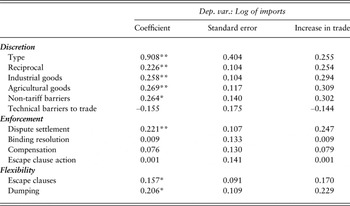
In the next section, we unpack the combined measures and focus on the components individually. By looking at the components individually, we can explore whether some components of the enforcement mechanism variables affect trade more than others. The results are reported in Table 5. The findings are consistent with results from the aggregate measures; the individual Discretion measures have more of a positive effect on trade than the Enforcement and Flexibility measures.
Effect of individual index components: 1970–2006

Notes: Significance levels: *0.10 **0.05 ***0.01.
The remaining variables from Table 4 are included in the models but are not shown in order to conserve space. All models contain year and dyadic fixed effects. The increase in trade measures the increase if the variable is moved from 0 to its maximum value.
The first half of Table 5 includes the six individual Discretion components. Five of the six discretion measures have a positive and significant effect on trade. The exception is technical barriers to trade (TBTs), which is negative and fails to reach statistical significance. The highest level of the type of agreement in PTAs in Asia is a free trade area.Footnote 26 Moving from no PTA or a preferential agreement to a free trade agreement increases trade by 26%., which indicates that minimal agreements where countries liberalize trade only on some products do not have a large effect on trade while efforts to liberalize substantially all products do have an effect.Footnote 27 The other four components have similar or stronger effects on trade. PTAs with reciprocal reductions that are implemented within the same time frame by all parties result in a 25.4% increase in trade. Agreements that cover more than 80% of industrial goods – the highest category of coverage of industrial goods – are associated with a 29.4% increase in trade. PTAs with provisions that cover more than 80% of agricultural goods – also the highest category of coverage for agricultural products – are associated with a 30.9% increase in trade. Finally, if non-tariff barriers are eliminated at the same pace or more quickly than tariffs and if no exclusions are allowed, trade increases by 30%.
The bottom half of Table 5 includes the Enforcement and Flexibility components. Results largely corroborate those for the aggregate measures. For Enforcement, the provision of a formal dispute settlement mechanism is the only statistically significant measure. Not surprisingly, the more formal the dispute settlement mechanism, the stronger the effect on trade. Moving from no dispute settlement mechanism to a formal dispute settlement mechanism increases trade by 25%, about the same effect as creating a free trade area. None of the three measures associated with imposing costs for violating the agreement has a significant effect.Footnote 28 This suggests that greater costs for violating an agreement are not necessary to increase trade. However, the costs do not have to be prohibitive. The Flexibility measures concerning dumping and escape clause invocation have positive but marginally significant effects on trade.
Overall, then, governments do not need to tie their hands too tightly when signing PTAs. Giving up more trade policy discretion increases trade more than giving up less discretion. Trade also increases more if a government is given some latitude to violate the agreement than if a government is prevented from violating the agreement. Moreover, the costs that a government pays for violating the agreement do not have any effect on trade. That is, an agreement that imposes high costs for violating the agreement does not increase trade more than one that imposes low costs.
Conclusion
In this paper, we argue that PTAs should not all be treated the same and that differences in their provisions have different effects on trade creation. Some agreements are weaker than others in providing for the liberalization of trade, as they allow for trade-distorting measures or provide subjective dispute settlement mechanisms that frustrate trade. We construct an index of PTA provisions based on their legal texts and apply it to PTAs involving at least one Asian country. The wide variation in judicialization in trade agreements and other control variables, such as economic size and development among countries in the region, provide a very good testing ground for our argument, and we expect that these findings are generalizable to a larger sample that includes countries outside the region.
In our results, we find that a dichotomous measure of PTAs does not significantly affect trade flows for 1970 to 2006. In support of our first hypothesis, our measure of commitment, which combines the amount of trade policy discretion a government gives up and the enforcement mechanisms in an agreement, does have a significant positive effect on trade. When we break out the discretion and enforcement components, we find that the more discretion a government gives up, the stronger the effect on trade, supporting our second hypothesis. We find little support that enforcement mechanisms increase trade. Surprisingly, this seems to be largely because the costs of violating the agreement do not have an effect. Moreover, some flexibility in invoking trade remedies has a significant effect on trade. Rather than tying their hands as strongly as possible, then, governments may be better off leaving themselves some room to respond to exogenous shocks. Not only may flexibility increase the likelihood of compliance with the agreement, as others have argued, it may increase trade more.
These distinctions become increasingly important as PTAs are likely to remain a permanent feature of the trade governance landscape of the international economy, especially so long as the WTO continues to be unsuccessful in concluding the Doha Round. The agreements examined in this study focus on a region that has been especially active in PTA formation in recent years. The agreements are indicative of the diversity of institutional arrangements more broadly, and their differential impact on trade expansion. Implementation of the agreement is the responsibility of the government. As Haftel (Reference Haftel2013) finds, there is a gap between design and implementation; agreements between natural trading partners tend to be more fully implemented. Our argument suggests that the design of the agreement also matters. Agreements that overreach and do not allow as much flexibility may end up being ignored by governments. At the same time, during the negotiation stage, governments may fear the commitment of their partners and want less flexibility to prevent cheating. Our analysis highlights this tradeoff that governments face in signing onto PTAs. The results indicate that strong trade liberalization programs in PTAs that are tempered by flexibility mechanisms that leave room for temporary ‘escape’ are most likely to promote trade between agreement partners.