





Introduction
Surgical site infections (SSIs) remain an important cause of morbidity after pediatric cardiothoracic surgery. Reference Schaffzin, Harte and Marquette1 Surveillance depends on accurately identifying operations that trigger follow-up. The National Healthcare Safety Network (NHSN) defines a standardized denominator using procedure-code categories. 2,3 Solutions for Patient Safety (SPS), a pediatric safety collaborative, uses a subset of NHSN cardiac codes, but NHSN omits some procedures used to correct or palliate congenital heart disease. 4,Reference Li, Bonebrake, Mansavage, Moravec and Schroeder5 The Society of Thoracic Surgeons (STS) defines the index operation as the first cardiovascular surgical operation in an case of care; other operations are non-index. 6
These differing denominators can exclude congenital cardiac operations from NHSN/SPS surveillance, creating discrepancies in identified infections and rates and limiting benchmarking and quality improvement. Reference Li, Bonebrake, Mansavage, Moravec and Schroeder5,Reference Atchley, Pappas and Kennedy7 STS index status provides a clinical reference but is not directly linked to CPT codes used in routine surveillance and does not itself determine SSI-surveillance eligibility, which also depends on surveillance-specific procedural and attribution criteria. We therefore used STS index procedures to identify gaps in NHSN code capture and mapped those gaps to additional CPT codes.
Methods
We conducted a retrospective study at Cleveland Clinic Children’s with Institutional Review Board approval. Procedures from January 2010 through February 2022 comprised the derivation cohort used to identify additional CPT codes; a nonoverlapping validation cohort from March 2022 through March 2024 followed replacement of our Anesthesia Record Keeping System (ARKS) by the Epic anesthesia module. A separate SSI review included expanded-only procedures from January 2020 through January 2025.
In the derivation cohort, STS index procedures in patients younger than 18 years were linked to ARKS records by medical record number and procedure date/time. Discordant matches were manually reviewed before joining CPT code-linked ARKS records to STS records.
We applied the 2025 NHSN cardiac-related CPT categories—cardiac (CARD), coronary artery bypass graft with chest and donor-site incisions (CBGB), coronary artery bypass graft with chest incision only (CBGC), pacemaker (PACE), and heart transplant—to the derivation cohort. 3 CPT codes associated with uncaptured STS index procedures were candidates for addition. We retained cardiovascular codes relevant to operative pediatric cardiac surgery and excluded central-line procedures, extracorporeal membrane oxygenation placement or decannulation, and nonsurgical procedures.
Remaining codes were assigned to pediatric extensions of CARD, PACE, CBGB/CBGC (P-CABG, P-PACE, and P-CABG, respectively) or to a new Arteries and Veins category (P-ARTV). Together with the NHSN categories, these formed the expanded code set.
In validation, sensitivity was the proportion of STS index procedures captured. We also measured the proportion of captured procedures classified as STS index, overall and among expanded-only procedures; these measures assessed agreement with STS index status, not appropriateness for SSI surveillance. Wilson methods provided 95% confidence intervals (CIs). Age-group differences used Newcombe score CIs and 2-sample score tests; paired sensitivities used exact McNemar tests. Because the expanded set contained the NHSN set, the sensitivity-gain CI used the Wilson interval for the proportion newly captured. All tests were 2-sided. Analyses, tables, and figures were generated in Python 3 using pandas, SciPy, statsmodels, Matplotlib, and python-docx.
JS performed manual review under guidance, supervision, and review of CF and JA, an infection preventionist experienced in NHSN SSI definitions. We reviewed the 7 STS index procedures missed by the expanded set and the 7 expanded-only procedures not classified as STS index. Expanded-only procedures were also reviewed for SSIs using NHSN definitions; operative-location criteria were not used to exclude denominator procedures. We did not systematically evaluate all STS non-index procedures or SSI occurrence among them.
Generative AI (ChatGPT) was used to edit the manuscript and assist with portions of the Python code. All AI-generated content was reviewed, refined, and verified by the authors. Clinical interpretation and judgment remained solely the authors’ responsibility.
Results
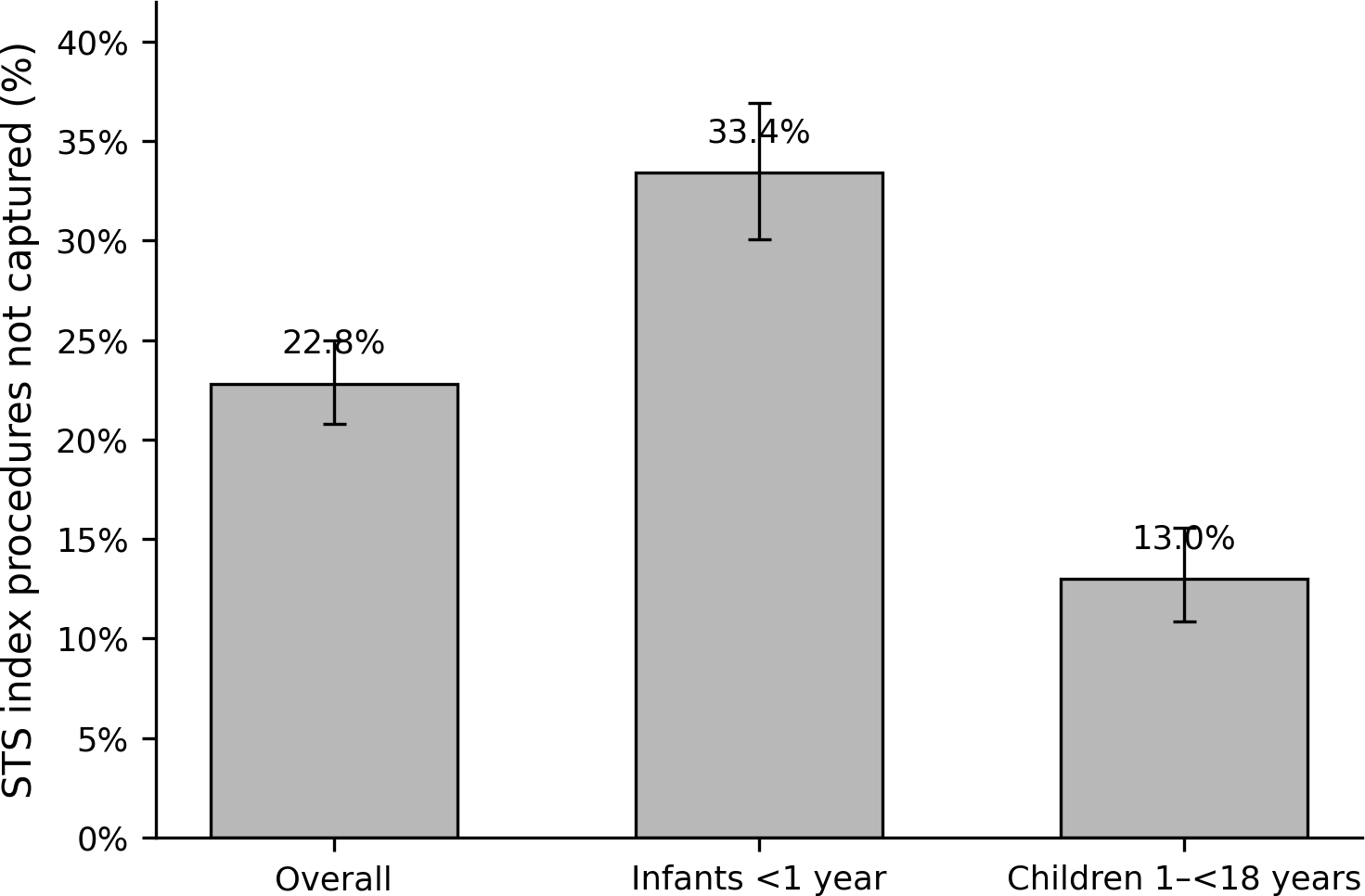
In the derivation cohort, 1,508 STS index procedures were identified. The NHSN code set missed 344 (22.8%). Under-capture was greater among infants: 242 of 724 procedures (33.4%) versus 102 of 784 (13.0%) among children aged 1 to younger than 18 years (difference, 20.4 percentage points; 95% CI, 16.2–24.5; P < .001) (Figure 1).
Proportion of Society of Thoracic Surgeons (STS) index procedures not captured by the 2025 National Healthcare Safety Network cardiac current procedural terminology code set during the derivation period, overall and by age group. Error bars show Wilson 95% confidence intervals. The absolute difference between infants and older children was 20.4 percentage points (95% CI, 16.2–24.5; P< .001).

Derivation added 62 CPT codes: 50 P-CARD, 9 P-ARTV, 2 P-CABG, and 1 P-PACE (Supplementary Table S1). The expanded denominator contained 238 unique codes: 176 existing NHSN codes and 62 pediatric add-on codes (Supplementary Tables S1 and S2).
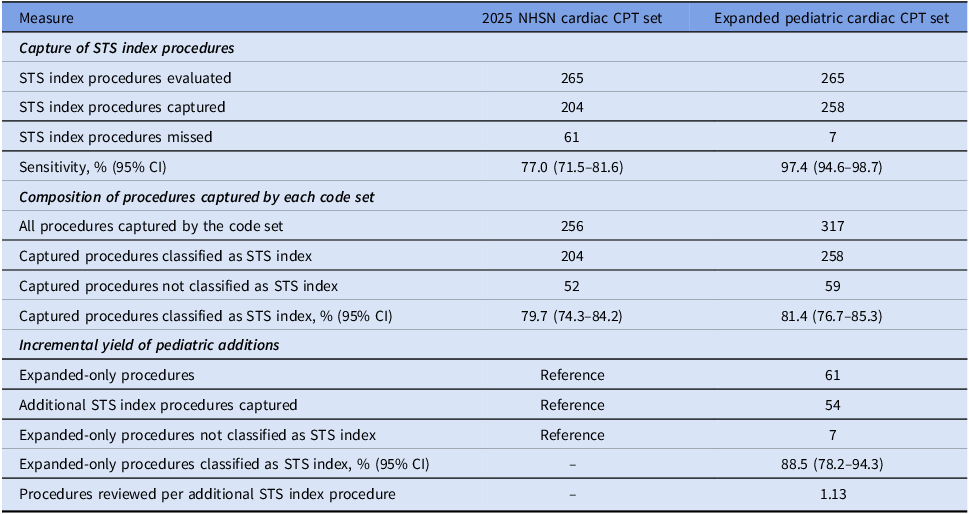
During validation, 265 STS index procedures occurred. Sensitivity was 77.0% (204/265; 95% CI, 71.5%–81.6%) for NHSN and 97.4% (258/265; 95% CI, 94.6%–98.7%) for the expanded set, an absolute gain of 20.4 percentage points (95% CI, 16.0%–25.6%; exact McNemar P < .001). Among all captured procedures, 204 of 256 NHSN procedures (79.7%; 95% CI, 74.3%–84.2%) and 258 of 317 expanded-set procedures (81.4%; 95% CI, 76.7%–85.3%) were STS index. Of 61 expanded-only procedures, 54 were STS index (88.5%; 95% CI, 78.2%–94.3%), or 1.13 additional reviews per additional index procedure captured (Table 1).
Validation-period performance of the NHSN and expanded pediatric cardiac CPT code sets

Table 1. Long description
A table comparing the performance of the NHSN and expanded pediatric cardiac CPT code sets. The table has 12 rows and 3 columns. Column headers are Measure, 2025 NHSN cardiac CPT set, and Expanded pediatric cardiac CPT set. Row labels include Capture of STS index procedures, Composition of procedures captured by each code set, and Incremental yield of pediatric additions. Row 1: STS index procedures evaluated, 265, 265. Row 2: STS index procedures captured, 204, 258. Row 3: STS index procedures missed, 61, 7. Row 4: Sensitivity, %, (95% CI), 77.0 (71.5-81.6), 97.4 (94.6-98.7). Row 5: All procedures captured by the code set, 256, 317. Row 6: Captured procedures classified as STS index, 204, 258. Row 7: Captured procedures not classified as STS index, 52, 59. Row 8: Captured procedures classified as STS index, %, (95% CI), 79.7 (74.3-84.2), 81.4 (76.7-85.3). Row 9: Expanded-only procedures, Reference, 61. Row 10: Additional STS index procedures captured, Reference, 54. Row 11: Expanded-only procedures not classified as STS index, Reference, 7. Row 12: Expanded-only procedures classified as STS index, %, (95% CI), -, 88.5 (78.2-94.3). Row 13: Procedures reviewed per additional STS index procedure, -, 1.13.
Note. CI, confidence interval; CPT, Current Procedural Terminology; NHSN, National Healthcare Safety Network; STS, Society of Thoracic Surgeons. Confidence intervals for individual proportions were calculated using Wilson methods. The paired sensitivity comparison used an exact McNemar test (P < .001). STS index status served as the clinical reference; procedures not classified as STS index were not necessarily inappropriate for SSI surveillance because STS non-index procedures were not systematically evaluated. The 7 STS index procedures missed by the expanded set are distinct from the 7 expanded-only procedures not classified as STS index.
Both code sets also captured procedures not classified as STS index: 52 with NHSN and 59 with the expanded set. Of the 59 expanded-set non-index captures, 52 were already included in NHSN categories, leaving 7 introduced by the pediatric additions. Manual review of these 7 identified major cardiac operations including cavopulmonary shunt, pulmonary artery banding, ascending aortic reconstruction, and coarctation repair. In the opposite direction, 7 procedures classified as STS index were missed by the expanded set; manual review suggested that 3 were true index procedures and 4 likely were not (Supplementary Table S3).
Among 169 expanded-only procedures, 12 SSIs were identified (7.1%; 95% CI, 4.1%–12.0%): 6 organ-space and 6 superficial incisional SSIs (Supplementary Table S4).
Discussion
The 2025 NHSN cardiac CPT set incompletely captured pediatric STS index procedures, particularly in infants. Adding 62 pediatric codes increased sensitivity from 77.0% to 97.4%, although agreement with STS index status remained similar. The additions were efficient: 54 of 61 expanded-only procedures were STS index. The SSI review also identified infections after procedures outside the existing NHSN denominator.
STS index status was a useful clinical reference but not a complete gold standard for SSI surveillance. Some procedures not classified as STS index were substantial cardiac operations that may still warrant surveillance, whereas a few procedures classified as STS index appeared unlikely to be true index operations. CPT codes also cannot identify which operation STS designated as index; confirming concordance with STS reporting requires linkage or feedback to the local registry. Thus, the expanded denominator can reduce, but not eliminate, discordance among NHSN, SPS and STS.
Limitations include the single-center design, retrospective application of the 2025 NHSN code set across earlier years, and reliance on CPT rather than ICD-10-PCS. We evaluated STS index procedures but not all STS non-index procedures or SSI occurrence among them; therefore, these data cannot define an optimal denominator. During derivation, CPT linkage required an ARKS anesthesia record, so procedures performed in nontraditional locations without such documentation may have been missed; whether this persisted after transition to Epic is unknown. We also did not map codes to detailed congenital disease categories. Reference Zafar, Allen and Bryant8 The expanded-only SSI review established that infections occurred outside the NHSN denominator but did not compare infection risk across index and non-index operations.
An optimized pediatric cardiac CPT denominator can bring most STS index operations into routine infection prevention surveillance while remaining compatible with code-based workflows. Multicenter validation should include STS index and non-index procedures and ICD-10-PCS mapping to refine the optimal denominator.
Supplementary material
The supplementary material for this article can be found at https://doi.org/10.1017/ice.2026.10606.
Financial support
This research was supported through the Ellen and Steven Ross Fellowship Grant to JS. Data analytic tools used in this study were developed with support from a Cleveland Clinic Healthcare Delivery and Implementation Science grant to CBF.
Competing interests
The authors report no relevant conflicts of interest.


 Open access

