Implications
A new generation of electronic systems that continuously monitor physical activity of dairy cows to predict timing of artificial insemination (AI) have been developed. In two experiments on a large commercial dairy in the United States, an activity monitoring system detected only 70% of lactating Holstein cows with increased activity with the remainder of cows being anovular or ovulating in the absence of activity. A combined approach in which AI based on activity is followed by submission of cows not detected with activity to timed AI after synchronization of ovulation may be an effective strategy for submission of cows to first AI.
Introduction
Despite the widespread adoption of hormonal synchronization protocols that allow for timed artificial insemination (AI), detection of behavioral estrus continues to play an important role in the overall reproductive management program on most dairies in the United States (Caraviello et al., Reference Caraviello, Weigel, Fricke, Wiltbank, Florent, Cook, Nordlund, Zwald and Rawson2006; Miller et al., Reference Miller, Norman, Kuhn, Clay and Hutchison2007). The many challenges of estrus detection on farms include: cows with anovular conditions (Wiltbank et al., Reference Wiltbank, Gümen and Sartori2002); attenuation of the duration of estrus behavior associated with increased milk production near the time of estrus, resulting in shorter periods of time in which to visually detect estrus behavior (Lopez et al., Reference Lopez, Satter and Wiltbank2004); few cows expresing standing estrus at any given time (Roelofs et al., Reference Roelofs, van Eerdenburg, Soede and Kemp2005; Palmer et al., Reference Palmer, Olmos, Boyle and Mee2010); silent ovulations (Palmer et al., Reference Palmer, Olmos, Boyle and Mee2010; Ranasinghe et al., Reference Ranasinghe, Nakao, Yamada and Koike2010; Valenza et al., Reference Valenza, Giordano, Lopes, Vincenti, Amundson and Fricke2012); and reduced expression of estrus owing to confinement housing systems (Palmer et al., Reference Palmer, Olmos, Boyle and Mee2010) with concrete flooring (Britt et al., Reference Britt, Scott, Armstrong and Wiitacre1986). Whatever the cause, the low accuracy and efficiency of estrus detection not only increases time from calving to first AI but increases the average interval between AI services (Stevenson and Call, Reference Stevenson and Call1983), thereby limiting the rate at which cows become pregnant.
Because of the impact of AI service rate on reproductive performance and the problems associated with visual detection of estrus on farms, technologies have been developed and marketed to dairy farmers to enhance detection of estrus by providing continuous surveillance of behavior in the absence or in addition to visual observation of estrus. These technologies include rump-mounted devices and androgenized females (Gwazdauskas et al., Reference Gwazdauskas, Nebel, Sprecher, Whittier and McGilliard1990), pedometry (Peralta et al., Reference Peralta, Pearson and Nebel2005; Roelofs et al., Reference Roelofs, van Eerdenburg, Soede and Kemp2005) and radiotelemetric devices that monitor mounting activity (Walker et al., Reference Walker, Nebel and McGilliard1996; Dransfield et al., Reference Dransfield, Nebel, Pearson and Warnick1998; Xu et al., Reference Xu, McKnight, Vishwanath, Pitt and Burton1998). Increased physical activity is a secondary sign of estrus in cattle, and pedometry systems that detect changes in the number of steps per unit time have been available for many years with some adoption by the dairy industry in the United States. A new generation of electronic systems that continuously monitor physical activity in cattle (Holman et al., Reference Holman, Thompson, Routly, Cameron, Jones, Grove-White, Smith and Dobson2011; Jónsson et al., Reference Jónsson, Blanke, Poulsen, Caponetti and Højsgaard2011) have been developed, and there has been rapid adoption of this technology in the United States over the past several years. Many reviews have been published on systems used to detect estrus in cattle (Nebel et al., Reference Nebel, Dransfield, Jobst and Bame2000; Firk et al., Reference Firk, Stamer, Junge and Krieter2002; Rorie et al., Reference Rorie, Bilby and Lester2002). This paper will focus on the accuracy and effectiveness of activity monitoring systems for detecting estrus in lactating dairy cows and the integration of this technology within reproductive management programs in the United States.
Activity monitoring systems for detection of estrus
Senger (Reference Senger1994) proposed that the ideal electronic system to detect estrus would (1) provide for continuous surveillance and accurate identification of individual cows; (2) require minimal labor; and (3) accurately predict the timing of ovulation so that cows are inseminated at the correct time in relation to ovulation. Activity monitoring systems clearly fulfill the first two requirements, however, few studies have assessed the accuracy of AI in relation to ovulation based on detection of activity. During proestrus in the absence of progesterone, estradiol from the dominant follicle increases in circulation until it reaches a threshold level, thereby inducing behavioral estrus. Because increases in estradiol above this threshold do not further enhance the behavioral response, estrus has been proposed to be an ‘all or none’ behavioral response in cattle (Alrich, Reference Alrich1994). Standing estrus, defined as the period when the cow makes no attempt to escape when mounted, is the primary sign of true estrus in cattle (Hurnik et al., Reference Hurnick, King and Robertson1975). In contrast to pedometers that measure changes in the number of steps taken per unit time as an indicator of physical activity, activity monitoring systems incorporate an accelerometer or an electromechanical device that continuously measures acceleration forces due to gravity in three special dimensions to assess changes in physical activity associated with estrus. It is important to note that activity monitoring systems by definition do not asses the primary sign of estrus behavior (i.e. standing to be mounted) but rather one of several secondary signs of estrus behavior (i.e. increased physical activity).
We recently conducted a series of experiments in collaboration with a commercial dairy farm in Wisconsin to assess the accuracy of an activity monitoring system for timing of AI in relation to ovulation (Valenza et al., Reference Valenza, Giordano, Lopes, Vincenti, Amundson and Fricke2012) and to incorporate an activity monitoring system into a reproductive management program for first AI (Fricke et al., Reference Fricke, Valenza, Giordano, Amundson and Lopes2014). The collaborating dairy was typical of a large confinement-based dairy in the upper Midwest region of the United States. The farm was milking ~1000 cows, which were housed in free-stall barns with ad libitum access to feed and water. Cows were fed a total mixed ration once daily that was formulated to meet or exceed requirements for high-producing lactating dairy cows. Cows were milked three times daily and averaged ~41 kg of milk/day throughout the course of the two experiments.
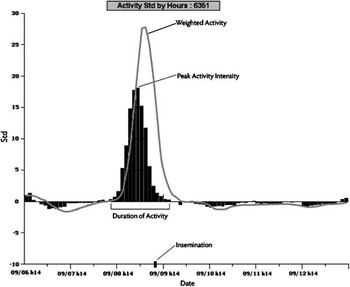
At ~14 days after calving, all cows were fitted with an activity tag (Heatime; SCR Engineers Ltd, Netanya, Israel) attached to a neck collar. After each milking, data collected by the activity monitoring system was read by a transceiver unit placed in an archway at the milking parlor exit and transferred to the activity monitoring system herd management software (DataFlow I™ version 4.7; SCR Engineers Ltd) installed on an on-farm computer. All settings of the activity monitoring system software were those being used by the farm at the time of the experiments, and software settings were not changed throughout the course of the experiments. The activity monitoring system continuously monitored individual cow activity and recorded average activity for 2 h time periods. The raw activity of individual cows was plotted as a bar graph where each bar represented a 2 h block of time (Figure 1). Using a mathematical algorithm, a weighted activity index was calculated by the software that expressed the momentary deviation of the activity from the average activity in the same time period during the past 7 days, and weighted activity was represented on the activity report by a solid line (Figure 1). Pregnancy outcomes are presented as pregnancies per AI (P/AI) evaluated a pregnancy diagnosis at a given day postinsemination.
A representative graph of an activity report for a cow generated by the DataFlow™ software (version 4.7) of the activity monitoring system (Heatime; SCR Engineers Ltd, Netanya, Israel). The activity monitoring system continuously monitored individual cow activity and recorded average activity for 2 h time periods (bars) throughout the experiment. Activity data were analyzed by the system software using an algorithm that created a weighted activity value represented by a line from which timing of insemination was determined. Adapted with permission from Valenza et al. (Reference Valenza, Giordano, Lopes, Vincenti, Amundson and Fricke2012).

Efficiency of detection of estrus
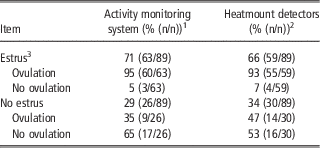
When estrus was synchronized in lactating Holstein cows using gonadotropin-releasing hormone (GnRH) followed 7 days later by PGF2α (Valenza et al., Reference Valenza, Giordano, Lopes, Vincenti, Amundson and Fricke2012), only 71% of synchronized cows (defined as having a corpus luteum that went on to fully regress and a follicle >10 mm in diameter at the PGF2α injection) were detected with increased activity by an activity monitoring system (Table 1). Overall, 95% of cows determined to be in estrus by the activity monitoring system ovulated, whereas 5% did not ovulate within 7 days of induction of luteolysis. Thus, 95% of cows that the activity monitoring system determined to be in estrus went on to ovulate. Of the cows not detected in estrus by the activity monitoring system, 35% ovulated (about 10% of all cows) whereas 65% (about 20% of all cows) did not ovulate within 7 days of induction of luteolysis (Table 1). These results agree with another study, in which cows received two sequential PGF2α injections at 35 and 49 days in milk (DIM), only 68% of cows determined to be cycling at 49 DIM were detected in estrus and inseminated after the second PGF2α injection leading the authors to conclude that issues other than cyclicity status affected efficiency and accuracy of estrus detection (Chebel and Santos, Reference Chebel and Santos2010). Results in Table 1 define two subpopulations of cows constituting nearly one-third of cows in this experiment that an activity monitoring system did not detect with increased activity: anovular cows and cows that ovulated in the absence of detectable increases in activity.
Percentage of cows defined to be in estrus, and distribution of cows by estrus activity and ovulation based on use of an activity monitoring system or heatmount detectors

Adapted with permission from Valenza et al. (Reference Valenza, Giordano, Lopes, Vincenti, Amundson and Fricke2012).
1 Heatime, SCR Engineers Ltd, Netanya, Israel.
2 Kamar Heatmount Detectors, Kamar Inc., Steamboat Springs, CO, USA.
3 The percentage of cows detected in estrus within 7 days after treatment with PGF2α preceeded 7 days by gonadotropin-releasing hormone used to synchronize estrus in this experiment did not differ (P=0.52) between the activity monitoring system and the heatmount detectors.
The proportion of cows that failed to ovulate within the group of cows not detected in estrus by the activity monitoring system was 65% for the activity monitoring system (Table 1) suggesting that estrus did not occur in these cows, whereas the remaining 35% of ovulations in cows not detected in estrus may have been silent ovulations (ovulation without estrus), a phenomena described in lactating dairy cows, especially during the early postpartum period (Allrich, Reference Alrich1994; Palmer et al., Reference Palmer, Olmos, Boyle and Mee2010; Ranasinghe et al., Reference Ranasinghe, Nakao, Yamada and Koike2010). In another study, the overall rate of ovulation failure in lactating dairy cows detected in estrus was 6.5% and was greater during the warm than during the cool season (López-Gatius et al., Reference López-Gatius, López-Béjar, Fenech and Hunter2005). This rate of ovulation failure represents a small percentage of the population of cows and could occur due to failure in the mechanism triggering ovulation (i.e. no LH surge or insufficient LH secretion) or a lack of response by the dominant follicle to the LH surge, as suggested by Valenza et al. (Reference Valenza, Giordano, Lopes, Vincenti, Amundson and Fricke2012).
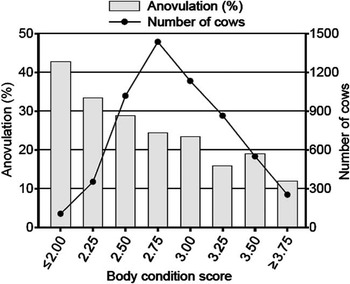
Several field trials conducted on large commercial dairies in the United States reported that 20% to 30% of high-producing lactating Holstein cows are anovular at 60 to 75 DIM (Gümen et al., Reference Gümen, Guenther and Wiltbank2003; Lopez et al., Reference Lopez, Caraviello, Satter, Fricke and Wiltbank2005; Sterry et al., Reference Sterry, Welle and Fricke2006), a time coinciding with the end of the voluntary waiting period and onset of AI breeding to detected estrus and/or timed AI after synchronization of ovulation in many herds. Based on an analysis using 5818 cows from 13 studies in 8 dairy herds in the United States (Bamber et al., Reference Bamber, Shook, Wiltbank, Santos and Fricke2009), the rate of anovulation in lactating Holstein cows averaged 23% at 50 to 65 DIM with a range among herds of 7.3% to 41.7% (Figure 2). Thus, anovular cows represent a significant proportion of cows present in US dairy herds at the end of the voluntary waiting period that will not be detected based on primary or secondary signs of estrus when using an activity monitoring system or any other form of estrus detection.
Observed prevalence of anovulation (bars) and number of cows (line) by body condition score category. Data consisted of 5818 cows from 13 studies in 8 large confinement dairy herds in the United States. Overall prevalence of anovulation was 23.3% with a range among herds of 7.3% to 41.7%. Adapted with permission from Bamber et al. (Reference Bamber, Shook, Wiltbank, Santos and Fricke2009).

Duration of activity associated with estrus
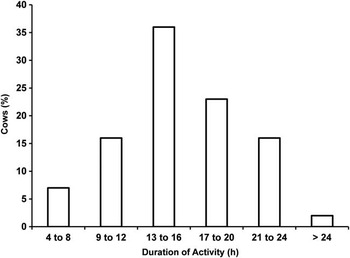
The duration of activity based on the activity monitoring system was 16.1±4.7 h (range=4.0 to 28.0; Figure 3; Valenza et al., Reference Valenza, Giordano, Lopes, Vincenti, Amundson and Fricke2012). This duration of estrus is comparable to the mean duration (13.4 h) reported for cows monitored for estrus by visual observation of both primary (standing to be mounted) and multiple secondary signs of behavioral estrus (Roelofs et al., Reference Roelofs, Bouwman, Dieleman, Van Eerdenburg, Kaal-Lansbergen, Soede and Kemp2004). Conversely, duration of estrus activity reported by Valenza et al. (Reference Valenza, Giordano, Lopes, Vincenti, Amundson and Fricke2012) is considerably longer than the mean duration of estrus based on the interval between the first and last standing event of estrus detected using radiotelemetric monitoring of mounting activity (Dransfield et al., Reference Dransfield, Nebel, Pearson and Warnick1998; Xu et al., Reference Xu, McKnight, Vishwanath, Pitt and Burton1998). Discrepancies between the duration of estrus based on activity or visual observation with that recorded based on standing events may be due to the uncoupling of expression of secondary signs of estrus behavior and standing estrus in high-producing dairy cows (Valenza et al., Reference Valenza, Giordano, Lopes, Vincenti, Amundson and Fricke2012). Indeed, Sveberg et al. (Reference Sveberg, Refsdal, Erhard, Kommisrud, Aldrin, Tvete, Buckley, Waldmann and Ropstad2011) reported that secondary signs of estrus behavior, which can be detected by visual observation or increased activity, increased significantly within 1 to 3 h before the initiation of standing estrus in lactating dairy cows.
Percentage distribution of cows based on duration of activity associated with estrus for cows detected in estrus (n=61, no duration data was available for 2 cows of the 63 cows detected in estrus) by the activity monitoring system (Heatime; SCR Engineers Ltd, Netanya, Israel) within 7 days after synchronization of estrus. Estrus was synchronized using an i.m. injection of gonadotropin-releasing hormone (100 µg) followed 7 days later by induction of luteolysis using PGF2α (25 mg). Adapted with permission from Valenza et al. (Reference Valenza, Giordano, Lopes, Vincenti, Amundson and Fricke2012).

Timing of AI relative to behavioral estrus
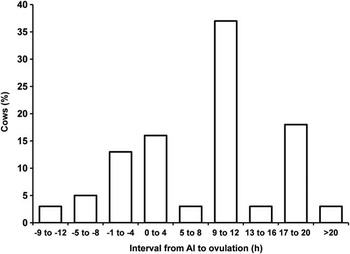
Timing of AI relative to behavioral estrus in dairy cattle has been an active area of reproductive research for over 50 years because the timing of AI relative to ovulation has a profound effect on pregnancy outcomes after AI (Nebel et al., Reference Nebel, Walker, McGilliard, Allen and Heckman1994). Owing to the short lifespan of the oocyte in cattle (Hunter, Reference Hunter2003), the interval from AI to ovulation is critical for optimizing fertility in dairy cows inseminated based on activity associated with estrus. The mean interval from AI to ovulation when inseminating based on activity using an activity monitoring system was 7.9 h (Figure 4; Valenza et al., Reference Valenza, Giordano, Lopes, Vincenti, Amundson and Fricke2012). This may initially seem appropriate because it allows for the 6 to 8 h required for the sustained phase of sperm transport to the site of fertilization and sperm capacitation (Hunter and Wilmut, Reference Hunter and Wilmut1983; Wilmut and Hunter, Reference Wilmut and Hunter1984), however, the degree of variation in the AI to ovulation interval is a major concern for pregnancy outcomes to AI based on activity. Overall, 21% of cows received AI between 0 and 12 h after ovulation (Figure 4), a timing associated with low fertilization rates and embryo quality in lactating dairy cows (Roelofs et al., Reference Roelofs, Graat, Mullaart, Soede, Voskamp-Harkema and Kemp2006), possibly due to aging of the oocyte. By contrast, only one cow was inseminated more than 24 h before ovulation (Figure 4), a period that results in high fertilization rates but low embryo quality, possibly due to aging of spermatozoa (Roelofs et al., Reference Roelofs, Graat, Mullaart, Soede, Voskamp-Harkema and Kemp2006).
Percentage distribution of cows (n=38) based on the interval from artificial insemination (AI) to ovulation. AI was conducted twice daily (7 to 9 am and 2 to 5 pm) based on increased activity detected by the activity monitoring system (Heatime; SCR Engineers Ltd, Netanya, Israel). Ovulation was determined using transrectal ultrasonography conducted every 8 h from 48 to 96 h after induction of luteolysis. Estrus was synchronized using an i.m. injection of gonadotropin-releasing hormone (100 µg) followed 7 days later by induction of luteolysis using PGF2α (25 mg). Adapted with permission from Valenza et al. (Reference Valenza, Giordano, Lopes, Vincenti, Amundson and Fricke2012).

Based on data from Valenza et al. (Reference Valenza, Giordano, Lopes, Vincenti, Amundson and Fricke2012), it may be beneficial to either reduce the variation in the AI to ovulation interval so that more cows are inseminated at the optimal time in relation to ovulation, or alternatively, to inseminate cows a few hours earlier to reduce the probability of inseminating cows after or around the time of ovulation when detected in estrus using the activity monitoring system. Interestingly, the interval from the onset of activity to ovulation increased as duration of activity increased (Valenza et al., Reference Valenza, Giordano, Lopes, Vincenti, Amundson and Fricke2012) making it difficult to optimize the AI to ovulation interval among the entire population of cows when inseminating based an activity monitoring system. In addition, the activity monitoring system software was used to generate lists of cows eligible for AI based on activity twice daily so that AI was conducted after both the first (7 to 9 am) and the second (2 to 5 pm) milking. A practical recommendation for farms relying on activity monitoring systems for timing of AI is to generate lists of cows and conduct AI twice daily rather than once daily to minimize variation from AI to ovulation, which could potentially decrease P/AI.
Presynch–Ovsynch and timed AI for first AI
The development of a hormonal synchronization protocol (i.e. Ovsynch) that allowed for timed AI (Pursley et al., Reference Pursley, Mee and Wiltbank1995, Reference Pursley, Kosorok and Wiltbank1997) has provided a management tool for initiating first AI in dairy cows, regardless of their cyclicity status. A presynchronization strategy in which cows receive two injections of PGF2α administered 14 days apart with the second PGF2α injection 10 to 14 days before initiation of an Ovsynch protocol (i.e. Presynch–Ovsynch) increases fertility to timed AI in lactating dairy cows compared with Ovsynch alone (Moreira et al., Reference Moreira, Orlandi, Risco, Mattos, Lopes and Thatcher2001; Navanukraw et al., Reference Navanukraw, Reynolds, Kirsch, Grazul-Bilska, Redmer and Fricke2004). The Presynch–Ovsynch protocol has been widely adopted by dairies in the United States (Caraviello et al., Reference Caraviello, Weigel, Fricke, Wiltbank, Florent, Cook, Nordlund, Zwald and Rawson2006) and is a popular strategy for submitting cows for first AI because AI to detected estrus can be combined with timed AI for cows failing to be detected in estrus. In this way, a dairy can precisely manage the voluntary waiting period as well as set a maximum number of DIM when all cows in the herd receive their first and subsequent AI services.
One mechanism by which presynchronization with PGF2α may improve fertility is by presynchronizing the estrus cycle so that cows initiate the first GnRH injection of the Ovsynch protocol on days 5 to 9 of the estrus cycle, thereby resulting in a greater synchronization rate and fertility compared with initiation of an Ovsynch protocol at other stages of the cycle (Vasconcelos et al., Reference Vasconcelos, Silcox, Rosa, Pursley and Wiltbank1999). Initiating an Ovsynch protocol on day 6 or 7 of the estrus cycle increases the probability of inducing ovulation of the dominant follicle of the first follicular wave of the estrus cycle, thereby improving synchrony of emergence of a new wave and synchronized ovulation rate to the second GnRH injection of the Ovsynch protocol. It is important to note that the first published study using a PGF2α -based presynchronization strategy resulted in an increase in fertility to timed AI for presynchronized cows compared with Ovsynch alone only after anovular cows were removed from the data set but not when they were included in the analysis (Moreira et al., Reference Moreira, Orlandi, Risco, Mattos, Lopes and Thatcher2001). Thus, presynchronization strategies based on PGF2α alone do not resolve the anovular condition in cows before they initiate the Ovsynch portion of the protocol. Although anovular cows submitted to a Presynch–Ovsynch protocol and timed AI have reduced fertility and greater pregnancy loss than their cycling herd mates, some anovular cows receiving timed AI do conceive and maintain a pregnancy (Santos et al., Reference Santos, Thatcher, Chebel, Cerri and Galvão2004; Sterry et al., Reference Sterry, Welle and Fricke2006).
Combining AI based on activity with protocols for timed AI
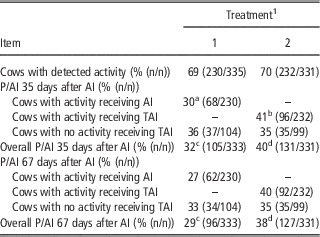
A combined approach in which AI is based both on activity detected by an activity monitoring system followed by submission of cows not detected with activity to timed AI after synchronization of ovulation may be an effective and economical strategy to submit lactating dairy cows for first AI. A field trial was conducted to compare reproductive performance of lactating dairy cows managed for first AI using timed AI with or without detection of estrus using an activity monitoring system (Fricke et al., Reference Fricke, Valenza, Giordano, Amundson and Lopes2014). All cows were administered 2 i.m. injections of PGF2α 14 days apart (Presynch) at 39±3 and 53±3 DIM to presynchronize their estrus cycles 12 days before submission to an Ovsynch protocol, and activity was monitored in all cows using an activity monitoring system (Heatime) beginning at 24±3 DIM. Cows in treatment 1 (n=333) with increased activity after the second PGF2α injection were inseminated based on activity, whereas cows without increased activity were submitted to an Ovsynch protocol beginning 12 days after the second PGF2α injection of the presynchronization protocol and received timed AI at 75±3 DIM. Cows in treatment 2 (n=331) with increased activity after the second PGF2α injection were recorded by the activity monitoring system software but were not inseminated so that all cows in treatment 2 completed the Presynch–Ovsynch protocol and received a timed AI at 75±3 DIM, regardless of whether or not they were detected with increased activity after the second PGF2α injection.
The activity monitoring system detected increased activity in 69% and 70% of cows after the second PGF2α injection in treatments 1 and 2, respectively (Table 2), which is about 10 to 15 percentage points greater than that reported in studies using tail chalk after the second PGF2α injection of a Presynch–Ovsynch protocol (Stevenson and Phatak, Reference Stevenson and Phatak2005; Chebel and Santos, Reference Chebel and Santos2010). Overall, cows in treatment 1 in which inseminations occurred as a combination between AI to activity and timed AI had fewer P/AI compared with cows in treatment two in which all cows received timed AI after completing the Presynch–Ovsynch protocol (Table 2). The reduction in P/AI due to inseminating cows with increased activity after the second PGF2α injection was expected because the increase in P/AI due to presynchronization with PGF2α likely results from synchronizing estrus after the second PGF2α injection (Navanukraw et al., Reference Navanukraw, Reynolds, Kirsch, Grazul-Bilska, Redmer and Fricke2004) so most cows initiate the Ovsynch protocol on days 5 to 9 of the ensuing estrus cycle, thereby improving P/AI to timed AI (Vasconcelos et al., Reference Vasconcelos, Silcox, Rosa, Pursley and Wiltbank1999). Inseminating 70% of cows based on activity after the second PGF2α injection removed the presynchronized cows from the protocol, thereby negating the increase in P/AI due to presynchronization. Cows without increased activity after the second PGF2α injection and submitted to an Ovsynch protocol had P/AI of 33% and 35% for treatments 1 and 2, respectively (Table 2). Pregnancy outcomes of anovular cows subjected to an Ovsynch protocol is generally about 20% compared with about 35% for cycling cows starting an Ovsynch protocol at a random stage of the cycle (Gümen et al., Reference Gümen, Guenther and Wiltbank2003; Stevenson et al., Reference Stevenson, Tenhouse, Krisher, Lamb, Dahlen, Pursley, Bello, Fricke, Wiltbank, Brusveen, Burkhart, Youngquist and Garverick2008). Thus, cows without activity that received an Ovsynch protocol had a P/AI similar to that of cycling cows starting an Ovsynch protocol at a random stage of the cycle. Thus, aggressive submission of cows to an Ovsynch protocol after failing to be detected with increased activity is an effective management strategy to establish pregnancy in this subgroup of cows.
Effect of treatment on percentage of lactating Holstein cows with activity based on an activity monitoring system, and pregnancies per AI (P/AI) for cows with or without activity and inseminated to activity (AI) or inseminated after synchronization of ovulation (TAI)

AI=artificial insemination; TAI=timed artificial insemination
Adapted from Fricke et al. (Reference Fricke, Valenza, Giordano, Amundson and Lopes2014).
a,bWithin a treatment by activity subgroup, statistical contrast differed (P=0.004).
c,dWithin a row, percentages with different superscripts differed (P=0.0454).
1 Treatments were: (1) cows inseminated based on an activity monitoring system after the second PGF2α injection of a Presynch–Ovsynch protocol with cows not detected with activity receiving timed AI after completing the Presynch–Ovsynch protocol; (2) cows receiving timed AI after a Presynch–Ovsynch protocol.
Overall, 31% of cows in treatment 1, and 100% of cows in treatment 2 were submitted to the Ovsynch portion of the synchronization protocol, and blood samples were collected from a subgroup (~85%) of cows in each treatment at the first GnRH injection of the Ovsynch protocol to determine progesterone concentration at the onset of the protocol (Fricke et al., Reference Fricke, Valenza, Giordano, Amundson and Lopes2014). Surprisingly, over 50% of these cows had progesterone concentrations ⩾1 ng/ml at the first GnRH injection of the protocol, and similar results were observed for cows in treatment 2 that were not detected with activity after presynchronization. Thus, many cows without activity after presynchronization likely ovulated in the absence of detectable activity resulting in high progesterone at the first GnRH injection of the Ovsynch protocol. These results agree with the 10% of cows that ovulated but failed to be detected with activity by the activity monitoring system (Valenza et al., Reference Valenza, Giordano, Lopes, Vincenti, Amundson and Fricke2012; Table 1). Results from Fricke et al. (Reference Fricke, Valenza, Giordano, Amundson and Lopes2014) support a management strategy in which the 30% of cows not detected with activity are aggressively submitted to an Ovsynch protocol rather than continuing to detect activity using an activity monitoring system.
Combining detection of estrus with Presynch–Ovsynch and timed AI
Whether or not to inseminate cows detected in estrus after the second PGF2α injection of a Presynch–Ovsynch protocol or to allow all cows to receive a timed AI after completing the protocol is a question posed by many dairy farm managers in the United States. The rate at which cows become pregnant is determined by an interaction between the insemination risk and the conception risk during the AI breeding period. Cows inseminated to estrus are inseminated earlier but at a lesser conception rate compared with the total timed AI approach, in which cows are inseminated later but at a greater conception rate. In reality, conception rates of cows inseminated to estrus v. timed AI as well as the proportion of cows detected in estrus after the second PGF2α injection of a Presynch–Ovsynch protocol varies widely among farms. A Markov-chain model was developed to simulate a dairy herd and assess the economic value of various reproductive programs (Giordano et al., Reference Giordano, Kalantari, Fricke, Wiltbank and Cabrera2012). To compare the economic and reproductive performance of programs combining timed AI and different levels of AI after detection of estrus using a daily Markov-chain model, a dairy herd was modeled with every cow following daily probabilistic events of aging, replacement, mortality, pregnancy, pregnancy loss and calving (Giordano et al., Reference Giordano, Kalantari, Fricke, Wiltbank and Cabrera2012). The probability of pregnancy depended on the combination of probabilities of insemination and conception that varied among the programs compared.
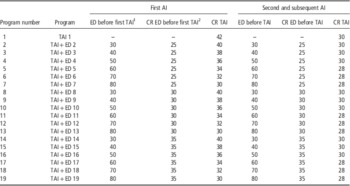
Nineteen reproductive programs were simulated to evaluate and compare the economic and reproductive performance when using a Pesynch–Ovsynch program that relies on 100% timed AI for all AI services with programs that combine different levels of estrus detection, including three different levels of P/AI for cows inseminated to estrus (Table 3). The net value of a given program was the sum of milk income over feed cost, replacement and mortality cost, income from calves, and reproductive program costs (Giordano et al., Reference Giordano, Kalantari, Fricke, Wiltbank and Cabrera2012). This range of programs was selected to represent the spectrum of dairy farm reproductive management practices, combining synchronization with detection of estrus in the US Program 1 was set as a baseline and relied completely on timed AI for all services after synchronization of ovulation for first timed AI using a Presynch–Ovsynch protocol (Moreira et al., Reference Moreira, Orlandi, Risco, Mattos, Lopes and Thatcher2001), with an Ovsynch protocol (Pursley et al., Reference Pursley, Mee and Wiltbank1995) for second and subsequent timed AI. For Program 1, the end of the voluntary waiting period was set at 72 DIM coincident with first timed AI. Thirty-two days after first and subsequent timed AI; all cows received the first GnRH injection of the Ovsynch protocol for resynchronization of ovulation, regardless of their pregnancy status. Seven days later, nonpregnancy diagnosis was performed by rectal palpation, and those cows failing to conceive to the previous timed AI continued the protocol to receive their next timed AI 42 days after the prior AI.
Expected reproductive performance of programs used for simulation in the case study

AI=artificial insemination; TAI=timed artificial insemination; ED=estrus detection; CR=conception rate.
Adapted with permission from Giordano et al. (Reference Giordano, Kalantari, Fricke, Wiltbank and Cabrera2012).
1 Percentage of cows AI after ED before first TAI.
2 CR of cows receiving AI after a detected estrus.
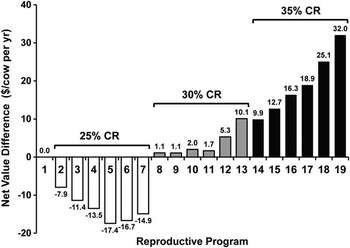
When 30% to 80% of cows received AI to a detected estrus and the resulting P/AI was 25%, the economic outcome was negative when compared with the 100% timed AI program based on a Presynch–Ovsynch protocol with 42% P/AI after first timed AI and 30% P/AI after second and subsequent timed AI (Giordano et al., Reference Giordano, Kalantari, Fricke, Wiltbank and Cabrera2012; Figure 5). Thus, when P/AI to detected estrus in a herd is poor, allowing all cows to complete the Presynch–Ovsynch protocol and receive their first timed AI is the most profitable strategy. Conversely, whenever P/AI to AI after a detected estrus was 30% or 35%, there was always an economic advantage to inseminating cows detected in estrus across all levels of estrus detection.
Difference in Net Value (NV; $/cow per year) for 18 reproductive programs combining estrus detection and timed artificial insemination (AI) with 100% timed AI after a Presynch–Ovsynch protocol as defined in Table 2. Adapted with permission from Giordano et al. (Reference Giordano, Kalantari, Fricke, Wiltbank and Cabrera2012).

Future directions of technologies for detection of estrus
There is a clear trend toward the adoption of new technologies such as activity monitoring systems by US dairy farmers for detecting estrus in dairy cows. At present, activity monitoring systems can accurately detect ~70% of cows in estrus, and most cows determined to be in estrus by the system go on to ovulate making these systems potential tools for managing reproduction in dairies. Data reviewed herein, however, reveal two key biological challenges that limit use of monitoring changes in physical activity as a means for inseminating high-producing dairy cows. First, anovular cows represent a significant subpopulation of cows in US dairy herds that by definition are not reproductively cycling. Furthermore, cows failing to be detected with increased activity that were submitted to an Ovsynch protocol had similar fertility compared with cows inseminated to activity. Interestingly, although body condition score near timed AI was negatively correlated with the proportion of anovular cows, level of milk production did not affect the proportion of anovular cows (Lopez et al., Reference Lopez, Caraviello, Satter, Fricke and Wiltbank2005). Thus, until the underlying mechanisms causing anovulation in dairy cows are understood and mitigated, some level of hormonal therapy used to deal with these anovular cows will be beneficial.
Second, timing of AI relative to increased activity is not optimal due to the variation among cows in the interval from the onset of activity to ovulation (Valenza et al., Reference Valenza, Giordano, Lopes, Vincenti, Amundson and Fricke2012). As milk production increases, duration of estrus increases (Lopez et al., Reference Lopez, Satter and Wiltbank2004) and the interval from onset of activity to ovulation also increases (Valenza et al., Reference Valenza, Giordano, Lopes, Vincenti, Amundson and Fricke2012). One area of focus for improving activity monitoring is to further understand factors affecting the interval from onset of activity to ovulation among cows and to develop algorithms to adjust timing of AI to improve fertility outcomes in individual cows (Løvendahl and Chagunda, Reference Løvendahl and Chagunda2010). It is possible, however, that as milk production increases due to genetic selection that an uncoupling of estrus behavior and induction of the LH surge will continue to be manifest in high-producing dairy cows (Valenza et al., Reference Valenza, Giordano, Lopes, Vincenti, Amundson and Fricke2012). Thus, as milk production continues to increase in the dairy cow population as a whole, problems with the accuracy with which activity monitoring systems predict timing of ovulation may only worsen.
Part of the problem with activity monitoring systems in confinement-based dairies is that the environment is not suitable for cows to exhibit estrus activity (Britt et al., Reference Britt, Scott, Armstrong and Wiitacre1986). Grazing-based systems in which cows spend extended time on grass may provide a more suitable environment for expression of estrus. A recent experiment compared two activity monitoring systems to visual observation during a 37 days AI breeding season in a large grazing-based dairy in New Zealand (Kamphuis et al., Reference Kamphuis, DelaRue, Burke and Jago2012). Both activity monitoring systems and visual observation accurately identified cows not in estrus, but the activity monitoring systems performed poorly when identifying cows in true estrus compared with visual observation. In another experiment (Aungier et al., Reference Aungier, Roche, Sheehy and Crowe2012), an activity monitoring system was evaluated for use in 89 spring-calving cows managed on pasture in Ireland. Although the activity monitors identified 72% of preovulatory follicular phases correctly, one-third of the activity clusters detected by the system were associated with high progesterone (i.e. false positives). Collectively, these data indicate that activity monitoring systems as well as the software used to interpret activity data show promise for managing reproduction in grazing-based dairy systems but in their present form have much room for improvement.
A novel approach to the problem of estrus detection in dairy cattle would be to monitor substances or hormones secreted in milk in sufficient quantities to be detected by an inline milk sensing device during normal milking periods on a dairy. Obviously, this substance must first be identified or a known marker must be used and the inline milk sampling technology developed to accurately detect and monitor this substance. If sensitive and specific, such a system would have a minimal marginal cost once the initial capital outlay was made to install the equipment on the dairy. By using such a system, a list of cows eligible for insemination could be generated once or twice daily on a farm. Integration of this information into a computerized dairy management software system would allow dairy managers to review the status of individual cows to determine whether or not cows are in estrus as well as assess their cyclicity and pregnancy status to identify anovular cows as potential candidates for hormonal therapy. One such technology available in some areas of the world presently assesses milk progesterone concentrations of individual cows at each milking. Progesterone is abundant in milk, is easily measured, and levels in milk change predictably during the reproductive cycle. A decrease in milk progesterone associated with luteolysis alone, however, is not sufficient to accurately predict ovulation because the interval from luteolysis to ovulation varies widely among cows due to a prolonged follicular phase, resulting from increased hepatic steroid metabolism (Wiltbank et al., Reference Wiltbank, Lopez, Sartori, Sangsritavong and Gümen2006). Future technologies that could monitor changes in progesterone as well as estradiol in milk might better predict timing of estrus and ovulation, thereby allowing for timed AI in dairy cows.
Summary and conclusions
Based on two experiments assessing an activity monitoring system on a large commercial dairy farm in the United States (Fricke et al., Reference Fricke, Valenza, Giordano, Amundson and Lopes2014; Valenza et al., Reference Valenza, Giordano, Lopes, Vincenti, Amundson and Fricke2012), only about 70% of cows were inseminated based on the activity monitoring system. These data underscore the importance of implementing a comprehensive reproductive management program for identification and treatment of cows that would otherwise not be inseminated. The mean time of AI in relation to ovulation was acceptable for most of the cows detected in estrus, however, variability in the duration of estrus and timing of AI in relation to ovulation could lead to poor fertility in some cows (Valenza et al., Reference Valenza, Giordano, Lopes, Vincenti, Amundson and Fricke2012). Although use of an activity monitoring system to inseminate cows based on activity reduced days to first AI, cows receiving 100% timed AI after completing a Presynch–Ovsynch protocol had more P/AI (Fricke et al., Reference Fricke, Valenza, Giordano, Amundson and Lopes2014). The trade-off between AI service rate and P/AI was reflected by an economic analysis in which varying levels of estrus detection and three levels of P/AI were compared (Giordano et al., Reference Giordano, Kalantari, Fricke, Wiltbank and Cabrera2012). When P/AI to detected estrus in a herd is poor, allowing cows to complete the Presynch–Ovsynch protocol and receive a timed AI would be a preferred strategy; conversely, whenever P/AI to AI after a detected estrus is 30% or 35% there was always an economic advantage to inseminating cows detected in estrus across all levels of estrus detection.
We conclude that although a variety of strategies can be used to submit cows for first and subsequent AI, synchronization of ovulation and timed AI is a beneficial strategy to inseminate cows not detected by the activity monitoring system. Clearly, much effort has been invested in developing systems for detecting estrus in dairy cows. Refinement of existing technologies as well as development of new technologies for detection of estrus will likely continue in the future. It will indeed be interesting to see how physiological changes in dairy cows due to high milk production affect the ability of cows to express estrus as well as affect the ability of technologies to accurately detect estrus in dairy cows.
Acknowledgements
We thank Majestic View Dairy for use of their cows and facilities to conduct these experiments. This research was supported by SCR Engineers, Ltd. and Hatch project WIS01171 to P.M.F.