


The signum congruentiae, or sign of congruence, is a familiar symbol found in many music manuscripts, particularly those from the fifteenth century. It is a label that has long been accepted to describe a very specific notational symbol found within mensural polyphonic notation and appears frequently in musicological scholarship. Under most modern definitions, this symbol – represented as  – almost always marks a point of alignment across the polyphonic parts of a musical work, often occurring at an important structural moment. Whilst we nearly universally accept this definition and its label as a ‘sign of congruence’, there are several instances in surviving practical and theoretical sources where these symbols seem to indicate a different function, a phenomenon that has received little scholarly attention to date.
The notational treatises of the fifteenth-century music theorist Johannes Tinctoris (c. 1435–1511), well known to scholars of medieval and Renaissance music as some of the most important theoretical texts of the age, contain a few intriguing uses of this symbol that are not found in practical sources. Tinctoris, ever searching for clarity and precision in musical notation and lambasting those who introduce ambiguity, seemingly assigns a different function to signa congruentiae for specific points throughout his treatises, especially in his magisterial treatise on the art of counterpoint, De arte contrapuncti. This article examines in detail Tinctoris’s use of this sign across his theoretical output and considers what it might tell us about his particular intention at specific points.
Before considering Tinctoris’s texts and examples, however, a brief exploration of the various functions of the sign and the term itself is in order. The sign appears with some frequency in musical sources from at least the early fifteenth century onwards. In describing the sign and its function, Willi Apel provides a facsimile of Guillaume Du Fay’s three-voice chanson Dona i ardenti rai from Oxford, Bodleian Library, MS Canon. Misc. 213 (fol. 73r) which includes two signa congruentiae (one in the Discantus and the other in the Tenor).Footnote 1 In this instance, the signs, made up of three dots in a triangular formation, indicate a point of congruence between these two voices. These are placed at the end of the opening phrase of this piece, creating a visual signifier for a structural point. Canon. Misc. 213 is certainly not the first source to make use of such symbols but it provides ample introductory demonstration that these were common in mensural notation from at least the generation before Tinctoris.
Moving forward some forty or fifty years to Tinctoris’s own circle, it is interesting to note the appearance of these signs in the Mellon Chansonnier, a source with which Tinctoris may have been involved in some kind of editorial capacity.Footnote 2 The sign appears in numerous pieces across the manuscript, almost always at the end of sections. It is used to indicate points of congruence, usually followed by a short rest, or to indicate second endings in pieces, much like the examples discussed later in this article from Paris, Bibliothèque nationale de France, f. fr. MS 12744 and f. fr. MS 9346.Footnote 3 In most cases, these signs are followed by a short rest, a feature which holds some theoretical links to discussions of these signs, as will become clear shortly.
DEFINING THE SIGNUM CONGRUENTIAE
Although this sign appears with relative frequency in practical musical sources and, by implication, without explanation, few theoretical works mention or describe it in any real detail. The term ‘signum congruentiae’, and close relations, appears in only three theoretical treatises, all of which date from the mid- to late fifteenth century. It is significant that none of these texts had particularly widespread circulation if the surviving sources are taken as an indicator of dissemination. The definitions found in these treatises are also highly ambiguous and, in some senses, raise more questions than they answer. Thus, the term, if not the symbol, is far from a contemporary commonplace and should perhaps be accepted more cautiously given its rather limited historical justification.
One of the treatises to include a definition of this sign is the Tractatus et compendium cantus figurati by Coussemaker’s Anonymous XII (c. 1460–71), a treatise known for its introduction of new reduced note-value terminology that remained in use in Germany throughout the sixteenth century.Footnote 4 The treatise is somewhat geographically distant from Tinctoris’s theoretical spheres of influence and it seems unlikely he knew its contents, even though it is contemporaneous with the composition of his texts. At the end of a list of musical signs – including those indicating mensuration and prolation, and those described as signum aspirationis and signum concordationis – the anonymous author provides a short definition of the signum congruentiae amongst a list of nine other types of notational signs:Footnote 5

Anon. XII places the signum congruentiae alongside mensuration signs and proportional signatures, grouping this sign together with the principal notational symbols used in mensural notation that are not note shapes or rests. Proximity to these important notational symbols suggests that the anonymous theorist recognised implicitly the importance of this symbol in contemporary thought and musical practice. The text provides a short explanation of what a sign of congruence shows, noting that it is placed ‘where all voices come together’. Although the description is very brief, its definition is clear and to the point: the sign is used to mark a point where all voices coincide. Interestingly, the anonymous author’s text is curiously quiet on the extra meanings that we attach to such symbols as indicating important structural moments, repeat markings or other musical points in his text.Footnote 7 For this theorist, the sign simply represents a point of coincidence: structural significance is not required for the sign to be applied.
The second source for a definition of a symbol resembling that of the signum congruentiae is drawn from a treatise related to that of Anon. XII, and offers a partial extension to our anonymous theorist’s theoretical point. The anonymous treatise known as Anonimi tractatus de musica compendium cantus figurati terms this symbol both a signum convenientiae and a signum cadentiae. The theorist provides a symbol that closely resembles that of the signum congruentiae.Footnote 8 In contrast to its other highly derivative points, this is a rare instance where this text offers an extension to the definitions set out by Anon. XII.
However, this slight elaboration does relatively little to fully clarify the function of this symbol. Such a sign is described as being used ‘ubi una vox post pausas cadit supra reliquam’ (‘where one voice falls upon the rest [of the voices] after rests’), providing some evidence that signa of this type could be used to indicate canonical entries or the re-entry of a voice after a period of rest.Footnote 9 Thus, this second definition provides some information that is missing from the first, offering a suggestion of the likely placement of such symbols within a practical context. This takes the definition a step closer to our modern understanding of this symbol.
The same symbol is similarly defined in the version of Tinctoris’s De punctis that survives in Ghent. The twentieth chapter of the text labels these symbols as ‘puncti acceptionis’ (points of take-up). As the chapter that discusses these symbols in Tinctoris’s De punctis survives only in Ghent and not in the three ‘main’ sources for Tinctoris’s texts – (Br1, V and BU) – its attribution to Tinctoris is questionable.Footnote 10 Further evidence to support this is found in the absence of the term from Tinctoris’s Diffinitorium, casting further doubt on his authorship, and all but confirming this chapter was written by another author. The identity of this other author is unlikely to be unearthed unless new evidence comes to light. Other peculiarities of Ghent contribute to this notion as well, as this source seems to represent a different transmission process from the three principal manuscripts, and thus it might preserve an alternative tradition of Tinctoris’s treatises, perhaps even in slightly earlier incarnations. For the present discussion, the author of this chapter will be labelled ‘pseudo-Tinctoris’ in the absence of a more accurate identification. The passage reads as follows:

Pseudo-Tinctoris’s text, unlike that of Anon. XII, clearly describes the shape and form of these signa as consisting of three dots placed together as a triangular figure from which a turned-back stroke is drawn out. The description of the shape and part of its function seems to match our modern conception of the signum congruentiae. Thus it seems that, on a basic level, we can draw rough equivalence between these labels. If the definition is consulted carefully, however, it is clear that the two labels indicate subtly different things.
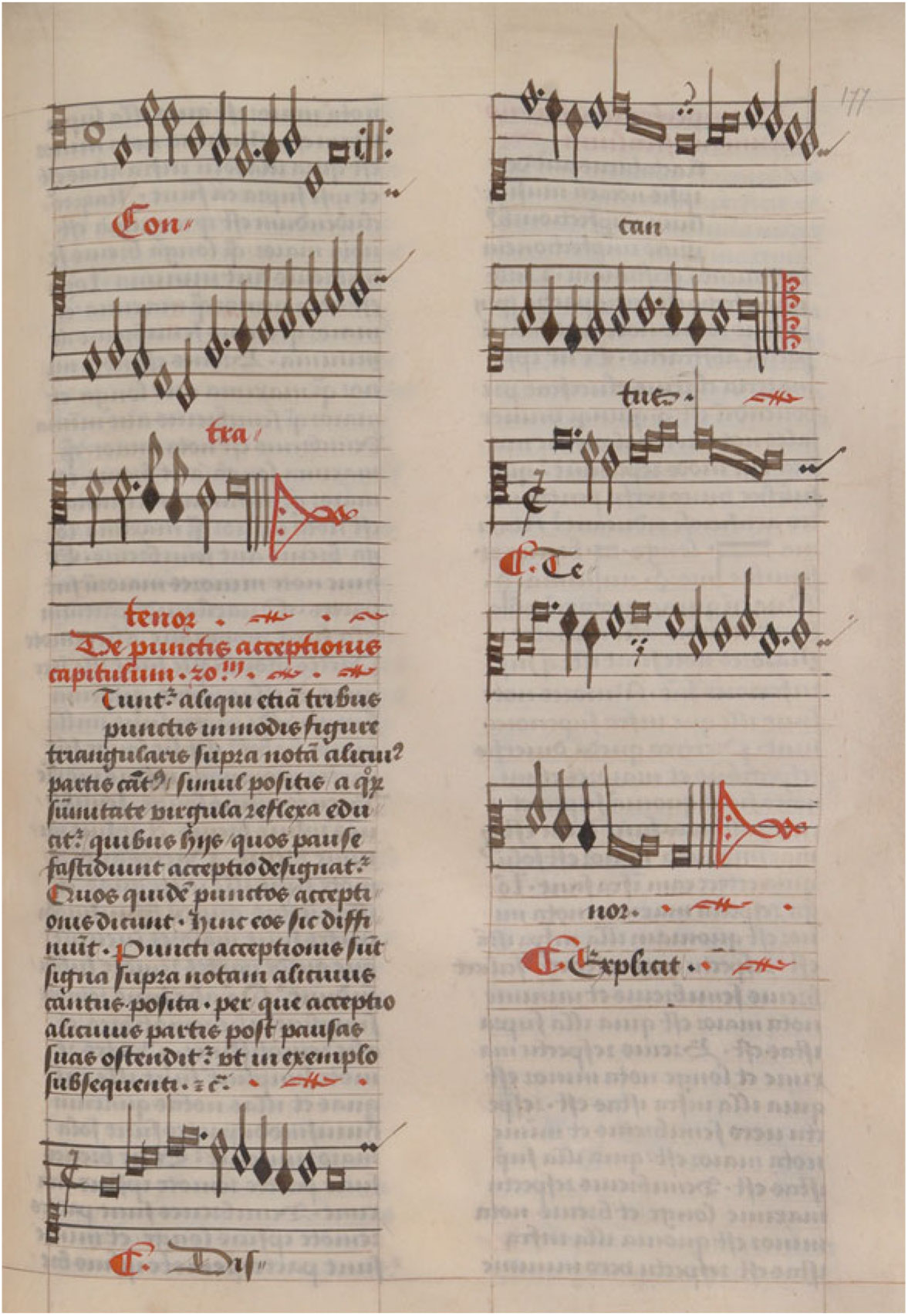
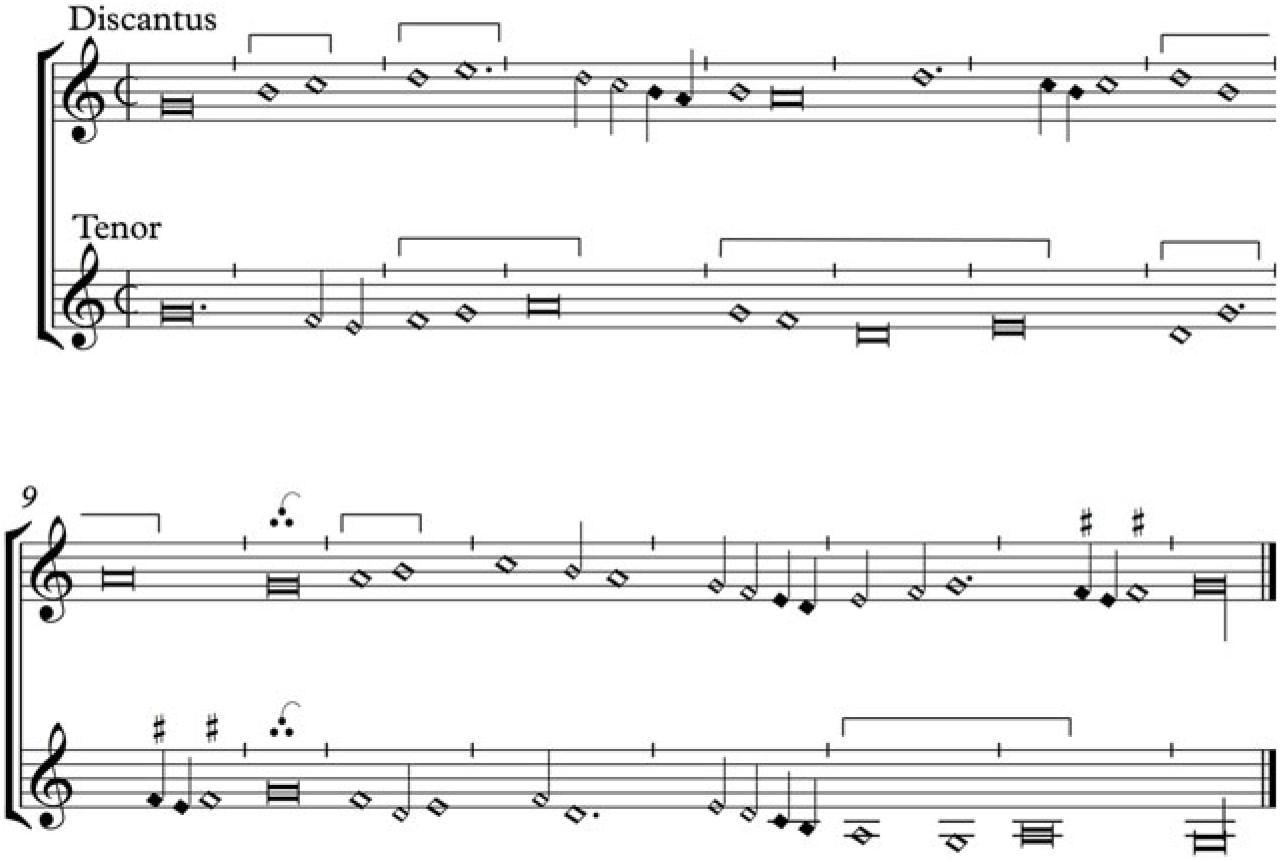
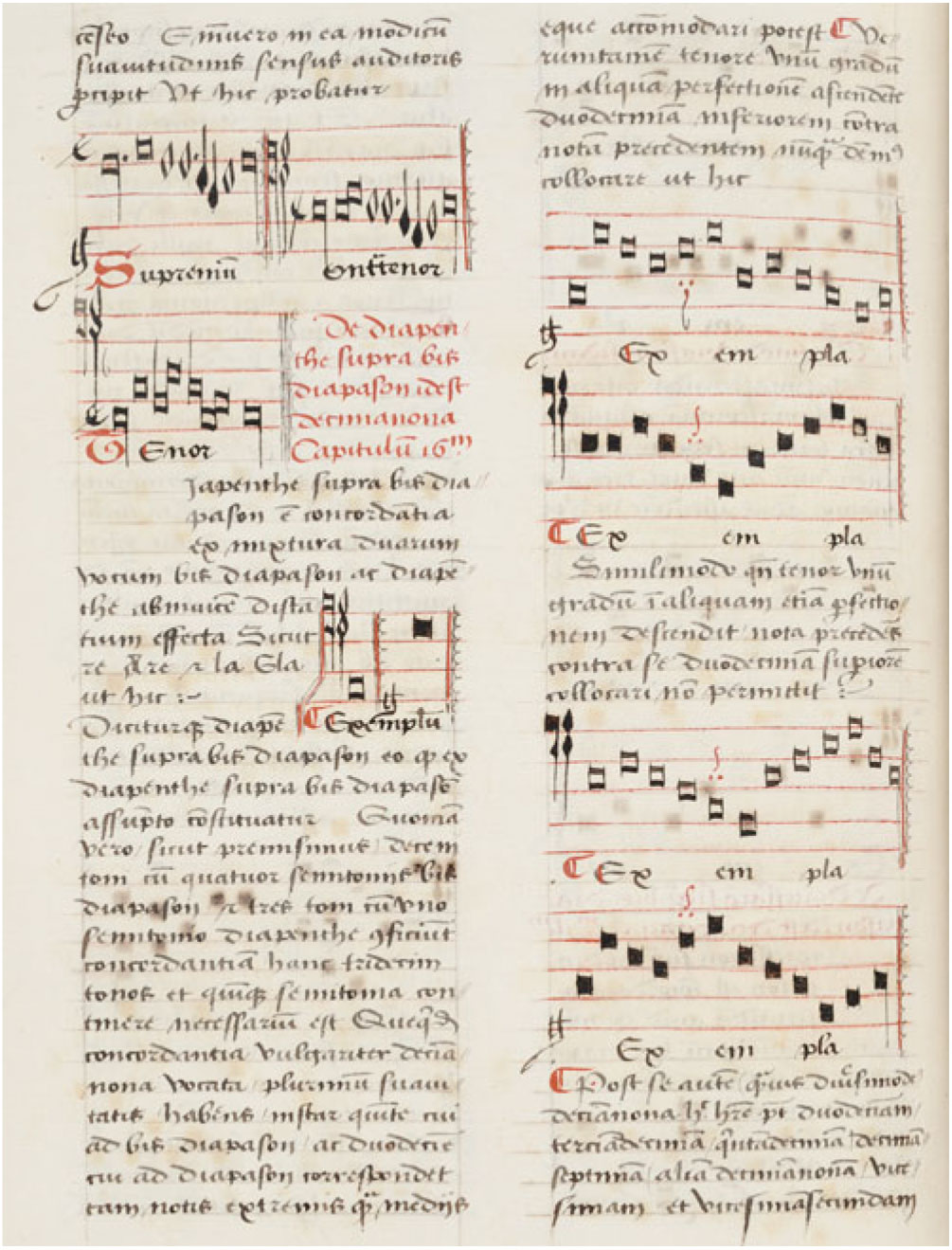
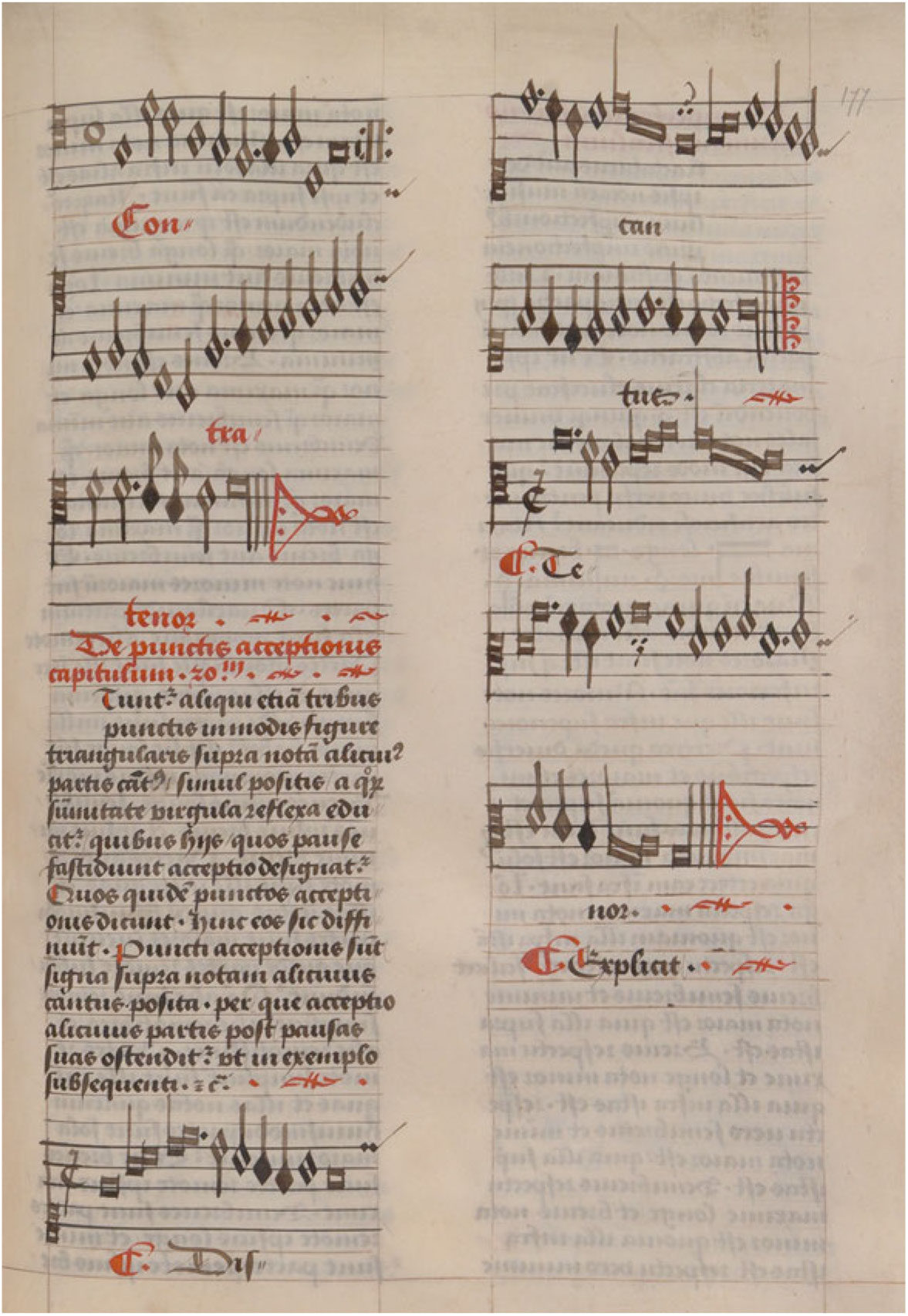
Puncti acceptionis are described as indicating a point of take-up to aid those ‘whom rests annoy’. We might infer from this that such symbols were to be used after a long period of rest in a voice part, during which time a singer could consult another part and follow it until their point of entry. Undoubtedly, this would have helped a singer in practical performance, particularly one with less experience in reading mensural notation. Quite characteristically, the text in Tinctoris’s treatise is followed by an example (see Figure 1 and Example 1) intended to show the use of these symbols, using a miniature two-part polyphonic composition as a vehicle for this demonstration.
Pseudo-Tinctoris, De punctis, ch. xx in Ghent, Universiteitsbibliotheek, MS 70, fol. 177r. A short polyphonic miniature to demonstrate the application of puncti acceptionis, though the example (bottom of left column and entirety of right column) actually demonstrates signa congruentiae in a more traditional sense, and does not meet the full requirements of the text
Transcription of the polyphonic miniature which follows the discussion of puncti acceptionis (as seen in Figure 1)

At first glance it would seem that this pedagogical miniature demonstrates the theoretical point fully, including signa in both voice parts. The two signa are placed on a unison G (above middle C) in both voice parts at the cadence marking the end of the first phrase. This represents a traditional point of coincidence or congruence. Though satisfying our modern understanding of the term, the example does not demonstrate the full specifics of pseudo-Tinctoris’s definition. To exemplify puncti acceptionis properly, the example would need to contain a symbol placed after a period of rest, presumably one long enough to justify its inclusion, in order to indicate properly the ‘point of take-up’, i.e. the point at which a voice restarts after a period of rest. Given that rests are entirely absent from this example, it is not possible for this important aspect of pseudo-Tinctoris’s definition to be demonstrated. Instead, the example demonstrates a signum congruentiae in the traditional sense as laid out by Anon. XII, albeit with a more detailed textual description of its shape and form, and a musical miniature to show the way in which it might be used in a practical musical scenario.
Thus, two distinct definitions have been identified in three fifteenth-century theoretical texts, with each approaching the symbol from a slightly different viewpoint. Anon. XII, and the related Anonimi tractatus de musica compendium cantus figurati, presents this symbol as a tool to indicate a point where voice parts align, with no specific context for the application of the symbol being given; De punctis gives a specific notational context for the symbol functioning as an aid to singers, yet includes an example that demonstrates Anon. XII’s definition and not that of the puncti acceptionis.Footnote 12 These divergent definitions of a similarly shaped notational sign are indicative of the possibility that the functions of this symbol could be multiple.
Indeed, the modern label of signa congruentiae does not even wholly account for the different uses of this symbol in some practical sources. Maureen Epp has highlighted two French sources – Paris, Bibliothèque nationale f. fr. 12744 and Paris, Bibliothèque nationale f. fr. 9346 – that make use of signa congruentiae to indicate the structural and sectional outlines of musical compositions.Footnote 13 Of the 105 songs in these two manuscripts, all of which are monophonic, thirty-five make use of signs resembling signa congruentiae. These appear throughout the manuscript and are not confined to any particular gathering or genre of work. Epp notes that, in almost every instance, signa appear on the first note of the final phrase of a song, suggesting that the symbol carries out another function than indicating a point of congruence. Instead, it might demarcate a structural division, important for the song structure, or indicate that the last phrase is to be repeated. The notion that this small symbol had multiple meanings is clear from the investigation of its usage in theoretical treatises.
The discussion that follows outlines some different uses of symbols resembling Anon. XII’s signum congruentiae and pseudo-Tinctoris’s punctum acceptionis in Tinctoris’s De arte contrapuncti (c. 1477), and demonstrates that labelling this symbol in this way is not entirely fit for purpose, given the multiplicity of its function. The symbol to which we ascribe a simple musical function in modern editions and discussions in fact operated in a much more complex text–notation relationship in some theoretical sources than we might first assume.
THE SIGNUM CONGRUENTIAE AS SIGNIFIER OF DISSONANCE OR CONGRUENCE
Tinctoris’s De arte contrapuncti is perhaps his most famous and important theoretical treatise. The substantial treatise is made up of three books, offering comprehensive, if a little cumbersome, instruction in the rules of counterpoint, the correct way in which to sing improvised counterpoint, and to compose. Each of the books focuses on one aspect of counterpoint training: Book I deals with concords; Book II begins with discords before moving on to more complex issues pertaining to the composition of counterpoint; Book III covers eight general rules to be considered when composing counterpoint, focusing on stylistic issues rather than the procedural rules laid out in the first two books. It offers one of the most comprehensive treatments of counterpoint from the period, and includes countless examples of diverse sizes and forms, making Tinctoris’s usage of the signs in different contexts noteworthy.
Tinctoris’s treatise on counterpoint is unusual in that it gives examples of both note-against-note counterpoint and mensural polyphony, often in close succession, to demonstrate the same point from different perspectives.Footnote 14 Note-against-note counterpoint examples appear with the greatest frequency in the first and second books of the treatise, though there are occasional examples of this type in the third book. They are used principally for the exemplification of specific contrapuntal motions relating to the discussion of intervals in the main theoretical text. One might argue these set out a kind of grammar of counterpoint. In all examples of this type, the Tenor is presented in void square notation with the added Contrapunctus voice or voices presented in black square notation. This visually distinguishes the two voice parts, which are sometimes presented in a kind of vertical alignment, perhaps facilitating silent comprehension of the main theoretical point.
Given that these examples of note-against-note counterpoint require by default that both notes be sounded together, i.e. in congruence, it is surprising to find many examples with signa congruentiae attached to both voice parts.Footnote 15 Although we might read the presence of signa to be a little superfluous to requirement – ultimately, all voices coincide in such a configuration by default – the symbols play a pivotal role in strengthening the relationship between the musical notation and the text of the treatise.
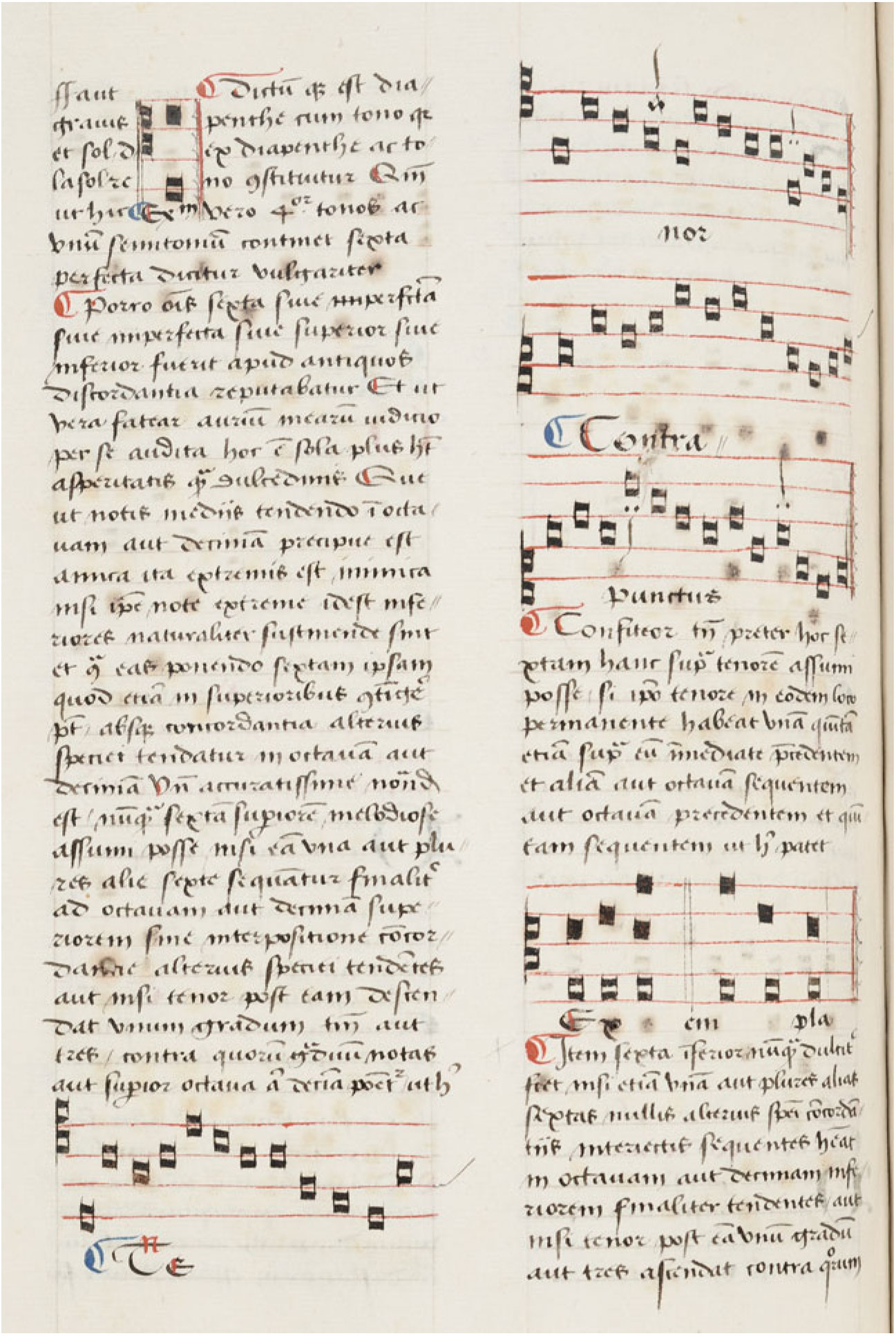
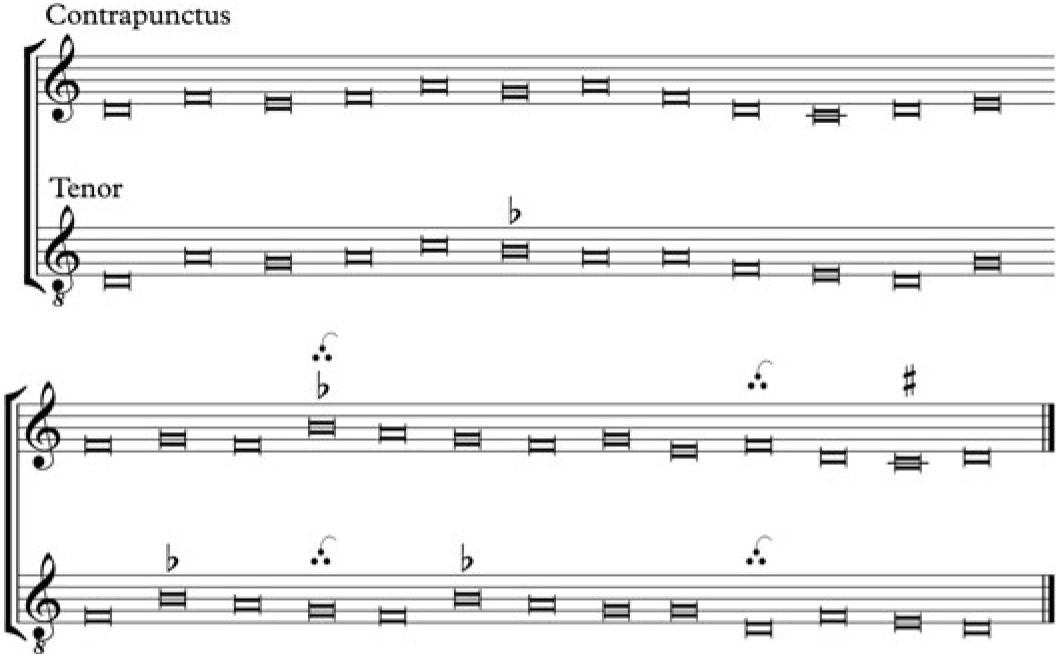
The first example of this type to feature symbols resembling signa congruentiae is found midway through Book I, ch. 7, a chapter which discusses the intervals of ‘diapente cum semitonio’ and ‘diapente cum tono’ or, in modern terms, the minor and major sixth. After two graphical depictions of the intervals themselves, Tinctoris provides an example of note-against-note counterpoint that follows a specific progression set out in the text (see Figure 2 and Example 2).

Tinctoris, Liber de arte contrapuncti, Book I, ch. 7. Example of note-against-note counterpoint, with added signa. Brussels, Bibliothèque Royale, MS II 4147, fol. 59v. Reproduced with the kind permission of the Bibliothèque royale de Belgique

Tinctoris, Liber de arte contrapuncti, Book I, ch. 7. Example of note-against-note counterpoint, with added signa. Brussels, Bibliothèque Royale, MS II 4147, fol. 59v

Here Tinctoris clearly describes contrapuntal motions relating to the interval of the sixth. He places signa congruentiae above vertically aligned instances where the contrapuntal motions described in the text are demonstrated, raising the visual profile of key moments. In the first case, a sixth precedes the tenth with a signum placed above it, and then the Tenor descends by a single step. The process is repeated for the second case, though the Tenor descends three steps in this instance, demonstrating the second part of Tinctoris’s textual description. In both cases, signa congruentiae serve to highlight a specific point in the notation relating to the text and, importantly, do not indicate a point of congruence in the traditional sense, usually associated with cadential motion.
From this, it seems that signa congruentiae have been used to act as didactic markers, strengthening the relationship between the text and the musical notation and, crucially, operating in a different manner from the function we usually ascribe to such symbols. Interestingly, the signa deployed in this example appear only in Br1. However, given Tinctoris’s likely close involvement in the production of all of the ‘main’ manuscripts of his works, and the consistency with which the signa are applied across the sources, this placement should not be attributed to a scribal emendation. The theoretical point is clear for all to see, even to those whose proficiency in counterpoint and the reading of musical notation may still have been developing. Further examination of the examples in the treatise reveals that Tinctoris’s use of the symbol is not restricted to note-against-note counterpoint examples, but extends to other types of exemplary material.
Tinctoris’s treatise on counterpoint is famous for its quotations from – and criticisms of – works by other composers, including some of the most revered compositional masters of the day, such as Okeghem and Busnoys. Examples of this type often provide a demonstration of a ‘bad’ contrapuntal or dissonance practice and are usually followed by one of Tinctoris’s own pedagogical miniatures to demonstrate the ‘correct’ contrapuntal practice.Footnote 17 In the cases where quotations of pre-existent music refer to a dissonance practice that Tinctoris judges to be erroneous, symbols resembling signa congruentiae do not function as traditional signa congruentiae. Instead, each signum, working as something close to an asterisk, signifies the point of dissonance discussed in the main text.Footnote 18
A particularly good instance of this type is found in Book II, ch. 29, where Tinctoris discusses the acceptable duration of dissonances within a polyphonic mensural context. He states that a dissonance may never last for more than half of the length of the note that defines the mensura – the mensura being the measurement of the relations of all the notes in the quantitas or mensuration.

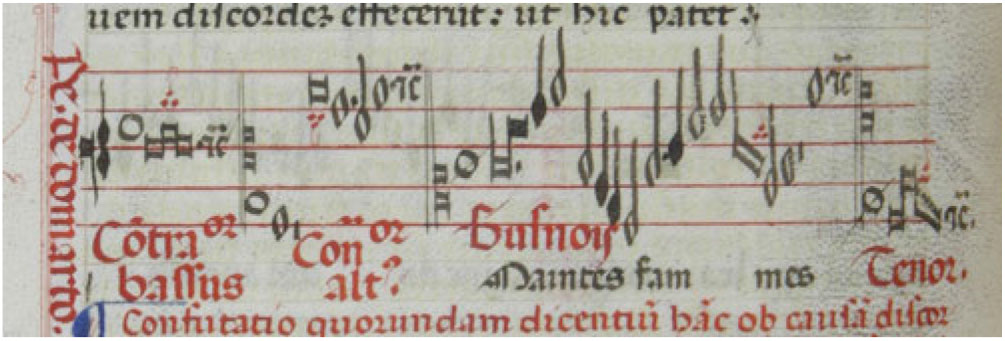
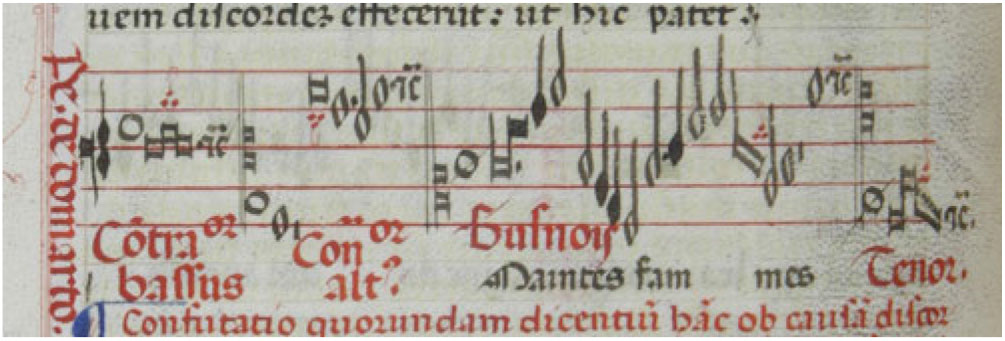
In the text, Tinctoris names and criticises harshly two of his contemporaries, Petrus de Domarto and Antoine Busnoys, for their use of dissonances that exceed the maximum duration permitted in relation to the mensura.Footnote 20 The citations are taken from sections of the Et in terra of Domarto’s Missa Spiritus almus, a work that Tinctoris appears to have taken great issue with on a number of theoretical levels, if the quantity of citations is taken to be indicative of his views on its quality, and Busnoys’s chanson Maintes femmes.Footnote 21
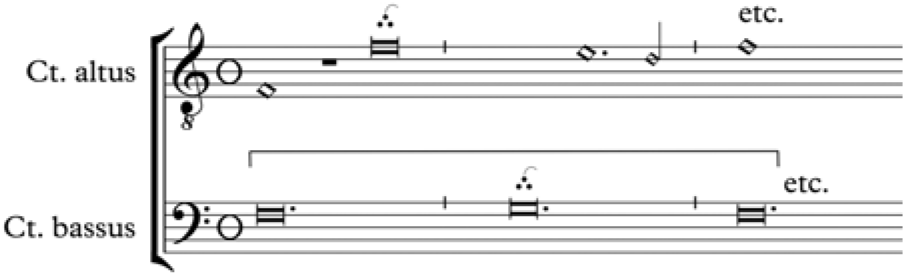
Tinctoris includes a short passage of notation from the two contratenor voices (Contratenor bassus and Contratenor altus) from Domarto’s work, placing a signum above the second note of the Contratenor bassus and Contratenor altus (see Figure 3 and Example 3). The brevity of the citation provides a sufficiently rich context for demonstration without the distraction of contextual clutter that might obscure important theoretical details in the example. If the traditional definition of a signum congruentiae was understood for this example, a reader might have mistakenly aligned the two symbols and assumed that the two corresponding pitches were to be sounded together as though they coincided. The only solution to this ambiguity would have been for Tinctoris to split this breve into two notes, thus obscuring his theoretical point. However, closer examination of the notation reveals that, although indicating a broad point of coincidence, these two pitches should not be ‘struck’ together, as demonstrated by the transcription (Example 3). The F of the Contratenor altus is to be sounded before the G of the Contratenor bassus, creating a brief moment of overlapping dissonance, fulfilling the requirements of Tinctoris’s text. Instead of indicating a point of alignment, the signa in both voice parts surely draw attention to a specific point, in this case a dissonance that exceeds the duration permitted under Tinctoris’s rather conservative rules. Such visual distinction strengthens the link between the theoretical text and musical notation. A reader who understood the function of signa placed in such positions would have been able to quickly identify the theoretical point of the example, aiding the understanding of Tinctoris’s rule.Footnote 22
Tinctoris, Liber de arte contrapuncti, Book II, ch. 29. Two citations from existing works by Petrus de Domarto (left) and Antoine Busnoys (right), Valencia, Universitat de València, Biblioteca Històrica, MS 835, fol. 136v. Reproduced with the kind permission of the Universitat de València, Biblioteca Històrica
Transcription of the citation from Domarto’s Missa Spiritus almus, with signa congruentiae

Given that some effort has been made to draw a hypothetical reader’s attention to the key theoretical moment with such striking visual clarity, we could see this as an implicit recognition of the needs of Tinctoris’s potential readers. Might this demonstrate the use of a symbol to raise the visual profile of a key theoretical moment, perhaps to help readers less comfortable with mensural notation? Considered in this context, the example from Domarto’s mass may provide evidence to suggest that some of Tinctoris’s readers might not have fully understood the musical notation, or ‘glossed’ over it. The signa congruentiae could have been used as a way to navigate to the main theoretical point as presented in the notation and establish a link between the Latin text and musical notation.
The deployment of signa in this way in two examples presented together is almost certainly not coincidental, as Tinctoris adopts the same method for showing the point of dissonance, incidentally also a seventh, in the quotation from Busnoys’s Maintes femmes that immediately follows the partial extract from Domarto’s mass. Tinctoris uses two voice parts from a larger polyphonic work for this second example, and places signa in both parts at the point of dissonance that breaches his theoretical rules (see above, Figure 3). The citation from the chanson has a more florid upper part, and thus the inclusion of a symbol to draw attention to the point of dissonance would probably have been even more helpful than in the Domarto quotation.Footnote 23 Nevertheless, music in practical sources would never have used this symbol in such a way, and I have found no other examples of this type being used to this effect outside of Tinctoris’s theoretical works in the fifteenth century. It seems that Tinctoris made a clear decision to use signa to represent key theoretical moments in his examples. Although the signa might be judged to introduce a small degree of ambiguity if not considered within the overall context, their function is clearly that of an asterisk rather than a technically specific musical symbol to indicate a congruent point of structural importance.
Similar usage of symbols resembling signa congruentiae is also to be found in the more extended polyphonic examples located towards the end of Book II and throughout Book III of De arte contrapuncti. Despite being best known as an influential music theorist, Tinctoris was also a composer of modest distinction, though discussions of this aspect of his output often only merit a passing remark in musicological literature.Footnote 24 Perhaps the best demonstrations of his compositional skills are the short musical examples composed to demonstrate particular theoretical points.Footnote 25 Indeed, it is in this type of example that symbols resembling signa congruentiae may have the most profound effect upon the text–example relationship.
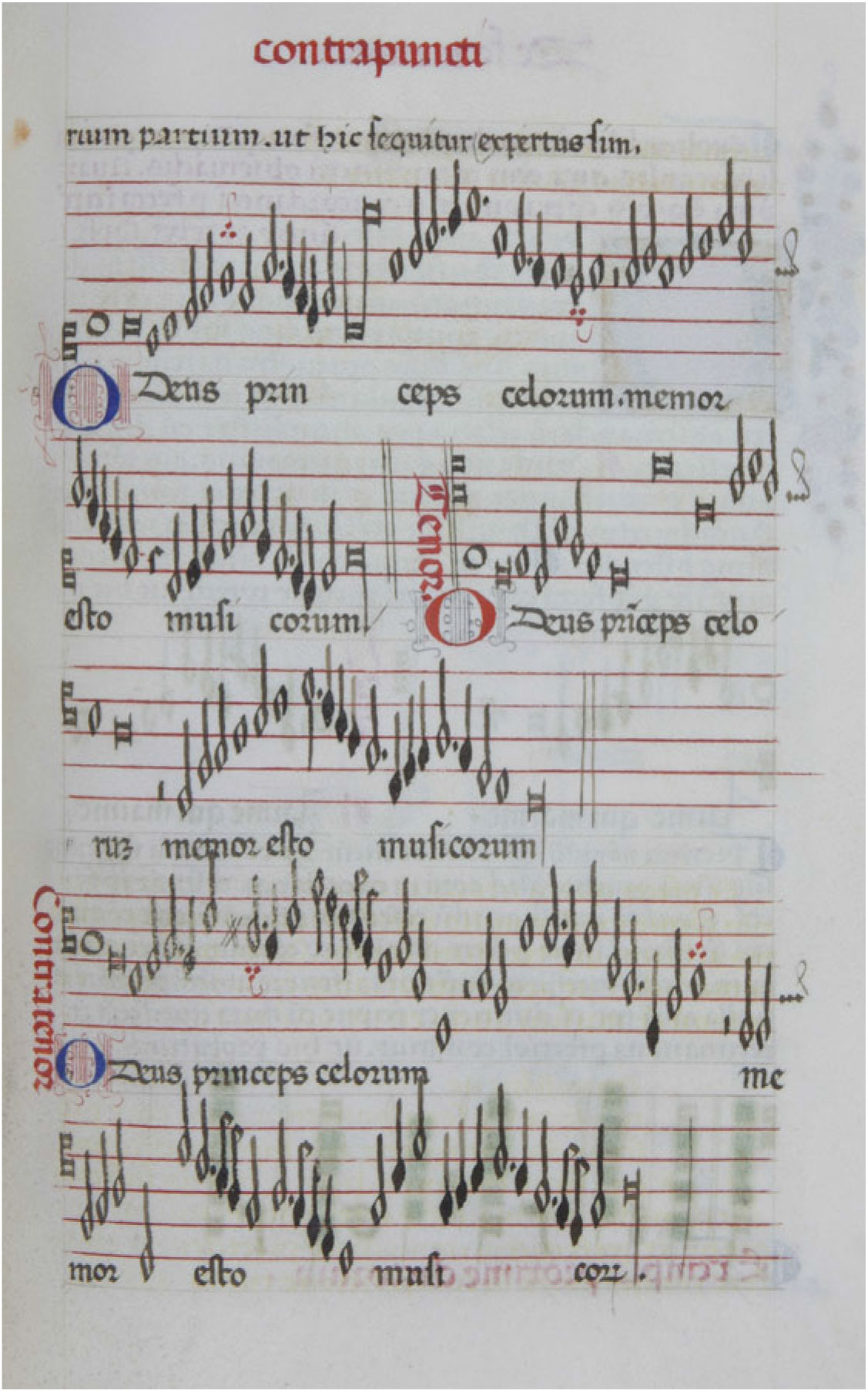
The first newly composed extended polyphonic miniature to use signa congruentiae in an unusual fashion is found in Book II, ch. 34, a chapter which has received much discussion in recent musicological literature.Footnote 26 Figure 4 accompanies a theoretical point that discusses issues surrounding false relations specifically caused by sharpening one note in a polyphonic texture, rendering a perfect consonance ‘imperfect’ (diminished) or ‘superfluous’ (augmented) by virtue of such alteration:

O Deus princeps celorum from Tinctoris, Liber de arte contrapuncti, Book II, ch. 34. Valencia, Universitat de València, Biblioteca Històrica, MS 835, fol. 139r. Reproduced with the kind permission of the Universitat de València, Biblioteca Històrica
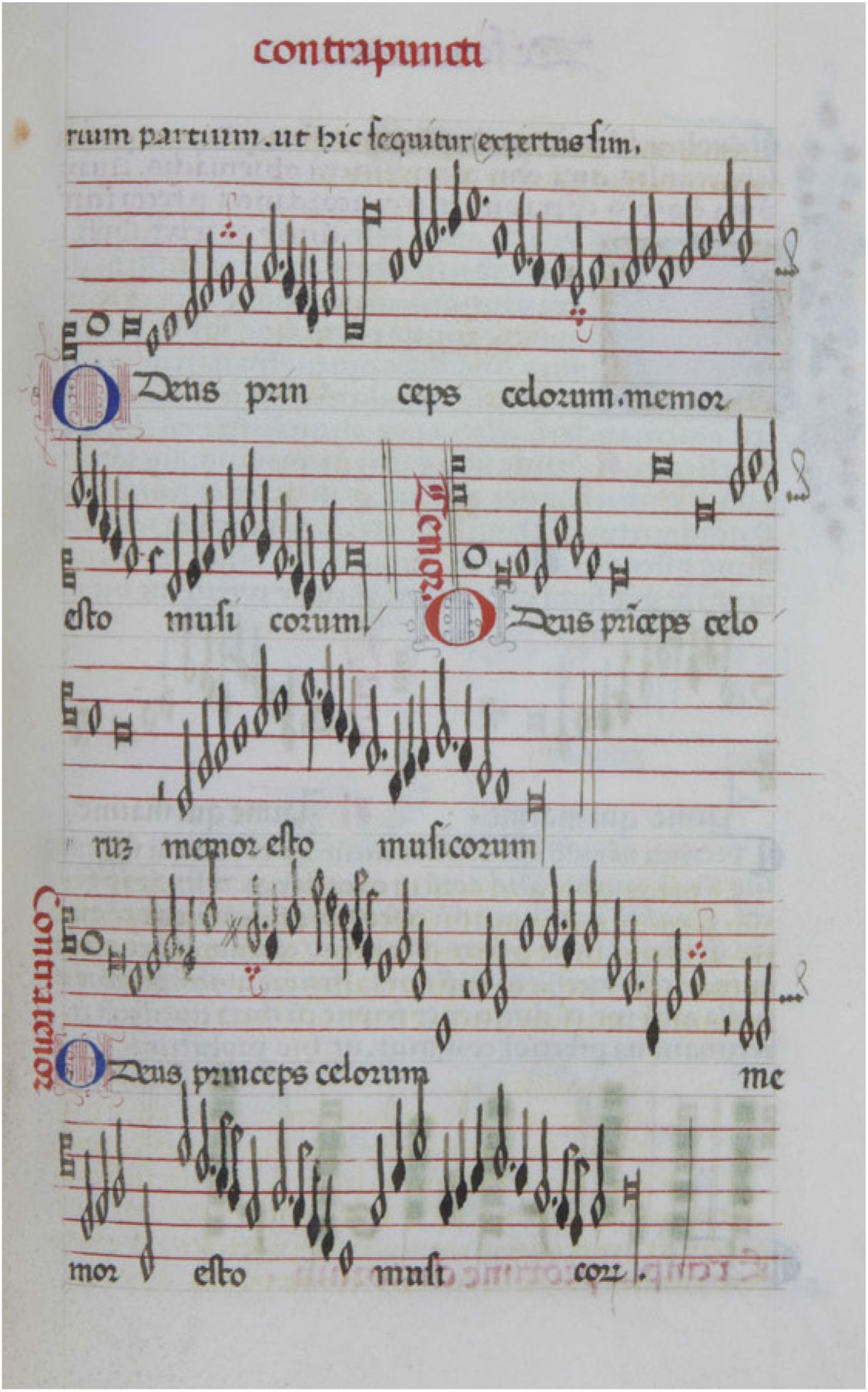
Tinctoris’s text here centres on the widening and narrowing of perfect concords, describing the altered intervals as ‘imperfecte’ [imperfect, i.e. making the concord narrower] and ‘superflue’ [making the concord superfluous, i.e. widening the concord]. Although stating that this should be avoided, he concedes that it is an accepted practice for many composers, and thus he provides a rare demonstration of ‘bad’ practice through one of his own miniature compositions (Example 4).Footnote 28 Given that discussions of naturally false perfect concords (including those created by flattening one note) are found in Book II, chs. 10–16 and those created by sharpening in ch. 17, Tinctoris does not identify the false perfect concords here explicitly. He does, however, provide specific details regarding the placement and qualities of such concords, noting that these are often placed immediately before a cadence in compositions of three (or more) voices, and that the duration of such dissonances (in relation to the mensura) extends beyond that which he feels is proper in counterpoint.
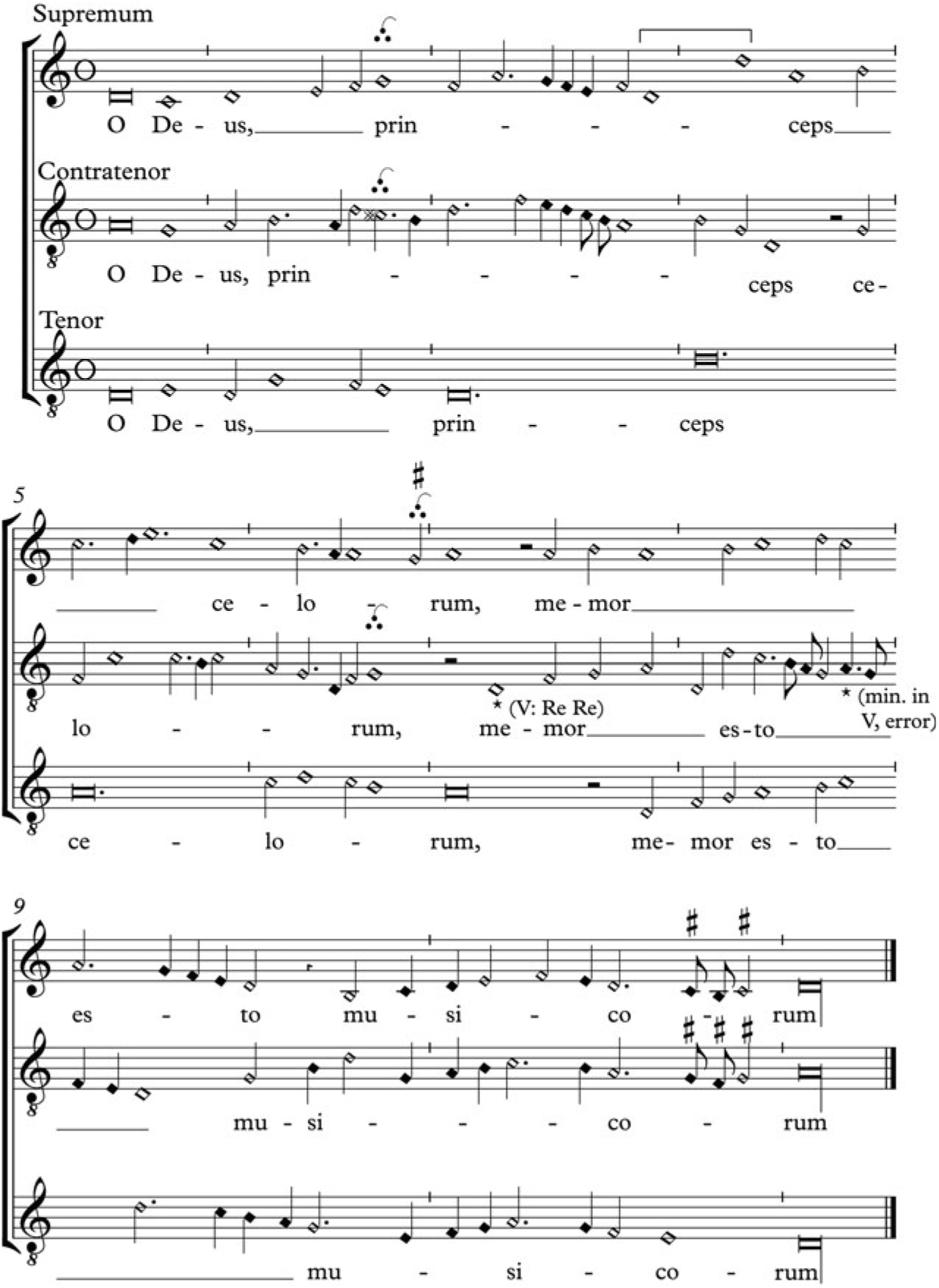
Transcription of O Deus princeps celorum from Tinctoris, Liber de arte contrapuncti, Book II, ch. 34, fol. 139r

Figure 4 and Example 4 show two instances of the type of chromatic alteration of perfect concords discussed in the text, both of which make use of signa congruentiae in V and BU, but not in Br1. The first chromatically altered perfect concord is found between the seventh note of the Contratenor and the sixth note of the Discantus (highlighted with  ; see Example 4, b. 2). These two notes (C♯ and G) show the chromatic alteration of the interval of a perfect fifth (C–G), with the C♯ indicated using the sign of the chromatic semitone.Footnote 29 The signum proprium for the chromatic semitone (
 ) is placed immediately before the Contratenor C in all three sources, helping to raise the visual profile of this moment. As mentioned, V and BU provide signa congruentiae to mark the point being discussed, but it is the chromatic alteration to a C♯ that makes this example useful to demonstrate this particular theoretical point, with the sign of the chromatic semitone confirming to a singer that this dissonance was intended, and preventing any adjustment being made to avoid the apparent clash.
The second likely point of dissonance to be found in this example is also marked with signa congruentiae in the Discantus and Contratenor parts, occurring in the verticality preceding the second cadential moment (Example 4, b. 6). Again, signa are present in V and BU only. Two signa are placed above the G in both the Discantus and Contratenor parts, and thus it seems that this is the location of the second instance.
However, if the two parts marked with signa congruentiae are consulted carefully and taken exactly as notated, to modern eyes at least, there is no dissonance at all. Both the Discantus and Contratenor parts have a notated G, spread by an octave. Looking at the three-voice texture here, one might actually be tempted to flatten the B in the Tenor to lead to a Phrygian cadence. However, in order for there to be a false concord at this moment, a chromatic alteration needs to be applied to one of the notes in the Discantus or Contratenor; in this case the upper voice should be sharpened to make the interval ‘superfluous’.Footnote 30
The fact that a sharp is apparently missing from this part of the notation, yet is present in the earlier part of the example, seems to be unusual. Indeed, none of the extant sources of this treatise includes any kind of accidental or symbol for a chromatic semitone at this point, and thus it seems that this was either a rare mistake in the exemplar or – equally likely – a sharp to be implied by ficta as a cadential inflection.Footnote 31 It is thanks to the signa congruentiae that it is possible to identify Tinctoris’s intended point of dissonance: he clearly planned for something to happen at this moment.Footnote 32 Therefore, the additional didactic aids employed in the presentation of this example may be the only witnesses to his theoretical intentions.
There may also be a contextual explanation to this slightly confusing moment if the previous chapter of the treatise (ch. 33) is considered briefly. Margaret Bent, amongst others, has discussed this chapter at great length and thus the discussion here will not consider the much broader implications of this passage.Footnote 33 For now, it will suffice to say that Tinctoris never unambiguously demonstrates a ‘false’ octave created by the use of the chromatic semitone in his three quotations from works by Faugues, Busnoys and Caron in this chapter. The apparent omission of an unambiguously notated false octave from Tinctoris’s own example might suggest that this was a practice that was tacitly understood, and therefore did not require detailed explication. Perhaps, though, Tinctoris was not entirely sure how to deploy this dissonance in the manner that his contemporaries would. Indeed, it is in his discussion of the chromatic semitone that Tinctoris appears to get somewhat muddled, providing apparently contradictory descriptions of this interval in two consecutive sentences in Book 2, Chapter 2 of the counterpoint treatise.Footnote 34 Whatever the reasons behind this point of ambiguity, it is certainly clear that a dissonance of this type was intended, and that the signum proprium was not included in the exemplar copy, either on account of a small mistake, or on the grounds of implied performance practice.
Signa congruentiae continue to appear in Tinctoris’s newly composed pedagogical miniatures in V and BU throughout the latter stages of the second book, and in the entire third book of the treatise. Thus far in the treatise, signa have been used to indicate points of alignment, to highlight specific moments in the notation closely relating to theoretical points that the example accompanies, and as an indicator of dissonance itself, though this last category is almost certainly down to an error in an exemplar or the scribal omission of a crucial chromatic semitone. There is, however, one final type of signa usage found in the treatise on counterpoint. The penultimate notated example of the treatise uses this symbol to draw attention to a specific sonic effect rather than a specific dissonance or point of congruence in the traditional sense.
THE SIGNUM CONGRUENTIAE AND SONIC EFFECTS
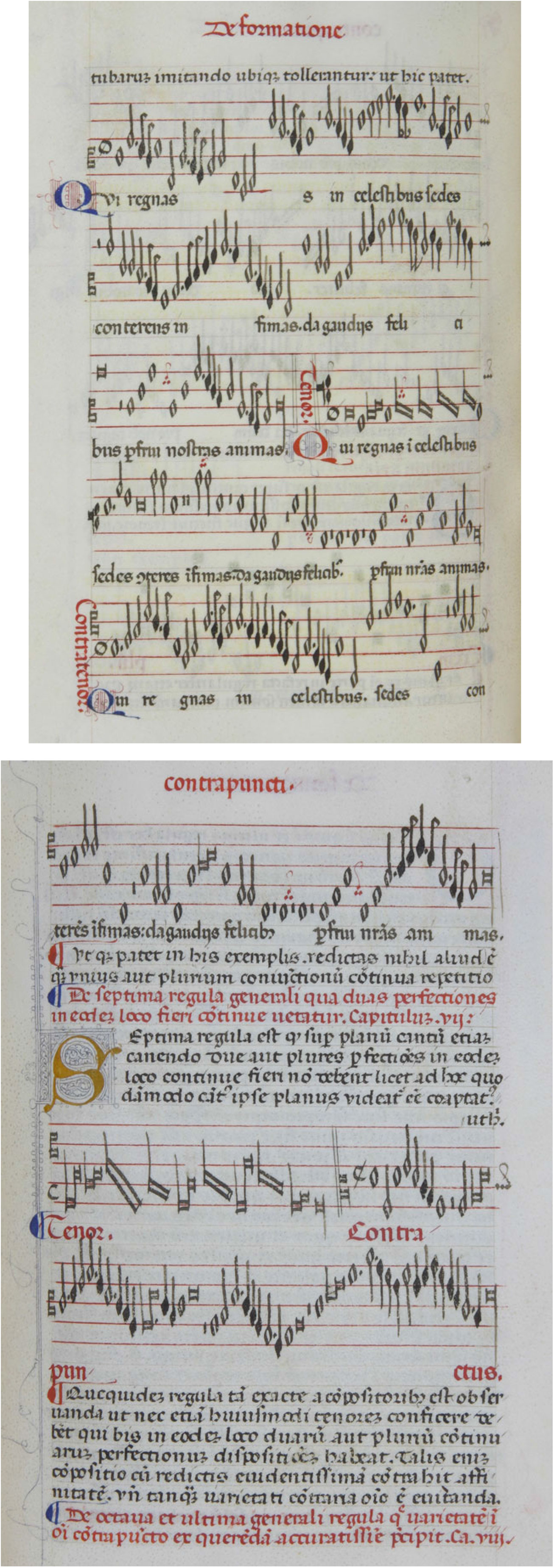
The example in question (Figure 5) is found in Book III, ch. 6 and accompanies a discussion central to understanding Tinctoris’s concepts of varietas and redicte in music.Footnote 35 Varietas was a concept derived from the trivium (grammar, rhetoric, logic) that encouraged the use of a variety of rhetorical and grammatical figures and devices to maintain interest in an oration. It influenced all aspects of the composition of a speech and was discussed at length by Cicero in his De oratore, amongst other authors. Alexis Luko observes that Tinctoris’s conception of varietas cannot merely be described as ‘variety’, but has a more limited definition and application than many musicologists have suggested, tied more closely to the theories associated with rhetoric. The concept of redicte is dialectically related to varietas, referring to the repetition of figurations. The relationship and interaction between the two concepts in musical composition, and style in a broader sense, is important to our understanding of fifteenth-century musical practice, but goes beyond the scope of this article. The discussion that follows self-consciously focuses on one side of this two-part relationship.
Tinctoris, Liber de arte contrapuncti, Book III, ch. 6. Example showing the use of repeated figures to sound as ‘bells and trumpets’. Valencia, Universitat de València, Biblioteca Històrica, MS 835, fols. 142v–143r. Reproduced with the kind permission of the Universitat de València, Biblioteca Històrica
In discussing the musical applications of redicte, Tinctoris includes an example of the type of two-part counterpoint used in earlier books, with tenor and contrapuntal voice, and an interesting polyphonic miniature that, by implication, recognises the need to maintain variety other than for the purposes of creating specific sonic effects. Tinctoris’s use of a pedagogical miniature here to show elements of contrapuntal style, rather than a specific technicality, marks a significant innovation from the often shorter examples found in newly composed examples which do not consider aspects of ‘style’ in the same way, or indeed his own discussions of necessarily narrowly defined theoretical precepts. After introducing the requirement to avoid motivic repetition by means of an example of note-against-note counterpoint in breves, where the tenor sings FGFG and then ABABA, Tinctoris writes:

In the musical example that accompanies this point (see Example 5), Tinctoris includes five instances of repeated figures, with the most striking occurring across all three voices towards the end of the example.Footnote 37 His text outlines the permissible scenarios for repeating patterns within a contrapuntal context, stating that they may be used when imitating the sound of bells and trumpets. Although Tinctoris’s text specifies the types of material he deems acceptable to repeat in a polyphonic context, he does not provide any further details regarding the musical shape or rhythm of such figures. He simply states their sonic effects: perhaps we are to assume that these were such commonplaces for his readers that their construction required no further explication.
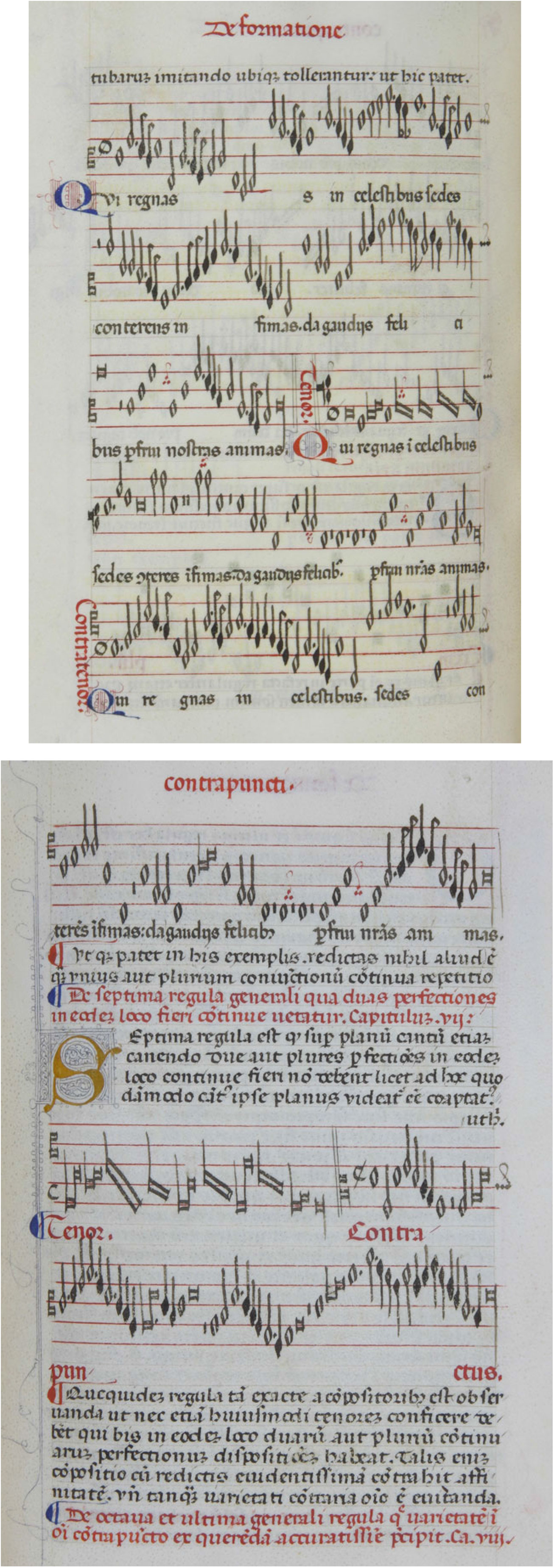
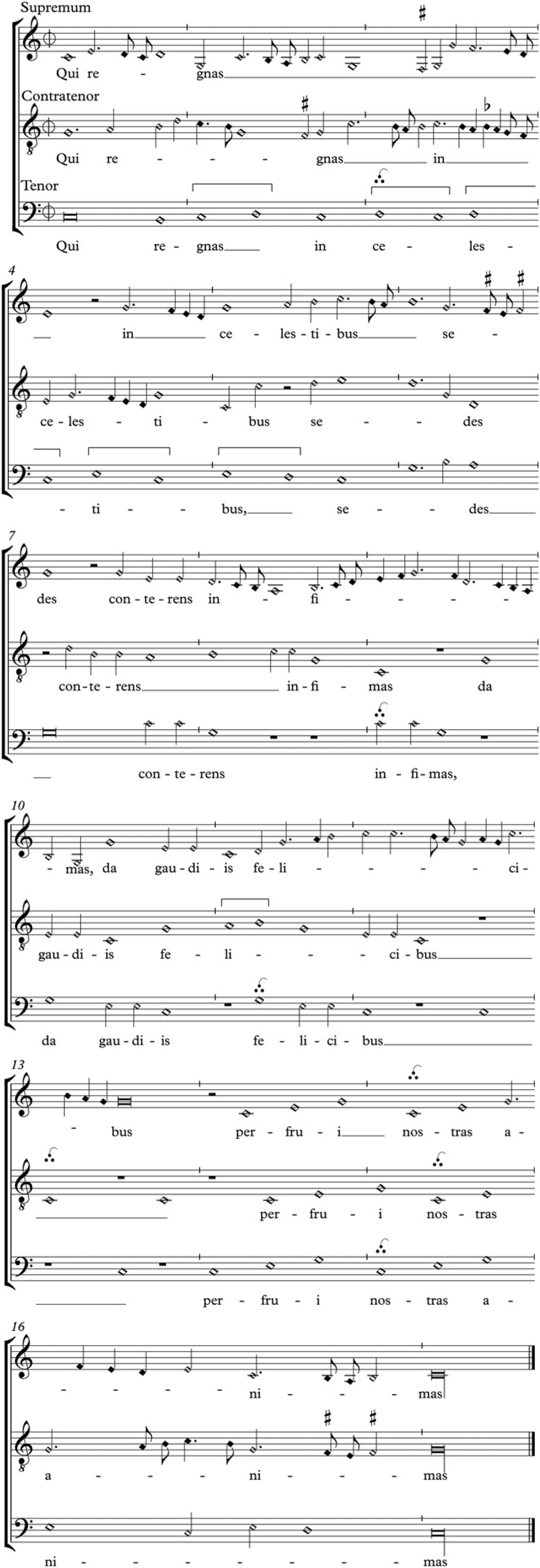
Polyphonic example Qui regnas in celestibus from Tinctoris, Liber de contrapuncti, Book III, ch. 6, with repeated figures indicated using signa congruentiae

The example itself is a three-voice polyphonic miniature, with a text beginning ‘Qui regnas in celestibus …’, showing five instances of motivic repetition. The statements are distributed throughout the polyphonic miniature, with each instance indicated with signa congruentiae in the relevant voice parts in V and BU.Footnote 38 Three of these five instances are found in the Tenor alone, and are not presented in imitation in any of the other voice parts. The final case is spread across all three voices, with each restatement indicated by a signum at the relevant point in each voice.
The first instance of motivic restatement is found on the sixth note of the Tenor on a two-semibreve ligature figure which is restated exactly twice more (Example 5, bb. 3–5), and a further two times in a slightly altered form. This instance probably addresses the sonic effect of ‘bells’ described in the main text, given the alternation between two notes. As is common in Tinctoris’s treatises, this matches the order in which the sonic effects are listed in the theoretical text, perhaps suggesting the simultaneous conception of musical example and text. If nothing else, it certainly demonstrates that they are intended to function together as a pedagogical unit, and that Tinctoris did not simply shoehorn readily available examples into his discussions.
The second and third instances, both of which are characterised by two minims on the same note followed by a descent to a semibreve a fourth lower, occur later in the Tenor. The third instance appears as a falling triad motif, with the middle note repeated, thus closely resembling the rhythmic characteristics of the second instance.Footnote 39 This figure is also present in the Contratenor, adding a layer of imitative counterpoint not seen with the first instance. The signum congruentiae that highlights this motivic restatement is placed above the second statement of the figure, continuing the practice that Tinctoris applies in all cases in this example. As before, Tinctoris deploys a single signum to indicate these restated instances, requiring the reader to engage closely with the notation to identify the number of repeats and, importantly here, the interaction between these restated figures and the rest of the polyphonic texture. The identification of these restatements would have been much easier after the initial figure had been highlighted with asterisk-like markings, but may still have posed a problem for some readers. Placing this symbol on the first restatement of each figure also helps to emphasise the difference between imitative counterpoint across the voices, and motivic restatement within a voice part, with the latter forming the basis of redicte.
The use of signa for the fourth and fifth instances, applied to overlapping restatements in close rhythmic proximity across all three voices, is particularly important to this discussion. These overlaid restatements create something approaching a ‘hocket’ effect at points, adding a layer of imitative counterpoint to this example that contrasts with the rest of the example. The fourth figure (bb. 7–11) is marked by a repeated ‘C’ in the Tenor and Contratenor parts, temporarily bringing the otherwise moderately florid counterpoint to a relatively static point, clearing the texture to emphasise the tolling bell-like effect of this figure.Footnote 40 The fifth figure is characterised by an ascending triadic figure that contains the notes C, E, and G, imitating the sound of trumpets and linking this restatement to the final part of Tinctoris’s text: the theoretical point has been extrapolated into a musical context.Footnote 41 Tinctoris places signa congruentiae above the first repeat of this figure in each voice part, marking these two final instances of repetition out from the first three in this example, which are confined to the Tenor.
Tinctoris’s use of signa in all three voice parts is noteworthy. If the apparent primary function of the signum congruentiae is taken to be at work at these moments, a reader might have been forgiven for vertically aligning all three voices here, particularly given that this would have been a striking point of consonance. The function of these signa is different from their usage in contemporary practical sources, demonstrating another case of rather flexible usage of this sign. It should also be observed that signa are not deployed on instances of a motif stated only once in a given part, or a motif repeated with other notes in between, even if these are in imitation with another part. Thus, it can be understood that Tinctoris objects to the immediate repetition of motifs when not justified by imitative sonic effects, and clearly demonstrates he does not object to imitation or discontinuous repetition of motifs.
In raising the visual profile of this specific point of the example, Tinctoris emphasises its structural significance to his theoretical point. However, a reader familiar with the conventions associated with this symbol might have misinterpreted Tinctoris’s intention here, instead aligning the three voice parts as though sounding simultaneously in vertical alignment. Of course, careful reading of the polyphonic context, alongside the theoretical text, would avoid this, but it is interesting that the use of signa may have introduced some ambiguity in resolving the notation, something Tinctoris would undoubtedly have criticised a near contemporary for.
Importantly, these signa survive in V and BU only. They were almost certainly part of the exemplar for these sources and, given that Tinctoris may have had a close involvement in their compilation, it seems likely that they are witness to authorial intention and not merely scribal emendations. The absence of signa congruentiae in Br1 (fol. 99v) at this point, and for the example of chromatically altered concords discussed earlier in this article, may be significant. Given the multiplicity of meanings associated with the signum in practical music sources, it seems entirely plausible that the Br1 scribe chose to omit these symbols, on the basis that the repetitions were obvious in the notation. However, the omission of signa from the later parts of the De arte contrapuncti as it survives in Br1 might also point towards the scribe simply running out of time to write these additional symbols, which may well have been entered at a later stage of the production process. Nevertheless, it is significant that signs which appear to be so important in the text–example relationship in the most complex examples of V and BU are mostly absent from the equivalent examples in Br1. In these different manuscript contexts, readers might have engaged with the notation in a slightly different manner, and thus the signa provide an additional layer to the exemplification strategy played out here.
GENRE, FUNCTION, AND SPHERES OF READERSHIP(S)?
With the different uses of signa in the examples of De arte contrapuncti now outlined, it is possible to draw together the evidence laid out above and make some tentative remarks about the possible implications for readerships and modes of reading musical notation in Tinctoris’s treatise that the presence of these symbols might have. In the two presentation sources of Tinctoris’s works, V and BU, all but the first case outlined in this article visually distinguish the signa from the musical notation through the use of red ink. Whilst this may not seem overly significant at first glance, it cannot be ignored that the use of this colour ink places the signa on the same visual plane as a chapter heading, rubric, or other visual aids such as solmisation annotations in the Expositio manus.Footnote 42
Rubrication was originally a process by which markings, usually in red ink, were added to a manuscript after the main text had been copied to help the reader navigate a text, placing particular emphasis on key points. The presence of such markings and conceptions can be seen in numerous manuscripts from across the Middle Ages, and they continued to appear in printed publications well into the sixteenth century and beyond. In liturgical books, rubrics were added to indicate specific directions to help the ritual be carried out correctly, adding an additional layer of explanation to the core text, and retaining features of manuscript traditions of these texts.Footnote 43 Rubrication was also used in lyric manuscripts in the thirteenth and fourteenth centuries, often functioning as part of the narrative direction and authorial voice of the text in addition to its primary role of marking out the structure of a text.Footnote 44 The rubrication models used in such manuscripts often emulated those used in manuscripts containing the works of Boethius, Aristotle and Plato, and facilitated the kind of intertextuality for which manuscripts are now famed.Footnote 45
Readers familiar with texts from other disciplines would have been entirely comfortable with using rubrics as a way of navigating the text, given that such indications were commonplace in intellectual texts of the Renaissance period. As Tinctoris’s signa do not always function in the way that they might if found in a practical musical source, is it possible that he intended these signa to function as a kind of rubric rather than as a musical symbol? Such a question can be addressed, though not answered wholly, by considering the context surrounding the production and likely readership of the two presentation sources of Tinctoris’s treatise.
Both V and BU were copied by the same scribe in the last quarter of the fifteenth century. Although the dating of these manuscripts is highly contentious, V is probably from sometime in the 1480s, with BU being completed a few years later.Footnote 46 These volumes were held in the Aragonese Royal Library in Naples for a time and were probably completed through royal patronage of some sort, most likely of King Ferrante himself or one of his children, owing to the luxuriousness of the manuscript and its similarities with other manuscripts produced for the royal library at this time. The scribe was the highly accomplished Neapolitan court scribe, Wenceslaus Crispus, who was also responsible for a number of Thomas Aquinas manuscripts (also held in Naples) from the 1480s and was probably involved in the production process of the Mellon Chansonnier.Footnote 47
The respective layouts, text and music examples of V and BU all show a degree of similarity, suggesting that they might have been copied from the same exemplar, or possibly under the supervision of the same editor, probably Tinctoris himself. They are at least cousins, if not direct siblings. Indeed, there is some evidence that an editor went through both manuscripts after the text had been copied to make very small changes to the text, often going as far as dividing words that had been inadvertently joined in the copying process with a thin vertical stroke.Footnote 48 Interestingly, there do not seem to be any significant emendations to the content of the music examples, even though there are occasional mistakes in note shapes and pitches. This makes it difficult to tell whether the editorial work was completed before the music examples were entered into the manuscript, or that the editor was less concerned with this content. These volumes were clearly conceived as anthology collections to sit alongside the works of other esteemed humanists in the royal library on an equal status, and, perhaps by implication, to be read by the same readers who would engage with the other humanistic texts held in the library.
Readers familiar with the works of Tinctoris’s Neapolitan humanist contemporaries, such as Giovanni Pontano (1426–1503), and those of an earlier generation, including Lorenzo Valla, would have been entirely comfortable with using rubrics as a way of navigating the text, and would have good levels of Latin proficiency. Despite Tinctoris’s meticulous descriptions of musical notation in his more ‘elementary’ treatises and Book I of the counterpoint treatise, additional visual aids may have been required. It seems unlikely that a novice (or perhaps even more advanced students) would have had an equivalent understanding of the complexities of mensural notation without any support. Perhaps this help came in the form of symbols resembling signa congruentiae acting as indicators of rubrication?
Although the contexts in which symbols resembling signa congruentiae were used might have introduced confusion for musically trained readers and singers, a readership more familiar with texts that made extensive use of rubrication might not have been so concerned with, or aware of, the primary function of these signa as presented in practical sources. Indeed, a comparison between the presentation of the final two examples discussed in V and BU and the presentation of the same material in Br1 might lend some support to this argument.
The discussion above has shown that V and BU make use of signa as ‘asterisk’ markings in many different types of examples, especially in the cases of Figures 4 and 5. However, these examples, presented identically in both V and BU, save for a few minor differences that can be ascribed to scribal refinements and corrections, are presented in Br1 without signa to highlight the main theoretical points (fols. 96vb–97ra and fol. 99v respectively).
Although the Br1 scribe deploys signa in some contexts in the earlier part of the Liber de arte contrapuncti, consultation of Br1 in detail reveals that signa are not used beyond Book I. Thus, they do not feature in any of the polyphonic miniatures found in the latter stages of Book II and throughout Book III. It is also noteworthy that the final use of a signum in Br1 appears in a slightly different configuration from that seen in Figure 2. Instead of being presented as two dots and a straight line in black ink, the final instance is drawn in red ink with a curved line (see Figure 6, right column).
Tinctoris, Liber de arte contrapuncti, Book I, ch. 16. Example of note-against-note counterpoint, with added signa, entered in red ink. Brussels, Bibliothèque Royale, MS II 4147, fol. 74v. Reproduced with the kind permission of the Bibliothèque royale de Belgique

It seems significant that the signa stop in Br1 in the middle of Tinctoris’s explanations of concords. It is therefore likely that, in this manuscript, these symbols were put in at some point following the entry of music notation, and that the scribe did not manage to complete this task. Indeed, there are countless initials missing as Br1 progresses, with Ds, Ts, Cs and Ss being written with some regularity but other letters being left out of the manuscript as it survives. It seems that Br1 is unfinished in this regard. However, it is impossible to say from the evidence at hand whether missing signa in this manuscript are indicative of a particular exemplification strategy, or merely show that a layer of scribal work never quite reached completion. Whichever of these lines of inquiry we choose to follow, it is significant that this is one of the few areas of substantial difference between the three main sources of Tinctoris’s works that has a significant effect on the visual profile of the text–example relationship.
It is clear that symbols to which we attach the single label signum congruentiae have various roles across Tinctoris’s treatises, and operate differently from their usage in practical sources of the period. The use of the term signum congruentiae itself is problematic due to its limited presence in contemporaneous texts, and requires some re-examination in its own right. Using such terminology is overly reductive given its wide range of applications in theoretical and practical sources, and thus it is important that modern musicological scholarship recast this symbol as something of a movable feast rather than a marker of specific prescription. The need for a more nuanced reading of such signs is clear from their usage as ‘asterisk’-like marking in some of Tinctoris’s treatises. In V and BU these signs can act as visual marks to draw attention to a specific theoretical point manifested in the musical notation that exemplifies general theoretical rules. This would have supported visual comprehension, perhaps even facilitating the silent reading of these musical miniatures, and demonstrate that some consideration was given in the production process of V and BU to provide additional support for readers. Similarly, a careful reading of the signa in Br1 might reveal similarly interesting insights into the stage at which these symbols were entered into musical examples, and the extent to which they were deemed to be necessary to access Tinctoris’s theoretical points. Thinking more broadly, a careful reconsideration of the function of these signs draws attention to important questions around the modalities of reading music theory, the readerships for these texts and the conceptual function of visual signifiers throughout this period. We must therefore be mindful of using the term signum congruentiae as a catch-all label, for that has somewhat limited support in contemporaneous sources. Instead, we should seek to account for the subtleties of these notational signs in a more nuanced manner, and celebrate the multiplicity of meanings attributed to a single symbol.