





Introduction
Mental ill health is a significant public health and societal challenge (Cardoso & McHayle, Reference Cardoso and McHayle2024; Lucero-Prisno et al., Reference Lucero-Prisno, Shomuyiwa, Kouwenhoven, Dorji, Odey, Miranda, Ogunkola, Adebisi, Huang, Xu, Obnial, Huda, Thepanondh, Dayrit, Evardone, Lamawansa, Solomon, Aziato, Adongo and Wong2023). The British Medical Association (2024) has suggested that mental health care services in England are in crisis. Recognizing these concerns, it is well accepted that nongovernment organizations and charities can help to support mental health in the UK (Harmer, Reference Harmer2024; Weaks, Reference Weaks2015), and in practice, signposting to charities is already occurring (NHS, n.d.; Mind, 2017). Using mixed-methods research, Newbigging et al. (Reference Newbigging, Rees, Ince, Mohan, Joseph, Ashman, Norden, Dare, Bourke and Costello2020) confirm the valuable contributions that voluntary sector organizations can make to those in mental health crisis by offering individuals a distinctive, social approach to support.
To support individuals experiencing mental health crises, charities in the UK rely on volunteers. Therefore, it is essential to understand what motivates individuals to volunteer in this setting. One important reason is identity. Dean (Reference Dean2020) suggests that although volunteers often report altruistic motivations, there is also an influence of symbolic power. That is, the positive reputation that can be associated with an individual, through volunteering within a charity which is recognized as moral and valuable to society. Moreover, Yates (Reference Yates2025) highlights the importance of ideological alignment, whereby an individual needs to be connected to the identity and beliefs of the organization to want to join an organization or continue their membership. This has similarly been found within a charity setting, where pride in being a volunteer at the charity organization is positively associated with intentions to remain an active volunteer (Boezeman & Ellemers, Reference Boezeman and Ellemers2007).
However, while many volunteers may initially be motivated by the charity’s values, there are significant barriers that may influence volunteering in charity settings. For example, Paterson et al. (Reference Paterson, N. Hyndman and Jegers2026) detail the managerial and structural pressures within third-sector organizations, such as concerns around resources, governance, and accountability. These pressures influence how charities communicate their mission, and could impact the volunteers’ sense of ideological alignment with the organization.
Despite strong initial motivations, volunteer retention remains a significant challenge. For example, one in three sampled UK voluntary, community, and social enterprise organizations reported difficulties with retention between 2023 and 2024 (Evans, Reference Evans2024). Research has attempted to consider factors that may be associated with volunteer retention and turnover. Clary et al. (Reference Clary, Snyder, Ridge, Copeland, Stukas, Haugen and Miene1998) report several motivators for undertaking volunteering (i.e., to act on values, to gain understanding, for enhancement, to gain career experience, for social reasons, to be protective against negative feelings). They suggest that ensuring experiences meet initial motivations is an important factor for volunteer retention. Moreover, through a literature review, Locke et al. (Reference Locke, Ellis and Smith2003) highlight that personal factors (e.g., changes in circumstances) and the context of organizations (e.g., poor organization) are associated with volunteer turnover.
More recently, Meijeren et al. (Reference Meijeren, Ellemers and Lubbers2026) detail the influence of personal and organizational factors on volunteer retention, highlighting that retention remains a key challenge in the voluntary sector. Specifically, they find that retention of volunteers is positively influenced by feeling valued and connected to the organization. Whereas poor supervision, pressure, and poor facilities are highlighted as potential retention barriers. Moreover, Holtrop et al. (Reference Holtrop, Soo, Gagné, Kragt, Dunlop and Luksyte2026) assess reasons for volunteer turnover, finding that relative to those committed to staying, reluctant leavers are more likely to attribute their intentions to personal circumstances, reluctant stayers more frequently perceive high role demands, and enthusiastic leavers are more likely to report poor alignment between the role and their expectations. However, as these factors may be deemed as socially acceptable justifications for leaving an organization, these self-reports may conceal the true reasons for disconnection (e.g., ideological disconnection; Yates, Reference Yates2025). This highlights the need to consider the processes through which volunteers become more or less connected to an organization over time.
For example, many separate factors have been suggested to impact on volunteer retention and turnover, but volunteer engagement is thought to be of particular importance. Harp et al. (Reference Harp, Scherer and Allen2017) define volunteer engagement as a positive mental state in which volunteers show investment and full commitment to their volunteering activities. They suggest that understanding factors that harm or improve engagement could positively impact upon retention, as the two are intrinsically related. This has also been suggested by Vecina et al. (Reference Vecina, Chacón, Sueiro and Barrón2012) who find that volunteer engagement (classified as vigor, dedication, and role absorption) is associated with satisfaction, which predicts intention to remain among new volunteers, as well as organizational commitment (e.g., alignment with organizational values), which predicts intentions to remain among established volunteers. Moreover, a recent meta-analysis highlights strong negative associations between volunteer engagement/satisfaction and volunteer intentions to leave/turnover (Forner et al., Reference Forner, Holtrop, Boezeman, Slemp, Kotek, Kragt, Askovic and Johnson2024).
As low engagement may be associated with reduced intentions to remain and volunteer turnover, it is important to consider factors that may negatively impact on volunteer engagement. In a quantitative study of three US nonprofit organizations, Harp et al. (Reference Harp, Scherer and Allen2017) find that high organizational constraints (e.g., inadequate training) and role ambiguity (e.g., not knowing what is expected of them) are both independently associated with reduced engagement. Moreover, in a qualitative study within a not-for-profit organization, Edeigba and Singh (Reference Edeigba and Singh2022) find that lack of knowledge of the organization’s aims, egoism, and a lack of skills/supervisory support are barriers to retention and engagement. Whereas, altruism, interest in gaining a social network, and the consistency of the organizational values with their own interests are facilitators.
The extent to which these engagement and retention factors apply to volunteers who support individuals in mental health crisis remains unclear. Mental health support volunteers may face unique motivations and challenges, which could impact upon their engagement. An early study on community mental health volunteers suggests that there may be a specific “altruistic personality” among individuals who choose to volunteer (Allen & Rushton, Reference Allen and Rushton1983). Similarly, more recent research demonstrates that many individuals in this setting report altruistic motivations (Sundram et al., Reference Sundram, Corattur, Dong and Zhong2018). However, there are also challenges of undertaking the role, such as needing to be strong emotionally to be able to deal with the role demands (Pinto da Costa & Oliveira, Reference Pinto da Costa and Oliveira2023). Indeed, Willems et al. (Reference Willems, Drossaert, Vuijk and Bohlmeijer2021) report that crisis line volunteers experience challenges such as negative emotions in relation to telephone call experiences. This suggests distinct emotional challenges associated with volunteering within mental health charities.
Past research indicates a demand for mental health volunteers and motivation to volunteer in this sector. However, with the reported challenges of the role, there is a need to understand the factors that sustain volunteer commitment. While there is some understanding of factors associated with volunteer engagement, there is limited understanding of the specific influences on volunteer engagement and retention within the UK mental health charity sector. This is a notable gap, considering the recognized value of these charity organizations in supporting mental health in the UK (e.g., Newbigging et al., Reference Newbigging, Rees, Ince, Mohan, Joseph, Ashman, Norden, Dare, Bourke and Costello2020). Sector-specific insights may also aid understanding of volunteer engagement across voluntary roles requiring emotional resilience. To address this gap, we conducted a longitudinal qualitative case study within a local center of a UK mental health charity. Our research questions were: 1) Among new mental health charity volunteers, what factors are associated with continued or reduced engagement over time?; and 2) Among past volunteers, what factors contributed to turnover? We therefore aimed to understand factors shaping engagement (i.e., potential barriers to retention) over volunteers’ first 12–18 months within the organization. We also aimed to understand factors explaining volunteer turnover, through interviewing recent center leavers.
Methods
Setting and design
We used a longitudinal qualitative case-study approach within a local center of a UK mental health charity during 2022–2024. This large-scale charity provides national telephone helpline and email support to individuals who are facing difficulties coping in life and/or who are in mental health crisis. The local center regularly recruits new volunteers, and it had approximately 120–140 volunteers active at any one time during the study. Ethical approval was received from the University of Liverpool Ethics Committee.
Participants
Recruitment
Recruitment occurred over an 18-month period (September 2022–March 2024). We targeted new volunteers and center leavers (aged 18+). A £10 Amazon voucher per interview was provided to compensate for time. New volunteers were recruited from several incoming cohorts, and this continued until theoretical saturation was reached (Glaser & Strauss, Reference Glaser and Strauss1999). Leavers were recruited via standard exit emails sent by the local center. We excluded those who had left due to sensitive reasons (e.g., ill health, bereavement). Leavers emailed the lead investigator to participate. Advertisements ran for the entire 18-month period.
Sample
We advertised the study to 21 new volunteers and 39 leavers, conducting interviews with 22 participants who responded (14 new volunteers, 8 leavers). Two new volunteers left prior to the study period ending, and one of these conducted a leavers interview. Leavers reported one to nine years’ experience at the time of leaving. See Supplementary Table S1 for sample characteristics.
Volunteering process and responsibilities
New volunteers completed an initial period of training and mentoring, which detailed organizational policies and expectations for volunteering frequency. After this process, they could independently complete volunteering responsibilities (i.e., responding to service-user telephone calls and emails) while being in a probationary period. Volunteering occurred via in-person shifts (4–5 hour shifts, occurring day or night) with other volunteers present. After probation, the volunteers could sign up for additional responsibilities (e.g., supporting with information or fundraising events). Volunteers are integral to operation, as telephone and email support depends on shifts being covered.
Interview procedure
For new volunteers, three milestone-specific interviews were conducted (i.e., Timepoint 1 [TP1] = completion of a training and mentoring period; Timepoint 2 [TP2] = completion of a probationary period; Timepoint 3 [TP3] = after three to six months as a fully qualified volunteer). There was some variation in the time between interviews, as volunteers completed different shift frequencies. Although the probationary period was typically six months, among some volunteers it was shorter if probationary requirements were met earlier. TP3 interviews were scheduled 3–6 months after the last contact to ensure participants had completed their required number of shifts. By the final interview stage, volunteers’ membership at the center ranged from approximately 12 to 18 months. Leavers were interviewed shortly after (i.e., within one month) formally leaving the center. See Supplementary Table S2 for further details.
Semi-structured interview guides were developed for each interview timepoint/population. The guides contained open-ended questions about the volunteers’ motivations, experiences, expectations, and if relevant, reasons for leaving the role. For question examples, see Supplementary Table S3. Participants provided written or oral consent at their primary timepoint, and verbally confirmed consent at repeat interviews. Demographic information was obtained via a questionnaire. A single author conducted and audio recorded all interviews in person, online, or via the telephone, with no other individuals present. The mean interview duration was 55 minutes (mean range = 39 minutes [TP1] to 69 minutes [TP3]). After each session, reflective diary entries were written to highlight future points of interest.
Data analysis
Familiarization occurred via transcription and rereading. Analyses followed stages of Charmaz’s (Reference Charmaz2014) constructivist grounded theory, acknowledging the researchers’ role in constructing meaning. The coding process began with initial coding, where line-by-line coding was conducted to identify patterns and concepts emerging from the data. Next, focused coding was utilized, refining and grouping initial codes by identifying significant patterns and similarities across transcripts. Finally, theoretical coding was conducted, which involved interpreting the relationships between focused codes to develop broader conceptual categories. We decided to conduct theoretical coding across timepoints and populations, due to the similarities between the produced focused codes (for further details, see Supplementary Materials). Interpretations were continuously verified and refined against additional data to ensure the validity of the theoretical insights (Charmaz, Reference Charmaz2014). This process informed our future data collection (e.g., saturation, future prompts) and helped with code understanding.
While constructivist grounded theory guided the analytical approach, the aim of this study was not to develop a formal theory of volunteer engagement and retention. Instead, this approach supported the development of themes relevant to this contextual setting, which were subsequently interpreted in relation to existing psychological theories.
The authors held varying positions in relation to the organization and participants. The interviewer, a young, White, female, was a partial insider. While they spent time at the local center to build contextual familiarity, they were not a volunteer, and they had no prior connection to participants. One researcher held insider status through having previously volunteered, while the other researcher remained a clear outsider. This allowed for multiple perspectives to inform interpretation and construction of meaning. Each stage of the coding process was reviewed and agreed upon by all three researchers.
Findings
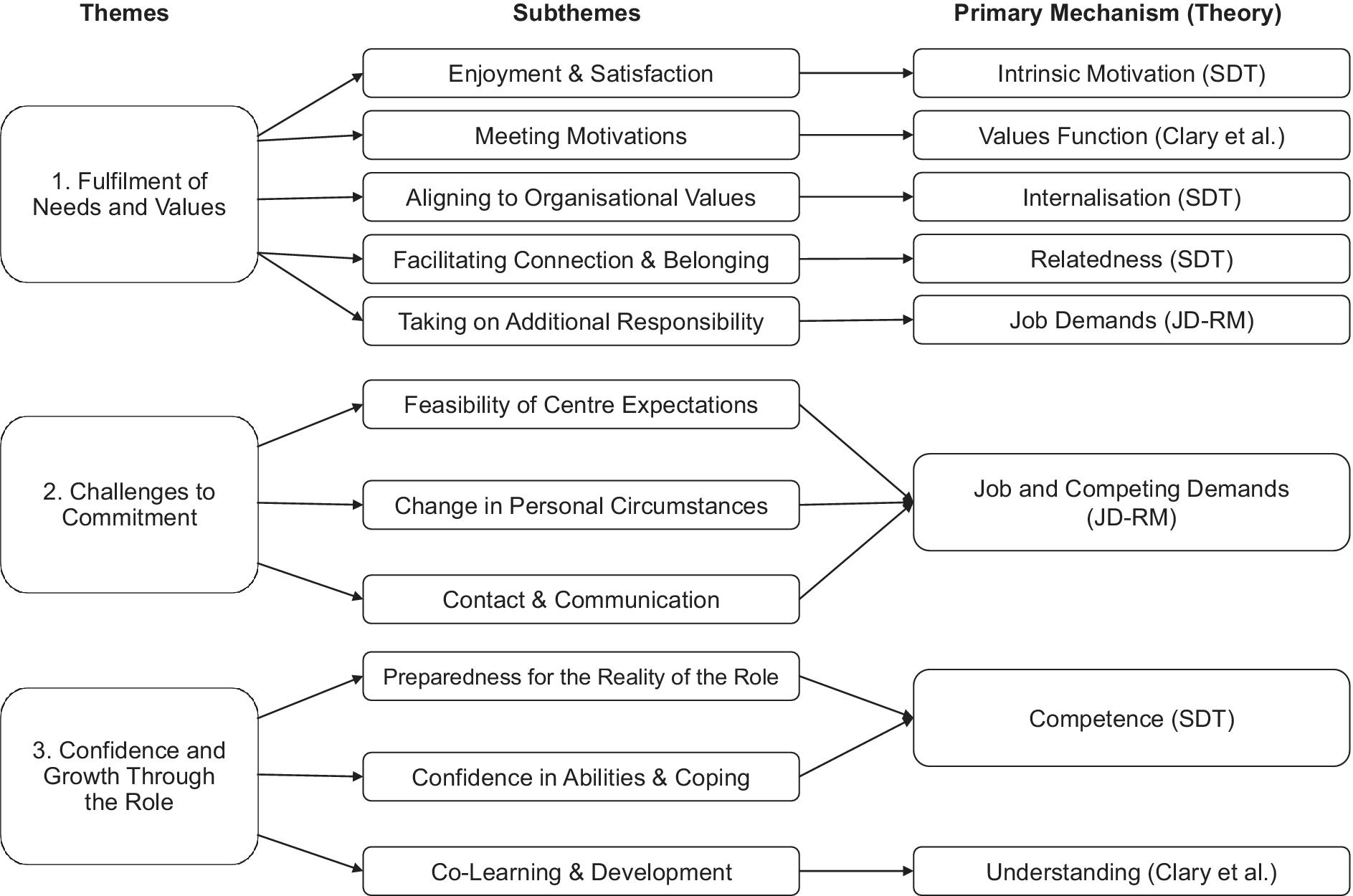
Analyses revealed three themes and 11 subthemes. See Figure 1 for themes identified. For further quotations, see Supplementary Tables S4–S6.
A conceptual map linking inductively derived themes and subthemes to the theoretical mechanisms underlying reduced volunteer engagement.
Note. SDT = self-determination theory (Deci & Ryan, Reference Deci and Ryan1980, Reference Deci and Ryan2000); Clary et al. = Clary et al. (Reference Clary, Snyder, Ridge, Copeland, Stukas, Haugen and Miene1998) functional approach to volunteer motivation; JD-RM = job demands–resources model (Demerouti et al., Reference Demerouti, Bakker, Nachreiner and Schaufeli2001).

Fig. 1 Long description
The flowchart is divided into three columns titled Themes, Subthemes, and Primary Mechanism (Theory).
Section 1: Fulfilment of Needs and Values.
* The theme 1. Fulfilment of Needs and Values points to five subthemes:
* Enjoyment & Satisfaction, which links to Intrinsic Motivation (S D T).
* Meeting Motivations, which links to Values Function (Clary et al.).
* Aligning to Organisational Values, which links to Internalisation (S D T).
* Facilitating Connection & Belonging, which links to Relatedness (S D T).
* Taking on Additional Responsibility, which links to Job Demands (J D dash R M).
Section 2: Challenges to Commitment.
* The theme 2. Challenges to Commitment points to three subthemes:
* Feasibility of Centre Expectations, Change in Personal Circumstances, and Contact & Communication.
* All three subthemes converge and point to a single mechanism: Job and Competing Demands (J D dash R M).
Section 3: Confidence and Growth Through the Role.
* The theme 3. Confidence and Growth Through the Role points to three subthemes:
* Preparedness for the Reality of the Role and Confidence in Abilities & Coping both point to Competence (S D T).
* Co-Learning & Development points to Understanding (Clary et al.).
Theme 1: Fulfillment of needs and values
This theme incorporated feelings about whether the role was achieving what the participants desired from their volunteering experience. Unmet needs were linked to reduced engagement with the role. It consisted of five subthemes: Enjoyment and Satisfaction, Meeting Motivations, Aligning to Organizational Values, Facilitating Connection and Belonging, and Taking on Additional Responsibility.
Enjoyment and Satisfaction highlighted the variation in satisfaction and enjoyment that participants experienced. Some participants discussed enjoyment as an important motivator for initially volunteering. At TP1, Volunteer K stated “you could feel like you’re doing something worthwhile and be miserable doing it, can’t you? And so I think it was finding something that was a thing I enjoyed.” Over time, volunteers reported more variation in satisfaction depending on shift experiences (e.g., reports of experiencing some less enjoyable shifts) and experiences with services (e.g., reports of less enjoyment with specific telephone or email service experiences). Reduced enjoyment/satisfaction was sometimes linked to decisions to leave: “I think perhaps towards the end, I got less satisfaction, and I just wanted a break.” (Leaver C).
A range of motivations for volunteering were reported (e.g., self-development, social, and most commonly altruistic). Meeting Motivations, particularly altruistic motivations, was associated with satisfaction and personal benefits (e.g., positive self-esteem). However, some individuals felt their motivations were not being met, which was sometimes linked to frustration. For example:
If the only box to tick was giving something back and helping people, then yes, I’m getting that out of it, at the moment, kind of meeting new friends, and finding another group of people to kind of interact with I don’t think that’s being ticked as much. (Volunteer C, TP1)
For those who were unsure whether the role met expectations, these feelings remained prominent over time. For Volunteer I, unmet motivations led to doubts about remaining: “I don’t know whether for me it’s like, whether I want to spend my time doing this or doing something else that’s less passive.” (TP2).
Aligning to Organizational Values discussed whether the participant understood and agreed with organizational processes. Some volunteers gained understanding and belief in the policies (e.g., related to how members of the organization should communicate with service users), as their experience level increased. For example, at TP1, Volunteer D highlighted the challenges of not deviating from policies while supporting service users, stating “that has not been brilliantly easy.” However, by TP2 they showed increased support, stating “it gradually becomes easier to accept that these ways work and I do understand.” For a couple of participants, the policies remained challenging and difficulties aligning with these impacted on feelings around continuing volunteering. Leaver E’s decision to leave the center was influenced by changing policy: “it just seems to me that it’s getting so complex now. I mean, at one time, it was just picking up the phone and answering a caller, but these days there’s [organisational policy].”
Facilitating Connection and Belonging discussed the relationships between volunteers. Many participants had positive interactions with co-volunteers, such as receiving support, having conversations, and sharing values (e.g., motivations for volunteering). Over time, some individuals reported that these interactions had developed into friendships: “I’ve developed friendships with people that I wouldn’t have.” (Volunteer M, TP2). Specifically, the common motivations and values allowed for building connections regardless of differences in personal characteristics. While some reported positive connections, other volunteers felt like they had experienced limited connections with co-volunteers, despite spending long periods of time together on shifts (e.g., had shifts without any conversation, no developed friendships, colleagues engaged in small talk as opposed to more meaningful conversations). This may have been influenced by the lack of continuity over who they completed shifts with. These experiences negatively impacted on feelings of connection and belonging: “I felt like I didn’t belong.” (Leaver F); “I’d like to know more of the volunteers, like in the future and feel more like a community.” (Volunteer F, TP1).
Taking on Additional Responsibility encompassed the participants’ feelings about undertaking commitments beyond supporting service users who contact the charity (e.g., supporting with fundraising, information sessions). At first contact, a minority were aware of potential pressure to take on additional responsibilities: “I’ve sort of been told several times that you get sucked into things.” (Volunteer K, TP1). Over time, this pressure was discussed more. However, most participants felt they either wanted to undertake more, or were comfortable declining invitations. For those that took on additional responsibilities, some gained satisfaction from the experience. For some center leavers, there was a sense of frustration with taking on additional responsibilities: “you expel a lot of energy and don’t really see any personal feedback or benefits of it.” (Leaver H). This suggested that contributing additional time, without clarity on its direct benefit to the organization, had the potential to create frustration.
Theme 2: Challenges to commitment
This theme described the commitment of completing the volunteer role and whether it was feasible for all volunteers. Difficulties with meeting the commitment impacted upon engagement and retention. Three subthemes were uncovered: Feasibility of Center Expectations, Change in Personal Circumstances, and Contact and Communication.
The Feasibility of Center Expectations for volunteers (e.g., attending training, shift frequency) varied by participant. Some felt able to meet expectations comfortably, positively discussing the shift flexibility and undertaking more commitments. For other participants, the expectations were challenging. Volunteer L (TP1) said about training: “it’s a huge commitment. And I don’t think it’s always made clear at the beginning.” Some felt unable to meet the required shift frequency. Changing availability made this more challenging for some individuals over time. This included night-time shifts that were seen as difficult to schedule and deal with the aftereffects (e.g., tiredness). For many leavers, the unfeasibility of expectations was associated with their decisions to leave: “I just thought it was asking quite a lot of me.” (Leaver A). To improve satisfaction, a few participants felt that there could be better balance between the center’s needs for volunteers, compared to how much time they can donate. For example, Volunteer I (TP3) stated: “I think you may get volunteers who are almost meeting the commitment or not quite meeting the commitment now, and they feel a bit defeated.”
Difficulties meeting the commitment was sometimes associated with a Change in Personal Circumstances. A minority of new volunteers had changed circumstances over time (e.g., changed careers, began education), which had impacted upon their availability to complete shifts. At TP2 Volunteer I stated: “practically, I’m finding it harder to sort of to meet the commitment, I think with the [change in life circumstances].” For most leavers, a life change (e.g., moving, career change) was associated with them leaving their role. Career changes decreased availability, and for those that became employed in mental health-related work desires to continue volunteering in a similar field reduced. Leaver A explained these challenges: “I know that I wouldn’t be able to do [volunteering] in the weekday and then go to work and work with more vulnerable people not in the right mindset.”
In relation to Contact and Communication, some participants reported unclear communication around the shift expectations and the consequences of doing less. When participants informed the local center of commitment challenges, they received understanding. As they progressed within the role, some volunteers reported that the frequency of communication from the local center had increased. For example, volunteers reported regular communication about rota gaps (i.e., where there were shifts that did not have volunteers signed up for it, and without anyone signing up, it would result in telephone and email services not being delivered for that 4–5 hour time period). For a few, this communication led to feelings of pressure and guilt to commit to more than they felt able to. For example: “everyday there are there are messages and emails to say, if anyone’s available for shift XYZ can you sign up? And I rarely can so it is a struggle to only give what I can comfortably give.” (Volunteer A, TP3). Being contacted about their shift frequency triggered some individuals to leave. This approach was met with mixed feelings depending on if the individual intended to stay or leave. Leaver B felt they could have remained a volunteer doing occasional shifts without the contact, stating:
I kind of felt by getting those [contacts about needing to do more shifts] that there was somebody kind of concerned that I needed to be more active. And in so doing, it kind of made me think well, can I be more active and then eventually just thinking well probably not, so maybe I should just say that I can’t do [the volunteering role].
Theme 3: Confidence and growth through the role
This theme encompassed self-development both within and outside of the role. For development within the role, this was linked to the comfort and confidence the volunteer developed. Limited confidence and coping were associated with reduced engagement. This theme contained three subthemes: Preparedness for the Reality of the Role, Confidence in Abilities and Coping, and Co-Learning and Development.
There were positive comments about the quality of the training received, and for some this helped foster Preparedness for the Reality of the Role. However, there were some feelings that the training prepared the individuals for the role extremities, without preparing for the reality. This approach was associated with feelings of apprehension about dealing with extreme scenarios. For example, Leaver B stated: “it can really make you feel like even if you are quite skilled as a communicator or whatever, it can really make you feel like you don’t know what you’re doing.” As volunteers completed more shifts, they developed better understanding of the reality of the role. For some, this reduced the initial feelings of apprehension. Additionally, some individuals felt less prepared to support service users with specific mental health-related concerns. For some, this was a temporary issue, as they received the training later in their progression (i.e., after they had begun responding to service users). For example, Volunteer M (TP2) stated: “I felt almost just like when you’re on the call, you can’t really be like hang on a minute I’ve got this training next week.” For others, they expressed continued feelings of being less prepared. For example, many felt less prepared to deliver the email service due to limited training, with Volunteer F stating: “I have not had any training on the emails.” (TP2).
Being prepared for the role develops Confidence in Abilities and Coping. After training and mentoring (TP1), there were some feelings of apprehension and self-doubt over delivering the service. For a few participants, imposter syndrome feelings had developed after receiving negative feedback from colleagues. For example, Volunteer B (TP1) stated “the feedback I got was just like is this your first [role play call]? So I was just like, well, I was like oh my God I can’t! I’m not built to do this!” Over time, increased comfort and confidence were reported by many participants, especially in relation to responding to the telephone service. This suggested that confidence was developed through gaining more experience within the role. Volunteer K (TP2) stated: “I’m growing in confidence that it doesn’t matter what I pick up the phone to. I can deal with it.” Additionally, some individuals reported feeling too inexperienced to undertake additional responsibilities. Most individuals felt able to cope with the role. This was aided by them knowing they would receive support from colleagues after challenging experiences. For a minority of leavers, reduced confidence in abilities were associated with them leaving the role. Leaver F discussed self-doubt as the primary reason they left: “I think that was probably the main thing, thinking that I’m not good enough for this.”
The development of confidence within the role was linked to Co-Learning and Development. Progressing within the role was seen by some as daunting: “it’s just another daunting step I wasn’t jumping at the chance of being on my own.” (Volunteer B, TP1). However, many reported that they continued to feel supported throughout all stages of progression in the volunteer role. Some participants discussed the value of sharing experiences and receiving reassurance. Volunteer J (TP2) stated: “it was reassuring to hear that you know the experience you’re having is similar to the experience that other people are having.” However, a few participants reported that they had received inconsistent information from other long-standing volunteers compared to what they had been taught in training, which was a confusing experience. Volunteer L (TP1) stated: “[they’d] give me advice that we were told was a no no in training, so there wasn’t always that consistency.” Co-learning within the role also helped to develop transferable skills (e.g., listening), which many felt were of value in their lives externally to volunteering.
Discussion
The study explored the factors associated with engagement and retention among new mental health charity volunteers as they progressed through training milestones and volunteers who had recently left the organization. Our study found that for volunteers providing mental health support, engagement and retention were shaped by a combination of organizational demands and the extent to which psychological needs and motivations were being fulfilled. In relation to the organization, volunteers were more engaged when their roles within the organization aligned with their expectations, motivations and personal values. However, unmet needs from volunteering, such as the organization not fostering connection or belonging, were barriers to engagement and retention. Many new volunteers also discussed desires to grow in confidence and skills, viewing the organization’s co-learning avenues as a valuable opportunity for development. Limited improvements in confidence and coping were significant barriers to continued engagement. On a personal level, many volunteers faced challenges in meeting the organization’s time commitments, particularly when their circumstances changed. These results align in some ways with previous research on volunteer engagement and retention, but they also highlight novel findings related to the unique challenges of mental health volunteering.
Like previous literature in this field (e.g., Edeigba & Singh, Reference Edeigba and Singh2022; Locke et al., Reference Locke, Ellis and Smith2003; Same et al., Reference Same, McBride, Liddelow, Mullan and Harris2020; Sundram et al., Reference Sundram, Corattur, Dong and Zhong2018; Warren & Garthwaite, Reference Warren and Garthwaite2015), we found there to be both organizational and personal factors that may influence volunteer retention and turnover. For example, one such study by Hustinx (Reference Hustinx2010) reported that being unable to balance the volunteering commitment with other life demands (e.g., work, family) was a primary reason for turnover in their humanitarian setting. This is similar to our finding within a mental health setting, suggesting that there may be some consistent barriers to engagement and retention that exist across voluntary sector settings.
Most significantly, we found unique engagement barriers within this mental health support setting. In our study, volunteers discussed the ability to cope with supporting callers through challenging circumstances, as the telephone calls could resonate emotionally and involve sensitive topics. Past counseling helpline volunteer research alluded to coping challenges, with some volunteers reporting that they felt unsupported with the emotional impact of telephone calls (Sundram et al., Reference Sundram, Corattur, Dong and Zhong2018). While these earlier studies have described the emotional challenges of mental health volunteering (e.g., Willems et al., Reference Willems, Drossaert, Vuijk and Bohlmeijer2021), our findings suggest that appropriate volunteer support can assist in the development of coping with the unique challenges of mental health volunteering. Therefore, our findings extend prior evidence by showing that coping skills evolve longitudinally and appear to be shaped by the support volunteers receive. This is likely a key antecedent to continued volunteer engagement in a mental health support setting.
Past research has detailed the challenges of volunteers aligning with organizational values (e.g., Edeigba & Singh, Reference Edeigba and Singh2022). In the present study, some volunteers felt unable to provide the support they believed service users required when they followed the organizational policies. This experience appears to resemble moral distress, which is defined as having a judgement on the right action to complete, which differs from the organization’s thoughts on the right action (Jameton, Reference Jameton1984). Moral distress is discussed widely in medical settings. For example, higher levels of moral distress have been found among medical clinicians who had left their roles versus remained (Whitehead et al., Reference Whitehead, Herbertson, Hamric, Epstein and Fisher2015). However, the influence of moral distress in mental health support voluntary contexts remains unexplored. Therefore, as we have identified this as a potential barrier to engagement, further research is now warranted to understand the impact of moral distress in this setting.
After volunteering in mental health roles, some individuals later gained employment in the field and decided to stop volunteering. This aligns with suggestions that some volunteers are motivated by skill development and career benefits (Dean, Reference Dean2014). Volunteering may therefore be viewed as a transitory step for some individuals, with engagement reducing after career goals are achieved. However, among these leavers, concerns about the wellbeing impact of completing both roles were also detailed. In support of this, past qualitative research has reported on the emotional challenges (e.g., frustration, guilt, sadness) that can occur through providing mental health support (Willems et al., Reference Willems, Drossaert, Vuijk and Bohlmeijer2021). Our findings offer a novel insight by showing that volunteers recognize the emotional challenges of mental health support as a barrier to continued engagement. Specifically, volunteers reported choosing to step back once they enter paid roles, as completing both forms of work in the same sector was considered to be emotionally challenging.
Many volunteers felt less confident to respond to the email service (versus telephone service) within this organization, due to limited training. Moreover, for some, the day-to-day reality of the role was not made clear within the training (i.e., the training focused on extreme scenarios, which led them to believe that they would always be dealing with extremities), which was linked to feelings of imposter syndrome. There is a reported negative relationship between feelings of imposter syndrome and years employed for mental health care professionals (Clark et al., Reference Clark, Holden, Russell and Downs2022). Our work extends this finding to the mental health volunteer sector. Therefore, understanding how best to deliver training and feedback to reduce imposter syndrome feelings among new volunteers may be important for increasing early engagement in voluntary roles.
Established psychological frameworks, including self-determination theory (SDT; Deci & Ryan, Reference Deci and Ryan1980, Reference Deci and Ryan2000), the job demands–resources model (JD-RM; Demerouti et al., Reference Demerouti, Bakker, Nachreiner and Schaufeli2001), and Clary et al.’s (Reference Clary, Snyder, Ridge, Copeland, Stukas, Haugen and Miene1998) functional approach to volunteer motivation align with the interpretation of our findings. As illustrated in Figure 1, our findings can be understood through specific psychological mechanisms within these frameworks. Together, these mechanisms could explain the psychological processes that influence volunteer engagement and retention within the mental health charity context.
Firstly, our findings can be understood through SDT, which was proposed by Deci and Ryan (Reference Deci and Ryan1980, Reference Deci and Ryan2000) to understand intrinsic and extrinsic behavior motivations. It suggests that humans have basic psychological needs, with fulfillment of three needs: autonomy (freedom and interest over actions), competence (having skills and self-development), and relatedness (forming connections and belonging) being associated with behavior engagement (Deci & Ryan, Reference Deci and Ryan2000; Ryan & Deci, Reference Ryan and Deci2020). Quantitative research finds positive associations between perceptions of these three needs and volunteer engagement (Fernandes & de Matos, Reference Fernandes and de Matos2023). Considering our own qualitative findings, expectations to align to organizational values, to take on additional responsibility, and to meet center expectations could have reduced feelings of autonomy for some. Over time, the development of confidence may have increased individuals’ feelings of competence in completing the role responsibilities. The desire for connections and belonging could have been an attempt to satisfy the need for relatedness. The overall enjoyment of the role may be associated with increased intrinsic motivation. Therefore, these findings suggest that engagement is more likely to be sustained when volunteers experience fulfillment of autonomy, competence, and relatedness needs, whereas unmet psychological needs contribute to disengagement. This offers a unique application of SDT within the context of mental health volunteering, showing how basic needs become met or remain unmet longitudinally in this setting.
As SDT focuses on behavior engagement broadly, the JD-RM (Demerouti et al., Reference Demerouti, Bakker, Nachreiner and Schaufeli2001) may help to understand engagement within an organizational setting. Bakker and Demerouti (Reference Bakker and Demerouti2007) suggest that individuals face job demands (e.g., high pressure), which may turn into stressors. However, experiencing job resources (e.g., coworker support) can reduce job demands, and help to achieve goals. Specifically, they suggest that job resources have positive impacts on engagement, and they can fulfill psychological needs. Empirically, Harp et al. (Reference Harp, Scherer and Allen2017) confirm the negative associations between job demands (organizational constraints and role ambiguity) and volunteer engagement. From our own findings, many of the discussed barriers may be considered job demands (e.g., the commitment, reduced preparedness, limited connections), and the facillitators may be classified as resources (e.g., co-learning, support, training/feedback). Moreover, the competing life demands (due to changes in personal circumstances), may have increased total demands, reducing engagement. This suggests that when perceived demands exceed available resources, volunteers are less likely to remain engaged, supporting the relevance of this framework in voluntary settings.
Finally, more specific to volunteering, Clary et al. (Reference Clary, Snyder, Ridge, Copeland, Stukas, Haugen and Miene1998) proposed six psychological functions volunteering can satisfy. Among the mental health volunteers sampled, there were mixed motivations and differing opinions on whether these were met. Specifically, the role allowed volunteers to express their altruistic values, learn and utilize skills, and enhance volunteers’ own feelings about themselves. However, within our sample, desires for a career in mental health and using volunteering as a protection against their own personal problems were not widely held motivations. Our results therefore demonstrate that motivations may differ across individuals and voluntary settings, and that not all of the six functions need to be present and met among retained volunteers. Moreover, our findings suggest that alignment between volunteers’ primary motivations (i.e., value-driven motivations within this mental health setting) and their experiences within the role plays a key role in sustaining engagement over time.
Moreover, one motivation which remained unmet for some individuals within our study was the social aspect of the model. Specifically, a barrier to engagement within this setting was the limited connections built. This suggests that satisfying the need for social connections may be key within mental health settings. This is supported by a recent umbrella review by Nichol et al. (Reference Nichol, Wilson, Rodrigues and Haighton2024), which highlighted that volunteering may benefit social networks. Moreover, they report that the social networks and support gained through volunteering can have a positive impact on mental wellbeing. This may be particularly valuable in emotionally challenging volunteering roles, like those within the mental health voluntary sector.
Following the suggestions of these existing theoretical models, it is important to consider how to ensure psychological needs and motivations are met, demands are reduced, and resources are increased to improve engagement. Based on our findings, we propose some potential strategies to reduce demands for this volunteer group. For example, one approach could be considering whether the commitment expectations are feasible and clearly communicated. Moreover, an unmet need for some volunteers was social connection. There may be benefits of implementing socialization processes to increase this resource, with a recent meta-analysis confirming socialization processes can significantly improve the retention of newcomers (Liu et al., Reference Liu, Watts, Feng, Wu and Yin2024). Finally, the existing processes used to develop confidence and coping (e.g., support) increased resources, and should continue to be implemented. Further confidence may be developed through training improvements (e.g., highlighting the role reality, introducing topics earlier, and delivering refreshers). Collectively, these strategies have the potential to improve volunteer engagement within mental health voluntary settings.
The longitudinal qualitative design was a study strength, as it allowed us to assess factors associated with volunteer engagement over time. This approach led us to conclude that there are consistent factors impacting on volunteers’ engagement and retention over time within this organization. However, it also allowed us to find that some engagement factors (e.g., alignment with organizational values, the development of confidence) and disengagement factors (e.g., inability to meet the commitment due to circumstance changes, determining that the role is not meeting their motivations) became more prominent over time for new volunteers. We also sampled volunteers who had recently left the charity, which allowed us to gain understanding of what influenced decisions to leave. Another strength was the constructivist grounded theory approach, as it allowed us to take a reflective approach and clarify participant meaning in repeated interviews.
There were some limitations. Firstly, we chose not to interview any long-standing active volunteers because our focus was on volunteers at risk of low engagement and who had experienced recent disengagement. Further research focusing on volunteers who were retained long term may be useful in identifying protective factors for volunteer engagement and retention. Secondly, there was a smaller sample of leavers interviewed, due to lower responses to advertisements from this potential sample. It is therefore possible that some barriers to retention remain unidentified. Moreover, we were unable to contact any volunteers who had left due to potentially sensitive personal circumstances (e.g., poor health, bereavement) because of organizational preference, and this is a limitation to the present study. Moreover, due to this being a case study, the generalizability of findings to other organizations remains an empirical question. Finally, constraints on funding and data management agreements resulted in us being unable to receive feedback from participants on identified themes. However, we checked response understanding during data collection, increasing confidence in our interpretations.
In summary, there are unique emotional challenges to retaining an engaged volunteer base in the mental health support sector, given the nature and type of support provided by volunteers to service users. While our findings were specific to mental health volunteers in a single organization, we have identified factors that may be associated with engagement and retention of volunteers in other types of mental health support organizations. Specifically, we have uniquely found that unmet needs, difficulties with the commitment and reduced confidence/coping were likely barriers to engagement and retention among mental health volunteers.
These findings suggest that volunteer engagement is shaped by an interaction between the fulfillment of psychological needs, alignment of motivations and the balance between organizational demands and capacity. Where these conditions are met, sustained engagement is likely, whereas unmet needs and increased demands may be associated with reduced engagement and turnover. Taken together, these findings contribute to the literature by offering novel insights into the experiences of mental health volunteers, including their changing engagement over time, while also providing proposed mechanisms to explain changing engagement, informed by broader psychological models of motivation and engagement.
Future studies are now warranted to investigate the generalizability of the identified engagement barriers to wider voluntary organizations. This will confirm whether proactively addressing these facilitators and barriers during volunteer training and integration (e.g., by ensuring all needs are fulfilled) may lead to increased volunteer engagement and retention across organizations.
Supplementary material
The supplementary material for this article can be found at http://doi.org/10.1017/S0957876526000719.
Data availability statement
The data generated during the current study are not publicly available. However, subject to specific conditions for use, data will be made available from the corresponding author on reasonable request.
Acknowledgements
We would like to thank all new and past volunteers who took part in the research study. We would also like to thank the leadership team at the local center of the UK mental health charity for allowing us access to volunteers and supporting in distributing advertisements. We would also like to thank Dr Rob Noonan, University of Chester, and Dr Laura Goodwin, University of Lancaster, who provided feedback on initial research protocols and interview grids.
Author contribution
Conceptualization: R.M.M., E.R.; Data curation: R.M.M.; Formal analysis: R.M.M., V.V.; Funding acquisition: E.R.; Investigation: R.M.M.; Methodology: R.M.M., E.R.; Project administration: R.M.M.; Supervision: V.V., E.R.; Validation: V.V., E.R.; Visualization: R.M.M.; Writing—original draft: R.M.M.; Writing—review and editing: R.M.M., V.V., E.R.
Funding statement
This work forms part of RMM’s PhD, and was supported by an Economic and Social Research Council NWSSDTP case studentship [grant number: ES/P000665/1]. The funding source had no involvement in study design, analysis and interpretation of data, writing of the report, and in the decision to submit the article for publication.
Competing interests
The authors declare that there is no conflict of interest.
Ethical standards
The study was approved by the University of Liverpool Ethics Committee (approval reference no. 11195). It adheres to the ethical standards in the 1964 Declaration of Helsinki and its later amendments. All participants provided written or verbal informed consent prior to the interviews beginning. Verbal consent was taken when written consent was not possible (e.g., during online interviews), and this was audio recorded. For repeated interviews, participants verbally confirmed consent to continue in the study under the same conditions prior to their repeated interviews beginning.


 Open access

