Latin American countries are taking important steps to broaden and strengthen universal health coverage (UHC) (Reference Dmytraczenko, Torres and Aten1). Health decision makers, in their efforts to maximize health benefit within constrained budgets, have begun to require more and more information that is reliable and relevant to allow them to make better decisions in priority-setting (Reference Terwindt, Rajan and Soucat2;3). This has placed health technology assessment (HTA) in a more prominent role. From an initial stage where HTA was primarily a series of isolated reports with little or no impact on decisions, it has recently come to take a central role in decision making for health resource allocation in many countries in the region. This has been more evident in countries such as Brazil, Chile, Colombia, and Mexico, but it is beginning to spread to many other countries in Latin America and the Caribbean (Reference Augustovski, Alcaraz, Caporale, Garcia Marti and Pichon Riviere4).
In the early days of HTA in Latin America, the focus was primarily to develop human resources to produce HTA reports and related aspects such as evidence synthesis and health economics (Reference Banta5;Reference Pichon-Riviere, Augustovski and Rubinstein6). More recently, however, as the region began to develop greater technical capacity, other priorities arose for making improvements to the process and quality of HTA. In this context, given that decisions made through the HTA process have the potential to affect a large number of people and institutions, the participation of all relevant stakeholders has become a priority to make the HTA-based decision-making process more transparent and legitimate (Reference Baltussen, Jansen and Mikkelsen7).
The First Latin American HTA Policy Forum of Health Technology Assessment International (HTAi) was held in 2016 in Costa Rica, and the topic of good practice principles to guide HTA in the region was discussed. One of the highest priority principles that was identified by participating country representatives related to stakeholder involvement (Reference Pichon-Riviere, Soto, Augustovski, Garcia Marti and Sampietro-Colom8). The involvement of relevant stakeholders in the HTA process is a good practice principle largely recognized by the international HTA community (Reference Daniels9–16). However, many Latin American countries have not yet implemented formal mechanisms for stakeholder involvement in the HTA process, and in many other countries in the region implementation is still partial, involving only certain groups or involving them only in some, but not all, components of HTA and decision-making processes.
Also during the first Forum, it was emphasized that the local context must be taken into account for all of the good practice principles. Thus, determining when and how to implement these principles depends upon the state of HTA development in each country, the resources available, and the characteristics of the health system and the decision-making process. This insight informed the selection of the topic for the second Latin American HTA Policy Forum held in 2017, which was: “Stakeholder Involvement in the Health Technology Assessment Process.” The objective of the Forum was to debate the best way for HTA agencies in the region to improve stakeholder involvement, both in terms of the conceptual frameworks as well as in the methodological and operational aspects of HTA.
METHODS
The Second Latin American HTA Policy Forum was held in-person in Lima, Peru, on April 24–25, 2017, and it included a total of forty-one participants: ten representatives of HTA agencies; seven representatives of funders of the public, social security, and private insurance sectors; seventeen representatives from industry (pharmaceuticals, medical equipment, and diagnostic tests); one representative of the Pan-American Health Organization and six academics and organizers, and members of the event's scientific secretariat. In total, there were ten countries in the region represented and ten companies. In the acknowledgements section of this study is the list of participants, including their affiliations and countries.
The scientific secretariat developed a background document summarizing the state of knowledge on the topic; establish shared understanding among participants; harmonize the definitions of key terms; and support discussions during the in-person meeting. This document was created with input from the Forum Organizing Committee and the members of the Forum (Reference Pichon-Riviere, Soto, Augustovski, Garcia-Marti and Sampietro-Colom17).
Relevant stakeholders were defined as those individuals, organizations or communities who have a direct interest in the process and results of an assessment of a health technology, in other words, all the people potentially affected by a health technology coverage (reimbursement) decision (18). The Forum focused discussion on two stakeholder groups deemed to be of highest priority in the region: (i) patients and caregivers in general, and (ii) health technology producers.
To facilitate presentations and debate, two areas where involvement could occur were defined: one relating to the general structure, policies, and values of the HTA process; and the other relating to the development and production of HTA.
The keynote speaker, Edward Clifton, shared the experiences of Healthcare Improvement Scotland, an institution with a long history of stakeholder involvement in HTA. This was followed by presentations on the current state and main barriers to the implementation of stakeholder involvement in each of the countries represented at the Forum. In turn, two representatives from industry (medicines and devices) presented their perspectives on the topic, one providing a global perspective, the other a regional view. These presentations were the basis for breakout group discussions that led to the results of the Forum.
Both the supporting materials and presentations, along with the breakout group discussions were developed to: (i) discuss stakeholder involvement experiences in different countries, (ii) assess the current situation in the region, and, (iii) discuss possible next steps toward involving stakeholders in HTA processes in the region.
The Forum was conducted following the Chatham House Rule (19), which permits participants to share information obtained during the meeting but without revealing the identity or affiliation of the person who provided the information.
After the Forum, the scientific secretariat developed a summary report of the activities, results, and conclusions, which was circulated to all participants for input and comment. This study is based on this summary report and presents the main points debated during the Forum. It is not a formal consensus of Forum participants and, therefore, it should not be construed as representing the views of the participants or the organizations where they work.
RESULTS AND DISCUSSIONS HELD DURING THE FORUM
The background document summarized the main mechanisms of, and experiences with, stakeholder involvement in HTA from around the globe, with examples from countries in the region where possible. Mechanisms for involvement were described in each of the two aforementioned areas: first, in the definition of the structure of HTA bodies, policies, and values of the HTA process; and, second, in the different stages of the HTA processes (e.g., prioritization of topics for assessment, formulation of recommendations and their implementation and/or revision) (Reference Pichon-Riviere, Soto, Augustovski, Garcia-Marti and Sampietro-Colom17). Forum participants agreed that the background document provided a good base to support discussions about stakeholder involvement in Latin America.
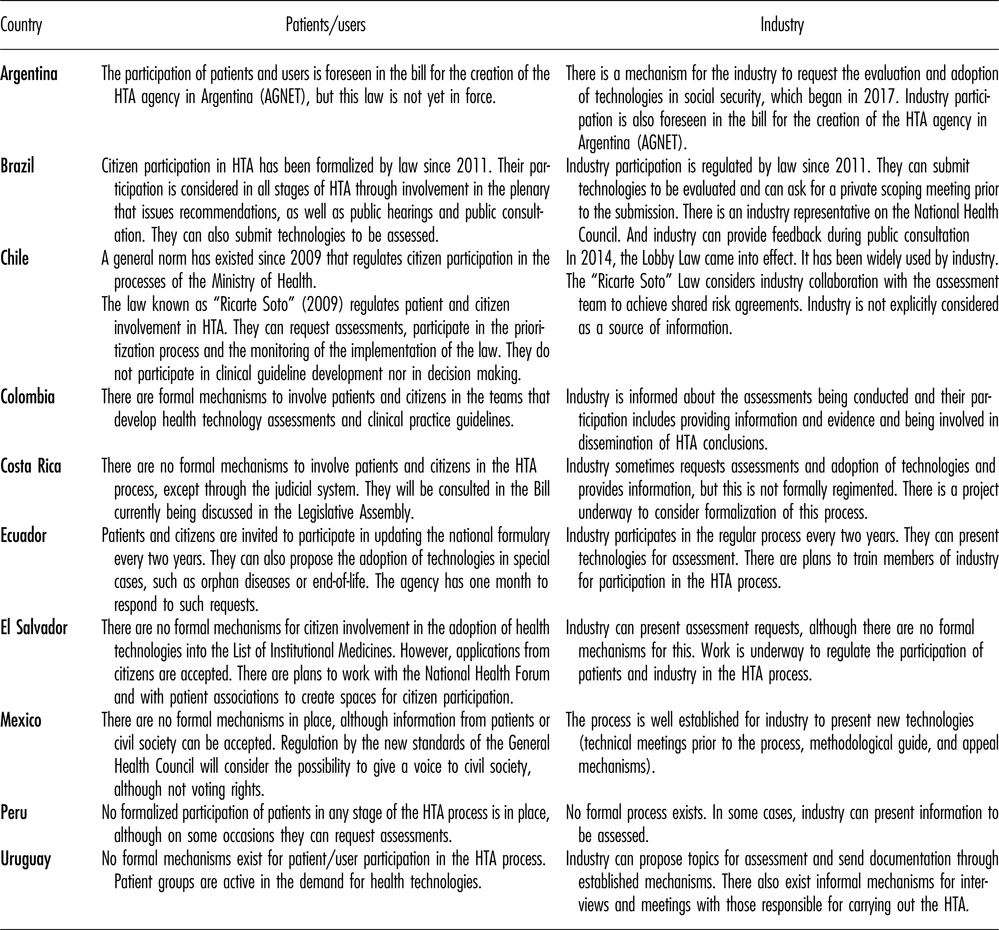
Presentations by members about the current state of the situation in the region showed that Latin America has made tremendous progress in HTA in the past few years. Nevertheless, opportunities for improvement remain, particularly in aspects related to the use of HTA in decision making. Table 1 provides an overview of the state of stakeholder involvement in the ten Latin American countries represented at the Forum, with a special focus on patients/users and industry. It shows a high level of heterogeneity, ranging from countries systematically involving stakeholders, to others where there are no formal mechanisms in place for stakeholder involvement in HTA. Even in countries that have been able to move forward in this respect, implementation is mostly either limited to a subset of all relevant stakeholders, or it applies only to certain phases of the HTA process, for example, the assessment phase but not decision making.
Overview of the Involvement of Patients/Users and Industry in the Ten Latin American Participating Countries of the Forum

Note. Source: Developed by the authors based on data presented by participants in the Second Latin American HTA Policy Forum.
HTA, health technology assessment.
Presentations by industry emphasized that the participation of patients in the HTA process is a critical success factor and could be seen as the third pillar of evidence along with clinical and economic evidence. It was noted that this involvement should follow two key principles: involving the right patients or patient groups at the right time, and involving them in the right way.
In subsequent discussions the importance of stakeholder involvement in HTA was reaffirmed. It was seen as a way to provide a broader perspective that would prevent a narrow focus limited to the viewpoints of technocrats and health professionals only. It was also seen as a way to engage various groups in dialogue thereby increasing the legitimacy of both the process and the resulting decisions.
Throughout the meeting, different types and degrees of stakeholder involvement were discussed. These ranged from passive involvement, for example, publicly available HTA documents open for comments through formal mechanisms and the incorporation of social values in the weighting of criteria used in the assessment, to active participation, for example, where representatives are present at committee meetings involved in decision making.
The Forum did not reach a consensus on the stages of HTA to be prioritized for involvement. However, there was agreement that stakeholder involvement could enrich many of these stages, except for those that are purely technical. Many attendees believed that such stages should be the responsibility of HTA staff who are appropriately trained and that social values should not influence this work, which should be protected from external influences. However, it was noted that the items for technical assessment could be prioritized in previous participatory stages, and the results of the technical assessment should be appraised in a deliberative process including nontechnical stakeholders.
In the exploration of the issues and barriers to the implementation of stakeholder involvement, one main barrier mentioned was their lack of knowledge about HTA processes and methods. Other barriers identified by Forum participants were the lack of trained staff and dealing with the additional cost and time burdens arising from changes made to the HTA process to achieve greater participation.
Several participants expressed concern over potentially negative consequences of stakeholder involvement in HTA. Some of the main fears were that certain groups could have an excessive influence on setting the agenda for prioritization of technologies to be assessed. Specifically, some participants mentioned that stakeholder involvement would engender excessive influence by industry, which would lead to the prioritization of assessment of those interventions/technologies that have a “sponsor” promoting them and away from those technologies that are most needed by the health system, thereby leading to an increase in existing health inequalities. Forum attendees feared that stakeholders could inappropriately influence the assessment and decision making as well, and mentioned cases of pressures received from severely ill patients or patient groups highly associated with industry. This concern was more pronounced in countries with a lower level of HTA institutionalization where HTA mechanisms and structures are weaker or in the process of emerging.
Country representatives also worried that stakeholder involvement could increase demand to a point exceeding available resources, thereby causing delays in the HTA process. In this regard, the cases of Brazil and Mexico were referred to because, according to regulations, they are required to respond within a certain timeframe to requests for assessment or adoption of technologies from different stakeholders. It was argued that this could be readily applied in large countries with assessment structures equipped to respond to such demands, but for smaller countries, this would be unfeasible. This is one reason why some countries in the region are reluctant to establish formal participation processes.
Most attendees agreed that the participation of stakeholders would increase legitimacy. This, in turn, would reduce the discretion of decision makers, which was considered a positive factor to further reinforce the legitimacy of the decision-making process.
Several additional potential barriers were identified, namely, the lack of trust among different stakeholders, the judicialization of many of the HTA related decisions through individual-based appeals, the lack of education and awareness among patients about HTA, the absence of clear and accessible mechanisms to promote the participation of the general public in the HTA process, the fragmentation of many of the countries’ health systems, and the lack of a culture of citizen participation in policy development in general.
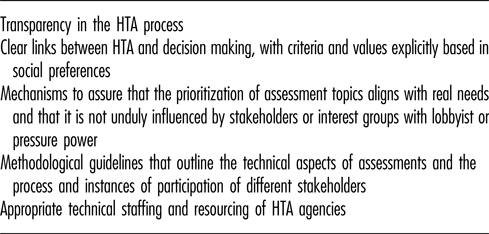
For all these reasons, many participants believed that there should be certain principles and conditions already in place to facilitate appropriate involvement of stakeholders in HTA, including clear mechanisms to guide the assessment and decision-making processes. Many countries in the region still do not have HTA agencies, nor explicit benefit packages, nor defined explicit processes to incorporate technologies. If certain basic conditions are not met, the HTA process could be exposed to excessive “external” influences. Table 2 presents the basic principles and mechanisms deemed by attendees to be necessary for consideration by health systems to involve other stakeholders in the HTA process without exposing the assessors and decision makers to potentially distortive external influences.
Principles and Basic Mechanisms to Achieve Sakeholder Involvement in HTA According to Forum Participants

HTA, health technology assessment.
Brazil and Mexico were mentioned as good examples where industry participation has been made clearer, which happened mainly because these countries first clearly defined the role of HTA in the decision-making process.
The legitimization of the HTA process in decision making; bringing information complementary to the sources of scientific evidence traditionally considered in assessment; the broadening of perspectives beyond the health system; and fostering trust and improved dialogue among stakeholders were mentioned as the main reasons to promote stakeholder involvement.
The recognition by agencies of the importance of stakeholder involvement, the laws and institutional frameworks in countries that support and facilitate citizen participation in government decision making, and advances in stakeholder involvement experiences internationally, and awareness of these, were identified as the main facilitators to promote these changes in HTA processes in the region.
CONCLUDING REMARKS
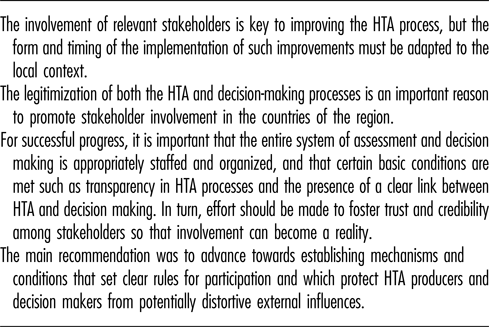
The presentations and discussions at the Forum clearly showed the relevance of improving HTA processes in the region, which includes advancing toward the involvement of the main stakeholders in different HTA areas. Forum participants agreed that the involvement of relevant stakeholders is key to improve HTA processes, but the form and timing of how this is carried out must be adapted to the local context of each country. Participants selected patients-users and industry producers as the priority stakeholders for this edition of the Forum 2017, and future efforts should perhaps be focused on these stakeholders because others (such as health professionals or scientific societies) are already more generally involved in HTA processes in the region. Table 3 provides a summary of key messages emerging from the presentations and discussions held at the Forum.
Main Messages Emerging during the Forum

HTA, health technology assessment.
One important aspect identified as fundamental when it comes to moving forward with a mature and effective process of stakeholder involvement is to work with all groups to improve trust, which is often undermined by certain behaviors and practices. Successful methods or strategies for stakeholder involvement will not be achieved, particularly for industry, citizens, and patients, if no effort is made to foster and strengthen trust among the different groups and to establish clear “rules of the game” for all.
Many participants perceived mistrust as one of the most significant barriers to more rapid and meaningful progress in stakeholder involvement in the region. Therefore, to achieve progress, it is important that the entire system of assessment and decision making is properly organized, and that stakeholder participation is an essential part of the system. For this to happen, certain requirements and basic conditions must be met, such as adequate training in HTA and provision of resources for this in the country, transparency in the HTA process, and a clear link between HTA and decision making.
Participants agreed that the next steps should be aimed at finding the appropriate processes and/or methodologies, adapted to the context of each country, which would allow a gradual advance in improving the link between HTA and decision making and progress toward involving the relevant stakeholders in the different stages.
Attendees agreed that participation in the Forum was productive and they suggested that patient and user representatives be involved in future Forums.
CONFLICTS OF INTEREST
None declared for the authors.