Introduction
Pediatric posttraumatic stress disorder (pPTSD) is a detrimental neurodevelopmental disorder that affects an estimated 5% of youth by the age of 18 (McLaughlin et al., Reference McLaughlin, Koenen, Hill, Petukhova, Sampson, Zaslavsky and Kessler2013). PTSD has a significant impact on cognitive, emotional, and psychosocial development in youth, is highly comorbid with other psychiatric illnesses (Brady, Reference Brady1997; Donnelly & Amaya-Jackson, Reference Donnelly and Amaya-Jackson2002; Famularo, Fenton, Kinscherff, & Augustyn, Reference Famularo, Fenton, Kinscherff and Augustyn1996; Kessler, Sonnega, Bromet, Hughes, & Nelson, Reference Kessler, Sonnega, Bromet, Hughes and Nelson1995; Lamberg, Reference Lamberg2001), and carries the highest risk of all mental illnesses for a first suicide attempt (Miché et al., Reference Miché, Hofer, Voss, Meyer, Gloster, Beesdo-Baum and Lieb2018). The development of new treatments for pPTSD have been hampered by a limited understanding of its underlying neurobehavioral mechanisms, which occur against the backdrop of ongoing neurodevelopment. A crucial aspect of psychosocial development is the ability to accurately recognize the emotional expression of others, and deficits in this process may contribute to psychopathology such as PTSD (Abhang, Gawali, & Mehrotra, Reference Abhang, Gawali, Mehrotra, Abhang, Gawali and Mehrotra2016). While prior research indicates impairments in emotion recognition in maltreated youth, there has been little investigation of such abilities within pPTSD across all trauma types. The identification and characterization of these deficits and their underlying behavioral, physiological, and neurobiological mechanisms may elucidate novel and intervenable treatment targets.
On the one hand, facial emotion recognition, or the general ability to infer emotional meaning from a facial expression(Izard et al., Reference Izard, Fine, Schultz, Mostow, Ackerman and Youngstrom2001), is well conserved, begins in the first few years of life, and undergoes normative development from childhood and adolescence through adulthood (Herba & Phillips, Reference Herba and Phillips2004; Philippot & Feldman, Reference Philippot and Feldman1990; Tottenham, Hare, & Casey, Reference Tottenham, Hare and Casey2011). On the other hand, impairments in emotion recognition during childhood and adolescence are detrimental to the development of positive social interactions and can contribute to emotional and behavioral difficulties (Izard et al., Reference Izard, Fine, Schultz, Mostow, Ackerman and Youngstrom2001). Emotion recognition impairments may be influenced by a number of environmental factors during childhood, including exposure to maltreatment (Pollak, Reference Pollak2008; Pollak, Messner, Kistler, & Cohn, Reference Pollak, Messner, Kistler and Cohn2009; Pollak & Sinha, Reference Pollak and Sinha2002). While still understudied, a recent systematic review found preliminary support for an association between childhood maltreatment and a global impairment in facial emotion recognition in younger children and further suggests that maltreated youth are able to identify threat at lower intensities than nonmaltreated youth (da Silva Ferreira, Crippa, & de Lima Osório, Reference da Silva Ferreira, Crippa and de Lima Osório2014).
However, emotion recognition deficits specific to youth with PTSD remain unclear. To our knowledge, there have been two studies which have begun to characterize emotion recognition in cohorts of trauma-exposed youth with differing rates of PTSD. One study of maltreated children with and without PTSD who underwent a recognition task with happy, fearful, and neutral faces found faster recognition of fearful faces as compared to nonmaltreated children, but with no effect of PTSD status (Masten et al., Reference Masten, Guyer, Hodgdon, McClure, Charney, Ernst and Monk2008). In contrast, a sample of adolescent boys enrolled in therapeutic day school with and without PTSD who completed a recognition task using only sad, angry, and fearful expressions found that continuous PTSD symptom severity was associated with less accurate recognition of angry relative to fearful faces (Javdani et al., Reference Javdani, Sadeh, Donenberg, Emerson, Houck and Brown2017). In response to these contradictory findings within clinically mixed samples, there is a clear need to characterize emotion recognition deficits within a sample of pPTSD subsequent to any index trauma type and their relationship to symptom severity measures.
When investigating emotion recognition abnormalities in pPTSD, it is also important to investigate its underlying neurobehavioral substrates. One proposed mechanism of emotion recognition impairments lies in visual attention or arousal during the recognition task (Adolphs et al., Reference Adolphs, Gosselin, Buchanan, Tranel, Schyns and Damasio2005). A recent study of emotion recognition using eye tracking in healthy adults found emotion-specific patterns of eye fixations across positive, negative, and neutral conditions (Eisenbarth & Alpers, Reference Eisenbarth and Alpers2011). Abnormal visual attention patterns during emotion recognition have been found in adults with prefrontal lesions (Wolf, Philippi, Motzkin, Baskaya, & Koenigs, Reference Wolf, Philippi, Motzkin, Baskaya and Koenigs2014), autism spectrum disorders (Black et al., Reference Black, Chen, Iyer, Lipp, Bölte, Falkmer and Girdler2017), adults with PTSD (Wolf, Reference Wolf2016), and comorbid borderline personality disorder (BPD) and PTSD (Kaiser et al., Reference Kaiser, Jacob, van Zutphen, Siep, Sprenger, Tuschen-Caffier and Domes2019). Within the maltreatment literature, previous studies have shown both that childhood trauma severity is positively correlated with attentional bias toward angry faces (Lakshman et al., Reference Lakshman, Murphy, Mekawi, Carter, Briscione, Bradley and Powers2020) and conversely that maltreated youth exhibit an attentional bias away from threatening faces as compared to nonmaltreated youth (Pine et al., Reference Pine, Mogg, Bradley, Montgomery, Monk, McClure and Kaufman2005). To date, however, no studies have examined visual attention during emotional face recognition in youth with PTSD as compared to typically developing (TD) youth.
Another possible mechanism of altered recognition may be in underlying neurobiological circuitry of facial emotion recognition. One model of facial emotion recognition suggests a three-part process (Adolphs, Reference Adolphs2002). First, visual cortices, such as the inferior occipital gyrus, fusiform gyrus, and superior temporal gyrus, are responsible for initial perceptual processing of a face (Haxby, Hoffman, & Gobbini, Reference Haxby, Hoffman and Gobbini2000). Second, the responses to emotionally salient stimuli in visual cortices are modulated by feedback from the prefrontal cortex (PFC) and amygdala providing a conceptual analysis of the emotion. Human lesion studies of the amygdala consistently identify deficits in recognition of negative emotional faces, including fear, anger, disgust, and sadness in adults with bilateral lesions (Adolphs et al., Reference Adolphs, Tranel, Hamann, Young, Calder, Phelps and Damasio1999; Broks et al., Reference Broks, Young, Maratos, Coffey, Calder, Isaac and Hadley1998; Calder, Reference Calder1996; Calder, Lawrence, & Young, Reference Calder, Lawrence and Young2001; Schmolck & Squire, Reference Schmolck and Squire2001) and unilateral lesions to the right amygdala (Adolphs, Tranel, & Damasio, Reference Adolphs, Tranel and Damasio2001; Anderson, Spencer, Fulbright, & Phelps, Reference Anderson, Spencer, Fulbright and Phelps2000). Finally, the amygdala and PFCs may then trigger the hippocampus in order to retrieve conceptual knowledge about the identified emotion (Adolphs, Reference Adolphs2002).
In line with studies of adults with PTSD and adolescents/adults with childhood trauma exposure that have reported functional abnormalities in the amygdala (Cisler, Scott Steele, Smitherman, Lenow, & Kilts, Reference Cisler, Scott Steele, Smitherman, Lenow and Kilts2013; Etkin & Wager, Reference Etkin and Wager2007; Hayes, Hayes, & Mikedis, Reference Hayes, Hayes and Mikedis2012; Hein & Monk, Reference Hein and Monk2017; Patel, Spreng, Shin, & Girard, Reference Patel, Spreng, Shin and Girard2012), functional deficits in amygdala circuitry may also play a role in the emotion processing impairments in pPTSD. This is evidenced by previous reports in which youth with PTSD symptoms have exhibited amygdala hyperactivation during emotional faces tasks (Garrett et al., Reference Garrett, Carrion, Kletter, Karchemskiy, Weems and Reiss2012; Keding & Herringa, Reference Keding and Herringa2016) as well as cross-sectional and longitudinal abnormalities in amygdala–prefrontal functional connectivity (Cisler et al., Reference Cisler, Scott Steele, Smitherman, Lenow and Kilts2013; Heyn et al., Reference Heyn, Keding, Ross, Cisler, Mumford and Herringa2019; Wolf & Herringa, Reference Wolf and Herringa2016). To our knowledge, abnormalities in amygdala function during emotional face viewing have yet to be linked to specific emotion recognition processes in pPTSD.
The current study uses a well-defined clinical cohort of youth with PTSD and age- and sex-matched nontraumatized TD youth in order to address these knowledge gaps. Here, we investigated (a) accuracy and reaction time of facial emotion recognition spanning positive, negative, and neutral expressions, (b) physiological correlates of recognition abnormalities using pupil diameter and eye tracking, and (c) the relationship between recognition abnormalities and amygdala functional connectivity during emotional face viewing due to the well-characterized role of the amygdala in emotion processing and its functional abnormalities in pPTSD. In line with the previous studies of emotion processing in youth with PTSD (Javdani et al., Reference Javdani, Sadeh, Donenberg, Emerson, Houck and Brown2017; Keding & Herringa, Reference Keding and Herringa2016; Pine et al., Reference Pine, Mogg, Bradley, Montgomery, Monk, McClure and Kaufman2005), we hypothesize youth with PTSD to show impaired recognition, in combination with attentional avoidance, of negative or threat-related emotions.
Method
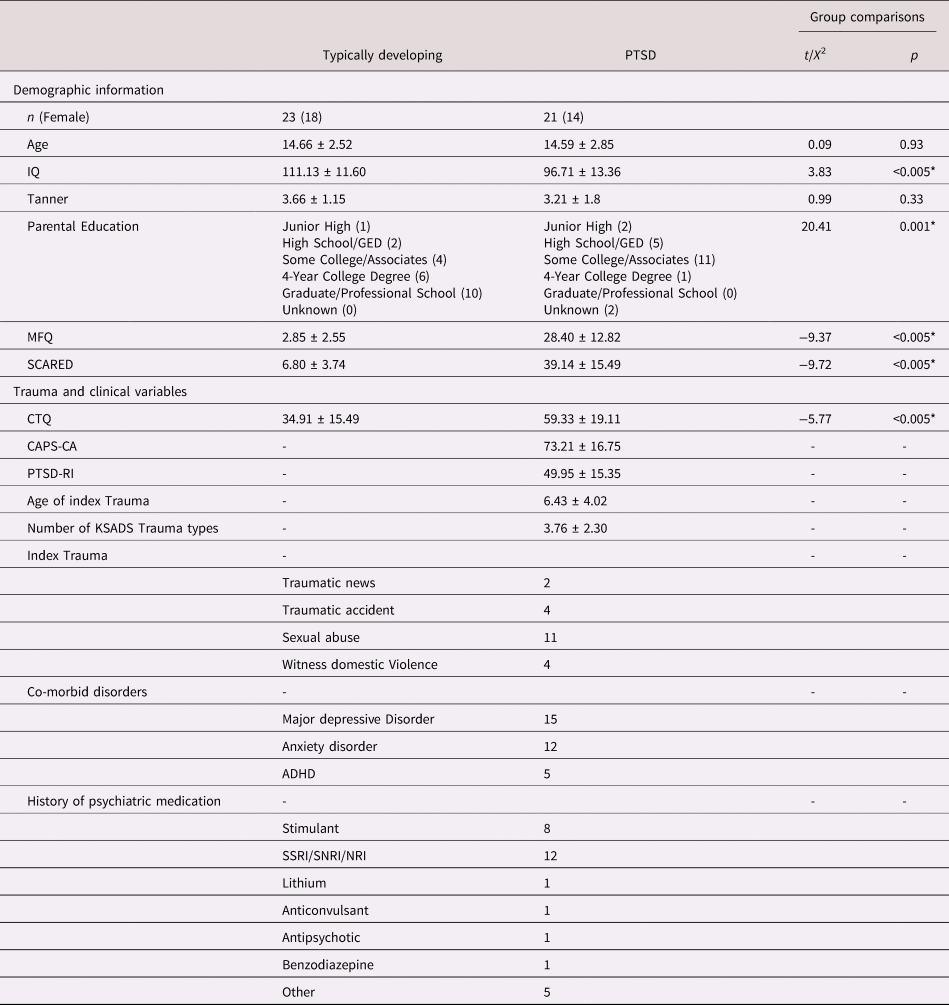
Table 1 provides participant demographic information. Recruitment and assessment details have been previously described (Heyn et al., Reference Heyn, Keding, Ross, Cisler, Mumford and Herringa2019; Keding & Herringa, Reference Keding and Herringa2015, Reference Keding and Herringa2016; Wolf & Herringa, Reference Wolf and Herringa2016) but are briefly summarized here. The Youth PTSD Study recruited 96 youth (TD, n = 48; PTSD, n = 48) ranging from 7 to 17 years. Youth with PTSD were recruited from local mental health facilities and age- and sex-matched TD youth were recruited from the community using social media, University emails, flyers, and so on.
Full sample participant characteristics

Note: Typically developing and PTSD youth did not significantly differ in sex distribution, age, or pubertal stage. The PTSD group had significantly lower IQ scores, and significantly higher MFQ, SCARED, and CTQ scores. The CAPS-CA score was not obtained on the first five PTSD participants.
Abbreviations: AHDH, attention deficit hyperactivity disorder; CAPS-CA, Clinician-Administered PTSD Scale Child and Adolescent version; MFQ, Mood and Feelings Questionnaire; PTSD, posttraumatic stress disorder; PTSD-RI, PTSD Reaction Index; SCARED, Screen for Child Anxiety Related Mood Disorders; SSRI/SNRI/NRI, selective serotonin/norepinephrine reuptake inhibitor.
All youth participants and their parent/caregiver completed the Kiddie Schedule for Affective Disorders and Schizophrenia (KSADS) (Kaufman et al., Reference Kaufman, Birmaher, Brent, Rao, Flynn, Moreci and Ryan1997) in order to assess the youth for current and past psychopathology. In addition, all youth were assessed for childhood abuse severity (Childhood Trauma Questionnaire – abuse subscale, CTQ), depression (Mood and Feelings Questionnaire, MFQ) (Costello & Angold, Reference Costello and Angold1988), and anxiety symptom severity (Screen for Child Anxiety Related Emotional Disorders, (SCARED) (Birmaher et al., Reference Birmaher, Khetarpal, Brent, Cully, Balach, Kaufman and Neer1997), as well as IQ using the Wechsler Abbreviated Scale of Intelligence –II (Wechsler, Reference Wechsler2011), pubertal stage using the Tanner Sexual Maturation Scale (Marshall & Tanner, Reference Marshall and Tanner1969, Reference Marshall and Tanner1970), and lifetime load of stressful events using the Stressful Life Events Schedule (Williamson et al., Reference Williamson, Birmaher, Ryan, Shiffrin, Lusky, Protopapa and Brent2003). Within the clinical group, a PTSD diagnosis was determined using Diagnostic and Statistical Manual of Mental Disorders, fourth edition (DSM-IV) criteria using a combination of the KSADS and the Clinician-Administered PTSD Scale for Children and Adolescents (CAPS-CA) (Weathers, Keane, & Davidson, Reference Weathers, Keane and Davidson2001). The number of KSADS trauma types endorsed was used as a proxy for trauma load. PTSD symptom severity was assessed using the UCLA PTSD Reaction Index (PTSD-RI) (Steinberg, Brymer, Decker, & Pynoos, Reference Steinberg, Brymer, Decker and Pynoos2004).
Exclusion criteria included IQ < 70, history of psychotic/bipolar/obsessive compulsive disorders, active suicidality, substance abuse or dependence, psychotropic medication usage in the past 4 weeks (6 weeks for fluoxetine), unstable neurological or other medical condition, magnetic resonance imaging (MRI) contraindication, and/or pregnancy in females. Youth were not taken off psychotropic medication for the purpose of study enrollment. All participants gave written informed consent from a legally acceptable representative and a youth assent when appropriate. All study procedures were approved by the University of Wisconsin Health Sciences IRB.
Emotion recognition task and statistical analyses
Full details regarding the emotion recognition task can be found in Supplementary Materials and Methods and are briefly summarized here. The emotion recognition task consisted of participants viewing faces with six different expressions (happy, sad, angry, fearful, disgust, and neutral) selected from Karolinska Directed Emotional Faces set (Lundqvist, Flykt, & Öhman, Reference Lundqvist, Flykt and Öhman1998). The face stimuli consisted of ten white male and ten white female actors, with each actor presenting two emotions. The stimulus set included images from all 20 actors, and each participant was presented with the same stimulus set. For homogeneity, all actors chosen for this task were of the same race, images were converted to grayscale, cropped in order to remove hair and ears, and matched for size and luminescence. Before beginning the task, youth were given instructions that they would see a series of faces that would display on the screen for a few seconds and then would be asked to identify which emotion they believe was on the face. An identical control task using the same set of faces was completed by all participants in which they were instead asked to identify the gender of the face presented. The presentation order of the gender and emotion identification task was counterbalanced across participants. During each facial stimulus presentation, pupillary diameter, fixation count, and fixation duration were estimated. One fixation was defined as any time a gaze coordinate remained within a 1° visual angle for 100 ms or greater (Karsh & Breitenbach, Reference Karsh and Breitenbach1983; Lambert, Monty, & Hall, Reference Lambert, Monty and Hall1974), and identified offline using automated software. Finally, each face was divided into four areas of interest for eye-tracking analyses: eyes, mouth, face, and outside. Due to limited availability of eye-tracking equipment, 45 youth completed the behavioral emotion and gender identification tasks (TD, n = 23; PTSD, n = 21).
All statistical analyses were completed in R (R Core Team, 2016) and RStudio (RSTudio Team, 2012). General linear models and linear mixed-effect modeling on the trial-wise data for all participants were used to identify group (TD, PTSD) × Emotion (happy, sad, angry, fearful, disgust, neutral) interactions, adjusting for age, sex, trial number, and subject as a random effect across three dependent variables: accuracy, reaction time, and pupil diameter. Following any significant interactions, independent-sample t tests were used in order to compare groups for each emotion. In order to identify group- and emotion-related differences within the eye-tracking data, Group × Emotion × Face region interactions were modeled against fixation duration and fixation count, adjusting for age, sex, trial number, and subject as a random effect. Multiple-comparison correction was applied using false discovery rate (FDR) (Benjamini & Hochberg, Reference Benjamini and Hochberg1995) at p FDR < .05 across all models in the emotion and gender recognition tasks.
Functional MRI task and statistical analyses
In order to relate any abnormalities in emotion identification accuracy with implicit emotion processing, we analyzed functional connectivity differences during a separate dynamic face task. Details regarding this task have been previously reported (Keding & Herringa, Reference Keding and Herringa2016) and are briefly summarized here. During functional MRI (fMRI), all participants completed an implicit cognitive–emotional processing task which required them to identify the color of a semitransparent overlay atop a face changing from neutral to emotional (angry, happy) over a 1-s period. Examples of the emotional stimuli used in this task are included in Figure 2. Youth completed three blocks, each consisting of 12 faces, presented pseudorandomly based on emotion condition. Control shape blocks displaying a morphing oval with the colored overlay was intermixed between face blocks in order to ensure no emotion blocks were encountered sequentially. Please see Supplementary Material and Methods for details on image acquisition and preprocessing. One youth with PTSD was excluded from final analyses due to motion artifact.
In first-level analyses, functional data for individual subjects were analyzed using general linear models within analysis of functional images's (AFNI) 3dDeconvolve. Variables modeled included three blocks for each emotion condition, and a shape condition as a fixed-effect regressor, with a gamma hemodynamic response function (HRF) of 1-s duration. Also included were six motion parameters and their derivatives as nuisance regressors and four polynomial drift terms. Using AFNI's 3dCalc, we used the average activation and bilateral amygdala functional connectivity across the three angry blocks, due to abnormalities identified in recognition of anger in the preceding behavioral analyses. Finally, a general linear test was used from these average activation and connectivity templates in order to create an angry-shape contrast for each subject to be used in subsequent group analyses.
In second-level analyses, between-subject analyses were conducted to examine group differences in the relationship between average anger accuracy as quantified by results of the behavioral in recognition task and activation/bilateral amygdala functional connectivity in this dynamic face task. This a priori analysis was chosen to quantify possible neurobiological underpinnings of aberrant emotion processing identified in the first set of behavioral analyses. In order to control for the ability to identify any emotion, anger identification accuracy is defined as the ratio between accuracy to only angry faces and accuracy across all emotions. Each of the three models were fit using AFNI's 3dttest++. Age and sex were also included as covariates. We completed both whole-brain analyses and analyses within an a priori limbic search region comprising the amygdala and hippocampus using masks generated from the AFNI standard template. Whole-brain multiple-comparison correction was preformed using Monte Carlo simulation in AFNI's 3dClustSim with voxel-wise p < .005 and p FWE < .05. The identified cluster threshold was 32 voxels in the amygdala/hippocampus and 283 for whole-brain correction. Peak coordinates are based in the Montreal Neurological Institute (MNI) atlas in LPI orientation.
Secondary analyses
First, in order to compare sample characteristics between the PTSD and TD groups, independent t tests and chi-squared tests were conducted across demographic and clinical variables. Second, exploratory analyses assessing the role of PTSD symptom severity and identified behavioral and activation/connectivity abnormalities were conducted within the PTSD group using general linear mixed effect models and symptom severity measures (PTSD-RI total score, PTSD-RI B/C/D subscores, MFQ, and SCARED). Each symptom measure was evaluated in a separate linear regression, adjusting for age and sex, with multiple-comparison correction across all symptom models. Symptom results that survive FDR correction are reported (p FDR < .05). Third, in order to investigate the mechanisms underlying recognition deficits between groups, the proportion of each erroneous emotion label to total incorrect trials was calculated per emotion per group. Two-sample tests for equality of proportions between groups with continuity correction were then run to compare PTSD and TD erroneous emotion attribution. Finally, regression analyses were conducted to investigate the impact of the following demographic variables on behavioral and neural abnormalities: IQ, Tanner stage, age at index trauma, stressful life events, trauma load, childhood abuse severity, presence of current or previous clinical depressive or anxiety disorder, previous use of psychotropic medication, or history of therapy. All secondary analyses were conducted in R (R Core Team, 2016) and RStudio (RSTudio Team, 2012).
Results
Demographic and clinical characteristics
TD and PTSD youth did not significantly differ on age (t(42) = 0.09, p = .93), sex (χ 2(1) = 0.01, p = .92), or pubertal stage (Tanner; t(42) = 0.99, p = .33). However, youth with PTSD did on average have lower IQ scores than TD youth (t(42) = 3.83, p < .005). As expected, PTSD youth scored significantly higher than TD youth on overall childhood maltreatment exposure severity (CTQ; t(42) = −5.77, p < .005), as well as depression (MFQ; t(42) = −9.37, p < .005) and anxiety symptom severity (SCARED; t(42) = −9.72, p < .005). As a whole, the PTSD cohort was exposed to high levels of trauma. On average, each youth with PTSD experienced 3.8 ± 2.3 KSADS trauma types; interpersonal violence represented the majority of index trauma. The average age of index trauma was 6.4 ± 4.0 years. Finally, rates of current comorbidity were high with just over 71% of PTSD youth diagnosed with major depression and 57% with an anxiety disorder. Demographic and clinical characteristics are further summarized in Table 1.
Emotion recognition performance
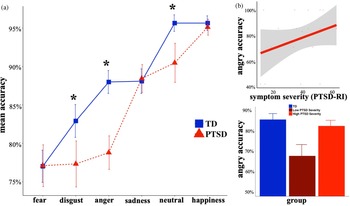
When youth were explicitly instructed to process and identify emotion, PTSD youth overall performed worse at emotion identification than TD youth (χ 2 = 271.85, p FDR < .001). Average emotion identification accuracy was 84.3% (±SD 0.364) correct identification for PTSD youth and 87.6% (±SD 0.330) correct identification for TD youth. We also found a significant group by emotion interaction on identification accuracy (χ 2 = 20.33, p FDR = .003). Specifically, PTSD youth performed significantly worse than TD youth for anger, disgust, and neutral accuracy (Figure 1). A detailed breakdown of the average accuracy and standard deviation for each emotion and group can be found in Supplementary Materials and Methods. Importantly, when youth were instructed only to attend to the gender rather than the emotion of the face presented, the groups performed equally well (Supplementary Figure S1; F (5,40) = 1.49, p FDR = .69). Further details regarding gender recognition task performance can be found in Supplementary Material and Methods.
Emotion recognition deficits and symptom correlates in youth with PTSD. (a) Line chart representing mean accuracy across all trials per participant per group, based upon emotion of the face presented. Error bars represent the standard error. (b) Scatterplot represents average angry accuracy plotted by PTSD symptom severity, as measured by the PTSD-RI total score. The bar chart visualizes the average accuracy by group, median-splitting the PTSD youth into high and low PTSD-RI symptom severity. Angry and symptom correlates are one representative symptom relationship identified. *p FDR < .05. Abbreviations: TD, typically developing; PTSD, posttraumatic stress disorder.

Importantly, these group-related abnormalities in identifying threat-related emotions could not be explained by any other behavioral or physiological measure tested. This is evidenced by the absence of any significant group by emotion interactions in reaction time (F (5,6788) = 1.09, p FDR = .54), fixation count (F (5,6917) = 1.18, p FDR = .49), fixation duration (F (5,6917) = 1.57, pF DR = .32), or pupil diameter (F (5,6953) = 0.31, p FDR = .99). More specifically, PTSD youth showed no differences in overall fixation duration to the eyes, mouth, or face compared to TD youth across all emotion conditions. PTSD youth did show decreased fixation counts to the face region across all emotions in both the emotion and gender identification tasks (Supplementary Figure S2; F (3, 6917) = 27.69, p FDR < .001). These differences in fixation count were unaccompanied by emotion-specific differences.
Within the PTSD group, anger accuracy was positively associated with symptom severity across numerous domains (Figure 1b) (PTSD: PTSD-RI Total, t = 3.44, p FDR = .002; re-experiencing, PTSD-RI B, t = 2.50, p FDR = 0.03; avoidance, PTSD-RI C, t = 3.33, p FDR = .003; hyperarousal, PTSD-RI D, t = 4.03, p FDR < .005; anxiety, SCARED, t = 3.18, p FDR = .004). All emotion recognition and symptom relationships are detailed in Supplementary Materials and Methods. In an effort to understand why accuracy would increase with symptom severity, the PTSD group was separated into high and low PTSD severity based upon a median split in total PTSD-RI score. Youth with low PTSD symptom severity had significantly lower threat-related emotion identification accuracy than both high PTSD severity youth and TD youth (Figure 1c).
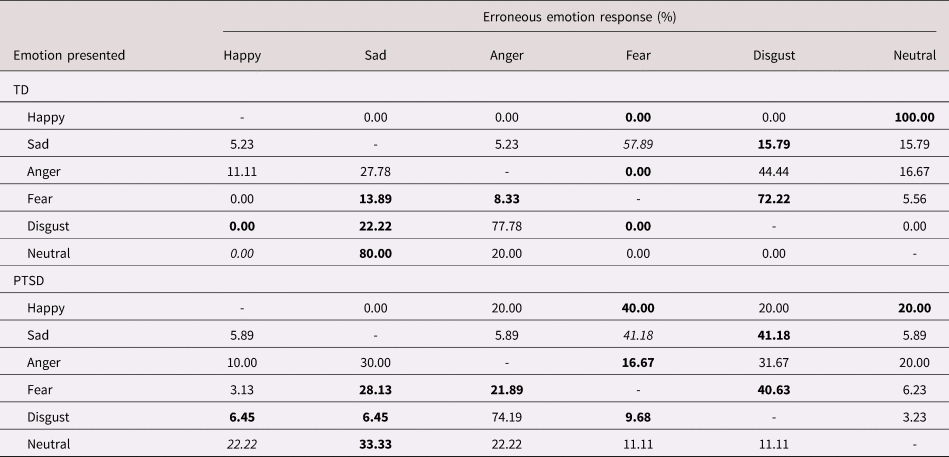
As an additional step we then carried out an analysis of the errors made by youth in the emotion recognition task. In general, when youth incorrectly identified an emotion, they were most prone to say they saw disgust. Among the trials in which the participant chose the wrong emotion, we found that the incorrect use of an emotion was dependent on group status (χ 2 = 23.44, p < .005). Two-sample tests for equality of proportions between groups with continuity correction were then run across all incorrect trials to identify which misattributions are driving this effect (Table 2). Altogether, these results suggest differential processing of positive and negative in pPTSD. PTSD youth more often attributed happy when presented disgust faces (χ 2 = 5.41, p = .02), as well as a trending misattribution of happy when viewing neutral faces (χ 2 = 3.53, p = .06) as compared with TD youth. Youth with PTSD were more likely than TD youth to label fear when presented with the majority of other emotions, including happy (χ 2 = 4.44, p = .04), angry (χ 2 = 11.67, p < .001), and disgust (χ 2 = 9.14, p = .003) faces.
Erroneous response patterns within the typically developing and posttraumatic stress disorder groups during incorrect identification trials
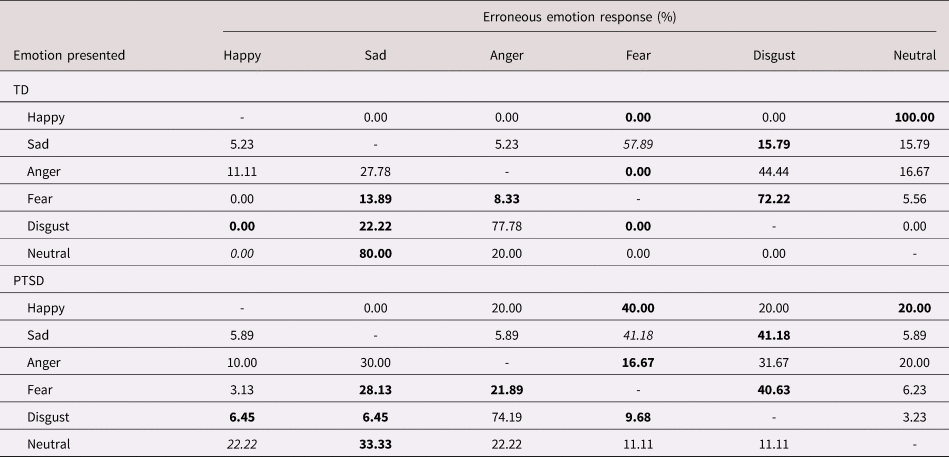
Note: “Emotion presented” indicates the emotion of the face that the youth was viewing and “erroneous emotion response” indicates the incorrect label chose by the youth. Values are shown as a percentage of total incorrect trial per emotion. Colored cells show significantly (bold, p < .05) or trending (italics, p < .10) differences in proportion between groups using a two-sample equality test of proportions using continuity correction.
Abbreviations: TD, typically developing; PTSD, posttraumatic stress disorder.
Emotion identification accuracy and amygdala function
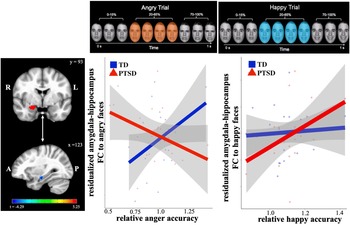
In an effort to understand the neural underpinnings of deficits in threat-related emotion processing, we investigated the relationship between amygdala activation/functional connectivity and average anger recognition accuracy. This average accuracy was estimated from results of the behavioral emotion recognition task. No significant Group × Accuracy interactions were identified in activation nor in the whole-brain analyses of amygdala functional connectivity. However, amygdala functional connectivity analyses in the a priori search region revealed a significant Group × Accuracy interaction between right amygdala and right hippocampus (peak F = −3.62; k = 49; x = 32, y = 16, z = −11). In this case, PTSD youth showed decreased amygdala–hippocampus connectivity with identification accuracy, the reverse pattern of TD youth (Figure 2). This Group × Accuracy interaction was not identified in the happy condition (p FDR > .05). There was no significant relationship identified between amygdala–hippocampus functional connectivity and any measure of symptom severity.
Aberrant amygdala–hippocampus functional connectivity to angry faces viewing relative to anger accuracy in the recognition task. Angry and happy fMRI trial schematics represent the one second face presentation in which the faces morphed from neutral to angry or happy, and youth were asked to report what color the face was presented over. Significant Group × Anger accuracy effect using the amygdala in a seed-based whole-brain functional connectivity analysis, covaried for age and sex (p FDR < .05). Scatterplots represent extracted cluster averages per subject. Accuracy was defined relative to total recognition accuracy per subject, to account for individual variation in global recognition ability. Also shown is the extracted cluster average from amygdala-hippocampus region identified in the angry trials applied to the happy viewing trials for reference. Abbreviations. TD, typically developing; PTSD, posttraumatic stress disorder; FC, functional connectivity.

Confound analyses
The significant primary behavioral and connectivity results (group by emotion and group by anger identification accuracy interactions, respectively) remained significant when adjusted for the following potential confounds: IQ, Tanner stage, age at index trauma, stressful life events, trauma load, childhood abuse severity, presence of current and previous clinical depressive or anxiety disorder, previous use of psychotropic medication, or history of therapy. Details of confound analyses can be found in Supplementary Materials and Methods Table 2.
Discussion
To our knowledge, this is the first reported study to comprehensively characterize emotion recognition in pPTSD, including behavioral performance, visual attention, and functional brain measures. In summary, we found: (a) youth with PTSD exhibit decreased accuracy in identifying threat-related and neutral expressions, (b) emotion recognition deficits were identified in the absence of visual attention and gender identification deficits, (c) recognition accuracy was positively (and unexpectedly) related to PTSD, anxiety, and depression symptom severity, (d) youth with PTSD exhibit unique patterns of incorrectly labeling negative and positive emotional expressions, and (e) recognition accuracy deficits were further related to aberrant right amygdala–hippocampus functional connectivity. Altogether, this preliminary study works to clarify behavioral deficits in threat recognition in youth with PTSD, discusses these findings within the context of a broader model of trauma exposure and risk for PTSD, and suggests one potential mechanism may be abnormalities in emotional contextualization circuits implicated in the appraisal of threat-related stimuli.
We detected valence-specific abnormalities in facial emotion recognition in youth with PTSD, who exhibited decreased accuracy to threat-related emotions as compared to TD youth. Curiously, we further found that within the PTSD group, symptom severity was positively associated with accuracy recognizing these emotions. While previous studies, along with a systematic review, have identified a link between childhood maltreatment exposure and more sensitive (earlier) detection of threat (da Silva Ferreira et al., Reference da Silva Ferreira, Crippa and de Lima Osório2014; Iffland & Neuner, Reference Iffland and Neuner2020; Pollak et al., Reference Pollak, Messner, Kistler and Cohn2009; Pollak & Sinha, Reference Pollak and Sinha2002), there is little consensus as to how threat recognition is related to pPTSD. One study detected no deficits in recognizing fear, happy, or neutral faces in a cohort of maltreated youth, about half of whom had PTSD (Masten et al., Reference Masten, Guyer, Hodgdon, McClure, Charney, Ernst and Monk2008), while a separate study found that PTSD symptom severity was associated with a decreased ability to recognize anger relative to fear and sadness (Javdani et al., Reference Javdani, Sadeh, Donenberg, Emerson, Houck and Brown2017). The discordance of findings in these prior studies as well as the current study could be due to a number of factors including differences in tasks (what emotions were presented and how responses were elicited), outcome measures (overall and relative recognition accuracy, intensity of emotion when recognition occurred, etc.), and the inclusion of trauma-exposed youth with mixed diagnostic status.
Despite these differences, in line with a recent meta-analysis hypothesizing a link between deficits in social cognition and PTSD risk (Stevens & Jovanovic, Reference Stevens and Jovanovic2019), we propose a synthesis of our findings and previous studies detailed above into a parsimonious model of trauma exposure and emotion recognition in youth vulnerable to psychopathology. Specifically, we posit that emotion recognition processes mediate the relationship between trauma exposure and PTSD. Here, trauma exposure may induce threat-related emotion recognition deficits in youth vulnerable to the development of PTSD leading, in turn, to the emergence of PTSD. Conversely, the emergence of PTSD may serve to counteract these emotion recognition deficits through increasing hypervigilance processes. While this study is unable to directly test the causal relationships between these variables, it is imperative that future studies use prospective longitudinal designs, recruiting youth prior to trauma exposure, to further explore these hypotheses.
In order to understand the interaction of perception and recognition in this study, we also had youth complete a control task in which they were only asked to identify the sex of the face and collected eye fixation patterns during both tasks. All results indicate that neither visual perception nor attention underlie emotion recognition deficits in pPTSD. Both TD and PTSD youth were able to perceive other aspects of the facial stimuli at comparable levels, as evidenced by similarly high accuracies of gender recognition during the control task. Eye-tracking analyses of fixation data further revealed no evidence of visual attention differences. Youth with PTSD completed recognition tasks at the same pace of TD youth in both emotion and gender recognition and further did not exhibit any abnormal eye fixation behavior specific to emotion type, altogether suggesting no deficiencies in basic face perception. Finally, although pupillary response has been identified as a useful proxy of emotional arousal (Aboyoun & Dabbs, Reference Aboyoun and Dabbs1998; Bradley, Miccoli, Escrig, & Lang, Reference Bradley, Miccoli, Escrig and Lang2008; Hess & Polt, Reference Hess and Polt1960; Libby, Lacey, & Lacey, Reference Libby, Lacey and Lacey1973), we did not detect any differences in pupil diameter between PTSD and TD youth during threat-related emotion identification. While this may provide evidence suggesting that differences in arousal during viewing of emotional expressions was not an underlying mechanism of aberrant emotion recognition, future research may find evidence of underlying arousal differences using a different proxy.
Due to this lack of behavioral or visual attention mechanisms underlying detected threat-related deficiencies, we conducted post-hoc exploratory analyses in order to investigate neurobiological correlates of recognition accuracy during a similar emotional face processing task. Functional connectivity analyses revealed an abnormal relationship between right amygdala–hippocampal circuitry and anger accuracy. While TD youth showed a positive relationship between anger accuracy and right amygdala–hippocampus FC, this relationship was reversed in youth with PTSD. Previous studies have found that interactions between the amygdala and hippocampus are crucial to the creation of emotionally salient representations and interpretations of your environment (Phelps, Reference Phelps2004). Further, this circuit has been already implicated in both rodents (Herry et al., Reference Herry, Ciocchi, Senn, Demmou, Müller and Lüthi2008; Pitkänen, Pikkarainen, Nurminen, & Ylinen, Reference Pitkänen, Pikkarainen, Nurminen and Ylinen2000; Senn et al., Reference Senn, Wolff, Herry, Grenier, Ehrlich, Gründemann and Lüthi2014) and humans (de Voogd, Fernández, & Hermans, Reference de Voogd, Fernández and Hermans2016; Hermans et al., Reference Hermans, Kanen, Tambini, Fernández, Davachi and Phelps2017) during emotion and threat processing tasks. Maltreated adults without psychiatric illness have previously shown exhibited increased recruitment between the amygdala and hippocampus during an emotional matching task, providing initial evidence that childhood maltreatment may be due to underlying inefficiency in the neural processing of emotions (Demers et al., Reference Demers, McKenzie, Hunt, Cicchetti, Cowell, Rogosch and Thomas2018). Expanding this model into youth with trauma exposure and PTSD, it could be that increased connectivity in lower accuracies mimic these network inefficiencies previously characterized. This may further be evidenced by better threat recognition accuracy as a reflection of increasing network efficiency. Altogether, this evidence suggests the presence of a threat-related contextual modulation model within the basal amygdala and hippocampus whose efficiency be disrupted in youth with trauma exposure and PTSD. However, these are preliminary links between behavioral and neural correlates and future research is needed to further explore these hypotheses.
We then investigated patterns of emotion labeling during incorrect trials in order to further understand the behavioral deficits. First, youth with PTSD were more likely than TD youth to use the fear label regardless of the emotional valence of the face being shown. Behaviorally, adult PTSD has been associated with the overgeneralization of fear associations, hypersensitivity to threat, and difficulties in fear extinction (Blechert, Michael, Vriends, Margraf, & Wilhelm, Reference Blechert, Michael, Vriends, Margraf and Wilhelm2007; Ehlers et al., Reference Ehlers, Suendermann, Boellinghaus, Vossbeck-Elsebusch, Gamer, Briddon and Glucksman2010; Milad et al., Reference Milad, Orr, Lasko, Chang, Rauch and Pitman2008; Pole et al., Reference Pole, Neylan, Otte, Henn-Hasse, Metzler and Marmar2009; Shin & Handwerger, Reference Shin and Handwerger2009). When combined with our findings that youth with PTSD are more likely to identify fear in their surroundings, regardless of the emotion they are presented with, this lends additional support to the suggestion that primary clinical manifestation of PTSD may be the overgeneralization of fear perception in both youth and adults.
Finally, we detected patterns within the misidentifications of facial expressions. While our sample size warrants cautious interpretation, we nonetheless detected that during the presentation of negative facial expressions (fear, anger, and disgust), youth with PTSD were statistically more likely to identify the face as being happy than TD youth. To supplement this finding of paradoxical reversal of positive and negative stimuli in emotion identification, we further explored whether similar patterns were present in the functional connectivity analyses. To do so, we compared the right amygdala–hippocampus circuitry while viewing an angry face, which we found to be significantly related to anger identification accuracy, with how the same circuitry during the viewing of happy faces was related to happy identification accuracy. Unsurprisingly, TD and PTSD youth seemed to exhibit no differences in right amygdala–hippocampal recruitment with happy accuracy, suggesting less contextual modulation is needed in non-threatening conditions. This finding of entangled positive and negative emotion processing in the right amygdala is supported by converging evidence that the amygdala encodes across multiple emotional valences (Mattavelli et al., Reference Mattavelli, Sormaz, Flack, Asghar, Fan, Frey and Andrews2014; Tovote, Fadok, & Lüthi, Reference Tovote, Fadok and Lüthi2015) and previously identified differential coupling between the amygdala–PFC to happy versus angry facial emotion presentation (Keding & Herringa, Reference Keding and Herringa2016). Together, these findings further suggest valence-inappropriate emotion recognition and right amygdala–hippocampal recruitment in pPTSD. Future investigation of emotion recognition including both positive and negative stimuli in prospective studies prior to trauma exposure would be helpful in delineating the onset and causal relationship of these abnormalities with the emergence of PTSD in youth.
While the present study has helped to characterize behavioral, physiological, and neurobiological emotion recognition impairments in youth with PTSD, this novel study has several limitations that should be noted. First, the clinical sample recruited for this study was diverse and included a high proportion of youth with past and/or present comorbid disorders such as anxiety and depression. While confound analyses revealed that comorbidity was not a significant explanatory factor of any of the behavioral or imaging findings, many of these effects were significantly correlated with comorbid symptom severity. This sample is also highly representative of our study population, which commonly presents with high rates of comorbidity (Kessler et al., Reference Kessler, Sonnega, Bromet, Hughes and Nelson1995). Second, the cross-sectional nature of our data and use of nontrauma-exposed TD youth as a comparison precludes any investigation of the causal effects of trauma and PTSD on emotion recognition in youth. Next, all facial stimuli viewed by youth in the current study were adult faces. The literature surrounding the own-age bias in facial perception and recognition is mixed (Picci & Scherf, Reference Picci and Scherf2016; Vetter, Drauschke, Thieme, & Altgassen, Reference Vetter, Drauschke, Thieme and Altgassen2018); however, it remains unclear whether this bias is present in pPTSD especially in the wake of interpersonal violence perpetrated by adults. In addition, the current study related behavioral metrics derived from one task and related those metrics to neuroimaging measures collected during a related yet separate task which precludes this study from making any definitive inferences underlying abnormal emotion recognition processes and pPTSD. Although the amygdala is consistently regarded as important in the pathophysiology of PTSD (Henigsberg, Kalember, Petrović, & Šečić, Reference Henigsberg, Kalember, Petrović and Šečić2019), whole-brain rather than seed-based functional connectivity analyses could identify other regions and networks involved in abnormal emotion recognition. Finally, previous research has suggested that IQ may account for some variance in emotion recognition performance in other disorders, such as autism spectrum disorder (Anderson & Miller, Reference Anderson and Miller1998; Harms, Martin, & Wallace, Reference Harms, Martin and Wallace2010; Jones et al., Reference Jones, Pickles, Falcaro, Marsden, Happé, Scott and Charman2011; Wright et al., Reference Wright, Clarke, Jordan, Young, Clarke, Miles and Williams2008) and may mediate the relationship between childhood maltreatment and future emotion processing deficits (Young & Widom, Reference Young and Widom2014). For these reasons we chose to investigate the IQ confound analyses and importantly all of those effects identified remained significant. Altogether, the limitations mentioned above together warrant future prospective studies with larger samples that are able to interrogate across trauma types to further investigate emotion recognition processes and pPTSD.
In conclusion, the present study found that youth with PTSD exhibit deficits in facial emotion recognition for threat and neutral expressions. We posit that impaired differentiation between threatening and non-threatening facial expressions may be related to the onset of pPTSD and that increasing PTSD severity may be a compensatory response to counteract deficits in threat-safety emotion recognition through enhanced neural processing of threat. Of note, while these impairments could not be explained by reaction time differences, fixation time to different regions of the face, or arousal via pupil diameter, they may be related to abnormal communication between the right amygdala and hippocampus. Furthermore, youth with PTSD exhibit patterns of emotion misidentification that suggest confusion of positively and negatively valanced emotions. Together, these data point to emotion identification deficits as a potentially novel and modifiable treatment target for youth with PTSD. Future studies would be warranted to replicate the current findings in larger prospective samples of youth, and test whether novel therapies such as emotion recognition training may help prevent or treat symptoms of PTSD and other comorbid disorders in youth.
Supplementary Material
The supplementary material for this article can be found at https://doi.org/10.1017/S0954579420001704.
Acknowledgments
We owe our sincerest gratitude to the youth and families who have given their time for this study. Development of the MacBrain Face Stimulus Set was overseen by Nim Tottenham and supported by the John D. and Catherine T. MacArthur Foundation Research Network on Early Experience and Brain Development. Please contact Nim Tottenham at tott0006@tc.umn.edu for more information concerning the stimulus set. This study was presented as a poster at the 2019 Wisconsin Symposium on Emotion, Madison, WI, April 10–11, 2019. This study was also presented as a poster at the 2019 Society of Biological Psychiatry Meeting Annual Meeting, Chicago, IL, May 16–18, 2019.
Funding Statement
Funding for this study was provided by the National Institute of Mental Health Career Development Award (K08 MH100267, to RJH), American Academy of Child and Adolescent Psychiatry Junior Investigator Award (to RJH), NARSAD Young Investigator Grant (to RJH), University of Wisconsin Institute for Clinical and Translational Research Translational Pilot Grant Award (NIH/NCATS UL1TR000427, to RJH), University of Wisconsin Institute of Clinical and Translational TL1 Training Award (TL1TR000429, to SAH), and the University of Wisconsin School of Medicine and Public Health. None of these funding sources had a direct effect in the design, analysis, or interpretation of the study results, nor in preparation of the manuscript. This material is also based upon work supported by the National Science Foundation Graduate Research Fellowship Program under Grant No. DGE-1747503 (to TJK). Any opinions, findings, and conclusions or recommendations expressed in this material are those of the authors and do not necessarily reflect the views of the National Science Foundation. Support was also provided by the Graduate School and the Office of the Vice Chancellor for Research and Graduate Education at the University of Wisconsin-Madison with funding from the Wisconsin Alumni Research Foundation.
Conflicts of Interest
The authors of this study declare no conflict of interest.