Introduction
Mass-gathering music events, such as outdoor music festivals (OMFs), increase the risk of injuries and illnesses among attendees.Reference Krul, Blankers and Girbes 1 - Reference Nardi, Bettini and Bozzoli 3 Compared with similar sized mass gatherings, OMFs have a higher incidence of injury and illness.Reference Raineri and Earl 4 , Reference Hutton, Ranse, Verdonk, Ullah and Arbon 5 This increased risk is associated with access to alcohol and other drugs by young people and an environment that places many people in close contact with each other.Reference Raineri and Earl 4 To help understand the kinds of injuries and illnesses experienced, Hutton et alReference Hutton, Ranse, Verdonk, Ullah and Arbon 5 identified previous patterns of patient presentations at 26 OMFs in Australia. To develop effective prevention strategies, the next logical step was to examine the risk factors associated with each illness/injury event. A common framework used in other injury investigations is the Haddon matrix.Reference Haddon 6 The purpose of this report was to demonstrate how Haddon’s matrix was used to examine the factors that contributed to injuries and illnesses that occurred at 26 OMFs by using data from the Ranse and Hutton’sReference Ranse and Hutton 7 minimum data set. Guided by the resultant matrix, the authors provide recommendations for prevention strategies to promote the health and safety of participants at these OMFs and to prevent injury and illness.
Background
Outdoor music festivals are common in Australia, prompting the study of injuries and illnesses experienced by those attending these events. Outdoor music festivals are unique events that are, for the most part, bounded, ticketed, and alcohol is served. The genres at OMF include hard rock, electronic house music, and anything in between. They frequently have a higher incidence of injuries and illnesses when compared with similar sized mass gatherings.Reference Raineri and Earl 4 , Reference Hutton, Ranse, Verdonk, Ullah and Arbon 5 In addition to high injury and illness rates, OMFs are identified as often having a high transport to hospital rate, due to the combination of drugs and alcohol and the population predominantly being young people aged 18 to 25.Reference Hutton, Ranse, Verdonk, Ullah and Arbon 5
Many case studies of mass-gathering music events have been conducted over the years to understand what types of injuries and illnesses occur at these events, and to ensure ways in which these can be prevented.Reference Krul, Blankers and Girbes 1 - Reference Nardi, Bettini and Bozzoli 3 Hutton and colleaguesReference Hutton, Ranse, Verdonk, Ullah and Arbon 5 documented the number and types of injuries and illnesses for 4,950 young people presenting for medical assistance at 26 OMFs during the summer of 2010. These presentations were categorized as illness, injury, environmental (sunburn, alcohol, and other drugs), and mental-health-related.Reference Hutton, Ranse, Verdonk, Ullah and Arbon 5 , Reference Haddon 6 In line with most mass gatherings, Hutton et alReference Hutton, Ranse, Verdonk, Ullah and Arbon 5 found that the majority of presentations were minor, preventable injuries (n=1,377; 27.7%) and illnesses (n=2,766; 55.9%). Further analyses of these data can be done through the lens of an epidemiologic model comprised of influencing factors, including the host, the agent, and the environment (physical and social environment)Reference Ranse and Hutton 7 in order to develop more effective interventions.
As mass-gathering science evolves, public health strategies and policies are recognized as increasingly important components to support the safety of participants, staff, and those attending these types of events. Thus, health promotion strategies and public health information should be integral in planning any mass gathering to minimize public health risk, support harm reduction, and to provide opportunities for the promotion of healthy behaviors and changes in environmental approaches in the local population. As demonstrated by Barnett et al,Reference Barnett, Balicer, Blodgett, Fews, Parker and Links 8 Haddon’s matrix provides a logical approach to studying the factors that influence preventable illness and injury at OMFs. Given the popularity of OMFs in Australia, health promotion and protection efforts should be directed toward preventing and minimizing harm to young people.
Haddon’s Matrix
Haddon’s matrix grew out of the classic epidemiological model of agent-host-environment.Reference Barnett, Balicer, Blodgett, Fews, Parker and Links 8 The matrix is a useful means of examining factors related to personal attributes (eg, young people attending OMFs), vector or agent attributes (eg, access to alcohol and drugs and festival atmosphere), and environmental attributes (eg, physical and social) pre-event, during the event, and post event. Even though Haddon’s matrix was designed initially to be used on a single issue, such as a single traffic accident, the principles of examining the interrelationships between causal factors, pre, during, and post event, can provide insight into the complexity of public health planning at mass gatherings.Reference Arnold 9 Haddon’s matrix serves as a theoretical basis for understanding injury causation and is depicted as either a three by three or three by four table.Reference Ranse and Hutton 7 , Reference Barnett, Balicer, Blodgett, Fews, Parker and Links 8 , Reference Baker and Guohua 10 Use of the matrix aids investigators in identifying factors that explain injuries by dividing the causative factors into host, agent, physical, and social environment. The host is defined as the human that sustained the illness or injury, the agent is defined as the vehicle/vector responsible for the injury or illness, and the environment is divided into the physical environment and the social environmentReference Ranse and Hutton 7 (Table 1).
Haddon’s Matrix (Inkpen, 1990)

The matrix also assists the investigators in identifying risk factors related to the timing of the event: pre-event, the event, and post event.Reference Arnold 9 , Reference Inkpen 11 This framework is useful in evaluating the relative importance of different factors that contribute to those harms and for designing interventions. Haddon’s matrix has been used in the disaster context to help plan for disaster events.Reference Ranse and Hutton 7 , Reference Lund, Gutman and Turris 12 , Reference Zhong, Clark, Hou and Fitzgerald 13 Thus, applying this framework to mass-gathering events holds promise for understanding the influencing factors. Haddon’s matrix also has been used in other contexts. It has been used to structure an analysis of systematic reviews for purposes of better understanding risk factors. In a recent review, 20 studies focused on motor vehicle crashes among Canadian Aboriginal people revealed that additional research should focus on the role of the social environment.Reference Short, Mushquash and Bedard 14
Based on the potential utility of the Haddon matrix in providing a better understanding of preventable illness and injury at OMFs, the authors examined data on the illnesses, injuries, and environmental-related presentations for the 4,950 patients from the 26 OMFs. These data then have been related to the following factors: host (individual factors), agent (availability of alcohol and other drugs), physical environment, and social environment in respect to pre-event, during event, and post event data.
Methods
This was a descriptive study using secondary data analysis. Illness and injury data from 26 OMFs during the Australian summer of 2010Reference Hutton, Ranse, Verdonk, Ullah and Arbon 5 were used for this study using the Ranse and HuttonReference Ranse and Hutton 7 minimum data set. Each patient presentation to the medical tent (or station) and related data were placed into one of four categories: illness, injury, environmental health, and mental health.
This database included 4,950 separate patient presentations to on-site care from the 26 OMFs.Reference Hutton, Ranse, Verdonk, Ullah and Arbon 5 To achieve the aims of this report, the Haddon matrix was used to categorize key influences of patient presentations at these events, and to identify contributing factors. For each adverse event, data were entered into the matrix related to the host, the agent, and the environment related to pre-event, the event itself, and post event. Arnold’sReference Arnold 9 guide was used as the model for capturing the temporal and unpredictable nature of a mass gathering. The authors modified the guide for use in the event/mass-gathering setting, and subsequently, expanded on Haddon’s matrix (Table 2). Social environmental factors were considered to be the most important group of risk factors, since they are often the most amenable to manipulation by governing bodies.Reference Arnold 9 The data were categorized into three areas: illness, injury, and environment (the category mental illness was excluded from this report due to low numbers). Data for each category were subsequently utilized to populate Haddon’s matrix. A separate matrix was developed for each of the categories based on the top four presenting categories from the Hutton study.Reference Hutton, Ranse, Verdonk, Ullah and Arbon 5
Adaptation to Haddon’s Matrix by Arnold and Hutton et al

Findings
The majority of those who presented to on-site care were less than 25 years of age (n=3,875; 78%) with a mean age of 21.3 years. In addition, over one-half of those who presented were female (n=3,087; 52%).Reference Hutton, Ranse, Verdonk, Ullah and Arbon 5
Illness
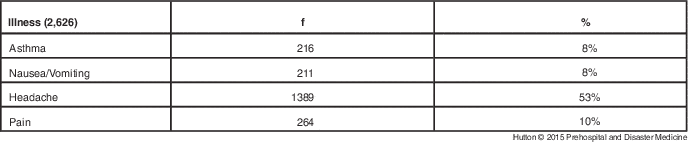
The majority of the illness complaints were headaches (53%), followed by pain (10%), asthma (8%), and nausea/vomiting (8%; Table 3). These four were also the most frequent illnesses. Pre-event, the host factors were memory or lack of preparedness (these being forgetting to bring equipment, such as a puffer, or forgetting to eat and drink prior to attending, which could then contribute to presentations of headaches or nausea and vomiting). During the event, the social and physical environments appeared to be the main contributors to all four illness presentations. These were: the density of the crowd, the activities undertaken (such as the availability of alcohol and drugs), and the loudness of the music. Post event, there was a reliance on self-reporting of illnesses, which could have been impacted by the size of the event and the amount of walking that the audience members had to travel to seek care. For many of these misdemeanors, audience members may have delayed treatment until they got home (Table 4).
Illnesses Sustained at Mass Gatherings in Australia

Factors That Contribute to Illness at Events

Injury
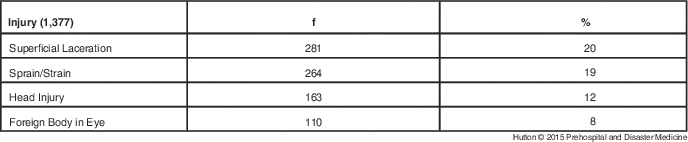
The majority of the injury complaints were superficial laceration (20%), followed by sprain/strain (19%), head injury (12%), and foreign body to the eye (8%; Table 5). Pre-event, host factors identified were rushing to the event as a main precipitator of sprain/strains and lacerations. During the event, the social environment of dancing and moshing contributed to injury. The agent, being the availability of alcohol, contributed to all four recorded injuries. Coupled with the physical environment (the music type, the density of the crowd, the uneven terrain, and the length of time it took to walk between stages) these factors all contributed to injuries at OMFs. Post event, the common influence to the injury was the physical and social environment itself, having to walk to the medical tent, negotiating with peers to seek medical treatment, and the influence of alcohol and drugs. These factors all contributed to injuries at this phase of the events. As most events finished late at night, any injuries may not have been apparent until the next morning (Table 6).
Injuries Sustained at Outdoor Music Festivals in Australia

Factors That May Contribute to Injury at Events

Environmental
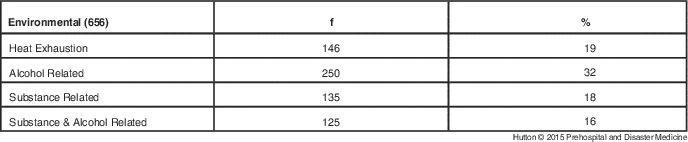
The majority of the environmental presentations were alcohol-related (32%), heat exhaustion (19%), substance-related (18%), followed by substance- and alcohol-related (16%; Table 7). Prior and during the events, the physical environment contributed to heat exhaustion if the temperatures were between 30°C and 40°C (86°F to 104°F). In the pre-event sphere, the availability of alcohol and the consumption of drugs before an event were agents that led to presentations. Again within the social environment, activities such as moshing, dancing, and going to and from different stages during the day led to the exacerbation of environmental presentations. In addition, the physical environment supported the consumption of alcohol with alcohol being served. As it is legal to drink alcohol, regardless of the time of day, people may have started drinking as early as 10 am as alcohol was often served as soon as the gates were opened. Post event, people may have presented to the medical tent if they felt that they couldn’t get home safely from the event; again, the physical environment was at play here if the medical tent was not accessible. Post event, the common influence to injury was the physical and social environment itself, having to walk to the medical tent, negotiating with peers to seek medical treatment, and perhaps the influence of alcohol and other drugs may have contributed to injuries at this phase of the events (Table 8).
Environmental Presentations Sustained at Outdoor Music Festivals in Australia

Factors That May Contribute to Environmental Injuries at events

Discussion
Health promotion, public health information, and environmental considerations are at the core of any mass gathering as a means to promote health behaviors and reduce the risk of harm. Central to this is a clear understanding of the factors that increase the risk for harm. The Haddon matrix allows event practitioners to formulate anticipatory planning for celebratory-type events. What was evident from this work was that the host, the agent, and the physical and social environments contributed to the development of injuries and illness at an event. The physical environment can be controlled, to a certain extent, through event design, safety guidelines, and legislation. However, balancing cultural norms, such as the importance placed on celebratory events, with the social environment is more difficult.
Using Haddon’s matrix, this report has highlighted how social and physical environments heavily influence the safety of young people attending OMFs. In addition, human factors, including the individual motivations, behaviors, knowledge, and competencies of these people across the continuum, impact the presentation of people at the event.Reference Hutton, Ranse, Verdonk, Ullah and Arbon 5 , Reference Arnold 9
Pre-event messaging can promote individual planning. Such messaging can be disseminated on official web sites of the mass gathering and when receiving or purchasing tickets. The health messaging topics can be predetermined from retrospective analysis of injury and illness data from the same or similar mass gatherings. Some messaging may include: “What do you need to bring to the event that will make you feel most comfortable?” “Do you take medication during the day; do you need to take that with you?” “Are you travelling with people; do you have a plan of where to meet throughout the day?” and “Will you be dancing a lot; do you need to wear comfortable shoes that will keep you on your feet throughout the day?”
This type of health messaging may appear rudimentary; however, these positive proactive messages serve as a reminder to audience members to make the most of the mass gathering through ensuring it is a success for them, and subsequently, resulting in a reduction of patient presentation rates at these events.
In addition, messages need to be audience and event specific. At OMFs, this messaging can be placed on the side of performance stages, on big screens, at food outlets, or in toilets. This positioning of health messages can be coupled with the use of health promotion tents during the event. The use of volunteers to distribute and reinforce positive health messaging has been a successful health strategy used at other festivals, such as Schoolies (end of school celebrations) events in South Australia,Reference Hutton, Cusack, Zannettino, Shaefer, Verdonk and Arbon 15 , Reference Hutton and Cusack 16 and could be adapted to OMFs in more general terms. Such messages could remind participants to: “Keep hydrated - drink water” and “Look after your mates!” Event planners can provide meeting/resting places around events, and these places can also be used to distribute health information and allow access to water, high energy snacks, and sunscreen. A further understanding of the physical and social conditions will contribute to health messaging during the event.
Post event, safe health messages can be posted onto social media within follow-up marketing campaigns to either reinforce health promotion at mass gatherings, to obtain participant feedback about the safety of the event, or to trace communicable diseases, such as influenza. The use of the matrix demonstrates that the use of drugs and alcohol can contribute to many of the injuries at OMFs.
Limitations
This report draws on data that were restricted to those patrons receiving on-site care, and thus, limits the ability to assess accurately the amounts of injuries and illnesses that happen at these events. Therefore, the results may not be generalizable to another population or setting. In addition, the care provided to those who present is given to treat the presenting symptoms, such as a headache. Since the cause of the headache was not explored or documented, other confounding contributors, such as dehydration, sun exposure, or alcohol use, are unknown. Similarly, nausea and vomiting can be linked to food poisoning, communicable diseases, and so on, but as symptoms are documented and not the underlying illness, it is difficult to determine the cause. Lastly, post event issues and presentation data were not captured in this study.
Conclusion
This report has demonstrated how the Haddon matrix can be used to examine factors that contributed to injuries and illnesses at OMFs. The findings were that interventions need to be targeted at all stages of the event, particularly both pre-event and during the event. The opportunity to promote health is lost by the time of post event. The matrix provided vital information on what factors may contribute to the injuries at OMFs; from this information, event planners can strategize possible interventions. The physical environment can be manipulated to promote public health and reduce injury. However, the social factors are more difficult to control.