We of peaceful London City have never beheld – and please God never shall witness – such a scene of hurry and alarm, as that which Brussels presented. Crowds rushed to the Namur gate, from which direction the noise proceeded, and many rode along the level chaussée, to be in advance of any intelligence from the army. Each man asked his neighbors for news; and even great English lords and ladies condescended to speak to persons whom they did not know. The friends of the French went abroad, wild with excitement, and prophesying the triumph of their Emperor. The merchants closed their shops, and came out to swell the general chorus of alarm and clamour. Women rushed to the churches and crowded the chapels, and knelt and prayed on the flags and steps. The dull sound of the cannon went on rolling, rolling. Presently carriages with travelers began to leave the town, galloping away by the Ghent barrier. The prophecies of the French partisans began to pass for facts. “He has cut the armies in two,” it was said. “He is marching straight on Brussels. He will overpower the English and be here to-night.”
– William Thackeray, Vanity Fair, Chapter 32
The final chapter ofVanity Fair's account of the 1815 Battle of Waterloo opens with a scene of public panic in the streets of Brussels. As French cannons sound just outside of the Belgian capital, Thackeray captures the chaos that ensues as the English men and women, who have accompanied the army to Brussels and remained in the city during the battle, begin to receive reports that Napoleon's forces have defeated the Duke of Wellington's army and are marching on the city. Rumor reigns in Brussels as the English civilians seek out one another for increasingly inaccurate reports on the French progress towards the city, and civil tranquility collapses as the public consensus becomes that French forces will soon invade.
Why would Thackeray's depiction of the Battle of Waterloo, the triumphant moment of nineteenth-century English nationalism, feature such an elaborate sequence of English civilian panic and indulge for so long in the possibility that the French might invade Brussels? The answer in part may be that the same specters of French invasion were haunting English popular discussion over three decades later, as Thackeray began to serialize Vanity Fair. The mid 1840s saw France re-emerge as an overt imperial power for the first time since the Napoleonic Wars, and also marked the return of the quintessential Napoleonic nightmare in England – invasion. Beginning in 1844, an invasion scare took hold in England. This was largely due to the widespread belief that the development of steam technology would allow the French Navy to cross the Channel quickly. This essay will read Vanity Fair in relation to popular reporting on the French threat, and suggest that Thackeray's return to the Battle of Waterloo functions as meta-history. He turns to history in order to critique the impulse to read the present through the past, and he caricatures the invasion scare in order to lampoon the ease with which English public discourse had revived old fears regarding the French and had readopted outmoded nationalist poses.Footnote 1
Clare Simmons argues in Eyes Across the Channel: French Revolutions, Party History and British Writing, 1830–1882 that Anglo-French relations in the nineteenth century were always almost immediately figured in terms of history. Simmons suggests that Victorians adopted an historical reflex when it came to France, always viewing present events in France through the lens of history, and situating them within a longer historical narrative that helped to create cultural meaning in England and a national sense of self (Simmons 7). Her project extends Linda Colley's groundbreaking work in Britons: Forging the Nation: 1707–1837 on the role that Francophobia played in the development of British national identity in the eighteenth and early nineteenth centuries. Colley persuasively argues that fear of the French helped to fuse disparate national and ethnic groups into “Great Britain” (5). The mid-1840s invasion crisis suggests the degree to which this was an on-going process in the Victorian period, and reading Vanity Fair as meta-historical allows us to understand the novel as a critique of the English cultural tendency to look back and to return to history. Thackeray's perspective at the end of his Waterloo chapters is that the English and French appear doomed to cycle through endless periods of violence and retribution in what he despairingly calls, “the Devil's Code of Honor” (374; ch. 32).
The 1840s began optimistically enough for England and France. In 1840, the two nations brokered a new Entente Cordiale. This “friendly agreement” was designed to facilitate economic and diplomatic exchange between the two nations, and to highlight the common global-political interests of the two powers. In October 1840, in conjunction with the new accord, the English government agreed to return Napoleon's body to the French for a state burial in Paris. Napoleon had died in exile on Saint Helena, a British territory, on May 5, 1821, and the return of his body to the French was meant to symbolize renewed faith between the two nations, and to thaw the cold diplomacy that had marked Anglo-French relations since Napoleon's defeat at Waterloo.
Thackeray followed events surrounding the reburial very closely. He personally attended Napoleon's state funeral in Paris on December 15, 1840, and eventually published his own account of Napoleon's return to France entitled The Second Funeral of Napoleon (Reference Thackeray1841). The work, written under Thackeray's pseudonym, Michael Angelo Titmarsh, is an odd mélange of first-hand observation and journalistic composite, as Thackeray collects and translates published accounts of Napoleon's disinterment at Saint Helena and the transport of his body to Paris. The work as a whole gives us insight into Thackeray's perspective on Anglo-French nationalism in the years just before he began work on Vanity Fair. Thackeray-as-Titmarsh is deeply distrustful of the détente, and he quips to his imagined English reader, Miss Smith:
They hate us, my dear, profoundly and desperately; and there never was such a hollow humbug in the world as the French alliance. Men get a character for patriotism in France merely by hating England. Directly they go into strong opposition, they appeal to the people, and have their hold on the people by hating England in common with them. Why? It is a long story; and the hatred may be accounted for by many reasons, both political and social. Any time these eight hundred years this ill-will has been going on, and has been transmitted, on the French side, not on ours; we have had no (or few) defeats to complain of, – no Invasions to make us angry. (Second Funeral of Napoleon 35–36)
Thackeray's sense that the long legacy of hatred and nationalist opposition between England and France was a one-sided French affair would change by the time he wrote Vanity Fair in 1847–48; and, in the interval, England would face the prospect of invasion. But his skepticism here stems primarily from an incident that occurred as Napoleon's body was being transported back to Paris from Saint Helena. French King Louis-Philippe had dispatched his son, the Prince de Joinville, a French naval officer, to collect the Emperor's body and to be present for a ceremony during which Napoleon was given full military honors by the British government. Shortly after the official transfer of Napoleon's remains to the French at Saint Helena, and while the Prince de Joinville's ship, the Belle Poule, was en route back to France, word reached the French crew that England and France were near hostilities over the Egyptian occupation of Syria. Joinville reacted by ordering his crew to demolish their cabins and convert them into additional gun batteries; he also made preparations to scuttle the ship should the English try to seize Napoleon's coffin. Joinville's act of military bravado infuriated Thackeray, who saw the French Prince's rapid shift from peacetime to war-footing as nothing more than stagecraft, an attempt to play the nationalist hero in order to improve his political standing in France. He writes:
The French captain takes his charge on board, and the first thing we afterwards hear of him is the determination “qu'il a su faire passer” into all his crew to sink rather than yield up the body of the Emperor aux mains de l'étranger – into the hands of the foreigner. My dear Monseigneur, is not this par trop fort? Suppose “the foreigner” had wanted the coffin, could he not have kept it? Why shew this uncalled-for valour, this extraordinary alacrity at sinking? Sink or blow yourself up as much as you please, but your royal highness must see that the genteel thing would have been to wait until you were asked to do so, before you offended good-natured, honest people, who, heaven help them, have never shewn themselves at all murderously inclined towards you. (Second Funeral of Napoleon 34)
Thackeray cannot contain his rage that the Prince de Joinville would so quickly adopt a nationalist pose and reflexively return to a posture of aggressive, paranoid, nationalist opposition. But Joinville's impulse to do so was a product of the delicate position of Louis-Philippe's government in the 1840s. France's “Citizen King” rose to power through popular support and constantly sought to solidify it. His son's instinct to score political points at England's expense shows that although Louis-Philippe's constitutional monarchy brought it more in line with England, the legacy of Republican patriotism still kept them firmly apart.
The Prince de Joinville's nationalist pretension was unnecessary; Napoleon's body was ultimately returned to France without incident, and the Near Eastern Crisis was resolved by 1841. However, Joinville's impetuous return to un-nuanced, unadulterated Anglo-French antagonism would prove to be a harbinger for cross-Channel relations in the coming years, as popular discourse steadily recalled and returned to the high period of Anglo-French aggression during the Napoleonic Wars. Thackeray's visceral reaction to Joinville's willingness to revive the war helps to frame how he would have read the return in public memory to the Waterloo era.
The Prince de Joinville himself triggered the popular return to history; on May 17, 1844, he anonymously published an article in La Presse advocating that French maritime forces should be increased to include a significant number of steam ships. He argued that steamers would allow the French navy to overcome its only historical obstacle to a successful invasion of England – the wind. Steam technology would eliminate the need for perfect wind conditions in support of any French invasion.
Joinville's article was an abridged version of a pamphlet he wrote entitled Note Sur L'Etat Des Forces Navales De La France (Note on the Status of French Naval Forces). After its abridged appearance in La Press, the pamphlet was rapidly republished in the French periodical, Revue des Deux Mondes; and within days of its appearance in France, it began to circulate in England. It was quickly known that Louis-Philippe's son had written the tract, and his authorship seemed to imply French governmental sanction for the project to revitalize the French navy through steam technology. It also shifted the tenor of the pamphlet from speculation to threat. The Times cautioned:
The worst consequences that would result to France from the superiority of the steam navy of England, so long as its army is so greatly superior to that of England, would be the temporary loss of its commerce and the bombardment of some of its seaports; whilst the consequence of French superiority to England would be the invasion of the whole kingdom. (“English and French Navies” 24 May 1844)
The invasion of England had long been a dream of Napoleon's. From 1803 to 1805, Napoleon maintained an invasion army of 200,000 men known as the Armée des côtes de l'Océan (Army of the Ocean Coasts) or the Armée de l'Angleterre (Army of England), as well as French flotilla of invasion barges in ports in France and in Holland ready to launch for England. Napoleon's belief, right up until the moment he was defeated at Waterloo, was that his forces could cross the Channel if they could only secure a few hours of favorable wind.Footnote 2 Even if French invasion was realistically never more than a Napoleonic fantasy in the early nineteenth century, it continued to haunt the British popular imagination, and fear of it provided a cognitive and emotional framework for a quick return to the Napoleonic period in public discourse.Footnote 3
Punch magazine offered one of the earliest responses to Joinville's pamphlet, which suggests that Thackeray was most likely following the invasion scare from its earliest stages, particularly because the Prince de Joinville was once again center stage.Footnote 4Punch's editors recalled that Joinville had made a formal state visit to London in 1843:
You were kindly received in our perfidious island last year. You visited our cities, towns, and country, our towns inland and seaboard. And your benevolent patriotism instantly pointed out to you, while considering the “Etat des Forces Navales de la France,” that it would be very easy to burn all these fair quiet towns, lying so peaceful and confiding along the water side. They were entirely defenceless, and their unprotected condition touched your great soul, and suggested to your Christian spirit the easy opportunity of plunder. . . . The riches accumulated upon our coasts and in our ports would no longer be in safety. Our arsenals are crowded with ships – how they would burn! Our warehouses are full of wealth – what is it for, but for Frenchmen to plunder! Our women are the most beautiful in the world. Sacrébleu! How they would scream as five hundred jolly lads from the Belle Poule came pouncing down upon them! (“The Prince of Joinville's Amateur-Invasion of England”)
Punch closes the invective by referencing the ship, the Belle Poule, that Joinville had captained during the Syrian crisis, thus recalling the militant stance he and his men took against England while transporting Napoleon's body. As Thackeray does in Second Funeral, Punch portrays Joinville as dangerously opportunistic, and willing to abandon postures of peace for the profit of war. Whereas Thackeray's frustration with Joinville stemmed from the Prince's ability to pivot so quickly between these two positions, Punch's editors take the next logical narrative step and depict Joinville as simultaneously offering peace while planning for war. Punch also imagines what Joinville's invasion of England would look like, rendering a remarkably detailed invasion fantasy in which all of England's island treasures, even its women, are vulnerable to the French incursion.
Punch also casts Joinville as explicitly Napoleonic in his ambition, concluding, “we may be perfidious, but at least we have the decency of hypocrisy. We may be sordid, but at least we profess to worship Christian peace – not murder and Napoleon” (“The Prince of Joinville's Amateur-Invasion of England”). Punch's standard satirical spin on current events makes Joinville's pamphlet an easy target for such an extreme depiction of the French national character; but Punch's caricature of France as a nation disposed to violence was matched in the mainstream press. The Times offered the same image of a French national proclivity for violence. On September 3, 1844, the Times remarked, “we think them [the French] as fond of blood, and as eager to shed it, as any people on the face of the earth, whether civilized or uncivilized. Whatever glory may belong to a disposition of this kind, we are willing to accord to the French people – at least to that portion of them who constitute the war party, and who are thirsting for a conflict with England” (“The Prince de Joinville And His Critics”). The Times hedges its assessment of the French national character by eventually reducing its indictment to “the war party” in France, but only after giving outlet to the alarmist view of France's disposition for violence.
The intensity of these reactions suggests how quickly the old nationalist postures and caricatures could be revived and readopted. In July 1845, Lord Palmerston, Britain's Foreign Secretary, addressed the House of Commons, assessing the threat of the French navy. He warned, “the Channel is no longer a barrier. Steam Navigation has rendered that which was before impassable by a military force nothing more than a river passable by a steam bridge” (“National Defences” 1223). Palmerston cultivates the old fear of invasion, and he would continue to raise the alarm regarding France, particularly once the Entente Cordiale between England and France finally collapsed in October 1846.
The delicate diplomatic détente between the two rivals evaporated as a result of the complicated intrigue of the so-called “Spanish Marriages” affair. On October 10, 1846, Queen Isabella II of Spain married her cousin, Francisco de Asís de Bourbon. On the same day, her sister and presumptive heir, Luisa Fernanda, married King Louis-Philippe's youngest son, Antoine, the Duc de Montpensier. The dual marriage secured French influence over the Spanish court. The Entente broke down because the French government had promised Lord Palmerston that Luisa Fernanda's marriage would not go forward until Isabella had given birth to one or more children, thus blocking Luisa's path to the throne, and diminishing Louis-Philippe's influence in Spain. For Palmerston, the “Spanish Marriages” signaled a dangerous increase in French power, and he sought to awaken a sense of public urgency over France's renewed imperial ambitions.
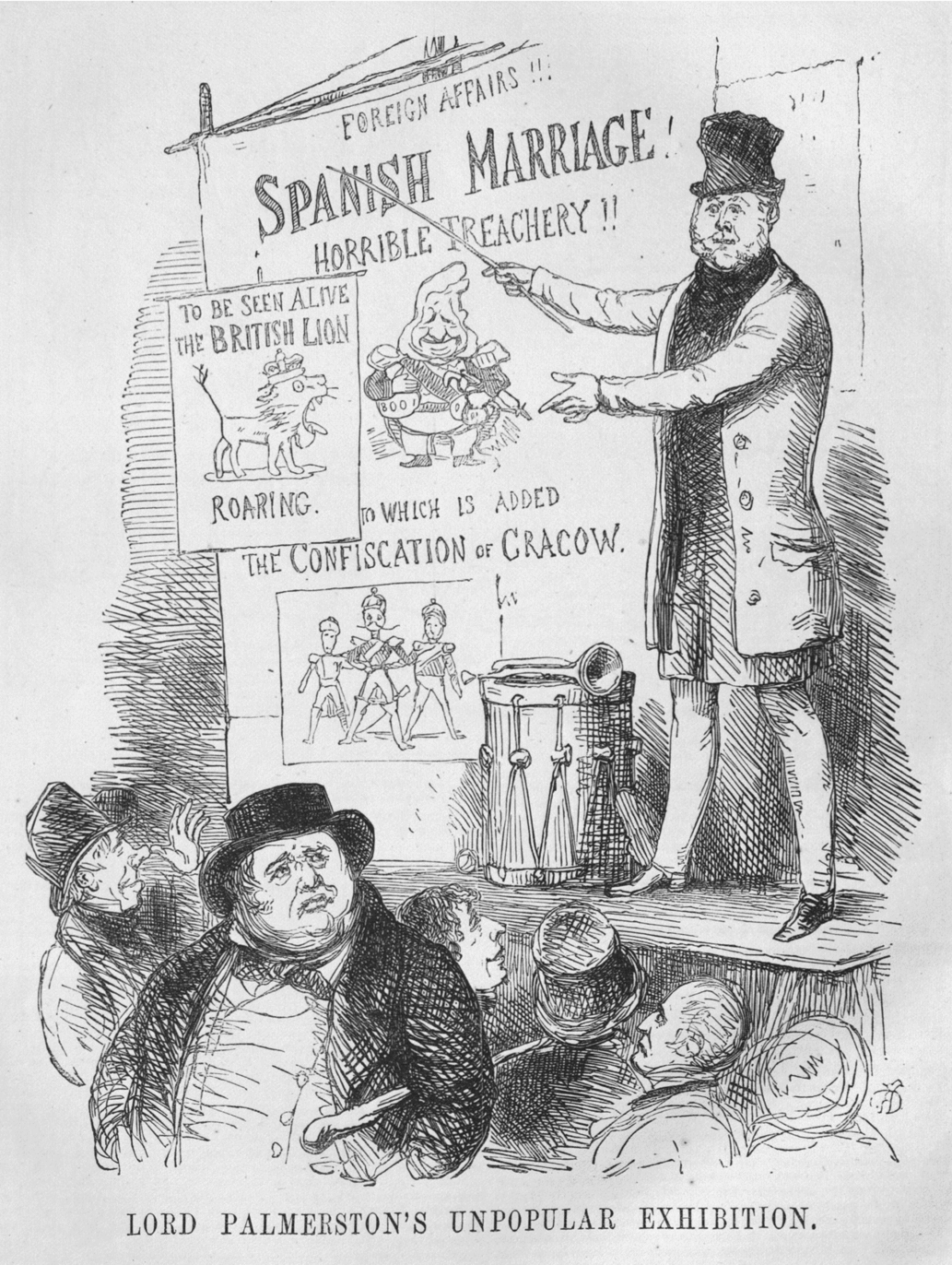
The post-Entente Cordiale period marked an interesting shift in popular discourse on France in England. The mainstream press continued to give weight to the possibility of invasion and to echo Palmerston's anxiety regarding France, but the satirical worm had turned, and Punch turned its attention towards those who were raising the alarm – and believing in it – in England. This shift corresponds to the period in which Thackeray began to serialize Vanity Fair.Footnote 5 In 1847, only a few months after the breakdown of the Entente Cordiale, Punch ran a cartoon entitled, “Lord Palmerston's Unpopular Exhibition,” (Figure 6) showing the foreign secretary warning an ambivalent John Bull of the “horrible treachery” of the “Spanish Marriages” and the equally unsettling “Confiscation of Cracow,” the Austrian Empire's annexation of the independent city of Kraków (Cracow), which was seen as a violation of the Congress of Vienna (1815) that had ended the Napoleonic Wars and settled Europe's political borders.
“Lord Palmerston's Unpopular Exhibition.” Illustration from Punch 12 (January-June 1847).

Punch depicts Palmerston as a carnival barker, attempting to sell both acts as a return to Napoleonic-era politics. In the cartoon, it is unclear if Palmerston is attempting to warn the British public that a new age of Anglo-French nationalist strife is at hand, or if he is promoting a return of English and French national antagonism. In the tableau, Louis-Philippe is depicted in Napoleonic dress, and the British Lion has been hastily added to the display in a last-minute effort to market the revival of British nationalism as part of the attraction. Punch paints Palmerston with the same brush as Joinville at the beginning of the invasion crisis: it casts him as eager to return to old nationalist postures and to resurrect old anxieties.
As Anglo-French tensions mounted in 1847–48, the hero of Waterloo himself joined the public discussion on invasion, and endorsed the perception that Anglo-French history was beginning to repeat itself. On January 5, 1848, the Times published a letter written by the Duke of Wellington to Major General John J. Burgoyne, assessing England's vulnerability to French assault. Wellington explicitly framed the contemporary debate in terms of Napoleonic history, writing, “I have taken the year 1804 as the standard, as that was the year in which the invasion was threatened. It was previous to the employment of the armies in the Peninsula or North America; in short, as nearly as possible similar to the political circumstances in which we stand at this moment” (“The Duke of Wellington's Letter”).
More damaging is Wellington's assessment of what he believes will be the English civilian response to French invasion. He writes:
We hear a great deal of the spirit of the people of England; for which no man entertains higher respect than I do. But, unorganized, undisciplined, without systematic subordination established and well understood, this spirit, opposed to the fire of musketry and cannon, and to sabers and bayonets of disciplined troops, would only expose those animated by such spirit to confusion and destruction. (“The Duke of Wellington's Letter”)
Wellington predicts full-scale public panic in the face of a French invasion; but many of his contemporaries, who took the threat from France seriously, also felt that public panic was necessary and dangerously absent in England. Wellington's “Burgoyne letter” was published in January 1848, but was composed one year earlier on January 9, 1847. In the interval, it circulated privately, and on December 1, 1847, one month before Wellington's missive was made public, the Times published an anonymous letter to the editor, written by someone who had read Wellington's assessment of England's national defenses. The anonymous writer doesn't identify Wellington by name, but leaves little doubt as to Wellington's identity, and warns, “his theme is the condition of this country as regards invasion, and his statements may make the stoutest heart tremble. He enters into every detail – he names, from personal observation, the most likely places for debarkation – he proves the ease with which it might be effected – he displays the nullity of our means of defence” (“The National Defences”). Wellington may name the most likely sites for the French to land in England, but the Times anonymous correspondent does not, thereby maximizing public panic and paranoia.
Six days later, another unnamed correspondent in the Times also sought to draw public attention to the possibility of French invasion, and to rouse the British people out of a state of complacency born by peace:
Thirty-Two years of peace have brought in their train numberless blessings, for which it behoves [sic] us to be most thankful. But there are concomitant evils. Ease, affluence, commercial and national prosperity, beget an unreasoning sense of security, and enervating habits of self-indulgence. No personal knowledge, realizing the horrors of warfare, counterbalances the dreamy memories of past victories.” (“To The Editor of the Times” 7 Dec. 1847)
For this correspondent, the oft-repeated nationalist accounts of the Napoleonic Wars have rendered the British people ignorant of their contemporary vulnerability. They view the current French threat through the hazy eyes of historical recollection and the popular hagiography of Waterloo – assuming future victories because of past successes. He seeks to shock them into a rapid shift from complacency and over-confidence to fear.
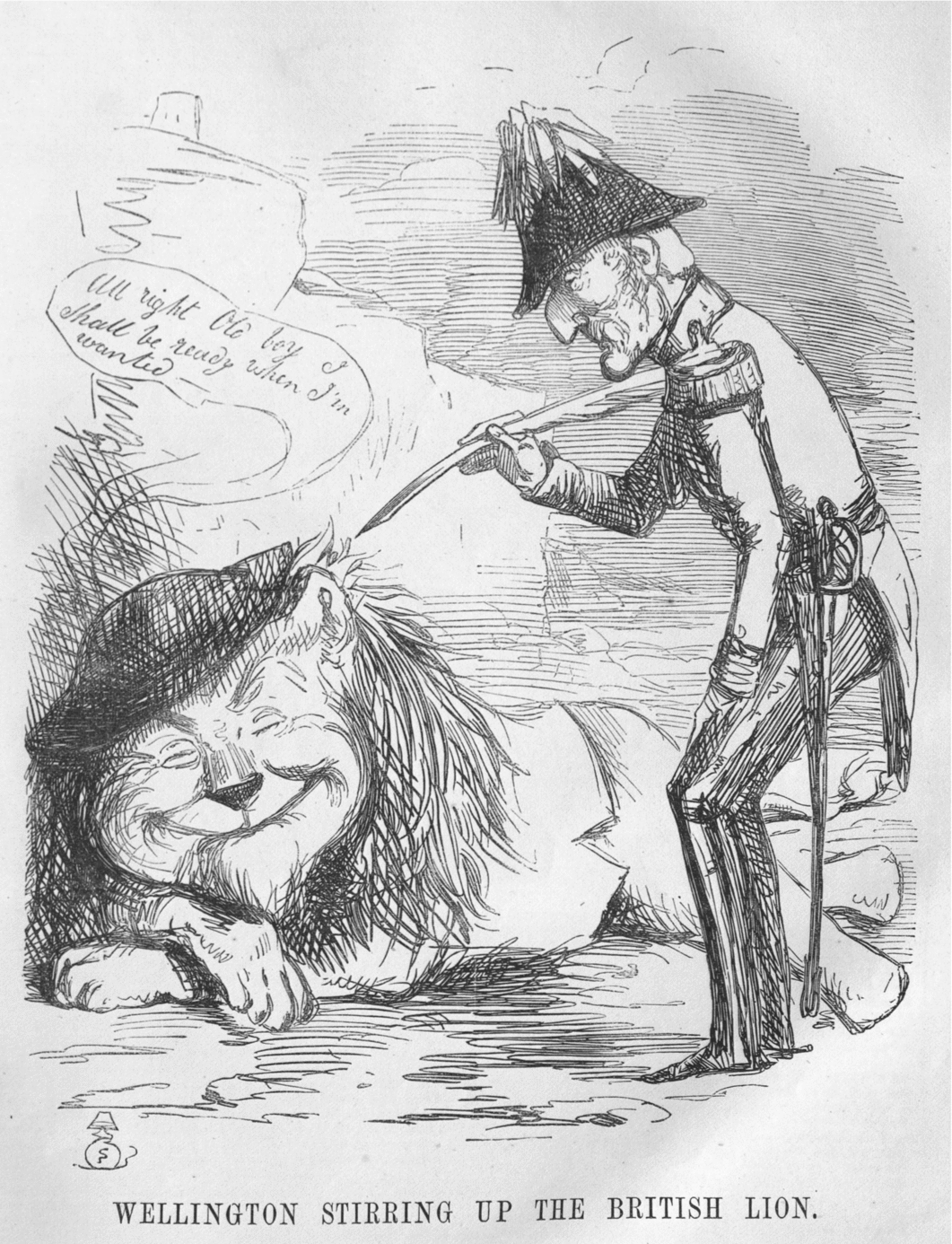
Punch ridiculed the renewed warnings of French invasion, and, as in its caricature of Lord Palmerston, saw Wellington as more interested in reviving old forms of nationalism and reawakening old fears about France than soberly assessing the modern threat. In January 1848, just after the full contents of Wellington's letter were finally made public, Punch published a cartoon entitled “Wellington Stirring Up the British Lion” (Figure 7 ) in which Wellington is depicted as trying to prod awake the British Lion with the tip of his plume pen. In the cartoon, Wellington has sheathed his sword for his pen, suggesting the pen has become his weapon of war. Wellington appears in full battle dress, ready to defend the English coast against the French fleet, while the lion dozes comfortably along the Cliffs of Dover, presumably still enjoying the easy slumber of England's peacetime relations with France. The lion sleepily reassures Wellington, “All right Ole' boy, I shall be ready when I'm wanted.” In Punch's hands, Wellington is a sad old man – still noble, but stuck in the past, ready, and perhaps hoping for, one last battle with France and one more moment of nationalist glory.
“Wellington Stirring Up the British Lion.” Illustration from Punch 14 (January-June 1848).
Punch continued to target those who would raise civilian fears about France in another satirical send-up of the invasion scare entitled “The Kettle Has Done it All,” published in early 1848. In the piece, two English women sit at home watching a new teakettle as it begins to steam; as it does so, one of the women, Mrs. Gerkins, is encouraged to watch it closely and see French shapes in the steam:
Look close to the spout, Madam, and you will behold the French fleet towed by steamers, coming out of the mouth of Boulogne, and crossing the Channel. They have arrived at Dover: and now keep your eye to the spout again, Ma'am, and do you not perceive – of course you do – thousands of boats putting off, full of soldiers, and horses, and field-pieces, to the beach? The whobbling of the kettle, Ma'am, is the lively representation of the guns of Dover Castle, a-firing down upon the shingles. You will now perceive in that cloud the railway train – winding as a sea-serpent – whirling the French army to London. And now, Ma'am – keep your eye close – and you will perceive the French cuirassiers and French infantry, with their swords and bayonets, a-charging of the mob through no end of streets and thoroughfares. (“The Kettle Has Done It All!”)
Punch's satirical rendering of the invasion scare casts the French threat as something akin to seeing shapes in the clouds as a result of strong suggestion. Punch is satirizing the English willingness to see a French army in a puff of steam, or in the rumor of a steam-navy, simply because someone says it is there. Punch's vignette also targets the ease with which gossip can translate into fear and the revival of old terrors regarding the French.
It was amid this backdrop that Thackeray composed Vanity Fair and returned to the Napoleonic age himself. The novel's Waterloo Chapters (28–32) were published by Punch in August and September 1847, which places them between the magazine's two caricatures of Palmerston and Wellington; and in them, Thackeray shares Punch's scorn towards both those who would elicit public panic about France and the ease with which old fears about the French could resurface.Footnote 6 While Vanity Fair's Waterloo chapters were published before Wellington's “Burgoyne letter” was made public, the speed with which Punch responded to it and the fact that Vanity Fair and Punch offer an identical critique of war-mongering and renascent nationalism suggests Thackeray's editorial influence on the Wellington cartoon. From the beginning of the decade, Thackeray had harbored resentment towards those who would take England and France back to the nationalism and nationalist aggression of the Napoleonic age, an anger that first emerged in The Second Funeral of Napoleon. Reading Vanity Fair as a response to the French invasion scare and the contemporary crisis in Anglo-French relations shows that by the end of the decade, Thackeray was weary of the idea that England and France would always return to the past and were doomed to perpetually reenact their part in a never-ending nationalist pas de deux.
Thackeray structures his Waterloo chapters to mimic the dynamics of the invasion scare, replicating its geographical and psychological elements. First, he positions Brussels as a continental stand-in for London. The Belgian capital is effectively transformed into an English city through the flood of English civilians who accompany the British army to Belgium and settle into the city, making it seem, “almost like Old England” (321; ch. 29). Indeed, Thackeray eventually calls the Belgian capital, “the little colony at Brussels” (345; ch. 31) and is careful to emphasize how comfortable, safe, and familiar life becomes in Brussels for the English civilians there. He writes, “the place was full of English soldiery. . . . English bugles woke them in the morning; at nightfall they went to bed to the note of the British fife and drum” (315; ch. 28). This sense of security and comfortable, national familiarity makes the eventual French menace to the city that much more dramatic and personal for Thackeray's English readers.
Furthermore, Thackeray's representational framework, which places the Battle of Waterloo itself off-stage, and limits the reader's perspective to events in Brussels alone, replicates the geographical schema of the invasion scare, as the tension in the Waterloo chapters stems from the progress of a rumored, but unperceived, French army marching on the city. In fact, Thackeray's Waterloo narrative so effectively mimics the invasion dynamic that his narrator actually pauses to reassure the reader, in the passage quoted at the beginning of this essay, “we of peaceful London City have never beheld – and please God never shall witness – such a scene of hurry and alarm, as that which Brussels presented” (358; ch. 32). He then launches into an extended description of the English civilian panic in the streets of Brussels as the French army approaches, sketching a scene similar to the worst-case scenarios imagined in the British press in the 1840s at the height of the invasion scare. Thackeray's reassurance that London has never known such scenes of public alarm and chaos only serves to remind the reader of those present fears and to link Vanity Fair to them; he blends two epochs of Anglo-French anxiety ultimately in order to critique the degree to which past and present fears always seem to blur when it comes to England and France.
In the novel, the civilian panic begins in the same manner as the contemporary invasion scare, through the circulation of a piece of French military propaganda. In the text, shortly after the Allied Army leaves Brussels, Napoleon's “Proclamation from Avesnes,” begins to circulate in the capital. The Emperor's eve-of-battle declaration is designed to solidify his support among Belgian civilians, and to rile up his French troops, but in Vanity Fair, it primarily serves to unnerve the English population in the city. Thackeray paraphrases the document at length, which lets him trace how its particular pronouncements begin to work on the civilian imagination, and by doing so he offers a critique of the advent of the modern scare.
The Waterloo section centers on the character of Jos Sedley, who is Thackeray's proxy for those English civilians willing to read the military propaganda and believe the invasion hype. In the course of only three short chapters, Sedley pivots from pompous certainty that the English will triumph at Waterloo to unrestrained panic that the French are about to invade Brussels. Napoleon's “Proclamation from Avesnes” rattles Sedley's nationalist certainty very quickly. His valet, Isidor, returns from the streets of Brussels to report fresh “news” from the front. He tells Sedley that the Duke of Wellington's army has been “crushed” by Napoleon. Sedley and Isidor's conversation allows Thackeray to lampoon not only the civilian proclivity to panic, but also the impulse to look back to history in order to process present events. He sets the two men up as dueling nationalist gossips, both relying on historical precedent to prove their cases and to out-terrify the other. Sedley scoffs at Isidor's testimony that Wellington has been beaten: “‘[C]rushed, psha!’ said Jos, whose heart was pretty stout at breakfast-time. ‘The Duke has gone to beat the Emperor, as he has beaten all his generals before’” (349; ch. 31). As Isidor adds additional details of what he's heard from fellow servants about the English defeat, Sedley gradually begins to panic: “‘[W]e are three to one, sir, against any force Boney can bring into the field,’ Mr. Sedley objected; ‘the Austrians and the Russians are on the march. He must, he shall be crushed,’ Jos said, slapping his hand on the table” (349; ch. 31).
Isidor seizes on Sedley's uncertainty, offering the details of Napoleon's Avesnes declaration as evidence that the French will win the war. He confidently tells Sedley:
‘The Prussians were three to one at Jena, and he took their army and kingdom in a week. They were six to one at Montmirail, and he scattered them like sheep. . . . Look here, here it is in black and white. Here's the proclamation of His Majesty the emperor and King,’ said the now declared partisan of Napoleon, and taking the document from his pocket, Isidor sternly thrust it into his master's face, and already looked upon the frogged coat and valuables as his own spoil. (349; ch. 31)
Almost immediately after Napoleon's declaration appears in Vanity Fair, it is transformed from propaganda to popular fact. Isidor seizes on it as “black and white” proof that the Emperor will triumph, and its most terrifying predictions begin to work on Sedley's mind. Thackeray replicates the effect that Joinville's pamphlet had in England, and the quick shift it went through from self-interested speculation to sinister and certain threat.
He also revives a Revolutionary narrative in this scene, coding it onto Sedley and Isidor's dynamic. As soon as Isidor declares his partisanship, he begins to covet Sedley's possessions, mentally taking possession of his “frogged coat.” He morphs into a quasi-Revolutionary figure, waiting for the moment his wealthy master will finally be overthrown. Thackeray links nationalist posturing to the rebirth of anachronous narratives about the French in order to critique nationalist uses of history and to suggest despairingly that there is never an origin moment for English francophobia; instead, there is only a constant and relentless return to the past to fuel panic in the present.
This historicized hysteria quickly becomes widespread in Thackeray's Waterloo. The old nightmares of the French Revolution re-emerge in Brussels as rumors gain traction that the French army is marching closer to the city. Becky Sharp encounters an English aristocrat, Lady Bareacres, who has sewn her diamonds into her clothing in order to hide them from the French (365; ch. 32), and even the typically unflappable Becky, who sleeps through her husband's departure for the battle, succumbs to the popular panic and takes the precaution of “a little needlework for her own advantage; she stitched away the major part of her trinkets, bills, and banknotes about her person” (372; ch. 32).
Jos Sedley's confidence finally collapses once a Belgian hussar returns to Brussels to report the English army has been routed and the French forces are en route to the city. The Belgian soldier is named Regulus, and Thackeray notes, “he had been born in the revolutionary times” (360; ch. 32). Regulus is named for the Roman General Marcus Atilius Regulus (3rd century BC); and his name recalls the popularity of Roman republicans during the French Revolution. In choosing this name for the Belgian soldier, Thackeray evokes both the Revolution and the Battle of Waterloo in tandem with prophecies of English destruction. He cultivates a cognitive association between English fear of the French and a tendency to recall earlier history. Regulus's report is of course a sham; he lies about the English defeat and exaggerates the horrors of the battle, in order to justify his flight from it. Thackeray targets those who cultivate popular panic for personal ends, the same dynamic Punch satirized in “Lord Palmerston's Unpopular Exhibition.”
Regulus's self-interested fear-mongering works. Sedley's remaining confidence in the English army evaporates, so much so that he even fears he might be mistaken for a British officer because he's grown out his mustache – which is of course what Sedley had hoped would happen when he believed the English would win. He frantically urges Isidor to shave off the offending mustache. In his terror, he mistakenly tells Isidor, “[C]oupez-moi, vite! Coupez-moi” (363; ch. 32). Sedley accidentally tells Isidor to “cut him” not to shave him, and, Thackeray adds, “Isidor thought for a moment [Jos Sedley] had gone mad, and that he wished his valet to cut his throat” (363; ch. 32). Sedley's linguistic infelicity briefly leaves him vulnerable to a replay of the Revolutionary violence of la guillotine. Even this comic misunderstanding is tinged with the threat of Revolutionary violence.
Thackeray is satirizing the impulse to look back and the facility with which the worst fears about the French are accepted as fact because they carry the weight of precedent. In the novel, the English civilians believe Napoleon will win because he has won before. They condescend to history, assuming it is an accurate guide for present events. Thackeray critiques the public willingness to read the past in the present, and does so by returning to history himself, and revising it in a way that collapses historical distance. He draws on popular imagery from the contemporary invasion scare, grafting it onto his depiction of the Battle of Waterloo. In the novel, as Napoleon's forces reportedly march closer to the city, the rumors of their arrival begin to echo the worst-case scenarios reported in the British press at the height of the 1840s invasion scare. English civilians in Brussels learn the frightening news:
The Duke of Wellington was retreating upon the capital, and a great battle must be fought under its walls probably, of which the chances were more than doubtful. The Duke of Wellington had but twenty thousand British troops on whom he could rely. . . and with this handful his Grace had to resist a hundred and fifty thousand men that had broken into Belgium under Napoleon. Under Napoleon! What warrior was there, however famous and skilful, that could fight at odds with him?. . . The few English that could be brought to resist him would perish at their posts, and the conqueror would pass over their bodies into the city. (370–71; ch. 32)
Thackeray transposes the modern stakes onto the historic battle. Vanity Fair's historiography denies a contemporary reader the comfortable distance of history; the imagined panic in the streets and the prospect of an invading French force would have seemed painfully familiar, and the historical frighteningly prescient. It is a reflection of the degree to which, for a Victorian, when it came to England and France, the “new” always seemed old, and the present always a repetition of history.
The civilian panic in Vanity Fair eventually subsides, once the French cannons cease to sound in the distance; however, Thackeray closes his Waterloo chapters not by trumpeting the English victory over the French, but by ruminating on the role that historical recollection has played in the seemingly endless rivalry between the two countries:
The tale is in every Englishman's mouth: and you and I, who were children when the great battle was won and lost, are never tired of hearing and recounting the history of that famous action. Its remembrance rankles still in the bosoms of millions of the countrymen of those brave men who lost the day. They pant for an opportunity of revenging that humiliation; and if a contest, ending in a victory on their part, should ensue, elating them in their turn, and leaving its cursed legacy of hatred and rage behind to us, there is no end to the so-called glory and shame, and to the alternations of successful and unsuccessful murder, in which two high-spirited nations might engage. Centuries hence, we Frenchmen and Englishmen might be boasting and killing each other still, carrying out bravely the Devil's code of honor. (374; ch. 32)
Thackeray imagines England and France locked in a continuous cycle of violence and retribution, constantly reliving and remembering history in order to fuel and give meaning to present strife. His account of Waterloo is deeply metahistorical; he looks back in order to reflect on the cultural impulse to do so. By modernizing Waterloo, he invites his first readers to question their tendency to return to the Napoleonic Wars as a means of understanding the most recent French threat. Thackeray satirizes the invasion panic, but he does so in order to ridicule and lament the ease with which old fears could become new, the facility with which old nationalist postures could be readopted, and the seemingly ceaseless return of history between England and France.