Background
About 50 million people around the globe are affected by dementia (WHO, 2017), and social systems worldwide were facing estimated, dementia-related costs of 818 billion USD in 2015 (Prince et al., Reference Prince2015). In addition, there is an adjusted overall prevalence of 16% (effect size, 95% CI 12–20%) for mild cognitive impairment (MCI), increasing with age (Hu et al., Reference Hu2017). While MCI is less severe than dementia, it already has significant negative impact on quality of life (Conrad et al., Reference Conrad2015). In the face of demographic change, cases of dementia and MCI are likely to rise.
While there is no cure for dementia yet, there are modifiable, protective factors that can contribute to a later onset of symptoms and improved cognitive functioning, enabling those affected by the disease to live longer lives with better well-being and less need for care (Hussenoeder and Riedel-Heller, Reference Hussenoeder and Riedel-Heller2018). Research has shown that protective mental work demands (PMWDs) have the potential to protect cognitive functioning and delay dementia onset (Fisher et al., Reference Fisher2014; Then et al., Reference Then2017). For example, PMWDs are reflected in the complexity of work with regard to data (Dekhtyar et al., Reference Dekhtyar2016; Lane et al., Reference Lane2017; Smart et al., Reference Smart, Gow and Deary2014) or job control, i.e. the extent to which one can use personal judgment and assert control over working time and pace (Andel et al., Reference Andel2011; Sabbath et al., Reference Sabbath2016). Many researchers assume that exposition to PMWDs during midlife contributes to a cognitive reserve (Stern, Reference Stern2009) that later acts as a buffer against age-related decline (e.g. Andel et al., Reference Andel, Finkel and Pedersen2016; Potter, Helms and Plassman, Reference Potter, Helms and Plassman2008; Rodriguez et al., Reference Rodriguez2017).
At the moment, research on PMWDs is at an early stage, scattered, there is uncertainty about what are the important concepts, and standardized assessment is missing (Hussenoeder et al., Reference Hussenoeder2019). To better understand, analyze, and research PMWDs and their association with cognitive functioning and to develop meaningful workplace interventions, it is important to adequately conceptualize, operationalize, and measure them. Hence, it was the goal of this research to develop a questionnaire to assess PMWDs that protect against cognitive decline and dementia.
Methods
The process of developing the instrument was realized following the recognized scientific standards in the “Handbook of Recommended Practices for Questionnaire Development and Testing in the European Statistical System” (EuStat; Brancato et al., Reference Brancato2006) and the “Patient-Reported Outcome Measurement Information System (PROMIS): Instrument Development and Psychometric Evaluation Scientific Standards” (PROMIS, 2013).
Questionnaire development phases comprised the conceptualization with a definition of an item pool, a pretesting by expert focus groups and potential end users, and the validation and finalization of the instrument. Details are described in the following sections.
Defining the item pool for the questionnaire
In a first step, we conducted a systematic review of the literature on PMWDs and their effects on dementia and cognitive functioning as the theoretical foundation of our work. A detailed description of the search process and the results is published elsewhere (Hussenoeder et al., Reference Hussenoeder2019).
Our review and subsequent expert input identified eight dimensions: (1) Complexity with People, (2) Complexity with Data, (3) Job Control, (4) Novelty, (5) Mental Workload, (6) Executive, (7) Verbal Demands, and (8) Information Processing. The review also revealed a set of studies that conceptualized PMWDs as a rather eclectic set of Mental Demands at Work (Rodriguez et al., Reference Rodriguez2017), Occupational Cognitive Requirements (Pool et al., Reference Pool2016), and Mental Stimulation (Marquie et al., Reference Marquie2010). We included these items under the label of “Intellectual Demands.”
In a second step, we conducted expert groups at our institute. Eight gerontologists/dementia researchers and four experts on the work environment came to a structured, open-ended-question group interview. The interview consisted of a brainstorming session and a systematic discussion of the PMWDs identified in the review, related items, and the usability of the existing concepts. Questions addressed relevance, potential problems, applicability, perspectives, underlying definitions, and context dependence. The most important conclusion from the expert interviews is that the conceptual model should include all factors that represent the interactivity and the dependence of the person, the work demands in general, and the level of PMWDs.
In a third step, we determined the item pool with the questions of the concepts identified in the literature review and with the experts (n = 97, a list of all items can be found in Appendix A). We carefully selected item format, response categories, wording, measurement units, and psychometric characteristics. We conducted a pretest with experts and potential end users. The pretest with the experts (n = 12) focused on reading level, clarity, wording with regard to person, grammar, language, applicability, stigmatization, and response categories. Pretests with potential end users (n = 11) were focused on literacy level, comprehension, and order of items. Based on the pretests, we rephrased items, adapted gender-neutral response formats, added a “not applicable” response category, added examples, split complex items in two parts, and reordered the items. These items comprised the preliminary questionnaire and could be answered on a scale from one to seven.
Cognitive tests
To validate the new questionnaire with respect to cognition, we assessed cognitive functioning. Following the recommendations of cognitive domains from the DSM-5, the following tests were used: Trail-Making Test – A (TMTA, complex attention), Trail-Making Test – B (TMTB, executive function), Word List Recall (WLR, learning and memory), and Verbal Fluency Test – Animals (VFT, language) from the neuropsychological test battery of the Consortium to Establish a Registry for Alzheimer’s disease (CERADplus) (Aebi et al., Reference Aebi2002; Chandler et al., Reference Chandler2005); the Benton Visual Retention Test (BVRT, perceptual-motor) (Benton, Reference Benton1974; Steck, Reference Steck2002); the Reading Minds in the Eyes Test (RMET, social cognition) (German version: Bölte 2005 following Baron-Cohen et al., Reference Baron-Cohen2001).
Sample
We applied the questionnaire to potential end users. Participants were recruited via convenience sampling from facilities and small companies in the neighborhood, at the Mitteldeutsche Institut für Arbeitsmedizin, at an orthopedic practice, through our website, local newspapers, email, flyers, and word of mouth between April and November 2018. Participant requirements were (1) age above 50 years; (2) currently holding a job; (3) not having received mental health treatment during the last 2 years. People who were interested in participating were briefed and received 20 Euros as compensation for approximately 40 minutes of testing. The final sample for validity analysis comprised 346 individuals (72% female).
Ethics
Our research was conducted in adherence to the Declaration of Helsinki and was approved by the ethics committee of the University. Participants provided written informed consent.
Statistical analysis
Statistical analyses were conducted using SPSS 25, AMOS 24.0 (CFA), and Stata 15 (item response theory [IRT]) to ensure the validity of the questionnaire. To guarantee content and construct validity, we ran confirmatory factor analyses (CFAs) of each of the concepts identified in the literature review and from expert input. To guarantee internal validity, we ran principal component analyses (PCAs) to identify the instrument’s factor structure. To guarantee criterion validity, we ran multiple regression analyses for cognitive performance. Reliability was estimated via standard errors and Cronbach’s α. Item-response theory was used to test the final questionnaire. Norms for the final questionnaire were calculated with regard to gender and education.
Confirmatory Factor Analyses
To analyze how items loaded on our eight theory-based scales, we conducted a CFA using maximum likelihood estimation. We utilized a three-step process for each of the concepts. In step one, we analyzed the items belonging to the original concept. In step two, we removed the items with factor loadings below .4 and/or commonalities below .3 to achieve a better and more parsimonious model. In step three, if necessary, we added items that were suggested by our experts to improve the concepts’ fit. Criteria for good model fit were root mean square error of approximation (RMSEA) <.08 (p ≤ .05) (Byrne, Reference Byrne2012), comparative fit index (CFI) ≥ .95, and Tucker–Lewis index (TLI) ≥ .95 (Hu and Bentler, Reference Hu and Bentler1999). An additional CFA was computed with the final questionnaire.
Principal Component Analysis
We conducted an initial PCA using varimax rotation and Kaiser normalization. The screeplot indicated five factors. We then ran iterating analyses sorting out items that either had factor loadings below .4 or that loaded on more than one factor. The PCA generated new scales, for which we ran CFAs to exclude items with factor loadings below .4 and/or commonalities below .3. If model fit indices could be significantly improved, we removed further items.
Multiple Regression Analysis
We conducted separate multiple linear regressions with PMWD-constructs as predictors, cognitive functioning as outcome, and age, gender, and education as control variables.
IRT
We conducted an IRT analysis using graded response models (GRM) in Stata 15, a useful model for ordinal data that allows discrimination for each item. As the responses to our items have different meaning, this model seemed appropriate. The log likelihood of 10625 was lower than that for other ordinal IRT models.
Results
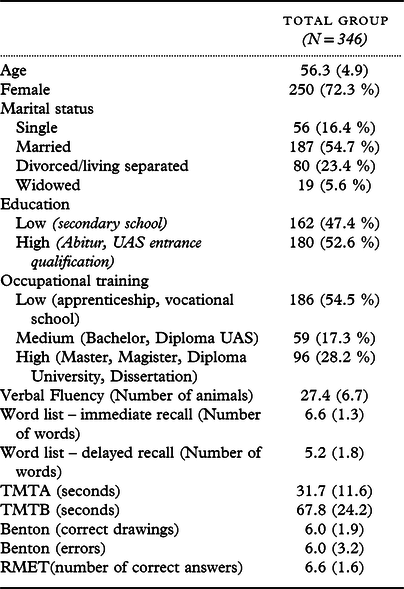
Our study sample consisted of 346 persons, 72.3% female, with an average age of 56.3 years. Detailed information on the study population can be found in Table 1.
General characteristics of the study population

Note: Continuous variables are given as mean (standard deviation); categorical variables are displayed as numbers (percentages).
UAS = University of Applied Sciences; TMTA = Trail Making Test, Version A; TMTB = Trail Making Test, Version B; RMET = Reading Mind in the Eyes Test.
Confirmatory factor analysis
We analyzed eight PMWD-concepts using CFA.
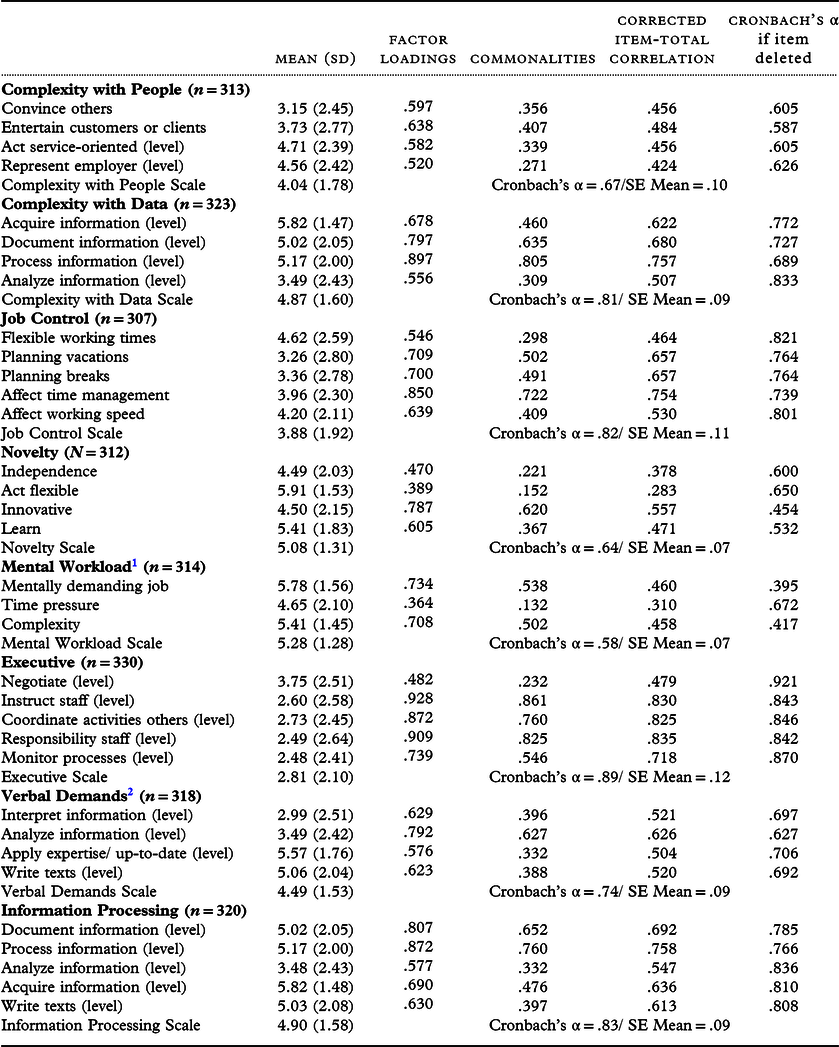
Complexity With People
The original concept contained six variables (RMSEA: .119, p < .001, CFI = .779, TLI = .484). After removing two items (RMSEA: .168, p = .001, CFI = .877, TLI = .385), we added one item and removed another to improve model fit (RMSEA: .032, p = .518, CFI: .996, TLI: .979).
Complexity With Data
The original concept contained eight items (RMSEA: .154, p < .001, CFI = .827, TLI = .689). After removing three items (RMSEA: .189, p < .001, CFI = .909, TLI = .727), we further removed the item with the lowest factor loading to improve model fit (RMSEA: .042, p = .447, CFI: .998, TLI: .988).
Job Control
The original concept contained six variables (RMSEA: .169, p < .001, CFI = .862, TLI = .679). Removing one item improved model fit (RMSEA: .230, p < .001, CFI = .852, TL I = .557).
Novelty
The original concept contained five items (RMSEA: .049, p = .444, CFI = .962, TLI = .887). After removing two items (RMSEA: .192, p < .001, CFI = 1.000, TLI = not available), we added one item suggested by experts as it matched theoretically and improved model fit (RMSEA: .035, p = .498, CFI: .995, TLI: .975).
Mental Work Load
The original concept contained three items. Since it could not be further reduced, this remained the final model (RMSEA: .241, p < .001, CFI: 1.000, TLI: not available).
Executive
The original concept contained five items (RMSEA: .233, p < .001, CFI = .846, TLI = .539). After reducing two items (RMSEA: .453, p < .001, CFI = 1.000, TLI = not available), two items were added since they matched theoretically with the concept and improved model fit (RMSEA: .153, p < .001, CFI: .965, TLI: .896).
Verbal Demands
The original concept contained seven items (RMSEA: .159, p < .001, CFI = .780, TLI = .559). After removing three items, the model fit improved (RMSEA: .174, p = .001, CFI: .923, TLI: .617).
Information Processing
The original concept contained 10 items (RMSEA: .164, p < .001, CFI = .724, TLI = .567). After removing items with commonalities below .3 (RMSEA: .302, p < .001, CFI = .875, TLI = .375), we added two items and removed one further item to achieve better fit (RMSEA: .081, p = .098, CFI: .982, TLI: .947).
Results from the CFAs are displayed in detail in Table 2.
Results from the confirmatory factor analysis and reliability analysis of existing concepts of protective mental work demands

Note: SE = standard error.
1 The Mental Workload scale is part of the final questionnaire.
2 The Verbal Demands scale was adapted for the final version of the questionnaire. The scale in this table represents the final version.
Principal component analyses
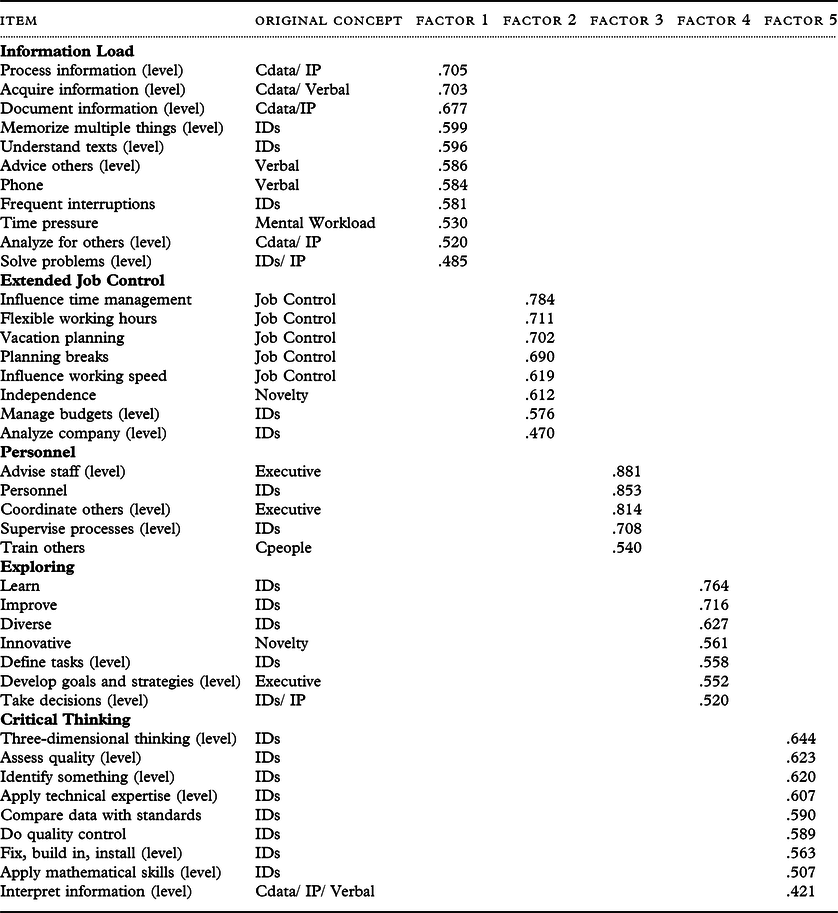
Results from the PCA were obtained in a step-wise manner. After five iterations and the exclusion of 20 items due to insufficient factor loadings and/or commonalities, we reached the final item pool with all factor loadings above .4 and no double loadings. Table 3 shows the rotated component matrix from the final PCA.
Rotated component matrix of the principal component analysis (original factors before item reduction)

Note: Cdata = Complexity with Data; Cpeople = Complexity with people; IP = Information Processing; IDs = Intellectual Demands.
The PCA resulted in five components:
Information Load
Factor 1 contained 11 items with loadings from .485 to .705, with items from the original concepts Complexity with Data (n = 4), Intellectual Demands (n = 4), Verbal Demands (n = 2), and Mental Workload (n = 1). After running CFAs, Information Load contains six items (RMSEA: .127, p < .001, CFI: .934, TLI: .846).
Extended Job Control
Factor 2 contained eight items mainly from the concept Job Control (n = 5), but also Intellectual Demands (n = 2) and Novelty (n = 1). Factor loadings range from .470 to .784. After CFAs, Extended Job Control comprises six items (RMSEA: .196, p < .001, CFI: .843, TLI: .633).
Personnel
Factor 3 consisted of five items with factor loadings from .540 to .881 and contains items from Executive (n = 2), Intellectual Demands (n = 2), and Complexity with People (n = 1). Finally, Personnel covers four items (RMSEA: .210, p < . 001, CFI: .972, TLI: .859).
Exploring
Factor 4 contained seven items from the concepts Intellectual Demands (n = 5), Novelty (n = 1), and Executive (n = 1) with factor loadings ranging from .520 to .764. The final Explore scale contained five items (RMSEA: .191, p < . 001, CFI: .906, TLI: .719).
Critical Thinking
Factor 5 comprised nine items with factor loadings from .421 to .644 that come from the concepts Intellectual Demands (n = 7) and Complexity with Data (n = 2). Due to the fact that all factor loadings were sufficient and every reduction of items caused significant decreases in fit indices, no items were removed from Critical Thinking despite several commonalities being below .3 (RMSEA: .116, p < .001, CFI: .828, TLI: .714).
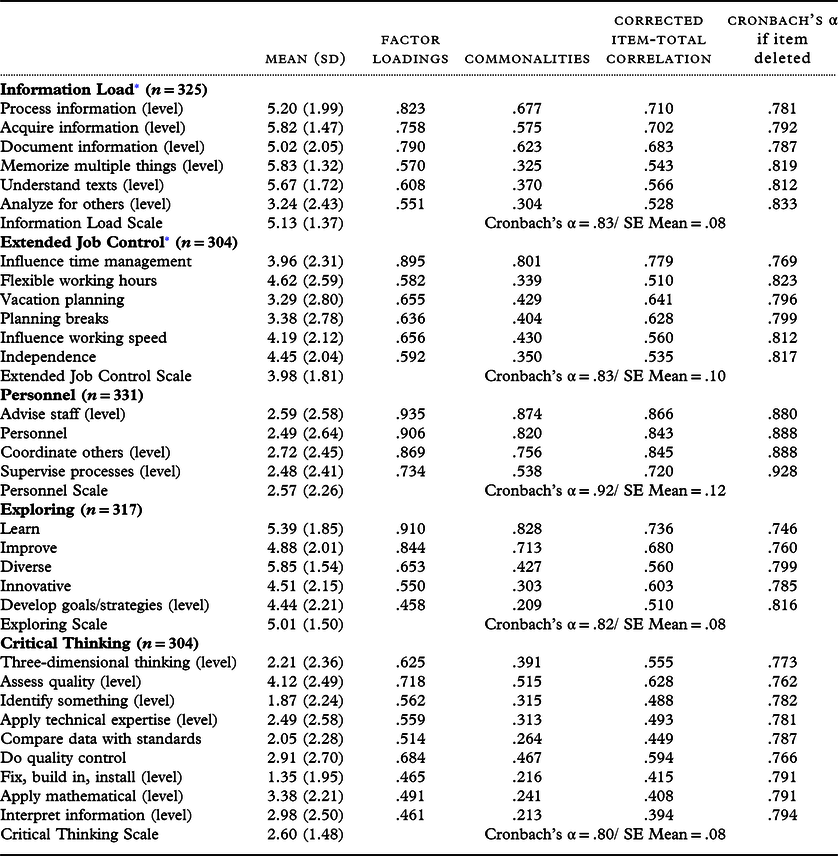
Results from CFAs of final scales can be found in Table 4.
Results from the confirmatory factor analysis and reliability analysis of empirically derived protective mental work demands

Note: SE = standard error.
* The Information Load scale and the Extended Job Control scale are part of the final questionnaire.
Multiple regression analysis
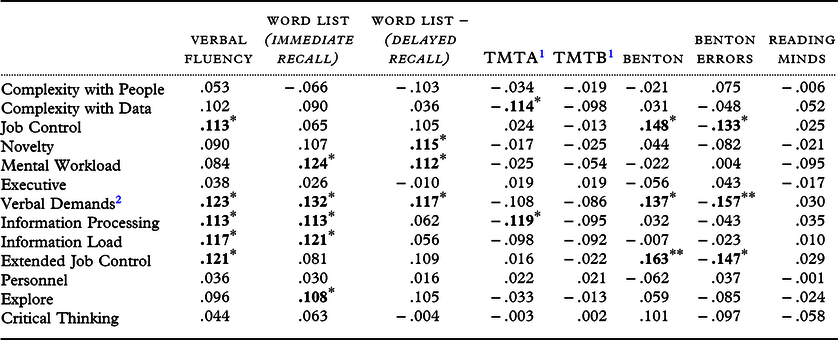
We conducted multiple regression analyses with all 13 PMWD-concepts from CFAs and PCA as predictors, cognitive functioning as outcome, and age, gender, and education as control variables. Results are shown in Table 5. Higher scores on the PMWD factor Verbal Demands were associated with better performance in four cognitive domains (Verbal Fluency, Word List immediate recall, TMTA, and Benton/Benton errors). Higher scores on the PMWD factor Information Processing were associated with better performance in three cognitive domains (Verbal Fluency, Word List immediate recall, and TMTA). Higher scores on the PMWD factors Job Control and Extended Job Control were connected to two domains (Verbal Fluency, Benton/Benton errors), as were those on Mental Workload (Word List immediate recall, Word List delayed) and Information Load (Verbal Fluency, Word List immediate). Complexity with Data (TMTA), Novelty (Word List delayed), and Explore (Word List immediate recall) were associated with only one cognitive domain, and Complexity with People, Executive, Personnel, and Critical Thinking did not have any significant associations.
Regression coefficients of the linear regression analyses of protective mental work demands on cognitive test scores (adjusted for age, gender, and education)

Note: *p ≤ .05; +**p ≤ .01; ***p ≤ .001.
1 Higher scores indicate worse cognitive performance.
2 The Verbal Demands scale was adapted for the final version of the questionnaire. The scale in this table represents the final version.
Final questionnaire
The six PMWD-concepts that were significantly associated with at least two cognitive domains (Job Control, Mental Workload, Verbal Demands, Information Processing, Information Load, and Extended Job Control) contained a total of n = 19 unique items, of which seven are part of two and one is part of three concepts.
All four items of Job Control were part of Extended Job Control and therefore the same construct. Since four out of five items in Information Processing were also part of either Information Load or Verbal Demands, we decided to remove this factor, which resulted in one now “left over” item. “Write texts (level)” was added to Verbal Demands since it matched theoretically as well as empirically. In addition, the item “acquire information (level)” had been part of two scales. Based on our analysis factor loadings, we removed it from Verbal Demands and kept it in Information Load. To validate these decisions, we ran a CFA of the final questionnaire, and the model fit confirms our choice (RMSEA: .097, p < .001, CFI: .824, TLI: .771).
The final questionnaire (Mean: 88.69, SD: 21.47, Median: 91.00, Range: 23–131) now contains 19 unique items and four concepts: Mental Workload, Verbal Demands, Information Load, and Extended Job Control. The final questionnaire can be found in Appendix B (the CFA in Appendix C).
Analysis of item response theory suggested a good variance with discrimination with eight items showing b < 1, seven items with a b between 1 and 2, and four items with a b > 2 (see Appendix D). The item with strongest discrimination, and therefore the best indicator for the latent factor that the instrument measures, is “processing information.” Difficulties displayed a high range from −7.01 to 4.3. There was a great variance in the internal ranges of the answer categories to each item, with “independence” having the largest range (11.3) and representing the full scale of the final questionnaire.
For calculating norms, we created four groups based on gender and education. Group means and cutoffs, i.e. mean minus one standard deviation, were (1) female + low education: M = 79.07, CO = 57.64; (2) female + high education: M = 94.10, CO = 77.02; (3) male + low education: M = 83.55, CO = 57.17; (4) male + high education: M = 97.78, CO = 77.94.
Discussion
The goal of this research was to develop a questionnaire to systematically assess PMWDs that protect against cognitive decline and dementia. Starting with a great variety of existing concepts, our final questionnaire now contains four concepts of PMWDs: Mental Workload, Verbal Demands, Information Load, and Extended Job Control. Detailed analyses of our initial item pool led to the exclusion of the concepts Complexity with People, Complexity with Data, Novelty, Executive, Personnel, Explore, and Critical Thinking since they exhibited insufficient associations with cognitive functioning and the exclusion of Job Control and Information Processing due to item overlap with other concepts.
Theoretical considerations
The concepts that form the final questionnaire center on information load, including verbal information processing, and job control. One approach to understanding the beneficial effects of complex information processing on cognitive outcomes can be found in the concept of cognitive reserve, i.e. the “ability to optimize or maximize performance through differential recruitment of brain networks, which perhaps reflect the use of alternate cognitive strategies” (Stern, Reference Stern2002). High demands on information processing at work may stimulate the growth and maintenance of this cognitive reserve that could be understood as an active coping strategy to deal with age-related cognitive constraints as well as pathological changes. Indeed, the cognitive reserve brain network that researchers have identified seems to include areas on cognitive control for upregulating task-relevant processes and downregulating distraction (Stern et al., Reference Stern2018). Complex information processing at work may train exactly these networks. Further, verbal memory is considered to be a marker for cognitive reserve in elderly people (Zahodne et al., Reference Zahodne2015). Thus, it is likely that work demands that train verbal memory thereby contribute to a cognitive reserve. Further studies are necessary to validate these assumptions.
Mental workload
Mental Workload could be seen as a very general, comprehensive measure of work-related cognitive stimulation due to a complex work environment which matches with the rather broad and general conceptualization in the literature (Bosma et al., Reference Bosma2003a; Bosmaet al., Reference Bosma2003b). Our data show that it is associated with learning and memorizing new information.
Verbal demands
Verbal Demands describe the cognitive stimulation of work tasks that contribute to the accumulation of knowledge, facts, and verbal skills that are acquired through life (Then et al., Reference Then2013). This idea is well reflected in the items of our Verbal Demands scale, which refer to the analysis and interpretation of information, the writing of texts, and the application of expert knowledge, all of which require the previous accumulation of knowledge.
The broad and pervasive nature of the Verbal Demands scale is also reflected in the fact that it is associated with four different cognitive domains: language, learning, memory, and perceptual-motor skills. Verbal Demands could be understood as a factor representing crystallized experience as it is reflected in intelligence and can be connected to reduced dementia risk (McGurnet al., Reference McGurn, Deary and Starr2008; Russ et al., Reference Russ2017). More research is needed to determine how different experiences and accumulated knowledge throughout the lifespan, and their cognitive and neural correlates, translate into cognitive reserve.
Information load
Information Load emerged as the first factor in the PCA, and the final scale contains all four items from Complexity with Data and two items from Intellectual Demands, “keeping in mind multiple things” and “reading and understanding texts.” We can, therefore, argue that Information Load represents a modern, empirically tested, self-reported German adaption of Complexity with Data, a concept that is widely used in the literature (Correa Ribeiro et al., Reference Correa Ribeiro, Lopes and Lourenco2013; Dekhtyar et al., Reference Dekhtyar2015; Lane et al., Reference Lane2017), and it was connected to lower risks for dementia and/or cognitive decline in 8 out of 13 studies in our systematic review (Hussenoeder et al., Reference Hussenoeder2019).
The strong correlation of Information Load with Verbal Demands (r = .72, p ≤ .001) reflects the conceptual as well as empirical closeness between both concepts, i.e. between the complexity of an environment and the cognitive stimulation from acquiring knowledge and skills as a way of adapting to and flourishing in that environment.
Extended job control
According to the literature, job control reflects the extent to which one can use personal judgment or decision authority to assert control in the workplace (Andel et al., Reference Andel2015), specifically with regard to work time and tasks (Sabbath et al., Reference Sabbath2016). The literature shows that low job control is associated with decreased cognitive performance (Andel et al., Reference Andel2011), episodic memory (Andel et al., Reference Andel2015), executive functioning, psychomotor speed, phonemic and semantic fluency in later life (Sabbath et al., Reference Sabbath2016), and with increased dementia risk (Seidler et al., Reference Seidler2004).
Our factor Extended Job Control mainly reflects control over time with five items addressing time management, flexible hours, planning vacations, planning breaks, and working speed. In addition, it includes one general item asking for independence covering tasks as well as time.
Our scale is significantly associated with verbal fluency, matching with the fact that higher job control most likely implies a heightened need to organize, coordinate, and therefore communicate with others leading to higher levels of cognitive reserve in the verbal area. In addition, there is an association between Extended Job Control and perceptual motor skills and visual memory that could represent an ability to adapt to new and different tasks, i.e. a form of cognitive flexibility or creativity that is connected to high levels of job control. In addition, there is a well-established link between stress and cognitive performance (Sandi, Reference Sandi2013), and the beneficial effects of Extended Job Control could to some extend be the consequence of stress reduction due to control over one’s own working pace. Clearly, more research is needed to better understand the connection between this important PMWD and visual memory.
In addition, Extended Job Control could also be protective in another way, i.e. by being protective against depression, a risk factor for dementia (Hussenoeder and Riedel-Heller, Reference Hussenoeder and Riedel-Heller2018). Literature shows that low job control, especially in combination with high job demands, is connected to depressive symptoms and other mental disorders (Åhlin et al., Reference Åhlin, LaMontagne and Magnusson Hanson2019; Harvey et al., Reference Harvey2017), while high job control is associated with good mental health (Fan, Mustard and Smith, Reference Fan, Mustard and Smith2019). Moreover, depression is currently discussed both as a risk factor for and a prodromal symptom of dementia (Cherbuin et al., Reference Cherbuin, Kim and Anstey2015; Deckers et al., Reference Deckers2015; Heser et al., Reference Heser2013).
Limitations
While this work benefits from comprehensive theoretical foundations as well as detailed cognitive testing, there are several limitations. There is an overrepresentation of white collar employees as compared to blue collar workers, of women, and of individuals with higher education limiting the generalizability of our results. On a methodological level, test–retest reliability needs to be established as well as predictive validity in a longitudinal follow-up. Minimally important differences and differential item functioning analysis need to be done retrospectively with a clinical group, as the problem is that people with dementia due to nature of memory problems cannot answer the questionnaires themselves. In addition, our self-assessment of complexity may be less appropriate to predict cognitive functioning then expert-assessed complexity rating measures. Traditionally, almost all operationalizations in the literature are based on the Dictionary of Occupational Titles (DOT) (ICPSR, 2017), a U.S. job classification system. The DOT allows researchers to connect job titles with expert-rated complexity scores unbiased by individual perceptions.
Conclusion
With dementia being a highly prevalent, terminal disease in old age, efforts must be focused on preventative factors. Having an intellectually challenging lifestyle is such a preventative factor and intellectual demands at work seem to contribute to that (Then et al., Reference Then2014). However, until today, there was no standardized way to assess intellectual demands at work that have the potential to protect against dementia. We developed and evaluated a first questionnaire to assess PMWDs that are protective for cognitive functioning as a foundation for further research and application. Our work led to a questionnaire in “Stage 2: Developmental – Calibration Phase” according to the “Instrument Development and Validation Scientific Standards” (PROMIS, 2013). Further steps are necessary to validate it longitudinally. In the long run, our questionnaire can help practitioners to assess individual workplaces, develop and evaluate interventions, and to create mentally healthier workplaces. On the policy level, our work may contribute to guidelines for working environments that help protect brain health and that will shape the future of work at a time of demographic change.
Conflict of interest
None.
Description of authors’ roles
FSH managed data collection, wrote the paper, and conducted analyses. FSR designed the study, supervised data collection and analysis, and assisted with writing the paper. SGRH and IC assisted with writing the paper and contributed to project management, organization of data assessment, and participant recruitment.
Acknowledgments
The study was funded by the German Research Foundation DFG (TH 2137/3-1).
Supplementary Material
To view supplementary material for this article, please visit https://doi.org/10.1017/S1041610220000654