INTRODUCTION
Management and organization studies have turned increasing interest to top management team (TMT) and leadership interactions. Prior TMT studies have long focused on direct relationships between TMT demographics and outcomes for organizations and teams (Bantel & Jackson, Reference Bantel and Jackson1989; Finkelstein & Hambrick, Reference Finkelstein and Hambrick1990; Michel & Hambrick, Reference Michel and Hambrick1992; Wiersema & Bantel, Reference Wiersema and Bantel1992). However, some researchers have questioned demographic predictors for emphasizing the ‘team’ aspect of the coalition and ignoring the role of CEOs who dominate elite policy-making groups (Perterson, Smith, Martorana, & Owens, Reference Peterson, Smith, Martorana and Owens2003). In addition, researchers have paid little attention to how CEO leadership affects team and organizational performance (Carmeli, Schaubroeck, & Tishler, Reference Carmeli, Schaubroeck and Tishler2011; Farrell, Flood, Hmaccurtain, Jeremydawson, & West, Reference Farrell, Flood, Hmaccurtain, Jeremydawson and West2005). To potentially refine TMT studies, it is essential to unravel the overlooked intervening process between CEO leadership and team outcomes (Hambrick, Reference Hambrick, Smith and Hitt2005). For instance, conflict is inevitable in TMT decision-making processes (Amason, Reference Amason1996), and CEOs play important roles in shaping the conflict culture (Gelfand, Leslie, Keller, & De Dreu, Reference Gelfand, Leslie, Keller and De Dreu2012). As such, conflict is likely to be one underlying mechanism through which CEO leadership influences TMT decision effectiveness. Therefore, this study focuses on a more specific evaluation of CEO leadership as it affects TMT decision outcomes and of intervening mechanisms such as team conflict.
Meanwhile, leadership researchers are calling for more culturally specific indigenous studies to examine how cultural and institutional forces affect executive behaviors and organizational outcomes (Li, Leung, Chen, & Luo, Reference Li, Leung, Chen and Luo2012; Van de Ven & Jing, Reference Van de Ven and Jing2011). One indigenous leadership concept, paternalistic leadership, emerged from the Chinese context (Farh & Cheng, Reference Farh, Cheng, Li, Tsui and Weldon2000). Paternalistic leadership is prevalent in regions such as Asia-Pacific, Latin America, and the Middle East (Pellegrini & Scandura, Reference Pellegrini and Scandura2008). In the Chinese traditional culture, paternalistic leadership has been found to affect organizational functioning (e.g., Chan, Huang, Snape, & Lam, Reference Chan, Huang, Snape and Lam2013; Chen, Eberly, Chiang, Farh, & Cheng, Reference Chen, Eberly, Chiang, Farh and Cheng2014; Cheng, Chou, Huang, Wu, & Farh, Reference Cheng, Chou, Huang, Wu and Farh2004; Wu, Huang, Li, & Liu, Reference Wu, Huang, Li and Liu2011). The current study focuses on the role of CEO paternalistic leadership in affecting TMTs’ strategic decision making (Cheng, Huang, & Chou, Reference Cheng, Huang and Chou2002). We integrate paternalistic leadership theory, team conflict theory, and relevant TMT theories to develop a comprehensive understanding of how paternalistic leadership and team conflict relate to TMT decision effectiveness. We conduct this study in the Chinese business context.
Most empirical studies indicate that the three paternalistic leadership dimensions – authoritarianism, benevolence, and morality – have different effects (Chen et al., Reference Chen, Eberly, Chiang, Farh and Cheng2014; Cheng et al., Reference Cheng, Chou, Huang, Wu and Farh2004; Wu et al., Reference Wu, Huang, Li and Liu2011), casting doubt on whether an overall concept of paternalistic leadership is valid (Pellegrini & Scandura, Reference Pellegrini and Scandura2008). Some scholars attribute the confusing findings to changes in China's significant political–cultural landscape (Farh, Liang, Chou, & Cheng, Reference Farh, Liang, Chou, Cheng, Chen and Lee2008) and call for further inquiry into paternalistic leadership from an indigenous perspective (Chen et al., Reference Chen, Eberly, Chiang, Farh and Cheng2014). Transitional China offers a dynamic setting for exploring the dimensional effects of paternalistic leadership, as well as the effect of potential cultural and institutional driving forces.
Prior research regarding conflict was mainly limited to TMTs in Western contexts and found that cognitive and affective dimensions of conflict usually had a double-edged sword regarding team performance (see Jehn, Greer, Levine, Szulanski, Reference Jehn, Greer, Levine and Szulanski2008, for a review). However, research conducted in China suggested that certain leadership styles and conflict resolution approaches could enhance team effectiveness (Chen et al., Reference Chen, Liu and Tjosvold2005). These findings offer us a rich opportunity for advancing our understanding of how cognitive and affective conflict affect Chinese TMTs and the role of CEO paternalistic leadership in TMT conflict management.
In summary, our study advances prior research by testing TMT conflict theory in China's transitional context. We enhance understanding of conflict effects on TMT decision making by incorporating CEO roles and their paternalistic leadership style into TMT strategic decision-making processes. Finally, we offer insights into paternalistic leadership and decision effectiveness by exploring TMT conflict as a mediator.
THEORETICAL BACKGROUND AND HYPOTHESES
Paternalistic Leadership: Concept and Cultural Roots
Since the 1960s, China and Southeast Asian countries have shown explosive entrepreneurial growth. In response, Western scholars have studied overseas Chinese business practices and have found that paternalism is a distinct and effective indigenous leadership style (Redding, Reference Redding1990; Silin, Reference Silin1976; Westwood, Reference Westwood1997). Based on a thorough review of the extant research, Farh and Cheng (Reference Farh, Cheng, Li, Tsui and Weldon2000) further developed a Chinese indigenous theoretical framework of paternalistic leadership. They define paternalistic leadership as ‘a style that combines strong discipline and authority with fatherly benevolence and moral integrity’ (94). They proposed that paternalistic leadership consists of three seemingly paradoxical dimensions: authoritarianism, benevolence, and morality. Authoritarian paternalistic leaders are commanding and controlling; they demand that subordinates obey without question. Benevolent paternalistic leaders show individualized, holistic concern for subordinates’ personal and family well-being. Moral paternalistic leaders demonstrate superior personal virtues and thus lead by example.
Paternalistic leadership is deeply rooted in Chinese culture through ancient Confucianism and Yin Yang (阴阳) philosophies. The three most essential Confucian principles of ren (仁, benevolence, kindness), yi (义, righteousness), and li (礼, proper conduct) have important influences on paternalistic leadership (Farh & Cheng, Reference Farh, Cheng, Li, Tsui and Weldon2000). First, benevolence originates from the principle of ren (仁), which emphasizes mutuality, harmony, and reciprocity (bao, 报) of social relations. It requires that superiors protect subordinates and that subordinates are loyal to the superior. Second, morality is rooted in Confucian ethics that incorporate yi (义) and li (礼). Under the principle of yi (义), superiors are expected to achieve self-control and serve as role models for subordinates. Li (礼) also requires superiors to treat followers fairly for establishing and maintaining harmony. Authoritarianism stems from an essential Confucian value that encourages hierarchy, the ‘five cardinal relations’ (五伦) in which ‘higher ups govern, lower ranks obey’ (Beamer, Reference Beamer1998: 54).
How can paternalistic leadership embrace conflicting elements of benevolence, morality, and authoritarianism? The answer may lie in the Yin Yang (阴阳) perspective (Wu et al., Reference Wu, Huang, Li and Liu2011). Yin Yang (阴阳) assumes a worldview involving ‘three tenets’ of duality: holistic, dynamic, and dialectical dualities. Contrasting with the Western view that paradoxes are exclusive opposites, Yin Yang (阴阳) conceives of paradox as interdependent opposites (Li, Reference Li2008). Thus, Chinese culture can embrace inherently paradoxical traits of any given cultural dimension (Fang, Reference Fang2012); Confucian-oriented value systems can allow the coexistence of potential paradoxical principles of ren (仁), li (礼), and hierarchy, so that paternalistic leadership can include the three seemingly conflicting holistic, dynamic, and dialectical components of benevolence, morality, and authoritarianism.
Recent empirical studies conducted in the Chinese context suggest that the three paternalistic leadership dimensions inconsistently affect subordinate and organization outcomes (Chen et al., Reference Chen, Eberly, Chiang, Farh and Cheng2014; Cheng et al., Reference Cheng, Chou, Huang, Wu and Farh2004; Wu et al., Reference Wu, Huang, Li and Liu2011). Analyzing and comparing the different effects of each dimension can provide ‘a more nuanced picture of the dimensional effect’ (Chen et al., Reference Chen, Eberly, Chiang, Farh and Cheng2014: 16). Following that research, we focus on the effect of each dimension of paternalistic leadership on TMT conflicts and decision effectiveness.
CEO Paternalistic Leadership Effects on TMT Decision Effectiveness
TMTs are senior executives who hold positions at or above vice-presidential levels and who report directly to upper-level CEOs (Carmeli et al., Reference Carmeli, Schaubroeck and Tishler2011). TMT studies focusing on decision effectiveness have explained that if TMTs are to produce and implement sustainable effective decisions, they must make decisions that have quality, consensus, and affective acceptance (Amason, Reference Amason1996). Decision quality measures how well a single decision contributes to team and organizational performance. Consensus refers to agreements among team members regarding understanding and commitment to decisions. Affective acceptance implies that team members feel long-term positive sentiments toward the team.
In the Chinese context, CEO paternalistic leadership is expected to be related to TMT decision effectiveness for the following reasons. First, benevolent leadership entails shi-en (施恩, favor granting), such as individualized care, understanding, and forgiving. Benevolent CEOs are likely to avoid embarrassing team members in public and will help them save face even in extreme cases (Farh et al., Reference Farh, Liang, Chou, Cheng, Chen and Lee2008). They create supportive atmospheres that encourage member participation, information vigilance, cognitive diversity and dissent, and careful consideration of various alternatives (De Dreu & West, Reference De Dreu and West2001). For similar reasons, benevolent CEOs can also stimulate cognitive diversity that creates better awareness and synthesizes various decision alternatives (Miller, Burke, & Glick, Reference Miller, Burke and Glick1998), which may ensure that the team shares common understanding of rationales underlying final decisions. By actively listening to members and incorporating their ideas into final recommendations, benevolent leaders may encourage members to participate and be committed to decisions (Korsgaard, Schweiger, & Sapienza, Reference Korsgaard, Schweiger and Sapienza1995). Finally, benevolent CEOs treat followers as family members, help them resolve personal crises, and provide job security (Farh et al., Reference Farh, Liang, Chou, Cheng, Chen and Lee2008). As a result, members feel affective commitment to the team and organization (Erben & Guneser, Reference Erben and Guneser2008) and develop positive within-team affect (Korsgaard et al., Reference Korsgaard, Schweiger and Sapienza1995).
Second, the Chinese CEO improves TMT decision effectiveness with moral leadership, which springs from shu-de (树德, serving as a role model), such as through unselfishness and leading by example. Highly moral CEOs tend to place group interest ahead of personal interest and never abuse their authority for personal gain (Farh et al., Reference Farh, Liang, Chou, Cheng, Chen and Lee2008). Their TMTs are more likely to adopt the objectively best solutions or alternatives rather than decisions reflecting CEOs’ personal interests. Treating people fairly and engaging them in the process of decision making rather than merely asking them to execute orders can also enhance group consensus (Becker, Reference Becker2007). Moral leadership creates an ethical work climate (Erben & Guneser, Reference Erben and Guneser2008), which increases team member commitment to common goals beyond self-interests when implementing strategic decisions. The leaders’ morality can encourage members to feel positive sentiments toward one another and toward the team in general, thereby cultivating high levels of trust and cooperation (Chen et al., Reference Chen, Eberly, Chiang, Farh and Cheng2014; Wu et al., Reference Wu, Huang, Li and Liu2011).
Third, the Chinese CEO can distract the TMT from making effective decisions through authoritarian leadership, which comprises four types of li-wei (立威, demonstrating authority) behaviors: authority and control, image building, didactic behaviors, and underestimation of subordinate competence. Authoritarian CEOs usually demand absolute compliance and punish deviants. Within-team conformity pressures may impair the quality of information processed, increase groupthink, and ultimately lead to defective decision making (Larson, Foster-Fishman, & Franz, Reference Larson, Foster-Fishman and Franz1998). Authoritarian CEOs tend to rely on top-down communication in decision making and are unwilling to share or delegate authority to other executives (Farh et al., Reference Farh, Liang, Chou, Cheng, Chen and Lee2008), so that teams are unable to achieve common understanding (Miller et al., Reference Miller, Burke and Glick1998). Furthermore, power centralization usually causes top teams to be enmeshed in political activity that impedes their ability to reach consensus (Finkelstein & Hambrick, Reference Finkelstein and Hambrick1996). Finally, authoritarian leadership may generate anger (Wu, Hsu, & Cheng, 2002), which undermines within-team affective acceptance. Thus, we hypothesize:
-
Hypothesis 1a: CEO benevolent leadership will be positively associated with TMT decision effectiveness.
-
Hypothesis 1b: CEO moral leadership will be positively associated with TMT decision effectiveness.
-
Hypothesis 1c: CEO authoritarian leadership will be negatively associated with TMT decision effectiveness.
Effects of CEO Paternalistic Leadership on TMT Conflict
Team conflict arises from tension among team members because of real or perceived differences. Research has distinguished between cognitive conflict (task related) and affective conflict (relationship related) (Amason, Reference Amason1996). Disagreements regarding decisions, viewpoints, ideas, and opinions related to work tasks, and controversies over the best ways to achieve team goals or objectives, underlie cognitive conflict. Interpersonal incompatibilities in taste, politics, values, and lifestyles often cause animosity, tension, and annoyance, and these are the essence of affective conflict (Simons & Peterson, Reference Simons and Peterson2000).
Paternalistic CEO leadership may predict the extent of conflict in TMT teams (Gelfand et al., Reference Gelfand, Leslie, Keller and De Dreu2012). First, benevolent leaders emphasize harmonious and cohesive working relations that should counter team tensions. They offer positive feedback by coaching and mentoring team members and facilitate open group climates (Wendt, Euwema, & Hatty Van Emmerik, Reference Wendt, Euwema and Hatty van Emmerik2009). Such high-quality communication might allow cognitive conflict to emerge, but would decrease the possibility of interpersonal hostility and frustration that generate affective conflict (Ensley & Pearce, Reference Ensley and Pearce2001). Second, moral leaders serve as examples of unselfishness, honesty, and integrity, which fosters high trust and respect from subordinates (Becker, Reference Becker2007). TMTs characterized by high trust should benefit from cognitive conflicts and experience less negative impacts from affective conflicts (Simons & Peterson, Reference Simons and Peterson2000). As such, moral leadership should stimulate cognitive conflict and suppress affective conflict by cultivating mutuality and trust. Third, CEO authoritarianism may generate more affective conflict and less cognitive conflict. Because authoritarian CEOs tend to control discussions, dominate interactions, guard critical information, and insist on making final decisions, team members are less likely to consider their own alternatives and more likely to comply with their leaders’ solutions (Larson et al., Reference Larson, Foster-Fishman and Franz1998). Team members have weaker emotional attachment and more negative attitudes toward colleagues (Chen et al., Reference Chen, Eberly, Chiang, Farh and Cheng2014; Wu et al., Reference Wu, Huang, Li and Liu2011), so that even sincere disagreements may be misinterpreted as personal attacks and thus provoke affective conflict (Simon & Peterson, Reference Simons and Peterson2000). Those discussions suggest the following hypotheses:
-
Hypothesis 2a: CEO benevolent leadership will be positively associated with cognitive conflict and negatively associated with affective conflict.
-
Hypothesis 2b: CEO moral leadership will be positively associated with cognitive conflict and negatively associated with affective conflict.
-
Hypothesis 2c: CEO authoritarian leadership will be negatively associated with cognitive conflict and positively associated with affective conflict.
Effects of Team Conflict on Decision Effectiveness
TMTs experiencing more cognitive conflict and less affective conflict are more likely to produce high-quality decisions as well as build the commitment and trust necessary to effectively implement their decisions (e.g., Amason, Reference Amason1996; Parayitam & Dooley, Reference Parayitam and Dooley2009; Tjosovold, Law, & Sun, Reference Tjosvold, Law and Sun2006).
Cognitive conflict encourages effective decision making for several reasons. First, cognitive conflict compels team members to synthesize diverse perspectives, which are generally better than individual perspectives for generating the best decisions (Amason, Reference Amason1996). Second, cognitive conflict overcomes confirmatory biases in group decision making (Schulz-Hardt, Brodbeck, Mojzisch, Kerschreiter, & Frey, Reference Schulz-Hardt, Brodbeck, Mojzisch, Kerschreiter and Frey2006) by encouraging team members to evaluate alternatives from various perspectives, fostering deep and thorough understandings of rationales underlying decisions (Parayitam & Dooley, Reference Parayitam and Dooley2009). Third, cognitive conflict enables team members to exercise their voices in the decision process, thereby ensuring that members will remain committed to the decision throughout its implementation (Amason, Reference Amason1996). Finally, cognitive conflict enhances affective acceptance among team members who know that their input was sincerely considered in open negotiations and debates (Korsgaard et al., Reference Korsgaard, Schweiger and Sapienza1995).
Conversely, affective conflict negatively affects TMTs’ decision effectiveness in four interrelated ways. First, affective conflict means that TMT team members may spend most of their time and energy on interpersonal issues rather than decision-related issues, which limits the team's information processing ability (Simons & Peterson, Reference Simons and Peterson2000). Second, affective conflict produces suspicion, distrust, and hostility so that members resist others’ task-related ideas and cannot develop common understandings in relation to broad organizational goals (Pelled, Reference Pelled1996). Third, affective conflict causes more competition and less cooperation by weakening member cohesion and increasing intentions to quit the team (Jehn et al., Reference Jehn, Greer, Levine and Szulanski2008). Finally, affective conflict provokes negative emotions that threaten members’ personal identities and feelings of self-worth, thereby decreasing their satisfaction with one another (De Dreu & Weingart, Reference De Dreu, Weingart, West, Tjosvold and Smith2003) and undermining long-term affective acceptance (Amason, Reference Amason1996). Thus, we advance the following hypotheses:
-
Hypothesis 3a: Cognitive conflict within TMTs will be positively associated with decision effectiveness.
-
Hypothesis 3b: Affective conflict within TMTs will be negatively associated with decision effectiveness.
Team Conflict as a Mediator
Studies have generally reported a systematic relationship between TMT demographics and organizational outcomes (for a review, see Priem, Lyon, & Dess, Reference Priem, Lyon and Dess1999). However, ‘the direct relationships are unlikely to be robust’ (Finkelstein & Hambrick, Reference Finkelstein and Hambrick1996: 156). The demographics approach has been further criticized as a ‘black box of organizational demography’ (2) with ambiguity on the causal gap between predictors and outcomes (Lawrence, 1997). Subsequent researchers have shifted the focus to group-process variables to explore the intervening links between CEO leadership or TMT characteristics and team outcomes (Carmeli et al., Reference Carmeli, Schaubroeck and Tishler2011; Farrell et al., Reference Farrell, Flood, Hmaccurtain, Jeremydawson and West2005; Knight et al., Reference Knight, Pearce, Smith, Olian, Henry, Smith and Flood1999).
Consistent with the intervention approach, we expect that team conflicts partially mediate the relationship between CEO paternalistic leadership and TMT strategic decision-making outcomes. We establish this view based on prior research findings that TMTs tend to make better decisions when they can stimulate cognitive conflict while avoiding affective conflict (Amason, Reference Amason1996) and previous arguments that CEOs’ paternalistic leadership determines the nature of team conflict. Moreover, the literature tends to support the idea that team leaders influence team dynamics, which, in turn, contributes to team performance (Morgeson, DeRue, & Karam, Reference Morgeson, DeRue and Karam2010). CEO paternalistic leadership may be associated with decision effectiveness, because it is positively related with the team's functional conflicts and negatively related with the team's dysfunctional conflicts. However, other mechanisms such as trust (Chen et al., Reference Chen, Eberly, Chiang, Farh and Cheng2014; Wu et al., Reference Wu, Huang, Li and Liu2011) and team behavioral integration (Carmeli et al., Reference Carmeli, Schaubroeck and Tishler2011) may also mediate paternalistic leadership's relationship with TMT performance. We therefore propose partial mediation hypotheses:
-
Hypothesis 4a: TMT team conflict will partially mediate the relationship between CEO benevolent leadership and decision effectiveness.
-
Hypothesis 4b: TMT team conflict will partially mediate the relationship between CEO moral leadership and decision effectiveness.
-
Hypothesis 4c: TMT team conflict will partially mediate the relationship between CEO authoritarian leadership and decision effectiveness.
METHOD
Sample and Procedures
We recruited executives from an EMBA program at a large university located in southwestern China. Participants came from 185 firms in various industries. First, we developed a survey and pretested it on top management members from five firms to assess its clarity. After refining the instrument, we administered 185 surveys to CEOs. To reduce common method variance, we collected data from different sources: TMT members, excluding the CEO, provided data on CEO paternalistic leadership; the CEO and other TMT members provided data on team conflicts; and the CEO provided data on decision effectiveness (Carmeli et al., Reference Carmeli, Schaubroeck and Tishler2011; Carmeli, Tishler, & Edmondson, Reference Carmeli, Tishler and Edmondson2012). We first requested the CEO to describe a specific strategic decision and to identify the senior executives who had actively participated in that decision to complete the TMT surveys. We thus controlled much of the recollection bias by focusing the attention of members from each team on a specific strategic decision (Amason, Reference Amason1996).
We received 117 sets of responses. Four sets of surveys were completed by fewer than three TMT members and were therefore excluded from subsequent analyses. We also excluded another five sets because of missing data, resulting in a useable sample of 108 firms (a valid response rate of 58%). The result of χ2 tests showed no significant differences between 108 responding and 77 nonresponding firms in terms of firm size (χ2 (5) = 1.83, n.s.), industry (χ2 (10) = 3.68, n.s.), and ownership (χ2 (1) = 0.32, n.s.).
The average team in the 108 firms had 6.43 executives, including the CEO; the largest team had 15 executives, and the smallest team had 3 executives. A total of 519 TMT members completed and returned the questionnaires (an average of one CEO and 3.80 team members per firm). The firms in the sample operated in diverse industries including manufacturing (21.3%), energy and chemical (21.3%), construction and real estate (12%), communication and information technology (10.2%), transportation and logistics (9.3%), food (1.9%), trade and retail (5.6%), tourism (3.7%), finance and investment (6.5%), pharmaceutical (5.6%), and other sectors (2.8%). Nearly 54% of the sample firms belonged to state-owned enterprises; 46% belonged to private-owned enterprises.
Measures
Paternalistic leadership
We measured paternalistic leadership using items from Farh, Cheng, Chou, and Chu (2006), which is a short version of Cheng, Chou, and Farh's (Reference Cheng, Chou and Farh2000) original scale, often used in mainland China.Footnote [1] Respondents rated the leadership style of their CEOs using four items for morality, six items for benevolence, and eight items for authoritarianism (1 = strongly disagree, 6 = strongly agree). The original measure for authoritarianism comprised nine items. We eliminated the item ‘In my supervisor's mind, the ideal subordinate always obeys his/her wishes’, because the meaning was similar to the item ‘my supervisor asks me to obey his/her instructions completely’. Sample items: for morality, ‘CEO treats team members fairly without bias’; for benevolence, ‘CEO takes good care of team members’ family members’; and for authoritarianism, ‘CEO determines all organizational decisions regardless of their importance’. Cronbach's alpha reliabilities for morality, benevolence, and authoritarianism were 0.84, 0.85, and 0.80, respectively.
Team conflict
We measured team conflict using Amason's (Reference Amason1996) scale. Respondents rated conflict regarding decision making within their teams using three items for cognitive conflict and three items for affective conflict (1 = none, 6 = a great deal). We conducted a pretest among top management members from five firms to assess the survey's clarity. The respondents suggested that affective conflict item 4 (‘how much tension did the group experience during this decision’?) was not applicable in the Chinese context, because tension might be interpreted as pressure and stress caused by the task rather than interpersonal relationships. Also, we noticed that in Amason's (Reference Amason1996) study, this item had the lowest factor loading (0.77) among the four items of affective conflict. Therefore, we eliminated item 4 and kept the other three items for measuring affective conflict. A sample item for cognitive conflict is ‘how many disagreements occurred over different ideas about this decision’? A sample item for affective conflict is ‘how much anger did the group have over this decision’? Cronbach's alpha reliabilities for cognitive conflict and affective conflict were 0.75 and 0.80, respectively.
Decision effectiveness
Decision effectiveness was measured using Amason's (Reference Amason1996) scale in four dimensions: decision quality (three items), understanding decision (six items), commitment to decision (six items), and affective acceptance (two items). A sample item for decision quality was ‘What do you think about the quality of the decision relative to its original intent’? (1 = very poor, 6 = extremely excellent). A sample item for understanding the decision was ‘How much were concerns about cost control and efficiency influencing the decision making’? (1 = had no influence, 6 = had significant influence). A sample item for commitment was ‘How much did you personally argue for the alternative that became the final decision’? (1 = none, 6 = a great deal). A sample item for affective acceptance was ‘Did you enjoy working with the group on that decision’? (1 = strongly disagree, 6 = strongly agree). Cronbach's alpha reliabilities for decision quality, understanding of decision, commitment to decision, and affective acceptance were 0.84, 0.92, 0.81, and 0.84, respectively.
Control variables
We controlled for TMT demographic variables (age, education level, and tenure), CEO tenure, team size, firm size, and ownership in line with previous research (Amason, Reference Amason1996; Carmeli, Reference Carmeli, Schaubroeck and Tishler2011; Makri & Scandura, 2010; Schaubroeck & Lam, 2007; Shin & Zhou, 2007). We obtained measures of TMT demographic variables from TMT members. A five-level coding was used for education (1 = high school, 2 = college, 3 = bachelor's degree, 4 = master's degree, and 5 = Ph.D.). Age and tenure were self-reported in years. All variables were calculated as the averages for a TMT. The CEO of each team provided measures of CEO tenure, team size, firm size, and ownership with dummy coding used for ownership (0 = private-owned enterprise, 1 = state-owned enterprise). Team size was the number of executives of the entire team including the CEO. Firm size was the number of employees in the firm. The natural log transform of firm size was used in the analyses. CEO tenure was self-reported in years.
Construct Validity
We conducted confirmatory factor analyses (CFA) by using individual-level data (TMT members excluding CEOs) to test the construct distinctiveness of the three components of paternalistic leadership and the two types of team conflict. The five-factor model with all indicators fits the data better (χ2/d.f. = 3.91, RMSEA = 0.08, NNFI = 0.97, CFI = 0.97, GFI = 0.85, SRMR = 0.09) than the four alternative models: a four-factor model in which morality, benevolence, and authoritarianism are distinct, whereas cognitive and affective conflict are combined (χ2 /d.f. = 11.13, RMSEA = 0.16, NNFI = 0.89, CFI = 0.91, GFI = 0.65, SRMR = 0.22); a three-factor model in which morality, benevolence, and authoritarianism are combined, whereas cognitive and affective conflict are distinct (χ2 /d.f. = 10.38, RMSEA = 0.15, NNFI = 0.92, CFI = 0.93, GFI = 0.67, SRMR = 0.10); a two-factor model in which morality, benevolence, and authoritarianism are combined, whereas cognitive and affective conflict are combined (χ2 /d.f. = 13.69, RMSEA = 0.18, NNFI = 0.88, CFI = 0.90, GFI = 0.60, SRMR = 0.12); and a one-factor model in which all five indicators are combined (χ2 /d.f. = 18.34, RMSEA = 0.21, NNFI = 0.84, CFI = 0.86, GFI = 0.53, SRMR = 0.13).
Next we performed CFA by using team-level data to examine the constructive distinctiveness of the two dimensions of team conflict and decision effectiveness. The results demonstrate that the one-high-order-factor model of decision effectiveness (χ2 /d.f. = 1.70, RMSEA = 0.08, NNFI = 0.94, CFI = 0.95, GFI = 0.82, SRMR = 0.06) yields a similar result to the four-factor model (χ2 /d.f. = 1.71, RMSEA = 0.08, NNFI = 0.94, CFI = 0.95, GFI = 0.83, SRMR = 0.06). For parsimony, we used the one-factor model of decision effectiveness as the dependent variable for further analysis in our study. Furthermore, the CFA results show that the three-factor model (of decision effectiveness and cognitive and affective conflict) (χ2 /d.f. = 1.05, RMSEA = 0.02, NNFI = 0.99, CFI = 0.99, GFI = 0.94, SRMR = 0.05) exhibits a better fit than the two alternative models: a two-factor model in which cognitive and affective conflict are combined, whereas four decision effectiveness dimensions are combined (χ2 /d.f. = 3.37, RMSEA = 0.15, NNFI = 0.84, CFI = 0.88, GFI = 0.82, SRMR = 0.10); and a one-factor model in which cognitive conflict, affective conflict, and four decision effectiveness dimensions are combined (χ2 /d.f. = 3.57, RMSEA = 0.16, NNFI = 0.81, CFI = 0.85, GFI = 0.81, SRMR = 0.10). In sum, the construct distinctiveness of the three components of paternalistic leadership and the two dimensions of conflicts and decision effectiveness was supported.
Within-Group Agreement and Aggregating of Data
We performed a one-way analysis of variance to test the consistency of individuals’ responses to the measures of paternalistic leadership and team conflicts. The ratings between teams showed greater variability than within teams (p < 0.01). We also computed intragroup reliability (Rwg) and intraclass correlations (ICCs) to access group member reliability (Carmeli et al., Reference Carmeli, Schaubroeck and Tishler2011). The values of Rwg, ICC [1] and ICC [2] for the measures of paternalistic leadership and team conflicts, were as follows: 0.91, 0.45, and 0.79 for benevolent leadership; 0.92, 0.46, and 0.80 for moral leadership; 0.91, 0.36, and 0.72 for authoritarian leadership; 0.94, 0.58, and 0.76 for cognitive conflict; and 0.96, 0.75, and 0.87 for affective conflict. The results support aggregation at the team level (George, Reference George1990; James, Demaree, & Wolf, Reference James, Demaree and Wolf1984). We then aggregated the individual responses for paternalistic leadership and team conflicts into team-level data for further analysis.
Assessing the Effects of Common Method Variance
We conducted structural equation modeling (SEM) analyses to assess the potential impact of common method bias on the hypothesized relationships (Chang, van Witteloostuijn, & Eden, Reference Chang, van Witteloostuijn and Eden2010; Podsakoff, MacKenzie, Lee, & Podsakoff, Reference Podsakoff, MacKenzie, Lee and Podsakoff2003). We compared Model A, the theoretically hypothesized model, to Model B, a model with two latent CMV factors added to the original theoretically hypothesized model. One of these two extra CMV factors was defined as having measures reported by CEOs (i.e., TMT conflict measures and decision outcome measures) as indicators; the other was defined as having measures reported by TMT members (i.e., paternalistic leadership measures and TMT conflict measures) as indicators, thus capturing any additional systematic method variance common to these measures (e.g., common rate bias, social desirability, ‘yes-saying’, etc.) (Chang et al., Reference Chang, van Witteloostuijn and Eden2010). The SEM analyses results showed that both Model A (χ2 /d.f. = 1.71, RMSEA = 0.08, CFI = 0.95, TLI = 0.94, SRMR = 0.07) and Model B yielded a good fit to the data (χ2 /d.f. = 4.75, RMSEA = 0.07, CFI = 0.95, TLI = 0.94, SRMR = 0.07). This result suggests that our theoretical model fitted the data reasonably well with and without controlling two extra CMV factors. Therefore, common method variance did not substantially influence the hypothesized relationships between the leader behaviors, mediators, and outcome variable.
Analyses for Hypotheses Testing
First, we conducted a path analysis to test the overall validity of our research model. Then we used hierarchical regression analysis to test the research hypotheses as all the variables included in this study were measured as team-level data. We first entered a series of control variables including TMT (excluding CEO) age, education, tenure, CEO tenure, team size, firm size, and ownership. To ensure that multicollinearity would not threaten the results of regression analysis, all the above control variables were standardized. To test the mediation effects of team conflict, we used the following four-step procedure outlined by Baron and Kenny (Reference Baron and Kenny1986): (1) determine whether a significant relationship exists between the independent variable and mediator, (2) determine whether a significant relationship exists between the independent variable and dependent variable, (3) determine whether a significant relationship exists between the mediator and dependent variable, and (4) control for the influence of the mediator while determining whether the original relationships between the independent variable and dependent variable are reduced to nonsignificance or become smaller. In addition, we examined the variance inflation factor (VIF) and condition index for each regression line to investigate the degree of multicollinearity in our study. Furthermore, we performed a Sobel test (1982) to test whether cognitive and affective conflict had significant mediating effects. Finally, we conducted two robustness tests: (1) enter sequentially the independent variables to check whether the predictors remain consistent in terms of significance level and direction and (2) randomly select 70% of observations and see whether the results remain generally consistent.
RESULTS
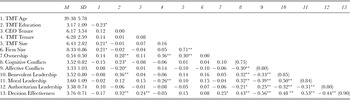
Table 1 presents the means, standard deviations, reliability coefficients, and zero-order correlations of all the variables. Moral leadership and benevolent leadership were each positively associated with cognitive conflict (r = 0.32, 0.32, p < 0.01) and decision effectiveness (r = 0.53, 0.48, p < 0.01), but negatively associated with affective conflict (r = −0.39, −0.33, p < 0.01). Authoritarian leadership was negatively associated with cognitive conflict (r = −0.21, p < 0.05) and decision effectiveness (r = −0.44, p < 0.01) but positively associated with affective conflict (r = 0.25, p < 0.01). Cognitive conflict was positively associated with decision effectiveness (r = 0.43, p < 0.01), whereas affective conflict was negatively associated with decision effectiveness (r = −0.56, p < 0.01). These correlations satisfied the conditions for mediation (Baron & Kenny, Reference Baron and Kenny1986).
Results for descriptive statistics and correlations for all variables

Notes: N = 108. Values on the diagonal (in parentheses) represent Cronbach alphas. Values off the diagonal are correlations between constructs.
*Significant at the 0.05 level. **Significant at the 0.01 level. TMT age denotes TMT average age; TMT education denotes TMT average education level, which ranged from 1(high school), 2(college), 3(bachelor's degree), 4(master's degree), to 5(Ph.D.); TMT tenure education denotes TMT average tenure; and Ownership: 0 denotes private-owned enterprise and 1 denotes state-owned enterprise.
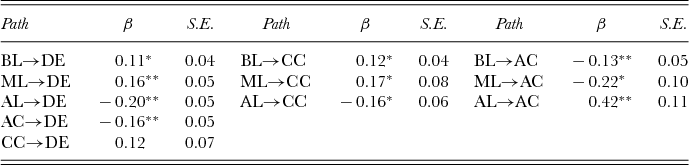
Table 2 represents path analysis results for the hypothesized model. The results for model fit indices indicate that the hypothesized model showed a good fit with the data (χ2/d.f. = 0.85, RMSEA = 0.00, CFI = 1.00, TLI = 1.03, SRMR = 0.01). The results for path coefficients show that benevolent and moral leadership were each significantly and positively associated with decision effectiveness (β = 0.11, p < 0.05; β = 0.16, p < 0.01), whereas authoritarian leadership was significantly and positively related to decision effectiveness (β = −0.20, p < 0.01). In addition, benevolent and moral leadership were each significantly and positively related to cognitive conflict (β = 0.12, 0.17, p < 0.05) but significantly and negatively related to affective conflict (β = −0.13, p < 0.01; β = −0.22, p < 0.05). Authoritarian leadership showed a significant and positive relation to affective conflict (β = 0.42, p < 0.01) and a significant and negative relation to cognitive conflict (β = −0.16, p < 0.05). Finally, affective conflict was significantly and negatively related to decision effectiveness (β = −0.16, p < 0.01), whereas cognitive conflict was positively related to decision effectiveness (β = 0.12, n.s.). Although the magnitude of the relationship between cognitive conflict and decision effectiveness was beyond the threshold of significance, it still showed a marginal significance (p = 0.08).Therefore, the path analysis results provided preliminary evidence for our hypothesized model.
Results for path analysis for hypothesized model

Notes: N = 108. *Significant at the 0.05 level. **Significant at the 0.01 level. BL denotes benevolent leadership; ML denotes moral leadership; AL denotes authoritarian leadership; CC denotes cognitive conflict; AC denotes affective conflict; and DE denotes decision effectiveness.
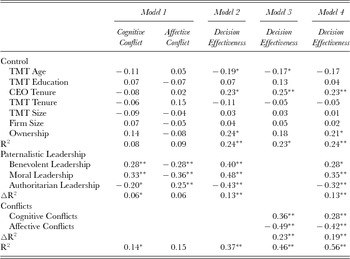
Table 3 represents hierarchical regression analysis results for the hypothesized mediation model. Model 1 shows that benevolent and moral leadership were each significantly and positively related to cognitive conflict (β = 0.28, 0.33, p < 0.01) but significantly and negatively related to affective conflict (β = −0.28, −0.36, p < 0.01). Authoritarian leadership was significantly and positively related to affective conflict (β = 0.25, p < 0.01) but significantly and negatively related to cognitive conflict (β = −0.20, p < 0.05). Therefore, H2a, H2b, and H2c were supported. Model 2 showed that benevolent and moral leadership were each significantly and positively related to decision effectiveness (β = 0.40, 0.48, p < 0.01), whereas authoritarian leadership was significantly and negatively related to decision effectiveness (β = −0.43, p < 0.01). Thus, H1a, H1b, and H1c were supported. Model 3 showed that cognitive conflict was positively associated with decision effectiveness (β = 0.36, p < 0.01), but affective conflict was negatively associated with decision effectiveness (β = −0.49, p < 0.01). Consequently, H3a and H3b were supported. Model 4 indicated that when cognitive conflict and affective conflict were added into the regression model, the initially significant relationship between benevolent, moral, and authoritarian leadership and decision effectiveness did not disappear but decreased to a moderate level (β = 0.28, p < 0.05; β = 0.35, p < 0.01; β = −0.32, p < 0.01). The results suggested that both cognitive and affective conflict partially mediated the relationship between benevolent, moral, and authoritarian leadership and decision effectiveness. Thus, H4a, H4b, and H4c were supported.
Results for hierarchical regression for mediation tests

Notes: N = 108. *Significant at the 0.05 level. **Significant at the 0.01 level.
The results of VIF scores for each variable ranged from 1.04 to 2.56, all of which were below the threshold of serious multicollinearity (typically 10). Meanwhile, the condition index for each model was not beyond 3.09. Thus, multicollinearity appears to be nonexistent in our study, because the condition indexes of 30−100 indicated moderate to strong multicollinearity problems (Belsley, Kuh, & Welsch, Reference Belsley, Kuh and Welsch1980).
The results for Sobel tests also showed that the mediating effect of cognitive conflict was significant between benevolent, moral, and authoritarian leadership and decision effectiveness (z = 2.16, 2.23, −2.12, p < 0.05). Meanwhile, the results also showed that the mediating effect of affective conflict was significant between benevolent, moral, and authoritarian leadership and decision effectiveness (z = 2.46, p < 0.05; z = 2.96, p < 0.01; z = −3.27, p < 0.01). Thus, H4a, H4b, and H4c were supported.
The robustness tests showed that although the bootstraps coefficients of the rest of predictors changed from mild to moderate, benevolent leadership's predictive power was sometimes diminished. For example, when we entered the independent variables sequentially into the regression equations, benevolence as a predictor experienced unstable regression coefficient and presented a nontrivial degree of prediction accuracy in three occasions: (1) in model 1, the standardized regression coefficients between benevolence and cognitive conflict changed from 0.28 (p < 0.01) to 0.14 (n.s.); (2) in model 2, the standardized regression coefficients between benevolence and affective conflict also dropped from –0.28 (p < 0.01) to −0.11 (n.s.); and (3) in model 3, the standardized regression coefficients between benevolence and decision effectiveness changed from 0.40 (p < 0.01) to 0.14 (n.s.). Similarly, the regression results on the basis of randomly selected 70% samples also demonstrated that standardized regression coefficients between benevolence and affective conflict in model 2 dropped from −0.28 (p < 0.01) to −0.20 (n.s.). Despite its unstable predictive power, benevolent leadership retained a positive prediction direction. Therefore, the relatively poor statistical performance of one subdimension (benevolence) of paternalistic leadership did not undermine our general findings.
DISCUSSION
Our primary objective for this study was to understand how Chinese leaders’ paternalistic leadership behaviour influences the quality of TMT interactions and decision effectiveness. We find support for our hypotheses that three dimensions of paternalistic leadership – benevolent, moral, and authoritarian – and types of team conflict – cognitive and affective – are associated with TMT decision effectiveness.
Researchers have observed that East Asians take a contextualized rather than dispositional view of behaviors and that they perceive and reason holistically (Choi, Nisbett, & Norenzayan, Reference Choi, Nisbett and Norenzayan1999). They tend to solve problems through compromise, to prefer arguments based on holism and continuity principles, and to reconcile or transcend seeming contradictions (Nisbett, Peng, Choi, & Norenzayan, Reference Nisbett, Peng, Choi and Norenzayan2001). Chinese, being more holistic, rely on dialectical reasoning paradigms such as Yin Yang (阴阳), a perspective that allows seemingly conflicting elements of paternalistic leadership to coexist, reinforce, and complement each other to shape a holistic, dynamic, and dialectical concept of indigenous leadership (Wu et al., Reference Wu, Huang, Li and Liu2011).
Furthermore, the recent cultural–political transitions in contemporary Chinese society can influence the effects of the three dimensions of paternalistic leadership. As China's prosperity, educational levels, and democratization increase, the foundation for authoritarianism is weakening: the new generation is less willing to accept the Confucian principles of hierarchy and less likely to depend on leaders for resources (Farh et al., Reference Farh, Liang, Chou, Cheng, Chen and Lee2008). Other conventionally accepted Confucian principles such as ren (仁) and li (礼), which emphasize benevolence and morality, are still meaningful to contemporary Chinese leadership. Although the new generation is more likely to disapprove of authoritarian leaders and to make poor decisions under their leadership, modern Chinese workers will make better decisions under benevolent and moral leaders.
Our robustness test results show that benevolent leadership sometimes has unstable predictive power, perhaps because of a relatively high correlation between benevolent and moral leadership (r = 0.50, p < 0.01) and because of our relatively small sample size (N = 108). To ensure reliability of research findings, future researchers should explore the meaning of benevolence in contemporary China and whether Chinese with modern values may expect different forms of benevolence than Chinese with traditional values.
Our results indicate that cognitive and affective conflict are negatively correlated (r = −0.30, p < 0.01), contradicting De Dreu and Weingart's (Reference De Dreu, Weingart, West, Tjosvold and Smith2003) meta-analysis reporting a positive average correlation of 0.47 between cognitive and affective conflict. Their analysis did not involve studies conducted in Chinese contexts, however, so we attribute the inconsistent results to cross-cultural influences. Chinese team members are less likely to allow cognitive disagreements to escalate into full-scale affective conflict, because they place such high value on harmony and social relationships (Chen et al., Reference Chen, Liu and Tjosvold2005).
Theoretical Implications
Our study has important implications for leadership and TMT studies. First, TMT studies have generally focused on a demographic approach. Few studies have taken a leader-centered approach to study the role of CEO personality or leadership in facilitating TMT processes and driving team performance (Peterson, Smith, Martorana, & Owens, Reference Peterson, Smith, Martorana and Owens2003). Our study aims to extend an understanding of CEO paternalistic leadership as it affects TMT conflicts and decision effectiveness. Consistent with studies of transformational, transactional, and empowering CEO leadership styles and their effect on TMT behavioral integration (Carmeli et al., Reference Carmeli, Schaubroeck and Tishler2011) and trust (Farrel et al., Reference Farrell, Flood, Hmaccurtain, Jeremydawson and West2005), we expand Amason's (Reference Amason1996) work and further show that CEO leadership style is a driving force behind TMT dynamics and performance.
Our study adds to the empirical base of paternalistic leadership research by demonstrating that paternalistic leadership has different dimensional effects at upper echelons. Answering Chen et al.'s (Reference Chen, Eberly, Chiang, Farh and Cheng2014) call for further examination on paternalistic leadership's dimensional effects, we show that CEO benevolence, morality, and authoritarianism exert different influences on TMT decision effectiveness because of traditional Confucian principles and Yin Yang (阴阳) philosophy. The findings, therefore, respond to the philosophical debates and conceptual arguments by showing that paternalistic leadership is a holistic, dynamic, and dialectical concept of indigenous leadership.
Our study contributes to the conflict literature by demonstrating that the conflict–decision model, originally developed and widely tested in the Western business context, is generalizable to China (Amason, Reference Amason1996; Simons & Peterson, Reference Simons and Peterson2000). The findings challenge prevalent claims that CEOs and TMT members may have limited interactional conflict because of China's hierarchical and harmonious traditions. This study suggests the importance of establishing functional conflict patterns within TMTs for strategic decision making. The negative correlation between cognitive and affective conflict in these Chinese TMTs suggests that future research must further explore how cultural differences may be linked with TMT dynamics and decision-making effectiveness.
Most important, our research enriches the literature on paternalistic leadership and TMTs by demonstrating team conflict as an alternative explanatory mechanism for the relationship between CEO leadership and TMT decision effectiveness. Much research has examined psychological dynamics through which paternalistic leadership influences individual outcomes, such as affective trust, perceived interactional justice, trust in supervisor, and organizational self-esteem (Chan et al., Reference Chan, Huang, Snape and Lam2013; Chen et al., Reference Chen, Eberly, Chiang, Farh and Cheng2014; Wu et al., Reference Wu, Huang, Li and Liu2011), with little attention to team dynamics as a mediator in paternalistic leadership–team outcomes. This study sheds light on this under-researched but highly important topic. It confirms the role of CEO benevolence and morality for facilitating cognitive conflict and eliminating affective conflict within top teams, which in turn enhances decision quality. In contrast, CEO authoritarianism stimulates and aggravates affective conflicts, thereby increasing possibilities of poor decisions. Our study advances an understanding of how paternalistic leaders motivate followers by incorporating important individual psychological and team process mediators into the overall leadership process.
Limitations and Future Research
Our study has three major limitations. First, we based our study entirely on self-reported data, thus increasing the chance that some observed results were from attribution bias and common method variance. We attempted to avoid this problem by using multiple data sources for measuring independent, mediating, and dependent variables, respectively. The results of CMV analyses also showed that common method variance did not substantially influence the hypothesized model. Second, the study employed a cross-sectional design, limiting inferences regarding causal direction between the variables. Data indicated that paternalistic leadership was directly associated with decision effectiveness and indirectly associated with decision effectiveness via TMT conflicts. Contextual factors might have influenced the relationships, so researchers should conduct longitudinal investigation in real work settings over multiple time periods to trace relationship dynamics. Finally, our study included only firms operating in China. Thus, we cannot generalize the findings to firms in other countries.
Although our study provides important empirical evidence for paternalistic leadership theory, many issues still remain for investigation. First, we discuss authoritarian leadership as if it includes mainly negative behaviors such as information manipulation, belittling subordinate contributions, and ignoring subordinate suggestions. Such behaviors are so outdated that most subordinates will reject them. Future study should re-examine more contemporary construct domains of authoritarian leadership. Second, we do not include personal or managerial factors that may moderate the relationship between paternalistic leadership and decision effectiveness, such as team members’ value orientations, dependence on the CEO's resources, or the within-team empowerment climate. Finally, highly task-oriented CEOs or highly authoritative but low-caring CEOs can advance middle managers’ performance when they are combined with supportive TMT members (Song, Zhang, & Wu, Reference Song, Zhang and Wu2014). Therefore, future paternalistic leadership studies should concurrently focus on several levels.
Practical Implications
On a practical level, our study can be used to better design strategic leadership training programs in China. With the rapid cultural–political transitions, contemporary Chinese people may perceive the paternalistic leader to be an ideal combination of fatherly benevolence and moral integrity, without authoritarianism. Specifically, TMT members will not appreciate authoritarian CEO leaders who use top-down communication, insist on making final decisions on key issues, and tightly guard key information. Such authoritarianism may cause affective conflict and reduce cognitive conflict, in turn resulting in inferior decisions. In contrast, Chinese employees still value moral and benevolent leaders who emphasize self-discipline, moral character, and care and protection of followers; thus, moral and benevolent leadership may become more influential in modern organizations. To improve the effectiveness of TMT strategic decision making, moral and benevolent CEOs can encourage functional cognitive conflict patterns and diminish affective conflict patterns. Our results strongly suggest that effective conflict management requires benevolent and moral paternalistic leadership and discourages authoritarianism.
CONCLUSION
This study contributes to the knowledge and practice of paternalistic leadership. Benevolent and moral paternalistic leaders can inspire their team members to work harder, to make high-quality decisions, to have greater commitment and consensus, and to favor one another with acceptance. Authoritarian paternalistic leaders, however, fail to inspire appreciation and thus negatively affect TMT decision effectiveness. This knowledge is deepened by understanding how team conflict may explain why CEO benevolence and moral leadership are associated with better decisions, while authoritarian leadership lowers decision effectiveness. With a deep Confucian culture, paternalistic leadership may continue to be important in leading Chinese firms and Chinese employees. Future research should explore further the meaning of paternalistic leadership and its constituency parts in greater depth to harness the power of this leadership approach for organizational effectiveness.
SUPPLEMENTARY MATERIAL
To view supplementary material for this article, please visit http://dx.doi.org/10.1017/mor.2015.34
Appendix I: Paternalistic Leadership scales (English version)
Benevolent Leadership
-
1. CEO expresses concern about team members’ private lives and daily living.
-
2. CEO ordinarily shows kindness and concern for team members’ comfort.
-
3. CEO takes good care of team members’ family members.
-
4. CEO takes care of team members who have been with him/her for a long time.
-
5. CEO meets team members’ needs according to their requests.
-
6. CEO helps team members resolve tough problems in their daily lives.
Moral Leadership
-
1. CEO leads by example.
-
2. CEO treats team members fairly without bias.
-
3. CEO is a role model for team members in terms of moral character and performance.
-
4. CEO is honest and has integrity; he/she never promotes his/her private interests under the guise of serving the public.
Authoritarian Leadership
-
1. CEO asks team members to obey his/her instructions completely.
-
2. CEO determines all organizational decisions regardless of their importance.
-
3. CEO always has the last say in the meeting.
-
4. Team members feel pressured when working with CEO.
-
5. CEO conceals his/her true intentions from team members.
-
6. CEO scolds team members when they can't accomplish their tasks.
-
7. CEO doesn't share information with team members.
-
8. CEO is aloof in the presence of team members.
Appendix II: Paternalistic leadership scales (Chinese version)
仁慈领导
-
1. 一把手对班子成员的照顾会扩及到其家人。
-
2. 一把手经常会向班子成员嘘寒问暖。
-
3. 一把手对班子成员的照顾会扩及到其家人。
-
4. 对相处较久的班子成员,一把手会做无微不至的照顾。.
-
5. 一把手会根据班子成员个人的需求, 来满足他们的要求。
-
6. 班子成员生活上有困难时, 一把手会及时伸出援手。
德行领导
-
1. 一把手能够以身作則。
-
2. 一把手对所有成员一视同仁。
-
3. 一把手是班子成员做人做事的好榜样。
-
4. 一把手为人正派, 不会假公济私。
威权领导
-
1. 一把手要求班子成员完全服从他 ( 她 ) 的领导。
-
2. 本企业大小事情都由一把手自己单独决定
-
3. 开会时, 都按一把手的意见做最后的决定。
-
4. 与一把手一起工作时, 班子成员感到他 ( 她 ) 带给大家很大的压力。
-
5. 一把手从不把他 ( 她 ) 的真实想法透露给班子成员。
-
6. 当任务无法达成时, 一把手会斥责领导班子成员。
-
7. 一把手不把信息透露给班子成员。
-
8. 在班子成员面前, 他表现出威严的样子。