Implications
To optimize the Iberian outdoor pig production, sows must give birth twice per year (spring and autumn). However, although both groups have similar weight at the beginning of the outdoor finishing-phase (Montanera), the age is different (18 or 12 months, respectively). We have concluded from this study that older pigs provide better meat and fat quality than younger pigs. Therefore, if the objective is to produce high-quality and homogenous meat products, only older pigs should be produced or the price of the end products should be different.
Introduction
The Iberian is the only Spanish pig breed reared outdoors in Spain, with nearly two million animals slaughtered per year and an annual production of 2.6 million dry-cured hams (Ministerio Medioambiente, Medio Rural y Marino, 2009). The high amount of intramuscular fat (IMF), the great concentrations of heme pigments and the high levels of monounsaturated fatty acids (MUFAs) are the most relevant quality aspects in meat from Iberian pigs (Ventanas et al., Reference Ventanas, Ventanas, Jurado and Estévez2006). The traditional productive cycle for Iberian sows is based on two litters per year (spring and autumn) and lactations of 56 days (Daza, Reference Daza2001). Also, the traditional cycle for growing Iberian pigs includes a final free-range fattening phase (from November to February) named Montanera in which natural feed resources, mainly acorns and grass are consumed. Acorns are characterized by a high oleic acid content that strongly influences the physical properties of fat, leading to soft and oily lard (Ruiz et al., Reference Ruiz, García, Muriel, Andrés and Ventanas2002). Pigs are usually slaughtered at the end of this period when they achieve 150 to 160 kg of body weight (BW) (López-Bote, Reference López-Bote1998). To better adapt to free-range rearing, pigs should reach a minimum capacity of their locomotive and digestive systems. So, it is generally accepted that pigs should be at least 10 months old before the start of the extensively fattening period (López-Bote, Reference López-Bote1998). In consequence, at the beginning of the first Montanera period, animals are not ready and have to wait until the end of the next Montanera period to be fattened and slaughtered. Because of this, spring-born pigs begin the Montanera phase at 18 months old and are slaughtered at 21 to 22 months of age and autumn-born pigs begin it at 12 months old and are slaughtered at 15 to 16 months of age. Therefore, restrictions of feed intake in the older pigs and higher feed allowance for the younger pigs during the pre-Montanera phase are necessary to afford that pigs with different ages achieve 160 kg BW at slaughter (Daza et al., Reference Daza, López-Bote, Olivares, Menoyo and Ruiz2006 and Reference Daza, López-Bote, Rey and Olivares2007). Several previous studies have reported the effect of age on meat and fat quality of commercial (not autochthonous) pigs reared indoors (Leach et al., Reference Leach, Ellis, Sutton, McKeith and Wilson1996; Weatherup et al., Reference Weatherup, Beattie, Moss, Kilpatrick and Walker1998; Latorre et al., Reference Latorre, Lázaro, Valencia, Medel and Mateos2004). However, this information in Iberian pigs is scarce and based on empirical observations.
The aim of this study was to evaluate the effects of the age at the beginning of Montanera period (AM) (18 or 12 months) (P18 and P12, respectively) on meat quality and fatty acid (FA) profile of subcutaneous fat of purebred Iberian pigs reared under free-range conditions and slaughtered at similar BW.
Material and methods
Animals and feeding management
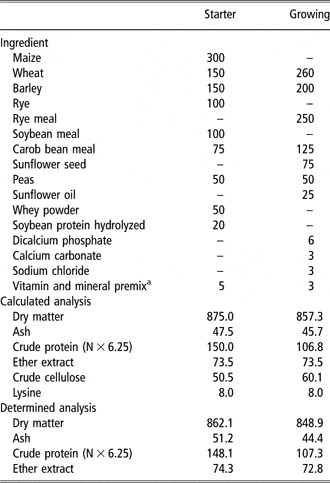
One hundred and twenty Iberian pigs of the Lampiña line (Finca La viñera, Alcuéscar, Cáceres, Spain) were used for the trial. There were two groups of animals with barrows and gilts at the same proportion in each group; pigs (n = 60) born in May 2006 and pigs (n = 60) born in November 2006. The May-born pigs were weaned in July (56 days of age and 14 to 16 kg BW). From July to October (during 105 days until reaching 35 to 40 kg BW), piglets were fed a starter diet at a rate of approximately 1 kg/day per pig. From October 2006 to February 2007 (during 113 days until reaching 60 to 65 kg BW), pigs made use of the Montanera period (Quercus ilex and Quercus rotundifolia forest, acorns and grass are fully available). The November-born pigs were weaned in January 2007 (56 days of age and 14 to 16 kg BW). From January to February (during 42 days until reaching 20 to 25 kg BW), piglets were fed ad libitum a starter diet also making use of the end of Montanera period natural resources. From February to November 2007, both treatments received a growing diet (261 days at a rate of approximately 1.4 kg/day per pig for animals born in May, and 259 days at a rate of approximately 2.7 kg/day per pig for animals born in November). The starter and growing diets were common for both groups and were formulated to meet or exceed the requirements of pigs for that age (National Research Council, 1998). Feeds were analyzed for moisture by oven drying method (930.15), ash by muffle furnace (942.05), crude protein by the Kjeldahl method (984.13) and ether extract by Soxhlet fat analysis (920.39) (Association of Official Analytical Chemists, 2000). Ingredients and chemical composition of the diets are shown in Table 1. During the fattening period, from October 2007 to February 2008 (107 days), both groups of pigs were reared under the same conditions; 0.60 pigs/ha of stocking rate and making use of the natural feed resources of Montanera. The amount of feed provided to each treatment was calculated to get similar BW at the beginning of the fattening phase (110 to 115 kg BW). The slaughter weight was 160 kg BW in both cases. All the experimental procedures used in this study were in compliance with the Spanish guidelines for the care and use of animals in research (Boletín Oficial Estado, 2005).
Ingredient composition and estimated and determined analysis of the starter and growing diets for Iberian pigs (g/kg, as fed)

aSupply per kg diet: vitamin A, 7500 IU; vitamin D3, 1000 IU; vitamin E, 10 IU; riboflavin, 3 mg; d-calcium pantothenate, 6 mg; nicotinic acid, 10 mg; thiamine hydrochloride, 1.0 mg; vitamin B12, 20 μg; choline chloride, 180 mg; Mn, 60 mg; Zn, 118 mg; Fe, 75 mg; Cu, 13 mg; I, 1 mg; Se, 0.2 mg.
Slaughter and sampling
In February 2007, Montanera period ended and pigs were transported 130 km to a commercial slaughterhouse (Mazafra SL, Zafra, Badajoz, Spain). At the abattoir, animals were resting for 15 h with full access to water but not to feed. Then, pigs were electrically stunned (225 to 380 V/0.5 amps for 5 to 6 s), exsanguinated, scalded, skinned and eviscerated according to standard commercial procedures and split down the midline. The hot weight of each carcass was recorded. Carcasses were then blast chilled at 2°C (1 m/s) for 2 h. At 45 min post mortem, fat over the gluteus medius (GM) muscle and depth of back fat (BF) between the third and the fourth last ribs on the midline of the carcass (skin included) were measured. In addition, at 45 min and at 24 h post mortem, the pH was measured in the Semimembranosus muscle using a portable pH meter equipped with a glass electrode (Model no. 52-00 Crison Instruments S.A., Barcelona, Spain). Carcasses were processed according to the simplified European Community-reference method (Branscheid et al., Reference Branscheid, Dobrowolski and Sack1990). Afterwards, a total of 20 carcasses from each group, barrows and gilts at the same proportion within each treatment were chosen at random for the meat and fat quality study. A section of 400 ± 20 g of longissimus dorsi (LD) muscle was excised at the level of the last rib from the loin of each left carcass. The subcutaneous fat samples, including fat layers, skin and lean, were taken at tail insertion in the coxal region of the each left carcass. Both meat and fat samples were vacuum package and stored in bags at −20°C until subsequent analysis.
Meat quality
The LD frozen samples were thawed for 24 h at 4°C, removed from packages, blotted dry and weighed. Thawing losses were calculated in percentage of fresh weight. Meat color was evaluated with a chromameter (CM 2002 Minolta, Minolta Camera, Osaka, Japan), previously calibrated with a pure white color tile, using objective measurements (Commission International de l’Eclairage, 1976). An average of three observations per sample were used to measure the lightness (L*) and two color coordinates (redness, a*; yellowness, b*). Additionally, chroma (c*) as c* = √(a*2 + b*2) and hue angle (H°) as H° = arctg (b*/a*) were calculated (Wyszcecki and Stiles, Reference Wyszcecki and Stiles1982). The IMF, crude protein and moisture content of the meat samples were determined by using a near infrared transmittance meat analyzer (Infratec 1265; Tecator, Höganäs, Sweden). First, the chops were trimmed free of intermuscular fat, minced and distributed in the cup ring equipped with a plastic bottom plate with 100 mm diameter and 15 mm deep. The monochromator contained a 50 W tungsten lamp and a diffraction grating, which created monochromatic light. The measured spectra were separated in the range from 800 to 1100 nm. In addition, cooking losses of the meat samples were determined (Honikel, Reference Honikel1998) and expressed in percentage of thawed weight. Briefly, an LD slice was taken from each chop, weighed (200 ± 10 g), placed in a plastic bag and cooked to an internal temperature of 70°C in a 75°C water bath (Precisterm; J.P. Selecta S.A., Barcelona, Spain). Internal temperature was monitored during cooking with a handheld temperature probe (Hanna Instruments®, Woonsocket, RI, USA).
FA profile of subcutaneous fat
The determination of FA profile of fat was performed according to Boletín Oficial Estado (2004). Briefly, a 200 mg sample of subcutaneous adipose tissue was homogenized and saponified and the FA was extracted, methylated and analyzed with a gas chromatograph (Autosystem XL Agilent Technologies 6890N Net Work GC System; Perkin Elmer, Boston, MA, USA) equipped with a flame ionization detector, a Hamilton injector and a Omegawax 320 (Supelco®, Bellefonte, PA, USA) capillary column (30 m × 0.32 mm with a film thickness of 0.25 μm) with 0.4 ml/min of He as the carrier gas. The temperature of the inlet detector was 260°C and the initial temperature of the oven was 190°C for 2 min, increasing to 205°C at a rate of 5°C/min for 3 min. The percentages of total saturated FA (SFA), MUFA, polyunsaturated FA (PUFA) and unsaturated FA (UFA = MUFA + PUFA) were calculated.
Statistical analyses
ANOVA was employed to determinate the main effect (18 or 12 months as AM) by using the GLM procedure of Statistical Analysis Systems Institute (1990). Each treatment was replicated 60 times for carcass traits and was chosen 20 times randomly for meat and fat traits. The experimental unit was the pig.
Results
Carcass quality
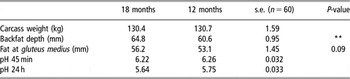
The carcass weight was similar for both treatments (130.4 v. 130.7 kg for P18 and P12, respectively; P > 0.10) (Table 2). However, P18 had fatter carcasses at BF (64.8 v. 60.6 mm; P < 0.01) and tended to show thicker fat at GM muscle (56.2 v. 53.1 mm; P = 0.09) than P12. No effect of AM on pH at 45 min or at 24 h post mortem was observed.
The effect of age at the beginning of Montanera period on carcass characteristics of Iberian pigs reared outdoor

**P < 0.01.
Meat quality
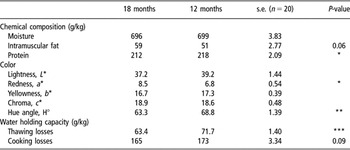
The effect of AM on meat characteristics is shown in Table 3. Meat from P18 had less protein (212 v. 218 g/kg; P < 0.05), but tended to show higher IMF content (59 v. 51 g/kg; P = 0.06) than meat from P12. Loin from P18 was redder (a*) (8.5 v. 6.8; P < 0.05), but showed lower H° value (63.3 v. 68.8; P < 0.01) than loin from P12. Meat from P12 had lower thawing losses (63.4 v. 71.7 g/kg; P < 0.001), and tended to show lower cooking losses (165 v. 173 g/kg; P < 0.10) than meat from P18.
The effect of age at the beginning of Montanera period on Musculus Longissimus dorsi characteristics of Iberian pigs reared outdoor

*P < 0.05; **P < 0.01; ***P < 0.001.
FA profile of subcutaneous fat
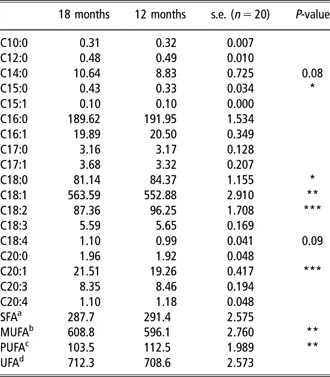
The effect of AM on FA profile is shown in Table 4. The fat from P18 had higher levels of C14:0 (P < 0.10) and C15:0 (P < 0.05), but lower of C18:0 (P < 0.05) than fat from P12. Therefore, no differences were detected on SFA content (287.7 v. 291.4 g/kg for P18 and P12, respectively). On the other hand, fat from P18 showed higher levels of C18:1 (P < 0.01) and C20:1 (P < 0.001) than that from P12. In consequence, fat from P18 had higher MUFA content than fat from P12 (608.8 v. 596.1 g/kg; P < 0.01). Also, fat from P18 tended to show higher level of C18:4 (P < 0.10), but had lower level of C18:2 (P < 0.001) than that from P12. Therefore, PUFA content was lower in subcutaneous fat from P18 than in that from P12 (103.5 v. 112.5 g/kg; P < 0.01). Finally, no effect of AM was observed in UFA content (712.3 v. 708.6 g/kg for P18 and P12, respectively).
The effect of age at the beginning of Montanera period on fatty acid profile (g/kg) of subcutaneous fat of Iberian pigs reared outdoor

*P < 0.05; **P < 0.01; ***P < 0.001.
aSFA = Σsaturated fatty acids = C10:0 + C12:0 + C14:0 + C15:0 + C16:0 + C17:0 + C18:0 + C20:0.
bMUFA = Σmonounsaturated fatty acids = C15:1 + C16:1 + C17:1 + C18:1 + C20:1.
cPUFA = Σpolyunsaturated fatty acids = C18:2 + C18:3 + C18:4 + C20:3 + C20:4.
dUFA = Σunsaturated fatty acids = MUFA + PUFA.
Discussion
No differences were detected on carcass weight between treatments because both groups of animals were slaughtered at similar average BW (approximately 160 kg). The individual slaughter weight was not available and therefore dressing percentage could not be statistically analyzed. However, the average slaughter weight within each treatment was available and was slightly lower in P12 than in P18 (159.2 v. 160.7 kg BW, respectively), which might provide lower dressing percentage in older pigs. In this respect, it has been reported lower carcass yield in pigs that started the fattening phase at 12 months of age compared with pigs that started it at 8 months being slaughtered at similar BW (Daza et al., Reference Daza, López-Bote, Rey and Olivares2006). This could be explained because P18 were reared free range for a longer time and ate more grass throughout their life (two Montanera periods completed) than P12 (the end of the first Montanera period and the second one completed). In fact, it has been found that an increase in crude fiber intake leads to a higher development of the large intestine and a consequent reduction in carcass yield (Hawe et al., Reference Hawe, Walker and Moss1992).
In spite of the similar carcass weight, P18 showed fatter carcasses than P12, which agrees with previous studies (Daza et al., Reference Daza, López-Bote, Olivares, Menoyo and Ruiz2007). Also, several researchers have reported that BF increases linearly as slaughter age increases (Cisneros et al., Reference Cisneros, Ellis, McKeith, McCaw and Fernando1996; Latorre et al., Reference Latorre, García-Belenguer and Ariño2008a). The BF values found in the present trial (6.0 to 6.5 cm) are between those reported by other authors (5.0 cm, Daza et al., Reference Daza, López-Bote, Olivares, Menoyo and Ruiz2007; 7.0 cm, Mayoral et al., Reference Mayoral, Dorado, Guillén, Robina, Vivo, Vázquez and Ruiz1999) for free-range Iberian pigs slaughtered at similar weights. However, the fatter carcasses in P18 than in P12 could be also due to the different feeding regimen. Pigs that were fed a more restricted diet during the growing phase (P18) might have exhibited a compensatory growth during the finishing phase increasing the fat deposition in carcass. It was the finding of Daza et al. (Reference Daza, López-Bote, Olivares, Menoyo and Ruiz2007) who studied the effect of the age at the beginning of the fattening period of Iberian pigs under free-range conditions.
No influence of AM on pH measured at any time point was observed, in accordance with several authors who studied the effect of weight (Leach et al., Reference Leach, Ellis, Sutton, McKeith and Wilson1996; Latorre et al., Reference Latorre, García-Belenguer and Ariño2008a) or age (Weatherup et al., Reference Weatherup, Beattie, Moss, Kilpatrick and Walker1998; Latorre et al., Reference Latorre, Ripoll, García-Belenguer and Ariño2009a) at slaughter on pH measured in the same muscle of heavy pigs.
The IMF values observed in the present trial (50 to 60 g/kg) are reasonable for these type of pigs, but higher than those reported in Iberian pigs reared indoors and slaughtered at similar BW (39 g/kg, Morcuende et al., Reference Morcuende, Estévez, Ramírez and Cava2007; 42 g/kg, Ventanas et al., Reference Ventanas, Ventanas, Jurado and Estévez2006). The IMF plays a major role in the quality of dry-cured meat products from Iberian pigs increasing juiciness and tenderness (García et al., Reference García, Ventanas, Antequera, Ruiz, Cava and Álvarez1996). In the current experience, meat from P18 had lower protein content, but tended to show higher IMF content than meat from P12. The reason for the differences in IMF proportion between treatments could be explained because it has been observed that IMF of the loin improved as age increased in commercial (not autochthonous) white pigs (Weatherup et al., Reference Weatherup, Beattie, Moss, Kilpatrick and Walker1998; Latorre et al., Reference Latorre, Medel, Fuentetaja, Lázaro and Mateos2003) or in Iberian pigs (Daza et al., Reference Daza, López-Bote, Olivares, Menoyo and Ruiz2007). In addition, in the current trial, older pigs grew slower than younger pigs to achieve similar slaughter weight and the literature has been reported a moderate negative correlation (−0.45) between average daily gain and IMF in three pig genotypes (Latorre et al., Reference Latorre, Pomar, Faucitano, Gariépy and Méthot2008b).
Although some studies have shown no influence of age on meat color even for wide ranges of slaughter weight (Weatherup et al., Reference Weatherup, Beattie, Moss, Kilpatrick and Walker1998; Serrano et al., Reference Serrano, Valencia, Fuentetaja, Lázaro and Mateos2008a), most studies agree on the beneficial effect of increased age on redder, darker and higher myoglobin content (Mayoral et al., Reference Mayoral, Dorado, Guillén, Robina, Vivo, Vázquez and Ruiz1999; Latorre et al., Reference Latorre, Lázaro, Valencia, Medel and Mateos2004). The trend followed by the data agree with such observations (a* or myoglobin content increasing as age increased). In addition, animals were free range in a wide area and therefore they had to walk far to eat and drink. In this sense, a beneficial impact of exercise on myoglobin content has been reported, showing redder meat, mainly due to an increase in the proportion of oxidative muscle fibers (Petersen et al., Reference Petersen, Berge, Henckel and Sorensen1997).
The water losses were higher in loin from P18 than in loin from P12 in accordance with some authors who have observed lower thawing losses (Latorre et al., Reference Latorre, Ripoll, García-Belenguer and Ariño2009a), drip losses (Peinado et al., Reference Peinado, Medel, Fuentetaja and Mateos2008) or cooking losses (Latorre et al., Reference Latorre, Ripoll, García-Belenguer and Ariño2009c) in pork as slaughter age increased. However, others have not found any effect (Leach et al., Reference Leach, Ellis, Sutton, McKeith and Wilson1996; Unruh et al., Reference Unruh, Friesen, Stuewe, Dunn, Nelssen, Goodband and Tokack1996). The reason for these discrepancies is unknown, but either very high or very low water holding capacity, associated with dark, firm and dry (DFD) and pale, soft and exudative (PSE) problems have negative consequences on the quality of dry-cured meat products (Arnau et al., Reference Arnau, Guerrero, Casademont and Gou1995). However, the range of water losses detected in the current trial is small and should have negligible influence on the quality of the elaborated products.
The FA profile of subcutaneous fat observed in the current trial (approximately 290, 600 and 110 g/kg of SFA, MUFA and PUFA contents, respectively) was similar to that reported by other researchers for Iberian pigs reared outdoors (Daza et al., Reference Daza, López-Bote, Rey and Olivares2006; Estévez et al., Reference Estévez, Morcuende and Cava2006). However, in indoor Iberian pigs, a higher SFA content (390 g/kg) and a lower UFA content (610 g/kg), mainly due to a low content of MUFA (90 g/kg), have been found (Serrano et al., Reference Serrano, Valencia, Fuentetaja, Lázaro and Mateos2008a and Reference Serrano, Valencia, Nieto, Lázaro and Mateos2008b). Also, in outdoor Duroc × (Landrace × Large White) pigs slaughtered at 170 kg BW, the SFA and MUFA contents reported were 348 and 472 g/kg, respectively (Latorre et al., Reference Latorre, Iguácel, Sanjoaquín and Revilla2009b). The increase of slaughter age did not modify the level of SFA, which is in agreement with Daza et al. (Reference Daza, López-Bote, Rey and Olivares2006) who found similar values of this parameter between pigs that began the fattening period at 12 and 14 months of age. On the other hand, in white pigs reared indoors, it has been found that SFA tended to increase as age increased mainly due to the increase of C16:0 (Cava et al., Reference Cava, Ruiz, López-Bote, Martín, García, Ventanas and Antequera1997).
The level of C18:1 observed in the current trial (552 to 563 g/kg) is close to the results of previous studies (Estévez et al., Reference Estévez, Morcuende and Cava2006), but was higher than that found in Iberian pigs reared indoors (485 g/kg) (Lo Fiego et al., Reference Lo Fiego, Santero, Macchioni and De Leonibus2005) or in white pigs reared outdoors (435 g/kg) (Latorre et al., Reference Latorre, Iguácel, Sanjoaquín and Revilla2009b). This is likely due to the fact that acorns have a higher content of oleic acid and consequently of MUFA and a lower content of PUFA than concentrate feed (Raj et al., Reference Raj, Skiba, Weremko, Fandrejewski, Migdal and Borowiec2005). The subcutaneous fat of P18 showed a higher level of MUFA content than the fat of P12, mainly because of the higher content of C18:1 and C20:1. In this line, it has to be taken into account that P18 made use of two full Montanera periods (5 to 10 and 17 to 22 months, respectively), whereas P12 made use of the end of the first Montanera (3 to 4 months) and the second one full (12 to 16 months).
The contents of C18:2 and C18:4, and consequently the PUFA content, were higher in P12 than in P18. It has been observed that this evolution was linear in Duroc × (Landrace × Large White) gilts slaughtered between 189 and 217 days of age (Latorre et al., Reference Latorre, Ripoll, García-Belenguer and Ariño2009c). The C18:2 plays a very important role from a technological meat quality point of view because it can reduce the firmness and cohesiveness of adipose tissue and increase the fat oxidation rate (Wood et al., Reference Wood, Enser, Fisher, Nute, Sheard, Richardson, Hughes and Whittington2008).
Literature data suggest an inverse relationship between the degree of unsaturation of lipids in fat and the age of the pigs. However, in the current trial, there were no significant differences between younger and older pigs for SFA and UFA proportions probably due, at least in part, to the inclusion of acorn and grass in the feeding plan.
Conclusions
It can be concluded that meat from P18 showed higher IMF content, red color and water holding capacity than P12. In addition, fat from P18 had higher C18:1 and MUFA content than fat from P12. Both 18 and 12 months were adequate age to begin the Montanera period from a commercial point of view. If the aim is to produce high-quality dry-cured Iberian products, P18 would be more advisable because they had better meat and fat characteristics than P12.
Acknowledgements
We would like to thank V. Collado (Agrícola y Ganadera La Viñera, Cáceres, Spain) and R. Álamo (Gourmet Ibérico Dos montaneras, Alicante, Spain) for the cession of the samples.