In 2014, Teva Pharmaceuticals was in a pickle. Much of its revenue came from its blockbuster drug for multiple sclerosis, glatiramer acetate (Copaxone), which cost an average of $3,688 per month at the time and generated over $3 billion in net sales annually.1 The problem was that the drug’s patents were set to expire in the next year, which would allow competitors to launch clinically equivalent generic drugs at far lower prices. Patients and insurance payors, for their part, were expecting to benefit from more inexpensive access to this costly therapy.
Teva, however, had other plans. According to an investigation published by the House Committee on Oversight and Investigation in December 2021,2 Teva “product hopped,” a strategy estimated in this case to cost the US health care system somewhere between $4.3 and $6.3 billion.Reference Rome, Tessema and Kesselheim3 The case is illustrative of a broader and unignorable reality: regulators are struggling to stay ahead of a pharmaceutical industry that has developed numerous strategies intended to sustain the high prices of its brand-name drugs.
Product hopping allows pharmaceutical companies to extend revenue streams from their brand-name prescription drugs by delaying competition from generic drug companies. In the years before a company’s final patents on a brand name prescription drug are about to expire, it launches a slightly modified version of the product and encourages patients to switch to the new “reformulation” that is inevitably protected by longer-lasting patents. The reformulated product may carry little to no additional medical benefit for patients,Reference Gellad, Choi, Mizah, Good and Kesselheim4 but drug companies have had success encouraging patients to switch over through marketing efforts (called a “soft switch”) or by discontinuing the old product and leaving patients with no other choice but to switch (a “hard switch”). Now, when generic drugs enter, the market has moved such that a substantial number of patients are taking the new version while the generics are equivalent to the older, less-used product. The brand name company can continue to charge high prices for the new version.
In this case, Teva launched a patent-protected reformulation of glatiramer that doubled the concentration of the drug, allowing patients to take it three times a week instead of daily which increased convenience to patients by reducing the need to take the drug via subcutaneous injection as frequently. Teva then sought to switch patients over to the new reformulation by increasing the price of the old version and directly marketing the new version to physicians and patients.5 Their efforts were successful — the House investigation turned up internal documents from December 2015 concluding that over three-fourths of patients had been converted to the new formulation.6
How is a change as slight as doubling the concentration of the product worthy of new patents? It actually isn’t. In 2017, a court struck down the patents and ruled that they had been erroneously issued by the US Patent and Trademark Office (USPTO).Reference Cohen and Rabinovitch7 This allowed generic competitors of the new version to enter the market. But the tactics had been enough to delay effective generic competition by two and a half years more than if the patents had not been incorrectly issued, which researchers estimate caused payers to pay approximately $5 billion more than they would have had to pay if the delay had not occurred.8
Product hops are not rare events. A recent study identified ten likely prescription drug hops occurring from August 2018 to June 2019 alone.Reference Gowda, Beall, Kesselheim and Sarpatwari9 An analysis of inhaler devices approved by the FDA between 1968 and 2020 found that by moving active ingredients from one device to another, manufacturers received a median of 28 years of patent protection and regulatory exclusivity on 14 inhalers.Reference Feldman, Bloomfield, Beall and Kesselheim10 Currently, the US health care system is watching perhaps the grandest product hop of all play out in real time. Several biosimilar competitors of adalimumab (Humira, currently the world’s best-selling drug and the second best-selling drug of all time),Reference Kenney11 are expected to enter the market in January 2023. This should bring down the price of the drug, which cost an average of about $34,000 per patient in 2017 after subtracting discounts that manufacturers offer to insurers.12 However, in 2018, AbbVie launched a modified, higher-concentration version, which has since become the dominant version in the US.Reference Silverman13 In fact, in one chart made public by the House investigation, executives at AbbVie compared the rate at which patients switched over to the new adalimumab version to the rate at which Teva successfully switched patients four years prior. [Figure 1]
From the Congressional Staff Report “Drug Price Investigation: Abbvie — Humira and Imbruvia”
Internal presentation slide comparing transition of patients from Humira to Humira Citrate-Free, with the success of Teva’s efforts to transition patients to the high concentration version of Copaxone

Thus, as competition begins in 2023, many of the approved biosimilar competitors will likely be comparable to the old version, and AbbVie may continue to enjoy high market share at a high price without robust competition. The financial implications are vast: in 2020, AbbVie generated about $16.1 billion in net revenue from Humira in the US alone.14
Product hopping is just one example of how pharmaceutical companies extend monopolies on brand-name prescription drugs. Another practice, creating “patent thickets,” involves filing for large numbers of patents on a single product for secondary characteristics (like the coating of the pill), even if on shaky legal grounds, to reduce generic drug companies’ incentive to enter the market and risk costly litigation. Two hundred and forty seven patent applications have been filed on adalimumab alone.15 When generic manufacturers challenge these patents and the parties end up in court, the manufacturers reach settlements that delay launch of competitor products.
Allowing pharmaceutical companies to extend their monopolies and subsequently continue charging higher prices for drugs like glatiramer and adalimumab can have a variety of financial and health consequences for patients. High prices reduce access to patients without health insurance as well as insured patients who cannot afford the high out-of-pocket costs. High prices may also decrease a patient’s ability to regularly fill their prescriptions or force a patient into medical bankruptcy — one multiple sclerosis patient, Humphrey Ball, testified that Copaxone’s high price wiped out her savings and ultimately led to her inability to fill her prescriptions and associated declines in her cognitive functions and short term memory.Reference Chandra, Flack and Obermeyer16 The systemic impacts of high drug prices are also vast: public and private insurers may offset higher costs onto beneficiaries by raising premiums or restricting access to other therapies. For example, Medicaid programs widely restricted who was able to access the life-saving hepatitis C drug, sofosbuvir (Sovaldi), in the early years after its approval.
Among the ways that Congress could alter the scope of the legislation in coming years include increasing the number of products over which the federal government is permitted to negotiate, allowing price negotiation closer to the time of product launch, and allowing negotiated prices to apply non-Medicare payors like private health insurance companies. Such reforms could help ensure that the financial reward for product hopping is commensurate with the level of benefit provided by the new product and lower risk in development as compared to innovative products.
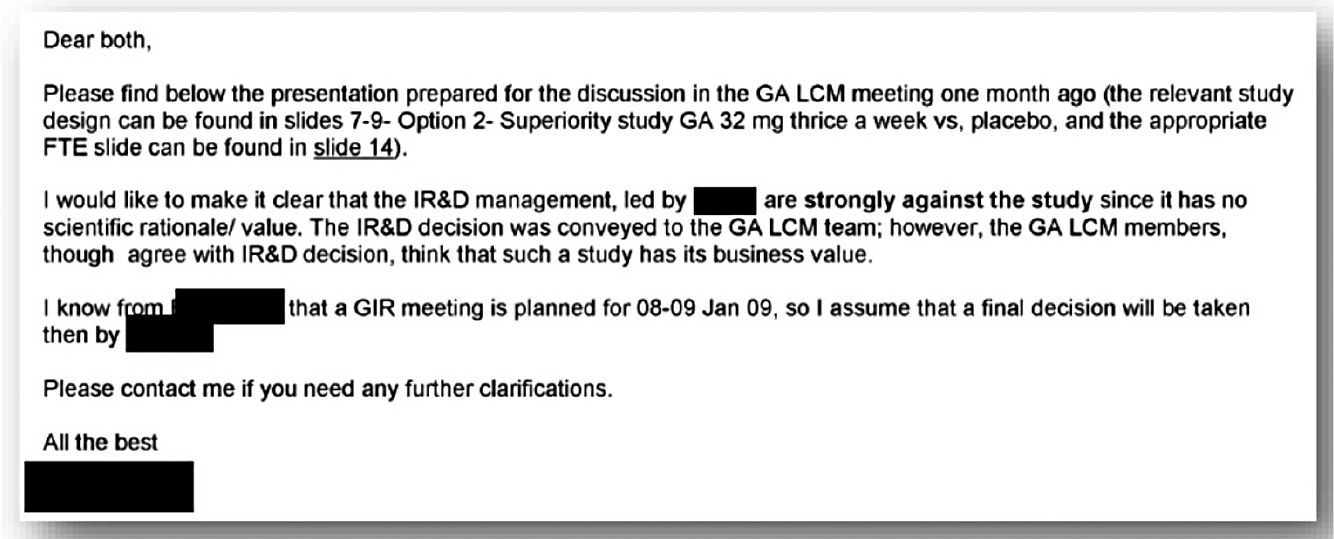
Allowing such practices may also have negative implications for therapeutic innovation by financially incentivizing pharmaceutical companies to invest in making and patenting slight modifications to these drugs rather than more clinically meaningful or transformative drug development. One striking detail from the House’s investigation was a memo sent by a Teva scientist indicating that his team was “strongly against” undergoing a study into benefits of a higher concentration reformulation because it had “no scientific rationale/value.” The company’s “Lifecycle Management” team, on the contrary, believed that it had “business value.” [Figure 2]
From the Congressional Staff Report “Drug Price Investigation: Teva — Copaxone”
Message from a Teva scientist indicating that his team was “strongly against” studying the benefits of the higher concentration reformulation “since it has no scientific rationale/value,” despite another team believing such a study “has its business value”

Congress and the Biden administration have several options for addressing these strategies. First, the administration can work to decrease the likelihood that the USPTO issues erroneous patents like the ones that it granted Teva for its reformulation. Currently, examiners face tight time constraints — a 2016 study by the Government Accountability Office found that 70 percent of examiners said they do not have enough time to thoroughly examine patent applications.17 A working paper estimated that giving reviewers 50% more time to review patents in one year would eliminate 16.9 years of delayed generic entry.Reference Frakes and Wasserman18 To reduce the chances it grants a weak patent, the USPTO could flag for closer review patent applications that were discontinued or rejected by patent offices in other countries.Reference Bloomfield, Lu and Kesselheim19 In addition, rather than requiring the USPTO to show that a patent is invalid, Congress may also consider flipping the burden of proof for FDA-listed patents to fall on applicants to show their patent is valid.
A second mechanism for screening invalid patents, legal challenges in federal courts, would also benefit from reforms. Congress should establish clearer criteria for what constitutes an anticompetitive product hop, like whether the reformulation was timed to maximally impact generic entry or whether there is a clinically meaningful benefit to the new product,Reference Carrier and Shadowen20 as was most recenty proposed in the Affordable Prescriptions for Patients Through Promoting Competition Act of 2021.21 The federal government could also take steps to increase the use of an already-existing cheaper and quicker process for challenging patents via evaluation by an administrative body called the Patent Trial and Appeal Board.Reference Darrow, Beall and Kesselheim22
The long-term success of many of these strategies, however, may be dependent on unpredictable factors such as future budget appropriations, the political will of a given presidential administration to use regulatory tools against the pharmaceutical industry, and the pharmaceutical industry’s ability to continue finding loopholes to circumvent these regulations. A more ambitious measure, sometimes referred to as the “one and done” approach, would entail limiting pharmaceutical companies to just one period of exclusivity per drug, irrespective of additional patents.Reference Feldman23 However, since such a policy may reduce pharmaceutical companies’ motivation to develop clinically meaningful modifications to drugs, Congress may need to come up with alternative incentives to reward useful incremental innovation.
It may be that the most durable way to mitigate the effects of product hopping and similar practices is indirectly through reforms that allow the federal government to broaden its role in negotiating drug prices based on factors like their clinical benefit over existing therapies. In August 2022, President Biden signed the Inflation Reduction Act, which included landmark provisions that will for the first time allow the federal government to negotiate prices of selected drugs in Medicare that received FDA approval at least 9 years prior (or 13 years for biological products). Medicare can negotiate 10 drug prices starting in 2026, 15 additional drug prices in each 2027 and 2028, and 20 in each year after that. Among the ways that Congress could alter the scope of the legislation in coming years include increasing the number of products over which the federal government is permitted to negotiate, allowing price negotiation closer to the time of product launch, and allowing negotiated prices to apply non-Medicare payors like private health insurance companies. Such reforms could help ensure that the financial reward for product hopping is commensurate with the level of benefit provided by the new product and lower risk in development as compared to innovative products.
Note
Dr. Kesselheim reports serving as an expert witness on behalf of a class of plaintiffs in a case against Gilead involving different formulations of tenofovir.