Antibiotic-resistant infections are a major threat to public health.Reference Hidron, Edwards and Patel 1 – Reference Urban, Bradford and Tuckman 4 In September 2013, the Centers for Disease Control and Prevention reported on “Antibiotic Resistance Threats in the United States,” prioritized as urgent, serious, or concerning based on clinical and economic impact, current and projected 10-year incidence, transmissibility, availability of effective antibiotics, and barriers to prevention. 5
Increasing antibiotic resistance and movement of patients among different healthcare settings make infection control awareness and interventions critical for the full spectrum of facilities, acute to long-term care.Reference Jarvis 6 , Reference Munoz-Price 7 Some pathogens have received media attention and legislative action, which has increased awareness and channeled resources to specific pathogens, but there is a general perception of a knowledge and a resource gap between acute care and other healthcare venues. 8
Public health departments are well positioned to educate, to impose or modify reporting requirements, and to share patient-specific laboratory data to improve regional awareness. The Chicago and Cook County health departments, with consultation from the Chicago Centers for Disease Control (CDC) Prevention Epicenter, created a pilot survey to assess staffing, knowledge, and the perceived importance of and response to various multidrug-resistant organisms (MDROs) at acute and long-term healthcare facilities in Cook County as a step toward developing an effective regional prevention program for antibiotic-resistant infections.
METHODS
A survey instrument was developed and distributed to >300 facilities in the Chicago metropolitan region via health department distribution lists, the Chicago Chapter of the Association for Professionals in Infection Control and Epidemiology (APIC) member list, and a June 2012 Chicago Health Alert Network (HAN) posting. The importance of the survey was stressed at regional meetings of infection preventionists and hospital epidemiologists. Skilled nursing facilities (SNFs) in Chicago were contacted by phone to encourage participation due to limited electronic communication. Due to multiple modes of distribution, the total number of facilities confirmed to receive the survey cannot be determined. However, using the Illinois 2012 Health Facilities and Services Review Board hospital profile and the Illinois Department of Public Health (IDPH) data portal, we were able to determine the number of Cook County facilities to use as a denominator. 9 , 10 Demographic information for nonrespondent acute care facilities (ACFs) and ownership for all ACFs were collected from the hospital profile. Demographic data on nonrespondent SNFs and ownership for all SNFs were obtained from the IDPH data portal.
Each facility was asked to have 1 staff member familiar with infection prevention and control policies complete the survey. The survey queried the number of beds per facility, training of those who performed infection prevention duties, employee time dedicated to infection control, rating of MDRO pathogen importance, and isolation procedures. Pathogens, selected to represent significant or emerging burdens, included C. difficile, carbapenem-resistant Enterobacteriaceae (CRE), carbapenem-resistant Acinetobacter, methicillin-resistant S. aureus (MRSA), vancomycin-resistant Enterococcus (VRE), resistant (defined as bacterial resistance to ≥3 antibiotic classes) Pseudomonas, and extended-spectrum β-lactamase (ESBL)–producing E. coli. If two surveys from one institution were received, the one received first received was tallied. Only responses from SNFs and ACFs were analyzed. Denominators are noted when they represent a subset or vary from the full set of respondents due to nonresponse. All analyses were conducted using SAS Software, version 9.3 (SAS Institute, Inc., Cary, NC) and Microsoft Excel (2010).
RESULTS
Respondents
Of 54 ACFs in Cook County, 30 responded to the survey, but 2 ACF responses were submitted without the institution name and were excluded from analysis. The mean bed size for facilities that responded was 355 (range, 187–724; 95% confidence interval [CI], 302–409) vs 308 (range, 113–894; 95% CI, 224–391) for nonrespondents. ACF ownership among respondents was 83% nonprofit corporations, 7% for-profit corporations, and 10% government institutions. Ownership among nonrespondents was 75% nonprofit corporations, 17% for-profit corporations, and 8% government institutions.
Among all 207 Cook County SNFs, 44 responded to the survey. Mean bed size for those that responded was 147 (range, 38–314; 95% CI, 129–165) compared with 173 (range, 26–485; 95% CI, 159–187) for nonrespondents. Of respondent SNFs, 25% were nonprofit corporations and 75% were for-profit corporations, limited liability corporations (LLC), or limited liability partnerships (LLP). Of all nonrespondents, 21% were nonprofit corporations; 76% were for-profit corporations, LLCs, or LLPs; and 3% were unknown.
Facility and Patient Characteristics
All facilities had some private rooms; however, 59% of SNFs versus 17% of ACFs had triple-occupancy rooms, and 41% of SNFs versus 10% of ACFs had quadruple-occupancy rooms. All 30 ACFs had patients requiring ventilators, tracheostomies, central venous catheters (CVCs), postoperative care, indwelling urinary catheters, or dialysis; 93% of all responding ACFs had patients with gastric feeding tubes. Of 44 SNFs, 95% had patients with indwelling urinary catheters and/or gastric tubes, 84% had post-surgical patients, 75% had patients requiring dialysis, 64% had patients with CVCs, 52% had patients with tracheostomies, and 7% had patients requiring ventilator support.
Infection Control Training and Support
Among ACF respondents, 73% reported that they had certification in infection control (CIC), but only 2% of SNF respondents reported certification. Of 30 ACFs, 20% had a Masters of Public Health degree, and none of the 44 SNF responders had this qualification. All ACF employees reported that their jobs were focused solely on infection prevention, whereas 98% of SNF employees reported that they served as nursing administrators, quality assurance personnel, or facility managers in addition to infection prevention duties. For both ACFs and SNFs, more than half (58%) of respondents reported <10 years of infection prevention experience, and 30% had 10–19 years of experience. All 30 ACFs but only 66% of SNFs had an infection control committee. All facilities, except for 1 SNF, reported having a written isolation policy for MDROs.
Screening
All 29 responding ACFs reported compliance with state-mandated screening for MRSA and 1 reported screening for Klebsiella pneumoniae carbapenemase (KPC) carriage. SNFs screened patients on admission for various communicable diseases including human immunodeficiency virus, tuberculosis (state-mandated), and viral hepatitis. Of 11 SNFs that screened for carriage of multidrug-resistant organisms (MDROs), 5 screened for MRSA, 4 for C. difficile, 4 for VRE, and 3 for ESBLs. We were unable to further define organisms which were noted in quotation marks on the survey response. Of 30 ACFs, 97% screened patients on admission and 63% performed periodic surveillance during patient stays. Of 44 SNFs, 43% screened on admission and 48% performed periodic surveillance.
Isolation Precautions
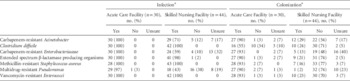
Respondents were asked whether they used isolation precautions for patients infected with specific MDROs (Table 1). With the exception of 1 patient, all ACFs isolated patients with active MDR Pseudomonas infections, and all ACFs reported isolating patients with active infection caused by other MDROs. For SNFs, all responding facilities reported the use of isolation precautions for active infection due to C. difficile, MRSA (ie, 43 of 43), and VRE (ie, 42 of 42), and 98% (41 of 42) reported isolation precautions for infection due to ESBL-producing E. coli. More variability was observed among the 41 SNFs that responded regarding patients with active CRE infection: 24 (59%) placed patients on isolation precautions and 4 (10%) did not; the remaining 13 (32%) responded “unsure.”
Use of Isolation Precautions for Infection and Colonization of Organisms by Facility Type

a n represents the maximum number of respondents, but some respondents did not answer all questions.
Of the 29 ACF respondents, 27 (93%) reported that their facility used isolation precautions for CRE colonization; 7% were unsure. Of the 40 SNF respondents, 5 (13%) reported using isolation precautions for patients with CRE colonization; 40% were unsure.
Discontinuing Isolation after Infection
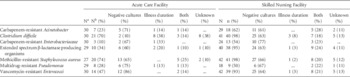
Among facilities that reported the use of isolation precautions, both ACFs and SNFs most commonly reported structured discontinuation for MRSA and C. difficile infection (CDI) (Table 2). Among SNFs, 63% reported discontinuing isolation for CDI based on negative follow-up toxin tests, a practice specifically discouraged by CDI guidelines.Reference Cohen, Gerding and Johnson 11
Criteria for Discontinuation of Isolation Precautions for Active Infection by Facility Type

a N represents the number of facilities that responded they use isolation precautions for patients with active infection with the given pathogen.
b n represents the subset of facilities that discontinue isolation precautions for the given pathogen.
Cohorting
The practice of cohorting patients was defined as placing patients with the same MDRO infection or colonization in the same room or wing of a floor; cohorting staff was defined as assigning dedicated staff to care for patients infected or colonized with the same MDROs. Among respondents, 15 ACFs (50%) and 36 SNFs (82%) reported use of MDRO-specific patient cohorting. In healthcare facilities with multi-occupancy rooms (ie, triple and quadruple rooms), 3 of 5 ACFs (60%) and 28 of 31 SNFs (90%) reported cohorting patients. Combining ACFs and SNFs, 32 of 37 (86%) of facilities with multi-occupancy rooms reported cohorting patients compared to only 21 of 42 facilities (50%) without multi-occupancy rooms (P<.05). All facilities that reported cohorting patients was conducted for patients with MRSA infection or colonization. For CDI, 31 of 36 SNFs (86%) and 6 of 15 ACFs (40%) cohorted patients. Just 6 of 30 ACFs (20%)and 3 of 43 SNFs (7%) reported cohorting staff caring for patients with the same MDRO infection or colonization.
Organism Ratings Regarding Infection Control Significance
Facilities were asked to rate MDROs based on infection control significance at their facility from 1 (least important) to 5 (most important). This rating was not exclusive, ie, >1 organism could be ranked at the same level of importance. MRSA and CDI were both rated most important by ACFs and SNFs. Of all respondents, 97% of ACFs and 88% of SNFs rated CDI as a 5 (most important), while 82% of both ACFs and SNFs also rated MRSA infection as a 5. Responses for CRE varied: 93% of ACFs versus 45% of SNFs rated CRE infection as a 5, and 29% of SNFs were unsure of CRE infection importance. For CRE colonization, 73% of ACFs versus 17% of SNFs rated it as a 5, while 32% of SNFs and 10% of ACFs were uncertain.
DISCUSSION
With this survey, we identified stark differences in human resources, knowledge, policy, and practice between acute and long-term care. SNF directors of nursing are multitasking on issues unrelated to infection control and have less training than their counterparts at ACFs. In addition, we found more interfacility SNF variability in response to problem pathogens, especially for CRE. The widespread use of invasive devices (eg, central venous catheters and indwelling urinary catheters), coupled with fewer resources and multi-occupancy rooms, place SNF patients at increased risk for infection and colonization. SNF patients may serve as reservoirs for potential amplification and transmission of MDROs as patients move among acute and long-term care facilities.Reference Won, Munoz-Price and Lolans 12 – Reference Lee, McGlone and Wong 14
Variation in awareness and practice regarding CRE control between ACFs and SNFs may illustrate how knowledge regarding emerging MDROs diffuses differentially within the healthcare region. At the time this survey was conducted in 2012, CRE was already a priority pathogen for control in the healthcare community, particularly ACFs.Reference Moellering 15 – 17 However, 40% of SNFs were either unsure or were not isolating patients with CRE infection, indicating an immediate need for SNF education.
There was more consistency among ACF and SNFs in responses regarding MRSA, VRE, and ESBLs. We believe that this consistency reflects the lead time that these pathogens had in knowledge diffusion to SNFs through guidelines and public health campaigns.Reference Bradley 18 , Reference Smith, Bennett and Bradley 19 In Illinois, MRSA screening legislation was enacted in 2007 requiring acute care hospitals (but not SNFs) to screen high-risk and intensive care unit (ICU) patients for MRSA colonization. 8 This legislation may have contributed to more uniform responses regarding MRSA. However, fairly consistent responses for VRE and ESBLs suggest that legislation is not necessary to impact practice.
Outreach to SNFs is challenging. High staff turnover results in frequent changes in email and phone contacts. The rate of response to this survey was 55% for ACFs and only 21% for SNFs. Following the survey, the Chicago Department of Public Health started a Long-Term Care Round Table. This round table has focused on infection control education and has brought nursing directors together to solve problems, to offer peer support, and to provide education. Furthermore, in 2012, Illinois passed a regulation requiring that SNFs designate an infection preventionist qualified through education, training, experience, or certification. 20
Differences in CRE knowledge and practice also highlight challenges in interfacility communication. The CDC’s ‘Detect and Protect’ campaign to combat antimicrobial resistance recommends that information such as CRE colonization status be communicated as patients move between healthcare facilities. 21 Lack of CRE understanding at any given healthcare facility can lead to inadequate communication of CRE information at the time of patient transfer. In November 2013, the Illinois Department of Public Health, in collaboration with the Chicago CDC Prevention Epicenter, created the XDRO registry, an electronic healthcare information exchange focused on CRE communication. 22 The registry provides a single location for all facilities (including SNFs and ACFs) to report CRE-carrying patients as mandated by law and allows any facility to query the registry for a patient’s CRE status at the time of admission, improving interfacility communication.
A major strength of this survey was inclusion of SNFs as well as ACFs, which leads to richer understanding of regional attitudes and practices as well as identifies facilities and topics in urgent need of educational intervention. The survey also has limitations. With the low SNF response rate, results may not be generalizable to all SNFs in Cook County, although survey respondents were similar to nonrespondents in bed size and ownership characteristics. No on-site review or observations of policy were conducted to assess the degree to which survey responses were accurate. The term “isolation precautions” was used to ascertain infection control interventions for a given MDRO. This term may have led to an overestimate of isolation use due to ambiguity about whether it referred to the use of a private room versus contact precautions (gown and gloves). The measure of MDRO infection control significance was not further defined in the question about the importance of pathogens, and survey responders could have interpreted this differently.
The results of this survey identify a clear need for public health interventions directed at healthcare facilities with fewer resources and the opportunity for public health to create more consistency in MDRO knowledge and practice for emerging pathogens such as CRE across the healthcare spectrum. Regional educational campaigns must account for differences in healthcare facility resources and baseline understanding. Targeted outreach programs (eg, separate programs for long-term versus acute-care) may be beneficial. Novel public health tools such as the Illinois XDRO registry may bridge the gap in knowledge and practice among healthcare facilities across a region while also serving as an important communication tool during interfacility transfer of patients with MDROs.
Acknowledgments
The authors acknowledge Mike Vernon and Deborah Burdsall for reviewing the survey, Megan T. Patel and Margaret Okodua for contacting facilities, and Chinyere Alu for providing IDPH facility databases.
Financial support: This research was funded by a CDC Cooperative Agreement FOA#CK11-001-Epicenters for the Prevention of Healthcare Associated Infections (RAW-PI).
Potential conflicts of interest: All authors report no conflicts of interest relevant to this article.