Written corrective feedback (CF), otherwise known as error correction or grammar correction (see Truscott, Reference Truscott1996, Reference Truscott2007), has been a controversial topic in second language (L2) teaching for several years. Especially among practitioners who work with L2 learners in writing classes, there are theoretical disagreements and conflicting research trends concerning written CF as well as a wide gap among research, theory, and real-world practice. From a theoretical or research perspective, there are ongoing disagreements about methodology, terminology, and interpretation of results. Meanwhile, real-world teachers struggle to help their students write more effectively, and, in some instances, students fail to meet practical goals because of their lack of progress in producing more linguistically accurate texts. This article briefly examines the history of this issue, proposes an explanation for some of the divergent findings and conclusions, and suggests ways in which researchers in both SLA and L2 writing studies could collaborate to more effectively bridge the gap that currently exists between research and practice with regard to written CF.
It is worth asking if a distinction between SLA and L2 writing scholarship is a legitimate basis for discussion in this article. After all, writing is a form of language production, and the ability to write effectively in a L2 is part of communicative competence for many learners. However, L2 writing is more than a subset of SLA studies. As has been noted by scholars such as Matsuda (Reference Matsuda, Matsuda, Cox, Jordan and Ortmeier-Hooper2006), Leki, Cumming, and Silva (Reference Leki, Cumming, Silva and Smagorinsky2006), and Silva, Leki, and Carson (Reference Silva, Leki and Carson1997), L2 writing is a (sub)discipline informed by language and composition studies as well as other disciplines, including rhetoric, communication, and cultural studies, among others. Some scholars and practitioners in L2 writing self-identify primarily as applied linguists, whereas others are more closely aligned with compositionists. L2 writing is an issue that has thus crossed disciplinary boundaries and created a new field of inquiry. It is important to note that L2 writing scholars may be motivated by different questions and influenced by philosophical and theoretical paradigms distinct from those that affect SLA researchers. These differences become important and practical when discussing the specific issue of written CF.
ERROR IN SLA: THEORETICAL PERSPECTIVES
In SLA research and theory, there has been disagreement over the decades about the role of error in language acquisition. In early years, writing was only emphasized as a means to practice the vocabulary and grammar that had been learned, and errors were not tolerated (Brown, Reference Brown2007; Ferris & Hedgcock, Reference Ferris and Hedgcock2005; Matsuda, Reference Matsuda, Matsuda, Cox, Jordan and Ortmeier-Hooper2006; Silva, Reference Silva and Kroll1990). Later, some linguists and psychologists argued that error in SLA oral or written production was just a necessary stage of the developmental process, similar to what children go through as they acquire a first language (L1; e.g., Corder, Reference Corder1967; Krashen, Reference Krashen1982). Krashen (Reference Krashen1982, Reference Krashen1984; Krashen & Terrell, Reference Krashen and Terrell1983) argued even further that error correction was not only unnecessary but potentially harmful in that it raised learners’ affective filters.
In addition to the linguistic and SLA viewpoints that have informed this issue in recent decades is the contribution by theorists in composition, rhetoric, and writing. For example, at around the same time that Krashen and others were arguing for a more developmentally based and enlightened view of error in SLA, composition theorists were propounding the process approach to writing instruction, which means that the emphasis in writing classes should be on the individual writer rather than on developing a perfect end product (see, e.g., Elbow, Reference Elbow1973; Sommers, Reference Sommers1980; Zamel, Reference Zamel1982). Notwithstanding Shaughnessy’s (Reference Shaughnessy1977) influential and highly pragmatic teacher guide, Errors and Expectations, the dominant perspective of this era is well expressed in a quotation from an article by Hartwell (Reference Hartwell1985) in the L1 composition journal College English:
Those of us who dismiss the teaching of formal grammar have a model of composition instruction that makes the grammar issue “uninteresting” in a scientific sense. Our model predicts a rich and complex interaction of learner and environment in mastering literacy, an interaction that has little to do with sequences of skills instruction as such. Those who defend the teaching of grammar tend to have a model of composition instruction that is rigidly skills-centered and rigidly sequential: the formal teaching of grammar, as the first step in that sequence, is the cornerstone or linchpin. (p. 108)
Although Hartwell’s emphasis is on formal grammar instruction in writing classes primarily intended for native English speakers rather than on written CF for nonnative speakers, the author’s choice of words makes his viewpoint clear: Those who argue for a role for focus on form in composition instruction are characterized as rigid.
As this process-oriented perspective from L1 composition was applied to issues of error in general and L2 writing in particular, it was argued that L2 writing teachers should deemphasize grammar instruction and error correction, allowing students instead to discover their ideas through a recursive process of drafting, receiving feedback, and redrafting. However, there were immediate objections from other L2 writing specialists (e.g., Eskey, Reference Eskey1983; Horowitz, Reference Horowitz1986; Silva, Reference Silva1988), who argued that such a benign view of written accuracy issues dangerously underestimated the linguistic gaps that most L2 writers bring into advanced writing situations (see also Johns, Reference Johns1995; Leki, Reference Leki and Kroll1990; Reid, Reference Reid1994).
Theory on the role of error in SLA and in L2 writing over the decades has thus shifted from one extreme to another, ultimately finding a middle ground accepted by most researchers and teachers: The knowledge and experience base of L2 acquirers and writers is not the same as that of native speakers. Thus, learners need additional information and intervention as well as (at least slightly) different pedagogical approaches to writing instruction. It also seems fair at this point to generalize that the current state of opinion among many SLA and L2 writing researchers and most L2 writing teachers is that there is some role for written CF in L2 writing instruction.Footnote 1 The nature and extent of this role, however, remains in dispute.
RESEARCH ON WRITTEN CF IN L2 WRITING
Early Research (1976–1996)
Prior to the mid-1990s, empirical research on the effects of written CF was relatively rare. A reason for this may have been the historical and theoretical trends: First, writing was not emphasized in L2 instruction and then later was heavily influenced by writing process pedagogy and Krashen’s SLA theories (Krashen, Reference Krashen1982, Reference Krashen1984; Krashen & Terrell, Reference Krashen and Terrell1983), both of which relegated written CF to a minor role. Although a few studies were conducted between 1976 and 1996 (e.g., Kepner, Reference Kepner1991; Lalande, Reference Lalande1982; Robb, Ross, & Shortreed, Reference Robb, Ross and Shortreed1986; Semke, Reference Semke1984; Sheppard, Reference Sheppard1992), researchers studied the progress of foreign language (FL) students (either English as a foreign language [EFL] or other FLs in the United States) rather than composition students in L2 settings—that is, contexts in which students must live, work, and complete their studies by utilizing the L2. This distinction is important because, as noted by scholars such as Hedgcock and Lefkowitz (e.g., Reference Hedgcock and Lefkowitz1994, Reference Hedgcock and Lefkowitz1996), FL students are rarely required to write extensively in the L2. As a result, they may not be highly motivated to attend to comments and corrections on their writing, and studies focused on this audience may not show as much progress in written accuracy following written CF. There were other methodological problems with these early studies, but space does not permit a full discussion here (see Ferris, Reference Ferris2003).Footnote 2
A number of materials designed to address language issues in L2 writing began to appear in the early 1990s, such as English-as-a-second-language (ESL) editing handbooks (e.g., Lane & Lange, Reference Lane and Lange1999) as well as books (e.g., Bates, Lane, & Lange, Reference Bates, Lane and Lange1993), chapters (e.g., Frodesen, Reference Frodesen and Celce-Murcia1991), and journal articles on enlightened error correction and response techniques (e.g., Ferris, Reference Ferris1995b; Reid, Reference Reid1994). These authors attempted to avoid the error-obsessed excesses of the past without neglecting accuracy issues altogether and advocated that error correction (or written CF) be contextualized within the recursive writing process, prioritized to focus on serious and frequent patterns of written error, and personalized to the specific needs of the individual student writer. Additionally, these newer advocates of form-focused feedback and instruction emphasized strategy training (e.g., Bates et al.; Ferris, Reference Ferris1995b, Reference Ferris2002; Ferris & Hedgcock, Reference Ferris and Hedgcock2005) as a way to develop student writers’ abilities as autonomous editors of their own work, with expert written CF positioned as one step toward that broader goal rather than as an end in itself.
Despite this evidence that the contradictory and counterproductive pendulum swings of previous eras were beginning to find a judicious and practical middle ground, Truscott (Reference Truscott1996) argued that grammar correction, as he called it, was ineffective and even harmful and should be abolished in L2 writing instruction. Truscott’s hard-line approach to this persistently difficult question received immediate attention and led to several published journal responses (e.g., Chandler, Reference Chandler2003, Reference Chandler2004; Ellis, Reference Ellis1998; Ferris, Reference Ferris1999) and heated discussions at conferences.
Recent Research (Since 1996)
In the 13 years since the publication of Truscott’s (Reference Truscott1996) original essay, there has been quite a proliferation of work on the topic of CF. It is safe to say that the benign neglect approach (Ferris, Reference Ferris1995b) to accuracy issues in L2 writing has ended. It is also intriguing to observe that Truscott’s essay, which called for the abandonment of the practice of written CF, has, rather than ending the discussion, actually inspired increased interest in the topic on the part of researchers.
The research that has been conducted over the past decade has crossed disciplinary—or at least subdisciplinary—boundaries. Some scholars positioned as L2 writing researchers or teachers have focused their research efforts and literature reviews on what happens in composition classes and what is published in journals that focus primarily on writing issues (e.g., Ashwell, Reference Ashwell2000; Chandler, Reference Chandler2003; Ferris, Reference Ferris, Hyland and Hyland2006; Ferris & Roberts, Reference Ferris and Roberts2001). Others who primarily identify themselves as SLA researchers have instead emphasized written CF research for language classrooms and extended paradigms related to focus-on-form instruction and oral CF to new research on the effects of written CF on SLA (e.g., Bitchener & Knoch, Reference Bitchener and Knoch2008; Bitchener, Young, & Cameron, Reference Bitchener, Young and Cameron2005; Ellis, Sheen, Murakami, & Takashima, Reference Ellis, Sheen, Murakami and Takashima2008; Sheen, Reference Sheen2007). The same topic has thus been examined in parallel lines of work by two distinct groups of researchers; and, there has been crossover with regard to publication venues.Footnote 3
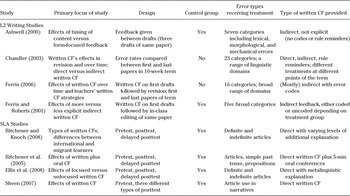
Although there are definitely overlaps between the two sets of recent studies, there are also important distinctions. The L2 writing studies tend to be set within writing classrooms; there may or may not be a control group or a pretest-posttest design; some studies do not define or delimit which types of student writing errors received written CF; and there is variation as to how written CF is provided (sometimes in very precise ways and in other cases not specified) and by whom (sometimes the teacher and sometimes the researcher). In contrast, the SLA studies are conducted under far more controlled experimental conditions, with a control and one or more treatment groups, pretest-posttest-delayed posttest designs, a focus on a few carefully chosen and defined error types, and feedback provided systematically by the researcher(s) or the teacher(s) in some classroom studies. Table 1 provides a visual comparison of several recent illustrative studies.
Comparison of recent SLA and L2 writing studies on written CF

Note
This list of studies is intended to be illustrative rather than comprehensive.
The four illustrative writing studies summarized in Table 1 (Ashwell, Reference Ashwell2000; Chandler, Reference Chandler2003; Ferris, Reference Ferris, Hyland and Hyland2006; Ferris & Roberts, Reference Ferris and Roberts2001) were all completed after Truscott’s original piece (1996), and all four reported positive effects for written CF.Footnote 4Table 1 also presents several excellent recent SLA studies on written CF (Bitchener & Knoch, Reference Bitchener and Knoch2008; Bitchener et al., Reference Bitchener, Young and Cameron2005; Ellis et al., Reference Ellis, Sheen, Murakami and Takashima2008; Sheen, Reference Sheen2007). These studies have taken the conversation about written CF a long way in a relatively short period of time. As a body of work, they provide consistent and compelling evidence that written CF, under the right conditions, can facilitate L2 development and help students improve the accuracy of their writing, at least for the particular features under consideration. It is also important that these studies have been methodologically rigorous enough to have addressed most of the criticisms aimed at the previous research on written CF. However, in considering the findings of these studies, the question of practical applicability arises.Footnote 5 Whereas reviewers such as Truscott (Reference Truscott1996, Reference Truscott2007) and other SLA researchers (e.g., Bitchener, Reference Bitchener2008; Ellis et al.; Sheen) have criticized earlier L2 writing work for its relatively less controlled and inconsistent designs, L2 writing researchers and practitioners might wonder if, in the interest of empirical rigor, some of the SLA research efforts on written CF have been so narrowly focused that it would be difficult to transfer their approach and findings to a real writing classroom or to a diverse group of students. These criticisms raise legitimate questions of whether the two bodies of work on written CF can be compared, should be included in the same reviews, or can contribute to one another, let alone provide practical pedagogical answers to L2 writing practitioners. Thus, the question of possible intersections and applications should be considered more thoroughly.
INTERSECTIONS OF SLA AND L2 WRITING RESEARCH ON WRITTEN CF: DIFFERENT STARTING POINTS?
Although L2 writing and SLA researchers look at similar phenomena, often (but not always) in similar ways, it is important to understand that they do not necessarily ask the same questions. The studies of written CF designed by SLA researchers examine whether written CF facilitates long-term acquisition of particular linguistic features, and, if so, how. Related subquestions include how many features (and which ones) should be examined in one treatment or study, whether the feedback should be implicit or explicit, and, if explicit, how much metalinguistic explanation is necessary (e.g., Bitchener, Reference Bitchener2008; Bitchener & Knoch, Reference Bitchener and Knoch2008; Bitchener et al., Reference Bitchener, Young and Cameron2005; Ellis et al., Reference Ellis, Sheen, Murakami and Takashima2008; Sheen, Reference Sheen2007). Other related research focuses on the influence of reformulation and think-aloud techniques in helping students to notice and incorporate corrections (e.g., Qi & Lapkin, Reference Qi and Lapkin2001; Sachs & Polio, Reference Sachs and Polio2007).
In contrast, L2 writing researchers start with the question of whether written CF helps student writers to improve the overall effectiveness of their texts and to develop as more successful writers. Expert written CF in this framework is seen as one useful tool that can help students improve their writing—but certainly not the only one. Most L2 writing experts would agree that helping students improve linguistic control in L2 writing involves a variety of teaching approaches beyond (and including) expert CF, such as explicit instruction, strategy training, and peer- and self-editing activities, among others. However, most L2 writing researchers or practitioners would be unlikely to focus on the acquisition of a specific linguistic feature, such as definite and indefinite articles, as an important pedagogical goal. Although practitioners certainly want students to use articles and other linguistic features accurately, a heavy emphasis on a few narrowly drawn structures in instruction and feedback would seem too limited a focus for a writing class.
Revision Studies
These differences in starting points are important because they help those interested in written CF understand the reasons behind conflicting methodologies and conclusions of various reviews on this topic (e.g., Ferris, Reference Ferris2003, Reference Ferris2004; Truscott, Reference Truscott1996, Reference Truscott2007). For example, one set of L2 writing studies (Ashwell, Reference Ashwell2000; Fathman & Whalley, Reference Fathman, Whalley and Kroll1990; Ferris & Roberts, Reference Ferris and Roberts2001) examined the influence of written CF on students’ revisions of the same paper: Students wrote a paper, received CF, and then revised the paper. Students’ ability to utilize expert written CF to revise and edit their work in progress was assessed. It has been argued by Truscott (Reference Truscott2007) and other SLA researchers (e.g., Ellis et al., Reference Ellis, Sheen, Murakami and Takashima2008; Sheen, Reference Sheen2007) that such studies are of limited value because they do not demonstrate that the effects of the written CF extend to future compositions. In contrast, there is widespread agreement in composition studies concerning the centrality of revision in the development of students’ writing abilities and processes. L2 writing researchers and teachers thus have a keen interest in identifying strategies to help students more successfully revise and edit their work. The revision study by Ferris and Roberts, for example, focused on one specific issue: the relative explicitness of written CF and whether students could self-edit their texts if corrections were coded for error type or simply marked (e.g., underlined or circled) but uncoded.Footnote 6 The study was not designed to prove definitively whether written CF works in the long term but rather to assess the efficacy of one particular approach to CF for developing students’ self-editing strategies.
Second language writing researchers thus see the development of effective strategies and writing processes that can impact students’ subsequent writing as the primary goal of writing instruction. Thus, starting from the L2 writing question of whether written CF helps student writers, revision studies are not only interesting but provide important evidence that helps teachers refine their practice. It has also been argued that revision and editing of a specific text after receiving written CF may be a helpful and perhaps necessary intermediate step between expert feedback about a target feature and long-term acquisition of that feature (see Ferris, Reference Ferris2004, Reference Ferris, Hyland and Hyland2006; see also Sachs & Polio, Reference Sachs and Polio2007, for a discussion and Truscott & Hsu, Reference Truscott and Hsu2008, for a rebuttal). Nonetheless, from the SLA starting point of whether written CF facilitates acquisition of targeted structures, the evidence from these revision studies is less compelling because it does not independently demonstrate that control of the structure is maintained over subsequent pieces of writing (or on posttests and delayed posttests). It is clear that distinct starting points for investigation can lead to differing viewpoints about what is interesting and important in written CF research.
Studies of Direct and Indirect Feedback
A distinction has been made in the written CF literature between direct feedback—that is, explicit corrections provided by the teacher or another reader—and indirect feedback—that is, an error called to the student’s attention (whether through more or less explicit means) but left for the student to correct (Bates et al., Reference Bates, Lane and Lange1993; Ferris, Reference Ferris2002, Reference Ferris, Hyland and Hyland2006; Ferris & Roberts, Reference Ferris and Roberts2001; Hendrickson, Reference Hendrickson1980; Lalande, Reference Lalande1982). Recent SLA studies on written CF have argued for the superiority of direct feedback, at least for a few targeted features (Bitchener, Reference Bitchener2008; Bitchener & Knoch, Reference Bitchener and Knoch2008; Ellis et al., Reference Ellis, Sheen, Murakami and Takashima2008; Sheen, Reference Sheen2007), whereas L2 writing researchers have argued for the importance of indirect feedback as a means to engage student writers in guided problem-solving and to encourage them to take more responsibility for their own progress (Ashwell, Reference Ashwell2000; Ferris, Reference Ferris2002, Reference Ferris2003, Reference Ferris, Hyland and Hyland2006; Lalande). It is also interesting to note that when asked for their opinions about written CF, L2 student writers have also expressed a clear preference for indirect feedback (Ferris & Roberts; Leki, Reference Leki1991). This direct versus indirect distinction is also prevalent in oral CF studies that have compared the efficacy of recasts (direct correction) and prompts (indirect feedback) in facilitating learner acquisition of targeted structures (see Lyster & Saito, this issue; Sheen, this issue; Yang & Lyster, this issue).
As with the revision studies, understanding the differences in focus may also explain the differing outcomes and conclusions. If a researcher’s goal is to trace evidence for acquisition of a specific feature, perhaps direct correction (providing the most input for acquisition) gives the most efficient and explicit information to the learner (Ellis et al., Reference Ellis, Sheen, Murakami and Takashima2008). If, however, the researcher’s goal is to assess the success of possible strategies for developing effective metacognitive skills as well as revision and editing processes in student writers, then feedback methods that require more effort or engagement on the part of the learner may better address this different objective (Ferris, Reference Ferris, Hyland and Hyland2006; Lalande, Reference Lalande1982).
Reformulation Studies
A different type of example of the effects of distinct starting points is research on whether reformulation (i.e., teacher rewriting) of student texts might be more effective than written CF in promoting acquisition and written accuracy (e.g., Qi & Lapkin, Reference Qi and Lapkin2001; Sachs & Polio, Reference Sachs and Polio2007). Although the evidence from these studies is inconclusive—in fact, Sachs and Polio found CF to be more helpful in the short term than reformulation—the key point here is that even if the studies had clearly shown reformulation to be superior, it is unlikely that some writing teachers would embrace it as a pedagogical technique. Because reformulation puts teachers’ words into students’ mouths (or pens or word processors), it is thus antithetical to the larger goal of helping students explore their ideas and develop their own voices. In other words, teachers might win the battle (students may use more accurate structures that have been fed to them through expert reformulations of their texts) but lose the war (students’ confidence and motivation to express their ideas through writing may be undermined).Footnote 7 This is not to say that examination of reformulation and its effects is not a worthy or interesting topic from a theoretical SLA standpoint. However, many L2 writing researchers, starting from the philosophical standpoint that writing instruction is not at its heart about the production of the ideal text (Brannon & Knoblauch, Reference Brannon and Knoblauch1982; Sommers, Reference Sommers1982), would be unlikely to regard reformulation as a topic worthy of serious consideration for research and especially for practice. This example further illustrates the claim that the distinct starting points of L2 writing and SLA research on written CF may cause scholars and practitioners to diverge first in research methodology (and interpretation of resultant findings) and later in application.
IMPLICATIONS: PRACTICAL APPLICATIONS AND FUTURE RESEARCH INTERSECTIONS
With these different starting points in mind, it is helpful to consider the practical implications of the most recent research findings on written CF. The latest SLA-focused written CF research is rigorous and carefully designed, especially compared with many earlier studies conducted by L2 writing researchers. Although recent L2 writing research on written CF has been more responsive to the methodological concerns raised by Truscott (Reference Truscott1996) and Ferris (Reference Ferris2004)—for instance, several of the writing studies in Table 1 (Ashwell, Reference Ashwell2000; Ferris & Roberts, Reference Ferris and Roberts2001) include control groups, and, in these later studies, error categories and feedback methods are more clearly operationalized—most still lack the pretest-treatment-posttest-delayed posttest components utilized in the SLA studies. It is tempting to conclude that the recent SLA-focused research is clearly superior and that the findings and approaches of earlier work (and perhaps even the most recent work) from L2 writing research can be simply dismissed. However, considering the complexity of both language acquisition and the development of academic literacy or writing proficiency, such comparisons are oversimplified. The two lines of research are not in competition; rather, they are complementary. There may be a methodological gap, but it is not a philosophical or theoretical chasm. L2 writing researchers and SLA researchers who investigate written CF—although they pose somewhat different questions—can and should learn from each other and build on one another’s work.
Practical Implications
Although the clear and empirically sound designs of recent SLA studies of written CF are indeed impressive, L2 writing specialists might wonder if applying their findings to composition instruction could be difficult. This may raise some objections or concerns, which are detailed here.
Strict Limits on the Number of Errors Treated With Written CF. SLA researchers working with written CF have argued that one major problem with earlier written CF research is in its vague correct-all-the-errors approach (Ellis et al., Reference Ellis, Sheen, Murakami and Takashima2008; Sheen, Reference Sheen2007). In contrast, SLA research designs have been limited to the effects of written CF on just a few (two or three) narrowly drawn and carefully defined features, such as definite and indefinite articles. These studies have consistently demonstrated that when error treatment is limited in this way, written CF results in statistically significant positive effects on posttests and delayed posttests as much as 2–10 months later (e.g., Bitchener, Reference Bitchener2008; Bitchener & Knoch, Reference Bitchener and Knoch2008). These SLA researchers are probably correct that a comprehensive, yet vague approach to written CF, compared with selective treatment of targeted error types, is less likely to yield empirically robust findings and be pedagogically effective. It only makes sense that students would utilize written CF more effectively for long-term language acquisition and writing development when there are fewer, clearer error types on which to focus attention. However, L2 writing scholars, and especially teachers, would respond that written CF that focuses only on one or two specific errors will not address students’ accuracy issues comprehensively enough because student writers tend to make a broad range of written errors. Furthermore, such a limited CF focus does not address the need to individualize feedback according to students’ different strengths and weaknesses. Although unfocused CF may not be effective, written CF might be too narrowly focused in the opposite approach; the question is raised as to whether there exists a middle position—focused error treatment would still be provided but in ways that are more representative of the diversity and complexity of language issues in L2 student writing.
Narrowly Defined Error Categories Treated With Written CF. Recent studies of written CF have limited not only the number of error categories treated but also the types of errors considered (see Table 1). With the exception of Bitchener et al. (Reference Bitchener, Young and Cameron2005), who also included prepositions, recent research has been limited to errors that have been called treatable (Ferris, Reference Ferris1999, Reference Ferris2002, Reference Ferris, Hyland and Hyland2006; Ferris & Roberts, Reference Ferris and Roberts2001)—that is, those that are relatively easy, from a linguistic standpoint, to define, describe, and teach. Although it is undoubtedly easier to design studies by limiting error categories in this way, L2 writing instructors would counter that error feedback that focuses only on narrowly drawn features will not address the more complex, more problematic errors student writers make—those that obscure meaning and interfere with communication (Bates et al., Reference Bates, Lane and Lange1993; Ferris, Reference Ferris2002; Hendrickson, Reference Hendrickson1980; Lane & Lange, Reference Lane and Lange1999), such as global errors in word order, sentence boundaries, phrase construction, word choice, or collocations. Moreover, as noted by Truscott (Reference Truscott1996), student writers’ language errors may occur in syntactic, morphological, or lexical domains, yet written CF research and pedagogy often treat these more or less complex matters in identical ways. Thus, a written CF treatment that appears to work for article errors may not be effective for complex sentence structure errors.
Demands on Teacher Time, Energy, and Expertise. Recent SLA studies (e.g., Bitchener & Knoch, Reference Bitchener and Knoch2008; Sheen, Reference Sheen2007) have called for the provision of direct feedback (teacher corrections or rewriting) paired with rule reminders or explanations, which may be either written (appended to students’ texts) or oral (in one-to-one conferences or whole-class presentations). Although the combination of in-text direct correction and rule reminders may well be effective in a laboratory setting, it is not realistic to expect classroom writing teachers to provide not only CF but also written or oral rule explanations. Most teachers have neither the time nor the patience to give that much feedback in that much detail, especially if they are attempting to address a broader, more complex range of error types than those represented in the recent studies. Additionally, many of these errors defy any kind of succinct rule or explanation. Many teachers do not even have the linguistic expertise to attempt such a task, even if it were logistically feasible. Finally (and most importantly), because there are many other aspects of writing to focus on, such as ideas, organization, and processes, many teachers would find an intensive instructional emphasis on specific written errors to be out of balance.
Second language writing researchers, teachers, and teacher-educators are thus caught in a dilemma when considering the findings of the SLA-oriented written CF studies of recent years. On the one hand, these SLA studies provide much-needed support for a controversial pedagogical practice—written error correction—that most L2 writing teachers and nearly all L2 writing students feel is essential and even nonnegotiable. On the other hand, the practical applicability of the SLA studies is an unresolved question that demands further exploration. It is not clear whether the findings of these types of studies will be applicable if more errors are treated at the same time, if more complex structures are addressed, and if teachers opt, in the interest of time, energy, and limited expertise, for less explicit feedback methods. For the L2 writing audience, this observation begs the question of how the lessons learned from these SLA studies can be further examined to address these practical questions.
SLA and L2 Writing Intersections: Future Research Directions
With these issues in mind—design and focus differences and questions about real-world implementation—there are some profitable ways in which SLA researchers and L2 writing researchers and practitioners could benefit from each other’s work, whether in collaborative efforts or in complementary lines of research.
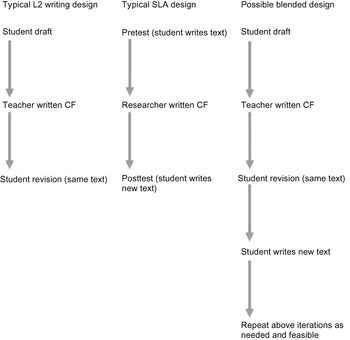
Longitudinal and Contextualized Written CF Studies. SLA research tends to follow a pretest-posttest-delayed posttest design that can be somewhat detached from the day-to-day activities of a typical writing class. L2 writing research tends to follow a response and revision design that fits within the context of a multiple-draft process-oriented approach found in many L2 writing courses. However, typically missing in these L2 writing studies is a longitudinal component that could be considered parallel to the posttest and delayed posttest stages of SLA studies. Classroom-based L2 writing designs should examine whether feedback and revision on one paper can help student writers exhibit greater control of those same features in subsequent writing.Footnote 8 Although there have been a couple of attempts at such designs over the years (e.g., Chandler, Reference Chandler2003; Ferris, Reference Ferris1995a, Reference Ferris, Hyland and Hyland2006; Truscott & Hsu, Reference Truscott and Hsu2008), there is room for much more work in this area. In the writing classroom, analysis of response, revision, and subsequent texts could be roughly compared to an experimental pretest-posttest-delayed posttest design that would thus be both contextualized and longitudinal (see Figure 1).
Possible research designs incorporating revision.

Revision as Part of Written CF Research Design. Revision studies of written CF have been criticized by some scholars as having limited value because they are not longitudinal. The recent SLA studies outlined in Table 1 (Bitchener & Knoch, Reference Bitchener and Knoch2008; Bitchener et al., Reference Bitchener, Young and Cameron2005; Ellis et al., Reference Ellis, Sheen, Murakami and Takashima2008; Sheen, Reference Sheen2007) do not include mandated (or even optional) student revision or correction following written CF as part of their design. Rather, the students produce a text (pretest), receive written CF (treatment), and later produce new texts (posttest and delayed posttest). In contrast, some oral CF research designs include uptake or learners’ immediate response to CF. When measured, such uptake has sometimes appeared to facilitate acquisition of the target structure (e.g., Lyster & Ranta, Reference Lyster and Ranta1997). Compared with oral CF, it would seem even more likely that written revision or editing would have beneficial effects, given that students have more time to think about and process the corrections and attempt repairs and modifications (see also Sachs & Polio, Reference Sachs and Polio2007, for a discussion of this point). One possible modification to the recent pretest-posttest-delayed posttest designs of SLA researchers would be to assess whether asking students to make revisions after receiving feedback on their writing improved their posttest and delayed posttest scores (see Figure 1).
Examinations of Different Written CF Methods. Both SLA and L2 writing researchers have examined the direct versus indirect feedback question and, in a couple of instances, have even investigated varying subtypes of direct or indirect feedback (e.g., coded vs. uncoded indirect feedback as in Ferris & Roberts, Reference Ferris and Roberts2001; Truscott & Hsu, Reference Truscott and Hsu2008). However, written CF can be delivered in a variety of ways (see Ferris, Reference Ferris2002) that could merit further investigation—for instance, more detailed comparison of the different subtypes of direct or indirect written CF in terms of the level of explicitness or explanation such feedback should provide. Furthermore, studies should be designed in ways that address the L2 writing starting point (i.e., whether written CF helps students to develop more effective revision and self-editing processes) as well as the more immediate SLA concern of whether written CF helps learners acquire a target structure (see Ellis et al., Reference Ellis, Sheen, Murakami and Takashima2008, for a concise discussion of the direct versus indirect CF issue with regard to types and stages of SLA).
Focus on Specific Errors and Features for Written CF. It seems clear from both L2 writing and SLA research that identifying specific features for feedback is more effective than a broad and vague comprehensive approach (either for research or for teaching). The most obvious follow-up question is: How many features can optimally be treated in a research study (and, by extension, during a writing or language course), and which ones? From a L2 writing perspective, it seems fair to say that 1 or 2 features are too few and 15–20 features are probably too many. However, it has not been established what the most appropriate number of written CF categories should be. These categories might change over time; for instance, an instructor or researcher could focus on several categories early in a course or a study but then emphasize different features later (Sheen, Reference Sheen2007). It is not clear whether research designs must be limited to narrowly drawn treatable categories (i.e., errors that can be addressed by reminders of a clear and succinct rule; see Ferris, Reference Ferris2002, Reference Ferris, Hyland and Hyland2006; Ferris & Roberts, Reference Ferris and Roberts2001) or may also consider more complex features (such as lexical issues or sentence structure).
A productive study or series of studies could be designed to investigate these questions to determine whether the empirically rigorous parameters of the SLA-oriented written CF research models will prove to be equally valuable in less controlled but more naturalistic contexts. For instance, equivalent groups of participants could be compared when one group receives feedback on two error types while the other group receives written CF on five categories, and their pretest-posttest-delayed posttest results could be contrasted to examine whether a broadened focus dilutes the effectiveness of written CF. Similarly, one group of writers could receive feedback on untreatable error types such as lexical choice or sentence structure while another is provided with written CF on discrete morphological issues such as noun plurals or regular verb forms (Ferris, Reference Ferris, Hyland and Hyland2006; Ferris & Roberts, Reference Ferris and Roberts2001). The investigation of these questions is especially important for an audience of L2 writing specialists, who may need to be convinced that the narrowly drawn findings of the previous SLA studies (Bitchener & Knoch, Reference Bitchener and Knoch2008; Bitchener et al., Reference Bitchener, Young and Cameron2005; Ellis et al., Reference Ellis, Sheen, Murakami and Takashima2008; Sheen, Reference Sheen2007) are not only reliable but also ecologically valid.
Context and Individual Characteristics in Written CF. Finally, future research designs for written CF, whether from a SLA or L2 writing standpoint, must consider and control for contextual and individual differences. This is one of the most surprising oversights in written CF research. In terms of context, FL students in the United States, EFL students in other countries, and ESL students in the United States (who further subdivide into international, recent immigrant, and early arriving students) are discussed together in research reviews as if the differences across L1, L2, motivation, and proficiency level or writing experience are irrelevant in understanding why or if written CF works. As to individual differences, every writing instructor knows that some students benefit more from CF than others, for a variety of reasons such as motivation, learning style, and metalinguistic background knowledge. Written CF researchers crucially fail to adequately consider divergent paths to SLA (i.e., classroom instruction vs. naturalistic exposure in a L2 context), and how these paths affect both the knowledge students bring to L2 writing and their ability to utilize various types of CF. Although Bitchener and Knoch’s (Reference Bitchener and Knoch2008) study examined differences between international and migrant students in New Zealand with regard to written CF, much more work remains to be done in this area. At this moment in time, it seems safe to assume that a one-size-fits-all approach to error treatment is unlikely to be effective or appropriate.
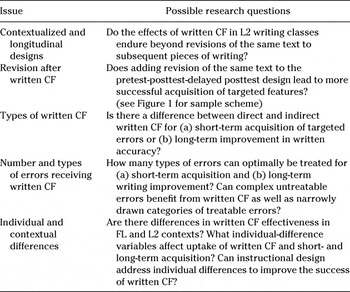
In sum, researchers should build upon the insights of the effective base of SLA studies—with its built-in longitudinal components, careful definition of relevant linguistic structures, and precise descriptions of how written CF is provided—but by posing questions and adapting research designs in ways that address the concerns of both SLA and L2 writing scholars, practitioners, and students. In this way, a body of research work rigorous enough to be convincing to SLA researchers but practical enough to be useful to L2 writing specialists can be developed over time. Table 2 summarizes these suggestions for future research.
Suggestions for research intersections for SLA and L2 writing studies of written CF

CONCLUDING THOUGHTS
In recent years, work on (oral or written) CF in the SLA realm has added immensely to the knowledge base about this important and controversial research issue, which is also a ubiquitous pedagogical practice.Footnote 9 Although some scholars concluded long ago that grammar instruction (Hartwell, Reference Hartwell1985; Krashen, Reference Krashen1982, Reference Krashen1984) and CF (Truscott, Reference Truscott1996) have limited and perhaps nonexistent value (or are even harmful), most writing teachers and students continue to believe in both. Nonetheless, it is important to acknowledge and respond to criticisms that have been made in the past regarding not only research designs and findings but also pedagogical practices. Those primarily interested in written CF from the L2 writing perspective must continue to ask whether compelling evidence obtained from rigorously designed studies (not just anecdotal experience) exists to support the continuation of current practices and whether such evidence helps refine and improve what practitioners do. Similarly, SLA researchers should ask how their designs and findings reflect realities that surround writing (a complex endeavor), contexts, and individual students. The two perspectives have great potential to move knowledge and practices forward, and the interaction and collaboration represented in this special issue is an excellent step in the right direction.
In closing, it would seem that differences between SLA and L2 writing researchers with regard to written CF are not a chasm but a gap, which can be bridged by a broader understanding of what is being looked at and what the implications of the findings might be. Through crossing these subdisciplinary bridges, the gaps between theory, research, and practice in this important area of language and writing instruction can also be narrowed—and perhaps closed altogether.