INTRODUCTION
The penaeid shrimp accounted for around 40% of world catches of shrimp in 2015 (FAO, 2017). In Brazil, the white shrimp Litopenaeus schmitti (Burkenroad, 1936) is one of the most important penaeid species in terms of fishery biomass (Caparelli et al., Reference Capparelli, Kasten, Castilho and Costa2012; Bochini et al., Reference Bochini, Adilson, Antonio, Gustavo and Rogerio2014). Moreover, landings of L. schmitti rank second in small-scale fisheries of crustaceans in the state of Pernambuco, being surpassed only by the fishery of Callinectes spp. (IBAMA, 2007), representing an important socio-economic activity for coastal communities, as they operate in areas with low employment opportunities (Lagares et al., Reference Lagares, Ordaz and Garcia del Hoy2016).
Litopenaeus schmitti is distributed throughout the western Atlantic, from Cuba (23°30′N) to the Brazilian State of Rio Grande do Sul (29°45′S) (Perez-Farfante & Kensley, Reference Perez-Farfante and Kensley1997). The species is usually found in coastal areas from shallow depths up to 30 m, and its distribution has been related to environmental factors, mainly salinity, in the south-eastern Brazilian coast (Bochini et al., Reference Bochini, Adilson, Antonio, Gustavo and Rogerio2014; Barioto et al., Reference Barioto, Stanski, Grabowski, Costa and Castilho2017).
Knowledge of growth, mortality and reproductive parameters are essential not only for the ecological information, but also for use as an input to the application of stock assessment models required for fisheries management (Hartnoll, Reference Hartnoll and Bliss1982; Siddeek et al., Reference Siddeek, Hermosa, Al-Amri and Al-Aisery2001). As decapod crustaceans lack structures that can provide information about ageing and have a discontinuous growth, frequently interrupted by successive ecdyses, methods based on length-frequency distributions are the most useful and commonly employed (Petriella & Boschi, Reference Petriella and Boschi1997).
The development of fisheries has shown the need for studies on the state of exploitation of stocks, as the commercial extinction and genetic changes of L. schmitti populations in Cuba demonstrates the high vulnerability of this species to overfishing (Borrel et al., Reference Borrell, Arenal, Mbemba Z.M., Santana, Díaz-Férnandez, Vázquez, Blanco and Sánchez2007). However, although studies have been performed on population dynamics and distribution of L. schmitti populations from the coast of Cuba (Borrell et al., Reference Borrell, Espinosa, Romo, Blanco, Vázquez and Sánchez2004, Reference Borrell, Arenal, Mbemba Z.M., Santana, Díaz-Férnandez, Vázquez, Blanco and Sánchez2007), Venezuela (Andrade & Pérez, Reference Andrade and Pérez2004; Diaz et al., Reference Diaz, Ferrer, Álvarez, González, Méndez and Corona2013, Reference Diaz, Ferrer, Álvarez, González, Méndez and Corona2014) and south-eastern Brazil (Capparelli et al., Reference Capparelli, Kasten, Castilho and Costa2012; Bochini et al., Reference Bochini, Adilson, Antonio, Gustavo and Rogerio2014; Barioto et al., Reference Barioto, Stanski, Grabowski, Costa and Castilho2017), little information is available for this species in north-east Brazil (Santos et al., Reference Santos, Pereira, Ivo and Souza2006). Moreover, lack of information on this resource and lack of legislation in the state of Pernambuco that regulates shrimp fishing both result in a potential risk to the sustainability of the species and the maintenance of the fishing activity.
In this context, due to the biological and economic importance of L. schmitti in north-eastern Brazil, this study provides information about the population structure, period of recruitment, biometric relationships, growth, mortality and yield per recruit for the species on the southern coast of Pernambuco, north-eastern Brazil, increasing the overall knowledge of the species.
MATERIALS AND METHODS
Data collection
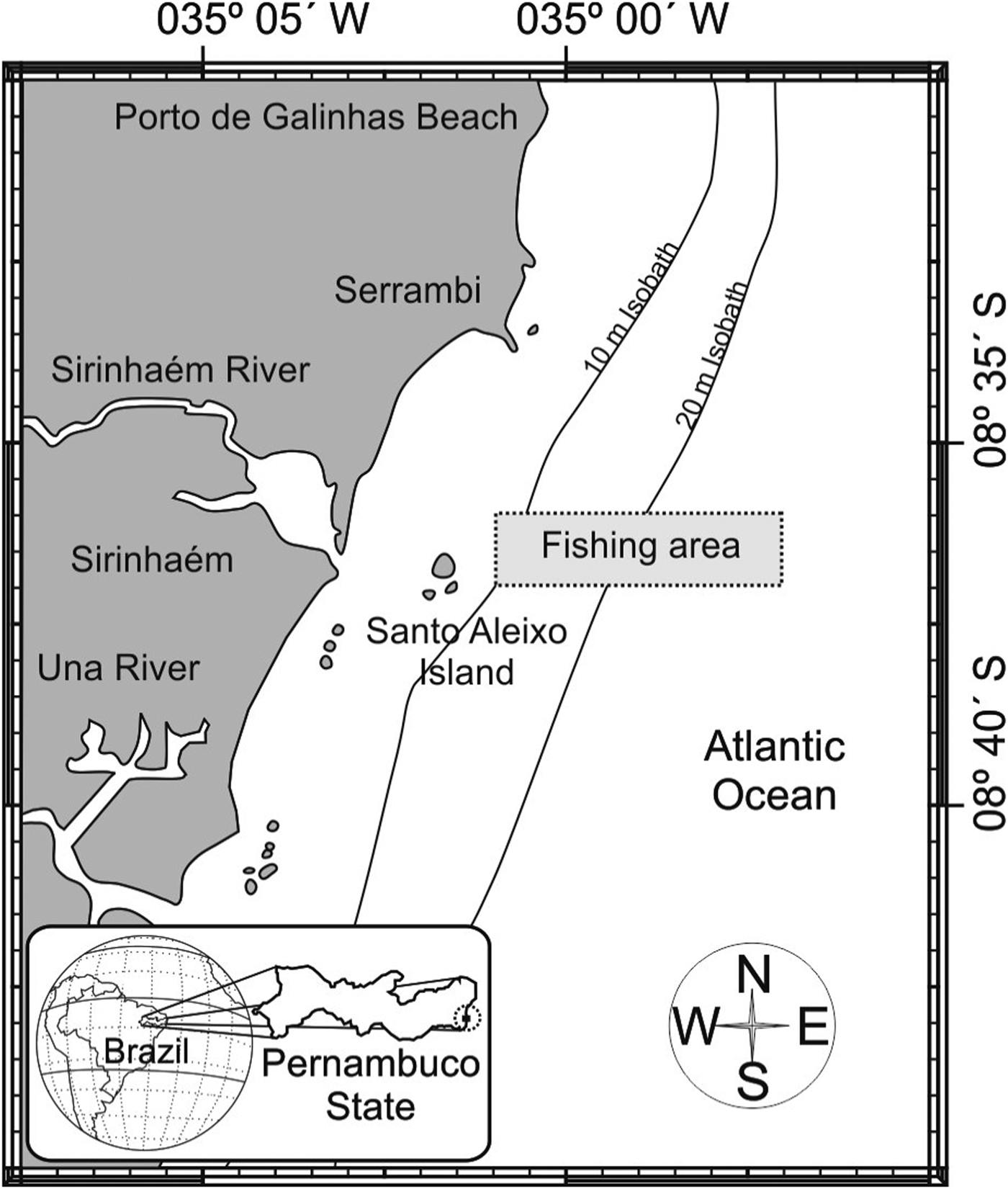
Data collection was performed in the main shrimp fishing area of Pernambuco state, located in the municipality of Sirinhaém, near the mouth of the Sirinhaém River (08° 35′ 57″ S–08° 36′ 57″ S and 034° 56′ 58″ W–035° 00′ 48″ W, Figure 1).
Geographic location of the study site (fishing area) on the coast of Pernambuco, north-eastern Brazil.

Specimens of L. schmitti were collected monthly from August 2011 to July 2012 in daytime during the full moon. Fishing was held using an artisanal boat from the local fleet, which operated with double trawling with 10-m long nets, with mouth of 6.10 m and mesh size of 30 and 25 mm in the body and codend, respectively. Monthly, around 120 shrimps were collected within the three trawls, lasting 2 hours each, carried out for each sampling. Approximately 40 shrimps per trawl were randomly selected. Shrimp were immediately cooled on ice until the analysis.
The sex of the animals was identified based on external characters (presence of thelycum in females and petasma in males). The carapace length (CL, from the base of the rostrum to the posterior edge of the carapace) and total length (TL, from the tip of the rostrum to the posterior end of the telson) were measured using a digital calliper (mm) and total weight (TW, wet total weight) was measured with an analytical balance (accuracy of 0.1 g).
Population structure
The population structure has been described considering the months and sex. To determine significant differences in CL between them, two-way ANOVA was used, considering the necessary normality (Kolmogorov–Smirnov test) and homogeneity (Levene test) assumptions. The Bonferroni test was used to determine significant differences between sexes and months (P < 0.05). The sex ratio in relation to CL classes of 0.1 cm was compared using the chi-square test (P < 0.05).
Biometric relationships
Biometric relationships were estimated for separated and grouped sexes through regression analysis, where TL was the independent variable and the CL and TW were dependent variables. The regressions were adjusted by the least squares method, with 95% significance level (Sokal & Rohlf, Reference Sokal and Rohlf1987).
The relationship between TL and CL was calculated using linear regression (CL = a + bTL), where a is the intercept and b is the allometric coefficient (positive allometric growth when b > 1; negative allometric when b < 1 and isometric when b = 1). To evaluate the relationship between TL and TW, a potential regression was performed (TW = aTLb), where a is the intercept and b is the allometric coefficient (positive allometric growth when b > 3; negative allometric when b < 3 and isometric where b = 3). The Student's t-test was used to compare the coefficient b of these relations with 1 and 3, respectively, for the linear and potential regressions, as well as to compare the relationships between the sexes (Zar, Reference Zar2009).
Growth
The frequency of CL data was analysed using the computer package FISAT II (FAO/ICLARM Stock Assessment Tools) (Gayanilo et al., Reference Gayanilo, Sparre and Pauly2005), and the growth was described through the von Bertalanffy model (Reference Von Bertalanffy1938), according to the following equation:
 $$L_t = L_\infty \left[ {1 - {\rm exp}\left\{ { - k\left( {t - t_0} \right)} \right\}} \right]$$
where Lt is the carapace length (cm) at age t (month); L∞ is the asymptotic full length (cm); k is the growth coefficient (year−1); t0 is the age at which the carapace length of the animal is zero. For our study, we consider t 0 = 0, a practice widely used for penaeids (Leite & Petrere, Reference Leite and Petrere2006; Lopes et al., Reference Lopes, Silva, Peixoto and Frédou2014; Silva et al., Reference Silva, Calazans, Nolé, Viana, Soares, Peixoto and Frédou2015).
The parameters of the von Bertalanffy growth curve were determined through the distribution of CL measures of males, females and both sexes grouped divided into 0.1 cm class intervals for each month in order to set the average lengths by age, using the method of Bhattacharya (Reference Bhattacharya1967). Afterwards, the tool ‘linking of means’ (FISAT II) was used to identify the increase in size during growth. Growth parameters were estimated using the method Length-at-age. Moreover, for the best fit of the von Bertalanffy growth model, the length frequencies were also restructured through ELEFAN (Gayanilo et al., Reference Gayanilo, Sparre and Pauly2005), available at FISAT II. The Kimuras likelihood ratio test was used to compare the growth curves between males and females (P < 0.01) (Kimura, Reference Kimura1980). The Kimuras test was performed using R version 3.3.3 (R Core Team, 2016), package ‘fishmethods’.
Mortality
The total mortality (Z) was estimated through the catch curve (Pauly, Reference Pauly1984) and Beverton and Holt's model (Beverton & Holt, Reference Beverton and Holt1956). The Natural mortality (M) was estimated by using Pauly's empirical relationship (Pauly, Reference Pauly1980), and the fishing mortality (F) by the difference between Z and M.
The exploitation rate was estimated by the ratio between F and Z. The length at first capture (Lc) was estimated as the length corresponding to 50% capture probability. The maximum yield per recruit (ERMY) was estimated using the model of relative yield per recruit (Y/R) (Beverton & Holt, Reference Beverton and Holt1966) and longevity through the Hoening's method (1982).
RESULTS
Population structure
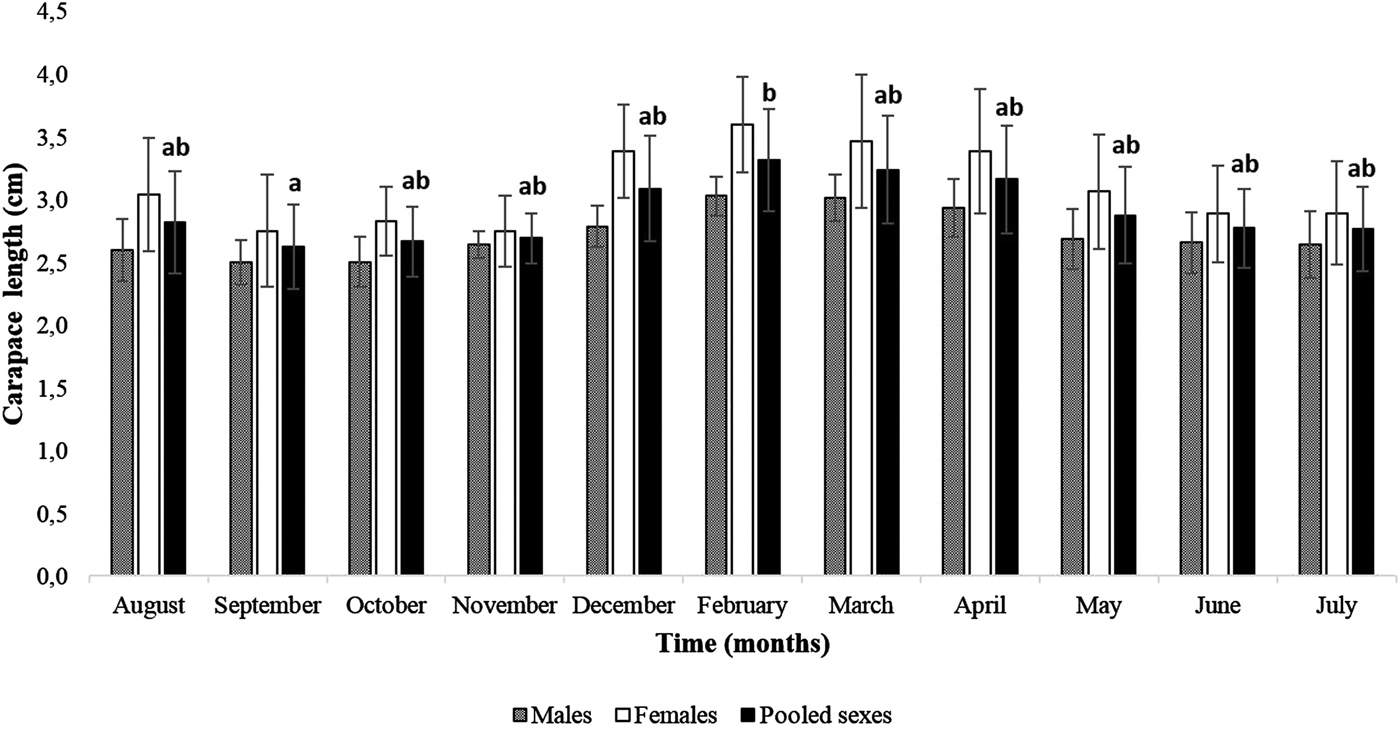
During the study period, a total of 1169 specimens of L. schmitti were collected, corresponding to 678 females (58%) and 491 males (42%), except for January, when no specimens were captured. In general, females were larger (3.07 ± 0.51 cm) than males (2.68 ± 0.25 cm) (P < 0.05).
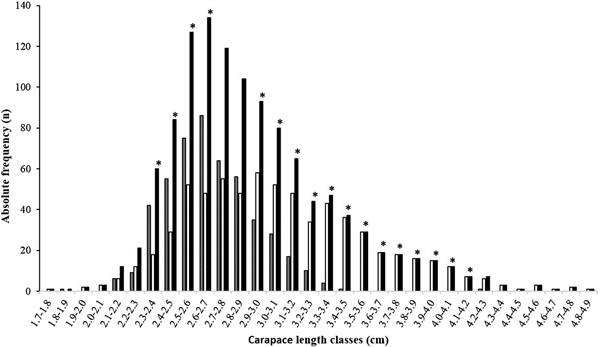
Absolute frequency distribution per length classes of males, females and pooled sexes for white shrimp Litopenaeus schmitti, captured in the period of August 2011 to July 2012, on the coast of Pernambuco, north-eastern Brazil. *Significant differences between males and females within length classes.

The highest absolute frequency of CL was observed in the class 2.6–2.7 cm, with a higher frequency of males (P < 0.05) (Figure 2). However, females dominated in larger size classes, as observed from the class 2.9–3.0 cm onwards (Figure 2).
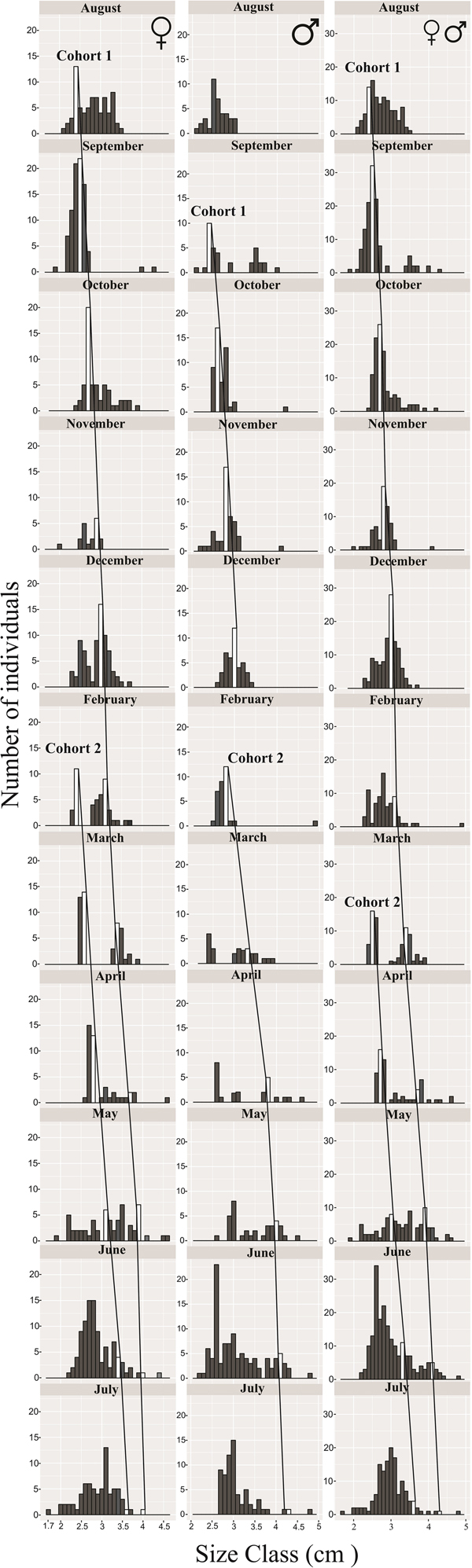
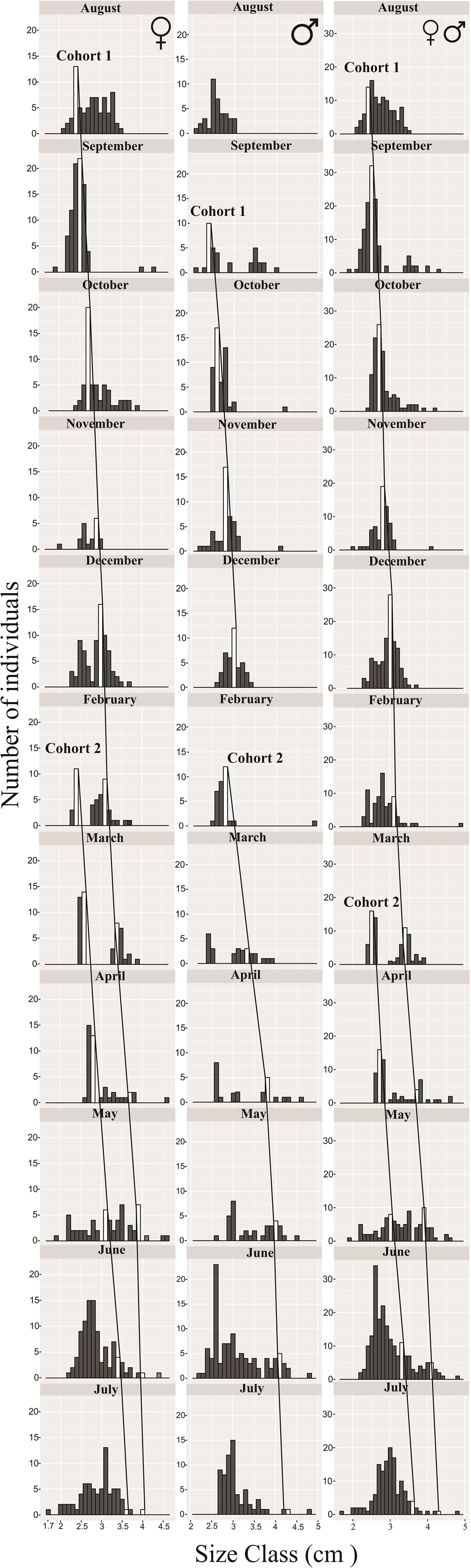
The largest shrimps were observed in February, with an average CL of 3.32 ± 0.41 cm, significantly differing only from animals captured in September (P < 0.05) (Figure 3). No significant differences were observed between the animals caught in the other months (Figure 3). The animals with smaller size classes were observed in the months of September to October and June to July (Figure 4).
Monthly average (±S.D) of the carapace length (CL) (cm) of males, females and pooled sexes for white shrimp Litopenaeus schmitti, captured in the period of August 2011 to July 2012, on the coast of Pernambuco, north-eastern Brazil. Different letters indicate significant differences between months.

Carapace length classes of males, females and pooled sexes of white shrimp Litopenaeus schmitti, captured in the period of August 2011 to July 2012, on the coast of Pernambuco, north-eastern Brazil.
Biometric relationships
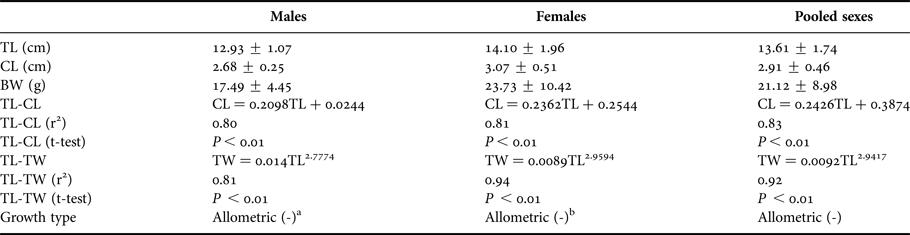
The TL and CL relationship was significant for males, females and both sexes showing a negative allometric growth (P < 0.01), as the shrimps grow more in total length than in carapace length. The coefficient ‘b’ of the TL-CL equation, which represents the type of growth, showed significant differences between males and females (P < 0.01) (Table 1). The relationship between TL and TW for males, females and both sexes grouped was significant, with a negative allometric growth (P < 0.01), where the animal grows less in weight than in length. The coefficient ‘b’ of the equation TL-TW showed significant differences between males and females (P < 0.01) (Table 1).
Mean values (±SD) of total length (TL), carapace length (CL) and total weight (TW), and biometric relationship equations (TL-CL and TL-TW) and descriptive statistics for Litopenaeus schmitti from the coast of Pernambuco, north-eastern Brazil.

Different superscript letters indicate significant differences between males and females.
Growth
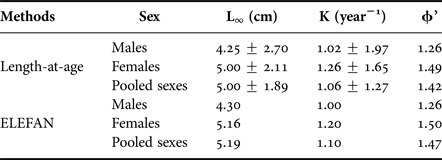
Two cohorts were identified for females and males, with a higher growth for females (Figure 4). The growth curves of males and females were statistically different (P < 0.01). The values of L∞ estimated by different methods were higher for females (5.00–5.16 cm) than males (4.25–4.30 cm). Similarly, females achieved higher k value (1.20–1.26 year−1) than males (1.00–1.02 year−1) (Table 2). The growth parameters estimated by Length-at-age and ELEFAN methods were used as input for the models of mortality estimation and maximum yield per recruit.
Estimation of growth parameters L∞ (cm) and k (year−1) (±S.E) and growth performance index (ϕ') through Length-at-age and ELEFAN methods for males, females and pooled sexes for Litopenaeus schmitti captured in the period of August 2011 to July 2012 in the coast of Pernambuco, north-eastern Brazil.

Mortality
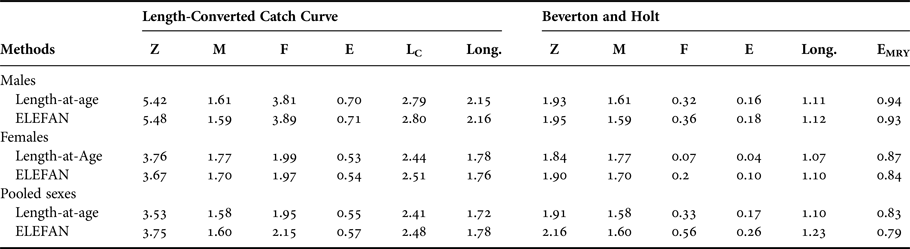
Mortalities Z (1.84 to 5.48 year−1), M (1.58 to 1.77 year−1) and F (0.07 to 3.89 year−1) varied according to the different methodologies. Generally, mortality rates were higher when the growth parameters derived from the ELEFAN method were used as input, rather than the parameters estimated by Length-at-age. Z mortality estimated by the catch curve had higher values compared with the Beverton and Holt method (Table 3).
Estimates of total mortality (Z-year−1), natural mortality (M-year−1), fishery mortality (F-year−1), exploitation rate (E), length at first catch (LC-cm), longevity (Long. year−1) and maximum recruitment yield (EMRY) through both the Length-Converted Catch Curve and the Beverton and Holt method for males, females and pooled sexes of Litopenaeus schmitti, captured in the period of August 2011 to July 2012 in the coast of Pernambuco, north-eastern Brazil.

In general, mortality of males was higher than females regardless of the method. Similarly, the exploitation rates (E) of males (0.70–0.71) were higher than the females (0.53–0.54) with the catch curve method. The value for maximum yield per recruit (ERMY) was estimated at 0.93–0.94 and 0.84–0.87 for males and females, respectively (Table 3). The Beverton and Holt method estimated exploitation rate values lower than the maximum yield per recruit.
The length at first capture was higher in males (2.79–2.80 cm) than females (2.44–2.51 cm). Males survived longer than females, regardless of the methodology used (Table 3).
DISCUSSION
In the southern coast of Pernambuco, females of the white shrimp L. schmitti were dominant and larger than males, showing a higher growth coefficient and greater asymptotic length. As in other penaeids (Grabowski et al., Reference Grabowski, Simões and Castilho2014; Castilho et al., Reference Castilho, Bauer, Freire, Fransozo and Costa2015), the growth curves of males and females were statistically different. Although females were also more dominant than males (1.5:1) in the Gulf of Venezuela, the total length range (9–24 cm) was similar between sexes (Diaz et al., Reference Diaz, Ferrer, Álvarez, González, Méndez and Corona2014). According to Garcia & Le Reste (Reference Garcia and Le Reste1986), penaeid females tend to show higher numbers in the largest size classes, which is in line with the results observed in the present study. Sexual dimorphism is characteristic in penaeids where females are larger and heavier than males (Dall et al., Reference Dall, Hill, Rothlisberg and Staples1990; Gopal et al., Reference Gopal, Gopikrishna, Krishna, Jahageerdar, Rye, Hayes and Paulpandi2010). Gab-Alla et al. (Reference Gab-Alla, Hartnoll, Ghobashy and Mohammed1990) argued that the largest size of the carapace and abdomen of females may correspond to the further development of the ovaries and increased production of oocytes and fertility. Smaller individuals were observed from September to October and from June to July, indicating a possible recruitment during these months, which is in accordance with the main spawning season of the species observed by Peixoto et al. (Reference Peixoto, Calazans, Silva, Nole, Soares and Frédouin press) from August to November and February to March in the same region.
In this study, L. schmitti presented a negative allometric growth in TL-CL and TL-TW relationships. The same tendency was observed for Farfantepenaeus subtilis in the north-east region (Silva et al., Reference Silva, Calazans, Nolé, Viana, Soares, Peixoto and Frédou2015), and for Farfantepenaeus brasiliensis and Farfantepenaeus paulensis in the south-east coast (Leite & Petrere, Reference Leite and Petrere2006). However, the TL-TW relation indicated a positive allometry for L. schmitti in Venezuela (Diaz et al., Reference Diaz, Ferrer, Álvarez, González, Méndez and Corona2014). The body size of crustaceans increases in different ratios for each organism and these differences are often related to sex and maturational stage of the animal (Hartnoll, Reference Hartnoll and Bliss1982). Immature or developing organisms in the habitat can explain the lower increase in weight relative to the length observed in this study (Peixoto et al., in press).
The growth parameters obtained by the Length-at-age and ELEFAN methods in this study showed similar results for L. schmitti. The L∞ and k was higher for females (5.00–5.16 cm; 1.20–1.26 year−1) than males (4.25–4.30 cm; 1.00–1.02 year−1). Penaeid males usually have a lower value of L∞ and higher k value than females (Garcia & Le Reste, Reference Garcia and Le Reste1986; Dall et al., Reference Dall, Hill, Rothlisberg and Staples1990). Diaz et al. (Reference Diaz, Ferrer, Álvarez, González, Méndez and Corona2014) observed L∞ of 22.2 cm for females and 20.1 cm for males of L. schmitti in Venezuela, however, a lower k value for males (1.40 year−1) than females (1.69 year−1) was reported, which is in agreement with the results observed in the present study. This trend was also registered in the Persian Gulf as Niamaimandi et al. (Reference Niamaimandi, Arshad, Daud, Saed and Kiabi2007) found a higher k value for females for Penaeus semisulcatus.
The instantaneous rate of total mortality (Z), and hence the fishery mortality (F) estimated in this study, varied with the methods of the catch curve and Beverton and Holt, as well as growth methods, used as input. Mortality values estimated with the Beverton and Holt method were lower than those obtained with the catch curve. Moreover, the use of growth parameters estimated by ELEFAN provided higher values of mortality than those estimated by the Length-at-age. Regardless of the methodological scenarios used, mortality was higher for males (1.93–5.48 year−1) than females (1.84–3.76 year−1). Similar results was observed by Diaz et al. (Reference Diaz, Ferrer, Álvarez, González, Méndez and Corona2014) for the same species in Venezuela (Z of 5.41 and 3.96 year−1 for males and females, respectively), given the same trend of k and L∞ observed in relation to our study. The fishing mortality (F) was higher in relation to M coefficients only when the length-converted catch curve was used, and varied from 0.07 to 3.89 year−1. Similar values and wide ranges of F observed in this study were also reported for L. schmitti females (0.36–2.57 year−1) and males (2.01–4.14 year−1) in Venezuela, as a consequence of the wide variations of M among different methods (Diaz et al., Reference Diaz, Ferrer, Álvarez, González, Méndez and Corona2014). The longevity values in this study varied from 1.07 (Beverton and Holt for females) to 2.16 (catch curve for males), but were within the longevity estimates observed for penaeids. Niamaimandi et al. (Reference Niamaimandi, Arshad, Daud, Saed and Kiabi2007) estimated longevity of 1.3–1.8 years to P. semisulcatus. For F. subtilis, Silva et al. (Reference Silva, Calazans, Nolé, Viana, Soares, Peixoto and Frédou2015) estimated a longevity of 1.88–2.20 years, while Lopes et al. (Reference Lopes, Silva, Peixoto and Frédou2014) observed longevity of 1.55–2.40 years for Xiphopenaeus kroyeri. Dall et al. (Reference Dall, Hill, Rothlisberg and Staples1990) report that the life cycle of penaeids is estimated at about 2 years; and Garcia & Le Reste (Reference Garcia and Le Reste1986) suggested that the longevity of penaeids is 1.3–2.5 years.
According to Fernandes et al. (Reference Fernandes, Silva, Jardim, Keunecke and Di Beneditto2011), growth parameters (and hence mortality estimates) may vary spatially and temporally for the same species and may be associated with intrinsic (genetic) and extrinsic (environmental) factors, as well as geographic location, sex and stage of life. Also, uncertainty does exist when using FISAT for growth performance estimates. Therefore, it is acknowledged that the use of these methods entails great uncertainty; however, the use of multiple methods may reduce the bias imposed by any of the methods used (Hewitt et al., Reference Hewitt, Lambert, Hoenig, Lipcius, Bunnell and Miller2007). Despite the numerical differences between mortality rates and exploitation, the results obtained from the different inputs converged with respect to the level of sustainability of this fishing stock. Both indicated that the rate of exploitation of L. schmitti is relatively close to, but not at the maximum exploitation possible. It is also observed that the length of first capture of females (12.29–12.81 cm TL – 3.15–3.28 cm CL) in this study is below the length of sexual maturation, estimated at 14.2 cm TL–3.61 cm CL by Peixoto et al. (in press). Moreover, the other target species (Farfantepenaeus subtilis, X. kroyeri and Litopenaeus schmitti) caught within the shrimp trawler fishery in the region, are either close to or at maximum exploitation rates (Lopes et al., Reference Lopes, Silva, Peixoto and Frédou2014; Silva et al., Reference Silva, Calazans, Nolé, Viana, Soares, Peixoto and Frédou2015) and this fishery is hence increasingly vulnerable. Therefore, a reduction in the fishing effort on this stock is needed by reducing the number of vessels, which would not only protect L. schmitti but also other penaeids and main by-catch that are exploited in this region and show a similar biological pattern, as already observed by previous studies in the area (Lopes et al., Reference Lopes, Silva, Peixoto and Frédou2014; Silva et al., Reference Silva, Calazans, Nolé, Viana, Soares, Peixoto and Frédou2015; da Silva et al. Reference da Silva, Viana, Frédou and Frédou2015).
FINANCIAL SUPPORT
This study was supported by the Foundation for Science and Technology of the State of Pernambuco (FACEPE), the Higher Education Personnel Improvement Coordination (CAPES) and the National Council for Scientific and Technological Development (CNPq). Silvio Peixoto and Flavia Lucena Frédou are fellow productivity researchers at CNPq.