Introduction
Production of field beans (Phaseolus vulgaris Linnaeus; Fabaceae), including white pea (navy), pinto, cranberry, kidney, black and small red beans, and of soybeans (Glycine max (Linnaeus) Merrill; Fabaceae), has increased in Canada in the last decade (Pulse Canada 2014). Manitoba is the largest producer of field beans in Canada (Pulse Growers Association 2010) and they and soybeans together contributed $ (Canadian) 207 million to the provincial economy in 2011 (Manitoba Agriculture Food and Rural Development 2012). In Manitoba, field beans and soybeans are planted in mid-May to late-May. Field beans are harvested from late-August to early-September (Manitoba Agriculture Food and Rural Development 2011a) and soybeans are harvested in September and October (Manitoba Agriculture Food and Rural Development 2011b).
Plant bugs (Heteroptera: Miridae) of the genera Lygus Hahn and Adelphocoris Reuter are important crop pests in the Canadian Prairie Provinces (Kelton Reference Kelton1980), where they attack a wide range of crops including canola (Butts and Lamb Reference Butts and Lamb1990; Gerber and Wise Reference Gerber and Wise1995), alfalfa (Craig Reference Craig1983; Soroka and Murrell Reference Soroka and Murrell1993; Gerber and Wise Reference Gerber and Wise1995; Mostafa and Holliday Reference Mostafa and Holliday2008), and buckwheat (Wise et al. Reference Wise, Elliott and Mostafa2005). The most common Lygus species present in Manitoba crops are Lygus lineolaris (Palisot de Beauvois), Lygus borealis (Knight), and Lygus elisus (Van Duzee) (Timlick et al. Reference Timlick, Turnock and Wise1993; Gerber and Wise Reference Gerber and Wise1995; Mostafa Reference Mostafa2007). Adults of Lygus species overwinter in litter and crop residues (Kelton Reference Kelton1975) and nymphs develop through five instars (Schwartz and Foottit Reference Schwartz and Foottit1992a). In southern Manitoba, L. lineolaris is bivoltine; in spring, offspring of overwintered adults develop on early-flowering plants. Beginning in July, as these first summer generation insects become reproductive adults, they disperse to later-flowering plants and produce a second generation there (Gerber and Wise Reference Gerber and Wise1995). Adelphocoris lineolatus (Goeze) overwinters as eggs in plant stems (Hughes Reference Hughes1943), develops through five nymphal instars (Craig Reference Craig1963) and is largely bivoltine in the study area (Craig and Loan Reference Craig and Loan1984).
Plant bugs use piercing and sucking mouth parts (Tingey and Pillemer Reference Tingey and Pillemer1977) to inject salivary enzymes that macerate host plant tissues, and ingest the resulting fluids (Miles Reference Miles1972; Cooper et al. Reference Cooper, Nicholson and Puterka2013). In early growth stages of legumes, feeding can result in shedding of buds, flowers, and pods and consequent reduced quantity of yield (Elmore Reference Elmore1955). Feeding on later growth stages can result in seed pitting (Baker et al. Reference Baker, Snyder and Holland1946; Elmore Reference Elmore1955) that reduces seed quality.
Producers of field beans and soybeans in Manitoba are concerned about the presence of plant bugs in their crops and the implications for yield quantity and quality; in 2002 and 2007 insecticides were applied to field beans for plant bug control (Gavloski 2001–Reference Gavloski2010). In addition, processors have reported blemishes on field beans that they attribute to insect damage, and it is reported that 5–20% seed damage may occur in severe Lygus bug infestations to field beans in Canada (Agriculture and Agri-Food Canada 2005). Nevertheless, little is known about plant bugs and their effects on these crops in Manitoba. Therefore, the objective of this study was to determine the species composition and seasonal pattern of occurrence of plant bugs in field beans and soybeans in Manitoba, and to seek evidence of crop loss resulting from these insects.
Methods
Field surveys were conducted from 2008 to 2010 in commercial fields of field beans (navy or pinto) and soybeans in, and to the west of, the Red River Valley in southern Manitoba. A total of 17 navy bean, 10 pinto bean and nine soybean fields were sampled from areas close to Carman (49.50°N, 98.00°W), Portage la Prairie (50.14°N, 98.25°W), and Letellier (49.35°N, 97.37°W). Twenty nine fields were square and 64 ha in area and the rest were rectangular and 128 ha. Beans were planted as row crops with a row spacing of 56 cm for field beans and 15 cm for soybeans.
Except on rainy days, samples were taken at weekly intervals from the late vegetative stage of the crop until harvest. On each sampling date, the crop growth stage was recorded, as well as harvesting activities in adjacent crops.
In each field, five permanent sampling locations were marked with flags: one near the centre of the field, and four at about the mid-points of each side, at least 5 m in from the field margin and avoiding headland rows. On each sample day, at each of the five locations, 40 sweeps (180°) across two rows (Kogan and Herzog Reference Kogan and Herzog1980) were made with a 38-cm-diameter sweep net along two rows of the crop. In addition, one tray sample was taken at each location, using a 30×25 cm white tray. The foliage of a 30 cm length of a single row of plants was tapped by hand vigorously five times over the tray. The foliage and the insects that fell into the tray were collected. The sampling direction from the marker flag was alternated to avoid the same plants being sampled in successive weeks. Sweep and tray samples were put individually into Ziploc® (S.C. Johnson, Brantford, Ontario, Canada) bags and brought to the laboratory in an insulated cooler with freezer packs. The samples were stored in a 5°C room for up to a week before plant bugs were separated. Plant bug adults were identified to species and the nymphs of Lygus and Adelphocoris were identified to genus using the keys of Kelton (Reference Kelton1975, Reference Kelton1980), Schwartz and Foottit (Reference Schwartz and Foottit1992b) and Mueller et al. (Reference Mueller, Summers and Goodell2003). In 2009 and 2010, the instar of all Lygus and Adelphocoris nymphs was recorded, but this was not done in 2008.
For both field beans and soybeans, at crop maturity, 4 m2 of crop from each sample location was harvested by hand. The harvested samples were placed in burlap sacks, air dried indoors, and then threshed using a bean plot combine (Wintersteiger Classic 1540-44; Salt Lake City, Utah, United States of America). After threshing, samples were sieved and the bean seeds were weighed to estimate yield. Quality of field beans was assessed by a commercial grader who reported insect damage and seed grade based on a sub-sample of 250 mL seeds from each sample. Soybean seeds were not graded because a grader was not available.
The relationship between plant bug numbers and yield, quality and quantity, was assessed by simple correlation analysis. Analysis of contingency tables was used to compare species and stage composition among years and crops, catches among sampling locations, and catches of sweep and tray samples. All analyses were performed using Systat 13 (Systat 2009), with an α level for significance of ⩽0.05.
Results
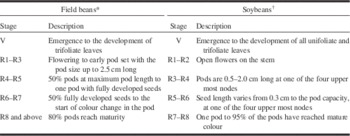
Crop growth stages are defined in Table 1. The R1–R3 stage of field beans occurred on 14–28 July 2008; 1–7 August 2009, and in late July 2010. Field beans were harvested during the third and fourth week of September in 2008 and 2009, and in the second and third week of September in 2010. Soybeans were not sampled in 2008. In soybeans, the R1–R2 stage occurred during the first and second week of August in 2009 and during the last week of July and first week of August in 2010. Soybeans were harvested during the last week of September and first week of October in 2009 and 2010.

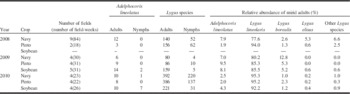
Three species of Lygus and one species of Adelphocoris were commonly collected during the study (Table 2): L. lineolaris, L. borealis, and L. elisus and A. lineolatus. Lygus lineolaris was the dominant Lygus species in all the bean fields and represented 78–95% of the adults, with none of the remaining common Lygus species exceeding 13% of the total annual collection of adults (Table 2). The total number of A. lineolatus never exceeded 10% of the adult mirid collection in any year or crop. In field beans, the relative frequency of L. lineolaris, L. borealis, L. elisus, and A. lineolatus differed among years (Likelihood ratio (LR)χ²=53.1, df=6, P<0.001), but not between navy and pinto beans (LRχ²=3.8, df=3, P=0.3). Soybeans were sampled in 2009 and 2010 and frequency of L. lineolaris, other Lygus species pooled together, and A. lineolatus differed between the two years (LRχ²=226.2, df=2, P<0.001), but not between field beans (navy and pinto together) and soybeans (LRχ²=1.4, df=2, P=0.5).
Total numbers of Adelphocoris lineolatus and Lygus species adults and nymphs, and relative abundance (%) of mirid adults in Manitoba, Canada.
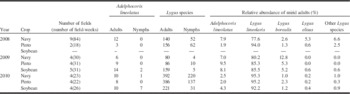
Note: One field-week represents one of the weekly samples of 200 sweep samples and five tray samples from a field.
In 2009 and 2010, a total of 1700 Lygus were collected in sweep samples of which 77% were adults, 5% were instars 1–3, and 18% were instars 4–5. In tray samples, the total catch was 31, of which 55% were adults, and about 23% were in each nymphal category. Sampling method significantly influenced the relative frequencies of the three stages (LRχ²=12.6, df=2, P=0.002). Although tray samples yielded a higher proportion of nymphs, the total catch of nymphs in tray samples was less than from sweep sampling.
As there were four samples near the field margin and one in the middle of the field, the frequencies in edge and middle samples were compared with the expectation that the total in edge samples would be four times that in the middle sample. Frequencies in edge and middle did not differ from this expectation for Lygus adults (LRχ2=2.4, df=1, P=0.1) or nymphs (LRχ2=2.8, df=1, P=0.1). Numbers of Adelphocoris adults and nymphs were too small for reliable assessments of effects of sample position.
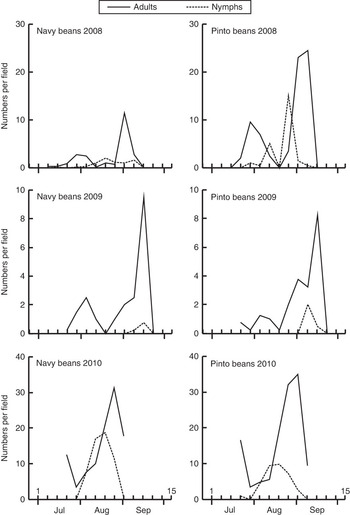
In field beans, adults of L. lineolaris were usually first collected in mid-July to early August and were found until the crop matured. In several fields, adults were present on the first day of sampling, so it is unknown when they were first present. In fields where sampling occurred before adult detection, that detection occurred from 21 July to 5 August at stages from late V to R3 of the navy and pinto beans. In 2008 and 2010, Lygus nymphs were first collected one to three weeks after the first adults (Fig. 1). In 2009, numbers of nymphs were very low (Table 2); nymphs were collected only late in the season and only third to fifth instars were detected. In 2010, nymphs of instars 1–3 were collected both at the edge and in the middle of the fields in field beans, two to three weeks after the first adults; later instars were collected until the penultimate week of sampling. In all years the numbers of Lygus nymphs peaked in mid-August to mid-September, in most cases one to two weeks before the peak of adult numbers from the last week of August to mid-September (Fig.1). Except for two fields in 2008 where numbers were very low and the peak occurred at stage R2, the peaks of nymphs and adults occurred at R6 or later.
Seasonal abundance of Lygus lineolaris adults and Lygus nymphs in navy beans and in pinto beans. Values plotted are weekly averages of total catch from 200 sweep (180°) samples and five tray samples per field (n is given in Table 2, but was reduced in weeks of inclement weather). Internal tick marks on the horizontal axis are weeks where week 1 is the first week of July; note that the scales of the vertical axes differ among years.

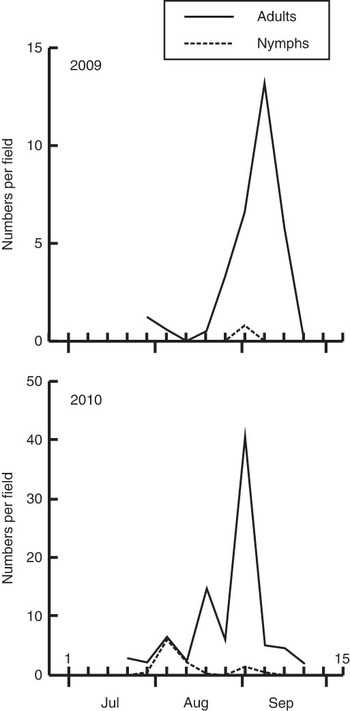
In soybeans, the first Lygus adults were found in stage R1–R6, in late July to mid-August. The nymphs appeared one to five weeks after the first appearance of adults. Adult numbers peaked between 7 and 26 September (Fig. 2), when the crop stage was R5–R6. In the majority of fields, the peak for nymphs occurred at R3–R6. Of the Lygus collected in soybeans in 2009, 3% were nymphs and in 2010, 12% were nymphs. These proportions were lower than those in field beans in the same years (2009: 8%; 2010: 31%) and the differences were significant (2009: LRχ2=3.8, df=1, P=0.049; 2010: LRχ2=42.7, df=1, P<0.001). Furthermore, in 2010, when numbers were high enough for the comparison, 52% of nymphs collected from soybeans were of instars 4–5, significantly lower than the 80% of nymphs in instars 4–5 in samples from field beans (LRχ2=11.4, df=1, P=0.01).
Seasonal abundance of Lygus lineolaris adults and Lygus nymphs in soybeans. Values plotted are weekly averages from 200 sweep (180°) samples and five tray samples per field (n is given in Table 2, but was reduced in weeks of inclement weather). Internal tick marks on the horizontal axis are weeks where week 1 is the first week of July; note that the scales of the vertical axes differ between years.

The late season numbers of L. lineolaris adults were higher than the early season numbers of nymphs in navy, pinto, and soybeans in all years. Of the 22 sampled fields for which adjacent harvests were recorded, the late season peak of adult numbers occurred within one week following the harvest of adjacent canola in 17 fields. Adjacent canola fields were harvested between 18 August and 7 September, corresponding to weeks 8–11 in Figures 1–2.
A total of 48 A. lineolatus adults were collected in field beans (Table 2) and adults were present from late July to mid-September in 2008 and early August to late September in 2009 and 2010. Only one A. lineolatus nymph was collected in field beans. In soybeans, both adults and 4–5 instar nymphs of A. lineolatus were found in 2009 and 2010. In 2009, the adults occurred from early August to late September and nymphs were found during early September. In 2010, both nymphs and adults occurred from early August to mid-September.
The numbers of mirids and total seed weight in the 4 m2 area harvested around each sampling location were never significantly correlated for any of the three crops. Correlation coefficients for navy beans were positive in 2010 (r=+0.02, P=0.9, n=18) and negative in other years (2008: r=−0.25, P=0.1, n=35: 2009: r=−0.31, P=0.2, n=20). Correlation coefficients were negative for pinto beans (2008: r=−0.18, P=0.7, n=8; 2009: r=−0.34, P=0.4, n=8; 2010: r=−0.34, P=0.1, n=20). For soybeans, correlation coefficients were positive in both years (2009: r=+0.13, P=0.6, n=20; 2010: r=+0.20, P=0.4, n=20). In navy beans, the frequency of insect-damage was generally highest in 2008 when the maximum number of insect-damaged seeds per sub-sample was 16. The highest number of insect-damaged seeds per sub-sample was nine in 2009 and four in 2010. Numbers of insect-damaged seeds in navy beans were not correlated with the numbers of mirids in any year (2008: r=−0.09, P=0.6, n=37; 2009: r=+0.01, P=0.9, n=20; 2010: r=−0.30, P=0.2, n=18). In pinto beans, no insect damage was found in 2008 and 2009 and only one damaged seed was recorded in 2010.
Discussion
The highest number of Lygus bugs observed in Manitoba field beans was 0.11 per sweep in stage R1–R3 and 0.5 in R6–R7; lower than the numbers in canola (average of 3.0 Lygus bugs/sweep) (Timlick et al. Reference Timlick, Turnock and Wise1993) and buckwheat (average of 6.7 Lygus bugs/sweep) (Mostafa Reference Mostafa2007) in Manitoba. In Lima beans in California, United States of America, an average of 0.7 Lygus bugs/sweep has been recorded in stage R1–R3, with 2.9 bugs/sweep later in the season (Bushing et al. Reference Bushing, Burton and Tucker1974). In edible bean varieties in stage R1–R3 a maximum of 12.6 Lygus bugs/sweep was observed in Washington, United States of America (Hagel Reference Hagel1978). In Manitoba, mirid densities in field beans and soybeans tend to be lower than those observed in other Manitoba annual crops and those observed on beans in the United States of America.
Lygus lineolaris accounted for 78–95% of the mirids collected in the sampled crops in Manitoba. The order of relative abundance of Lygus species in beans, L. lineolaris, L. borealis, and L. elisus, is similar to that in canola (Timlick et al. Reference Timlick, Turnock and Wise1993), alfalfa (Mostafa Reference Mostafa2007), and flax (Wise and Lamb Reference Wise and Lamb2000) in Manitoba. This same order of relative abundance is characteristic of canola in the boreal region of Alberta (Cárcamo et al. Reference Cárcamo, Otani, Gavloski, Dolinski and Soroka2003), and L. lineolaris and L. borealis are the main Lygus species in canola adjacent to alfalfa in Alberta, British Columbia, and Manitoba, Canada (Cárcamo et al. Reference Cárcamo, Otani, Herle, Dolinski, Dosdall and Mason2002).
Lygus species nymphs and adults were distributed evenly in the bean fields, so we infer that producers could sample anywhere in the field to obtain reliable information about Lygus bug numbers. Tapping of plants and collecting the dislodged insects is an effective method of sampling Lygus nymphs in strawberries (Schaeffers Reference Schaeffers1980; Rancourt et al. Reference Rancourt, Vincent and De Oliveira2000) and cotton (Snodgrass Reference Snodgrass1993). However, although relative efficiency of collecting nymphs was higher for tray sampling than for sweep netting in our study, the total catch in tray samples was too small to make them an effective method of sampling in field beans or soybeans.
The arrival of Lygus adults in the bean crops in July or early August coincided with the development of plant reproductive tissues. These adults were probably of the first summer generation, as reproductive first generation adults also colonise flowering canola in Manitoba at the same time of the year (Gerber and Wise Reference Gerber and Wise1995). All five stages of nymphs of Lygus were found in both bean types sampled. The peak occurrence of nymphs was found shortly before that of adults, a pattern of occurrence that accords with the hypothesis that development was completed in field beans and soybeans. The alternative, that nymphs disperse from adjacent crops, is unlikely: most of our sampled fields were separated from other crops by roads or ditches, which are barriers to Lygus dispersal (Schaber et al. Reference Schaber, Harper and Entz1990). Furthermore, the proportion of nymphs in samples ⩾400 m from adjacent crops in the middle of fields was no lower than in field margin samples. Most Lygus nymphs move only short distances (Swezey et al. Reference Swezey, Nieto, Hagler, Pickett, Bryer and Machtley2013) with maximum recorded dispersal distances of 50–62 m (Khattat and Stewart Reference Khattat and Stewart1980; Swezey et al. Reference Swezey, Nieto, Hagler, Pickett, Bryer and Machtley2013). We conclude that nymphs of the second summer generation (Gerber and Wise Reference Gerber and Wise1995) complete development on beans in Manitoba and contribute to the second summer generation adult peak in late August or early September.
In late August or early September, there were peaks of L. lineolaris adults and late instar Lygus nymphs in field beans that were higher than the peaks of early instar nymphs. This phenomenon is attributable, in part, to the higher efficiency of sweep sampling for adults than for nymphs (Byerly et al. Reference Byerly, Gutierrez, Jones and Luck1978). Also, the lack of synchronisation of developmental stages coupled with the shorter duration of nymphal development compared with adult longevity (Bariola Reference Bariola1969) reduces the probability of nymphs being included in a sample compared with adults (Birley Reference Birley1977). Nevertheless, adult peaks often coincided with or followed soon after the harvest of adjacent crops, particularly canola. Thus, some of the adults in the study fields late in the season may have dispersed from adjacent crops that had matured to the point where they were no longer suitable for Lygus feeding or had been harvested.
In soybeans, the seasonal occurrence of L. lineolaris was similar to that of field beans and is consistent with adults of the first summer generation colonising the crop and giving rise to nymphs of the second generation. However, the proportion of nymphs was low in Lygus collections in soybeans, which is consistent with studies in the southern United States of America (Freeman and Mueller Reference Freeman and Mueller1989; Snodgrass et al. Reference Snodgrass, Jackson, Abel and Perera2010). The lower proportion of nymphs from soybeans that were of instars 4–5 suggests that the survival of nymphs was poorer on this crop than on field beans. In cage studies, L. lineolaris females oviposit less and fewer nymphs survive to complete development on soybeans than on suitable hosts (Snodgrass et al. Reference Snodgrass, Jackson, Abel and Perera2010). The patterns we observed are consistent with both these mechanisms operating, and suggest that soybeans are a marginal host for production of the second generation of L. lineolaris in Manitoba. As with field beans, late season migration of Lygus bugs into soybeans was evident, with peaks of adults observed following the harvest of adjacent crops.
The numbers of alfalfa plant bug, A. lineolatus, in field beans and soybeans in our study were too low for conclusions to be drawn about reproduction or development in these crops. Adelphocoris lineolatus is primarily a herbivore of alfalfa and red clover, and occurs in low numbers in other crops (Hughes Reference Hughes1943; Craig Reference Craig1963; Soroka and Murrell Reference Soroka and Murrell1993; Mostafa Reference Mostafa2007). At least some cultivars of Phaseolus vulgaris are poor hosts for A. lineolatus: relative to insects reared on alfalfa, fewer nymphs survive to adulthood and the durations of the oviposition period and adult life are reduced (Qiaosi et al. Reference Qiaosi, Qinxuan and Wangxi1994). Adult A. lineolatus disperse to soybean plots embedded in alfalfa fields when the alfalfa is cut (Poston and Pedigo Reference Poston and Pedigo1975). Thus, A. lineolatus in bean crops in Manitoba may be mostly transients displaced from harvested alfalfa, as was suggested for buckwheat (Mostafa Reference Mostafa2007).
In our study there was no evidence of economic losses in yield quantity or quality that could be attributed to plant bugs in field beans and no quantity loss that could be attributed to plant bugs in soybeans. The highest numbers of mirids, both adults and nymphs, per 200 sweeps (180°) during three years of sampling in navy and pinto beans were 18 and 22 in stage R1–R3, 37 and 16 in R4–R5, and 110 and 97 above R6, respectively. The highest numbers of plant bugs per 200 sweeps in soybeans were eight in R1–R2, 15 in R3–R4, and 68 in R5–R6. Thus, in Manitoba commercial fields, mirid numbers fewer than these cause no economic damage in these crops, and farmers would receive no benefit from control measures applied at these or lower densities. The incidence of seed quality loss through seed pitting depends on the type of field bean. Seed pitting was negligible in pinto beans and there was a small amount in navy beans. The highest number of insects was in 2010, which had the lowest number of damaged seeds. Hagel (Reference Hagel1978) also found little or no seed pitting in pinto beans, in contrast to 5–20% of pitted seeds in other types of beans that did not include navy beans. Soybeans are not preferred hosts for Lygus bugs, and peak numbers similar to those we observed cause no loss in soybeans in Mississippi (Snodgrass et al. Reference Snodgrass, Jackson, Abel and Perera2010), although high numbers of Lygus adults, caged on soybean buds or blooms, cause yield loss (Broersma and Luckmann Reference Broersma and Luckmann1970).
Mirid bugs, particularly L. lineolaris, occur in field beans and soybeans in Manitoba. Lygus species reproduce in these crops and nymphs reach adulthood feeding on the crops. However, during our study the population densities were too low to cause economic losses in the crops. In southern Manitoba, populations of mirids were low in all crops in 2009, but insecticides were applied for Lygus control in canola, sunflowers, seed alfalfa, and strawberries in 2008, and in sunflowers and strawberries in 2010 (Gavloski 2001–Reference Gavloski2010). The patterns of insecticide application for Lygus control in 2008 and 2010 appear typical for southern Manitoba for most years from 2001 to 2010, suggesting that the populations in the region were not unusually low in two of the three years of our study. Hence, the absence of economic loss attributable to plant bugs in field beans and soybeans in our study fields may occur in most years in southern Manitoba. However, our results should not be applied incautiously during the occasional years in which extremely high populations of plant bugs occur in the Prairie Provinces. In 1997 for example, Lygus numbers reached 20/sweep in canola in Alberta and large areas of canola, legumes and other crops were affected (Western Committee on Crop Pests 1997). It is likely that, if such populations occurred in an area with field beans and soybeans, these crops would suffer economic damage.
Acknowledgements
The authors thank the Manitoba Pulse Growers Association, Manitoba’s Agri-Food Research and Development Initiative, and the University of Manitoba for financial assistance. Thanks are due to the growers who allowed their fields to be sampled, to Parent Seed Farm Ltd. and D. Lange for grading of field bean samples, to D. Holder and L. Babey for technical assistance and to B. Brolley for facilitation in various stages of this project. They thank J. Du for translations and R. J. Lamb for suggesting improvements to the manuscript.