


1 Introduction
The Lorenz system was introduced in [Reference Lorenz29] as a simplified model for atmospheric convection. Numerical simulations have shown that the Lorenz system admits a strange attractor, called the Lorenz attractor, which became one of the most iconic examples in the field.
A rigorous mathematical approach to study the Lorenz system was developed with the introduction of the so-called geometric Lorenz flow by [Reference Afraimovich, Bykov and Sil’nikov1, Reference Guckenheimer and Williams25], which mimics the dynamics of the Lorenz flow and which has a robust strange attractor under
 $C^1$
perturbations. Later in [Reference Tucker37, Reference Tucker38], it was shown that the actual Lorenz attractor is indeed singular hyperbolic, further showing that the geometric Lorenz attractor represents the original Lorenz attractor well. Moreover, it admits the often named Sinai–Ruelle–Bowen (SRB) measure, which is ergodic [Reference Araújo, Pacífico, Pujals and Viana11]. It is also possible to derive a one-dimensional map named the Lorenz map from the Lorenz flow by defining a Poincaré map on the flow and quotienting along stable leaves. The statistical properties of both the flow and one-dimensional map, such as mixing rates, limit theorems and their stability under various perturbations, have been studied intensely (see for example, [Reference Alves and Khan6, Reference Alves and Soufi8–Reference Araújo, Melbourne and Varandas10, Reference Bahsoun, Melbourne and Ruziboev13, Reference Bahsoun and Ruziboev14, Reference Díaz-Ordaz19, Reference Holland and Melbourne26, Reference Luzzatto, Melbourne and Paccaut30]).
Another class of systems with similar properties was introduced by Rovella in [Reference Rovella35] called the contracting Lorenz flows. A fundamental difference between these systems is that the attractor of the system introduced by Rovella is not robust under perturbations, but is still abundant in a measure theoretic sense. The set of parameters for which the system is chaotic is called Rovella parameters and satisfies strong chaotic properties [Reference Alves and Soufi7]. In [Reference Pacifico and Todd33], thermodynamic formalism for the flow was addressed. Moreover, similarly to the expanding case, a one-dimensional map can be derived from the flow, which has been shown to be stochastically stable in [Reference Metzger31, Reference Metzger32]. Up to now, the contracting Lorenz flow and one-dimensional maps with critical points remain profound examples of truly non-uniformly hyperbolic systems, which is studied via construction of induced schemes. We refer to [Reference Alves3] for a comprehensive account of these constructions.
Recently, there has been increased interest in studying statistical properties of random dynamical systems, especially quenched (path-wise) properties. When the system has good uniformly hyperbolic properties, spectral techniques are still applicable and imply strong statistical properties; we refer to [Reference Buzzi18, Reference Dragičević, Froyland, González-Tokman and Vaienti20–Reference Dragičević and Sedro23] and references therein for results on quenched decay of correlations, limit theorems and stability results in this case.
For the non-uniformly expanding (or non-uniformly hyperbolic) case, spectral techniques are not applicable directly. In such cases, it is natural to employ inducing techniques, in particular, a randomized version of Young tower [Reference Young39] construction called random Young towers. This was first carried out in [Reference Baladi, Benedicks and Maume-Deschamps15] for random towers with stretched exponential tails, where the results were applied to random compositions of unimodal maps. Later, similar towers with polynomial tails were studied in [Reference Bahsoun, Bose and Ruziboev12]. An alternative approach for random towers was given in [Reference Du24]. More recently, random Young towers for hyperbolic systems were introduced in [Reference Alves, Bahsoun and Ruziboev4], where the construction of such towers was carried out for non-uniformly hyperbolic random maps and in [Reference Alves, Bahsoun, Ruziboev and Varandas5] for non-uniformly expanding systems with an ergodic base. As in the deterministic case [Reference Bruin, Luzzatto and van Strien16], the construction of the random Young towers is highly non-trivial [Reference Larkin27].
In this paper, we study rates of mixing for small random perturbations of Rovella maps. We use a random tower construction to prove that for Hölder observables, the random system admits exponential rates of quenched decay of correlations. The paper is organized as follows: in §2, we present the setup of the random system under consideration and the statement of the main result, Theorem 2.2; in §§3–6, we give the proof of the main result; finally Appendix A contains the relevant background information for random towers in the sense of [Reference Baladi, Benedicks and Maume-Deschamps15, Reference Du24], in particular, Theorem A.1, which is used to prove the main result.
2 Preliminaries, setup and statement of main result
2.1 Contracting Lorenz maps
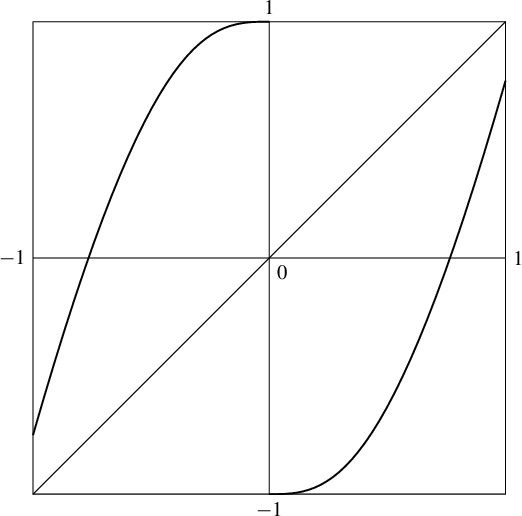
The contracting Lorenz map (see Figure 1)
 $f_0: I \to I$
, with
 $I = [-1,1]$
, is piecewise
 $C^3$
and satisfies the following conditions:
-
(C1)
 $f_0$
has a discontinuity at the critical point
$x=0$
where (1)
$$ \begin{align} \lim_{x \to 0^+}f_0(x) = -1, \quad \lim_{x \to 0^-}f_0(x) = 1; \end{align} $$
-
(C2)
$Df_0 (x)> 0$
for all
$x \neq 0$
with (2)and
$$ \begin{align} \sup_{x \in (0,1]}Df_0(x) = Df_0(1), \quad \sup_{x \in [-1,0)}Df_0(x) = Df_0(-1) \end{align} $$
(3)
$$ \begin{align} \lim_{x \to 0}\frac{Df_0(x)}{|x|^{s-1}}\ \text{exists and is non-zero for some } s> 1; \end{align} $$
-
(C3) the orbits of
$x = \pm 1$
are pre-periodic and repelling, that is, there exist constants
$k_1, k_2, n_1, n_2 \in \mathbb {Z}_+$
satisfying
$$ \begin{align*} &f_0^{n_1 + k_1}(1) = f_0^{k_1}(1),\quad Df_0^{n_1}(f_0^{k_1}(1))> 1,\\ &f_0^{n_2 + k_2}(-1) = f_0^{k_2}(-1),\quad Df_0^{n_2}(f_0^{k_2}(-1)) > 1; \end{align*} $$
-
(C4)
$f_0$
has negative Schwarzian derivative, that is, for all
$x \in I \setminus \{ 0 \}$
, we have (4)
$$ \begin{align} S(f_0) := D\bigg( \frac{D^2f_0}{Df_0} \bigg) - \frac{1}{2} \bigg( \frac{D^2 f_0}{Df_0} \bigg)^2 < 0. \end{align} $$


A one-dimensional contracting Lorenz-like map.

Furthermore, in [Reference Rovella35], it was shown that there exists an interval
 $[0, a_*) \subset \mathbb R$
, where
 $a^*>0$
is small, and that there exists a family of
 $C^3$
maps
 $\{f_a : I \to I \}_{a \in [0, a_*)}$
, where
 $f_0$
corresponds to some initial unperturbed contracting Lorenz map satisfying conditions (C1)–(C4) such that, for the remaining
 $a \in (0, a_*)$
, all maps
 $f_a$
are close to the original
 $f_0$
. Here, by ‘close’, we mean their corresponding flows from which they are projected are in a small
 $C^3$
neighbourhood of the original contracting Lorenz flow. Moreover, there exists a Cantor-like set
 $E \subset (0, a^*)$
with positive Lebesgue measure such that, for all
 $a \in E$
,
 $f_a$
is chaotic and satisfies the following conditions:
-
(R1) there exist constants
$K_1, K_2> 0$
such that for every
$a \in E$
and
$x \in I \setminus \{ 0 \}$
, we have where
$$ \begin{align*} K_1 |x|^{s_a - 1} \le Df_a (x) \le K_2 |x|^{s_a - 1}, \end{align*} $$
$s_a$
is the order of the critical point associated with
$f_a$
as in condition (C2), though as in [Reference Rovella35], for simplicity, we can assume it is constant for all
$a \in E$
and has the same value as that of
$f_0$
;
-
(R2) there exists a constant
${\unicode{x3bb}}> 1$
such that for all
$a \in E$
, at the points
$x=1$
and
${x=-1}$
, we have
$$ \begin{align*} Df_a^n(\pm 1)> {\unicode{x3bb}}^n \quad \text{for all } n \ge 0; \end{align*} $$
-
(R3) there exists a constant
$\alpha>0$
such that for all
$a \in E$
, we have
$$ \begin{align*} |f_a^{n-1}(\pm 1)|> e^{-\alpha n} \quad \text{for all } n \ge 1; \end{align*} $$
-
(R4) the orbits of the points
$x= \pm 1$
under
$f_a$
are dense in
$[-1, 1]$
for all
$a \in E$
.


These maps are often referred to as Rovella maps. Note that if
 $a \in (0, a_*) \setminus E$
, then
 $f_a$
will not necessarily satisfy all of these conditions. Additionally, it is worth noting that property (R1) implies the following three conditions for any
 $a \in E$
.
-
(1) Large derivatives condition:
$$ \begin{align*} \lim_{n \to \infty} | Df_a^n(f_a(0)) | = \infty. \end{align*} $$
-
(2) Summability condition of exponent 1:
$$ \begin{align*} \sum_{i=0}^\infty \frac{1}{| Df_a^n(f_a(0)) |} \le \infty. \end{align*} $$
-
(3) Collet–Eckmann condition:
$$ \begin{align*} \liminf_{n \to \infty} \log \frac{| Df_a^n(f_a(0)) |}{n}>0. \end{align*} $$


An important expansion result for Rovella maps, proved in [Reference Alves and Soufi7], is the following lemma.
Lemma 2.1. [Reference Alves and Soufi7, Lemma 2.1]
There exists a constant
 ${\unicode{x3bb}}> 1$
such that, for sufficiently small
 $a> 0$
(not necessarily
 $a \in E$
) and for sufficiently small
 $\delta> 0$
, there exists some
 $c(\delta )> 0$
such that for any
 $x \in I$
, we have the following:
-
(1) if
$x, f_a(x), \ldots , f_a^{n-1} \notin (- \delta , \delta )$
, then
$Df_a^n(x) \ge c(\delta ) {\unicode{x3bb}} ^n$
; -
(2) if
$x, f_a(x), \ldots , f_a^{n-1} \notin (- \delta , \delta )$
and
$f_a^n(x) \in (- \delta , \delta )$
, then
$Df_a^n(x) \ge {\unicode{x3bb}} ^n$
; -
(3) if
$x, f_a(x), \ldots , f_a^{n-1} \notin (- \delta , \delta )$
and
$f_a^n(x) \in (- e^{-1}, e^{-1})$
, then
$Df_a^n(x) \ge e^{-1} {\unicode{x3bb}} ^n$
.


2.2 Setup and statement of the main result
Let
 $f_0: I \to I$
be a one-dimensional contracting Lorenz map as described in the previous subsection. Furthermore, let E be its Rovella parameter set and let
 $f_a: I \to I$
be some Rovella map for
 $a \in E$
.
Setting
 $T_0 = f_a$
and taking sufficiently small
 $\varepsilon >0$
, we assume that there exists a one-parameter family of maps
 $\{ T_t : I \to I \}_{t \in [-\varepsilon , \varepsilon ]}$
perturbed from
 $T_0$
that is admissible in the following sense:
-
(1)
$|\partial _t F(t,x)| \le 1$
for all
$x \in I$
and
$t \in [-\varepsilon ,\varepsilon ]$
, with
$F(t,x) = T_t(x)$
; -
(2) for all
$t \in [-\varepsilon ,\varepsilon ]$
, the map
$T_t$
will satisfy condition (C2); -
(3) there exists a constant
$C>0$
such that for all
$x,y \in I$
and
$t \in [-\varepsilon ,\varepsilon ]$
, we have
$$ \begin{align*} 2 |x -y| < |x| \implies \bigg|\kern-2pt \log \frac{DT_t(x)}{DT_t(y)} \bigg| \le C \frac{|x - y|}{|x|}. \end{align*} $$


Now, let
 $\nu _\varepsilon $
denote the normalized Lebesgue measures on
 $[-\varepsilon , \varepsilon ]$
. Furthermore, we define
 $\Omega _\varepsilon = [-\varepsilon ,\varepsilon ]^{\mathbb Z}$
, that is, each
 $\omega \in \Omega _\varepsilon $
is a bi-infinite sequence of the form
 $$ \begin{align*} \omega = \cdots \omega_{-2}\omega_{-1}\omega_{0}\omega_{1}\omega_{2} \ldots, \quad \omega_i \in [-\varepsilon , \varepsilon ]\quad \text{for all } i \in \mathbb{Z}, \end{align*} $$
and we take the product measure
 $\mathbb P_\varepsilon = \nu _\varepsilon ^{\mathbb Z}$
on
 $\Omega _\varepsilon $
. We define our random dynamical system with the usual skew product
 $$ \begin{align*} S : \Omega_\varepsilon \times I \to \Omega_\varepsilon \times I,\quad S(\omega, x) = (\sigma \omega, T_\omega (x)). \end{align*} $$
Iterates of S are defined naturally as
 $$ \begin{align*} S^n(\omega, x)= (\sigma^n(\omega), T^n_{\omega}(x)),\quad T^n_{\omega}(x):=T_{\omega_{n-1}}\circ\cdots\circ T_{\omega_0}(x). \end{align*} $$
To simplify the notation, we denote
 $T_{\omega } = T_{\omega _0}$
. With the setup complete, we now state the main result of this paper.
Theorem 2.2. Let
 $\varepsilon >0$
be sufficiently small. The random contracting Lorenz system
 $\{T_\omega \}$
admits a unique equivariant family of absolutely continuous probability measures
 $\{\mu _\omega \}$
. Moreover, there exists a
 $\mathbb P_\varepsilon $
-integrable constant
 $C(\omega )$
, and there exists a constant
 $ b>0$
such that for almost every
 $\omega \in \Omega $
, for every
 $\varphi \in \mathcal {C}^{\eta }(I)$
with
 $\eta \in (0,1)$
and for every
 $\psi \in L^\infty (I)$
, we have
 $$ \begin{align*} \bigg|\kern-2pt\int(\varphi\circ T_\omega^n)\psi \,d\mu_\omega-\int \varphi \,d\mu_{\sigma^n\omega}\int \psi \,d\mu_\omega\bigg|\le C(\omega) C_{\varphi, \psi} e^{-bn} \end{align*} $$
and
 $$ \begin{align*} \bigg|\kern-2pt \int (\varphi \circ T^n_{\sigma^{-n} \omega}) \psi \,d\mu_{\sigma^{-n}\omega} - \int \varphi \,d\mu_\omega \int \psi \,d\mu_{\sigma^{-n}\omega} \bigg| \le C(\omega) C_{\varphi, \psi} e^{-bn} \end{align*} $$
for some
 $C_{\varphi , \psi }>0$
which only depends on
 $\varphi $
and
 $\psi $
, and is uniform for all
 $\omega \in \Omega $
.
Remark 2.3. One should note that even though
 $T_0$
satisfies conditions (R1)–(R3), the other maps in the family do not necessarily satisfy these conditions. Because of this, for certain random compositions of maps, we may need to wait a long time before we see a map with the desired properties. This means that we will need to introduce a waiting time before we see the desired asymptotic behaviour for the tails of return times and the decay of correlations. We express this equivalently using a large constant factor
 $C(\omega )$
in the upper bound of the random correlation function for almost every
 $\omega \in \Omega _\varepsilon $
.
2.3 Strategy of the proof
We prove Theorem 2.2 by showing that the random system
 $\{T_\omega \}$
admits a random Young tower structure in the sense of [Reference Baladi, Benedicks and Maume-Deschamps15, Reference Du24] for almost every
 $\omega \in \Omega $
with exponential tails of the return times. For convenience, in Appendix A, we include the definition of random Young towers as well as Theorem A.1 from [Reference Baladi, Benedicks and Maume-Deschamps15, Reference Du24], which we use in the proof of Theorem 2.2.
To build a random Young tower, we use a similar construction to that of [Reference Du24, §8.3], where a random Young tower is constructed for a system of random unimodal maps. However, before we can use such a construction, we must prove that certain results hold for our random contracting Lorenz system that are analogous to the results proved in [Reference Shen36] for random non-uniformly expanding interval maps. In particular, we must prove results regarding random non-uniform expansion and the tails of ‘bad’
 $(\omega , x) \in \Omega _\varepsilon \times I$
parameters where expansion is not guaranteed. Once we have these, then we move onto the tower construction, which involves the use of hyperbolic return times, originating from the works of Alves [Reference Alves2].
Thus, the structure of the rest of the paper is as follows.
-
• Section 3 (Random non-uniform expansion): prove that if the random orbit stays outside of a particular neighbourhood around the origin (which we will use as the base of our random tower), then we have exponential expansion.
-
• Section 4 (Good and bad parameter sets): prove that the measure of the set of ‘bad’
$(\omega , x) \in \Omega _\varepsilon \times I$
parameters shrinks to zero as
$n \to \infty $
, thereby guaranteeing that we eventually have expansion for almost all
$\omega \in \Omega _\varepsilon $
. -
• Section 5 (Hyperbolic times and hyperbolic return times): prove that hyperbolic times and hyperbolic return times can be used to define subintervals in the base of the tower on which we have good properties such as the Markov property, bounded distortion and uniform expansion.
-
• Section 6 (Return partition): prove that we can construct a return partition using the subintervals from the previous step and that we have exponential tails of return times along with the other necessary random tower conditions to apply Theorem A.1.


3 Random non-uniform expansion
Non-uniform expansion has already been proved in [Reference Alves and Soufi7] for Rovella maps in the deterministic case on intervals of the form
 $(-\delta , \delta )$
, where
 $\delta> 0$
is some small constant, and this can extended relatively easily to the random case. However, for our tower construction, we will instead be using a neighbourhood around 0 of the form
 $\tilde B(\delta ) = T^{-1}(B_\delta (1)) \cup T^{-1}(B_\delta (-1))$
, on which we need to prove non-uniform expansion also holds.
Let us define
 $\mathcal {D}(\delta ) = {|B_\delta (0)|}/{|\tilde B(\delta )|}$
. Additionally, throughout this section, we assume that there exists a small constant
 $\delta _*>0$
such that for every
 $x \in \tilde B(\delta _*)$
,
 $\delta = \max \{ x, \delta _* \}$
and
 $\omega \in \Omega _\delta $
, we have
 $$ \begin{align} DT_\omega(x) \ge \mathcal{D}(\delta). \end{align} $$
We prove the following proposition, which is an adaption of [Reference Shen36, Theorem 2.1] and [Reference Du24, Lemma 8.1.6].
Proposition 3.1. There exist uniform constants
 $A, \kappa>0$
and, for sufficiently small
 $\delta>0$
, there exists a constant
 $\Lambda (\delta )>0$
satisfying
 $\lim _{\delta \to 0} \Lambda (\delta ) = \infty $
such that for all sufficiently small
 $\varepsilon >0$
, all
 $\omega \in \Omega _\varepsilon $
and all
 $x \in I$
, we have:
-
(1) if
$x, T_\omega (x), \ldots , T_\omega ^{n-1}(x) \notin \tilde B(\delta )$
and
$T_\omega ^n(x) \in \tilde B(2\delta )$
, then (6)
$$ \begin{align} |DT_\omega^n(x)| \ge A e^{\kappa n}; \end{align} $$
-
(2) if
$|x - T(0)| \le 4 \delta $
,
$x, T_\omega (x), \ldots , T_\omega ^{n-1}(x) \notin \tilde B(\delta )$
and
$T_\omega ^n(x) \in \tilde B(2\delta )$
, then (7)
$$ \begin{align} |DT_\omega^n(x)| \ge \frac{\Lambda(\delta)}{\mathcal{D}(\delta)} e^{\kappa n}. \end{align} $$


To prove this, we follow similar steps used in [Reference Shen36]. We start in §3.1 by proving that the random orbits have some bound on their distortion (Lemma 3.2), that if the random orbit up to time N does not go too close to the point
 $0$
, then N is a binding time (Lemma 3.4), and that the tails of non-returning orbits decay exponentially (Lemma 3.6). In §3.2, we prove results for non-uniform expansion with respect to
 $\tilde B(\delta )$
for the original map
 $T_0$
. Finally, in §3.3, we perform non-uniform expansion on the random orbits with respect to
 $\tilde B(\delta )$
and then give the proof of Proposition 3.1.
3.1 Results for distortion control, binding periods and tails of non-returning orbits
First, let us introduce the relevant notation and prove a series of smaller initial lemmas. Set
 $I_+ = (0, 1]$
and
 $I_- = [-1, 0)$
. Given some subset J, satisfying either
 $J \subset I_+$
or
 $J \subset I_-$
for every
 $\omega \in \Omega $
, we define
 $$ \begin{align*} \text{Dist}(T_\omega | J) := \sup_{x,y \in J} \log \frac{DT_\omega(x)}{DT_\omega(y)} \end{align*} $$
as well as
 $$ \begin{align*} \mathcal{N} (\varphi | J) := \sup_{J' \subset J} \text{Dist}(T_\omega | J') \frac{|J|}{|J'|}. \end{align*} $$
Additionally, we set
 $$ \begin{align*} A(\omega, x, n) = \sum_{i = 0}^{n-1} \frac{DT_\omega^i(x)}{|T_\omega^i(x)|}. \end{align*} $$
Lemma 3.2. For our family of maps
 $\{ T_\omega \}_{\omega \in \Omega }$
, there exists a constant
 $\theta _0>0$
(independent of
 $\varepsilon $
) such that for all
 $\omega \in \Omega $
and
 $x \in I \setminus \{ 0 \}$
, and for any
 $n \in \mathbb Z_+$
such that
 ${A(\omega , x , n) < \infty }$
, setting
 $$ \begin{align*} J = \bigg[ x - \frac{\theta_0}{A(\omega, x , n)}, x + \frac{\theta_0}{A(\omega, x , n)} \bigg] \cap I_\pm, \end{align*} $$
we have that
 $T_\omega | J$
is a diffeomorphism and that
 $\mathcal N (T_\omega ^n | J) \le 1$
. Furthermore, for every
 $y \in J \setminus \{0\}$
, we have
 $$ \begin{align} e^{-1} \frac{DT_\omega^n(x)}{A(\omega, x, n)} \le \frac{DT_\omega^n(y)}{A(\omega, y, n)} \le e \frac{DT_\omega^n(x)}{A(\omega, x, n)}. \end{align} $$
Proof. Let
 $\omega \in \Omega $
and let
 $L \subset I$
be some subinterval in either
 $I_-$
or
 $I_+$
. Recall the definition of
 $\mathcal N (T_\omega | L)$
:
 $$ \begin{align*} \mathcal{N} (T_\omega | L) = \sup_{L' \subset L}\text{Dist}(T_\omega | L') \frac{|L|}{|L'|} = \sup_{L' \subset L} \sup_{x_1,x_2 \in L'} \log \frac{DT_\omega(x_1)}{DT_\omega(x_2)} \frac{|L|}{|L'|}. \end{align*} $$
We want to show that for any
 $y \in L$
, we have
 $$ \begin{align} 2|L| \le |y| \implies \mathcal{N} (T_\omega | L) \le C \frac{|L|}{|y|}. \end{align} $$
First, we should confirm that
 $\mathcal {N} (T_\omega | L)$
actually has a finite value for all L either in
 $I_-$
or
 $I_+$
. For a given L, we may have the trivial case where there does exist a subinterval
 $L' \subset L$
of positive length that maximizes
 $\text {Dist}(T_\omega | L')/|L'|$
, in which case,
 $\mathcal {N} (T_\omega | L)$
is clearly finite. Now, consider the less trivial and more likely case that there exists no such
 $L'$
. If so, we are effectively taking
 $$ \begin{align*} \mathcal{N} (T_\omega | L) = |L| \cdot \bigg( \lim_{h \to 0} \sup_{\substack{ L' \subset L \\ |L'| = h }} \sup_{x_1,x_2 \in L'} \log \frac{DT_\omega(x_1)}{DT_\omega(x_2)} \frac{1}{h} \bigg). \end{align*} $$
Since the derivative is monotonically decreasing and increasing on
 $I_-$
and
 $I_+$
, respectively, then the
 $x_1$
and
 $x_2$
that maximize the distortion are just the end points of
 $L'$
, that is,
 $|x_2| = |x_1| - h$
. Thus, we have
 $$ \begin{align*} \mathcal{N} (T_\omega | L) = |L| \cdot \bigg( \lim_{h \to 0} \sup_{x_1, \in L'} ( \log DT_\omega(x_1) - \log DT_\omega(x_1 \pm h) ) \frac{1}{h} \bigg). \end{align*} $$
However, this is just the derivative of
 $\log DT_\omega (x_1)$
, and since we already know
 $T_\omega $
is
 $C^3$
for all
 $\omega \in \Omega $
, we therefore have
 $$ \begin{align} \mathcal{N} (T_\omega | L) = \sup_{x_1 \in L} \frac{D^2T_\omega(x_1)}{DT_\omega(x_1)} |L|. \end{align} $$
Notice that by condition (R1) for the order of the critical point, we have
 $$ \begin{align*} \mathcal{N} (T_\omega | L) &\le \sup_{x_1 \in L} \frac{(s-1)K_2 |x_1|^{s-2}}{K_1 |x_1|^{s-1}} |L| = \frac{K_2(s-1)}{K_1} \sup_{x_1 \in L} \frac{1}{|x_1|}|L|. \end{align*} $$
Now, clearly the
 $x_1 \in L$
that maximizes this expression is the one closest to
 $0$
. Thus, we have
 $|x_1| \ge |y| - |L|$
. Furthermore, using the assumption
 $2 |L| \le |y| $
, we therefore have
 $|x_1| \ge 1/2|y|$
. Thus, we have
 $$ \begin{align*} \mathcal{N} (T_\omega | L) \le \frac{K_2(s-1)}{K_1} \frac{2}{|y|}|L|. \end{align*} $$
We can assume that
 ${2 K_2(s-1)}/{K_1}$
is small, say smaller than
 $1.5$
. Therefore, we can choose some
 $\theta _0 \in (0, (6e)^{-1})$
such that
 $$ \begin{align*} 2|L| \le |y| \implies \mathcal{N} (T_\omega | L) \le \frac{1}{4e\theta_0} \frac{|L|}{|y|}. \end{align*} $$
Now, let us set
 $n_0$
as the largest integer in the set
 $\{ 1, 2, \ldots , n \}$
such that
 $$ \begin{align*} \sum_{i=0}^{n_0-1} \frac{|T_\omega^i(J)|}{|T_\omega^i(x)|} \le 2e \theta_0 < \frac 1 3. \end{align*} $$
Note that
 $|J| = 2\theta _0 / A(\omega , x, n)$
. Also note that for any
 $\omega \in \Omega $
and
 $x \in I$
, we have
 $A(\omega , x , 1) = 1$
. Thus, the above inequality holds for
 $n_0=1$
.
In fact, we want to show that
 $n_0=n$
. First, we note that for all
 $0 \le i < n_0$
, the above inequality implies that
 $2|T_\omega ^i(J)| \le |T_\omega ^i(x)|$
; otherwise, one of the terms in the sum would be equal to or greater than
 $1/2$
, thereby breaking the above inequality. Thus, for every
 $1 \le m \le n_0$
, we have
 $$ \begin{align*} \text{Dist}(T_\omega^m | J) &= \sup_{y, z \in J} \log \frac{DT_\omega^m(x)}{DT_\omega^m(y)} \\ &= \sup_{y, z \in J} \log \bigg( \prod_{j=0}^{m-1 } \frac{DT_{\sigma^j \omega}(x)}{DT_{\sigma^j \omega}(y)} \bigg) = \sup_{y, z \in J} \sum_{j=0}^{m-1} \log \frac{DT_{\sigma^j \omega}(x)}{DT_{\sigma^j \omega}(y)} \\ & \le \sum_{j=0}^{m-1} \text{Dist}(T_{\sigma^j \omega} | T_\omega^j (J) ) \le \sum_{j=0}^{m-1} \mathcal{N} (T_{\sigma^j \omega} | T_\omega^j (J) ) \\ & \le \frac{1}{4e\theta_0} \sum_{j=0}^{m-1} \frac{|T_\omega^i(J)|}{|T_\omega^i(x)|} \le \frac 1 2. \end{align*} $$
Clearly, this implies using the mean value theorem that there exists some
 $y \in J$
such that
 $$ \begin{align*} DT_\omega^m(y) = \frac{|T_\omega^m(J)|}{|J|} \end{align*} $$
and, therefore,
 $|T_\omega ^m(J)| \le e (T_\omega ^m)'(x) |J|$
. Now, for contradiction, assume
 $n_0<n$
. Consider
 $$ \begin{align*} \sum_{i=0}^{n_0} \frac{|T_\omega^i(J)|}{|T_\omega^i(x)|} &\le \sum_{i=0}^{n_0} \frac{e DT_\omega^m(x) |J|}{|T_\omega^i(x)|}\\ &= e A(\omega, x, n_0 + 1)|J| \le 2 e \theta_0. \end{align*} $$
However, this contradicts the definition of
 $n_0$
. Thus, it must be that
 $n_0 = n$
.
For any subinterval
 $J' \subset J$
, using the bounded distortion, we have
 $|T_\omega ^i(J')| \le e |J'| |T_\omega ^i(J)|/|J|$
. Thus, we have
 $$ \begin{align*} \text{Dist}(T_\omega^n | J') &\le \frac{1}{4e\theta_0} \sum_{j=0}^{m-1} \frac{|T_\omega^i(J')|}{|T_\omega^i(x)|}\\ & \le \frac{1}{4e\theta_0} \sum_{j=0}^{m-1} \frac{|J'|}{|J|} \frac{|T_\omega^i(J)|}{|T_\omega^i(x)|} \le \frac{|J'|}{2|J|}. \end{align*} $$
Thus, we have
 $$ \begin{align*} \mathcal{N} (\varphi | J) := \sup_{J' \subset J} \text{Dist}(\varphi | J') \frac{|J|}{|J'|} \le \sup_{J' \subset J} \frac{|J'|}{2|J|} \frac{|J|}{|J'|} \le \frac 1 2 < 1. \end{align*} $$
Now, notice that for any
 $y \in J$
and for
 $0 \le m < n$
, we have
 $$ \begin{align*} \bigg| \frac{|T_\omega^m(y)|}{|T_\omega^m(x)|} - 1 \bigg| &= \frac{|T_\omega^m(y) - T_\omega^m(x)|}{|T_\omega^m(x)|} \le \frac{|T_\omega^m(J) |}{|T_\omega^m(x)|} \le \frac 1 2, \end{align*} $$
which clearly implies
 $ 1 / 2 \le {|T_\omega ^m(y)|}/{|T_\omega ^m(x)| \le 3/2} $
. Using the bounded distortion, we have
 $e^{-1/2}(T_\omega ^m)'(x) \le (T_\omega ^m)'(y) \le e^{1/2}(T_\omega ^m)'(x) $
. Thus, combining these two, we obtain
 $$ \begin{align*} e^{-1} \frac{DT_\omega^m(x)}{|T_\omega^m(x)|} \le \frac{DT_\omega^m(y)}{|T_\omega^m(y)|} \le e \frac{DT_\omega^m(x)}{|T_\omega^m(x)|}. \end{align*} $$
To prove inequality (9), we work with the reciprocal since it is slightly easier to work with:
 $$ \begin{align*} \frac{A(\omega, y, n)}{DT_\omega^n(y)} &= \frac{\sum_{i =0}^{n-1} ({DT_\omega^i(y)}/{|T_\omega^i(y)|})}{DT_\omega^n(y)}\\ &\le \frac{({3}/{2})e^{1/2}\sum_{i =0}^{n-1} ({DT_\omega^i(x)}/{T_\omega^i(x)})}{e^{-1/2}|T_\omega^n(x)|} = \frac{3}{2}e\frac{A(\omega, x, n)}{DT_\omega^n(x)}. \end{align*} $$
Likewise for the lower bound.
We now introduce the concept of a binding period along with a relevant lemma.
Definition 3.3. (Binding period)
For given
 $\varepsilon >0$
,
 $v \in I\setminus \{ 0 \}$
and
 $C>0$
, we say that
 ${N \in \mathbb Z_+}$
is a C-binding period for
 $(v, \varepsilon )$
if for every
 $y \in I\setminus \{ 0 \}$
, such that
 $|v - y| \le \varepsilon $
, and for every
 $0 \le j < N$
and
 $\omega \in \Omega $
, we have the following:
 $$ \begin{align} 2 |T_\omega^j(y) - T_0^j(v)| &\le |T_0^j(v)|;\end{align} $$
 $$ \begin{align} e^{-1} |DT_0^{j+1}(v)| &\le |DT_\omega^{j+1}(y)| \le e |DT_0^{j+1}(v)|; \end{align} $$
 $$ \begin{align} C \varepsilon |DT_0^{j+1}(v)| &\ge |T_\omega^{j+1}(y) - T_0^{j+1}(v) |. \end{align} $$
Lemma 3.4. There exists a constant
 $\theta _1>0$
such that for sufficiently small
 $\varepsilon >0$
, for any point
 $v \in [-1,1]\setminus \{0\} $
, if there exists
 $N \in \mathbb Z_+$
such that
 $$ \begin{align*} W := \sum_{j=0}^N |DT_\omega^j(v)| < \infty \quad\text{and}\quad A(0, v, N)W \le \theta_1/\varepsilon , \end{align*} $$
then N is an
 $\varepsilon W$
-binding period for
 $(v, \varepsilon ).$
Proof. Using the same proof as in one of the previous lemmas, we know there exists some
 $\theta _1 \in (0, (4e)^{-1})$
such that for any interval
 $L \subset [-1, 1] \setminus \{0 \}$
,
 $z \in L$
and
 $\omega \in \Omega $
, we have
 $$ \begin{align} 2|L| \le |z| \implies \mathcal{N} (T_\omega | L) \le \frac{1}{2 e \theta_1} \frac{|L|}{|z|}. \end{align} $$
Now, given some
 $y \in [-1, 1] \setminus \{0 \}$
such that
 $|v - y| \le \varepsilon $
and some
 $\omega \in \Omega $
, we define
 ${L_i = [v_i, y_i]}$
(or alternatively,
 $L_i = [ y_i, v_i]$
), where
 $v_i = T_0^i(v)$
and
 $y_i = T_\omega ^i(y)$
. Trivially, we have
 $$ \begin{align*} |I_{i+1}| \le |T(I_i)| + \varepsilon . \end{align*} $$
Now, we want to show that the following three inequalities hold for all n:
 $$ \begin{align} |I_n| \le e W \varepsilon DT_0^n(v); \end{align} $$
 $$ \begin{align} \sum_{0 \le i < n} \frac{|I_i|}{|T_0^i(v)|} \le e \theta_1; \end{align} $$
 $$ \begin{align} \sum_{0 \le i < n} \text{Dist} (T_0 | I_i) \le \frac 1 2. \end{align} $$
For
 $n=0$
, this is trivial. We have
 $ |I_0| = |v - y| \le \varepsilon \le e W \varepsilon ; \; 0 \le e \theta _1; \; 0 \le \frac 1 2. $
Now, we prove the statement by induction and assume that we have proved this up to some time
 $0 \le n_0 < N$
. For
 $n = n_0 + 1$
, the proof is straightforward:
 $$ \begin{align*} \sum_{i = 0}^{n_0} \frac{|I_i|}{|v_i|} &\le e W \varepsilon \sum_{i = 0}^{n_0} \frac{ DT_0^n(v)}{|v_i|} \\ & \le e W \varepsilon A(0, \omega, n_0 + 1) \le e W \varepsilon A(0, \omega, N) \le e \theta_1. \end{align*} $$
For the first inequality, we have used the fact that inequality (15) holds for
 $n_0$
, and for the last inequality, we have used our starting assumption. Note that this implies that for
 ${0 \le i \le n_0}$
, we have
 $2|I_i|\le |v_i|$
. Thus, we can apply inequality (14) to obtain the following:
 $$ \begin{align*} \sum_{0 \le i < n_0 + 1} \text{Dist} (T_0 | I_i) \le \frac{1}{2e \theta_1} \sum_{0 \le i < n_0 + 1} \frac{|I_i|}{|v_i|} \le \frac 1 2 < 1, \end{align*} $$
where in the last step, we just use the fact that inequality (17) holds for
 $n_0$
.
Finally, by the mean value theorem, there exists some
 $\xi _i \in I_i$
for all
 $i = 0, 1 , \ldots , n_0$
such that
 $|I_{i+1}| \le DT_0(x_i)|I_i| + \varepsilon $
. Iterating this, we have
 $$ \begin{align*} |I_{n_0 + 1}| \le \prod_{i=0}^{n_0} DT_0(x_i)|I_0| + \varepsilon \bigg(1 + \sum_{k=1}^{n_0} \prod_{j = k}^{n_0} DT_0(x_j) \bigg). \end{align*} $$
As we have already shown that inequality (17) holds for
 $n = n_0 + 1$
, we thus have for all
 $0 \le k \le n_0$
,
 $$ \begin{align*} \prod_{i = k}^{n_0} DT_0(x_i) \le e \prod_{i = k}^{n_0} DT_0(v_i) = e \frac{DT_0^{n_0 + 1}(v)}{DT_0^k(v)}. \end{align*} $$
Plugging this into the previous inequality, we have
 $$ \begin{align*} |I_{n_0+1}| &\le \prod_{i = 0}^{n_0} e DT_0(v_i) |I_0| + \varepsilon \bigg( 1 + \sum_{k=1}^{n_0} \prod_{j = k}^{n_0} DT_0(x_j) \bigg) \\ &= e DT_0^{n_0 + 1}(v) \bigg( |I_0| + \frac{\varepsilon }{e DT_0^{n_0 + 1}(v)} + \sum_{k=1}^{n_0} \frac{\varepsilon }{DT_0^k(v)} \bigg) \\ & \le e \varepsilon DT_0^{n_0 + 1}(v) \bigg( 1 + \sum_{k=1}^{n_0+1}\frac{1}{(T_0^k)'(v)} \bigg) \le e W DT_0^{n_0 + 1}(v) \varepsilon . \end{align*} $$
Our focus now is to show these imply that
 $eW$
is a binding time for sufficiently small
 ${\varepsilon >0}$
. Condition (11) is clearly implied by inequality (16), and likewise for condition (12) and inequality (17). To prove the remaining condition, we need to show that for
 ${0 \le j \le N-1}$
, we have
 $$ \begin{align} \log \bigg( \frac{|DT_\omega^{j+1}(y)|}{|DT_0^{j+1}(v)|} \bigg) \le 1. \end{align} $$
We split the above in the following way:
 $$ \begin{align*} \log \bigg( \frac{|DT_\omega^{j+1}(y)|}{|DT_0^{j+1}(v)|} \bigg) &= \sum_{i = 0}^j \log \bigg( \frac{|DT_{\sigma^i \omega}(y_i)|}{|DT_0(v_i)|} \bigg) \\ & = \sum_{i = 0}^j \log \bigg( \frac{|DT_{\sigma^i \omega}(y_i)|}{|DT_0(v_i)|} \cdot \frac{|DT_0(y_i)|}{|DT_0(y_i)|} \bigg)\\ & = \sum_{i = 0}^j \log \bigg( \frac{|DT_0(y_i)|}{|DT_0(v_i)|} \bigg) + \sum_{i = 0}^j \log \bigg( \frac{|DT_{\sigma^i \omega}(y_i)|}{|DT_0(y_i)|} \bigg). \end{align*} $$
For the first sum, we already know from inequality (17) that
 $$ \begin{align*} \sum_{i = 0}^j \log \bigg( \frac{DT_0(y_i)}{DT_0(v_i)} \bigg) \le \sum_{i = 0}^j \text{Dist}(T_0 | I_i) \le \frac 1 2. \end{align*} $$
Thus, we need to show the same upper bound for the second sum. To this end, we use the fact that
 $\log (1 + x) \le x$
for
 $x \ge 0$
to obtain the following:
 $$ \begin{align*} \sum_{i = 0}^j \log \bigg( \frac{|DT_{\sigma^i \omega}(y_i)|}{|DT_0(y_i)|} \bigg) &= \sum_{i = 0}^j \log \bigg( \frac{|DT_{\sigma^i \omega}(y_i)|}{|DT_0(y_i)|} + \frac{|DT_0(y_i)|}{|DT_0(y_i)|} - \frac{|DT_0(y_i)|}{|DT_0(y_i)|} \bigg)\\ & \le \sum_{i = 0}^j \log \bigg(1 + \frac{|DT_{\sigma^i \omega}(y_i) - DT_0(y_i)|}{|DT_0(y_i)|} \bigg) \\ &\le \sum_{i = 0}^j \frac{|DT_{\sigma^i \omega}(y_i) - DT_0(y_i)|}{|DT_0(y_i)|} \le \sum_{i = 0}^{N-1} \frac{e \varepsilon }{|DT_0(v_i)|}, \end{align*} $$
where in the last inequality, we use bounded distortion and the assumption that for all
 $x \in I \setminus \{ 0 \}$
and all
 $\omega , \tilde \omega \in \Omega _\varepsilon $
, we have
 $|DT_{\omega }(x) - DT_{\tilde \omega }(x)| \le \varepsilon $
. Now, using this lemma’s assumptions, and the definitions of W and A, we have
 $$ \begin{align*} \frac{\theta_1}{\varepsilon } \ge A(0, v, N)W &= \bigg( \sum_{i=0}^{N-1} \frac{DT_0^i(v)}{|v_i|}\bigg) \bigg( \sum_{i=0}^{N-1} \frac{1}{DT_0^{i+1}(v)} \bigg) \\ & \ge \sum_{i=0}^{N-1} \frac{DT_0^i(v)}{|v_i|} \frac{1}{DT_0^{i+1}(v)} = \sum_{i=0}^{N-1} \frac{1}{DT_0(v_i)|v_i|} \ge \sum_{i=0}^{N-1} \frac{1}{DT_0(v_i)}. \end{align*} $$
Thus,
 $$ \begin{align*} \sum_{i = 0}^j \log \bigg( \frac{|DT_0(T_\omega^i(y))|}{|DT_0(T_0^i(y))|} \bigg) \le e \theta_1 < \frac 1 2, \end{align*} $$
thus completing the proof.
Now, we recall from [Reference Alves and Soufi7, Lemma 2.1] that the deterministic system
 $T_0$
has expansion when the orbit stays outside a small neighbourhood of
 $0$
. Analogously to [Reference Shen36, Proposition 2.7(i)], we prove that the same holds true for our perturbed system as well.
Lemma 3.5. There exists a constant
 $\eta>0$
and for sufficiently small
 $\delta> 0$
, there exists a constant
 $C=C(\delta )>0$
such that for all sufficiently small
 $\varepsilon >0$
, all
 $\omega \in \Omega _\varepsilon $
, all
 $n\ge 1$
and all
 $x \in I \setminus \{0\}$
, if
 $x , T_\omega (x), \ldots , T_\omega ^{n-1}(x) \notin (-\delta , \delta )$
, then
 $DT_\omega ^n(x) \ge C e^{\eta n}$
.
Proof. Assume we have
 $\delta>0$
already fixed sufficiently small. For the first result, we already know from [Reference Alves and Soufi7, Lemma 2.1] that if
 $x, T_0(x), \ldots , T_0^{n-1}(x) \notin (-\delta , \delta )$
, then
 $DT_0^n(x) \ge c(\delta ) {\unicode{x3bb}} ^n$
. Now, depending on how small our constant
 $c(\delta )$
is, let us fix a sufficiently large iterate M. Clearly, for sufficiently small
 $\varepsilon $
, for each
 $\omega \in \Omega _\varepsilon $
, the orbit
 $\{ x, T_\omega (x), \ldots , T_\omega ^{M-1}(x) \} $
will not deviate too much from the unperturbed orbit, especially since we are only considering finite iterates. Thus, if
 $DT_0^M(x) \ge c(\delta ) {\unicode{x3bb}} ^M$
, then by continuity, we can say that
 $DT_\omega ^M(x) \ge c(\delta ) \hat {\unicode{x3bb}} ^M$
, where
 ${\unicode{x3bb}}> \hat {\unicode{x3bb}} > 1$
is some smaller suitably chosen constant.
Now, suppose
 $n \le M$
and suppose
 $x, T_\omega (x), \ldots , T_\omega ^{n-1}(x) \notin (-\delta , \delta )$
. We have already assumed that
 $\varepsilon $
is small enough so that all perturbed orbits are close to the unperturbed orbit up to iterate
 $M-1$
. However, one must note that
 $x, T_\omega (x), \ldots , T_\omega ^{n-1}(x) \notin (-\delta , \delta )$
does not necessarily imply
 $x, T_0(x), \ldots , T_0^{n-1}(x) \notin (-\delta , \delta )$
because it may be that there exists some iterate
 $1\le j \le n-1$
such that
 $T_0^j(x) \in (-\delta , \delta )$
, but
 $T_0^j(x)$
lands close enough to the edge of
 $(-\delta , \delta )$
that the perturbed orbit can land outside. However, this can be handled, as we can simply decompose the unperturbed orbit, with
 $x, T_0(x), \ldots , T_0^{j-1}(x) \notin (-\delta , \delta )$
and
 $T_0^j(x) \in (-\delta , \delta )$
, implying
 $DT_0^j(x) \ge {\unicode{x3bb}} ^j$
, and then
 $T_0^{j+1}(x), \ldots , T_0^{n-1}(x) \notin (-\delta , \delta )$
implying
 $DT_0^{n-(j+1)}(T_\omega ^{j+1}(x)) \ge c(\delta ) {\unicode{x3bb}} ^j$
, and by using continuity again, we have
 $x, T_\omega (x)$
,
 $\ldots , T_\omega ^{n-1}(x) \notin (-\delta , \delta )$
implies
 $DT_\omega ^n(x) \ge c(\delta ) \hat {\unicode{x3bb}} ^n$
. Additionally, if
 $T_\omega ^n(x) \in (-\delta , \delta )$
, again this does not imply that
 $T_0^n(x) \in (-\delta , \delta )$
because it may be that
 $T_0^n(x)$
lands just outside
 $(-\delta , \delta )$
but the perturbation is large enough that
 $T_0^n(x) \in (-\delta , \delta )$
. Thus, we cannot claim
 $DT_0^n(x) \ge {\unicode{x3bb}} ^n$
. Nonetheless, by the size of
 $\varepsilon $
,
 $DT_0^n(x)$
must be extremely close to
 $(-\delta , \delta )$
, so by continuity, we can instead say
 $DT_0^n(x) \ge \tilde {\unicode{x3bb}} ^n$
for some
 ${\unicode{x3bb}}> \tilde {\unicode{x3bb}} > 1$
, and thus
 $DT_\omega ^n(x) \ge \hat {\unicode{x3bb}} ^n$
for
 $\tilde {\unicode{x3bb}}> \hat {\unicode{x3bb}} > 1$
.
Now, assume that
 $M <n \le 2 M$
. After
 $M-1$
iterates, we lose that the perturbed orbits of our original x are close to the unperturbed orbit of x. To remedy this, we take x such that
 $x, T_\omega (x), \ldots , T_\omega ^{n-1}(x) \notin (-\delta , \delta )$
, and let us decompose its orbit into
 $x, T_\omega (x), \ldots , T_\omega ^{M-1}(x) \notin (-\delta , \delta )$
and
 $T_\omega ^M(x), \ldots , T_\omega ^{n-1}(x) \notin (-\delta , \delta )$
. Along the first part of the perturbed orbit, clearly we have
 $DT_\omega ^M(x) \ge c(\delta ) \hat {\unicode{x3bb}} ^M$
. As for the second part, let us take
 $y = T_\omega ^M(x)$
and then consider its unperturbed orbit
 $\{y, T_0(y) , \ldots , T_0^{n-1 -M}(y)\}$
. We can then use the exact same continuity argument as before to show that
 $DT_0^{n-M}(y) \ge c(\delta ){\unicode{x3bb}} ^{n-M}$
implies
 $DT_{\sigma ^M \omega }^{n-M}(T_\omega ^M(x)) \ge c(\delta ) \hat {\unicode{x3bb}} ^{n-M}$
. Thus, we have
 $DT_\omega ^n(x) = [DT_\omega ^M(x) ] \cdot [ DT_{\sigma ^M \omega }^{n-M}(T_\omega ^M(x)) ] \ge c(\delta )^2 \hat {\unicode{x3bb}} ^n$
. Furthermore, we can use the same argument as above to show that if
 $T_\omega ^n(x) \in (-\delta , \delta )$
, then
 $DT_\omega ^n(x) \ge c(\delta ) \hat {\unicode{x3bb}} ^n$
.
For any
 $\ell M < n \le (\ell +1) M$
, for
 $x, T_\omega (x), \ldots , T_\omega ^{n-1}(x) \notin (-\delta , \delta )$
, we simply decompose the orbit as before, giving us
 $DT_\omega ^n(x) \ge (c(\delta ) \hat {\unicode{x3bb}} ^M)^\ell c(\delta ) \hat {\unicode{x3bb}} ^{n- \ell M} = c(\delta )^{\ell +1} \hat {\unicode{x3bb}} ^n$
. Clearly, this
 $c(\delta )^{\ell +1}$
may be an issue if it shrinks too quickly, so we choose M large enough and
 $\varepsilon $
small enough (which prevents
 $\hat {\unicode{x3bb}} $
from becoming too small) so that
 ${c(\delta ) \hat {\unicode{x3bb}} ^M \ge 1}$
. Thus, choosing an even smaller
 $\hat {\unicode{x3bb}}> \hat {\unicode{x3bb}} _0 > 1$
so that
 $ \hat {\unicode{x3bb}} _0^{\ell M} \le (c(\delta ) \hat {\unicode{x3bb}} ^M)^\ell $
, we have
 $DT_\omega ^n(x) \ge c(\delta ) \hat {\unicode{x3bb}} _0^n$
. Furthermore, using this and the argument above, if
 $T_\omega ^n(x) \in (-\delta , \delta )$
, then
 $DT_\omega ^n(x) \ge \hat {\unicode{x3bb}} _0^n$
.
Additionally, we want to prove the tails of perturbed return times decay exponentially as well.
Lemma 3.6. There exists a constant
 $\eta>0$
and for sufficiently small
 $\delta> 0$
, there exists a constant
 $C=C(\delta )>0$
such that for all sufficiently small
 $\varepsilon >0$
, all
 $\omega \in \Omega _\varepsilon $
and all
 $n\ge 1$
, we have
 $$ \begin{align*} |\{ x \in I: T_\omega^j(x) \notin (- \delta, \delta) \text{ for all } 0 \le j \le n-1 \}| \le C e^{- \eta n}. \end{align*} $$
Proof. Let
 $\delta>0$
and
 $\varepsilon >0$
already be fixed sufficiently small. Setting
 $U=(-\delta , \delta )$
, for every
 $\omega \in \Omega _\varepsilon $
and
 $n \ge 1$
, we define
 $$ \begin{align*} \Lambda_n^\omega (U) = \{ x \in I : T_\omega^j(x) \notin U \text{ for all } 0 \le j \le n-1 \} \end{align*} $$
as well as
 $\Lambda _\infty ^\omega (U) = \bigcap _{n=1}^\infty \Lambda _n^\omega (U)$
. Furthermore, let
 $U_0 \subset U$
also be an open neighbourhood of the critical point at
 $0$
.
Now, we want to use Lemma 3.2 to show that for some chosen constant
 $\tau>0$
, all
 $x \in I \setminus \{0 \}$
and
 $\omega \in \Omega $
, there exists some neighbourhood of x,
 $J_n(x)$
, which
 $T_\omega ^n$
maps diffeomorphically onto some interval of length
 $\tau $
and such that
 ${\mathcal {N} ( T_\omega ^n | J_n(x)) \le 1}$
. Furthermore, by choosing a sufficiently small
 $\tau $
, we have
 $J_n(x) \subset \Lambda _n^\omega (U_0)$
for all
 ${x \in \Lambda _n^\omega (U)}$
. To do this, we require that
 $ A(\omega , x, n) < \infty $
for all
 $x \in \Lambda _n^\omega (U)$
. Indeed, recalling
 $$ \begin{align*} A(\omega, x, n)& = \sum_{i = 0}^{n-1} \frac{DT_\omega^i(x)}{|T_\omega^i(x)|} = \frac{1}{|x|} + \frac{DT_\omega(x)}{|T_\omega(x)|} + \cdots + \frac{DT_\omega^{n-1}(x)}{|T_\omega^{n-1}(x)|}, \end{align*} $$
by the definition
 $\Lambda _n^\omega (U)$
, we have
 $ |T^{i}_\omega (x)| \neq 0 $
for
 $i = 0, \ldots , n-1$
, and since
 $DT_\omega $
is bounded from above,
 $A(\omega , x, n)$
will always have a finite value. Thus, we are free to apply Lemma 3.2.
Let
 $\Lambda _n^0$
correspond to the unperturbed orbit. Since
 $\Lambda _\infty ^0 (U_0)$
is of measure zero, then clearly for every
 $\rho>0$
, there exists some
 $N=N(\rho ) \in \mathbb Z_+$
such that
 $|\Lambda _N^0 (U_0)|< \rho $
. Now, if
 $\varepsilon >0$
is sufficiently small, then for every
 $\omega \in \Omega $
, we have that
 $\Lambda _N^\omega (U_0)$
is contained in a small neighbourhood of
 $\Lambda _N^0 (U_0)$
. Thus, we also have
 $|\Lambda _N^\omega (U_0)|< \rho $
for all
 $\omega \in \Omega $
.
Let us define
 $\eta _k = \sup _{\omega \in \Omega } |\Lambda _{kN}^\omega (U)|$
. For us to obtain the desired result, it is sufficient to show that
 $\eta _{k+1} < \frac 1 2 \eta _k$
. Recall that the elements of the set
 $\mathcal {A} = \{ J_N(x) | x \in \Lambda _N^\omega (U) \}$
form a cover of
 $\Lambda _N^\omega (U)$
. Thus, using Besicovitch’s covering lemma, we can say the following: there exists a constant
 $c_1$
and there exist subsets
 $A_1, \ldots , A_{c_1}$
of I such that for each
 $i = 1 , \ldots , c_1$
, the elements of the set
 $\{ J_N(x) | x \in A_i \}$
are all disjoint. Furthermore, we can say
 $$ \begin{align*} \Lambda_N^\omega (U) \subset \bigcup_{i = 1}^{c_N} \bigg( \bigcup_{x \in A_i} J_N(x) \bigg). \end{align*} $$
Note that this implies each point
 $x \in \Lambda _N^\omega (U) $
can only be covered by at most
 $c_1$
open neighbourhoods from these
 $c_1$
sub-collections.
Clearly,
 $\Lambda _{(k+1)N}^\omega (U) \subset \Lambda _N^\omega (U)$
and, thus,
 $\mathcal {A}$
is also an open cover of
 $\Lambda _{(k+1)N}^\omega (U)$
; thus, we can write
 $$ \begin{align} |\Lambda_{(k+1)N}^\omega(U)| \le \sum_{i=1}^{c_1} \sum_{x \in A_i} |J_N(x) \cap \Lambda_{(k+1)N}^\omega (U)|. \end{align} $$
Therefore, we need to find an upper bound for
 $|J_N(x) \cap \Lambda _{(k+1)N}^\omega (U)|$
.
Trivially, we have
 $$ \begin{align*} &|J_N(x) \cap \Lambda_{(k+1)N}^\omega (U) |\\ &\quad= \frac{|T_\omega^N(J_N(x))|}{|T_\omega^N(J_N(x))|} \cdot \frac{|T_\omega^N(J_N(x) \cap \Lambda_{(k+1)N}^\omega (U) )|}{|T_\omega^N(J_N(x) \cap \Lambda_{(k+1)N}^\omega (U) )|} \cdot |J_N(x) \cap \Lambda_{(k+1)N}^\omega (U) |. \end{align*} $$
Recall that we have
 $1/|T_\omega ^N(J_N(x))| = \tau ^{-1}$
by definition. Additionally, we have
 $T_\omega ^{N} (\Lambda _{(k+1)N}^\omega (U)) \subset \Lambda _{kN}^{\sigma ^N \omega }(U)$
for all
 $\omega \in \Omega $
, and thus,
 $$ \begin{align*} |T_\omega^N(J_N(x) \cap \Lambda_{(k+1)N}^\omega (U) )| &\le |T_\omega^N(\Lambda_{(k+1)N}^\omega (U) )|\\ &\le |\Lambda_{kN}^{\sigma^N \omega} (U) )| \\ &\le \eta_k. \end{align*} $$
Now, for the remaining
 $|T_\omega ^N(J_N(x))|/ |T_\omega ^N(J_N(x) \cap \Lambda _{(k+1)N}^\omega (U) )|$
, we want to use bounded distortion. However,
 $J_N(x) \cap \Lambda _{(k+1)N}^\omega (U) $
is not necessarily a connected interval, so we cannot directly use the usual mean value theorem combined with bounded distortion technique on it. Instead, one needs to split
 $J_N(x) \cap \Lambda _{(k+1)N}^\omega (U) $
into its connected components, and then apply the technique and recombine the results. Thus, let
 $\{ A_i \}_i$
be the set of connected components of
 $J_N(x) \cap \Lambda _{(k+1)N}^\omega (U) $
. We can write
 $$ \begin{align*} \frac{|T_\omega^N(J_N(x) \cap \Lambda_{(k+1)N}^\omega (U) )|}{|T_\omega^N(J_N(x))|} &= \sum_i \frac{|T_\omega^N(A_i)|}{|T_\omega^N(J_N(x))|} \\ & \ge \sum_i e^{-1}\frac{|A_i|}{|J_N(x)|} \\ &= e^{-1}\frac{|J_N(x) \cap \Lambda_{(k+1)N}^\omega (U) |}{|J_N(x)|}. \end{align*} $$
Taking the reciprocal of this and using the preceding two statements, we have
 $$ \begin{align} |J_N(x) \cap \Lambda_{(k+1)N}^\omega (U) | &\le e \tau^{-1} \eta_k \frac{|J_N(x)|}{|J_N(x) \cap \Lambda_{(k+1)N}^\omega (U) |} \cdot |J_N(x) \cap \Lambda_{(k+1)N}^\omega (U) | \nonumber \\ &= e \tau^{-1} \eta_k |J_N(x)|. \end{align} $$
Now, define
 $$ \begin{align*} \hat \Lambda^\omega(U) = \bigcup_{x \in \Lambda_{N}^\omega (U)} J_N(x). \end{align*} $$
Recall that
 $J_n(x) \subset \Lambda _n^\omega (U_0)$
for all
 $x \in \Lambda _n^\omega (U)$
. Thus,
 $|\hat \Lambda ^\omega (U)| \le |\Lambda _N^\omega (U_0)| < \rho $
. Plugging the previous inequality into equation (19), we have
 $$ \begin{align*} |\Lambda_{(k+1)N}^\omega(U)| &\le \sum_{i=1}^{c_1} \sum_{x \in A_i} e \tau^{-1} \eta_k |J_N(x)|\\ & = e \tau^{-1} \eta_k c_1 |\hat \Lambda^\omega(U)| \\ &< e \tau^{-1} \eta_k c_1 \rho, \end{align*} $$
where in the second line, we use the fact that any point
 $x \in \Lambda _N^\omega (U)$
is covered by at most
 $c_1$
open neighbourhoods
 $J_N(y)$
with
 $y \in A_1 \cup \cdots \cup A_{c_1}$
.
To finish the proof, all we need to do is take
 $\rho $
to be small enough such that
 ${e \tau ^{-1} c_1 \rho \le 1/2}$
. Since the above inequality holds for all
 $\omega $
, it also holds for
 $\eta _{k+1}$
; thus, giving us our desired result.
3.2 Deterministic non-uniform expansion with respect to
$\tilde B(\delta )$

We now prove certain expansion results for the deterministic dynamics of the initial unperturbed map
 $T_0$
. Specifically, we wish to prove two propositions, the first of which being the following.
Proposition 3.7. For any fixed constants
 $L>0$
,
 $\theta \in (0,1)$
and
 $\zeta> 0$
, and for sufficiently small
 $\delta> 0$
, there exists a positive integer
 $M=M(\delta )$
, satisfying
 $M(\delta ) \to \infty $
as
 $\delta \to 0$
, such that
 $$ \begin{align} &A( \underline{0}, 0, M(\delta)) \le \theta/\delta, \end{align} $$
 $$ \begin{align} &T_0(0), \ldots , T_0^{M(\delta) - 1}(0) \notin \tilde B(L \delta) \end{align} $$
and
 $$ \begin{align} DT_0^{M(\delta) + 1}(T_0(0)) \ge \bigg( \frac{ \max \{ |T_0^{M+1}(0) |, \delta \} }{\delta} \bigg)^{1 - \zeta}. \end{align} $$
The second of the two propositions is the following.
Proposition 3.8. There exists a constant
 $\kappa _0>0$
such that, for all sufficiently small
 ${\delta>0}$
, for
 $x \in I \setminus \{ 0 \}$
, if
 $x , T_0 (x), \ldots , T_0^{n-1}(x) \notin \tilde B(\delta )$
and
 $T_0^n(x) \in \tilde B(\delta )$
for some
 $n \in \mathbb N$
, then we have
 $$ \begin{align} DT_0^n(x) \ge \frac{\kappa_0}{\mathcal{D}(\delta)} \bigg( \frac{\delta}{ \max \{ |x - T_0(0)|, \delta \}} \bigg)^{1 - 1/s}. \end{align} $$
To prove these, we start by proving a result adapted from [Reference Shen36, Lemma 4.3] regarding backwards contraction, which itself is cited from [Reference Bruin, Rivera-Letelier, Shen and van Strien17, Theorem 1].
Lemma 3.9. For sufficiently small
 $\delta>0$
, there exists a constant
 $\hat v(\delta )>1$
satisfying
 $\hat v(\delta ) \to \infty $
and
 $\hat v(\delta ) \delta \to 0$
as
 $\delta \to 0$
such that for every
 $n \in \mathbb Z_+$
and every component W of
 $(T_0^n)^{-1}(\tilde B(\hat v(\delta ) \delta ))$
, if
 $\mathrm {dist}(W, T_0(0) ) \le \delta $
, then this implies
 $|W| < \delta $
.
Remark 3.10. Note that a difference in the statement formulation between [Reference Bruin, Rivera-Letelier, Shen and van Strien17, Theorem 1] and [Reference Shen36, Lemma 4.3] is that in the former,
 $\hat v> 1$
is first chosen as a fixed constant and then the contraction property is shown to hold for all sufficiently small
 $\delta>0$
, whereas in the latter,
 $\hat v(\delta )> 1$
depends on
 $\delta $
and cannot be arbitrarily chosen. We define
 $\hat v (\delta )$
more explicitly in the proof of Lemma 3.9.
To prove this, we will use the following sublemma adapted from [Reference Bruin, Rivera-Letelier, Shen and van Strien17, Lemma 1].
Sublemma 3.11. For any fixed constant
 $\hat v> 1$
, any sufficiently small
 $\delta>0 $
and all
 ${n \in \mathbb Z_+}$
with
 $T_0^n(0) \in \tilde B (\hat v \delta )$
, if
 $\hat W$
is the component of
 $(T_0^n)^{-1}(\tilde B (\hat v \delta ))$
containing
 $0$
, then
 ${\hat W \subset \tilde B( \delta )}$
.
Proof. Let us fix some constant
 $\hat v> 1$
and small
 $\delta>0$
, and then take some
 $n \in \mathbb Z_+$
such that there exists a connected component
 $\hat W \subset (T_0^n)^{-1}(\tilde B (\hat v \delta )) $
containing
 $0$
. Consider the sets of intervals
 $\{ G_j \}_{j=0}^n$
and
 $\{ H_j \}_{j=0}^n$
satisfying
 $G_n = \tilde B(2^s \hat v \delta ) \supset H_n = \tilde B(\hat v \delta ) $
(the choice of the
 $2^s$
constant is so that
 $G_n$
is roughly twice the size of
 $H_n$
),
 $G_0 \supset H_0 = \hat W$
, and for each
 $j = 0, 1, \ldots , n-1$
,
 $G_j$
is a connected component of
 $T_0^{-1}(G_{j+1})$
,
 $H_j$
is a connected component of
 $T_0^{-1}(H_{j+1})$
and
 $H_j \subset G_j$
.
Let
 $n_1 < n$
denote the largest time such that
 $G_{n_1}$
contains the point 0 and let
 $H_{n_1 + 1}'$
denote the convex hull of
 $H_{n_1 + 1} \cup \{ T_0 (0) \}$
, where clearly we have
 $H_{n_1 + 1}' \subset G_{n_1 + 1}$
by construction. We want to show that for sufficiently small
 $\delta>0$
, we have
 $H_{n_1} \subset \tilde B(\delta )$
.
To prove this claim, it is sufficient to show that
 $|H_{n_1 + 1}'| \le \delta $
, since by construction,
 $T_0(H_{n_1}) \subset H_{n_1 + 1} \subset H_{n_1 + 1}'$
, and since
 $T_0(0) \in H_{n_1 + 1}'$
, it must be the case that either
 $H_{n_1 + 1}' \subset B_\delta (-1)$
or
 $H_{n_1 + 1}' \subset B_\delta (1)$
(depending on the value of
 $T_0(0)$
), to which applying
 $T_0^{-1}$
gives us one side of
 $\tilde B(\delta )$
by definition.
We start by noticing that
 $T_0^{n - n_1 - 1}: G_{n_1 + 1} \to G_n$
is a diffeomorphism for sufficiently small
 $|G_n|$
and, thus, by applying the one-sided Koebe principle to the connected components of
 $G_{n_1 + 1 } \setminus \{ T_0(0) \} $
that also intersect
 $H_{n_1+1}'$
, we know that there exists a uniform constant
 $C>0$
such that, for every
 $x \in H_{n_1 + 1}'$
, we have
 $$ \begin{align} DT_0^{n - n_1 -1}(x) \ge C (DT_0^{n - n_1 -1}(T_0(0) ) ). \end{align} $$
Furthermore, by property (R2) for
 $x \in H_{n_1 + 1}'$
, we have
 $$ \begin{align*} DT_0^{n - n_1} (T_0(0)) \ge {\unicode{x3bb}}^{n - n_1}. \end{align*} $$
Additionally, by our initial assumptions, we have that
 $T_0^{n - n_1 - 1}(0) \in \tilde B (\hat v \delta )$
, which when combined with property (R1) for the order of the critical point, we have
 $$ \begin{align*} DT_0(T_0^{n - n_1}(0)) &\le K_2 |T_0^{n - n_1}(0)|^{s -1} \\ & \le K_2 (\hat v \delta)^{({s-1})/{s}}, \end{align*} $$
where we use the fact that
 $|\tilde B(\delta )| \asymp \delta ^{ 1 /s}$
. Combining these all together, we have
 $$ \begin{align*} DT_0^{n - n_1 - 1}(T_0(0)) = \frac{DT_0^{n - n_1} (T_0(0))}{DT_0(T_0^{n - n_1}(0))} \ge {\unicode{x3bb}}^{n - n_1} K_2^{-1}(\hat v \delta)^{-({s-1})/{s}}. \end{align*} $$
Combining this with inequality (25), we obtain
 $$ \begin{align*} \frac{|G_n|}{|H_{n_1 + 1}'|} \ge C K_2^{-1} {\unicode{x3bb}}^{n - n_1} (\hat v \delta)^{-({s-1})/{s}}. \end{align*} $$
Since by definition
 $| G_n | \asymp 2 (\hat v \delta )^{ 1/ s} $
, rearranging terms, we have
 $$ \begin{align*} |H_{n_1 + 1}'| \le C^{-1} K_2 {\unicode{x3bb}}^{-(n - n_1)} 2 \hat v\delta. \end{align*} $$
By taking
 $\delta $
sufficiently small, by property (R3), we can guarantee that n must be sufficiently large, and the gap between n and
 $n_1$
is sufficiently large so that
 $C^{-1} K_2 {\unicode{x3bb}} ^{-(n - n_1)} 2 \hat v < 1$
, and thus,
 $|H_{n_1 + 1}'| \le \delta $
. If
 $n_1=0$
, then this completes the proof, otherwise, we just repeat the above process until we obtain the desired result, that is, until we reach
 $n_k = 0$
.
Proof of Lemma 3.9
Before proving for
 $\hat v(\delta )$
, we first prove for fixed
 $\hat v$
. Let us fix some constant
 $\hat v> 1$
and small
 $\delta> 0$
, and assume that W is a connected component of
 $(T_0^n)^{-1}(\tilde B(\hat v \delta ))$
for some
 $n \in \mathbb Z_+ $
such that
 $\text {dist}(W, T_0(0) ) \le \delta $
. Clearly, the distance condition implies that
 $T_0(\tilde B(\delta )) \cap W \neq \emptyset $
.
To show
 $|W| < \delta $
, let
 $x \in \tilde B(\delta ) \cap T_0^{-1}(W)$
and let
 $W_k = W_k(x)$
be the component of
 $(T_0^{n + 1- k})^{-1}(\tilde B (\hat v \delta ))$
containing
 $T_0^k(x)$
. Our W will correspond to
 $W_1$
, so the proof becomes a question of showing
 $|W_1| < \delta $
, which we do by following an inductive argument on n.
For the base case
 $n = 1$
, with
 $T_0(x) \in W_1 \subset T_0^{-1}(\tilde B (\hat v \delta ))$
and
 $T_0^2(x) \in \tilde B (\hat v \delta ) $
, notice that it is sufficient to show
 $T_0^2(0) \in \tilde B (\hat v \delta )$
. Indeed, this would mean
 $W_0$
satisfies the assumptions of Sublemma 3.11, which implies
 $W_0 \subset \tilde B (\delta )$
, and since
 $W_1 = T_0(W_0)$
, we would have
 $|W_1| < \delta $
by the definition of
 $\tilde B (\delta )$
. To show this is the case, recall the initial assumption that
 $\text {dist}(W_1, T_0(0) ) \le \delta $
, which trivially implies
 $|T_0(x) - T_0(0)| \le \delta $
. Since we have an upper bound on the derivative, we therefore have for sufficiently small
 $\delta> 0$
that the distance between
 $T_0^2(x)$
and
 $T_0^2(0)$
will be small enough to also guarantee
 $T_0^2(0) \in \tilde B (\hat v \delta )$
.
For the inductive step, assume that the result holds for all
 $m < n$
. To prove the result for n, define the sets
 $\{ G_j \}_{j = 0}^{n+1}$
where
 $G_{n+1} = \tilde B (8^s \hat v \delta )$
and
 $x \in G_0$
, where we note that
 $\tilde B (8^s \hat v \delta )$
is a 3-scaled neighbourhood of
 $\tilde B ( \hat v \delta )$
. There are two possible cases.
In the first case, we have that there is one
 $0 \le n_1 < n+1$
such that
 $0 \in G_{n_1}$
. Then, from Sublemma 3.11, this therefore implies
 $G_{n_1} \subset \tilde B(\delta )$
. If
 $n_1 = 0$
, then
 $W_0 \subset G_0 \subset \tilde B(\delta )$
and thus proves the desired result. If
 $n_1>0$
, then we simply repeat this process as we did in the proof of the previous lemma, giving us the desired result.
In the second case, we have that
 $T_0^{k}(0) \notin \tilde B(\hat v \delta )$
for
 $0 \le k < n + 1$
. This immediately implies that
 $T_0^{n}: G_1 \to G_{n+1}$
is a diffeomorphism. Again, using the Koebe principle, we have that
 $G_1$
contains a 1-scaled neighbourhood of
 $W_1$
, and thus
 $0 \notin G_0$
,
 $T_0(0) \notin G_1$
and
 $T_0(x) \in B_{\delta }(T_0(0))$
, thereby completing the proof for fixed
 $\hat v$
.
Now, to prove there exists a
 $\hat v (\delta )$
satisfying all the desired properties, observe that for any value of fixed
 $\hat v$
, we can choose some
 $\delta _{\hat v}>0$
such that the results hold for any
 $\delta \le \delta _{\hat v}$
. Then, for integer values of
 $\hat v> 1$
, we can define the function
 $\hat v (\delta ) = \hat v$
for when
 $\delta \in (\delta _{\hat v + 1} , \delta _{\hat v} ]$
. Clearly,
 $\hat v (\delta ) \to \infty $
as
 $\delta \to 0$
and, by construction, we know the results we have just proven will hold for
 $\tilde B (\hat v (\delta ) \delta ) = \tilde B (\hat v \delta ) $
when
 $\delta \in (\delta _{\hat v + 1} , \delta _{\hat v} ]$
. Furthermore, we can guarantee that
 $\hat v (\delta ) \delta \to 0$
as
 $\delta \to 0$
by choosing
 $\delta _{\hat v}$
sufficiently small for each integer
 $\hat v$
.
We now prove the following two lemmas.
Lemma 3.12. For all sufficiently small
 $\delta>0$
, there exists a constant
 $v(\delta )> 1$
, satisfying
 $v(\delta ) \to \infty $
and
 $v(\delta )\delta \to 0$
as
 $\delta \to 0$
, such that for all
 $x \in (- \delta , \delta )$
satisfying
 $x , T_0(x), \ldots , T_0^{n-1}(x) \notin \tilde B(\delta )$
and
 $T_0^n(x) \in \tilde B(2 \delta )$
for some
 $n \in \mathbb Z_+$
, then we have
 $$ \begin{align} DT_0^n(x) \ge \frac{v(\delta)}{\mathcal D(\delta)}. \end{align} $$
Proof. Let us take
 $\delta>0$
small enough so that
 $\hat v(\delta )> 4$
. Since we have already assumed that
 $|x| \le \delta $
, then there exists a component W of
 $(T_0^{n})^{-1}(\tilde B(\hat v (\delta ) \delta ))$
such that
 $x \in W$
and, therefore, by Lemma 3.9, we know that
 $|W|<\delta $
. Furthermore, we know that
 $T_0^n(x)$
is close to the centre of
 $\tilde B(\hat v (\delta ) \delta )$
, we therefore know that by the Koebe principle, there exists some constant
 $C>0$
such that
 $$ \begin{align*} DT_0^n(x) &\ge C \frac{|\tilde B(\hat v (\delta) \delta)|}{\delta} \\ & \ge C \frac{\hat v (\delta)^{1/s}|\tilde B( \delta)|}{|B_\delta(0)|} \\ &= C \frac{\hat v(\delta)^{1/s}}{\mathcal D (\delta)}. \end{align*} $$
Setting
 $v(\delta ) =C \hat v(\delta )^{1/s}$
completes the proof.
Lemma 3.13. For all sufficiently small
 $\delta> 0$
, there is a constant
 $ \theta (\delta )> 0$
, satisfying
 $\theta (\delta ) \to 0$
as
 $\delta \to 0$
, such that for all
 $n \in \mathbb Z_+$
and
 $x \in I$
with
 $x , T_0(x), \ldots , T_0^{n-1}(x) \notin \tilde B(\delta )$
and
 $T_0^n(x) \in \tilde B(2 \delta )$
, we have
 $$ \begin{align*} A( \underline 0 , x, n) \le \theta(\delta) \frac{DT_0^n(x)}{|\tilde B(\delta)|}. \end{align*} $$
Proof. First, let us start with some fixed
 $\delta> 0$
. We already know from [Reference Alves and Soufi7, Lemma 2.1] that for each
 $x \in I$
such that
 $x , T_0(x), \ldots , T_0^{n-1}(x) \notin \tilde B(\delta )$
and
 $T_0^n(x) \in \tilde B(2 \delta )$
, we have
 $DT_0^n(x) \ge {\unicode{x3bb}} ^n$
. Thus, we know there exists some minimal constant
 $\theta (\delta )$
such that the above inequality holds. To show the same inequality holds for smaller values of
 $\delta $
, it remains to show that there exist constants
 $\tau (\delta )$
, satisfying
 $\tau (\delta ) \to 0$
as
 $\delta \to 0$
, and
 $\kappa <1$
, where
 $$ \begin{align*} \kappa^2 = \sup_{\text{small } \delta> 0} \frac{\tilde B (\delta /2)}{\tilde B(\delta)}, \end{align*} $$
such that we have
 $$ \begin{align*} \theta(\delta/2) \le \kappa (\theta(\delta) + \tau(\delta)). \end{align*} $$
Now, consider an
 $x \in I$
whose orbit up to time n satisfies
 $x , T_0(x), \ldots , T_0^{n-1}(x) \notin \tilde B(\delta /2)$
and
 $T_0^n(x) \in \tilde B( \delta )$
. Let
 $0 \le \nu _1 < \nu _2 < \cdots < \nu _m = n$
denote all of the iterates where
 $T_0^{\nu _i}(x) \in \tilde B(\delta ) $
and let
 $d_i = |T_0^{\nu _i}(x)|$
. Clearly, for every
 $i = 1, 2, \ldots , m-1,$
we have
 $d_i \ge \delta /2$
and, furthermore, by Lemma 3.4, we have
 $DT_0(T_0^{\nu _i}(x)) \ge \mathcal D(d_i)$
. Thus, by Lemma 3.12, we have
 $$ \begin{align*} DT_0^{\nu_{i+1} - \nu_i}(T_0^{\eta_i}(x)) \ge \frac{v (\delta) \mathcal D(d_i)}{\mathcal D(\delta)} = \frac{v(\delta) d_i}{\delta} \frac{|\tilde B(\delta)|}{|\tilde B(d_i)|} \ge \frac{v(\delta) }{2} \frac{|\tilde B(\delta)|}{|\tilde B(d_i)|}. \end{align*} $$
Using condition (C2) in the same way as we did in the previous lemma, the above implies that
 $$ \begin{align*} \frac{|DT_0^{\nu_i}(x)|}{|\tilde B(\delta)|} \le \frac{|DT_0^{\nu_i}(x)|}{|\tilde B(d_i)|} \le \frac{2}{v(\delta)}\frac{DT_0^{\nu_{i+1}}(x)}{\tilde B(\delta)}, \end{align*} $$
and by iterating this, we obtain
 $$ \begin{align} \frac{DT_0^{\nu_i}(x)}{|T_0^{\eta_i}|} \le C \frac{DT_0^{\nu_i}(x)}{|\tilde B (d_i)|} \le C \bigg(\frac{2}{v(\delta)} \bigg)^{m-i}\frac{DT_0^{n}(x)}{|\tilde B(\delta)|}. \end{align} $$
Now, since for each
 $i = 1, \ldots , m-1$
we have
 $T_0^{\nu _i + 1}(x), \ldots , T_0^{\nu _{i + 1}-1}(x) \notin \tilde B(\delta )$
and
 $T_0^{\nu _{i + 1}}(x) \in \tilde B(2 \delta )$
, we can use the estimate at the beginning of the proof to obtain
 $$ \begin{align*} \sum_{j = \nu_i + 1}^{\nu_{i+1}-1}\frac{DT_0^j(x)}{|T_0^j(x)|} \le \theta(\delta) \frac{DT_0^{\nu_{i+1}}(x)}{|\tilde B(\delta)|}. \end{align*} $$
Furthermore, in the case where
 $\nu _1 \neq 0$
, the same applies:
 $$ \begin{align*} \sum_{j = 0}^{\nu_{1}-1}\frac{DT_0^j(x)}{|T_0^j(x)|} \le \theta(\delta) \frac{DT_0^{\nu_{1}}(x)}{|\tilde B(\delta)|}. \end{align*} $$
Thus, taking the sum of these, we clearly have
 $$ \begin{align*} A( \underline{0}, x, n) &= \sum_{j = 0}^{n-1} \frac{DT_0^j(x)}{|T_0^j(x)|} \\ & \le \sum_{i = 0}^{m-1} \sum_{j = \nu_i + 1}^{\nu_{i+1}-1} \frac{DT_0^j(x)}{|T_0^j(x)|} \le \sum_{i = 0}^{m-1} \theta(\delta) \frac{DT_0^{\nu_{i+1}}(x)}{|\tilde B(\delta)|} \\ &\le (1 + \theta(\delta)) \sum_{i = 1}^{m-1} \frac{DT_0^{\nu_{i}}(x)}{|\tilde B(\delta)|} + \theta(\delta) \frac{DT_0^{\nu_{m}}(x)}{|\tilde B(\delta)|}, \end{align*} $$
and thus combining this with inequality (27), we obtain
 $$ \begin{align*} A( \underline{0}, x, n) \le ( \theta(\delta) + \tau(\delta) (1 + \theta(\delta) ) )\theta(\delta) \frac{DT_0^{\nu_{m}}(x)}{|\tilde B(\delta)|}, \end{align*} $$
where we have
 $\tau = 2 C / (v(\delta )(1 - 2/v(\delta )) )$
. Now, notice that for sufficiently small
 $\delta> 0$
, we have
 $1 + \tau (\delta ) < \kappa ^{-1}$
, and thus, using the fact that
 $|\tilde B(\delta /2)| \le \kappa ^2 |\tilde B(\delta )|$
by definition, we therefore have
 $$ \begin{align*} \kappa (\theta(\delta) + \tau(\delta)) \frac{DT_0^{\nu_{m}}(x)}{|\tilde B(\delta)|}, \end{align*} $$
which completes the proof.
Now, using the above lemmas, we complete the proofs for Propositions 3.7 and 3.8.
Proof of Proposition 3.7
For our fixed
 $L>1$
, it is possible to construct (similarly to how
 $\hat v(\delta )$
in Lemma 3.9 is constructed) some
 $L(\delta )$
which, for sufficiently small
 $\delta>0$
, satisfies
 $L(\delta )> L $
,
 $\lim _{\delta \to 0 } L(\delta ) = \infty $
,
 $\lim _{\delta \to 0 } L(\delta )\delta = 0$
and
 $\lim _{\delta \to 0 } v(L(\delta ) \delta )/ L(\delta ) = \infty $
. Furthermore, we can choose some
 $L(\delta )$
such that if
 $|T_0^n(0) | \le L(\delta ) \delta $
, then
 $$ \begin{align} DT_0^{n+1}(T_0(0)) \ge L(\delta)^{1 - \zeta}. \end{align} $$
Indeed, using properties (R1) and (R2) of Rovella maps, we know that if
 $|T_0^n(0) | \le L(\delta ) \delta $
, then n must be sufficiently large so that
 $e^{-\alpha n} \le L(\delta ) \delta $
and, thus,
 $DT_0^{n+1}(T_0(0)) \ge {\unicode{x3bb}} ^{n+1}> L(\delta )^{1 - \zeta }$
. As long as
 $L(\delta )^{1-\zeta }$
grows sufficiently slowly, then this always holds for all sufficiently small
 $\delta $
.
For sufficiently small
 $\delta>0$
, let us denote
 $N = N(\delta )$
to be the largest time such that we have
 $A( \underline {0}, x, N) \le \theta / \delta $
. We want to prove the following: for every
 $j = 1, \ldots , N-1$
, we have
 $T_0^j(0) \notin \tilde B(L(\delta ) \delta ))$
. Indeed, this can be shown by a simple proof by contradiction. If this is not the case, then there exists some smallest
 $t \in \{ 1 , \ldots , N-1\} $
satisfying
 ${T_0^t \in \tilde B(L(\delta )\delta )}$
. Then, by Lemma 3.12, we have
 $$ \begin{align*} DT_0^t(0) \ge \frac{v(L(\delta) \delta)}{\mathcal D(L(\delta) \delta)} \end{align*} $$
and, thus, we have
 $$ \begin{align*} A( \underline{0}, x, N) \ge \frac{DT_0^t(0)}{|T_0^t(0)|} \ge \frac{v(L(\delta) \delta)}{|\tilde B(L(\delta) \delta)| \mathcal D(L(\delta) \delta)} = \frac{v(L(\delta) \delta)}{v(\delta)\delta}> \frac{\theta}{\delta}, \end{align*} $$
which clearly contradicts our initial assumption.
Now, suppose
 $T_0^N(0) \in \tilde B(L(\delta ) \delta )$
. In this case, we simply set
 $M(\delta ) = N$
. Furthermore, since we already know
 $\delta ' \le L \delta $
, then inequality (23) immediately follows from equation (28). Alternatively, assume the opposite, that is,
 $T_0^N(0) \notin \tilde B(L(\delta ) \delta )$
. Then, our procedure for defining M becomes more involved.
Let us set
 $V_k = \tilde B (2^{-k} \delta )$
and let us denote
 $k_1$
as the first iterate such that
 $T_0^j(0) \notin V_{k_1}$
for every
 $0 \le j \le N$
. Clearly, it follows that
 $\delta /2^{k-1}> L(\delta ) \delta $
. Thus, for sufficiently small
 $\delta>0$
, we have
 $$ \begin{align*} \sum_{k = 0}^{k_1 -1} \bigg( \frac{\delta}{\delta/ 2^k} \bigg)^{\zeta/2} \le \bigg( \frac{\delta}{ \delta/2^{k - 1}} \bigg)^{\zeta/2} \frac{1}{1 - 2^{- \zeta/2}} \le \frac{L(\delta)^{- \zeta/2}}{1 - 2^{- \zeta/2}} \le \frac{\theta}{ 2}. \end{align*} $$
Now, let us set
 $\nu ^*_{k_1} = -1$
and we set for each
 $0 \le k < k_1$
 $$ \begin{align*} \nu^*_k = \max \{ 0 \le j \le N | T_0^j(0) \in V_k \}. \end{align*} $$
Then, there are two possibilities: either
 $$ \begin{align} \sum_{i = \nu^*_0 + 1}^N \frac{DT_0^i(T(0))}{|T_0^i(T(0))|} \ge \frac{\theta}{2 \delta} \end{align} $$
or, alternatively, there exists some
 $0 \le k < k_1$
such that
 $$ \begin{align} \sum_{i = \nu^*_k + 1 }^{s_{k+1}} \frac{DT_0^i(T(0))}{|T_0^i(T(0))|} \ge \frac 1 \delta \bigg( \frac{\delta}{\delta/ 2^k} \bigg)^{\zeta/2}. \end{align} $$
If the former holds, then we again set
 $M = N$
. As we already have
 $T_0^n(c) \notin \tilde B(\delta )$
, we therefore know that for every
 $\nu ^*_0 < j \le N$
, there will exist some constant
 $C_1>0$
such that
 $$ \begin{align*} DT_0^{N+1}(T_0(0)) \ge C_1 \sum_{n = \nu^*_0 + 1}^N \frac{DT_0^n(T(0))}{|T_0^n(0)|} \ge \frac{C_1 \theta}{2 \delta} \ge \bigg( \frac{\delta_*}{\delta} \bigg)^{1 - \zeta}, \end{align*} $$
assuming that
 $\delta> 0$
is sufficiently small.
Suppose that equation (29) is not the case. Then, we instead set
 $M = \nu ^*_k$
. By definition,
 $T_0^{\nu ^*_k} \in \tilde B(\delta _k)$
. By Lemma 3.13, there exists some constant
 $C_2>0$
such that
 $$ \begin{align*} \frac{DT_0^{s_k}(T_0(0))}{|\tilde B(\delta_k)|} \ge C_2 \sum_{n = \nu^*_k + 1}^{\nu^*_{k+1}} \frac{DT_0^n(T(0))}{|T_0^n(0)|} \ge \frac{C_2}{\delta}\bigg( \frac{\delta}{\delta_k} \bigg)^{ \zeta / 2}. \end{align*} $$
Now, using the fact that
 $\nu ^*_k> \nu ^*_{k+1}$
and the fact that
 $T_0^{\nu ^*_k}(0) \in \tilde B(\delta _k/2)$
, we therefore have
 $DT_0(T_0^{\nu ^*_k}(0)) \cdot |\tilde B(\delta _k)| \ge C_3 \delta _k$
, with
 $C_3>0$
being some constant. Combining this altogether, we have
 $$ \begin{align*} DT_0^{\nu^*_k + 1}(T_0(0)) = DT_0^{\nu^*_k}(T(0)) \cdot DT_0(T_0^{\nu^*_k}(T(0))) \ge C_2 C_3 \frac{\delta_k}{\delta}\bigg( \frac{\delta}{\delta_k} \bigg)^{ \zeta / 2}. \end{align*} $$
Using the fact that
 $\delta _k/\delta \ge 2 \delta _{k_1}/\delta \ge L(\delta )$
, then if
 $\delta $
is sufficiently small, then we obtain our desired result.
Proof of Proposition 3.8
Let us take some constant
 $\delta _0>0$
sufficiently small such that for all
 $\delta \in (0, \delta _0)$
, Lemma 3.12 can be applied and that
 $v(\delta )> 2$
. Because we already know that
 $T_0^n(x) \in \tilde B(2 \delta )$
, we therefore know that there exists a sequence of iterates
 $n_1 < n_2 < \cdots < n_m = n$
such that
 $n_1$
is the first iterate when
 $T_0^{n_1}(x) \in \tilde B(\delta _0)$
and such that, for every
 $i = 1, 2, \ldots , m - 1$
, the iterate
 $n_{i + 1}>n_i$
is the minimal integer such that
 $$ \begin{align*} |T_0^{n_{i+1}+1}(x) - T_0(0)| \le \min \{ \delta_0, 2 |T_0^{n_{i}+1}(x) - T_0(0)| \}. \end{align*} $$
Additionally, for every
 $i = 1, 2, \ldots , m - 1$
, let
 $\rho _i = |T_0^{n_{i}+1}(x) - T_0(0)|$
, which means
 $\rho _i \in [\delta , \delta _0)$
for every
 $i = 1, 2, \ldots , m - 1$
.
Now, for every
 $i = 1, 2, \ldots , m - 1$
, consider the segment of the orbit
 $T_0^{n_i+1}(x), \ldots , T_0^{n_{i+1}}(x)$
. If we apply Lemma 3.12 with respect to
 $\rho _i$
instead of
 $\delta $
, then we have
 $$ \begin{align*} DT_0^{n_{i+1} - n_i}(T_0^{n_i}(x)) &= DT_0(T_0^{n_i}(x)) \cdot DT_0^{n_{i+1} - n_i - 1}(T_0^{n_i + 1}(x))\\ & \ge \mathcal{D}(\rho_i) \frac{v(\rho_i)}{\mathcal{D}(\rho_i)} \ge 2 \frac{\mathcal{D}(\rho_i)}{\mathcal{D}(\rho_i)}. \end{align*} $$
Additionally, if we set
 $\rho _0 = \delta " = \max \{ |T_0(x)|, \delta \}$
, then this gives us
 $DT_0^{n_1}(x) \ge 2 \kappa _0 / \mathcal {D}(\rho _0)$
. Indeed, if we have that
 $\delta " < \delta _0$
, then we can just apply Lemma 3.12. However, if
 $\delta " \ge \delta _0$
, then we can just use the non-uniform expansion. Therefore, combining this all together, we obtain
 $$ \begin{align*} DT_0^n(x) &\ge \frac{2\kappa_0}{\mathcal{D}(\rho_0)} \prod_{i = 1}^{m - 1} \frac{\mathcal{D}(\rho_i)}{\mathcal{D}(\rho_i)} = \frac{2\kappa_0}{\mathcal{D}(\rho_{m-1})} \prod_{i = 1}^{m - 1} \frac{\mathcal{D}(\rho_i)}{\mathcal{D}(\rho_{i-1})} \\ &\ge \frac{2\kappa_0}{\mathcal{D}(\rho_{m-1})} \frac{\mathcal{D}(\rho_i)}{\mathcal{D}(\rho_{i-1})} \ge \frac{2\kappa_0}{\mathcal{D}(\rho_{m-1})} \bigg( \frac{\rho_i}{\rho_{i-1}} \bigg)^{1 - 1/s} \ge \frac{\kappa_0}{\mathcal{D}(\delta)} \bigg( \frac{\delta}{\delta " } \bigg)^{1 - 1/s}.\\[-3.4pc] \end{align*} $$
3.3 Random non-uniform expansion with respect to
$\tilde B (\delta )$
and Proof of Proposition 3.1

In this final subsection, we prove several results for expansion along random orbits with respect to
 $\tilde B(\delta )$
and use these to prove Proposition 3.1.
We start by proving the following result.
Proposition 3.14. For sufficiently small
 $\delta> 0$
, there exists some constant
 $\hat \Lambda (\delta )>0$
satisfying
 $\lim _{\delta \to 0} \hat \Lambda (\delta ) = \infty $
such that, for all sufficiently small
 $\varepsilon >0$
, all
 $\omega \in \Omega _\varepsilon $
, all
 ${x \in I}$
satisfying
 $|x| \le 4 \delta $
and all
 $n \in \mathbb Z_+$
, if
 $x, T_\omega (x) , \ldots , T_\omega ^{n-1} \notin \tilde B(\delta )$
and
 $T_\omega ^n(x) \in \tilde B(2 \delta ) $
, we have
 $$ \begin{align} DT_\omega^n(x) \ge \frac{\hat \Lambda(\delta)}{\mathcal D (\delta)}. \end{align} $$
To prove this, it is useful to define
 $$ \begin{align} W_0= \sum_{n = 0}^\infty \frac{1}{DT_0^n(T_0(0))}. \end{align} $$
Additionally, let us fix some constant
 $\eta _* \in (0,1)$
and let us set some small
 $\theta> 0$
satisfying
 $$ \begin{align} 4 \theta W_0 \le \theta_1 \quad\text{ and }\quad 16e \theta W_0 \sup DT_0 \le \eta_*, \end{align} $$
recalling
 $\theta _1$
from Lemma 3.4. It will be useful to introduce the notion of a preferred binding period.
Definition 3.15. (Preferred binding period)
Let us fix some small constant
 $\theta> 0$
satisfying
 $4 \theta W_0 \le \theta _1$
, where
 $\theta _1$
is from Lemma 3.4. Furthermore, let us fix constants
 $L> 2^{s+1}$
and
 $\zeta \in ( 0, s^{-1})$
. For sufficiently small
 $\delta>0$
, we say
 $M(\delta )$
is the preferred binding period if
 $M(\delta )$
is the smallest positive integer such that the results of Proposition 3.7 hold for our constants
 $\theta $
, L and
 $\zeta $
. Associated to this, we also denote
 $$ \begin{align*} \Lambda_0(\delta) := DT_0^{M(\delta) + 1}(0), \end{align*} $$
where we clearly have
 $\lim _{\delta \to 0 }\Lambda _0(\delta ) = \infty $
.
Using this definition, we prove the following result.
Proposition 3.16. There exist constants
 $\zeta _1, \zeta _2>0$
such that, for sufficiently small
 ${\delta>0}$
, for all sufficiently small
 ${\varepsilon >0}$
, all
 $\omega \in \Omega _\varepsilon $
and all
 $x \in I$
satisfying
 $|x| \le 4 \delta $
, we have
 $$ \begin{align} T_\omega^j(x) &\notin \tilde B(2 \delta) \quad \text{for all } 0 \le j < M, \end{align} $$
 $$ \begin{align} DT_\omega^M(y) &\ge \frac{\Lambda_0(\delta)^{\zeta_1}}{\mathcal{D}(\delta)}. \end{align} $$
Furthermore, if
 $T_\omega ^M(x) \notin \tilde B(\delta )$
, then we have
 $$ \begin{align} DT_\omega^{M+1}(y) \ge \Lambda_0(\delta)^{\zeta_1} \bigg( \frac{|T_\omega^{M}(y) - T_0(0)|}{\delta} \bigg)^{1 - 1/s}. \end{align} $$
Proof. Let
 $\delta>0$
be fixed and sufficiently small, and set
 $M=M(\delta )$
. Using Lemma 3.4, we can see that M is an
 $eW_0$
-binding period for
 $(0, 4 \delta )$
. Furthermore, by inequalities (22) and (11), we can see that equation (34) holds.
Now, for inequality (35), we notice that by property (13) in the definition of a binding time, we have

where for the last inequality, we have used the second inequality in equation (33). This thereby implies that there exists some
 $C_1> 1$
such that
 $$ \begin{align} DT_0(T_0^M(0)) \le C_1 \mathcal{D}(\delta_1), \end{align} $$
where
 $\delta _1 = \max \{ |T_0^M(0)|, \delta \}$
. Now, let us set
 $\zeta _1 = (1/s - \zeta )/ (2 - 2 \zeta )$
. Therefore, by inequality (23) in Proposition 3.7 and by the definition of
 $\Lambda _0$
, we have
 $$ \begin{align} DT_0^{M+1}(T(0)) \ge \Lambda_0(\delta)^{2 \zeta_1} \bigg( \frac{\delta_1}{\delta} \bigg)^{1 - 1/s}. \end{align} $$
Combining the two above inequalities with property (12) of the definition of a binding time, we have
 $$ \begin{align*} DT_0^M(x) &\ge e^{-1} \frac{DT_0^{M+1}(T_0(0))}{DT_0(T_0^{M+1}(0))} \\ & \ge e^{-1} \frac{\Lambda_0(\delta)^{2 \zeta_1}}{C_1 \mathcal{D}(\delta_1)} \bigg( \frac{\delta_1}{\delta} \bigg)^{1 - 1 /s} \\ &\ge \frac{C_2 \Lambda_0(\delta)^{2 \zeta_1}}{ \mathcal{D}(\delta_1)}, \end{align*} $$
where
 $C_2>0$
is some suitably chosen constant and we use the fact that
 $\delta ^* \ge \delta $
, recalling
 $\delta ^*$
from inequality (5). Finally, if
 $\delta>0$
is sufficiently small, then
 $C_2 \Lambda _0(\delta )^{ \zeta _1}> 1$
, which thereby proves inequality (35).
Now, for the last property (36), recall that we are assuming
 $T_\omega ^M(x) \notin \tilde B(\delta )$
, which implies
 $|T_\omega ^M(x)| \ge \delta $
. Setting
 $\delta _2 = |T_\omega ^M(x)|$
,
 $\zeta _2 = \zeta _1 / s$
and using inequality (5), we have
 $$ \begin{align} DT_{\sigma^M \omega}(T_\omega^M(0)) \ge C_3 \mathcal{D}(\delta_2) \end{align} $$
for some suitably chosen constant
 $C_3>0$
. There are two possible cases, either (Case 1)
 $\delta _2> \Lambda _0(\delta )^{2 \zeta _1} \delta _1$
or (Case 2)
 $ \delta _2 \le \Lambda _0(\delta )^{2 \zeta _1} \delta _1$
.
Case 1: if
 $\delta _2> \Lambda _0(\delta )^{2 \zeta _1} \delta _1 \ge \Lambda (\delta )^{2 \zeta _1} \delta $
, then for sufficiently small
 $\delta>0$
, there exists a constant
 $C_4> 0$
such that
 $\eta _M \ge C_4 |\tilde B(\delta _2)|$
and, thus, combining this with inequality (39), we have
 $$ \begin{align*} \eta_M DT_{\sigma^M \omega}(T_\omega^M(0)) \ge C_3 \mathcal{D}(\delta_2) C_4 |\tilde B(\delta_2)| \ge C_3 C_4 \delta_2. \end{align*} $$
Furthermore, by combining this with properties (34) and (35) of the definition of a binding time, we thereby have equation (36).
 $$ \begin{align*} DT_\omega^{M+1}(x) &\ge e^{-1} DT_0^M(T_0(0)) DT_{\sigma^M \omega}(T_\omega^M(T_0(0))) \\ &\ge \frac{\eta_M DT_{\sigma^M \omega}(T_\omega^M(T_0(0))) }{4 e^2 W_0 \delta} \\ & \ge C_5 \frac{\delta_2}{\delta} \\ & \ge C_5 \Lambda_0(\delta)^{2 \zeta_1} \bigg( \frac{\delta_1}{\delta} \bigg)^{1 - 1/s}, \end{align*} $$
where
 $C_5>0$
is a suitably chosen constant. Thus, if
 $\delta $
is sufficiently small, then equation (36) holds.
Case 2: now suppose that
 $ \delta _2 \le \Lambda _0(\delta )^{2 \zeta _1} \delta _1$
. If we combine this with property 1 of the definition of binding time, equations (37), (38) and (39), we have
 $$ \begin{align*} DT_\omega^{M+1}(x) &\ge e^{-1} DT_0^{M+1}(T_0(0)) \frac{DT_{\sigma^M \omega}(T_\omega^M(0))}{DT_0(T_0^M(0))} \\ & \ge C_6 \Lambda_0(\delta)^{2 \zeta_1 } \bigg( \frac{\delta_1}{\delta} \bigg)^{1 - 1/s} \bigg( \frac{\delta_2}{\delta_1} \bigg)^{1 - 1/s} \ge C_6 \Lambda_0(\delta)^{2 \zeta_1 } \bigg( \frac{\delta_2}{\delta} \bigg)^{1 - 1/s}, \end{align*} $$
where
 $C_5> 0$
is a suitably chosen constant. Thus, equation (36) follows if
 $\delta $
is sufficiently small.
We prove the following additional two lemmas.
Lemma 3.17. Let
 $\delta _3 = \max \{ |x - T_0(0)|, \delta \}$
. There exists a constant
 $\kappa>0$
and, for sufficiently small
 $\delta>0$
, there exists a constant
 $\hat \eta = \hat \eta (\delta )> 0$
such that, for sufficiently small
 $\varepsilon >0$
and all
 $\omega \in \Omega _\varepsilon $
, and for all
 $x \in I\setminus \{0 \}$
and
 $n \in {\mathbb N}_0$
satisfying
 $x, T_\omega (x), \ldots , T_\omega ^{n-1} \notin \tilde B(\delta )$
and
 $T_\omega ^n(x) \in \tilde B(\delta )$
, we have
 $$ \begin{align} DT_\omega^n(x) \ge \frac{\kappa}{\mathcal{D} (\delta)} \bigg( \frac{\delta}{\delta_3} \bigg)^{1 -1/s} e^{\hat \eta n}. \end{align} $$
Proof. Using Lemma 3.5, we know that there exists some
 $C>0$
such that if there exists some
 $\delta ^*> 0$
such that
 $x, T_\omega (x), \ldots , T_\omega ^{n-1} \notin (- \delta ^*, \delta ^*)$
, then there will exist some
 ${\eta = \eta (\delta ^*)}$
such that
 $DT_\omega ^n \ge C e^{\eta n}$
. Now,
 $\tilde B(\delta )$
is not necessarily symmetrical; however, we can simply set
 $\delta ^*$
as the smallest
 $|y| \in \partial \tilde B(\delta )$
and then use Lemma 3.5.
Now, if
 $C e^{ (\eta /2) n} \ge 1/ \mathcal {D} (\delta )$
, then the proof is complete with
 $\kappa = 1$
and
 $\hat \eta = \eta /2$
. Assume this is not the case, that is,
 $n \le N(\delta )$
, where
 $N(\delta ) \in {\mathbb N}_0$
is the largest integer such that
 $C e^{(\eta / 2) n} < 1/ \mathcal {D} (\delta )$
. Furthermore, if
 $\varepsilon $
is sufficiently small, then because n is bounded, we know that
 $x, T_\omega (x), \ldots , T_\omega ^{n-1} \notin \tilde B(\delta )$
implies that
 $x, T_0(x), \ldots , T_0^{n-1} \notin \tilde B(0.9 \delta )$
as well as
 $DT_\omega ^n \ge DT_0^n/2$
. Thus, by Proposition 3.8, we know that
 $$ \begin{align*} DT_\omega^n(x) \ge \frac{\kappa_0}{2 \mathcal{D} (\delta)}, \end{align*} $$
where
 $\kappa _0>0$
is the same constant from Proposition 3.8. Thus, if we fix some
 $\eta '>0$
such that
 $e^{\eta ' N(\delta )} < 2$
, then setting
 $\hat \eta = \eta '$
and
 $\kappa = \kappa _0/4$
gives us the desired result.
Lemma 3.18. Let
 $\varepsilon >0$
be sufficiently small and let
 $\omega \in \Omega _\varepsilon $
. Furthermore, let
 $\delta _0>0$
be the same constant from the proof of Proposition 3.8 and let
 $0 < \delta \le \delta _0$
. Assume that we have some some
 $n \in {\mathbb N}_0$
and some
 $x \in B_{4 \delta }(0)$
satisfying either
 $n = M(\delta )$
and
 $T_\omega ^{M(\delta )}(x) \in \tilde B(\delta _0)$
or, alternatively,
 $n> M(\delta )$
,
 $T_\omega ^M(\delta )(x) \notin \tilde B(\delta _0)$
and
 $T_\omega ^{M(\delta ) + 1}(x), \ldots , T_\omega ^{n-1}(x) \notin B(\delta _0)$
. Then, there exists a constant
 $\zeta _3> 0$
(independent of
 $\delta _0$
,
 $\delta $
,
 $\varepsilon $
,
 $\omega $
, x and n) such that
 $$ \begin{align} DT_\omega^n(x) \ge \frac{ \Lambda_0(\delta)^{\zeta_3}}{\mathcal{D}(\delta)}. \end{align} $$
Furthermore, if
 $T_\omega ^{n}(x) \notin \tilde B(\delta )$
, then we have
 $$ \begin{align} DT_\omega^{n+1}(x) \ge \Lambda_0(\delta)^{\zeta_3} \bigg( \frac{|T_\omega^n(x) - T_0(0)|}{\delta} \bigg)^{1 - 1/s}. \end{align} $$
Proof. For the first case where
 $n = M(\delta )$
, this follows directly from Proposition 3.16, where all we need to do is replace
 $\zeta _1$
and
 $\zeta _2$
with
 $\zeta _3 = \max \{\zeta _1, \zeta _2\}/2$
. For the second case, we set
 $\delta _3 = |T_\omega ^M(x) - T_0(0)|$
and
 $\delta _4 = |T_\omega ^{M+1}(x) - T(0)|$
. Notice that there exists a constant
 $C_1> 0$
such that
 $\delta _4 \le C_1 \delta _3 $
. Indeed, if we have
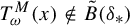 $T_\omega ^M(x) \notin \tilde B(\delta _*)$
(recall
 $\delta _*$
from inequality (5)), then
 $\delta _4 \le 1$
and
 $\delta _3 \ge \delta _*$
, and thus, the inequality holds for
 $C_1 = 1 / \delta _*$
. If this is not the case, then we must have
 $\delta _4 \le \delta _3 + \varepsilon \le 2 \delta _3$
, where we recall
 $\varepsilon $
is the maximum perturbation size, in which case, the statement holds for
 $C_1=2$
.
Now, by inequality (36) in Proposition 3.16 and Lemma 3.17, we have
 $$ \begin{align*} DT_\omega^n(x) &= DT_\omega^{M+1}(x) \cdot \prod_{j = M + 1}^{n-1} DT_{\sigma^j \omega}(T_\omega^{j}(x)) \\ & \ge \frac{\kappa \Lambda_0 (\delta)^{\zeta_2}}{\mathcal{D}(\delta_0)} \bigg( \frac{\delta_0}{\delta} \cdot \frac{\delta_3}{\delta_4} \bigg)^{1 - 1/s}. \end{align*} $$
Thus, combining this with the statement above, we have
 $$ \begin{align} DT_\omega^n(x) \ge \frac{C_2 \Lambda_0 (\delta)^{\zeta_2}}{\mathcal{D}(\delta_0)}\bigg( \frac{\delta_0}{\delta} \bigg)^{1 - 1/s}. \end{align} $$
Furthermore, since
 $\delta \le \delta _0$
, we have
 $$ \begin{align*} DT_\omega^n(x) \ge C_3 \frac{ \Lambda_0 (\delta_0)^{\zeta_2}}{\mathcal{D}(\delta)} , \end{align*} $$
and since
 $\delta _0$
is sufficiently small, then inequality (41) follows.
Now, if
 $T_\omega ^{n}(x) \notin \tilde B(\delta )$
, then we set
 $\rho = |T_\omega ^n(x) - T_0(0)|$
, and from the fact that
 $T_\omega ^{M(\delta ) + 1}(x), \ldots , T_\omega ^{n-1}(x) \notin B(\delta _0)$
, we therefore have
 $\rho \ge \delta $
. Clearly, then
 $DT_{\sigma ^n \omega } (T_\omega (x)) \ge \mathcal {D}(\rho )$
. Furthermore, since we have
 $\rho < \delta _0$
, then by inequality (43), we know there must exist some constant
 $C_4>0$
such that we have
 $$ \begin{align*} DT_\omega^{n+1} (x) \ge C_4 \Lambda_0(\delta)^{\zeta_2} \bigg( \frac{\rho}{\delta} \bigg)^{1 - 1/s}. \end{align*} $$
Since
 $\delta _0$
is assumed to be sufficiently small, the desired result holds.
Using these results, we can now give the proof of Proposition 3.14.
Proof of Proposition 3.14
Let us assume our
 $\delta _0 $
is sufficiently small so that for all
 ${0 < \delta \le \delta _0}$
, we have
 $\Lambda _0(\delta )> 1$
. Let
 $s_1$
be the first time that
 $\nu _1 \ge M(\delta )$
and
 ${T_\omega ^{\nu _1}(x) \in \tilde B(\delta _0)}$
. If
 $n = \nu _1$
, then the desired result follows from Lemma 3.18.
Alternatively, if
 $\nu _1 < n$
, then we set
 $\rho _1 = |T_\omega ^{\nu _1}(x)|$
. By inequality (42), we have
 $$ \begin{align} DT_\omega^{\nu_1 + 1}(x) \ge \Lambda_0(\delta)^{\zeta_3} \bigg( \frac{\rho_1}{\delta} \bigg)^{1 - 1/s}. \end{align} $$
Now, let
 $\nu _2> \nu _1$
be the smallest integer such that
 $\nu _2 \ge M(\delta _1)$
and
 $T_\omega ^{\nu _2}(x) \in \tilde B(\delta _0)$
. If
 $\nu _2 = n$
, then we stop, otherwise, we define
 $\rho _2 = |T_\omega ^{\nu _2}(x)|$
then find
 $\nu _3$
. We continue this process until we reach some
 $\nu _k = n$
and then apply inequality (42) to obtain for all
 ${i = 1, \ldots , k - 2}$
,
 $$ \begin{align*} \prod_{j =\nu_i+1}^{\nu_{i + 1}} DT_{\sigma^j \omega}(T_\omega^j(x)) \ge \Lambda_0(\rho_i)^{\zeta_3} \bigg( \frac{\rho_{i + 1}}{\rho_i} \bigg)^{1 - 1/s}, \end{align*} $$
and using Lemma 3.18, we have
 $$ \begin{align*} \prod_{j = \nu_{k -1}+ 1}^{n -1}DT_{\sigma^j \omega}(T_\omega^j(x)) \ge \frac{\Lambda_0(\rho_{k-1})^{\zeta_3}}{\mathcal{D}(\delta)}. \end{align*} $$
Thus, combining the above inequalities together, we have
 $$ \begin{align*} DT_\omega^n(x) &= DT_\omega^{n+1}(x) \bigg( \prod_{i = 1}^{k - 2} \prod_{j = \nu_i + 1}^{\nu_{i + 1}} DT_{\sigma^j \omega}(T_\omega^j(x)) \bigg) \prod_{j = \nu_{k-1}+1}^{n -1} DT_{\sigma^j \omega}(T_\omega^j(x)) \\ & \ge \frac{\Lambda_0(\delta)^{\zeta_3}}{\mathcal{D}(\delta)} \prod_{i = 1}^{k - 2} \Lambda_0(\rho_j)^{\zeta_3} \bigg( \frac{\rho_{k-1}}{\delta} \bigg)^{1 - 1/s} \ge \frac{\Lambda_0(\delta)^{\zeta_3}}{\mathcal{D}(\delta)}. \end{align*} $$
Thus, the result holds.
We can now give the proof of Proposition 3.1.
Proof of Proposition 3.1
Statement (1): this follows directly from Lemma 3.17. Indeed, from Lemma 3.17, we know that because
 $x, T_\omega (x), \ldots , T_\omega ^{n-1}(x) \notin \tilde B(\delta )$
and
 $T_\omega ^n(x) \in \tilde B(2\delta )$
, then
 $$ \begin{align*} DT_\omega^n(x) \ge \frac{\kappa}{\mathcal{D} (\delta)} \bigg( \frac{\delta}{\delta_3} \bigg)^{1 - 1/s} e^{\hat \eta n}, \end{align*} $$
where
 $\delta _3 = \max \{ |x - T_0(0)|, \delta \}$
. The smallest value
 $( {\delta }/{\delta _3} )^{1 - 1/s}$
can take is
 $(\delta /2)^{1 - 1/s}$
. Thus, if we set
 $A = A(\delta ) = {\kappa }/{\mathcal {D} (\delta )} (\delta /2)^{1 - 1/s}$
, then this gives us the desired result for fixed
 $\delta>0$
.
Statement (2): this follows directly from Proposition 3.14 and Lemma 3.17. Indeed, as in the proof for the first statement, from Lemma 3.17, we know that because
 $x, T_\omega (x), \ldots , T_\omega ^{n-1}(x) \notin \tilde B(\delta )$
and
 $T_\omega ^n(x) \in \tilde B(2\delta )$
, then
 $$ \begin{align*} DT_\omega^n(x) \ge \frac{\kappa}{\mathcal{D} (\delta)} \bigg( \frac{\delta}{\delta_3} \bigg)^{1 - 1/s} e^{\hat \eta n}. \end{align*} $$
However, we already know that
 $|x - T_0(0)| \le 4 \delta $
, so we therefore have
 $$ \begin{align*} \bigg( \frac{\delta}{\delta_3} \bigg)^{1 - 1/s} \ge \bigg( \frac 1 4 \bigg)^{1 - 1/s}, \end{align*} $$
which can just be absorbed into the
 $\kappa> 0$
term, thereby giving us
 $$ \begin{align} DT_\omega^n(x) \ge \frac{\kappa}{\mathcal{D} (\delta)} e^{\hat \eta n}. \end{align} $$
Finally, if we set a constant
 $\beta (\delta )$
that satisfies the following criteria:
-
(1)
$\beta (\delta ) \to 0 $
as
$\delta \to 0$
; -
(2)
$\hat \Lambda (\delta ) = \Lambda (\delta )^{\beta (\delta )}e^{1 - \beta (\delta )} \ge 2e$
for all sufficiently small
$\delta>0$
; -
(3)
$\Lambda (\delta )^{\beta (\delta )} \to \infty $
as
$\delta \to 0$
,


and if we set
 $$ \begin{align*} \eta_0(\delta) = (1 - \beta(\delta)) \hat \eta(\delta), \end{align*} $$
then we have
 $$ \begin{align*} DT_\omega^n(x) \ge \frac{\hat \Lambda(\delta)}{\mathcal{D} (\delta)} e^{ \eta_0 n}.\\[-41pt] \end{align*} $$
4 Good and bad parameter sets
For a given
 $(\omega , x) \in \Omega _\varepsilon \times I$
, if the orbit
 $\{ T_\omega ^n \}_{n \in \mathbb {Z}_+}$
goes too close to the point
 $0$
too often, then we do not have expansion. In this section, we prove that the measure of the ‘bad’ set of such
 $(\omega , x) \in \Omega _\varepsilon \times I$
decays exponentially as
 $n \to \infty $
, leaving us with a full-measure set of ‘good’
 $(\omega , x)$
parameters where expansion is guaranteed, meaning that the expansion condition for the tower will be satisfied.
To better define what we mean by ‘good’ and ‘bad’
 $(\omega , x)$
parameters in a more concrete sense, it is useful to define the notion of return depth.
Definition 4.1. (Return depth)
For fixed
 $\delta>0$
, we define the return depth of
 $(\omega , x)$
as
 $$ \begin{align*} r_\delta (\omega, x) := \inf \{ r \in \mathbb Z_+ | |DT_\omega(x)| \cdot |x| \ge e^{-r}\delta \}. \end{align*} $$
When
 $\omega \in \Omega _\varepsilon $
is fixed, we will use the shorthand
 $r_\delta (x) =r_\delta (\omega , x) $
and
 $r_\delta (T_\omega ^j(x))= r_\delta (\sigma ^j\omega , T_\omega ^j(x))$
.
Remark 4.2. One should note that by this definition, one can show an equivalent condition for return depth using property (C2): if
 $r_\delta (x) = r^*$
, we have
 $$ \begin{align*} |x| \ge \frac{e^{-r^*}\delta}{T_\omega'(x)} \ge \frac{e^{-r^*}\delta}{K_2 |x|^{s-1}}, \\ \end{align*} $$
which implies

Using the notion of return depth, we can now define more clearly what is meant by ‘good’ and ‘bad’: for fixed n,
 $\delta $
and
 $\varepsilon $
, we define the ‘bad’ set of
 $(\omega , x)$
parameters as
 $$ \begin{align} E_n = E_n(\delta, \varepsilon ) := \bigg\{ (\omega, x) \in \Omega_\varepsilon \times I | \sum_{j=0}^{n-1} r_\delta(T_\omega^j(x)) \ge cn \bigg\}, \end{align} $$
where
 $c>0$
is some small constant, and by extension, an
 $(\omega , x)$
is ‘good’ if
 $(\omega , x) \notin E_n$
. The motivation for this definition is that
 $(\omega , x) \notin E_n$
have expansion, which we will prove in §4.1.
We can now give the main result of this section.
Proposition 4.3. There exists a small constant
 $c>0$
such that, for all sufficiently small
 $\delta>0$
, there exist constants
 $ \gamma (\delta ), C(\delta )>0$
such that for sufficiently small
 $\varepsilon > 0$
, we have
 $$ \begin{align} (\mathbb{P}_\varepsilon \times \mathrm{Leb})(E_n) \le C(\delta) e^{- \gamma(\delta)n}. \end{align} $$
4.1 Good
$(\omega , x)$
parameters have expansion

In this subsection, we verify that
 ${(\omega , x) \notin E_n}$
parameters indeed have expansion.
Proposition 4.4. There exist constants
 $c, C, {\unicode{x3bb}}>0$
such that for any sufficiently small
 $\delta>0$
and
 $0 < \varepsilon \le \delta $
, and for all
 $\omega \in \Omega $
, if
 $\sum _{i=0}^{n-1} r_\delta (T_\omega ^i(x)) < cn$
and
 $T_\omega ^n(x) \in \tilde B(\delta )$
, then
 $$ \begin{align*} DT_\omega^n(x) \ge C e^{{\unicode{x3bb}} n}. \end{align*} $$
To prove this, we first need to adapt a version of [Reference Shen36, Lemma 7.7].
Lemma 4.5. Let
 $\Gamma = \Gamma (\omega , y, n)$
denote the number of returns for
 $(\omega , x)$
up to time n (excluding
 $t=0$
) and let
 $\nu _1, \ldots , \nu _\Gamma $
be the ordered return times. There exists a constant
 $C>0$
such that, if
 $y \in \tilde B(\delta )$
, then
 $$ \begin{align*} \log \bigg( \frac{DT_\omega^n(y)|y| |T_\omega^{\nu_1}(y)| \cdots |T_\omega^{\nu_\Gamma}(y)|}{|\tilde B(\delta)|^\Gamma} \bigg) \ge \log C + \kappa n - \sum_{i=0}^{n-1} r_\delta(T_\omega^i(y)). \end{align*} $$
Furthermore, if both
 $y, T_\omega ^n(y) \in \tilde B(\delta )$
, then for
 $(\omega , x)$
, we have
 $$ \begin{align*} \log \bigg( \frac{DT_\omega^n(y)|y| |T_\omega^{\nu_1}(y)| \cdots |T_\omega^{\nu_\Gamma}(y)|}{|\tilde B(\delta)|^\Gamma} \bigg) \ge \kappa n - \sum_{i=0}^{n-1} r_\delta(T_\omega^i(y)). \end{align*} $$
Proof. We give the proof of the case where both
 $y, T_\omega ^n(y) \in \tilde B(\delta )$
. The proof for the case where just
 $y \in \tilde B(\delta )$
follows in exactly the same way, with the exception that one uses the weaker lower bound for the derivative between the last return time and n.
First, we assume the case that
 $T_\omega ^j(y) \notin \tilde B(\delta )$
for all
 $1 \le j < n$
, that is,
 $\Gamma = 1$
. Since we are already assuming
 $y \in \tilde B(\delta )$
, we therefore have
 $|T_\omega (y) -T(0)| \le 4\delta $
. Thus, we can use the non-uniform expansion result in equation (6), so clearly we have
 $$ \begin{align*} DT_{\sigma \omega}^{n-1}(T_\omega(x)) \ge \frac{1}{\mathcal{D}(\delta)}e^{\kappa n}, \end{align*} $$
where
 $\kappa>0$
is some suitably chosen constant since
 $\delta $
is fixed. Thus, we have
 $$ \begin{align*} \frac{DT_\omega^n(y)|y|}{|\tilde B (\delta)|} &= DT_{\sigma \omega}^{n-1}(T_\omega(y)) \frac{DT_\omega(y)|y|}{|\tilde B (\delta)|} \ge DT_{\sigma \omega}^{n-1}(T_\omega(y)) \frac{e^{-r_\delta (\omega, y)}\delta}{|\tilde B (\delta)|} \\ & \ge \frac{1}{\mathcal{D}(\delta)}e^{\kappa n}e^{-r_\delta (\omega, y)} \mathcal{D}(\delta) = e^{\kappa n -r_\delta (\omega, y)}. \end{align*} $$
Thus, clearly
 $$ \begin{align*} \log \bigg( \frac{DT_\omega^n(y)|y|}{|\tilde B(\delta)|} \bigg) \ge \kappa n -r_\delta (\omega, y). \end{align*} $$
Now, consider when it is not the case that
 $T_\omega ^j(y) \notin \tilde B(\delta )$
for all
 $1 \le j < n$
, that is,
 $\Gamma = 2$
. Say there is one iterate
 $1 \le k < n$
where
 $T_\omega ^k(y) \in \tilde B(\delta )$
. Then, we simply split the orbit into
 $y, T_\omega (y), \ldots , T_\omega ^{k-1}(y)$
and
 $T_\omega ^{k}(y), \ldots , T_\omega ^n(y)$
, and then apply the same procedure above to each segment. This will give us
 $$ \begin{align*} DT_{\sigma \omega}^{k-1}(T_\omega(x)) \ge \frac{1}{D(\delta)}e^{\kappa k} \quad \text{and} \quad DT_{\sigma^{k+1} \omega}^{n-k-1}(T_\omega^{k+1}(x)) \ge \frac{1}{D(\delta)}e^{\kappa (n-k)}, \end{align*} $$
and thus,
 $$ \begin{align*} &\frac{DT_\omega^{n-k}(T_\omega^k(y))|y| |T_\omega^k(y)|}{|\tilde B (\delta)|^2} = \frac{DT_{ \omega}^{k}(y)|y|}{|\tilde B (\delta)|} \frac{DT_{\sigma^k \omega}^{n-k}(T_\omega^k(y))|T_\omega^k(y)|}{|\tilde B (\delta)|} \\ &\quad \ge DT_{\sigma \omega}^{k-1}(T_\omega(y)) \frac{DT_\omega(y)|y|}{|\tilde B (\delta)|} DT_{\sigma^{k+1} \omega}^{n-k-1}(T_\omega^{k+1}(y)) \frac{DT_{\sigma^k \omega}(T_\omega^k(y))|T_\omega^k(y)|}{|\tilde B (\delta)|}\\ &\quad \ge \exp (\kappa k -r_\delta (\omega, y)) \exp (\kappa (n-k) -r_\delta (\sigma^k \omega, T_\omega^k(y))) \\ &\quad = \exp(\kappa n -r_\delta (\omega, y) - r_\delta (\sigma^k \omega, T_\omega^k(y))). \end{align*} $$
One follows the same procedure if there are more returns.
Proof of Proposition 4.4
From Lemma 4.5, we know that for
 $y, T_\omega ^n(y) \in \tilde B(\delta )$
, we have
 $$ \begin{align*} \log \bigg( \frac{DT_\omega^n(y)|y| |T_\omega^{\nu_1}(y)| \cdots |T_\omega^{\nu_\Gamma}(y)|}{|\tilde B(\delta)|^\Gamma} \bigg) \ge \kappa n - \sum_{i=0}^{n-1} r_\delta(T_\omega^i(y)). \end{align*} $$
Choosing some small
 $0 < c < \kappa $
and setting
 ${\unicode{x3bb}} = \kappa - c$
, if our starting point x is in
 $\tilde B(\delta )$
, then we simply consider
 $y=x$
and directly use the above lemma:
 $$ \begin{align*} DT_\omega^n(y) \ge \frac{|\tilde B(\delta)|}{|x|} \frac{|\tilde B(\delta)|}{|T_\omega^{\nu_1}(y)|} \cdots \frac{|\tilde B(\delta)|}{|T_\omega^{\nu_\Gamma}(y)|} \exp\bigg(\kappa n - \sum_{i=0}^{n-1} r_\delta (T_\omega^i(y))\bigg)> e^{{\unicode{x3bb}} n}. \end{align*} $$
Here, we can get rid of each
 $|\tilde B(\delta )|/|T_\omega ^i(x)|$
for
 $i \in \{0 , \nu _1, \ldots , \nu _\Gamma \}$
because
 $T_\omega ^i(x) \in \tilde B(\delta )$
.
Now, if
 $x \notin \tilde B(\delta )$
, then we instead consider the starting point
 $y=T_\omega ^{\nu _1}(x)$
in the context of the above lemma. Clearly, we have
 $$ \begin{align*} \sum_{i=0}^{n-\nu_1-1} r_\delta(T_{\sigma^{\nu_1} \omega}^{i}(y)) = \sum_{i=0}^{n-1} r_\delta( T_\omega^i(x)) < cn, \end{align*} $$
thus, we can write
 $$ \begin{align*} &DT_{\sigma^{\nu_1} \omega}^{n-\nu_1}(y) \ge \exp \bigg({\kappa(n-\nu_1) - \sum_{i=0}^{n-\nu_1-1} r_\delta(T_{ \omega}^i(y))}\bigg)\\ &\quad> \exp(\kappa(n-\nu_1) - cn ) = \exp({\unicode{x3bb}} n - \kappa \nu_1). \end{align*} $$
Furthermore, since we have assumed
 $x \notin \tilde B(\delta )$
and, by definition,
 $T_\omega ^{\nu _1}(x) \in \tilde B(\delta )$
, we can apply inequality (6) to obtain
 $$ \begin{align*} DT_\omega^{\nu_1}(x) \ge A \exp(\kappa \nu_1). \end{align*} $$
Combining these together, we obtain
 $$ \begin{align*} DT_\omega^n(x) = DT_{\sigma^{\nu_1} \omega}^{n-\nu_1}(y) \cdot DT_\omega^{\nu_1}(x)= \exp({\unicode{x3bb}} n - \kappa \nu_1) \cdot A \exp(\kappa \nu_1) = A e^{{\unicode{x3bb}} n}.\\[-37pt] \end{align*} $$
4.2 Proof of Proposition 4.3
Having verified that the ‘good’ condition guarantees expansion, we now move onto the proof of Proposition 4.3 using the following sequence of lemmas.
Lemma 4.6. Let
 $\delta> 0$
be sufficiently small and denote
 $\hat R_\omega (x) = \min \{ n \in {\mathbb N} | T_\omega ^n(x) \in \tilde B(\delta ) \} $
. For any sufficiently small
 $\varepsilon > 0$
, all
 $\omega \in \Omega _\varepsilon $
, and all
 $x \in I$
such that
 ${| x - T_0(0)| \le 4 \delta }$
and
 $n = \hat R_\omega (x)< \infty $
, if J is the component of
 $(T_\omega ^n)^{-1}(\tilde B(\delta ))$
containing x, then
 $T_\omega ^n|_J : J \to T_\omega ^n(J)$
is a diffeomorphism with bounded distortion
 $\mathcal {N} (T_\omega ^n | J) \le 1$
and size
 $|J| \le \delta $
.
Proof. Recall the constant
 $\theta _0>0$
from Lemma 3.2 and define
 $$ \begin{align*} \hat J_{x,n} = \bigg[ x - \frac{\theta_0}{A(\omega, x , n)}, x + \frac{\theta_0}{A(\omega, x , n)} \bigg] \cap I_\pm. \end{align*} $$
Let us set
 $\theta = \theta _0/e$
. Then,
 $T_\omega |_{\hat J_{x,n} } : \hat J_{x,n} \to T_\omega ^n(\hat J_{x,n})$
is a diffeomorphism and
 $\mathcal {N} (T_\omega ^n | \hat J_{x,n}) \le 1$
. We know that for any
 $y \in \partial \hat J_{x,n} \setminus \{ -1 , 1 \}$
, we have
 $| T_\omega ^n(x) - T_\omega ^n(y) | \ge |DT_\omega ^n(x)| \theta _0 / (e A(\omega , x, n)) \ge |\tilde B(\delta )| $
. Therefore, we know that
 $J \subset J_{x,n} $
and, thus,
 $\mathcal {N} (T_\omega ^n | \hat J_{x,n}) \le 1$
. Furthermore, since we have
 $|x - T_0(x)| \le 4 \delta $
, from Proposition 3.1, we know that
 $DT_\omega ^n(x)> e/ \mathcal {D}(\delta )$
and, thus,
 $|J| \le e |\tilde B(\delta )|/ DT_\omega ^n(x) < \delta $
.
Lemma 4.7. There exist constants
 $K_1> 0$
such that for sufficiently small
 $\delta>0$
, sufficiently small
 $\varepsilon >0$
, all
 $\omega \in \Omega $
and all
 $r \in \mathcal {N}$
, for the set
 $$ \begin{align*} Y_\delta^\omega (r) = \{ y \in B(0, 2 \delta) | r_\delta(T_\omega^{\hat R_\omega}(x)) \ge r \}, \end{align*} $$
we have
 $$ \begin{align} |Y_\delta^\omega (r) | \le K_1 \delta e^{- r/s}. \end{align} $$
Sublemma 4.8. For any fixed constants
 $0 < \xi < \xi ' \le 2$
, and for sufficiently small
 $\varepsilon >0$
,
 $\omega \in \Omega _\varepsilon $
and
 $n \in {\mathbb N}$
, if J is an interval such that
 $J \cap \tilde B(\xi \delta ) \neq \emptyset $
and
 $T_\omega ^n(J) \subset \tilde B(2 \delta )$
, then
 $J \subset \tilde B(\delta )$
.
Proof. Consider the following condition:
 $$ \begin{align} T_\omega^j(J) \cap \tilde B (\delta) = \emptyset \quad\text{for every }1 \le j < n. \end{align} $$
First, we consider the case when this holds and then the case when it does not.
For the first case, our main aim is to show that every component
 $J'$
of the intersection
 $J \cap (\tilde B(\xi ' \delta ) \setminus \tilde B( \xi \delta )) $
is a proper subset of
 $\tilde B(\xi ' \delta )$
, thereby implying that
 $J' \subset \tilde B (\xi ' \delta )$
. Furthermore, we know that there exists some constant
 $C = C(\xi )$
such that, as long as
 $\delta $
is sufficiently small, we have
 $DT_\omega (x) \ge C \mathcal {D}(\delta ) $
for all
 $x \in \tilde B(2 \delta ) \setminus \tilde B(\xi \delta )$
. Using statement (2) of Proposition 3.1, we therefore have
 $$ \begin{align*} DT_\omega^n(x) = DT_{\sigma \omega}^{n-1}(T_\omega(x)) \cdot DT_\omega(x) \ge \frac{\Lambda(\delta)}{\mathcal{D}(\delta)} C \mathcal{D}(\delta) = C \Lambda(\delta) \end{align*} $$
for every
 $x \in J'$
, and thus,
 $$ \begin{align*} |J'| \le \frac{|\tilde B(2 \delta)|}{\inf_{x \in J'}|DT_\omega^n(x)|} \le \frac{2 |\tilde B(\delta)|}{C\Lambda(\delta)}. \end{align*} $$
For sufficiently small
 $\delta $
, we therefore know
 $|J'|$
is significantly smaller than
 $|\tilde B(\delta )|$
. Furthermore, knowing that
 $J' \cap \partial \tilde B(\xi \delta ) \neq \emptyset $
, we therefore know that
 $J'$
is a proper subset of
 $\tilde B( \xi ' \delta )$
, thereby proving this sublemma.
If condition (49) does not hold, then consider the iterates
 ${0 \le \nu _1 < \nu _2 < \cdots < \nu _k < n}$
, where
 $T_\omega ^{\nu _i} \cap \tilde B(\delta ) \neq \emptyset $
for each
 $i = 1, \ldots , k$
and no other iterates. If we use
 $2$
and
 $1$
in place of
 $\xi '$
and
 $\xi $
, respectively, then we know that
 $T_\omega ^{\nu _k}(J) \subset \tilde B(2 \delta )$
. If we repeat this process, we have
 $T_\omega ^{\nu _{k-1}}(J) \subset \tilde B(2 \delta ), \ldots , T_\omega ^{\nu _1}(J) \subset \tilde B(2 \delta )$
until we obtain
 $J \subset \tilde B(2 \delta )$
.
Proof of Lemma 4.7
First, for any
 $\omega \in \Omega $
, consider the set
 $$ \begin{align*} Z_\delta^{\omega}(r) = \{ x \in \tilde B(\delta) | r_\delta(\omega, x) \ge r \}. \end{align*} $$
Using the definition of
 $r_\delta $
and condition (C2), there exists some constant
 $K_2>0$
such that
 $$ \begin{align*} |Z_\delta^{\omega}(r)| \le K_2 e^{-r/s}|\tilde B(\delta) |, \end{align*} $$
and furthermore, there exists some constant
 $r^*>0$
such that
 $Z^{\omega }(r) \subset \tilde B(\delta /e)$
for all
 ${r < r^*}$
.
Now, for all
 $r < r^*$
, inequality (48) holds for some sufficiently large
 $K_1$
. For the case where
 $r \ge r^*$
, for any
 $y \in Y_\delta ^\omega (r) $
, we set
 $n = \hat R_\omega (y)$
and set
 $J= J(y)$
as the component of
 $(T_\omega ^n)^{-1}(\tilde B(\delta ))$
which contains y. We wish to prove that there exists a constant
 $K_3>0 $
such that
 $$ \begin{align} |J \cap Y_\delta(\omega, n)| \le K_3 e^{-r/s}|J|. \end{align} $$
To prove this, recall that since
 $r \ge r^*$
, we have
 $T_\omega ^n(y) \in \tilde B(\delta /e)$
. Thus, at least one component of
 $\tilde B(\delta ) \setminus \tilde B(\delta / e)$
is contained within
 $T_\omega ^n(J)$
, thereby implying that there exists some
 $\gamma>0$
such that
 $|T_\omega ^n(J)|/|\tilde B(\delta )| \ge \gamma> 0$
. Using Lemma 4.6, we know that
 $\mathcal {N}(T_\omega ^n | J) \le 1$
.
To prove equation (48), we need to show that
 $$ \begin{align} T_\omega^n(J \cap Y_\delta^\omega(r)) \subset Z_\delta^{\sigma^n \omega}. \end{align} $$
Now, we prove by contradiction that
 $\hat R_\omega (y') = \hat R_\omega (y)$
for all
 $y' \in J \cap Y_\delta ^\omega (q)$
. Indeed, suppose instead we have
 $1 \le n' < n$
, where
 $n' = \hat R_\omega (y')$
. We know that
 $T_\omega ^{n'}(y') \in \tilde B( \delta / e)$
, which, combined with Proposition 3.1, implies
 $T_\omega ^{n'}(J(y')) \subset \tilde B(\delta )$
. However, this contradicts our assumption that
 $n' $
is the first return.
We now conclude the proof by once again using Besicovitch’s covering lemma: the intervals in the set
 $\{J(y) | y \in Y_\delta (r)\}$
form an open cover of
 $Y_{\delta }(r)$
and, thus, a sub-covering can be found that has bounded multiplicity of intersection. From Lemma 4.6, we already now that
 $|J| \le \delta $
, which implies that
 $J \subset B(0, 3 \delta )$
. Thus, inequality (48) holds.
Lemma 4.9. There exist constants
 $K_0, \rho _0> 0$
such that, for sufficiently small
 $\delta>0$
and sufficiently small
 $\varepsilon >0$
, if
 $x \in \tilde B(\delta )$
and for the set
 $$ \begin{align*} \hat{Y}_\delta (x, r) = \{ \omega \in \Omega_\varepsilon | r_\delta(T_\omega^{\hat R_\omega}(x)) \ge r \}, \end{align*} $$
we have
 $$ \begin{align} \mathbb{P}_\varepsilon (\hat Y_\delta(x, r)) \le K_0 e^{-\rho_0 r}. \end{align} $$
Proof. For all
 $\omega \in \tilde B(\delta )$
and all
 $\omega \in \Omega _\varepsilon $
, consider the set
 $$ \begin{align*} X_\delta(\omega, x , r) = \{ t \in [- \varepsilon , \varepsilon ] | r_\delta( T_\omega^{R_\omega}(T_t(x))) \ge r \}. \end{align*} $$
Clearly, if
 $t \in X_\delta (\omega , x , r)$
, then
 $T_t(x) \in Y_\delta (r)$
and, thus,
 $$ \begin{align*} P_\varepsilon (X_\delta(\omega, x , r)) \le |Y_\delta^\omega (r) | \le K_1 \delta e^{- r/s} \end{align*} $$
and
 $$ \begin{align*} \mathbb{P}_\varepsilon (\hat Y_\delta(x, r)) = \int_{\Omega_\varepsilon } P_\varepsilon (X_\delta(\omega, x , r)) \,d \mathbb{P}_\varepsilon \le K_1 \delta e^{- r/s}. \end{align*} $$
Lemma 4.10. For all fixed
 $n \in {\mathbb N}$
and all
 $(r_1, \ldots , r_n) = \mathbf r \in {\mathbb N}^n$
, and for all sufficiently small
 $\varepsilon , \delta>0$
and
 $x \in \tilde B(\delta )$
, for the set
 $$ \begin{align*} \hat Y_\delta^n(x, \mathbf r) = \{ \omega \in \Omega | r_\delta(T_\omega^{\nu_i }(x)) \ge r_i \text{ for all } i = 1, \ldots, n \}, \end{align*} $$
where
 $$ \begin{align*} \nu_1 &= \hat R_\omega(x), \\ \nu_2 &= \hat R_{\sigma^{\nu_1}\omega}(T_\omega^{\nu_1}(x)),\\ & \vdots \\ \nu_n &= \hat R_{\sigma^{\nu_1 + \cdots + \nu_{n-1}}\omega}(T_\omega^{\nu_1 + \cdots + \nu_{n-1}}(x)), \end{align*} $$
we have
 $$ \begin{align} \mathbb{P}_\varepsilon (\hat Y_\delta^n(x, \mathbf r)) \le K_0^n e^{- \rho_0 | \mathbf{q}|}. \end{align} $$
Proof. Lemma 4.9 gives us the desired result for
 $n = 1$
. For the case
 $n>1$
, we simply need to show that
 $$ \begin{align*} \mathbb{P}_\varepsilon (\hat Y_\delta^n (x , \mathbf r)) \le K_0 e^{- \rho_0 r_n} \mathbb{P}_\varepsilon (\hat Y_\delta^n (x , \hat{\mathbf{r}})), \end{align*} $$
where
 $\hat{\mathbf{r}} = (r_1, \ldots , r_{n-1})$
. Indeed, consider the set
 $$ \begin{align*} W_m^n = \bigg\{ \omega \in \hat Y_\delta^{n-1} (x, \hat{\mathbf{r}}) | \sum_{i = 0}^{n - 2} \hat R_\omega(T_\omega^i (x) ) = m \bigg\}. \end{align*} $$
Clearly,
 $\hat Y_\delta (x, \hat{\mathbf{r}}) \subset \bigcup _{i = 1}^{\infty } W_i^n$
. Furthermore, for any two
 $\omega , \tilde \omega \in \Omega _\varepsilon $
such that
 $\omega _i = \tilde \omega _i$
for all
 $0 \le i < m$
, then we know that
 $\omega \in W_m^n$
if and only if
 $\tilde \omega \in W_m^n$
as well. This is equivalent to saying
 $W_m = [- \varepsilon , \varepsilon ]^{- {\mathbb N}} \times A_m \times [-\varepsilon , \varepsilon ]^{\mathbb N}$
,
 $A_m$
being a measurable subset of
 $[-\varepsilon , \varepsilon ]^m$
. Clearly,
 $\mathbb {P}_\varepsilon (W_m^n) = P_\varepsilon ^m(A_m)$
.
Now, for any
 $\omega \in W_m^n$
, from Lemma 4.9, we have
 $$ \begin{align} \mathbb{P}_\varepsilon (\hat Y_\delta (T_\omega^m(x), r)) \le K_1 \delta e^{- r/s}. \end{align} $$
Furthermore, notice that we have
 $$ \begin{align*} W_m^n \cap \hat Y_\delta^n (x, \mathbf r) = \{ (\hat{ \boldsymbol{\omega}}, \omega_0, \omega_1, \ldots,\, &\omega_{m-1}, \tilde \omega ) | \hat{ \boldsymbol{ \omega}} \in [- \varepsilon , \varepsilon ]^{-{\mathbb N}}, \\ &(\omega_0, \ldots, \omega_{m-1}) \in A_m, \tilde \omega \in \hat Y_\delta(T_\omega^m(x), r_n) \}. \end{align*} $$
Thus, by Fubini’s theorem, we have
 $$ \begin{align*} \mathbb{P}_\varepsilon (W_m^n \cap \hat Y_\delta^n (x, \mathbf r) ) = \int_{A_m} \mathbb{P}_\varepsilon (\hat Y_\delta(T_{\omega_{m-1}}\circ \cdots \circ T_{\omega_0}(x), r_n)) \le K_1 \delta e^{- r/s} \mathbb{P}_\varepsilon (W_m^n). \end{align*} $$
Thus, we have
 $$ \begin{align*} \mathbb{P}_\varepsilon (\hat Y_\delta^n(x, \mathbf r)) &= \sum_{i=1}^\infty \mathbb{P}_\varepsilon (W_i^n \cap \hat Y_\delta^n (x, \mathbf r) ) \\ &\le K_1 \delta e^{- r_n/s} \mathbb{P}_\varepsilon (\hat Y_\delta^{n-1}(x, \mathbf r)). \end{align*} $$
Using recursion, this proves the lemma.
Proof of Proposition 4.3
Take the constants
 $K_0 , \rho _0>0 $
from Lemma 4.9, and set
 $\rho = \min \{ \rho _0/5, 1/2s \}$
. Using Stirling’s approximation, we know that there will exist some constant
 $\kappa> 1$
such that, for all constants
 $n, m \in {\mathbb N}$
with
 $n> \kappa m/2$
, we have
 ${{ n + m -1 \choose m-1 } \le e^{\rho n}}$
.
Let us set
 $$ \begin{align*} \Xi = \{ (\omega, x) \in \Omega \times I | x \in \tilde B(\delta), r_\delta (x) \ge cn/2 - \kappa \} \end{align*} $$
as well as
 $$ \begin{align*} Q_{n_1}^{n_2} (\omega, x) = \sum_{j = n_1}^{n_2} r_\delta(T_\omega^j(x)). \end{align*} $$
Furthermore, for any
 $m', n \ge 0$
, we set
 $$ \begin{align*} \Xi_\ell^m = \{ (\omega, x) \in \Omega_\varepsilon \times I | \text{ there exists } N \ge 1 \text{ such that } \Gamma(\omega, x,N) = \ell, Q_1^N (\omega, x) = m \} \end{align*} $$
and define
 $\mathcal {I} = \{ (\ell , m) \in {\mathbb N}^2 | 2 \ell \ge \max \{ cn, \kappa m \}> 0 \}$
. We want to prove that
 $$ \begin{align} E_n \subset \Xi \cup \bigg( \bigcup_{(m', n) \in \mathcal{I} } \Xi_\ell^{ m} \bigg) \end{align} $$
and then show both of these sets decay exponentially.
To show
 $E_n$
is a subset, we must first show that for every
 $(\omega , x) \in E_n$
, there exists some
 $n' \ge 0$
such that
 $$ \begin{align} Q_0^{n'}(\omega, x)> \max \{ cn - \kappa, \kappa \Gamma_0^{n'}(\omega, x) \}. \end{align} $$
To see this, set
 $n_0$
as the first iterate where
 $Q_0^{n_0}(\omega , x) \ge cn$
. In the case where
 $Q_0^{n_0}(\omega , x)> \kappa \Gamma ^{n_0}(\omega , x)$
, then we can simply set
 $n' = n_0$
. If this is not the case, then we instead take
 $n' < n_0$
to be the largest iterate where
 $T_\omega ^{n'}(x) \in \tilde B (\delta )$
. By the definition of
 $n_0$
, we have
 $Q_0^{n'}(\omega , x) < m$
and, thus, we must have
 $Q_0^{n'}(\omega , x)> \kappa \Gamma ^{n'}(\omega , x)$
instead since
 ${(\omega , x) \in E_n }$
. Furthermore, clearly
 $\Gamma ^{n_0}(\omega , x) = \Gamma ^{n'}(\omega , x) + 1$
and, thus, we have
 $$ \begin{align*} Q_0^n(\omega, x)>\kappa \Gamma_0^{n_0} - \kappa \ge Q_0^{n_0}(\omega, x) - \kappa \ge cn - \kappa. \end{align*} $$
This confirms inequality (56). Now, for every
 $(\omega , x) \in E_n \setminus \Xi $
, if we set
 $\ell = Q_1^n(\omega , x)$
and
 $m = \Gamma _1^n(\omega , x)$
, then this implies that
 $(\omega , x) \in \Xi $
. It is now simply a question of showing that
 $(\ell , m) \in \mathcal {I}$
. Indeed, using the fact that
 $$ \begin{align*} 2 \ell = 2(Q^{n'}(\omega, x) - r_\delta(\omega, x)) \ge 2 ((cn - \kappa) - (cn/2 - \kappa)) = cn, \end{align*} $$
implies that
 $m>0$
. Furthermore, using the fact we have
 $2r_\delta (\omega , x) \le n - \kappa < Q_0^n(\omega , x)$
, we know that
 $2 \ell \ge Q_0^n(\omega , x)> \kappa \Gamma _0^n(\omega ,x) \ge \kappa n$
, thereby implying that
 $(\ell , m) \in \mathcal {I}$
and therefore that
 $E_n$
is a subset.
For the estimate on
 $|\Xi |$
, note that by the definition of
 $r_\delta $
, there is a constant
 $C=C(\kappa )$
such that for all
 $\omega \in \Omega _\varepsilon $
, we have
 $$ \begin{align*} |\{ x \in \tilde B(\delta) | r_\delta(x) \ge cn/ 2 - \kappa \}| \le C |\tilde B(\delta)| e^{-n/2s} \le C |\tilde B(\delta)| e^{-\rho n} \end{align*} $$
and, thus, by using Fubini’s theorem, we have
 $$ \begin{align} |\Xi| \le C |\tilde B(\delta)| e^{-\rho n}. \end{align} $$
As for the estimate on
 $|\Xi _\ell ^{ m}|$
for
 $(\ell , m) \in \mathcal {I}$
, for every
 $x \in \tilde B(\delta )$
, we set
 $$ \begin{align*} \hat E_\ell^{ m }(x) = \{ \omega \in \Omega_\varepsilon | x \in \Xi_\ell^{ m} \}. \end{align*} $$
Clearly, we have
 $$ \begin{align*} \hat E_\ell^{ m }(x) \subset \bigcup_{\substack{\mathbf{r} \in {\mathbb N}^m \\ |\mathbf{r}| = \ell}} \hat Y_{\delta}^m(x, \mathbf{r}). \end{align*} $$
Additionally, there are
 ${\ell + m - 1 \choose m - 1} $
of
 $\mathbf r \in {\mathbb N}^m$
with
 $|\mathbf r| = \ell $
. Thus, using Lemma 4.10, we have
 $$ \begin{align*} \mathbb{P}_\varepsilon (\hat E_\ell^{ m}(x)) &\le {\ell + m - 1 \choose m - 1} \le K_0^m e^{- \rho_0 | \mathbf{\ell}|} \\ & \le e^{\rho \ell} e^{-\rho_0 \ell} e^{\kappa \rho m} \le e^{- \rho(4 \ell - \kappa m)} \le e^{- 2 \rho \ell}. \end{align*} $$
Thus, we have
 $$ \begin{align*} \sum_{(\ell, m) \in \mathcal{I}} \mathbb{P}_\varepsilon (\Xi_\ell^{ m}) \le \sum_{\ell \ge \left\lfloor {n/2} \right\rfloor } \sum_{\substack{ m \text{ such that } \\ (\ell, m) \in \mathcal{I}}} \mathbb{P}_\varepsilon (\Xi_\ell^{ m}) \le \sum_{\ell \ge \left\lfloor {n/2} \right\rfloor } e^{- 2 \rho \ell} \frac{2 \ell}{\kappa} \le C e^{- \rho n}.\\[-55pt] \end{align*} $$
5 Hyperbolic times and hyperbolic return times
The idea of hyperbolic times and hyperbolic return times originates in [Reference Alves2] and was then adapted to the random case in [Reference Baladi, Benedicks and Maume-Deschamps15]. Their usefulness, as we will show in this section, arises from the fact that they can be used to construct a suitable return partition on the base of our tower, on which we have the Markov property, bounded distortion and expansion (tower axioms (A3)–(A5) in Appendix A).
First, in §5.1, we define hyperbolic times and show that, as n goes to infinity, the set of
 $(\omega , x) \in \Omega _\varepsilon \times I$
which have not experienced a hyperbolic time is measure zero. Next, in §5.2, we show that if n is a hyperbolic time for a point x, then this implies the existence of a neighbourhood around x on which we have the desired properties up to time n. Finally, in §5.3, we define hyperbolic return times and show almost all
 $(\omega , x) \in \Omega _\varepsilon \times I$
has one as n goes to infinity.
5.1 Hyperbolic times
We give a formal definition of hyperbolic times here.
Definition 5.1. (Hyperbolic times)
Let us fix two constants
 $\delta>0$
and
 $c'>0$
. An iterate n is considered a
 $(\delta , c')$
-hyperbolic time for
 $(\omega , x)$
if for all
 $0 \le k \le n-1$
, we have
 $$ \begin{align} \sum_{j=k}^{n-1} r_\delta( T_\omega^j(x)) < c'(n - k). \end{align} $$
We should note two particular properties of
 $(\delta , c')$
-hyperbolic times stemming from this definition. The first is that if
 $n_1 \ge 1$
is a
 $(\delta , c')$
-hyperbolic time for
 $(\omega , x)$
and
 ${n_2 - n_1 \ge 1}$
is a hyperbolic time for
 $(\sigma ^{n_1}\omega , T_\omega ^{n_1}(x))$
, then
 $ n_2$
is also a hyperbolic time for
 $(\omega , x)$
. Indeed, for any
 $n_1 \le k < n_2$
, we just have
 $$ \begin{align*} \sum_{j=k}^{n_2 -1} r_\delta( T_\omega^j(x)) = \sum_{j=k - n_1}^{n_2 - n_1 -1} r_\delta( T_{\sigma^{n_1}\omega}^j(x)) < c'((n_2- n_1) - (k-n_1)) = c'(n_2 - k). \end{align*} $$
Likewise, if
 $0 \le k < n_1$
, we have
 $$ \begin{align*} \sum_{j=k}^{n_2-1} r_\delta( T_\omega^j(x)) &= \sum_{j=k}^{n_1 -1} r_\delta( T_\omega^j(x)) + \sum_{j=n_1}^{n_2-1} r_\delta( T_\omega^j(x))\\ & < c'(n_1 - k) + c'(n_2 - n_1) = c'(n_2 - k). \end{align*} $$
The second property is that if
 $n \ge 1$
is a
 $(\delta , c')$
-hyperbolic time for
 $(\omega , x)$
, then
 $n - m$
is a
 $(\delta , c')$
-hyperbolic time for
 $(\sigma ^m \omega , T_\omega ^m(x))$
for each
 $1 \le m < n$
. Indeed, we have for every
 $0 \le k < n - m$
,
 $$ \begin{align*} \sum_{j=k}^{n - m-1} r_\delta( T_{\sigma^m\omega}^j(x)) = \sum_{j=k + m}^{n-1} r_\delta( T_{\omega}^j(x)) < c'(n - (k + m))= c'((n - m) - k)). \end{align*} $$
We denote by
 $h(\omega , x)$
the first
 $(\delta , c')$
-hyperbolic time for
 $(\omega , x)$
. We want to show that the set of
 $(\omega , x)$
parameters that have not experienced a
 $(\delta , c')$
-hyperbolic time by time n, that is,
 $h(\omega , x)>n$
, decays exponentially as n goes to infinity.
Lemma 5.2. For any fixed
 $0 < \delta < 1$
and
 $c'> c$
, all
 $(\omega , x) \notin E_n$
experience a
 $(\delta , c')$
-hyperbolic time smaller than or equal to n. Furthermore, there exist some
 $C=C(\delta )$
and
 $\gamma =\gamma (\delta )$
such that, for sufficiently small
 $\varepsilon $
, we have
 $$ \begin{align*} (\mathbb P_\varepsilon \times \mathrm{Leb}) (\{ (\omega, x) | h(\omega, x)> n \}) \le Ce^{-\gamma n}. \end{align*} $$
Before we prove this, we make use of Pliss’s lemma [Reference Pliss34].
Lemma 5.3. (Pliss’s lemma)
Let us fix some constants
 $A \ge c_2> c_1$
and set
 $\theta = (c_2 - c_1)/ (A - c_1)$
. For any real numbers
 $a_0, a_1, \ldots , a_{n-1} \le A$
satisfying
 $$ \begin{align*} \sum_{j=0}^{n-1} a_j> c_2 n, \end{align*} $$
there exists some constant
 $\ell \ge \theta n$
and integers
 $1 \le n_1 < n_2 < \cdots < n_\ell \le n$
such that, for every
 $i = 1, 2, \ldots , \ell $
and every
 $0 \le k < n_i$
, we have
 $$ \begin{align*} \sum_{j=k}^{n_i-1} a_j> c_1 (n_i - k). \end{align*} $$
Proof of Lemma 5.2
We follow the same steps as in [Reference Du24]. First, we want to show that
 $(\omega ,x) \notin E_n$
implies that
 $h(\omega , x) \le n$
. To this end, we set
 $a_i = c - r_\delta (T_\omega ^i(x))$
. By definition, for any
 $(\omega , x) \notin E_n$
, we have
 $\sum _{j=0}^{n-1}a_j> 0$
. For any
 $c'> c$
, if we set
 $A = c$
,
 $c_2 = 0$
and
 $c_1 = c - c' <0$
(and thus
 $A \ge c_2> c_1$
), we can apply Pliss’s lemma: there exists some integer
 $1 \le n_1 \le n$
such that for all
 $0 \le k < n_1$
, we have
 $$ \begin{align*} \sum_{j=k}^{n_1-1} a_j> c_1(n_1 -k)= (c - c')(n_1 -k). \end{align*} $$
Using how we have defined
 $a_i$
, this can be rewritten as
 $$ \begin{align*} \sum_{j=k}^{n_1-1} r_\delta(T_\omega^j(x)) < c'(n_1 -k). \end{align*} $$
Thus,
 $n_1$
is a
 $(\delta , c')$
-hyperbolic time for
 $(\omega , x)$
.
For the tails of first hyperbolic times, we simply use the contrapositive that
 $h(\omega , x)>n$
implies
 $(\omega , x) \in E_n$
, which decays exponentially by Proposition 4.3. Thus, the proof is complete.
Remark 5.4. The above lemma implies that almost every
 $(\omega , x) \in \Omega _\varepsilon \times I$
has infinitely many hyperbolic times. Furthermore, the proof of the above not only implies that if
 $(\omega , x) \in I \setminus E_n$
, there will be at least one hyperbolic time less than or equal to n, but between
 $1$
and n, there will in fact be at least
 $(1 - {c}/{c'})n$
hyperbolic times. This means that, provided
 $(\omega , x)$
is not in
 $E_n$
at time n, we can choose whatever lower bound for proportion of times that must be hyperbolic times that we like, depending on our choice of c and
 $c'$
.
5.2 Expansion, bounded distortion and Markov property
We now verify that hyperbolic times guarantee the Markov property, bounded distortion and expansion, and, by extension, the tower map constructed from
 $\{T_\omega \}$
will satisfy properties (A3)–(A5).
Proposition 5.5. For some fixed
 $c' \in (c, \kappa )$
, assume that
 $(\omega , x)$
has a
 $(\delta , c')$
-hyperbolic time n. There exists some open neighbourhood
 $V_{x,n}^\omega $
of x and some constant
 $\delta _0>0$
dependent on
 $\delta $
such that for all
 $0 \le k < n$
, we have that the map
 $$ \begin{align*} T_{\sigma^m \omega}^{n - k}: T_\omega^k(V_{x,n}^\omega) \to B(T_\omega^n(x), \delta_0) \end{align*} $$
is a diffeomorphism (that is, the map is Markov) of bounded distortion. Furthermore, there exist constants
 $C, {\unicode{x3bb}} '>0$
such that, for all elements
 $y \in V_{x,n}^\omega $
, we have
 $$ \begin{align*} DT_{\sigma^k \omega}^{n-k}(T_\omega^k(y)) \ge C e^{{\unicode{x3bb}}'(n-k)/2} \quad \text{and} \quad \mathcal{N} (T_{\sigma^k \omega}^{n-k}| T_\omega^k(V_{x,n}^\omega)) <1. \end{align*} $$
Proof. We split this proof into several parts. First, we verify the expansion property for the point x itself. Next, we prove bounded distortion for a particular neighbourhood of x. After this, we prove that for each
 $0 \le k < n$
, the open ball
 $B(T_\omega ^n(x), \delta _0) $
is always contained inside the image under
 $T_{\sigma ^{k}\omega }^{n-k}$
of this neighbourhood around
 $T_{\omega }^k(x)$
. Finally, we end the proof by using this neighbourhood to define
 $V_{x,n}^{\omega }$
and show it satisfies the desired properties.
5.2.1 Expansion at point x
Let us fix some
 $0 \le k \le n-1$
. First, we prove that there exists constants
 $C, {\unicode{x3bb}} '>0$
such that
 $$ \begin{align} DT_{\sigma^k \omega}^{n-k}(T_\omega^k(x)) \ge Ce^{{\unicode{x3bb}}'(n-k)}. \end{align} $$
We note that even though we know that n is a
 $(\delta , c')$
-hyperbolic time for
 $(\omega , x)$
, we do not know anything about the positions of
 $T_\omega ^k(x)$
and
 $T_\omega ^n(x)$
, and, in particular, we do not know if they are in
 $\tilde B(\delta )$
. We need to consider all possible cases.
The simplest possible case is when
 $T_\omega ^k(x) \notin B(\delta ) $
, and there are no return times between iterate k and n, regardless of if n is a return time. In this case, we can simply directly apply Proposition 3.1 to obtain
 $$ \begin{align*} DT_{\sigma^k \omega}^{n-k}(T_\omega^k(x)) \ge C e^{\kappa (n-k)} \end{align*} $$
or if
 $T_\omega ^n(x) \in B(\delta ) $
, then
 $$ \begin{align*} DT_{\sigma^k \omega}^{n-k}(T_\omega^k(x)) \ge e^{\kappa (n-k)}. \end{align*} $$
However, if there are return times between iterates n and k or if
 $T_\omega ^k(x) \in B(\delta ) $
, then we need to use Lemma 4.5.
As in Lemma 4.5, let
 $\Gamma $
denote the number of returns between iterates k and n, and let
 $\nu _1, \ldots , \nu _\Gamma $
be those returns. Setting
 $y_k = T_\omega ^{k}(x)$
and assuming that
 $y_k \in \tilde B(\delta )$
, by Lemma 4.5, we have
 $$ \begin{align*} \log \bigg( \frac{DT_\omega^{n-k}(y_k)|y_k| |T_\omega^{r_1}(y_k)| \cdots |T_\omega^{r_\Gamma}(y_k)|}{|\tilde B(\delta)|^\Gamma} \bigg) \ge \log C + \kappa (n-k) - \sum_{j=0}^{n-k-1} r_\delta(T_{\sigma^k \omega}^j(y_k)). \end{align*} $$
Or equivalently,
 $$ \begin{align*} DT_\omega^{n-k}(y_k) \ge C \exp \bigg( \kappa (n-k) - \sum_{j=0}^{n-k-1} r_\delta (T_{\sigma^k \omega}^j(y_k)) \bigg). \end{align*} $$
Now, we adapt the proof of Proposition 4.4. Using the definition of n being a
 $(\delta , c')$
-hyperbolic time, we have
 $$ \begin{align*} \sum_{j=0}^{n-k-1} r_\delta(T_{\sigma^k \omega}^j(y_k)) =\sum_{j=k}^{n-1} r_\delta(T_\omega^j(x)) < c' (n-k). \end{align*} $$
Thus, we have
 $$ \begin{align*} \exp \bigg(\kappa (n-k) - \sum_{i=n-k}^{n-1} r_\delta (T_\omega^i(y_k)) \bigg) \ge \exp(\kappa (n-k) - c' (n-k) ). \end{align*} $$
Setting
 ${\unicode{x3bb}} ' = \kappa - c'$
, we therefore have
 $$ \begin{align*} DT_{\sigma^k \omega}^{n-k}(y_k) \ge e^{{\unicode{x3bb}}'n}. \end{align*} $$
Likewise, for the case where
 $y_k \notin \tilde B(\delta )$
, we just follow the same steps as in the proof of Proposition 4.4: setting
 $\nu $
as the first return time for
 $(\sigma ^k \omega , y_k)$
, we have
 $$ \begin{align*} DT_{\sigma^{k+\nu} \omega}^{n-(k+\nu)}(y_{k+\nu}) &\ge \exp \bigg({\kappa(n-(k+\nu)) - \sum_{i=0}^{n-k-\nu - 1} r_\delta(T_{\sigma^{k+\nu}\omega}^i(y_{k+\nu}))}\bigg)\\ &= \exp \bigg({\kappa(n-(k+r)) - \sum_{i=k+ \nu}^{n-1} r_\delta(T_\omega^i(x))} \bigg) \\ &\ge \exp \bigg({\kappa(n-(k+r)) - \sum_{i=k}^{n-1} r_\delta(T_\omega^i(x))} \bigg) \\ &> \exp(\kappa(n-(k+\nu)) - c'(n-k) ) .\\ &= e^{{\unicode{x3bb}}'(n-k) - \kappa \nu}. \end{align*} $$
Then, by Proposition 4.4, we have
 $$ \begin{align*} DT_\omega^{k+\nu}(y_k) \ge C e^{\kappa \nu} \end{align*} $$
and, thus,
 $$ \begin{align*} DT_{\sigma^k \omega}^{n-k}(y_k) = DT_{\sigma^{k+\nu} \omega}^{n-(k+\nu)} (y_{k+\nu}) \cdot DT_{\sigma^k \omega}^\nu(y_k) \ge C e^{{\unicode{x3bb}}'(n-k)}. \end{align*} $$
Thus, inequality (59) holds, where for convenience, we just assume
 ${\unicode{x3bb}} ' \le \kappa $
.
5.2.2 Bounded distortion in a particular neighbourhood of x
We now choose
 ${\delta _0>0}$
such that
 $C' C^{-1}K_2 \delta _0 \delta ^{1/s}< {\unicode{x3bb}} '/2$
, where
 $C'$
is the constant from the admissibility condition, C is from Proposition 4.4 and recall s as the order of the critical point from condition (C2). Notice that the definition of hyperbolic time implies that for each
 ${0 \le k \le n-1}$
, we have
 $r_\delta (y_k) < c'(n-k)$
, which therefore implies
 $$ \begin{align} |T_\omega^k(x)|> \frac{1}{K_2}\delta^{1/s}e^{-c'(n-k)}. \end{align} $$
This implies that for any
 $0 \le k \le n-1$
and
 $y \in B(T_\omega ^k(x), C^{-1}\delta _0 e^{-{\unicode{x3bb}} '(n-k)/2})$
, we have
 $|x - y| <|x|$
. Indeed, from the condition on
 $\delta _0$
, we have
 $$ \begin{align*} \delta_0 < \frac{C}{K_2} \frac{{\unicode{x3bb}}'\delta^{s}}{2C'} < \frac{C }{K_2}\delta^{1/s}, \end{align*} $$
where we assume we have taken
 $\delta $
small enough that
 ${\unicode{x3bb}} '\delta ^{s}/2C' < \delta ^{1/s}$
. Thus, we have
 $$ \begin{align} C^{-1} \delta_0 e^{-{{\unicode{x3bb}}'}/{2}(n-k)} < \frac{1}{K_2}\delta^{1/s}e^{-c'(n-k)}, \end{align} $$
where we assume that we have chosen
 $c'$
sufficiently small such that
 $0 < c' < \kappa /3$
. This means we can use the admissibility condition in the following way:
 $$ \begin{align*} \bigg| \kern-2pt\log \frac{DT_{\sigma^k \omega}(T_\omega^k(x))}{DT_{\sigma^k \omega}(y)|} &\bigg| \le C' \frac{|T_\omega^k(x) - y|}{|T_\omega^k(x)|} \\ & \le C' \frac{C^{-1}\delta_0 e^{-{\unicode{x3bb}}'(n-k)/2}}{({1}/{K_2}) \delta^{1/ s}e^{-c'(n-k)}}\\ &= C'C^{-1} K_2 \delta_0 \delta^{1/s} e^{-({\unicode{x3bb}}'/2 - c')(n-k)} < \frac{{\unicode{x3bb}}'}{2}. \end{align*} $$
5.2.3
$B(T_\omega^n(x), \delta_0)$
is always contained

We wish to prove that for any
 $0 \le k < n$
, we have
 $$ \begin{align} B(T_\omega^n(x), \delta_0) \subset T_{\sigma^{k}\omega}^{n-k} (B(T_\omega^{k}(x),C^{-1} \delta_0 e^{-{{\unicode{x3bb}}'}/{2}(n-k)})). \end{align} $$
We start by proving the case for
 $k=n-1$
.
From the bounded distortion property proved in the previous part of the proof, we know that for
 $0 \le k < n$
,
 $$ \begin{align} DT_{\sigma^k \omega}(y)> e^{- {\unicode{x3bb}}'/2}DT_{\sigma^k \omega}(T_\omega^k(x)). \end{align} $$
Then, by Proposition 4.4 and inequality (63), for all
 $y \in B(T_\omega ^{n-1}(x), C^{-1}\delta _0 e^{-{{\unicode{x3bb}} '}/{2}})$
, we have
 $$ \begin{align*} DT_{\sigma^{n-1}\omega}(y)> e^{-{{\unicode{x3bb}}'}/{2}}DT_{\sigma^{n-1}\omega}(T_\omega^{n-1}(x)) \ge C e^{{{\unicode{x3bb}}'}/{2}}. \end{align*} $$
This clearly means that, if we consider some subinterval
 $J \subset B(T_\omega ^{n-1}(x), C^{-1}\delta _0 e^{-{{\unicode{x3bb}} '}/{2}})$
, since the above lower bound on the derivative applies to all
 $y \in B(T_\omega ^{n-1}(x), C^{-1} \delta _0 e^{-{{\unicode{x3bb}} '}/{2}})$
, we have
 $$ \begin{align*} |T_{\sigma^{n-1}\omega}(J)| \ge C e^{{{\unicode{x3bb}}'}/{2}} |J|. \end{align*} $$
Thus, taking
 $J =B(T_\omega ^{n-1}(x), \delta _0 e^{-{{\unicode{x3bb}} '}/{2}})$
itself, we have
 $$ \begin{align*} |T_{\sigma^{n-1}\omega}(J)| \ge C e^{{{\unicode{x3bb}}'}/{2}} C^{-1} \delta_0 e^{-{{\unicode{x3bb}}'}/{2}} = \delta_0 \end{align*} $$
and, therefore,
 $$ \begin{align} B(T_\omega^n(x), \delta_0) \subset T_{\sigma^{n-1}\omega} (B(T_\omega^{n-1}(x),C^{-1} \delta_0 e^{-{{\unicode{x3bb}}'}/{2}})). \end{align} $$
Now, clearly, we want to show that for our fixed k, we have
 $$ \begin{align} B(T_\omega^n(x), \delta_0) \subset T_{\sigma^{k}\omega}^{n-k} (B(T_\omega^{k}(x),C^{-1} \delta_0 e^{-{{\unicode{x3bb}}'}/{2}(n-k)})), \end{align} $$
thereby proving equation (65) for
 $k = n-1$
.
For the case,
 $k=n-2$
, we use proof by contradiction and assume that equation (65) is not true. Then, there exists a point
 $z \in (T_{\sigma ^{n-2}\omega }^2)^{-1}(B(T_\omega ^n(x), \delta _0))$
such that
 $|T_\omega ^{n-2}(x) - z| = C^{-1}\delta _0 e^{-{\unicode{x3bb}} '}$
. Without loss of generality, assume
 $z < T_\omega ^k(x)$
. For any point
 $y \in (z, T_\omega ^{n-2}(x))$
, clearly, we have
 $$ \begin{align*} y \in B(T_\omega^{n-2}(x), C^{-1}\delta_0 e^{-{\unicode{x3bb}}'}). \end{align*} $$
In addition, trivially by construction, we also have
 $$ \begin{align*} y \in (T_{\sigma^{n-2}\omega}^2)^{-1}(B(T_\omega^n(x), \delta_0)), \end{align*} $$
which implies
 $$ \begin{align*} T_{\sigma^{n-2}\omega}(y) = T_\omega^{n-1}(y^*) \in (T_{\sigma^{n-1}\omega})^{-1}(B(T_\omega^n(x), \delta_0)) \subset B(T_\omega^{n-1}(x),C^{-1} \delta_0 e^{-{{\unicode{x3bb}}'}/{2}}), \end{align*} $$
where
 $y^*$
is just some point that satisfies
 $T_\omega ^{n-2}(y^*) = y$
and where the subset in the above statement comes from simply applying
 $(T_{\sigma ^{n-1}\omega })^{-1}$
to both sides of equation (64). Thus, for any y and
 $T_{\sigma ^{n-2}\omega }(y)$
, we have by inequaltiy (63),
 $$ \begin{align*} DT_{\sigma^{n-2}\omega}(y)> e^{-{{\unicode{x3bb}}'}/{2}}DT_{\sigma^{n-2}\omega}(T_\omega^{n-2}(x)) \end{align*} $$
and
 $$ \begin{align*} DT_{\sigma^{n-1}\omega}(T_{\sigma^{n-2}\omega}(y))> e^{-{{\unicode{x3bb}}'}/{2}}DT_{\sigma^{n-1}\omega}(T_\omega^{n-1}(x)). \end{align*} $$
Thus, we have
 $$ \begin{align*} DT_{\sigma^{n-2}\omega}^2(y) &= DT_{\sigma^{n-1}\omega}(T_{\sigma^{n-2}\omega}(y)) \cdot DT_{\sigma^{n-2}\omega}(y) \\ &> e^{-{{\unicode{x3bb}}'}/{2}}DT_{\sigma^{n-1}\omega}(T_\omega^{n-1}(x)) \cdot e^{-{{\unicode{x3bb}}'}/{2}}DT_{\sigma^{n-2}\omega}(T_\omega^{n-2}(x)) \\ &= e^{-{\unicode{x3bb}}'}DT_{\sigma^{n-2}\omega}^2(T_\omega^{n-2}(x)) \ge Ce^{{\unicode{x3bb}}'}. \end{align*} $$
This therefore means we have
 $$ \begin{align*} |T_\omega^n(x) - T_{\sigma^{n-2}\omega}^2(z)|> Ce^{{\unicode{x3bb}}'} |T_\omega^{n-2}(x) - z| = Ce^{{\unicode{x3bb}}'}C^{-1}\delta_0 e^{-{\unicode{x3bb}}'} = \delta_0. \end{align*} $$
However, this implies that
 $z \notin (T_{\sigma ^{n-2}\omega }^2)^{-1}(B(T_\omega ^n(x), \delta _0))$
, which contradicts our assumption on z. Thus, we must have
 $$ \begin{align*} B(T_\omega^n(x), \delta_0) \subset T_{\sigma^{n-2}\omega}^{2} (B(T_\omega^{n-2}(x),C^{-1} \delta_0 e^{-{\unicode{x3bb}}'})). \end{align*} $$
One can prove the rest of the cases
 $0 \le k < n-2$
by induction using the same steps as above. We assume that equation (65) has already been proven for all
 $k < j \le n -1$
. We then assume that equation (65) does not hold for k for proof by contradiction. Therefore, we can choose a point
 $z \in (T_{\sigma ^{k}\omega }^{n-k})^{-1}(B(T_\omega ^n(x), \delta _0))$
such that
 $|z - T_\omega ^k(x) |= C^{-1} \delta _0 e^{-{{\unicode{x3bb}} '}/{2}(n-k)}$
. We can then show that for all
 $y \in (z, T_\omega ^k(x))$
, we have
 $$ \begin{align*} T_{\sigma^k \omega}^\ell(y) \in B(T_\omega^{k+\ell}(x), C^{-1}\delta_0 e^{-{\unicode{x3bb}}'(n-(k+\ell))/2}) \end{align*} $$
for
 $\ell = 0, 1, \ldots , n-(k+1)$
by construction and using the fact equation (65) has already been proven for
 $k < j \le n -1$
. We can therefore use equation (63) to obtain the lower bound on the derivate
 $$ \begin{align*} DT_{\sigma^k \omega}^{n-k}(y)> Ce^{{{\unicode{x3bb}}'}/{2}(n-k)}, \end{align*} $$
which can then be used to show
 $$ \begin{align*} |T_\omega^n(x) - T_{\sigma^k \omega}^{n-k}(z)|> \delta_0, \end{align*} $$
thereby contradicting our assumption and proving our desired result.
5.2.4 Definition of
${V}_{{x,n}}^{{\omega}}$
and proof of Markov property, bounded distortion and expansion

Let us define
 $$ \begin{align*} V_{x,n}^\omega = (T_\omega^n)^{-1}(B(T_\omega^n(x), \delta_0) ) \cap B(x, C^{-1} \delta_0 e^{-{{\unicode{x3bb}}'}/{2}n}). \end{align*} $$
We start by proving the Markov property, that is, that
 $T_{\sigma ^k \omega }^{n-k}|_{T_\omega ^k(V_{x,n}^\omega )}: T_\omega ^k(V_{x,n}^\omega ) \to B(T_\omega ^n(x), \delta _0)$
is a diffeomorphism for all
 $0 \le k \le n-1$
. It is not immediately obvious why this should be the case. Like in the unimodal case, for all
 $\omega \in \Omega $
,
 $T_\omega $
is clearly not bijective. In the unimodal case, the map restricted to some subinterval
 $J \subset I$
is not bijective when J covers any two-sided neighbourhood of
 $0$
. However, in our case,
 $T_\omega $
would have to be restricted to some interval J such that there exists a
 $0\le k < n$
such that
 $T_\omega ^k(J)$
covers all or nearly all of one half of I and a sufficiently large part of the other half, depending on the values of
 $T_{\sigma ^k \omega }(1)$
and
 $T_{\sigma ^k \omega }(-1)$
. Despite this, because of the discontinuity at
 $0$
, there is the possibility that if there is a
 $0\le k < n$
such that
 $T_\omega ^k(J)$
covers any neighbourhood of
 $0$
, then
 $T_\omega ^{k + 1}(J)$
will be split into two components and the images of these components under further iterations may intersect. Thus, to prove this does not happen for n and
 $V_{x,n}^\omega $
, we need to show that
 $T_\omega ^{k}(V_{x,n}^\omega )$
never intersects
 $0$
and is contained entirely in one half of I or the other for all
 $0 \le k < n-1$
.
However, this is just a consequence of the fact that for all
 $0 \le k \le n-1$
and
 $y \in B(T_\omega ^k(x), C^{-1}\delta _0 e^{-{\unicode{x3bb}} '(n-k)/2})$
, we have
 $|x - y| <|x|$
. Indeed, notice that using equation (65), we have
 $$ \begin{align*} T_\omega^k(V_{x,n}^\omega) &\subset (T_{\sigma^k \omega}^ {n-k}|_{T_\omega^k(V_{x,n}^\omega)})^{-1} (B(T_\omega^n(x), \delta_0 ) \cap T_\omega^k ( B(x, C^{-1} \delta_0 e^{-{{\unicode{x3bb}}'}/{2}(n-k)}) ) \\ & \subset (T_{\sigma^k \omega}^ {n-k}|_{T_\omega^k(V_{x,n}^\omega)})^{-1} (B(T_\omega^n(x), \delta_0 ) \\ & \subset (T_{\sigma^k \omega}^ {n-k}|_{T_\omega^k(V_{x,n}^\omega)})^{-1} ( T_{\sigma^{k}\omega}^{n-k} (B(T_\omega^{k}(x),C^{-1} \delta_0 e^{-{{\unicode{x3bb}}'}/{2}(n-k)}))) \\ & = B(T_\omega^{k}(x),C^{-1} \delta_0 e^{-{{\unicode{x3bb}}'}/{2}(n-k)}). \end{align*} $$
Therefore, we need to show that the set
 $B(T_\omega ^{k}(x),C^{-1} \delta _0 e^{-{{\unicode{x3bb}} '}/{2}(n-k)})$
for each
 $0 \le k < n-1$
is connected and does not intersect the point 0. Indeed, this follows from equations (60) and (61), which respectively imply that
 $T_\omega ^{k}(x)$
is a minimum distance away from 0, and that the distance between
 $T_\omega ^{k}(x)$
and
 $y \in B(T_\omega ^{k}(x),C^{-1} \delta _0 e^{-{{\unicode{x3bb}} '}/{2}(n-k)})$
is small enough that y must be on the same side of I as
 $T_\omega ^{k}(x)$
. Thus, we have the Markov property.
For the bounded distortion, we make use of the admissibility condition again: for all
 $y \in T_\omega ^k(V_{x,n}^\omega )$
and all
 $0 \le k < n$
, we have
 $$ \begin{align*} &\bigg|\kern-2pt \log \frac{DT_{\sigma^k \omega}^{n-k}(T_\omega^k(x))}{DT_{\sigma^k \omega}^{n-k}(y)} \bigg| = \sum_{j = 0}^{n-k-1} \bigg|\kern-2pt \log \frac{DT_{\sigma^{k+j}\omega}(T_{\sigma^k \omega}^j(y))}{DT_{\sigma^{k+j}\omega}(T_{\omega}^{k+j}(x))} \bigg| \\ &\quad\le \sum_{j = 0}^{n-k-1} C' \frac{|T_\omega^{k+j}(x)- T_{\sigma^k \omega}^j(y)|}{|T_\omega^{k+j}(x)|} \le \sum_{j = 0}^{n-k-1} C' \frac{C^{-1}\delta_0 e^{-{\unicode{x3bb}}'(n-k-j)/2}}{({1}/{K_2}) \delta^{1/s}e^{-c'(n-k-j)}}\\ & \quad\le C'C^{-1} K_2 \delta_0 \delta^{-1 /s} \sum_{j = 0}^{\infty} e^{-({\unicode{x3bb}}'/2 - c')j} < 1, \end{align*} $$
where we have placed an extra condition on
 $\delta _0$
that
 $$ \begin{align*} \delta_0 < \bigg( C'C^{-1} K_2 \delta^{- 1/ s} \sum_{j = 0}^{\infty} e^{-({\unicode{x3bb}}'/2 - c')j} \bigg)^{-1}. \end{align*} $$
Thus, for all
 $0 \le k < n$
and all
 $y \in T_\omega ^k(V_{x,n}^\omega )$
, we have
 $$ \begin{align*} e^{-1}DT_{\sigma^k \omega}^{n-k}(y) < DT_{\sigma^k \omega}^{n-k}(T_\omega^k(x)) < e DT_{\sigma^k \omega}^{n-k}(y). \end{align*} $$
Furthermore, this combined with equation (59) proves the expansion property that for all
 $0 \le k < n$
and all
 $y \in T_\omega ^k(V_{x,n}^\omega )$
, we have
 $$ \begin{align*} DT_{\sigma^k \omega}^{n-k}(y)> e^{-1}DT_{\sigma^k \omega}^{n-k}(T_\omega^k(x)) \ge Ce^{{\unicode{x3bb}}'(n-k)}, \end{align*} $$
where we just absorb the
 $e^{-1}$
term into the constant C, which thereby completes the proof.
5.3 Hyperbolic return times
Now, we introduce the definition of hyperbolic return times.
Definition 5.6. (Hyperbolic return times)
Let us set sufficiently small
 $\kappa , c> 0$
and sufficiently small
 $\delta , \delta _0(\delta )>0$
according the previous lemmas and propositions. For a fixed
 $c' \in (c, \kappa )$
, we consider an iterate n to be a
 $(\delta , c')$
-hyperbolic return time for
 $(\omega , x)$
if n is a
 $(\delta , c')$
-hyperbolic time and
 $T_\omega ^j(x) \in \tilde B(\delta _0/2)$
.
We denote
 $h_\omega ^*( x)$
as the first hyperbolic return time for the point x under
 $T_\omega $
, and we denote
 $\hat {R}_\omega (x) = \min \{ s \ge 1 | T_{\omega }^s(x) \in \tilde B(\delta _0/2) \}$
. We wish to show that almost every point has a finite hyperbolic return time.
Proposition 5.7. For sufficiently small
 $\delta>0$
, there exist constants
 $C_0 = C_0(\delta )>0$
and
 $\gamma _0= \gamma _0(\delta )>0$
such that, for sufficiently small
 $\varepsilon >0$
, we have
 $$ \begin{align*} (\mathbb P_\varepsilon \times \mathrm{Leb}) ( \{ (\omega, x) : h^*(\omega, x)> n \} ) \le C_0 e^{- \gamma n}. \end{align*} $$
Proof. First, we note the following:
 $$ \begin{align} \{h_\omega^*( x)>n \} \subset \{h_\omega ( x) &>n/2 \} \cup \bigg( \bigcup_{j=1}^{n/2}\{ h_\omega ( x) = j, \hat R_{\sigma^j \omega}( T_\omega^j(x)) > n/2 \} \bigg). \end{align} $$
Indeed, if
 $h_\omega (x)> n > n/2$
, then that automatically implies
 $h_\omega ^*(x)> n$
and, thus,
 $x \in \{ h_\omega (x)> n/2 \} $
. Likewise, if
 $n/2 < h_\omega (x) \le n$
, then we also have
 $x \in \{ h_\omega (x)> n/2 \} $
. Finally, if
 $h_\omega (x) = j$
with
 $0 < j \le n/2$
, we must have
 $\hat R_{\sigma ^j \omega }(T_\omega ^j(x))> n - j \ge n/2$
.
We have already shown that
 $\{h_\omega ( x)>n/2 \}$
decays exponentially in Proposition 5.2, so all that remains to do is to estimate an upper bound for the second union of sets.
Recall from Lemma 3.6 the set
 $$ \begin{align*} \Lambda_n^\omega (U) = \{ x \in I : T_\omega^j(x) \notin U \text{ for all } 0 \le j \le n-1 \}. \end{align*} $$
Let us denote
 $\Lambda _n^\omega (\delta ) = \Lambda _n^\omega (B(\delta )) $
. We have that for any sufficiently small
 $\delta> 0$
, all
 $\omega \in \Omega $
and all
 $n \in \mathbb Z_+$
, if a subinterval
 $J \subset I_{\pm }$
maps diffeomorphically under
 $j\ge 1$
iterations onto some interval of length
 $\tau>0$
and has bounded distortion, then
 $$ \begin{align*} |J \cap \Lambda_n^\omega(\delta)| \le C e^{-\eta n}|J|. \end{align*} $$
Indeed, simply recall inequality (20) combined with the exponential decay result of Lemma 3.6.
Now, let us denote
 $H_j(\omega ) = \{ x \in I | h_\omega (x)=j \}$
. Recall from Proposition 5.5 that if j is a hyperbolic time for every
 $x \in H_j(\omega )$
, then for every
 $x \in H_j(\omega )$
, there will exist a neighbourhood
 $V_{x, j}^\omega $
of x such that the map
 $T_\omega ^j|_{V_{x, j}^\omega }: V_{x, j}^\omega \to B(T_\omega ^j(x), \delta _0)$
is diffeomorphic and has bounded distortion. Using this, we note that
 $e^{-1/2} |B(T_\omega ^j(x), \delta _0)| \le | V_{x,j}^\omega | \le e^{1/2}|B(T_\omega ^j(x), \delta _0)|$
and, thus,
 $$ \begin{align*} \frac{|\{ y \in V_{x,j}^\omega | \hat R_{\sigma^j \omega}(T_\omega^j(x))> n/2 \}|}{|V_{x,j}^\omega|} \le e \frac{| B(T_\omega^j(x), \delta_0) \cap \Lambda_{n/2}^{\sigma^j \omega}(\delta_0/2) |}{|B(T_\omega^j(x), \delta_0)|} \le e^{1 - \eta n/2}, \end{align*} $$
or equivalently,
 $$ \begin{align*} |\{ y \in V_{x,j}^\omega | \hat R_{\sigma^j \omega}(T_\omega^j(x))> n/2 \}| \le e^{1 - \eta n/2}|V_{x,j}^\omega|. \end{align*} $$
Now, clearly, the set
 $\{ V_{x,j}^\omega | x \in H_j(\omega ) \}$
forms an open covering of
 $H_j(\omega )$
. Thus, similar to the proof of Lemma 3.6, we know from the Besicovitch covering lemma that there exist finite subsets
 $A_1, \ldots , A_{c_1}$
of
 $H_j(\omega )$
such that for every
 $i = 1, \ldots , c_1$
, all
 $V_{x, j}^\omega $
are disjoint for every
 $x \in A_i$
. Furthermore, we have
 $$ \begin{align*} H_j(\omega) \subset \bigcup_{i = 1}^{c_N} \bigcup_{x \in A_i} V_{x,j}^\omega. \end{align*} $$
Using these, we have
 $$ \begin{align*} |\{ y \in H_j(\omega) | \hat R_{\sigma^j \omega}(T_\omega^j(x))> n/2 \}| &\le \bigg|\bigcup_{i = 1}^{c_N} \bigcup_{x \in A_i} \{ y \in V_{x,j}^\omega | \hat R_{\sigma^j \omega}(T_\omega^j(x)) > n/2 \} \bigg| \\ & \le \sum_{i=1 }^{c_1} \sum_{x \in A_i} |\{ y \in V_{x,j}^\omega | \hat R_{\sigma^j \omega}(T_\omega^j(x)) > n/2 \}| \\ &\le e^{1 - \eta n/2} \sum_{i=1 }^{c_1} \sum_{x \in A_i} |V_{x,j}^\omega| \le C e^{1 - \eta n/2} |H_j(\omega)|. \end{align*} $$
Thus, we have
 $$ \begin{align*} |\{ h_\omega^*(x)> n \}| &\le |\{ h_\omega(x) > n/2 \}| + \sum_{j = 1}^{n/2}|\{ h_\omega(x) = j | \hat R_{\sigma^j \omega}(T_\omega^j(x)) > n/2 \}| \\ & \le Ce^{- \gamma n /2} + C e^{1 - \eta n/2} \sum_{j=1}^{n/2} |H_j(\omega)| \le C e^{- \gamma_0 n}.\\[-3.8pc] \end{align*} $$
6 Construction of the return partition and completion of the proof
In this final section, we prove that one can construct a return partition with exponential tails using the hyperbolic return time results proven in the previous section. This can then be used to construct a random Young tower as described in Appendix A, which we then use to prove the main result of this paper, Theorem 2.2, via Theorem A.1, by showing all tower axioms are satisfied and that the observables on the random Young tower can be related to the observables on the original random system.
To construct the return partition for our random tower, we first set
 $\delta ' = \delta _0/2$
, where we recall that
 $\delta _0$
is the constant from Proposition 5.5. By definition, if n is a
 $(\delta , c')$
-hyperbolic return time, then
 $T_\omega ^n(x) \in \tilde B(\delta ')$
. Furthermore, if
 $\partial I \cap V_{x,n}^\omega = \emptyset $
, then
 $T_\omega ^n|_{V_{x,n}^\omega }: V_{x,n}^\omega \to B(T_\omega ^n(x), \delta _0)$
is an expanding diffeomorphism with
 $\mathcal N(T_\omega ^n|_{V_{x,n}^\omega }) < 1$
. Moreover, since
 $\tilde B(\delta ') \subset B(T_\omega ^m(x), \delta _0) = B(T_\omega ^m(x), 2 \delta ')$
, we have
 $\tilde B(\delta ') \subset T_\omega ^n (V_{x,n}^\omega ).$
Now, we define
 $J_{x, n}^\omega = (T_\omega ^n)^{-1}(B(\delta '))\cap V_{x,n}^\omega $
. Clearly, if
 $J_{x, n}^\omega \cap \{\pm 1 \} = \emptyset $
, then the mapping
 $T_\omega ^n |_{J_{x, n}^\omega }: J_{x, n}^\omega \to B(\delta ')$
inherits the properties of being diffeomorphic, expanding and of bounded distortion. Furthermore, recall Proposition 5.5 that for all
 $y \in V_{x,n}^\omega $
, we have
 $$ \begin{align*} DT_{\omega}^{n}(y) \ge C e^{{\unicode{x3bb}}'n/2}. \end{align*} $$
Thus, the maximum size of
 $J_{x, n}^\omega $
is
 $$ \begin{align*} |J_{x, n}^\omega| \le \frac{| B(\delta') |}{Ce^{{\unicode{x3bb}}'n/2}} = C \delta' e^{-{\unicode{x3bb}}' n/2}. \end{align*} $$
We prove the following proposition that both helps us to define the return partition and also gives us the aperiodicity condition.
Proposition 6.1. There exist four points
 $x_1, x_2, x_3, x_4 \in B(\delta ')$
with respective associated
 $(\delta , c')$
-hyperbolic return times
 $\{t^*_1, t^*_2, t^*_3, t^*_4 \}$
such that greatest common divisor (g.c.d.)
 $(t^*_i)=1$
. Furthermore, for sufficiently small
 $\varepsilon >0$
, the intervals
 $J_{x_i, t_i}^\omega $
are all pairwise disjoint and are in
 $ B (\delta ')$
.
Proof. First, we begin by proving aperiodicity in general. Recall that our original unperturbed contracting Lorenz system is mixing. Thus, we can proceed as in [Reference Alves, Bahsoun and Ruziboev4, Remark 3.14]. Since the unperturbed map admits a unique invariant probability measure, it can be lifted to the induced map over
 $\Delta ^\ast $
. Moreover, the lifted measure is invariant and mixing for the tower map. Therefore, there exists a partition
 $\mathcal {Q}^0$
of
 $ B(\delta ')$
and a return time
 $\tau ^0: B(\delta ')\to {\mathbb N}$
such that
 $\tau _i^0=\tau ^0(Q_i)$
,
 $Q_i\in \mathcal {Q}^0$
such that g.c.d.
 $\{\tau _i^0\}_{i=1}^{N_0}=1$
for some
 $N_0>1$
. Now, by shrinking
 $\varepsilon $
if necessary, we can ensure that the first
 $N_0$
elements of the partition
 $\mathcal {Q}^\omega $
satisfy
 $|Q_i^\omega \cap Q_i|\ge |Q_i|/2$
with
 $\tau _\omega ^0(Q_i^\omega )=\tau _i^0$
for
 $i=1, \ldots N_0$
and for all
 $\omega \in \Omega $
. Thus, we may take
 $\varepsilon _i=|Q_i|/2$
. Notice that we define only finitely many domains in this way. Therefore, the tails estimates, distortion, etc. are not affected.
Now, assuming
 $N_0 \ge 4$
, we can simply choose four partition elements
 $Q_1, Q_2, Q_3, Q_4$
and then pick a point from each, giving us the points
 $x_1, x_2, x_3, x_4$
with respective
 $(\delta , c')$
-hyperbolic return times
 $t^*_1, t^*_2, t^*_3, t^*_4$
.
Now, we define the return partition via a sequence of partitions. First, we define the set
 $$ \begin{align*} \mathcal U_0(\omega) = \{ J_{x_i, t^*_i}^\omega | i = 1, 2, 3, 4 \}. \end{align*} $$
Next, we define the set
 $$ \begin{align*} \mathcal U_1(\omega) &= \{ J_{x,1}^\omega | x \in I, \text{ 1 is a }(\delta, c')\text{-hyperbolic} \text{ return time for }(\omega, x), \\&\qquad J_{x,1}^\omega \cap (\boldsymbol{U}_0 \cup \partial I \cup \partial \tilde B(\delta')) = \emptyset \}, \end{align*} $$
where
 $$ \begin{align*} \boldsymbol{U}_0 = \bigcup_{U \in \mathcal U_0}U. \end{align*} $$
Next, we define
 $$ \begin{align*} \mathcal U_2(\omega) &= \bigg\{ J_{x,2}^\omega | x \in I, \text{ 2 is a }(\delta, c')\text{-hyperbolic} \text{ return time for }(\omega, x), \\&\qquad J_{x,2}^\omega \cap \bigg(\bigcup_{j <2 }\boldsymbol{U}_j \cup \partial I \cup \partial \tilde B(\delta')\bigg) = \emptyset \bigg\} \end{align*} $$
with
 $$ \begin{align*} \boldsymbol{U}_j = \bigcup_{U \in \mathcal U_j}U. \end{align*} $$
Iterating this process, we obtain
 $$ \begin{align*} \mathcal U_k(\omega) &= \bigg\{ J_{x,k}^\omega | x \in I, \text{ k is a }(\delta, c')\text{-hyperbolic} \text{ return time for }(\omega, x), \\&\qquad J_{x,k}^\omega \cap \bigg(\bigcup_{j <k }\boldsymbol{U}_j \cup \partial I \cup \partial \tilde B(\delta')\bigg) = \emptyset \bigg\}. \end{align*} $$
Using these, we define the set
 $$ \begin{align*} \mathcal Z_\omega = \bigcup_{j \in \mathbb Z_+} \boldsymbol U_j \cap \tilde B (\delta). \end{align*} $$
Now, we need to show the following.
Proposition 6.2. For sufficiently small
 $\varepsilon > 0$
and all
 $\omega \in \Omega _\varepsilon $
, there exist constants
 $C, \gamma> 0$
such that for every
 $n \in \mathbb Z_+$
, we have
 $$ \begin{align} \bigg|I \setminus \bigcup_{k \le n} \boldsymbol{U}_k \bigg| \le C e^{-\gamma n}. \end{align} $$
For a fixed typical
 $\omega \in \Omega $
and
 $x \in I$
, we denote
 $h_i^* = h_{\omega , i}^*(x)$
as the ith hyperbolic return time for
 $(\omega , x)$
. Furthermore, we denote by
 $p= p_\omega (x, n)$
the number of hyperbolic return times
 $(\omega , x)$
experiences before and including iterate n. By the definition of each
 $\mathcal U_j$
for
 $j \in \mathbb Z_+$
, if
 $x \in I \setminus \bigcup _{k \le n} \boldsymbol {U}_k$
, then for every
 $1\le i \le p(x,n)$
, either
 $$ \begin{align} J_{x, h_i^*}^\omega \cap (\partial I \cup \partial B(\delta')) \neq \emptyset \end{align} $$
or there is an iterate
 $q < h_i^*$
and partition element
 $U_q \in \mathcal U_q$
such that
 $$ \begin{align} U_q \cap J_{x, h_i^*}^\omega \neq \emptyset. \end{align} $$
If only condition (68) holds for all
 $1\le i \le p(x,n)$
, then we do nothing. If there is at least one
 $1\le i \le p(x,n)$
such that condition (69) holds, then we follow the following procedure. Let us define two sets of increasing values
 $\{ p_i \}_{i=1}^s$
and
 $\{ q_i \}_{i=1}^s$
. For the first values, we set
 $$ \begin{align*} q_{ 1} = q_{\omega, 1}( x) = q_{\omega, 1}( x, n) &:= \min \{ 1 \le q \le n | \boldsymbol U_q \cap J_{x, h_j^*}^\omega \neq \emptyset \text{ for some } j \le p \} \end{align*} $$
and
 $$ \begin{align*} p_{ 1} = p_{\omega, 1}( x) = p_{\omega, 1}( x, n) &:= \max \{ 1 \le j \le p | \boldsymbol U_{q_1} \cap J_{x, h_j^*}^\omega \neq \emptyset \}. \end{align*} $$
For the second values, we set
 $$ \begin{align*} q_2 = q_{\omega, 2}( x) = q_{\omega, 2}( x, n) &:= \min \{ 1 \le q \le n | \boldsymbol U_q \cap J_{x, h_j^*}^\omega \neq \emptyset \text{ for some } p_1 \le j \le p \} \end{align*} $$
and
 $$ \begin{align*} p_2 = p_{\omega, 2}( x) = p_{\omega, 2}( x, n) &:= \max \{ 1 \le j \le p | \boldsymbol U_{q_2} \cap J_{x, h_j^*}^\omega \neq \emptyset \}. \end{align*} $$
We repeat this process until we reach some
 $p_s$
with some index
 $ t = t_\omega (x,n)$
such that either
 $p_t = p$
or for all
 $ p_t < j \le p$
,
 $J_{x, h_j^*}^\omega $
satisfies only condition (68) and not condition (69), that is, for all
 $ p_t < j \le p$
, we have
 $$ \begin{align*} J_{x, h_j^*}^\omega \cap \bigcup_{k \le n} \boldsymbol{U}_k = \emptyset \end{align*} $$
and
 $$ \begin{align*} J_{x, h_j^*}^\omega \cap (\partial I \cup \partial B(\delta')) \neq \emptyset. \end{align*} $$
Now, using these values we have defined, we define the ‘bad’ sets
 $$ \begin{align*} X_\omega(n, t) = \bigg\{ x \in I \setminus \bigcup_{k \le n} \boldsymbol{U}_k^\omega | t_\omega(x,n ) = t \bigg\} \end{align*} $$
and
 $$ \begin{align*} X_\omega(n,t, \{p_i\}, \{q_i\} ) &= \bigg\{ x \in I \setminus \bigcup_{k \le n} \boldsymbol{U}_k^\omega | t_\omega(x,n ) = t \text{ and for every } 1 \le j \le t,\\&\qquad\text{we have } p_{\omega, i}(x,n) = p_i \text{ and } q_{\omega, i}(x,n) = q_i \bigg\}. \end{align*} $$
Now, we give the proof of Proposition 6.2.
Proof of Proposition 6.2
For all
 $x \in I \setminus \bigcup _{k \le n} \boldsymbol {U}_k^\omega $
, we consider four possible cases.
Case 1:
 $t> c_1 n$
. Assume that
 $t> c_1 n$
, where
 $0 < c_1 < 1$
is some sufficiently small constant that we will choose later. In this case, we need to show that for some small constant
 $0 < \alpha < 1$
that we will determine later, there exist constants
 $C=C(\alpha )>0$
and
 $\theta = \theta (\alpha )>0$
such that
 $$ \begin{align*} \sum_{t \ge c_1 n} |X_\omega(n,t) | \le C\theta^n. \end{align*} $$
For
 $J_{x, h^*_{p_t}}^\omega $
, there will exist some
 $V_{q_t} \in \mathcal U_{q_t}$
satisfying
 $J_{x, h^*_{p_t}}^\omega \cap V_{q_t} \neq \emptyset $
. Now, by bounded distortion, we clearly have
 $$ \begin{align*} \frac{|J_{x, h^*_{p_t}}^\omega|}{ |V_{q_t}|} \le e \frac{|T_\omega^{q_t}(J_{x, h^*_{p_t}}^\omega)|}{| B(\delta')|}, \end{align*} $$
where we use the fact that
 $T_\omega ^{q_t}(V_{q_t})= B(\delta ')$
by the definition of
 $V_{q_t} \in \mathcal U_{q_t}$
. Furthermore, by the mean value theorem, we know that there exists some
 $\xi \in T_\omega ^{q_t}(J_{x, h^*_{p_t}}^\omega )$
such that
 $$ \begin{align*} DT_{\sigma^{q_t} \omega}^{h^*_{p_t} - q_t}(\xi) = \frac{| B(\delta')|}{|T_\omega^{q_t}(J_{x, h^*_{p_t}}^\omega)|}, \end{align*} $$
and by the expansion property of hyperbolic times, we have
 $$ \begin{align*} DT_{\sigma^{q_t} \omega}^{h^*_{p_t} - q_t}(\xi) \ge C e^{{\unicode{x3bb}} ' (h^*_{p_t} - q_t)/2}. \end{align*} $$
Thus, combining these, we have
 $$ \begin{align*} \frac{|J_{x, h^*_{p_t}}^\omega|}{ |V_{q_t}|} \le \frac{e}{Ce^{{\unicode{x3bb}} ' (h^*_{p_t} - q_t) /2}} \le \frac{e}{Ce^{{\unicode{x3bb}} ' M(\delta') /2}}. \end{align*} $$
Now, for some fixed
 $0 < \alpha _0 < (6e)^{-1}$
, we take
 $\delta $
to be sufficiently small so that
 $Ce^{{\unicode{x3bb}} ' M(\delta ') /2}> \alpha _0^{-1}$
. If we set
 $\alpha = 6 e \alpha _0$
, then clearly
 $\alpha <1$
. Furthermore, this implies
 $$ \begin{align*} \frac{|J_{x, h^*_{p_t}}^\omega|}{ |V_{q_t}|} \le e \alpha_0 = \frac \alpha 6 \implies |J_{x, h^*_{p_t}}^\omega| \le \frac{\alpha}{6}|V_{q_t}|. \end{align*} $$
Thus, we have
 $$ \begin{align*} J_{x, h^*_{p_t}}^\omega \subset (1 + \alpha/6)V_{q_t}, \end{align*} $$
where
 $ (1 + \alpha /6)V_{q_t}$
denotes the interval with the same centre point as
 $V_{q_t}$
and with
 ${1 + \alpha /6}$
the length.
Recalling the times
 $t^*_1, t^*_2, t^*_3, t^*_4$
from Proposition 6.1, let
 $t^*_0 = \max _{1 \le i \le 4} \{ t^*_i \}$
. By definition, for any
 $1 \le i \le t - 1$
, if we take some
 $V_{q_i} \in \mathcal U_{q_i}$
satisfying
 $V_{q_i} \cap J_{x, h^*_{p_i}}^\omega \neq \emptyset $
and some
 $V_{q_{i+1}} \in \mathcal U_{q_{i+1}}$
satisfying
 $V_{q_{i+1}} \cap J_{x, h^*_{p_{i+1}}}^\omega \neq \emptyset $
, if
 $q_i \ge t^*_0$
, then clearly we have
 $q_i < h^*_{p_i} < h^*_{p_{i+1}}$
as well as
 $q_i < q_{i+1}$
. Now, let us consider the maps
 $T_\omega ^{q_i}$
and
 $T_\omega ^{h^*_{p_i}}$
. From the fact that we already know
 $V_{q_{i+1}} \cap J_{x, h^*_{p_{i+1}}}^\omega \neq \emptyset $
, we have
 $$ \begin{align*} \frac{|T_\omega^{q_i}(J_{x, h^*_{p_i}}^\omega)|}{|B(\delta')|} \le \frac{1}{Ce^{{\unicode{x3bb}} ' M(\delta') /2}} < \alpha_0. \end{align*} $$
Additionally, since we know that
 $h^*_{q_{i + 1}}> h^*_{q_i}$
, we therefore have
 $$ \begin{align*} \frac{|T_\omega^{q_i}(J_{x, h^*_{p_{i+1}}}^\omega)|}{|T_\omega^{q_i}(J_{x, h^*_{p_{i}}}^\omega)|} &\le e \frac{|T_\omega^{q_i + ( h^*_{p_{i+1}} - q_i)}(J_{x, h^*_{p_{i+1}}}^\omega)|}{|T_\omega^{q_i + (h^*_{p_i} - q_i)}(J_{x, h^*_{p_i}}^\omega)|} \\ &= e \frac{|T_\omega^{h^*_{p_i}}(J_{x, h^*_{p_{i+1}}}^\omega)|}{|B(\delta')|} \le \frac{e}{Ce^{{\unicode{x3bb}} ' M(\delta') /2}} < e \alpha_0. \end{align*} $$
Thus, we have
 $$ \begin{align*} \frac{|T_\omega^{q_i}(J_{x, h^*_{p_{i+1}}}^\omega)|}{|B(\delta')|} = \frac{|T_\omega^{q_i}(J_{x, h^*_{p_{i+1}}}^\omega)|}{|T_\omega^{q_i}(J_{x, h^*_{p_{i}}}^\omega)|} \cdot \frac{|T_\omega^{q_i}(J_{x, h^*_{p_{i}}}^\omega)|}{|B(\delta')|} < e \alpha_0^2, \end{align*} $$
that is,
 $$ \begin{align*} |T_\omega^{q_i}(J_{x, h^*_{p_{i+1}}}^\omega)| \le e \alpha_0^2 |B(\delta')|. \end{align*} $$
Furthermore, since we know that
 $T_\omega ^{q_i}(V_{q_{i+1}}) \cap T_\omega ^{q_i}(J_{x, h^*_{p_{i+1}}}^\omega ) \neq \emptyset $
and that
 $ e \alpha _0^2 < 1 $
, we therefore know that
 $T_\omega ^{q_i}(V_{q_{i+1}}) \cap B(2\delta ') \neq \emptyset $
. Thus, we have
 $$ \begin{align*} \frac{|T_\omega^{q_i}(V_{q_{i+1}}) |}{|B(\delta')|} \le \frac{1}{Ce^{{\unicode{x3bb}} ' M(\delta') /2}} < \alpha_0. \end{align*} $$
Combining all of the previous statements, we therefore have
 $T_\omega ^{q_i}(V_{q_{i+1}}) \subset (1 + 2 \alpha _0 + e\alpha _0^2)B(\delta ')$
, which furthermore implies
 $$ \begin{align*} V_{q_{i+1}} \subset (1 + 2 e \alpha_0 + e^2 \alpha_0^2)V_{q_i} \subset (1 + \alpha)V_{q_i}. \end{align*} $$
Now, let us define the set
 $$ \begin{align*} \mathcal V_i = \{ V \in \mathcal U_{q_i(x)} | x \in X_\omega(n, t) , V \cap J_{x, h^*_{p_i(x)}}^\omega \}. \end{align*} $$
Recall that we have shown that for every
 $x \in X_\omega (n,s)$
, we have
 $$ \begin{align*} J_{x, h^*_{p_i(x)}}^\omega \subset (1 + \alpha/3) V_t. \end{align*} $$
Clearly, for each
 $t^*_0 \le j < t$
,
 $V_{j+1} \in \mathcal V_{j+1}$
, there exists some
 $V_j \in \mathcal V_j$
such that
 $$ \begin{align*} V_{j+1} \subset (1 + \alpha) V_j. \end{align*} $$
Denoting
 $\boldsymbol V_i = \bigcup _{V \in \mathcal V_i} V$
, clearly, we have
 $$ \begin{align*} |X_\omega(n,t)| &\le \bigg| \bigg( \bigcup_{x \in X(n,t)} J_{x, h^*_{p_t(x)}}^\omega \bigg) \setminus \bigg( \bigcup_{i \le n} \boldsymbol U_i \bigg) \bigg| \\ & \le \frac \alpha 3 |\boldsymbol V_t| \le \frac{\alpha^2}{3} |\boldsymbol V_{t-1}| \le \cdots \le \frac{\alpha^{s-t_0 +1}}{3} |\boldsymbol V_{t^*_0}| \le \frac{2 \alpha^{t - t^*_0 + 1}}{3}. \end{align*} $$
Thus, altogether, we have
 $$ \begin{align*} \sum_{t \ge c_1 n} |X_\omega(n,t) | \le \sum_{t \ge c_1 n} \frac{2 \alpha^{t - t^*_0 + 1}}{3} \le \frac{2 \alpha^{-t^*_0 + 1}}{3(1 - \alpha)}\alpha^{c_1 n} = C_1 \theta_1^n , \end{align*} $$
where we have set
 $C_1 = {2 \alpha ^{-t^*_0 + 1}}/{3(1 - \alpha )}$
and
 $\theta _1 = \alpha ^{c_1}$
.
Case 2. Consider the case where
 $\# \{ 1 \le i \le p | J_{x, h^*_{p_i(x)}}^\omega \cap ( \bigcup _{k \le n} \boldsymbol U_k ) = \emptyset \}> c_2 n$
, where
 $0 < c_2 < 1$
is some constant that will be determined.
When
 $J_{x, h^*_{p_i(x)}}^\omega \cap \bigcup _{k \le n} \boldsymbol U_k = \emptyset $
, we have
 $J_{x, h^*_{p_i(x)}}^\omega \cap (\partial I \cup \partial B(\delta ' )) \neq \emptyset $
. Clearly, there exists a point
 $b \in (\partial I \cup \partial B(\delta '))$
satisfying
 $$ \begin{align*} \# \{1 \le i \le p | b \in J_{x, h^*_{p_i(x)}}^\omega \}> c_2 n /4. \end{align*} $$
Now, let us denote
 $k = \max \{ 1 \le i \le p | b \in J_{x, h^*_{p_i(x)}}^\omega \}$
. Since we know the number of integers
 $1 \le i \le p$
satisfying the desired condition is equal or greater than
 $c_2 n /4$
, clearly, the worst case is that all these integers are the bottom values, in which case we must have
 $k \ge c_2 n /4$
. Using similar arguments to those in Case 1, we can show that

Here, we use the fact that
 $x \in \bigcup _{b \in \partial I \cup \partial B(\delta ')} B(b, C e^{- c_2 {\unicode{x3bb}} _0 n/4})$
.
Case 3. Let us denote
 $\{ k_i \}_{i=1}^m = \{ 1 \le k \le p | J_{x, h^*_i}^\omega \cap \bigcup _{j \le n} \boldsymbol U_j = \emptyset \}$
. Consider the case when we have either
 $\sum _{j=1}^t (h^*_{p_j + 1} - h^*_{p_j })> c_3 n$
or
 $\sum _{j=1}^m (h^*_{k_j + 1} - h^*_{k_j })> c_3 n$
, where
 $0 < c_3 < 1$
is some constant we determine later.
Suppose we have a strictly increasing sequence
 $i_1 < \cdots < i_t $
with
 $i_j \in \{1, \ldots , p \}$
for each
 $1 \le j \le t$
. Let us denote
 $$ \begin{align*} \mathcal M_\omega = \mathcal M_\omega(i_1, \ldots , i_t) = \bigg\{ x \in I | \sum_{j = 1}^t (h^*_{i_j + 1} - h^*_{i_j})> c_3 n \bigg\}. \end{align*} $$
Clearly,
 $\mathcal M_\omega $
can be expressed as the following union:
 $$ \begin{align*} \mathcal M_\omega = \bigcup_{\substack{ a_1, \ldots, a_{t-1} \in \mathbb Z_+ \\ a_1 + \cdots + a_{t-1} < c_3 n}} \mathcal M^*_\omega(a_1, \ldots, a_{t-1}), \end{align*} $$
where we denote for fixed
 $i_1 \le \cdots \le i_t $
,
 $$ \begin{align*} \mathcal M_\omega^*(a_1, \ldots, a_{t-1}) &= \bigg\{ x \in I | h^*_{i_j + 1} - h^*_{i_j} = a_j, 1 \le j \le t-1, \\&\qquad h^*_{i_t } - h^*_{i_t -1}> c_3 n - \sum_{j = 1}^{t-1} a_j \bigg\}. \end{align*} $$
Furthermore, from Proposition 5.7, we know that
 $$ \begin{align*} | \mathcal M_\omega^*(a_1, \ldots, a_{t-1})| \le C^t e^{- \gamma c_3 n}. \end{align*} $$
Thus, we know that
 $$ \begin{align*} |\mathcal M_\omega | &\le \sum_{\substack{ a_1, \ldots, a_{t-1} \in \mathbb Z_+ \\ a_1 + \cdots + a_{t-1} < c_3 n}} |\mathcal M_\omega^*(a_1, \ldots, a_{t-1})| \\ & \le {c_3 n \choose t-1} C^t e^{- \gamma c_3 n} \le {c_3 n \choose c_1 n} C^{c_1 n} e^{- \gamma c_3 n}, \end{align*} $$
provided
 $c_1 < \frac 1 2 c_3$
. Now, notice that we have the following:
 $$ \begin{align*} \bigg\{ x \in I | \sum_{j =1}^{t (x)} (h^*_{ p_j(x)+ 1} - h^*_{ p_j(x)}) \bigg\} \subset \bigcup_{p, t} \bigcup_{\substack{i_1 < \cdots < i_{t-1} \\ i_1, \ldots, i_{t-1} \in \{1, \ldots , p \} }}\mathcal M_\omega(i_1, \ldots , i_t). \end{align*} $$
This combined with the previous estimate gives us
 $$ \begin{align*} \bigg|\bigg\{ x \in I | \sum_{j =1}^{t (x)} (h^*_{ p_j(x)+ 1} - h^*_{ p_j(x)}) \bigg\}\bigg| &\le \sum_{p, t} \sum_{\substack{i_1 < \cdots < i_{t-1} \\ i_1, \ldots, i_{t-1} \in \{1, \ldots , p \} }} | M_\omega(i_1, \ldots , i_t)| \\ & \le \sum_{p, t} {p \choose t} {c_3 n \choose c_1 n} C^{c_1 n} e^{- \gamma c_3 n}\\ & \le c_3 M^{-1} n^2 {n \choose c_1 n}{n \choose c_1 n} C^{c_1n}e^{-\gamma c_3 n}\\ & \le c_3 M^{-1}n^2 e^{2 \mu(c_1)n}C^{c_1 n}e^{- \gamma c_3 n}, \end{align*} $$
where
 $\mu (c_1)$
is some suitably chosen constant satisfying
 $\lim _{c_1 \to 0} \mu (c_1) = 0$
.
Thus, as long as we choose
 $c_1> 0$
sufficiently small, then there exists some constant
 $0 < \theta _3 < 1$
such that
 $$ \begin{align*} e^{2 \mu(c_1)}C^{c_1}e^{- \gamma c_3} < \theta_3. \end{align*} $$
Thus, we have
 $$ \begin{align*} \bigg|\bigg\{ x \in I | \sum_{j =1}^{t (x)} (h^*_{ p_j(x)+ 1} - h^*_{ p_j(x)}) \bigg\}\bigg| \le c_3 M^{-1}n^2 (e^{2 \mu(c_1)}C^{c_1 }e^{- \gamma c_3 })^n < C \theta_3^n. \end{align*} $$
Now, for the case where
 $\sum _{j=1}^m (h^*_{k_j + 1} - h^*_{k_j })> c_3 n$
instead, we simply need to set
 ${c_2 = c_1}$
and, using the argument from Case 2, this gives us
 $$ \begin{align*} \bigg|\bigg\{ x \in I | \sum_{j =1}^{t (x)} (h^*_{ k_j(x)+ 1} - h^*_{ k_j(x)}) \bigg\}\bigg| \le C \theta_3^n. \end{align*} $$
Case 4. Suppose that for our fixed
 $n \in \mathbb Z_+$
, our fixed
 $x \in I \setminus \bigcup _{k \le n} \boldsymbol {U}_k^\omega $
is not in any of the previous three cases. We denote the set of such points as
 $\tilde {X}_\omega ^n \subset I \setminus \bigcup _{k \le n} \boldsymbol {U}_k^\omega $
. Furthermore, we denote
 $\hat X_\omega ^n = \hat X_\omega ^n(t,\{ p_i \}, \{ q_i \})= \tilde {X}_\omega ^n \cap X_\omega (n,t,\{ p_i \}, \{ q_i \})$
.
By construction, for any
 $1 \le j \le t$
and any
 $V \in \mathcal {U}_{q_j}$
, the number of elements of the set
 $ \{ J_{x, h^*_{p_j}} | x \in \tilde {X}_\omega ^n \cap X_\omega (n,t,\{ p_i \}, \{ q_i \}) \}$
is either
 $1$
or
 $2$
. Furthermore, using the same argument as in Case 1 with bounded distortion, we can show that

Thus, combining these two, we obtain

Now, clearly, we need to show that
 $|\boldsymbol {V}_{j+1}|$
decays exponentially. Consider the case where
 $q_{j + 1}> h^*_{p_j}$
. Then, for any
 $V \in \mathcal V_{q_j+1}$
that intersects the set
 $J_{x, h^*_{p_j}}$
, by Case 1, we know that
 $V \subset (1 + \alpha ) J_{x, h^*_{p_j}}$
. Plugging this into the above estimate, this gives us

Alternatively, consider the case when
 $q_{j + 1} \le h^*_{p_j}$
. Notice that for any
 $V \in \mathcal V_{j+1}$
, if
 $V \cap J_{x, h^*_{p_j}} \neq \emptyset $
, then we in fact have
 $$ \begin{align*} V \cap (I \setminus J_{x, h^*_{p_j}}) \neq \emptyset. \end{align*} $$
Indeed, by construction, we have
 $T_\omega ^{q_{j+1} }(V) = B(\delta ')$
, which contains the point
 $0$
, whereas
 $T_\omega ^{q_{j+1}}(J_{x, h^*_{p_j}}) $
is bounded away from
 $0$
. Thus, there are points in
 $T_\omega ^{q_{j+1} }(V)$
which are not in
 $T_\omega ^{q_{j+1}}(J_{x, h^*_{p_j}}) $
and, therefore, the same can be said about the original V and
 $J_{x, h^*_{p_j}} $
. Thus, we have

Combining this all together, we have

Clearly, we need to show that the last line above decays exponentially. Indeed, we will show that
 $$ \begin{align*} (q_1 + n - h^*_{p_t}) + \sum \max \{ 0 , q_i - h^*_{p_{i-1}} \} \le 2 c_3 n. \end{align*} $$
For any
 $i < t$
, let
 $p_{i+1}'(x) = \min \{ j> p_i | J_{x, h^*_{k}} \cap \boldsymbol {V}_{i+1} \neq \emptyset \}$
. By construction, this implies that
 $q_i {\kern-1pt}<{\kern-1pt} h^*_{p_i'}$
and that for any
 $p_i {\kern-1pt}<{\kern-1pt} k {\kern-1pt}<{\kern-1pt} p_{i+1}'$
, we have
 $ J_{x, h^*_{p_j}} {\kern-1pt}\cap{\kern-1pt} (\partial I \cup \partial B(\delta ')) \neq \emptyset $
. Likewise, if
 $p_s \neq p$
, then the same holds for any
 $p_t < k \le p$
. Thus, we can write
 $$ \begin{align*} (q_1 + n - h^*_{p_t}) + \sum \max \{ 0 , q_i - h^*_{p_{i-1}} \} &< (h^*_{p_1'} + n - m_{p_t}) + \sum_{i =1}^{t-1} \max \{ 0 , q_i - h^*_{p_{i-1}} \} \\& \le \sum_{i = 1}^s (h^*_{p_i + 1} - h^*_{p_i }) {\kern-1pt}+{\kern-1.5pt} \sum_{i = 1}^m (h^*_{k_i + 1} {\kern-1pt}-{\kern-1pt} h^*_{k_i }) {\kern-1pt}\le{\kern-1pt} 2 c_3 n, \end{align*} $$
where we have used the fact that we assume our x is not in Case 3. Thus, we can write

where we have set
 $0 < c_3 < {\unicode{x3bb}} _0 / (2 + \log C)$
and set
 $\theta _4 = C^{c_1 } e^{-({\unicode{x3bb}} _0 - 2 c_3)}$
.
Now, since
 $\hat X_\omega ^n = \hat X_\omega ^n (t,\{ p_i \}, \{ q_i \})$
is only for specific values
 $s, \{ p_i \},$
and
 $ \{ q_i \}$
, we need to sum this over all possible values. Thus, we have
 $$ \begin{align*} \bigg|\kern-3pt \bigcup_{t \le c_1 n} \bigcup_{\{ p_i \}, \{ q_i \} } \hat X_\omega^n (t,\{ p_i \}, \{ q_i \}) \bigg| &\le \sum_{t \le c_1 n} \sum_{\{ p_i \}, \{ q_i \} } | \hat X_\omega^n (t,\{ p_i \}, \{ q_i \})| \\ &\le \sum_{t \le c_1 n} \sum_{\{ p_i \}, \{ q_i \} } 2 \theta_4^n \le c_1 n {n \choose c_1 n}{n \choose c_1 n} 2 \theta_4^n \\ & \le 2 c_1 n (e^{2\hat \mu (c_1) } \theta_4)^n \le C_4 \hat \theta_4^n, \end{align*} $$
where
 $\hat \mu (c_1)$
is some suitably chosen constant satisfying
 $\lim _{c_1 \to 0} \hat \mu (c_1) = 0$
and where we have chosen
 $c_1$
small enough so that
 $\hat \theta _4 = e^{2\hat \mu (c_1) } \theta _4 < 1$
.
Since we have now exhausted all possibilities for
 $x \in I \setminus \bigcup _{k \le n} \boldsymbol {U}_k^\omega $
, we therefore have the desired result:
 $$ \begin{align*} \bigg| I \setminus \bigcup_{k \le n} \boldsymbol{U}_k^\omega \bigg| \le C_1 \theta_1^n + C_2 \theta_2^n + C_3 \theta_3^n + C_4 \hat \theta_4^n \le C e^{- \gamma n}. \end{align*} $$
This completes the proof.
Having now proved that there exists a return partition with exponential tails, we can complete the proof of Theorem 2.2.
Proof of Theorem 2.2
To finish the proof, we verify that the random Young tower constructed using the return partition from Proposition 6.2 satisfies conditions (A1)–(A6), which implies Theorem A.1 holds. Indeed, condition (A1) is true by construction in Proposition 6.2; conditions (A2)–(A4) are true as a result of Proposition 5.5; condition (A5) was proved in Proposition 6.2; finally, condition (A6) is true from Proposition 6.1. Thus, Theorem A.1 holds.
The last step involves making the standard tower project argument to relate the observables on the original state space to the observables on
 $\Delta _\omega $
, see [Reference Bahsoun, Bose and Ruziboev12, Reference Baladi, Benedicks and Maume-Deschamps15, Reference Larkin27]. Thus, decay of correlations on the tower implies decay of correlations on the original random system, completing the proof of the main result of this paper.
Acknowledgements
We thank Wael Bahsoun for suggesting the problem and his continuous attention throughout the entire duration of this project. We also thank Mike Todd for reading an earlier version of the paper and making numerous useful comments. We would also like to thank Henk Bruin and Weixiao Shen for generously giving their time to explain certain results to us. A.L. would like to thank the hospitality of the University of Vienna where part of this work was carried out. The research of M.R. is supported by the Austrian Science Fund (FWF): M2816 Meitner Grant.
A Appendix. Random towers
This appendix is based on the work and results of [Reference Baladi, Benedicks and Maume-Deschamps15, Reference Du24]. See also the related work of [Reference Bahsoun, Bose and Ruziboev12, Reference Li and Vilarinho28] on random towers. We can introduce a random tower for almost every
 $\omega $
as follows:
 $$ \begin{align*} \Delta_\omega = \{ (x, \ell) \in \Delta^{*} \times \mathbb{Z}_+ | x \in \mathcal{Q}^{\sigma^{-\ell} \omega}(\Delta^*), j, \ell \in \mathbb{N}, 0 \le \ell \le \tau_{\sigma^{-\ell}\omega}(x) - 1\}. \end{align*} $$
We can also define the random tower map
 $F_\omega : \Delta _\omega \to \Delta _{\sigma \omega }$
as
 $$ \begin{align*} F_\omega(x, \ell) = \begin{cases} (x, \ell + 1), \quad &\ell + 1 < \tau_{\sigma^{-\ell}\omega}(x), \\ (T_{\sigma^{-\ell}\omega}^{\ell + 1}(x), 0), &\ell + 1 = \tau_{\sigma^{-\ell}\omega}(x). \end{cases} \end{align*} $$
Notice that this allows us to construct a partition on the random tower as
 $$ \begin{align*} \mathcal{Z}_\omega= \{ F_{\sigma^{-\ell}\omega}^\ell (J^{\sigma^{-\ell}\omega}) | J^{\sigma^{-\ell}\omega} \in \mathcal{Q}^{\sigma^{-\ell}\omega} (\Delta^*), \tau_\omega |{J^{\sigma^{-\ell}\omega}} \ge \ell + 1, \ell \in \mathbb{Z}_+ \}. \end{align*} $$
Let us define the separation time on the tower as
 $$ \begin{align*} \hat s_\omega((x,\ell), (y, \ell))=\min\{n\mid F^n_\omega(x, \ell )\in J, F^n_\omega(y, \ell)\in J', J\neq J' \in \mathcal{Z}_\omega \}. \end{align*} $$
Assume the following.
-
(A1) Return and separation time: the return time function
$\tau _\omega $
can be extended to the whole tower as
$\tau _\omega : \Delta _\omega \to \mathbb {Z}_+$
with
$\tau _\omega $
constant on each
$J \in \mathcal {Z}_\omega $
, and there exists a positive integer
$p_0$
such that
$\tau _\omega \ge p_0$
. Furthermore, if
$(x, \ell )$
and
$(y, \ell )$
are both in the same partition element
$J \in \mathcal {Z}_\omega $
, then
$\hat s_\omega ((x,0), (y,0)) \ge \ell $
, and for every
$(x, 0), (y,0) \in J \in \mathcal {Z}_\omega $
, we have
$$ \begin{align*} \hat s_\omega((x,0), (y,0))= \tau_\omega(x, 0) + \hat s_{\sigma^{\tau_\omega}\omega}( F_\omega^{\tau_\omega (x,0)}(x,0), F_\omega^{\tau_\omega (y,0)}(y,0)). \end{align*} $$
-
(A2) Markov property: for each
$J \in \mathcal {Q}^\omega (\Delta ^*)$
, the map
$ F_\omega ^{\tau _\omega } |J : J \to \Delta ^{*}$
is bijective, and both
$ F_\omega ^{\tau _\omega } |J$
and its inverse are non-singular. -
(A3) Bounded distortion: there exist constants
$0 < \gamma < 1$
and
$\mathcal {D}> 0$
such that for all
$J \in \mathcal {Z}_\omega $
and all
$(x, \ell ), (y,\ell ) = x, y \in J $
, where
$$ \begin{align*} \bigg| \frac{J F_\omega^{\tau_\omega}(x)}{J F_\omega^{\tau_\omega}(y)} - 1 \bigg| \le \mathcal{D} \gamma^{\hat s_{\sigma^{\tau_\omega}\omega}( F_\omega^{\tau_\omega}(x,0), F^{\tau_\omega}_\omega(y,0))}, \end{align*} $$
$J F_\omega ^{\tau _\omega }$
denotes the Jacobian of
$ F_\omega ^{\tau _\omega }$
.
-
(A4) Weak forwards expansion: the diameters of the partitions
$\bigvee ^n_{j=0} ( F_\omega ^j)^{-1} \mathcal {Z}_{\sigma ^j \omega }$
tend to zero as
$n \to \infty $
. -
(A5) Return time asymptotics: there exist constants
$B, b> 0$
, a full-measure subset
$\Omega _1 \subset \Omega $
such that for every
$\omega \in \Omega _1$
, we have We also have for almost every
$$ \begin{align*} m( \{ x \in \Delta^{*} | \tau_\omega> n \}) \le Be^{-bn}. \end{align*} $$
$\omega \in \Omega $
, which gives us the existence of a family of finite equivariant sample measures. We also have for almost every
$$ \begin{align*} m(\Delta_\omega) = \sum_{\ell \in \mathbb{Z}_+} m( \{\tau_{\sigma^{-\ell}\omega}> \ell \}) < \infty, \end{align*} $$
$\omega \in \Omega $
,
$$ \begin{align*} \lim_{\ell_0 \to \infty} \sum_{\ell \ge \ell_0} m(\Delta_{\sigma^{\ell_0} \omega, \ell}) = 0. \end{align*} $$
-
(A6) Aperiodicity: there exists
$N_0 \ge 1$
, a full-measure subset
$\Omega _2 \subset \Omega $
and a set
$\{ t_i \in \mathbb {Z}_+ : i = 1,2,\ldots ,N \}$
such that g.c.d.
$\{ t_i \} = 1$
and there exist
$\epsilon _i>0$
such that for every
$\omega \in \Omega _2$
and every
$i \in \{1,\ldots ,N_0\}$
, we have
$m( \{ x \in \Lambda | \tau (x) = t_i \})> \epsilon _i$
.


Let us also define the following function spaces:
 $$ \begin{align} \mathcal{F}_\gamma^+ &= \bigg\{ \varphi_\omega : \Delta_\omega \to \mathbb{R} | \text{ there exists } C_\varphi> 0 \text{ such that } \text{ for all } J \in \mathcal{Z}_\omega, \text{ either } \varphi_\omega|J \equiv 0 \nonumber\\&\qquad\text{or }\varphi_\omega|J>0 \text{ and } \bigg| \log \frac{\varphi_\omega(x)}{\varphi_\omega(y)} \bigg| \le C_{\varphi} \gamma^{s_\omega(x,y)} \text{ for all } x,y \in J\bigg\}. \end{align} $$
For almost every
 $\omega $
, let
 $K_\omega : \Omega \to \mathbb {R}_+$
be a random variable which satisfies
 $\inf _\Omega K_\omega> 0$
and
 $$ \begin{align*} \mathbb{P} (\{ \omega | K_\omega> n \}) \le e^{-un^v}, \end{align*} $$
where
 $u,v>0$
. We then define the spaces
 $$ \begin{align} \mathcal{L}^{K_\omega}_\infty &= \{ \varphi_\omega: \Delta_\omega \to \mathbb{R} | \text{ there exists } C_{\varphi}^{'}> 0, \sup_{x \in \Delta_\omega}|\varphi_\omega(x)| \le C_{\varphi}^{'} K_\omega \} \end{align} $$
 $$ \begin{align} \mathcal{F}_\gamma^{K_\omega} &= \{ \varphi_\omega \in \mathcal{L}^{K_\omega}_\infty | \text{ there exists } C_{\varphi}"> 0, |\varphi_\omega(x) - \varphi_\omega(y)|\nonumber \\&\le C_{\varphi}" K_\omega \gamma^{s_\omega(x,y)} \text{ for all } x, y \in \Delta_\omega \}.\end{align} $$
We assign to
 $\mathcal {L}^{K_\omega }_\infty $
and
 $\mathcal {F}_\gamma ^{K_\omega }$
the norms
 $|| \varphi ||_{\mathcal {L}_\infty } = \inf C_\varphi '$
and
 $||\varphi ||_{\mathcal {F}} = \max \{ \inf C_{\varphi _\omega }', \inf C_{\varphi _\omega }"\}$
, respectively, which makes them Banach spaces.
We can now apply the following theorem from [Reference Baladi, Benedicks and Maume-Deschamps15, Reference Du24].
Theorem A.1. Let
 $F_\omega $
satisfy conditions (A1)–(A6) and let
 $K_\omega $
satisfy the above condition. Then, for almost every
 $\omega \in \Omega $
, there exists an absolutely continuous
 $\hat F_\omega $
-equivariant probability measure
 $\nu _\omega = h_\omega m$
on
 $\Delta _\omega $
, satisfying
 $(\hat F_\omega )_* \nu _\omega = \nu _{\sigma \omega }$
, with
 $h_\omega \in \mathcal {F}_\gamma ^+$
. Furthermore, there exists a
 $\mathbb P$
-integrable constant
 $C(\omega )$
and there exists a full-measure subset
 $\Omega _2 \subset \Omega $
such that for every
 $\omega \in \Omega _2$
,
 $\varphi _\omega \in \mathcal {L}_\infty ^{K_\omega }$
and
 $\psi _\omega \in \mathcal {F}_\gamma ^{K_\omega }$
, there exists a constant
 $C_{\varphi , \psi }$
such that for all
 $n \in \mathbb Z_+$
, we have
 $$ \begin{align} \bigg|\kern-2pt \int (\varphi_{\sigma^n \omega} \circ F_\omega^n) \psi_\omega \,dm - \int \varphi_{\sigma^n \omega} \,d\nu_{\sigma^n \omega} \int \psi_\omega \,dm \bigg| \le C(\omega) C_{\varphi, \psi} e^{-bn} \end{align} $$
and
 $$ \begin{align} \bigg|\kern-2pt \int (\varphi_\omega \circ F_{\sigma^{-n} \omega}^n) \psi_{\sigma^{-n} \omega} \,dm - \int \varphi_\omega \,d\nu_\omega \int \psi_{\sigma^{-n} \omega} \,dm \bigg| \le C(\omega) C_{\varphi, \psi} e^{-bn}. \end{align} $$