Introduction
Schistosomiasis affects millions worldwide (Hotez and Fenwick, Reference Hotez and Fenwick2009; Colley et al., Reference Colley2014). It is the second most devastating infection, after malaria (Yang et al., Reference Yang2013), because of its chronic and debilitating effects on human health (Rollinson et al., Reference Rollinson2013). More than 249 million people are infected in 78 endemic countries, resulting in 200,000 deaths yearly (WHO, 2018). There is currently no vaccine, and treatment and control depend almost entirely on praziquantel (PZQ) (Kramer et al., Reference Kramer2013; Thetiot-Laurent et al., Reference Thetiot-Laurent2013), which has significant limitations, including decreased effectiveness against immature worms (Doenhoff et al., Reference Doenhoff, Cioli and Utzinger2008; Cioli et al., Reference Cioli2014), reduced susceptibility, and experimentally induced resistance (Greenberg, Reference Greenberg2013). The increasingly widespread drug administration targeting populations in sub-Saharan Africa, where infection is endemic, has led to reduced efficacy of PZQ, which portends the selection of drug-resistant forms of these pathogens (Vale et al., Reference Vale2017).
An in silico study based on the concept that similar targets have similar ligands listed promising drugs against schistosomes through a target-based chemogenomic screen of a wide protein dataset. Primary in vitro screens with these drugs may provide new insights into their antischistosomal activity. Important starting points for lead identification and optimization may have been found (Neves et al., Reference Neves2015). Accordingly, two drugs were selected to be validated for the first time: cinnarizine, which was proposed to inhibit the Schistosoma mansoni voltage-dependent L-type calcium channel subunit alpha-1S and has been used as a potent dilator of peripheral vessels (Singh, Reference Singh1986; Cohen et al., Reference Cohen, Spires and Van Skiver1992; Neves et al., Reference Neves2015), and griseofulvin, a fungistatic drug that is administered orally (Oxford et al., Reference Oxford, Raistrick and Simonart1939) and is able to inhibit the growth of fungal, plant and mammalian cells by blocking the cells at the G2/M phase of the cell cycle (Uen et al., Reference Uen2007; Rathinasamy et al., Reference Rathinasamy2010). It selectively induces apoptosis in multiple cancer cell lines (Rebacz et al., Reference Rebacz2007; Uen et al., Reference Uen2007). It has low toxicity against healthy cells, so it is highly appropriate for clinical use and may also inhibit the S. mansoni β-tubulin chain in the biological process of cytoskeleton formation (Neves et al., Reference Neves2015).
Schistosoma mansoni shows strong calcium (Ca2+) influx within seconds of PZQ exposure, followed by intense and sustained muscular contraction, disruption of the tegument and death (Pax et al., Reference Pax, Bennett and Fetterer1978). In addition, the cytosolic Ca2+ concentration is controlled by channels located on the tegument (Noël et al., Reference Noël2001). Voltage-operated Ca2+ channels (VOCCs) are prime candidate targets for chemotherapy (Redman et al., Reference Redman, Robertson and Fallon1996; Greenberg, Reference Greenberg2005), as they have a critical role in regulating the levels of intracellular Ca2+ and thus are essential for many parasite cellular events, including contraction, gene expression and neurotransmitter release (Salvador-Recatalà et al., Reference Salvador-Recatalà, Schneider and Greenberg2008). Nifedipine has shown promising activity on schistosomula and adult worms of S. mansoni. Additionally, amlodipine and diltiazem were included in preliminary assays, and both demonstrated in vitro antischistosomal activity that was similar to nifedipine (Silva-Moraes et al., Reference Silva-Moraes2013).
Antifungals were introduced in many studies as antischistosomal drugs (Nessim et al., Reference Nessim2000; William et al., Reference William, Guirguis and Nessim2003). Flubendazole proved to have great potential and led to a significant reduction in the recovery of adult schistosomes after portal perfusion, the absence of immature stages of ovum development, a higher level of dead ova in the oogram and the smallest mean diameter of granuloma (William et al., Reference William, Guirguis and Nessim2003). The therapeutic effects of artesunate against experimental Schistosoma japonicum (Li et al., Reference Li1996) and S. mansoni were also shown by significant reduction in the number of eggs produced by surviving worms and the status of egg maturation through inhibition of sexual maturation, as seen by electron microscopy, which revealed morphological damage, especially on the tegument (Shaohong et al., Reference Shaohong2006).
The present study investigated the effects of cinnarizine and griseofulvin on S. mansoni through their in vitro effects on adult worms and oviposition. It also evaluated in vivo the effects of oral treatment on early and late infection in terms of total worm burden, oogram pattern and tissue egg load compared to PZQ in a preliminary experimental model. The tegumental alterations of the male schistosomes recovered from mice following treatment were assessed using scanning electron microscopy (SEM).
Materials and methods
In vitro study
Experimental animals and schistosome material
To recover worms to test the worm killing under the influence of different test compounds, S. mansoni-infected Syrian golden hamsters (Mesocricetus auratus), 100–120 g each, were obtained from the Schistosome Biological Supply Center (SBSC), Theodor Bilharz Research Institute. They were fed on a standard pelleted diet containing 24% protein, 4% fat and approximately 4–5% fibre, and water ad libitum. The hamster was anaesthetized with sodium pentobarbital; its abdomen was cleaned and moistened with aerated tap water after shaving of the hair. The hamster was placed in supine position onto a glass watch dish. A suitable amount of cercarial suspension containing 350 cercariae was pipetted onto the abdominal skin, allowing 30 minutes’ exposure (Duvall and De Witt, Reference Duvall and De Witt1967; Liang et al., Reference Liang, John and Boyd1987).
Drug preparation for the in vitro study
Different drugs were prepared as stock solutions of 1 mg/ml in dimethylsulfoxide (DMSO). At the day of sacrifice, different concentrations (100, 50, 25, 10 and 5 μg/ml) were prepared from each of the test compounds using fresh RPMI 1640 medium plus glutamine, 20% fetal calf serum, and antibiotics (streptomycin, penicillin and gentamicin) (Pica-Mattoccia and Cioli, Reference Pica-Mattoccia and Cioli2004; Botros et al., Reference Botros2005, Reference Botros2009).
The potential antischistosomal activity of cinnarizine and griseofulvin
For each trial and with every drug, six to eight worms were placed in a 12-well tissue culture plate. Different concentrations of each test compound were added. Every concentration was tested in duplicate, and the final worm mortality per drug concentration was that of total worm mortality in the two wells/total worms in both wells. Worms were incubated overnight in a CO2 incubator. On the second day, worm motility was observed, and the medium was changed. The plates were left for two more days, and on the 5th day, the ratio of living to dead worms was calculated. At the end of the observation period (5 days), worms were examined in a laminar flow hood for their viability using a stereomicroscope (Pica-Mattoccia and Cioli, Reference Pica-Mattoccia and Cioli2004; Botros et al., Reference Botros2005, Reference Botros2009). For the final recording of worm mortality percentage, the number of dead worms relative to the total number of worms was calculated. The surviving parasites were swimming freely without any structural deformation, whereas the dead parasites were recognized by complete loss of motility and were lying at the bottom of the well (Moraes, Reference Moraes and AJ2012). Negative controls using pure medium alone or medium with DMSO (2%), as well as positive-control medium containing parallel concentrations of PZQ, were similarly tested.
In vitro ovipositing capacity
Six to eight worms were placed in each well of a 12-well tissue culture plate, and each well contained one worm couple. Each of the drug concentrations mentioned was tested in duplicate wells. On the 4th day, ova were counted and collected, and then the medium was changed. On the 5th day (end of the observation period) the ova were again counted and collected, and the average number of ova for each concentration was recorded. The final egg number was the total count of days four and five for each concentration tested (Pica-Mattoccia and Cioli, Reference Pica-Mattoccia and Cioli2004).
In vivo study
Compounds tested in vivo
Cinnarizine (The Arab Drug Company, Cairo, Egypt), griseofulvin ultra-micro ionized (Kahira Pharm. and Chem. Industry, Cairo, Egypt) and PZQ tablets (Distocide) were freshly suspended in 2% Cremphore-EL (Sigma-Aldrich, St Louis, MO, USA).
Infection of animals
Male Swiss albino mice (CD-1), obtained from the Theodor Bilharz Research Institute (TBRI), Giza, Egypt, weighing 18–20 g, were used in this study. Mice were housed in an environmentally controlled room at 20–22°C, with 12 h light/dark cycle and 50–60% humidity, and had free access to food and water. Mice were infected with S. mansoni cercariae provided by the Schistosome Biology Supply Center by body immersion (Liang et al., Reference Liang, John and Boyd1987) through exposure to 70 ± 10 cercariae/mouse.
Experimental design
Schistosoma mansoni-infected mice were introduced to the study and divided into seven groups. In early infection, each group included six mice. In late infection, each group included six mice except the PZQ group, which included seven mice. The first three groups were treated with cinnarizine, griseofulvin, and PZQ, respectively, in doses of 200 mg/kg/day after 3 weeks of infection. Meanwhile, groups 4, 5 and 6 were treated in doses of 200 mg/kg/day of the respective compounds after 6 weeks of infection. The 7th group was the vehicle control. The above dose was chosen to mimic the daily prescribed dosage for those drugs and to avoid toxic effects from higher concentrations. All animals of the early infection groups were sacrificed 5 weeks post treatment, and all animals of the late infection groups were sacrificed 2 weeks post treatment (Duvall and De Witt, Reference Duvall and De Witt1967).
Assessment of parasitological criteria of cure
To recover worms for subsequent counting and determination of sex, hepatic and mesenteric vessels of animals were perfused according to Duvall and DeWitt (Reference Duvall and De Witt1967). To examine worm distribution, hepatic worms were separated from mesenteric ones by ligating the portal vein The number of ova per gram of liver or intestinal tissue (tissue egg load) was counted according to Cheever (Reference Cheever1968), in which a piece of small intestinal or hepatic tissue was weighed before KOH digestion. The number of eggs per gram of liver or intestine was calculated. The percentages of different egg developmental stages (oogram pattern) were studied according to Pellegrino et al. (Reference Pellegrino1962), in which eggs at different stages of maturity were identified (from I to IV) according to the size of the embryo and counted. In addition, mature eggs containing fully developed miracidium and dead eggs (granular, dark, and semitransparent) were counted, and the mean number of each stage was calculated.
Scanning electron microscopy (SEM)
To determine the morphological alterations in the recovered S. mansoni, adult male worms were washed thoroughly in phosphate buffered saline (PBS) and then fixed in 3% glutaraldehyde in PBS at room temperature for 24 h. Following fixation, worms were dehydrated and critical point dried. Dehydrated worms were mounted on stainless-steel holders, sputter-coated with gold and examined using a Joel JEM-1200 SEM fitted with a camera (de Oliveira et al., Reference de Moraes2014).
Data analysis
Recorded data were analysed using SPSS version 20.0 (SPSS Inc., Chicago, Illinois, USA). Quantitative data are expressed as the mean ± standard deviation (SD). The Shapiro–Wilk test was used to examine the normality of numerical data distribution. The percentage reduction of worm or egg burden in each treated group was calculated according to the following equation: % reduction = (no. of worms or eggs in control group) − (no. of worms or eggs in treated group) / (no. of worms or eggs in control group) × 100. ANOVA was used to compare more than two means. The post-hoc test was used for multiple comparisons between different variables. The confidence interval was set to 95%, and the margin of error accepted was set to 5%. P < 0.05 was considered significant, P < 0.001 was considered highly significant, and P > 0.05 was considered non-significant.
Results
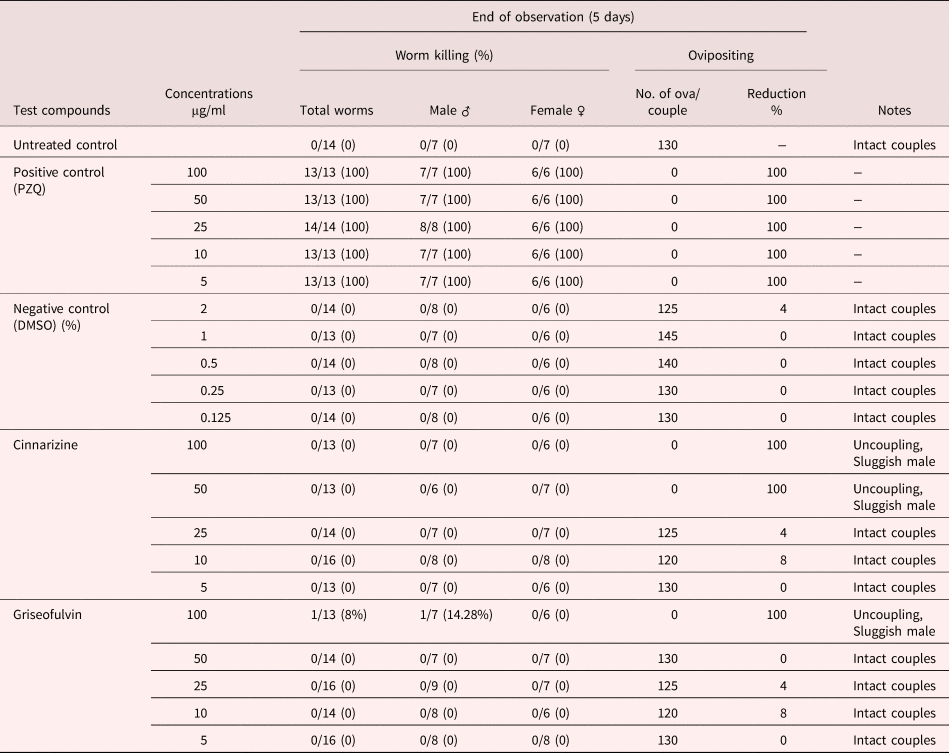
In the in vitro study, in comparison to PZQ, which showed 100% worm killing, 0% ovipositing capability, 100% ovum reduction and non-intact couples in all tested concentrations, cinnarizine + griseofulvin also showed uncoupling and sluggish male movement and a complete absence of ova at 100 μg/ml. However, cinnarizine alone did not show any worm killing, even at the highest tested concentration (100 μg), and griseofulvin showed only 8% worm killing. Both led to a trivial reduction in the number of ova at concentrations of 50, 25 and 10 μg/ml (table 1).
Mature Schistosoma mansoni worm killing and ovipositing under different concentrations of cinnarizine and griseofulvin compared to controls.

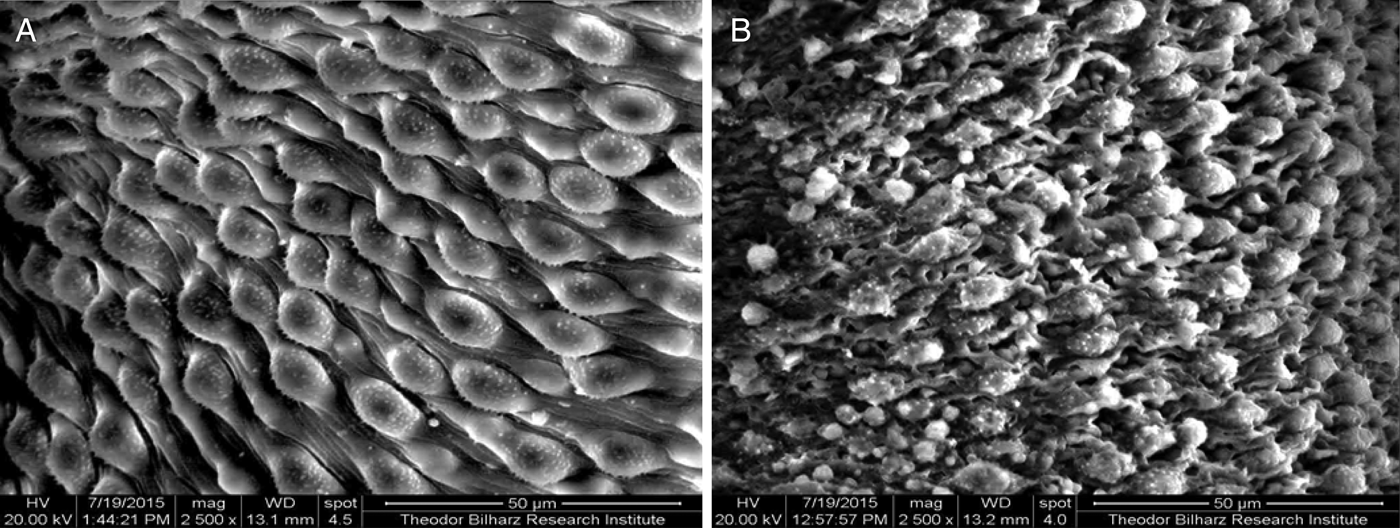
For cinnarizine + griseofulvin, scanning electron micrographs of the tegument (dorsal surface of adult male schistosome) showed a normal appearance of the tubercles, with normal spines and intact ridges, whereas PZQ revealed a completely disrupted tegument with multiple blebs (fig. 1).
Scanning electron micrographs of the tegument (dorsal surface of adult male schistosome). (A) Negative control, cinnarizine and griseofulvin, showing same findings of normal appearance of the tubercles and spines with intact ridges. (B) PZQ, showing completely disrupted tegument with multiple blebs. (A ×2500)

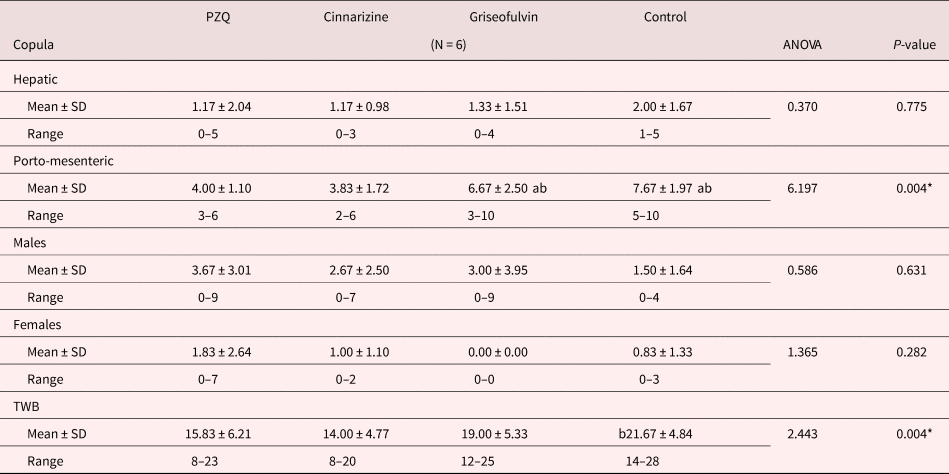
In early infection, cinnarizine outperformed PZQ and griseofulvin in significantly reducing the total worm burden compared to the control group (P = 0.004); both cinnarizine and PZQ showed a significant reduction in the number of porto-mesenteric couples (P = 0.004) compared to griseofulvin. However, the three drugs showed a non-significant reduction in the number of hepatic couples (P = 0.775) as well as the number of individual male and female worms (P = 0.631 and P = 0.282, respectively) in relation to the control group (table 2). The two new drugs, as well as PZQ, showed a non-significant reduction in the hepatic and intestinal ovum counts (P = 0.196 and P = 0.422, respectively), as well as a non-significant difference in oogram pattern regarding percentages of immature, mature and dead worms (P = 0.154, P = 0.396, and P = 0.306, respectively) (supplementary tables S1 and S2).
Comparative analysis of the number of adult worms of each group in response to treatment, as compared to control group in early infection.

TWB, total worm burden
a, significant difference to PZQ
b, significant difference to cinnarizine
c, significant difference to griseofulvin
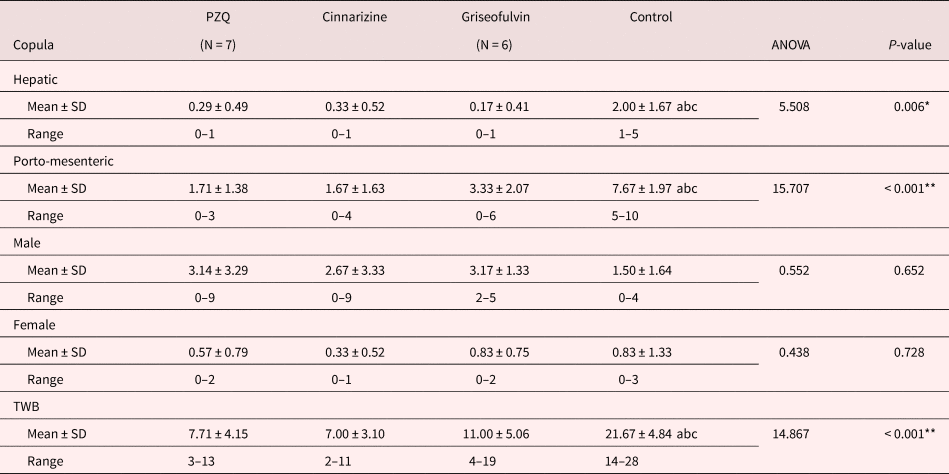
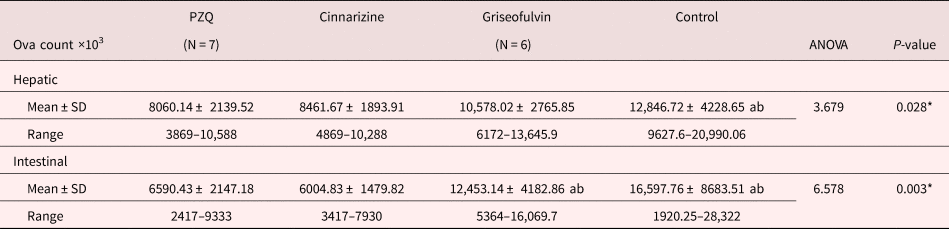
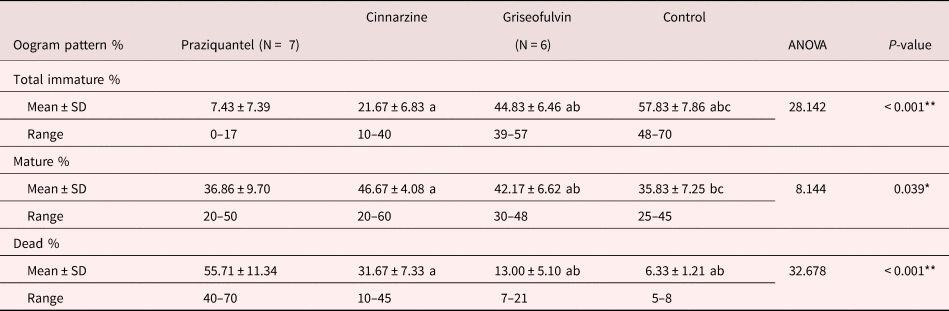
In late infection, the three drugs showed a significant reduction in numbers of hepatic (P = 0.006) and porto-mesenteric couples (P < 0.001), with the least number recorded for cinnarizine, followed by PZQ and then griseofulvin, as well as a reduction in the total worm burden (P < 0.001), with the lowest mean value recorded for cinnarizine, followed by PZQ and then griseofulvin. However, the three drugs showed a non-significant reduction in the numbers of male (P = 0.652) and female worms (P = 0.728) compared to controls (table 3). Both cinnarizine and PZQ caused a significant reduction in ovum count, whether in hepatic tissue compared to the control group (P = 0.028) or in intestinal tissue compared to the griseofulvin and control groups (P = 0.003) (table 4). Comparing the oogram patterns, cinnarizine and griseofulvin significantly reduced the percentage of immature ova and increased the percentage of dead ova (P < 0.001). The mean outcome for immature ova indicated that griseofulvin approached the control, followed by cinnarizine, and far beyond was PZQ, while the mean number of dead ova was highest in the PZQ group, followed by cinnarizine and then griseofulvin (table 5). Compared to griseofulvin, cinnarizine induced the complete disappearance of the first two immature stages and partial disappearance of the third stage in some animals.
Comparative analysis of the number of adult worms of each group in response to treatment, as compared to control group in late infection.

TWB, total worm burden
a, significant difference to PZQ
b, significant difference to cinnarizine
c, significant difference to griseofulvin
Comparison between groups according to ova count in late infection.

a, significant difference to PZQ
b, significant difference to cinnarizine
c, significant difference to griseofulvin
Comparison between groups according to oogram pattern in late infection.

a, significant difference to PZQ
b, significant difference to cinnarizine
c, significant difference to griseofulvin
Discussion
PZQ has remained the drug of choice for schistosomiasis treatment and transmission control for more than 40 years because of its efficacy, safety, cost, and the lack of alternatives (Andrews, Reference Andrews1985; Caffrey, Reference Caffrey2015). Yet PZQ has drawbacks, including inactivity against juvenile schistosomes, reduced susceptibility in field isolates and experimentally induced resistance (Doenhoff et al., Reference Doenhoff, Cioli and Utzinger2008; Wang et al., Reference Wang, Wang and Liang2012; Greenberg, Reference Greenberg2013). Thus, the reliance on this single treatment is particularly dangerous, and a pressing need for new interventions has arisen (Brindley and Hotez, Reference Brindley and Hotez2013).
This study aimed to find new alternatives that could be used synergistically or as future substitutes for PZQ. This study is the first to highlight the potential curative capacity of cinnarizine and griseofulvin, which were selected based on a recommendation by a previous study (Neves et al., Reference Neves2015). As a great deal of new drug discovery against schistosomes has been dependent on in vitro and in vivo whole-parasite screens (Ramirez et al., Reference Ramirez2007), an in vitro S. mansoni worm-killing assay and in vivo S. mansoni-infected animal model were chosen. The drugs’ antischistosomal properties against S. mansoni-infected mice were assessed by comparing the results for treated infected mice with those for untreated infected mice and PZQ controls.
Sluggish movement with worm paralysis is an important sign of worm affection (Pica-Mattoccia and Cioli, Reference Pica-Mattoccia and Cioli2004; Kamel and Bayaumy, Reference Kamel and Bayaumy2017). Additionally, uncoupling has been used as an indicator of the potency of drugs (Badria et al., Reference Badria2001). In this work, the in vitro finding that cinnarizine showed uncoupling and sluggish male movement with an absence of ova when given at 100 and 50 μg anticipated its potential antischistosomal activity. Griseofulvin also showed uncoupling and sluggish worm movement with no detected ova, but only at its highest concentration of 100 μg.
The in vitro results were further confirmed by the ultrastructural study. The schistosome tegument, an important target for drugs, is critical for the survival and proliferation of the parasite. It plays vital roles in immune evasion, nutrient absorption, and cholesterol metabolism of the host (Jiraungkoorskul et al., Reference Jiraungkoorskul2005; Mostafa, Reference Mostafa2005; Manneck et al., Reference Manneck, Haggenmuller and Keiser2010; Bertão et al., Reference Bertão2012; de Oliveira et al., Reference de Oliveira2012). Moreover, the alterations caused by antischistosomal drugs are more pronounced in the male tegument than in that of the female (Shaw and Erasmus, Reference Shaw and Erasmus1988), as most of the female's body is hidden within the male gynecophoric canal and is not in direct contact with the host's environment. Therefore, the current work selected male worms to investigate tegumental alterations induced by the two drugs. Both drugs failed to induce any morphological alterations in the tegument of male schistosomes recovered 2 weeks post treatment, whereas a completely disrupted tegument was observed after PZQ treatment. Although cinnarizine is categorized as a calcium channel blocker, spasms or parasite contractions were not observed, even when the highest concentration was added to the culture. In contrast, nifedipine results in spasms and parasite contractions after drug exposure, which may be caused by the depleted intracellular Ca2+ stores, which occur when the VOCC is blocked, eliminating the extracellular Ca2+ influx (Silva-Moraes et al., Reference Silva-Moraes2013).
Cinnarizine was effective in reducing the total worm burden in early infection, surpassing PZQ and griseofulvin. In late infection, both cinnarizine and griseofulvin showed a reduction in total worm burden, with cinnarizine exceeding PZQ and griseofulvin, highlighting its potency. One of the main findings in this study is the significant reduction by cinnarizine of hepatic and intestinal ovum counts. This could be attributed to the effect of cinnarizine on female fecundity, which resulted in a reduction in egg output and in tissue egg load. Others have observed the same for verapamil, another Ca2+ channel antagonist (Walter and Kuris, Reference Walter and Kuris2003). Bonn (Reference Bonn2004) emphasized that the interruption of egg production is highly relevant because eggs are responsible for most of the lesions witnessed in infected patients. Here, the oogram pattern showed the complete disappearance of the first two immature stages under cinnarizine treatment, which indicated cessation of oviposition, definitive evidence that the drug possesses antischistosomal activity (Pellegrino et al., Reference Pellegrino1962; Shaohong et al., Reference Shaohong2006) similar to PZQ. Moreover, cinnarizine stimulated the shift of female worms from their normal habitat in the mesenteric blood vessels to the liver. Consequently, the number of immature eggs laid in the wall of the small intestine was progressively reduced, reflecting therapeutic efficacy (Pellegrino et al., Reference Pellegrino1962).
There was a variation in drug susceptibility between male and female schistosomes in vivo. Sex-specific sensitivities for in vivo PZQ exposure were recorded, in line with observations of several antischistosomal drugs (Pica-Mattoccia and Cioli, Reference Pica-Mattoccia and Cioli2004; Keiser et al., Reference Keiser2009; Mitsui et al., Reference Mitsui, Miura and Aoki2009; Riad et al., Reference Riad, Taha and Mahmoud2009; de Moraes et al., Reference de Oliveira2014). Unlike griseofulvin, PZQ and cinnarizine showed a prominent effect against both worm sexes, with more effect on female worms, a finding that agrees with previous studies showing a superior activity of PZQ against females (Delgado et al., Reference Delgado1992; Frezza et al., Reference Frezza2013, Reference Frezza2015).
In conclusion, cinnarizine and griseofulvin show promising results as potential antischistosomals, especially cinnarizine, whose effects approached those of PZQ. Further studies are required to elucidate their exact mechanisms of action, and particularly their synergistic effect with PZQ.
Supplementary material
To view supplementary material for this article, please visit https://doi.org/10.1017/S0022149X19000178
Author ORCIDs
R.M. Sarhan, 0000-0002-7174-1688
Conflict of interest
None.
Ethical standards
All the animal experiments were conducted in accordance with the Guide for the Care and Use of Laboratory Animals and were approved by the Institutional Review Board of Theodor Bilharz Research Institute.