Introduction
Depression is a highly prevalent mental health problem worldwide (World Health Organization, 2017), and is projected to be the leading cause of disease burden globally by 2030 (World Health Organization, 2011). Treatments for depression are moderately effective (Cipriani et al., Reference Cipriani, Furukawa, Salanti, Chaimani, Atkinson, Ogawa and Geddes2018; Cuijpers, Andersson, Donker, & Van Straten, Reference Cuijpers, Andersson, Donker and Van Straten2011), but individual response varies (Maslej, Furukawa, Cipriani, Andrews, & Mulsant, Reference Maslej, Furukawa, Cipriani, Andrews and Mulsant2020). Understanding the cognitive processes maintaining depression may allow us to develop sensitive targets for therapeutic intervention. In this study, we explored the role of self-processing in depression, in relation to emotion and reward processing.
Self-processing
Across the general population, people show greater attention, recall and learning of self-related stimuli, often referred to as the self-prioritisation effect (Cunningham & Turk, Reference Cunningham and Turk2017; Sui, He, & Humphreys, Reference Sui, He and Humphreys2012; Sui & Humphreys, Reference Sui and Humphreys2015a). However, individuals experiencing depression exhibit a heighted focus on the self, and difficulty disengaging from an internal self-referential focus (Northoff, Reference Northoff2007; Sheline et al., Reference Sheline, Barch, Price, Rundle, Vaishnavi, Snyder and Raichle2009). Paradoxically, this heightened internal self-referential focus may prevent individuals from associating novel stimuli with internal representations of the self (Sui, Ohrling, & Humphreys, Reference Sui, Ohrling and Humphreys2016). This concept has previously been demonstrated in a study where following a negative mood induction participants were worse at associating arbitrarily assigned neutral shapes with the self (Sui et al., Reference Sui, Ohrling and Humphreys2016). Individuals experiencing depression may subsequently be limited in their ability to update their self-concept from environmental feedback, perpetuating maladaptive views of the self.
The strength and consistency of self-prioritisation effects has led to proposals of the self being an integrative hub through which incoming stimuli is processed (Sui & Humphreys, Reference Sui and Humphreys2015a). Targeting abnormalities in self-referential processing in depression may have wider implications for other cognitive domains implicated in depression. This is likely to include emotion (Ma & Han, Reference Ma and Han2010) and reward (Northoff & Hayes, Reference Northoff and Hayes2011), as they are fundamental behavioural drivers and neutrally overlap in the medial prefrontal cortex.
Self and emotional processing
Negative perceptions of the self are believed to play a causal role in the development of depression. According to Beck's cognitive theory, individuals experiencing depression develop negative views of the self as an internalised reaction to repeated adverse social experiences. When activated by stressful life events these negative self-schema dominate information processing, promoting automatic processing of negative information about the self (Beck, Reference Beck2008). Supportive of this theory, emotional biases are more likely to be observed in depression when stimuli is processed in reference to the self (Gaddy & Ingram, Reference Gaddy and Ingram2014; Hertel & El-Messidi, Reference Hertel and El-Messidi2006; Ji, Grafton, & MacLeod, Reference Ji, Grafton and MacLeod2017). Altering negative information processing in relation to the self is therefore a key target for therapeutic interventions for depression.
Self and reward processing
Depression is also associated with a hyposensitivity to reward and hypersensitivity to punishment (Eshel & Roiser, Reference Eshel and Roiser2010). There is evidence to suggest that this is linked to self-processing. Self-relevant information induces activity in areas of the brain also activated during reward processing, such as the ventral medial prefrontal cortex, ventral striatum and ventral tegmental area (Northoff & Hayes, Reference Northoff and Hayes2011). Differences in self-processing in depression may be at least partially driven differences in reward processing. In keeping with this theory, individuals with greater depression were found to continue to selectively engage in negative thoughts about the self even when this resulted in economic loss (Takano, Van Grieken, & Raes, Reference Takano, Van Grieken and Raes2019). Targeting reward processing in depression may have wider effects on self-processing and vice versa.
Self, emotion and reward processing
The interaction between self, emotion and reward processing may be a key combination of cognitive processes maintaining depression. Patients with depression show reduced activation of both reward and self-related areas of the brain when processing positive stimuli (Northoff, Reference Northoff2007; Northoff & Hayes, Reference Northoff and Hayes2011). Reduced self-referential processing of positive information has also been identified as the most robust predictor of low approach motivation and reward responsivity (Hsu et al., Reference Hsu, McNamara, Shumake, Stewart, Labrada, Alario and Beevers2020). Increased sensitivity to punishing feedback may sustain preferential processing of negative information about the self, reinforcing negative self-schema. Likewise, reduced sensitivity to positive feedback may reduce the ability to learn positive information about the self. The intersection between self, emotion and reward may therefore be the most effective target for cognitive treatments for depression.
Aims and hypotheses
We explored the role of the self in relation to emotion and reward processing associated with varying levels of depressive symptoms. In contrast to previous studies that focused on either of these independent cognitive processes (based on self, reward, or emotion) or interactions between any two components, we used three cognitive tasks to examine relationships between these processes and depressive symptoms, not only as distinct cognitive processes but also how they functionally interact.
To examine self, reward and emotion processing occurring independently we used associative learning tasks where participants paired neutral shapes with self-relevant, emotionally valenced and varying degrees of reward, in three separate tasks. Based on previous research (Sui et al., Reference Sui, Ohrling and Humphreys2016), we predicted that increased depression severity would be associated with worse performance when associating shapes with the self. Similarly based on evidence of impaired affective processing in depression (Dalgleish & Watts, Reference Dalgleish and Watts1990; Dalili, Penton-Voak, Harmer, & Munafò, Reference Dalili, Penton-Voak, Harmer and Munafò2015; Eshel & Roiser, Reference Eshel and Roiser2010), we predicted that depression would be associated with worse performance when associating shapes with positive and rewarding stimuli.
To examine self, reward and emotion processing occurring in interaction we used a social reinforcement learning task where participants learnt when the computer liked themselves and others. Based on previous evidence (Hobbs et al., Reference Hobbs, Faraway, Kessler, Munafò, Sui and Button2019), we hypothesised that increasing depression severity would be associated with worse learning of the self being ‘liked’.
We also included a self-esteem go/no-go task due to its ability to integrate self and emotion processing. Participants rapidly categorised emotional and referential words, with greater discriminative accuracy believed to reflect existing implicit associations. An implicit negative self-esteem would therefore be reflected by greater discriminative accuracy when categorising self-referential and negative stimuli. However, due to mixed findings regarding the role of response inhibition in depression (Lewis, Button, Pearson, Munafò, & Lewis, Reference Lewis, Button, Pearson, Munafò and Lewis2020), and no previous use of this task within our research group we made no hypotheses regarding this task.
Methods
This study was pre-registered on the Open Science Framework (https://osf.io/34ma2), where study materials are also available. Study data are available in the University of Bath Research Data Archive (https://doi.org/10.15125/BATH-00924; Hobbs, Sui, Kessler, Munafò, & Button, Reference Hobbs, Sui, Kessler, Munafò and Button2020).
Participants
We recruited participants aged 18−65, fluent in English, with normal or corrected-to-normal vision, through campus advertising at the University of Bath. As depression severity is positively skewed (Tomitaka, Kawasaki, & Furukawa, Reference Tomitaka, Kawasaki and Furukawa2015), to ensure balanced levels of depression we screened participants using the Patient Health Questionnaire (PHQ-9; Kroenke, Spitzer, & Williams, Reference Kroenke, Spitzer and Williams2001). We recruited an equal number of participants with no depression (PHQ-9 < 5), mild depression (PHQ-9 5-9) and moderate-to-severe depression (PHQ-9 ⩾ 10).
Procedure
Participants completed two testing sessions, on average 8 days apart (s.d. 3). At each session participants completed a social evaluation learning task, allowing measurement of test−retest reliability. To reduce fatigue effects associated with reaction time tasks, participants completed a go/no-go task at session one and an associative learning task at session two. At each session participants completed self-report measures of mood after the cognitive tasks.
Materials
Cognitive tasks
To personalise tasks, prior to testing participants provided the first names of themselves, a friend, and a stranger.
Associative learning task
We used three simple associative learning tasks to measure how self, emotion and reward processing are independently associated with depression (Stolte, Humphreys, Yankouskaya, & Sui, Reference Stolte, Humphreys, Yankouskaya and Sui2017; Sui & Humphreys, Reference Sui and Humphreys2015b). In each task, participants learnt to associate stimuli related to the relevant area of processing (e.g. Self: names of the self, a friend and a stranger; Emotion: happy, neutral and sad faces; Reward: £9, £3, £1), with abstract shapes. These tasks were completed sequentially in a counterbalanced order.
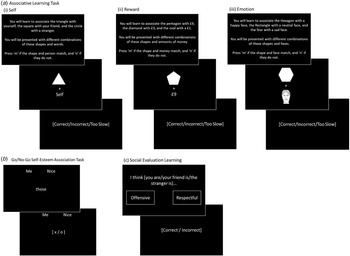
At the start of each task participants were instructed to learn randomly assigned stimuli-shape pairings. Two blocks of 60 trials were completed per task. In each trial a fixation point was displayed for 200 ms, followed by a stimuli-shape pairing presented for 100 ms (self, reward) or 150 ms (valence task only due to greater visual stimuli complexity). Participants pressed the ‘n’ or ‘m’ keys to indicate whether the presented pairings matched with the learnt association (Fig. 1a). Key assignment to ‘matching’ or ‘non-matching’ responses was randomised for each participant but consistent across tasks. A response limit of 1100 ms was applied. Feedback was presented for each trial for 500 ms (‘correct’/‘incorrect’/‘too slow’). At the end of each block participants were informed of their accuracy. For the reward task only, participants received a monetary reward based on the proportion of correct trials per reward stimuli.
Cognitive task procedures. (a) Associative learning tasks: Example of an introduction, trial and feedback for each type for each type of task (self, reward, emotion). In the introduction of each task participants were instructed to associate specified randomly assigned shape and stimuli pairings. In each trial participants were presented with a random combination of these shape-stimuli pairings and were asked to use the ‘n’ and ‘m’ keys to indicate whether these matched with the pairings they had previously learnt. In these examples, the ‘m’ key indicates a ‘matching’ responses and the ‘n’ key indicates a ‘non-matching’ response, however key assignment was randomised for each participant. Following each trial, feedback was given indicating if the participant was correct, incorrect, or too slow (>1100 ms). Each of these examples demonstrate a ‘matching’ trial, where the presented shape-stimuli match with the pairings specified in the introduction. A ‘matching’ response would therefore be correct, in this example the ‘m’ key, whereas an ‘non-matching’ response would be incorrect, in this example the ‘n’ key. (b) Go/no-go self-esteem association task: example of a trial and feedback for the self-positive condition. The conditions that words should be categorised according to (in this instance me or nice) were presented at the top of the screen throughout the block. In each trial a word was presented at the centre of the screen. Participants were asked to press the spacebar if the word belonged to a specified category (a ‘go’ response) or to refrain from pressing the spacebar if the word did not belong to the specified category (a ‘no-go’ response). Feedback (correct indicated by a green circle, or incorrect indicated by a red cross) was given for each response. In this example, a ‘no-go’ response would be considered a correct rejection and a ‘go’ response would be considered a false alarm, as the stimuli (‘those’) does not belong to the me or positive categories. (c) Social evaluation learning task: example of a trial and feedback. Participants were asked to select the word that they felt reflected the computers’ opinion of the person being learnt about (self, friend or stranger), and were given feedback on their response. The proportion of trials deemed correct upon selection of the positive word was manipulated to reflect learning of two different rules: positive ‘like’ 60–80%, negative ‘dislike’ 20–40%.

Accuracy and reaction times (ms) were recorded. Prioritisation of stimuli is indicated by faster reaction times and/or higher accuracy.
Self-esteem go/no-go task
To measure how self and emotion processing occurring in interaction are associated with depression, we used a self-esteem go/no-go task. This task is proposed to measure implicit self-esteem (Gregg & Sedikides, Reference Gregg and Sedikides2010).
Participants were asked to categorise characteristics as positive (e.g. ‘charming’, ‘smart’) or negative (e.g. ‘cruel’, ‘boring’), and referential worlds as related to the self, specified to participants as ‘me’ (e.g. participants’ first name, ‘me’, ‘I’), or others, specified to participants as ‘not-me’ (e.g. ‘they’, ‘them’, ‘others’). In the training phase participants categorised words according to single categories (e.g. positive, negative, me, not-me), with 20 trials per condition. In the test phase, participants categorised words belonging to paired categories (e.g. positive OR me, positive OR not-me, negative OR me, negative OR not-me). There were 16 practice trials and 48 test trials for each paired combination of categories. An equal number of trials for stimuli relating to each condition was presented per block. A response timeout of 600 ms was applied. Block order was randomised.
At the beginning of each block the condition(s) by which words should be categorised was presented at the top of the screen and remained in place throughout the block. In each trial a word belonging to any of the conditions (e.g. positive, negative, me or not-me) was presented at the centre of the screen for 600 ms. Participants were asked to press the spacebar if the presented word related to the specified category (a ‘go’ response) or to refrain from pressing the spacebar if the word did not relate to the specified category (a ‘no-go’ response) (Fig. 1b).
We categorised responses in test trials according to hits (a ‘go’ response when the stimuli belonged to the specified categories) and false alarms (a ‘go’ response when the stimuli did not belong to the specified categories). Responses to both referential and valence stimuli were included. For example, if the specified categories were ‘positive OR me’ a trial was considered a hit if a ‘go’ response was given upon presentation of a positive characteristic or a self-referential word.
Discriminative accuracy (d′) for each referential-emotion block was calculated by applying z-score transformations and subtracting hits from false alarms. Greater d′ values indicate greater accuracy, suggesting stronger associations between paired-categories.
Social evaluation learning task
To measure self, emotion and reward learning occurring simultaneously we used a reinforcement learning task within a social context (Button, Browning, Munafò, & Lewis, Reference Button, Browning, Munafò and Lewis2012; Button, Karwatowska, Kounali, Munafò, & Attwood, Reference Button, Karwatowska, Kounali, Munafò and Attwood2016; Button et al., Reference Button, Kounali, Stapinski, Rapee, Lewis and Munafò2015). Participants learnt how much the computer ‘liked’ the self, a friend and a stranger based on feedback to a forced choice selection between positive and negative social evaluation pairings (Fig. 1c). A response time limit was not imposed. Participants learnt two rules based on the probability of the positive evaluations being ‘correct’ (‘Like’ 60–80%, ‘Dislike’ 20–40%). The number of errors made before reaching the criterion of eight consecutive rule-congruent responses were recorded. Bias scores were calculated by subtracting errors to criterion made when learning the dislike rule from the like rule. A positive value indicates a negative bias, as fewer errors were made learning the dislike rule compared to the like rule. We also calculated participants cumulative accuracy across trials in each condition-rule block to visualise learning curves.
After completing each rule block participants were also asked to provide a global rating of how much the computer liked the person, ranging from ‘Complete Dislike’ (0) to ‘Complete Like’ (10).
Participants completed all referential-conditions and rules. Order of referential-condition, and nested within this rule, was randomised. All participants completed 24 trials per referential-condition rule block.
Self-report measures
We measured depression severity using the Patient Health Questionnaire (PHQ-9) (Kroenke et al., Reference Kroenke, Spitzer and Williams2001) and Beck Depression Inventory (BDI-II) (Beck, Steer, & Brown, Reference Beck, Steer and Brown1996). The PHQ-9 and BDI-II are self-administered questionnaires of the experience of depression within the previous 2 weeks. The PHQ-9 consists of nine items relating to the DSM-IV diagnostic criteria with scores ranging from 0 to 27, whereas the BDI-II consists of 21 items with scores ranging from 0 to 63 and has a greater focus on cognitive symptoms. Both measures demonstrate good psychometric properties (Cameron, Crawford, Lawton, & Reid, Reference Cameron, Crawford, Lawton and Reid2008; Wang & Gorenstein, Reference Wang and Gorenstein2013), and are widely used in clinical practice (Kendrick et al., Reference Kendrick, Dowrick, McBride, Howe, Clarke, Maisey and Smith2009).
We also identified whether participants met ICD-10 criteria for a primary diagnosis of a Major Depressive Episode (MDE) using the Clinical Interview Schedule-Revised (CIS-R; Lewis, Pelosi, Araya, & Dunn, Reference Lewis, Pelosi, Araya and Dunn1992). The CIS-R is a fully structured self-administered computerised assessment that provides ICD-10 diagnoses of common mental health disorders. It has previously been used in large-scale epidemiological studies within the general population.
As social anxiety has previously been associated with performance on the Social Evaluation Learning task (Button et al., Reference Button, Kounali, Stapinski, Rapee, Lewis and Munafò2015), we also measured social anxiety using the Brief Fear of Negative Evaluation Scale (Leary, Reference Leary1983). To characterise the clinical profile of our sample we collected additional self-report measures of mental health and cognition. We measured anxiety using the Generalised Anxiety Disorder Scale (GAD-7; Spitzer, Kroenke, Williams, & Löwe, Reference Spitzer, Kroenke, Williams and Löwe2006), anxiety relating to positive social feedback using the Fear of Positive Evaluation Scale (Weeks, Heimberg, & Rodebaugh, Reference Weeks, Heimberg and Rodebaugh2008), self-esteem using the Rosenberg Self-Esteem Scale (RSES; Rosenberg, Reference Rosenberg1965), and self-schema using the Dysfunctional Attitude Scale (DAS; Weissman & Beck, Reference Weissman and Beck1978). Finally, we measured change in state mood before and after completion of the cognitive tasks using the Positive and Negative Affect Scale (PANAS; Watson, Clark, & Tellegen, Reference Watson, Clark and Tellegen1988).
Statistical analyses
Sample size calculation
A priori power calculations indicated that 144 participants would be required to provide greater than 80% power at an alpha level of 0.05 to detect previously observed effect sizes (η 2 = 0.05) for the relationship between bias scores in the self condition in the Social Evaluation Learning task and depression severity (Button et al., Reference Button, Browning, Munafò and Lewis2012, Reference Button, Kounali, Stapinski, Rapee, Lewis and Munafò2015, Reference Button, Karwatowska, Kounali, Munafò and Attwood2016; Hobbs et al., Reference Hobbs, Faraway, Kessler, Munafò, Sui and Button2019), and greater than 99% power to detect previously observed effect sizes for the relationship between reaction times when matching shapes with the ‘self’ on the Associative Learning Task and depression severity (η 2 = 0.17) (Sui & Button, Reference Sui and Button2017).
Data exclusion
Data were excluded according to a priori criteria as specified in our pre-registration.
For the associative learning task, trials with reaction times less than 200 ms (0.8%) and trials with no response (8%) were excluded. We included matching and non-matching trials in our analyses. For reaction time data we used both correct and incorrect responses.
We excluded 36 (25%) participants from the Go/No-Go Self-Esteem analyses due to a pattern of response indicating non-compliance (discrimination scores lower than 5 and/or bias scores less than 12 or greater than 36). As the exclusion rate was high, we repeated the main analyses for this task with all participants included as a sensitivity analysis.
Due to a technical error, data for the social evaluation learning task was unavailable in the second session for one participant.
Statistical models
All analyses were conducted in R 3.6.
To aid interpretation we have provided both standardised (β) and unstandardised (b) regression coefficients.
We first assessed whether task performance differed across conditions using mixed-effects linear regression models. Separate models were used for each task, and for each measure of performance. Subject was entered as a random effect to account for within-subject effects. Task performance measures were entered as the outcome, and conditions as predictors.
Whilst the associative learning task and go/no-go task have previously been evidenced to have acceptable levels of reliability (Stolte et al., Reference Stolte, Humphreys, Yankouskaya and Sui2017; Williams & Kaufmann, Reference Williams and Kaufmann2012), the reliability of the social evaluation learning task is yet to be tested. We calculated intraclass correlation coefficients for bias scores in the social evaluation learning task, using two-way mixed-effects models to calculate absolute agreement and consistency as recommended for cognitive-behavioural measures (Parsons, Kruijt, & Fox, Reference Parsons, Kruijt and Fox2019).
We used linear regression models to assess the relationship between task performance and depression. In all models, task outcomes were entered as separate predictors according to condition (e.g. in the self associative learning task accuracy model, accuracy in the self, friend and stranger condition were entered as separate predictors). We used depression as the outcome in these models, rather than a predictor as is typical in psychiatric experimental models, in preparation for future work using the cognitive task outcomes as predictors of change in depression severity. Separate models were conducted for each task outcome with PHQ-9 or BDI-II scores used as continuous outcomes. As the social evaluation learning task was completed in two sessions, we used mixed-effects linear regression models with session included as an additional predictor and subject as a random effect.
To examine the reliability of our findings for individuals meeting diagnostic criteria for depression, we repeated the primary analyses for each task using logistic regression models. Primary diagnosis of major depressive episode derived from the CIS-R was used as a binary outcome (diagnostic criteria met/not met). As the CIS-R was only completed at session 1, for tasks with multiple timepoints data from session 1 was used.
Full details of models are provided in the online Supplementary Materials.
Results
Participant characteristics
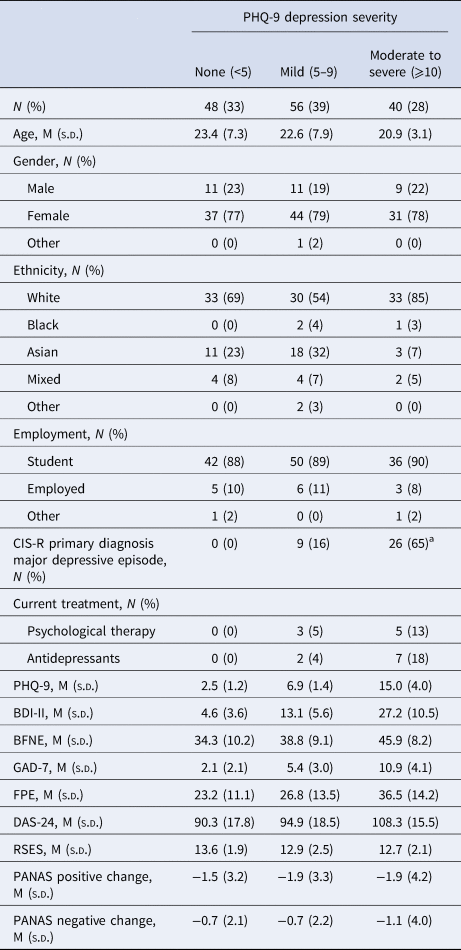
We recruited 144 participants, all of whom provided data for analysis. To demonstrate variability across depression severity, participant characteristics grouped according to PHQ-9 clinical cut-offs are presented in Table 1. The PHQ-9 and BDI-II showed excellent test–retest reliability between sessions (PHQ-9: ICC 0.94 (95% CI 0.89–0.96), BDI-II: ICC: 0.96 (95% CI 0.94–0.97)), and strongly correlated (r = 0.90, 95% CI 0.88–0.92).
Participant Characteristics according to Depression Severity

CIS-R, Clinical Interview Schedule Revised; PHQ-9, Patient Health Questionnaire; BDI-II, Beck Depression Inventory; BFNE, Brief Fear of Negative Evaluation; GAD-7, Generalised Anxiety Questionnaire; BFNE, Brief Fear of Negative Evaluation Scale; FPE, Fear of Positive Evaluation Scale; DAS-24, Dysfunctional Attitudes Scale; RSES, Rosenberg Self-Esteem Scale; PANAS, Positive and Negative Affect Schedule.
a Participants who met criteria for a primary diagnosis of a MDE within this group had higher PHQ-9 (M 16.21, s.d. 4.35) and BDI-II scores (M 31.88, s.d. 10.42), compared to those that did not have a primary diagnosis of a MDE (PHQ-9: M 12.00, s.d. 1.83, BDI-II: 19.57, s.d. 5.95).
Note: All data presented in this table were collected at the first testing session. PANAS change scores reflect differences in scores from pre- to post-completion of the cognitive tasks.
Associative learning task
Hypothesis: Depression will be associated with reduced learning of self, highly rewarding and positive stimuli as indicated by reduced accuracy and greater reaction times.
Self
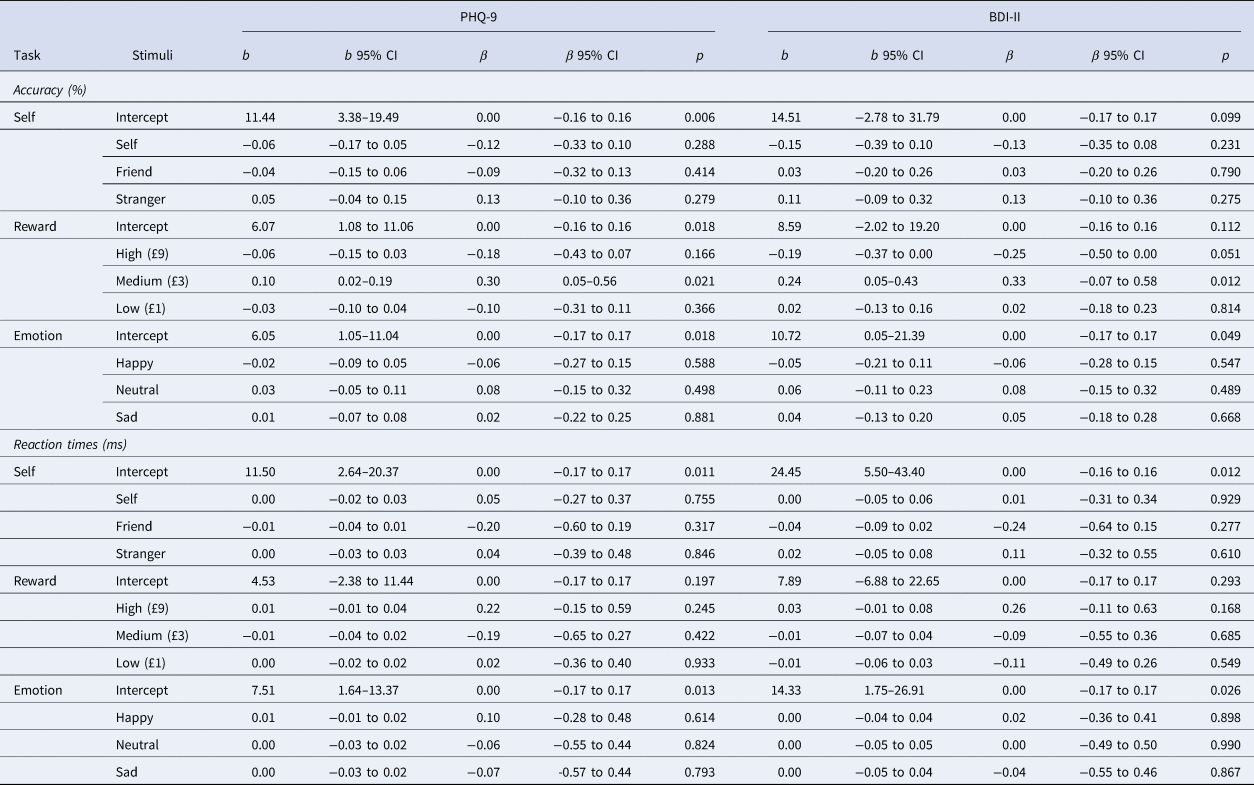
Consistent with prior evidence of self-prioritisation (Sui et al., Reference Sui, He and Humphreys2012), participants on average showed the highest level of accuracy and fastest reaction times when matching shapes with the name of the self v. a friend or stranger (online Supplementary Tables S1 and S2). We found no evidence to support our hypothesis; ability to associate shapes with the self, a friend or a stranger was not associated with depression (Table 2).
Results from linear regression models examining the association between accuracy and reaction times for each task condition (predictors) in the associative learning task with depression (Outcome: PHQ-9/BDI-II)

b = unstandardised regression coefficients, β = standardised regression coefficients.
Reward
Likewise consistent with previous evidence of prioritisation of higher levels of reward (Sui & Humphreys, Reference Sui and Humphreys2015b), participants on average were more accurate and faster when matching shapes with the highest level of reward (online Supplementary Tables S1 and S2).
We found some evidence that increased accuracy when matching shapes with the medium level of reward was associated with greater depression. For every 1% increase in accuracy when matching shapes with ‘£3’, PHQ-9 and BDI-II scores increased by 0.10 (b 95% CI 0.02–0.19, p = 0.021) and 0.24 (b 95% CI 0.05–0.43, p = 0.012) points, respectively.
There was also weak evidence that decreasing accuracy when matching shapes with the high level of reward was associated with increased BDI-II scores (b = −0.19, b 95% CI −0.37–0.00, p = 0.051). However, confidence intervals (CIs) overlapped with the null and there was little evidence of a similar relationship for PHQ-9 scores. We therefore found only weak support for our hypothesis.
No association was observed between accuracy when matching shapes with the low level of reward (£1) and depression severity (Table 2). We also found no relationship between reaction times and depression for this task (Table 2).
Emotion
Consistent with previous evidence of prioritisation of positive stimuli (Stolte et al., Reference Stolte, Humphreys, Yankouskaya and Sui2017), participants on average were more accurate and faster at matching shapes with happy faces (online Supplementary Tables S1 and S2). However, in contrast with our hypothesis, accuracy or reaction times were not associated with depression (Table 2).
Self-esteem go/no-go task
Due to previous mixed findings for the role of response inhibition in depression we made no hypothesis regarding this task, our findings should therefore be considered exploratory.
We found strong evidence of an interaction between referential condition and emotion on discriminative accuracy in the self-esteem Go/No-Go Task (b = 0.79, b 95% CI 0.61–0.97, β = 1.31, β 95% CI = 1.01–1.61, p < 0.001; online Supplementary Table S3). On average, participants showed a positive bias towards the self with greater discriminative accuracy for positive (M 1.40, s.d. 0.56) v. negative (M 1.0, s.d. 0.52) associations with the self. The opposite pattern was observed when associating words with the other (positive: M 0.71, s.d. 0.48, negative: M 1.12, s.d. 0.62).
We found consistent evidence that discriminative accuracy in the ‘other’ condition was associated with depression severity. Increased discriminative accuracy when associating positive words with others was associated with greater depression severity using both the PHQ-9 (b = 3.51, b 95% CI 1.24–5.79, β = 0.30, β 95% CI 1.24–5.79, p = 0.003) and BDI-II (b = 6.78, b 95% CI 1.93–11.64, β = 0.28, β 95% CI 0.08–0.47, p = 0.007). Conversely, increased discriminative accuracy when associating negative words with others was associated with lower PHQ-9 (b = −2.46, b 95% CI −4.24 to −0.68, β = −0.27, β 95% CI −0.46 to −0.07, p = 0.007), and BDI-II scores (b = −5.13, b 95% CI −8.92 to −1.34, β = −0.27, β 95% CI −0.46 to –0.07, p = 0.008). Individuals with greater depression therefore showed both a greater positive bias, and a reduced negative bias, when processing information about others.
Evidence for an association between discriminative accuracy in the self-condition and depression was less consistent. Increased discriminative accuracy when associating positive words with the self was associated with a decrease in PHQ-9 scores (b = −2.47, b 95% CI −4.54 to −0.39, β = −0.24, β 95% CI −0.44 to −0.04, p = 0.020). Although an effect in the same direction was observed for BDI-II scores, CIs overlapped substantially with the null (b = −3.20, b 95% CI −7.62 to 1.23, β = −0.15, β 95% CI −0.36 to 0.06, p = 0.155). There was little evidence of an association between discriminative accuracy when associating negative words with the self with either the PHQ-9 (b = −0.59, b 95% CI −2.57 to 1.39, β = −0.05, β 95% CI −0.24 to 0.13, p = 0.553) or BDI-II (b = 0.81, b 95% CI −5.03 to 3.41, β = −0.04, β 95% CI −0.22 to 0.15, p = 0.704).
As we excluded a large proportion of participants (25%) in these analyses due to a priori criteria indicating non-compliance with the task, we repeated these analyses including all participants as a sensitivity analysis. We no longer found evidence for an association between discriminative accuracy in the other-negative condition and PHQ-9 severity, as CIs overlapped with the null. However, the results described above persisted for all other associations (online Supplementary Table S4).
Social evaluation learning
Hypothesis: Depression will be associated with reduced positive biases when learning about the self, driven by a greater number of errors before learning the positive ‘like’ rule.
Bias scores
Participants on average were most positively biased when learning about the friend, making 2.07 fewer errors learning positive relative to negative evaluations (b 95% CI −2.93 to −1.21, β = −0.35, β 95% CI −0.49 to −0.20, p < 0.001), compared to when learning about the self. Participants displayed similar levels of bias when learning about the self and stranger (b = −0.44, b 95% CI −1.31 to 0.42, β = −0.07, β 95% CI −0.22 to 0.07, p = 0.318). The estimated agreement and consistency for bias scores across test sessions was ICC = 0.41 (95% CI 0.29–0.52).
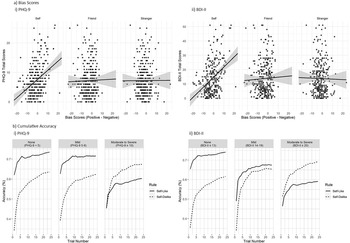
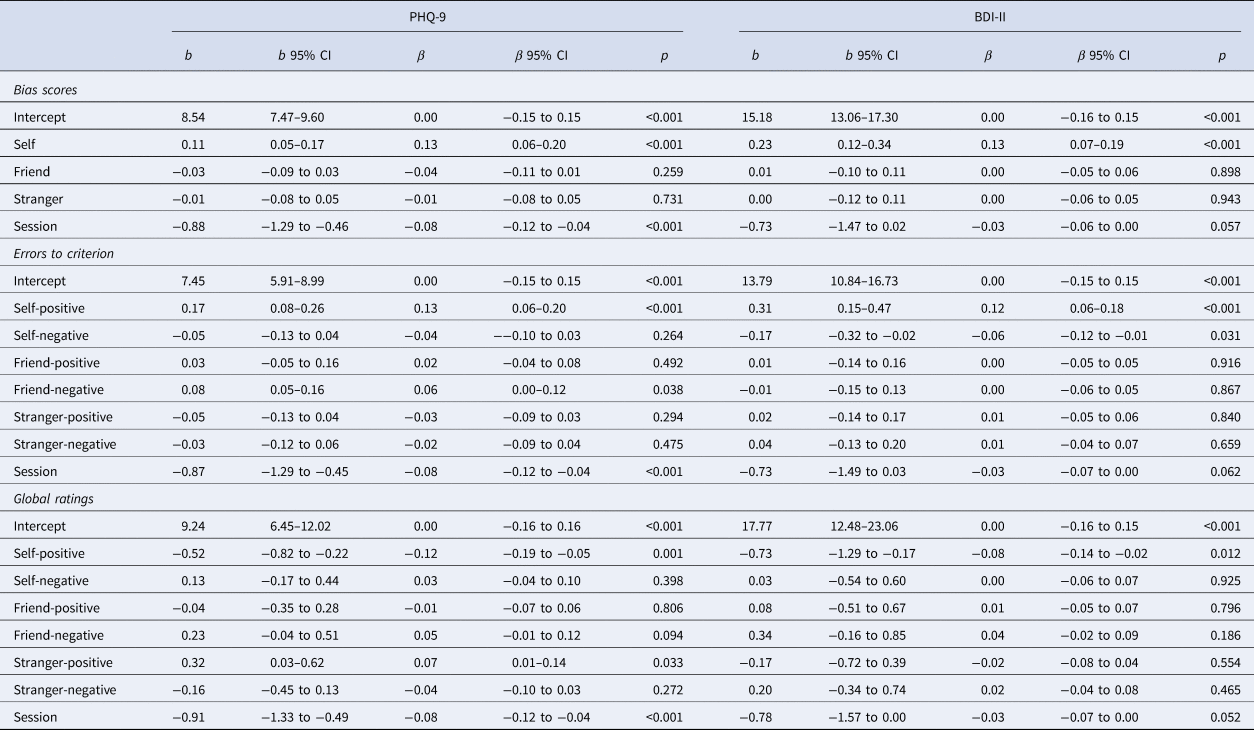
In support of our hypothesis, bias scores when learning about the self were associated with depression severity. For every additional error learning the positive relative to the negative rule, PHQ-9 scores increased by 0.11 points (b 95% CI 0.05–0.17, p < 0.001) and BDI-II scores increased by 0.23 points (b 95% CI 0.12–0.34, p < 0.001). Effects were specific to learning about the self; bias scores when learning about the friend or a stranger were not associated with depression (Fig. 2a; Table 3).
(a) Relationship between bias scores in the self, friend and stranger conditions in the social evaluation learning task with (i) PHQ-9 and (ii) BDI-II scores. (b) Learning curves in the self condition in the social evaluation learning task based on cumulative accuracy with depression severity grouped according to (i) PHQ-9 clinical cut-offs and (ii) BDI-II clinical cut-offs.

Results from mixed−effect linear regression models examining the relationship between social evaluation learning task outcomes (predictors) and depression (Outcome: PHQ-9/BDI-II)

b = unstandardised regression coefficients, β = standardised regression coefficients.
We also conducted additional exploratory analyses to examine whether the relationship between self-bias scores and depression symptoms was consistent across sessions. We found little evidence of an interaction suggesting that the relationship did not vary over the two sessions (PHQ-9 b = 0.04, b 95% CI −0.04 to 0.11, β = 0.02, β 95% CI −0.02 to 0.06, p = 0.377; BDI-II b = 0.07, b 95% CI −0.07 to 0.21, β = 0.02, β 95% CI −0.02 to 0.06, p = 0.315).
Errors to criterion
To investigate whether the relationship between bias scores and depression severity was driven by worse learning of the positive rule, or better learning of the negative rule, we examined the relationship between errors to criterion in each referential-rule condition and depression.
Participants overall were positively biased, making greater errors learning the negative v. positive rules (b = 1.45, b 95% CI 0.82–2.07, p < 0.001; online Supplementary Table S5) The greater bias scores in the friend condition, as outlined above, was driven by participants making both fewer errors learning the positive rule (M 5.39, s.d. 3.76) and greater errors learning the negative rule (M 8.90, s.d. 4.24), compared to the self (positive M 6.50, s.d. 4.22; negative M 7.95 s.d. 4.28) and stranger (positive M 6.34 s.d. 3.90, negative M 8.23 s.d. 3.97) conditions.
We found consistent evidence to support our hypothesis that depression would be associated with a greater number of errors when learning the self-positive rule. For every additional error before learning the self-positive rule, PHQ-9 scores increased by 0.17 points (b 95% CI 0.08–0.26, p < 0.001) and BDI-II scores increased by 0.31 points (b 95% CI 0.15–0.47, p < 0.001).
We also found weak evidence that worse learning of the friend being disliked was associated with greater PHQ-9 scores, and better learning of the self being disliked was associated with reduced BDI-II scores (Table 3). However, CIs were relatively wide, and these effects were not observed in the alternative depression measure for each, suggesting unreliable effects.
Errors to criterion when learning that a friend was liked, or either rule about the stranger, were not associated with PHQ-9 or BDI-II scores (Table 3).
Cumulative accuracy
Figure 2b demonstrates the cumulative mean accuracy over the 24 learning trials for the positive ‘like’ and negative ‘dislike’ rules about the self in participants grouped according to none, mild, and moderate-to-severe levels of depression on the PHQ-9 and BDI-II. In keeping with our findings for errors to criterion, participants with moderate to severe levels of depression demonstrated impaired learning of the self-like rule as indicated by lower levels of mean accuracy both initially and cumulatively across trials.
Global ratings
After each rule we asked participants to provide a global rating of how much the computer ‘liked’ the person.
Demonstrating understanding of each rule, participants gave lower global ratings following completion of the negative v. positive rules (b = −2.67, 95% CI −2.85 to −2.49, p < 0.001).
Additionally, participants showed slightly increased perceptions of the friend being liked compared to the self (b = 0.32, 95% CI 0.14–0.50, p = 0.001), but gave similar global ratings in the self and stranger conditions (b = 0.09, b 95% CI −0.10 to 0.27, p = 0.354). Full results are available in online Supplementary Table S5.
Consistent with our findings for errors to criterion, increased perceptions of being liked after completing the self-positive rule were associated with lower depression severity (Table 3). We also found weak evidence that greater global ratings in the stranger-positive condition was associated with greater PHQ-9 scores, however there was little evidence of this association with BDI-II scores (Table 3).
Social anxiety
The effects outlined above persisted when social anxiety was taken into account, suggesting an independent relationship between social evaluation learning and depression (online Supplementary Table S6).
Reliability of findings with clinical diagnosis of depression
To examine whether our findings were valid for participants meeting clinical diagnostic criteria for depression, we repeated the primary analyses for each task using logistic regression models with primary diagnosis of major depressive episode, derived from the CIS-R, as a binary outcome. The primary effects of each task were replicated; increased positive biases towards others in the self-esteem go/no-go task and reduced positive biases towards the self in the social evaluation learning task, were associated with an increased odds of meeting diagnostic criteria for a major depressive episode. Full details are available in online Supplementary Materials (Supplementary Tables S7–S9).
Adjusting for age and gender
The results of our primary analyses were consistent when we adjusted for age and gender (online Supplementary Table S10).
Discussion
Depression is characterised by differences in processing self-related information, which are believed to be related to emotion and reward cognition. However, the precise relationship between these areas of processing is not yet well understood. In this study we examined the role of the self in emotion and reward processing, separately and in interaction, in individuals experiencing varying levels of depression. Healthy individuals typically show enhanced positive perceptions of the self relative to others (De Jong, Reference De Jong2002). We found that when the self was processed in relation to emotion and reward, this self-favouring bias was reduced in individuals with greater depression severity. However, when self, emotion and reward processing occurred independently there was little evidence of an association with depression.
Using a social evaluation learning task, we found evidence of interaction between self, emotion and reward processing with depression. During social interactions, healthy individuals preferentially incorporate positive evaluations into their self-concept (Korn, Prehn, Park, Walter, & Heekeren, Reference Korn, Prehn, Park, Walter and Heekeren2012). In support of our pre-registered hypothesis, we found that participants with greater depression showed a reduced positive self-bias when learning social evaluations. Participants with greater depression made a greater number of errors before learning that they were ‘liked’ and gave lower global ratings of being liked. Depression was therefore consistently associated with a reduced ability to learn positive, socially rewarding information about the self.
Using a go/no-go task, we found that individuals with greater depression severity showed increased sensitivity to positive words in relation to others, and decreased sensitivity to negative words. However, in keeping with previous research using response inhibition tasks we found only weak evidence of an association between implicit self-esteem and depression (De Jong, Sportel, De Hullu, & Nauta, Reference De Jong, Sportel, De Hullu and Nauta2012; Franck, De Raedt, & De Houwer, Reference Franck, De Raedt and De Houwer2008; Van Tuijl, De Jong, Sportel, De Hullu, & Nauta, Reference Van Tuijl, De Jong, Sportel, De Hullu and Nauta2014). Depression was therefore characterised by increased positive ‘other-esteem’, but not by an increased negative self-esteem. Our research adds to evidence suggesting that individuals with depression tend to perceive others more positively (Kuiper, Derry, & MacDonald, Reference Kuiper, Derry, MacDonald, Weary, Mirels and Mirels1982). Depression has previously been theorised to originate from discrepancies between internal self-representations, and representations of the ideal self (Higgins, Reference Higgins1987). Enhanced positive perceptions of others may increase discrepancies between views of the actual and idealised self, perpetuating depressive symptoms. Alternatively, our findings of a weak association between implicit self-esteem and depression may reflect debate over the construct validity of implicit association tests (Hahn, Judd, Hirsh, & Blair, Reference Hahn, Judd, Hirsh and Blair2014), or questions over the extent to which affective response inhibition are associated with depression severity (Lewis et al., Reference Lewis, Button, Pearson, Munafò and Lewis2020).
When the self was processed independently of emotion or reward, within an associative learning task, we did not find evidence of changes in self-prioritisation with greater depression severity. This contrasts with previous findings of reduced self-prioritisation following negative mood induction (Sui et al., Reference Sui, Ohrling and Humphreys2016). Whilst temporary, sudden changes in state mood may inhibit self-prioritisation in the absence of emotional processing, this does not seem to apply to low trait mood. We also found no evidence that depression was associated with differences in learning emotional associations when processed independently of the self. There were some indications of differences in reward learning associated with depression. Although, in contrast to our expectations this was only observed for medium levels of reward. It is possible that depression alters sensitivity to reward, with greater value being placed on lower levels of reward. However, CIs were relatively wide for this effect. Further research replicating these results is therefore required in order to understand their importance.
A substantial body of research suggests that healthy individuals hold relatively enhanced perceptions of the self v. others (Kuiper et al., Reference Kuiper, Derry, MacDonald, Weary, Mirels and Mirels1982), and typically rate their abilities as better-than-average (Zell, Strickhouser, Sedikides, & Alicke, Reference Zell, Strickhouser, Sedikides and Alicke2019). These positive self-biases are believed to be beneficial for mental health in increasing self-esteem and confidence (Button et al., Reference Button, Kounali, Stapinski, Rapee, Lewis and Munafò2015). Our results indicate that when processed independently of emotion, at least at a ‘cold’ perceptual level as in the associative learning task, self-referential processing is similar irrespective of depression severity. However, differences were observed when integrating positive and negative information with the self and others. Overall, depression was characterised by a reduction in self-favouring biases. Individuals with greater depression showed both greater implicit positive perceptions of others, and impaired learning of positive associations with the self. Depression may be driven by other-favouring biases strengthened by reduced learning of positive information about the self. In combination, reduced positive perceptions of the self and enhanced positive perceptions of others are likely to maintain negative views of the self.
Clinical implications
Acknowledging that much of the work in therapy already implies self-reference, our findings suggest that it may be beneficial to explicitly manipulate referential focus and target biases in emotion and reward processing in relation to the self. Social evaluation learning in particular may be an important target for intervention. Depression is associated with poorer quality social interactions (Teo, Choi, & Valenstein, Reference Teo, Choi and Valenstein2013), and social withdrawal (Hirschfeld et al., Reference Hirschfeld, Montgomery, Keller, Kasper, Schatzberg, Moller and Bourgeois2000). Our findings suggest that individuals with depression show a stable pattern of reduced learning of positive evaluations about the self. Reduced positive self-biases in social interactions are likely to maintain negative perceptions of the self, reinforcing social withdrawal and increasing the likelihood of poor social relationships, subsequently maintaining depression symptoms (Lewinsohn, Mischel, Chaplin, & Barton, Reference Lewinsohn, Mischel, Chaplin and Barton1980). Social evaluation learning provides an important and potentially reversible target for therapeutic intervention that can address impairments in social functioning, negative perceptions of the self, and wider depressive symptoms. It is also possible that social evaluation learning may be a transdiagnostic mechanism. Future research examining latent mental health traits would allow us to understand the importance of social evaluation learning across mental health disorders.
Additionally, we found evidence that the relationship between biased learning about the self and depression was consistent across testing sessions. Change in social evaluation learning may therefore be a viable predictor of change in depressive symptoms. Individual treatment response for depression is varied (Maslej et al., Reference Maslej, Furukawa, Cipriani, Andrews and Mulsant2020). It is currently difficult to predict which treatments are effective at an individual level (Simon & Perlis, Reference Simon and Perlis2010). Exacerbating these difficulties are the long time periods between commencing treatment and improvement in mood (Uher et al., Reference Uher, Mors, Rietschel, Rajewska-Rager, Petrovic, Zobel and McGuffin2011). Identifying markers of therapeutic change would be beneficial in allowing identification of effective treatments at an earlier timepoint. Further research examining changes in learning positive evaluations about the self as a potential predictor of treatment response would be beneficial.
Limitations
We recruited participants based on depression severity to gain a balanced range of depression. However, in the time between screening and testing, depression severity on average decreased potentially weakening our effects. In-depth analysis of larger samples representative of the spectrum of individuals with depression would be fruitful to further characterise changes in self-referential processing and to replicate the current findings. Although, our results were replicated for individuals meeting diagnostic criteria for depression, suggesting that our results are reliable for greater severities of depression.
Additionally, whilst our sample was representative of the range of depressive symptoms experienced in the general population it was limited in its demographic diversity. Participants were predominantly young, students and female. While this may be an ideal sample to investigate the role of self-biases in depression, given the worrying increase of depression in this population at a developmentally sensitive time where self-identity and peer relations are evolving (Blakemore & Mills, Reference Blakemore and Mills2014; Royal College of Psychiatrists, 2011), future studies should investigate whether these finding generalise across the wider population and test whether the strength of the associations alter across adulthood.
Whilst we found evidence of a consistent relationship between biased learning about the self and depression in the social evaluation learning task, bias scores themselves showed limited reliability between test sessions. Further development of this task to improve reliability would be beneficial.
Finally, this was a cross-sectional study examining the association between self, emotion and reward processing with depression. We are therefore unable to comment on the causal role of self processing in relation to emotion and reward. Future research examining the longitudinal relationship between self processing and depression would provide insight into the potential causal role of reduced positive self-biases. Additionally, manipulating self-referential affective processing through cognitive bias modification would help us understand the importance of this cognitive style in maintaining depression symptoms.
Conclusion
Overall, our findings suggest that depression is characterised by enhanced positive implicit associations with others, and reduced positive learning about the self, culminating in reduced self-favouring biases observed in healthy individuals. We also found some evidence of altered sensitivity to reward in individuals with greater depression severity using a simple associative learning task, although this effect requires further replication. Treatments targeting reduced positive self-biases may provide more sensitive targets for therapeutic intervention and potential biomarkers of treatment responses, allowing the development of more effective interventions.
Supplementary material
The supplementary material for this article can be found at https://doi.org/10.1017/S0033291721003597
Data
The data that support the findings of this study are openly available in the University of Bath Research Data Archive (https://doi.org/10.15125/BATH-00924).
Acknowledgements
We would like to thank the participants who took part in this study.
Author contributions
CH and KSB conceptualised the study aims and design. JS and KSB provided materials for the study, and CH created the remaining materials. All authors obtained funding for the study. JS, DK, MRM and KSB provided supervisory support. CH recruited participants and collected data. CH cleaned, analysed and archived the data. CH wrote the original draft of this manuscript, which was reviewed and edited by JS, DK, MRM and KSB.
Financial support
This study was funded by a GW4 BioMed MRC Doctoral Training Partnership award to Catherine Hobbs.
Conflict of interest
None.
Ethical standards
The authors assert that all procedures contributing to this work comply with the ethical standards of the relevant national and institutional committees on human experimentation and with the Helsinki Declaration of 1975, as revised in 2008. All procedures involving human subjects were approved by the University of Bath Department of Psychology Ethics Committee (18-167). Written informed consent was obtained from all participants.