Introduction
After the Second World War, while Europe began to assess the economic, material and psychological damage of the conflict, the United States embodied all the characteristics of economic leadership. The country had achieved a leading position in science, technology and in most fields of economic endeavour: the manufacture of steel, the production of coal, oil and automobiles, the use of tractors in agriculture and the ordinary worker's salary. The gap between American and European production methods had greatly increased before and during the war, and most countries in Europe ‘had fallen into arrears in the industrial sphere’.Footnote 1 In the period after 1945, the United States not only showed Europeans the best technology available on the market and allowed them to import it through Marshall Plan loans, but also shared their expertise on efficiency and moving into new markets, while demonstrating to European governments how to become more free-market oriented and less dependent on cartels, monopolies and tariffs. The American example profoundly influenced Europe with regard to business methods, new technology and skills, managerial practices, marketing and labour relations. But the birth of the European Communities also shows the enduring appeal of America to the ‘United States of Europe’. The Marshall Plan demonstrates the important role played by the US in rebuilding Western Europe with a degree of foresight and generosity unparalleled in world history. This also partly explains the Marshall Plan's positive practical achievements as far as industrial recovery and relaunch were concerned and its long-standing and solid reputation as one of the best foreign aid programs ever implemented.Footnote 2 In the case of Italy, the value of the equipment sent amounted to 171 billion Italian lire, which was divided among 358 firms. Fiat was the major beneficiary and used the loans to renew its production apparatus. As this article will show, investment in new equipment prompted gains in productivity (and reductions in production costs), opening the way to mass production. Correspondingly, Italian and foreign consumers proved ready for mass motorisation: demand kept increasing faster than supply, thus calming the fears of Vittorio Valletta (Fiat's general manager) that ‘Turin could turn into Algiers’ if the market weren't to prove itself sufficiently buoyant.Footnote 3
Yet, no European country or company fully adopted the American model: indigenous European styles, organisations and economic backgrounds survived. In the case of Italy, there was incomplete Americanisation: Italy surely benefited from the transfer of technology (including the use of patents), yet every new machine which was imported was adapted to existing production methods. In the case of US marketing and managerial models, only part of the business world thought it was worth adopting them.Footnote 4 Therefore, Americanisation needs to be contextualised in each country and inside each firm, as the Fiat example dealt with in this article will show. US methods and practices were selectively chosen and then adapted by Fiat's technicians and modified to respond to local needs and circumstances. But if Italy's industrial structure was not entirely Americanised, American technology and business accomplishments remained a constant point of reference, an inspiring model which created pressure for change. This article thus reinforces the quite diffuse scholarly consensus in Italy against Americanisation tout court. There was no widespread emulation of overseas models after the war. American ideas and models found pre-existing political and economic traditions and social strategies which often impeded ‘passive adaptation’, even where the adoption of American technologies and organisational paradigms seemed to meet with complete success. Americanisation was thus an irregular process, following different routes, at very different speeds inside each firm.Footnote 5 Italy's technological upgrading took place thanks to the US inspiring models, yet, for better or for worse, its examples were ‘domesticated’ according to each receiving firm or entrepreneur.
Furthermore, at a more general level, many ‘American liberties’ were too far from the Italian mentality of the time: the dismantling of state industries, the liberalising of capital markets, the updating of corporate governance and the adoption of anti-trust laws were just postponed (for another forty years). The substrate of Italy's economic culture, which mostly needed overseas modernising inputs, therefore did not change substantially from the fascist model. Consequently, the Italian economy experienced what could be defined a ‘superficial Americanisation’, touching many firms’ production methods and management techniques, but leaving many old issues unchallenged, including a profound distrust in the market which constantly oriented the firm towards bank credit and increased its propensity to keep business small. American equipment and plants undoubtedly brought Italian industry closer to the technological frontier; but the old economic legacies remained unchanged and have curbed Italy's growth path in the longer run.Footnote 6
Nevertheless, it must be stressed that in the short run American modernising inputs, productivity policies and trade liberalisation pressures set the basis for the economic miracle. In the 1950s Italy recovered at a speed none had dared to predict, its GNP and export growth rates were astounding and were paralleled only by those of Germany in Europe (the yearly growth rate during 1950–62 of Germany's GNP and exports was 7.3% and 12.1% respectively, Italy's was 6.2% and 13.9%).Footnote 7 This unprecedented pace of recovery led economic observers to talk of an economic miracle.
Fiat provides a good case study for illustrating the successful recovery strategies put forward by Italian industry after the war and in particular the ‘innovation through creative imitation policy’ that has characterised its relationship with American producers. It should be emphasised that this policy was feasible because in 1945 the Italian car sector was fairly well prepared to measure itself against the American model. Contacts between technical experts on both sides of the Atlantic had been established since the turn of the century and continued throughout the fascist period, even though the diffusion of American methods met obstacles such as an unstable relationship with the United States, autarkic restrictions and increasingly isolated markets. During the war years all contacts were interrupted and Italy's technological gap inevitably increased, but after the conflict contacts and study trips were swiftly resumed. Valletta successfully established viable connections with Philip Hills (Chrysler's export manager) in 1945 and an important agreement was signed in 1947 allowing Fiat's engineers to access Chrysler technological and project-planning knowhow. As Duccio Bigazzi correctly underlined when speaking of Italian technicians and engineers visiting the US plants on study missions: ‘Fiat's men were no “industrial pilgrims” travelling to modernity's promised land’, and despite a desperate need to modernise and catch up, their excellent technical knowledge allowed Fiat to modernise without upsetting the existing working asset.Footnote 8
Valletta was aiming at Americanisation through technology transfer, in order to make Fiat competitive in the global market; mass production adapted to Italian plants and necessities, combined with Italian style and design, was seen as a path towards its international relaunch. Fiat in fact selectively adapted American industrial culture to its national reality, avoiding, for instance, excessive rigidity in the production flow and gradually adapting American machinery and organisational inputs to local context and actual practice.
There is a strong consensus among scholars that neither Italy nor its firms were technological leaders before the Second World War (and rarely afterwards). True, Italy was a latecomer and had a long-documented history of taking advantage of this status, increasing efficiency through imitation. Yet, Fiat's investment policy aimed at bridging the technological gap with the US; it was fostered by the good conditions offered by the Marshall Plan and was not just a sign of its long-term ‘technological dependence’.Footnote 9 This article will argue that Fiat's policy aimed to recover the time lost during the war years (and before), to develop strategic knowledge in order to quickly catch up, to be competitive on the international market and to start pursuing an independent innovative path. Certainly, superior American technologies and forms of production organisation acted as a sort of pole of attraction towards which every entrepreneur was drawn. However, it was by no means a straightforward example of convergence towards a superior external pattern.Footnote 10 If in the beginning Fiat started by adapting foreign technological inputs to domestic conditions, it soon turned to incremental and process innovation through its own research and develeopment (R&D) inputs, strengthening its technological capabilities to secure a dynamic competitive advantage.Footnote 11 Finally, Chrysler's 1947 agreement allowed Fiat to look at and choose the best and most modern machinery available, and then import it through Marshall Plan aid. A company in financial difficulty was rescued through a sharing of technical knowledge (Chrysler at the time had a reputation for engineering excellence)Footnote 12 and the technology gap was filled thanks to American aid.Footnote 13 Nevertheless, Fiat's subsequent development of its own technological resources and innovation strategy enabled it to go through the ups and downs of its long-term business history.
Fiat in the Difficult 1945 Contingency
Fiat faced difficult months at the end of the conflict, especially when the National Liberation Committee, which was in charge of ruling the liberated territories, decided upon a temporary expulsion of the company's general manager, Vittorio Valletta, in April 1945, for alleged war-time collaboration. He was not the only one: a number of managers, technical personnel and workers were fired with the same charge. The legitimacy of their ousting was justified on the basis of political and psychological reasons. According to an American embassy official, reporting the words of Aurelio Peccei (Fiat's ad interim manager appointed by the National Liberation Committe): ‘a certain epuration of rank and file was carried out (upon the need) of a certain rejuvenation and change after twenty months of German occupation . . . but utmost care was used not to impair the efficiency of any single unit’.Footnote 14 Yet black clouds were gathering ahead: the company's day-to-day work and ordinary administration was entrusted to a provisional board headed by Antonio Cabinato; Giovanni Agnelli (Fiat's founder and president) died in December 1945; the financial year ended with a loss of L. 2,8 billion, and war damages were estimated at L. 12 billion and, as illustrated in the 1945 Annual Report, they had been ‘caused by bombing and systematic machine tools and materials stealing by the Germans’.Footnote 15 In spite of this, there were reasons to look positively to the future. First, the company was proud of its workers, who, during the last days of German occupation (from 26 to 30 April), had ‘kept watch in arms in the factories . . . and succeeded in saving the greatest part of the machinery and equipment’.Footnote 16 Second, Valletta, even though ousted from Fiat's premises, never ceased his activity, since the provisional governing board hastened to contact him whenever necessary. Thanks to his guidance, despite the enormous difficulties of those months, production tripled, as indicated in Fiat's annual report for 1945.Footnote 17 Moreover, in his private office in Turin, Valletta worked on and developed its international contacts in preparation for Fiat's relaunch. Luckily, war damages caused by bombing and the theft of industrial equipment by retreating Germans troops only moderately reduced Mirafiori's productive capacity (the big Fiat plant inaugurated in 1939) which had reached 80% of total pre-war capacity by July 1945. What Fiat needed was a constant supply of raw materials ‘from our American friends, which is the only way to save us from utter disaster’. Practically all Fiat plants, including the smaller ones, were able to resume normal operations by the middle of May and work progressively increased ‘well above the level of any other big industry in Italy . . . By the end of 1945 we expect to deliver about 17,000 vehicles having on payroll about 60,000 people in Turin’.Footnote 18
The main obstacles in the immediate post-war period were the lack of raw materials and of adequate funds to invest in the company's technological upgrading. Both Valletta and Fiat's provisional governing board saw the United States as the main source of raw materials and technical expertise in the near future. Peccei got in touch with both the American Embassy in Rome and Fiat's offices in New York to find out whether it was possible
to resume our contacts with the American industry, with which we already had friendly and cordial relations before the unhappy estrangement between our two countries, due to the political folly of the fascist government; and [whether it would be possible] to send a small number of technicians to visit some leading American firms.Footnote 19
Valletta, for his part, even before being officially reintegrated into Fiat, had by November 1945 already seen in his private office in Turin various American personalities such as Amedeo Giannini, the president of the Bank of America, Mr Ruggeri, the Chase Bank representative, and Philip Hills, the Chrysler export manager. A long talk with Giannini was particularly gratifying for Valletta since ‘he was the only person who gave me words of thanks while the newspapers were talking rubbish’. Giannini offered a $600,000 loan, to be increased in the future if necessary; this credit offer was ‘immediately accepted’ in the words of Valletta.Footnote 20 He also discussed with Hills numerous Fiat–Chrysler collaboration hypotheses, including the possibility of Fiat acquiring American productive technologies and Chrysler assembling spare parts in Turin. The essence of the agreement, according to Fiat's general director, was that ‘we offered to do some work on their behalf’.Footnote 21 During their first post-war American trip, Fiat engineers visited Chrysler sites and plants in December 1946. These initial contacts between the two car manufacturers opened the way for an agreement signed in 1947, which allowed Fiat's engineering division freely to access the technological and projecting resources of the American car producer.Footnote 22
Preparing for the Relaunch – 1946
A couple of weeks after his official re-employment in March 1946, Vittorio Valletta was called to testify in front of the economic committee of the Ministero per la Costituente (a provisional governmental body entrusted with a wide range of tasks, from the collection of the necessary documentation for the new constitution to the gathering of information on the country's economic and social conditions). Giovanni Demaria, rector of Bocconi University, questioned him at length. Valletta's answers clearly reflected his long-term strategy of relaunch, aimed at better facing the competitive challenge of a global market. He did not simply want to return to ‘pre-war conditions’, but to improve production and assembly lines as much as possible without charging the consumer a higher price.Footnote 23 Probably in order to reassure the economic committee, he made it clear that Fiat's output would continue to privilege older car models since ‘there is presently no possibility of thinking about projecting new models’.Footnote 24 However, as we shall see, he had already put Dante Giacosa, a renowned engineer, to work designing a new ‘American-styled’ vehicle.
What Valleta was not at all afraid to disclose was Fiat's intention to take mandatory and immediate steps towards introducing mass production. Italy could easily ‘double or triple production’ since ‘domestic demand is undersized in respect to actual possibilities and foreign demand is rapidly expanding’.Footnote 25 Italy's comparative advantage lay in a low wage level compared to the United States and Northern Europe, while Fiat's comparative advantage lay in the capacity swiftly to foster the introduction of American technology, allowing for modernisation and productivity increases in the plants.Footnote 26 According to Valletta, foreign car producers were willing to collaborate with Fiat's technological upgrading, since they did not fear competition from the company, which was focused on low-powered and low-priced vehicles. Similarly, Fiat felt sure the US would never encroach upon its territory, given the great difference in production models. In the words of Fiat's chief executive, ‘With our very small car type and also with the one immediately following, we are safe’. If technological catching-up did not present a problem for Valletta, the financial obstacles were enormous. He told the economic committee he worried about the financial needs of Italian firms, and he wished that a closer business-government alliance could develop and foster increasingly peaceful social and political conditions to reassure the Americans and obtain much-needed international loans. He also suggested seriously addressing the unemployment problem through large-scale public works that could provide jobs for Italy's labour surplus; improving the social situation would also convey a better picture of the country to the US. Enhancing living conditions in Italy was a means for asking for more subsidies, as Valletta repeatedly underlined to the committee.Footnote 27
The problem of international aid and loans was among Valletta's deepest worries and he talked again about it in front of the board of directors in July 1946 when he laid bare the three principal obstacles delaying Fiat's recovery. The first and most serious one was the lack of coal: industry received only 45% of its coal requirements, and even this meagre supply came mainly from international assistance, since European production was still severely compromised. The second obstacle was the fall of international demand resulting from a strong disarticulation of the European market, locked up by tariffs, quotas and other restrictive measures hampering the free circulation of goods. This also explained why Fiat had only exported 2990 vehicles since the end of the war.Footnote 28 The third obstacle was technological obsolescence. As underlined by Fiat's president, even though, during the conflict, contacts had developed with the major German engineering and metal mechanics industries, Fiat's scientific knowledge gap had widened, due primarily to the interrupted technical knowledge flow coming from the US.Footnote 29 Furthermore, during the war the long-standing plant modernisation programme, which aim to replacement of one tenth of the machinery and equipment each year, was suspended. As a result, when the war was over, Fiat's machinery was rather ‘old and with an excessively long average life’.Footnote 30 Extensive renewal was required, but funds were lacking.
The bank that seemed capable of playing the role of international lender to European countries and companies was the Export-Import Bank (Eximbank), a semi-public institution for international financing controlled by the American government. It had already authorised important amounts to three European countries by September 1945 ($550 million to France, $55 million to Belgium and $50 million to the Netherlands) and on 31 March 1946 Italy obtained its first credit for buying $25 million worth of American cotton.Footnote 31 The US-based Italian technical delegation, ‘Deltec’, a government agency set up in Washington in 1945 to improve tracking of Italy's aid requests and to oversee their shipment, decided to submit a second considerable loan request amounting to $940 million to the Eximbank in February 1946.Footnote 32 Yet, these hopes (including Fiat's) were vain and nothing more came through that year.
In this period, difficult yet full of expectations, the minister of foreign affairs asked Valletta to join the technical committee assisting the diplomatic delegation in Paris during the Peace Treaty negotiations.Footnote 33 Valletta agreed, and left for Paris on 4 August 1946. He was willing to help the delegation and Italy to safeguard national interests, but he was also eager to find a solution to Fiat's financial problems. In particular, Valletta entered into business relations with Nelson Monfort, member of the US delegation but also agent of the France-based branch of the Bank of America (BoA, the biggest private bank in the world at the time). The BoA was headed by Amedeo Giannini, who, in the words of Valletta, had always demonstrated ‘a very amicable attitude’ towards Italy and Fiat.Footnote 34 Before the signing of the Peace Treaty, the Paris meetings with Monfort and Valletta's long-standing friendship with Giannini resulted in an increase of Fiat's loan up to $10 million, and in the conviction that the foundations of future Italian–American business deals had been laid.Footnote 35
As mentioned earlier, in December 1946 the first post-war American trip of Fiat's specialised technical delegation took place, with a visit to Chrysler's production plants and factories (including Plymouth, De Soto, Dodge and Dodge Fargo). These study trips to the US thereafter occurred on a regular basis and also developed links with Ford, General Motors (GM) and several other engineering companies, representing a valuable opportunity to see foreign production and management methods at close quarters, to compare and to learn from them. The 1946 mission participants were particularly struck by the use of overhead conveyors to transport heavy and bulky material, especially in the Plymouth plant; by the fact that storage areas were virtually non-existent, since all material was carried to the assembly lines as soon as it was unloaded from the train or truck; and by the pressurised system used to spray synthetic paint (they also envied the ease with which different colours could be chosen). Overhead conveyors in fact became key to the operation of the Mirafiori system. It was the greatest innovation introduced there, and its adoption spread quickly over the next few years: in 1946 the conveyor network was 3.1 miles long and carried few components, but by 1950 its length had doubled, and it reached 69 miles by 1962. Conveyors simplified the movement of huge quantities of components, but also eliminated stationary storage for batch processing.Footnote 36
Fiat engineers took detailed notes of the names of companies supplying Chrysler's machinery for mechanical works: Budd's press shop impressed Fiat's managers (die construction machinery and assembly equipment were ordered almost entirely from this company), as did Newton's milling machines, NATCO's hydraulic machinery, Ingersoll and Excello's boring machines, All Grinder Co. and Toledo's machines with multiple pipe openers (spindles), Lebolonde's lathes, Olsen's balancing machines, Centreless's grinding machines, Hamilton and Clearing's presses, White Co. Moline's flattening machines, and finally Newcomb Detroit and Ditizier Color Division for the spraying tools. The Fiat mission was also impressed by the speed of the tyre assembly (1000 tyres an hour in a completely automatic operation), the metal-turning lathes with dust-intaking plants (National Acme), the varied machinery used to assemble and disassemble car parts which shortened vehicle-completion time and the design of the engine-insertion system.Footnote 37 The mission report was incredibly detailed and inspired Valletta's shopping list for the following year under the auspices of the European Recovery Programme.Footnote 38
Valletta's American Journey and the Fiat-Chrysler Agreement of 1947
In January 1947, Italy's prime minister Alcide De Gasperi went to Washington on a vastly celebrated wide-ranging visit to American authorities, his major economic success being the issue of a fresh $100 million loan on the part of the Export-Import Bank. To some Italian officials in the Embassy and Deltec it seemed a tiny amount compared to the $940 million loan request put forward in 1946. Nonetheless, De Gasperi considered the loan a substantial political victory, something important to take home, and a way to show that the US deemed Italy a trustworthy ally. In the words of Ambassador Alberto Tarchiani: ‘what's important is that we have got the money, nothing else matters’.Footnote 39
From the beginning, Valletta aimed at obtaining a considerable share of the loan in order to pursue two main objectives: first, he wanted to build up a primary materials reserve in order to be able to face future deficiencies or the irregularities of supply markets. Secondarily, he sought to improve Fiat's equipment to strengthen quality and international competitiveness. He knew that Fiat's machinery and plants absolutely needed technological upgrading in order ‘to obtain an exportable output’.Footnote 40 It was about time Fiat's President planned a visit to the US, for quite a number of good reasons: he had to plead the company's financial cause with the Eximbank in order to secure a large share of the $100 million loan, but he was also on the hunt for further financial opportunities with the big American banks and industrial collaboration with the three colossal American car manufacturers. Valletta left for the US on 7 March 1947. During his tour he made contact with financial institutions and renowned industrial companies such as International General Electric, Westinghouse, Aluminium Co., and with the president of Standard Oil. He was summoned to the Department of State in Washington where ‘Fiat's problems were duly set against the background of Italy's overall problems’ and where Valletta encountered ‘a truly friendly atmosphere and noteworthy appraisal of Fiat's capacity and possibilities’.Footnote 41 Valletta also confronted the State Department about the $100 loan issue since he considered the money utterly inadequate to fulfil Italy's requirements as well as Fiat's financial and industrial renewal demands. He spoke his mind to the Director of European Affairs, John Hickerson, complaining about the fact that $100 million could not even cover the country's ‘extraordinary necessities’. What Italy needed was a solid credit arrangement amounting to $400 million a year over four or five years and fifteen years to redeem it. This was the only way Italy could ‘bring its balance of payments into equilibrium again and pay off its debt’.Footnote 42 As to Fiat, its $15 million request on the Eximbank loan would only cover in part the $35 million required to relaunch the company. This appraisal had been made a year earlier, during Fiat's recovery plan presentation to the government, when new technology acquisition requirements were estimated to amount to about 21 billion lire ($35 million).Footnote 43 This assessment of Fiat's needs is often found in Fiat's records and international requests in this period. Valletta also petitioned the International Bank for Reconstruction and Development (IBRS) for this sum ‘in order to modernise all the company's plants’, but with no success in this case.Footnote 44 The Eximbank loan materialised quickly instead: $10 million to be returned by 15 September 1954, an amount which ranked Fiat first among the selected companies.Footnote 45
Valletta also travelled to San Francisco to finalise the BoA loan details. He paid a visit to Giannini Senior and Junior, and after a long discussion came to an agreement on the $10 million loan terms and formalities.Footnote 46 A 6% interest rate was applied to the loan (‘a quite onerous interest rate’, which gave rise to several quarrels); it was agreed upon a rotative credit system, meaning that a new credit could be issued each year according to the yearly instalments and Fiat undertook to pay off its debt ‘through export earnings made on the US or other foreign markets’.Footnote 47 Valletta was pleasantly taken aback by ‘the warm welcome and huge credit offer, with the possibility to extend it to the naval field’.Footnote 48 As a matter of fact, the $10 million BoA loan was used in many different ways: Fiat bought materials and equipment in the US, but a part of the loan financed the acquisition and transformation of a few US Liberty and Victory ships, on which Fiat-made diesel engines were installed. This conversion allowed the ships to go faster, save fuel and transport Fiat 500 cars to the American market in the 1950s.Footnote 49 Valletta's successful loan negotiation in San Francisco persuaded the bankers he had previously met in New York, who offered him ‘similar loans’. Valletta was thus satisfied, everyone now had confidence in him and Fiat was considered a very reliable company which had been able to defend ‘its freedom and independence’ throughout a difficult time.Footnote 50
Valetta's major success was yet to come. If the new loans helped Fiat's financial problems, two major American car producers resisted each and every attempt to reach collaboration agreements in the industrial field. In Valletta's words: ‘Ford is willing to make no openings, while General Motors is not tempted to embark on new European adventures after Opel's dreadful experience’.Footnote 51 Nevertheless, Valletta's efforts finally paid off when on 10 April 1947 a technical co-operation agreement was signed with Chrysler. This big car producer offered ‘the help we need . . . The most significant result would be the possibility to let our technicians and engineers get in touch with the latest American innovations and progress in our field of interest’.Footnote 52 The agreement stressed the need to develop ‘mutual technical help, both for the projecting as well as for the productive work. Everything will have to be exchanged on equal conditions of reciprocity and freedom, yet excluding the possibility of financial arrangements’.Footnote 53
The agreement was articulated in three parts: the first related to technical co-operation and included the possibility of sharing data in order to improve future production; the second related to the possibility of Fiat purchasing Chrysler-manufactured goods at set prices; the third prescribed a sole agency clause: Chrysler would be Fiat's only partner on American territory and Fiat would be Chrysler's only partner in Italy.Footnote 54 In pursuance of the agreement a team of Fiat engineers and technical personnel was sent to Detroit in May 1947, as mentioned above, headed by Dante Giacosa, an engineer working on a new car model – the Fiat 1400. In fact, Giacosa had already presented to Valletta a first 1400 prototype in October 1946, but the president did not like it. He envisioned a ‘vehicle which can comfortably hold five people’ and the prototype failed in this purpose and ‘was to be transformed in a bigger vehicle’. As Giacosa recalls in his memoirs, he was very upset about by the rejection of his design work but he got briskly back to work. Before presenting the new prototype and before making the final chassis and bearing body drawings he was sent to Detroit. Valletta wanted him ‘get in touch with and be aware of technological progress in American industry’. He spent one month in Detroit, mainly at Chrysler's plants, where ‘the friendly information and opinion exchanges with Mr Herreshoff, head of the advance engineering studies department, helped his team to finalise the 1400 project’.Footnote 55 Back in Turin, Giacosa improved the bearing body and suspension system, but also completely redesigned the engine according to the American model (the oversquare engine was thus introduced, with cylinders having a greater bore diameter than the stroke length). The first trial vehicle was ready for tests by the end of January 1948, but when Valletta saw it, he still was not satisfied with it. He wanted the new car model to win American endorsement and appreciation, since the US was ‘the only source of future aid to Fiat’. Giacosa therefore changed the model once again and increased the volume of the driver's cabin to hold three people on the front seat, ‘bench-shaped as in the American cars’. Giacosa was ‘not at all convinced that the Americans would have liked the new model just because it could accommodate three people on the front seat’ but he redesigned the prototype a third time. In the meanwhile, the Fiat–Chrysler relationship was progressing well: Chrysler's top export managers often visited Fiat sites and were considering the possibility of installing Fiat diesel engines in Dodge trucks, while Fiat was to build vehicles using Chrysler mechanical components. The two projects were abandoned in the end. However, the good relationship between the two car producers was not interrupted, but grew with the beginning of the Marshall Plan.
Fiat in the Marshall Plan Years 1948–51
What was Fiat's financial and productive situation at the beginning of the Marshall Plan? For the first time after the war, in 1947 Fiat closed the books with a balanced account, while output more than doubled in respect to the previous year. The models that were selling well were the Fiat 500, 1100 and 1500, the market was buoyant and demand ‘outdid production potentialities’.Footnote 56 However, growing production costs represented one of Fiat's major worries in 1947: they had increased by 100% over one year. The reasons lay primarily in the inflation rise during the first months of 1947. Things started to improve when, on 4 August, the Italian minister for the budget, Luigi Einaudi, finally implemented draconian measures to halt the continuing rise in prices that threatened to transform a growing inflation into hyper-inflation, and the lira was successfully stabilised at 625 lire per dollar in a few months (this rate was maintained for twenty-three years). While the government was placing inflation under control, Fiat decided to keep its production costs in check through ‘energetic measures’ and cut expenses by 25%, which also entailed a unilateral price cut of 25% on materials, spare parts and other production inputs usually bought from its suppliers. As the ‘Relazione per il 1947’ testifies: ‘This cut has provoked fierce reactions and opposition; but in the end everyone has realised that Fiat's decision was in the common interest and a job defence measure’.Footnote 57
Excessive production costs were also the result of an overabundant labour force. Fiat had already tacked the problem in different ways since 1946. It had asked very elderly workers to retire, sent surplus workers to training and requalification courses in order ‘to transform spurious elements in better and qualified workers ready to be employed as a thorough recovery sets in’, and had asked the government to lift the ban on dismissals and suggested a policy of public works and support for construction activity (as a matter of fact the government followed this latter suggestion using Marshall Plan counterpart funds from 1949 onwards). Last but not least, in September 1946 Fiat inaugurated the (long-lasting) recourse to a newly created public instrument to help companies in times of crisis: the ‘Cassa di integrazione’, which granted a low state salary to employees temporarily suspended from work (still operating now as a sort of unemployment subsidy).Footnote 58 If in 1947 Fiat's accounts balanced, they entered a 4,865,621,933 lire surplus in 1948.Footnote 59
In June 1947, US Secretary of State George Marshall announced the need to alleviate ‘the highly abnormal conditions’ in Europe and help start the continent on its way to recovery. Marshall did not only recall ‘the visible destruction of cities, factories, mines and railways’, but pinpointed the necessity of industrial upgrading: ‘machinery has fallen into disrepair or is entirely obsolete’ and the need to reconstruct the ‘entire fabric of European economy’.Footnote 60 Recovery had been seriously retarded: two years had not been enough to restore confidence in the local currencies, in banks and commercial relations, and economic dislocation was also the result of a lack of confidence in a joint economic future of Europe. The signing of the Foreign Assistance Act (3 April 1948) entrusted to the OEEC (Organisation for European Economic Co-operation) the task of organising and superintending the division of American aid among the sixteen participants. A battle for the division of aid began, leading to the allocation of $12384 million worth of goods, the main beneficiaries being Great Britain (23.1%), France (20.8%), followed by two former enemies: Italy (10.9%) and Germany (10.6%).Footnote 61
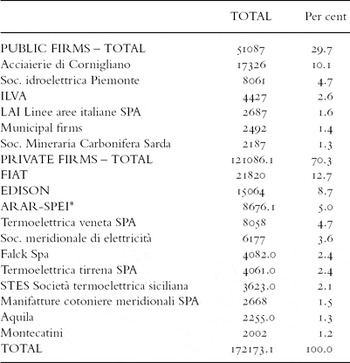
Altogether, between 1948 and 1951, the European Recovery Program (ERP) issued Italy with purchasing authorisations to the value of 1.3 billion dollars, thanks to which more than 18 million tons of goods arrived. The first five items in order of importance were cotton, cereals, coal, oil and machinery.Footnote 62 The goods could be supplied in the form of ‘grants’ or ‘loans’. In the first case these were free goods sent on the request of the Italian government, which sold them in part, then paying the profits into a special account with the Bank of Italy (thus forming the Lire Fund). In the second case, industrialists could obtain loans in order to ‘import machinery and equipment from the United States on the ERP program’.Footnote 63 Interested industrialists had to send the Istituto Mobiliare Italiano (IMI, a public financial institution) their applications for the purchase of machinery and equipment on the US market and, besides demonstrating the financial solidity of the firm, they had to specify carefully the supplier firms and the unit prices in dollars of the selected equipment.Footnote 64 While the process was slow to start, mainly for bureaucratic reasons, in four years the importation of machinery increased from 0.8% to 29% of the total goods imported as part of the ERP. Three hundred and fifty-eight Italian firms were given the opportunity to renew their industrial plants and equipment, and Fiat was the main beneficiary of ERP loans with 21.8 billion lire out of a total of 172 bn (see Table 1).Footnote 65
The distribution of the ERP (in millions of lire, only for companies receiving more than 2 billion lire).

* ARAR-SPEI took care of small industry financing.
Author's calculations from Giorgio Lombardo, L'Istituto Mobiliare Italiano (Bologna, 2000), 663–93.
Fiat's prompt activation of its international contacts and its ability to apply for loans directly through its representatives in Washington undoubtedly helped win the company the largest slice of the Marshall Plan pie. Valletta's detailed requests for almost 22 billion lire in machinery included the best industrial goods and high technology equipment to be found on the US market. His high technology requests provoked an American officer who exclaimed: ‘You want to be fed with caviar and champagne’. Valletta promptly answered: ‘You can't expect us to be satisfied with fish and coca cola’.Footnote 66
On average, 25% of Mirafiori machinery was replaced by more updated and expensive models, including mass-production apparatus which allowed notable productivity increases and the employment of unspecialised labour.Footnote 67 One Fiat manager, Olindo Sassi, recalled that the automatic processes that were introduced allowed a net saving of the number of hours of direct labour per unit of output in every productive division. On average, the necessary number of hours to manufacture the different car parts decreased from 100 in 1948 to 47.5 in 1953, and further to 27 in 1958. The rise in productivity did not encourage labour cuts – on the contrary, employment increased thanks to growing demand. Furthermore, these documented gains in productivity soon translated into lower production costs. In the end, what the consumer earned from these productivity increases was a progressive reduction of the unit price. Fiat prices went down by at least 21%, and by up to 27% in the case of the Fiat 600.Footnote 68 Production boost after 1949 was directly linked to a ‘reduction in the working hours necessary to build each component thanks to the introduction of a new work organisation, modern equipment and machine tools. The vehicle that most benefited from the machinery imported through MP aid and productivity increases was the Fiat 1400: if in February 1950 it took 283 hours to build one, in December it took only 225’.Footnote 69 The Fiat 1400 was soon named ‘Marshall Plan baby’ by the American press and was also a great economic success.Footnote 70 Thanks to American machinery and plants and intense technical collaboration with Chrysler, in 1950 Fiat was able to present the first modern load-bearing body vehicle ever produced in Italy. In the words of Giacosa: ‘the 1400 demonstrated that we could mass-produce an affordable vehicle, yet robust and noiseless’.Footnote 71 Fiat's production levels, which had been around 350,000 vehicles per decade from 1921 up to 1950, increased sevenfold in the 1950s, when Fiat produced 2,938,848 vehicles. As to foreign sales, Fiat exports as a percentage of total output increased from 17% in 1951 to the peak of 46% in 1959, external demand playing a role almost as important as domestic demand.Footnote 72 Paraphrasing Balassa, Fiat was exporting the right goods (for which international demand was increasing) at the right price (or competitive at the international level) to the right countries (in which the car market was expanding).Footnote 73
Conclusion
During the years of European economic recovery the United States were a major point of reference for European companies, consumers and cultures. The Marshall Plan and the technical assistance programmes provided straightforward vehicles for the transmission of US production methods, yet it never was a simple transfer of American ideas on the back of American power. Indeed, as recent comparative works have shown, interactions with the economic leader were usually rather complex and differed from country to country. Americanisation was the fruit of negotiations and compromises and varied sector by sector and even case by case. European entrepreneurs actively searched for American solutions and even took the initiative of establishing connections with their overseas partners or producers in the same field, as the Fiat case has shown. A number of different stories across Europe show that Americanisation was the result of selective appropriation: indigenous practices were never completely abandoned and European companies adopted some American technology, often at the technological frontier, and US management techniques.Footnote 74 Success stories in the European industrial panorama entailed the capacity to adapt foreign production methods to the local context, and involved real people in specific companies, who adapted Americanisation to their specific needs.
In the case of Italy, the United States played a significant but not dominant role in its search for technological development. Italy's industrial apparatus in the North matched European standards (with no need to build anything from scratch), yet the country was deeply tied up with legacies (good and bad) from the past. Italy reacted to the American challenge using the means available to it. This process of technological adaptation was a selective appropriation of the American modernising stimulus.
The Marshall Plan definitely transmitted a decisive impulse for modernising Italy's industrial technologies, work organisation and management, as well as for introducing a new productivity policy. Over the first three years in particular, investments in new equipment involved all the large and many medium-sized firms, and the slogan ‘less macaroni, more machinery’ became a reality. The engineering industry, as the Fiat example demonstrates, made a definitive shift from an assembly industry to continuous production. The introduction of conveyor belts forced important changes in the overall organisation of production: from the restructuring of internal transport to the organisation of purchasing, from a new and more important role for middle management to the adoption of modern marketing techniques. Total productivity (the amount of output per unit of labour) in Italy rose faster than in almost any other Western economy. Between 1950 and 1960 the yearly average growth rate of industrial labour productivity was 7.2% against 3.4% for the US and 2.4% for Britain.Footnote 75 The input of new technology via the Marshall Plan increased productivity, while employment increased thanks to expansion in demand both at home and abroad.
If American aid (machinery, industrial equipment and raw materials in the first place) set production in motion again and modernised plants and management methods, the further expansion of all these sectors in foreign markets was also the result of Italian peculiarities such as competitive prices, characteristic style and design.Footnote 76
Fiat's case analysed in this article surely fits in with the success stories of this period. Fiat could count on a very successful strategy pursued by its chief executive officer Vittorio Valletta: on the one hand, he was swift in reconnecting with his American partners in 1945 and by 1947 had already signed a very important co-operation agreement with Chrysler. On the other hand, Valletta spent time and energy preparing an investment plan to import the best available American machinery. The ERP programme made a vital contribution to this strategy. In the words of Duccio Bigazzi: ‘The ERP legitimated goals which would otherwise have appeared too ambitious: only by counting on this support could Fiat unabashedly pursue a development strategy based on mass production of cars’. Yet, two considerations emerge from this research. First, there was a ‘soft revolution’ in Fiat's production methods, that is to say, a gradual movement towards technological change, a day-to-day adaptation to Fiat's production flow of the most suitable American machinery and plants carefully selected by Fiat technicians and engineers.Footnote 77 Second, it is worth underlining that, without the Marshall Plan, Fiat's pattern of technological accumulation would not have ceased, but would probably only have been delayed. After the war, besides being willing to work hard for expansion, Valletta, like many other businessmen, exhibited a commendable resolve in investing not only most of the business's growing profits in modernisation, but also what could be borrowed from the national and, as we have seen, international credit institutions and from the stock market. Valetta's leadership and active initiative made a crucial difference to Fiat's future: it gave the company an evolutionary perspective rather than a sudden technological overhaul. This strategy of constant development, based not simply on purchasing equipment, but also on cultivating reciprocal trust-based relationships with US car, machinery and plant producers, established a long-lasting network of human relationships which carried Fiat through to the years of the economic miracle.
In the decades since, the actors have exchanged roles: while the American automakers have cut investments, confining their leadership to the Fordist years and model of production, Fiat, despite undisputable difficulties (and risks of financial collapse) has been able to keep afloat in today's competitive and crowded market and maintain investment and research in its core business: small vehicles, low in both fuel consumption and emissions. Furthermore, when in 2008 the car market was shaken by bankruptcies, and American government bailouts entered the picture, Fiat intensified talks with Chrysler. Although it had been a pillar of the US industrial economy in the past, Chrysler had weakened and slowed down to the point that its cars had become less competitive (less popular, reliable and fuel-efficient) than foreign cars, and taxpayer assistance was sought to prevent the company's collapse. According to the merger agreement signed in April 2009, Fiat agreed to transfer billions of dollars in cutting-edge technology to Chrysler in order to build new fuel-efficient cars and engines in America (and save thousands of American jobs). As a matter of fact, although the 2009 Fiat–Chrysler alliance was in no way predictable, Fiat had many aces up its sleeve: this partnership could save the American company, and also 40,000 US jobs (30,000 jobs at Chrysler, and tens of thousands of jobs at suppliers, dealers and other businesses that rely on this company) and most of all bring in important innovative inputs. In particular, Fiat's cutting-edge Multiair technology, which dramatically reduces fuel consumption, boosts power and torque and significantly cuts engine pollutants: a much-needed knowledge transfer prioritising ecological and fuel-saving vehicles. Fiat cars nowadays possess the sort of engineering innovation that Chrysler had come to neglect and the sort of appearance often undermined by its dull design. It is now Italy's turn to share its new green technology that could be critical for the cars of the future and help the company survive in the global market. But most importantly, the Fiat–Chrysler partnerships of 1947 and 2009 have one thing at least in common: they represent a fundamental opportunity to survive in the global market, to reduce the uncertainties that arise from unpredictable demand conditions, and increase a company's international competitive position.