For Alexei
In 1787 the Berlin Academy installed a large public clock ‘so that all city clocks [could] be set by it’ (‘um hiernächst zur Richtung für alle hiesige Stadt Uhren dienen zu können’); the following year, Johann Forkel wrote that ‘The partitioning of rhythm into bars and phrases with bar lines – the marks that express them – is to be seen in like manner to the hour hand, indicating to us the musical relationship of time that every musical phrase has to pass through’ (‘In dieser Rücksicht sind die Abtheilungen des Rhythmus in Takte und Sectionalzeilen, mit ihren äußern Zeichen, den Taktstrichen, gleichsam als Stundenweiser anzusehen, wodurch uns das musikalische Verhältnis der Zeit angedeutet wird, die ein jeder musikalischer Satz zu durchlaufen hat’).Footnote 1 As Roger Mathew Grant has noted, the eighteenth century had an ‘overarching preoccupation with timekeeping practices. After the opening of the universe and the loss of cosmological motion as the universal timekeeper, natural philosophy was forced to recognize that all temporal measurements were equally relative, and therefore equally useless for the specification of a universal temporal measure. The universal clock had been dismantled’.Footnote 2 Meanwhile, pocket clocks became ever more common, four hundred thousand produced per year in Europe by century's end.Footnote 3 Music treatises were ‘threaded through with the language of loss and anxiety . . . the possibility of forgetting or misunderstanding’ tempo.Footnote 4 The clockwork instruments we will consider occupied an intriguing intersection between music and time and allowed experiential comparisons between them. Rather than subjugating music to time, I will argue that Mozart and Haydn, in different ways, demonstrated that music could modulate – and even suspend – time.
The issues involved continue to reverberate. ‘Music exists in time’, we often read, yet this seemingly self-evident claim remains subject to controversy and re-examination.Footnote 5 As Christopher Hasty has suggested, if indeed it be ‘a time-art par excellence, music surely must hold important clues for our understanding of human temporal experience and perhaps even for our understanding of time in general’.Footnote 6 Against the prevalent view that ‘music is an art of time’, others propose that ‘musical time’ differs from ‘chronological time’, so that music ‘suspends ordinary time, and offers itself as an ideal substitute and equivalent’.Footnote 7 In that vein, Igor Stravinsky (following Pierre Souvtchinsky) described ‘musical time’ as ‘a particular relationship, a sort of counterpoint between the passing of time, the music's own duration, and the material and technical means through which the music is made manifest’.Footnote 8 Likewise, in his Cello Sonata (1948) Elliott Carter contrasted what he called ‘clock time’ with ‘psychological time’.Footnote 9 Alternatively, Suzanne Langer argued that ‘all music creates an order of virtual time, in which its sonorous forms move in relation to each other – always and only to each other, for nothing else exists there. Virtual time is as separate from the sequence of actual happenings as virtual space from actual space’.Footnote 10 Taking a historical view, Karol Berger has contrasted Mozart's use of time as directional arrow with Bach's cyclical time.Footnote 11
Yet these formulations presume some kind of time (whether actual or virtual) as the given framework in which music operates. As Hasty has observed, ‘any discussion of rhythm and meter in music will involve decisions concerning the nature of time, succession, duration, and continuity – topics that are usually conceived in classical scientific terms’.Footnote 12 This article explores a more radical option, that music can operate in opposition to time, established not through philosophical arguments but through a kind of experimentation that Wolfgang Amadeus Mozart pioneered in his compositions for musical clocks. Implicitly, Isaac Newton's concept of uniformly flowing time challenged Gottfried Leibniz's arguments that time was not absolute but emerged from the interrelation between events, of which music provided a strong example. Leibniz's views underlie the event- and process-oriented accounts of time advocated by Alfred North Whitehead, Milič Čapek, Hasty and others.Footnote 13
Musical automata have aroused considerable interest among historians of science interested in debates between vitalism and mechanism as well as among musicologists studying the ars combinatoria in compositional practice.Footnote 14 To these helpful approaches I wish to add the ways time itself implicitly moved to the fore, at first as a uniform Newtonian substrate for the play of musical wit and ingenuity in works for musical clocks by George Frideric Handel, Wilhelm Friedemann Bach and Carl Philipp Emanuel Bach. In his clockwork compositions, Leopold Mozart evoked a more complex relation to time by alternating between metres and tempos driven by the same underlying pulsation. In his Andante and Allegro in F minor, k608, Wolfgang took his father's work further by shaping large-scale alternations in metre and affect within a dramatic installation that confronted the constant swinging of an illuminated clock pendulum with the power of music that did not obediently follow Newtonian time and also conveyed the illusion of ‘free’ cadenzas and fermatas. This installation repeated Mozart's k608 thousands of times, leading some contemporaries to compare it to the ‘music of the spheres’, in terms of both its sublimity and its endless repetition.
To be sure, in many other compositions Mozart combined diverse rhythms, textures and topics, but only here did he compose a wholly new piece that had to address and solve the mechanical problems involved in musical clockwork, problems that probably rendered unperformable his earlier Adagio and Allegro, k594. To achieve a practicable result, Mozart needed to face up to and overcome these mechanical limitations so that the available clockwork could perform k608 only three weeks after its composition. I use the word ‘experiment’ because this installation expressly confronted a clock with music generated by clockwork. In many senses, this composition emerged in the tension between music and time, written ‘against the clock’.
For his part, Joseph Haydn had long been obsessed with time and timing.Footnote 15 In the aftermath of Mozart's death, Haydn returned to writing musical clock music that he then incorporated into his Symphony No. 101 (‘Clock’), which I interpret as reimagining clockwork music as performed by human executants, taking Mozart's experiments further by stopping, then restarting time. Though Franz Schubert's interest in time is less well known, his earliest known writing was a poem entitled ‘Die Zeit’, a meditation as much on death as on time.Footnote 16 I suggest that Schubert's Fantasy in F minor, d940, for piano four hands, emerged from his close study of Haydn and Mozart, responding to the metric proportions and tonal layout of k608 as well as to the stoppages of time found in Haydn's Symphony No. 101. These compositions experimentally altered, even reversed, the presumed hegemony of time over music. In the process, they also addressed death as a surrogate for time.
The composers and craftsmen in this story did not set down theoretical descriptions of what they were doing, so that we cannot be sure of their thinking and should be on guard against interpretative flights of fancy. Whether or not these composers knew anything about Newton and Leibniz, their competing views on time may give us a helpful framework within which to situate the extraordinary musical works considered here. Quite apart from contemporary philosophical debates, Mozart and Haydn surely thought about time in their own ways as they contemplated the relation between clocks and music, and more broadly between mechanical time and its musical surrogates. In order to understand their compositional choices, I will consider the evidence from contemporary descriptions as well as the extant clockwork instruments themselves.
The Music of the Spheres and the Controversy about Time
Let us first situate these compositions for musical clocks in the larger controversy about the nature of time. At the centre of his cosmology based on music and its Pythagorean mathematics, Plato had described time as ‘the moving image of eternity’.Footnote 17 The ‘music of the spheres’ depends on the uniform circular revolution of the heavens that produces astronomical time, continually moving yet endless, turning uniformly around an axis he called ‘the Spindle of Necessity’.Footnote 18 In contrast, Aristotle held that ‘time is a measure of motion and of being moved’, implying that motion was the reality from which time was derived, rather than vice versa.Footnote 19
For Newton, ‘absolute, true, and mathematical time, in and of itself and of its own nature, without reference to anything external, flows uniformly’ (‘tempus absolutum verum & Mathematicum, in se & natura sua absq; relatione ad externum quodvis, æquabiliter fluit’). Along with absolute time, Newton allowed that ‘relative, apparent, and common time is any sensible and external measure (precise or imprecise) of duration by means of motion; such a measure – for example, an hour, a day, a month, a year’ (‘relativum apparens & vulgare est sensibilis & externa quævis Durationis per motum mensura, (seu accurata seu inæquabilis) qua vulgus vice veri temporis utitur; ut Hora, Dies, Mensis, Annus’).Footnote 20 Because they provide this measure, we will take clocks simply as representing this relative time, uniform and independent of observers or external bodies, which we will call Newtonian.Footnote 21
In contrast, Leibniz questioned the absoluteness of time as well as space and considered the possible positions and motions of bodies the fundamental reality from which ‘time’ and ‘space’ were derived. He stated that ‘the Hypothesis [that space and time are anything absolute] is contradictory, that is, ’tis an impossible Fiction’, because ‘Space in it self is an Ideal thing, like Time’.Footnote 22 Unlike Newtonian time, Leibnizian time is not absolute, nor uniform and unchanging by definition, but an ‘Ideal thing’ that is more flexible and could in principle depend on observers or external bodies.
Music connects material phenomena (clocks or instruments), the immaterial phenomenology of human perception and the fundamental ontology of time itself. Because of this, my investigation concerns how composers and listeners interpreted clocks (and clockwork instruments), how they perceived musical metres and rhythms, and how they accordingly interpreted ‘time’. In particular, hybrid clock/instruments challenged eighteenth-century musicians by presenting them with the simultaneous experience of clocks and music, whose interrelation involves our interpretation of time as well as the fundamental question whether time is absolute or relative.
The Mozarts’ Musical Clocks
We will be particularly concerned with the Flötenuhr or Spieluhr, which Mozart called Orgelwerk. These musical clocks often hid their sounding parts but showed a clock (Uhr) in operation, as if to underline its relation to the sounds produced internally (see Figure 1), usually by a second clockwork mechanism separate from the one driving the clock itself.Footnote 23 These instruments exemplified the Enlightenment quest to unify a mechanistic world order with the realm of the passions. A clock that could produce music and evoke feelings would demonstrate that human passions could indeed emerge from a purely mechanical body, thereby rendering unnecessary the age-old construct of an immaterial soul to animate that body. The pieces George Frideric Handel and J. S. Bach's sons wrote for these musical clocks followed late baroque style, each sustaining a single affect to achieve what Charles Rosen called ‘an encompassing and sweeping continuity’.Footnote 24 For instance, each of Carl Philipp Emanuel's thirty pieces for Spieluhr or Drehorgel (barrel organ), collected under the catalogue number Wq193, emphasized the parallelism between its particular affect and the clockwork driving the steady, consistent flow of musical gesture and rhythm, exemplifying Newtonian time.
(a) A Flötenuhr by Christian Ernst Kleemeyer, dated 1775–1785; (b) the clockwork mechanism and pipes hidden inside its pedestal. Photos by Oliver Ziebe, 2022. Courtesy of the Musikinstrumenten-Museum, Staatliches Institut für Musikforschung SPK Berlin (object no. 4901)

These earlier compositions form the background and context for Haydn and Mozart's works for Flötenuhr, fascination with which touched many strata of society.Footnote 25 A manuscript dated December 1789 includes some of Haydn's earliest extant compositions for musical clockwork, which probably were played by a now-lost Flötenuhr built by his student and friend Primitivus (Joseph) Niemecz, a priest who also served in Prince Esterhazy's household as librarian and built superb musical clocks.Footnote 26 The selection of pieces on this clock (hXIX:11–16, 31) exemplified contemporary style in miniature, each piece intensifying towards its middle section, where Handel's clock pieces characteristically relax.
Wolfgang Mozart certainly heard such a musical clock as he himself prepared to write ‘for the clockmaker’, meaning Niemecz. On 3 October 1790 Mozart wrote to his wife Constanze that he had resolved to write ‘an Adagio’ for Niemecz in order ‘to put some ducats into the hands of my dear little wife, and did so too – but, because this is work that I truly hate, I was so unhappy that I could not bring it to completion – I sit working on it every day – but have to pause because it bores me’ (‘Ich habe mir so fest vorgenommen, gleich das Adagio für den Uhrmacher zu schreiben, dann meinem lieben Weibchen etwelche Ducaten in die Hände zu spielen; that es auch – war aber, weil es eine mir sehr verhaßte Arbeit ist, so unglücklich, es nicht zu Ende bringen zu können – ich schreibe alle Tage daran – muß aber immer aussetzen, weil es mich ennuirt –’). Mozart complained that ‘if it were a large clock and the thing sounded like an organ, I would have joy in it; but in fact the works consist of nothing but little pipes which to me sound too high-pitched and too childish’ (‘wenn es eine große Uhr wäre und das Ding wie eine Orgel lautete, da würde es mich freuen; so aber besteht das Werk aus lauter kleinen Pfeifchen, welche hoch und mir zu kindisch lauten’).Footnote 27 Though harsh, this does describe the sound of the surviving Niemecz clocks.
Mozart doubtless compared these musical clocks with a far grander instrument he had known all his life – ‘Der Salzburger Stier’ (The Salzburg Bull), a Hornwerk (mechanical organ) originally built in the sixteenth century for the Hohensalzburg Fortress above the town.Footnote 28 This behemoth bellowed out an F major triad twice daily, followed by a musical composition that changed monthly.Footnote 29 In 1753 Mozart's father was tasked (along with another colleague at the archepiscopal court, Johann Ernst Eberlin) with providing these compositions, which he published in 1759 along with a description of the history of the fortress and its Hornwerk, including its range (Figure 2a).Footnote 30 Leopold's piece for the Carnival month of February, ‘Für den Hornung (Die Fastnacht)’, mixes 2/4 and 3/4 time (marked Allegro and Presto, Figure 2b). In it, each bar would presumably have kept the same clockwork tactus, thus generating a 2:3 ratio between the crotchets of the Allegro and the quavers of the Presto, a technique his son later took up in his Adagio and Allegro (k594, December 1790) and his Andante and Allegro (also known as ‘Fantasie’, k608, 3 March 1791). Each about eight times as long as any of the pieces we have considered so far, they required a special ‘long-play’ cylinder mechanism, an important innovation that changed the nature of this medium.Footnote 31
(a) The range of the Hornwerk mechanical organ at the Hohensalzburg Fortress, Salzburg; (b) Leopold Mozart's composition for that organ, ‘Für den Hornung (Fastnacht)’ (For February (Carnival)), from Der Morgen und der Abend, ed. Leopold Mozart (Augsburg: Lotter, 1759). Available on IMSLP, www.imslp.org

Joseph Nepomuk Franz de Paula, Baron Deym von Střítež (1752–1804), a former Austrian army officer with a chequered career, was the impresario behind these commissions. Somewhat sickly, he retired from military service under a cloud and then left the country.Footnote 32 Abroad, he learned the craft of wax moulding, then returned under the assumed name of Müller and opened a gallery that exhibited plaster casts of sculptures and wax figures. The varied offerings of the ‘Müller'sche Kunstgalerie’ included a ‘Bedroom of the Graces’, in which ‘a fair sleeper’ – a wax effigy of a woman with real human hair – reposed on ‘an elastic bed’ near a large statue of Venus.Footnote 33 Spectators could contemplate this suggestive scene listening to what Deym advertised as ‘the most enchanting music, without it being possible to tell whence the magic notes come. It is an Adagio by the unforgettable Mozart’ (‘ein herrliche Flötenmusik, ohne daß Du weißt, woher die Zaubertöne kommen. Es ist ein Adagio des unvergeßlichen Mozart’). This was probably the Andante in F major ‘for a cylinder in a small organ’, k616.Footnote 34 A police report on what they considered a lascivious spectacle reached Emperor Joseph II, who stipulated on 6 May 1789 that the statues must either be decorously veiled or removed from exhibition.Footnote 35
As his pièce de résistance, Deym presented ‘a magnificent Mausoleum erected in honour of the great Emperor Joseph [II] and Field Marshal [Ernst Gideon, Baron von] Laudon’ (‘ein dem großen Kaiser Joseph und dem Feldmarschall Laudon errichtetes prächtiges Mausoleum’), the victorious general in the Battle of Belgrade of 1789 against the Ottoman Turks. Both the emperor and his field marshal died in 1790, which ‘Laudon's Mausoleum’ commemorated with an elaborate mythological display (Figure 3) centred on
eine Uhr, deren Perpendikul eine aus pierres des Straße gefaßte Sonne vorstellt, die durch Bewegung, besonders des Nachts, einen vorzüglich guten Effekt macht. Man hört alle Stunden eine durch den unvergeßlichen Tonkünstler Mozart eigends dazu komponierte passende Trauermusik, die acht Minuten lang dauert, und an Precision und Reinigkeit alles übertrifft, was man bey dieser Art von Kunstwerken je schickliches anzubringen suchte.
a clock whose pendulum represents a sun made of pierres de Strasse, which by its motion, particularly at night, produces a most excellent effect. Each hour a suitable funeral music, especially written for the purpose by the unforgettable composer Mozart, is to be heard, which lasts eight minutes and in precision and purity surpasses anything that was ever attempted to be suitably applied to this kind of artistic work.Footnote 36
To render this music, Deym commissioned Niemecz to build a mechanical organ.Footnote 37 This monument reflected the military world in which armies marched to the swing of a pendulum ‘until the exact prescribed Cadence has been acquired’, so that ‘the time may not differ in the smallest degree’.Footnote 38
Laudon's mausoleum in Deym's museum; anonymous engraving (1791). Note the clock's pendulum in the form of a sun faceted with crystals. Graphische Sammlung Albertina, Vienna. Used by permission

There is no evidence Mozart had any particular feeling for Laudon, though he wrote a few patriotic pieces during the Serbian campaign and his letters indicate clear awareness of Laudon's military successes; as noted above, his main motivation was financial gain.Footnote 39 Already in the mid-1770s, Haydn had noted the commercial advantages of using Laudon's name to help sell music.Footnote 40 By 1790, the war with the Turkish Empire had become very burdensome to Austria; the siege of Belgrade in 1789 led to outbreaks of disease that caused many aristocratic families to leave Vienna for their country estates. The shortage of money resulted in the failure of Mozart's subscription concerts.Footnote 41 This Serbian campaign ended with Joseph's premature death and the consequent ruin of Mozart's prospects at court under Joseph's reactionary successor.
Laurence Dreyfus has helpfully discussed ‘the hermeneutics of lament’ in k594, particularly the part played by the descending chromatic bass lamento.Footnote 42 Annette Richards argued that k608, ‘in its evocation of a contrapuntal and mechanical sublime . . . provided its own commentary on death and its transcendence. This funeral music reached beyond mortality to the wheeling, disembodied infinity of the sublime’.Footnote 43 To these insights I wish to add a specific analysis of Mozart's treatment of time in these works, which he foregrounded in his personal catalogue entries for these two pieces ‘for an organ in a clock’ (k594) and ‘for a clock in an organ’ (k608). Mozart generated living music not from human performers but from the rigid clockwork of an automaton. Further, the original installation included a glass coffin containing a wax effigy of Laudon (with real human hair) in a strange nexus of life, death and the mechanical; Deym's illustration (Figure 3) placed the clock at the centre. Even in 1800, Gianluigi de Freddy's description of Vienna's attractions still featured this ‘temple of death’, where ‘lugubrious music, executed by a clock placed above and expressly composed by the renowned Maestro Mozart, increases the sadness of the funereal monument’.Footnote 44
Mozart's solution to this peculiar challenge stepped beyond any of the pieces we have mentioned so far by including a number of contrasting affects, metres and tempos, assembled to form a larger complex. As we shall see, k594 and k608 accomplished this assembly differently within a short time. In both works, Mozart's central insight was that the constant pulsation of clockwork could drive a cylinder whose pinning would sequentially encode several different temporal styles, tempos and rhythms. This organizing principle raises questions about the relative priority of time and music.
Mozart's Experiments with Time
Before we discuss Mozart's compositions in detail, let us pause over their tempo in relation to the clockwork driving a revolving cylinder. Though some Flötenuhren had provisions for altering the frequency of rotation through movable vanes, the relative tempo ratios pinned onto the cylinder remained unchanged. In what follows, I will refer to the ‘basic tempo’ as the common denominator of these ratios. The one extant instrument that plays Mozart's k608, Johann Georg Strasser's mechanical orchestra (1801) in St Petersburg, has the basic tempo of minim = 69MM (or alternatively crotchet = 132MM, within four per cent of a strict 2:1 ratio). Helmut Kowar used this basic tempo in his reconstructions of k594 and k608, both to follow the available historical instruments but also because he found experimentally that a tempo noticeably slower would lead to the mechanical problems discussed below.Footnote 45
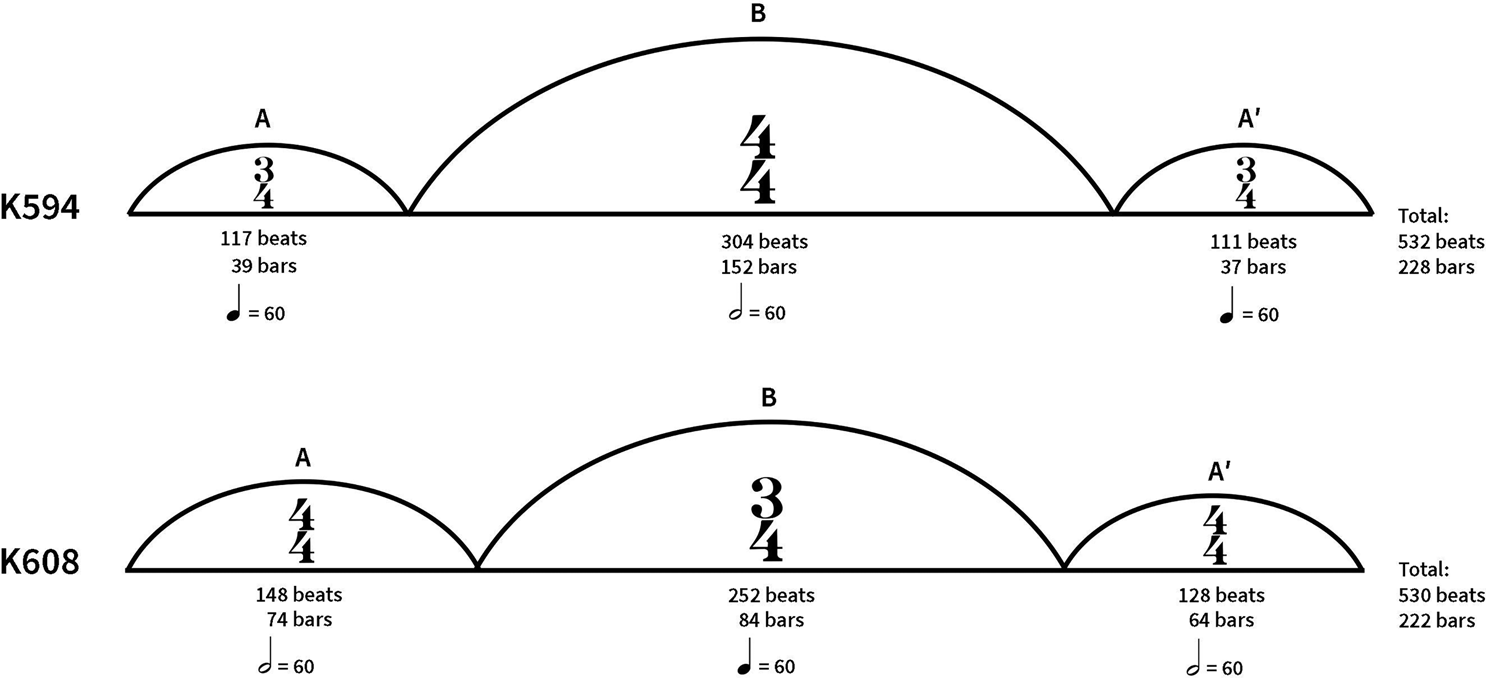
Mozart's two major works for musical clock share ternary form, summarized and compared in Figure 4. Though Berger may be right that Mozart's compositional time often is an ‘arrow’, flying irreversibly from past to future, in this (perhaps exceptional) case Mozart chose an indefinitely repeating cycle.Footnote 46 The ABA′ form of k594 begins with an A section, Adagio in 3/4 (F minor), with crotchet = basic tempo (bars 1–39, Figure 5a). The B section, Allegro in 4/4 (F major), is a quick march in double time, minim = basic tempo, (bars 40–117, Figure 5b). Following this, the Adagio returns (118–154) in ornamented form (A′). The formal lament (the opening and closing adagio sections A and A′) thus brackets the Allegro B section, which seems a celebration (in the major mode) of the hero's martial valour. The clockwork drive rotated unchangingly to produce these contrasting affects so that the perceived sense of time would change dramatically from slowly walking lament to rapid march and back.
Form diagrams comparing k594 and k608, assuming a basic tempo of MM60

Mozart, Adagio and Allegro, k594: (a) the opening of the Adagio (A section, bars 1–12); (b) the opening of the Allegro (B section, bars 40–47). Neue Mozart-Ausgabe, series 9, group 27, volume 2, ed. Wolfgang Plath (Kassel: Bärenreiter, 1982)

Leopold's Hornwerk piece using two different metres (Figure 2b) offered Wolfgang an example of more complex rhythmic structures for mechanical organ works. Observant visitors might have deduced the 2:1 ratio underlying k594's Adagio and Allegro tempos, yet their felt experience of time during those sections would have been notably different because of the change of time signature. Where his father's piece employed a 2:3 ratio of beats per bar between Allegro and Presto, k594 uses alternating ratios of 2:1 and 3:2, maintained by a constant underlying tactus.
Like k594, k608 is ternary, though with a more complex inner structure. It begins with a martial Allegro (F minor, bars 1–12; Figure 6a) in dotted rhythms, a neo-baroque French overture whose tempo I will take as minim = basic tempo. This same tempo then drives a fugue (bars 13–59, Figure 6b) whose subject begins with minims, hence creating the effect of a slower tactus, while the quaver continuation of the subject creates the effect of a contrastingly faster movement. Here the example of Haydn's clockwork Fuga (hXIX:16) may have stimulated Mozart's imagination.
Mozart, Allegro and Andante, k608: (a) the opening of the Allegro (A section, bars 1–8); (b) the exposition of the fugue in the A section (bars 12–27); (c) the opening of the Andante (B section, bars 75–87); (d) the cadenza at the end of the Andante (bars 154–158), which leads to a reprise of the Allegro (A′). Neue Mozart-Ausgabe, series 9, group 27, volume 2, ed. Wolfgang Plath (Kassel: Bärenreiter, 1982)

The martial Allegro then resumes (bars 59–84), ending on the dominant of F. Thus k608's A section is itself ternary in structure. The B section, Andante (A flat major, bars 75–158), moves twice as slowly, crotchet = basic tempo (Figure 6c). Though filled with chromatic details, the lyricism of k608's B section is very different from that of the lamenting A section of k594, not least because of its major mode. In k608, Mozart enriched the texture with ever more luxuriant counterpoint in semiquavers, leading to a climactic cadenza (bars 154–158) involving hemidemisemiquavers and multiple trills (Figure 6d). Finally, the martial A′ section returns, synthesizing its fugue into a brilliantly compressed ending building on the rhythmic energy of the French overture. Both k608 and k594 became well known through Mozart's transcriptions for piano four hands, published posthumously by Traeg in 1799.
Thus the structures of k594 and k608 mirror each other in metre and felt pulsation – k594: A (slow 3/4) B (fast 4/4) A′ (slow 3/4), compared to k608: A (fast 4/4) B (slow 3/4) A′ (fast 4/4), while being parallel in their modal structures – k594: A (minor) B (major) A′ (minor) matching k608: A (minor) B (major) A′ (minor). Their overarching metrical patterns are likewise mirrored: 3:2:3 (k594) to 2:3:2 (k608). Scholars have long wondered why Mozart wrote two different compositions for this installation.Footnote 47 Though it has generally been assumed that the two works alternated, Deym's advertisement of ‘choice funeral music’ (‘eine auserlesene Trauermusik’) seems to indicate that only one work was performed. Indeed, the extant sources describing the installation only speak of k608, whereas k594 ‘was more or less forgotten’, as Zaslaw notes.Footnote 48
On the basis of his extensive practical experience with these clockwork instruments, Kowar has given a persuasive explanation: only k608 was heard in the Mausoleum because the realization of k594 ‘probably failed owing to the wind supply’ (‘wird wahrscheinlich an der Windversorgung gescheitert sein’). For this installation, Niemecz produced what Kowar described as a ‘rather small three-octave automaton’ (‘Niemecz hatte mit einem Orgelautomaten von drei Oktaven Umfang ein eher kleines Werk . . . hergestellt’), but
bei großen Wiener Flötenwerken aus der Mitte des 19. Jahrhunderts die Windversorgung derart ökonomisch ausgelegt war, dass Musikstücke mit langsamen Abschnitten, lang ausgehaltenen Basstönen oder liegenden Akkorden . . . das System an den Rand der Leistungsfähigkeit bringen, was zum Ersterben und Ausbleiben der Töne führt. Das Flötenwerk wird also bei KV 594 wahrscheinlich nach dem sechsten oder siebenten Takt des Adagio – wenn nicht schon früher – mit Tonausfällen zu kämpfen begonnen haben. In der Wiederholung des Adagio mit dem langen Orgelpunkt ab Takt 134, Fünf- bis Sechsstimmigkeit und langen, überaus luftkonsumierenden Notenwerten in der Mittel- und Basslage dürfte die Windversorgung vollkommen erschöpft gewesen sein.Footnote 49
even in large Viennese flutework mechanisms from the middle of the nineteenth century, the wind supply was designed so economically that pieces of music with slow sections, sustained bass notes or sustained chords . . . bring the system to the edge of its capacity, which leads to the notes dying out and not being played. So the mechanism for k594 would probably have begun to struggle with dropped notes after the sixth or seventh bar of the Adagio, if not earlier. In the repetition of the Adagio with the long pedal point from bar 134, with five to six voices and long, extremely air-consuming note values in the middle and bass range, the wind supply was probably completely exhausted.
Because the bellows could not be changed within the existing mechanism, a different composition was required:
Und siehe da, KV 608 entspricht allen Erfordernissen, damit der Automat mit seiner Windversorgung über die Runden kommt: kurze Akkorde, viele Pausen, Vielstimmigkeit nur über wenige Takte, kein Adagio mehr sondern nur mehr Andante, kleinräumige Figuren, kaum liegende Basstöne. Ich könnte mir vorstellen, dass Mozart von Niemecz eingehend über die automatenspezifische Satzweise instruiert wurde.Footnote 50
Lo and behold, k608 fulfils all the requirements so that the automaton can make ends meet with its wind supply: short chords, many rests, polyphony only over a few bars, no more Adagio but only Andante, small-scale figures, hardly any bass notes. I would think Niemecz instructed Mozart in detail about the automaton-specific manner of writing.
Indeed, Mozart had to complete k608 quickly, only three weeks before the opening of the Mausoleum and three months after having written k594.Footnote 51 The carefully designed differences between the two works show how exactingly Mozart must have worked to surmount the technical problems of the installation while still maintaining 2:3 tempo relations. Figure 4 compares the very different proportions of the two works; Mozart clearly had to calculate closely and exercise considerable ingenuity to make k608 have nearly the same number of beats (and hence total duration) as k594 while avoiding its mechanical problems.
In the process, Mozart would naturally have noticed the visual effect of this particular musical clock, whose pendulum was ‘a sun with pierres de Strasse’, faceted crystals that (even in the engraving shown in Figure 3) glitteringly dramatized its unchanging once-per-second swing, ‘particularly at night’, as Deym's advertisement noted, when candles or lamps would presumably be arranged to bring out its dazzling effect in the dark. Thus this installation magnified and dramatized the clock's regular pendulum swings performing uniform Newtonian time. Having learned of his father's interest in this author (noted in a 1778 letter), Mozart might have been aware of Johann Mattheson's assertion in the Kleine General-Baß-Schule (1735) that
Das beste Gleichniß, wobey die Natur und Bedeutung des Tacts begriffen, gesehen, gehöret und gefühler werden mag, ist ein grosses Schlag-Uhrwerck, dessen Bley-Wage einen ordentlichen geraden Tact führet, und dadurch die Minuten, Secunden und Tertzen richtig, nach der Zeit-Maasse, eintheilet. Doch ist hiebey zu mercken, daß alle Abmessungen in Uhrwercken nur einen gleichen Verhalt zum Grunde legen; da hingegen der musicalische Tact nicht nur an ihm selbst ungleich seyn, sondern auch gantz verschiedene Glieder und Gelencke haben kann.
The best comparison whereby the nature and significance of the bar might be seen, heard and felt is that with a great striking-clock, whose plumb line carries a steady, even stroke and through which the minutes, seconds, and the canonical hours are kept exactly according to the time-measures. In this comparison, it should be noted that the bars of the clockwork lie only in equal relationship to the fundamental stroke, whereas the musical bar not only itself can be unequal but can also have quite diverse members and articulations.Footnote 52
Deym's installation confronted Mozart with just the situation Mattheson described: a ‘great striking-clock, whose plumb line carries a steady, even stroke’, contrasted with music's ‘diverse members and articulations’.
As my analysis has shown, Mozart's music transformed clock time variously into slow lament in 3/4 (k594, section A), military quickstep in 4/4 (k594, section B), baroque-style overture and fugue in 4/4 (k608, section A) and lyrical andante in 3/4 (k608, section B). These highly varied textures and topics each play with the sense of time, in successive sections counterpointing the visibly unchanging swing of the pendulum with music that seems relatively accelerated or slowed, neither uniform nor ‘absolute’. In order to achieve these effects, Mozart had to regulate his composition carefully to overcome the specific mechanical limitations that seem to have afflicted k594. Thus his solution for k608 had to involve compositional artifice that went considerably beyond what he would have had to do for any of his other multisectional compositions. In the process, he confronted the specific ways in which his compositional choices would or would not mesh with the clockwork's limitations.
In k608, Mozart presented a completely new composition with markedly different affects from k594, not merely a repair job. Even while obeying the tight mechanical constraints he had learned about from the failure of k594, Mozart decided to take k608 in a different direction. The earlier work had opened and closed mournfully, around a lively, ‘heroic’ middle section; in contrast, k608 begins and ends assertively, even triumphantly, around a peaceful, wonder-struck middle section. In effect, k608 avoids the ‘lugubrious’ qualities of k594. Evidently, Mozart took this occasion to change the impact of this ‘Trauer musique’ to something more positive than the brooding melancholy with which k594 had begun and ended. That change was consistent with his long-held view that death is ‘the true final purpose of our lives . . . the key to our true happiness’, as he put it in his final letter to his father.Footnote 53
To be sure, listeners felt, then as now, the relative effects of different tempos and metres during live musical performances.Footnote 54 Yet because k608 ran by the clock, not dependent on the ‘free’ actions of human performers, those who visited Deym's installation would probably have experienced what we might call ‘temporal relativity’ even while viewing the glitteringly illuminated clock that controlled the music. Because that clock was not necessarily in phase with the music (being driven by a separate clockwork), viewers confronted ‘temporal dissonance’ between the musical tempo and the illuminated pendulum.Footnote 55 Finally, in the lyrical andante and the ‘free’ cadenza of k608, Mozart slowed the perception of time so far that his hearers might well feel that time had stopped. Indeed, the fermatas in these pieces literally suspend time, though the clock ticks on, its pendulum brilliantly swinging.
Mozart's Clocks and the Music of the Spheres
Contemporary listeners marvelled that k608's mechanism could produce such sublime effects. The Allgemeine musikalische Zeitung in 1799 judged that the central Andante ‘in every regard deserves to be called heavenly’ (‘in jedem Betrachte himmlisch gennant zu werden verdient’).Footnote 56 Even in 1813, Ignaz von Seyfried, a former student of Mozart's, could write:
Noch erinnere ich mich aus meinen Jugendjahren lebhaft des Eindrucks, den die wiederholte, oft wiederholte Anhörung dieses genialen Producktes unvertilgbar meinem Gedächnisse einprägte. Tausend verschiedenartige Empfindungen erwekt das, fast möchte ich sagen, furchtbar wilde Allegro, mit seinem künstlich verarbeitetem Fugenthema. Bey der erschütternden Ausweichung nach fis moll erstarrt der Zuhörer, und wähnt, den Boden unter sich erbeben zu fühlen. Sphärengesang ist das liebliche, so äusserst zarte Adagio [recte Andante] in As dur; es entlockt Thränen, wohltätige Thränen der Sehnsucht nach oben. Zurück in das unruhige menschliche Leben schleudert das wiederholt eintretende Allegro. Die zwey mitsammen streitenden Fugenthematen geben ein treffendes, ernstes, kräftiges Bild des Kampfes der Leidenschaften. Nur am Ziele ist Ruhe. Erschöpft ist die Kraft, ausgerungen hat die menschliche Natur, und der Geist entflieht seiner Hülle. Nach jenseits deutet der Schluß!
I still recall from my youth the lively sensation that repeated – oft repeated – hearings of this ingenious production ineradicably impressed upon my memory. A thousand varying emotions were aroused by that (I might almost call it) terrifying Allegro, with its artful fugue subject in the strict style. The listener is startled at the violent modulation to F sharp minor and imagines the ground shaking beneath him. The lovely, so tenderly expressed Adagio [recte Andante] in A flat major is music of the spheres [Sphärengesang]; it elicits tears – salutary tears of longing for heaven. The repeat of the opening Allegro catapults us back into troubled human existence. The two mutually belligerent fugue subjects impart a striking, serious, powerful image of the battle of the passions. Only at the end is there calm. Power is exhausted, human nature has died, and the soul escapes the body. The end signifies the life to come.Footnote 57
Seyfried even orchestrated k608 as part of his Grande Fantasie in F minor (1814). Despite its overheated rhetoric, his description suggests that k608 transmits something like the true ‘music of the spheres’, not just vaguely ‘heavenly music’.
The music of the spheres featured in Mozart's early Il sogno di Scipione, k126 (1772), an azione teatrale whose libretto presented the ‘strange music of the spheres’ (‘insolito concento delle mobili sfere’) as the ‘order and universal principle of all creation . . . an arcane ray of higher learning, within the numbers of the sage of Samos [Pythagoras]’ (‘ordine e norma universal delle create cose . . . d'alto saper misterioso raggio, entro i numeri suoi di Samo il Saggio’). Pure necessity produces this music, not human performers: ‘in their courses they [the spheres] come into collision: each gives forth a different sound from the next; and from all a harmonious sound is formed’ (‘insieme urtansi nel girar: rende ciascuna suon dall'altre distinto; e si forma di tutti un suon concorde’). Unlike that of Aeolian harps, the music of the spheres was regular and automatic. In k608, Mozart embedded the ‘music of the spheres’ within animated martial music as well as learned fugue and lament, unified by their neo-baroque style and driven by unchanging clockwork. This implied that time – as manifested by the clock at the centre of the visual installation – would compete with the listeners’ aural experience. Mozart showed that music could impose its own ratios over time, which was therefore neither uniform nor absolute.
This disquieting pliability of time implied a certain incompleteness in the established Newtonian belief in time as a pre-existing substrate for all phenomena, which Gottfried Leibniz had strongly criticized because ‘things which are uniform, containing no variety, are always mere abstractions: for instance, time, space, and the other entities of pure mathematics’ (‘les choses uniformes et qui ne re[n]ferment aucune varieté, ne sont jamais que des abstractions, comme le temps, l'espace et les autres Estres des mathematiques purs’).Footnote 58 Mozart was in contact with individuals with strong Leibnizian sympathies, especially Ignaz von Born, an eminent natural scientist, mineralogist, leader of the Illuminati and the master of the Masonic lodge Mozart and his father attended.Footnote 59 Whether or not Mozart knew Leibniz's ideas, he could well have pondered these problems about time from his own compositional experiences.
Haydn's Memorial to Mozart
Haydn left Vienna for his first visit to London on 15 December 1790, and he was abroad when Mozart died on 5 December 1791. Haydn called Mozart ‘a God in Music’ and was stunned by his death; in 1829 Mozart's son Franz Xaver recalled that ‘Haydn he thinks his father's greatest admirer, and said [Haydn] never saw him as a child but he wept’.Footnote 60 This means that Haydn could only have heard k608 performed at Deym's installation after his return to Vienna on 24 July 1792.Footnote 61
That installation gave numerous repetitions of Mozart's pieces. Opening on 23 March 1791, by August of that year, as Zaslaw notes, ‘only Mozart's music [k608] was to be heard there’, played ‘on the stroke of each hour’ (‘mit Schlag jeder Stunde’). The Wiener Zeitung reported that this installation ‘was splendidly illuminated from eight o'clock in the morning till ten o'clock at night’ (‘von früh 8 Uhr bis Nachts 10 Uhr herrlich beleuchtet’), with admission ‘one florin [= sixty kreuzers] for a first place, but thirty kreuzers for a second’ (‘auf dem ersten Platz 1 fl. auf den zweiten aber 30 kr’.).Footnote 62 According to de Freddy's description in 1800, k608 could be heard ‘every day from 9 in the morning until 9 at night’ (‘ogni giorno dalle 9 di mattina sino alle 9 di notte’) upon paying an admission of thirty kreuzers; at that time, a labourer received between 7 and 20 kreuzers per day.Footnote 63 Müller's gallery was operated in various locations by Deym until his death in 1804, then by his widow until 1819.Footnote 64 Because he left heavy debts, the mechanism probably lacked the necessary maintenance needed to keep it operating for long.Footnote 65 Assuming that the installation presented k608 ten times daily for three hundred days per year during 1791–1806 yields 45,000 repetitions of k608 during that period, far exceeding the number of live presentations of all Mozart's other compositions. The whole concept of mechanical reproduction of musical masterworks here erupted into a new phase; Seyfried emphasized such ‘repeated, oft repeated’ hearing as a powerful element of his experience of the work.
Though no documentary evidence remains, it seems highly likely that Haydn visited the installation to hear his friend's composition. After all, thousands of visitors thronged to hear it, including Beethoven; given Haydn's intense interest in Mozart and his deep mourning for his death, one can scarcely imagine that he did not also want to experience the extraordinary spectacle of k608 executed as it were under Mozart's direction even after death. Further, Deym solicited Haydn to contribute a new composition for his gallery, which he surely invited him to visit. Though Haydn did not accept this commission, in 1792 he again began composing for musical clocks built by Niemecz, one signed and dated that year, the other dated 1793. For the latter, Haydn made a version of a minuet (hXIX:29) from his partially completed Symphony No. 101, which Salomon premiered in London on 3 March 1794.Footnote 66 Thus the version for Flötenuhr preceded the version in the symphony, which already by 1798 had become known as ‘Die Uhr’ (The Clock), as evidenced by Johann Traeg's piano arrangement of the second movement as ‘Rondo . . . Die Uhr’.Footnote 67
Despite James Webster's judgment that most nicknames for Haydn's symphonies ‘are trivial or irrelevant’,Footnote 68 I think that the appellation ‘Clock’ is relevant and significant because it was so early and so widely attached to this symphony, which was one of Haydn's most frequently performed works.Footnote 69 The popular perception of ‘ticking’ in this symphony accords with two of its movements referring directly to musical clockwork. Haydn's Symphony No. 98 (1792) was already ‘his Requiem for Mozart’, as Donald Tovey put it, including as it did quotations from the ‘Coronation’ Mass and ‘Jupiter’ Symphony,Footnote 70 and he continued to think deeply about Mozart's music. I will argue that Haydn's ‘Clock’ Symphony memorialized Mozart through a complex reaction to his works for musical clock. In so doing, Haydn pushed even further Mozart's experiments with the relationship between clocks, time and music.Footnote 71
The symphony's second movement (Andante, G major) begins with the ‘ticking’ quavers (pizzicato in the strings, staccato in the bassoons). Haydn balanced this steady ‘clockwork’ against a lyrical melody whose many rhythmic variants float above the ticking quavers. Foregrounded for the first bar, before the melody comes in (Figure 7), that ticking appears in at least fifty of the sixty-eight bars of the movement's first section (seventy-four per cent, including repeats).Footnote 72 Rather than a clock imitating an orchestra, Haydn had an orchestra imitate a clock, an irony he presents with subtle relish of the balance between human lyricism and mechanical ticking.Footnote 73
Haydn, Symphony No. 101/ii (‘Clock’), bars 1–5. Kritische Ausgabe sämtlicher Symphonien, twelve volumes, volume 12, ed. H. C. Robbins Landon (Salzburg: Haydn-Mozart Presse, 1967)

In bar 342 Haydn suddenly shifts to the parallel minor, forte, an outburst of lamentation whose intensity seems to overwhelm the preceding good humour with anguished grief. What had been quiet ticking suddenly becomes a forte dotted rhythm in the bass (bars 34–36), then insistently pounding quavers (bar 37) that eventually lead to the reprise in the major (bar 63), the ticking now assigned to staccato flute and bassoon. The play of varied rhythms under the ticking continues until another surprise that experiments with time in a new way at bar 97 – a rest for an entire bar (without fermata) that corresponds formally to what had been the first bar of arrival at the stormy minor section, the first time around (Figure 8). After the bar of rest, the ticking resumes but now in E flat major (the flattened sixth of G), after our initial impression that he has switched modes to G minor. This resumption is gradual compared to the orchestration elsewhere in the movement, at first only in the second violins, joined a bar later by the rest of the strings.
Haydn, Symphony No. 101/ii, bars 91–102, featuring the silent bar (97). The first system (bars 91–97) has a scoring of flute, oboe, bassoon and first violin, while the second (bars 98–102) once again gives the full orchestral complement

During that silent bar, the ticking has ceased, as if time itself had stopped.Footnote 74 All kinds of questions arise: should the musicians ‘freeze’ during the empty bar? should the leader continue to beat time silently? As he had planned to do with the finale of Symphony No. 99,Footnote 75 Haydn probably entertained the possibility of Symphony No. 101 being performed by a mechanical clock, setting up a dizzying hall of mirrors: clocks imitating humans imitating clocks. In such a machine version, presumably the cylinder would have continued to spin silently during the ‘rest’. But is that true in the orchestral version? If time is what is measured by a clock, and the clock stops ticking, what happens to time? Somehow, in that mysterious bar we modulate to the flattened sixth: something has indeed happened, but how and why? Haydn does not explain, but serenely finds his way back to G major (bar 112) and continues the play of variant rhythms over the ticking, now allowing the opening section to swell to forte in the reprise (bars 112–126) while at the same time incorporating triplet motion over the double-dotted quavers. Something of the fierce energy of the minore is thereby synthesized in the reprise, which (one senses) owes a great deal to that mysterious silent bar.
In this interpretation, Haydn extended Mozart's experiments with time by raising the problem of silence. After the relentless ticking over the preceding thirty-two bars, the ticking's sudden cessation paradoxically opens a strange vista beyond time to whatever durational feelings we are habituated to hear in terms of clocks. Even after the ticking resumes, the silence has opened an abyss under the façade of immutable clockwork. In the process, Haydn's curiously human clocks assimilate intense lamentation in their unfolding play, as if reconciling death and time.
As noted above, the Menuetto reused the musical clock piece hXIX:29, transposing it from C major to D major with a number of changed details. Landon emphasized the ‘prodigious length’ of this minuet, the longest in all twelve Salomon Symphonies, which Haydn adorned with an ‘incredible variety’ of orchestration and rhythmic subtlety.Footnote 76 Coming after the ‘clock’ movement – and its silent bar – had sensitized his listeners to such varieties of temporal texture, Haydn added to his clockwork transcription a new Trio, built on a repeated iambic crotchet–minim pattern, anticipated in bars 66–68 of the Menuetto.
Haydn repeats this pattern in 78 of the Trio's 128 bars, and then uses this clock-like repetitiveness to stage a particularly sly joke.Footnote 77 At the beginning of the Trio, the strings repeat the iambic figure four times, but after the solo flute enters (bar 84) the strings do not change their harmonies accordingly at bar 87, as if they had lost count yet nevertheless continued vamping. As if to forestall the scholars and musicians who later tried to ‘correct’ this, Haydn specifically numbered those repeated bars in the string parts. An orchestral outburst upbraids the strings’ seeming inattention, completing a sixteen-bar phrase (bars 81–96). In a written-out repeat (bars 97–112) the string parts finally change harmonies appropriately at bar 102, as if the ensemble had finally got back on track. For Landon, this depicts ‘a village band in the 1790s – complete with sleepy strings, delayed entrances, wrong entries and hurdy-gurdy effects’.Footnote 78 In so doing, I suggest that Haydn took his time experiments in a new comic direction that depends on persistently repeated rhythms. The Trio's iambic rhythm has a lulling, mesmerizing quality that leads the players – and listeners – to lose track of time, partly because iambic rhythms so easily can be mistaken for trochaic by mistaking an upbeat for a downbeat. The village musicians demonstrate a kind of temporal confusion induced by the endless repeating pulsations.
The composer gives us a further signal that his experiments in time have continued from the second into the third movement. The second part of the Trio begins by extending its first phrase from the original sixteen bars (81–96) to twenty-four (113–136), as if tempting the musicians to lose count yet again. The subsequent tutti seems poised to complete another twelve-bar phrase, but Haydn makes the twelfth bar silent (Figure 9, bar 148), as if the musicians had become so muddled they had to break off. Then the iambic pattern begins again, order seemingly restored, but the comic mistimings have one final twist: at bar 155, the horns enter far too early with their tonic pedal, as if they too had lost count. By making this temporal interruption happen twice, Haydn thereby drew further attention to the ways in which he had been experimenting with time.
Haydn, Symphony No. 101/iii, bars 142–150, featuring the silent bar (148) near the end of the Trio

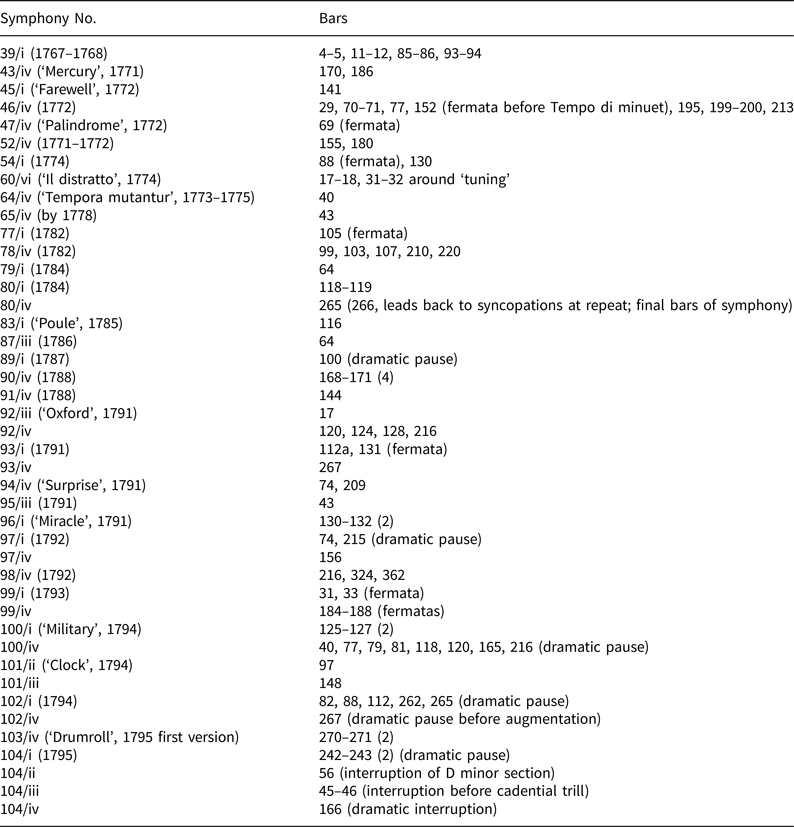
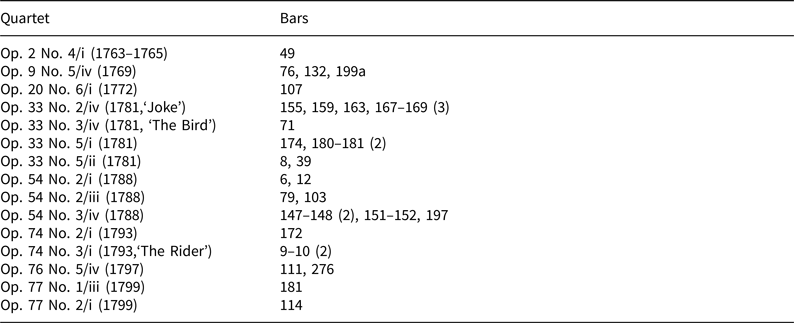
In previous symphonies, Haydn had occasionally interposed one or sometimes several bars of silence, which seems to go back to the ‘Mannheim general pause’ required for sudden tableaux vivants at the climactic moments of ballets.Footnote 79 Table 1 lists all the instances of silent bars in Haydn's symphonies (occurring in thirty per cent of them), which he generally reserved either for dramatic pauses in fast movements or for comic byplay in finales. Tables 2 and 3 list the silent bars found in his string quartets (nineteen per cent) and keyboard sonatas (five per cent).Footnote 80 Other than in Symphonies Nos 101 and 104, he never introduced a silent bar in a slow movement, and only three previous times in a symphonic minuet. By comparison, Mozart used silent bars only in his last three symphonies, in their first movements and only once in a finale, as if he had noted that device in Haydn and saved it for these symphonies.Footnote 81 Haydn told his biographer Griesinger that ‘once I had seized upon an idea, my whole endeavor was to develop and sustain it in keeping with the rules of art’, rather than breaking off what Leopold Mozart called il filo, the thread.Footnote 82 A slow movement would generally require that thread to be spun out without the problematic interruption of a silent bar. In that light, Haydn's use of empty bars in the ‘Clock’ Symphony emphasizes the work's special exploration of time. Its connection with k608 does not come about through quotation, such as Haydn had used in Symphony No. 98. Rather, a natural process of association connects Mozart's well-known clockwork installation to Haydn's ‘Clock’.
Silent bars in Haydn symphonies

The table gives notated full bars of silence (Generalpause), though neither that term nor G. P. appears on any contemporary score. It does not include bars that are empty except for a downbeat or an upbeat. No fermata is indicated in the score unless specifically noted. The number in parentheses indicates the number of bars of silence, if greater than one.
Silent bars in Haydn string quartets

The table gives notated full bars of silence (Generalpause), though neither that term nor G. P. appears on any contemporary score. It does not include bars that are empty except for a downbeat or an upbeat. No fermata is indicated in the score unless specifically noted. The number in parentheses indicates the number of bars of silence, if greater than one.
Silent bars in Haydn keyboard sonatas

The table gives notated full bars of silence (Generalpause), though neither that term nor G. P. appears on any contemporary score. It does not include bars that are empty except for a downbeat or an upbeat. No fermata is indicated in the score unless specifically noted.
Epilogue: The Afterlives of k608 in Beethoven and Schubert
Beside Haydn, many others heard Wolfgang Mozart's k594 and k608. Beethoven became personally involved with the Deyms, perhaps even falling in love with Deym's widow, Josephine (née Brunsvik).Footnote 83 Beethoven made copies of the two pieces, indicating his particular interest in them. Among the five pieces he wrote for Deym (WoO 33, 1799), his Andante in F major seems to be modelled on the B section of k608, as if Beethoven had wanted to try his hand at imitating the ‘music of the spheres’. None the less, as Zaslaw notes, ‘no other composers are mentioned in subsequent accounts of the Mausoleum – only Mozart’.Footnote 84 This installation had a wide impact; Baron Peter von Braun drew on it as he constructed his Temple of Night at Schönau, near Vienna (opened in 1801).Footnote 85 There, too, visitors experienced ‘the ancients’ music of the spheres’: in an artificial grotto, they gazed at a starry vault while hearing the strains of Antonio Salieri's Armonia per una Tempio di Notte played by an invisible Orgelwerk.Footnote 86
It is unclear how long it remained possible to hear k608 in Müller's gallery. Seyfried's 1813 letter called Mozart's mechanical Fantasie ‘little known’, as if it had not been operational for some time.Footnote 87 Yet Wolfgang Plath thought that ‘the impression made on the following century by this very late Mozart can hardly be overstated’.Footnote 88 Zaslaw adds that ‘many public performances [of k608] can be documented’.Footnote 89 Deym's gallery moved to its final quarters in 1798 (Figure 10), a grand building Schubert would have entered on 14 March 1819 to hear an overture of his (perhaps d648) performed by the Gesellschaft der Musikfreunde, conducted by his brother Ferdinand.Footnote 90 Though Mozart's installation was probably not operational by then, Schubert (like Beethoven) might well have joined the throngs that had visited it in earlier years. Indeed, Alfred Einstein judged that ‘between 1810 and September 1811, Schubert “woke up” and became a composer’ in his early fantasies for piano four hands (d1, d9), which were ‘conscious, even self-conscious imitations. The model in each case was one or both of Mozart's works for the mechanical organ (k594 and k608).’ Such an intense reaction in a young person would suggest his having experienced the original installation as well as its four-hands version.Footnote 91 Schubert venerated ‘Mozart, immortal Mozart’ (‘Mozart, unsterblicher Mozart’, as his 1816 diary entry put it) and studied his four-hand piano works with particular care; thus it seems very likely that Schubert knew the piano four-hands version of k608, whether or not he ever got to hear its original clockwork form.Footnote 92 I argue that k608 strongly influenced his Fantasy in F minor for piano four hands, d940 (1828), in both its tonality and its formal construction. This is not a new observation; Plath thought that Schubert's Fantasy was ‘one of the most polished “recompositions” that a classical model [k608] has ever undergone’.Footnote 93
The Müller'sches Gebäude, the specially constructed buildings that housed Deym's gallery in its final location on the Rottenturmstrasse, as shown in the frontispiece of Anton Pichler, Neuestes Sittengemählde von Wien (Vienna: author, 1801) www.digital.wienbibliothek.at

Schubert's Fantasy shares with k608 not only its tonality of F minor but also a very specific and unusual detail, what Seyfried called Mozart's ‘shattering [erschütternden] excursion to F sharp minor’ (bars 55–62), which arguably influenced Schubert's extended Largo episode in that key (bars 121–163). If indeed these works are so strongly connected both in tonality and formal construction, then Schubert's metrical relations may also reflect Mozart's choices. Even if he only knew the four-hand version of k608, Schubert surely would have noted its tempo relations, with contemporary performance practice probably reflecting the tempo ratios of the original clockwork installation.Footnote 94
If so, this provides important information about the relative tempos of the sections of Schubert's Fantasy. Assuming Schubert's opening Allegro molto moderato were set at minim = basic tempo (say 60MM), then that same tempo would apply to the Largo as crotchet = basic tempo (a 2:1 relation), the Allegro vivace as dotted minim = basic tempo (a 3:2 relation, as in Mozart), which then leads back seamlessly to minim = basic tempo for the return of the Tempo I. Plath notes that k608 ‘rapidly became for the knowledgeable the quintessence of Mozartean art’.Footnote 95 If so, Schubert would have expected his audience to recognize its relation to his Fantasy.
Whereas Haydn wrote his ‘clock’ piece into a symphony, Schubert chose the special intimacy of four hands. This private domesticity opens a whole new realm of temporal experience, compared to the public character of Mozart's installation or Haydn's symphony. From the beginning of Schubert's Fantasy, the secondo's lulling ostinato has the quality of a gentle ticking or beating whenever the theme returns, the quavers swinging between the crotchets, more reminiscent of Mozart's pendulum than of Haydn's ticking clock. The primo's theme is very different in character, freely intertwined within the secondo's strict tempo, with many hesitations, syncopations and grace notes that bespeak a sensitive human performer. Together, they seem to contrast the even pendular flow of time with a subtle, ever-changing human reaction. This kind of music-making was for the home, for two friends or lovers seated close, as if they were body and soul of a single being. To be sure, similarly contrasting characters between melody and accompaniment can be found in many other of Schubert's works; what makes the Fantasy different is its close relation to Mozart's clockwork original, now mediated through the shared format of four hands. Even when that clock was no longer physically present, it would inform those who had heard or known of the original installation and would therefore continue to be an implicit subject of these four-hand works, both Mozart's arrangement of k608 and Schubert's Fantasy.
The following sections of the Fantasy contrast a sequence of time-feelings, beginning with a forte passage whose insistence on ‘strict time’ (beginning at bar 48) and emphatic rhythm convey the funereal impression of a death march.Footnote 96 In the following parallel-major passage (bar 102) a triplet ostinato smooths away all accent into a seamless flow. In contrast, the Largo uses double dotting to dramatize the jagged accents of a neo-baroque French overture (clearly reminiscent of the A section of k608), set against a lyrical passage (bar 134) accompanied by triplets in which the flow of time is ecstatically suspended. Thinking back to k608, this corresponds to the B section and thus represents Schubert's version of the ‘music of the spheres’. The constant exchange of these triplets between the pianists indicates that they contemplate this starry sky together, their melodic dialogue a rapturous commentary suspended in time.
The following Allegro vivace in waltz time (dotted minim = basic tempo) breaks off with a dramatic silent bar (437). The return of the initial material leads to a fugue whose countersubject accents the second beat heavily, as if dragging an obstacle. The silent bars 437 and 554 might well remind listeners of Haydn's similar stoppage of time in Symphony No. 101, especially the abrupt cut-off at bar 554; Schubert was closely familiar with Haydn's works and had surely noticed his use of silent bars.Footnote 97 In Schubert's Fantasy, time stops so abruptly that it is not clear what, if anything, can follow. Quietly, for the last time, the dialogue between strict time and freedom returns.
Only fifteen bars remain before the end, just long enough for the theme to rise to a final outcry, then quickly fade away. If read as a statement about time, Schubert's Fantasy seems much darker than k608, which seems to revel in its ability to mould and bend time. Schubert's dialogue between time and freedom has tragic overtones: soon after the music stops, time stops too. These works by Mozart, Haydn and Schubert give experiential demonstrations that time is not a preordained, uniform flow (as Newton held), but the result of dynamically interacting events (as Leibniz argued) that can alter the course of time, even suspend it or bring it to a halt. Music can make time stop because it engenders the events from which time begins and ends.
Musical clocks had been the obedient servants of time, their compositions faithfully following the ticking driving them. Mozart's experiments confronted tensions between music and clocks, tensions he used to make a machine subvert itself and modulate time. Even in a ‘temple of death’, his music was triumphant. As if turning Mozart's experiment on its head, Haydn's orchestra imitated a clock that would stop at his command. Thus Haydn commemorated a master of time who came to an untimely end. Near the end of his own time, Schubert's intimate dialogue between humanity and time eventuates in a tragic stoppage. In these different ways, music led the growing insurrection against the tyranny of time.