Introduction
The aging of the world population is dominant demographic feature of the 21st century, but the tempo of this process and proportions of age cohorts varies. In addition to the global and national levels, differences in age structure exist at lower administrative-territorial levels. Within one country, these differences are observed between federal states, regions, municipalities, cities, villages, and between different communities (racial, ethnic, religious, cultural, political, class). All the differences are based on various socio-economic conditions and characteristics.
Many authors emphasize cultural differences as the main cause of different aging among certain population categories (Ananta, Arifin, and Bakhtiar Reference Ananta and Arifin2005; Idler Reference Idler, Binstock, George, Cutler, Hendricks and Schulz2006; Catney and Simpson Reference Catney and Simpson2014; Zubair and Norris Reference Zubair and Norris2015; Tey et al. Reference Tey, Siraj, Bahyah, Kamaruzzaman, Chin, Tan, Sinnappan and Müller2016; Ferraro, Kemp, and Williams Reference Ferraro, Kemp and Williams2017; Kupiszewski, Kupiszewska, and Brunarska Reference Kupiszewski, Kupiszewska and Brunarska2017). Contemporary research regarding age structure and its interaction with racial, ethnic, or religious structure (Williams and Wilson Reference Williams, Wilson, Binstock and George2001; Goodyear Reference Goodyear2009; Coleman Reference Coleman2010; Catney and Simpson Reference Catney and Simpson2014; Ananta, Arifin, and Bakhtiar Reference Ananta and Arifin2005; Nair Reference Nair2011; Tey et al. Reference Tey, Siraj, Bahyah, Kamaruzzaman, Chin, Tan, Sinnappan and Müller2016; Arifin, Hasbullah, and Pramono Reference Arifin, Hasbullah and Pramono2017; Kupiszewski, Kupiszewska, and Brunarska Reference Kupiszewski, Kupiszewska and Brunarska2017; Oliveira and Luiz Reference Oliveira, Alves and Luiz2017), pay most attention to the populations of countries with pronounced contemporary immigration or countries with heterogeneity of the domestic population. However, these studies mostly analyze changes in the abovementioned population structures in a certain period of time, explain the facts, or provide demographic projections.
Differentiation between demographic development of individual communities may be the result of discrimination. Minority communities are particularly exposed to discrimination, and those in postwar (post-conflict) areas are most vulnerable (Jeffery and Murison Reference Jeffery and Murison2011; Eastmond Reference Eastmond2006; Stefanovic and Loizides Reference Stefanovic and Loizides2017). Forced migration is often a consequence of wars. Changes in population composition imply disruption of different demographic structures. Migration can directly influence the age and ethnic structure of a particular territory after the war, depending on dominant age cohorts and the relative share in the total population of those who emigrate, immigrate or who remain to live in that territory. In the context of return migration, the age structure is crucial for their long-term sustainability, as well as for the biological reproductive capacity of the community and the socio-economic revitalization of the post-conflict area. Unfortunately, with return migration, the selection of returnees in terms of their age is usually negative (also in the terms of economic activity, education, and lifestyle) (Mesić and Bagić Reference Mesić and Bagić2007, Reference Mesić, Bagić, Ramet and Valenta2016).
The last decade of the 20th century was a turbulent period in the history of Southeastern Europe. SFR Yugoslavia was a country made up of six republics. The main characteristic of the Yugoslav population was ethnic, religious, and cultural heterogeneity. The breakup of the SFR Yugoslavia resulted in the separation of previously federal republics into sovereign countries. In most cases, there ensued violent clashes that left a large number of dead and displaced persons. One of the wars was fought in Croatia (1991–1995). In addition to the Croat-majority (3,736,356 or 78.1%), Serbs were the second largest ethnic group with 581,663 inhabitants (or 12.2%), according to a 1991 census. The two opposing sides did not have the same interests and views on remaining in Yugoslavia and on proclaiming Croatian independence, which, with the rise of nationalism, made the war inevitable. The political goals of the opposing sides in the war, and the first interethnic conflicts, led to mutual ethnic cleansing in Serb-Croat-controlled areas. At the beginning of the war, Serbs proclaimed an internationally unrecognized Republic of Serbian Krajina in the area they controlled. During 1995, Croatia took over most of this territory, which forced Serbs into exile. These events enabled the return of Croats who were expelled in 1991 at the beginning of the war, as well as the settling of Croats from other parts of the former Yugoslavia. In the following years, the Croatian Government has consciously hampered the return of Serbs by slow acting, intentionally and purposefully. Since 1998, after the introduction of the Program for Return, a significant number of Serbian refugees began to return (Koska Reference Koska2008). The following 2001 census showed the extent of ethnic changes and the unfinished return process. Serbs remained the most populous ethnicity after Croats, but their population and share were much lower (201,631 or 4.5%). Compared to 1991 data, there was an absolute decrease in the number of Serbs of 380,032 (-65.3%). In August 1995 alone, about 250,000 Serbs fled Croatia (Koska Reference Koska2008; Mesić and Bagić Reference Mesić and Bagić2011).
Multiple demographic consequences of the war in Croatia (depopulation, war victims, indirect demographic losses, ethnic homogenization in favor of Croats, parallel processes of emigration and immigration, spatial polarization of the population, aging) have been the subject of many studies (Akrap, Gelo, and Grizelj Reference Akrap, Gelo and Grizelj1999; Gelo Reference Gelo1999; Mišetić Reference Mišetić2002; Babić Reference Babić2003; Lajić Reference Lajić2004; Wertheimer-Baletić Reference Wertheimer-Baletić2004; Ilić Reference Ilić2006; Pažanin Reference Pažanin2006; Berber, Grbić, and Pavkov Reference Berber, Grbić and Pavkov2008; Lajić and Bara Reference Lajić and Bara2010; Turk, Simunic, and Jovanic Reference Turk, Šimunić and Jovanić2015; Mrđen and Jurić Reference Mrđen and Jurić2018). These articles mainly dealt with general demographic analyzes or analyzes of certain structures at the level of the country, geographical regions, counties (županije), and lower administrative units. In other studies, the war period and its impact are treated as part of chronologically longer demographic analyzes, or it is cited as a key event that accelerated and intensified pre-existing demographic processes (Pokos Reference Pokos1999; Živić Reference Živić2003, Reference Živić2008; Pejnović Reference Pejnović2004; Nejašmić and Toskic Reference Nejašmić and Toskić2013, Reference Nejašmić and Toskić2016; Đurđev, Livada, and Arsenović Reference Đurđev, Livada and Arsenović2014; Nejašmić Reference Nejašmić2014; Mrđen and Barić Reference Mrđen and Barić2016; Kokotović-Kanazir, Filipović, and Panić Reference Kokotović-Kanazir, Filipović and Panić2016). As expected, the consequences were most pronounced in the area that was directly affected by the war.
This article researches the effects of the war and postwar socio-economic conditions in Croatia, on changes in the age and ethnic structureFootnote 1 in the BanijaFootnote 2 region (located in Central Croatia). In the decades before the war Banija had an unfavorable demographic development. It was characterized by a decline in population growth, fertility and birth rate, increased aging, and pronounced emigration. The ethnic structure was heterogeneous, and Serbs were the majority population.
As mentioned above, many articles dealing with age and ethnic structure reveal that change between different ethnic groups emerges due to emphasized socioeconomic differences among them. Our article refers to a region whose inhabitants (Serbs, Croats, and others) had similar demographic characteristicsFootnote 3 and had led a similar lifestyle, but the difference among them emerged after the war. One of the most pronounced difference has emerged in the field of aging. There are no census statistics of age structure by ethnicity at national or lower administrative levels for 2001. According to the media reports and information from the literature which have studied the sustainability of returns, the Serbs in returnee areas are mostly old population (Matas Reference Matas2004; Koska Reference Koska2008; Mesić and Bagić Reference Mesić and Bagić2007, Reference Mesić and Bagić2008, Reference Mesić and Bagić2010, Reference Mesić and Bagić2011, Reference Mesić, Bagić, Ramet and Valenta2016; Braičić and Lončar Reference Braičić and Lončar2011; Mrđen and Jurić Reference Mrđen and Jurić2018). Exact data are not available, but they were obtained on the basis of a random sample – based on those surveyed during the researches of returnee population all over Croatia. The results of these studies are in line with studies that indicate that older rather than young refugees are more likely to return in the case of minority returnees (Hammond Reference Hammond, Black and Koser1999 ; Jeffery and Murison Reference Jeffery and Murison2011; Eastmond Reference Eastmond2006; Stefanovic, Loizides, and Parsons Reference Stefanovic, Loizides and Parsons2015; Stefanovic and Loizides Reference Stefanovic and Loizides2017; Jansen Reference Jansen, Stef and Staffan2009; Lukić and Nikitović Reference Lukić and Nikitović2004; Loizos Reference Loizos, Stef and Staffan2009). Older economically inactive returnees find it easier to repatriate, especially to rural areas, where they can live off pensions, farming, and financial assistance from other family members who have not returned (Mesić and Bagić Reference Mesić, Bagić, Ramet and Valenta2016). Also, those who have spent most of their lives in their place of birth are sentimentally attached to their homeland. Jansen (Reference Jansen, Stef and Staffan2009, 55) in his research of repatriation to Bosnia and Herzegovina points out that the elderly “dying to return and returning to die,” and Mesić and Bagić (Reference Mesić and Bagić2007, 101) conclude that elderly want to “die on their doorstep.” Although the international community and ex-Yugoslavian countries affected by the refugee crisis supported voluntary repatriation, most younger refugees and IDPs saw the solution in integration in a country (entity) where their people were in the majorityFootnote 4 and had political power. Many of them also decided to relocate abroad (Eastmond Reference Eastmond2006; Mesić and Bagić Reference Mesić and Bagić2007, Reference Mesić, Bagić, Ramet and Valenta2016; Korać Mandić et al. Reference Korać Mandić, Opačić, Škorc, Ćirić, Volarević and Muždeka2006; Jansen Reference Jansen, Stef and Staffan2009; Stefanovic and Loizides Reference Stefanovic and Loizides2017). Return is negatively affected by the number of years spent in exile. Although return is an open process without a time limit, experiences from the past have shown that the probability of return is lower in the case of prolonged refugees (Zetter Reference Zetter1999; Hammond Reference Hammond, Black and Koser1999; Stefanovic and Loizides Reference Stefanovic and Loizides2017; Loizos Reference Loizos, Stef and Staffan2009), during which new social connections with the local environment are established in the new environment and a new life is started. On the other hand, return and reintegration are complex processes that do not take place without difficulties. This is especially emphasized in areas where interpersonal relations have been disrupted and political, security, economic and educational situation have changed.
The main problems related to the research of this vulnerable category of people are lack of data, unreliability of data, low and unrepresentative sampling and exposure to potential danger (Stefanovic and Loizides Reference Stefanovic and Loizides2017). Unlike most research, ours includes the entire population of the post-conflict area based on census statistics (thus eliminating certain shortcomings of the interview or survey). By using census statistics and two methods that previously were not used in the field of post-conflict research, we performed a comparative analysis of the demographic age of the pre-war and postwar population. Due to the applied methodological approach, the article presents an innovative study on the impact of war, ethnic cleansing, and postwar discrimination on the different aging of majority and minority ethnic communities.
In order to determine the effects of the war on demographic development in the postwar period, it is most appropriate to compare the results of the 1991 and 2001 censuses. Demographic consequences of the war are evident from the fact that in 2001 44.9% less inhabitants were registered in Banija, compared with 1991. A question arises from this fact: whether and how the change in the total population and its ethnic structure affected the age structure? The aim of this article is to research whether, in such a demographically disrupted region, exists a discernible difference in age structure between the Serbian and Croatian population, which could be directly related to the incomplete postwar return of Serbs to Croatia. Therefore, the main aim of this study is going to be a confirmation of the hypothesis that a higher proportion of Serbs corresponds to a higher average age and a higher proportion of Croats to a lower average age, and vice versa.
Methodology and Data
In the next three sections we will analyze the ethnic and age structure of the population in Banija region in 1991 and in 2001. The comparative analysis will be carried out at the municipality and settlement level. In order to examine the impact of war on the changes of ethnic and age structure and their interrelation we used two methods – determination the stages of demographic age (SDA) of settlement and correlation analysis. In order to obtain precisely results and to test the hypothesis in the best way, we have used these two methods at settlement level.
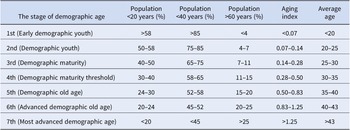
Defining the SDA was a topic researched by Croatian and Serbian demographers Klemenčić (Reference Klemenčić1990), Nejašmić (Reference Nejašmić1992) and Penev (Reference Penev and Jovanović1995). Their statistical methods for determining SDA have been used in numerous studies. In this article, we will apply the grouping of settlements by SDA according to Penev. The results of this method depend on a number of variable indicators (participation of different age contingents in the total population, aging index and average age of the population). With these critical values, the population of each settlement can be classified into one of seven stages of demographic age, from early demographic youth (1st stage) to the most advanced demographic age (7th stage). A model for determining SDAFootnote 5 is presented in table 1.
The Criteria for Determining the Stage of Demographic Age

Source: Penev Reference Penev and Jovanović1995
According to these determined stages, the settlements will be grouped into those with Croat and Serb majority for both census years. The analysis included ethnically homogeneous settlements with over 80% members of one ethnic group. The hypothesis of the interconnectedness of ethnicity and age structure in 2001 – the slower aging of Croats relative to Serbs – can be confirmed by this rough analysis. The assumption is that almost all settlements with a high share of the Serbian population (over 80%) are in the 7th stage (the most advanced demographic age). For significant number of the settlements with a high share of the Croatian population (over 80%) it is expected to be in the lower SDA.
In order to research this topic in more detail and to confirm the hypothesis in a more precise way, we will use correlation analysisFootnote 6. The average age of a settlement is determined as one variable while the average share of Serbs or Croats as another.
In the analysis we used the 1991 and 2001 censuses data.Footnote 7 In the process of analysing statistical data of these two censuses, the difference in definition of category of “permanent population”Footnote 8 has been noted. Both methods we have applied analyze average age and ethnic structure of settlements. For 14 settlements that had 10 or fewer inhabitants in 2001, the ethnic structure was not given. The members of other ethnicities and those who had not declared were not considered in the analyses. In 1991, their share in total population was 7.6%Footnote 9 and in 2001 it was 4.6%, so the impact on the analysis results is negligible.
There is also a difference in the territorial organization until 1991 and the new organization since Croatian independence. According to the new territorial organization, Croatia is divided into counties and the lowest units of local government are the towns and municipalities. Banija region covers the southern part of the County of Sisak-Moslavina and consists of eight towns and municipalities (Donji Kukuruzari, Dvor, Glina, Hrvatska Dubica, Hrvatska Kostajnica, Majur, Petrinja and Sunja), with 267 settlements. Within the administrative boundaries BanijaFootnote 10 has an area of 2,084 km2. Petrinja, Glina and Hrvatska Kostajnica have the status of a town, which implies greater competencies, while Dvor, Hrvatska Dubica, Majur, Donji Kukuruzari and Sunja are municipalitiesFootnote 11. For the purposes of comparison and further analysis we observed the 1991 census data according to the 2001 administrative-territorial divisionFootnote 12.
Analysis of the Ethnic Structure Changes in the Region Between 1991 and 2001
The ethnic structure of the population is one of the most dynamic demographic categories in the Banija region. The volume of ethnic changes has also influenced the changes in the overall demographic structure of the studied area. The dynamics of the ethnic structure of Banija region is closely linked with the geopolitical changes in wider regional surroundings, since the end of the 20th century (the breakup of the former Yugoslavia). The war in Croatia (1991–1995), as well as the postwar period, has been characterized by frequent and intense ethnic changes in Banija region. Banija was largely inhabited by the Serbs during the entire 20th century. However, the war events from the last decade of the 20th century have dramatically changed its ethnic structure and introduced Banija into the 21st century as a region with a majority Croatian population.
The dynamics and extent of ethnic changes in the last decade of the 20th century are best reflected in the fact that such a short historical period (10 years) can be divided into four phases of ethnic transformation:
-
(1) The first phase of ethnic changes represents a continuation of historical heterogeneity in the region, with the domination of Serb-majority (58.8%). It lasted until mid-1991 (until the outbreak of the war).
-
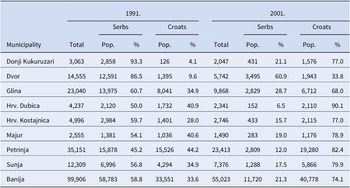
(2) The second phase includes the period from mid-1991 until the August 1995. In this period, almost entirely Banija was inhabited by the Serbian population. This was a war time in the former Yugoslavia, and Banija was located within the border of Republic of Serbian Krajina. During the war, no official census was conducted, but the data collected from the Main Staff of Serbian Army of Krajina indicated that in June 1993 there were living approximately 82,000 Serbs, and at that time they accounted for 97% of the total population (Vojska, n.d. Footnote 13). Compared to the data in Table 2, it can be seen that there were significantly more Serbs in the Banija region compared to the 1991 census. Actually, at the very beginning of the war forced migrations of opposite directions occurred simultaneously. A large number of Serbs from the other parts of Croatia (mostly from Sisak and Zagreb) had moved to the territory under Serbian control, while Croats from Banija fled to territory controlled by the Croatian government.
-
(3) The fall of the Republic of Serbian Krajina in early August 1995 meant the beginning of the third phase of ethnic changes. This phase was characterized by opposite directions of migration flows among the Serbian and Croatian population. Conducting the military action called “Operation Storm,” Croatia took over the most of the Republic of Serbian Krajina, and the Serbian population fled to Bosnia and Hercegovina (Republic of Srpska) and FR Yugoslavia. This is how Banija region became unpopulated within just a few days. During the next two years, indigenous Croats that fled at the beginning of the war in 1991 returned to Banija region (Braičić and Lončar Reference Braičić and Lončar2011). At the same time, the settling of the Croats from the other parts of the former Yugoslavia have been organized (Bosnia and Herzegovina, Autonomous Province of Kosovo and Metohija) (Matas Reference Matas2004). The third phase of the ethnic transformation of Banija is the most important for the changes of ethnic structure of the region. At the end of the third phase (in 1997) there were more Croats in the Banija region than before the war (in 1991). An even more important fact, viewed from a demographic, historical, and geopolitical point of view, is that during this two-year period (1995–1997) the population and territorial relations between Serbs and Croats, that lasted for centuries, was disrupted, and the ethnic image of Banija region was permanently changed. After these events, Banija became a region dominantly populated by Croats.
-
(4) The last, fourth phase of ethnic changes begins with the return of expelled Serbs, at the end of 1997. However, the number of returnees is far less than the number of expelled Serbs. Although the fourth phase of ethnic evolution of the region may be called “the phase of rebalance of ethnic heterogeneity,” it is actually characterized by the dominance of the Croatian ethnic majority (2001 – 74.1%).

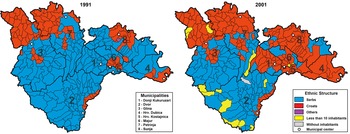
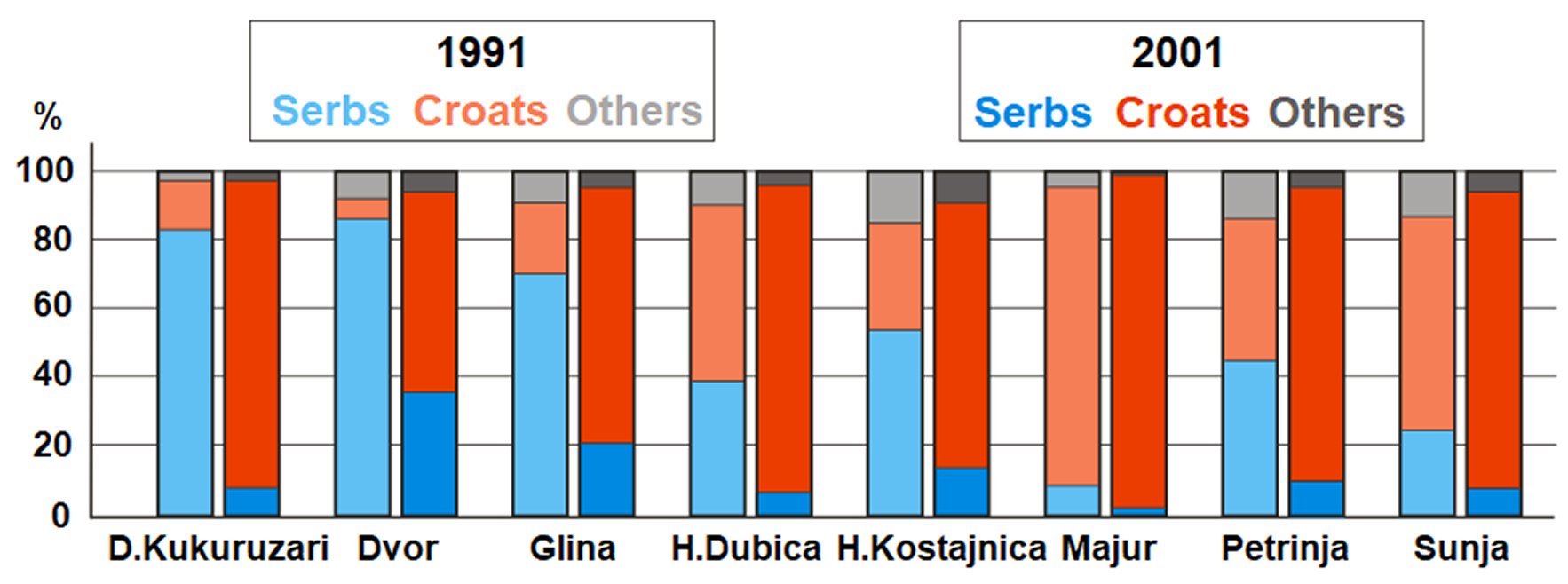
Table 2 shows the magnitude of ethnic changes in Banija region. In 1991 Banija had 99,906 inhabitants. Serbs were ethnic majority (58.8% – 58,783 inhabitants), while 33.6% of the population of Banija (33,551 inhabitants) were Croats. Serbs were an absolute majority (over 50% of population) in each municipality, except in Petrinja (45.2% of Serbs, and 44.2% of Croats). Also, Serbs were an ethnic majority in each major urban (and municipal) center: Dvor (84.8%), Donji Kukuruzari (82.7%), Glina (69.7%), Kostajnica (54.3%) and Petrinja (45.2%). Оn the other side, Croats had ethnic majority in three small municipal centers: Majur (85.9%), Sunja (61.8%) and Dubica (50.5%) (figure 2).
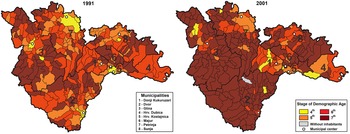
The ethnic structure of each settlement, as well as the spatial distribution of Serbs and Croats through the region is of particular importance for this research. Because of this, it is important to point out that, until 1991, Banija was an example of region characterized by ethnically homogeneous settlements with dual-character (high proportion of either Serbs or Croats – often more than 95%). On the other side, as we can see from the previous paragraph, municipal centers were exceptions to this rule. The proportion of Serbs and Croats in urban settlements was more uniform than in rural. Approximately, 66% of total settlements (175) were with Serb-majority and 33% of them (91) with Croat-majority. The ethnic polarization of the region in 1991 is best illustrated in the number of settlements in which one ethnic group had absolute majority (over 80%). Out of 175 settlements with Serb-majority, 162 had over 80% of this ethnic group in it; out of 91 settlements with Croat-majority, 73 had over 80% of this ethnic group in it. Given that, Serbs made up ethnic majority in twice larger number of settlements and the territory they were inhabited in 1991 was also much larger. The Serbs mostly inhabited both central and peripheral parts of the region, except the far northern parts in the valleys of Kupa and Sava rivers, as well as a small number of settlements in Una river valley, which were inhabited with Croat-majority (figure 1).

The results of the 2001 census indicate the dramatically different ethnic structure of Banija region. The census was conducted six years after the end of the war, during the fourth phase of the ethnic transformation of the region. According to the 2001 census the population of Banija region was 55,023, which is 44,883 inhabitants fewer (-44.9%) than in 1991. Although the total population almost halved during the observed period the number of Croats were increased by 7,227 compared to 1991. In 2001, there were 40,778 Croats in the region, and they made up 74.1% of total population. During the ten-year period, Croats have become dominant ethnic group in the Banija region. In 2001 they represented ¾ of total population, unlike the 1991 census data when Croats made up one third of the total population. In the same period, number of Serbs decreased from 58,783 to 11,720 (47,063 or 80% Serbs less in 2001, compared to 1991). From ethnic majority Serbs became minority (21.3% of total population in 2001) (table 2). Among all of these results there is one interesting fact: the decrease in the total number of the population in Banija region is smaller than decrease in the population of Serbs.
After the turbulent decade, the population and territorial domination of the Croats in Banija region is the best indicated in the fact that Croats constituted an absolute ethnic majority in all municipalities, except in Dvor municipality (where Serbs remain ethnic majority, with 60.9% in total population). Also in 2001, all urban (and municipal) centers were predominantly populated by Croats (unlike 10 years ago) (figure 2). The largest absolute decrease in the number of Serbs was recorded in the two biggest towns of the region: Petrinja (7,092 inhabitants less in 2001 compared to 1991) and Glina (4,188 inhabitants less in 2001 compared to 1991).

By analysing results of the census 2001 at the settlement level, we can obtain more precise insight into the changing of spatial distribution of Serbs and Croats in the Banija region. According to the data, Croats have made majority in 144 settlements (unlike 91 settlements in 1991), and Serbs in 109 settlements (unlike 175 in 1991). Out of 144 settlements with Croat-majority, in 101 of them Croats makes more than 80% of total population. Changes in spatial distribution of both ethnicities are shown in figure 1. Central and south-west sub-regions of Banija are mostly settled by Serbs (mostly mountainous, rural, and peripheral areas). On the other side, sub-regions at the lower altitude, located in the river valleys, near urban (administrative) centers and at important regional roads are mostly settled by the Croats.
Analysis of the Age Structure Changes in the Region Between 1991 and 2001
A comparison of the 1991 and 2001 census data suggests that Banija is a region affected by intense depopulation process. Such an intensive population decline is a consequence of population migration during and immediately after the end of the war. The wartime events have led to a further decline in fertility, which has accelerated the process of demographic aging. The applied methodological approach in the article enables a complex analysis of the spatial and temporal component of the process of depopulation and demographic aging.
The average age of the population of Banija was 39.2 years in 1991 and 42.8 years in 2001. The population of the municipality of Hrvatska Kostajnica was the youngest in both census years (36.3 and 39.6 years respectively). Comparing data on average age, municipalities Donji Kukuruzari and Hrvatska Dubica had a younger population in 2001 compared to 1991. This is largely due to the significant share of Croatian refugees from Bosnia and Herzegovina in the population of these municipalities. Croatian immigrants from Bosnia and Herzegovina provided an additional influx of younger and more vital population (they had higher fertility than the native population) (Matas Reference Matas2004). The population of other municipalities have aged in the inter-census period. According to the 2001 census, the region was polarized into two groups of municipalities. The first group comprises the municipalities of Hrvatska Kostajnica, Donji Kukuruzari, Petrinja, and Hrvatska Dubica, where the average age is 39–41 years. The second group consists of municipalities with over 44 years of average age (Majur, Sunja, Glina, and Dvor). The most unfavourable data are for municipalities of Glina (46.1 years of average age) and Dvor (47.9 years of average age). These are also the municipalities with the highest share of Serbs in Banija (28.7% and 60.9% respectively), which potentially indicates that Serbs have older average age compared to the Croats in the region.
The average age data analyzed at the settlement level shows a more accurate insight in the intensity of population aging in the Banija region. In 1991, the age structure by settlements indicated a uniform age structure, with no regional differences. Only one settlement in the region had an average age of more than 60 years and seven settlements had an average age under 35 years (mostly urban settlements). The youngest settlement had an average age of 32.7 years (Moščenica) and the oldest 61 years (Kostrići). Data from 2001 indicate how much war-induced migration has influenced demographic changes in Banija. The number of settlements with an average age of less than 35 years was eight (but none of the same settlements from 1991 appear again in this category). As many as 38 settlements had an average age of over 60 years. The youngest settlement had an average age of 30.6 years (Dumače) and the oldest had an average age of 72.1 years (Draškovac).
The population distribution by age is an important factor for the social and economic development of the region. In 1991, the share of the young population (0–14 years) was higher than the share of the old population (65+ years) – 17.6% compared to 14.5%. However, in 2001 the share of the young population was reduced (15.3%) with a significantly increase of the old population (21.9%). This indicates an intense aging process and impaired biodynamic and demographic vitality of the region. Particularly noteworthy is the decrease in the share of the youngest population categories (0–4 and 5–9 years). Their total number decreased by more than 50% in the inter-census period. The interdependence of the process of depopulation and negative changes in the age structure can best be seen on the basis of data related to the main age groups of the population.
Aging index is the ratio between the population older than 65 years and the population younger than 15 years. According to the 1991 census, population of Banija was already old. The aging index was 0.82 (while the threshold for a certain population to be considered old is 0.40). The population of Banija in 2001 was very old and the aging index was 1.43. Some settlements did not have young population, so this indicator could not be calculated. The number of such settlements between the two censuses has increased significantly and this can be taken as an indicator of negative demographic trends. In 1991, there was only one settlement with no population younger than 20 years in the region. However, in 2001 as many as 38 settlements had no young population.
Based on the previous indicators (average age, aging index, share of population younger than 20 and 40 years and older than 60 years), the stages of demographic aging of the population were calculated, at the regional and settlement level. In 1991, population in Banija region was in the 5th SDA, while in 2001, it was in transition from the 6th to the 7th SDA.
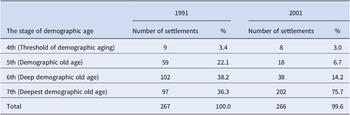
The settlement-level data provides a better analysis of regional differences concerning the intensity and spatial distribution of demographic aging. Data from 1991 indicate an unfavourable age structure of the population at the settlement level. Out of the total number of settlements, 36.3% were in the 7th and 38.2% in the 6th SDA. Only 10 years later, the age structure has deteriorated significantly. The number of settlements in the 7th SDA has doubled (as much as 75.7% of all settlements in the region) (table 3 and figure 3). Such data indicate that many areas of the Banija region have no demographic future.Footnote 15
Settlements by SDA in 1991 and 2001Footnote 14

Calculated by the authors according to data from the Croatian Bureau of Statistics

Results
To complete previous analyses of changes in ethnic and age structure, we have examined the effects of war conflict and postwar conditions on their interconnectedness. The first method we have used to examine the relationship between ethnicity and age structure in Banija was the comparison between the SDA of settlements, according to the criteria of ethnic domination (Serbs or Croats). The region had an ethnically heterogeneous population before the war, but most settlements were characterized by a high degree of ethnic homogeneity, with over 80% of one ethnicity. In 1991, there were as much as 235 or 88% of such settlements, which were ethnically homogenous. Using data at the level of ethnically homogeneous settlements, the age structure of both ethnicities can be indirectly analyzed.
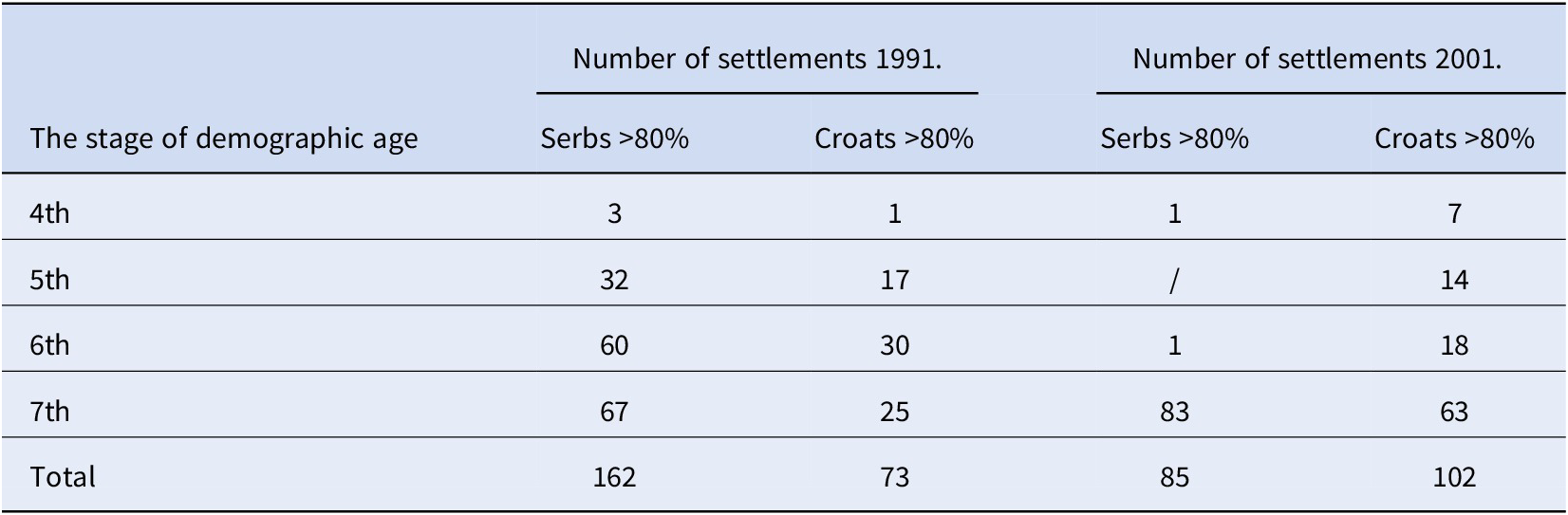
Banija entered the process of demographic aging even before the war and majority of settlements already were in the 6th or 7th SDA. This process involved settlements with both the Serb and Croat majority. About ¾ of Serbian and Croatian settlements were in the 6th and 7th SDA. Proportionally in the group of Serbian settlements, there were slightly more of them in the 7th SDA, and in the group of Croatian ones that are in the in the 6th. In the 5th SDA the relative share was almost equal, while in the 4th SDA there were only one Croatian and three Serbian settlements (table 4). These indicators confirm that until the war there were no significant differences in the population aging between the two ethnicities.

Ranking of settlements by SDA and ethnic majority in 2001 shows a significant change and a distinct difference from the 1991 data. Changes occurred in all three analyzed categories:
-
(1) the number of ethnically homogeneous settlements;
-
(2) the share of ethnically homogeneous settlements by ethnic groups;
-
(3) the distribution of settlements according to SDA.
The total number of ethnically homogeneous settlements remained high but decreased to 187 (70%). Out of 187 settlements, even 146 (78.1%) are in the 7th SDA. This is in line with the aging of the region’s population. Accordingly, there is a smaller number as well as smaller relative share of settlements in the 6th and 5th SDA. On the other hand, in the 4th SDA there was an increase (eight settlements or 4.3%). These changes did not occur uniformly in both ethnic groups. In 2001, the number of Croatian ethnically homogeneous settlements outnumbered Serbian settlements (101 compared to 86). Serbian population is extremely old and this is confirmed by the fact that 84 of the 86 Serbian settlements belonged to the 7th SDA. This data confirms the progressive aging process of the Serbian population. Also, majority of Croatian settlements are in the 7th SDA, but the concentration of Croatian population in the region in this group of settlements is relatively small (20.2%). Although the number of Croatian settlements increased in 4th SDA in 2001, our premise was that there was a more even distribution of settlements by SDA (table 4).Footnote 16
The initial hypothesis was partially confirmed by a comparative analysis of settlements by SDA. Correlation analysis is a more effective method in proving the hypothesis of an interdependence between ethnic and age structure. It applies to all settlementsFootnote 17, and each individual variable (average age and ethnic group share in the settlement’s population) can influence the outcome. Therefore, the result of the correlation of these two demographic characteristics is more accurate.
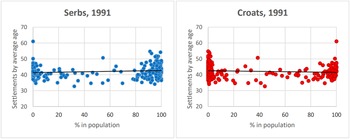
Based on data on the average age of the settlement and the relative share of both ethnicities in the settlement’s population from 1991, we calculated the correlation coefficient. In the case of Serbian population in Banija, the correlation coefficient (r) was 0.1375, and for Croatian population it was -0.1072. Both data fall into the domain of low, insignificant correlation. The data obtained show that in 1991 there was no correlation between the average age of settlements and the share of a particular ethnicity. This proves that the demographic characteristics of Serbs and Croats in Banija did not differ in that period. The correlation coefficient for the Serbs is positive and for the Croats negative. Due to the lack of correlation among the observed variables, determining the correlation as positive or negative is irrelevant for the research. The analysis is presented in figure 4.
Settlements by Average Age and Ethnic Share of Serbs and Croats in 1991

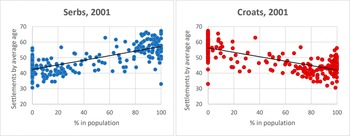
According to the 2001 census, the correlation coefficient between Serbian population and the average settlement’s age is 0.7257. The strength of the correlation is characterized as strong. In addition, the correlation is positive. This means that the increase in the share of Serbs in the ethnic structure of a settlement is accompanied by an increase in the average age of the same settlement. A strong correlation is also confirmed with Croatian ethnicity. The correlation coefficient is slightly higher than that of Serbs and is -0.7334. The correlation is negative, hence, the increase in the share of Croats in the ethnic structure of the settlement is matched by a decrease in the average age of the settlement (figure 5). Initial hypothesis about the interdependence between a larger share of Serbs in the population and a higher average settlement age, that is, a higher share of Croats and a lower average settlement age, is largely confirmed. Based on a strong correlation, we expect that Serbian population is older than Croatian population even in ethnically heterogeneous villages and urban centers.
Settlements by Average Age and Ethnic Share of Serbs and Croats in 2001

Conclusion
Banija is one of the regions that have suffered significant negative socio-economic consequences of the war. Forced migration of the Croats in the first years of the war, and as well as forced migration of the Serbs at the end of the war, had a strong impact on the bio-dynamic of the population of the Banija region. We should take into account that unfavourable demographic trends had already started in the decades prior to the war (Mišetić Reference Mišetić2002; Matas Reference Matas2004). The magnitude of negative demographic features was recorded in the first postwar census in 2001. The return of Croat and Serb refugees and the settlement of Croats from Bosnia and Herzegovina could not revitalize the unfavorable demographic trends in the region.
The aim of this article was to analyze changes in ethnic and age structure during only one inter-census period in the context of a hypothesis that the average age of a settlement is in correlation with the share of particular ethnic group (Serbs or Croats).
Results of our research confirmed that the intensity of aging varies between the Croats and Serbs. Ethnicity and age structure are correlated – settlements populated by Croats are younger than Serb-dominated settlements and vice versa. The obtained results undoubtedly confirm that Serbs are in the most advanced phase of aging. Their share in the reproductive population is smaller than their share in the total population. This makes them more susceptible to the process of assimilation, which, in addition to higher mortality, further intensifies the biological regression of the Serbian community. Analysis regarding SDA did not fully support the hypothesis because of our expectation that in 2001 most settlements with a dominant Croat-majority would not be found in the 7th SDA. This is only in line with the general aging of the population, which also affected the Croats. However, the results of the correlation analysis clearly confirmed the hypothesis.
The main explanation for these changes in the postwar period lies in the two fundamentally different immigration processes: (1) the return of the indigenous Croats and settling of the Croatian population from Bosnia and Herzegovina and (2) the incomplete return migration of the Serbs. Numerous existential problems burden all residents of Banija region, but many of them are more pronounced among the Serbian population. This has caused insufficient return of the Serbs, who were a dominating pre-war ethnicity, as well as intensified the negative demographic processes in the whole region. Several factors influenced the poor return of Serbs or their re-departure from Banija: endangered security (interethnic conflicts), arrests, confiscated property, poor economic situation (devastated economy), lack of basic living conditions, discrimination in the field of justice, employment, settlement-housing issues, achieving the right to pension insurance, to return to work, to get recognition for years of service, etc. (HRW 2003, 2006; Pupovac and Milošević Reference Pupovac and Milošević2007; Koska Reference Koska2008; Mesić and Bagić Reference Mesić and Bagić2010, Reference Mesić and Bagić2011; Gjenero Reference Gjenero2012). While the return of Croats and the settlement of Croats from Bosnia and Herzegovina were stimulated, state institutions long prevented the return of Serbs. They tolerated the destruction of religious sites and the destruction and illegal seizure of refugee property (houses, apartments, apartments over which Serbian returnees had tenancy rights, agricultural land, and other objects). The reconstruction of demolished houses was slow in the first postwar years. Some Serbian villages were without electricity and water even in the first years of the 21st century, which was also a way of obstructing return. Significantly fewer Serbs than the number expelled have returned and accepted living in such a socio-economic environment. Also, during the first years of refugee life in Serbia and Bosnia and Herzegovina (Republic of Srpska), certain refugee groups, mostly younger people, managed to provide basic living conditions and integrate into the new society (Mesić and Bagić Reference Mesić and Bagić2008, Reference Mesić and Bagić2010, Reference Mesić and Bagić2011). Security and political conditions for the return of Serbs started to improve after 2000. More intense redevelopment of the property began after 2002 (HRW 2003; Pupovac and Milošević Reference Pupovac and Milošević2007) and a larger part of the seized property had been returned to the owners after 2003, but Mesić and Bagić (Reference Mesić, Bagić, Ramet and Valenta2016, 222) point out that “the potential for Serb return was mainly exhausted by then.”
According to Frankenberg and Thomas, “Global aging represents one of the most remarkable triumphs of mankind and, at the same time, poses one of the greatest challenges for society” (Reference Frankenberg, Thomas, Binstock and George2011, 86). However, the positive factors are not the reason why the “triumph of the humanity” is taking place in the region of Banija. All these factors, as evidence of unequal living conditions, had influenced the ethnic and age structure in the postwar period. Differentiation of aging by ethnicity became one of main contemporary demographic characteristic of the region. Unfavourable economic and historical factors predetermined a more intense aging of the population of Banija. These factors had a greater impact on the Serbian population compared to the Croats. This study indicates that the demographic development of the population of Banija is not optimistic, especially regarding the demographic future of the Serbian minority. The discriminatory policy in the early postwar period, which is the most important for the success and sustainability of return migration, has decisively influenced the extremely unfavourable age structure of Serbian returnees. The consequences are far-reaching, as the impaired demographic structure threatens the socio-economic development and future of the entire region, and thus all its inhabitants, regardless of ethnicity.
Disclosures
None.
Financial Support
This article is a part of the project “Development Programs of Revitalization of Serbia Villages,” No. OI176008, funded by the Ministry of Education, Science, and Technological development of the Republic of Serbia.