The transmission of bloodborne pathogens during standard medical procedures resulting from improper injection practices by healthcare workers continues to occur throughout the United States.Reference Comstock, Mallonee and Fox 1 – Reference Thompson, Perz, Moorman and Holmberg 4 According to the Centers for Disease Control and Prevention (CDC), more than 50 outbreaks of viral (hepatitis B and C) and bacterial infections in the United States have stemmed from unsafe injection practices since 2001. 5 Among these outbreaks, 90% occurred in ambulatory settings, despite available national guidelines on safe injection practices. 5 , Reference Siegel, Rhinehart, Jackson and Chiarello 6 A persistent issue is the use of single-dose vials (SDVs) for multiple patients.Reference Siegel, Rhinehart, Jackson and Chiarello 6
An SDV is intended for use in a single patient for a single injection. 5 SDVs lack antimicrobial preservative and are intended to be discarded after the single use. A multiple-dose vial (MDV) can be used more than once because it contains antimicrobial preservative that limits the growth of bacteria. 5 An MDV should be dedicated to a single patient whenever possible, but it can be used for >1 patient if (1) it is dated when first punctured, (2) it is discarded within 28 days unless otherwise specified on the manufacturer label, and (3) it is stored and accessed in a dedicated medication preparation area. 5 , 7
Injection safety protocols have been released by the CDC, but they are not always followed.Reference Siegel, Rhinehart, Jackson and Chiarello 6 – Reference Thompson, Bowdey, Brett and Cheek 8 Moreover, 6% of US healthcare workers have admitted to knowingly using an SDV for >1 patient. 5 The gap between evidence and practice needs to be closed; however, there remains a paucity of data regarding the challenges in implementing safe injection practices in ambulatory care. Thus, we undertook an assessment of injection safety in ambulatory care.
METHODS
We conducted direct observations at 31 university-affiliated ambulatory clinics around the Madison, Wisconsin, area during June and July 2016. The sample area comprised 14 primary care and 17 specialty care clinics that were representative by location and services of the organization’s 38 primary care and 114 specialty care clinics. We collected data using elements from the CDC’s One and Only Injection Safety Checklist. 7 Principal items for observation at the 31 clinics included location of vial storage, presence of opened vials, and presence of proper dating of opened vials.
An online survey approved by our organization’s Nursing Research Council Survey Subcommittee was developed to assess injection practices witnessed during on-site observations and to gauge healthcare workers’ knowledge and perceptions. We distributed the survey link via e-mail to managers of the 31 clinics with a request to further distribute it to healthcare workers of each clinic. The survey was active for 2 weeks. Survey responses were analyzed using STATA software version 14 (StataCorp, College Station, TX). Categorical variables were compared using χ2 analysis. We conducted Bonferroni correction when multiple comparisons were made. Statistical significance was set at P≤.05. The project was considered a quality improvement study and was exempt from IRB review.
RESULTS
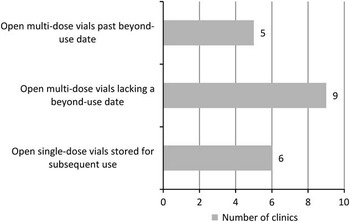
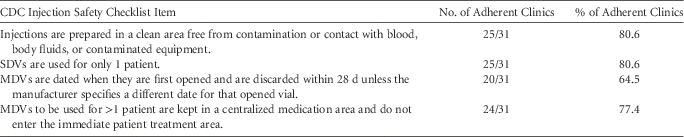
We observed healthcare providers at 31 ambulatory clinics: 14 clinics provide primary care and 17 provide specialty care. Improper use of vials was observed at 13 clinics (41.9%). Open SDVs that had already been used for a patient were being stored for subsequent use at 6 clinics (19.4%) (Figure 1). The most commonly noted deviation from the CDC Injection Safety recommendations was in the proper dating and discarding of MDVs (Table 1). Medication vials that were found to be in a noncompliant state included vials containing dextrose, sodium bicarbonate, sodium chloride, sterile water, bupivacaine HCl and epinephrine, and lidocaine.
Noncompliant Clinics by Observation Category (Total Clinics=31).

Adherence to Centers for Disease Control and Prevention (CDC) Safe Injection Practices Assessed by Direct Observation at 31 Clinics

NOTE. SDV, single-dose vial; MDV, multiple-dose vial.
Of 412 healthcare workers who received the survey request, 168 completed the survey, for a 40.8% response rate. The respondents were 78 nurses (46.4%), 66 medical assistants (39.3%), and 24 physicians and advance practice providers (14.3%). Most respondents (n=155; 93.4%) correctly answered that SDVs can be used for only 1 patient; nearly all (n=155; 93.4%) responded that there were no barriers to disposing of SDVs after a single use. More than half of survey participants (n=96; 57.5%) responded that MDVs contain a higher volume of medication than SDVs, which is not always true, and nurses were significantly more likely to register this response than were medical assistants (67% vs 46%, respectively; P = .04) (Appendix 1). In addition, 27 respondents (17.1%) admitted to storing open vials in the immediate patient treatment area rather than a centralized medication area.
DISCUSSION
The most notable finding of this investigation was the presence of open SDVs that were being stored for subsequent use at 6 clinics, although the majority (93.4%) of survey respondents indicated that there were no barriers to disposing of SDVs after 1 use. We speculate that the reason for open SDVs is lack of knowledge or training. Most respondents, and nurses more often the medical assistants, believed that MDVs contain a higher volume of medication than SDVs. This finding implies that healthcare workers may see a high-volume vial and assumed that it is for multiple uses without checking the label. The CDC recommends that clinics store MDVs to be used for >1 patient in a centralized medication area. 7 This recommendation was followed by most of the clinics observed; however, stored open vials were stored in procedure or treatment rooms in 7 clinics.
We recommend that clinics work with pharmacy to order smaller vial sizes, prefilled syringes, and SDVs whenever possible. Small vial sizes reduce confusion, and prefilled syringes eliminate the need for a vial entirely. SDVs are easier to store and use correctly because they do not need to be dated or initialed.
Furthermore, organizations need a universal method of dating open vials that applies to all MDVs in all clinics. We recommend a sticker with a designated spot for an expiration date and the healthcare worker’s initials.
A lack of medication storage space may have contributed to lapses in storage practices. Institutions should consider the use of rooms dedicated to medication storage and preparation when designing and constructing new clinics to decrease the possibility of contamination.
Finally, education of healthcare workers is key to successful implementation of safe injection practices. Active implementation and dissemination using materials, such as those provided by the CDC’s “One and Only” campaign adapted to the local context, may be of value.
Other studies on this topic have reported similar findings.Reference Thompson, Bowdey, Brett and Cheek 8 , Reference Pugliese, Gosnell, Bartley and Robinson 9 As we have outlined and others have concluded, maintaining safe injection practices requires education, robust surveillance, oversight, and the ability to enact change when issues are identified. 5 , Reference Siegel, Rhinehart, Jackson and Chiarello 6 , Reference Pugliese, Gosnell, Bartley and Robinson 9 , Reference Birkhead, Hamilton, Kossover, Perz, Gangadharan and Iskander 10
Our study has several limitations. Observations were announced prior to arriving on site; therefore, clinics could potentially have altered vial storage or remove noncompliant vials prior to the study. The survey and on-site observations of healthcare workers were subject to reporting bias. In addition, for any survey, social desirability bias may affect the answers that respondents select. The healthcare workers answering the survey likely knew the ‘best’ answer and were probably more likely to deviate their response toward that answer and away from the truth. This hypothesis emphasizes the necessity of on-site observations. While observations were made in various clinical spaces, very few healthcare workers were observed drawing up medications during these short visits. Given the relatively short observation time per clinic, we did not observe practices such as injections or other procedures.
In summary, our study shows that complementary methods of data collection, including direct observations, are useful for examining ambulatory infection prevention practices. In the ambulatory setting, challenges to the implementation of safe injection practices exist. Future studies should explore interventions that address these challenges to sustainably embed safe injection practices in the ambulatory setting.
Acknowledgments
Financial support: No financial support was provided relevant to this article.
Potential conflicts of interest: All authors report no conflicts of interest relevant to this article.
SUPPLEMENTARY MATERIAL
To view supplementary material for this article, please visit https://doi.org/10.1017/ice.2017.31