Oviposition by wheat midge, Sitodiplosis mosellana (Géhin) (Diptera: Cecidomyiidae), on spikes of wheat, Triticum aestivum L. (Poaceae), varies depending on wheat genotype and developmental stage (Ding and Lamb Reference Ding and Lamb1999; Lamb et al. Reference Lamb, Smith, Wise and Clarke2001, Reference Lamb, Wise, Smith, McKenzie, Thomas and Olfert2002, Reference Lamb, Sridhar, Smith and Wise2003; Gharalari et al. Reference Gharalari, Fox, Smith and Lamb2009b). No morphological traits have been found that account for oviposition preferences, and females are thought to use fine-scale features and surface chemicals, including volatile compounds, to select oviposition sites (Lamb et al. Reference Lamb, Smith, Wise and Clarke2001; Ganehiarachchi and Harris Reference Ganehiarachchi and Harris2009; Gharalari et al. Reference Gharalari, Smith, Fox and Lamb2009a). Female S. mosellana are attracted by volatile compounds from preanthesis wheat spikes (Birkett et al. Reference Birkett, Bruce, Martin, Smart, Oakley and Wadhams2004), and female Hessian flies, Mayetiola destructor (Say) (Diptera: Cecidomyiidae), are attracted by a combination of two chemicals in the surface waxes of wheat leaves, at least one of which is volatile (Harris and Rose Reference Harris and Rose1990; Foster and Harris Reference Foster and Harris1992). In this study, we tested the hypothesis that volatile compounds released by wheat spikes affect oviposition by S. mosellana and contribute to the reduced oviposition on some wheat genotypes and growth stages.
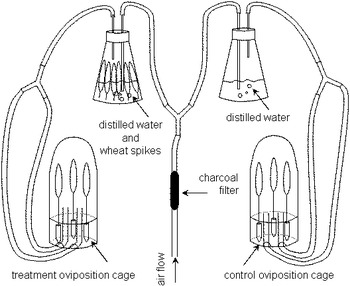
We used wheat midges obtained from laboratory cultures maintained on ‘Roblin’ spring wheat, an attractive and susceptible wheat cultivar (Lamb et al. Reference Lamb, McKenzie, Wise, Barker and Smith2000, Reference Lamb, Smith, Wise and Clarke2001). The test lines were ‘Roblin’ and ‘Key 10’, a wheat line shown to have oviposition deterrence and antibiosis resistance to wheat midge relative to preferred wheats. Wheat plants were grown hydroponically in artificial soil in individual tubular plastic pots in controlled-environment cabinets (Ding and Lamb Reference Ding and Lamb1999). Tests were carried out in a controlled-environment room at 20 ± 3°C, 45%–70% RH, and 20L:4D photoperiod. The light period included dawn and dusk intervals of 2 h during which light intensity changed gradually, simulating natural conditions for wheat midge females, which oviposit at dusk. The experimental apparatus (Fig. 1), secured to a Styrofoam block, consisted of two 250 mL Erlenmeyer flasks containing 100 mL of distilled water to provide the treated and control humidified air streams and two oviposition cages, each consisting of a clear plastic bottle (22 cm tall × 11 cm diameter) fitted on the top of a clear plastic 250 mL container. All parts were connected to each other with clear polyethylene tubing, 0.8 cm diameter, with incoming air provided by an air pump and filtered through granular charcoal. All parts of the system, including flasks, were rinsed with 75% ethanol and then with distilled water before assembly and between tests, and flasks were refilled with distilled water.

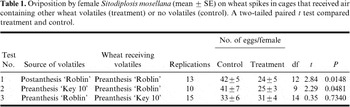
At the beginning of each test, six preanthesis wheat spikes (Zadoks growth stage 57–59, Zadoks et al. Reference Zadoks, Chang and Konzak1974) of either ‘Roblin’ or ‘Key 10’ (Table 1) were excised 20 cm below the terminal spikelet and placed in floral water piks (Smith and Lamb Reference Smith and Lamb2001). Three of these were placed in each cage to serve as oviposition sites. Three female (24–48 h old) and three male wheat midges were released into each cage. The source of volatiles for treatments was 20 wheat spikes of ‘Roblin’ or ‘Key 10’ (Table 1), excised and placed base-down in one of the flasks. Immediately after release of the females into a cage, the air valve was opened to a marked position so all experiments received the same amount of air. Wheat spikes were exposed to ovipositing females for 2 nights, corresponding to the peak oviposition period, and then removed from the cages and dissected under a stereomicroscope to record egg numbers. Replicates of each test were done sequentially and completed before the next test was run.

Numbers of eggs per female for replicate treatments and controls in each test were compared using a two-tailed paired sample t test (PROC TTEST, SAS version 9.1.3, SAS Institute Inc. 2002) after checking data for normality. Differences between experimental treatments were considered significant at P ≤ 0.05.
In test 1, preanthesis ‘Roblin’ spikes treated with postanthesis ‘Roblin’ volatiles had fewer eggs per female than the untreated preanthesis ‘Roblin’ control (Table 1). In test 2, preanthesis ‘Roblin’ spikes treated with preanthesis ‘Key 10’ volatiles had fewer eggs per female than the untreated preanthesis ‘Roblin’ control (Table 1). In test 3, wheat midge oviposition rate on preanthesis ‘Key 10’ spikes did not differ between treatment (preanthesis ‘Roblin’ volatiles present) and control (no volatiles) (Table 1). All tests were conducted with excised spikes; previous tests have demonstrated that wheat midge females show the same oviposition preferences on excised and intact spikes and in the field (Smith and Lamb Reference Smith and Lamb2001).
This study supports the hypothesis that volatile compounds from wheat spikes influence oviposition by female S. mosellana. Volatile compounds released from postanthesis wheat spikes, the less-preferred growth stage of ‘Roblin’, (test 1) or preanthesis spikes of the less-preferred wheat line, ‘Key 10’ (test 2) reduced oviposition on preanthesis ‘Roblin’ wheat spikes, which usually are preferred oviposition sites. Volatiles from wheat spikes of the preferred ‘Roblin’ added to a cage containing spikes of less-preferred ‘Key 10’ (test 3) failed to increase oviposition compared with the control, and so did not act as a stimulant.
Volatiles released by preanthesis susceptible wheat spikes are attractive to S. mosellana (Birkett et al. Reference Birkett, Bruce, Martin, Smart, Oakley and Wadhams2004). Volatiles probably also stimulate oviposition once females are on the spikes because females increase probing and oviposition on barley, Hordeum vulgare L. (Poaceae), a less-preferred host, in the presence of wheat (Ganehiarachchi and Harris Reference Ganehiarachchi and Harris2007). Stimulatory volatiles may be the cues that females use to find potential hosts and initiate oviposition. However, a lack of stimulatory volatiles is not likely the cue that females use to avoid less-preferred genotypes or growth stages associated with crop resistance because adding such a cue did not increase oviposition on the less-preferred genotype, as it did for barley (Ganehiarachchi and Harris Reference Ganehiarachchi and Harris2007). Conversely, volatiles produced by less-preferred genotypes and growth stages do reduce oviposition on preferred genotypes and growth stages. Stimulatory and deterrent volatiles, or mixes of volatiles, may play a role in the complex array of cues that wheat midge females use when selecting oviposition sites. Future investigations of the properties of these volatiles would be necessary to elucidate their functions in oviposition behaviour of S. mosellana.
We thank S. Wolfe for technical assistance. Financial support from the Ministry of Agriculture of Iran and the Ministry of Science, Research and Technology of Iran to the senior author and from Agriculture and Agri-Food Canada is gratefully acknowledged.