Introduction
In tribal societies, the custom of close kin marriage has been transmitted from one generation to the next for thousands of years and currently involves about 1.1 billion people worldwide (Bittles, Reference Bittles2012). Humans transmit adaptive traits via genetic and epigenetic factors, as well as through the cultural and language systems of inheritance (Jablonka & Lamb, Reference Jablonka and Lamb2014). It is generally assumed that tribal consanguinity is a maladaptive marital trait transmitted via a cultural system of inheritance and that it is associated with socioeconomic underdevelopment, poor education and a low level of social security, which are often presumed to be its causes (Khlat, Reference Khlat1997).
Since the discovery of oil in the United Arab Emirates (UAE) in the 1960s the country has experienced a dramatic economic boom, with the illiteracy rate declining dramatically and higher education greatly improving (Abdel Majid et al., Reference Abdel Majid, Abu-Khalid, Al-Amin, Al-Azmeh and Al-Banna2003; World Bank, 2008). In 2012 its GDP (purchasing power parity) was US$49,800 per capita, which was one of the highest in the world (CIA, 2013). Nonetheless, native UAE society is tribal, with an estimated 67 kinship groups and subgroups (Heard-Bey, Reference Heard-Bey2001). All marriages are arranged, and up to half of them are between close cousins (Al-Gazali et al., Reference Al-Gazali, Bener, Abdulrazzaq, Micallef, Al-Khayat and Gaber1997; Denic et al., Reference Denic, Aden, Nagelkerke and Essa2013). The situation is similar in other rich Gulf Arab countries (El-Mouzan et al., Reference El-Mouzan, Al-Salloum, Al-Herbish, Qurachi and Al-Omar2007; Sandridge et al., Reference Sandridge, Takeddin, Al-Kaabi and Frances2010). These observations do not support the socioeconomic model of human inbreeding, i.e. its explanation by poverty, lack of education and social insecurity. To gain new insights into the sociobiology of human inbreeding, this study was conducted to examine the characteristics of consanguineous and non-consanguineous families from the relatively higher socioeconomic strata of a rich tribal society.
Methods
In 2013 in the College of Medicine and Health Sciences at UAE University, Al Ain, Abu Dhabi, 491 medical students (349 females and 142 males) were invited to participate in a survey using a self-administered electronically mailed questionnaire. Responders (268, 54.6%) provided data on age, sex, social status, type of marriage and number of family members. The number of students recruited from each of the seven emirates was proportional to the respective population sizes. Analysis was carried out on the 217 participants who provided sufficient data. The social status of the participants’ families was determined using a five-point Likert-type scale in which participants could indicate their status as very high, relatively high, mid-level, relatively low or very low. In addition, they were asked whether in their families it was more difficult to arrange a marriage for a son or for a daughter. Marriage was defined as consanguineous if parents were reported to be cousins (double first cousins, first cousins, first cousins once removed, second cousins or more distant cousins). The mean coefficient of inbreeding (F) was calculated as an average of coefficients of inbreeding for each family as follows: double first cousin, 0.125; first cousin, 0.0625; first cousin once removed, 0.03125; non-cousin, →0. For second and more distant cousin unions, the coefficient of inbreeding was estimated as half of that for a second cousin union, i.e. 0.0078125. Family size was defined as the number of children per mother. Polygamy was defined as any instance of more than one marriage at any time during the lifetime of a parent. It included serial polygamy of men and women (marriage after divorce or death of a partner) and parallel polygamy of men (simultaneous multiple marriages). The survey was designed by the authors and executed using a commercial provider of surveys (https://www.surveymonkey.com/). The study was approved by the Al Ain Medical District Human Research Ethics Committee, Al Ain, Abu Dhabi, UAE (Protocol No. 12/43).
The survey data were exported to the SPSS program (Windows, Version 20.0) for statistical analysis. The frequencies of responses to the questions are presented as numbers and percentages. Missing data were not imputed. The differences between groups were compared using Pearson’s chi-squared test and the non-parametric Mann–Whitney U-test where appropriate. A two-tailed p-value of <0.05 was considered to be statistically significant.
Results and Discussion
Out of the 217 families, 79 (36%) were unions between cousins (double first cousins, 9; first cousins, 37; first cousins once removed, 5; second and more distant cousins, 28) and the mean coefficient of inbreeding was 0.018. This consanguinity rate is high considering that in 1981, before most of the parents of the study participants were married, the country’s GDP reached US$36,700 per capita (CIA, 2013). On the other side, it is lower than that in general population (50%) two decades ago (A-Gazali et al., 1997). Consanguinity rates are generally higher in less privileged than in privileged social strata of society (Bittles & Neel, Reference Bittles and Neel1994; Jurdi & Saxena, Reference Jurdi and Saxena2003). In the current study, no significant difference (p=0.57) was found between the socioeconomic status of the non-consanguineous and consanguineous families: (i) high and relatively high status 32.2% (n=36) vs 39.7% (n=25); (ii) mid-level status 65.2% (n=75) vs 58.7% (n=37); (iii) relatively low and very low status 2.6% (n=3) vs 1.6% (n=1), respectively.
In any population, social status distribution is pyramidal, but it is not so in this study group, which has a relatively higher than average social status. A recent review of family social status and social mobility has shown that profession and education are strong determinants of social status and that they are transmitted from parents to offspring. Additionally, social status changes little over generations, especially in endogamous tribal societies like that of the UAE (Clark et al., Reference Clark, Cummins, Hao and Vidal2014). Although this study relied only on self-declared social status, the fact that the family of each participant in the current study had offspring in the most prestigious medical school in the region predicts that family social status is more likely to be higher than the national average (as the results show). This explains the above discrepancy between consanguinity rates in the current study population and the general population (Al-Gazali et al., Reference Al-Gazali, Bener, Abdulrazzaq, Micallef, Al-Khayat and Gaber1997). Today, in the general population the consanguinity rate is lower (36%, same as in the current study) than two decades earlier (50%), but the mean coefficient of inbreeding (0.022) is unchanged (Al-Gazali et al., Reference Al-Gazali, Bener, Abdulrazzaq, Micallef, Al-Khayat and Gaber1997; Denic et al., Reference Denic, Aden, Nagelkerke and Essa2013). This apparent paradox is probably due to increased family size, better survival to marriageable age and a stronger preference for first cousin than more distant cousin marriage in the population. Saudi Arabia, Qatar and Kuwait, which are rich in oil and natural gas, have similarly high rates of cousin marriages; only oil-rich Bahrain has experienced a decline of inbreeding (El-Mouzan et al., Reference El-Mouzan, Al-Salloum, Al-Herbish, Qurachi and Al-Omar2007; Sandridge et al., Reference Sandridge, Takeddin, Al-Kaabi and Frances2010; Al-Arrayed & Hamamy, Reference Al-Arrayed and Hamamy2012). Likewise, slower socioeconomic development over longer periods in other Middle Eastern countries has not changed consanguinity rates much (Jurdi & Saxena, Reference Jurdi and Saxena2003). Overall, the findings here do not support the socioeconomic model of consanguinity.
Parents’ marriages
Family size
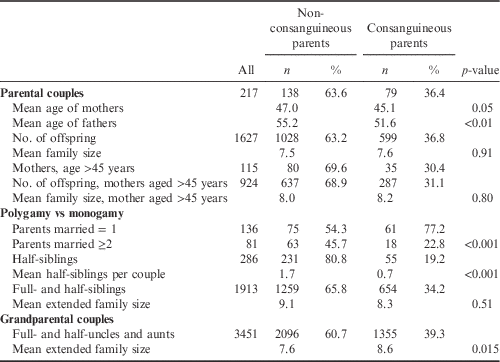
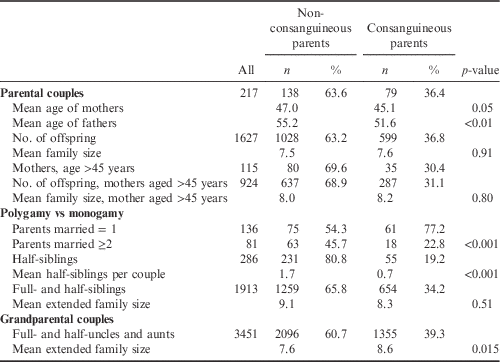
Family size is a measure of parental fitness, and in this study the mean sizes of non-consanguineous and consanguineous families were both about 7.5 children per mother (Table 1). Women marrying close kin married earlier than those marrying non-kin, and consanguineously married women had longer reproductive periods (Bittles, Reference Bittles1994), as evidenced here by their younger age (Table 1). Younger women had fewer and younger offspring. Therefore, the mean family size of mothers after the end of their reproductive period (age >45 years) was re-calculated, and again it did not differ significantly (p=0.80) between the non-consanguineous (8.0) and consanguineous (8.2) families. This finding is in general agreement with the results of other studies, which have shown that, overall, consanguinity does not affect fertility (Bittles, Reference Bittles2001).
Offspring, polygamy and size of families of biologically unrelated and related parents in the UAE
Polygamy
Table 1 shows that non-consanguineous parents had multiple marriages twice as often as consanguineous parents (46% and 23%, respectively; p<0.001). In general, polygamy is more common among the higher strata of society (Chamie, Reference Chamie1986), but in the current study the two parental groups were of similar social status, so this could not have caused the difference. Consanguineously married fathers were on average younger (Table 1), which could have caused a lower rate of polygyny. Among fathers aged 55 years or more, the polygamy rate was again higher among non-consanguineous couples (63%, 38/60) than among consanguineous couples (45%, 10/22), but the difference did not reach statistical significance (p=0.16).
Polygamy is related to the ability of a married man and his family to find and attract another spouse, and to the ability of a woman and her family to find and attract a married man. A lower frequency of polygamy among consanguineous parents could indicate that they are less capable of getting another spouse. Polygamy is common in many consanguineously marrying societies (Chamie, Reference Chamie1986; Sueyoshi & Ohtsuka, Reference Sueyoshi and Ohtsuka2003; Tadmouri et al., Reference Tadmouri, Nair, Obeid, Al Ali, Al Khaja and Hamamy2009; Bittles, Reference Bittles2012), but there seems to be no other comparative studies of polygamy in non-consanguineous and consanguineous families in tribal populations. In small and isolated societies, the mean number of wives per man was positively correlated with a higher coefficient of relatedness between the spouses (Walker & Bailey, Reference Walker and Bailey2014). In large-scale societies such as UAE, the relatedness of polygamous men to their wives is unknown.
The participants from non-consanguineous families had on average more half-siblings (1.7 per parental couple) than participants from consanguineous families (0.7) (p<0.001) (Table 1). This is expected from the observed rates of polygamy in the two groups of parents. However, this could have been due to the significantly different mean ages of the fathers in the two groups. Therefore, the numbers were re-calculated for older couples (father’s age ≥55 years). Non-consanguineous families still had on average more half-siblings (2.9; 172/60) than consanguineous families (1.6; 36/22) (p=0.06). This suggests that polygamy, not age, is the likely cause of the higher number of half-siblings in non-consanguineous families. The offspring from other marriages increased the extended non-consanguineous family size by an estimated 7% over the size of extended consanguineous families. This indicates that non-consanguineous parents are relatively fitter than consanguineous parents, which is in contrast to the determination of fitness based on the size of their nuclear families, which showed them to have equal fitness (Table 1).
Based on the numbers of full-siblings (1627) and half-siblings (286) (Table 1), 15% of all cousins were half-cousins. Half-cousin unions are rarely described in consanguinity studies and none was observed in the current study. On the other hand, in one highly polygamous African population, half-kin marriages were found to be more common than full-kin marriages (Scott-Emuakpor, Reference Scott-Emuakpor1974). In a study from the Middle East, 8% of all marriages were between half-cousins (Sandridge et al., Reference Sandridge, Takeddin, Al-Kaabi and Frances2010). The rarity of half-kin unions in some studies could be due to misclassification, cultural preferences, low-odds of their random union, mutual dislike or some other factor. Half-cousin unions produce 50% less inbred offspring than full-cousin unions, and correctly determining the biological relationship of parents is important. More studies are needed on the frequency of polygamy and half-cousin unions in consanguineously marrying populations.
Offspring marriages
Marriageability of offspring
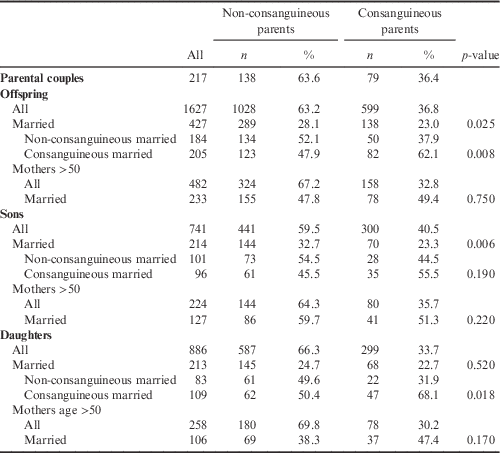
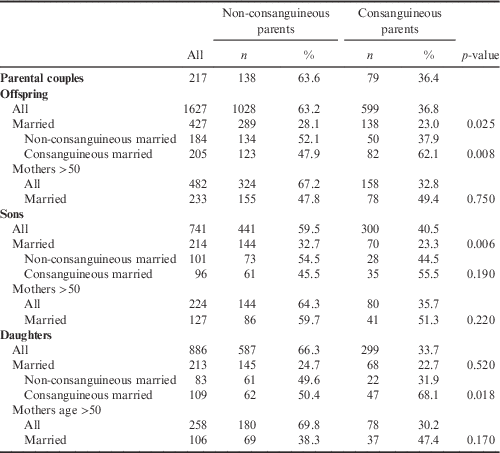
At first sight consanguineous parents appear to have difficulty finding mates for their progeny more frequently (44.3%; 35/79) than non-consanguineous parents (29.0%; 40/138) (p=0.025). Table 2 shows the numbers of marriages of offspring of non-consanguineous and consanguineous parents. Overall, fewer offspring of consanguineous parents were married (23%) than those of non-consanguineous parents (28%) (p=0.025). The observed offspring marriageability difference could have been caused by the younger age of the offspring in consanguineous families due to the younger age of the mothers (Table 1). Re-analysis of the marriage rates for the offspring of mothers who were >50 years old indeed showed no statistically significant difference between the two groups: 48% and 49%, respectively (p=0.75). This indicates that the consanguineous parents managed to overcome any difficulty in finding spouses for their offspring by selecting a spouse for their offspring from within their extended family. This possibility was tested by determining the rates of cousin marriages among the offspring of consanguineously and non-consanguineously married parents.
Marriages of offspring of biologically unrelated and related parents in the UAE
Parental consanguinity predicts offspring consanguinity
Table 2 shows that consanguineous parents arranged cousin marriages for their offspring more often than non-consanguineous parents (62% and 48%, respectively; p=0.008). This difference existed for sons (55% and 45%, respectively, p=0.190) as well as for daughters (68% and 50%, respectively; p=0.018). The odds ratio of consanguineous parents having consanguineously married offspring compared with non-consanguineous parents was 1.78 (95% CI 1.1−2.8, p=0.008). In another study on the same population, the odds of consanguineous parents having consanguineously married sons and daughters were found to be 1.3 and 1.1, respectively (Denic et al., Reference Denic, Nagelkerke and Agarwal2010). This propensity of parental consanguinity to lead to offspring consanguinity has been observed by others (Barbour & Salameh, Reference Barbour and Salameh2009). Thus, the current findings and those of others suggest that consanguinity is, in part, transmitted from parents to offspring.
Grandparental generation
The size of the families of the participants’ grandparents was estimated from the numbers of full- and half-uncles and aunts of the participants (Table 1). The average grandparent family size in the consanguineous parent group (8.6) was larger than in the non-consanguineous parent group (7.6) (p=0.015). Thus, in contrast to the current generation, in the grandparental generation extended consanguineous families were bigger than extended non-consanguineous families. This reversal of relative fitness might be explained as follows. Before the economic boom in the country, consanguineous families provided better support (when support was more needed) to their offspring than non-consanguineous families, which resulted in larger families (Denic et al., Reference Denic, Nagelkerke and Agarwal2010). Several theoretical, animal and human studies have shown that, given the right conditions, inbreeding may sometimes increase relative fitness (Theodorou & Couvet, Reference Theodorou and Couvet2006; Denic et al., Reference Denic, Nagelkerke and Agarwal2008; Helgason et al., Reference Helgason, Pálsson, Guðbjartsson and Stefánsson2008). For example, in theory, inbreeding accelerates selection of recessive beneficial alleles, increases the frequency of protective genotypes (such as alpha-thalassaemia, which is common in the study population), and increases survival in a given environment (such as during the time of heavy malaria infestation, which was endemic in UAE until one generation ago) (Denic et al., Reference Denic, Nagelkerke and Agarwal2008). Finally, the inter-generational reversal of relative fertility of inbred and outbred families observed here might explain in part the conflicting results of fertility studies in consanguineous societies living under different environmental conditions (Bittles et al., Reference Bittles, Grant, Sullivan and Hussain2002).
Limitations of the study
An effect of unwitting selection bias cannot be excluded. Moreover, although participants were asked to recall major events in the lives of their close family members, recall bias cannot be excluded either. To avoid possible gender bias (asymmetry in recall from mother’s versus father’s side of the family), the numbers of family members from both sides of the families were combined in all the analyses. Similarly, it is difficult and unreliable to recall information from the distant past. To avoid time recall bias, comparisons of parental groups were limited to within the same generation. Studies from other consanguineously marrying societies are needed to confirm the findings reported here.
Conclusion
In these families of relatively high socioeconomic status in this rich tribal society, consanguineously married individuals are less polygamous and have more difficulty marrying their offspring than non-consanguineously married individuals. Consanguineous parents arrange kin marriages for their offspring more often than non-consanguineous parents, suggesting that marital behaviour is transmitted from parents to offspring. The size of consanguineous families relative to non-consanguineous families is smaller in the current generation than it was in the pre-economic-boom generation.
Acknowledgment
The authors acknowledge the useful comments of the anonymous reviewers in the preparation of this paper.