Introduction
Eggplant (Solanum melongena L.) is an economically important solanaceous vegetable crop, which is widely grown in tropical, subtropical and warm temperate regions (Sihachakr et al., Reference Sihachakr, Daunay, Serraf, Chaput, Mussio, Haicour, Rossignol, Ducreux and Bajaj1994). The world production was estimated at 30.5 Mt in 2005, and China and India are among the main producers, with 18.0 and 8.2 Mt, respectively (FAO, 2005). The cultivated eggplants include three main species of the family Solanaceae and the subgenus Leptostemonum: S. melongena (aubergine, eggplant, brinjal), which is commonly grown in Asia, America and Mediterranean countries, S. aethiopicum (scarlett eggplant) and S. macrocarpon (gboma eggplant), which are mainly cultivated in Africa (Daunay et al., Reference Daunay, Lester, Ano, Charrier, Jacquot, Hamon and Nicolas1997). Great variations have been found in the three species of cultivated eggplants for agro-morphology affecting plant morphology and fruit characteristics, and for resistance to diseases as well as environmental adaptation (Lester and Hasan, Reference Lester, Hasan, Hawkes, Lester, Nee and Estrada1991). However, in Europe, America and some Asian countries, such as China and Japan, the release of commercial F1 hybrids, displaying higher productivity but poor in phenotypic variability, has contributed to the loss of eggplant landraces that possess great genetic variability, thus resulting in the genetic erosion of S. melongena (Daunay et al., Reference Daunay, Lester, Ano, Charrier, Jacquot, Hamon and Nicolas1997). Likewise, some African cultivated eggplants also met with genetic erosion following social, economical and political changes (Lester et al., Reference Lester, Jaeger, Bleijendaal-Spirings, Bleijendaal and Holloway1990). Therefore, the cultivated eggplants have been considered priority species for the development of genetic resources since the 1970s, and studies have been reported on their origin and domestication (Lester and Hasan, Reference Lester, Hasan, Hawkes, Lester, Nee and Estrada1991), and collections have been built up (Bettencourt and Konopka, Reference Bettencourt, Konopka and IBPGR1990). In a collaborative project, the Institutes of Vegetable Crops of Jiangsu Academy of Agricultural Sciences in Nanjing and Hangshu, China (IVC/JAAS-ZAAS) have collected and maintained a collection of nearly 2000 eggplant accessions. However, the large number of accessions results in complications, as their evaluation, management and utilization are difficult, particularly in the case of initiation of new breeding programmes for the improvement of agronomic traits such as resistance to diseases and pests and fruit quality, as the screening of the entire collection for such traits would be quite expensive and time-consuming.
Core collections, which consist of a subset of accessions selected to represent the genetic diversity in the collection and provide a minimum of repetitiveness, have been proposed as a good way of maintaining and managing the germplasm collections in view of their further utilization in breeding programmes (Frankel and Brown, Reference Frankel and Brown1984; Hodgkin, Reference Hodgkin1989). Therefore, there is increasing interest in developing the core collections in many germplasm collections, such as perennial Glycine (Holbrook et al., Reference Holbrook, Grace and Speer1987), peanut (Holbrook and Dong, Reference Holbrook and Dong2005), winter wheat (Mackay, Reference Mackay, Arber, Llimensee, Peacock and Starlinger1984; Vaughan Zeuli and Qualset, Reference Vaughan Zeuli and Qualset1993), Medicago (Kannenberg et al., Reference Kannenberg, Bauchan and McIntosh1994), and the cultivated European Brassica oleracea (Hintum and Van Hintum, Reference Hintum, Van Hintum, Balfourier and Perretant1994; Hintum et al., Reference Hintum, Van Hintum and Astley1997).
Besides morphological data, biochemical and molecular markers have been employed for assessing the genetic diversity of eggplants (Kniffer and Muehlbauer, Reference Kniffer and Muehlbauer1991; Isshiki et al., Reference Isshiki, Okubo, Oda and Fujieda1994, Reference Isshiki, Uchiyama, Tashiro and Miyazaki1998; Hu et al., Reference Hu, DeLacy, Taba, Hodgkin, Brown, Van Hintum and Morales1995; Karihaloo and Gottlieb, Reference Karihaloo and Gottlieb1995; Karihaloo et al., Reference Karihaloo, Brauner and Gottlieb1995, Reference Karihaloo, Kaur and Singh2002), but the use of biotechnological tools would be very expensive for measuring the genetic variability of the entire collection. Thus, statistical approaches utilizing agronomic descriptors provide a viable alternative option for developing a core collection of eggplants. The logical approaches for developing the core collection of cultivated eggplants should be based on several key factors, such as geographical grouping, botanical classification and agronomic descriptors (Holbrook and Balfourier, Reference Holbrook and Balfourier1995).
Therefore, in this study, experiments were designed to compare different methods for developing the core collection of cultivated eggplants, based on agronomic and geographical descriptors, and to determine the potential use of this core collection for further evaluation, management and utilization of the germplasm.
Materials and methods
Plant materials
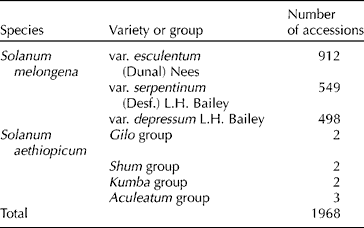
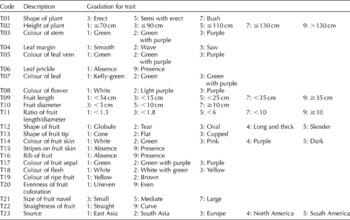
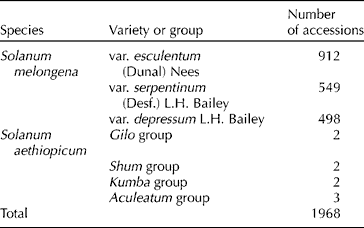
The eggplant collections available at the IVC/JAAS and IVC/ZAAS consisted of 1968 accessions, collected from 18 countries in Asia (including China, India, Indonesia, Japan, Korea, Laos, Myanmar, Thailand and Vietnam), Europe (Denmark, France, Italy, The Netherlands and Russia) and North America. These collections also included the eggplant landraces and inbred lines derived from inter/intra-specific hybrids, which are now being used in the breeding programmes. The passport data comprising 23 important morphological traits, such as characteristics of plant, stems, leaves, flowers and fruits, and geographic information about this collection were investigated at JAAS and ZAAS experimental fields in Nanjing during 1998–2001. The eggplant accessions and traits which were investigated are summarized in Tables 1 and 2, respectively. In this work, home-made descriptors were used to study the 23 traits (Table 2).
Accessions collected for the construction of the core collection of the cultivated eggplants
Morphological and geographic traits investigated in the collection of cultivated eggplants. Home-made descriptors were used to encode the traits

Divisions of group over entire collection
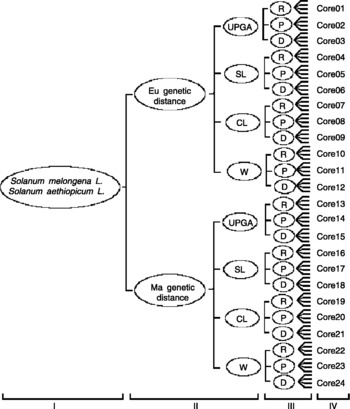
The divisions of the collection into groups were accomplished in a procedure of stepwise cluster analysis (Hu et al., Reference Hu, Zhu and Xu2000), shown in Fig. 1. This stepwise cluster analysis was conducted sequentially using unweighted pair group average (UPGA), single linkage (SL), complete linkage (CL), and Ward's (W) methods and on the basis of Mahalanobis (Ma) and Euclidean (Eu) distance at every point dividing a group of accessions into subgroups, which were genetically as distinct as possible. These subgroups were further divided in accordance with morphological and geographic data; resulting in the construction of a ‘diversity tree’, which represented the genetic structure of all accessions. The exercise of branching terminated when no further subdivision in genetically distinct groups could be made, and in this case, only one or two accessions were present at branch ends. Within the procedure, two types of genetic distance were used to provide distance among accessions following cluster analysis. Herein, Mahalanobis distance (Mahalanobis, Reference Mahalanobis1936) was calculated by a variance–covariance matrix, and was suitable for dealing with correlations among traits and to eliminate the scalar differences between traits, whereas Euclidean distance revealed the geometrical distance between two accessions in the case of multi-traits. For the cluster analysis, four kinds of clustering methods, viz. UPGA, CL, SL and W were employed on the basis of the above-mentioned genetic distance.
Procedure for the construction of a core collection of cultivated eggplants. I, Available collection; II, division of main groups: four kinds of clustering method were carried out on the basis of Euclidean (Eu) and Mahalanobis (Ma) genetic distance; III, allocation entries – three sampling strategies, viz. random (R), preferred (P) and deviation (D) strategies, were employed with a series of sampling sizes, i.e. 10, 15, 20 and 30% under each strategy; and IV, evaluation of the core collection.

Sampling proportion
The choice of proportion of accessions to be included in the core was designed in a series of percentages (10, 15, 20 and 30%) under each of the three sampling strategies.
Sampling strategies
Three sampling strategies were investigated: random (R), preferred (P) and deviation sampling (D). For the R strategy, one accession from each subgroup at the lowest level of sorting was randomly selected, keeping to the fact that a core should include distinct entries. For the P strategy, accessions with maximum or minimum values of traits were selected from each subgroup at the lowest level of sorting. For the D strategy, the deviation of two accessions was compared in each subgroup at the lowest level of sorting, and the accession with the larger deviation was selected for subsequent cluster analysis. The deviation of accessions can be determined by the formula:  , where i = 1, 2,…, n, j = 1, 2,…, m,
 is the genotypic variance of the jth trait, and g ij is the ith genotype value of the jth trait. If there was only one accession in a subgroup resulting from a particular sampling strategy, it was used directly in the next cluster analysis.
Evaluation of the core collection
The mean difference percentage (MD%), the variance difference percentage (VD%), the coincidence rate (CR%) and the variable rate (VR%) are designed to evaluate the property of the core collection in terms of the initial collection (Hu et al., Reference Hu, Zhu and Xu2000). Within the procedure, a homogeneity test (F-test) for variances and a t-test for means (P = 0.05) were conducted to determine the difference of MD% and VD% of traits between the core and initial collections. Then the CR% and VR% were calculated to measure the percentage of the significant difference of traits between core and initial collections:  , where R C = range of the core collection, R I = range of the initial collection, and m = number of traits.
 , where CVC = coefficient of variation of the core collection, CVI = the coefficient of variation of the initial collection, and m = number of traits.
In accordance with the definitions of MD, VD, CR and VR, a representative and qualitative core collection will possess lower MD, VD and VR, but higher CR.
Results
The eggplants that have been investigated in this study included three main botanical varieties of S. melongena L. The cultivars with round or egg-shaped fruits are grouped under var. esculentum, the dwarf plants are put under var. depressum, and var. serpentinum includes the cultivars with long, slender fruits (Table 1). Besides, four cultivar-groups of S. aethiopicum L. (Lester, Reference Lester1986) have also been investigated (Table 1). S. aethiopicum Gilo group has fruits with the size and shape of hens' eggs, and its hairy leaves are not eaten (Lester and Daunay, Reference Lester and Daunay2001). S. aethiopicum Shum group is typically a short, much-branched plant with small glabrous leaves and shoots, and its small, bitter fruits are not eaten. S. aethiopicum Kumba group produces large and grooved fruits, which are picked green or red, and stewed or eaten raw. S. aethiopicum Aculeatum group is an ornamental plant, which is prickly and hairy, but with large, grooved fruits. This cultivar-group is used as source of resistance against bacterial wilt (Lester and Daunay, Reference Lester and Daunay2001).
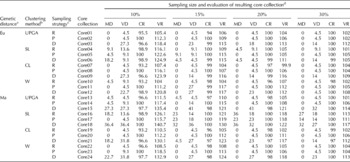
A total of 24 core collections were established and evaluated by using a comprehensive numerical classification methodology, which included two types of genetic distance, four cluster methods, four sampling sizes, and three sampling strategies. The complete data are given in Table 3.
All core collections derived from the combinations of genetic distance, cluster methods, sampling size and sampling strategy

a Genetic distance employed here is: Ma, Mahalanobis distance; and Eu, Euclidean distance.
b Clustering methods include: UPGA, unweighted pair group average; SL, single linkage; CL, complete linkage; and W, Ward's method.
c Sampling strategy includes: P, preferred; R, random; D, deviation.
d Evaluation of core collection: MD, mean difference percentage; VD, variance difference percentage; CR, coincidence rate (%); VR, variable rate (%).
Choice of genetic distance
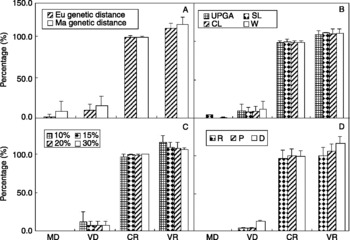
The average values of MD, VD, VR and CR were calculated on the basis of Ma and Eu distance (Table 3), and figured out the difference between the two genetic distances as shown in Fig. 2A. The Eu distance demonstrated lower MD, VD and VR, but equal CR estimates (1.2, 9.6, 98.8 and 109.9%, respectively) compared to the Ma distance, which provided 8.0, 15.1, 98.8 and 114.8% in the corresponding measurements. As a result, the Eu distance is preferred in our case, and all the following assessments were carried out on the basis of the Eu distance.
Comparison of the core collection. (A) Comparison of Mahalanobis (Ma) and Euclidean (Eu) distance for the construction of a core collection in cultivated eggplants. (B) Comparison of clustering methods for the construction of a core collection in cultivated eggplants on the basis of Euclidean (Eu) distance. UPGA, unweighted pair group average method; W, Ward's method, CL, complete linkage method and SL, single linkage method. (C) Comparison of sampling size of 10, 15, 20 and 30% by using mean difference percentage (MD), variance difference percentage (VD), coincidence rate percentage (CR) and variable rate percentage (VR). (D) Comparison of sampling strategy by using MD, VD, CR and VR with 20% sampling size based on Euclidean genetic distance. R, random sampling strategy; P, preferred sampling strategy; D, deviation sampling strategy. The vertical line on top of each bar represents the standard deviation of the mean (P = 0.05).

Cluster methods
Four cluster methods (UPGA, SL, CL and W) were compared, as shown in Fig. 2B, and in general, they showed slight differences on MD, VD, CR and VR. However, among the four clustering methods, UPGA displayed the lowest MD, VD and VR (3.4, 15.9 and 113.7%, respectively) as well as CR (98.7%), which was not significantly different from 99.3% in SL, 99.3% in CL and 99.9% in W. Consequently, UPGA was considered as the first option for establishing the core collection of the cultivated eggplants.
Proper sampling strategy
Three sampling strategies were compared under the combination of 15 and 20% sampling size (Fig. 2D). Among the three sampling strategies, D strategy performed the highest MD (6.8%), VD (35.2%) and VR (122.9%), and a moderate CR (98.3%), suggesting that this was not the preferred strategy in this case. R strategy generated a moderate MD (2.3%), the lowest VD (4.5%), VR (106.7%) and CR (97.7%), while P strategy produced the lowest MD (1.1%), moderate VD (7.9%) and VR (111.5%), but the highest CR (100%). Therefore, P and R strategies exhibited a higher effectiveness than D strategy for the establishment of the cultivated eggplant core collection.
Optimal sampling size
To optimize the sampling size, four sampling sizes (10, 15, 20 and 30%) were evaluated by the UPGA clustering method, as shown in Fig. 2C. The sampling size of 30% provided a high effectiveness due to the lowest MD (0%), VD (4.5%) and VR (103.2%) but the highest CR (100%). On the contrary, the sampling size of 10% gave the highest MD (12.1%) and VR (121.4%), moderate VD (6.8%), and the lowest CR (98.3%). Both 15 and 20% sampling size showed moderate MD (0–2.3%), VD (4.5–9.1%), CR (98.3–98.9%) and VR (106.5–112.3%). Considering the number of accessions investigated and the effectiveness obtained, a core collection with 15–20% of the initial collection is proposed for eggplants.
Discussion
Sampling size is an important factor for keeping a balance between genetic diversity and acceptable cost for management of the collections. Whatever the most effective management and cost, the lack of genetic diversity degraded the validity of the core collections. Sampling size at 30% was the preferred representative sample of the collection because it simultaneously possessed the lowest MD (0%), VD (4.5%) and VR (103.2%) but the highest CR (100%). Although a large sampling size provides sufficient information, it is also costly and difficult to manage and maintain. On the contrary, a 10% sampling size core collection is economic, but it provides insufficient genetic information, which is evidenced by the highest MD (12.1%) and VR (121.4%). In this study, sampling size at 15 and 20% demonstrated moderate MD, VD, CR and VR. The resulting core collections with these sizes provided an adequate and representative genetic diversity, compared to the initial collection, while maintaining an acceptable cost for management. Moreover, flexibility is another necessary feature for a better core collection nowadays. In some cases, users need, for example, only half the size of the core collection but still a representative set, or only material of a specific type but more accessions than are included in the core collection (Van Hintum, Reference Van Hintum, Scloes and Rossnagel1996). To meet these requirements and allow a much more flexible use of the core collection concept, the concept of the ‘core selection’ has been developed, considering that the number of entries no longer has to be fixed, and the relative size of specific parts of the core selection can be adjusted to the needs of the users (Brown and Spillane, Reference Brown, Spillane, Johnson and Hodgkin1999). In this study, we propose that the adequate size of the eggplant core collections should be within the range of 15–20%, the exact size depending on the determined objectives. The core collection has been shown to be effective in improving the identification of genes of interest in the entire germplasm collection. However, a smaller subset of the core collection is needed for traits that are difficult or expensive to measure. In peanut, not only the majority of genetic variation expressed in the core collection was preserved in the core of the core collection, but the identification of desirable traits was also effectively improved (Holbrook and Dong, Reference Holbrook and Dong2005).
Several strategies have been proposed for sampling (Hintum and Van Hintum, Reference Hintum, Van Hintum, Balfourier and Perretant1994; Spagnoletti and Jelovac, Reference Spagnoletti, Jelovac, Balfourier and Perretant1994; Crossa et al., Reference Crossa, DeLacy, Taba, Hodgkin, Brown, Van Hintum and Morales1995; Hu et al., Reference Hu, Zhu and Xu2000). In this study, three strategies, i.e. R, P and D, were investigated. The D strategy was eliminated due to the largest variation of MD, VD, VR and a moderate CR. Both P and R strategies exhibited a higher effectiveness than D strategy because of the lowest VD and VR obtained in R strategy, and lowest MD and highest CR in P strategy. This indicates that P and R strategies can be used individually and in conjunction. The R strategy will be particularly helpful in those cases where complementary information is unavailable. However, if detailed marker information on the majority of accessions in a group of cultivars is available, then the P strategy, an importance-based strategy, can be followed. Furthermore, the combination of R and P strategies will be preferred in certain cases where the accessions for a specific purpose are specified in a core collection.
It is clear from the above discussion that the purpose can determine the kind of strategy to be followed. But the sampling strategy definitely has an impact on the accessions that are involved in the core collection. In this study, 16 of total 24 core collections were established using R or D strategy, only an average 10% of accessions were repetitive when compared between any two of these collections. It means that the majority of the accessions represented by the core differ from each other. Therefore, the really valid core collection always depends on not only the botanic, geographic and/or genetic information, but also on the purpose of establishing the collection itself.
Acknowledgements
We would like to thank Dr V. K. Rajam, Department of Genetics, University of Delhi South Campus, New Delhi 110023, India, for perusing and improving the manuscript.