Critics of the International Monetary Fund (IMF) typically focus on the nature of conditionality imposed in exchange for loans. The IMF's programs are criticized for being insensitive to the burden adjustment places on the poor and most vulnerable in society. But while the effect of the IMF's structural adjustment programs on various macroeconomic targets has been the subject of intense focus over the past twenty-five years, attention to their effect on the poor is relatively limited and reaches mixed conclusions. This article addresses the critique that IMF adjustment programs force reductions in social spending from which the poor particularly benefit, but does so with an eye toward whether the effects of such austerity programs are mediated by domestic political factors in the recipient country. One drawback of the current literature is the absence of any serious theorizing about the role of domestic politics in shaping the effects of IMF programs. As we show below, however, there is good reason to believe that the domestic political environment influences the effects of austerity. In short, our research addresses the related questions of whether IMF programs do indeed hurt the poor, whether these effects are conditional on regime type, and the direction of conditionality, if it exists. Our findings are noteworthy. Contrary to recent research by the IMF, we show that IMF programs do cause reductions in social spending, and, perhaps counterintuitively, that this effect is particularly pronounced in democratic countries. We also demonstrate that observed differences between democracies and nondemocracies in terms of their spending priorities diminish or vanish in the presence of IMF programs. These empirical patterns, we argue, are the result of a political calculus whereby democracies decrease spending on those programs associated with the least organized interests.
We organize the article as follows. The next section surveys the relevant research on the IMF, focusing especially on the nature of conditionality and recent empirical research on its effects—particularly as they relate to the poor. We then develop a theoretical argument for why we might expect effects of IMF programs to be conditional on the recipient country's regime type. Hypotheses suggested by this argument are tested using cross-national, time-series data from 1980–2000, and we report results from a series of robustness checks in the penultimate section. We conclude with a consideration of the implications of our findings for future research on the IMF and government provision of public services.
Policy Conditionality and Its Effects on the Poor
Prior to the debt crisis of the early 1980s, the IMF's role in developing countries focused on providing temporary infusions of capital to alleviate problems with inflation, budget deficits, or balance of payments. After the debt crisis, however, lenders and policymakers in the developed world became convinced that the economies of developing countries required far-reaching structural reforms to remedy their underlying problems.1
The use of conditionality has increased accordingly over the past twenty years. Buira cites previous research showing the “average number of [IMF] conditions rose from about six in the 1970s to ten in the 1980s,” and claims that this trend has continued through the 1990s with programs enacted between 1995 and 1999 averaging 12.1 conditions.2Buira 2003a, 61, fig. 1.
Ibid., 62, fig. 2. Dreher and Jensen also document an increase in the number of structural conditions over time, though the average number of conditions per program they cite is slightly lower than those stated by Buira; see Dreher and Jensen forthcoming. According to their research, in 1987, the average number of conditions per IMF program was about three, and it rose to about nine in the late 1990s.
Of particular interest to this article, given its focus on the effect of IMF programs on the provision of government public services, is the role fiscal adjustments play in IMF programs. While IMF programs differ across countries, they share an emphasis on reducing the role played by the state in the economy.4
Biersteker 1990, 477.
Cornia 1987, 50–51. Mahdavi 2004 argues similarly that fiscal deficit reduction has been a central component of conditions placed on developing countries seeking to restructure their debts or receive debt relief.
Biersteker 1990, 490.
Given that fiscal deficits are typically regarded as a central cause of macroeconomic imbalance, it is hardly surprising that fiscal policy “is often a centerpiece of program design, with quantified targets included as key elements of conditionality.”8
IMF 2003, 14.
Mahdavi 2004, 1139.
Bienen and Gersovitz 1985, 737.
Cho 2004.
This emphasis on lower government expenditures is one reason the IMF has been criticized harshly. IMF “austerity programs” are argued to cause tremendous dislocation within the economy, especially for the poorest and most vulnerable sectors of society that are most dependent on the state for valuable public services such as health and education.12
See Remmer 1986, 7; Crisp and Kelly 1999, 534, 542; Garuda 2000, 1031; Bird 2003, 253; and IMF 2003, 14. Another effect that is often mentioned is the reduction in food subsidies. However, the lack of cross-national, time-series data on government spending on food subsidies targeted at the poor makes it impossible to include this factor in our analysis. It remains an important question for future research.
Cornia 1987, 67.
Pinstrup-Andersen, Jaramillo, and Stewart 1987, 77.
The IMF has recognized the urgency of such critiques and, in 2003, its Independent Evaluation Office (IEO) published a comprehensive review of its fiscal adjustment programs. Its findings suggest that many of the criticisms reviewed above are baseless.15
IMF 2003.
Ibid., 4.
Ibid., 19.
Ibid., 17, tab. 2.2.
Ibid., 17.
Ibid., 34.
Second, while the IEO criticizes the IMF for being too vague in specifying how best to protect social spending, it rejects the criticism that fiscal austerity leads to reductions in spending on education and health. In 1995, Killick also argued that existing research showed “that social services are among the more protected categories” during IMF programs.21
Killick 1995, 51.
The results show that the presence of an IMF-supported program does not reduce public spending on either health or education—measured as a share of total public spending, GDP, or in per capita real terms. In fact, we estimate that during program periods, and with all other factors being the same, public spending in each of the health and education sectors increased by about 0.3 to 0.4 percentage points of GDP compared to a situation without a program.22
IMF 2003, 8, emphasis added.
It would seem that the IMF's critics have been incorrect and unfair.
Vigorous debate therefore continues over the effects of IMF policies on the poor. A striking feature of this debate is the absence of any serious theorizing about the role played by domestic politics in the country receiving IMF credit. In trying to explain why some countries are less likely to complete their IMF programs, or implement the mandated reforms, scholars have invoked the notion of “political will,”23
but there is no study of which we are aware that systematically tests whether and how political considerations shape how IMF programs are implemented. In the next section, we develop an argument that focuses on explicitly political answers to this article's central questions: does politics—specifically, a country's regime type—mediate how conditionality programs affect expenditure reductions, and if so, in what direction?The Conditional Impact of IMF Conditionality
To start, we establish that domestic political factors can influence the effects of IMF programs. Critics often accuse the IMF of fostering a “democratic deficit”—a transfer of national sovereignty to the IMF—by reducing the autonomy of domestic governments. To be sure, conditionality does require governments to take actions they might otherwise avoid, but the argument of a democratic deficit is too quick to accuse the IMF of imposing its will on “helpless” governments, and fails to recognize that domestic politics can also shape how IMF programs are implemented in recipient countries. Recall first that the IMF can only establish a program at the request and consent of the recipient country. This is a particularly important point because it means austerity conditions are not imposed on countries exogenously. Rather, observed program content is the outcome of arduous bargaining between recipient governments and the IMF. As such, the content of austerity is endogenous to the features of the IMF and the recipient country that influence their reservation points in the bargaining process. Conway makes this point well: “[IMF austerity] is a negotiated agreement between the IMF and the participating country, and thus should be considered endogenously determined. The conditions, rather than being an independently set list of policy reforms to achieve economic growth and external balance, are the outcome of bargaining between the IMF and the participating country.”24
That bargaining determines the content of these programs means that politicians in borrowing countries retain some leverage over what spending programs are cut and the extent of these spending reductions. Presumably, political leaders in borrowing countries expect that austerity will require structural reforms with serious distributional consequences. The fact that they retain leverage over the nature of the austerity package, then, is critically important as it enables incumbents to influence the reform package in ways that minimize the expected costs of the budget reductions. Which policies fulfill this goal is, however, still an open question and is the issue at the heart of our research agenda here.Kahler gives persuasive anecdotal evidence of such bargaining behavior. As we do here, he argues that countries' reservation points are a function of the domestic political setting and, as such, domestic politics affects which policies receive protection from cuts by shaping how hard politicians are willing to work to take some budgetary items off the bargaining table entirely. He writes, “Coalition-building [on the part of IMF staffers to make the program politically palatable] may mean sparing budgetary sacred cows that permit senior politicians to support an adjustment program: chief among these politically sensitive items are food subsidies and military spending.”25
Kahler 1993, 376.
Somewhat related to the bargaining process over such a politically sensitive issue as budget reductions is that the contents of IMF programs are often quite vague, which allows domestic politicians greater leeway in the process of program implementation and hence how budgetary cuts are distributed. Initially, IMF programs were intent on setting targets for expenditure reductions but were less inclined to dictate which programs should be cut and which protected. Bienen and Gersovitz cite a study (based on internal IMF sources) of IMF agreements between 1969 and 1978 which found that only three of 105 agreements mandated specific expenditure measures.26
Bienen and Gersovitz 1985, 737.
Dreher and Jensen forthcoming.
IMF 2003, chap. 6.
Ibid. 2003, 55–56.
In the final analysis, then, we believe that it is not entirely accurate to argue, as many critics do, that IMF programs are simply imposed on countries in economic turmoil and hence that the IMF is entirely culpable in whatever negative effects these programs have on the poor (if such effects are indeed negative at all). Rather, the upshot of this brief discussion is that the available theoretical and empirical observations show persuasively that the bargaining process allows recipient country governments to retain some influence over IMF program content and hence the distributional implications of those programs. If the effects of IMF policies on the poor are indeed negative, as the critics argue, borrowing country governments might need to shoulder some of the blame. As such, studies of the effects of IMF programs on the poor would do well to turn their attention to how the constellation of domestic interests and institutions affects how politicians in borrowing countries are likely to bargain over the content of austerity plans and hence how they are likely to distribute the costs of budgetary reductions. In the next section, we take up precisely this task.
Democracy and Conditionality
Considerable recent research in political science has theorized that certain types of governments should be more likely to emphasize social (or public services) spending. Bueno de Mesquita and colleagues argue that political institutions affect government spending policy by shaping the incentives politicians have to cater to larger versus smaller constituencies.30
Bueno de Mesquita et al. 2003.
Employing a different theoretical framework, Lake and Baum argue that democracies are more likely to provide public services than are nondemocracies.31
Lake and Baum 2001.
We are left then with the conclusion that, ceteris paribus, democracies—characterized by more political competition and larger winning coalitions than autocratic regimes—should allocate more of their budget to public services such as education and health. There is strong evidence in support of this conclusion. Both Bueno de Mesquita and colleagues and Lake and Baum report results supporting their propositions.32
Furthermore, several recent articles report a significantly positive effect of regime type on education spending.33See Avelino, Brown, and Hunter 2005; Brown and Hunter 2004; Kaufman and Segura-Ubiergo 2001; Rudra and Haggard 2005; and Stasavage 2005.
Of interest to us is whether it necessarily follows from these arguments that, in periods of fiscal austerity such as those required by IMF conditionality, democratic governments “protect” public services against cuts. That is, should we expect that, even under circumstances where governments are required to trim spending, these regime differences persist and democratic governments will dedicate a larger share of their budgets to public services than do their nondemocratic counterparts?
The conclusions of existing research on regime type's impact on spending patterns would suggest that democracies should protect public services against cuts, even in the face of austerity programs mandated by IMF programs. Cuts to public service spending adversely affect the poorer sections of society most of all because their demand for such services is fairly income-inelastic and they are less able to exit to the private sector. One might expect, therefore, that democratic governments, which after all are accountable to the populace, might protect these citizens by finding other areas of the budget to trim while preserving the emphasis given to education and health provision. Perhaps more importantly, taken as stated above, there is little reason to believe that the incentive structures political leaders face in periods of IMF austerity are substantially different than in periods of greater economic well-being. The above arguments are fundamentally about the effects of institutions, and one should expect that the presence of political institutions that increase the size of the winning coalition required to retain office and those that subject incumbents to stiff political competition should have similar results with respect to public service spending in a variety of heterogeneous political and economic environments. That is, the institutional incentives of the size of the winning coalition relative to the selectorate or the presence of political competition are constant across periods of “good” and “hard” times, and therefore the expectation is that the differences in spending attributed to regime type should persist regardless of the available fiscal resources.
It is not altogether clear, however, whether this motivation to provide public services will prevail when budgets have to be trimmed substantially. A simple fact about politics is that the probability of political participation and the efficacy of that participation vary greatly across individuals and societal interest groups. As such, all things constant, we should expect office-seeking political incumbents to pay more attention to those segments of society that are more efficacious participants in the political sphere. As Schattschneider eloquently put it, the “pressure system has an upper-class bias,”34
yielding favorable policies to those groups that can organize most effectively on behalf of their interests, while those groups that cannot overcome the problems of collective action or mobilize sufficient influence fail to get their preferred resource allocation. Importantly, pro-poor policies such as education and health services provide diffuse benefits and costs, and on a continuum are nearer to pure public goods than pure private ones. Therefore, there is typically less organization on the part of citizens to preserve these services, and instead citizens “free ride” off the lobbying efforts of others.This matters because in an environment where resources are constrained and politicians must cut spending, one might expect politics to be characterized by fierce interest-group politics over the distribution of the even-more-scarce government resources. Every societal interest group wants to maximize its allocation of favorable policies and, for each, the imposition of deficit-reduction conditionality carries with it the possibility of a reduction in the resources it receives from the government. Thus, the military fears a reduction of its allocation of government spending, public employees fear wage contraction and layoffs, and the public in general (and the poor especially) fears cuts in essential government services such as food subsidies, education, and health. Furthermore, the spending game under such conditions is very much zero sum, and should one group manage to maintain the status quo level of resource allocation, cuts are inevitably passed along to some other spending category. Ultimately, the proverbial “buck” stops at the least organized societal interests. Since politicians retain discretion over how to distribute these cuts, each group has an incentive to lobby the government in an effort to minimize the cuts it sustains.35
As noted above, the IMF's IEO has criticized previous programs for not being proactive in identifying where cuts should be made in order to protect social spending. In 1997, the IMF issued new Guidelines on Social Expenditures that required IMF programs to state explicitly how social services will be maintained and to monitor trends in social spending and human development outcomes such as enrollment and child mortality rates. We discuss this initiative explicitly in our empirical section below.
Garuda 2000, 1033.
Under such conditions, one might well expect governments to be more responsive to well-organized and powerful interest groups than to the poor, whose political resources are far more limited. For example, the costs of spending cuts on other categories such as the military or government wages are far more concentrated. Most defense expenditures in most developing countries are not for purchasing new weapons but rather allocated to personnel. Thus, “the recurrent component of defense expenditures, especially personnel, is high and this reduces the ability of governments to cut defense expenditures during times of economic stringency.”38
Harris et al. 1988, 166.
IMF 2003, 10.
Birn and colleagues echo a common variant of this argument when they allege that the IMF “ensures government commitment to paying interest on the national debt by making further loans conditional on meeting interest payments”; see Birn, Zimmerman, and Garfield 2000, 115. Here the international financial institutions and commercial lenders are the powerful group demanding their share of the pie.
The upshot of this analysis is that cutting “politically easy targets” such as education and health, while certainly unpopular with citizens, is less likely to hurt policymakers than cutting programs that are associated with well-organized and powerful lobbies.41
See Darrow 2003, 73. Anderson and Smirnova 2004 find evidence for precisely this logic in their study of budget deficit reduction plans enacted by the City of New York. Even though public opinion polls show that public service agency cuts are the second most costly in terms of political support (increased taxes are least popular), they are the most frequently used budget gap closing option during the 1981–2004 fiscal years.
One particular concern is that spending on primary education and health and spending on programs that target the poor tend to be cut back along with other government expenditures. This happens because the fiscal adjustment has to be undertaken quickly. Governments face great pressure from a variety of political interest groups at such times. Proportional cuts are easier to implement quickly both in technical terms and in terms of raw politics. However, since poor people do not usually form organized groups, and so lack a political voice, spending cuts on social protection and other programs that benefit the poor often tend to be larger in relative terms.42
Lustig 2000, 12, emphasis added. Further, studies of the determinants of social spending indicate that spending on the poor is more procyclical than is the rest of the budget; see Lustig 2000, 1. Snyder and Yackovlev, based on an analysis of spending in the Latin American and Caribbean countries, find that, while overall social spending is procyclical, spending on education and health is particularly so; see Snyder and Yackovlev 2000, 4. Snyder and Yackovlev also find that both democracies and nondemocracies cut social spending during economic downturns, but that, if anything, “spending seems to be more procyclic under democratic rule than under authoritarian rule”; see Snyder and Yackovlev 2000, 31–32.
In opposition to the institutional arguments proposed above, this logic suggests that democracies will not necessarily protect spending on pro-poor policies such as education and health during IMF programs. Rather, interest group politics will oblige incumbents, even in countries characterized by democratic institutions, to cut spending on those policies associated with poorly organized interests. This is not to say, however, that an altogether different logic dictates spending on public services in good or bad times; both institutions and the organization of interests groups shape what policies incumbents employ. What remains, rather, is the proposition that during IMF programs, the obligation to decrease spending places a greater political premium on protecting those policies characterized by organized interests. When governments retain some semblance of fiscal flexibility, all interest groups can get a reasonable share of spending, even if the more organized groups get a disproportionate share of the available resources. By contrast, when budgets must be trimmed, as they must during IMF austerity plans, the more organized sectors of society have the political clout to minimize the cuts they sustain. In short, during austerity, office-seeking incumbents have incentives to place an even greater premium on appealing to the relatively more organized interests than what they might absent such constraints on the fiscal budget.
Formal models represent these ideas with “shrinking pie” games in which two or more groups interact in the presence of declining available resources, resulting from either some exogenous shock or an endogenous political process. In such games, social conflict over the distribution of resources exists when the distribution process is zero sum and some groups can be excluded from the pie.43
Rodrik 1999, 9.
Lustig 2000, 13.
Empirically, our discussion thus far proposes that the effect of IMF programs on social expenditures may well be conditional on the regime type of the recipient country. While the critics suggest that IMF programs hurt the poor, it seems as if democratic countries have both the motivation (that is, the institutional incentives) and opportunity to protect pro-poor services, thus at the very least, establishing a policy regime that hurts the poor less than in nondemocracies. On the other hand, as Vreeland notes, “political will” is needed to protect the poor during austerity, and there is reason to suspect that leaders in democracies often lack such will even given democratic institutions. Instead, when forced to make reductions, leaders in democracies choose just these pro-poor categories to cut because the groups that benefit from them are relatively weak politically.
We thus arrive at three hypotheses:
H1: The effect of IMF programs on social expenditures is conditional on the regime type of the recipient country.
The direction of the conditional effect is, however, unclear given our two plausible but distinct arguments. An institutional argument such as that from Bueno de Mesquita and colleagues or Lake and Baum would suggest the following.
H2: Under IMF programs, democracies should spend more on social services than nondemocracies.
But there is also reason to believe that the institutional origins of spending are trumped by the organization of various interests, and that in periods of fiscal austerity, the political premium of appealing to the more organized sectors of society is even larger. Thus, we have the third testable proposition.
H3: Under IMF programs, increases in levels of democracy should have smaller impacts on social expenditures.
The next section describes the data and research design used to test these hypotheses, and presents the results from these tests.
A Cross-National, Time-Series Analysis
Tests of claims that IMF programs hurt the poor by forcing reductions in social spending have become increasingly rigorous. While many early critics based their allegations on single-country episodes or anecdotal evidence of specific instances in which programs were cut, recent studies have attempted more systematic analyses involving cross-national, time-series data. However, until the 2003 IEO study, most such studies had not accounted for possible selection effects, a short-coming remedied by the IEO. The conclusions of this most recent study suggest that the IMF's critics have been misguided, and that the presence of an IMF program actually increases spending on education and health.
However, the IMF study, as well as those preceding it, suffers from a serious flaw. While many scholars recognize that whether and how governments cut spending in response to IMF austerity measures depends on political considerations, none has accounted for this fact in its empirics. Once this possibility is accounted for in the analysis, two possibilities arise. First, we may find that the effect of IMF programs is conditional on the regime type of the recipient country, and possibly that they have different effects in different political systems. Second, we may find that the precise impact of increasing the level of democracy in a given country on its level of social spending depends on whether there is an IMF program in place. The analysis presented in the preceding section thus suggests two new hypotheses, as well as a first ancillary hypothesis.
First, nothing in our account contradicts the conventional expectation that an increase in the level of democracy will increase a government's level of social spending. Thus, we expect to see a positive relationship between democracy and social spending in our data.
Second, we expect the effect of IMF programs on social spending to be conditional on the level of democracy in the recipient country. Specifically, we expect IMF programs to have a negative impact on social spending as the country's level of democracy gets higher. This follows from the argument that democratic governments are likely to respond to pressure from more organized interests seeking to preserve their share of government spending.45
Note, however, that this argument need not be symmetrical. That is, we do not argue that nondemocracies become more responsive to the poor under IMF programs. Indeed, to anticipate our analysis of per capita spending measures in a later section, IMF programs have no impact on per capita education or health spending in nondemocracies, though they do have negative effects in more democratic states. Why might this be? Why would nondemocracies not respond to IMF pressure by targeting those groups to which they are least beholden? While a full answer to this question falls beyond the scope of this article, two arguments strike us as plausible and consistent with the framework developed here. First, nondemocracies spend less on education and health than democracies in the first place. Therefore, trimming these programs will not yield much in the way of fiscal reductions. Second, considerable evidence exists that education and health spending in nondemocracies are biased toward the upper classes rather than to the masses; see Lindert 2004. Since these groups are more likely to have political influence, a class bias in spending would also explain why nondemocracies do not target these social services.
Third, combining our first and second hypotheses, we expect the effect of an increase in democracy to be attenuated under IMF programs.
To test these hypotheses, we collect data for all countries for which data are available for the period 1980–2000.46
Economic data are from World Bank 2004. Data on regime type are from Marshall, Jaggers, and Gurr 2004. IMF participation data are from Vreeland 2003. Descriptions and summary statistics of all variables used are provided in the Data Appendix. Due to missing data, not all countries are included in the estimation samples of our regression models. A list of countries included in the statistical analysis is also in the Appendix.
Data on education spending are available for the entire period. Data on health spending are available only since 1990. Our results are robust to measuring the dependent variables in per capita rather than share of spending terms, and we discuss these alternative specifications below.
We use regression analysis to assess the effects of IMF programs and democracy on these two categories of social spending while controlling for a number of other economic factors.48
To ensure comparability of our results with those from the IMF 2003 study, we use as far as possible the same set of covariates in our models. We make two exceptions. First, we include a lagged dependent variable to capture any dynamic considerations. Since, as Achen 2000 shows, the inclusion of a lagged dependent variable can suppress the explanatory power of the other independent variables, we consider ours a conservative test. Second, we do not control for currency devaluation. When we do include this variable, our results hold, but we lose more than forty countries (about 40 percent of our total observations) due to missing data. These results are available from the authors.
Arguably, the population over sixty-five variable does not belong in the education spending model, but we choose to include it to enhance comparability of our results with those of the IEO report. When we drop this variable from the model, our results hold. These results are available from the authors. We thank an anonymous reviewer for making this point.
Ideally, including a measure of labor strength would allow us to test an additional implication of the argument, because unionized workers are particularly well-positioned to exercise political influence to resist cuts. However, cross-national, time-series data on levels of unionization by sector are not available, and we leave this for future research.
The IMF study dichotomizes this variable and codes countries scoring 4 or higher as democracy; see IMF 2003, 80. We prefer not to discard the information in the full range of the variable and so use it in its original interval form. However, our results are robust to measuring democracy as a dichotomy (whether the threshold is 4 as in the IMF study or 6 as Jaggers and Gurr 1995 suggest) or as a trichotomy (where countries scoring lower than −6 are coded as nondemocracies and those between −6 and 6 are coded as anocracies).
There are four main types of IMF programs: (1) Stand By Arrangements (SBA); (2) Structural Adjustment Facility (SAF); (3) Extended Structural Adjustment Facility (ESAF); and (4) Extended Fund Facility (EFF). We do not distinguish between these programs, especially because “evidence suggests that there is little significant difference [in severity] between IMF programmes;” see Bird 2003, 94. See also Bird 2003, 52; Jensen 2004; Sturm et al. 2005; and Vreeland 2003 for other uses of a dichotomous IMF indicator.
Conceptually, we use the following format for the regression model:

where ED is education's share of spending, HC is health's share of spending, C is a vector of controls (as described above and including a constant), IMF and DEM are our measures of the presence of an IMF program and the recipient country's level of democracy, and α and β are coefficients to be estimated. As with the IEO, we estimate these models using an error-correction framework in which the dependent variable is expressed as its first difference, and all right-hand variables are entered in their lagged levels, and, depending on theory, as contemporaneous changes.
Our hypotheses can be expressed formally as:
- Democracy increases social spending (βdem > 0).
- The impact of an IMF program is conditional on level of democracy (βid ≠ 0).
- The presence of an IMF program reduces the positive impact of democracy (βdem > βdem + βid → βid < 0).
Since we know IMF participation is not randomly assigned to country-years, we must estimate these equations in a way that corrects for possible selection bias. The intuition behind the selection bias concern is one of endogeneity. Bound, Jaeger, and Baker provide a precise statement of the problem: “Empirical researchers often wish to make causal inferences about the effect of one variable on another. Doing so in nonexperimental settings is frequently difficult, because some of the explanatory variables are endogenous: that is, they are influenced by some of the same forces that influence the outcome under study.”53
Bound, Jaeger, and Baker 1995, 443. See Heckman 1979 for the classic statement of the selection bias problem.
See Heckman 1978 and 1979; and Achen 1986. For discussions and other examples of selection bias corrections in studies of the IMF, see Vreeland 2003; Ul Haque and Khan 1998; Garuda 2000; IMF 2003; and Jensen 2004.
More formally, consider an equation of interest for country i, in our case with relative spending (S) on category j as the dependent variable with a vector of covariates x and stochastic term ε:55
This discussion draws heavily on Greene 2003, chap. 22. For notational convenience, we ignore the time subscript t.

Not all countries enter IMF programs. Assume IMF participation is a linear function of some covariates (ω) and a stochastic component (μ):

We only observe participation in IMF programs as a dichotomous variable such that IMF = 1 if IMF* > 0 (IMF = 0 otherwise).
If selection bias is present, that is, μi and εi are correlated, then, estimating equation (2), we find that

Heckman's correction for selection proceeds in two steps. First, estimate equation (3) predicting IMF participation. Using the estimated γ, compute

for each observation in the sample. Second, estimate β and βλ = ρσε in equation (4) by least squares regression on x and the selectivity correction,

.
The first step, therefore, is to build a statistical model of participation in IMF programs. We follow the IEO's strategy and construct a linear probability model of IMF participation.56
IMF 2003, app. 4.
To increase confidence in the robustness of our results, we also used two different techniques for estimating the hazard rates. First, we considered a dynamic probit model of IMF participation; see Beck et al. 2002. Second, we used a dynamic bivariate probit with partial observability; see Vreeland 2003, chap. 4; and Conway 2003. The particular advantage of the second method is that it allows researchers to treat the IMF's decision to engage in an agreement as distinct from the government's decision. Since our results do not change when we use these alternative models to generate the hazard rates, we stick with the IMF's technique to enhance comparability of our results. The alternative results are available from the authors.
Our model of IMF participation employs the same explanatory factors identified by the IMF.58
IMF 2003, 81. Other factors sometimes included in models of IMF participation are total population as a proxy of market size, size of external debt, and number of domestic veto players.
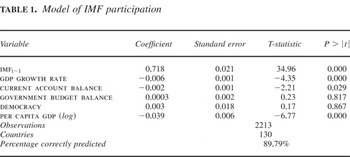
Other right-hand variables code economic characteristics of the country, which are appropriate since countries only turn to the IMF when their economies are in turmoil. We include the following indicators of such trouble: (1) the per capita income (GDP per capita), (2) the growth rate of the economy, (3) the size of the current account deficit as a share of gdp, which serves as a proxy of external crisis, (4) the size of the government balance as a share of gdp, and (5) the country's level of democracy. Table 1 presents the results of the IMF participation model.
Model of IMF participation

Our IMF participation model performs well, correctly predicting 89.79 percent of all observations in the sample.60
Bird cautions against putting too much stock in such “goodness-of-fit” statistics since, for most sample periods, predicting “no agreement” should be accurate 80 percent of the time; see Bird 2003, 51. We report ours as an indicator of the satisfactory nature of the model, relative to others of its kind. For benchmark purposes, Garuda's model correctly predicted 62 percent of his sample—see Garuda 2000, 1037; while Jensen's model correctly predicted 83 percent of the observations in his sample—see Jensen 2004, 22. Bird's summary of various published models of IMF participation suggest that, on average, 85 percent of observations are correctly predicted; Bird 2003, 51.
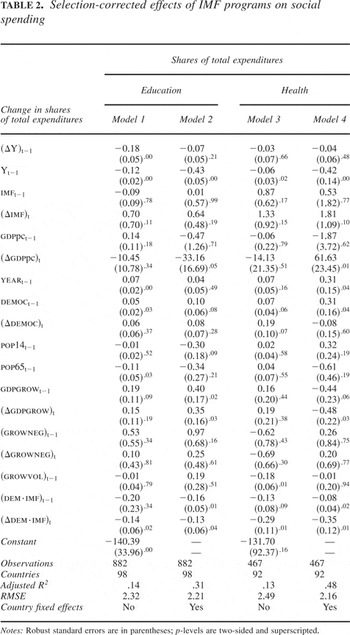
Having built a satisfactory model of IMF program participation, we can now turn to our primary interest, which is to see if democracy conditions the effect of IMF programs on government spending, controlling for the factors that lead countries into IMF programs in the first place. As noted above, we use the models of IMF participation to generate hazard rates (

) for IMF participants and nonparticipants, and then use this predicted imf variable in place of the observed IMF variable used above. There are some noteworthy findings of this model, which are presented in Table 2 below.
Selection-corrected effects of IMF programs on social spending

One of the more striking results of the models is that IMF participation seems to have a positive effect on public service spending, contrary to the critics' claims. The variable imf has a positive coefficient in three of the four models while the Δimf coefficient is positive in all four models. These results are in stark contrast to the critics of the IMF and seem instead to support the results submitted by the IEO. But we cannot make too much of these results because more often than not the coefficients do not reach conventional levels of statistical significance. The imf coefficient is not statistically significant in any of the four models and while the variable Δimf is closer to conventional levels, it reaches them only in Models 1 and 4. Since these variables are not significant, it would seem that IMF programs have little impact on the poor through their effect on government spending patterns.
Such a conclusion would be hasty given the inclusion of an interaction term. Technically, the estimated coefficients discussed above provide the impact of an IMF program for countries that score 0 on the Polity scale. To gain a full appreciation of the IMF's impact, therefore, we must evaluate the evidence for a conditional effect of IMF programs on public service spending. The coefficients on the interaction terms (dem·imf and Δdem·imf) are significant at conventional levels across the board with the exception of Model 1. Importantly, and counterintuitively given the existing literature, these effects are negative, suggesting that in democracies, IMF programs exert a downward pressure on education and health spending. A more precise way to interpret these results is to do so with reference to the partial derivative (using the subscripts from equation 1):

Using the results from Model 2 (since it incorporates fixed effects, which is a more conservative specification), the partial derivative taken with respect to imf is [0.001 − (0.16·dem)]. We can see, then, that the effect of IMF programs on education spending is negative and, more strikingly, that this downward pressure actually increases with increasing levels of democracy. Model 4 shows that IMF programs have a similar increasingly negative effect in democracies for health spending.
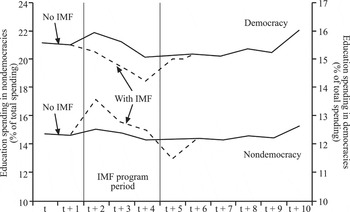
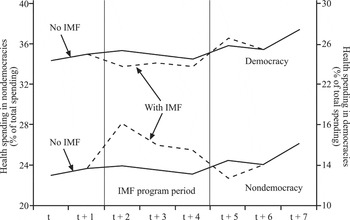
To provide greater intuition for these results, Figures 1 and 2 simulate these results, using the average sample values for each year for the control variables and manipulating the imf and dem variables. Thus, we first predict a baseline for each regime type, and then “shock” the system with an IMF program that last three periods. The deviation of the “with IMF” line from the “no IMF” line provides an estimate of the impact of the IMF program. For presentation purposes, the “democracy” and “nondemocracy” predicted values are placed on different axes. Looking first at Figure 1, we see that absent IMF programs, democracies spend more on education as a percent of total spending than their nondemocratic counterparts do, but this difference shrinks during IMF program periods—evidence that impact of IMF programs differs according to the regime type. Democratic countries with IMF programs tend to cut education spending about 2 percent of total spending, while the share of spending rises in nondemocracies about the same amount. A similar finding with health is shown in Figure 2, which reveals that health spending as a share of total government spending falls when democracies experience IMF austerity programs but rises in nondemocracies, even as democracies spend more than nondemocracies absent IMF programs.

Effect of IMF program on education spending

Effect of IMF program on health spending
These results show that IMF programs do indeed hurt spending on the poor, but they do so more in democratic countries. What are we to make of these results? There are three ways these results can be interpreted. The first is what we might call an “accounting” interpretation. Since our dependent variable is spending as a share of total government spending, the negative coefficient can arise because of movements in either the numerator or the denominator. In particular, the negative sign can result due to (1) an increase in total spending while education and health spending remain constant or increase at a slower rate, making it appear as if governments are spending less, or (2) a decline in spending on education and health services while total spending is constant or perhaps declining at a slower rate than the decrease in services spending. Since we know from previous research that IMF programs do indeed result in governments reducing their total spending, we can quickly discard the first option and conclude that something else is driving these results.61
A second possibility is an “economic efficiency” interpretation. This would suggest that because democracies spend more on these services in the absence of IMF programs, it makes the most sense for these to be the targets of cuts during austerity. That is, if austerity requires that governments reach some targeted level of budget cuts, the most economically efficient way to do this is to trim those categories where spending was particularly “loose” in the absence of austerity. We can see from our results that democracies do indeed spend more on these programs in the absence of IMF programs, and so one reasonable interpretation of the negative coefficients on the interaction terms is that democratic governments cut spending according to economic reasons rather than political ones. This explanation would also explain why nondemocracies appear to “increase” their social spending under IMF programs. Given that nondemocracies spend less on these categories in “good” times, a more plausible interpretation of this finding is that they cut other categories of spending to bring their deficits down, which results in the share of social spending increasing even as the absolute amount spent does not change.
The final interpretation, and one that arises out of our discussion earlier, is a wholly political logic. It would suggest that democratic leaders cut programs according to the power of the interests associated with those spending items. Since democratic governments are put in power according to frequent political tests, and since the probability and efficacy of political participation is not equally distributed throughout the population, office-seeking democratic leaders appeal to those better-organized and hence more politically relevant interests. In times of fiscal austerity, this means protecting those spending items from substantial budget cuts.
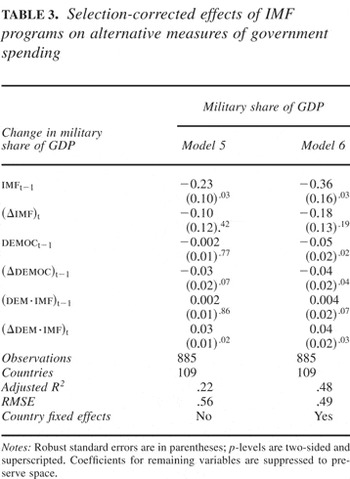
Given that the economic and political interpretations discussed above are observationally equivalent, we attempt to distinguish between them by extending our analysis to another category of government spending, namely military spending.62
Specifically, we estimate these models using military spending as a percent of total GDP.
Models reported in Table 3 include the selection-correction described above. To preserve space, we report only the coefficients from the key variables. Complete results are available from the authors.
Selection-corrected effects of IMF programs on alternative measures of government spending

Turning to these results, we see that the pattern of the estimated coefficients is precisely the opposite of those in the education and health spending models. The estimated coefficients on the uninteracted democracy variable, which provide the effect of democracy in the absence of IMF programs, are all negative, and three of the four coefficients are statistically significant. Thus, as expected, in the absence of IMF programs, democracies allocate a smaller share of their budgets to the military. What happens when the IMF demands cuts to the budget? The interaction term coefficients tell an interesting story. All four coefficients are positive, and three of the four are statistically significant. Thus, in the presence of an IMF program, democracies increase the share of spending allocated to the military. We take this to mean that the military's organization allows it to overcome the problem of collective action and resist cuts as compared to an explanation that would focus on economic efficiency.
Our statistical analysis thus provides strong and consistent support for the claim that the effect of IMF programs is indeed shaped by the domestic political institutions of recipient countries; but these effects do not go in ways conventional accounts might lead us to expect. Rather, while we do find that democracies allocate more of their budgets to social categories such as education and health when there is no IMF program in place, this relationship is reversed in the presence of an IMF program. Contrary to the unconditional positive effect reported by the IMF, we find that IMF programs reduce the share of spending on education and health in democracies. We also find evidence suggesting that this is not due to economic rationality but rather to a political calculus based on heterogeneity in the efficacy of political organization. Of course, the economic and political stories are not stark opposites, and decisions of how to frame the economic rationale are undoubtedly influenced by political factors. Our data are too coarse to distinguish truly between the two explanations, but they should provide an impetus to efforts to do so via more detailed case studies of particular instances of IMF program implementation.
Robustness Checks
In this section, we check first if our results hold with different measures of the dependent variables. Second, we ask if recent guidelines for social expenditures have worked.64
We also checked if our results held in separate regional subsamples of our data. Specifically, we estimated our models using only the Latin American or sub-Saharan African samples because these two regions have the most experience with IMF programs. Our results do hold in these subsamples and are available from the authors.
Alternative Social Spending Indicators
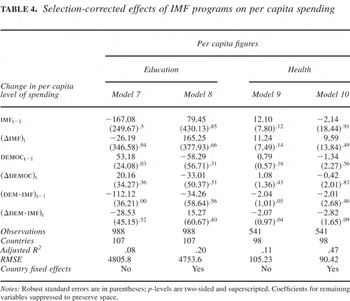
First, we test robustness by using alternative measures of education and health spending, considering each in per capita terms rather than as shares of total spending. Doing so provides leverage on the question of whether the results discussed above are simply an artifact of the fact that changes in shares could result from changes to total spending even while absolute spending on education and health remain unchanged. Table 4 reports the results from estimations using these measures of spending.65
Models reported in Table 4 include the selection-correction described above. We report only the key coefficients to preserve space.
Selection-corrected effects of IMF programs on per capita spending

The results reported in Table 4 are supportive of the claims made above, though they are stronger for the health measure than for the per capita education measure. In the two models on per capita education, few of the key coefficients are statistically significant, but these are illustrative. Consider Model 7. Here, the uninteracted coefficient on democracy is positive and statistically significant. In the absence of IMF programs, a one-unit increase in a country's democracy score is predicted to increase its spending on education per capita by $53. However, the interaction term is negative and statistically significant (β = −112.12). Thus, the presence of an IMF program results in a decrease in the per capita spending on education, though, as indicated above, these results are clearly not conclusive.
The per capita health models, by contrast, are far more damning. Three of the four interaction term coefficients in Models 9 and 10 are negative and statistically significant, which means that, in the presence of IMF programs, increases in a country's democracy score result in reductions in the per capita amount spent on health. The negative effect of IMF programs on social spending described in the previous section are thus not merely accounting artifacts, but rather evidence of political considerations in the implementation of budgetary cuts.
A Kindler, Gentler IMF?
Our final robustness check considers if recent policy changes at the IMF have had their desired effect. Starting in the late 1980s and early 1990s, the IMF has responded to its critics by placing greater emphasis on protecting social expenditures. In 1996, Bird reported:
The Fund is also moving away from concentration on simple budgetary aggregates, such as total spending or the budget balance, in favor of paying more attention to the “quality” of fiscal adjustment. Since the economic impact of its fiscal provisions are much affected by which expenditures are trimmed and what is done with taxes, the Fund is becoming more insistent on knowing how a government proposes to implement promised reductions in the budget deficit, increasingly urging governments to install social safety nets and asking awkward questions about military spending.66
Bird 1996, 492.
However, Bird questioned whether such pronouncements have made any difference in practice, noting that the “hard core” of IMF programs had not changed much.67
Ibid., 493.
IMF 2003, 8–9.
To find out, we create a dummy variable for the 1995–2000 period, and interact it with the core variables in our analysis (imf, democracy, and their interaction).69
We chose 1995 as the cutoff point because Bird's analysis indicates that the reforms were already underway by 1996.
Full results are available on request.

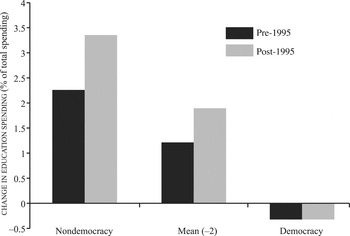
Effect of IMF program on education spending before and after 1995
Figure 3 graphs the predicted effect of an IMF program on the share of spending allocated to education for three values of the regime type variable. At either extreme is the predicted effect of an IMF program for nondemocracies (−10) and democracies (10), while in the middle we show the predicted effect for the mean level of democracy in our sample (−2). Figure 3 also separates the estimated effect of the IMF pre- and post-1995. From our perspective, three conclusions are suggested by this analysis. First, the conditional impact of the IMF is clearly evident here. For nondemocracies, the IMF's effect is to increase education's share of total spending, but this positive effect decreases as the country's level of democracy increases, such that it is negative for pure democracies. Second, the data suggest that IMF efforts to pay more attention to distributional consequences of budgetary cuts have had some effect in nondemocratic countries. Post-1995, the positive impact of the IMF on education spending in nondemocracies is larger than it was before 1995. Finally, this evidence suggests a way to reconcile the IEO's findings with ours. Given that the average recipient of an IMF program in these data is a nondemocracy, and given that the positive effect of the IMF in nondemocracies is larger than its negative effect in democracies, it is not surprising that pooling democracies and nondemocracies results in a finding of a positive IMF effect. However, as our analysis has demonstrated, such a finding masks important political dynamics that are important to understand if we are to assess the “true” impact of the IMF on the public programs that benefit the poor.
Conclusion
Over the past twenty-five years, the role played by the IMF in developing countries has expanded rapidly, and its achievements at stabilization and reform have been clouded by harsh criticism of its alleged negative effects on the poor. This article examines the critique that IMF austerity programs cause reductions in social expenditures such as education and health that are particularly important to the lower classes. Our analysis finds strong and robust evidence for this criticism, in contrast to a recent IMF report claiming to find the opposite. But our results are more nuanced than this basic finding. Structural reforms, such as curbing government spending, almost always have short-term distributional implications. What is important about our findings is that in democracies the weight of this burden seems to be placed squarely on the shoulders of those least able to access private sources of supply of services such as education and health. Contrary to the logic of the democratic deficit, we would argue that this is not necessarily due to the IMF imposing its will on “helpless” governments. Rather, we argue that governments maintain some leverage over the content and implementation of IMF programs, and hence the decrease in spending can be attributed to an unabashedly political calculus. Because public services are associated with relatively less-organized interests, cutting these programs may be preferable in democracies where political tests are frequent and the barriers to entry into the political arena are relatively low.
This research has both theoretical and policy implications. Theoretically, two implications for future research are especially noteworthy. First, studies of the IMF's impact on various aspects of the domestic economies of program recipients have correctly focused on the various methodological challenges posed by such policy evaluation exercises. However, this focus has been to the detriment of more important political questions. While many scholars point to the importance of political considerations in the implementation of IMF conditionality, we have yet to understand fully how such political factors might alter the effects of the IMF. We hope our research spurs others to develop more nuanced arguments about the effects of IMF programs. Particularly helpful would be detailed case studies seeking to uncover the nature of domestic bargaining that takes place under the shadow of IMF austerity. How do groups mobilize to resist cuts? Which groups get heard and which are ignored? How do the specific institutional mechanisms of accountability linking citizens and policymakers affect who wins and loses?
Second, more attention to the dynamics of the “democratic deficit” is warranted. Conditionality reduces the flexibility of domestic leaders, but that, after all, is its point. More relevant questions are: Does entering an IMF program undermine democratic accountability and, if so, how? Do domestic leaders “scapegoat” the IMF to enact policies that might be politically infeasible otherwise? Or are they truly helpless to resist IMF-preferred policies? What determines a country's bargaining leverage vis-à-vis the IMF? The IMF's recent move to transparency in making available country letters of intent should enable future research to answer such questions.
Third, we hope our research is useful also to scholars seeking to understand the links between regime type and government spending. Evidence of the procyclicality of social spending suggests that the relationship between democracy and social spending is more complicated than previously modeled. If, for instance, democracies have higher revenues or generate more debt and therefore increase expenditures, they might well use these additional funds to finance higher levels of social spending. In this case, the higher levels of social spending in democracies has less to do with greater political competition, larger winning coalitions, or electoral accountability, and more to do with the differential sizes of government budgets. Alternatively, one might well argue that the reason democracies have larger budgets is because they face pressures to spend more on social spending. Unpacking the endogenous relationships between democracy, social spending, and budget constraints thus holds tremendous promise.
Finally, the policy importance of studies such as these cannot be understated, as they can shape public perceptions of the IMF, bolster the voices of those seeking to reform the IMF, and affect how the IMF responds to its critics. Consider, as an example, the reaction of Jean-Claude Milleron, former French Executive Director of the IMF, to the IEO's 2003 evaluation of IMF fiscal adjustment programs:
The IEO made a remarkable and useful contribution when it found that countries with an IMF program have higher social spending, on average, than they would have had without a program. Thus, the naïve view that the IMF always proposes a “one size fits all” approach for countries in distress is a myth, broadly disseminated by poorly informed academics and nongovernmental organizations. Cross-sectional econometric studies are often the proper response to ideology. Such studies would have been very useful, in particular when the IMF was under fire from its colleagues in the World Bank. In the same spirit, I also remember difficult hearings in the French parliament in which I would have been much more comfortable if I had had such useful and interesting studies to rely on.71
Milleron 2004, 49.
At the very least, our findings should suggest that such optimism is out of place and that the IMF must return to the drawing board to reassess the true impact of its programs.
Data Appendix
Countries in Estimation Sample
(Countries in italics are only in the education spending sample; countries in bold are only in the health spending sample.): Albania, Argentina, Australia, Austria, Azerbaijan, Bangladesh, Belarus, Belgium, Bhutan, Bolivia, Botswana, Brazil, Bulgaria, Burkina Faso, Burundi, Cameroon, Canada, Chile, Colombia, Costa Rica, Congo (Rep.), Congo (Dem. Rep.), Cote d'Ivoire, Croatia, Cyprus, Denmark, Dominican Republic, Ecuador, Egypt, Estonia, Ethiopia, Finland, Fiji, France, Germany, Ghana, Greece, Guatemala, Guinea, Guyana, Haiti, Hungary, India, Indonesia, Iran (Islamic Rep.), Iceland, Ireland, Israel, Italy, Jamaica, Japan, Jordan, Kenya, Korea (Rep.), Kuwait, Kyrgyz Republic, Latvia, Lesotho, Lithuania, Luxembourg, Madagascar, Malawi, Malaysia, Mali, Mauritius, Mexico, Moldova, Mongolia, Morocco, Namibia, Nepal, Netherlands, New Zealand, Nicaragua, Norway, Pakistan, Panama, Papua New Guinea, Paraguay, Peru, Philippines, Poland, Portugal, Romania, Sierra Leone, Singapore, Slovak Republic, Slovenia, South Africa, Spain, Sri Lanka, Sweden, Switzerland, Syrian Arab Republic, Thailand, Togo, Trinidad and Tobago, Tunisia, Turkey, United Kingdom, United States, Uruguay, Venezuela, Vietnam, Yemen (Rep.), Zambia, and Zimbabwe.
Description of Variables72 All data are from World Bank 2004
unless otherwise noted. We convert the education and health data into
shares of total expenditures using the gdp and
expenditures data described below.
All data are from World Bank 2004 unless otherwise noted. We convert the education and health data into shares of total expenditures using the gdp and expenditures data described below.
education: Per capita public spending on education.
education*: Public spending on education (% of total spending).
health: Per capita public spending on health.
health*: Public spending on health (% of total spending).
defense: Military expenditures (% of GDP).
gdp: Gross domestic product (constant 1995 US $).
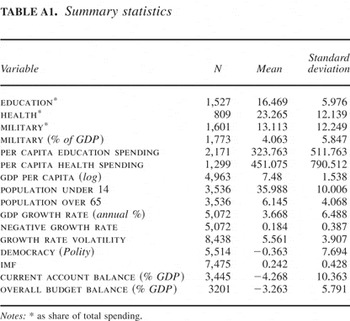
Summary statistics

expenditures: Central government expenditure, total (% of GDP).
gdp per capita: GDP per capita (constant 1995 US $).
gdp growth: GDP growth (annual %).
gdpneg: Negative GDP growth. Dichotomous variable coded as “1” if GDP growth was negative; “0” otherwise. Source: Authors' calculations.
gdpvol: Volatility of GDP growth. Sample period standard deviation of growth rates. Source: Authors' calculations.
pop14: Population under the age of 14.
pop65: Population over the age of 65.
democracy: Polity combined scale of regime type (−10 to 10). Source: Marshall, Jaggers, and Gurr 2004.
imf:. Dichotomous variable for participation in IMF program. Source: Vreeland 2003.
current account balance: Current account balance (% of GDP).
government balance: Overall central government budget balance (% of GDP).