Introduction
Precise identification of plant material is important within closely related species of medicinal plants for proper utilization related to genetic improvement and discovery of new drugs. Fruits of Phyllanthus emblica L. are one of the top selling agricultural products having diverse applications in health care, food and cosmetic industry across the world (Warude et al., Reference Warude, Preeti, Joshi and Patwardhan2006). Medicinal properties of P. emblica have been well documented and proven to have immunomodulatory properties (Ganju et al., Reference Ganju, Karan, Chanda, Srivastava, Sawhney and Selvamurthy2003), anticancer (Jose et al., Reference Jose, Kuttan and Kuttan2001), antioxidant (Bhattacharya et al., Reference Bhattacharya, Ghosal and Bhattacharya2000), heart diseases (Khopde et al., Reference Khopde, Indira Priyadarsini, Mohan, Gawandi, Satav, Yakhmi, Banavaliker, Biyani and Mittal2001) and antiulcer properties (Al-Rehaily et al., Reference Al-Rehaily, Al-Howiriny, Al-Sohaibani and Rafatullah2002). There are over 2000 species and 60 genera of Phyllanthaceae globally (Samuel et al., Reference Samuel, Kathriarachchi, Hoffmann, Barfuss, Wurdack, Davis and Chase2005). However, only two species of Indian gooseberries, namely P. emblica and Phyllanthus indofischeri, are commercially cultivated (Pathak et al., Reference Pathak, Srivastava, Dwivedi and Singh1993; Singh, Reference Singh2003). Presently, these two species are indiscriminately introduced in several of the commercial orchards in India (Pathak et al., Reference Pathak, Srivastava, Dwivedi and Singh1993). These two species are distinguished from each other based on their morphological and reproductive parameters (Ganeshan, Reference Ganeshan2003), but it is very often confusing for the farmers to identify due to changes in vegetative morphology (bark colour, leaf size and leaf colour) and reproductive morphology (number of male and female flowers per branchlet, fruit set and retention, colour of the fruits, and rate of fruit maturity) under the influence of different agroclimatic conditions.
Indiscriminate distribution of clones generated from unauthentic genetic stocks of Indian gooseberry is the major concern for precise identification of similar species and varieties. Inferior clones introduced from unauthentic sources are often susceptible to leaf rust disease (Ravenelia emblicae Styd.) and pests such as the shoot gall maker (Betousa stylophora Swinhoe), bark eating caterpillar (Indarbela tetraonis Moore) and mealy bugs (Nipaecoccus vastater Newstead). These pests are common in Indian gooseberry (Lal et al., Reference Lal, Joshi and Singh1996). In addition, many of the orchards in India are occupied with a mixture of clones developed from P. emblica and P. indofischeri, exhibiting close morphological resemblance (Rai et al., Reference Rai, Gupta, Pathak and Rana1993). Farmers often find it difficult to distinguish these two species for collecting nodal cuttings for clonal propagation. Therefore, development of molecular tool for precise identification of P. emblica and P. indofischeri is felt to be important. Chloroplast trnL (UAA) intron was used as one of the potential candidate genes for developing phylogenetic relationships in several plant species such as Coffea arabica (Maurin et al., Reference Maurin, Davis, Chester, Mvungi, Fakim and Fay2007), Fagopyrum esculentum (Logacheva et al., Reference Logacheva, Samigullin, Dhingra and Penin2008), members of Dipsacales (Zhang et al., Reference Zhang, Chen, Li, Chen and Tang2003) and Rosaceae (Verbylaitė et al., Reference Verbylaitė, Ford-Lloyd and Newbury2006). In this study, an extensive survey was carried out to study the influence of different elevations on the vegetative and reproductive characters of P. emblica and P. indofischeri. We also report that trnL (UAA) intron is one of the potential candidate genes for precise identification of these two species for cloning and selective harvesting of crops.
Materials and methods
Characterization of vegetative and reproductive features
Field observation on morphological and reproductive characteristic features of P. emblica and P. indofischeri was carried out for three consecutive seasons in three different ranges of elevations (200–400, 400–800 and 800–1500 m), comprising a total of six well-established orchards close to Western Ghats of Tirunelveli district, South India. The morphological observations include both vegetative features (bark colour, tree shape, leaf size, leaf shape and leaf texture) and reproductive features (male and female flowers per branchlet, fruit set and retentions). Data on these parameters were recorded during vegetative (August–September), flowering (June–July and February–March) and fruiting (October–December) seasons. These data were compared with the taxonomic description of these two species published by Ganeshan (Reference Ganeshan2003). The influence of three different elevation ranges on the changes in vegetative and reproductive parameters of these two commercial species of Indian gooseberries was analyzed. The study sites include Kalakad Mundanthurai Tiger Reserve Forest and Agathiyar mountain of Western Ghats in extreme southern part of India.
Isolation of genomic DNA
Fully expanded leaf samples from authentic source (State Horticultural Department, Government of Tamilnadu, India) of P. emblica and P. indofischeri were collected and thoroughly washed with sterile water before grinding of samples under extraction buffer. One gram of leaves was cut into tiny pieces and ground thoroughly using pre-chilled mortar and pestle under extraction buffer (100 mM Tris–HCl, 0.5 M EDTA, 1.5 M NaCl and 2% cetyl trimethylammonium bromide). β-Mercaptoethanol (300 μl, v/v) and 500 μl of 0.1 N NaOH were added during grinding of samples. Samples were incubated at 65°C for 60 min with gentle mixing of samples at a regular time interval, and 20 μl of 0.1 N NaOH were added for every 15 min of incubation to stabilize the pH at 8.0. Samples were allowed to attain room temperature, and equal volume of chloroform–isoamyl alcohol mix (24:1) was added with gentle mixing before spinning the samples at 8000 rpm for 10 min. Clear supernatant of the samples was recovered, and 2/3 volume of isopropanol and 500 μl of 0.5 M NaCl were added before incubation at − 20°C overnight. Precipitated DNA after spinning of samples at 8000 rpm for 10 min was recovered by removing the supernatants, and pellets were washed with ethanol (70%). Pellets were allowed to dry and dissolved in 200 μl of Tris 10 mM and EDTA 1 mM) buffer. Samples were treated with RNase before determining the quality and quantity of DNA.
Polymerase chain reaction (PCR) amplification
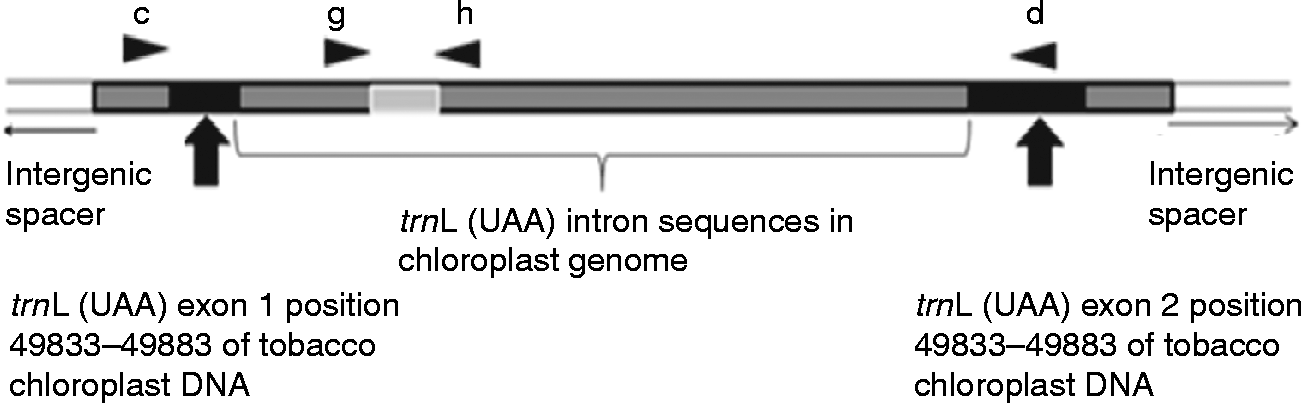
PCR for amplification of chloroplast trnL (UAA) intron positioned between two intergenic spacers (Fig. 1) was performed with DNA samples of P. emblica and P. indofischeri using the universal chloroplast DNA gene-specific primers namely ‘c’ 5′CGAAATCGGTAGA-CGCTACG3′ (A49325) and ‘d’ 5′GGGGATAGAGGGACTTGAAC3′ (A49865) designed by Taberlet et al. (Reference Taberlet, Gielly, Pautou and Bouvet1991). In addition, genomic DNA from individual trees in different orchards was also included for PCR amplification. The PCR mixture consists of 25 μl master mix (contains 10 × Taq buffer, 2 mM MgCl2, 0.4 mM dNTP mix and 2 U proofreading Taq DNA polymerase) from Helini Biomolecules (Chennai, India) forward and reverse primers − 10 pmoles/μl (1 μl), template DNA (2 μl) and nuclease free water (21 μl) to make final volume to 50 μl. The PCRs were 94°C for 3 min (initial denaturation), 94°C for 1 min (denaturation), followed by 30 cycles (annealing) of 50°C for 1 min, 72°C for 1 min (extension) and 72°C for 5 min (final extension). Amplified products were run on an agarose gel containing 0.5 × Tris/borate/EDTA buffer along with 100 bp DNA ladder (Helini Biomolecules).
Position of trnL (UAA) intron sequences between two intergenic spacers and exons in chloroplast genome of tobacco. Arrows indicate the primer-binding site of chloroplast gene-specific primers namely c, d, g and h (Taberlet et al., Reference Taberlet, Gielly, Pautou and Bouvet1991).

DNA sequencing and bioinformatic analysis
PCR products of trnL (UAA) intron obtained from authentic samples of P. emblica and P. indofischeri were subjected to DNA sequencing using ABI 373 automated sequencer (Applied Biosystems, Inc., Foster City, CA, USA) using a DyeDeoxyTM Terminator Cycle Sequencing Kit (Applied Biosystems) as recommended by the manufacturer, and analyzed using the Basic Local Alignment Search Tool 2.2.8 of National Centre for Biotechnology Information (NCBI) with program BLASTX. These sequences become the reference for comparing sequences of unknown samples. PCR fragment of trnL (UAA) introns obtained from 60 randomly collected samples in three different orchards was compared with reference sequences for correct identification species.
Results
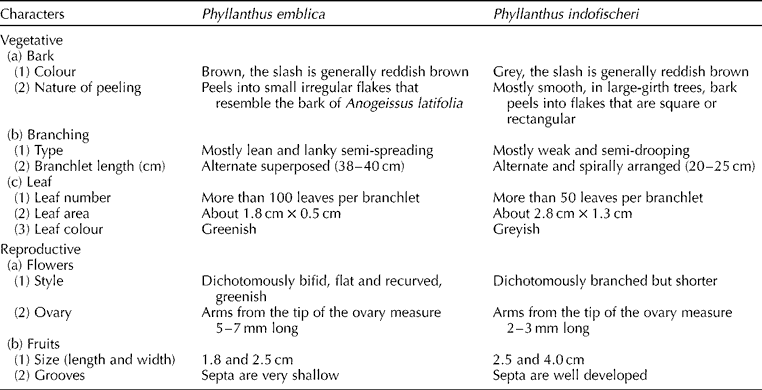
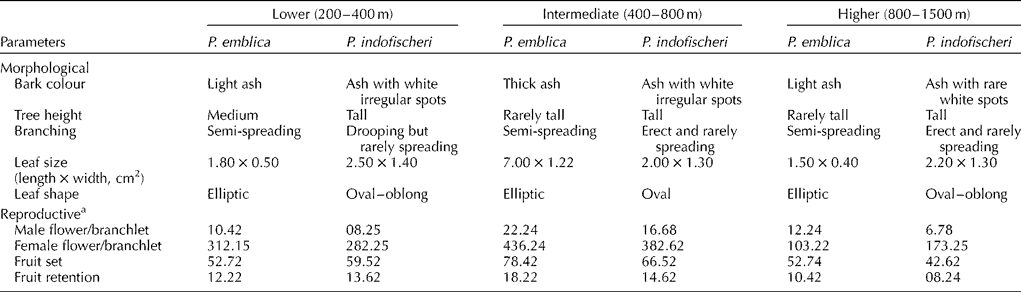
The published descriptions of the vegetative and reproductive features of P. emblica and P. indofischeri (Fig. 2) were compared with our data (Table 1). Quantitative traits such as leaf size, length of branchlet and fruit size were found to be highly variable within species. The colour of the bark varies from light gray to dark gray in two commercial species of Indian gooseberry. Both species exhibited medium to high degree of drooping of primary and secondary branches with very similar leaf lengths (1.8 cm). Leaf width, however, was distinguishable between P. emblica (0.5 cm) and P. indofischeri (1.3 cm). Extensive survey and field observations of P. emblica and P. indofischeri for three consecutive seasons of vegetative and reproductive phase at three different elevations revealed significant levels of variation with regards to vegetative and reproductive features (Table 2). Trunk colour of ca. 15-year-old trees was observed to be light ash to thick ash, with irregular white patches when both the species were grown at three different elevations (200–400, 400–800 and 800–1500 m).
Characteristic features of branchlet, leaf and fruits of Phyllanthus indofischeri ((1–4): 1, branchlet with a fruit; 2, leaf; 3, flowering branchlet; 4, fruits) and Phyllanthus emblica ((5–8): 5, branchlet with a fruit; 6, leaf; 7, flowering branchlet; 8, fruits) (Ganeshan, Reference Ganeshan2003).

Vegetative and reproductive characteristic features distinguishing two species of Phyllanthus

Changes in vegetative and reproductive features of Phyllanthus emblica and Phyllanthus indofischeri under different elevations

a Data represent the mean values scored from 30 trees.
Drooping nature of the branching habit was found to be influenced by elevation. P. emblica, which always produces spreading primary and secondary branches at lower elevations, exhibited medium to complete drooping at higher elevations. P. emblica and P. indofischeri produced the highest number of male (22.24 and 16.68, respectively) and female (436.24 and 382.62, respectively) flowers/branchlet at intermediate elevation (400–800 m). At lower (200–400 m) and higher (800–1500 m) elevations, the number of male and female flowers/branchlet was significantly reduced. Fruit set and final retention of fruit number per branchlet in both the species of Indian gooseberries were greatly influenced by elevation rather than the genotypes. Intermediate elevation (400–800 m) produced the maximum fruit set in both P. emblica and P. indofischeri species. The morphological and reproductive features of these two species were partly influenced by elevation as they exhibited varying response of growth and development under different elevations. Thus, these features alone cannot be used for differentiating P. emblica and P. indofischeri as the environmental conditions often change the vegetative and reproductive features of these two species.
A PCR product of 540 bp was obtained from authentic P. emblica and P. indofischeri when amplified with trnL (UAA) intron gene-specific primers. Sequencing followed by multiple sequence alignment of trnL (UAA) introns of these two species had shown polymorphism at four different sites of trnL (UAA) intron (Fig. 3). These two species are found to be very close to Phyllanthus amarus based on the sequence homology of trnL (UAA) intron (NCBI Acc. No. EU861193). Extending our study on sequencing of trnL (UAA) intron from the DNA of 60 randomly spotted trees in three commercial orchards followed by comparison with reference sequences corresponding to both species of Indian gooseberries revealed that 76% of the population of these orchards were occupied by P. indofischeri and the remaining 24% with P. emblica. Reference sequences that correspond to P. emblica (FJ847837) and P. indofischeri (GU930706) were submitted to NCBI database.
Multiple sequence alignment of Phyllanthus emblica and Phyllanthus indofischeri along with closely related species Phyllanthus amarus. Arrow indicates the differences in trnL (UAA) intron nucleotide sequences between P. emblica and P. indofischeri.

Discussion
Indian gooseberry is an important nutritional and medicinal tree. In order to maintain the quality of drug and food products, it is essential that these are prepared from correctly identified material. The differences with regards to fibre content, juice, pulp, acidity, vitamin C and polyphenols including tannins differ between P. emblica and P. indofischeri (Rai et al., Reference Rai, Gupta, Pathak and Rana1993; Supe et al., Reference Supe, Shate, Chaukvaa and Kaulgud1997). Our study has shown that the vegetative and reproductive features of the two commercial Indian gooseberries described earlier by Ganeshan (Reference Ganeshan2003) are often confusing due to interaction of environmental conditions. Thus, a reliable molecular tool would be useful for precise identification of these two species. Chloroplast genes are extensively used for developing phylogenetic relationships based on their unique DNA sequences corresponding to each species within the families such as Scrophulariaceae (Freeman and Scogin, Reference Freeman and Scogin1999), Dipsacales (Zhang et al., Reference Zhang, Chen, Li, Chen and Tang2003), Phyllanthaceae (Samuel et al., Reference Samuel, Kathriarachchi, Hoffmann, Barfuss, Wurdack, Davis and Chase2005), Rosaceae (Verbylaite et al., Reference Verbylaitė, Ford-Lloyd and Newbury2006), Rubiaceae (Maurin et al., Reference Maurin, Davis, Chester, Mvungi, Fakim and Fay2007) and Zingiberaceae (Dhivya et al., Reference Dhivya, Sarma and Sathish Kumar2008). They also become the potential candidate genes to identify closely related species of commercial importance (Kress et al., Reference Kress, Wurdack, Zimmer, Weigt and Janzen2005).
Utilization of trnL (UAA) intron to distinguish closely resembled species and also for developing DNA barcoding of plants was described (Taberlet et al., Reference Taberlet, Coissac, Pomponon, Gielly, Miquel, Valentini, Vermat, Corthier, Brochmann and Willerslev2007). Samuel et al. (Reference Samuel, Kathriarachchi, Hoffmann, Barfuss, Wurdack, Davis and Chase2005) have demonstrated the suitability of utilizing matK gene for developing phylogenetic relationships among several species of Phyllanthaceae. In India, barcoding exercise is focused on two important angles, namely (1) meeting the taxonomic challenges and providing robust identification of species and (2) securing intellectual property rights (IPRs) for some of the country's important bioresources (Aravindh et al., Reference Aravindh, Ravikanth, Uma Shanker, Chandrashekara, Kumar and Ganeshaiah2007). Indian gooseberries comprising two species namely, P. emblica and P. indofischeri, are cultivated as different varieties under wider range of agroclimatic conditions (Pathak, Reference Pathak2003). These varieties are primarily seedling progenies, and are genetically heterogeneous providing scope for seedling selection. Pathak (Reference Pathak2003) reported that there is pressing demand for Indian gooseberries from China and Israel, as promising cultivars of gooseberries have not been developed in other countries. Thus, it is possible to utilize trnL (UAA) intron and other possible chloroplast genes for characterizing the promising germplasm of Indian gooseberries in the context of IPRs.
Our study has shown that trnL (UAA) intron can be used effectively for distinguishing two closely related species of Indian gooseberry based on their nucleotide differences in the trnL (UAA) introns. Thus, trnL (UAA) intron can be used for distinguishing P. emblica and P. indofischeri in a well-established orchard, where more than one species are introduced without authentic sources. Precise identification of these two species using trnL (UAA) intron followed by manual marking of plants would help the farmers to carry out selective picking of berries from these two species. This molecular tool can be of great utility for farmers to enable the preparation of clones and grafts from correctly identified species for commercial application.
Acknowledgements
This study has been financially supported by the University Grants Commission, New Delhi, India, under major project ‘Collection, Conservation and Molecular Characterization of wild and hybrid derivatives of Amla (P. emblica) germplasm’ in Tirunelveli district, Tamil Nadu (no.: 33-244/2007 (SR) dated 24 December 2007).