

I. Introduction
The concept of reputation has been used in every field of theoretical research because it affects the outcome of economic and non-economic transactions of agents, where the latter can be firms (Kreps, Reference Kreps, Alt and Shepsle1990), minority shareholders (Gomes, Reference Gomes2000), managers (Yermack, Reference Yermack2004), banks (Gorton, Reference Gorton1996), central banks (Barro and Gordon, Reference Barro and Gordon1983), public debt managers (Drudi and Prati, Reference Drudi and Prati2000), auction participants (Houser and Wooders, Reference Houser and Wooders2006), internal auditors (Sridhar, Reference Sridhar1994) and even criminals (Lott, Reference Lott1996).
The importance of reputation on the price that a seller is able to charge has been recognized already by Akerlof (Reference Akerlof1970), who demonstrated that markets for experience goods with asymmetric information can fail when sellers cannot reliably signal product quality. However, the asymmetric information problem can be reduced or remedied by the seller's reputation. Reputation is associated with quality expectations, which reflect long-term cumulative investments; reputation can also change as a result of short-term accidental or intentional actions (Fombrun and Shanley, Reference Fombrun and Shanley1990). Price premium attached to good reputations compensates sellers for their investment in quality (Barney, Reference Barney1991). Therefore, it is not surprising that several empirical studies confirm the expected benefits associated to a positive reputation (Roberts and Dowling, Reference Roberts and Dowling2002).Footnote 1
In spite of the comprehensive body of theoretical literature on reputationFootnote 2 and its relation to performance,Footnote 3 much remains to be explored regarding the determinants of reputation.
So, in this paper, we study the relationship between reputation and its determinants with reference to the Italian wine market. We consider both national and international firm reputation as indicated by popular wine guides. We find that a winery's reputation is positively affected by firm age and size, producer's intrinsic motivations, collective reputation, and institutional regulation. Negative reputational effects are caused by outsourcing (e.g., buying grapes from other companies). We do not find any effect of horizontal diversification (number of wines produced), ownership status, or relying on well-known external consultants. Furthermore, some differences among determinants of national versus international reputation raise considerations about the judgment process, which have important implications and are discussed in Section IV.
The remaining sections of the paper is organized as follows. Section II describes the set of employed variables that capture the theoretical determinants of firm reputation. Section III explains how our data were collected and presents summary statistics. Section IV reports the empirical results from different econometric models, and Section V offers a conclusion.
II. Testing the Theory in the Wine Market
Four factors are key in determining the importance of reputation on economic transactions: (1) the extent of uncertainty about the seller; (2) the seller's valuation of future interactions; (3) the characteristics of demand that determine how sensitive buyers are to reputation; (4) the rate at which buyers learn from outcomes, including the rate of information diffusion among buyers.
In this respect, as discussed above, the wine market is best placed to proceed with a study on seller reputation.Footnote 4 First of all, wine is an experience good, meaning that buyers learn only after purchase about the real characteristics of the product, which makes reputation an important variable affecting purchases.Footnote 5.Second, the wine market is dominated by uncertainty. The classification system and the single denominations were born, respectively, as institutional and collective responses to market failures connected to wine frauds and, more generally, to consumer uncertainty about the quality of producers (Unwin, Reference Unwin1991). Finally, consumers are very sensitive to the reputation of wines, especially as regards the high-quality end of the market, that is, premium, super-premium, ultra-premium, and icon wines (Heijbroek, Reference Heijbroek2003).
In this context characterized by large number of sellers and labels, mechanisms to centralize and disseminate information have been developed. Nowadays, gurus, journalists, and wine guides play a crucial role in assessing and disseminating information on wineries' reputations (Ali et al., Reference Ali, Lecocq and Visser2008). Thus, as a preliminary remark, all the modalities leading to the reputation judgment can influence the judgment itself. In this paper, by comparing the determinants of international and national reputations of wineries, we are able to disentangle the effect exerted by diversity in the “locus” of reputation assessment.
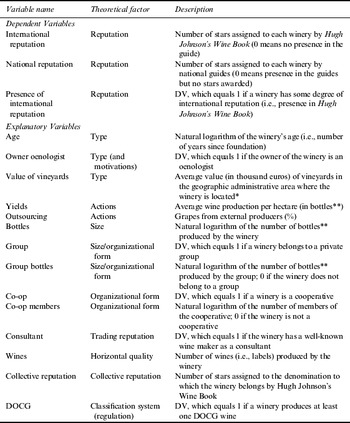
As for the determinants of reputation, we select a set of variables that incorporate, for the wine market, a large number of factors that have been proposed in the theoretical literature.Footnote 6Table 1 presents definitions of dependent and explanatory variables and their link to theoretical factors. We began our data collection by selecting a first group of three variables that capture information on winery type. We define the number of years that the winery operates in the market (Age) as a proxy of consumer learning and learning-by-doing of wineries. Then, we turn to entrepreneurs' skills and motivationsFootnote 7 (in terms of involvement in the production process), by defining a dummy variable (Owner oenologist) that equals 1 when the owner of the winery is an oenologist. Finally, given the importance of natural endowments for wine quality and firm reputation, we introduce a variable (Value of vineyards) that provides the average market value of vineyards in the geographic area where the winery is located.Footnote 8 Of course, there could be endogeneity because the value of vineyards reflects expected future income streams from it. In order to control for it, we have run econometric estimates with and without such variable (see note 22).
Description of the Variables Used in the Econometric Models

* The value refers to one hectare of soil devoid of any grapes and facilities, therefore the value is downward biased for all provinces with respect to the real market price of one hectare of productive soil.
** Bottles are measured in a 0.75 L standard.
Second, we capture the role of wineries actions by using two variablesFootnote 9Yields is the winery's average production by hectare, where less productive wineries are the ones that most care about wine quality.Footnote 10Outsourcing is the percentage of wine grape production provided by external producers; wine quality is associated with complete control of the overall production process, so that recourse to external producers can result in lower quality.Footnote 11
We then move to other determinants of reputation. Bottles, that is, the natural logarithm of the total number of bottles of wine produced by the winery, captures dimensional issues (size). Indeed, big firms have a larger buyer base, which, combined with word-of-mouth comments on successful or failed transactions, makes their actions more visible to market agents (see Rob & Fishman, Reference Rob and Fishman2005). In addition, big firms have more resources to realize marketing campaigns and investments aimed at improving the quality of their products. Finally, “the availability of information may benefit large firms disproportionally by inflating audiences' familiarity with their activities” (Fombrun and Shanley, Reference Fombrun and Shanley1990, p. 240). Therefore, the induced effort of a large firm will be greater, such as its incentives (and resources) to invest in costly advertising. Other measures of size are related to the eventual belonging of the winery to a larger business group (Group) and to the dimension of the group itself (Group Bottles). Group also provides information on the organizational form of wineries.
The effect of the organizational structure on reputation is also explored through the effect of cooperation. In this respect, it is worth noticing that cooperatives are a common form of organizational structure in the wine industry, especially in countries like Italy, France, Spain, and Germany, characterized by the presence of both a large number of small producers and a fragmented use of land. The theoretical literature has recently investigated the effect of cooperatives on firm quality, because belonging to a cooperative allows significant savings and improves efficiency, especially when firms are very small and the physical capital (e.g., land in agriculture) is dispersed among many producers. However, if costs are sustained by each producer but revenues are equally shared among all the members, there are clear free-rider problems because members have an incentive to minimize costs even if this has a negative effect on quality (see Fleckinger, Reference Fleckinger2007; McQuade et al., Reference McQuade, Salant and Winfree2008; Winfree and McCluskey, Reference Winfree and McCluskey2005; Fishman et al., Reference Fishman, Finkelshtain, Simhon and Yacouel2008). We thus introduce the dummy variable Cooperative, which equals 1 when the organizational structure of the winery takes the form of a cooperative. In order to test for possible free-rider effects on quality, we also introduce a variable that measures, for each cooperative, the number of its members (Coop Members).Footnote 12
Other possible determinants of winery reputation are related to horizontal differentiation strategies (i.e., linking transactions through the production and sale of several different types of wines under the same brand) and trading reputation practices (i.e., use of well-known external consultants). As to the former, reputation can also be seen as buyers' belief about the extent to which the seller will match their tastes, so product diversification can allow the transfer of buyers' expectations from one quality product to other products of lower quality (Wernerfelt, Reference Wernerfelt1988). As to the latter, reputation can also become a tradable asset, because the seller might try to redirect buyers' beliefs by acquiring an external reputation on the market (see Bar-Isaac and Tadelis, Reference Bar-Isaac and Tadelis2008, section 6; Kreps, Reference Kreps, Alt and Shepsle1990). In the wine industry, it is common practice to use these strategies by both hiring prestigious winemakers, who are supposed to provide their skills as well as reputation (Roberts et al., Reference Roberts, Khaire and Rider2011), and adopting umbrella branding strategies.Footnote 13 Thus, Consultant is a dummy variable that equals 1 whenever the winery has a well-known (national or international) wine maker as a consultant, while Wines is the number of different labels that are produced under the same winery's brand.
The extent of uncertainty on product quality in many markets makes reputation strategies of single firms insufficient for solving market failures alone. Hence, institutional and collective arrangements have been developed to guarantee consumers with minimum quality levels. Sellers' self-regulation generates a collective reputation, modeled as an aggregate of individual reputations by Tirole (Reference Tirole1996) in his seminal paper, which shows that the two reputations influence each other. Given the importance of collective reputation for the wine sector,Footnote 14 we introduce a measure (Collective) of the reputation of local denominations—such as Barolo, Barbaresco, and Franciacorta—which associates with each winery the quantitative (international) rating assigned to its denomination. This enables us to investigate the relationship between collective and individual reputation.
A related but different concept regards regulation by public institutions through the introduction of minimum quality standards (Winfree and McCluskey, Reference Winfree and McCluskey2005). Even though the two concepts may be intertwined, because DOCGFootnote 15 wines on average have higher collective reputation, one has to distinguish collective reputation from institutional quality regulation. While collective reputation, as mentioned above, refers to the aggregate reputation of a coalition of wineries, entry regulation fixes minimum quality standards for a winery to enter the quality segment of the market. To be more specific, we distinguish the effect of the classification system set up by public institutions (e.g., DOC or DOCG) from that of the reputation of a specific denomination set up by coalitions of firms of a certain restricted area (thus, net of the belonging to a certain category of wines like DOC or DOCG).Footnote 16 Entering the high-quality segment of the market by producing certified quality wines (VQPRD in Europe generally, DOCG in Italy) is an additional factor affecting a winery's reputation. So, we define the dummy variable Docg, which equals 1 when the winery produces at least one DOCG wine (and equals 0 otherwise), in order to control for this latter effect.
The inclusion in this paper of all these variables allows us to present evidence on the determinants of seller reputation using a comprehensive set of controls that are meant to test theoretical predictions. The next section provides details on the empirical methodology upon which this test is based.
III. The Empirical Fieldwork
A. The Empirical Setting
Having discussed the elements that make the wine market a natural candidate for investigating the determinants of seller reputation, several characteristics make the Italian market an ideal test bed for this analysis. First, Italy is the largest producer and the second-largest consumer of wine in the world; we chose the most important area, the North-West (which comprises Piedmont, Aosta Valley, Liguria, and Lombardy), which is characterized by high quality (Barolo, Barbaresco, Franciacorta) and great variety (white wines, red wines, sparkling wines). Top wines have quality comparable to the best wines of Burgundy, Bourgogne, and Champagne. Second, the Italian market is characterized by great variability in the quality of wineries and high uncertainty for consumers.Footnote 17
This also implies that there is no market as suitable as the Italian one to study reputation in terms of the score evaluation provided by wine guides. Of course, by focusing on wine guides, we look at preferences of experts and not at those of consumers (which are closer to Carl Shapiro's concept of individual reputation; see Shapiro, Reference Shapiro1983). However, as it is common in markets characterized by strong asymmetric information, “rating agencies” have a key role in determining individual reputation. This is particularly true in the wine market, where gurus' ratings significantly influence consumers and investors' opinions and decisions (see again Ali et al., Reference Ali, Lecocq and Visser2008). In addition, as just mentioned, the intrinsic features make the Italian wine market an ideal test bed for investigating determinants of wineries' reputation in terms of experts' scores.Footnote 18
Therefore, we have measured winery (national and international) reputation by relying on well-known and highly respected wine guides. In particular, data on the assessment of the national reputation of Italian wineries are derived from L'Espresso Wine Guide (one of the leading and most popular Italian wine guides), while those on international reputation are from Hugh Johnson's Wine Book (an acclaimed international guru whose guide has been published yearly since 1977).
Because many empirical studies suffer from sample selection bias issues, we concentrated on determinants of the presence of international reputation, in addition to the national one. In other words, we investigate which variables affect the probability that a firm will have an international reputation, conditional on already having a national reputation. So, we focus on the universe of all wineries that already have an established national reputation (i.e., they are present in at least one of the following four guides: L'Espresso Wine Guide, Vini d'Italia of the Slow Food Association, Duemilavini of the Italian Sommelier Association, and Vini di Veronelli), therefore avoiding the risk of selecting misleading samples of wineries.
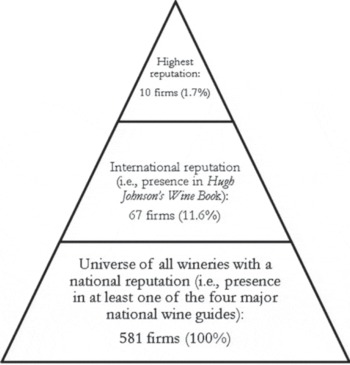
The path of the reputation-building process is: (1) no reputation, then (2) only national reputation, and finally (3) both national and international reputation. All Italian wineries with an international reputation previously gained a national reputation, while only 12% of wineries with a national reputation also have an international reputation. The top of the reputation pyramid is made up of those firms (1.7% of our sample), which had the maximum score (in terms of stars) in Hugh Johnson's Wine Book. Figure 1 offers a description of this reputation path and illustrates the empirical methodology.
The Reputation Pyramid

Data on explanatory variables come from many sources: wine guides (L'Espresso Wine Guide, Vini d'Italia of the Slow Food Association, Duemilavini of the Italian Sommelier Association, and Vini di Veronelli), Cerved (i.e., the database of the Italian Chambers of Commerce), Inea (the National Institute of Agricultural Economics), wine portals (e.g., www.langhevini.it), and winery associations. Direct checks with wineries occurred when needed.
For each winery, the final database provides information on national and international reputation; firm structure, age, size, ownership, and management; membership in denominations (DOC/DOCG); and relative collective reputation. Data on the dependent variable (i.e., national and international reputation) refer to the year 2006, while explanatory variables refer to 2005.
B. Preliminary Descriptive Evidence
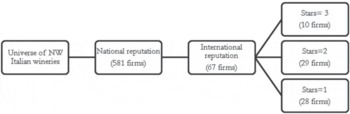
The sample comprises 581 wineries located in the Italian North-West region: 418 (72%) from Piedmont, 114 (20%) from Lombardy, 29 (5%) from Liguria, and 20 (3%) from Aosta Valley. By design, all 581 wineries considered have a national reputation (i.e., they are present in at least one of the four aforementioned national wine guides) with a score that ranges from 0 to 3, where 0 means existence of a national reputation with the lowest value (no star). International reputation equals to 0 when absent (i.e., the winery is not present in Hugh Johnson's Wine Book) and equals 1 to 3 when present (equal to the number of stars awarded by the international wine guide). Figure 2 illustrates the distribution of national and international reputations of sample wineries.
National and International Reputation of Italian Wineries

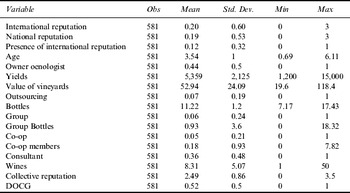
Table 2 provides summary statistics for variables used in the statistical analysis. As mentioned above, out of 581 firms with a national reputation, only 67 (12%) also have an international reputation: 58/418=14%in Piedmont, 9/114=8% in Lombardy, and 0 in Liguria and Aosta Valley. Piedmont not only has the highest number of wineries but also the most prestigious firms. As to the other firm characteristics, 6% of wine producers belong to a group and 5% are cooperatives with a high mean and great variability in the number of associated members (from 5 to 2,500),Footnote 19 which increases the risk of free-rider problems. The number of wines produced by each firm ranges from 1 to 50 with an average of 8 different labels.
Summary Statistics

Yields per hectare, a fundamental determinant of wine quality, range from 1,200 to 15,000 bottles. On average, 7% of the grapes used are bought from vineyards of external producers, which, in absence of effective controls and firm traceability, is expected to reduce the quality of the final product. Note that when outsourcing is absent (the variable is equal to 0), production is fully integrated and vise versa.
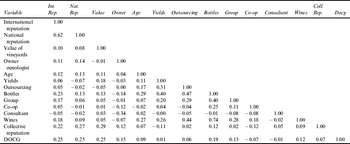
Almost half the owners are also oenologists, a confirmation of the importance of entrepreneur's skills and intrinsic motivations in viticulture. In fact, while this might be due in part to economic incentives to increase productivity, reduce costs, and maximize profits, it is surely due in part as well to the personal involvement and the intrinsic desire to increase the quality.Footnote 20 Furthermore, 36% of firms rely on consultancies by expert wine makers with national and even international reputations, which is sometimes (and arguably) supposed to be an asset for a firm willing to climb the reputation pyramid. In this respect, it is interesting to note the strong negative relationship between internal competencies and the recourse to external skills (see Table 3).
Correlation Matrix of Selected Variables

Slightly more than half the sample produces at least one wine belonging to a DOCG, the highest level of denomination in the Italian classification system. Wineries that produce at least one DOCG wine as a share of the total number of wineries is 61% for Piedmont, 41% for Lombardy, and 0 for Liguria and Aosta Valley.
In order to isolate the contribution of every single variable in reputation at the national and international levels, we move on to the regression analysis.
IV. Determinants of Seller Reputation: Econometric AnalysisFootnote 21
A. Determinants of the Presence of International Reputation
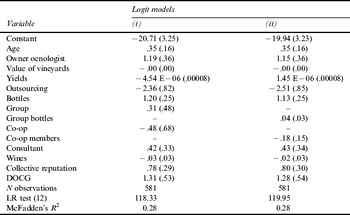
In order to analyze which variables influence the presence of international reputation, we build a dummy variable that equals 1 when international reputation is present, and 0 when it is absent (see Table 1). The obvious candidates are logit (and probit) models. Results of regressions are robust (see LR tests) and are reported in Table 4.
Determinants of the Presence of International Reputation

Notes: Results come from logit regressions with robust standard errors (reported in parentheses). Regressions were run with Stata. The dependent variable is a dummy equal to 1 when the firm has both national and international reputation, 0 otherwise.
The presence of international reputation is significantly affected by many factors. As to the type of seller, results are mixed. On the one hand, reputation is strongly related to the owner's expertise and the number of years in the market, with the coefficient of Owner Oenologist and Age positive and significant in all regressions. On the other hand, contrary to common knowledge but in line with some recent research (see Gergaud and Ginsburgh, Reference Gergaud and Ginsburgh2008; for an opposite finding see Cross et al., Reference Cross, Plantiga and Stavins2011), natural endowments like the value of vineyards have an insignificant role on reputation.Footnote 22
Although internal competencies strongly affect the reputation of the winery, trading reputation practices, that is, acquisition of well-known wine makers, have a negligible effect (the coefficient of the variable Consultant is insignificant in all regressions). In this respect, it is worth noting that Delmastro (Reference Delmastro2005), in a similar setting, finds a positive effect for external consultancy on the quality of individual wines. In sum, it seems that external consultancies have a positive effect on the reputation (and quality) of individual wines but not on the winery itself.
Turning to action variables, production technologies have a significant impact, with Outsourcing negative and significant in all regressions. In contrast, actual Yields seem to play no role in the international assessment of a winery's quality, even though it comes up to be significant in regressions on national reputation (see Table 6).
As to the effect of the size of the seller, it turns out to be positive and significant in all regressions; indeed, Bottles is the variable that displays the greatest explanatory power on the probability of achieving an international reputation. However, it is interesting to note that the effect of size is limited (i.e., the coefficients of Group and Group Bottles are insignificant), so there is no additional benefit of being part of a larger group. In other words, at least as far as quality reputation is concerned, in the wine market the minimum efficient scale can be reached at the level of the winery, so the effect of economies of scale seems to vanish quite early with no need to be part of a big group.
However, individual responses to asymmetric information issues are not the only ones to affect a seller's reputation. Being part of a well-known coalition of producers (i.e., a denomination like Barolo) strongly affects the (positive) quality assessment of a single winery (i.e., Collective reputation is significant and positive in all regressions). Similarly, by producing certified quality wine (i.e., DOCG) a winery gains strong returns to its reputation.
B. Simulations
In order to obtain further insights into the issues at hand, a simulation study on the likelihood of having an international reputation has been performed. Given the nonlinear nature of regression models and the fact that most explanatory variables are Boolean or categorical, a simulation analysis offers clearer and more interesting results than simple marginal effects, in order to assess the magnitude of the effects of the different explanatory variables on the dependent variable.
The basic idea is to use the estimated parameters for calculating the distribution function. For any plant, F gives the probability of reaching an international reputation, conditional on having a national reputation. As a benchmark, we first calculated the value of F when the explanatory variables in the vector takes on values that describe the benchmark winery. The probability of the representative winery is then compared with those calculated for different values of explanatory variables, in order to analyze the estimated effects of the variable(s), which have been modified.
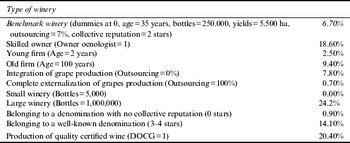
The characteristics of the benchmark winery are described in Table 5 (see the first row). All non-dummy variables have been set at the mean, with the exception of Bottles, which equals 250,000, while dummies have been set to 0. So the benchmark case is represented by a single-brand winery founded in 1972, which produces 250,000 bottles of wine per year (but not DOCG), with an average yield of 5,500 per ha, and part of a denomination with an average international reputation (i.e., 2 stars out of 4).
Probabilities of the Presence of International Reputation

Note: Simulations on Model (ii) of Table 4 run with SPost developed by J. Scott Long and Jeremy Freese (Reference Scott Long and Freese2005).
Table 5 illustrates the predicted probability of gaining an international reputation when the significant explanatory variables are changed one at a time, to give an idea of the effect of each variable on the likelihood of having an international reputation. Whenever a variable is changed, it is set either to a value representative of the lowest figures observed in our sample or to a value representative of the highest ones, with one exception: for size and age, intermediate (more interesting) values are chosen.
Having set all dummy variables at 0 (even though with a yearly production slightly greater than the average), the benchmark probability of the presence of international reputation is small, 6.7%, and lower than the average (12%). However, this probability is very sensitive to the type and actions of the seller: Being a skilled owner increases the likelihood of holding an international reputation to 18.6%, so the young age of a winery and the complete externalization of grape production tend to reduce it to near zero (2.5% and 0.7%, respectively).
As mentioned, winery size displays a crucial role in holding an international reputation. Very small firms have no resources with which to promote their products so that international reputation is absent (0% when yearly production is less than or equal to 5,000 bottles), while wineries whose dimension rises above a minimum threshold (nearly 100,000 bottles a year) hold enough assets to significantly increase the probability of having an international reputation (up to 24.2% for wineries with a production of 1 million bottles).
Finally, institutional and collective arrangements strongly affect the likelihood of achieving an international reputation. First, belonging to unknown denominations reduces the probability of holding an international reputation to nearly 0%, while being part of a celebrated appellation increases it to 14%. Second, the production of certified and guaranteed (by minimum quality standards set up by national institutions) wines efficiently acts, in the context of asymmetric information, as a quality signal, so the probability of achieving an international reputation rises above 20%.
C. Determinants of International and National Reputation
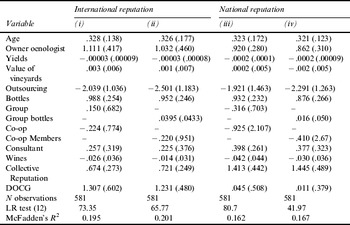
We then turn to an analysis of seller reputation through the use of ordered logit models with bootstrapped standard errors (in the same vein, see Gergaud et al., Reference Gergaud, Montana and Verardi2007) on the assessment (in terms of stars) awarded, at a national and international level, on each sample winery (see Section 4 and Table 1 for definition of dependent variables). In particular, Table 6 presents results of estimates on international and national reputation, columns i–ii and iii–iv respectively.
Determinants of International and National Reputation

Notes: Results come from ordered logit regressions with robust standard errors (reported in parentheses). Regressions were run with Stata.
The first two columns of Table 6 report the results of the estimates on international reputation. As a preliminary remark, empirical results are overall robust (see LR tests reported at the bottom of the table). In addition, results are very similar to those reported in Table 4 for binomial models, and this reveals that the determinants of achieving an international reputation are almost the same of those of increasing this assessment. Therefore, empirical evidence on ordered data confirms the role played by the type (skill and age) and actions (production technology) of the seller as well as its size. Similarly, the presence of institutional and collective arrangements figures prominently in shaping the reputation of individual firms.
In the last two columns, we analyze the determinants of a national reputation. Because national and international reputations display a positive correlation (see Table 3), we expect the sign of the coefficients to go in the same direction as the previous models. This is actually the case for most variables, so we have confirmation of the robustness of results on the determinants of a winery's reputation.
Furthermore, the existence of two important differences between results of models i–ii and iii–iv completes the picture indicating the role played by the assessment process and, more generally, by the specific features of the mechanisms to centralize and disseminate information on seller quality.
First, the coefficient of productivity (Yields) is not significant in regressions with an international reputation while it is strongly negative in those with a national reputation. This is due to the fact that the degree of investigation that an observer geographically close to the producers and to his vineyards can provide is higher than one of an evaluator from other countries (if not continent). Indeed, in the national reputation setting, the observer's proximity to the winery (and the number of interactions between the two parties) allows niche producers with very low productivity to emerge and become known.
Second, and in a similar vein, while the national classification system (i.e., the DOCG system) exerts a significant effect on international reputation of wineries, this is not the case for national reputation (i.e., the coefficient DOCG is positive but insignificant in both regressions iii and iv), where the collective reputation effect (the reputation of single denominations, i.e., the positive coefficient Collective reputation displays the greatest explanatory power in all regressions on national reputation) strongly prevails in institutional information signals as a determinant of individual reputation.
To sum up, it turns out that a number of determinants (type, actions, size, ownership structure and collective reputation) robustly affect the individual reputation of sellers, irrespective of the mechanisms of the evaluation process. In addition, more technical information influences reputation only when there is proximity between the person who assesses the quality of the firm and the firm itself. On the contrary, when this is not the case, reputation tends to rely more heavily upon institutional information signals (i.e., quality regulation).
V. Concluding Remarks
Since Akerlof's (Reference Akerlof1970) seminal paper on the consequences of asymmetric information on economic transactions, the literature on the importance of reputation has expanded enormously and covered every field of economic activity. In this paper, we develop an empirical exercise on the Italian wine market that allows us to test a comprehensive set of theoretical determinants of a seller's reputation.
Some of our results confirm some of the main predictions of the theoretical literature. In particular, seller's type (see also Mirvis, Reference Mirvis1992, and Banerjee and Duflo, Reference Banerjee and Duflo2000) and actions (Fombrun and Shanley, Reference Fombrun and Shanley1990, and Goldberg and Hartwick, Reference Goldberg and Hartwick1990) have a significant effect on the probability of having international reputation. However, the extent and significance of these effects depend on factors that are often sector specific. For instance, in the wine market, motivations have a crucial impact on product quality and reputation, while, contrary to common knowledge, natural endowments have a less important (sometimes insignificant) role than technology.
On the contrary, size and age (Fombrun and Shanley, Reference Fombrun and Shanley1990) confirm their expected impact on reputation. In contrast to other research (Roberts et al., Reference Roberts, Khaire and Rider2011), relying on well-known external consultants (i.e., trading reputation) does not accrue any outside reputation to the seller as a whole, but the effect seems limited to a single product (Delmastro, Reference Delmastro2005).
Two additional results seem particularly interesting for the present theoretical debate on reputation. First, we distinguish the effect of quality entry regulation from that of collective reputation. We find that both variables significantly affect the individual reputation of sellers. This result suggests the role played by collective and institutional arrangements in shaping the reputation of individual sellers. However, the effect of quality regulation depends heavily on the mechanisms of the evaluation process of firms. Second, more technical information influences the reputation only when there is proximity between the person who assesses the quality of the firm and the firm itself. On the contrary, when this is not the case, reputation tends to rely more heavily upon institutional information signals.