Scholarship on the creation of the Federal Trade Commission has explored the influences of progressives, capital, labor, agrarians, and electoral coalitions, all in an effort to explain the nexus of influences that led to this state-building effort. Most have noted that there was an agency, the Bureau of Corporations, engaged in the corporate question before the FTC's creation, but none explores this agency's influence on the FTC's construction.
The influence of bureaucracies on political development has gained new traction with the advent of the literature on bureaucratic autonomy. Daniel Carpenter has shown how, in some circumstances, bureaucracies can become political actors in their own right that can win political battles against other significant interests.Footnote 2 I suggest that a bureaucracy still might influence crucial legislation regarding its own structure, even if it has not achieved autonomy as defined by Carpenter's model.Footnote 3 Leaders at the Bureau of Corporations followed congressional debates, developed studies on the antitrust problem, and harnessed their network in an effort to influence the legislation establishing the bureau's larger and more powerful successor agency. They took advantage of a political opportunity to enhance the influence of their organizational and technical expertise.
The Bureau of Corporations was created in 1903 as part of the act creating the Department of Commerce and Labor. Its principal task was to gather information on large industries. It did so by sending agents to inspect the books and operations of firms in selected industries. It wrote a series of lengthy published reports on industries such as beef, steel, petroleum, tobacco, and cotton exchanges. Individual firms subject to particular scrutiny included Standard Oil, U.S. Steel, and International Harvester. The bureau was, therefore, mainly an information-gathering agency. The creation of the FTC transformed this agency into one with quasi-judicial administrative powers: it could identify unfair business practices, initiate hearings, and issue cease and desist orders.Footnote 4
Officials at the Bureau of Corporations had followed debates and proposals in Congress in 1911 and during the campaign of 1912. They prepared for the battle over the trade commission seriously beginning in the summer of 1913, months before President Woodrow Wilson declared a trade to be a legislative priority. The bureau shifted a substantial portion of its resources to trust issues. It analyzed each of the legislative proposals and critiqued efforts to define unfair trade practices in the legislation as unworkable; instead the agency came to advocate that its successor should have bureaucratic discretion. Bureau officials contacted leading academics, civic leaders, and businessmen, and they cultivated relationships with newspapers and rating agencies. In the process, the Bureau of Corporations gained much of what it sought when it became the nucleus of the new FTC.
People loyal to President Theodore Roosevelt dominated the original staffing and culture of the agency: the Bureau of Corporations had been made in his image. Nonetheless, the preferences stated by bureau leaders in 1913 and 1914 differed somewhat from what Roosevelt had envisioned. Above all, Roosevelt advocated federal charter or licensing of interstate corporations. In 1911, the commissioner of corporations whom he had initially appointed, Herbert Knox Smith, also proposed registration as a means of control, with the envisioned agency receiving power to revoke licenses.Footnote 5 But this policy had few backers during debates over the Federal Trade Commission Act of 1914 (FTCA), either within the bureau or in Congress. As a result one of the greatest sources of potential strength was barely discussed: the FTC would not have a gatekeeping power.Footnote 6 Nonetheless, the bureau's influence was progressive: it promoted bureaucratic state power to curb the worst abuses of corporate power. This reflected Roosevelt's New Nationalism more than the New Freedom Woodrow Wilson championed during the 1912 election: rather than legislate away large concentrations, the bureau sought to bring order to the market by expert observation and oversight.Footnote 7
Background
Government's response to big business was one of most contested issues of the early twentieth century. Nineteenth-century corporation law was made in the states. At the middle of the nineteenth century, these laws contained significant restrictions on what a corporation could do. By the end of the century, these restrictions had largely been eliminated, or rendered ineffective by state competition. Corporations began to consolidate via mergers and holding companies to create oligopolies or monopolies in an ever-wider range of industries.Footnote 8
Congress made a start toward defining the federal role in the trust issue with the Sherman Act of 1890, which declared “contracts, combination in the form of trust or otherwise, or conspiracy in restraint of trade or commerce” to be illegal. In the 1890s the Supreme Court narrowly interpreted these provisions. In the E.C. Knight case of 1895, the Court ruled that the Commerce Clause, and thus congressional authority, did not extend to manufacturing operations that happened to occur within states. Second, the Court interpreted the Sherman Act literally. The common law understanding of restraint of trade prohibited unreasonable restraints but not all restraints. The Court interpreted the language to prohibit all restraints, reasonable or not. Agrarians supported this view, because they thought it could be used to break up monopolies.Footnote 9 The Supreme Court reversed ground in 1911 in the Standard Oil and American Tobacco cases.Footnote 10 Although these combinations were indeed broken up, the Court posited a “rule of reason” that permitted reasonable restraints on trade. This reframed the debate over federal policy. One alternative was to reinstate the literal definition of restraints on trade and overturn the rule of reason. Conceivably, a bill more strongly defining illegal activities could accompany this. Under this approach, the courts would enforce transgressions specified by legislation. A second alternative would be to develop an independent regulatory commission with enforcement powers.
The FTCA established that commission. The passage of this act has been the subject of substantial scholarly attention. Robert Wiebe's account places the FTC squarely within a progressive movement directed toward greater government monitoring of a nationalized economy.Footnote 11 The growth of a national economy created new sets of impersonal relationships. Reforms were built on the capacities of an increasingly specialized professional class. At the bureaucratic level, this involved “continuous management” of more complicated state-society relationships. Historian Louis Galambos characterizes Wiebe's approach as emblematic of an “organizational synthesis.”Footnote 12 Ellis Hawley elaborates on this line of reasoning by suggesting that an ideology of functional associationalism caused such state building to take place in a piecemeal fashion, with the FTC as an example of this process. This associationalism sought to rationalize collective management while preserving individualism.Footnote 13 Brian Balogh notes that historians taking this approach were reacting against a functionalist lens that depicted bureaucratic growth as efficient and largely apolitical. He argues that the separate development of professionalization and the federal bureaucracy were characteristic of state building at this time.Footnote 14
Martin Sklar, meanwhile, attributes the advent of the FTC to the consolidation of corporate liberalism.Footnote 15 Although nineteenth-century economic relations centered on relatively small firms, the legal environment began to favor increasingly large firms, which led to conflict over the role of government in managing economic relations. The political contest for president in 1912 pitted three progressive presidents against one another. Theodore Roosevelt advocated strong presidential control to distinguish good trusts from bad trusts, William Howard Taft advocated judicial processes to punish violations of the Sherman Act, and Woodrow Wilson advocated bureaucratic regulation of the corporate legal environment. In Sklar's narrative the Wilson agenda was the one implemented. Elizabeth Sanders, by contrast, identifies electoral support from the agrarian economic periphery as the crucial factor. Sanders divides congressional districts according to degree of industrial development: urban, mixed, and rural. Representatives from the rural sectors gave greater support to the FTC than did urban or mixed areas.Footnote 16
One problem with these critiques is that they do not account for Wilson's shift in preferences. Wilson's economic views prior to 1912 rested on a sort of economic moralism. Further, the Democratic Party adopted a platform associated with William Jennings Bryan, who advocated a strict interpretation of the Sherman Act, which he expected would put an end to trusts. The Supreme Court ruling in the Standard Oil case propelled Bryan and his Democratic followers to call for a law restoring the strict interpretation of “restraint of trade.” Wilson's initial New Freedom proposals did not differ substantially from this formulation.Footnote 17
Scott James explains Wilson's change in preferences as a result of electoral imperatives. Wilson was elected with 42 percent of the vote, when Theodore Roosevelt split with the Republican Party after failing to win its nomination. The need to win Electoral College votes induced President Wilson to alter his program. Rather than seek to break up trusts by rewriting the Sherman Act, Wilson shifted toward a strong regulatory commission, an approach similar to that favored by Theodore Roosevelt. Given the potential for the Democrats to lose in a two-way race, Democratic members of Congress were willing to adjust their preferences to accommodate the needs of the national party. Complicating matters, Ballard Campbell suggests that the poor economic conditions that contributed to Democratic electoral success in 1910 and 1912 might well have the opposite effect in succeeding contests, when Democrats were the incumbent party. Gerald Berk concurs on the centrality of electoral politics but argues that the final arrangement was more ambiguous than James recognizes. He notes that Senator Francis G. Newlands of Nevada, a leading progressive Democrat, depicted the FTCA as regulating but not destroying large corporations, while at the same time Senator Albert Cummins of Iowa, a leading progressive Republican, depicted it as a vehicle designed to arbitrate the debate as to whether large corporations had lower production costs than smaller firms. Cummins thought that large consolidations would not have occurred had a proper trade commission been in place. The FTCA was thus portrayed by Newlands, a Democrat, to progressive Republicans as regulating large trusts and by Cummins, a Republican, to progressive Democrats as designed to prevent trust formation. Each faction, in this view, was being told that the bill was giving them what they wanted, and this helped it gain support.Footnote 18
Elizabeth Kimball MacLean attributes much of the impetus not to Brandeis but to Joseph E. Davies, Wilson's commissioner of corporations. Davies hailed from Wisconsin and was an acolyte of University of Wisconsin economist Richard. T. Ely and of Robert La Follette. MacLean credits Davies with implementation of a variant of the Wisconsin Idea at the federal level. She notes, for example, that Davies advocated an expanded bureaucracy to Wilson and helped shepherd the legislation through Congress. As I show below, however, the bureau articulated many of the same preferences prior to Davies’ appointment.Footnote 19 This suggests greater cross-fertilization of ideas than has been recognized thus far.
All researchers on the origins of the FTC note the prior existence of the Bureau of Corporations, but none to date have considered the influence of this agency on the particular powers given to the FTC. Here, I explore this influence. The bureau leveraged its reputation by directing substantial resources to the corporate regulation issue. Agency leaders communicated with key members of Congress and with a network of businessmen, lawyers, and academics.Footnote 20 They acted to further a political end.
To make these claims, I draw on Daniel Carpenter's concept of bureaucratic autonomy. Carpenter argues that under certain conditions, bureaucracies can become political actors in their own right. First, autonomy requires an effective leadership. Leaders must develop a strategic plan and provide direction to achieve agency ends. Second, the incremental character of bureaucratic innovation facilitates the development of wide-ranging networks. These can include political ties to congressional and executive branch officials, as well as ties to academics, interest group activists, and civic groups. Third, autonomy requires the development of a capable and expert mezzo-level workforce. A strong mezzo-level force enables a bureaucracy to build reliable expertise for its clients that other agencies cannot as effectively provide. Agencies that achieve these can build a strong reputation and a measure of autonomy: they are capable of winning political battles pitted against other political actors, even including Congress.Footnote 21 Opportunities for autonomy can be enhanced by strategic action. For example, Daniel Ernst claims the Securities and Exchange Commission (SEC) had a degree of autonomy in the 1930s, in part by strategic harnessing and co-opting of the Wall Street securities bar, whose members became gatekeepers to securities law. He also credits strategic coalitions built by the SEC with congressional allies.Footnote 22
By Carpenter's standard, the Bureau of Corporations did not achieve autonomy; it did not, for example, win a major political battle against other institutional actors.Footnote 23 But in Carpenter's model, autonomy is fairly rare. The agencies he portrays as attaining this status had a long history before the arrival of new leadership that led the drive toward autonomy. By contrast, the Bureau of Corporations was new, and its enabling legislation gave the president gatekeeping authority over the information gathered there. Location within the Department of Commerce and Labor was also an impediment: this added an additional layer of supervision. As an arm of the executive branch, its commissioner did not have authority to release information without approval by the president. It had limited power to compel testimony and no direct enforcement powers. Findings of illegal behavior cases could be referred to the Department of Justice but only on direction of the president. It would be hard to be autonomous under this circumstance. Though failing to meet the high bar of autonomy, the bureau still used its reputation and networks for important ends. This suggests a continuum with full autonomy on one end of the scale.
Identifying the bureau as an actor positions it within the state-capacity arguments advanced by Theda Skocpol.Footnote 24 From this perspective, the state is by no means a mere reflection of competition among pluralist interests; state-centered scholars such as she position the state as an actor itself. A significant challenge for these theories has been identifying and measuring state influences and then distinguishing them from societal forces. Eric Nordlinger sought to solve this by defining state action as where the state gets what it wants in contradistinction to social actors.Footnote 25 This essay provides such an example: the interests of the Bureau of Corporations differed from any single group within the country itself, whether agrarian, corporate, or reform-minded.
The organizational synthesis approach focused on associations formed to promote policy agendas or to organize market oversight. Notably, Wiebe identified, as a crucial component of the new order, a class of educated professionals with coordinating capacities, parallel to the middle managers whom business historian Alfred D. Chandler saw as rationalizing enterprise. When operating in the state, these upper and middle managers can form a separate interest and, in Carpenter's analysis, strive for autonomy.Footnote 26 Such actions are necessarily political. Chandler's argument seems to numerous scholars to veer toward economic determinism. William Roy and Gerald Berk offer examples of the counterargument that politics and the law were essential ingredients in the formation and success of trusts in transportation or industry. Richard White takes this antideterminist case further by arguing that top management was incompetent and corrupt and not particularly efficient.Footnote 27
A tension between free market ideology and antimonopoly sentiment provides a crucial background to this narrative. The challenges for regulation of big business in general were distinct from railroad regulation. First, there was far greater variation in operational idiosyncrasies and regulation required a commensurately greater range of expertise. Second, Congress passed a series of acts authorizing railroad rate regulation; a similar pattern did not yet exist for other corporations.Footnote 28 Railroads had a natural monopoly in areas served only by one road, and they were crucial transportation links to a national market. As a result they were conceptualized as “affected by the public interest.”Footnote 29 Most business corporations were not. Third, numerous states had railroad commissions, whose commissioners had organized into the National Association of Railroad and Utility Commissioners (NARUC). By the 1910s, government simply had a much greater capacity for gathering information on railroads and analyzing it than it did for nearly all other businesses. A survey by the Bureau of Corporations undertaken in 1903 revealed that most states knew little about corporate activity in their state. Only one state, Massachusetts, provided detailed information of the sort requested. Most of the other states did not, as they had never distilled the data from charter filings and tax returns.Footnote 30 The Bureau of Corporations sought to address this problem, within the constraints of its limited grant of power.
The bureau had four principal audiences, the most important being the president. The bureau was set up to serve the executive branch, who had authority over the release of its information. The second audience was Congress; one of its original purposes was to gather information that could inform Congress as to appropriate legislation. From the outset, each house of Congress passed resolutions requesting the bureau to investigate industrial conditions, particularly when there had been a sudden or persistent price increase. Testimony by bureau leaders at congressional appropriation hearings noted the stress these requests placed on agency resources and the resulting need for larger appropriations.Footnote 31 A third audience was the large industries and corporations that the bureau was charged with investigating. This included not only large, powerful firms, but also small businesses, competitors, suppliers, distributors, and retailers that had dealings or were in competition with trusts. A final category included the news media and the public. While the bureau issued reports of several hundred pages, it included summaries of its findings appropriate for newspapers. During debates over the FTCA, the bureau interacted with each of these audiences.
The transition from the Bureau of Corporations to the FTC was substantial. The FTCA delegated both congressional lawmaking power and judicial decision-making power to an administrative agency. The FTC was made independent of the Department of Commerce and was assigned powers the bureau did not have. It was granted authority to require standardized reports from corporations. It could investigate antitrust violations and report them to the attorney general. In turn, the attorney general could refer antitrust violations to the FTC for further investigation. If a court so dictated, the FTC could act as a master in chancery to give hearings and suggest appropriate relief. Unlike the bureau, the FTC could publicize according to its own discretion, so long as it did not reveal trade secrets. In addition, the FTC was charged with enforcing provisions of the Clayton Act concerning, among other matters, price discrimination, tying contracts, holding companies, and interlocking directorates. Finally, the FTC was not authorized to approve business contracts in advance of their execution. All of these, including the prohibition on prior authorization, were in accord with what the bureau wanted. In sum, the new FTC had greater independence, increased information-gathering powers, increased powers of investigation, quasi-judicial powers, and discretion in the publicity of information it gathered.Footnote 32 Its tools for continuous management were substantially enhanced.
Reputation and Networks at the Bureau of Corporations
By the time the FTCA was passed, the Bureau of Corporations had over ten years of experience investigating large firms, industrial conditions, and regulatory regimes in states and in foreign nations. It had a substantial staff and a reputational profile. The first secretary of the Department of Commerce and Labor was George Cortelyou, a close confidant of Roosevelt. He was followed in 1904 by Victor H. Metcalf, and then by Oscar Strauss in 1906. The first commissioner of corporations was James R. Garfield, son of the slain president. He was connected in Ohio politics to Mark Hanna and had met Roosevelt in 1896, when Roosevelt was New York City police commissioner. Prior to his appointment at the bureau, Garfield served in Roosevelt's old position as civil service commissioner.Footnote 33 Deputy Commissioner Herbert Knox Smith was elevated to commissioner in 1907 when Garfield was appointed secretary of the interior. Garfield and Smith established the agency's foundations and cultivated its reputation. Smith remained in that post for most of the William Howard Taft presidency, although like other Roosevelt holdovers he fell into disfavor, with Taft bypassing him and dealing directly with bureau subordinates. When Smith left in 1912 to support Roosevelt's candidacy, Taft elevated Deputy Commissioner Luther Conant to commissioner. Taft de-emphasized the bureau and gave priority to judicial processes over administrative processes.Footnote 34 Through the Taft years, the bureau continued its investigations, cultivated contacts in Congress, and pursued its own set of preferences. On taking office, Woodrow Wilson named Joseph E. Davies to the post. Wilson later appointed Davies first chairman of the FTC.
Garfield proved to be an efficient administrator who took great care in appointing staff. These included E. Dana Durand, a Harvard economics instructor who had served on the U.S. Industrial Commission; he was chief investigator from 1903 to 1908. Francis Walker (son of the famous economist and Massachusetts Institute of Technology [MIT] president) also served as an economist before moving on to serve as chief economist of the FTC. Other senior staff were lawyers, including Charles Earl, and chief clerks Z. Lewis Dalby and Warren Choate. Earl wrote several important analyses during the early period of the bureau. Choate established a records system advanced for its time, with case file records and index cards with serial numbers. Evidence of the bureau's efficient organization came as early as 1906, when the Keep Commission commended it for having among the most efficient records keeping in Washington.Footnote 35
During a congressional appropriations hearing in 1904, Smith pleaded for discretion in making appointments to key positions:
It is not like the work of the Census Bureau, for instance, where a man goes out and where they find by experience that so much of the population can be covered in a given time, and it is safe to assume that two men can cover twice that in that time. We can not do that. Our work is highly specialized and technical work, with the result that until we get inside the business and know what is developing we can not tell how much time we have got to put on statistics, how much on the commercial question, and how much on the legal question, and how much time it will take to work up that result in the office, and how much in the field.Footnote 36
By the standards of the day, the staff was extensive. The bureau had sixty-one employees in 1904, which grew to 127 by 1911. Smith claimed that many employees who could have found other employment for substantially more money stayed because they believed in the mission of the bureau.Footnote 37 Their objective was to build the capacity of continuous management in observing corporate behavior.
The first major examination—of the beef industry—occurred in response to a congressional request to investigate, among other matters, low prices paid to cattle ranchers and the high margins on fresh beef.Footnote 38 Garfield initially doubted whether he could legally commence an investigation at the request of Congress because the bureau's enabling act required direction by the president. Also, he worried that the investigation might antagonize a major industry at a time when the bureau was trying to get up and running; business resistance and hostility would interfere with the agency goal of voluntary cooperation. Moreover, with the 1904 election on the horizon, Garfield did not want to do anything that would inhibit Roosevelt's prospects. A bureau investigation could interfere with a Justice Department investigation already underway of the six major Chicago meatpackers.Footnote 39
Garfield nevertheless sought voluntary cooperation from the Chicago meatpackers. He and Durand explained to industry representatives that firm-specific data would not be released, that data gathered would not be used for prosecution, and that only the president could release information. Despite these efforts, the industry resisted. However, in the end the findings of the report were mild. The big six meatpackers controlled only 45 percent of the cattle, the bureau asserted. Profits and margins were small, individual cattle ranchers were paid fairly, and consumers were charged fair prices.Footnote 40 Several newspapers were highly critical, calling the report unconvincing, even “silly.”Footnote 41 The publicity probably harmed the bureau's reputation. Complicating matters, when the Department of Justice filed suit against the beef industry, industry representatives claimed immunity from prosecution due to their testimony to the bureau. District Judge J. Otis Humphrey agreed, dealing a severe blow to the bureau and Roosevelt.Footnote 42
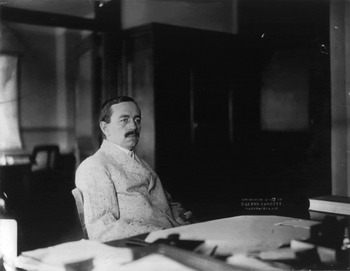
Herbert Knox Smith, c. 1907, around the time Theodore Roosevelt appointed him commissioner of corporations. Courtesy Prints and Photographs Division, Library of Congress, LC-USZ62-62637.

The next report, on Standard Oil, received more favorable press. The bureau expanded a congressional request to investigate Kansas oil prices into a broad look at the oil industry. Initially, Standard Oil cooperated, giving the bureau access to its books. Why is not clear; perhaps after the beef investigation company officials thought they might get immunity or that they too would be exonerated. Instead, the report was a public indictment of Standard Oil rebating and other monopoly practices. The resulting publicity did much to enhance the reputation of the bureau. The timing was also fortuitous: by highlighting the secret rebating agreements of Standard Oil with railroads, the report gave ammunition to Roosevelt in pressuring Congress to pass the Hepburn bill in 1906.Footnote 43 Still, Smith wrote to Garfield with concerns that the bureau did not receive enough credit:
Of course, neither you nor I care for any personal advertisement in this matter, but considering that the entire cases were the work of the Bureau—the Bureau even outlining the indictments, and helped drew them, and established the principles of law upon which they are based, the appropriation of the credit for the work by the Department of Justice made me rather tired, and I think it is essential that the Bureau should have the public prestige of these cases above any other department. I think this credit is a valuable asset we can't afford to ignore.Footnote 44
The bureau crafted its later reports for multiple audiences. Smith explained to Congress, “We make a report of perhaps 300 or 1000 pages. We do not expect any man except the expert to read that report, but when it comes out it has to be boiled down into two newspaper columns, and that is released on a given date to the newspapers, so it goes into papers all over the country, and the 'man in the street' gets the important facts and conclusions as to what is going on in a particular industry.”Footnote 45 He later characterized such efforts as “efficient publicity,” justifying its work as regulatory despite not having the power of enforcement.Footnote 46 This conformed to an ideology of limited government involvement in markets. The audience of disgruntled businessmen, by contrast, was more difficult to serve. The files of the bureau are filled with letters from small businesses unhappy with unfair competition. Although the bureau's profile was sufficiently high to attract such complaints, it was rarely in a position to respond. Information could only be released to the president. Further, because the bureau had both a limited budget and a narrow view of its powers, most requests were denied. In that regard, the bureau's public image was crimped.Footnote 47
By 1914 the Bureau of Corporations had developed a reputation for competence. It had published several well-supported investigations. Congress had found it to be useful in meeting the demands of constituents for explanations of rising prices in particular industries. The industries varied from oil, steel, coal, and lumber to cotton exchanges and resale price maintenance.Footnote 48 This reputation was evident when it came time to debate the creation of a trade commission. William C. Adamson of Georgia, chair of the House Committee on Interstate and Foreign Commerce, favored expanding the information capabilities of the Bureau of Corporations, while limiting its power. Nonetheless, his confidence in delegating more power was built upon the reputation the bureau had cultivated to this time:
This committee, after due deliberation and hearings . . . decided to create the Bureau of Corporations in the Department of Commerce, and the result has justified the wisdom of the course taken by this committee. The child has grown, it has done finely, and this bill you are talking about to-day, as I understand it, was merely a provision to recognize the wisdom of that child's creation, congratulation on its growth and usefulness, and to give it a bigger suit of clothes—to give it a little more power, standing, and influence, and that is about as far, I understand, as that bill tries to go.Footnote 49
Herbert Knox Smith and the Agenda of the Bureau
During his tenure as deputy commissioner (1903–07) and then commissioner (1907–12) Hebert Knox Smith helped mold the bureau, shape its policies, and give it direction. He was a Roosevelt loyalist who resigned to follow Roosevelt when he bolted the Republican Party following defeat at the 1912 Republican National Convention. Roosevelt advocated robust statist leverage over markets. This included presidential control of the information flow of investigations, a plan of federal licensing and registration, and prior approval of trade agreements. Roosevelt's approach would allow governmental inspection of corporate books and contracts and give the commissioner of corporations the ability, after a hearings process, to revoke the license. This would place vast power in the executive branch. A licensing scheme had been evaluated by bureau lawyers in 1904 and was a central part of the ill-fated Hepburn bill introduced in 1908.Footnote 50
Smith sought over time to lessen the statist implications of such a strong agency. By 1911, under Taft, he suggested a publicity and license registration system that would authorize the bureau to revoke licenses and thereby remove the government's seal of approval but not prevent the corporation from engaging in interstate commerce. He no longer supported giving the commission a quasi-judicial power.Footnote 51 Smith's views concerning agency structure also evolved. While Roosevelt was president, Smith advocated a single-head model of bureaucracy, along the lines of the Bureau of Corporations. By 1911 Smith allowed that if an agency was purely investigatory, then a single-head administrator was preferable. If it were to have quasi-judicial powers, however, then a system of multiple commissioners would be better. This would mean greater agency independence. By 1914, he came to agree with the independent commission formula.Footnote 52
Smith's testimony before the House Committee on Interstate Commerce on February 10, 1914, was perhaps the most comprehensive public statement on the logic of a trade commission, one that aligned closely with the bureau's perspective, even though he was no longer its head. This testimony is important for two additional reasons. First, Smith participated in writing Roosevelt's proposal for a trade commission, along with Garfield; William Draper Lewis, dean of the law school at the University of Pennsylvania; and Chicago attorney Donald Richberg. Moreover, George Rublee, a progressive who associated with both Roosevelt and Brandeis, wrote the Stevens bill that became the FTCA; Rublee became convinced of his views in part based on the testimony of Lewis, Richberg, and Smith at these hearings.Footnote 53
Smith wanted the Bureau of Corporations to form the nucleus of a new trade commission, a view he had already expressed to Newlands by 1911. There would be no point, Smith stated, in continuing the bureau separate from a trade commission. A transfer of personnel from the bureau would allow the new commission to be staffed with experts from its beginning. Though he favored efficient publicity, he also thought there was a limit to its effectiveness.Footnote 54
Smith believed that an administrative system was superior to a reliance on the courts. A properly organized agency would have a staff of experts, including lawyers, economists, and field investigators. The courts did not. The courts were too slow, too focused on procedural rights, insufficiently expert in business matters, and not suited for investigating the conditions of a given industry.Footnote 55 Even an attorney general would not be well positioned:
The courts are not business experts; they can not handle statistics. The bureau's statistical force was composed of 40 or 50 men handling vast amounts of figures. For instance, in making our report on the United States Steel corporation, it took us, I think, a year and a half or two years, with the work of 20 men simply to get the cost of making the cruder forms of steel . . . an enormous mass of figures, yet we had to have them if we were going to get any conclusions as to the cost of making steel in this country.Footnote 56
Another advantage of a trade commission would be agreements made in public “before an expert board, after hearing the parties interested.” Smith pointed to the prosecution of Standard Oil as the paradigmatic case. The case took over four years, and then the remedy proved to be woefully ineffective. Federal trust policy should target the “real economic factor” underlying economic organization, and courts were not equipped to do this. Instead of breaking up the company in a functional fashion, according to lines of business, Standard Oil was fragmented into thirty-four corporations. Existing shareholders acquired fractional shares in the successor companies. The only ones with a real knowledge of the value of the various units were the insiders, who used their knowledge to regain control of the most important parts at bargain prices. Within six months, control over the oil industry was as concentrated as before the breakup.Footnote 57
Smith contrasted the Standard Oil prosecution with his dealings with International Harvester. The bureau had been investigating International Harvester for about two years when the Justice Department requested its assistance in its own dealings with the company. The bureau used this background knowledge to propose a break up of the company according to functional units, so that real competitors would be created. This got management's attention and eventually led to a consent agreement. A bureau report laid out the structure of the industry and provided a road map to break it up effectively. The courts were in no position to do this; they would need a small army of experts. When Attorney General George Wickersham did frame a consent decree with American Tobacco, he did so with the bureau's assistance.Footnote 58 Only continuous management of a specialized bureaucracy afforded this capacity.
For practical reasons, Smith wanted to limit commission authority to the largest corporations, those with a gross annual return of about $3 million or more. This would include 700–800 large firms under FTC supervision, while excluding most small firms. He suggested that if the bill were to include all small corporations doing interstate commerce, “you will swamp the commission absolutely, and you will raise a storm of indignant protest from every little man who does some insignificant business over the State line all over the United States.” He did favor giving the commission some discretion over what the dollar limit might be.Footnote 59 Limiting the commission to large businesses was not, in this view, a restriction but an expedient that would free the commission to focus on its central mission. Indeed, Smith had for several years advocated agency discretion as to which firms would be covered under a new commission and how they would be classified, because the assignment of firms to different industries changed as manufacturing processes changed.Footnote 60 He also favored a uniform system of accounting, which the bureau had already successfully overseen in the steel industry: “We did that without any trouble at all. We simply wrote out the forms we wanted the reports in, and they took it out of their accounts, and as a matter of fact I will say that several of those corporations changed their system of accounting of their own accord, because they saw it was a better way to get their costs.”Footnote 61
Prior review of business pacts had long been a goal of a variety of businesses. Businesses could then submit a proposed agreement to an agency and proceed if it were approved. This was precisely what Morgan interests accomplished with individual gentleman's agreements made with Roosevelt: the Bureau of Corporations would informally notify Morgan's firms when they engaged in activity the bureau found problematic.Footnote 62 The Civic Federation favored this approach in debates over the 1908 Hepburn bill, which proposed a system of federal licensing of corporations doing interstate business. As debates over antitrust legislation heated up, Louis Brandeis came out in favor of administrative review and approval of trade deals. In his address introducing trade legislation, President Wilson agreed: “Business men should be able to present to the trade commission projects that they desire to undertake, and practices of their business upon which they desire advice.” Wilson envisioned a sixty-day period for objections, after which a firm could proceed without penalty. Several businessmen who testified at the Adamson hearings supported this view.Footnote 63
Smith, however, insisted on keeping criminal investigations separate from the work of the trade commission. If the FTC were to become a detective agency for the Department of Justice, an adversarial relationship would result between the commission and businesses. This would make it more difficult to gather information. Further, he did not think the trade commission could effectively grant a shield from prosecution for areas of the law controlled by the Justice Department. This is consistent with views of the bureau dating back at least to 1904.Footnote 64 A bureau report written in November 1913 for Woodrow Wilson characterized these derisively as “immunity baths.” Elizabeth Sanders shows that representatives from rural areas (the economic periphery) voted overwhelmingly against this provision and ensured its defeat in the House of Representatives. But intellectual weight opposing it came from the Bureau of Corporations.Footnote 65
Smith was careful to distinguish the quasi-judicial powers of the proposed commission from those entrusted to the Department of Justice. The point is subtle, but important. He did not wish to give the commission authority to enforce laws such as the Sherman Act. This, in his view, was the appropriate function of the attorney general. The proposed trade commission would be undermined if it were to take on such tasks. Said Smith, “We are not looking for crime; we are looking for commercial conditions.” The commission would not be able to regulate and act in a cooperative manner if it assumed that sort of adversarial posture. The focus of the courts was entirely different from how a commission ought to work: “The courts through centuries have been adapted to trying out private rights and not questions involving statistics, in the way of economics, in the way of accounts. They have dealt with, mostly, questions of private rights between individuals, and our whole procedure and our bench and bar are educated along that line.” In Smith's view, the FTC should stay away from prosecutions but instead have the power to make rules. The posture of the agency would not be to destroy competition or competitor, but to maintain a market economy, with regulators who seek to “use competition as an automatic regulator as much as possible.” This was different from the proposed House version of the FTC bill, which would require the commission to assist the Department of Justice and the courts.Footnote 66
From its beginnings in 1903, officials in the Bureau of Corporations had concurred with Roosevelt in resisting suggestions that the information it collected might be used in criminal prosecutions.Footnote 67 An internal analysis, however, suggested that while there was no rule requiring the bureau to furnish evidence to the attorney general, there was also no rule prohibiting it. According to this line of analysis, the president had inherent authority to use the information as he thought best and could choose to direct bureau information be turned over to the attorney general.Footnote 68 The bureau expressed concern that firms would be less likely to divulge information if it could be used against them in court. Information gathered by the bureau had in fact been used in the prosecution that broke up Standard Oil in 1911. Under the enabling act of the Bureau of Corporations, only the president had authority to decide when information could be given to the Justice Department. The bureau wanted its successor to have this discretion, and it did not want to engage in criminal prosecutions itself.
Annual reports indicate that such attitudes prevailed in the bureau even after Smith left amid the Republicans’ 1912 split. Taft's appointee, Luther Conant, argued in favor of making all corporations submit reports. As the law stood at the time, the bureau was forced to launch individual investigations precisely because these reports were not required. Further, he asked for standardization of the information to be provided. This would include automatic submission of data on “capitalization, properties, valuations, earnings, and personnel, at regular intervals and without further initiative by the Bureau,” whose expertise was essential to discern the underlying structure of an industry. For example, the steel industry investigation showed that company books were useless, as profits were shifted between company units to hide cost structures. Bureau reports also asked for clearer statutory definition of agency powers, including the power to compel attendance of witnesses and the production of documents.Footnote 69
Wilson's commissioner, Joseph Davies, repeated these requests in its 1913 annual report: “The careful analysis and coordination of this mass of information would shed a degree of light upon conditions that would be of great value to the President and to the country in considering the problem of control. This work would probably require a force equal to the present force of the Bureau.” To make this work feasible, Davies recommended the bureau have authority to compel the provision of information only for corporations with gross receipts in excess of $5 million. Davies recommended discretion with regard to smaller firms, which would be required to submit reports via schedules created by the bureau.Footnote 70 This is all consistent with what Smith indicated he wanted, and with what the FTC was created to do.
The Bureau's Contribution to the FTC Debates
In the summer of 1913, before debates over a trade commission heated up, the Bureau of Corporations acted to enhance its reputation and secure its place as the nucleus of a much stronger agency. Staff at the bureau sketched a study of the causes of monopoly relevant to how the pending legislation might be written.Footnote 71 Commissioner Davies consulted with, among others, Brandeis and economist Frank Taussig on strategies the bureau might take and information it might gather.Footnote 72 From this came a proposed “Efficiency Investigation” intended to address the question as to whether monopolies resulted from unfair competition or from greater levels of efficiency. Unfair competition included political power over legal rights, control over natural resources, or unfair practices markets. If monopolies were more efficient than smaller-scale firms, then government should allow them to exist but regulate to prevent price gouging. If they were not more efficient, then government should consider causes of their formation and institute regulations to inhibit this.Footnote 73
This question arose during floor debates in Congress. Senator Albert Cummins argued that large firms could not produce more efficiently than small firms. Senator Henry Hollis of New Hampshire also thought that small businesses would be more likely to succeed if unfair competition were eliminated. The Newlands Committee Report of June 13 addressed this problem, while arguing a trade commission could have prevented the formation of the big trusts. These were, however, only assertions; actual evidence was thin. The bureau was seeking to provide an empirical answer to this question a year before the FTCA passed.Footnote 74
In order to have a report ready in time for Congress, special examiner Worthy P. Sterns wrote several memos on how to conduct such an investigation. He recommended limiting the investigation to selected industries, particularly those in which the bureau already had significant expertise. Despite time constraints, “a useful report, which would add to the good reputation of the Bureau, can be prepared within the time limit suggested.” Sterns's memo indicates concerns for the bureau's reputation among various elements of its network. The bureau should solicit input from members of Congress who would be most likely to use the report. A similar effort “to give the report standing among business men” would include contacting editors of trade papers and secretaries of trade associations. He advocated that the bureau approach “economic associations and scientific libraries from a different angle, letting them know at once the Bureau was engaged in the preparation of a report,” based on secondary sources, and that it wanted help from them in regard to such sources of information such as would most help the “scientific student.” A similar approach would be used in “conferences with the Moody Corporation Service and similar institutions,” including the Journal of Commerce and the Wall Street Journal.Footnote 75
The bureau shifted substantial resources to this investigation, surveyed twenty major industries, and created a national file of corporate directors. In fiscal year 1914, it directed approximately 10 percent of its budget to the efficiency investigation, and nearly 10 percent more to an investigation of trusts in general. This included study of trust policies in Europe and of state commissions with trust regulation responsibility.Footnote 76 Davies included a description and justification for the efficiency investigation in his 1913 annual report:
One of the alleged advantages claimed by monopoly, by which it is argued that monopoly is justified as an ultimate fact in industrial evolution, is the alleged greater cheapness of its production. The question is whether the trust form of organization is really efficient. If it be found that smaller competitive units in industry can produce commodities more cheaply, or even as cheaply as monopolistic unites, and that they have other and greater advantages than those claimed for the monopolistic or trust system, then the problem is finally settled in favor of the competitive system, and the chief argument for the regulation of monopoly is destroyed. This is a scientific question of fact, and it is the plan of the Bureau to investigate this question.Footnote 77
Davies signed on to this prior to the debates over the FTC. He urged Congress to vastly expand its appropriations so that it could fully address this question.Footnote 78
As events proceeded, the bureau corresponded with business groups and trade associations such as the Sugar Beet Growers Association, the Chicago Association of Commerce, American Laundry Machinery, and National Paper and Type. Civic leaders also wrote to critique proposed elements of trade commission. These included University of Wisconsin president Charles van Hise, attorney Samuel Untermeyer, economist Henry Seager, and railroad attorney Charles Faulkner. Senators Newlands, Willard Saulsbury, and Charles Spalding Thomas corresponded regularly with the bureau and shared other correspondence with the agency.Footnote 79 The bureau worked to gauge congressional and business sentiment throughout the process.
In December 1913, Davies delivered to Wilson a report on trade legislation that reflected the bureau's work.Footnote 80 In November 1913 a bureau employee, E.J. McClintock, put together a thirty-four-page summary of the legislative proposals then under consideration in Congress, which Davies also forwarded to Wilson, along with a lengthy explanatory letter. The bureau's reports described legislative proposals without taking sides. Davies did take positions, however, advocating changes to address anticompetitive behavior, such as restrictions on interlocking directorates, holding companies, and predatory pricing, proposals that would be addressed in the Clayton Act. But more important for the purposes here, Davies recommended the creation of a strong trade commission. This included the authority to hold quasi-judicial hearings and to establish findings of fact that, absent a significant reason, could not be reversed in courts of law.Footnote 81
These ideas diverged from what Democrats had been proposing prior to and during the 1912 campaign. Rather, they more closely mirrored the approach identified with Roosevelt.Footnote 82 Wilson had not yet accepted the idea of a strong regulatory commission. Rather, he conceived of the new FTC as “a reorganization of the Bureau of Corporations . . . without much more power than the bureau now possesses.” While observing that Davies's proposals were at odds with Wilson's stated preferences at that time, Scott James does not identify the Bureau of Corporations as a source of those proposals. Neither does Elizabeth MacLean, who credits Davies alone.Footnote 83 But Davies’ recommendations are consistent with the arguments and prior work of the bureau.
The strongest powers, involving federal licensing and the ability to supervise corporate behavior, were not part of this plan. In his memo, Davies implicitly showed the extent to which a federal charter system was not seriously being considered. He simply said, “The arguments for and against this suggestion are familiar.” The same was noted for licensing. However, publicity and a trade commission received extensive analysis. The FTC would not have gatekeeping power.Footnote 84 It would not be a truly strong commission, but it would be stronger than the bureau with independent leadership separated from direct presidential control.
Wilson advanced the debate with an address to Congress on January 20, 1914. He proposed prohibiting interlocking directorates, penalizing officers and directors for actions of their firms, giving private litigants the right to sue, and the creation of an Interstate Trade Commission. Such a trade commission was a departure from the Democratic platform.Footnote 85 His views were introduced in five pieces of legislation, known as the “Five Brothers.” This bore some relation to the “Seven Sisters” legislation approved by the New Jersey legislature in February 1913, under the guidance of Governor (and President-elect) Wilson. The trade commission bill was introduced to the Committee on Interstate and Foreign Commerce in each house. It had been drafted in consultation with Senator Newlands, following committee hearings held in 1911. The trade commission would be able to require regular reports, subpoena witnesses, initiate inquiries as to whether any covered firm was violating the Sherman Act, inform the attorney general of violations, investigate on request of the attorney general, and make reports on its own initiative (without the president as a gatekeeper). This amounts to an enlarged and expanded Bureau of Corporations but still without direct regulatory or quasi-judicial powers.Footnote 86
The House Interstate and Foreign Commerce Committee held hearings from January 30 to February 14, 1914. On February 16, the House committee assigned the redrafting of the bill to a special subcommittee led by Representative James H. Covington of Maryland. Released a month later, the Covington bill substantially weakened the new commission: it reduced the number of commissioners to three, did not make the commissioner of corporations an ex officio member, and restricted investigations of antitrust laws to those so directed by the president (rather than assigning the FTC independent authority). A “definitions” bill, drawing on the New Jersey Seven Sisters bills, tried to specify what would constitute an unreasonable restraint of trade. The Covington bill that emerged from the Adamson hearings was harsh in terms of banning combinations of any sort. It would have gone far toward prohibiting any restraint of trade and approached reversing the rule of reason enunciated in the Standard Oil decision.Footnote 87 This report led to substantial opposition, including letters from businessmen and trade associations to the Department of Commerce and the bureau. Already on March 15, the day before the report was released, Wilson had announced that the definitions bill had been dropped from his program.Footnote 88
During February 1914, while the House committee held hearings and deliberated, Worthy P. Sterns hastily wrote a 147-page memo for the bureau addressing the definition of unfair restraints on trade. Sterns cataloged and provided examples of various ways trade had been restrained in the past. The memo detailed the grave difficulty that would face Congress in defining unfair competition succinctly in legislation. Business practices labeled unfair at different times ranged from harmonious relations between ostensible competitors, interlocking directors, dummy directors, and tacit understandings to casual social functions, pooling arrangements, profit allotments, trusts, holding companies, mergers, and trade associations. Sterns provided examples over the prior twenty or so years as different as Standard Oil's machinations in the transportation of petroleum and the allocation of territory in the Iowa lumber business. This memo, written in nine days, showed that unreasonable restraints on trade were ubiquitous. It also highlighted the bureau's eleven years of work on the issue of unfair competition, thereby drawing attention to the capabilities, thoroughness, and quality of the bureau's operations during that time.Footnote 89 Along these lines, Representative Raymond Stevens, a New Hampshire Democrat, argued in an April 20th House minority report that the Congress ought not try to define unfair or oppressive competition and instead leave this to the commission. This was repeated in the Senate report of June 13: “The committee was of the opinion that it would be better to put in a general provision condemning unfair competition than to attempt to define it.”Footnote 90
The Senate referred the trade commission bill to the Committee on Interstate and Foreign Commerce. The other pending antitrust measures were referred to the Judiciary Committee, which deprived the Commerce Committee of control over definitions of antitrust in what would become the Clayton Act. On April 13, Stevens had introduced a bill in the House Interstate and Foreign Commerce Committee as a substitute for the Covington bill. This bill—largely written by Rublee—required a uniform system of corporate accounts in reports to the commission and provided the commission with authority to issue orders against unfair methods of competition. The Stevens bill did not make it through the House. However, following a meeting with President Wilson, Louis Brandeis, and Senator Henry Hollis, it reemerged as the principal vehicle in the Senate, modified by Cummins's amendment to give commission findings substantial standing in court.Footnote 91
The Stevens proposal was introduced to the Senate on June 25. Section 5 banned unfair methods of competition and gave the FTC enforcement authority. The commission could, on suspicion of a violation, hold hearings and issue cease and desist orders. Procedures for appeal to circuit courts were specified, and commission findings of facts were to be conclusive (with some procedures for appeal). This was among the most debated elements. During his introduction, Francis Newlands attempted a definition of “unfair competition.” In his view, both interlocking directorates and holding companies qualified, as did localized price cutting, contracts tying the sale of a good to another under patent, exclusive rebates, and industrial espionage (documented at National Cash Register, among other places). Said Newlands, “The peculiarity of these practices is that just as soon as one is brought under the direct condemnation of the law another is invented, so that if you should attempt by direct legislation to cover every one of these, and you should secure judgment against those practices, the very day after the judgment was rendered new practices would be invented that would not come within the wording of the law.” Newlands's views concerning the convolutions involved in defining unfair competition comported with the views of the bureau as outlined in the Sterns memo.Footnote 92
The Senate passed its bill on August 5, leading to a conference committee with the House. Some, including Rublee, argued that the conference report should provide for broad review of FTC decisions when appealed to circuit courts. Wilson was similarly inclined. Davies, however, came out in support of a narrow standard of review, thereby conferring a legal presumption in favor of FTC decisions.Footnote 93 The conference committee worked out a compromise: findings of fact would be final, but findings of law determined by the FTC were subject to judicial review. Commission cases would go directly to appeals courts rather than district courts. The FTC would receive discretion to refuse to investigate complaints of unfair competition if it did not believe a public benefit would follow. The conference report on the FTCA passed the Senate on September 8 and the House on a voice vote two days later.
Much of the electoral support behind this bill indeed came from agrarians, as Sanders suggests,Footnote 94 but the final result was not what these interests and regions had favored during the 1912 campaign. As James argues, the electoral imperatives of Democrats did change, and they did follow the party line dictated by Wilson. The ideas were rooted in Roosevelt's progressivism and informed by his New Nationalism. Beyond that general provenance, however, the Bureau of Corporations provided much of the content. The bureau contributed arguments against alternatives to a trade commission, it underscored the inadequacy of the judicial process, and it emphasized the need for bureaucratic expertise. It deployed its resources for political ends: to further continuous management by agency experts.
Conclusion
The FTC did not begin from scratch; it began with a core of employees socialized in an agency made in Roosevelt's image. Section 3 of the FTCA made the Bureau of Corporations the centerpiece the new agency:
All pending investigations and proceedings of the Bureau of Corporations shall be continued by the commission. . . . All clerks and employees of the said bureau shall be transferred to and become clerks and employees of the commission at their present grades and salaries. All records, papers, and property of the commission, and all unexpended funds and appropriations for the use and maintenance of the said bureau . . . shall become funds and appropriations available to be expended by the commission in the exercise of the powers, authority, and duties conferred upon it by this Act.Footnote 95
Senator Newlands justified the transformation, “The merger of the Bureau of Corporations, with all its officials and powers, in the Federal Trade Commission, insures the preservation of the accumulated knowledge of that useful organization.”Footnote 96 E. Dana Durand, by this time a professor at the University of Minnesota, praised the new legislation, arguing that the FTC would prove a significant improvement on the bureau it subsumed.Footnote 97 An attorney with the Chicago Association of Commerce congratulated Davies: “It seems to me that the bill as finally adopted is in excellent shape and all of us who fully realize to a very great extent your effort are more responsible for the successful result than those of any other one individual.”Footnote 98 Although overstated, this praise was not entirely unwarranted: the bureau had been engaged in evaluating the role of a regulatory agency for years, and Davies for over a year.
Scott James notes that supporters of a commission had developed sophisticated arguments in its favor on policy grounds, but that it could not be put into law until it made sense for Democrats on political grounds. Berk credits Brandeis almost exclusively for ideas on administrative expertise that informed the FTCA; MacLean credits Davies. None of them credit the bureau. But neither Brandeis nor Davies had developed the policy rationale alone. The bureau used its expertise to evaluate proposals and analyze economic relations and unfair competition. The agency networked with academics, businessmen, and trade associations. It harnessed its reputation to advocate a trade commission with itself as the nucleus.Footnote 99 This suggests a much wider sharing of ideas than depicted by scholars who credit single individuals. The end result incorporated numerous provisions advocated by the bureau: increased appropriations, greater information-gathering powers, and the ability to require large corporations to file regular standardized reports. The FTC received regulatory powers, quasi-judicial powers, and the authority to establish findings of fact. Trade agreements would not be cleared in advance, and criminal investigations would be conducted separately by the Justice Department.
Without the Bureau of Corporation's influence, the FTCA might have looked different. The experience and reputation of the bureau probably helped to quiet fears of those from the country's periphery who feared an unresponsive bureaucracy. This likely made it easier for Wilson to alter his stance in support of a commission and to bring along Democrats from the South and West who preferred to eliminate rather than regulate the large trusts. It made it easier for supporters of the New Freedom to adopt policies consonant with the New Nationalism. Without the actions of the bureau, the quasi-judicial power might not have been granted; further, if FTC findings were sure to be forwarded to the Department of Justice, businesses would have been less likely to cooperate with the FTC. Finally, it is more likely that the effort to define unfair practices in the law would have survived. If so, the judiciary would have likely interpreted them, and businesses would have been in a position to craft inventive ways to avoid the defined prohibitions.Footnote 100
The Bureau of Corporation's interests were distinct from any one societal interest. They were also distinct from stated interests of other political actors. Two elements were key. One was an already-developed infrastructure, with a reputation for effective investigations and revealing industrial reports. This had developed over the prior eleven years, and Roosevelt's influence was embedded both in the agency's personnel and in its approach to state economic management. The second element was the active engagement of the bureau in the legislative process. Its task was to harness networks and reputation to gain increased appropriations and authority, along with independence, not only from the president, but also from the Department of Justice.