Introduction
Improving the health of children is of special interest to policy makers and society in general. Research suggests that childhood health is linked to later life outcomes such as educational attainment, earnings and well-being (Almond and Currie, Reference Almond and Currie2011). Providing free health care for children is also a potential mechanism by which to break the intergenerational transmission of economic status: children of poor families may be less likely to be poor as adults if they have better health (Currie et al., Reference Currie, Culyer and Newhouse2000; Case et al., Reference Case, Fertig and Paxson2005; Venkataramani, Reference Venkataramani2011). Our work evaluates the expansion of health insurance for children under age 6 adopted by the Vietnamese government in 2005. The program provides children with a health care card that grants them free medical care at public health care facilities. Using pre-/post-data from the Vietnam Household Living Standard Survey (VHLSS) in 2002–2004–2006–2008, we explore the impact of this program on medical utilization, out-of-pocket (OOP) spending and self-reported health outcomes.
Our research builds on a large literature studying the impact of health reforms in developing countries (Gertler and Sturm, Reference Gertler and Sturm1997; Lagomarsino et al., Reference Lagomarsino, Garabrant, Adyas, Muga and Otoo2012; Sachs, Reference Sachs2012). Existing studies examining the impact of health insurance on health care use and health outcomes is generally mixed, with the magnitude of the price effect varying across countries and programs. For example, an early evaluation of the free health care program for children in Vietnam by Nguyen and Wang (Reference Nguyen, Duong, Nguyen, Pham, Bales and Duong2013) suggests that insurance may not necessarily lead to an increase in quantity of care, but an improvement in efficiency of the overall health service delivery system. Evidence from Thailand shows that increased access to health care among the poor can significantly reduce infant mortality, although mostly through the supply-side reforms (Gruber et al., Reference Gruber, Hendren and Townsend2014). Somanathan (Reference Somanathan2008) evaluates the impact of price subsidies on child health care service use in Indonesia and finds that the subsidy program was not associated with substitution from private to public health care.
Our research uses quasi-experimental methods to investigate the universal health insurance program for children in Vietnam. Our specific research questions are as follows: (1) Does the public health insurance expansion program increase health care use? (2) Does the program reduce OOP spending? and (3) Does the program improve children’s reported health outcomes? To address our research questions, we use a difference-in-differences (DD) estimator comparing outcomes before and after the policy enactment for a group exposed to the expansion relative to a group not covered by program.
Health insurance for children in Vietnam
Following the World Health Organization guideline for universal health insurance coverage, the Vietnamese government set a goal of covering its population by 2015 (Nguyen et al., Reference Nguyen and Wang2008). The ‘Health Care Card’ program for children under age 6 was first introduced in 2005 to cover all children younger than age 6, regardless of household income, location or parental socio-economic status. Since insurance eligibility is based solely on age, children become ineligible for the program on their sixth birthday.
Children are required to register with a local public health facility and they are encouraged to use that facility unless the facility is not able to provide specific treatments, such as required specialty care, in which case patients will be referred to a more comprehensive facility. When children do not visit their local facility they can still receive care, but they may be required to pay OOP, depending on facility policy (UNICEF, 2007).
According to the program’s policy, enrolled children are entitled to free care at public facilities for both inpatient and outpatient services. The insured are entitled to a benefit package that covers medical consultations, diagnosis and treatment, associated X-ray and laboratory tests, functional examinations, and generic medicines approved by the Ministry of Health. Although there are no deductibles or copayments, the program does not cover non-prescription medicines bought from pharmacies, certain (generally costly) individual services (e.g. dialysis), and total coverage is capped at a level of 40 times the minimum wage. In addition, other costs such as transportation, caregiver expenses and the need to seek care from a private facility are not covered by the program, potentially resulting in OOP spending (Ha, Reference Ha2011).
Evidence suggests that enrollment is achieved in a timely manner for most children (UNICEF, 2007). A study at Hai-Phong, a mid-size city in Vietnam, indicated that 71% of 3-month-old children were enrolled in the program and the rate was 95% for children 6 months old in 2006 (UNICEF, 2007). In 2006, ~80% of children under age 6 had health insurance (Lieberman and Wagstaff, Reference Lieberman and Wagstaff2009). As of 2008, the insurance program has covered around 90% of children under 6 (author calculations from VHLSS 2008), compared with <20% of that population with health insurance in 1997 (Trivedi and Hall, Reference Trivedi and Hall2002).
Data
Our study uses the 2002, 2004, 2006 and 2008 waves of the VHLSS, a nationally representative data set. The 2002 VHLSS covers 132,384 individuals from 30,000 households and each wave 2004–2006–2008 covers ~40,000 individuals living in 9000 households. The data have been widely used by researchers studying health and health care in Vietnam (Mitra et al., Reference Mitra, Palmer, Mont and Groce2016).
The household questionnaire contains information on demographic characteristics, employment, household income and consumption expenditures for each individual in the household. In the health section, the questionnaire asks insurance status including type of insurance (e.g. health insurance for the poor, policy beneficiary, required state health insurance, voluntary health insurance or free health care card for children under 6), types of health care facilities used, OOP expenses and total household expenditure on self-medication and medical equipment, all based on a 12-month recall period. For health outcomes the data contain two self-reported measures: the number of days that the respondent was forced to stay in bed due to illness and the number of days the respondent had limited activities due to illness, such as not being able to carry out regular activities or go to school.
Given that the policy was implemented in 2005, the pre-policy period is defined as the years 2002 and 2004 and the post-policy period is the years 2006 and 2008. Considering that the policy is for children under 6 only, and that children aged 6–10 are not affected, we rely on children aged 6–10 as our control group. Selecting the control group based on age can minimize one pitfall that composition of the treatment and control groups change as a result of the treatments because manipulating age is more difficult than, in the case of means tested programs, for example, income.
Research design
Our approach is a DD analysis, comparing the changes in various outcomes of children under age 6 (treatment) to children above age 6 (control) before and after the policy enactment in 2005.
Specifically, we implement a regression of the following form:
 $$\eqalignno { Y_{{it}} \,{\equals}\, & \alpha _{0} {\plus}\alpha _{1} {\rm Age}_{{0{\minus}2}} {\plus}\alpha _{2} {\rm Age}_{{3{\minus}5}} {\plus}\alpha _{3} POST_{{it}} {\rm Age}_{{0{\minus}2}} {\plus}\alpha _{4} POST_{{it}} {\rm Age}_{{3{\minus}5}} \cr & {\plus}\alpha _{5} POST_{{it}} {\plus}\alpha _{7} X_{{it}} {\plus}v_{{it}} ,$$
where Y it represents the outcomes of child i at time t; POST it the indicator whether the time (t) is after the policy (years 2006 and 2008); X it a set of control variables including household head’s education indicators, income quintiles, gender, rural residence. Our specification allows for differential effects between children aged 0–2 and children aged 3–5 as the youngest children likely have different health care needs relative to somewhat older children and thus may be differentially affected by the program.
The key identification assumption for DD analysis is that trends would have been the same for both the treatment and control group in the absence of the new policy. The identification assumption could be violated if there are underlying differential trends in care utilization across the age groups, and observed changes in outcomes may simply reflect pre-existing trends. To address this issue, we include provincial indicator variables to remove time-invariant differences between provinces and year dummies to account for specific time trends. We also include linear time trends in the regression for each group.
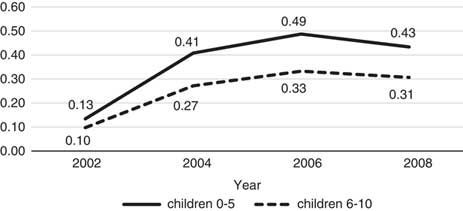
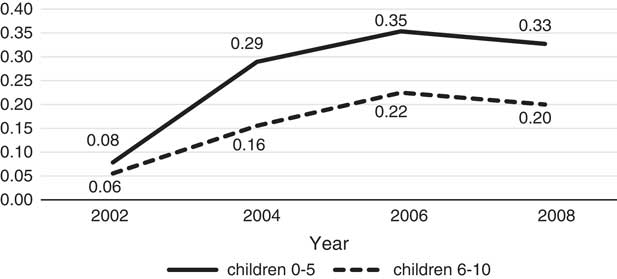
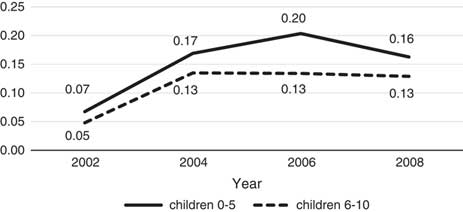
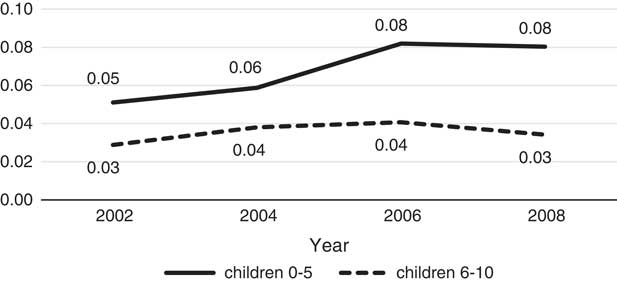
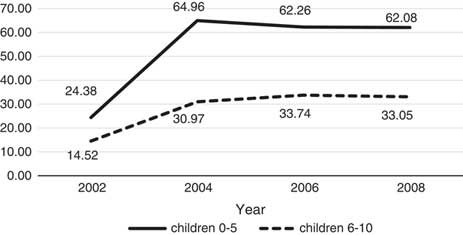
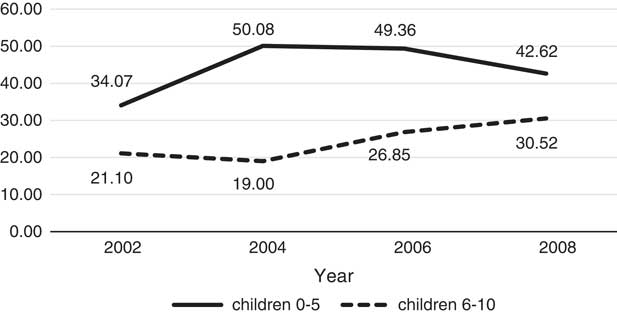
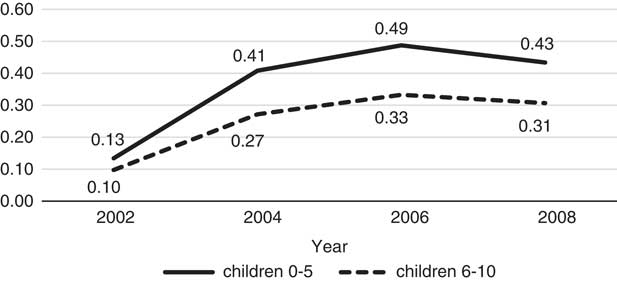
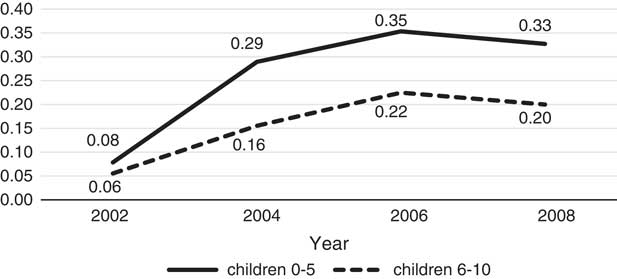
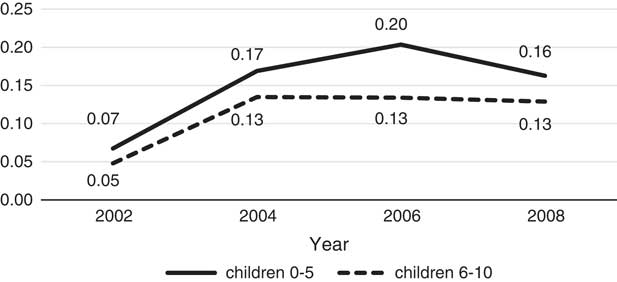
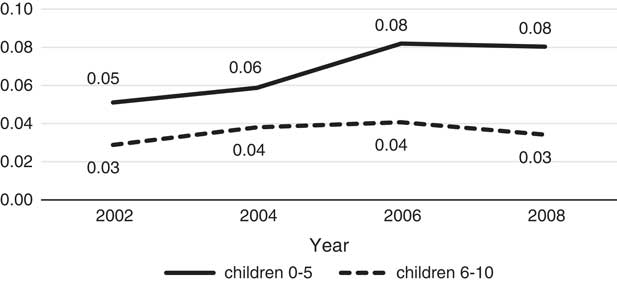
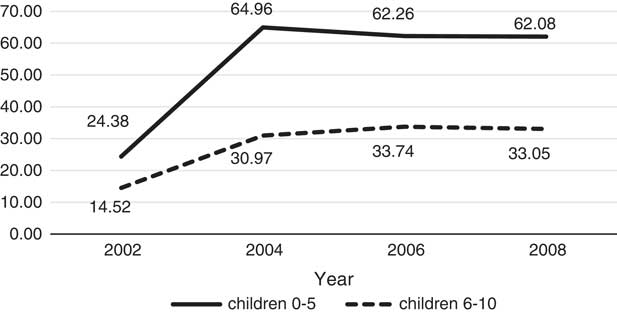
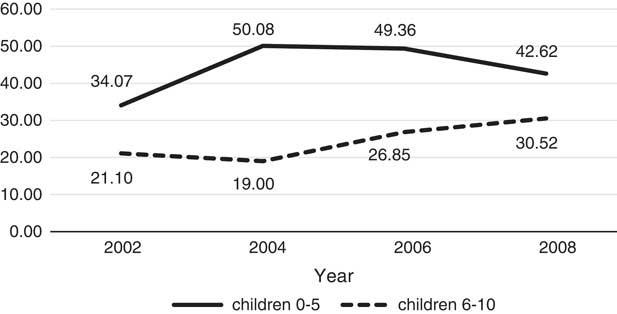
To further investigate the trends in the outcome variables, Figures 1–6 present graphs of each of our six outcome variables over time. The figures do suggest important differences between 2002 and 2004, but accounting for year effects will likely control these differences. Pre-period trends appear to be roughly parallel for the proportion of children with an outpatient visit at a private facility (Figure 3) and for the proportion with an inpatient visit (Figure 4). Although the proportion of children with a visit to a public facility appears to increase among the younger, affected children relative to the older, unaffected children (Figure 2), which makes the overall trend in outpatient visit use somewhat non-parallel (Figure 1). However, this trend tends to work against us finding an effect of the program, implying our estimated effects will provide conservative estimates of the impact of the insurance expansion program on the use of outpatient facilities. Figures 5 and 6 display trends in OOP spending. Here again the trends are not consistently parallel, but they generally point toward our estimates providing a conservative estimate of the true effect.
Proportion of children with at least one outpatient visit
Proportion of children having an outpatient visit at a public facility
Proportion of children with an outpatient at a private facility
Proportion of children with any inpatient visit
Outpatient out-of-pocket spending
Inpatient out-of-pocket spending
For binary outcomes, we estimate linear probability models via ordinary least squares (OLS) models for computational ease and to facilitate comparisons across alternative models. For completeness, in Table A1 we show results using logit models; the magnitudes and statistical significance of the results are very nearly the same between the linear probability and the logit models. For the OOP expenditure outcomes, a generalized linear model (GLM) with a log link function is used to account for the skewed distribution of spending with a relatively large mass at zero. GLM has been shown to perform well in terms of predictive performance over the traditional two-part model; moreover, coefficient estimates can be interpreted directly without retransforming the results from the log to the original scale (Buntin and Zaslavsky, Reference Buntin and Zaslavsky2004).
Results
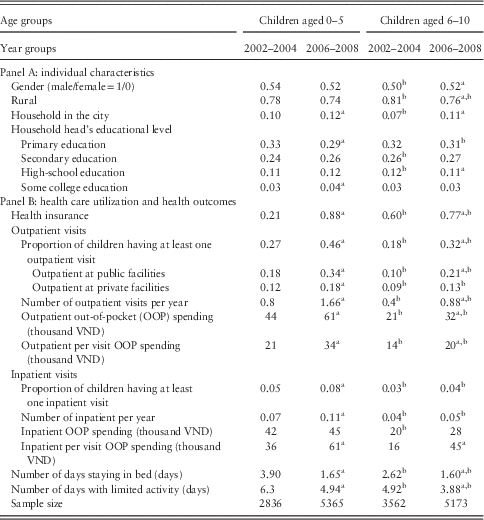
Table 1 shows the means and the number of observations for treatment and control groups across all years 2002–2008. Since the VHLSS 2002 data does not have information on health insurance and health outcomes, the number of observations of these three variables is substantially smaller than that of other variables. Panel A presents the sample descriptive statistics for individual characteristics with comparisons across treatment (aged 0–5) vs control (aged 6–10) groups and pre- (2002–2004) and post- (2006–2008) periods. Children aged 6–10 and children aged 0–5 are roughly similar in characteristics such as household’s head education, household size and gender.
Summary statistics of children aged 0–10 years from the Vietnam Household Living Standard Survey 2002–2008

Note:
a Statistically different between 2002/2004 and 2006/2008.
b Statistically different between ages 0–5 and 6–10.
Panel B illustrates the means of the primary study outcomes. Health insurance coverage increases dramatically from 21 to 88% (300% increase rate) for the treatment group and 60 to 77% (28% increase rate) for the control group, all statistically significant at p⩽0.05. On average, in 2006–2008, 46% of children aged 0–5 have at least one outpatient visit per year, statistically higher than the corresponding 27% rate in 2002–2004. Outpatient visits increased sharply from 0.8 visits/year (pre-period) to 1.66 visits/year (post-period) for the treatment group, 0.4 visits (pre-period) to 0.88 visits (post-period) for the control group. Although the outpatient visit statistics increase substantially for a short period of time, our numbers are very similar to the official published statistics for VHLSS data (General Statistics Office, 2012). OOP expenditures for outpatient visits also increase correspondingly but the rates are less profound. Outpatient OOP increases from VND 44,000 ($3.20) to VND 61,000 ($4.50) for the control group and increase from VND 21,000 ($1.60) to VND 32,000 ($2.30) for the treatment group.
For inpatient care utilization, 5% of children in the treatment group have at least one visit in 2002–2004, while 8% of young children had a visit in 2006–2008 with corresponding OOP spending increases from VND 42,000 ($3.20) in 2002–2004 to VND 45,000 ($3.50) in 2006–2008. For the control group, the rate of increase is lower, 4–5%, but OOP spending increases at a higher rate (VND 20,000 to VND 28,000). Simple mean comparisons also point to a reduction in the number of days children had to stay in bed or had limited activity for both groups in the post-period.
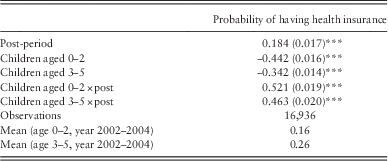
Table 2 displays OLS regressions for our DD models of the probability of having health insurance after the public insurance expansion. The model controls for a wide range of covariates. Health insurance coverage increases substantially: 52 percentage points, or a 247% increase relative to the pre-policy period for children aged 0–2 and 46 percentage points, or a 218% increase for children aged 3–5.
Linear probability models (ordinary least squares) for the probability of having health insurance among children aged 0–10 years from the Vietnam Household Living Standard Survey 2002–2008
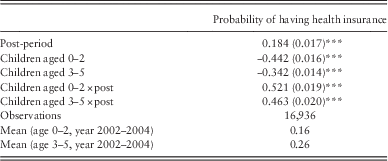
Note: Covariate controls include gender, household head’s education categories (primary school, secondary school, high school, college, with illiterate is the reference group), income quintiles, rural and city. Standard errors are in parentheses. Weights are the standard survey weight. Year dummy is year 2008 (since the regression already controls for post-period).
Year dummies are: *, **, *** indicate statistical significance at 10, 5, 1% level, respectively.
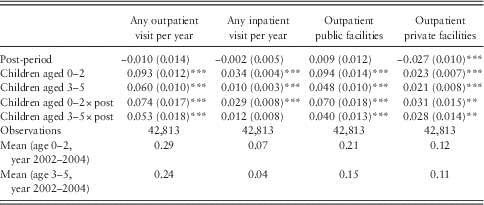
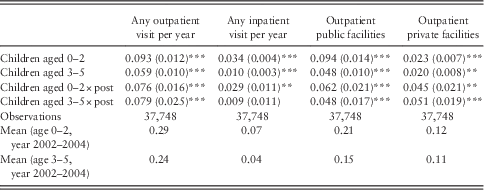
Regarding health care utilization, for young children (aged 0–2) and older children (aged 3–5), respectively, Table 3 indicates that the program is associated with a 7 percentage point and a 5 percentage point (27 and 20%) increase in the probability of having an outpatient visit, a 3 percentage point and 1 percentage point (56 and 22%) increase in the probability of having a hospital admission. Also, the health insurance expansion is associated with a change in the composition of health care utilization. Specifically, the policy resulted in a 7 percentage point (38%) increase in visits to public clinics for younger children and a 4 percentage point (22%) for older children; we also find a 3 percentage point (26%) increase in private clinics visit for younger and 2.8 percentage point (23%) for older children. The increases in utilization at private facilities suggests that consumption of health care services at public and private facilities appear to be complements given that insurance only covered services provided at public facilities. Another possibility is that ‘income effect’ from the insurance expansion allowed parents more money to spend generally on children’s medical services, thus increasing care from both public and private facilities.
Ordinary least squares regression for health care access and utilization among children aged 0–10 years from the Vietnam Household Living Standard Survey 2002–2008

Note: Covariate controls include age groups (aged 0–2 years and age 3–5 years), gender, household head’s education categories (primary school, secondary school, high school, college, with illiterate is the reference group), income quintiles, rural and city. Standard errors in parentheses. Weights are the standard survey weight. Year dummy is year 2008 (since the regression already controls for post-period).
*, **, *** indicate statistical significance at 10, 5, 1% level, respectively.
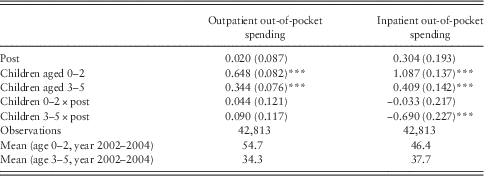
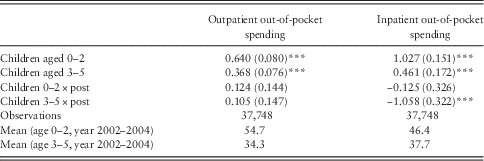
Table 4 presents the GLM results for OOP spending. For outpatient OOP spending, consistent with Figure 5 where we observed essentially flat trends over time, we observe no significant effect of the program in the regression model (first column). For inpatient OOP spending, consistent with the pattern observed in Figure 6 where we observed declining spending for the young (eligible) children and rising spending for older (ineligible) children, we see the program is associated with an ~50% reduction in inpatient OOP for children 3–5 years of age (second column).
Generalized linear model regression results for outpatient and inpatient out-of-pocket spending among children aged 0–10 years from the Vietnam Household Living Standard Survey 2002–2008

Note: Covariate controls include age groups (aged 0–2 years and age 3–5 years), gender, household head’s education categories (primary school, secondary school, high school, college, with illiterate is the reference group), income quintiles, rural and city. Standard errors in parentheses. Weights are the standard survey weight. Year dummy is year 2008 (since the regression already controls for post-period).
*, **, *** indicate statistical significance at 10, 5, 1% level, respectively.
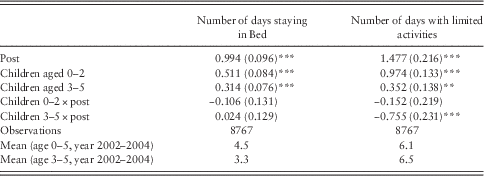
Table 5 presents regression results for self-reported health outcomes in the form of bed days and restricted activity days. We do not find statistically significant effects of the expansion program for bed days. However, for children aged 3–5, we find a statistically significant reduction in limited activity days of roughly three-quarters of a day. The effect size represents a reduction of roughly 12%. The effect is an encouraging signal because the self-reported health outcomes could reflect a more general sense of improved well-being rather than actual improvements in objective health (Finkelstein et al., Reference Finkelstein, Taubman, Wright, Bernstein, Gruber and Joseph2012).
Ordinary least squares regressions for self-reported health outcomes among children aged 0–10 years from the Vietnam Household Living Standard Survey 2002–2008

Note: Covariate controls include age groups (aged 0–2 years and age 3–5 years), gender, household head’s education categories (primary school, secondary school, high school, college, with illiterate is the reference group), income quintiles, rural and city. Standard errors in parentheses. Weights are the standard survey weight. Year dummy is year 2008 (since the regression already controls for post-period).
*, **, *** indicate statistical significance at 10, 5, 1% level, respectively.
Robustness checks
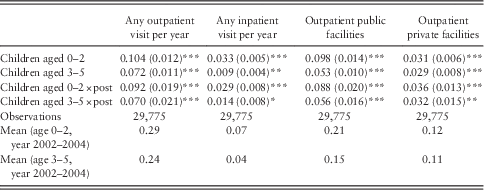
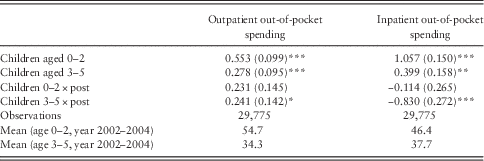
There are at least two important potential threats to the validity of our results. It is possible that some of the children in the control group (aged 6–10) in both 2006 and, to a greater extent, 2008 may have been affected by the program by previous exposure to health insurance as a result of the expansion in earlier years. For example, 6-year olds in 2006 were eligible for the program in 2005 when they were 5 years old; similarly, 6-, 7- and 8-year olds in 2008 were eligible when younger in previous years. If such exposure provided children with a usual source of care or access to medicines that improved their health, it could introduce potential bias in our results if that exposure influenced their later health habits and access to care. We perform two robustness checks to address this issue. First, we re-estimate our models dropping 2008 data. Thus, the post-period only represents 2006 and thus very few of the potentially age-eligible children. Results from this analysis are presented in Tables A2 and A3. Second, we alter the control group to remove children potentially age eligible in prior years for the expansion. This involves adjusting the control group to include only children aged 7–10 in 2006 and to include only children aged 9–10 in 2008. The results are displayed in Tables A4 and A5. In both cases despite the reduced sample size we find comparable results in terms of magnitude and statistical significance of the results. The robustness checks provide us with reassurance in our identification strategy and the strength of our main results.
Discussion
Expanding health insurance for children is an important public policy initiative, particularly in a developing country context, because childhood health has a lasting impact on productivity, educational attainment, and the well-being of children as they age into adulthood (Almond and Currie, Reference Almond and Currie2011). Our work examines the effects of the expansion of health insurance to all children under age 6 in Vietnam. The results show that the public health insurance expansion program increased insurance coverage by 250% for children aged 0–5 relative to the pre-policy period. For young children (aged 0–2) and older children (aged 3–5), the insurance rate is associated with a 27 and 20% increase in the probability of having an outpatient visit, a 56 and 22% increase in the probability of having a hospital admission, respectively. Health insurance availability increases outpatient visit levels at both public and private facilities, suggesting that care from public and private facilities are complements and not substitutes. While health insurance is associated with a decrease in inpatient OOP spending for children aged 3–5, it does not have a statistically significant effect on outpatient OOP spending for children. Finally, we find evidence that the health insurance expansion improved some self-reported health outcomes.
Our results are consistent with Nguyen and Wang (Reference Nguyen, Duong, Nguyen, Pham, Bales and Duong2013), who suggest that health insurance increases health care utilization at secondary level public hospitals for both inpatient and outpatient care in non-poor households. Using additional years of data and a different methodology, our research shows that even with universal health insurance, we do not find unambiguous reductions in OOP spending, likely given that enrollees are also observed to increase use of private facilities for care.
The study has important implications for policy. It is clear that access to health insurance is a necessary condition to improvements in welfare for children and their families. However, it is not a sufficient condition. While offering access to ‘free’ health care via a universal insurance program is a politically appealing proposition for politicians, realizing benefits entails sufficient well-trained medical workforce to meet the demand for care, clean and modern facilities that are accessible, and both health care supplies and pharmaceutical products. In short, it is easy to promise free care, but delivering meaningful services where and when the public needs it requires a great deal of money. It remains to be seen if Vietnam’s health insurance expansion program for children will translate into the hoped for improvements in later life human capital attainment. If nothing else, our results suggest that there were consistent improvements in access to outpatient care. This may have led to reduction is limited activity days for some children. While both are encouraging signs, more follow-up work is needed.
Our study has some limitations, however. First, the household survey data are subject to potential measurement errors, especially for items with a 12-month recall period (Grosh, Reference Grosh1997). Second, the study does not distinguish between preventive and curative care at public facilities. For example, an evaluation of health insurance programs in South American countries (Argentina, Ecuador and Brazil) show that public-insured children are more likely to receive age-appropriate immunizations compared with uninsured children, and thus health insurance may increase preventive care for young children (Wehby, 2013). We also are able to say very little about quality of care received, though this is clearly a fruitful area for future research. Finally, given that the program is observed at an early stage, children under 6 and their families may not be aware of the existence of the program, or may lack knowledge about access to health services, or administrators at public facilities may not fully understand and implement the benefits for policy beneficiaries.
Acknowledgements
The authors are grateful for comments from the editor, Mark Stabile, as well as comments from Bob Kaestner, David Merriman, Frank Chaloupka, and Darren Lubotsky.
Appendix
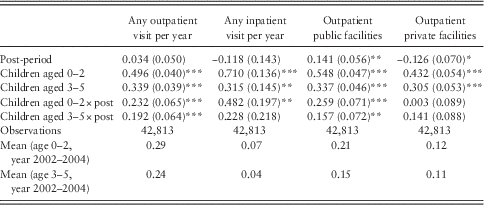
Logistic regression for health care access and utilization among children aged 0–10 years from the Vietnam Household Living Standard Survey 2002–2008

Robustness check dropping 2008 from ordinary least squares regression for health care access and utilization among children aged 0–10 years from the Vietnam Household Living Standard Survey, 2002–2006

Robustness check dropping 2008 from generalized linear model regression results for outpatient and inpatient out-of-pocket spending among children aged 0–10 years from the Vietnam Household Living Standard Survey, 2002–2006

Robustness check dropping children potentially age eligible for the expansion

Robustness check dropping children potentially age-eligible for the expansion